The minefield of unearned privilege: tread carefully!

It was not surprising when in a discussion of privilege in class the other day, we spent more time talking about affirmative action in higher education than we did about, say, white or male privilege.

When I paused the conversation to point this out, some students suggested it might be due to their firsthand knowledge of the inequities of the affirmative action system.  Many in the room had conflicted feelings and ideas about the question of merit vs. need-based scholarships.  Why should a student who can afford to pay for college, they asked, be granted a scholarship on the basis of merit, thus denying a place and funds to a student who may be less well-prepared, but is far more needy?

One can argue these issues for a long time without coming anywhere near the deeper issues that lie buried under the surface, like mines just waiting to go off.

Why are white students more likely to be both better-prepared and less needy than students of color?

WHITE PRIVILEGE.  It’s the elephant in the room that no one really wants to deal with, because it doesn’t feel good to admit that if your skin is pinkish beige in color, it’s given you systematic unearned advantages your whole life long.

There are also students—generally white male–who will complain that women now get unfair preferential treatment in higher education admissions.  This may have been true a decade ago, but in fact what’s happened of late is that affirmative action for women has been so successful that now it is men, especially men of color but white men too, who are sought after by college recruiters.

Does this mean that MALE PRVILEGE is all over and done with?  Hell no.  Men still earn at least 20% more than women doing the same job, whether blue collar, white collar or CEO.  Women still have a tougher time rising to leadership positions, and are judged much more harshly if and when they do succeed.  Women still have disproportionate responsibility for keeping the home fires burning and the children taken care of, even when they’re happily married and earning the same as or more than their husbands.

Male privilege is alive and well—but no one really wants to talk about it, not even women.

At least at the college level, students seem more comfortable talking about HETEROSEXUAL PRIVILEGE than about race/class/gender privilege.  It seems trendy to be aware of how queer folk are bullied and discriminated against, and to be sympathetic about it.  But there’s a lot less sympathy when it comes to women who point to male privilege, or people of color pointing to white privilege, or poor folks pointing to elite privilege.

Why is that?

For one thing, if the complaint comes from someone who belongs to the subordinate group, there is an immediate perception that they are speaking in self-interest, and overt action on behalf of one’s self-interest is never well-received by dominant groups when it comes from subordinates, particularly from women.  It’s labeled as “strident” or “whining.”

All the while, dominant groups–say, men, or white people–may be acting in their own self-interest, but it’s just accepted as normal striving, part of the great American way.

For people in subordinate groups and their allies, it can be a difficult challenge to raise the issue of dominant groups’ unearned privilege without setting off all kinds of defensive reactions or tricky deflections, as when a whole class is spent talking about affirmative action instead of about unearned privilege.

If I knew the answer to this conundrum, I would be a much better teacher than I am.  All I can do is keep trying to pull students’ attention back to that minefield of privilege and oppression, and tread carefully–but without turning back.

But what can we DO?

It’s not enough to simply lament the disappearance of species, or the poisoning of the air, water and soil of the planet.  The urgent question of our time is WHAT TO DO ABOUT IT?  How can any of us–how can I–act to staunch the hemorrhage and resuscitate this dying patient, our planet, before it’s too late?

Let’s review the options.

There is political reform, through various channels: appealing to our duly elected representatives and/or supporting environmental groups that lobby these politicians and try to pressure the relevant federal and state agencies charged with protecting the “natural resources” of our country.

I have to say that I am quite skeptical of this approach, which doesn’t seem to have worked at all in the 40 years or so since I first became a Ranger Rick reader and aware of the environmental movement.

Things have gotten much worse for the natural world in my lifetime, despite all the efforts of big, well-funded groups like the National Wildlife Federation, the Sierra Club, the Nature Conservancy, or even Greenpeace, the most radical of them all. Greenpeace is the most willing to go out on a limb to protect species and habitat, but its actions have failed to make the kind of global difference we need.

There is international peer pressure to do the right thing–conventions, treaties and protocols.  Even as I type these words, I inwardly despair.  From Kyoto onward, the U.S. has been the bully who refused to play nice in the community of nations whenever it’s come to putting the common good before the holy Free Market.

There is actually going around the blowing up the worst aspects of civilization, like dams, power plants, cell towers and chemical plants, as the proponents of Deep Green Resistance advocate.  Eco-terrorism, anyone?

Or there’s crowd power of the Occupy Wall Street variety, which certainly seems right now to hold the most promise.  ‘Never doubt that a small group of thoughtful, committed citizens can change the world. Indeed, it is the only thing that ever has,” Margaret Mead said.

But how to convince those crowds that the fate of seals, bees and goldfinches–not to mention the oceans and the boreal forests of North America–is actually more important than the injustices of economic inequality here in the U.S.?

Of course, it’s all important.  I have several friends who are on unemployment now and having serious trouble finding jobs.  If the Tea Party had their way, unemployment itself would be a thing of the past, a quaint relic of the old New Deal.  We can’t let these radical conservatives shred our social safety net, and we do need to start creating jobs again–green jobs, of course.

But there is no single issue more urgent than climate and environmental health, because if our climate goes haywire and our life support systems here on Earth fail, folks, we are all going down with the ship.

How to convey this to the crowds who are willing to turn out to protest economic injustice, but give it a miss when the issue is global warming?  How to convince people that what we should be demanding as we flood the squares and Main Streets of our country are well- subsidized options to reduce our energy consumption?

Doesn’t sound very glamorous, but the truth is that there’s nothing more important to be fighting for right now than subsidies to install solar roof tiles, like they’ve been doing in Europe for a decade already; and solar hot water heaters; and geothermal ducts for large buildings; and affordable green tech cars.

As Mark Hertsgaard and others have been saying, it’s not enough to make individual green lifestyle decisions, like recycling or composting or turning out the lights when you leave the room.  These individual actions are all well and good, but they’re not going to make the dramatic change we need to get our climate back into shape.

For the kind of change that will save the polar bears and the walruses and the coral, we need our government to step up and protect the interests of its people.  Not the interests of the corporations which have collectively driven our planet to the brink of ruin with their shortsighted greedy ethos of extraction and exploitation.

Government by the people, for the people.  And for the environment that sustains these people in a web of life that includes all living beings on this planet.

How to say this in a way that will light up the imaginations of the 99% and ignite an unstoppable movement for change?

I will keep trying.  What more can I do?

Our planet, ourselves: we must wake up to the destruction, before it’s too late

First the honey bee population crashed.  Then it was the bats, dying by the millions in their caves during the winter hibernation, of a strange white fungal infection.

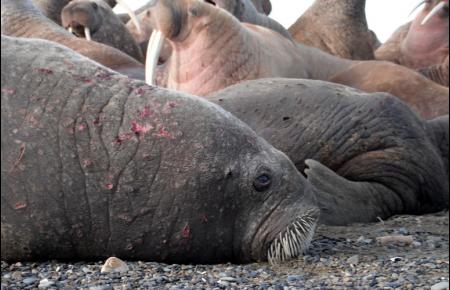
Now marine mammals, including walruses and ringed seals, are turning up dying on the beaches of Alaska and the far north.  Unidentified skin lesions and sores are the visible evidence of an unknown disease that is ravaging them.

Meanwhile, climate change is causing unprecedented surges in the populations of destructive insects like pine borers, which are killing off millions of acres of forests around the world.

I could go on, and on, and on.

Truly, Derrick Jensen is not exaggerating when he says that human civilization is killing our planet.

Last weekend I watched the new film “End:Civ,” by Franklin Lopez, based on Jensen’s book Endgame.  I had put off watching it for several weeks, because I knew it how upsetting it would be, and sure enough, it was disturbing, to say the least.

For me the hardest-hitting part of the film was about human beings’ casual tolerance of cruelty; our willingness to stand by, indifferent, as our fellow travelers on this planet are systematically hunted or poisoned or displaced to extinction.

Part of this detachment of ours may be rooted in the way we tell the stories of how these deaths occur.  We talk about “colony collapse disorder,” for example, rather than narrating the way that entire hives of bees–which are highly evolved, communicative insects–fail to return to the hive one day.

They get lost out there–maybe due to cell phone waves or other forms of chemical interference, we don’t really know–and never come home.  Imagine this happening on a global scale, a whole species of productive, social insects lost, one by one, by the million.

In the same way, it’s far easier to talk about “cancer victims” en masse than to live through the suffering death of your own loved one.  How many vibrant, creative, hardworking people have we lost to cancer the last ten years?  In the last year?  In the last month?  Wangari Maathai and Steve Jobs, to name two famous, very recent cancer victims.  The list goes on and on and on.

But still we remain passive.  We may mourn the disappearance of the honeybees or the songbirds, but we don’t make the effort to connect the dots and come to a true understanding of the extent to which our way of life has been poisoning our planet since the advent of industrialization, and especially since the beginning of the 20th century, which is when synthetic chemical production really took off.

Before she died of cancer, Rachel Carson managed to break through the wall of indifference and make the case against DDT.  Thanks to her efforts, the bald eagle and many other birds have rallied and come back from the brink of extinction.

It’s amazing how resilient life is.  If human civilization would just back off and give our natural systems on the planet a chance, they would heal themselves, and go back to providing the healthy ecological web that made our success as a species possible.

Our planet, ourselves.  We need to understand, in the deepest and most urgent possible terms, that we cannot dissociate ourselves from the poisoning and destruction that is being visited on the forests, oceans, swamps and grasslands of this planet.

The “Wall Street Awakening” cannot be only about jobs, about fixing a broken economy and continuing on our merry path of global domination and “resource extraction.”  The analysis has to go deeper than that, and the change has to be much more dramatic.

All the jobs in the world won’t bring back the walruses or the ringed seals or the polar bears.  What use will jobs be when the ocean is a giant dead zone, and industrial agriculture collapses?  Will we be worrying about jobs when the forests that provide our oxygen are all gone?

We need to focus on what’s important and go all the way this time.  As I keep saying, our future depends on it.  And I am not exaggerating.

An urgent message for the global elites: change is coming, like it or not!

America’s ‘Primal Scream’ – NYTimes.com.

It’s always nice to wake up and see the very thoughts I was writing last night trumpeted in the Sunday Review of the NY Times.  Nick Kristof cites many of the same statistics I did to make his case that income inequality is not only real, but “a cancer on our national well-being.”  

But where he ends his column wondering whether the movement will persist “once Zuccotti Park fills with snow and the novelty wears off,” I believe things are only going to get more intense as we move into this winter of discontent.

For one thing, there’s climate change looming over us.  Check out today’s big story on the fact that this imperative issue has lost traction in the U.S., even as most of the rest of the world is moving aggressively to regulate carbon emissions and develop more sustainable technologies.

It seems that the elites driving our economy believe that we can continue our comfortable insulated ride in the plush American Caddy, and let the plebes outside the walls of our national gated community deal with the unpleasantness.

How quickly we forget the major blizzard in New York City last year, or Hurricane Irene bearing down on the whole East Coast.  Climate change is only going to intensify in the coming years unless we get serious about it fast.  The natural disasters it will cause will cost far more than action to curb emissions proactively.

Unlike Nick Kristof, I don’t believe our society has a choice about whether or not to change.  We will be changing, like it or not.  The question is, will we change in an orderly fashion, through regulation and innovation that puts the common good ahead of the greedy goals of the men behind the tinted windows of those chauffeured limousines?

To me, this is what the Occupy protests are about.  The 99% are sick and tired of shouldering all the costs of our industrial capitalist way of life–the debt bondage, the toxic chemicals making us sick, the decimation of our environment wreaking havoc with our climate, the fading of the American dream–while a few fat cats sit pretty on top of the heap and enjoy the spoils.

I have news for you, global elites.  You can’t escape the impartial justice of climate change.  You should have realized by now that you will reap what you sow: if you seed our agriculture, air and water with toxic chemicals, you and your children will get cancer just like the rest of us.  If you continue to deforest the Earth at the current rate, you too will be gasping for oxygen along with the poorest inhabitants of what used to be a boreal forest.


Hiding behind police barricades in your plate-glass towers will only get you so far.  In the long run, it’s no way to live.

Come on out into Liberty Plaza with the rest of us, and let’s work together for a better life for all–while there’s still time.

Much to protest…and much work to be done to make it right

Riots in Rome, a huge protest in Times Square, New York, and rolling protests from New Zealand to London to L.A. Things haven’t been this globally lively since the 2003 protests against the imminent U.S. invasion of Iraq.  Where is it all leading?

None of us know.  But the police are getting out their riot gear, and it is very possible that there are going to be more violent clashes, as there were in Rome today.

As the protests gain momentum, it’s important to keep our eye on just what all the anger is about.

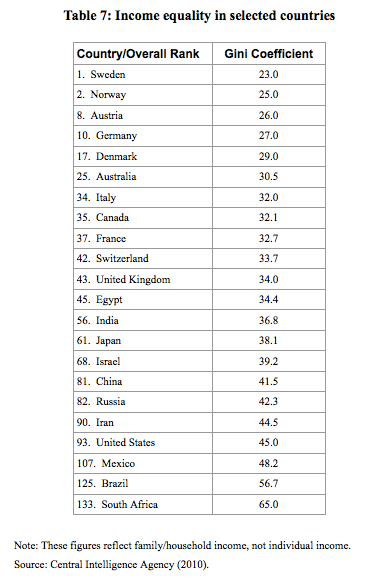
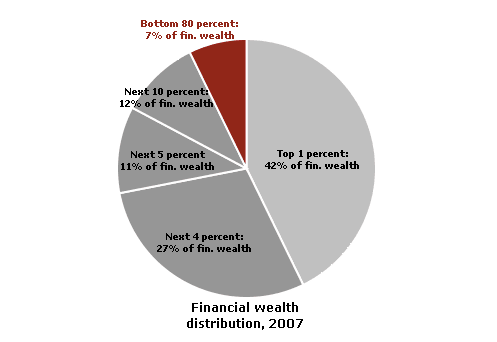
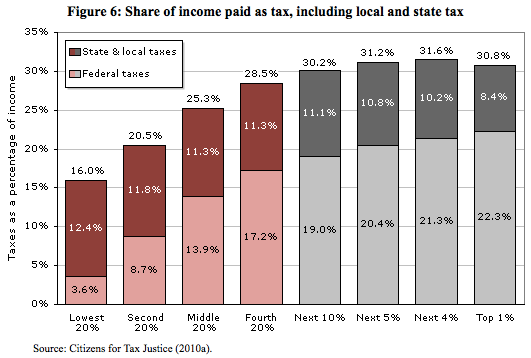
Business Insider, of all sites, published a very interesting set of charts and commentary last week promising to explain just what all the fuss was about down in Liberty Plaza.  Check it out, you won’t be disappointed.

Here are a few of the most damning charts:

The U.S. ranks below China, Iran and India in terms of income INEQUALITY.

Five percent of Americans own 69% of financial wealth.  The top 1% own 42% of this country’s financial wealth.

And the tax rate of these fabulously wealthy people is about the same as everyone else’s. That’s why they continue to get richer and richer, and everyone else slides inexorably downward.

While CEO pay is up nearly 300% since 1990, average workers’ pay is up 4%.  I don’t know about you, but the modest increases in my salary over the past decade have been totally absorbed by higher expenses, from food to gas to health insurance premiums and everything else.

So hell yes, there is something to be angry about!  There is a lot to protest!  There is a lot of work to be done to turn this country and this world around. The question is, how far will we go to rock the comfortable cruise ship of the one percenters?  And how far will they go to keep the status quo the way it is?

Police forces have always done the bidding of the wealthy in capitalist societies; is there any chance this could change?  The police are workers just like the protesters; is there any chance they will break their indoctrination and side with their own class interest?

Seems unlikely, but let’s not underestimate the forces of change.  Who would have believed, even six weeks ago, that people would be turning out in the thousands across the world to protest corporate greed and social inequality?

Look at this crowd.  It’s pretty clean cut, isn’t it?  This doesn’t look like a case for the riot police.  By and large, these people don’t want revolution. They just want to be able to live decent lives in a country they can be proud of.

Is this too much to ask?

No.  But, and this is a BIG BUT: what we’ve come to consider “a decent life” is going to have to change in the 21st century, given peak oil, the impending collapse of industrial agriculture, and the climate crisis.

So much will depend on our being smart enough to put these pieces together with the economic injustice we perceive so clearly, and see our way clear to a new, sustainably grounded society.

This is not too much to ask either.  But it will be a challenge to move from the fist-in-the-air stage to the creative visioning, and most of all to the implementation of a more just and sustainable economic system.

We have no choice but to meet this challenge.  Our global future as a species depends on it. This is the central task of our time.

What President Obama and Eve Ensler have in common

President Obama did something really, really good this week.  He sent 100 Special Ops military “advisors” to Central Africa to help local government forces get rid of the Lord’s Resistance Army, a group of crazed, vicious thugs who have been terrorizing people in four countries for as long as many in the region can remember.

The New York Times reports: “For more than two decades, the Lord’s Resistance Army (LRA) has murdered, raped and kidnapped tens of thousands of men, women and children in central Africa,” Mr. Obama wrote in a letter to Congress announcing the military deployment. “The LRA continues to commit atrocities across the Central African Republic, the Democratic Republic of the Congo and South Sudan that have a disproportionate impact on regional security.”

You don’t even want to know what kind of atrocities he’s talking about.  Joseph Kony and his men are depraved, sick torturers, rapists and murderers who have been at it so long that I doubt they can ever be rehabilitated.  They are part of a long cycle of violence in Africa that begins with the kidnapping or luring in of young children, boys and girls, who are then drugged, beaten and raped into total submission to the authority of the adults, and grow up indoctrinated into the lifestyle of terror.

For an inside story, read Ismael Beah’s memoir A Long Way Gone, or the chapter in my anthology African Women Writing Resistance by former girl child soldier China Keitetsi, whose memoir Child Soldier is available in an e-book edition.

I can’t help but think that there is an element of racism in the fact that it’s taken so long for the international community to unite behind the mission of bringing true security to Central Africa (including the Democratic Republic of Congo, where some of the worst human rights violations in the world are taking place daily, with women and girls disproportionately targeted.)

When Bosnian men were massacred, people thrown out of their homes, and women and girls imprisoned in rape camps by the Serbs, the Clinton Administration waged an all-out war to stop it.  All that and more has been happening in the DRC and neighboring countries for decades.  Decades.

Eve Ensler has done a tremendous amount to get the word out about the impact of all this violence on women, not just in Africa but throughout the world.  I particularly admire her because she has used art as the medium for her outspoken calls for solidarity and resistance with victims of rape and violence–starting with “The Vagina Monologues,” and moving on through a host of books and plays.

She’s also used digital media to get her word out and build a global movement to end violence against women, and I don’t think anyone does it better–check out her website, vday.org, to see for yourself.

Eve Ensler is a great example of a woman of privilege who has used all of her talents and gifts to reach out and help others–and not through begging, cajoling or guilt-tripping, either, but through the sheer power of her spoken and written word.

President Obama has the power to send in the military, and it’s good he’s at least taken the first step in that direction.

We ordinary people have power too, more than we often realize.  We can open our eyes to what’s really happening in our towns, our country and our world, and then allow our hearts to show us the way to action for positive social change.

There is no more urgent task for each of us in our lifetimes.  This is what we came here to do.

From brooms of resistance to guerilla tactics…let’s keep it going!

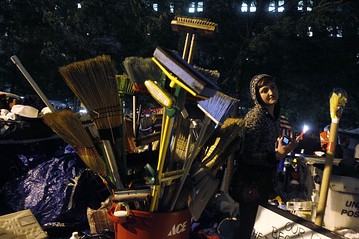
Congratulations to the Occupy Wall Streeters for making weapons out of mops and brooms and holding off the Bloomberg eviction forces!  A major victory!  I wonder when was the last time Bloomberg held a broom–probably so long ago he couldn’t conceive of such a strategy of resistance.

Looking out on this rainy, cool morning, I can’t help but wonder what’s going to happen when the cold winds of winter start to blow.  Those of us supporting this movement from the comfort of our homes don’t want to see the protesters getting frostbite out by the Wall Street bull!

I saw a great suggestion this morning: why not turn the Occupy movement into a guerilla resistance, with daily occupations happening in designated strategic sites all over the country, the occupiers called in via cell phones and social media?  A movement like this would have the flexibility of motion, and would be able to respond to current events.

It could also be fun–like the spontaneous street parties that often happen in European cities, with the partiers called in by cell phone.

Now almost a month old, the Occupy movement has done an outstanding job of waking up this nation.  Let’s keep the momentum going even as the cold winds of winter begin to blow.

Citigroup’s CEO Says He’d Be Happy to Talk With Wall Street Protesters

Pandit Says He’d Be Happy to Talk With Wall Street Protesters – Businessweek.

I think the Occupy Wall Street folks should take him up on his offer to talk!  But he should go down to the park just like everyone else, and meet the people at Liberty Plaza.  It would be a thrill for him, I’m sure, to rub elbows with the common folk, and hear his voice amplified by thousands of sets of vocal cords!

The article says that “Pandit also confirmed that Citigroup would make a profit in the third quarter, the bank’s seventh profitable quarter in a row since losing a total of $29.3 billion during 2008 and 2009. The bank may post earnings of $2.49 billion, according to a survey of 14 analysts surveyed by Bloomberg.”

I’d like to politely suggest that this income should be fully taxed….

Confessions from Park Avenue: Ignorance, Privilege and Change

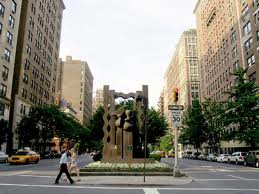
This week the Occupy Wall Street protest ventured uptown, to the Upper East Side of Manhattan–where I grew up.

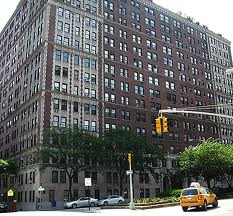
I have always been reluctant to admit that for a good portion of my life I called Park Avenue home.  I knew what kinds of stereotypes would instantly leap to my interlocuters’ minds upon hearing these gilded signifiers: “Upper East Side,” “Park Avenue,” even “Manhattan.”  And indeed, I have known many neighbors who fit the model of the wealthy socialite snob.  But there are also thinking, feeling, compassionate people living on Park Avenue.  They are guilty, above all, of the privilege of ignorance.  They truly don’t know how the other half lives.

I can just hear the scornful snickers and groans that greet this statement.  But it’s true.  I know it because I lived it.  And to some extent, you’ve lived it too.  All of us Americans have this privilege relative to people living in desperate material circumstances in other parts of the world.  At least our society pays lip service to the ideal of equality.

The tony apartment buildings lining Park Avenue are urban gated communities.  Most are co-ops, and it is difficult to buy your way into them–money alone won’t do the trick, you also have to be thoroughly vetted by the co-op board, and depending on the building, you may or may not pass muster.  The people living inside tend to be very reserved with one another.  You might not get to know your neighbors even if you live in the building for twenty years or more.  You might know your daytime and nighttime doorman better than the person who lives on the other side of your bedroom wall.

As for knowing more of the world, and how ordinary people live, well–there is television. There is the internet.  But in terms of flesh and blood, there is very little connection.  Back at the turn of the 20th century, Jacob Riis captured the lives of the less fortunate in his sensational book How the Other Half Lives, which shocked the nation and inspired some excellent reforms.  That kind of documentary expose has become much more commonplace in our time, to the point where even the most shocking revelations–sex slaves in Westchester, sweatshop labor in Chinatown, human organ thieves in Brazil–have lost their power to shock.
A crowd of people chanting, holding up signs and making merry through the hushed, tranquil streets of the Upper East Side, though–now that is shocking!  In my 20+ years of living in that august quartier, I can only remember a few times when anything like this happened.

Once was on a long-ago St. Patrick’s Day, when the Fifth Avenue parade-goers got a little too drunk, a little too rowdy, and the police had to step in and reimpose order.  My mom, brother and I watched in amazement from our the 9th floor window overlooking Park Avenue.  Quiet was soon restored.

Another time was when the lights went out back in 1977, and there was some looting over on Lexington Avenue.  We heard the shouting and sounds of glass breaking, but of course nothing could touch us, secure behind the gates and under the watchful eyes of our uniformed doormen.

This is the central fact of privileged existence, Park Avenue-style.  Nothing can touch you.  The red carpet of privilege rolls out in front of you effortlessly; you live in an enchanted bubble, from which the distant rumors of unrest are just that–distant rumors, which you don’t understand, and don’t care about enough to investigate.

I say this now to underscore the success of the Occupy Wall Street protesters in breaking through that bubble, at least a little bit.  The tight membrane of privilege surrounding the NY Times popped after three weeks of pressure.  It will take a lot longer to penetrate the hearts and minds of the men and women who work on Wall Street and live up on Park and Fifth Avenues.  But just because it will take a while to get through is absolutely no reason to be discouraged.  It can be done!  And it should be done.

I have a feeling that there are probably a lot of people like me living on Park and Fifth Avenues today.  Privileged by birth, but with the same hearts, minds and sense of compassion as any other American.  Just ignorant of what’s up with the 99%.

For instance, one observer of the “Millionaire’s March” noticed “a chic young mother,” who “turned to a puzzled daughter in a tony school uniform, “People don’t have jobs right now,” she explained. Whether Mom connected this fact to the actions of any of her neighbors was anyone’s guess.”

Did Mom connect this fact to her own actions, is more to the point.  For the privileged, it’s too easy to pass the buck.

I am currently working on a book, which I call a “political memoir,” in which I try to understand the social dynamics of privilege, and how and why some people become “privilege traitors” and go against their own class interests.  Judging from this week’s events in New York, I am going to have a lot of interesting material to study, beyond my own story.  Stay tuned.

Hey Boston? Remember your roots! The world is watching you…and so are we!

Have you noticed that there hasn’t been any more pepper spray lately down on Liberty Square in New York?  If that gratuitous act of police brutality hadn’t been caught on videotape by an alert citizen journalist, the pepper-spray impunity might have continued.  Such is the power of the public sphere.

What’s different about this 21st century protest movement is that the public square has expanded to be as big as the whole networked world.

Even if we’re not physically present,we’re watching, we care, and, as Medea Benjamin of Code Pink said yesterday on Democracy Now, “We are here to stay….It really doesn’t matter to us that our permit has run out. We feel like this is a public square, we are the public, and we are occupying this square, so we will stay here.”

Last night the Boston PD unceremoniously removed Occupy Boston protesters from a park that turned out not to be public.  They manhandled Veterans for Peace representatives who were peacefully protesting under the banner of the American flag, and threw the protesters’ tents and belongings into a municipal garbage truck.  Check out this report in the Harvard Crimson, or watch this video and see for yourself.

Bad move, Boston.  Aren’t you the home of the original Tea Partiers, the ones we celebrate as patriotic resisters of British oppression?  Do you really want to trample on American citizens’ right to the peaceful expression of dissent?  How un-American is that??

There was no way the Boston Tea Partiers could have predicted that their action in the harbor would spark the American Revolution.  All major watersheds in human history have unfolded in the same way, set off by the actions of a few dedicated individuals who are willing to stand up for their rights and their principles.

Why should our historical moment be any different? The truth is that every hundred protesters arrested will bring another thousand to the movement for change.  Get used to it, Boston–and Chicago, New York, Atlanta, San Francisco….This movement is just getting going.