An Eco-Humynist Manifesto for the 21st Century

Having watched with dismay as the Durban climate talks sputtered to a disappointing conclusion, with all parties knowing that every day that goes by without concerted international effort to address climate change means the inexorable shifting of life as we know it on Earth, I was moved yesterday to put fingers to keyboard and come up with a Manifesto for change.

Even as I was writing it, I was thinking that such radical changes would not be possible to put into place without resistance from the status quo powers that be; therefore bloodshed, which is specifically antithetical to the principles I lay out, would be inevitable.

But if a World War III must commence, I would rather it be for a good cause like this one, than for the petty greed, bigotry and hatred that have propelled humanity into previous wars.

If we want not only ourselves, but our entire eco-system to survive, do we have any other choice but to take decisive action now?

An Eco-Humynist Manifesto for the 21st Century

Whereas human beings have acted in a dominating fashion towards each other and towards other living species on this planet, using the excuse of difference to justify aggressive and destructive behavior;

Whereas competition has been used as a rationale for economic systems based on hierarchical systems of power;

Whereas social exclusion and systematic discrimination has been seen as the normative right of dominant groups;

Whereas privileged groups have felt entitled to take more than their fair share from the environmental commons, and to deprive less powerful groups, whether human or of other species, of the resources necessary for well-being;

Whereas it is quickly becoming apparent, in the age of climate change, that the dominant paradigm of capitalist patriarchal social relations is resulting in the dangerous destabilization of the entire natural ecosystem;

The time has come to take action to change this paradigm in the following ways:

1. Move from a top-down hierarchical system to a horizontal, egalitarian model of social relations based on inclusivity across all of the traditional boundaries used to keep different groups apart, including race, class, gender, sex, nationality, ethnicity, religion, and also opening up the possibility for cross-species collaboration based on respect and stewardship;

2. Shift the worldwide economic system to a model of global cooperation and collaboration, with the focus of human industry and government on providing a baseline of well-being for all life forms on this planet, regardless of geographic origin or antiquated ideas of relative importance (ie, who is to say that a human being is more important than a songbird, or a sardine?);

3. Tailor the education system to teaching the history of the destructive cultural practices of homo sapiens up to the 21st century, and opening up constructive conversations across disciplines, where alternatives to these traditions can be envisioned and developed;

4. Model egalitarian, collaborative, respectful social relations in the private sphere of the family as well as the public spheres of education, the profession, government and law;

5. Shift from a violent conflict and punishment model of resolving disagreements to a peaceful persuasive model, with the goal always being the well-being of the community as a whole first, and secondly each member of it.

6. Destroy all weapons of mass destruction, as well as all bio and chemical weapons, and their blueprints.

7. Disallow any one person’s or minority group’s interests (with rich people and businesses or industries rightly being considered minorities)  to take precedence over the interests of the majority, including the non-human majority on this planet.

8. Develop an appropriate representative global governing council to administer these principles.

In the name of Mother Earth and ALL of her children, I call on the peoples of the world to act without delay to become the stewards of the planet and the collaborative, respectful individuals we were always meant to be.

Thanks to the students of Gender, Culture & Society, Fall 2011, for the inspiration to write this Manifesto.

On Human Rights Day, Calling the Next ‘Greatest Generation’

Today, Human Rights Day, I call upon the peoples of the world to understand that if we don’t focus on reducing human impact on the global environment in this new century, all the other more isolated issues will be moot.

Issues from the militarization of the police, to the use of rape as a weapon of war, to the stifling of free speech and democracy, are important—but they’re just minor skirmishes.

The real battle for human rights is taking place in the realm of energy politics.

It’s taking place on the thousands of oil rigs out in the Gulf of Mexico.

It’s taking place in the hundreds of new hydro-fracking wells being dug in upstate New York and Pennsylvania.

It’s taking place in the coal mines of China and the tar sands of Canada.

All of us are players in this deadly game.  Every time we turn the key in the ignition of our car, or buy food produced by a factory farm, or pay our electric bill.  We participate as consumers, and as consumers, we have more power than we realize.

On Human Rights Day, we need to remember three things:

•   The Universal Declaration of Human Rights guarantees the human right to health

•   A healthy environment, including healthy food, water and air, is essential to human health

•   Corporations, not being people, must not be allowed to trample on human rights.

Indeed, corporations, being human creations, should be serving human rights.

If a healthy environment is essential to human rights, then corporations should be working on making our environment as healthy as possible.  Corporations work for us.  They need to meet our needs, and uphold our rights.

There is a new movement afoot to define and uphold the Rights of Nature, which is a totally laudable goal. But in my view, the rights of the natural world and the rights of human beings are inextricably intertwined.

To truly uphold human rights would be to truly uphold the rights of Nature.

We are animals.  We are part of the natural environment of this planet.  If we foul and destroy our environment, we will die, along with countless other living beings: animals, insects, marine life, birds and plants.

This is a big battle; these are momentous times. We need to step up and be the new “greatest generation.”  We need to hold corporations accountable for their destructive, life-threatening actions.  We need to insist on change.

If we don’t, will anyone be left to lament our failure?

Swept away for the holidays? C’mon, Occupy, Let’s Go!

Looking back over the week, it seems like we’ve settled into some kind of holding pattern. The Occupy protests keep spinning, including a jubilant rally in Boston last night, but there is a feeling that we’re all waiting for the next shoe to drop…the next big push, the next new thing.

This week saw Occupy Foreclosures; next Monday there is a plan afoot to shut down the West Coast ports. The student protests are still sputtering; there is a group of hunger strikers in New York demanding a home for OWS;  and a stalwart group of climate activists has been braving relentless hostility to protest in at the COP 17 talks in Durban.

I’m glad to see all this stirring of outrage and energy.  I’m just starting to get confused by all the different tangents the movement is taking, and wishing for more focus and concentrated action.

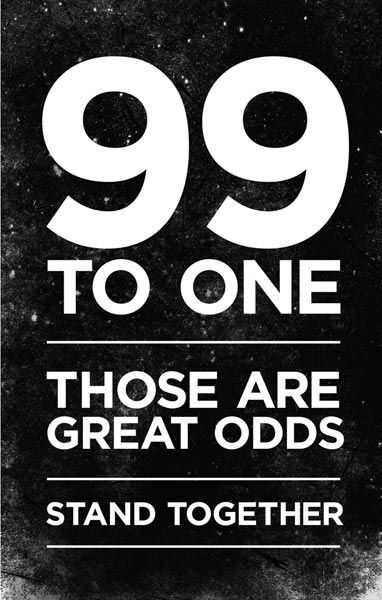
I want the 99% to be like a biblical flood that will wash all the corruption and evil away, leaving a sparkling new world ready for re-occupation.

I know full well that’s unrealistic.  It’s not meant to be taken literally.  It’s just the kind of mood I’m in: impatient, restless, tired of the same old same old.

I have that same feeling about the holidays this year.

Are we really going to go through those motions again?  Are we going to fool our little children into believing in Santa Claus?  Are we going to laugh and clink glasses at innumerable holiday parties?  Are we going to go on shopping sprees for presents at the malls?

Again I’m reminded of the band that was ordered to keep playing as the Titanic sank.  There’s a new 3-D version of the Leo DiCaprio/Kate Winslett Titanic coming out soon–as if what we really needed was to watch that horrible tragedy again, in 3-D.

Folks, I hate to be the bearer of bad tidings, but we need to stop fooling ourselves, we need to get real. If we don’t profoundly change our ways NOW, Mother Earth will do it for us, and she won’t be pussy-footing around.

I was listening to a news report today about how many billions of dollars in damage Hurricane Irene caused back in late August. Then there was the October snowstorm, knocking down trees and powerlines for millions of people in the Northeast.

What’s next?  How bad does it have to get before we stop pouring good money after bad, cleaning up after natural disasters that could perfectly well have been avoided if we focused on prevention rather than on damage control?

We do the same thing with health issues.  We spend billions looking for the “cure” for cancer, when the real issue is lurking upstream, in all the toxic chemicals we’re dumping into the environment and our own bodies.

We know what makes us sick. We know what is making our climate “sick” and out of balance.  We know how to fix it too–we need to start converting to renewable energy as fast as we can, immediately!  All systems go!

And it’s the same with the sociopolitical system.  We know where it’s broken.  Campaign finance reform is not a new idea.  Bank and finance regulation is nothing new.  Social policies that bolster the middle class are obvious.

WHY AREN’T WE DOING THESE THINGS?

The Occupy movement has the potential to fire up enough people to get out there and demand change.  The movement just needs to articulate a few clear, incontestably worthy goals, and pour all the creativity of the 99% into finding ways to pressure the ruling class to get the job done–or be swept away.

I don’t know about you, but I don’t much feel like celebrating this holiday season.  I feel like rolling up my sleeves, joining forces with my neighbors, and getting to work.  There is so much to be done, and so little time.

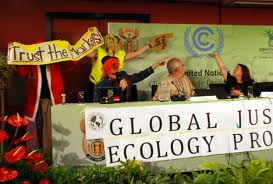
College climate activists lead the way at COP 17 in Durban

You have to hand it to the college students attending the U.N.-sponsored climate talks in Durban.  They know how to cut through the nonsense and tell it like it is.

Watch 21-year-old Middlebury College junior Abigail Borah telling the august assembly that they can no longer afford to drag their feet on curbing carbon emissions.

“I am speaking on behalf of the United States of America because my negotiators cannot,” said Ms. Borah, a representative of the International Youth Climate Movement. “The obstructionist Congress has shackled justice and delayed ambition for far too long. I am scared for my future. 2020 is too late to wait. We need an urgent path to a fair, ambitious and legally binding treaty.”

The response to her entreaty?  A swift escort off the premises.

Another group of students dressed as “corporate clowns” to bring some levity to the grim discussions.  As documented by the Climate Connections blog, they too were met with hostility by the powers that be.

While talking with the press, student clown Kevin Buckland “was grabbed and hauled away. His badge was taken, and he was barred from the International Conference Center.”

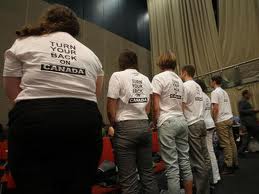
Then there was the group of Canadian students who were removed from the assembly hall just for displaying tee-shirts with the words “Turn Your Back on Canada,” a criticism of the Canadian government’s support for the oil extraction of the Alberta boreal forests (aka “tar sands”).

What kind of message are these young people going to take away from these incidents about the efficacy of trying to participate peacefully in global assemblies?  No wonder they’re turned off and turning to their own “people’s assemblies.”

As Laura Carlsen points out in an article posted on Common Dreams today, climate change activists need to “broaden the focus from once-a-year meetings in high-carbon conference centers, to the fields, communities and town halls where alternatives are already growing and a stronger political consensus can be built from the bottom up.”

The top-down approach favored by the U.N. and the international governmental community is showing itself to be not only ineffectual, but morally bankrupt.

Sex 101: From Plan B to Pleasure

I have mixed feelings about the decision of Secretary of Health Kathleen Sebelius to overrule the FDA’s recommendation to allow over-the-counter sales of Plan B, without any age restrictions.

On the one hand, the knee-jerk liberal in me says wait a minute–access to contraception in any form should not be restricted.

On the other hand, it makes me a little nervous to think about young kids–say, 12-year-old girls–being able to buy morning-after pills as casually as they might buy cold medicine.

Our society is already sexualizing young girls way more than I think is healthy.  If Plan B were widely available, it might be used as just another reason why girls should open themselves up to sex at a younger age.

Another part of my hesitation comes from knowing full well that Big Pharma is pushing over-the-counter (OTC) sales just to make more profits on the drug.  I don’t think they are really that concerned with the welfare of young women.

Rather than simply making Plan B available OTC, I would like to see a national conversation (let’s call it a national general assembly) on the issue of the hypersexualization of youth, on the one hand, and the with-holding of sex education and contraception, on the other.

It saddens me that students in my gender studies classes are still reporting that sex education in their high schools consisted mainly of scare tactics ranging from “have sex before marriage and you’ll go to hell” (Catholic school) to “have sex and you’ll get disgusting STDs” (public school) to abstinence-only “just say no” programs.

In an age where the answer to any question is readily available on the Web, we owe it to our teenagers to present these issues in much more depth.  We should be discussing sexuality in all its multivalent nuances, from issues of sexualized violence (what happens if you say no and he doesn’t listen?) to the pros and cons of each of the many contraceptive options, to what I see as very often the missing link in contemporary discussions of sexual relations: pleasure.

Sex isn’t just about contraception, it’s not just about STDs, it’s not just about violence, it’s not just about worrying over drawing limits of one kind or another.

It’s about pleasure.

Her pleasure as much as his.  Mutual pleasure.  Mutual desire, mutual satisfaction.

Any sex ed worth its salt needs to be honest with young people, both boys and girls, about why sex makes the world go round.  It shouldn’t just be discussed in terms of threats, warnings and prohibitions.

Sex for pleasure is one of those defining human characteristics that too often gets lost in discussions of Plan B, abortion rights, and HIV-AIDS prevention.  These are all important issues, but let’s not lose sight, along the way, of what it’s all about.

The drug companies have not yet figured out how to package pleasure.  Let’s hope they never will.

Challenging rape culture

In my Gender Studies class this week, we’ve been talking about “rape culture.”  It’s a term that’s bandied about somewhat cavalierly on college campuses, and is probably much less familiar out in the ordinary workaday world.

Well, wake up world.  Rape culture is here.  And it doesn’t need the ironic scare quotes.  It’s real, and it’s not funny at all.

You know you’re living in a rape culture when women’s bodies are suggestively displayed, commodified, in sexually enticing poses obviously intended for the male gaze.

In the culture of rape, “no” means “try harder” and it’s always the woman’s fault if she doesn’t like what’s going on.  Stupid bitch, if she didn’t want it, she shouldn’t have worn those heels/had that drink/come to the party.

Rape culture sanctions violence when necessary to overcome resistance.  She was asking for it, anyway.

Rape culture oppresses dissenting men, too.  Men who fail to conform to the code of dominant masculinity are “faggots,” and being called out as anything akin to feminine–pussy, for example–is the worst insult you can throw at a guy.

Lately I’ve been realizing that rape culture extends a lot further than women’s bodies.  It’s also responsible for the prevailing attitudes towards our environment–our Mother Earth.

Not for nothing are both Mother Earth and Mother Nature gendered female.

Some patriarchal cultures manage to respect Mother Nature while still maintaining a stranglehold on her female children.  For instance, in Chinua Achebe’s Things Fall Apart, which I’m re-reading now for another class, the all-powerful Oracle of the Hills, a goddess, is interpreted by a priestess whose pronouncements no men dare question.  This doesn’t stop the protagonist, Okonkwo, from beating up his wives on a regular basis.

In Judeo-Christian and Islamic cultures, the patriarchy dispenses with goddesses.  Or at least, goddesses of the truly powerful, fearsome kind.

In Euramerican cultures, we have sex goddesses, who exist to pleasure their men.  Islamic cultures shroud their women in veils, but towards the same end: women exist to please their men.

The explosive growth of the international pornography industry, in which it is still rare for women’s pleasure to be of any interest at all, bears testimony to the extent to which rape culture rules.

In 2006, the pornography industry had larger revenues than Microsoft, Google, Amazon, eBay, Yahoo, Apple and Netflix combined–and it’s only grown in the past five years.

Porn is a vast unregulated jungle.  It’s not all bad.  But some of it is really terrible.  Some of it is sexualized violence–rape–thinly veiled as entertainment.

Yes, the girls get paid.  But many studies have shown that female porn stars often come from sexually abusive childhoods, or are teen runaways, or are lured into the trade through drug addiction and prostitution.

In Euramerican porn, women exist to give men pleasure.  Doesn’t matter if they get fucked over in the process.  Doesn’t matter if all that’s left in the end is a hollow shell.  There’s always another slut waiting in line.

Yeah.  It hurts me to talk like this, but I want to convey the mind-set of this industry.

And then I want you to think about how this mind-set translates to the Euramerican assault on the environment, our Mother Earth.

Or the sub-prime loan scandal (it’s Occupy Foreclosures Day, after all).  Fuck’em over, make a profit and move on.  All that matters is the bottom line, baby.

Sometimes it seems as though the more powerful actual women become in real life–ie, successful at playing the formerly all-male games of education and career–the more frantically obsessive men’s consumption of pornography becomes.  The power they miss in real life, they can find acted out for them in porn fantasies.

But the environment is another story.  Mother Earth is not going to play men’s games–that is, she doesn’t care to beat them at their own game.  When she starts to resist, the game will be over.

In porn, women go along with the game for a variety of reasons.  Generally speaking, women do it to survive.

Likewise, women collude with the patriarchy in the rape of the Earth because it’s just easier to go along than to resist.  And the lifestyle has been pretty comfortable over the last 50 years, hasn’t it.

I would like to see a frank discussion of the connections between rape culture as played out in porn and rape culture as played out between humans and the environment.

We need to acknowledge that there is a serious problem in both the private and the public realms (along these lines, we are just beginning to see confessions of “sex addiction” hit the media.  How about “fossil fuel addiction”?).

The problem is a symptom of much deeper ills in human social relations, which transgress the usual boundaries of race, class, gender & nation.

Why are porn and energy extraction biggest, the fastest growing industries in the world?

What does it mean to live in a rape culture?  Who benefits, and who loses?

Most importantly, how can a rape culture be transformed?  And what is our alternative vision?

My vision is this:

The one-sided model of domination and extraction (“getting some”) needs to shift to a dialogic model of sustainable mutual pleasure.

Human beings should serve in a steward relation to our Mother Earth, tending and enriching her in exchange for the nourishment and pleasure she can afford us.

Likewise, sex should not be about domination and debasement, but about mutual pleasure and uplift.

In these transition times, such a transformative shift should be possible, if each of us begins with our own selves, our own backyards, and lets the ripples of range move outward.

Let it be so.

Outsourced pollution rides the trade winds home

How timely, that just as the U.N.-sponsored climate talks are going on in Durban, a new report comes out  from the Global Carbon Project informing us that global greenhouse gas emissions grew by a whopping 5.9 percent last year, the largest leap in any year since the Industrial Revolution began.

The U.S. remains the world’s second-largest greenhouse gas emitter, trailing only China.  But as we all know, China has become a factory state of the U.S. and Europe–isn’t virtually every manufactured thing you own “made in China”?

As I hear all the time from travelers to China, air quality is noticeably bad there.  Most cities seem to be in a permanent miasma of smog, sometimes approaching the sooty fog Charles Dickens used to describe as veiling London in the coal-burning 19th century.

Here in the U.S., air quality has improved since I was a kid in New York, when smog was a daily occurrence and you just learned to live with noxious blue bus fumes blown in your face on every street corner.

But apparently what we’ve done is simply outsource our pollution to China.  Let them deal with the smog over there; we’re paying for the goods they produce aren’t we?  If they can’t figure out how to manufacture cleanly, that’s not our problem.

So goes the smug line of American entitlement.

But welcome to the new century.

First of all, the great American credit bubble has burst, and the middle class is having trouble affording those imported manufactured goods, no matter how “cheap” they are.

Second, it’s obvious that the trade winds are blowing Chinese smog our way, in the form of global climate change that will affect us here as much as it affects them over there.

Politicians the world over continue to take a short-sighted view of both of these issues, imagining that a little re-tooling is going to get us past the bumps in the road.

The media isn’t helping matters–you will have to peer deeply into the New York Times this morning to find the small buried news story about the biggest leap in global carbon emissions on record.

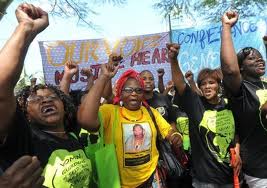
People who are already living on the edge understand the stakes.  Thousands of African women farmers have been marching in Durban, along with indigenous forest defenders from around the globe.  They’ve been kept away from the politicians inside the gates by riot police.

Guess what?  All the riot police in the world cannot keep climate change havoc from our doorstep.  Here in the U.S., in China, in Africa, and all over the world.

It’s time to deal with it.

President Obama, looking for solutions on student debt, should not overlook the issue of contingent faculty labor

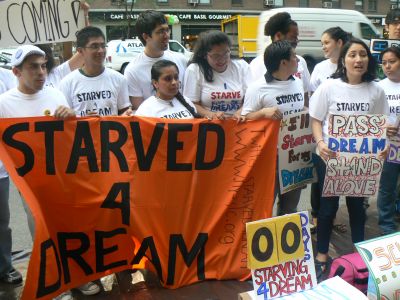
The student protests around the country have been focused largely on three key concerns: the high cost of a college education, the resulting weight of student debt after graduation, and the scarcity of jobs.

Put together, it’s a recipe for frustration, if not outright desperation.  Students who lack substantial family support these days have to make incredibly tough sacrifices to get their B.A. degrees, and with no jobs at the end of the tunnel, many are rightly asking–is it worth it?

A lot of thoughtful people have been considering this very question for some time now.  On Monday at the Berkman Center for Internet and Society at Harvard University, there will be a panel discussion on “The Fate of Civic Education in a Connected World,” featuring, among others, Ellen Condliffe Lagemann of Bard College, who just co-edited a book called What is College For? The Public Purpose of Higher Education.

In the book, Lagemann and co-author Harry Lewis argue that colleges and universities need to renew their commitment to fostering ethical, responsible student engagement with the public sphere.  Higher education should not just be a credential to string around one’s neck, the passport to a decent job, they say, but should challenge students to think deeply about their role as citizens and stakeholders in society.

This message certainly seems timely.  If getting a college degree can no longer be valued in purely instrumental terms, as a ticket to a job, then it had better be providing some deeper value, both for the students and for society.

On the same day as the Harvard panel, President Obama will be meeting at the White House with a group of ten influential college and university presidents, along with Secretary of Education Arne Duncan and other key players in higher education, to discuss “increasing access and success as well as how to make higher education  more affordable,” according to an article in today’s online Inside Higher Ed magazine.

The article says that “amid an increasing focus on student debt and college prices, the event seems to signal that the Obama administration will make the issue a focus going into the 2012 campaign. In a speech Monday, Education Secretary Arne Duncan called on colleges to address rising tuition prices “with much greater urgency.” The House of Representatives held a subcommittee hearing Tuesday on rising costs, discussing a broad range of possible solutions.”

As someone who has been teaching in higher education for more than 20 years, I am of course concerned about the rising costs for students.

But I’m also concerned with the way budgets are increasingly being balanced by reducing fulltime tenured faculty teaching lines.

The phenomenon of using adjunct faculty, graduate student teaching assistants, temporary “visiting” faculty and any other form of contingent labor available is under-discussed, both within the institutions perpetrating these practices, and in the broader society.

Within the institutions, it’s under-discussed partly because it’s so humiliating for Ph.Ds, respected scholars when they present their research at conferences or publish articles, to admit how little money they’re making as adjunct or visiting faculty.  College adjunct teachers are typically paid $2,000 to $4,000 a course.  Most faculty teach 3-4 courses a semester.  You do the math.

Also, there’s the fear factor: if you speak out, your contract may not be renewed next semester, or next year.  There is no job security for what we call in the business “term contracts.”

At the White House meeting, the college presidents aren’t going to want to tell the President that they’re reigning in the cost of tuition by hiring contingent faculty at bargain basement salaries.  But that’s the truth of the matter.

And it’s been very difficult for adjuncts to unionize, in part because the Labor Board in recent years has ruled that college and university faculty are “managers” because we make a salary rather than an hourly wage, and get to set our own hours. Managers aren’t entitled to a union.

There are a host of reasons why it’s bad for American higher education to use cheap faculty labor.  If we want to get serious about student success, as the Obama Administration claims, focusing on contingent faculties would be a good starting point.

A harried professor who’s working at two or three institutions to barely make ends meet is not going to do as a good a job for her students as someone making a living wage with a longterm contract at a single institution.

American institutions of higher education need to model the kind of society we want our students to create when they move out into the world as newly minted young citizens.  They won’t want to be temporary workers any more than their teachers do.

President Obama, if you really want to make a difference, you need to push those college presidents for deeper, systemic changes.

From occupations to manifestations: Arundhati Roy imagines another world

I was excited to find in my inbox today an interview with one of my favorite women writers of resistance, Arundhati Roy.

Roy may be most famous for her novel, The God of Small Things, but I am most moved by her political writings.  She is the one who coined that very popular saying, which became a motto of the World Social Forum in the 1990s: “Another world is not only possible, she is on her way.  On a quiet day, I can hear her breathing.”

She has been a shrewd and no-holds-barred critic of transnational corporate capitalism for decades now, long before it became a trendy position to take.

As she wrote in An Ordinary Person’s Guide to Empire, “So much of what I write, fiction as well as non-fiction, is about the relationship between power and powerlessness and the endless, circular conflict they’re engaged in.”

Since she’s been thinking about these issues for so long, it’s not surprising that the comments she made to Arun Gupta, published today in The Guardian,” are right on target.

“I don’t think the whole protest is only about occupying physical territory, but about reigniting a new political imagination.

“I don’t think the state will allow people to occupy a particular space unless it feels that allowing that will end up in a kind of complacency, and the effectiveness and urgency of the protest will be lost.

“The fact that in New York and other places where people are being beaten and evicted suggests nervousness and confusion in the ruling establishment.

“I think the movement will, or at least should, become a protean movement of ideas, as well as action, where the element of surprise remains with the protesters.

“We need to preserve the element of an intellectual ambush and a physical manifestation that takes the government and the police by surprise.

It has to keep re-imagining itself, because holding territory may not be something the movement will be allowed to do in a state as powerful and violent as the United States.”

This certainly speaks to the question that has been worrying at me all day today, as news spread of the violent evictions of Occupy encampments in L.A. and Philadelphia.
Once the physical encampments are gone, will the movement die away?
Or can it keep bubbling up in guerilla fashion, as I advocated in an earlier piece on this blog, like the spontaneous street parties of European cities, that materialize, stage an intervention, and then vanish before they can be contained?
Also, what role will the internet continue to play over the winter?  Perhaps we should be moving from a stage of “occupations” to a new stage of “manifestations,” where the focus will be not on resistantly occupying a physical territory, but on proactively gathering, both virtually and actually, to manifest a new vision of social relations.
In the Guardian interview, Roy ends by pointing to indigenous people, and people who live close to the land, as key mentors in the days and months and years ahead.
As climate change and environmental degradation accelerates,  Roy says, “we are going to confront a crisis from which we cannot return. The people who created the crisis in the first place will not be the ones that come up with a solution.
“That is why we must pay close attention to those with another imagination: an imagination outside of capitalism, as well as communism. We will soon have to admit that those people, like the millions of indigenous people fighting to prevent the takeover of their lands and the destruction of their environment – the people who still know the secrets of sustainable living – are not relics of the past, but the guides to our future.”
There are many of us who are now waking up to the certain knowledge that the leaders we thought were our trusty guides have been taking us on a joy ride to nowhere, ending up barreling towards a cliff.
There have been those all along who have refused to go along for the ride, who have maintained their independent imaginations and worldviews despite intense efforts by the corporate capitalist world to beat them down.
Those are the people we need to heed now–if, as Roy says, we want to learn “the secrets of sustainable living” and survive.  And if, of course, they’ll have us.