Much to protest…and much work to be done to make it right

Riots in Rome, a huge protest in Times Square, New York, and rolling protests from New Zealand to London to L.A. Things haven’t been this globally lively since the 2003 protests against the imminent U.S. invasion of Iraq.  Where is it all leading?

None of us know.  But the police are getting out their riot gear, and it is very possible that there are going to be more violent clashes, as there were in Rome today.

As the protests gain momentum, it’s important to keep our eye on just what all the anger is about.

Business Insider, of all sites, published a very interesting set of charts and commentary last week promising to explain just what all the fuss was about down in Liberty Plaza.  Check it out, you won’t be disappointed.

Here are a few of the most damning charts:

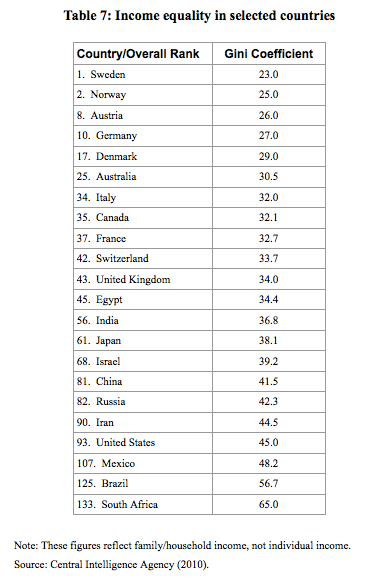
The U.S. ranks below China, Iran and India in terms of income INEQUALITY.

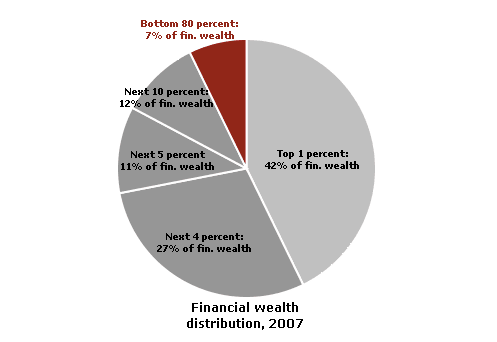
Five percent of Americans own 69% of financial wealth.  The top 1% own 42% of this country’s financial wealth.

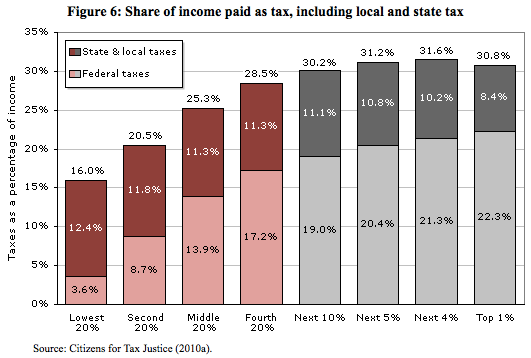
And the tax rate of these fabulously wealthy people is about the same as everyone else’s. That’s why they continue to get richer and richer, and everyone else slides inexorably downward.

While CEO pay is up nearly 300% since 1990, average workers’ pay is up 4%.  I don’t know about you, but the modest increases in my salary over the past decade have been totally absorbed by higher expenses, from food to gas to health insurance premiums and everything else.

So hell yes, there is something to be angry about!  There is a lot to protest!  There is a lot of work to be done to turn this country and this world around. The question is, how far will we go to rock the comfortable cruise ship of the one percenters?  And how far will they go to keep the status quo the way it is?

Police forces have always done the bidding of the wealthy in capitalist societies; is there any chance this could change?  The police are workers just like the protesters; is there any chance they will break their indoctrination and side with their own class interest?

Seems unlikely, but let’s not underestimate the forces of change.  Who would have believed, even six weeks ago, that people would be turning out in the thousands across the world to protest corporate greed and social inequality?

Look at this crowd.  It’s pretty clean cut, isn’t it?  This doesn’t look like a case for the riot police.  By and large, these people don’t want revolution. They just want to be able to live decent lives in a country they can be proud of.

Is this too much to ask?

No.  But, and this is a BIG BUT: what we’ve come to consider “a decent life” is going to have to change in the 21st century, given peak oil, the impending collapse of industrial agriculture, and the climate crisis.

So much will depend on our being smart enough to put these pieces together with the economic injustice we perceive so clearly, and see our way clear to a new, sustainably grounded society.

This is not too much to ask either.  But it will be a challenge to move from the fist-in-the-air stage to the creative visioning, and most of all to the implementation of a more just and sustainable economic system.

We have no choice but to meet this challenge.  Our global future as a species depends on it. This is the central task of our time.

What President Obama and Eve Ensler have in common

President Obama did something really, really good this week.  He sent 100 Special Ops military “advisors” to Central Africa to help local government forces get rid of the Lord’s Resistance Army, a group of crazed, vicious thugs who have been terrorizing people in four countries for as long as many in the region can remember.

The New York Times reports: “For more than two decades, the Lord’s Resistance Army (LRA) has murdered, raped and kidnapped tens of thousands of men, women and children in central Africa,” Mr. Obama wrote in a letter to Congress announcing the military deployment. “The LRA continues to commit atrocities across the Central African Republic, the Democratic Republic of the Congo and South Sudan that have a disproportionate impact on regional security.”

You don’t even want to know what kind of atrocities he’s talking about.  Joseph Kony and his men are depraved, sick torturers, rapists and murderers who have been at it so long that I doubt they can ever be rehabilitated.  They are part of a long cycle of violence in Africa that begins with the kidnapping or luring in of young children, boys and girls, who are then drugged, beaten and raped into total submission to the authority of the adults, and grow up indoctrinated into the lifestyle of terror.

For an inside story, read Ismael Beah’s memoir A Long Way Gone, or the chapter in my anthology African Women Writing Resistance by former girl child soldier China Keitetsi, whose memoir Child Soldier is available in an e-book edition.

I can’t help but think that there is an element of racism in the fact that it’s taken so long for the international community to unite behind the mission of bringing true security to Central Africa (including the Democratic Republic of Congo, where some of the worst human rights violations in the world are taking place daily, with women and girls disproportionately targeted.)

When Bosnian men were massacred, people thrown out of their homes, and women and girls imprisoned in rape camps by the Serbs, the Clinton Administration waged an all-out war to stop it.  All that and more has been happening in the DRC and neighboring countries for decades.  Decades.

Eve Ensler has done a tremendous amount to get the word out about the impact of all this violence on women, not just in Africa but throughout the world.  I particularly admire her because she has used art as the medium for her outspoken calls for solidarity and resistance with victims of rape and violence–starting with “The Vagina Monologues,” and moving on through a host of books and plays.

She’s also used digital media to get her word out and build a global movement to end violence against women, and I don’t think anyone does it better–check out her website, vday.org, to see for yourself.

Eve Ensler is a great example of a woman of privilege who has used all of her talents and gifts to reach out and help others–and not through begging, cajoling or guilt-tripping, either, but through the sheer power of her spoken and written word.

President Obama has the power to send in the military, and it’s good he’s at least taken the first step in that direction.

We ordinary people have power too, more than we often realize.  We can open our eyes to what’s really happening in our towns, our country and our world, and then allow our hearts to show us the way to action for positive social change.

There is no more urgent task for each of us in our lifetimes.  This is what we came here to do.

From brooms of resistance to guerilla tactics…let’s keep it going!

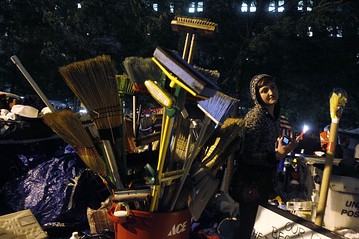
Congratulations to the Occupy Wall Streeters for making weapons out of mops and brooms and holding off the Bloomberg eviction forces!  A major victory!  I wonder when was the last time Bloomberg held a broom–probably so long ago he couldn’t conceive of such a strategy of resistance.

Looking out on this rainy, cool morning, I can’t help but wonder what’s going to happen when the cold winds of winter start to blow.  Those of us supporting this movement from the comfort of our homes don’t want to see the protesters getting frostbite out by the Wall Street bull!

I saw a great suggestion this morning: why not turn the Occupy movement into a guerilla resistance, with daily occupations happening in designated strategic sites all over the country, the occupiers called in via cell phones and social media?  A movement like this would have the flexibility of motion, and would be able to respond to current events.

It could also be fun–like the spontaneous street parties that often happen in European cities, with the partiers called in by cell phone.

Now almost a month old, the Occupy movement has done an outstanding job of waking up this nation.  Let’s keep the momentum going even as the cold winds of winter begin to blow.

Citigroup’s CEO Says He’d Be Happy to Talk With Wall Street Protesters

Pandit Says He’d Be Happy to Talk With Wall Street Protesters – Businessweek.

I think the Occupy Wall Street folks should take him up on his offer to talk!  But he should go down to the park just like everyone else, and meet the people at Liberty Plaza.  It would be a thrill for him, I’m sure, to rub elbows with the common folk, and hear his voice amplified by thousands of sets of vocal cords!

The article says that “Pandit also confirmed that Citigroup would make a profit in the third quarter, the bank’s seventh profitable quarter in a row since losing a total of $29.3 billion during 2008 and 2009. The bank may post earnings of $2.49 billion, according to a survey of 14 analysts surveyed by Bloomberg.”

I’d like to politely suggest that this income should be fully taxed….

Confessions from Park Avenue: Ignorance, Privilege and Change

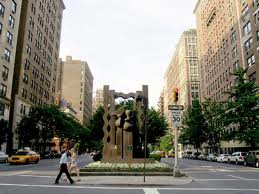
This week the Occupy Wall Street protest ventured uptown, to the Upper East Side of Manhattan–where I grew up.

I have always been reluctant to admit that for a good portion of my life I called Park Avenue home.  I knew what kinds of stereotypes would instantly leap to my interlocuters’ minds upon hearing these gilded signifiers: “Upper East Side,” “Park Avenue,” even “Manhattan.”  And indeed, I have known many neighbors who fit the model of the wealthy socialite snob.  But there are also thinking, feeling, compassionate people living on Park Avenue.  They are guilty, above all, of the privilege of ignorance.  They truly don’t know how the other half lives.

I can just hear the scornful snickers and groans that greet this statement.  But it’s true.  I know it because I lived it.  And to some extent, you’ve lived it too.  All of us Americans have this privilege relative to people living in desperate material circumstances in other parts of the world.  At least our society pays lip service to the ideal of equality.

The tony apartment buildings lining Park Avenue are urban gated communities.  Most are co-ops, and it is difficult to buy your way into them–money alone won’t do the trick, you also have to be thoroughly vetted by the co-op board, and depending on the building, you may or may not pass muster.  The people living inside tend to be very reserved with one another.  You might not get to know your neighbors even if you live in the building for twenty years or more.  You might know your daytime and nighttime doorman better than the person who lives on the other side of your bedroom wall.

As for knowing more of the world, and how ordinary people live, well–there is television. There is the internet.  But in terms of flesh and blood, there is very little connection.  Back at the turn of the 20th century, Jacob Riis captured the lives of the less fortunate in his sensational book How the Other Half Lives, which shocked the nation and inspired some excellent reforms.  That kind of documentary expose has become much more commonplace in our time, to the point where even the most shocking revelations–sex slaves in Westchester, sweatshop labor in Chinatown, human organ thieves in Brazil–have lost their power to shock.

A crowd of people chanting, holding up signs and making merry through the hushed, tranquil streets of the Upper East Side, though–now that is shocking!  In my 20+ years of living in that august quartier, I can only remember a few times when anything like this happened.

Once was on a long-ago St. Patrick’s Day, when the Fifth Avenue parade-goers got a little too drunk, a little too rowdy, and the police had to step in and reimpose order.  My mom, brother and I watched in amazement from our the 9th floor window overlooking Park Avenue.  Quiet was soon restored.

Another time was when the lights went out back in 1977, and there was some looting over on Lexington Avenue.  We heard the shouting and sounds of glass breaking, but of course nothing could touch us, secure behind the gates and under the watchful eyes of our uniformed doormen.

This is the central fact of privileged existence, Park Avenue-style.  Nothing can touch you.  The red carpet of privilege rolls out in front of you effortlessly; you live in an enchanted bubble, from which the distant rumors of unrest are just that–distant rumors, which you don’t understand, and don’t care about enough to investigate.

I say this now to underscore the success of the Occupy Wall Street protesters in breaking through that bubble, at least a little bit.  The tight membrane of privilege surrounding the NY Times popped after three weeks of pressure.  It will take a lot longer to penetrate the hearts and minds of the men and women who work on Wall Street and live up on Park and Fifth Avenues.  But just because it will take a while to get through is absolutely no reason to be discouraged.  It can be done!  And it should be done.

I have a feeling that there are probably a lot of people like me living on Park and Fifth Avenues today.  Privileged by birth, but with the same hearts, minds and sense of compassion as any other American.  Just ignorant of what’s up with the 99%.

For instance, one observer of the “Millionaire’s March” noticed “a chic young mother,” who “turned to a puzzled daughter in a tony school uniform, “People don’t have jobs right now,” she explained. Whether Mom connected this fact to the actions of any of her neighbors was anyone’s guess.”

Did Mom connect this fact to her own actions, is more to the point.  For the privileged, it’s too easy to pass the buck.

I am currently working on a book, which I call a “political memoir,” in which I try to understand the social dynamics of privilege, and how and why some people become “privilege traitors” and go against their own class interests.  Judging from this week’s events in New York, I am going to have a lot of interesting material to study, beyond my own story.  Stay tuned.

Hey Boston? Remember your roots! The world is watching you…and so are we!

Have you noticed that there hasn’t been any more pepper spray lately down on Liberty Square in New York?  If that gratuitous act of police brutality hadn’t been caught on videotape by an alert citizen journalist, the pepper-spray impunity might have continued.  Such is the power of the public sphere.

What’s different about this 21st century protest movement is that the public square has expanded to be as big as the whole networked world.

Even if we’re not physically present,we’re watching, we care, and, as Medea Benjamin of Code Pink said yesterday on Democracy Now, “We are here to stay….It really doesn’t matter to us that our permit has run out. We feel like this is a public square, we are the public, and we are occupying this square, so we will stay here.”

Last night the Boston PD unceremoniously removed Occupy Boston protesters from a park that turned out not to be public.  They manhandled Veterans for Peace representatives who were peacefully protesting under the banner of the American flag, and threw the protesters’ tents and belongings into a municipal garbage truck.  Check out this report in the Harvard Crimson, or watch this video and see for yourself.

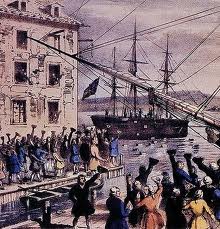
Bad move, Boston.  Aren’t you the home of the original Tea Partiers, the ones we celebrate as patriotic resisters of British oppression?  Do you really want to trample on American citizens’ right to the peaceful expression of dissent?  How un-American is that??

There was no way the Boston Tea Partiers could have predicted that their action in the harbor would spark the American Revolution.  All major watersheds in human history have unfolded in the same way, set off by the actions of a few dedicated individuals who are willing to stand up for their rights and their principles.

Why should our historical moment be any different? The truth is that every hundred protesters arrested will bring another thousand to the movement for change.  Get used to it, Boston–and Chicago, New York, Atlanta, San Francisco….This movement is just getting going.

Honoring Native Americans instead of Columbus

I’d like to suggest that instead of honoring Christopher Columbus on this day in October, we make this a national holiday in honor of the indigenous peoples of North America.

It is shameful that we have no national day of recognition for the native tribes who were here to welcome the first European explorers.  Perhaps this is no innocent oversight; if there was a day of recognition, we’d have to confront the ugly truth of what those Europeans did to the Native Americans–from smallpox to displacement, massacres and enslavement.

Still, that bloodstained history lurks beneath the surface of national holidays like Columbus Day and Thanksgiving.  It would be better to look squarely at the truth and do something to atone for it–at minimum, honoring the native ancestors of this land, and their contemporary descendants, who continue to struggle and resist the tsunami of Euramerican industrial civilization.  

For an idea of what that struggle looks like today, check out the Honor the Earth website.  Honor the Earth works “to address the two primary needs of the Native environmental movement: the need to break the geographic and political isolation of Native communities and the need to increase financial resources for organizing and change.”  It was founded in 1993 by native rights and environmental activist Winona LaDuke and the Indigo Girls.

In honoring the Native peoples of the United States instead of the European explorer who accelerated the invasion of their territories and the assault upon their cultures, we would be honoring the amazing resilience and wisdom of these ancient tribes, who have withstood the onslaught of European culture with incredible strength, courage and dignity.

We contemporary Americans are standing at a turning point in history where we may be able to get away from the destructive mode of domination represented by Columbus and a host of European explorers after him.

Changing Columbus Day to Native American Day (or perhaps selecting one significant representative Native person from history–I would not presume to suggest a single figure, but there are many to choose from) would be a good start at not only atoning for the bloody history of European-Native encounters, but also moving more harmoniously into the future.


Bill McKibben: The Sky Does Not Belong to Wall Street!


Thanks to the magic of You-Tube, we can see a terrific 6-minute speech by Bill McKibben today, linking the fight to save the climate to the fight against the Wall Street tycoons.

He’s planning another big action in D.C. next month: setting up a ring of protesters around the White House, standing siege until the real Barack Obama comes out–not the zombie who’s actually considering letting the oil industry raze the boreal forest in Alberta and run a leaky pipeline all the way to the Gulf.

We need our Obama to stand up to those guys and remind us why we elected him!

Let’s hope Bill McKibben and company can free the real Obama from the stranglehold of Big Oil, so he can be our champion in the White House, as we so hoped he would be.

“The sky does not belong to Exxon.  They cannot keep using it as a sewer into which to dump their carbon,” Bill reminds us.

Barack, are you listening?

Occupy Wall Street: Finally, the New York Times Gets It!! Now, how about Obama?

Protesters Against Wall Street – NYTimes.com.

This is a big victory for the Occupy Wall Street movement.  To move the staid NY Times from complete indifference to disdainful incomprehension to vigorous approval in the space of just three weeks is truly remarkable!

Haven’t I been saying that the young people today are the sleeping giant that needs to awaken, stretch and roar?  Any subordinate class (and make no mistake, the young ARE a subordinate class) is only kept down through ignorance of the true extent of their power.

In the past, it’s usually been a charismatic leader who has seized the microphone and shaken the masses out of their beaten-down stupor.  Think Frederick Douglass or Martin Luther King Jr., for example.

With Occupy Wall Street, we’re onto something new: a “leaderless movement,” without microphones, but with the extraordinary amplifying power of the World Wide Web.

Social media couldn’t have done it alone–we need the resolute presence of those flesh and blood people down at Liberty Square and in parks and street corners all across America.  But their resistance is exponentially strengthened by the social network around them, spreading like wildfire throughout the country and the world.

President Obama responded at least obliquely in last week’s press conference, showing at least a glimmer of understanding of what the movement is about.

If he had a shred of political sense, he’d be looking for ways to harness the intelligence, social commitment and determination of these young people to stand up to the Tea Party crowd and the drill-and-kill Republicans who have shown themselves again and again to be against social equality in any way, shape or form.

This could turn into the political juggernaut needed to push the Republicans back into their holes, and give the Democrats some much-needed backbone.

One thing is certain: these kids are not backing down, and they’re not going to be fobbed off with half-hearted gestures of appeasement.  They are after real social change, from the ground up.

What was it Arundhati Roy used to say?   “Another world is not only possible, she is on her way.  On a quiet day, I can hear her breathing.”

Yes.

Nobel Peace Prize honorees: why not Vandana Shiva?

How can I complain when the Nobel committee saw fit to grace not one but three women, two from Liberia and one from Yemen, with the annual Peace prize?

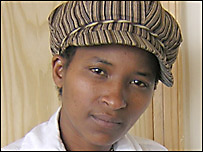
After all, I’ve been working for years now to help the women of the two-thirds world gain more power and recognition, and these three women–the towering elder and current President of Liberia, Ellen Johnson Sirleaf; Leymah Gbowee, the Liberian peace activist familiar to many from the portrait of her in the powerful documentary film “Pray the Devil Back to Hell”; and the young Yemeni human rights activist Tawakkol Karman– are certainly very deserving.

In fact, for our anthology African Women Writing Resistance: Contemporary Voices, my co-editors and I chose a quote from President Johnson Sirleaf as one of our epigraphs.  “Listening to the hopes and dreams of our people,” she said in a speech to the American Congress in 2006, “I recall the words of a Mozambican poet, who said ‘Our dream has the size of freedom.’ My people, like your people, believe deeply in freedom–and, in their dreams, they reach for the heavens.”

All three of this year’s Nobel Peace Prize winners have been channels for the hopes and dreams of their people, seeking political empowerment, social stability and security, and a sustainable path forward out of chaos (in Liberia’s case) and stagnation (in Yemen).  Ellen Johnson Sirleaf, who holds a Master’s degree in Public Administration from the Kennedy School of Government at Harvard, has done a lot of good things for her people in her tenure as President, including many development programs aimed specifically at empowering women.  She has succeeded in gaining major debt relief from Liberia’s creditors, as well as brokering deals with big transnational energy companies to extract Liberia’s oil.

The other two Nobel Peace Prize honorees are equally deserving.

But I wish the Nobel Committee had been a bit more forward-thinking, and seen fit to honor another woman from the two-thirds world, Vandana Shiva of India.  A Ph.D. in particle physics, Shiva has been way ahead of her time for most of her life.

Instead of taking her place comfortably in the ranks of the Indian elite, Shiva became aware as a young woman of the danger of the industrialization of agriculture in India. She founded an organization, Navdanya, dedicated to saving heirloom seeds and preserving the knowledge of how to farm using ancient, local, sustainable methods.

When Monsanto began moving aggressively into the Indian market, luring in farmers with fertilizers and GMO seed on credit, Vandana Shiva was just about the only one who seemed to perceive the huge risk they were taking.  When these same farmers began committing suicide in droves as their reliance on foreign seed, fertilizer and pesticide drove them inexorably into debt, Vandana Shiva was the one who went to court to defend their lands and the rights of their widows.
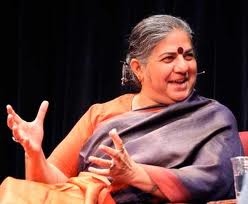
She has been a veritable David fighting the Goliath of Monsanto for the past twenty years or so.  And in many cases, she has won!

While I also honor Ellen Johnson Sirleaf and her younger co-awardees this year, I have to say that I would like to see them follow more in Vandana Shiva’s footsteps in the future.

Take Liberia, for instance, which in 2010 ranked 162 out of 169 countries on the United Nations Human Development Index.  Ellen Johnson Sirleaf is busy signing agreements with Chevron to extract the country’s oil, and hoping that some of the oil wealth will trickle down to ordinary Liberians, who are still hungry and poor today.

I’d like to respectfully suggest that instead of selling her soul to Big Oil, President Sirleaf follow the example of Vandana Shiva, and look to local, sustainable agriculture and manufacturing to build her country’s economy.

In a time of rapid climate change, it’s the countries and regions that are most self-sufficient and least plugged into the fossil-fuel-driven global economy that are going to be able to ride out the coming maelstrom.

It is clear that the corporate and political leaders of the world have no intention of acting decisively to stop global warming.  Last week’s major climate change story was about a report issued by a Washington D.C. think tank calling for more research into bioengineering of the climate, or “climate remediation.”  Specifically, they’re interested in getting the federal government to fund research into two major approaches:

  • Carbon Dioxide Removal (CDR): CDR strategies aim to remove greenhouse gases from the atmosphere, thereby addressing the root causes of climate change.
  • Solar Radiation Management (SRM): SRM strategies aim to counteract or mask the effect of rising greenhouse gas concentrations in the atmosphere by increasing the amount of solar energy that is reflected back into space.
The first method involves working with plants that will absorb more carbon dioxide, or finding ways to sequester the CO2 we produce back underground.  One could hardly argue with an aggressive tree-planting and conservation campaign, particularly in light of the appalling reality of deforestation across the world today (see this very cool interactive map for the gruesome details).
The second method is the environmental equivalent of Ronald Reagan’s infamous Star Wars missile defense system: a sci-fi-esque plan to install giant mirrors in space, or to seed the atmosphere with reflective particles that will deflect solar rays from Earth.  One can just imagine the military industrial complex salivating at the thought of such a project, particularly at a time when there is so little support for continuing the wars that are this industry’s usual diet.
The problem, of course, is that both of these approaches miss the central most important fact about climate change, which is that nothing will stop it other than aggressive changes to our carbon-based lifestyle.
Will that happen?  Can it happen in time?  Maybe the Occupy Wall Street movement can bring the necessary energy to this fight, and I certainly hope they do.  Recently Bill McKibben’s 350.org, a leader in climate change activism, became one of the many larger national organizations seeking to ally themselves with this young juggernaut of political action.

Meanwhile, so-called “less developed nations” like Liberia and Yemen and all the rest should seriously re-evaluate their acceptance of this designation, which means rethinking the whole rationale behind Western-style “development.”  Development, Western-imperialist style, has benefited a few people mightily but brought suffering to the vast majority of people on Earth, especially those in the areas of greatest resource extraction, which are, paradoxically, the “less-developed” nations.
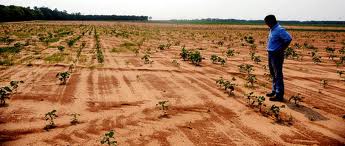
Now the time has come for us here in the heart of Empire to feel the blowback from our aggressive policies of development.  Climate change is upon us.  And in this new era, it is precisely those with the least reliance on oil, electricity and industrial agriculture that will have the best chance of adapting to the new realities of life on Earth.

President Johnson Sirleaf and all the other leaders of “less-developed nations” should stop and reconsider their friendships with the global corporate elite.  The urgent task now is to build resilient communities and economies based on the exchange and consumption of local resources–just like it was for the tens of thousands of years of human existence before the industrial revolution started us off on a different path.

It is people like Vandana Shiva, who are still in touch with older ways of living in harmony with the Earth, who may be able to lead us through the current crisis into a sustainable future.  Let us take heed while there’s still time.