Protest and social transformation–what do Uranus and Pluto have to do with it?

I said when I started this blog that I’d be open to all kinds of explorations of the transition times we’re living in.  Recently, after a long period of just reading his open-source work, I subscribed to the astrology reports produced by Eric Francis.  I am wondering: could it be that the motions of the planets have a real impact on how we think, feel and act here on Earth?

Francis just produced a terrific reading of the history of American protest movements since the Sixties, grounded in his knowledge of astrology and inspired by his visit to the Occupy Wall Street protest last weekend.

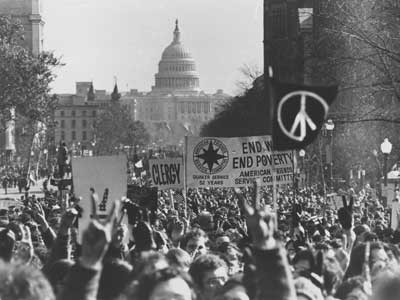
Apparently we have just returned to a period of astrological alignment of Uranus and Pluto.  Francis writes: “the most passionate and sustained uprisings are reasonably predictable: they tend to happen when Uranus and Pluto come into alignment. When the planet of revolution (Uranus) and the one about evolution (Pluto) get together, there is always an international revolt. The alignments spread out over 10 to 12 years, and we are still toward the beginning of this one.  The last time these two planets got together was between 1960 and 1972.”

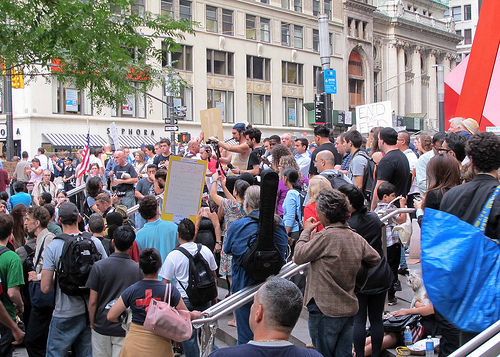
Francis describes the “vibe” at Liberty Plaza Park as quite different from the militancy of the 1960s.  “The feeling was nothing but friendly. There was not the fist-in-the-air sensation that Sixties demonstrations are remembered with.…The vibe was open but also introspective. People were expressing concern and anger about the economic situation and there was a clear sense of understanding that Wall Street holds a lot of the responsibility for that — but no sense of rage being projected onto anyone. My sense from many things I’ve read and heard is that among this generation of activists, there’s the awareness that we need to change ourselves and change the world in the same gesture.”

So true—because there is only a difference of degree between the protesters’ privilege and that of the corporate and financial leaders they’re criticizing.  All of us Americans have benefited hugely from the corporate globalization of “free trade” and the easy accessibility of credit.  The problem is that now the chickens have come home to roost, and the same havoc that we–as a nation and as a leading member of the global elite–wreaked so thoughtlessly on the rest of the world is now coming back to haunt us.

When I listened to the news this morning and heard of the extreme hardship being forced down the throats of ordinary Greeks in the name of “fiscal austerity,” I remember the same scenario going down in Mexico and Argentina and so many other nations, as we continued to party here in the U.S.  Well, the party is over here too, at least for the 99% of us, and it’s not fun at all.

 But, as Eric Francis notes, there is a lot of potential in this moment of crisis.  “As you think about what this aspect represents,” he counsels,  “remember that the personal awakening process of Uranus in Aries is about to meet up with the changes in society represented by Pluto in Capricorn. There is potential for wide-scale cultural change, but it starts from the inside-out. That approach, if we follow it, will help us avoid many of the really huge mistakes that were made during the protests of the Sixties.

“Uranus in Aries also connects people to groups, but from the perspective of being an individual. Pluto in Capricorn turns over the soil of society’s institutions, bringing out their frailty and their fertility. It will be exciting to see what happens as this aspect builds to its first peak in June 2012 and then develops for the next three years.”

“Exciting” might not be the word most of us would choose for the crazy lurching of our society, both national and global, towards the tipping point forecast long ago to arrive in 2012.  It’s exciting the way a roller-coaster ride is exciting, and I have never in my life allowed myself to experience that thrill.

But maybe part of what is being asked of us now is that we let go of our fears and inhibitions, and allow ourselves to try something new—something other than what has been expected of us as we grew up and docilely took our place in the structures that had been established for us by previous generations.

It’s pretty plain to see that those structures have outlived their functionality, and were never good for this planet to begin with.

It’s the transition time, folks.  What are we going to become?

 

Empathy: Igniting Force for Social Action

Now that the mainstream media has finally caught on to the importance of the Occupy Wall Street protests, I feel like I can go back to using this space to explore some other questions that have been niggling at me lately.

Last week there were not one but TWO op-ed pieces in the NY Times about empathy–both responding to Harvard Professor of Psychology Steven Pinker’s new book The Better Angels of Our Nature: Why Violence Has Declined.  I haven’t read Pinker’s book yet, but I gather that he argues that humans have become more empathetic of late, and thus less violently aggressive towards one another.

Honestly, I haven’t noticed any decline in violence recently, have you? We still haven’t had a year go by without war erupting somewhere on the planet, and usually in many places at once. Men are still raping and battering women in alarming numbers all over the globe.  Suicides are up, and that deadly malaise I’ve talked about before subjects many of us to a constant low-level form of self-directed aggression.

But what I really want to think about are the two reactions to Pinker’s book, published last week in the Times by columnists David Brooks (conservative political pundit) and Benedict Carey (science reporter).  Both were extremely negative about the potential for empathy to be a positive force for social change.

Brooks argues that “Empathy makes you more aware of other people’s suffering, but it’s not clear that it actually motivates you to take moral action or prevents you from taking immoral action….

“Nobody is against empathy,” he says. “Nonetheless, it’s insufficient. These days empathy has become a shortcut. It has become a way to experience delicious moral emotions without confronting the weaknesses in our nature that prevent us from actually acting upon them. It has become a way to experience the illusion of moral progress without having to do the nasty work of making moral judgments.”

Brooks ends his column by proffering “sacred codes” as an alternative to mere empathy.  “Think of anybody you admire,” he says. “They probably have some talent for fellow-feeling, but it is overshadowed by their sense of obligation to some religious, military, social or philosophic code. They would feel a sense of shame or guilt if they didn’t live up to the code. The code tells them when they deserve public admiration or dishonor. The code helps them evaluate other people’s feelings, not just share them.”

The problem with this formula is obvious.  Sacred codes are all very well, as long as they don’t direct their adherents to, say, “exterminate the cockroaches,” as was the cry both in Nazi Germany and in Hutu Rwanda.

Benedict Carey comes up with another objection to empathy as a trigger for social action: people are much more likely to feel for and want to help a single victim whose story is well-told, than to reach out to help in a major disaster involving millions of unnamed victims.  We get “compassion fatigue” pretty quickly, and if we are fed enough sad stories, we begin to get “psychic numbing,” where we lose our ability to feel any empathy at all.

Carey ends his piece by suggesting that psychic numbing may actually serve a useful purpose.  People charged with trying to help victims of disaster or tragedy are better able to function, he says, if they are not wallowing in empathy.

“In his book “Death in Life: Survivors of Hiroshima,” the psychiatrist Robert Jay Lifton argued that rescue workers at Hiroshima were able to function at all only because they succeeded in “turning off” their feelings of compassion. He called that process “psychic numbing,” too, and it’s a reminder that empathy may be a limited resource for a reason.  Real action, when it’s called for, often requires a cool heart, if not a cold one.”

So here we have, within the space of a single week, two well-respected intellectuals arguing that empathy may be overrated. Both maintain that empathy can actually get in the way of constructive action.

I have thought quite a bit about this very issue, since so much of my teaching over the years has involved exposing young people to narratives of political struggle with the goal of awakening their empathy as a first step on the road to positive social action.

Very rarely have students complained to me that the narratives of testifiers like Ismael Beah, Fadumo Korn or Rigoberta Menchu have caused their circuits to bust into “psychic numbing” mode.

And while it may be true that the experience of empathy is not enough in itself to produce the kind of social change called for by the testifiers in these narratives, it is still an important and necessary first step for potential allies from outside the given cultural context of the narrative.

In her closing essay to my first anthology, Women Writing Resistance: Essays on Latin America and the Caribbean, Julia Alvarez invoked the simple, hopeful expression of human connection exemplified in the phrase, “Here, let me help you with that.”

Gloria Anzaldua also wrote about the importance of situating oneself in the liminal space between self and other, which she named “nepantla,” the space of the borderland.

Those of us who have been blessed with privilege may never venture into that borderland space of connection and social change unless we are jarred into awareness by a jolt of empathy.  It may just never occur to us to reach out a helping hand.

I teach literature because I believe in the power of stories to provide this crucial explosive charge of understanding, which Simona Sharoni, who visited the Simon’s Rock Junior Proseminar today, calls “compassionate resistance.”

It’s true that this is a starting point, not an end in itself.  But it’s a critical ignition stage, not to be under-estimated.

I wonder about the subtexts of these two Times columns this week, both putting down the value of empathy a means towards social change.  Just what are these guys afraid of?

Whatever it is, Rachel Corrie found out how dangerous that fear–or lack of empathy–can be.

Real reporting from Liberty Square

Thank you, Sarah Jaffe of Alternet, for giving us some good, well-linked, on-the-ground reporting from Liberty Square!  If you only read one article about Occupy Wall Street today, it should be this one.

(Photo by Michael Whitney)


Can’t you just play nice?

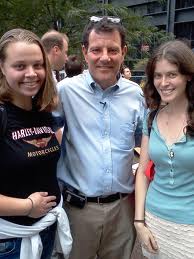
It’s one of the most popular NY Times articles on Facebook this morning.  Yes, a bonafide Times columnist, Nick Kristof, finally went down to Liberty Plaza to interview the Occupy Wall Street protesters.

But what does he come back with?  A strong personal defense of capitalism as a philosophy (“I don’t share the antimarket sentiments of many of the protesters”), and a condescending pat on the head for the demonstrators, who, he says, don’t really know why they’re there (“Where the movement falters is in its demands: It doesn’t really have any”).

Let me help, Kristof suggests.  His advice, listed in neat bullet points in his column today, is nothing you haven’t heard before from various left-of-center sources.  Tax financial transactions, close tax loopholes, regulate banks more carefully.  Nothing wrong with these ideas for reform–though they’re not exactly galvanizing.

But what’s infuriating is the way the establishment, from reporters to editors to cops & the Mayor, is treating the protests as child’s play: a source of amused wink-winks, not to be taken too seriously.  Give them some finger-wags, accompanied if necessary by some wrist-slaps (or pepper-spray, or tricky mass-arrest scenarios), and they’ll go home.  Let’s all just play nice.

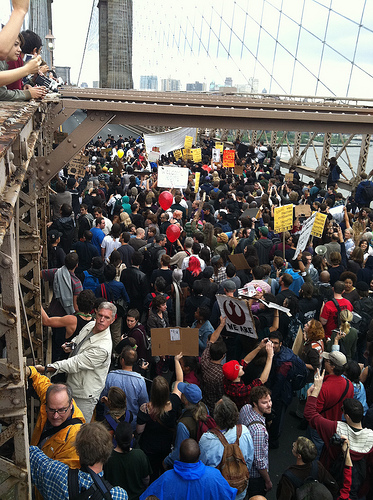
Well, was it playing nice to “allow” hundreds of protesters to gain access to the Brooklyn Bridge roadway, and then round them up like cattle and haul them off to jail?

Is it nice to continuously infantilize the movement by pretending that the people in Liberty Square don’t know why they’re there or what they stand for?

Why are they there? The 99% says it all. To protest the ever-widening income disparity in this country, and the lack of political or ideological support for change.

A protest song from the 1960s has been running around in my brain this week.  It’s called “It isn’t nice,” and it goes like this:

It isn’t nice to block the doorways/It isn’t nice to go to jail/There are nicer ways to do it/But the nice ways always fail/It isn’t nice, it isn’t nice/Well thank you buddy for your advice/But if that’s freedom’s price/We don’t mind, no no no, we don’t mind!

Give it a listen, and pass it along.

SlutWalk, Occupy Wall Street and other sparks of resistance: let’s fan the flames!

Finally this morning The NYTimes.com is paying some attention to the Occupy Wall Street protests.  But the tone is still highbrow and dismissive–Charles Blow, who really should know better, labels the protesters “hippies and hipsters” and the movement overall as “a spark set down on wet grass,” with “no where to go.”

He also finds space to inform us that “a New York Times/CBS News poll released two weeks ago found that a third of those who make $30,000 a year or less don’t believe that the government should raise taxes on the wealthy to lower the budget deficit.”

Could that be because those who are living on the edge are so beaten down by a variety of forces, including lousy education and the constant scorn this country shows the poor, that they could care less about “lowering the budget deficit”?

I bet that the pollsters would get quite a different response if the question were worded more directly, as in: Should the government raise taxes on the wealthy to help the poor get a better education, promote job growth and tighten the social safety net?  Hell yes! they’d say.

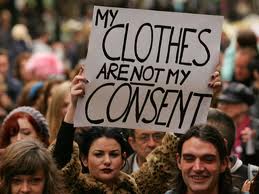
Meanwhile, up in Union Square, another protest is brewing today: SlutWalk, a new, international protest movement against “rape culture.”  In a rape culture like ours, the SlutWalkNYC site informs us, “sexual violence is made to be both invisible and inevitable; and these two practices are what normalizes rape, harassment and assault….The forces that normalize rape culture are not examined; rape is not seen as a culture or “practice” and if it is ever discussed, sexual violence is seen as an isolated act that occurs between individuals.”

SlutWalk began in Toronto last year, in response to an incident where a police officer told a rape victim that she had been “asking for it” because of the way she was dressed.  That the movement has caught on so quickly, especially among young women, is testament to the validity of its argument that no woman, no matter how she is dressed, is ever “asking” to be raped.

Both Occupy Wall Street and SlutWalk are driven by young people who are frustrated with the status quo and know that a better world is possible.  Their elders should know better than to dismiss these young folks as idealistic dreamers.  Hasn’t all change in human society, both positive and negative, been driven by those who dare to dream differently?

Lately I’ve been reading Derrick Jensen‘s latest book, a huge tome called simply, Dreams.  In it he argues that one of Western civilization’s crucial fallacies is our collective tendency to ignore and dismiss our dreams, as well as the possibility that through our dreams we may connect with “supernatural” forces that we don’t understand and cannot control.

Derrick sides with indigenous cultures who believe that the natural world is alive (“animism”) and can communicate with us.  His big question in Dreams is a weighty one: why hasn’t the natural world fought back harder in the face of the sustained murderous onslaught of humanity?

I would not presume to speak for the natural world.  But this question can be applied to a lot of other contexts today.

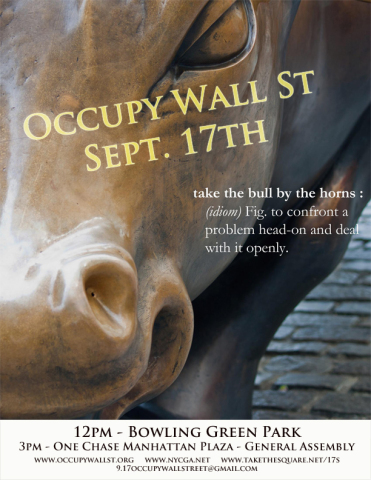
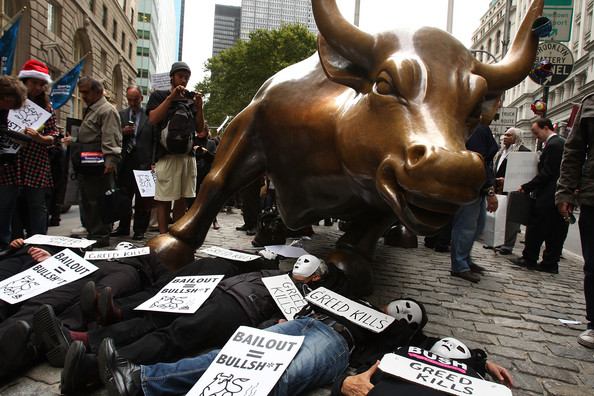
Why has it taken so long for Americans to get out and protest the takeover of our country by the corporate elite?  Why has it taken two weeks for the New York Times to deign to notice this gadfly protest on the flanks of the giant Wall Street bull?  The New York unions are finally stirring and considering joining the protesters–why has it taken so long for the American working class to awaken?

I think it might have something to do with the way we in the U.S. are caught up in a media-induced waking dream/nightmare, with a storyline that repeats over and over the following all-pervasive mantra: c’est la vie, there’s nothing to be done about it.  No fundamental change is possible.  The contamination of our environment is inevitable, and necessary if we want to maintain our comfortable fossil-fuel-driven lifestyle. The ever-growing gap between rich and poor is inevitable, as natural and normal as rape culture–boys will be boys, and you can’t expect rich boys to care about the poor.

Etc.

Someday analysts may look back on this period as one of remarkably successful mass indoctrination.  That is, if there are any shreds and shards left of our culture to examine after climate change is done with us.

To answer Derrick’s question, climate change is Nature fighting back.  Has anyone noticed that it’s been raining practically non-stop in New England for weeks now?  Here we are almost in leaf season, and our once-glorious maple trees are barely able to muster some mustardy brown color.  If this rain were snow, we’d be buried.  It may be an interesting winter season, to say the least.

However, resistance movements, both human and natural, are stirring all over the planet.  Like Occupy Wall Street, they may seem small, fragmented and disorganized to people who are accustomed to watching the huge, well-funded, tightly organized spectacles of mainstream political parties, or even mainstream-funded resistance movements like the Tea Party.

But it’s possible that dispersed, small-scale resistance may just what is called for under the present circumstances, when anything more obvious would simply be crushed by the iron fist of the corporate capitalist ruling class.

Resistance is happening when people take the time to relearn ancient human practices like small-scale biodynamic agriculture, bee-keeping, and storing food for the winter.  Resistance is happening when people refuse to let the dominant narratives ride rough-shod over their dreams of positive change.

Resistance is happening!  Let’s prove Charles Blow and the other naysayers wrong. It may be a rainy season, but let’s be the dry tinder for the spark of protest to fall on. It just takes one spark to start a wildfire, after all.

Enough already!

I know it’s not just me.  So many people I’ve talked to this week are feeling it.

It’s a kind of low-grade malaise, nothing you can put your finger on, just a weary, burned out sense of ENOUGH ALREADY.

Enough bad news.  Enough of the stock market endlessly gyrating downward.  Enough unmanned drones picking off clerics in desert hideouts.  Enough executions.  Enough police brutality.  Enough racism.  Enough bullying in the schools, and in the Congress.  Enough global warming.  Just ENOUGH ALREADY!!

But you know what?  There is no magic wand that can make these problems go away. We’re sleep-walking in some kind of collective cultural trance, living through a waking nightmare in excruciating slow motion.  What we need to do is WAKE UP and stop our goose-stepping death march.

That’s what the people sitting out in Liberty Plaza Park, Wall Street, are trying to do.  They’re trying to break the trance by doing something radically unexpected.

In our country, we sign online petitions and donate funds by cell phone, but we don’t sit out in the rain and use our collective voices as natural amplifiers. We don’t publicly put our bodies on the line.

Or maybe we do.  I am too young to remember the Civil Rights protests or the Stonewall riots.  I’m way too young to remember the workers’ strikes of the 1930s.  But these acts of resistance live on in our American collective unconscious, and it’s time to tap into them now.

The antidote to the vague sense of despair and depression that so many of us seem to be feeling these days is, quite simply, ACTION!  If we let this creeping malaise get to us, it’s all over.  We might as well just admit defeat.

And that, my friends, is unthinkable!  So let’s rouse ourselves, let’s prick ourselves in the flanks, let’s get out there and fight the good fight!  It’s the least we can do for the country and the planet that needs us–terribly.

American-style debt bondage–how much longer can we go on this way?

A propos of this question of what the Occupy Wall Street protest is all about, I would like to raise the issue of debt bondage.

Usually when someone says “debt bondage,” we flash to images of Indian rice farmers or child brick carriers or trafficked women from Southeast Asia.

There is horrendous debt slavery in South and Southeast Asia, and the conditions under which men, women and children labor there are far worse than anything we face here in the U.S.

But at the same time, I don’t think it’s far-fetched to call the average American middle-class lifestyle a form of debt bondage.

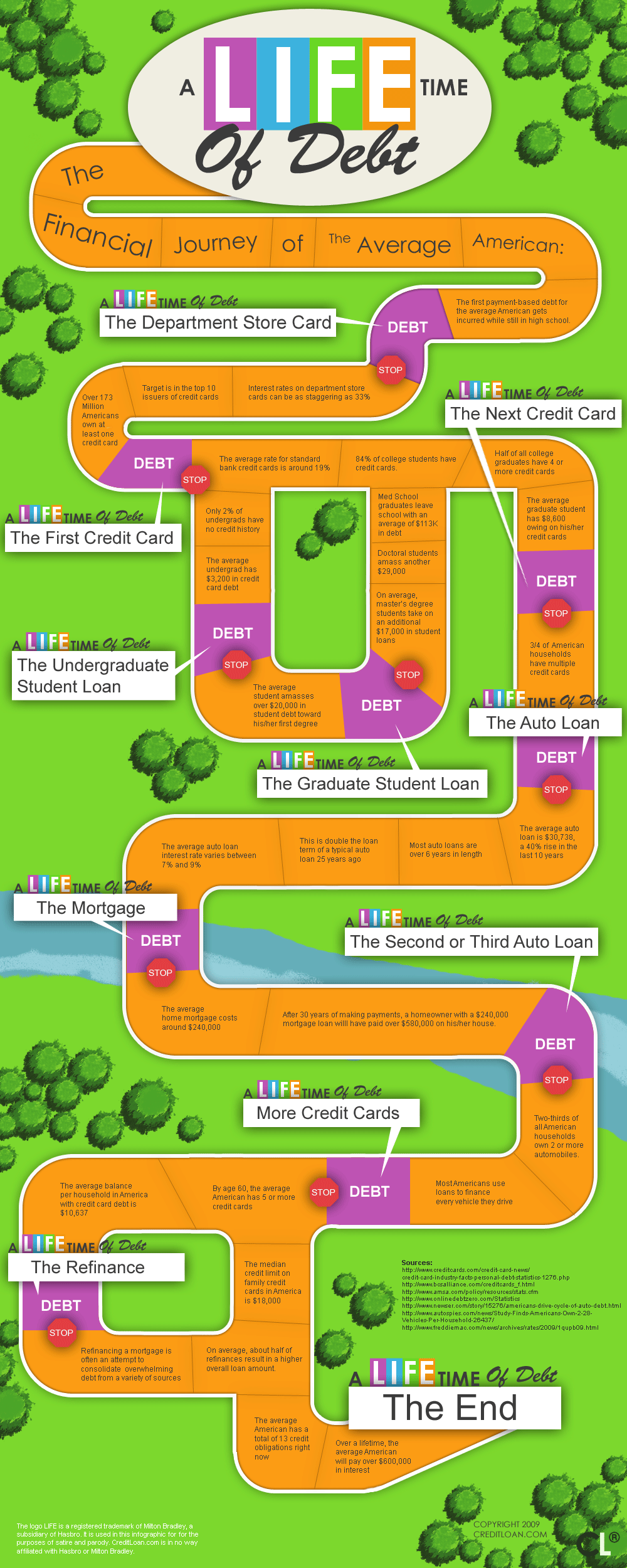
This graphic does a good job at giving us the picture:

In case you can’t read the fine print, the end of the “game” shows that Americans will pay about $600,000 in interest alone during their lifetimes.  [Source: Visual Economics.]

Working to pay off debt has become so commonplace that we scarcely even notice it anymore.  But it’s a relatively new phenomenon.  And all that interest, plus all those fees, are among the prime ways that the Wall Street bankers have gotten so phenomenally rich in the past 50 years or so.

What can be done about this?  For starters, a quality education should not so expensive that a middle-class student has to go into debt to attain it.

And we have to think much more deeply as a society about the job question.  We should not make it so easy for corporations to outsource jobs to cheaper labor markets.  Just as we are beginning to think about localizing agriculture and energy, we need to think about localizing jobs.

That’s the way human beings have made their livings for the past millennia, after all.  Only in the last 30 years or so has the world become so small (thanks to cheap fossil fuels) that it was conceivable to export manufacturing and other basic services to the other side of the globe.

Is outsourcing really more cost-effective, when you add in the costs of social welfare for all these displaced workers?  And the costs of millions of foreclosed homes?  And the costs of warehousing millions of poorly educated young people in jail? Not to mention the costs of global climate change?

Well, it depends on who is footing the bill, doesn’t it.  The Occupy Wall Street protesters are speaking for all American taxpayers in declaring that we should not have to pay for the greedy, short-sighted mistakes of the global corporate elite.

If they had to pay the true costs of the agendas they’ve pursued since World War II, well–it would be quite a different world we were living in, friends.  Maybe we would still be able to make a living that didn’t involve constantly adding more links to the chains of our debt bondage.

Unthinkable, you say?

Think again!

Don’t Pepper-Spray Our Dreams

New York Times reporter Ginia Bellafante has totally missed the mark in her coverage of the Occupy Wall Street movement.

Where I see a vibrant grassroots movement unfolding organically, she sees a disorganized group, marred by a “lack of cohesion” and an “intellectual vaccuum.”

Where I see a clever use of street theater to get across messages that might be too threatening to convey in a more direct, hard-driving tone, she sees an “apparent wish to pantomime progressivism rather than practice it knowledgably.”

Where she sees the cause of the protesters as “impossible to decipher” because of the “diffuse and leaderless” nature of this movement, I see the cause as rather starkly clear, if expressed in a multitude of colorful ways by the individual protesters.

It’s summed up in the movement’s use of the concept of 99% to identify themselves. Last week there were protesters who wore placards saying “I am Troy Davis.”  This week, almost all Americans could don similar placards proclaiming: “I am one of the 99%”–that is, the majority of citizens who are receiving almost nothing in the way of benefits from the vast wealth generated by Wall Street.

Even the disdainful Ginia Bellafante noted the growing economic inequality of America in her article on the protest:

Last week, she said, “The Forbes 400 list of wealthiest Americans, which included more than 50 New Yorkers whose combined net worth totaled $211 billion, arrived at the same moment as census data showing that the percentage of the city’s population living in poverty had risen to 20.1 percent. And yet the revolution did not appear to be brewing.”


Well look again, Ms. Bellafante and you Wall Street billionaires. The revolution is at your doorstep.  It may be young, motley and impulsive, but have’t revolutions always been started by the young, idealistic and passionate of any society?

They may not be arguing from any one intellectual vantage point, but they don’t need to be quoting Marx or Dewey or John Maynard Keynes to be able to pinpoint the source of the problem in our society: that the rich own our political system, and they are more interested in personal gain than in a healthy society where young people who work hard will know that they can look forward to a secure future.

We’ve seen the same kinds of protests from young people living under dictatorships in the Middle East; and in London; and now in New York and other American cities.  They all want the same thing: a social system that prioritizes the well-being of ordinary people over the need of the wealthy elite to accumulate ever more billions in personal property.

Is this too much to ask?

I don’t think so.  And it’s not “communism,” either. It’s what used to be called the American Dream, a dream that has faded for too many of us as cost of living has soared, wages have stagnated, housing values have fallen, and jobs have disappeared.

In today’s harsh world, idealist visions are often met with pepper spray.

That’s no way to treat the dreams and aspirations of our young people.

Mayor Bloomberg, you should be ashamed.

Occupy Wall Street: Time to Tell Bloomberg to Call Off the Goon Squad

Finally, the alternative media is coming alive!  Alternet is leaping on the Occupy Wall Street bandwagon, and urging its readers to do the same.

Arun Gupta issues “a clarion call to join the protests,” and a longer story by Sarah Jaffe shows how the heavy-handed police techniques and lack of attention from the press have not dampened the protesters’ determination, and if anything have drawn more people to the cause.

Truthout.org doesn’t have the protest on the front page, but they did reproduce a very disturbing video from msnbc, with anchor Lawrence O’Donnell, certainly no radical, standing up for the protesters in the strongest terms.

It’s the people wearing the badges that are the troublemakers, O’Donnell says, accusing the police of “unprovoked police brutality.”  The provocation, he observes, was having a video camera running.

There is NOTHING illegal in recording a peaceful protest.

Americans, we have to stand up for our freedom of speech.

It’s time to tell Mayor Bloomberg, a Wall Street type if there ever was one, that this is TOTALLY UNACCEPTABLE.

If you want to send the Mayor a letter, this is how.  And protesters, maybe it’s time to send a contingent over to the new Tammany Hall.

Occupy Wall Street, Day 10: Never doubt that a small group of thoughtful, committed citizens can change the world

One of Wangari Maathai’s most powerful political actions was when she and a group of women occupied Uhuru (Freedom) Park in downtown Nairobi, to protest government plans to turn the tree-lined public park into a giant private office complex.

At first it was just twenty women with hand-painted signs, sitting down together in the center of the park in protest.  But as word spread, the protest grew, until soon hundreds of people, men and women, were sitting down in the park with Wangari, demanding the right to hold on to one of the last remaining green spaces in their city.

And you know what?  They won!

I’m thinking of that story tonight as I watch the coverage of the Occupy Wall Street protests in Liberty Plaza Park, NYC.  Protesters have been sitting down there for the past ten days, and despite nasty police pressure and arrests, they are not moving–and the crowd is growing.

Their demands are simple: they want the Masters of the Universe who run Wall Street, and through Wall Street, the world, to pay attention to the ordinary folks at the bottom of the heap.

There are all kinds of people down in Liberty Park–students, housewives, journalists, activists, the unemployed.  What they have in common is a deep and abiding belief that the corporate capitalist system symbolized by Wall Street is not serving Americans well–other than the narrow top layer of financiers and their creatures, the politicians and corporate business types.

I am disappointed to see that my hometown newspaper, The New York Times, has treated the protest like a minor disturbance, not worthy of front-page attention.  Of course, the Times can’t risk angering its corporate advertisers and sponsors…so they have to tread carefully.

But it’s surprising to see that even more progressive publications like The Nation, the Huffington Post and Moveon.org are also largely ignoring the significance of this protest.

Maybe it’s because there’s no one famous in charge–although some celebs have started dropping by and addressing the crowd now, including Michael Moore, Cornel West and Susan Sarandon.

The truth is that this is a REAL grassroots protest movement.  There is no charismatic leader calling the shots and getting the glory. There is no fancy media kit or PR person fielding questions.

There’s just “a small group of thoughtful, committed citizens,” seeking by their persistent accusatory presence to change the world.  As Margaret Mead said, we shouldn’t doubt their ability to do just that.

More than that–we should get out there and join them!