Parents, listen up! You need to know, and you need to act–now.

We raise our children so carefully, so thoughtfully.  We make them eat their vegetables, organic if possible.  We send them to the best schools we can find and afford.  We screen their friends and text them anxiously if they’re late coming home.  We worry about their careers, their futures. Will there be any jobs for our precious children when we finally, with great effort and care, get them through high school and college?

Jobs are important, sure.  But why is it easier for us to think about the economy than about the biggest issue confronting our children, and all of us, in the next few years?  I’m talking about the climate crisis and the degradation of the environment. The loss of species, the toxifying of the air, soil and water.  The fact that the planet our children are inheriting is not the planet we were born on to.

Of course, that’s always been true.  The planet has always been changing, evolving, sometimes in violent increments.  But it’s different now.  It’s different because never before, in the history of homo sapiens, have we been so close to the brink of a major, fast shift in our climate.  Never before, at least since we humans have been on the planetary stage, have we come so close to a global extinction event.
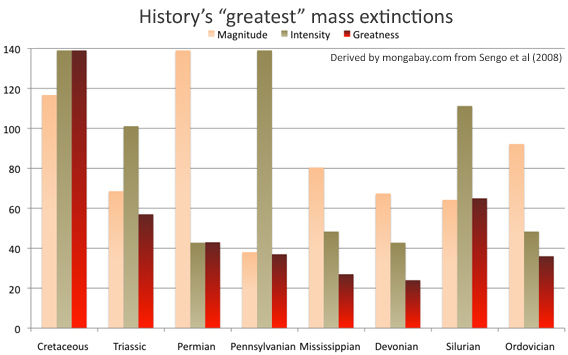
Global extinction event.  Where did I get a phrase like that?  It’s surely not my own language.  It’s one of those memes making the rounds of the Web.  But it’s not part of the lexicon of any of the parents I know.  They don’t want to think about it.  They don’t want to talk about it.  They don’t want to know.

How irresponsible is that, and how surprising, for parents who have been so conscientious, so completely invested in their role as primary caretakers and nurturers of their children.

It’s the privileged parents to whom I address myself most fervently. Parents who put so much time, energy and money into the task of raising their children, and do so with all their intelligence, responsibility and good will.  Parents who often have extra money to put towards a winter vacation someplace warm, or a summertime break by the beach.  Parents who are happy to send their kids to specialty camps in the summer, and who come up with the cash for school trips, afterschool lessons, an educational weekend in the city, a junior year abroad.

Privileged parents, listen up!  If you continue to turn a blind eye to the intertwined issues of environmental degradation and climate change, both of which are caused above all by enforced, ruthless economic growth based on the heedless consumption of fossil fuels and distribution of chemicals in the water, earth and air, your beloved children will face a future in which they cannot thrive.

A future in which none of us can thrive, unless it be perhaps the cockroaches, the ants and—for a while at least—scavengers like vultures and crows.
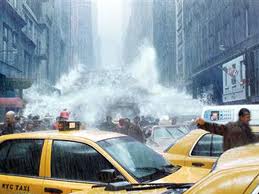
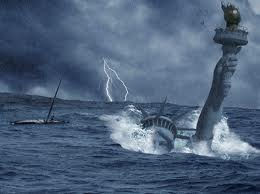
There have been so many disaster movies produced in the past few years—The Day After Tomorrow, 2012, WALL-E—putting out on the big screen our fears about what kind of future awaits us in an age of climate crisis and ecological collapse.  These movies represent our collective unconscious talking to us, presenting worse-case scenarios so that we can prepare ourselves for what may come.

We seem to like these movies because they give us the pleasure of stepping back afterwards and reassuring ourselves that it was just fantasy, not real.

The reports of the International Panel on Climate Change have none of the glamour of the big screen.  But they are saying the same thing as those disaster pictures.  They paint the same picture in different language.

It turns out that those disaster scenarios are real.

Sit with that knowledge for a bit, and then check in with yourself as a parent.  Once you accept that the looming environmental crisis is real, how can you continue to live your life blithely as though everything is OK?

Parents above all have a responsibility not just to take this knowledge seriously, but to act on what we know.  And parents of privilege–the 10%, the 25%–most of all.

We should be vehemently protesting the poisoning of our food, air and water.  We should be doing our utmost to stop the corporations who are wreaking this havoc, to change our own participation in the system, and to envision and manifest a better society that engages sustainably with the planetary ecological systems upon which we all depend.

Never before have we stood at such a juncture as a species.  Now is the tipping point.  Now is the time for us to stand up and be counted.  Now is the time for us to dare to take a path less traveled, to think for ourselves, to do what’s right for us and our children and the world we live in, before it’s too late.
It will not be easy, the road ahead.  There is so much to be done to turn this environmental train wreck around, and so little time.  We may not succeed.

But we cannot continue to play dumb any more.  We cannot continue to keep playing the game as if nothing were wrong, as if the biggest crisis of the past 10,000 years of human history were not on the horizon.  We cannot keep dancing to the band on deck as the iceberg looms before us.

There is too much at stake, for ourselves and especially for our children, whose lives—with any luck, and a lot of hard work—will reach further into the 21st century than ours.  If we care about our world—if we care about our children—we must act decisively, do whatever it takes.  Now.

The power of words for a world in crisis

So what am I, a Ph.D. in comparative literature with years of teaching experience in global women’s literature, gender studies and media studies, doing writing and thinking so much about the environment?

Why am I spending time blogging rather than diligently writing research-based articles for peer-reviewed academic journals?

I entered grad school part-time in 1984, first in English, and then in Comparative Literature.  Why those fields?

As an undergraduate, I started out wanting to major in environmental studies, but was soon turned off by the level of statistical empiricism required by my biology professors.  Having always loved to read and write, I gravitated towards English, and ended up interning for the local newspaper and becoming somewhat of a prodigy cub reporter.  I went on to work as a reporter for a daily newspaper, then a staff writer and editor for trade publications in New York City.

After a while, I missed the excitement of the classroom, began taking a class or two at night, and was soon drawn into the orbit of the comparative literature department at NYU, where things were really hopping in the late 1980s and early ’90s.  It was the time of the culture wars; of deconstruction and post-structuralist theory; of post-colonialism and eco-criticism and Marxist feminism.  It was an exciting time to be a budding scholar, learning to talk the talk and walk the walk.

And now here I am at mid-career, looking back and wishing that I hadn’t allowed myself to be discouraged from environmental studies so easily.

These reflections are spurred by the lead article in today’s Chronicle of Higher Education, about the Modern Language Association convention, which starts today in Seattle.  I’ve already written about why I’m not there, and reading today’s Chronicle article, I don’t feel too sorry to be missing this year’s conference.

The article, by Stacey Patton, presents a pretty bleak picture of the field of languages and literature–a picture I recognize only too well.  Enrollments in literature classes are at record lows, and many leading voices in the field are being called upon to explain just why an education in the humanities is of continued value in the 21st century.

The Chronicle article quotes James Donelan, a lecturer in English at the University of California at Santa Barbara: “We have been going about our business as if the study of literature were self-justifying, and that making an overt case for its relevance to society was somehow too mundane a task for us….The immediate consequence of this attitude is that we’re losing undergraduate majors and financial support at a terrifying rate, and the far-reaching consequence is that anti-intellectualism and a general lack of empathy are running rampant in civic life.”

Meanwhile, as many as 70% of English department faculty nationwide are so-called “contingent” faculty–hired as adjuncts, on a semester-to-semester basis, often earning minimum wage or less despite their doctorates and their publications.  As one angry commenter (evidently an adjunct English teacher) put it, “I for one will not encourage ANYONE to be an English major.  I will teach them their required composition classes for their OTHER majors because I know those majors will actually change their financial lives and allow them to support their families and move out of poverty.  This IS an elitist profession filled with elitist ivory tower ‘folks.’  Everybody knows it; that’s why the numbers in this field are dropping so much.  Get real.  Stop b.s.ing and face what is really going on.”

Yeah.  So we have an anti-intellectual student body, most of whom are highly resistant to reading books at all; combined with a demoralized and exploited faculty.  Although things are somewhat different at my college, it’s impossible to ignore what’s going on in the field as a whole.

And although some literature professors may be willing to put time and energy into justifying why it’s essential that we continue to study so-called “high literature,” like Shakespeare, Milton, Dante,  and Joyce–or even Pynchon, Rushdie, and Roth–I am not.

Egyptian author, doctor and activist Nawal El Saadawi

My whole career has been dedicated to the kind of literature that provides windows into the real material conditions of people living on the margins of society–people outside of the ivory tower, whose voices are rarely heard in the American classroom.  My own personal canon includes Rigoberta Menchu, Wangari Maathai, Buchi Emecheta, Gloria Anzaldua, Audre Lorde, Paula Gunn Allen, Shirin Ebadi, Nawal El Saadawi, Mahasweta Devi, Malalai Joya, Vandana Shiva, and many others, few of whom would be familiar to most of the scholars gathered at the MLA this year.

These writers have taught me, above all, to listen.  They’ve taught me to be aware of the intractability of my own privileged social conditioning, and to work hard at overcoming the elitist worldview into which I was born and raised.  And many of them have shown me again and again how in a patriarchal culture women are lumped together with Nature as commodified resources to be managed and controlled.

I never wanted to be a scientist.  My interest in environmental studies sprang from my love and reverence for the natural world, which was so strong in me as a child, and my horror at learning what human beings were doing to the flora and fauna of our planet.

Knowing what I know now about the dire urgency of the manmade threats to our ecological systems on Earth, I cannot sit by and write yet another academic essay on literary theory and disembodied “texts.”

Yes, I care about the sad state of English and literary studies in the academy.  But we’ve doomed ourselves, each of us, by the short-sighted and self-centered decisions we’ve made as individuals and as institutions.  If students today see reading books as irrelevant, and if administrators see English professors as expendable, well…who should we blame but ourselves?

As we hurtle into the 21st century with its multiple crises of climate, ecology and economics, I find myself  still reading, still writing, and circling back around to where I began, in environmental studies, where I will do all I can to use the power of the written word to ignite the social changes we so desperately need.

In narratives of women and the natural world, I have found my home–and my voice.

Shaking the crystal ball: the future is what we make it

As I slept on my last post, the ominous words “civil war” kept resounding discordantly in my mind.

Am I really advocating for civil war?  Me?  I’m so non-violent I won’t even let my kids bring an x-box or a Wii into the house, for fear they might play violent video games.  I’m so non-confrontational that when I get angry I get quiet, not loud.  I find violence of all kinds so abhorrent that probably the only thing that would get me enraged enough to fight back is, precisely, violence, especially if visited on the defenseless: animals, children, trees.

But leavergirl‘s comment this morning has got me thinking again.

She says: “We don’t have to toughen up, but we do have to get more cunning. No street demonstrations will bring a better world. Such things force surface changes with more or less the same problems underneath. The system knows how to coopt, and knows it very well. What will bring about a better world? Living the changes at the local level.

“It’s mindboggling that people think they can “force” changes via demonstrations and protests. After all, the people in power don’t know how, even if they wanted to. We all have to invent it as we go!”

Just as it doesn’t make sense to try to fight big money with more money, it doesn’t make sense to fight violence with more violence.  And she’s right that change has to happen at the local level–that is the whole “be the change” idea.

But can we afford, in this age of globalized capital and planetary climate change, to focus locally and ignore what’s happening on the national and global scale?

It seems to me that we have to do both.  We have to do our utmost in our own homes and backyards and town centers to push for the principles we believe in.  But we also have to keep an eye on the big picture, and add our voices to the chorus calling for a change in the grand narratives that drive social policy in boardrooms and legislative chambers.

Standing up and being counted in a protest does matter.  Voicing public dissent to master narratives, as I’ve been doing in this blog, also matters.  Practicing non-violence and respect in one’s home and community is also important.  That’s what the fourth point in my Manifesto is about:

4. Model egalitarian, collaborative, respectful social relations in the private sphere of the family as well as the public spheres of education, the profession, government and law.

Thoreau’s model of civil disobedience, like Gandhi’s and Martin Luther King’s high-minded non-violence, were effective tactics of resistance that had real, tangible results.

So no, I am not advocating for civil war.  I don’t want to see it come to that.  I am, however, saying that we cannot afford to sit back and hope for the best, or wait and see, or let others worry about it.  We just don’t have that luxury anymore.

I look around me and see so many of my friends who are parents investing so much time, energy, thought and care in the raising of their children.  We worry over every test score, we make sure they eat their organic vegetables, we carefully shield them from violence and pain.

How can we be so focused on the local care of our children that we miss the big picture, which is that the world we will soon be sending them out into is in crisis? How can we not take it as part of our parental duty to do all we can to ensure that when our children grow up, their planet will be intact and able to support them?

On New Year’s Day I had a conversation with my son that keeps ringing in my ears this week.  He expressed his anger at previous generations (including me, of course) who have so degraded our environment that as he now looks out into his own future, he cannot be sure that he will have any chance of realizing his dreams.

We talked about possible future scenarios, including one that seems to be coming up in various conversations lately: conditions of scarcity leading to armed gangs marauding in the streets and taking whatever they can find.  “We would be fucked,” he said bitterly.  “We don’t even have a gun in the house!”

There it is again.  Would having a gun in the house make us any safer?  Isn’t the problem precisely that there are too many guns in too many houses?

And is it inevitable that conditions of scarcity would lead to violence? Maybe it’s likely, but are there steps we can take now to promote a different outcome?

Back to the importance of the local.  Strengthening local communities can head off a dog-eat-dog mentality.  We are all in this together.  Together, we created the present moment we now stand on; and together we will create the future.

What future do we want?  We all want abundance; peace; stability; security.  I don’t think anyone in the world would argue with those general goals.

We have the knowledge and the technology, right now, to achieve these goals, worldwide.

We do!  If we turned our best and brightest minds to the task, we could drastically reduce our carbon emissions within a decade, while still enjoying electricity and heat through solar, geothermal and wind.  We could drastically improve energy efficiency and get rid of our wasteful consumerist mindset.  We could stop making bombs and missiles, and instead refocus those trillions of dollars into education and social welfare, including intensive sustainability efforts on all fronts.

We could do this.  But again, we need that unstoppable groundswell of demand for change. Locally and globally.  NOW.


A “Be the Change” Manifesto for the 21st Century

On New Year’s Day, 2012, I reaffirm my commitment to dedicate my talents and energies towards shifting our destructive global human society in a direction that values the ecological health of the entire web of life on Earth over the short-term gains of a minority of human beings.

I invite you to join me, and you would cheer me very much if you expressed your solidarity by responding to this post, if only with a “like.”

Manifesto for a Sustainable Future

Whereas human beings have acted in a dominating fashion towards each other and towards other living species on this planet, using the excuse of difference to justify aggressive and destructive behavior;

Whereas competition has been used as a rationale for economic systems based on hierarchical systems of power;

Whereas social exclusion and systematic discrimination has been seen as the normative right of dominant groups;

Whereas privileged groups have felt entitled to take more than their fair share from the environmental commons, and to deprive less powerful groups, whether human or of other species, of the resources necessary for well-being;

Whereas it is quickly becoming apparent, in the age of climate change, that the dominant paradigm of capitalist patriarchal social relations is resulting in the dangerous destabilization of the entire natural ecosystem;

The time has come to take action to change this paradigm in the following ways:

1. Move from a top-down hierarchical system to a horizontal, egalitarian model of social relations based on inclusivity across all of the traditional boundaries used to keep different groups apart, and also opening up the possibility for cross-species collaboration based on respect and stewardship;

2. Shift the worldwide economic system to a model of global cooperation and collaboration, with the focus of human industry and government on providing a baseline of well-being for all life forms on this planet, regardless of geographic origin or antiquated ideas of relative importance (ie, who is to say that a human being is more important than a songbird, or a sardine?);

3. Tailor the education system to teaching the history of the destructive cultural practices of homo sapiens up to the 21st century, and opening up constructive conversations across disciplines, where alternatives to these traditions can be envisioned and developed;

4. Model egalitarian, collaborative, respectful social relations in the private sphere of the family as well as the public spheres of education, the profession, government and law;

5. Shift from a violent conflict and punishment model of resolving disagreements to a peaceful persuasive model, with the goal always being the well-being of the community as a whole first, and secondly each member of it.

6. Destroy all weapons of mass destruction, as well as all bio and chemical weapons, and their blueprints.

7. Disallow any one person’s or minority group’s interests (with rich people and businesses or industries rightly being considered minorities)  to take precedence over the interests of the majority, including the non-human majority on this planet.

8. Develop an appropriate representative global governing council to administer these principles.

In the name of Mother Earth and ALL of her children, I call on the peoples of the world to act without delay to become the stewards of the planet and the collaborative, respectful individuals we were always meant to be.

Seeking balance in a bipolar holiday season

I have felt quite bipolar this Christmas season.

On the one hand, I have been going through all the familiar routines and patterns that I have observed at this time of year since earliest childhood: the planning, the extra shopping and cooking, the merry-making with friends and family, the sharing of gifts, especially for the children.  This is the way my parents always celebrated the winter solstice–not with any religious context, but simply as a festive time to light candles and keep a warm hearth against the winter dark and chill, bringing friends and family into the circle of friendship and good cheer, and exchanging gifts almost as a way of symbolizing the abundance accomplished in the previous year, and hoped for in the future.

On the other hand, I can’t escape the awareness of how well this playbook suits the capitalist economic model, which is relentlessly undermining the very abundance it seeks to enshrine, by pushing both the social system and the environment so hard that both are threatened with collapse.

The social conditioning that has made Christmas such a huge secular orgy of buying and exchanging gifts is very hard to break. If you don’t participate, you castigate yourself as a Scrooge, a boring wet blanket.  And you get depressed, too, because everyone else seems to be celebrating and having fun, while you–through your own perverse insistence on non-conformance–are off in a corner, worrying about the end of the world.

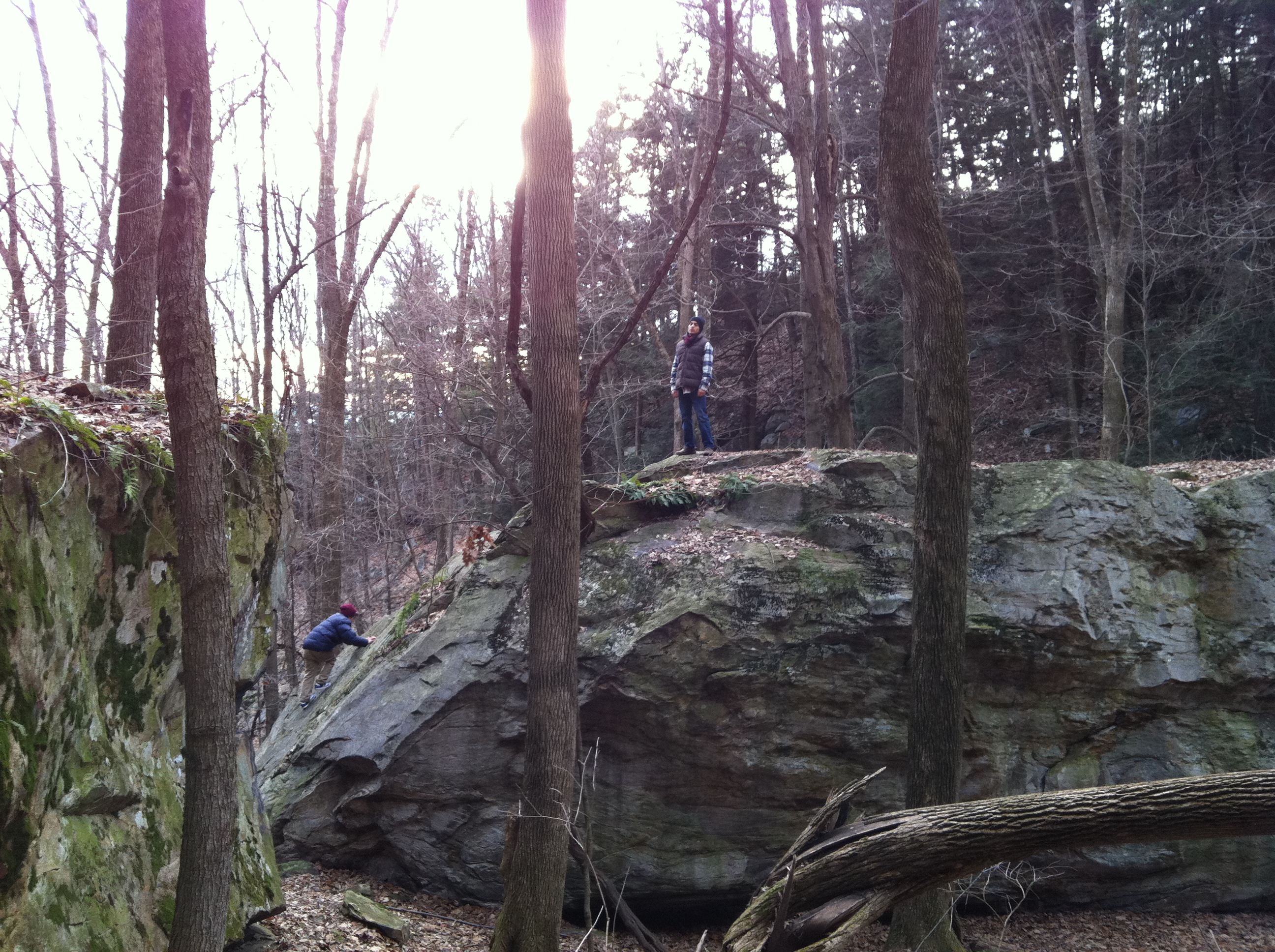
Yesterday, after opening presents by the tree and eating a cheery holiday brunch, my kids and I went for a long walk up the mountain that I can see from my front porch, the one over which the sun rises every morning.  Almost at our destination, we came through a narrow ravine in which several huge, craggy, beautifully colored boulders were scattered.

One presented one of those  classic overhangs that we know were used as sheltered campsites by indigenous hunters for millennia before the arrival of the Europeans.  Others were balanced with amazing precision, creating deep caves that we dared not explore in this season of hibernating bears.

There was an unmistakeable sense of age in that gathering of stones. Squinting my eyes, I could imagine the great glacier that had retreated down the mountainside, gouging out the flat ravine through which we now walked, and leaving the huge boulders scattered in its wake.  I could also imagine an even earlier time, when the rocks had been home to myriads of fish, with giant squid sleeping in the caves, instead of snoring bears.  Those great rocks have seen so much earthly history, standing majestically on their mountainside, unmoved by the shallower destinies of the flora and fauna that root on them or pass them by.

For a moment, putting my hand on the cold rough stone, my inner turmoil was calmed by a strong apprehension of the longer view of life on Earth.

It’s true that our current way of life, complete with its winking strings of colored lights powered by huge, dirty, out-of-sight mines, will not persist much longer.  Not with 7 billion people ravaging the globe like a swarm of ravenous locusts.

But these ancient stones have seen upheavals far more intense than what is currently on the horizon.  They have survived as silent witnesses to many cycles of destruction and regeneration.  They will be there, still silently bearing witness, after homo sapiens has become just another level on the fossil record of the planet.

There is strange comfort in this.

I still have every intention of trying to save our species–and so many other current inhabitants of Earth–by advocating for a transition from fossil fuels to renewables, and a shift from a civilization based on endless competitive growth to one based on collaborative stewardship of a steady state economy and a healthy, fully bio-diverse ecosystem. In my second half of life, this is the cause to which I will dedicate myself, second only to seeing through my job as a parent and giving my kids as strong a start as possible with which to face our uncertain future.

But somehow it helps to stave off despair, knowing that no matter how badly we may fail as a species, the planet will endure, and find new ways of prospering, new ways of combining the building blocks of creation into wondrous, miraculously beautiful and clever forms.

That knowledge forms a peaceful ledge on which to perch, between the bipolar swings of the season.  You’ll find me on this perch for the next week or so, quietly collecting my energy and my will for the struggles ahead.


De-coupling our wagons from the locomotive of global capitalism

There is a clear spectrum of response to the urgency of the environmental and economic challenges that face us.

On the one end is the Deep Green Resistance movement, calling for a complete take-down of industrialized civilization, violently if necessary (and it would be necessary, of course–industrial civilization won’t go down without a fight, unless it’s wiped out by natural disasters).

On the other end are those who believe we will be able to find our way into a sustainable world order via technology, ie, renewable energy sources that will keep the capitalist engines burning bright.

On this spectrum, I would have to locate myself somewhere in the middle.  While I see the necessity of deindustrialization, I don’t really want to live through the violent havoc a strong de-civ movement would cause.

But I know things can’t go on as they have been.  We must shift from an economic model built on endless growth to one that seeks to maintain a steady state, both for human societies and for the natural world (as if there were a separation between these two).

We must also shift from the capitalist system of accumulated wealth for the few based on the commodified labor of the masses, to a system in which people’s labor is more directly connected to their well-being, and wealth is not allowed to concentrate in a few disproportionately powerful, distant hands.

The only movement I’ve found so far that is actively working to accomplish a vision similar to what I’ve sketched out above is the Transition Town movement.  The brainchild of UK visionary activist Rob Hopkins, the movement describes itself as follows:

“The Transition Movement is comprised of vibrant, grassroots community initiatives that seek to build community resilience in the face of such challenges as peak oil, climate change and the economic crisis.

“Transition Initiatives differentiate themselves from other sustainability and “environmental” groups by seeking to mitigate these converging global crises by engaging their communities in home-grown, citizen-led education, action, and multi-stakeholder planning to increase local self reliance and resilience.

“They succeed by regeneratively using their local assets, innovating, networking, collaborating, replicating proven strategies, and respecting the deep patterns of nature and diverse cultures in their place.

“Transition Initiatives work with deliberation and good cheer to create a fulfilling and inspiring local way of life that can withstand the shocks of rapidly shifting global systems.”

What appeals to me about the Transition Town movement as a strategy for change is that it’s locally based and collaborative.  The first step is getting to know your neighbors, finding out what skills you can share, and taking stock of how you can prepare intelligently to cope with whatever environmental and economic shocks may lie ahead in our future.  It doesn’t dictate a one-size-fits-all model, but rather gives communities credit for being smart enough to figure out their own, locally adapted solutions.

As a society, America seems to be in collective denial about the reality of climate change.  We don’t want to hear that if we continue down the path of capitalist growth based on fossil fuels, the planet will heat up past the point where we could expect life as we know it to continue.  We don’t want to put the pieces together, because if we do, we will be forced to face the fact that we need to change. 

If we could accept this fact, we could begin to talk seriously about directions to take to make that change happen.  It would be nice if we could count on our world leaders to step up and face the challenge squarely, in a concerted effort.  But given the reality of global politics, still based on competition and armed power struggles, it seems very unlikely that we can look to the United Nations, or individual national governments, for the kind of decisive leadership we need now.

So we need to turn to each other, on the local level, and begin asking, as the Transition Town movement envisions, what can we do right here, together, to become more resilient?  What resources do we have, right here, that are not dependent on current systems of international or long-distance national trade?  How can we plan together for a sustainable future?

In a way, it’s an effort to de-couple our personal wagons from the locomotive of capitalist growth, which is proving so destructive to everything in its path, and seems to be on the verge of careening out of control.

I’ve been hearing a fair amount of fear expressed about “going backwards.” When people imagine stepping down from the capitalist growth model, they picture having to give up modern conveniences like advanced medical technologies, ready access to electricity, indoor plumbing, etc.

It doesn’t have to be that way.  We have to work on developing new ways of generating those conveniences, that are less destructive to the planet (the technological fix) and also work swiftly to dismantle those features of industrial civilization that are throwing our whole ecological system out of balance (de-industrialization).

The Transition Town movement calls this “the great re-skilling” approach.  We need to remember older, more sustainable ways of doing things, while also keeping the best of new technologies and learning how to apply them in smarter, more efficient and ecologically sound ways.

There are over 100 full-fledged Transition Town initiatives in the U.S., and hundreds more worldwide, along with many start-up groups forming all the time.  Although all of us seem to have so much to do, and so little time these days, this is really a movement we need to be focusing on now to prepare for the decade ahead.

Given the lack of effective top-down leadership, should we really be wasting our time worrying about national elections, for example?  Or bothering to go to international conferences on climate change?

Or is the smarter thing to do to begin, quietly and with determination and hopeful good cheer, to make our own preparations for a very different sort of future, in our own transition towns?

Swept away for the holidays? C’mon, Occupy, Let’s Go!

Looking back over the week, it seems like we’ve settled into some kind of holding pattern. The Occupy protests keep spinning, including a jubilant rally in Boston last night, but there is a feeling that we’re all waiting for the next shoe to drop…the next big push, the next new thing.

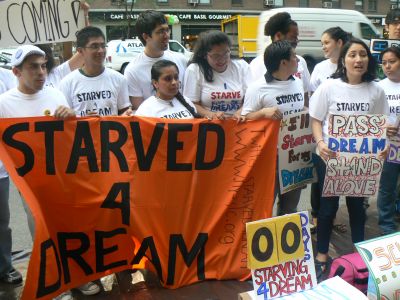
This week saw Occupy Foreclosures; next Monday there is a plan afoot to shut down the West Coast ports. The student protests are still sputtering; there is a group of hunger strikers in New York demanding a home for OWS;  and a stalwart group of climate activists has been braving relentless hostility to protest in at the COP 17 talks in Durban.

I’m glad to see all this stirring of outrage and energy.  I’m just starting to get confused by all the different tangents the movement is taking, and wishing for more focus and concentrated action.

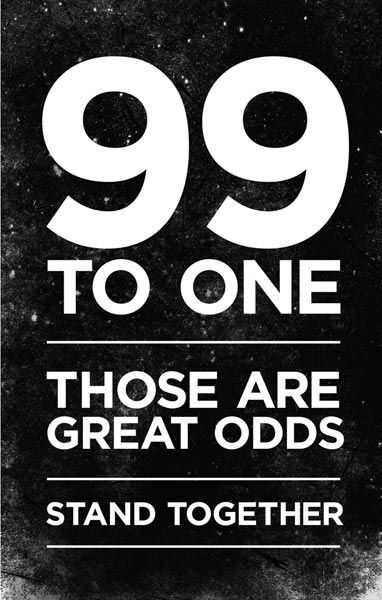
I want the 99% to be like a biblical flood that will wash all the corruption and evil away, leaving a sparkling new world ready for re-occupation.

I know full well that’s unrealistic.  It’s not meant to be taken literally.  It’s just the kind of mood I’m in: impatient, restless, tired of the same old same old.

I have that same feeling about the holidays this year.

Are we really going to go through those motions again?  Are we going to fool our little children into believing in Santa Claus?  Are we going to laugh and clink glasses at innumerable holiday parties?  Are we going to go on shopping sprees for presents at the malls?

Again I’m reminded of the band that was ordered to keep playing as the Titanic sank.  There’s a new 3-D version of the Leo DiCaprio/Kate Winslett Titanic coming out soon–as if what we really needed was to watch that horrible tragedy again, in 3-D.

Folks, I hate to be the bearer of bad tidings, but we need to stop fooling ourselves, we need to get real. If we don’t profoundly change our ways NOW, Mother Earth will do it for us, and she won’t be pussy-footing around.

I was listening to a news report today about how many billions of dollars in damage Hurricane Irene caused back in late August. Then there was the October snowstorm, knocking down trees and powerlines for millions of people in the Northeast.

What’s next?  How bad does it have to get before we stop pouring good money after bad, cleaning up after natural disasters that could perfectly well have been avoided if we focused on prevention rather than on damage control?

We do the same thing with health issues.  We spend billions looking for the “cure” for cancer, when the real issue is lurking upstream, in all the toxic chemicals we’re dumping into the environment and our own bodies.

We know what makes us sick. We know what is making our climate “sick” and out of balance.  We know how to fix it too–we need to start converting to renewable energy as fast as we can, immediately!  All systems go!

And it’s the same with the sociopolitical system.  We know where it’s broken.  Campaign finance reform is not a new idea.  Bank and finance regulation is nothing new.  Social policies that bolster the middle class are obvious.

WHY AREN’T WE DOING THESE THINGS?

The Occupy movement has the potential to fire up enough people to get out there and demand change.  The movement just needs to articulate a few clear, incontestably worthy goals, and pour all the creativity of the 99% into finding ways to pressure the ruling class to get the job done–or be swept away.

I don’t know about you, but I don’t much feel like celebrating this holiday season.  I feel like rolling up my sleeves, joining forces with my neighbors, and getting to work.  There is so much to be done, and so little time.

Occupying the Climate Talks & College Campuses–Full Speed Ahead!

Could be an interesting day today.  Word has it that the less-developed nations are threatening to “occupy” the climate talks at Durban if the big polluters–that’s us, America, and you too, Europe and China–won’t get serious about limiting emissions and working for systemic change.

Meanwhile, a student movement begun at UC Davis is calling for a General Strike today–no classes, no work–to create a space for student-run General Assemblies to discuss issues like police violence against peaceful protesters, as well as sky-rocketing tuition and debt-funded education that is putting college out of reach for more and more Americans.

I continue to be amazed at the speed with which awareness now spreads, thanks to how many of us are now plugged into what is coming to seem more and more like a collective brain.

Could the collective consciousness represented by the World Wide Web be an evolutionary leap forward?  Or could it at least be speeding up our evolutionary progression as a species?

Of course, it’s all dependent on electricity.  If the lights go out, our collective brain goes dead.

Or maybe not?  The General Assemblies, with their human microphones and patient face-to-face discussions give me hope that the new connections that are being forged in this time of transition are real and could stand alone, without the crutch of the Web.

In fact, maybe that’s what this is all about.  Building the human connections, virtual and real, to withstand the great shocks that are coming our way as the climate shifts and the Earth seeks to return to a steady state.

In Durban, South Africa and on college campuses and public parks across the country, people are turning out to be the change we want to see.

It’s an exciting time to be alive.


Ripples of change, from kitchen tables to public parks

This morning, in my parents’ house, a scene took place that underscored for me the extent to which the Occupy movement has entered the collective consciousness.

The man who has taken care of my parents’ property for the past 30 years or so had come by to say hello, and was standing in the kitchen complaining about how the oil companies are making billions while the price of fuel oil and gasoline goes ever higher for ordinary consumers.

He is a lifelong Republican, but voted for Obama in the last presidential election, having had enough of the Bush crowd with their lies and their wars.

Listening to his critique of the mega-oil companies, my mother turned to him and said teasingly, “So who should we occupy now?”

We all laughed and the conversation moved on, but there is an underlying element of seriousness there that amazes me when I think about it.

A few months ago, we might have complained, but without any thought of actually doing something to bring about change.

Now, suddenly, options are open to us.  We could go down and occupy the local gas station with some homemade signs, and probably get a lot of support from people filling their tanks.

Yes, we all do fill our tanks.  But instead of holding the resentment inside, there is now an outlet for it, a way to talk about it together that is not about the two parties and their endless childish jockeying for power, but about something deeper: the longing for and the pull to real change.

I have to admit I was disappointed that apparently Black Friday consumer shopping was more vigorous than ever this year. But it’s surely no accident that fights broke out at WalMarts across the country, where people who have precious few dollars to spend on their holiday shopping turned out on Black Friday to try to get some bargains.

What’s fascinating, and under-reported, is that on Black Friday, thousands of Chinese factory workers went out on strike to demand living wages and job security.  These are the workers who are supplying the products being sold as “bargains” in America, mostly to workers whose jobs have been outsourced–to China!

Marx’s dream of an international uprising of the proletariat has never been more possible, thanks to be magic of the internet.

And somehow the barriers between American consumers and Chinese producers–or between professional-class employers like my parents and blue collar workers like their property caretaker–are coming down.

There seems to be a new zeitgeist stirring the stagnant air of American social relations.  Is it the age of Aquarius?  The alignment of the planets?  The infamous Mayan 2012?

Whatever it is, let’s seize the moment and make the most of it.  Let’s talk up a storm, sharing ideas and encouragement with everyone we meet.

If a butterfly in Brazil can cause a hurricane in Texas, then maybe a casual conversation in your kitchen can be the catalyst for a change that will sweep the nation, and the world.  It’s certainly worth a try.

Honoring Native Americans on Thanksgiving

Thanksgiving in the U.S. is about gathering together with friends and family and giving thanks for being able to stuff oneself with a huge meal.

It’s one of the most important holidays of the American capitalist religion, second only to “Christmas.”

Its founding myth is the fateful meal shared by the indigenous peoples of Massachusetts with the starving English Pilgrims.  The Pilgrims “gave thanks” at that meal for the generosity of their hosts, and thus was born the tradition of a November Thanksgiving feast.

To my way of thinking, Thanksgiving should actually be a day of atonement marked by fasting, in the spirit of Yom Kippur, Lent or Ramadan.

We Euramericans should be reflecting and repenting on this day for the way our ancestors turned on their Native hosts, once the time of starvation was past.

We repaid their kind welcome with a shameful record of stealing, swindling, enslavement, displacement and deliberate infection.

We waged vicious war that slaughtered children and old people along with warriors both male and female.

We occupied their lands without a second thought, and proceeded to cut the primeval forests to make room for our livestock, roads and cities.

This pattern started with the Puritan Pilgrims in Massachusetts, and spread inexorably West, all the way to California and Texas, where indeed the brutal work had already been begun by the Spanish.

I don’t really expect Americans to give up the tradition of the jolly Thanksgiving feast.

But we do need to be mindful of the real historical background behind the custom of gathering to celebrate with family and friends.

American Thanksgiving is a holiday that honors the spirit of sharing the bounty.  When we dig into that heaped plate today, we should be giving thanks to the rich Earth that has nourished human beings for millennia, and for the Native peoples of this continent, who learned how to live in harmony with the flora and fauna of this place, cultivating the first corn, beans and squash, and craftily culling the abundant indigenous turkeys.

And we should pause in our feast to reflect on the ignoble history that unfolded after that original Thanksgiving in Plymouth MA, where America repaid her hosts not with honor, but with persecution, scorn and hate.

In the act of repentance springs redemption.  The indigenous people of this continent are not gone–they are alive and well and living among us.  Let us raise a glass to them today and give them the honor and thanks they deserve.

Wamponoag leader Massasoit