Holding the Fort for the Humanities

Michael Berube

Michael Berube

In a recent address to the American Council on Graduate Schools, out-going Modern Language Association president Michael Bérubé argues trenchantly that American graduate education in the humanities is in a state of crisis, and in urgent need of structural revision.

But to my mind, he does not go nearly far enough in his thinking.

“Graduate programs in the humanities have been designed precisely to replenish the ranks of the professoriate; that is why they have such a strong research component, also known as the dissertation,” Bérubé says.

But “the overall job system in the humanities has been in a state of more or less permanent distress for more than 40 years,” with doctoral programs “producing many more job candidates than there are jobs; and yet this is not entirely a supply-side problem, because over those 40 years, academic jobs themselves have changed radically. Of the 1.5 million people now employed in the profession of college teaching, more than one million are teaching off the tenure track, with no hope or expectation of ever winding up on the tenure track.”

So, he asks, how can we, in good conscience, continue to encourage students to enter graduate programs in the humanities, knowing the grim future that awaits most of them?

Bérubé reminds us that “the study of the humanities is more vibrant, more exciting, and (dare I say it) more important than it was a generation ago….The sheer intellectual excitement of the work, whether it is on globalization or subjectivity or translation or sustainability or disability, is one thing. This work is so valuable—and it offers such sophisticated and necessary accounts of what “value” is.

“And yet when we look at the public reputation of the humanities; when we compare the dilapidated Humanities Cottage on campus with the new $225-million Millennium Science Complex (that’s a real example, from my home institution); when we look at the academic job market for humanists, we can’t avoid the conclusion that the value of the work we do, and the way we theorize value, simply isn’t valued by very many people, on campus or off.”

Unfortunately, Bérubé doesn’t bring up the deeper questions about why our society currently values science and business so much more highly than the humanities.

Why is it that professors in the humanities make a fraction of what professors in business, law or science earn?

Why is it that academic programs in the humanities are under constant threat of the budget ax, while programs in business and science continue to attract huge inputs of resources?

Is it any surprise that students take a look at the depressed adjunct faculty in their dingy offices and take the nearest exit for the shiny new science building?

To me it’s pretty obvious: in our capitalist society, the academic fields that are most highly valued are those that create the possibility of more profit—with profit crudely conceived of as dollars in the bank.

My work in the field of comparative literature over the past 20 years, for example, has little to show for it in terms of money in the bank.

I’ve been focused on bringing the voices of marginalized or lesser-known women writers and activists to wider audiences within and outside of the Ivory Tower, because I believe that the perspectives offered by these women writers bring important, under-recognized and certainly under-valued ideas to the intellectual table.

For example, writers I study, like Rigoberta Menchu (technically not a “writer,” as her texts are transcriptions of her oral testimony), Vandana Shiva, Audre Lorde and Gloria Anzaldua, have been arguing for many years that human society must begin to honor our differences and value our interconnections with each other and with the natural world, in order to create a just and sustainable society.

Lorde, long ago, recognized that the “masters” are interested in keeping the oppressed divided, competitive, fighting with each other for the crumbs.  She urged us to think outside the box, “for the master’s tools will never dismantle the master’s house.”

The truth is that the humanities are dangerous ground for the “masters” of Euramerican society, because it is in the various academic terrains of the humanities that moral and human values are debated and interrogated.

It is no accident that critiques of capitalism itself, along with capitalist tools like elitism, militarism and globalization, have found their strongest purchase in the humanities.

Humanists who follow the lines of intellectual inquiry stretching back to the dawn of human written traditions and forward into the speculative reaches of science fiction and futurism, often find ourselves thinking outside the box of the current capitalist structures into which we have been born and indoctrinated to accept.

The moral questions raised in many humanities classrooms are themselves alternatives to “the master’s tools,” and they have the potential to dismantle the master’s house.

That is why, I believe, the humanities are currently being starved and derided by the masters.

That is why adjuncts in the humanities are being paid less than a living wage, discouraging the best and brightest from choosing that educational and career path—unless they are independently wealthy.

Bérubé ends his speech by suggesting that graduate programs in the humanities need to begin to combine the traditional focus on research, writing and teaching with the development of skills and connections that can help Ph.D.s secure good jobs outside of the professoriate, since he does not foresee any change to the current trend of an overwhelmingly low-paid, adjunct humanities workforce.

He points to the “digital humanities” as a prospect, since highly trained academics who can translate their knowledge into digital formats are more likely to find work in business, publishing or media.

I wish he would think a bit more radically.

As one of the humanities thought leaders of our time, I would like to see him come out and say that the deep questions of the humanities–questions about society, ethics and social and ecological justice–are precisely the ones that we need to be asking most urgently today, whether the masters like it and support it or not.

I know, up close and personal, how hard it is to wage this lonely battle, watching all the honors and riches going to colleagues who are willing to do the masters’ bidding more compliantly.

Sure, biotechnologists and creative financiers are going to get more funding and more accolades than someone like me, who studies ethics via personal narratives by little-known women writers.

But in the long run—or what is increasingly, in our era of climate change, seeming like the short run!—I believe that the wisdom these women have to offer will be more important than the latest patent on bio-engineered corn, or the most ingenious restructuring of debt derivatives.

Humanities education is one of the last outposts of oppositional thinking within the Academy.

Let’s hold our positions with honor, knowing that even if the material rewards are scant, we do get to keep our integrity, and do our best on behalf of the planet and all its denizens.

MOOCs for the Masses

imagesThe automation of education is one of the big issues of the early 21st century, and in the halls of higher education, where I hang out, it’s very controversial.

The leaders of small colleges like mine are watching nervously as the big boys jump on the MOOC bandwagon, throwing their immense resources behind the development of sophisticated online learning platforms designed to serve hundreds of thousands of students at a clip.

So far these courses are not available for actual degree credit, but the accrediting corps is not far behind, busily working on the conceptual architecture needed to award students college credit no matter which institution’s logo is on the screen.

Once this is fully operational, students will be able to work towards a college degree in patchwork fashion, taking math and science courses from MIT, liberal arts from Yale, and philosophy from Princeton along the way to their shiny new 21st century B.A.

The minute the technical hurdles to this system are worked out, the floodgates of online learning are going to open for real.

Those who are skeptical of the quality of online learning argue that even video conferencing, now widely available through Adobe Connect or Google Hang-out platforms, cannot match the electricity of ideas exchanged face to face, facilitated by a well-trained, talented instructor.

This is the argument used by small liberal arts colleges like mine to justify the continued emphasis on bricks-and-mortar institutions, and there is truth it, as long as the class sizes are small and the instructors are not only knowledgeable, but also  skilled at facilitating discussion.

But let’s be honest: most American students do not have the benefit of attending small liberal arts colleges, because the small student/teacher faculty ratio is incredibly expensive to maintain.

LectureHallHaving spent nearly a decade teaching on a State University of New York campus, I can attest that most undergraduates there sit in large lecture halls where they watch powerpoint shows narrated by a teacher down at the podium.  That is, when they bother to go to class.

There is no question that such lectures could be more easily and cheaply delivered online, sparing the professor the travails of explaining Chemistry 101 yet again to another generation of yawning, surfing students.

Big institutions are now getting excited about “flipping the classroom,” meaning: the student watches the lecture on her own time, as homework, and then comes into the classroom for a discussion about the material.

My question, as a higher education insider, is: who is going to lead that discussion?

My guess is it will be graduate students and adjunct professors doing the discussion leading, as it has been for many years already with tenure-track professors who give the lectures and leave the work of actually interacting with students to their teaching assistants.

The ramifications of this for higher education as a field of employment remain to be seen.  For the moment, most people who are thinking about online learning are much more focused on the students (the “clients”) than on the labor issues involved.

Clearly, a professor who can teach 100,000 students at a time is going to be offering a lot more value to the institution than a professor who teaches 20 students at a time, especially if at least a percentage of those thousands of online learners start to pay for credits towards a degree.

As the century goes on, we’re going to see fewer tenure-track professors and a lot more adjuncts.  The field was going this way anyway; online learning is just going to put the trend on hyperdrive.

Faculty advocates in higher education need to be focusing on the issue of a living wage for adjunct professors now, because once American adjuncts are competing with part-timers all over the world, we’re going to see the out-sourcing of American education bigtime, with unpredictable results.


Meanwhile, globalization cheerleaders like Tom Friedman are waxing enthusiastic about the idea of beaming lectures by Harvard professors to remote locations around the world.

“For relatively little money,” Friedman said in a recent column, the U.S. could rent space in an Egyptian village, install two dozen computers and high-speed satellite Internet access, hire a local teacher as a facilitator, and invite in any Egyptian who wanted to take online courses with the best professors in the world, subtitled in Arabic.”

Yes, this would be globalization with gloves on, and certainly far better than spreading American-style ideology at gun and loan-point, as we did in the 20th century.

MOOCs are already opening up the previously hallowed halls of the best American institutions of higher education to new, worldwide audiences.

As Friedman reports, the head of the new Harvard/MIT online platform EdX, Anant Agarwal, said that “since May, some 155,000 students from around the world have taken edX’s first course: an M.I.T. intro class on circuits. ‘That is greater than the total number of M.I.T. alumni in its 150-year history,” he said.’”

In the next few years, we’re going to see online learning take off bigtime, as more and more students clamor for the opportunities it affords, and higher education leaders perceive the huge benefits in cost savings that will result from not having to house all the students they serve.

We’re going to see more and more students living at home with Mom and Dad right through their undergraduate years, whether it’s here in the U.S. or, as Friedman imagines, in some Egyptian village.

From the point of view of the average student, the one who would not in any case be able to afford or get into a selective liberal arts college, this may be for the best.  Certainly it would be better to live at home a few more years than to incur heavy debt burdens for the privilege of living on campus.

Students and their parents are already viewing education in increasingly utilitarian terms; as they contemplate getting on the B.A. track they want to know What can I do with this degree? What jobs will it prepare me for?

They’re looking for the most practical, value-added route to the goal—a secure, interesting, well-paying career.

images-1There are always going to be elite undergraduate colleges ready to give a premium, face-to-face educational experience to those who can pay for it, just the way there are still deluxe prep schools available even though most Americans go to the public high school down the road.

Faculty at these colleges will continue to teach small classes, where students are encouraged to be creative, critical thinkers, to question authority, to write papers rather than take tests, and to get to know each other both in and outside of class.

Just as future queen bees are given a far richer diet than future worker bee, there will be different educational strokes for different folks.

The real question, as we enter the MOOC era, is whether education will continue to serve as a vehicle for social mobility, as it did so strongly in the 20th century, or whether we’ll have online learning for the masses and bricks-and-mortar for the elite, with the gap between the two growing ever wider.

American Mothers Must Unite Against the Culture of Violence

A couple of weeks ago, when I heard that my 14-year-old son and his friend had been playing with the other boy’s air-soft pistols by shooting each other at close range, I saw red.

“But it just stings like a bee-sting, Mom,” my son protested.  “It just leaves a welt.  Why are you getting so upset?”

At the time, I wasn’t sure why I was getting so upset—after all, these were only toy guns.

My answer to my son was that a “bullet” could ricochet and end up hitting him in the eye, which is true and a rational explanation for why I flatly forbid him to engage in that kind of behavior any more with those guns.

“Target practice only!” I insisted. But of course, what he and his friends do when I’m not around is impossible to predict or monitor.

Nancy Lanza

Nancy Lanza

Now, after the Newtown massacre, I am thinking more deeply about the issue of guns, violence and kids.  I’m also thinking more about Nancy Lanza, the gunman’s mother, who he savagely shot in the face, leaving her dead in her pajamas in bed while he went out on his mission of mass murder.

I’m far from the only one who is asking what Nancy Lanza could have been thinking to make her home into an arsenal, complete with assault weapons and major ammunition, especially with a son living there who she knew to have social adjustment problems.

I hear that the good people of Newtown are shunning Nancy in death, focusing on the “26 victims” of Adam Lanza and refusing to light a candle in her memory.

This seems like a classic case of blaming the victim, and yet of course Nancy does bear responsibility for the horrific massacre of the 26 innocent victims.

If she hadn’t armed her son, he could not have carried out this crime.

So this begs the question of our responsibility as parents, especially, in this context, as parents to sons.

I have two sons, and like Nancy I am divorced, with my sons’ father very distant from their day-to-day lives.

It is my responsibility to raise them to be kind, good-hearted men, who use their warrior strength to protect and strengthen their communities, not to destroy.

But what a battle it is to keep the tremendously destructive tsunami of media and cultural violence at bay in our home!

I don’t have TV in my house, and my kids don’t own a Wii or Playstation.  But we do have computers, tablets and smartphones; we watch Netflix and go to the movies and have friends who are more casually accepting of (toy) guns than I am.

Unknown-1I have tried to hold the line on violent video games that the boys may have access to through the computer, and for the most part I think I’ve been successful.  Even if they may sneak a violent game or two when I’m not around, at least they don’t play these games obsessively, with impunity, the way most teenage boys do in America.

We’ve talked at length about my objections to media violence, and I know they understand, even if they occasionally express the wish that they could just join the crowd and go on a good virtual shooting rampage like all the other boys they know.

I’ve gotten into arguments with my older son, age 20, and some of my college students, who insist that there is no way they’d ever do in real life what they have so much fun doing in video games.

I hope they’re right.

But I want to know why, as Americans, we tolerate and indeed seem to relish representations of violence, while at the same time we’re so fearful of actual violence that some of us are stockpiling weapons in our homes to prepare ourselves for the worst.

In the old days—not that long ago, in the scale of human history—a whole town used to turn out for a festive viewing of a hanging.

Today in places where conservative Islam reigns, women are stoned to death in public spectacles of participatory violence.

But how different is that, really, from the great American past-time of engaging in virtual violence of the most vicious sort?

America is the most violent, militarized society on Earth and Americans are the greatest exporters of violence, both physical and virtual, to the rest of the world.

Most perpetrators of violence—again, both real and virtual—are men.  Men are the greatest victims of violence too, though women and children bear a disproportionate share, given that they are far less likely to be pulling the triggers.

We need to start looking much harder at the way our culture encourages violence by selling us the story that real men enjoy violence and can handle it with insouciance.

I don’t want my teenage son shooting an airsoft gun at his friend, and I don’t want him going on virtual “special ops” missions armed with a Bushmaster assault rifle.

I wish his father were on hand to back me up in this, and I think my situation as a mother trying to keep violence out of my home is probably far more common than we realize as a nation.

We know that half of marriages end in divorce, and I wouldn’t be surprised to learn that of the remaining married couples, half include men who enjoy guns, violent video games and violent movies, and teach their sons to do the same.

So that leaves a lot of us women either on our own trying to fight the prevailing winds of culture and raise peace-loving men, or tolerating or going along with the culture of violence within our most intimate relationships and the private sphere of our homes.

Yes, some women may themselves be violent.  We still don’t know why Nancy Lanza felt the need to arm herself with such terribly potent weapons.

But the fact remains that of the steadily mounting toll of mass shootings in this country, not one has been committed by a woman.

Women are way more likely to be victims of violence than perpetrators, and even as perpetrators they are generally acting in self-defense.

American women, I call on you to look deeply at this issue, and find the strength to stand up collectively against the violence.

Mothers, we need to support each other on this!

Just as the Mothers Against Drunk Driving took a stand and changed the pattern of teenagers driving drunk and killing themselves and others year after year, by forcing legislators, schools, merchants and other parents to take collective responsibility for raising responsible kids, we need to start a new movement against the culture of violence in our country, both virtual and physical.

Then perhaps we could say that the 27 victims of Adam Lanza did not die in vain.

Unknown

Something is rotten in the state of higher education: time for change!

Higher education today is like a feudal castle, with the King living in opulence, his knights doing well as long as they serve the king faithfully, and the servants toiling away in perpetual bondage.

President Shirley Ann Jackson of Rensselaer Polytechnic Institute in Troy, NY, is the highest paid private college president in the land

President Shirley Ann Jackson of Rensselaer Polytechnic Institute in Troy, NY, is the highest paid private college president in the land

Thoughts of Elsinore are rising to mind today because of a new report detailing just how wealthy those academic Kings are: The Chronicle of Higher Education reports that “In 2010, 36 private-college presidents earned more than $1 million,” and among the 493 presidents surveyed at private American colleges with budgets exceeding $50 million, the median compensation was $396,649.”

In contrast, a recent American Association of University Professors survey found the average faculty salary at American institutions of higher education to be $82,000—but this average is pulled way down by the inclusion of “instructors” in the mix, for whom the average salary was $47,000.

Tenured faculty, in the Elsinore analogy, would be the nobles of the realm, the knighted vassals who serve the King in the castle, and are richly rewarded for their allegiance.

They are supported by a legion of staff, including graduate teaching assistants and adjunct faculty, whose salary falls behind the cost of living a little more each year.

And then there are the serfs in the system, whose labor supports it all: the students and their parents, many of whom are forced into a new kind of debt bondage to attain the gold ring of that vaunted college degree—paying ever-increasing tuition, and ever-increasing taxes as well.

What would make young Hamlet really moody these days is the growing recognition that the college degree just isn’t worth what it used to be.

Kevin Carey, director of the education policy program at the New America Foundation, cites Academically Adrift, the damning study by Richard Arum and Josipa Ruksa, which “found that many students at traditional colleges showed no improvement in critical thinking, complex reasoning and writing, and spent their time socializing, working or wasting time instead of studying.”  And then, he adds, there are all the students who enter college but never end up graduating, often because the price is too high or the academic work too dull.

At the graduate level, too, there is a sense of crisis.

According to Chronicle of Higher Education reporter Stacey Patton, “The student-debt problem, coupled with the dearth of jobs, has sparked a national conversation about whether going to graduate school is worth it.”

At the Council on Graduate Schools annual meeting this month, Patton reports, the buzz was about whether it’s “unethical to keep admitting students to programs and training them for jobs that don’t exist while they are racking up piles of debt only to risk finding university employment as just an adjunct, or obtaining some other low-wage job for which a graduate degree is not necessary, or ending up on food stamps.

Poor Hamlet, who just wanted to go back to Wittenberg and bury himself in philosophy!

These days, the humanities are particularly beleaguered, with leaders among the humanities professoriate having to constantly deliver pep talks to the rank and file on why what we’re doing matters.

“We should keep telling our students (and their parents) that ‘doing the humanities’ prepares them generally in a way no narrow occupational degree can,” says Rosemary Feal, Executive Director of the Modern Language Association.

“When we say the word research,” she continues, “most people don’t think of the humanities, and they have trouble recognizing the product as useful. It’s true that “doing the humanities” doesn’t produce scientific knowledge that can, say, cure cancer. But it can yield imaginative works on cancer like Susan Gubar’s Memoir of a Debulked Woman and Mary Cappello’s Called Back: My Reply to Cancer, My Return to Life that change people’s lives.”

It’s interesting that when pressed to think of humanities work that “changes people’s lives,” Feal points to two memoirs as examples.

As someone who is currently writing a memoir, and who has studied personal narrative since my dissertation (entitled Hybrid Encounters: Postcolonial Autobiographies of the Americas), I have to agree with Feal that personal narratives have great educational value.

Human beings have been sitting around campfires telling stories since we first began to use language.

We have always learned by listening to our elders hand down traditional stories, and inventing new ones.

The tragedy of Hamlet, for example, was Shakespeare’s reworking of the older Scandinavian tale, and it illustrates vividly the dangers of puffed up pride, greed and ruthless ambition.

The desire of Claudius for wealth and power blinds his moral sense, and in killing his brother, marrying his sister-in-law, and plotting to kill his nephew, he sets the stage for the total destruction of the royal house of Elsinore, leaving it ripe for the plucking of the neighboring Prince, Fortinbras, who is as decisive and aggressive as Hamlet is moody and tentative.

In our current educational landscape, the Fortinbras army waiting in the wings might be robotic: the legions of online courses that are swiftly breeching the walls of Castle Academe.

Online learning has the potential to be as revolutionary as the rise of industrial capitalism back in the 19th century.  Suddenly the educational territory cannot be entirely controlled by the King in his castle, although to be sure he is dispatching his Knights left and right to try to secure his boundaries—every day brings word of new online learning consortiums or treaties being signed in the scramble to lock down the goldmines of higher learning.

But what kind of educational model are those Kings of Academe trying so hard to protect and secure?

The kinds of subjects that lend themselves best to MOOC virtual classrooms (that’s Massive Open Online Courses, for those new to the territory) are those that can be taught by lecture and multiple-choice exams.

But does young Hamlet, or any other thoughtful, creative young person, really want to be lectured to and tested on canned, pre-recorded knowledge?

Wouldn’t he rather be engaged in a dialogue with his elders, or a dynamic, free-ranging conversation among his peers and their mentors?

Online technology does have the power to help open up multiple conversational platforms.  Since the advent of the internet, we humans are conversing globally in ever-expanding ways, and the price of admission to the conversation is fairly low: a computer and an internet connection is all you need, for starters, to get into the game.

But to succeed in this brave new social landscape, you do need competence with those familiar old tools of the humanities trade: the ability to read and analyze critically; the ability to write and speak with precision and thoughtfulness; the ability to sort through, understand and analyze the massive amounts of complex data that are thrown at us every day through the media.

The Kings of Academe must not lose sight of this bedrock mission of higher education in their rush to consolidate their hold on the online learning market.

The old model of having students physically living on a campus with their professors on the outskirts may not hold up in the 21st century, other than at a few of the most fabulously wealthy castles like Harvard, Yale and Princeton.

Is it worth having students and their parents bury themselves in debt to afford the tuitions that keep brick-and-mortar campuses running?

Maybe not.

But in this transition time, let’s make sure we hold on to what’s best in the old system, while getting rid of what no longer works.

I am all for increasing the horizontal democratization of learning, which is the promise of online education, as long as it doesn’t lead to the pauperization of the professoriate, the students and their parents, all toiling beneath bloated administrators.

It’s possible that we may be able to transition to what is now being called “blended learning” environments, rather like today’s distance MFA programs, which convene students for intensive sessions four times a year, but otherwise have them working in small online learning groups facilitated by a professor.

But it’s also possible that it may be time for some really profound change.  What if, instead of having to choose between Elsinore and Wittenberg, young Hamlet could reject both these traditional poles and instead strike off on his own, relying just on his own creativity, wits and drive?

What if he could access the maps, equipment and tools he needed to succeed from other entrepreneurs like himself, free agents circulating their skills in the grand market of online ideas?

Maybe massive fortunes wouldn’t be made this way, but isn’t it becoming painfully clear that the growth and accumulation model of economics is crashing and burning these days, going down like Claudius under the weight of its own greed?

A new kind of barter system might work just as well or better, if the goal were happiness and productivity, rather than frantically making enough cash to stay ahead of the debt collectors.

Joi Ito

Joi Ito

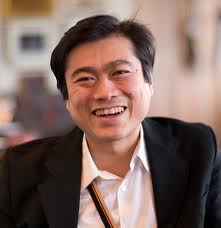
I am excited by the vision of Joi Ito, the dynamic new director of MIT’s influential Media Lab program.  Ito, profiled in a recent issue of WiredUK magazine, wants to break down the castle walls of academe, and get students and their professors out into the streets where the action is.

“In the old days,” he told WiredUK,  “being relevant was writing academic papers. Today, if people can’t find you on the internet, if they’re not talking about you in Rwanda, you’re irrelevant. That’s the worst thing in the world for any researcher.”

At the Media Lab, it’s not about students passively sitting and taking in a professor’s canned words of wisdom.  Instead, posses of students and professors work together in the labs and out on the streets to find creative solutions to real-world problems.

“By opening up the Media Lab,” WiredUK reports, “Ito hopes to move closer towards his goal of  ‘a world with seven billion teachers,’ where smart crowds, adopting a resilient approach and a rebellious spirit, solve some of the world’s great problems.

“His is a world of networks and ecosystems, in which unconstrained creativity can tackle everything from infant mortality to climate change.

“‘We want to take the DNA [of the lab], the secret sauce, and drop it into communities, into companies, into governments,’ he says. ‘It’s my mission, our mission, to spread that DNA. You can’t actually tell people to think for themselves, or be creative. You have to work with them and have them learn it themselves.’”

Ito has just placed his finger on the prime value of education at any level: helping young people learn how to think for themselves and be creative.

Young Hamlet had that gift, which is why he was able to escape the clutches of Claudius and maintain his own principles in even the poisonous atmosphere of Elsinore.

Laertes, whose poisoned sword kills both Hamlet and himself, is the other kind of student: the kind easily influenced by a corrupt mentor like Claudius into playing foul in the quest for personal gain.

In this day and age, we need to be teaching our young people not only to be creative problem-solvers, but also to be ethical, principled human beings who are willing to take risks and stand up for what is right and just—even if this means foregoing easily attainable blood money.

The Media Lab’s Ito has observed that “a lot of the kids at the Media Lab today don’t want to make more money, don’t want to become immortal, they just want to figure out how to fix this unhealthy system we have. There are lots of kids who are not happy with this massive consumerism, this unsustainable growth, but who have really smart science and technology values. That’s a type of person we can draw into what I think will become a movement.”

What kind of movement? A creative commons movement (Ito, by the way, was one of the founders of Creative Commons and the Mozilla Foundation), in which some of the key principles would be, in Ito’s words: “Encourage rebellion instead of compliance”; “Practice instead of theory”; ” Constant learning instead of education”; “Compass over map.”

Exactly the kind of principles that Hamlet employed to successfully navigate Elsinore—until he was undone by the treachery of Claudius and Laertes.

But get a billion young Hamlets–and Ophelias!–going, and there will be no stopping them.

“In the old days,” Ito told WiredUK,  “you needed hundreds of millions of dollars and armies of people to do anything that mattered. Today a couple of kids using open-source software, a generic PC and the internet can create a Google, a Yahoo! and a Facebook in their dorm room, and plug it in and it’s working even before they’ve raised money.

“That takes all the innovation from the centre and pushes it to the edges — into the little labs inside the Media Lab; inside dorm rooms; even inside terrorist cells. Suddenly the world is out of control — the people innovating, disrupting, creating these tools, they’re not scholars. They don’t care about disciplines. They’re antidisciplinary.”

This kind of talk, as Duke University professor Cathy N. Davidson observes, has many traditional educator-types quaking in their boots.

Tenured faculty tend to be rather complacent as a group, since their jobs are assured for life—unless, that is, their institutions fail.  The truth is that we are in a sea-change time when many of the weaker institutions of higher learning are likely to be weeded out.

We have, right now, a fantastic opportunity now to break out of what Davidson calls the “Fordist, production-line compartmentalizations and hierarchies of knowledge,” including ossified disciplines and stifling pedagogical models.

Those of us within the profession now need to be tunneling from within towards the freedom of creative expression that we and our students so desperately need.

Every discipline has a role to play, but only to the extent that we allow the disciplinary walls to become permeable, fostering the free germination of potent new ideas.

In the fresh air that will then begin to circulate in the musty corridors of academe, we will be able to hear rumors of the coming of a better world.


Privilege, Difference and the Challenge of Creating a “Beloved Community”

The recent Presidential election showed in concrete terms that the demograhics of the United States are shifting quickly.  The old majority of people of European descent (“Caucasians”) is rapidly shrinking to minority status in numerical terms, although white folks retain a lock on the gears of power and privilege so far in this country.

How do white folks continue to maintain dominance?

The key is still education.

When my Eastern European Jewish forebears came to the US through Ellis Island back at the turn of the 20th century, the adults in the family spoke no English, but they were hardworking and ambitious for their children to assimilate and succeed.

One of my great-grandfathers fixed sewing machines on the Lower East Side; another great-grandmother sold fish wrapped in newspaper on the street to support her children.

Within a generation, the children of these immigrants were living the middle-class American dream, and their children did even better, becoming doctors, lawyers, teachers and professionals.

My grandmother, a first-generation American whose mother tongue, before entering kindergarten, was Yiddish, got her B.A. and Masters in biology from Hunter College, and became a high school biology teacher.  Her son, my father, graduated from Oberlin and NYU and became a successful professional.  I followed the pattern and got my Ph.D.

This is what’s known in Americanese as pulling oneself up by the bootstraps.

What is too often unacknowledged is how the privilege accorded to whiteness in America has helped families like mine succeed.

It starts with where you are able to live, because property taxes still determine the quality of the primary and secondary education you’ll receive.

In the first half of the 20th century, there were a lot of places in the U.S. where Jews weren’t welcome, including many selective colleges and universities.

But just like the Irish and the Italians, soon enough Jews became “white,” and that was all that mattered—they were welcome in all but the snootiest bastions of American WASP-dom, and their privileges were helped along by the exclusion of others.

The color of one’s skin still matters in this country.  We still live in largely segregated neighborhoods, and thus most of our children attend largely segregated schools.

And they’re not “separate but equal” schools either.  They are, as Jonathan Kozol so eloquently documented, deeply unequal schools, where children with darker skin tones—who are often the most in need of support–are given less, financially and  intellectually.

The fight over “race-blind” college admissions is so fraught because what tends to happen without any affirmative action policy for Americans of color is that the people with the best “grooming” win out, and the best-groomed high school seniors tend to be those from affluent families, living in affluent neighborhoods, going to affluent schools.

As The New York Times noted in a recent editorial, “Those from the top fifth of households in income are at least seven times as likely to go to selective colleges as those in the bottom fifth. The achievement gap between high- and low-income groups is almost twice as wide as between whites and blacks,” and “blacks and Hispanics are also substantially underrepresented at selective colleges and universities. In 2004, they were 14.5 percent and 16 percent, respectively, of those graduating from high schools, but only 3.5 percent and 7 percent of those enrolling in selective colleges and universities. The underrepresentation has gotten worse over the past generation.”

***

All this is on my mind today because of a recent stir at the college where I teach, which has made a strong effort over the past decade to recruit more students from under-represented groups.

We have more people of color on the campus today than we’ve ever had, which should be a cause for celebration.

But this semester has brought some simmering tensions to the surface, showing how difficult it can be to put a group of passionate young people together on a campus and expect them to “just get along.”

The flashpoint this semester was Diversity Day, a day started several years ago by a group of disgruntled students who felt that not enough time was spent during regular classes focusing on issues of social diversity.

Students, staff and faculty organized workshop classes on a range of topics related to the experience of marginalized groups in America, and theories and praxes of social justice.

The day was so successful that it was subsequently institutionalized, with regular classes cancelled and all students required to attend at least three workshops.

This year, an influential group of students decided they were going to “boycott” Diversity Day.  Many of them were the student leaders of workshops, which meant that they were actually sabotaging their own event.

They took this extreme measure because they were angry at what they perceived as a lack of strong response from the college administration to the provocation of a student who questioned not just the value of diversity day, but the value of diversity itself in American society.

This student distributed posters on campus asking students to “Take the Diversity Challenge” by answering the following question: “Name 5 benefits of Diversity (besides ethnic food and music).”

His challenge was taken as a white supremacist assault on students who wear the mantle of diversity with pride, and he did not do much to dispel that perception, according to students who said he also sent them a link to a You-Tube talk by Jared Taylor, the controversial founder of the New Century Foundation and editor of its American Renaissance magazine.

The anti-discrimination watchdog organization Southern Poverty Law Center, which keeps tabs on Taylor, says that he “regularly publishes proponents of eugenics and blatant anti-black and anti-Latino racists,” and also “hosts a conference every other year where racist intellectuals rub shoulders with Klansmen, neo-Nazis and other white supremacists.”

In the video link shared on our campus, Taylor argues that because there is often friction when you put different social groups into close proximity (and he’s especially attentive to different racial groups)—say, in neighborhoods or schools or college campuses—the better thing to do is to back away and re-segregate, thereby eliminating the sources of tension.

This attitude is wrong on so many levels that I find it hard to know where to start.

Besides the obvious truth that race is just an illusion, as far as a real biological marker of human difference, it’s also true that ghetto-izing certain individuals, for whatever reason, has never been a good social strategy in the past, and it won’t work now.

We don’t want a balkanized, fearful, hateful America any more than we want a bland, homogenized America.

We want a society where, as Audre Lorde put it, “difference [is] not merely tolerated, but seen as a fund of necessary polarities between which our creativity can spark like a dialectic.”

In her famous essay “The Master’s Tools Will Never Dismantle the Master’s House,” Lorde continued: “Within the interdependence of mutual (nondominant) differences lies that security which enables us to descend into the chaos of knowledge and return with true visions of our future, along with the concomitant power to effect those changes which can bring that future into being” (Sister Outsider, 111-12).

***

Audre Lorde

At my college, we like to say that we teach “critical thinking skills,” by which we mean that we encourage students to question authority and think for themselves.

We shouldn’t be surprised or upset, then, when they do just that by questioning our own institutional authority.

The students who organized the Diversity Day boycott this year—many of them women of color–were angry that a student advocating white supremacy was allowed to remain in our campus community.

While the administration deliberated over whether this student presented any danger to the community, and whether his words had crossed the line into hate speech, they said, they felt unsafe and unheard.

So they staged a protest, quite in keeping with Audre Lorde’s injunction to “transform silence into language and action.”

“I have come to believe,” Lorde says, “that what is most important to me must be spoken, made verbal and shared, even at the risk of having it bruised or misunderstood.”  She urges her readers to ask themselves “What do you need to say?  What are the tyrannies you swallow day by day and attempt to make your own, until you will sicken and die of them, still in silence? ….We can sit in our corners mute forever while our sisters and our selves are wasted, while our children are distorted and destroyed, while our earth is poisoned; we can sit in our safe corners mute as bottles, and we will still be no less afraid” of speaking out.

But, she continues, “We can learn to work and speak when we are afraid in the same way we have learned to work and speak when we are tired.  For we have been socialized to respect fear more than our own needs for language and definition, and while we wait in silence for that final luxury of fearlessness, the weight of that silence will choke us….

“It is not difference that immobilizes us, but silence.  And there are so many silences to be broken” (“The Transformation of Silence into Language and Action,” Sister Outsider, 4144).

On our campus, Diversity Day originated as an attempt to break the silences between different social groups, including students, faculty and administration, in the cause of mutual understanding and communication.

But this year, it was the boycott that spoke loudest, and what it said, loud and clear, was that there are still so many silences to be broken.

Speaking as a faculty member who teaches classes in human rights and social justice, and who has organized many Diversity Day workshops over the years, the problem is that it’s often too little, too late.

By the time Diversity Day rolls around in November, tensions between social groups on campus have often already come to the fore, and the workshops provide opportunities to let off steam that can end up sparking further conflagrations that take place in the dorms or on social media sites, without the mediating influence of faculty and staff present to help channel discussions productively.

One day out of the school year is not enough to create the social bonds necessary to establish a cohesive, harmonious diverse student body.

We are going to have to try harder, to do better.

***

An opening has been created for us by the students this year. From my perspective as a faculty member, this is a prime teachable moment, an opportunity to advance our ideals of social justice and strengthen the ties of community on our campus.

Those with more privilege, on whatever grounds, must stand as firm allies with the less privileged.

Every class, every conversation, every interaction is an opportunity for respectful communication that encourages the breaking of the deep-seated silences that separate us.

The truth is that every college campus is a microcosm of the larger society from which our students are drawn.  In the small, sheltered community we create—a kind of Beloved Community, in Martin Luther King Jr.’s terms—we have an opportunity to envision and manifest new frameworks and understandings that our students will then carry with them out into the broader world.

In this struggle, as in all others, we are the ones we’ve been waiting for, and the time for thoughtful action is now.

Malala Yousafzai Stands Up for Us All

There are a couple of old saws that I was taught as a young journalist, which I continue to pass on to my media studies students now.

One is: if it bleeds, it leads.

And another: one powerful human interest story is worth a million statistics.

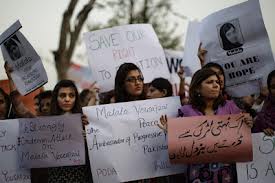
We saw both of these principles in action with this week’s news of Malala Yousafzai, a 14-year-old Pakistan girl who New York Times columnist Nicholas Kristof calls “one of the world’s most persuasive advocates for girls’ education.”

Everyone probably knows by now of how the Taliban viciously shot Malala in the neck as punishment for her outspoken insistence that girls should be allowed—and indeed, encouraged—to go to school, just like boys.

She is now the face of millions of girls worldwide who are denied the chance to get an education and empower themselves and their communities.

This week the Times also reports that in Africa, unprecedented wealth is being generated by the efforts of a rising tide of entrepreneurs—many of them women.

UN Women, formerly known as UNIFEM, has argued for years that by educating a girl, you help her whole family, including the children she will one day bear.

After all, as the Chinese say, “Women hold up half the sky.”

I am glad to see that Pakistanis have come together to reject the extremist politics of the gunmen who shot Malala.

We should all light a candle for her today as she is flown to the West for more treatment, and pray that this brave girl survives the attack and returns to the fray to serve as a defiant model for all girls, whose instinctive human desire for education will not be extinguished so easily.

In the Christian tradition, Eve takes the blame for the fall from Paradise, and here in the U.S., too, we can see many examples of strong women being sharply checked: for instance, in the shooting of U.S. Representative Gabby Giffords or the mocking of Hillary Clinton for wearing pants suits and acting tough.

The story of Malala Yousafzai is one particularly emblematic story among many that could be told, of women and girls who dare to stand up to patriarchal power, and learn quickly that such defiance has its price.

Lately we’ve been seeing a steady drumbeat of reports—most of them disapproving—of how women are becoming more successful in school and in careers, threatening traditional male dominance in the public sphere.

Maybe it’s time for a reminder that feminism was never about dominance—it was and is about equality.

What’s so threatening about that?

I’m sorry, but real men don’t shoot 14-year-old girls under any circumstances.

To me a real man is the one who encourages his children, regardless of their gender, to stay in school and work hard to be prepared to step out into a future that is sure to be challenging.

A real man applauds his wife’s successes, and stands by her side when things are rough.

Real women do the same.

The truth is that gender is just another one of those culturally conditioned differences, like eye shape or skin tone, that fade to irrelevance before the profound reality of our human similarities.

Having unlocked the secrets of the genome, we now know that human beings are genetically 99% the same as field mice.

Isn’t that enough to convince us that men and women are only different in the most superficial ways?

Sure, women can bear children; men are more muscular.  But our brains are close to identical, and our hearts are the same.

Our spirits, freed of our physical bodies, know no differences.

It’s time to soar above the petty in-fighting of gender, and work together for the good of all.


Fault-lines of American Educational Policy & Practice

When I read about how students at Stuyvesant High School and Harvard University, to name only two recent prominent examples, used everything from notes on scraps of paper to texting answers on cell phones to help each other out on exams, I shake my head—not at the students’ behavior, but at the institutional culture to which they were responding.

I am fortunate to be teaching at an institution that values collaboration rather than competition, and thoughtfully constructed arguments over right-or-wrong multiple choice tests.

Granted, I teach in the humanities, where memorization is less important than in the hard sciences.

But even in the sciences, given the ready accessibility of our collective auxiliary internet brain trust, do we really need to be forcing students to memorize the periodical table anymore?

Isn’t it more important that give them assignments and challenges that will develop their teamwork skills and encourage them to think creatively, rather than spit back knowledge that has already been established?

Nearly fifty years ago, the Brazilian educator Paulo Freire published his influential book Pedagogy of the Oppressed, in which he described “the banking system of education,” whereby students are treated as repositories for information that will be deposited into them by teachers.  Teachers are then able to “withdraw” the information from the students by means of tests.

Notice that it’s the teachers who are the active ones in this scenario; the students are simply passive recipients of knowledge.

In contrast, Freire proposed a dialogic form of education, where students’ ideas are valued by their teachers, and the pedagogical method is more of a conversation than a one-way lecture.

While still popular in some theoretical educational circles, it’s clear that Freire’s ideas are not in ascendancy in current American educational policy, which, in the No Child Left Behind era, has turned education into a process of leaping through the hoops of a long series of standardized tests.

I see this in my 14-year-old son’s current schooling in our local public school, which is in many ways about as good as a small-town American public school gets.  But nevertheless, even the best teachers there are forced to spend a lot of their time coaching the kids on passing the MCAS standardized tests that will be administered next May.

 ***

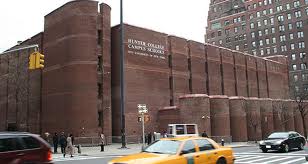
Back in the 1970s, I went to a selective New York City public school, Hunter College High School.  When I took the entry test, in sixth grade, I had no test prep whatsoever.  My parents were very nonchalant about the whole thing, so I wasn’t nervous about it—it was just something I had to do, so I went in and did my best.  I got in, along with five others from my elementary school, P.S. 6.

Hunter College High School

What I remember from my four years at Hunter is earnest, thoughtful discussion classes in English and Social Studies and even Spanish, with teachers who treated us like budding intellectuals.  When I left Hunter after 10th grade to transfer to Simon’s Rock College, now known as Bard College at Simon’s Rock, the classroom conversations got even livelier and more compelling, and the written assignments more challenging.  We were asked to write analytic essays, persuasive essays and informed opinion pieces…over and over, at ever-higher standards of rigor.

The process culminated in the required year-long senior thesis project, which for me, as an English major, was an in-depth study of the trope of androgyny in the novels of Virginia Woolf.  There is no doubt in my mind that the joy I got out of reading everything Woolf wrote, and all the literary criticism and proto-queer theory I could find, led me to eventually choose to return to graduate school for a doctorate in Comparative Literature.

My point in relating this personal trajectory is to reflect that if I had only been asked, at each stage of my schooling, to memorize information and spit it back out to a teacher (or worse, a robo-grader) on standardized tests, I don’t know that I would have chosen, in my time, to undertake the hard work of earning a doctorate and becoming a professor myself.

I would have had a very different idea of what education was all about.

And sadly, competitive, test-taking does pass for education in too many scholastic and even academic environments these days.  Given this reality, who can fault students for trying to game a system that so clearly disrespects them as intellectuals and original thinkers?

 ***

Last week, The New York Times reported that “a coalition of educational and civil rights groups filed a federal complaint…saying that black and Hispanic students were disproportionately excluded from New York City’s most selective high schools because of a single-test admittance policy they say is racially discriminatory.

Stuy HS students, 2007. Photo by Annie Tritt for The New York Times

“Although 70 percent of the city’s public school students are black and Hispanic,” the article continued, “a far smaller percentage have scored high enough to receive offers from one of the schools. According to the complaint, 733 of the 12,525 black and Hispanic students who took the exam were offered seats this year. For whites, 1,253 of the 4,101 test takers were offered seats. Of 7,119 Asian students who took the test, 2,490 were offered seats. At Stuyvesant High School, the most sought-after school, 19 blacks were offered seats in a freshman class of 967.”

These are demographics I recognize from my memories of my time at Hunter College High School, back in the 1970s.  There were hardly any Black or Latino students there then; Asian students accounted for most of whatever ethnic diversity the school could claim.

Why aren’t the city’s African American and Latino students doing well on the admission tests?

 ***

An article from the current issue of The Atlantic provides a window of insight into this question.  In “The Writing Revolution,” author Peg Tyre takes us inside one of New York City’s failing public high schools, New Dorp in Staten Island, and shows how student performance dramatically improved once school principal Deirdre DeAngelis began demanding a greater focus on essay-writing in the classrooms.

In this, DeAngelis was bucking the national trend observed by Arthur Applebee, the director of the Center on English Learning and Achievement at the University at Albany, who, Tyre says, “found that even when writing instruction is offered, the teacher mostly does the composing and students fill in the blanks. ‘Writing as a way to study, to learn, or to construct new knowledge or generate new networks of understanding,’ says Applebee, ‘has become increasingly rare.’”

At New Dorp High School, it turned out that the students simply did not know how to construct the kinds of good sentences that would enable them to build a logical, well-thought-out argument. They weren’t used to talking in such sentences, they didn’t do much reading, and they didn’t come from a home environment where the adults spoke in the way the students were being asked to write in school.

For someone like me, an avid reader with parents who were also educated, enthusiastic conversationalists and readers, learning to write came very naturally. But for kids coming out of underprivileged backgrounds, more has to be done in school to make up for what they’re not getting at home.

So I’m glad to see that the new Common Core standards that will be adopted by 46 states in the next two years do require the teaching of expository writing from elementary school on.

“For the first time,” writes Tyre, “elementary-school students—­who today mostly learn writing by constructing personal narratives, memoirs, and small works of fiction—will be required to write informative and persuasive essays. By high school, students will be expected to produce mature and thoughtful essays, not just in English class but in history and science classes as well.”

Tyre predicts that it is likely that “the new writing standards will deliver a high-voltage shock to the American public. Last spring, Florida school officials administered a writing test that, for the first time, required 10th-graders to produce an expository essay aligned with Common Core goals. The pass rate on the exam plummeted from 80 percent in 2011 to 38 percent this year.”

 ***

Maybe a high-voltage shock is what America’s public education system needs to move it from teaching to multiple-choice tests to teaching kids how to think creatively and write eloquently.

As a writing teacher myself, I know how hard it is to “teach” good writing.  When I grade a paper, I know what I’m looking for, but I can’t always tell a student exactly how to get there.

More than anything else, it takes practice. Lots of reading good writing, and lots of writing, rewriting, and writing again.

At Bard College at Simon’s Rock, our orientation workshop for entering freshman is actually a writing boot camp, the Writing & Thinking Workshop, in which we have students reading, discussing, writing and workshopping writing for five hours a day during their first week at school.  We follow this up with three semesters of a required general education seminar, in which students are reading, discussing and writing almost constantly.

As a graduate of Simon’s Rock, the parent of a recent graduate, and a veteran of nearly 20 years as a Simon’s Rock professor of literature and general education, I know this approach works.

Sure, once in a while we have a student who tries to get away with plagiarizing a paper.  They are generally caught easily, because of all the draft stages we require students to go through on the way to turning in their final paper.

Relatively few students try cheating at Simon’s Rock, though, because they know we professors really want to know what they think about a given topic.  For us, learning is truly a dialogic process, and students quickly respond to the seriousness with which we take them as creative, original thinkers and writers.

 ***

Fundamentally, American educational policy needs to start treating students with the respect they deserve, whether they are at elite private schools or underperforming public schools.

It’s not the kid’s fault if he doesn’t know how to construct an expository argument in good English, any more than it’s the kid’s fault if she decides to cheat on a test she knows doesn’t measure her accurately as a thinker.  It’s the school’s fault, and ultimately the nation’s fault.

Given the multiple crises today’s young people will be facing as they become adults on our overpopulated, environmentally damaged, violent planet, we need to be educating a generation of creative, collaborative problem-solvers for whom spoken and written eloquence is a necessary leadership tool.

This is not a matter of policy or even ethics.  It’s a matter of survival.

Why are we punishing America’s schoolchildren and their teachers?

Jonathan Kozol in action

Every stakeholder in the current Chicago teachers’ strike who has not visited an inner city Chicago public school should take the time to read Jonathan Kozol’s powerful book Savage Inequalities, which chronicles the author’s explorations of conditions in schools in poor and rich neighborhoods in a series of American cities.

“One would not have thought that children in America would ever have to choose between a teacher or a playground or sufficient toilet paper,” wrote Kozol back in 1991.  “Like grain in a time of famine, the immense resources which the nation does in fact possess go not to the child in the greatest need but to the child of the highest bidder—the child of parents who, more frequently than not, have also enjoyed the same abundance when they were schoolchildren.

“’A caste society,’ wrote U.S. Commissioner of Education Francis Keppel 25 years ago, ‘violates the style of American democracy….The nation in effect does not have a truly public school system in a large part of its communities; it has permitted what is in effect a private school system to develop under public auspices….Equality of educational opportunity throughout the nation continues today for many to be more a myth than a reality.’  This statement is as true today as it was at the time when it was written.”

And it remains true twenty years later.

The bedrock issue here is one of inequality, which is measured along multigenerational racial and class lines.  As long as we continue to link public school funding to local property taxes we are going to be perpetuating an entrenched system of race and class segregation, from which there is little chance for escape.

Kozol observed that kids in suburban schools, no matter what state, already have what the CPS teachers are begging for in the urban schools, and then some.

Is it right that kids from wealthy neighborhoods go to college while kids from poor neighborhoods go to jail?

Kids in poor districts need more help from the state, not less, than kids in wealthy districts.

Chicago is not the only place in America where our schools are failing our neediest children, it is just the only place in America right now where the teachers have been pushed so far that they are taking to the streets in protest.

The Chicago teachers’ strike is being presented in the media as a case of selfish, whining teachers walking out on their students because they are greedy for more money, or afraid of being held to high standards.

But when you listen to the teachers, parents and students who have managed to penetrate the media gatekeepers and make their voices heard, what you hear is not greed or shortsightedness, but deep concern for the health of the school system and the welfare of the children.

The teachers are asking for smaller class sizes (would you want your child in a kindergarten class of 45?); improvements in the crumbling physical plants of their schools, including libraries and playgrounds; and support staff for troubled students, including nurses and social workers.  They don’t want their evaluations tied so tightly to how their students perform on standardized tests, and they want to be given seniority preference if they are laid off because of a school closing.

I don’t hear anything unreasonable in these demands.

Has anyone on the editorial boards of the newspapers who have condemned the Chicago teachers’ strike, which include the Chicago Tribune, the New York Times and the Washington Post, ever set foot in a Chicago public school?

I know for a fact that Mayor Emmanuel’s children attend private school, as did the Obama girls when they lived in Chicago.

President Obama and business leaders like to exhort American children to study hard and close the achievement gap between our country and others like China and India.

They need to put their money where their mouth is, and give our dedicated teachers the support they need to do the job right.

Having it all: my own story

Jennifer Browdy de Hernandez

Today marks a milestone for me professionally: 18 years after earning my doctorate in Comparative Literature, after a demanding year-long evaluation process, I have finally been granted a ten-year contract, the closest thing to tenure at my institution.

Why did it take me so long, despite the fact that I had all the requisite publishing and service work and teaching excellence?

Two reasons.

One, I stepped off the tenure track right out of grad school to prioritize the needs of my two sons, the first born two years before I finished my Ph.D., the second six years later.   I chose to work part-time in those early parenting years, not realizing how hard it would be to get back on the fulltime track.

Two, once it became apparent to me that simply moving from part-time to fulltime at my home institution would be difficult, I accepted a lucrative lecturer position at a nearby state university, and did both—two-thirds time at the small liberal arts college, half time at the university—for nine years, while also raising my sons, publishing two edited collections, and directing various major conferences.

Last year the state funding dried up so I lost my second job; and at the same time I finally got a green light to go for that ten-year contract at my primary institution.

It’s still officially only two-thirds time, a fact that may surprise many who work with me, as I have actually taught fulltime every semester for the past three years, and often in the years before that, in addition to carrying a more than full load of committee and service work of all kinds.

If I were a man, would things be different?

Yes, I think so. I would probably have let my kids’ mother make the professional sacrifices, allowing me to go full throttle towards a tenure track position right out of grad school.  As a man, I would probably have been a better negotiator, able to make a persuasive case for why I should be earning a fulltime salary for the important work I put in for my institution.  I might have spent less time cooking dinners and reading bedtime stories, and more time writing that Important Book.

I don’t want this to be true.  I want parents of both genders to be equally likely to intensively parent, write great books or play the cut-throat negotiator.

But in my own case, I know that my gender did matter.  I was raised by a mother who put her parenting role first, and a father who focused primarily on professional success.  Put together, they made for a stellar parenting team.  But I certainly did absorb the gendered messages from them: a mother’s first obligation is to her children, while fathers are out bringing home the bacon.

The problem is that I have needed to be both mother and father to my children, in the sense of parenting AND bringing home the bacon, and there are only so many hours in the day, only so much of me to go around.

I feel fortunate to have chosen a field that gave me enough flex-time to approach something like “having it all”: doing a good job at home as well as at work.  I do not take it for granted, and firmly believe that this precious scenario should be the norm rather than the exception–for the health of our kids, their parents and our society as a whole.

Help Wanted: Change Agents in Academe

The stars seem to be aligning behind a strong push towards online learning in the world of American higher education.  Today’s lead op-ed piece in The New York Times, by Jeff Selingo, editorial director of the Chronicle of Higher Education, echoes the Chronicle’s recent interview with educational philanthropist Bill Gates, who has been funding innovative approaches to maximizing the potential of technology in higher ed, without sacrificing educational quality.

Bill Gates

Both Gates and Selingo are focused on interventions that can improve outcomes for students, and thus for American employers down the line.  Even the best universities, Gates says, “often only have a 60-percent completion rate. And the average university will have something like a 30-percent completion rate. So you have an immense amount of wasted resource, and students who end up with a big loan and sort of a negative experience in terms of their own self-confidence.”

Gates wants to see how technology can be used to improve completion rates for students, as well as to improve their academic experience while going through the educational process, and his foundation is searching for “change agents” to accomplish this mission.

Innovators are sorely needed, because it certainly is true, as Selingo points out, that “higher education is a conservative, risk-averse industry,” which has been putting far more attention into capital campaigns for physical improvements than into serious efforts to develop and integrate new technologies.  Even my own graduate alma mater, New York University, known in many ways as an innovator, is persisting in its focus on bricks and mortar expansion with its hotly debated NYU2031 plan.

“We bet on the change agents within the universities,” Gates says. “And so, various universities come to us and say, We have some ideas about completion rates, here are some things we want to try out, it’s actually budget that holds us back from being able to do that. People come to us and say, We want to try a hybrid course where some piece is online, some piece is not, and we’re aiming this at the students that are in the most need, not just the most elite. So that’s who we’re giving grants to, people who are trying out new things in universities.”

I hope the Gates Foundation is also interested in supporting smaller liberal arts colleges like my current employer, Bard College at Simon’s Rock, which was founded as an innovative early college for high school students ready to accelerate past the last two years of high school, right into the college experience.

As someone who did just that myself, leaving the prestigious Hunter College High School in Manhattan after 10th grade to earn my B.A. in four years at Simon’s Rock, I know this is a model that works. It also worked for my son, who also earned his B.A. in four years at Simon’s Rock after completing 10th grade at our local high school.

It was good to hear Gates affirm the continuing importance of small-group discussions as a method of learning, because that is the pedagogical style we value highly and do so well at Simon’s Rock.

“Having a lot of kids sit in the lecture class will be viewed at some point as an antiquated thing,” he said. “On the other hand, having a bunch of kids come into a small study group where peers help each other, where you can explain why you’re learning these various topics, that will be even more important.”

With the advent of giant open-source lectures made widely available by the most prominent universities, Gates predicts that higher education will have to form consortia to consolidate lecture offerings, rather than having the same courses taught hundreds of times across the country (and the world) by different professors, some of whom may not be the greatest of lecturers.

But I don’t believe we will ever find a substitute for the excitement of small group learning, sitting in a circle and sharing ideas with a skilled, knowledgeable and enthusiastic facilitator.

It’s possible that some of that small-group learning may be able to transition to online video chat rooms, and this is something I’d love the Gates Foundation to fund me and other collaborators to explore!

I can imagine a hybrid learning environment, in the not-too-distant future, in which a student living at home can take a lecture from a Harvard professor in the morning, meet in an online chat room with another instructor in the afternoon to discuss the lecture topic (as I used to do in person with undergraduates when I worked as a graduate teaching assistant at NYU), and perhaps come to campus twice a semester for intensive face-to-face classes culminating in final projects that would be shared and evaluated, leading to the awarding of course credit.

Already there are consortia forming to discuss how to begin to allow students to earn degrees by patching together courses from various institutions, something most colleges and universities currently permit in a limited way.

Gates is right that this kind of innovation is threatening to the status quo of higher ed, where each college and university sees itself in competition with the others for the best students, and administrators tend to be more focused on admissions and tuition than on completion rates and outcomes.

Collaboration and sharing of resources may mean that some of the weaker institutions will fall by the wayside—but this is already happening as it becomes increasingly apparent that the old residential, four-year, very expensive approach is unsustainable for any but the most heavily endowed institutions, who continue to attract students from the wealthiest families in the world.

I agree with Bill Gates that if we faculty and administrators dig in our heels and refuse to roll with the oncoming waves of technological innovation, we’ll be bowled over and blown away.

But the techies can’t make this educational revolution work without the expertise of seasoned faculty and administrators, so it’s our responsibility to insist on pedagogical quality while encouraging innovation, in order to accomplish our mission of giving the most possible students the best possible education at the lowest possible cost, in a sustainable model that will allow our students—and our institutions—to thrive and grow into the 21st century.