There’s More to Love Than Cupid and his Arrows

One of the reasons I was unhappy in the last five years or so of my marriage—which lasted 21 years—was because my husband, who had been so apparently social and outgoing when I fell in love with him, had become taciturn and isolationist.  He scorned Valentine’s Day as a commercial holiday, and considered buying me flowers or taking me out to dinner on February 14 as a distasteful concession to marketing pressure.

While I can’t deny that Valentine’s Day is seized upon as a marketing ploy by all kinds of industries, I also think that it’s wonderful that we take a day of the year to celebrate love.  It doesn’t have to be romantic love between sexual partners, or would-be sexual partners—that’s where I think our American capitalist version of Love Day has taken a wrong turn.

Valentine’s Day should be a time to celebrate love in all its guises.

Today I celebrate the great love I feel for my parents, who gave me life and have always been so thoughtful and unreserved in their nurturing, from the time when I was an infant to right now, as I contemplate my 50th year.   My parents have taught me so much about being loving as a parent—which is not the same thing at all as being permissive or indulgent.

Today I celebrate the love that flows both ways between parents and children.  After my parents, it is my sons who have taught me at every step along the road about what they needed from me as a loving parent.

Sometimes they needed to be enfolded in my arms, and sometimes they needed me to step back and pretend we were strangers, but always they needed that firm, unbreakable assurance that no matter what they did, I would always be there for them.  That is the bottom line love that I learned from my parents, and no doubt they learned from theirs.

Today in my Art of Autobiography class we wrote and talked about the legacies of love that are passed down through generations in a family.  Even though there are other, less positive legacies that are also passed down, I asked the students to focus on the positive, loving side today, in honor of Valentine’s Day, and to think about how each generation gives a loving gift to those who come next.

It may not always be a gift parents or grandparents recognize that they’re giving, because it may come from such a place of automatic second nature.  For instance, I wrote in class about how my father’s family placed such a high value on education, and that is certainly a legacy that I received, put to good use, and am in the process of handing down to my children.

Who knows how long into the past that chain of valuing education goes, or how far into the future it will penetrate as my sons begin to have children of their own?

I come from loving people who have always wanted the best for their children, even if they didn’t always know how to make it happen.  Even the most loving parents don’t always succeed in doing right by our children. For example, my older son will always regret that he did not have a chance to play soccer earlier in his childhood—his father and I did not realize how important that was to him and did not make it happen for him.  But I have no doubt that he will correct that failing when it comes his turn to parent.

Each generation is imprinted by their parents and grandparents, and then goes on to add a few new tricks of their own, often responding to the exigencies of the time or to what they’ve learned in their own process of coming to maturity.

But what runs through, like molten gold at the core of a happy family like mine, is love.  Deep, abiding love, untainted by self-interest or vanity.

This Valentine’s Day, I celebrate family love.  Maybe another year I’ll be beckoning to Cupid and his arrows, but right now that bright red heart, ancient symbol of the yoni that welcomes us all into life on this planet, needs no romantic glitz or glitter.  It’s calling me home.

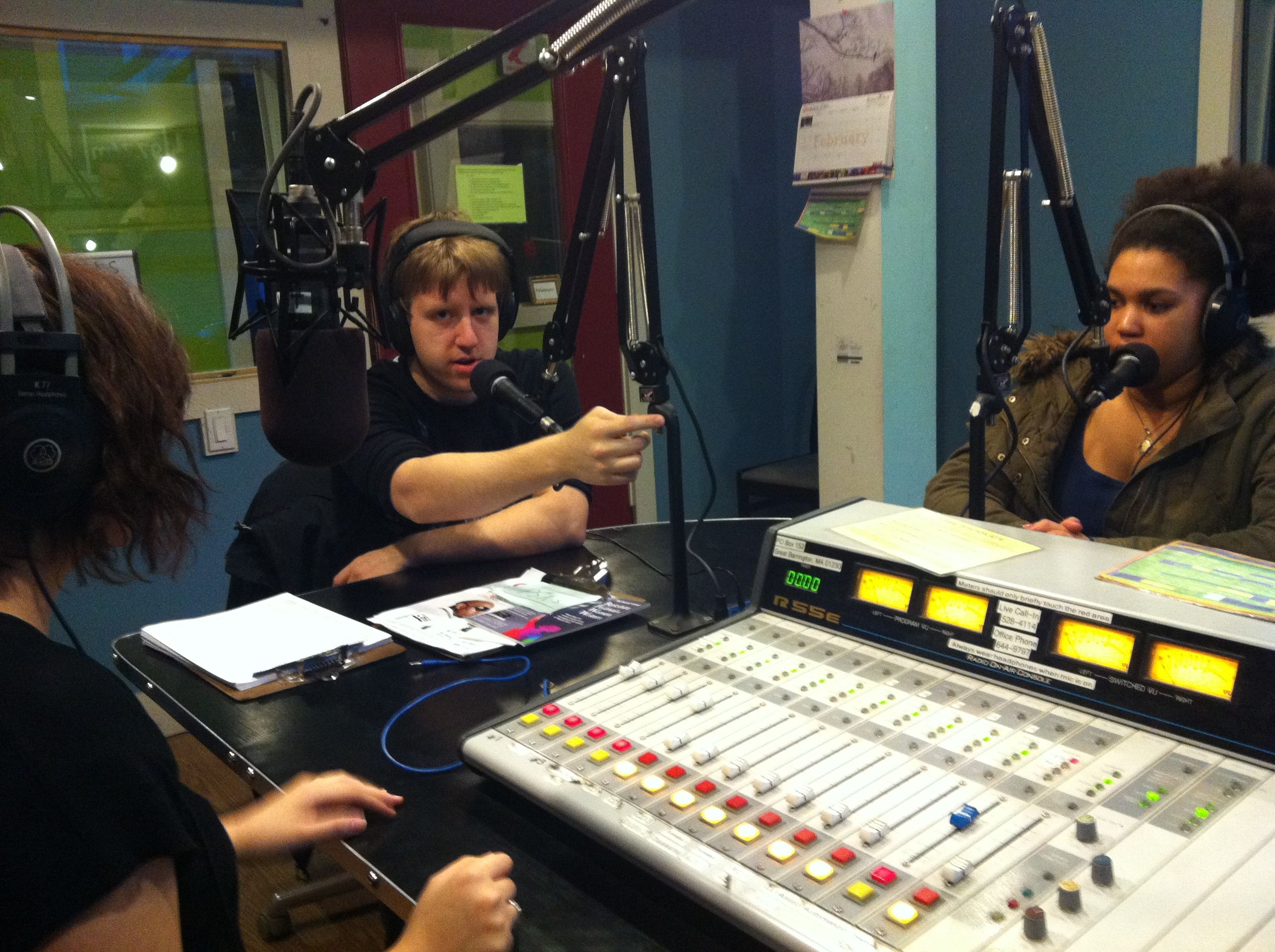
Coming to you live from the studios of WBCR-LP, 97.7 FM, Great Barrington….

This spring, students from Bard College at Simon’s Rock and Monument Mountain Regional High School are getting ready to go on the air with a series of Citizen Journalism Project news shows, broadcasting stories of local, national and even international interest from the intimate studios of WBCR-LP in Great Barrington MA.

Bard College at Simon's Rock students in radio board training

In preparation, students in my digital media studies class have been listening to great radio from NPR affiliates, Pacifica and other serious news radio outlets, as well as to homegrown shows on 97.7 FM, WBCR-LP.

We’re not sure yet how polished our programs are going to sound this spring, but in this first go-round, it’s really all about learning the process, from conceptualizing and pitching interesting stories, to interviewing and structuring the script, to recording, editing and putting it all together live on the air.

What could be more fun?

But also, what could be more important for young people than to hone their civic engagement skills through becoming not just consumers, but also producers of informational media on topics that really matter?

In keeping with the state of the profession of journalism, my class will also be working on student-produced video and online print stories, recognizing that in today’s media environment, it’s essential to be able to move fluidly across a variety of platforms.

When I came up with the Citizen Journalism Project initiative, combining my service on the WBCR-LP Board with my media studies teaching and my interest in getting Simon’s Rock students out into the local community and collaborating productively with their peers, it was one of those moments when you get into the flow and know the universe is with you.

Everyone I talked to about the idea loved it, from students to school administrators and the WBCR-LP programming committee staff, all volunteer, who are contributing their time and talents to getting the students trained and on the air in just a few short weeks.

When internet radio burst on to the media scene a few years back, some predicted the end of old-fashioned broadcast radio.

But there’s still something very special about being part of a community radio station grounded in the heart of a particular dot on the planet, where the people who live there are the ones running the board, conceiving and hosting the shows, and pumping out the music–not for money, but for the sheer joy of it.

When you drive through Great Barrington and tune in to 97.7 FM, it’s your friends and neighbors you’ll be hearing on the radio. And now, some cheerful, intelligent and very media-savvy students, too!

If you miss the live broadcasts, or you live far away, we’ll be archiving our shows at WBCR-LP later this spring.  Come by and check us out!


A Crucible Moment in Education

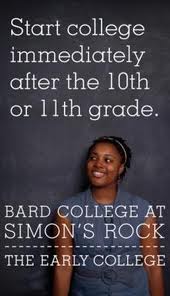
There was some rolling of eyes in my community when President Obama announced he would like to see high school mandatory until age 18.  That’s because at Bard College of Simon’s Rock, my alma mater, where I’ve been teaching for the past 17 years, the standard procedure for students is to leave high school at about age 16, generally after 10th grade, and shift into our early college program.

Most Simon’s Rock students are motivated to step off the beaten path and try a different approach to college because they’re high achievers who are bored in high school.  A few come to us because they’ve been so socially mauled in high school that Simon’s Rock becomes not only an academic, but also a social refuge for them.

In any case, for my students, being compelled to stay in high school until they were 18 years old would have been torturous, and would not have improved their future chances of success any more than “dropping out” to try a more innovative form of education—early college.

President Obama’s instinct that staying in school is better than dropping out altogether is absolutely correct.  It’s just that if we’re going to compel kids to stay in school, we need to make their schooling compelling.

Lots of great minds have already weighed in on the question of how to make learning fun and meaningful, but somehow we do not seem to have made a dent in the great battleship Education, which is still plowing its way implacably through the cold waters of Teaching to the Test.

It’s true that there is a certain amount of knowledge that you simply have to be taught, in that passive sense of receiving information and committing it to memory.  For instance, the alphabet.  The multiplication tables.

And having got these basic tools, you need to be taught how to use them: how to read, how to manipulate numbers.  If you’re going to be a doctor, you need to be taught how human systems work, just the way an engineer learns how a mechanical system works, or a mechanic learns how a car works.  OK.

But beyond mastering these kinds of basics in any field, there are two things students most need to get out of their education: learning how to figure things out for themselves, and learning how important their educated selves are to their communities and the larger society as a whole.

In today’s networked world, we no longer need to have kids waste their time memorizing all the state capitols, or learning by rote anything that can be measured in a multiple-choice test.  What kids need to learn is how to find the information they need to answer the questions they have about the world.  They need to learn how to frame their questions, understanding that the way a question is asked will often guide or predetermine its answer.

Reading is still a fundamentally important skill, but what we need to be teaching kids is how to read between the lines.  How to see through propaganda that passes for “fair and balanced” journalism, for instance.  How to sift through multiple sources of information on a given topic, and understand the criteria for determining which source is most credible.

But even that is not enough. Students not only need to become active readers, but also nimble thinkers, capable of taking in a spread of ideas on a given topic, and responding with their own original thinking.  A society where kids only learn how to feed back to their elders old, predigested ideas is a stagnant society, and we can’t afford that kind of stagnation at this time.

And here we get to my second point: kids not only need to learn to think for themselves, they need to understand how important this activity is for our rapidly changing society.  And that means taking the skills they’ve gained through their education out of the school and the academy into the street.

Students at every level, even the littlest ones, will benefit from a much more active engagement with the social and natural environment beyond the walls of their classrooms.  Little kids should be planting gardens in their schoolyards and composting the remains of their lunch. In Waldorf kindergartens like the one my sons attended, kids partake in preparing their mid-morning snack, and in keeping their classroom clean and neat.

What kids learn through activities like these is the importance of collaboration to community—an invaluable life lesson that needs to start early and be reinforced in different ways as they grow older.

Instead of our current competitive test-based system, we need collaborative learning that anticipates the kind of team-based environments of the most successful communities and businesses.  Instead of seeing kids hunched on their own behind raised folders taking a test—no cheating!—we should see groups of kids assembled around a problem, working collaboratively, noisily, joyfully to solve it.

The task of the teacher in this kind of learning environment would be to set the kids ever more challenging and interesting problems, with clearly visible and defined real-world applications, and guide the kids to the tools they need to solve the problems and evaluate their successes or setbacks.

Lord knows there is no shortage of serious problems in our world today, problems that demand every ounce of our most focused attention to surmount.  We need to get kids out of their classrooms and into their communities, bringing their creativity, their intelligence, their caring and their wonderful energy to bear on the challenges that lie just outside their classroom doors.

The Obama administration has just released a major new report, A Crucible Moment: College Learning and Democracy’s Future, prepared by the National Task Force on Civic Learning and Democratic Engagement, which brought together leaders in higher education from around the country to come up with recommendations for ways that education can help students become engaged, responsible local and global citizens.

The report concludes that given all the “pressing issues” facing us today—“growing global economic inequalities, climate change and environmental degradation, lack of access to quality health care, economic volatility, and more,” educators need to focus on “expanding students’ capacities to be civic problem-solvers using all their powers of intellect and inventiveness.

“The kind of graduates we need at this moment in history,” the authors say, “need to possess a strong propensity for wading into an intensely interdependent, pluralist world. They need to be agile, creative problem solvers who draw their knowledge from multiple perspectives both domestic and global, who approach the world with empathy, and who are ready to act with others to improve the quality of life for all.”

The report “urges every college and university to foster a civic ethos that governs campus life, make civic literacy a goal for every graduate, integrate civic inquiry within majors and general education, and advance civic action as lifelong practice.”

Specifically, the task force advocates developing service learning and community engagement programs that move beyond simple volunteerism to actually involving young people as active participants and innovators in making their social environments more vibrant, more responsible, and more equitable.

Sounds good, and sounds simple to implement, but as I know from trying to develop community engagement structures for students at my home institution, it takes staffing—and therefore funding—to provide the channels students need to quickly jump into productive off-campus programs.  Commitment to this kind of active learning environment needs to come from the top, and that’s why I am excited to see such an array of distinguished leaders in education come together as the signatories of this new National Task Force report.

Let’s hope some of that energy and enthusiasm will trickle down to schools and campuses all over the country, and soon.  The tone of urgency evident in the title of this report, A Crucible Moment, and in the President’s remarks about education this past week, is not exaggerated.

We are in a crucible moment in so many ways, and we desperately need to equip our young people with the skills and outlook they will require to bring us safely through the turbulence that awaits us in the foreseeable future as the globe heats up and pressures on human society increase.

Keeping our kids in high school until they’re 18 is only a good idea if high school becomes a meaningful, active learning environment.  Let’s do what needs to be done to make that so—or let’s come up with another model.  Early college, for example—a good idea whose time may finally have come.

Green Teaching: What the World Needs Now

In President Obama’s speech last night, he talked a fair amount about the importance of making higher education affordable for all Americans, and about how essential a highly skilled workforce is to America’s future.

I felt like I was in some kind of time warp.  Wasn’t Bill Clinton talking about just the same things, almost generation ago? Not only has insufficient progress been made, but while we’ve been fiddling and squabbling amongst ourselves, the whole landscape behind us has shifted radically.

It reminds me of one of those cartoon scenes where the mice are fighting amongst themselves and don’t even notice the huge cat face looming over them licking its chops.

The huge cat face, today, is the drastic heating of the planet.  Obama went on and on last night about manufacturing—we need a skilled workforce to support American manufacturing, we need to bring outsourced manufacturing back home, we need to adjust the tax code to benefit workers and manufacturers.

All the while, looming above the statehouse, is the runaway monster of climate change, which is at on the one hand fattened by all this manufacturing, while at the same time threatening to blow it all away.

I quite agree with Obama that we need to be pouring resources into education.  The question is, what kind of education is going to be most valuable for today’s children, tomorrow?

At the very least, we need an education that does not have its “eyes wide shut” about the fact of global heating and the impact this will have on us all in the near future.

I was encouraged this week when I picked up a print copy of the journal Green Teacher, and found an article by David Selby and Fumiyo Kagawa entitled “Unleashing Blessed Unrest as the Heating Happens.”  In it, the authors offer concrete curricular suggestions for how to introduce students in grades 5-12 to the reality of climate change, without sugar-coating it but also without leaving them so devastated that they lapse into denial or despair.  Since the article is not available online, I’m going to quote from it liberally in what follows, because this is news we can use.

The authors quote Jess Worth, who likens climate change denial to “finding out that you have cancer, but then delaying going to the doctor’s for treatment for a few months because you want to repaint your house.”

Selby and Kagawa speculate that because the “ever more dire accounts of a global climate lurching towards ever-deepening crisis” are so frightening, we tend to practice a kind of avoidance, which in education takes the form of “characterizing climate change as a technical problem that can be managed by a mix of technological innovation and policy solutions that avoid challenge to ‘business as usual.’”

For example, they say, “the recycling bin in most classrooms is…often cited as evidence of the school’s commitment to sustainability,” but “it can easily convey the subliminal message that consumerism approached responsibly can be benign.”

Reviewing American curricular materials for K-12, the authors found “a reluctance to investigate the culpability of neo-liberal economic growth models and to explore slow growth or no growth alternatives…. There is, too, an avoidance of envisioning and addressing personal and societal climate change scenarios that are likely to be played out in the learner’s lifetimes.”

This is certainly the kind of education I see my own son getting in his American public middle school.  The focus in his social studies, English and science classes has so far been squarely on the distant past.  There has been no discussion that I’m aware of about the fact that here we are at the end of January, and we are still seeing green grass outside.  NASA has just confirmed that nine of the ten warmest winters on record have occurred since the year 2000, and 2011 was the 9th warmest since 1880. Excuse me, shouldn’t we talk about that?

Selby and Kagawa say that instead of maintaining an “eyes wide shut” avoidance pattern with our youngsters, we need to engage in “an honest education facing up to the onset of what Alastair McIntosh describes as ‘a great dying time of evolutionary history’” and “overturning…the comfortable delusion that major disruption of Earth’s climate can be avoided or neutralized.

“Recognizing that present and future generations need hope, we have to ask what the hope is grounded in and what kind of hope it is.  Is it a spurious optimism, a comfortable fiction based on what we would prefer to see happen while keeping our ‘eyes wide shut’?  Or is it a pared down and realistically straitened optimism born of confronting the present and future earth condition?”

We have a responsibility as educators, parents, and elders to tell our children the truth about where we are as a global civilization, and where we are likely headed.  Wouldn’t you rather be forewarned, rather than bowled over by surprise when the shocks start coming?  Don’t you see it as the responsible thing to do to start preparing for those shocks now, both emotionally and practically?

The educators brought together in Selby and Kagawa’s new anthology Education and Climate Change advocate for a transformative learning agenda, involving “conscious, deep and sustained processes of engaging with pain, despair and grief over what we are losing, moving towards acceptance while searching for radically new meaning and values, and equipping ourselves for personal and collective empowerment and action.”

Concretely, they offer classroom exercises to guide students through these stages, including some pretty heavy-duty visioning of possible future scenarios that we may all have to live through.  The goal is not to depress students, but to empower them by moving from the disaster scenarios to hopeful plans of action to stave off the worst effects of climate change, or adapt successfully to whatever comes.

“A citizenship education for “blessed unrest” in a time of rampant climate change,” the authors say, “needs to be shaped by engagement in community-based action that creates, resists and transgresses in the name of sustainability.”

The time to start talking about these issues with our students and children is now, while we still have options as to how to confront the changes that are coming.  To do any less is to fail in our responsibility as the adults who should be out blazing the trail for the kids following behind us.  If we know there’s white water up ahead, let’s at least give those behind us a heads-up and see what we can do to ride out the rapids safely, together.

Webizens Unite!

The fuss over the SOPA/PIPA legislation last week is the marker of a generational shift in our understanding of the media: we’re at the transition point between 20th century media models, which rely on centralized, profit-driven control over production and consumption, and 21st century media models, which are all about open access and the free circulation of ideas.

While I’m generally a strong supporter of the open-access model, I do see some dangers to it.

For one thing, when we operate on a distributed intelligence model, information is so widely available that none of us really has to feel responsible about knowing anything.  We can just look it up, after all.

But when we rely so much on others to be the keepers of our collective intelligence, we become vulnerable on at least two crucial levels:

  • Vulnerable to being manipulated by the producers of that knowledge—think Fox News, for example, with its so-called “fair and balanced” reporting.  As long as we are aware that Fox News is reporting from a distinctly biased point of view, we can take their information under advisement, and balance it ourselves with other sources.  As long as there are other sources.  And as long as we have the education to be able to sift through it all and form our own informed opinions.
  • Vulnerable to loss of access—as in the one-day blackout on Wikipedia last week. It’s like kids who rely so completely on the calculator that they never learn their multiplication tables.  All well and good, until the day when they don’t have a machine available to make the calculations, and they’re left helpless.

Our society has become so totally tuned in to media that we would be lost without it.  And that kind of dependency is dangerous.

I think about the big push now to digitize libraries.  Of course, I love the idea of being able to carry 4,000 volumes around with me on one slim little e-reader.  It’s awesome!  But on the other hand, a little voice in the back of my head worries: what would happen if we lost ready access to electricity?  What would happen if there were shortages, so only the elites were able to power up their notebooks and Kindles?  Where would our libraries be then?

We’re already living in a society where social class, access to the Web and social influence form a tight, circular web.  Privileged kids today are growing up totally plugged in and able to make the best use of the amazing collective intelligence of the Web, while kids from poor backgrounds, worldwide, are growing up on the other side of the digital tracks, out there with the garbage and the weeds.

As the big media companies work ever more aggressively to stake their claim in the wild west of the Web, fencing off bigger and bigger areas of the digital commons, we need to become more vigilant about guarding our freedom of speech and our free access to the Web, and making sure that more and more of us really do have that access and the knowledge needed to make good use of it.

WordPress blogging platforms like the one I’m writing on are like little free information lanes alongside what are becoming ever more hulking, fenced and patrolled toll highways.  The fact that anyone can start up a blog or a Twitter feed or a Facebook page for free and get their voice out to the public immediately, with no censors, is a 21st century version of a time-tested Constitutional right that we need to make sure we defend.

Corporations don’t like the free circulation of “media content” because it escapes their profit-driven model.  That’s what they were trying to accomplish with their anti-piracy legislation—a way to shut down any website that did not pay its toll.

Looking into the brave new future that awaits us, I see increasing conflict over these basic issues of access to and control over the media.  I also see that unless we are successful in making the shift to renewable energy sources, it is conceivable that basic access to electricity, which we in the West now take for granted, may become less easily obtained.

As a blogger who relies on platforms and hardware that I could not possibly produce myself, I feel my vulnerability keenly.  I need Apple and WordPress to get me going, and the electric company to power me up, or I’d be dead in the water.

If I ever woke up and found the power out and my web browser blank, well…I could always go back to zining! But I would miss the incredible distribution powers of the World Wide Web.

Last week some 7 million webizens barraged Congress with protests of the proposed SOPA/PIPA legislation, and we won the battle!  We have to maintain our stations though.  As with the Keystone XL pipeline, it’s going to be a long siege.

Censorship in Academe, 21st century style

Unfortunately, the banning of books by Mexican Americans in Tucson last week was not an isolated incident.  It’s part of a larger pattern in American education.

At the elementary school level, it takes the form of resisting bilingual education for students whose family language is not English, and—for example—still teaching “Thanksgiving” as though it were the happy, peaceful start of a triumphant positive march towards a shining, splendid American empire.

At the middle school level, it’s about teaching Egyptian history—mummies, anyone?—instead of Native American or Mexican history.  Mummies are safe—there’s no politics left in them, they’ve been dead too long.

In high school, students are asked to stand and pledge allegiance by rote to the American flag representing “one nation, under God, indivisible, with liberty and justice for all,” but not asked to interrogate the proposition that liberty and justice really are available to all in our great land.

In undergraduate education, after a brief, highly contested period in the 1980s and 90s when the gates guarding the required curricula were wrenched open to let literature by ethnic minorities and women in, the tides have turned again.

Just as in middle school it’s safer to teach about the ancient Egyptians, in college the safest route is towards ancient Greece.  “After all,” I was once told blandly by a senior (white male) colleague in the course of a heated meeting on the core curriculum, “the Greeks are a minority too.”

The modern Greeks may be struggling, but the ancient Greeks are alive and well and generously represented in curricula throughout the Western world, where ancient figures like Plato, Sophocles and Aristotle still exert remarkable influence.

Meanwhile, graduate schools in the humanities are focused on jazzing up the study of history and literature through fancy digital applications.

I’m as digitally oriented as the next prof, but I won’t support “digital humanities” if it means that we no longer have the time or resources to engage in what I see as the most important functions of the humanities: teaching students how to analyze and wield the tools of narrative and argument; giving them the time and space to explore complex ethical issues; and most of all, empowering them to become informed, autonomous individuals who can research and think for themselves.

In theory, this could be done within a digital framework.  But the problem is that much of the push towards “digital humanities” is coming from the great surge towards online education as a business model for universities.  Of course you can do online education much better if you have high-tech online tools.  No argument there.

The problem is the bigger picture of online education, where tenured professors are being replaced with adjunct faculty who can teach in their pajamas from home, at a fraction of the salary or responsibility and no influence at all over what gets taught.  If you have an army of part-time online instructors working with students from remote locations all over the world, it’s pretty hard to have the kind of discussions that I’m remembering from my department’s deliberations over the core curriculum.

Most decisions over what gets taught in those burgeoning online courses are made by administrators who remain faceless to the instructors, with the result that professors become paid employees rather than professionals who are not only engaged in the process of teaching, but also in the process of deciding what gets taught.

It’s as easy as the push of a button for some administrator to decide that HUM 26X, Chicano/a History, will not be taught, while HUM 25X, History of Ancient Greece, will. And for the most part, no one will even notice.

This is going on all the time.  The incident in Tucson last week, when administrators were so sloppy as to order physical books pulled from the shelves, was a rare slip-up that brought the insidious practice of censorship into the public eye.

Most of the time it’s going on invisibly, under the radar, and so subtly that most of us won’t notice it until all of a sudden we look up and find that there are only a handful of Ethnic Studies Departments or Women’s Studies Departments left in the country, so there are hardly any graduate degrees being offered in those fields, so within a generation the whole hard-won movement to open the curriculum will be gone.

No, I am not over-reacting.  I am not hysterical.  I am not crazy.  Open your eyes, people, and you will see what I’m talking about.  Open your eyes, before it’s too late.

Shades of an American Kristallnacht?

Tonight at dinner the conversation turned to politics, although it seemed that everyone at the table was reluctant to mention the name “Obama”—a sign of the deep disappointment in our erst-while hero.

There was some enthusiasm for the political satire of Stephen Colbert and Jon Stewart, who are probably doing more to educate young people in politics than most high schools in America today.

There was derision for the spectacle of the Republican primaries, which I, for one, have been unable to stomach watching—not even for a moment.

And there was deep sadness over the unavoidable truth that now, in the wake of Citizens United, it has become totally legal for rich people to run politicians the same way they might run horses or greyhounds.  Just like that.

Maybe that’s what provides the eerie, zombie-like atmosphere in politics these days. You really have the sense that most politicians, especially the ones at the top echelons of power, are like old-fashioned Kabbalistic golems, animated out of clay by skilled magicians who can control them from afar.

Of course, that’s been going on for a long time.  Remember George Bush, a wind-up man getting remote control instructions through his earphone in the 2004 Presidential debates?

But it’s getting worse and worse.  That’s why I can’t stand to watch Gingrich and Santorum and all the other Republican wax model men mouth their lines on the stage these days.  You know they’ll say whatever they’re told…whatever they think it will take to win.

There is certainly a good chance that one of the Republicans will win.  The Democrats are dispirited and grumpy, not much in the mood to get all fired up about yet another election.

The Republicans, on the other hand, are rabid to take back the White House.  They’ve been busy as hell redistricting to try to gain every electoral advantage, and I have absolutely no faith in the electronic voting machines that they’ve been installing in every town and city in the land.

It’s very possible that Mr. XY Zombie Republican could seize power in November, with the backing of endlessly deep pockets like the Koch brothers, Big Energy, and Big Finance, and the blessing of the Supreme Court.

What then?

If the Republicans controlled all three houses of government, they could ram through the legislation they’ve been concocting during the past decade or so: legislation powering up the assault on the environment, on health, on social services, destroying any kind of safety net for people, animals or the environment.

They could escalate the war on dissidents (like me), who dare to oppose their plans.  In short order, the United States could turn into just another big banana republic, with a military-backed regime of elites governing through the indiscriminate use of fear tactics, with violence applied as necessary to keep the people in line.

Lately I have been re-reading Margaret Atwood’s marvelous sci-fi novel The Handmaid’s Tale, and finding it chillingly prophetic.  In Atwood’s dystopia, environmental catastrophe has rendered the elites infertile, and pushed them to withdraw into gated communities where food shortages are common, and people are regularly hung in the public square to keep everyone fearful and docile.

The narrator remembers how just before her world fell apart, there were signs of repression: books being banned and burned, identity cards being issued and required, mobility restricted, media censored.  All of a sudden, one fine morning, it was no longer possible for her and her family to get in their car and drive away to seek safety in Canada.  All of a sudden, they were trapped in a nightmare that went quickly from bad to worse.

Augusto Pinochet of Chile

This reminds me also of the many testimonials I have read from Latin America—true stories, not fiction—from the 1970s, when wealthy politicians wielding military power and complete control over the ballot boxes ruled their countries with iron fists, “disappearing” anyone who might remotely be a threat, including thousands of innocent students.  This happened in Chile and Argentina, in Guatemala and El Salvador and many other countries.  Often the shift from democracy to fascist dictatorship happened literally overnight.

As in Germany before the Kristallnacht, none of us here in the U.S. wants to believe that anything could happen to destroy our cherished freedoms, our vaunted  “American way of life.”  We don’t want to admit, even to ourselves, the extent to which our freedoms are already being encroached upon, day by day.

Just last week, for example, there was an outrageous episode in Arizona, where the government declared a whole long list of books by Mexican Americans to be unsuitable for school use, and went so far as to direct the school librarians and teachers to pull them from the shelves, box them up and put them into deep storage.

Among the authors banned are some of my favorite writers—Gloria Anzaldua, Elizabeth Martinez, Paulo Freire.

Paulo Freire

Yes, that Paulo Freire, the famous Brazilian educator and free thinker who wrote Pedagogy of the Oppressed, a brilliant analysis of the way that traditional education indoctrinates students into conformity and submission to authority.

Freire proposed that instead of a banking style of education, where knowledge is deposited into students, who are then required to spit it back upon demand, education worth its salt should empower students to think for themselves.

Such a simple idea, but so powerful, too.  Education should teach people to think for themselves, and to work with each other to come to consensus on issues of importance to the larger society.

Isn’t that just what the Occupy movements have been trying to do?  If Freire were alive, he would be out there in the thick of the Occupy action, inspiring the young to shake off the false animation of Zombiland, and insist on dancing to their own authentic beat.

This reminds me of another beloved science fiction book, A Wrinkle in Time by Madeleine L’Engle, where the sinister IT controls all the inhabitants of a city by forcing them to conform to ITS rhythm.  Their hearts pulse to ITS rhythm, their eyes twirl to ITS rhythm, their thoughts are entirely subsumed by IT.  The only way to break ITS control is to think for oneself, to be creative, resilient and determined.

The children Meg and Charles Wallace succeed in rescuing their father from the clutches of IT by dint of their own powers of creativity and love, with a little help from some eccentric and freethinking guides.

Will the science fiction tale we’re living through now have that kind of happy ending?

Oh yeah, it’s not fiction, is it.

A new generation rises, and with them, our hopes

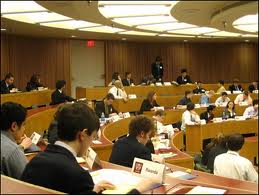
Today I gave the keynote address at the regional Model UN student conference sponsored by Bard College at Simon’s Rock.

On the one hand, it was heart-warming to look out and see that crowded lecture hall filled with bright, eager young faces, ready to step on to the world stage, if only in theory, and play leadership roles.

On the other hand, it was sobering to have to be the bearer of such grim tidings.

I started out by taking them back to a choral Ode in the Antigone that has always haunted me, the one where the Chorus sings the praises of human technological prowess, while at the same time sounding a warning note about how mankind’s “cunning…is the fertile skill which brings him, now to evil, now to good.

“When he honors the laws of the land, and that justice which he has sworn by the gods to uphold, proudly stands his city: no city has he who, for his rashness, dwells with sin.”

In other words, I told the students, we humans can do all kinds of amazing things with our great intelligence, but we will only prosper if we keep our moral compass and use our powers for good.

The Ode is basically a list of areas in which human beings have excelled, and that list is as valid today as it was in the 5th century B.C.: our power of navigation and transportation; agriculture; our dominion over other animals, wild and domestic; our ability to withstand the elements by building shelter and creating fire; our medical arts; our facility with language and “wind-swift thought.”

Truly we are a “wondrous” species.  And yet the fact that this list is recited in the tragedy of Antigone bears witness to the fact that our great “cunning” does not always guide us well.

In Antigone, Creon is a proud, vindictive tyrant who demands absolute allegiance from his subjects, including his niece Antigone.  When Antigone defies his order to let her brother’s remains be left in the open for the crows to feast on, and goes out alone to bury him, Creon goes into a fury and orders her arrested and sentenced to death.

It’s clear that the Chorus in this play believes Creon’s action is wrong.  Antigone was obeying her own moral judgement, putting her filial and religious obligations before her allegiance to the King. And just as the Chorus predicted in the initial Ode, because he is not using his power wisely and ethically, in the end Creon’s house will fall.

In our time, I told the students, the same kinds of battles rage, of good people standing up for their beliefs against oppressive tyrants, who don’t hesitate to imprison and even execute any who defy their power.

The Arab Spring showed us what can happen when enough people dare to speak truth to power and defy an authoritarian state  In the United States, the Occupy movements are now standing up, not so much against the state, as against the corporate capitalist elites—who often are the power behind the thrones of the various nations.

Even in our own country, the price of defying the status quo can be high.

But, I told the students, given the perilous state of the world today, the price of staying quiet and going along with the flow is inevitably going to be much higher.

I reminded them of the many dangers that face us today, including:

  • the homogenization of media and the reduction of education to multiple choice tests, instead of a media that stands strong in its watchdog role and an educational system that focuses on teaching students how to think creatively and question authority;
  • the tremendous militarization of police and national forces, with most countries fairly bristling with lethal weapons, from handguns to bombs;
  • environmental degradation and loss of biodiversity, including the contamination of our air, soils and waters with toxic chemicals caused by the very agriculture celebrated in the Antigone Ode;
  • serious health problems caused by environmental toxins and chemical additives in our food supply;
  • and above all, the looming menace of anthropogenic global warming.

These will be familiar themes to anyone who has been reading my blog these past few months.  But it was good to speak these ideas out loud this time, to the young people who are going to have to bear the brunt of the problems.

I quoted U.N. Secretary General Ban Ki-Moon, who told negotiators from 200 nations gathered at the recent COP17 climate conference in Durban that the situation was so urgent that they could not afford to wait for unified global action.

“Don’t wait for a binding agreement,” he said. “It could take years. All member states should take their own measures,” before it’s too late.

“Last year we saw the highest emissions ever,” Mr. Ban said. “If we carry on as though it is business as usual we will be out of business.”

Those are pretty stark, unequivocal words from the leader of the closest thing we have to a global government.

Given the need for drastic change in the way we do business as a civilization, I challenged the students to dare to think outside the box.

I encouraged them to let Antigone be their guide as they began their Model UN negotiations. “If you know that a policy is wrong, don’t be afraid to say so, and to fight for what you believe,” I told them.

I urged them not to let artificial boundaries like nation, race, class, religion or gender cloud their vision of what is needed to succeed in the goal of making human society safer, more nurturing, and more sustainable for us all.

“It is a deeply flawed, damaged world you will all soon be stepping out into as young adults,” I said.  “We live in a time of accelerated change and unprecedented transition.  None of us knows what lies around the bend.  But we do know that no matter what, we will be better off if we work proactively to overcome narrow national self-interests and begin to think in planetary terms—and not just about human interests, but in terms of the good of the entire web of life of which we are a part.”

Our only chance at changing the way we do business as a civilization, I said,  rests with our ability to successfully communicate with one another–to use the powers of “speech and wind-swift thought” commended by the Chorus of Antigone. 

What we need are not the stylized battles of debate, but the true, open-hearted communication of consensus building, where all viewpoints are listened to respectfully, and all positions are judged both on their own merits and on how well they’ll contribute to the collective goal of making the world a better place.

As I stepped away from the podium, I felt sad that I had to lay such a heavy burden on these bright young people, who through no fault of their own have inherited a planet in such disarray.

But I also felt the surge of hope that always rises again with each new generation.  Maybe this generation will be the one to turn off the beaten path and forge a new relationship with our planetary home.  Perhaps they will be able to resist the centripetal pull towards conformity.

As they all filed out of the room to take up their places at the Model UN negotiating tables, my heart went with them.  They are our last best hope.


Academic blogging: break-dancing for scholars?

As I previously noted, “digital humanities” was the topic du jour at this year’s Modern Language Association conference, but no one seems to be quite sure what precisely is meant by that moniker.

Stanley Fish took a stab at the digital part of the equation in his NY Times column on Monday, promising to come back again next time to explore burning questions such as: “Does the digital humanities offer new and better ways to realize traditional humanities goals? Or does the digital humanities completely change our understanding of what a humanities goal (and work in the humanities) might be?”

Professor Fish, being someone from the “great white north” (ie, a white male of a certain age–I only wish I could claim to have invented this pithy expression), is cautious in his official embrace of digitality, though he does take the leap of reluctantly admitting, in paragraph one, that he is technically writing a blog post, rather than a column.

Should this matter?

Well, in my profession, it does.  In fact, a column is only very slightly more palatable, officially, than a blog post, since both are classified as so-called “public scholarship,” as opposed to “real scholarship.”

Although nobody puts it quite that baldly, that’s what they mean.  In other words, as one academic put it recently, blogging is never going to get you tenure, even if thousands more people read your work on a blog than will ever read that monograph you finally published with an academic press.

All I can tell you is that it’s been a long time since I’ve felt as intellectually engaged as I do now that I’ve started blogging again.

Blogging–and publicizing my posts via Facebook, Twitter, Google, and other social media outlets–has allowed me to connect with people I never would have been able to reach in any other way.

I’ve tried the more traditional other route, publishing academic books and articles, and for the most part it was like sending my ideas out into the ozone.  I got very little back, either in the way of praise or disparagement.

In contrast, with my blog I get virtually instant feedback, almost every time I post.  It may not be more than a thumbs-up, but I can tell by looking at my blog stats whether or not people are intrigued by what I’m writing; and if they are interested enough to post a comment in response, I glow with the warmth of human connection, however mediated it might be by keyboard and screen.

Blogging suits my current lifestyle, which is hurried and harried to an extreme.  I am doing much more than I reasonably should be, stirring all kinds of pots and responsible for sustaining all kinds of programs, from classes, to festivals, to summer programming, to various and sundry committees–not to mention serving on boards, parenting my two children, writing piles of  letters of recommendation, applying for grants, sending in conference proposals, etc etc etc.  It’s endless!

How, given my life at the moment, could I ever steal away the focused, quiet, concentrated time necessary to produce “long-form scholarship”?  Maybe my colleagues at prestigious research institutions can manage it, but they don’t have the teaching, advising and service load I do, not to mention a life. 

For me, the hit-and-run blog post is just the right form: short, sweet and to the point, allowing me to express my ideas on a range of topics without having to be weighed down by footnotes and exhaustive surveys of existing scholarship.  In blogging, I can be light-footed and fleet, rather than plodding and thorough.

I do cherish the hope that eventually I will be able to find the time to gather my swiftly penned thoughts into a more sustained discourse that could be published in a book–though an e-book might be just fine.

But in the meantime, I wouldn’t give up my free-wheeling blogging lifestyle for anything.

Sure, a blog post may be to a book like a hook-up is to a marriage.  But you know what?  Having tried nearly a quarter-century of marriage, I’m ready for something new.

The power of words for a world in crisis

So what am I, a Ph.D. in comparative literature with years of teaching experience in global women’s literature, gender studies and media studies, doing writing and thinking so much about the environment?

Why am I spending time blogging rather than diligently writing research-based articles for peer-reviewed academic journals?

I entered grad school part-time in 1984, first in English, and then in Comparative Literature.  Why those fields?

As an undergraduate, I started out wanting to major in environmental studies, but was soon turned off by the level of statistical empiricism required by my biology professors.  Having always loved to read and write, I gravitated towards English, and ended up interning for the local newspaper and becoming somewhat of a prodigy cub reporter.  I went on to work as a reporter for a daily newspaper, then a staff writer and editor for trade publications in New York City.

After a while, I missed the excitement of the classroom, began taking a class or two at night, and was soon drawn into the orbit of the comparative literature department at NYU, where things were really hopping in the late 1980s and early ’90s.  It was the time of the culture wars; of deconstruction and post-structuralist theory; of post-colonialism and eco-criticism and Marxist feminism.  It was an exciting time to be a budding scholar, learning to talk the talk and walk the walk.

And now here I am at mid-career, looking back and wishing that I hadn’t allowed myself to be discouraged from environmental studies so easily.

These reflections are spurred by the lead article in today’s Chronicle of Higher Education, about the Modern Language Association convention, which starts today in Seattle.  I’ve already written about why I’m not there, and reading today’s Chronicle article, I don’t feel too sorry to be missing this year’s conference.

The article, by Stacey Patton, presents a pretty bleak picture of the field of languages and literature–a picture I recognize only too well.  Enrollments in literature classes are at record lows, and many leading voices in the field are being called upon to explain just why an education in the humanities is of continued value in the 21st century.

The Chronicle article quotes James Donelan, a lecturer in English at the University of California at Santa Barbara: “We have been going about our business as if the study of literature were self-justifying, and that making an overt case for its relevance to society was somehow too mundane a task for us….The immediate consequence of this attitude is that we’re losing undergraduate majors and financial support at a terrifying rate, and the far-reaching consequence is that anti-intellectualism and a general lack of empathy are running rampant in civic life.”

Meanwhile, as many as 70% of English department faculty nationwide are so-called “contingent” faculty–hired as adjuncts, on a semester-to-semester basis, often earning minimum wage or less despite their doctorates and their publications.  As one angry commenter (evidently an adjunct English teacher) put it, “I for one will not encourage ANYONE to be an English major.  I will teach them their required composition classes for their OTHER majors because I know those majors will actually change their financial lives and allow them to support their families and move out of poverty.  This IS an elitist profession filled with elitist ivory tower ‘folks.’  Everybody knows it; that’s why the numbers in this field are dropping so much.  Get real.  Stop b.s.ing and face what is really going on.”

Yeah.  So we have an anti-intellectual student body, most of whom are highly resistant to reading books at all; combined with a demoralized and exploited faculty.  Although things are somewhat different at my college, it’s impossible to ignore what’s going on in the field as a whole.

And although some literature professors may be willing to put time and energy into justifying why it’s essential that we continue to study so-called “high literature,” like Shakespeare, Milton, Dante,  and Joyce–or even Pynchon, Rushdie, and Roth–I am not.

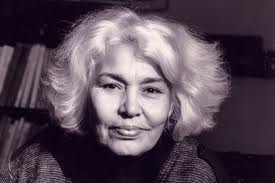
Egyptian author, doctor and activist Nawal El Saadawi

My whole career has been dedicated to the kind of literature that provides windows into the real material conditions of people living on the margins of society–people outside of the ivory tower, whose voices are rarely heard in the American classroom.  My own personal canon includes Rigoberta Menchu, Wangari Maathai, Buchi Emecheta, Gloria Anzaldua, Audre Lorde, Paula Gunn Allen, Shirin Ebadi, Nawal El Saadawi, Mahasweta Devi, Malalai Joya, Vandana Shiva, and many others, few of whom would be familiar to most of the scholars gathered at the MLA this year.

These writers have taught me, above all, to listen.  They’ve taught me to be aware of the intractability of my own privileged social conditioning, and to work hard at overcoming the elitist worldview into which I was born and raised.  And many of them have shown me again and again how in a patriarchal culture women are lumped together with Nature as commodified resources to be managed and controlled.

I never wanted to be a scientist.  My interest in environmental studies sprang from my love and reverence for the natural world, which was so strong in me as a child, and my horror at learning what human beings were doing to the flora and fauna of our planet.

Knowing what I know now about the dire urgency of the manmade threats to our ecological systems on Earth, I cannot sit by and write yet another academic essay on literary theory and disembodied “texts.”

Yes, I care about the sad state of English and literary studies in the academy.  But we’ve doomed ourselves, each of us, by the short-sighted and self-centered decisions we’ve made as individuals and as institutions.  If students today see reading books as irrelevant, and if administrators see English professors as expendable, well…who should we blame but ourselves?

As we hurtle into the 21st century with its multiple crises of climate, ecology and economics, I find myself  still reading, still writing, and circling back around to where I began, in environmental studies, where I will do all I can to use the power of the written word to ignite the social changes we so desperately need.

In narratives of women and the natural world, I have found my home–and my voice.