Survival is not an academic skill

Yesterday I wrote that I intend to devote my second half of life (OK, let’s be real, we’re talking about  more like my last third of life at this point) to parenting and trying to change our global social systems to be sustainable and non-exploitative.  That intention rolled around in my head overnight, and I began to wonder how my role as a college teacher fits into this scenario.

Can I use my vocation as a teacher of comparative literature, media studies & gender studies/human rights to change the world?
As if in response to my unvoiced question, the inimitable professor Stanley Fish published an op-ed on the NY Times website last night, in which he used the occasion of the upcoming Modern Language Association annual convention to reflect on the state of the higher-ed humanities profession.

I’ve participated in many an MLA convention in my 25 years or so of professional involvement in the field of comparative literature, but this year I am not attending because my panel proposal, entitled “Strategies of Resistance: Women’s Writing and Social Activism in Iran, South Africa and the United States,” was not accepted.

Professor Fish’s analysis of the 2012 conference Program gave me a good insight into why my proposal, which I thought was comprised of excellent papers by well-qualified scholars, was rejected.

“Absent or sparsely represented,” he says, “are the topics that in previous years dominated the meeting and identified the avant garde — multiculturalism, postmodernism, deconstruction, post-colonialism, neo-colonialism, racism, racialism, feminism, queer theory, theory in general.”  My panel would have fit nicely into at least three or four of these categories.

The new hot topics at the convention this year, says Prof. Fish, can be lumped under the umbrella term “digital humanities,” which covers “new and fast-moving developments across a range of topics: the organization and administration of libraries, the rethinking of peer review, the study of social networks, the expansion of digital archives, the refining of search engines, the production of scholarly editions, the restructuring of undergraduate instruction, the transformation of scholarly publishing, the re-conception of the doctoral dissertation, the teaching of foreign languages, the proliferation of online journals, the redefinition of what it means to be a text, the changing face of tenure — in short, everything.”

Everything?

The problem with this brave new direction in literary studies is that even while it reaches out to the world through digital portals, it seems to have lost all interest in the real world beyond its own narrow and insular ivory halls.  Other than “the changing face of tenure,” which is certainly a meaningful labor issue for the small percentage of Americans who are college/university professors, there is no indication that the young literary Turks all fired up about the digital humanities care at all about material conditions for people, animals or the environment.  Politics becomes cyber-politics; people become avatars; electricity simply flows, and food appears like magic in supermarkets or restaurant dishes.

Let me be clear: I am no Luddite when it comes to digital technologies.  I’m writing a blog, after all, and I regularly teach a class in digital media studies, which changes radically every time I offer it because I try to keep up with the rapidly transforming media landscape.

But to me, digital technology is a vehicle, not an end in itself.  I want to involve myself in digital media and the digital humanities to further my material, political goals of remaking the world.  Otherwise it’s just so much more mental masturbation.  We don’t have time for that now, if indeed we ever did.

And here’s where I come back around to my starting question of whether my role as a teacher will be useful to my larger political goals of transitioning to a safer, kinder, happier human and inter-species landscape.

It depends what I teach, doesn’t it?

For years now I have been teaching a series of classes on “women writing resistance” in various areas of the world–Latin America, the Caribbean, Africa, the Middle East, the U.S.  The political writings of strong women who have successfully resisted both private and public oppression have taught me and my students so much about what it takes to stand up for one’s principles and put one’s visions of positive social change into action.  We’ve also learned a lot about the price activists often pay.

In the years ahead, I want to continue to use my vocation as a teacher to explore literature that is not afraid to speak truth to power.  I want to seek out visionary texts that look ahead fearlessly into the future and light the way for those who are following more slowly and cautiously down the path.  I want to amplify the voices of authors who advocate for those who do not have the same privileged access to the literary stage.  I want to become one of those authors myself.

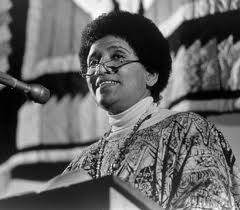
I should not be surprised that this direction is of little interest to the crowd inside the insular tower represented by the MLA.  What was it that Audre Lorde said at another academic conference, long ago?
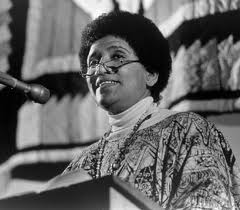
Survival is not an academic skill. It is learning how to stand alone, unpopular and sometimes reviled, and how to make common cause with others identified as outside the established structures in order to define and seek a world in which we can all flourish.”

Yes, Audre.  I’m with you.

An Eco-Humynist Manifesto for the 21st Century

Having watched with dismay as the Durban climate talks sputtered to a disappointing conclusion, with all parties knowing that every day that goes by without concerted international effort to address climate change means the inexorable shifting of life as we know it on Earth, I was moved yesterday to put fingers to keyboard and come up with a Manifesto for change.

Even as I was writing it, I was thinking that such radical changes would not be possible to put into place without resistance from the status quo powers that be; therefore bloodshed, which is specifically antithetical to the principles I lay out, would be inevitable.

But if a World War III must commence, I would rather it be for a good cause like this one, than for the petty greed, bigotry and hatred that have propelled humanity into previous wars.

If we want not only ourselves, but our entire eco-system to survive, do we have any other choice but to take decisive action now?

An Eco-Humynist Manifesto for the 21st Century

Whereas human beings have acted in a dominating fashion towards each other and towards other living species on this planet, using the excuse of difference to justify aggressive and destructive behavior;

Whereas competition has been used as a rationale for economic systems based on hierarchical systems of power;

Whereas social exclusion and systematic discrimination has been seen as the normative right of dominant groups;

Whereas privileged groups have felt entitled to take more than their fair share from the environmental commons, and to deprive less powerful groups, whether human or of other species, of the resources necessary for well-being;

Whereas it is quickly becoming apparent, in the age of climate change, that the dominant paradigm of capitalist patriarchal social relations is resulting in the dangerous destabilization of the entire natural ecosystem;

The time has come to take action to change this paradigm in the following ways:

1. Move from a top-down hierarchical system to a horizontal, egalitarian model of social relations based on inclusivity across all of the traditional boundaries used to keep different groups apart, including race, class, gender, sex, nationality, ethnicity, religion, and also opening up the possibility for cross-species collaboration based on respect and stewardship;

2. Shift the worldwide economic system to a model of global cooperation and collaboration, with the focus of human industry and government on providing a baseline of well-being for all life forms on this planet, regardless of geographic origin or antiquated ideas of relative importance (ie, who is to say that a human being is more important than a songbird, or a sardine?);

3. Tailor the education system to teaching the history of the destructive cultural practices of homo sapiens up to the 21st century, and opening up constructive conversations across disciplines, where alternatives to these traditions can be envisioned and developed;

4. Model egalitarian, collaborative, respectful social relations in the private sphere of the family as well as the public spheres of education, the profession, government and law;

5. Shift from a violent conflict and punishment model of resolving disagreements to a peaceful persuasive model, with the goal always being the well-being of the community as a whole first, and secondly each member of it.

6. Destroy all weapons of mass destruction, as well as all bio and chemical weapons, and their blueprints.

7. Disallow any one person’s or minority group’s interests (with rich people and businesses or industries rightly being considered minorities)  to take precedence over the interests of the majority, including the non-human majority on this planet.

8. Develop an appropriate representative global governing council to administer these principles.

In the name of Mother Earth and ALL of her children, I call on the peoples of the world to act without delay to become the stewards of the planet and the collaborative, respectful individuals we were always meant to be.

Thanks to the students of Gender, Culture & Society, Fall 2011, for the inspiration to write this Manifesto.

Sex 101: From Plan B to Pleasure

I have mixed feelings about the decision of Secretary of Health Kathleen Sebelius to overrule the FDA’s recommendation to allow over-the-counter sales of Plan B, without any age restrictions.

On the one hand, the knee-jerk liberal in me says wait a minute–access to contraception in any form should not be restricted.

On the other hand, it makes me a little nervous to think about young kids–say, 12-year-old girls–being able to buy morning-after pills as casually as they might buy cold medicine.

Our society is already sexualizing young girls way more than I think is healthy.  If Plan B were widely available, it might be used as just another reason why girls should open themselves up to sex at a younger age.

Another part of my hesitation comes from knowing full well that Big Pharma is pushing over-the-counter (OTC) sales just to make more profits on the drug.  I don’t think they are really that concerned with the welfare of young women.

Rather than simply making Plan B available OTC, I would like to see a national conversation (let’s call it a national general assembly) on the issue of the hypersexualization of youth, on the one hand, and the with-holding of sex education and contraception, on the other.

It saddens me that students in my gender studies classes are still reporting that sex education in their high schools consisted mainly of scare tactics ranging from “have sex before marriage and you’ll go to hell” (Catholic school) to “have sex and you’ll get disgusting STDs” (public school) to abstinence-only “just say no” programs.

In an age where the answer to any question is readily available on the Web, we owe it to our teenagers to present these issues in much more depth.  We should be discussing sexuality in all its multivalent nuances, from issues of sexualized violence (what happens if you say no and he doesn’t listen?) to the pros and cons of each of the many contraceptive options, to what I see as very often the missing link in contemporary discussions of sexual relations: pleasure.

Sex isn’t just about contraception, it’s not just about STDs, it’s not just about violence, it’s not just about worrying over drawing limits of one kind or another.

It’s about pleasure.

Her pleasure as much as his.  Mutual pleasure.  Mutual desire, mutual satisfaction.

Any sex ed worth its salt needs to be honest with young people, both boys and girls, about why sex makes the world go round.  It shouldn’t just be discussed in terms of threats, warnings and prohibitions.

Sex for pleasure is one of those defining human characteristics that too often gets lost in discussions of Plan B, abortion rights, and HIV-AIDS prevention.  These are all important issues, but let’s not lose sight, along the way, of what it’s all about.

The drug companies have not yet figured out how to package pleasure.  Let’s hope they never will.

President Obama, looking for solutions on student debt, should not overlook the issue of contingent faculty labor

The student protests around the country have been focused largely on three key concerns: the high cost of a college education, the resulting weight of student debt after graduation, and the scarcity of jobs.

Put together, it’s a recipe for frustration, if not outright desperation.  Students who lack substantial family support these days have to make incredibly tough sacrifices to get their B.A. degrees, and with no jobs at the end of the tunnel, many are rightly asking–is it worth it?

A lot of thoughtful people have been considering this very question for some time now.  On Monday at the Berkman Center for Internet and Society at Harvard University, there will be a panel discussion on “The Fate of Civic Education in a Connected World,” featuring, among others, Ellen Condliffe Lagemann of Bard College, who just co-edited a book called What is College For? The Public Purpose of Higher Education.

In the book, Lagemann and co-author Harry Lewis argue that colleges and universities need to renew their commitment to fostering ethical, responsible student engagement with the public sphere.  Higher education should not just be a credential to string around one’s neck, the passport to a decent job, they say, but should challenge students to think deeply about their role as citizens and stakeholders in society.

This message certainly seems timely.  If getting a college degree can no longer be valued in purely instrumental terms, as a ticket to a job, then it had better be providing some deeper value, both for the students and for society.

On the same day as the Harvard panel, President Obama will be meeting at the White House with a group of ten influential college and university presidents, along with Secretary of Education Arne Duncan and other key players in higher education, to discuss “increasing access and success as well as how to make higher education  more affordable,” according to an article in today’s online Inside Higher Ed magazine.

The article says that “amid an increasing focus on student debt and college prices, the event seems to signal that the Obama administration will make the issue a focus going into the 2012 campaign. In a speech Monday, Education Secretary Arne Duncan called on colleges to address rising tuition prices “with much greater urgency.” The House of Representatives held a subcommittee hearing Tuesday on rising costs, discussing a broad range of possible solutions.”

As someone who has been teaching in higher education for more than 20 years, I am of course concerned about the rising costs for students.

But I’m also concerned with the way budgets are increasingly being balanced by reducing fulltime tenured faculty teaching lines.

The phenomenon of using adjunct faculty, graduate student teaching assistants, temporary “visiting” faculty and any other form of contingent labor available is under-discussed, both within the institutions perpetrating these practices, and in the broader society.

Within the institutions, it’s under-discussed partly because it’s so humiliating for Ph.Ds, respected scholars when they present their research at conferences or publish articles, to admit how little money they’re making as adjunct or visiting faculty.  College adjunct teachers are typically paid $2,000 to $4,000 a course.  Most faculty teach 3-4 courses a semester.  You do the math.

Also, there’s the fear factor: if you speak out, your contract may not be renewed next semester, or next year.  There is no job security for what we call in the business “term contracts.”

At the White House meeting, the college presidents aren’t going to want to tell the President that they’re reigning in the cost of tuition by hiring contingent faculty at bargain basement salaries.  But that’s the truth of the matter.

And it’s been very difficult for adjuncts to unionize, in part because the Labor Board in recent years has ruled that college and university faculty are “managers” because we make a salary rather than an hourly wage, and get to set our own hours. Managers aren’t entitled to a union.

There are a host of reasons why it’s bad for American higher education to use cheap faculty labor.  If we want to get serious about student success, as the Obama Administration claims, focusing on contingent faculties would be a good starting point.

A harried professor who’s working at two or three institutions to barely make ends meet is not going to do as a good a job for her students as someone making a living wage with a longterm contract at a single institution.

American institutions of higher education need to model the kind of society we want our students to create when they move out into the world as newly minted young citizens.  They won’t want to be temporary workers any more than their teachers do.

President Obama, if you really want to make a difference, you need to push those college presidents for deeper, systemic changes.

Who’s Afraid of Women’s Writing?

Last night I participated in a panel discussion on Virginia Woolf and Margaret Mead called “Who’s Afraid of Women(‘s) Writing,” with Bard College of Simon’s Rock colleagues Maryann Tebben and Asma Abbas.

We were talking about how women’s writing is often oppositional, representing an outsider’s point of view to male-dominated mainstream discourse, whatever the discipline.

One of the students in the audience asked whether women’s writing would therefore always be reactionary, simply responding to the dominant rather than staking new ground.

I have been thinking about that question all day, off and on.

What I answered at the time was that while women’s writing is often a response to the dominant discourse, it also goes off in its own directions, which are not simply reactions to the mainstream, but rather true departures.

Of course, all writing occurs in dialogue with other writers, so even a departure is part of a larger conversation.  But I do believe that women, as outsiders, have something unique to contribute to any conversation.

Indeed, it is staggering to think of how impoverished literature, philosophy, history and all the other disciplines have been (and still are) in cultures where women have not been allowed to add our voices to the chorus.

Worst of all is that so few people (read: men) even noticed our absence.

I can recall so many times when have I had to fight for the inclusion of texts by women in our General Education curriculum at Simon’s Rock, arguing with colleagues who could say, with a sad shake of the head, that it was just too bad that women had never written any great, canonical literature.  For the past 20 years, out of the 16 required texts in our Gen Ed canon, which stretches from Gilgamesh to Achebe, only three are by women–though as of this year, after much lobbying, the ratio has finally improved slightly.

First deny women literacy and keep those few who do manage to become literate tightly locked in the private realm.  Then look back over history and note complacently that, as Woolf has the “odious Mr. Tansley” tell the artist Lily Briscoe in To The Lighthouse, “women can’t write, women can’t paint.”

In our time and place, young women now outnumber young men in higher education, and no one would dare to argue that women are innately less intelligent and talented than men.

But still, women in the U.S. earn 78 cents on the male dollar, for a variety of reasons, including the fact that we still shoulder more responsibility for housework and child care even when we work fulltime.

Women are still valued more highly as ornaments and service workers than as autonomous creative agents, and we still have to struggle harder to make our voices heard, especially if what we have to say is not what the mainstream wants to hear.

In To the Lighthouse, Lily Briscoe worries that her painting will be rolled up and thrown under a couch to gather dust.  Today, women still seem to have less self-confidence than men, perhaps because we’ve absorbed the prevailing ethos that considers a strong woman to be a “ball-breaker” or a “bitch on wheels.”

As MaryAnn Baenninger, President of the College of St. Benedict, wrote in a recent piece in The Chronicle of Higher Education, studies continue to show thatwomen underestimate their abilities and express lower levels of self-confidence than their abilities suggest. Men overestimate their abilities and express higher levels of confidence than their abilities warrant. This difference arrives with them as first-year students and leaves with them as seniors. When I talk about this, or I hear researchers describe this finding, the audience always chuckles (boys will be boys, after all).”

Baenninger concludes that while American women “have access to just about every educational opportunity and every career…access doesn’t guarantee outcomes. A gendered culture, mostly in unconscious ways, limits women’s expectations for themselves and our expectations for them.”

In other words, our gender role conditioning as women too often tends to silence us, while amplifying the voices of our brothers.

Soon after the great poet Audre Lorde was diagnosed with the cancer than would eventually kill her, she gave an address at the 1977 Modern Language Association annual convention in Chicago, called “The Transformation of Silence into Language and Action,” later published in the collection Sister Outsider.

In thinking back over her life, she said, “what I most regretted were my silences.”

“In the cause of silence,” she continued, “each of us draws the face of her own fear–fear of contempt, of censure, or some judgment….But most of all we fear the visibility without which we cannot truly live….That visibility which makes us most vulnerable…is also the source of our greatest strength.

“Because the machine will try to grind us into dust anyway, whether or not we speak.  We can sit in our corners mute forever while our sisters and our selves are wasted, while our children are distorted and destroyed, while our earth is poisoned; we can sit in our safe corners mute as bottles, and we will still be no less afraid.”

What we need to do, she said, is to “learn to work and speak when we are afraid in the same way we have learned to work and speak when we are tired.  For we have been socialized to respect fear more than our own needs for language and definition, and while we wait in silence for that final luxury of fearlessness, the weight of that silence will choke us.”

So many women today are still feeling the same fear and insecurity Lorde wrote about in 1977.  So many of us will go through our entire lives not daring to utter the truths we can hardly bring ourselves to acknowledge even in our most private thoughts.

In the same way that the richness of the Earth is diminished every time a species is lost, no matter how small and seemingly insignificant to the bigger ecological tapestry, the great canvases of literature, philosophy, science and all the other disciplines are impoverished and dulled when 50% of the population is not enthusiastically welcomed into the conversation.

Yes, we women can have our own conversations, outside the male-dominated mainstream.  There’s always “women’s writing.”  But what we should really be striving for is what Virginia Woolf called “androgynous writing,” where the masculine and feminine energies are brought together in a fecund explosion of cross-pollinating difference.

As Lorde put it so memorably in another of her important essays, “The Master’s Tools Will Never Dismantle the Master’s House,” “Difference must not be merely tolerated, but seen as a fund of necessary polarities between which our creativity can spark like a dialectic.  Only then does the necessity for interdependency become unthreatening.”

Maybe there will come a time when interdependency and androgyny will be the accepted standard of gender relations.  Until then, we still need to meet periodically and consider questions like “Who’s Afraid of Women’s Writing?” and why? and at what cost?


Is Anybody Listening?

Just curious: why is it that today’s NY Times front page features social protest in Egypt, Yemen and Hamas, but nothing about California?

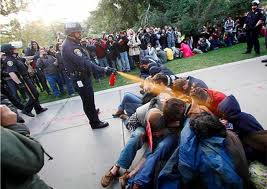
Way below the digital “fold,” in small print, there’s a piece with the bland headline “From Crowd Control to Mocking Images,” but it’s more about pepper spray itself than about the serious issues raised by the UC Davis incident.

The opinion pages are similarly focused on Egypt and Israel–nothing on the Occupy movement.

Somehow it reminds me of the classic situation where a kid is trying to get her parents’ attention, and Dad is buried behind his newspaper, Mom is talking away on the phone, and NOBODY IS LISTENING!

What does that kid have to do to get the adults’ attention?

Something outrageous. And even then, the focus will most likely be more on returning things to the status quo as fast as possible, rather than on talking through the issues deeply and seriously considering change.

That seems to be the posture of the UC system officials, who are in the current hot seat of the Occupy movement.  They want this whole mess to just go away, so that students will return to their classrooms and dorm rooms and keep paying their ever-higher tuition to earn degrees for jobs that don’t exist.

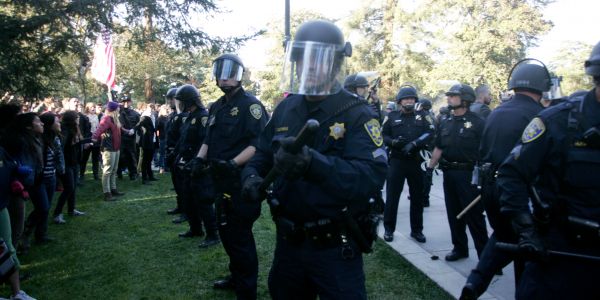
Things turned violent in the Middle East when people had enough of leaders who refused to listen.  There, soldiers and tanks were called in against civilians.  Here, we have armed riot police called in against students who were doing nothing more challenging than sitting cross-legged in a quad.

 Imagine what could happen here if protesters stopped being so polite and nonviolent and began demanding attention in a no-nonsense way.

How far would our leaders–from university chancellors to mayors to governors and the politicians in Washington DC–go in choosing to repress and stifle dissent rather than listening and engaging in thoughtful dialogue about the best way forward for all?

A couple of decades ago, when people took to the streets to protest working conditions and lack of freedom in Latin America, the U.S. demonized “the Communists” and sent military aid to the dictators to maintain order in the banana republics.  The civil wars there claimed hundreds of thousands of lives.

It is impossible to blame “the Communists” this time, and the unrest is not far away in some other country, it’s right here in our own heartland.

It’s our own sons and daughters who are feeling the crack of the police baton, the burn of the chemical sprays.

What are we going to do about it?

First of all, we’d better start listening.

Shades of Kent State?

Coast to coast, the Occupy movement is shaking things up, demanding engagement and accountability from those in power.

A contingent of Occupy Wall Streeters arrived in Washington DC today, with plans to set up a “temporary occupation” in front of Capitol Hill and “discuss the failure of the U.S. Government to be accountable to its people.”

In California, a huge General Assembly at UC Davis–the site of the criminal attack on students by a police officer–has called for a general strike on all of the University of California campuses in order to “reclaim the UC” from its corporate Board of Regents.

According to the strike motion:

“The continued destruction of higher education in California, and the repressive forms of police violence that sustain it, cannot be viewed apart from larger economic and political systems that concentrate wealth and political power in the hands of the few.

“Since the university has long served as one of the few means of social mobility and for the proliferation of knowledge critical to and outside of existing structures of power, the vital role it plays as one of the few truly public resources is beyond question.”

Interestingly, a prominent tenured UC Davis professor, Cynthia Carter Ching, has chosen to stand with the students against the administration, blaming “the people running this campus” for thinking of students as “data points and dollar signs, rather than as whole human beings.”  Had the administrators seen the students as human beings, she says, they would never “have called in armed riot police to deal with a peaceful protest, tents or no tents.”

Professor Ching also blames the faculty of UC Davis for being “too busy” with teaching and research to pay much attention to how the university as a whole was being run.

“You know, it wasn’t malicious,” she says. “We thought it would be fine, better even. We’d handle the teaching and the research, and we’d have administrators in charge of administrative things. But it’s not fine. It’s so completely not fine. There’s a sickening sort of clarity that comes from seeing, on the chemically burned faces of our students, how obviously it’s not fine.

“So, to all of you, my students, I’m so sorry. I’m sorry we didn’t protect you. And I’m sorry we left the wrong people in charge.

“And to my colleagues, I ask you, no, I implore you, to join with me in rolling up our sleeves, gritting our teeth, and getting back to the business of running this place the way it ought to be run. Because while our students have been bravely chanting for a while now that it’s their university (and they’re right), it’s also ours. It’s our university. And as such, let’s make sure that the inhuman brutality that occurred on this campus last Friday can never happen again. Not to our students. And not at our university.”

It should surprise no one that the students in the UC system are unwilling to entrust their welfare to the “busy busy” faculty or the stone-faced administrators.

And it’s not just the University of California.  There were arrests at Baruch College in New York today, and an open letter from a Yale philosophy professor has gone viral on the Web, with over 1,200 faculty signatories calling on university and college presidents to enforce “campus safe zones” for student protest.

It seems to me that the spirits of the four students killed by police at the Kent State protests a generation ago, back in 1970, are hovering over us these days.

Could it happen again?

Yes, in a heartbeat.  If anything police training has only gotten tougher in the new millennium, with less and less tolerance for any public “disorder.”

Those of us who work with college students know that if they have gone out into the quads and commons to protest, it is because there are very serious issues afoot that must be addressed now.

Generally speaking, college students would much rather be focusing on either their studies or their parties.

If they are participating in general assemblies and sit-ins, it is because the system in which they were raised, and in which they expected to find comfortable berths, has been shredded to the point where they can clearly see the gaping holes in the framework.

No longer can students expect to find jobs that will help them dutifully pay off their exorbitant student loans.  Can we blame them for glaring balefully at the administrators and politicians running the show, and asking angrily, “So what is it all for?”

The sad truth is that California now spends more on its prisons than on its universities, despite the fact that crime rates have fallen steadily since the 1990s.

As Juan Cole puts it in his excellent Truthdig column today,”the defunding of higher education in favor of an enormous gulag dovetails with a rise in the paramilitary repression of the population as one of America’s premier industries.

“Not only are UC Davis students being hit with massive tuition increases to pay for the penitentiaries and their policing, they are also being treated like unruly inmates by a militarizing police force.”

This is not the America we want to be, or to become.  It is time to stand with the Occupy movement and demand the demilitarization of our society, and the redirecting of resources towards education, innovation, creativity and social well-being.

The students are leading the way.  We older folk, who bear the responsibility for the current national and international crisis, must break the dark spell of conformity and accompany  them.  Now.

You can’t evict an idea whose time has come

My title comes from the Occupy Wall Street website, posted on a gray, gloomy morning after the police eviction of protesters in Liberty Park.

Occupations are going on in cities and towns in all 50 states now.  What the mayors and police chiefs of these locales need to understand is that the more they try to contain and stamp out this protest movement, the faster it will spread.

Beatings, gassings, intimidation, arrests, evictions…history has shown time and again that the human spirit refuses to be quenched by such brutality, especially when we face the firing squad together.

Occupy is a “leaderless movement”; it’s multigenerational and cuts across many social differences that have previously been used by the status quo to divide us.

United by a fierce and ardent hope that refuses to be extinguished, the Occupy protests all across America call on each of us to stand up in support of a new American dream.

In this new vision, our government representatives will put the well-being of the majority ahead of any narrowly defined special interests.

This means that the health of our citizens will come before the profits of industries like agriculture and energy. It means that the health of our global environment will be more important than corporate competition for resource extraction.

It means that the social safety net will be expanded and strengthened, not allowed to fray or be deliberately shredded.

It means that American public education will once again rise like a beacon throughout the world, giving all children, regardless of their social background, the knowledge, tools and creativity to move boldly and joyfully into the 21st century.

It means that our democracy will once again be broadly participatory.  We are done with politicians who are slaves to their corporate owners.

And no, we will not accept higher taxes on the working families who can least afford to bear the brunt of holding our creaky and corrupt system together.

We want a new system, with a radical reorganization of priorities.  Let our foreign policy be run by diplomats, not by bombers and drones.  Let an age of international cooperation in the service of urgent global needs begin.

Working together across borders, we can solve the world’s problems and move forward into a new era of sustainable, widespread prosperity.

Truly the Occupy protesters have it right.  You can’t evict an idea whose time has come.

A teachable moment at Penn State?

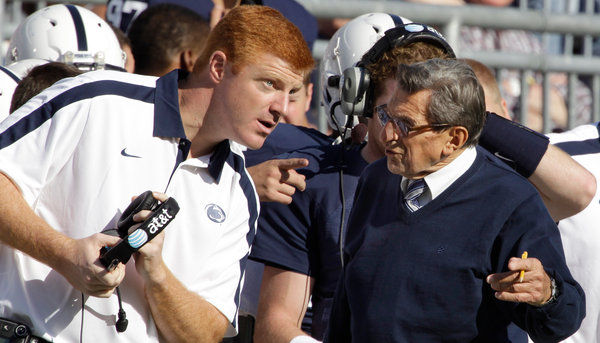
What is most shocking to me about the current scandal at Penn State (sports and sexual abuse of boys, in case you hadn’t heard) is the response of the students to the announcement last night that longtime head football coach Joe Paterno was fired.

Do the hundreds of students who poured into the streets to smash car windows and pull down lamp posts believe that it was OK that the coach turned a blind eye to the repeated rape of boys, some as young as 10 years old, in the university’s football locker room showers?

Do they want to be part of an institution that condones this kind of behavior?

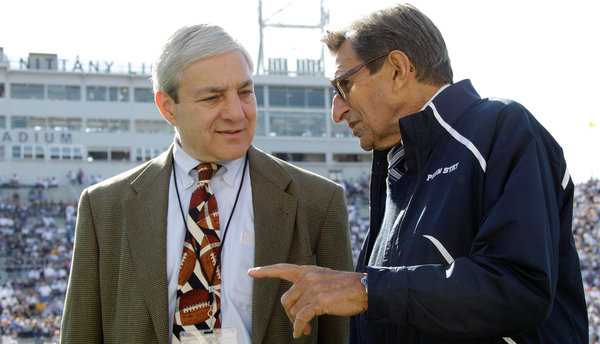
If anything, the students should have taken to the streets to demand Paterno’s resignation, along with that of his boss, Penn State president Graham Spanier.

But no.  To these rampaging students, what happened in those showers with the pedophile assistant coach Jerry Sandusky was less important than hanging on to their beloved head coach.

This is reminiscent of so many other, similar scandals, in which men’s loyalty to social groups, whether it’s the military, a fraternity, a gang, or a football team, is so strong that it completely skews their independent moral compasses.

If you presented a group of unaffiliated students with a scenario like what we’ve just witnessed at Penn State, and asked them whether assistant coach Mike McQueary was right to blow the whistle on Sandusky after witnessing him rape a 10-year-old boy in the football locker room shower late one night in 2002, I think most of those students would say McQueary was in the right.  They would also most likely come to the conclusion that it was the duty of McQueary and Sandusky’s boss, Joe Paterno, to report the crime.

But obviously things don’t look so clearcut when various conflicting loyalties come into play.  When McQueary realized that Paterno and other school officials were not going to report Sandusky, should he have pursued the matter independently–even when it might very well have cost him his job?

Of course, the answer is yes.  How could McQueary and Paterno sleep at night knowing that Sandusky was using university facilities to lure in boys?  Boys, who, by the way, he met through a charity he belonged to, the Second Mile Foundation, which purports to help disadvantaged children in Pennsylvania.

It saddens but does not surprise me that the students at Penn State who protested the firing of Coach Paterno are willing to put their team loyalty ahead of the pursuit of justice and integrity in this case.

It’s very similar to the loyalty of the Catholic priesthood, which chose to protect its own rather than stand up for the rights of the young children, mostly boys, who were being molested by pedophile priests for years and years.

Or like the loyalty of fraternity boys who would never rat out a “brother” who raped a girl during a party.

I’m sorry, guys, but this is not brotherhood.  It’s bullying: one person taking advantage of someone with less social power or physical strength, and a whole bunch of bystanders letting it happen.

This is what the Penn State students are proud of?  They should be ashamed.

At least Joe Paterno, at 84, does seem to be showing some signs of moral rectitude.  “This is a tragedy,” he said yesterday. “It is one of the great sorrows of my life. With the benefit of hindsight, I wish I had done more.”

Yeah, Joe.  You may have had more football game victories than any other college coach, but you sure could have done more.

Student-driven learning: Diversity Day at Simon’s Rock

Tomorrow is Diversity Day at Bard College at Simon’s Rock, a day when regular classes are cancelled so that the whole student body can attend workshops prepared by students, with some faculty guidance, on a range of topics related to social difference.

I am participating in three workshops: “Bros Before Hoes: When Male Loyalty Becomes Oppressive,” which comes out of my Explorations in Gender, Culture & Society class, in which we recently read Michael Kimmel’s Guyland; “Sex in the Media,” about the objectification of women (and men) in the media; and “The Green Belt Movement: Planting Trees, Saving Lives” about the life and legacy of environmental activist Wangari Maathai.

There are a whole host of workshops I wish I could attend, if only I could clone myself!  For instance, “The Prison Industrial Complex,” “Occupy Wall Street: A Discussion on Political Engagement,” “I Don’t Do Black Girls,” and many more.

As someone who regularly teaches classes in world literature, human rights, gender studies and related topics, I sometimes have mixed feelings about trying to cram so much politically charged information into a single day.  The danger is that we stir up a whole host of raw, unprocessed ideas, emotions and opinions, and then go back to business as usual, leaving many loose ends and open questions dangling.

The hope is that students who would not otherwise be drawn to explore issues of social class, race, ethnicity, gender, etc. in an academic class will at least get some exposure through these workshops to what their peers are thinking about or experiencing, and may be inspired to continue the conversations outside the classroom, or even to take a class in sociology or gender studies in a future semester.

What’s most positive about this annual event at Simon’s Rock is how it encourages the student workshop leaders to put to good use all the pedagogical modeling we’ve done for them in our classes. I am always so impressed at how carefully student leaders prepare for their 90-minute sessions, and how easily they are able to use the tools and skills we’ve been working on since Day One at Simon’s Rock: focused freewriting, small group discussion, coming to consensus, reporting back to the big group, sharing ideas in a thoughtful, respectful manner.

Once in a while things I’ve seen things get out of hand at a Diversity Day workshop, if a group is too big and rowdy, or the chemistry between the session leaders and some of the students in the class just clashes.  But that is very rare.  Most of the time students are respectful and kind, appreciative of each other’s efforts in sharing their knowledge and experiences.

Andrew Revkin of The New York Times blogged recently about progressive secondary education, citing with approval a Long Island high school student’s call for “project-based learning,” which is “designed to put students in the driver seat.

“No longer is the teacher the only hub of information,” writes student Nikhil Goyal. “No longer do kids work in silos, isolated from their peers and the community around them….Projects drive the curriculum, rather than the reverse. And they incorporate a wide range of interdisciplinary subjects to achieve real-world relevance. Learning isn’t supposed to be boring and a process of nailing facts in students’ heads. It’s hands-on, it’s practical, and it’s creative. And project-based learning offers constant feedback and revision to develop higher quality work.”

So true!  Diversity Day at Simon’s Rock is a great example of just this kind of student-driven, project based learning, as the student workshop leaders define the topics that interest them, work on structuring the class time, put together audio-visual aids, and then go in to lead their sessions.

Could there be any better hands-on training for life in the real world?