Idle No More: Exposing the Suicidal Cult of Global Capitalism

Once again we are seeing how the democratic power of social media can thwart the efforts of the state political apparatus to keep the people in line.

This time it’s happening in Indian Country, beginning in northernmost Canada and spreading like wildfire through social media networks down south and out into the broader world.

The movement is called Idle No More, and it was started by a coalition of four indigenous and non-indigenous women from Saskatchewan—Sylvia McAdam, Jess Gordon, Nina Wilson and Sheelah Mclean—who decided last fall that enough was enough with the steady assault on the environment and protections for First Nations lands in Canada.

Idle No More Founders

Idle No More Founders

Taking specific aim at an omnibus bill in the Canadian Parliament, known as Bill C45, the women began teach-ins and protests around their homes in northern Canada.  Word spread quickly across North America and beyond via social media channels, and a global solidarity movement was born.
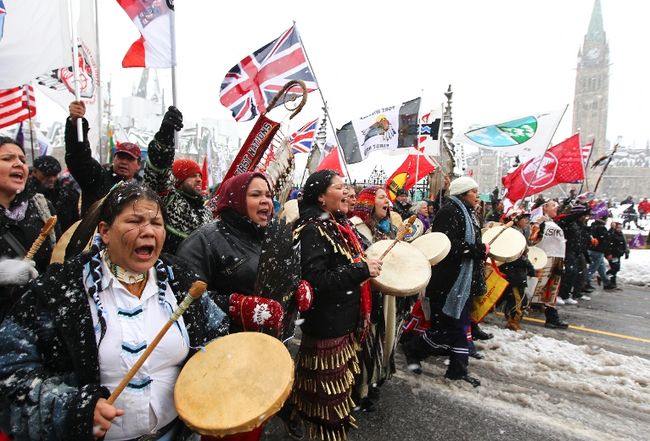
Idle No More protest in Toronto last month

Idle No More protest in Toronto last month

According to the Idle No More website, this is what happened:

 Bill C45 brings forward changes specifically to the Indian Act that will lower the threshold of community consent in the designation and surrender process of Indian Reserve Lands. 

Sheelah McLean reminds us that the bill is about everyone.  She says “the changes they are making to the environmental legislation is stunning in terms of the protections it will take away from the bodies of water – rivers and lakes, across the country.”  She further adds, “ how can we not all be concerned about that?”

The Idle No More efforts continued in Alberta with an informational meeting held at the Louis Bull Cree Nation.  The organizer for that event, Tanya Kappo, took to Twitter and Facebook to help generate awareness on the matter as the passage of Bill C45 was imminent. 

Kappo says, “the people in our communities had absolutely no idea what we were facing, no idea what plans Stephen Harper had in store for us.”  The events leading up to the National Day of Action have been focused on bringing awareness to people in First Nations communities and the rest of Canada. 

Jess Gordon says, “The essence of the work we are doing and have been doing will remain a grassroots effort, and will continue to give a forum to the voices of our people.”

When Bill C45 was brought to the House of Commons for a vote, First Nations leaders demonstrated that they are hearing these voices loud and clear.  They joined the efforts against Bill C 45 and went to Parliament Hill where they were invited into the House of Commons by the New Democratic Party. 

However, they were refused entry.  This refusal to allow First Nations leadership to respectfully enter the House of Commons triggered an even greater mobilization of First Nation people across the country. 

Nina Wilson says, “what we saw on Parliament Hill was a true reflection of what the outright disregard the Harper Government has towards First Nation people.”

With the passage of Bill C45, Idle No More has come to symbolize and be the platform to voice the refusal of First Nations people to be ignored any further by any other Canadian government.
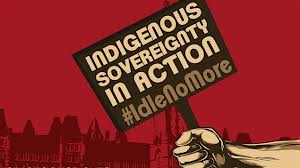
Unknown

Yesterday I happened to catch a call-in program on the CBC (Canadian Broadcasting Co.) on the Idle No More protests, which have apparently taken most Canadians by surprise.  The host interviewed a representative of the Canadian environmental protection agency, and it was shameful to listen to the way he sputtered when asking whether the bill in question really would result in damaged waters and fisheries.

Although he refused to come out and say it, the short answer was clearly, “Yes.”

As always, for mainstream politicians and businessmen the lure of short-term profits outweighs longterm planning for the health and welfare of the planet and her denizens.

Some of the callers on the CBC program displayed evident racism in their attitudes towards the Native peoples behind the Idle No More protests, which have blockaded railways and highways in recent weeks, in an effort to gain the attention of the Canadian prime minister, Stephen Harper.

Attawapiskat Chief Theresa Spence

Attawapiskat Chief Theresa Spence

One Native Chief, Theresa Spence, has been on a hunger strike for nearly a month now, her immediate goal simply being an audience with Mr. Harper and a chance to present the First Nations case.  Harper has finally agreed to meet with Spence and other chiefs, on January 11, 2013, one month after she started her hunger strike.

Spence is a controversial figure in this movement, which began with a grassroots coalition and has displayed some reluctance to let the indigenous chiefs steal the thunder.

There have been rumors of corruption among the chiefs, including Spence herself, who has just now, conveniently enough, been subjected to a humiliating government audit of her finances.

It’s not clear whether all the chiefs are truly after the protection of the environment, or if they just want to have their fair share of the economic action when it comes to the rapid development of Canada’s northern territories.

What is clear is that the immense land and resource grab in the Americas, which began with the colonial conquests and has continued to the present day, provides short-term financial gains for the few—mostly non-indigenous corporations and financiers—while the majority of Native peoples languish in poverty, sitting on environmentally devastated lands.
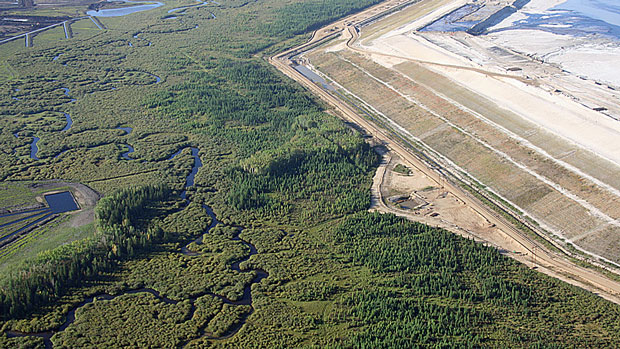
Aerial view of Alberta tar sands development, aka the destruction of the Alberta boreal forest. (Global Forest Watch Canada)

Aerial view of Alberta tar sands development, aka the destruction of the Alberta boreal forest. (Global Forest Watch Canada)

In case after case worldwide, rapacious corporations sweep in, negotiate favorable leases on the land, extract the resources and move on, leaving behind a toxic, degraded landscape and a broken people.

Now we have finally come to the time when it is becoming obvious that the damage that is being wreaked on people and their environments in specific parts of the world is not just “their own problem.”

As the founders of the Idle No More movement correctly perceived, if the waters of Canada are not protected, it will affect all Canadians, not just the First Nations folk who sit closest to those waterways.

If the boreal forests of northern Canada are razed, it will affect the entire planet, just as the steady destruction of the rainforests in the southern latitudes is inexorably destabilizing our climate worldwide.

It appears that our politicians only understand the language of dollars and cents.  In New York and New Jersey now, a serious discussion is underway about how to pay for the cost of adapting to the climate change that almost everyone sees now as inevitable.

Yes, we have to adapt, we have to mitigate the damage by changing the way we develop our coastlines.

But we also have to adapt our mindsets when it comes to “development of natural resources”—a green-washed euphemism for what has really been “the wholesale destruction of the planet.”

This is as true for the destruction of the boreal forests of Canada as it is for the fracking of the Marcellus Shale in the U.S.

If the real costs of this kind of destructive “development” were added up, no sane financier or politician would be able to support such a suicidal undertaking.

If our politicians and business leaders want to commit hari-kari by reckless short-term myopic thinking, good riddance to them.

But they have no right to take the rest of us along with them.

It reminds me of suicide cults like the infamous one in Jonestown, Guyana, in the 1970s.  A whole group of people was so taken in by the charismatic leadership of their guru, Jim Jones, that they obeyed his order to commit ritual suicide.
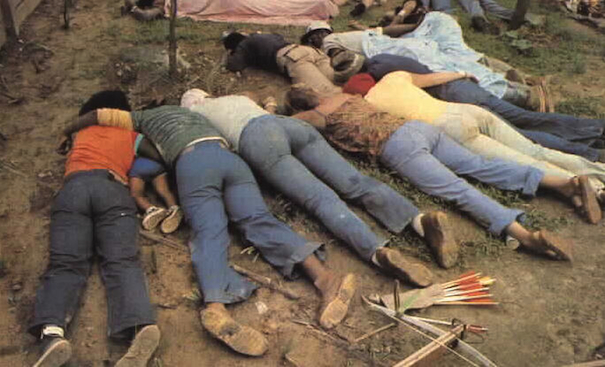
Victims of the Jonestown suicide cult

Victims of the Jonestown suicide cult

In our case, it’s the entire global capitalist leadership that has us all in thrall. We have been seduced, charmed and entranced by the siren call of “development,” which has given mainstream North Americans—the ones who agree to play by the rules—the benefits of a comfortable lifestyle.

The hidden underbelly of this lifestyle—the environmental destruction, the extermination of thousands of species annually, the annihilation of entire groups of indigenous peoples worldwide, the irrevocable destabilization of our climate—is now coming into view, thanks in large part to the democratization of the media through the World Wide Web.

I continue to believe that when ordinary, good-hearted people understand their own role in this planetary destruction, they will stand up and insist, like the four women who founded Idle No More, that enough is enough.

The question is, how far will we be willing to go to insist that our leaders respect our values and stop dragging us down the road to ruin?

How far will we have to go?

“Never doubt that a small group of thoughtful, committed citizens can change the world. Indeed, it is the only thing that ever has.”

–Margaret Mead

What should we do with our one wild and precious lifetime?

It is the last Full Moon of 2012, but the sky is overcast here, with snow on the way for tomorrow.

Having the moon obscured feels appropriate, as I am searching for a clarity that continually eludes me.

One thing for sure: this is the new normal, me alone with my dog by my side, sipping a quiet glass of wine by the fire, while my sons are out with their girlfriends.

Get used to it, honey!

After 20 years of hardly ever being alone, now it is coming around again, the long quiet hours I remember from my twenties, when I had seemingly endless time to think and read and write.

It saddens me to think of how I spent those hours, poring over the dry tomes of literary critics and deconstructionists, writing my own oh-so-alienated prose in a weak attempt at mimicry.

I wish I had instead been traveling the world in those years, voyaging and adventuring, meeting interesting people and learning new things.

I went as far as Paris and came home attached to a Mexican.

Married to him, I found myself locked into an endless loop of returning to his home in Mexico City year after year.  There I learned first hand about the power of internal colonization; the subtle and not-so-subtle debasement of women in Mexican society; and how to dance, drink and have a superficially good time.

I spent the past 20 years in what seems in retrospect like hard labor, being the primary caretaker in my home as well as—for nine of those years—working two demanding academic jobs.

Now my second job is gone, eliminated by state budget cuts, and one of my sons is almost launched, having gotten his B.A. last spring and moved to Florida for a job.

I am at the threshold of a new period in my life, and this time, knowing how short and precious a lifetime really is, I want to be more intentional–to make the best use of my time.

That is where I am seeking clarity.  What do I want to be doing with my one wild and precious life?

Where should I be putting my energies? What do I have to give? What do I want to be doing with my time?

In the current issue of Orion Magazine, the environmental writer Paul Kingsnorth asks this question too, and provides some answers that I find useful as pointers for myself.

After discussing how likely it is that we are on the cusp of civilizational and ecological collapse, he asks, “what, at this moment in history, would not be a waste of my time?”

His answers are fivefold: 1) Withdraw; 2) Preserve nonhuman life; 3) Insist that nature has a value beyond human utility, and proclaim this loudly to all and sundry; 4) Build refuges; 5) Get your hands into the earth.

This sounds like tremendously good advice to me.  I am especially glad to be reassured that my current retreat into solitary, meditative reflection is not a cop-out, but a necessary stage in the life-cycle of the bodhisattva for the planet that I want to become.

“Withdraw not with cynicism, but with a questing mind.  Withdraw so that you can allow yourself to sit back quietly and feel, intuit, work out what is right for you and what nature might need from you….Withdraw because action is not always more effective than inaction.  Withdraw to examine your worldview: the cosmology, the paradigm, the assumptions, the direction of travel.  All real change starts with withdrawal,” Kingsnorth says.

Preserving non-human life, and proclaiming its inherent value…well, I can try, within my sphere, but let’s face it, the very fact that I type these words on an Apple laptop with my refrigerator whirring quietly in the background means that I am part of the problem.

As Paul Kingsnorth knows and has expressed eloquently, there is nothing any one of us can do that will change the fate of the 200 species that go extinct every day on our planet.

Even if we come together collectively, it will be very hard, maybe impossible, to stop the juggernaut of climate change now.

That’s why the idea of building refuges and relearning off-the-grid skills makes a lot of sense to me.

UnknownI have a persistent vision of building a kind of hobbit-house in the side of a hill, off the grid and sheltered from the coming storms, in the company of others who share my dream of resilience.

It is not for nothing that JRR Tolkien’s classic The Hobbit and The Lord of the Rings are more popular than ever in these opening years of the 21st century.

We are engaged in an epic struggle once again, faced with the spread of a Mordor-esque wasteland over the entire planet.

Will those of us who share the ethos of hobbits, elves and dwarfs be able to save the day?

Will enough of our contemporary wizards—scientists, they call themselves now—weigh in on the side of life and health rather than the oppressive bondage of the capitalist technocracy?

In Tolkien’s novel, Evil comes even to the sheltered little Shire, but is vanquished in the end by the forces of Good.

That is how the stories we like to tell each other go.  It remains to be seen whether reality, this time, will follow this “happily-ever-after” fairytale motif.

I don’t know how it will all end. But I do know that in these dark months of winter, when even the bright full moon is obscured, it feels right to be retreating within to reflect on how best to pursue the struggle in the coming years.

Unknown-2

Be the change 2012

IMG_1102It is a dark, cold, winter’s morning, gray with a pelting mixture of sleet and freezing rain that has even the birds huddling for shelter in the thickest fir trees they can find.

I’ve just gotten up, lit the fire and the lights on the Christmas tree, made myself a cup of strong coffee, and thought to myself: where do I put my focus?

If I focus on the warmth and coziness inside the house right now, this seems like a wonderful morning, a perfect opportunity to curl up on the couch and make some progress on grading the papers students turned in to me before they left for the holidays.

If I focus on the sleet and wind outside, and begin to fixate on the way the trees are blowing around the icy power wires, I feel threatened, rather than protected, and start to worry in advance about whether or not I’ll be losing power later today.  Should I rush to take my shower and do some cooking before the power goes out?

Small dilemmas, and yet in the daily crucible of making these choices w of how to focus our attention, a lifelong habit is born of seeing the glass half-empty or half-full.

I must recognize that I have a tendency to see the glass half-empty.

I was a fearful, cautious, worrying sort of child, and I have not changed much as an adult.

In today’s age of aggravated climate change, random violence and the immediate potential for it all getting a whole lot worse in the near future, this attitude can make for a great deal of depression and anxiety.

But does it have to be that way?

Back in the 1980s, I spent a fair amount of time listening to recordings of Esther Hicks channeling the group of spiritual beings who called themselves Abraham.  The crux of their advice for us humans is to focus on what you want, with as much intensity and lavish detail as you can muster, and watch the Universe deliver it to you.

“You can have anything you want, if you exercise the Law of Attraction and call it to you,” Abraham would say over and over and over.

This idea has been picked up and popularized by others as well, and it is guaranteed to appeal to our can-do, feel-good American society.

We want to believe that we have the power to improve our lives, and it seems to happen often enough to keep the belief going.

But I always wondered, and wanted to ask Abraham, what about the people who were having terrible life experiences?  Did they “attract” these horrible situations to themselves too?

Did the 20 children who died in Newtown “attract” their destiny?

I cannot believe that they did.

It could be, however, that the killer’s vision was so strong that he was able to enact it, to make it come true.  Maybe he did what Abraham suggests, and replayed over and over again in his mind the details of what he wanted to do, until it was so well-thought-out and planned that he was able to unroll it in reality with no problem at all.

We need to pay more attention to the power of the human mind to affect reality.

It happens on an individual level, as when I can transform this gray, nasty morning into a warm, cozy one just by focusing on the peaceful interior of my house rather than the storm raging outside.

Focus on the outside

Focus on the outside

Focus on the inside

Focus on the inside

And it happens on a societal level, as when so many of us feel unsafe that we all start buying handguns and assault weapons, with the result that our feeling of peril becomes a self-fulfilling prophecy: with all those weapons circulating among our neighbors, we really are unsafe.

If we all settle into the mindset, amply seeded by the steady beat of the sci fi/disaster movies that have come out in the past decade, that the Earth is doomed and we are doomed with her, we will collectively give in to despair and simply go about business as usual while waiting passively for the end to come.

On the other hand, if we begin to collectively dream an alternative future, one based on respect for the Earth and respectful stewardship of her life systems, it is still possible that we may be able to manifest this positive vision.

The popular author Don Miguel Ruiz, whose book The Four Agreements has sold millions of copies worldwide, ends a recent interview by asserting that “We all came into this beautiful planet with a mission. The only mission, and it’s the same for every single human that we have on this beautiful planet earth, is to make ourselves happy.”

The only way I could agree with that principle of the human mission on Earth is if it is understood that we cannot be happy on an unhappy planet.

In other words, it is impossible for us to achieve real happiness when the dominant paradigm of human existence on the planet is based on oppression, suffering and violent destruction.

We may be able to achieve temporary “highs,” shelters in the storms of our lives, but real abiding happiness will elude us, at least those of us with enough sensitivity to be aware of the suffering always going on beneath the surface.

Events like the Newtown massacre break through the veneer of our superficially happy existence, here in the comfortable USA, and send many of us spiraling into depression.

And not just folks like me, who are habitually attuned to the malheur of life, but many more of us, who suddenly wake up and ask Why?

Why did this senseless massacre happen?

Perhaps it happened to remind us of the daily massacres of innocent wild creatures and feedlot animals, lab animals and vast flocks of birds, tons of fish in the sea and endless miles of coral and forest, all going down in a relentless bloodbath of human making.

Perhaps it happened to remind us of the children who are being trafficked into sex slavery or forced labor every day, of the children dying daily of hunger and preventable diseases, of the wasted lives of children whose poor-quality early education dooms them to lives of struggle and want.

When great tragedy strikes, survivors have a tendency to affirm to each other, Let their sacrifice not have been in vain. Let us learn from what happened and vow never to let it happen again.

Hence, in the wake of Newtown, the great outcry for better gun control laws, which may indeed, finally, be enacted in the coming year.

Abraham would say that you have to know what you don’t want in order to get clear on what you do want.

But the emphasis has to be on the positive; on building the vision, both personal and collective, of what we want for our society and our future.

We do not want an America where any random psychopath can get ahold of an assault weapon and wreak havoc in the neighborhood school or mall.

We do not want a lifestyle based on unsustainable consumption, oppression and callous disregard for the welfare of other living beings.

Now: what do we want?

We must get clear on our positive vision for a just and sustainable human civilization on our beloved planet, and then do the work of dreaming it into reality, day by day.

We must be intentional in where we focus our attention, not to ignore negative realities, but in order to put the power of our creative energies to work in manifesting the world we want to see.

In other words, as Gandhi said, be the change you want to see in the world, starting with your own thoughts and radiating outward.

Be the change.

IMG_1083

Dancing in the end times

And so here we find ourselves, finally, on the cusp of a great turning in solar time, the fabled 12-21-12.  It is a dark, wet, windy, wild morning here in the hills of western Massachusetts.

Since I started this blog back in the summer of 2011, with the optimistic URL “bethechange2012,” I have found many others who have beckoned to me like beacons of strength and inspiration on my somewhat lonely path of inquiry and discovery.

In the early days of Transition Times my own light was quite tentative and often overwhelmed with fear and distress, the product of my dawning realization of the tremendous gravity of the situation in which we find ourselves.

We cannot pretend to each other that the news is good for humanity, any more than for the rest of the living beings on the planet.

These are the transition times: the end of a long era of existence, as the ancient Mayan shamans rightly foresaw, and the beginning of something new.

I cannot and will not shy away from diving into the heart of the wreck that is our human civilization on this planet in the early 21st century.  Exposing what I find there is part of my mission with this blog.

However, it is also my purpose to be a channel and a beacon of hope for others who are searching for  meaning in these troubled times we live in.

We are all caught up in a vortex much greater than any individuals among us could produce, an accelerating forward surge that is hurtling humanity, and the planet we share with so many other life forms, towards a new era.

We cannot know what this means for each of us as individuals.  But I am coming to realize that the most important thing we can be doing in these transition times is to serve each other, and the other beings on the planet, as a form of shelter and anchor in the storm.

I will close with an image taken on one of my many thoughtful rambles over the past few months.  To me it represents the planet calling to me, and to all of us who love her, to continue to push back against the forces that would despoil and blight her.

The rocks, earth and waters of the Earth remind us that geological time is slow and very, very long.  Our dance on the planet as humans is so brief.  Let us enjoy our time here passionately, and turn our dancing to good works.

Benedict Pond, Monterey, November 2012

Benedict Pond, Monterey MA, November 2012

Standing strong against the Furies

AUDIO OF THIS PIECE READ BY JBH ON WAMC-NORTHEAST PUBLIC RADIO, DECEMBER 21, 2012

Just as people in places like the Maldives, Bangladesh and Japan shook their heads at the cluelessness of Americans who suddenly woke up to climate change when Sandy came to town, people living in hot spots of violence around the world now have every right to be shaking their heads at the collective American refusal to see and understand how, in the wake of the Newtown massacre, we are the cause of our own misery.

t1larg.pakistandronerally.giThe U.S. is the largest arms manufacturer and exporter in the world.  We have by far the largest military.  We are also by far the most heavily armed civilian population in the world, with some 300 million guns circulating among our population of about 300 million people.  Americans, we need to acknowledge that collectively, as a nation, we have been responsible for hundreds, and probably thousands of deaths of children worldwide through the weapons we sell abroad.

There is not a conflict in the world today that has not been fueled by American weaponry.

It is hypocritical to weep crocodile tears for the slaughter of innocent children in a kindergarten in Connecticut but to callously ignore the slaughter of innocent children by American drone fire in places like Afghanistan and Pakistan.

We need to start connecting the dots and realizing that the violence we mete out to the world will come back to haunt us a thousand-fold.

I’m not just talking about gun violence or missiles. I’m talking about the violence of inhuman labor practices and poverty, leading to rage that is sometimes turned inward, as in the spikes of farmer suicides due to heavy-handed Monsanto tactics in places like India and Asia, and sometimes outward, as in the terrorist strikes against targets inside the U.S. (9/11, anyone) or at our representatives abroad (did someone say Benghazi?).

I’m talking about the violence Western-style “development” has wreaked on the natural world, which is now boomeranging back to slam us against the wall of a destabilized climate.

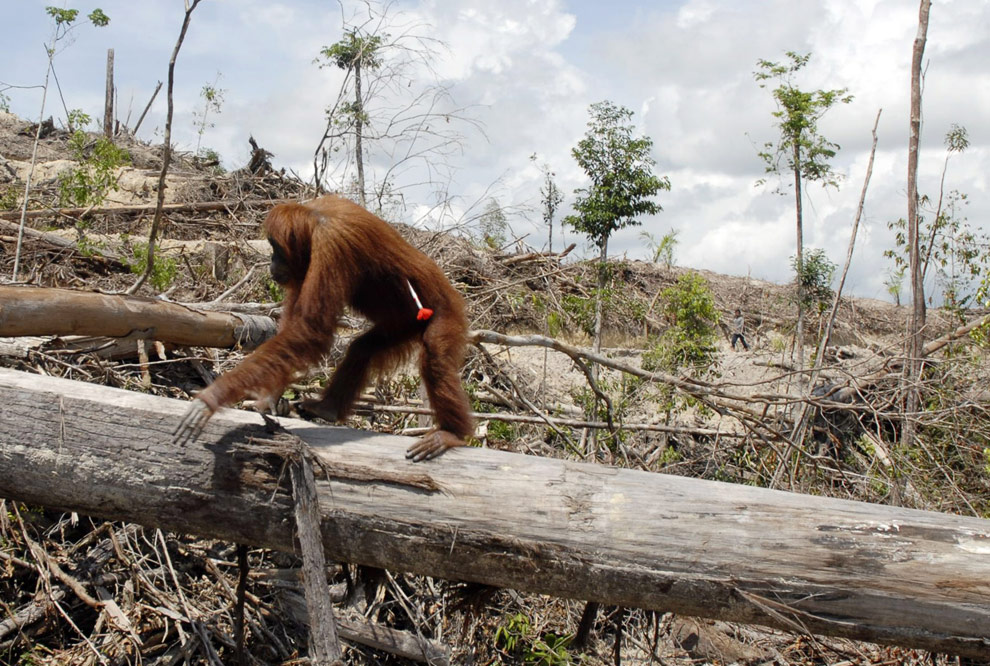
Orangutan with a tranquilizer dart in his side; will be relocated away from palm oil plantation site

Orangutan with a tranquilizer dart in his side; will be relocated away from palm oil plantation site

If you create lethal weapons and spread them widely among the populace, you should not be surprised when they discharge and kill people.

If you overheat the climate and bulldoze all the trees, you should not be surprised at the deadly droughts, wildfires, storms and temperature swings that result.

Back in the 19th century, Charles Darwin taught us to understand that competition is good, that the strongest and fittest will survive, and that if the weak perish it’s all for the best.  It was a perfect rationale for the capitalist/imperialist narrative of the past 500 years, domination as evolution, at gunpoint and bulldozer blade.

Would Darwin look out at today’s dangerous world and proclaim serenely that the coming population drop of humans, due to violence of our own making, is simply part of the grand scheme of Evolution?

If the answer is “yes,” does this mean we should just sit back and watch it all unfold with detachment?

I don’t think so.  I believe it’s the great task of our generation to meet the violence of our time with unwavering, clear-eyed resistance.

To a large extent, the damage has already been done.  The guns are circulating out there in the world; the nuclear power plants are whirring; the oil and gas rigs are pumping; the myriad plants and creatures with whom we grew up in our era on the planet are disappearing.

Pandora’s box is wide open, and the Furies have been released in the world.

We may not be able to get them back, but we can continue to insist that they do not represent us.  We can continue to stand as beacons to another mode of living, based not on competition and aggressiveness, but on collaboration and respect.

As we move into the darkest week of the year, let us not give up hope that as the planet swings back towards the Sun on December 22, we can collectively climb up out of the abyss of violence and pain and unite around the finest human values of life, peace and love, for our fellow human beings, and for the planet as a whole.

Building a Tsunami of a Climate Change Movement: What Will it Take?

In the seething, saturated media environment we live in, victory is measured in whether or not you’re able to get people to slow down and pay attention.

It’s getting harder and harder, especially for young people, to sustain attention for more than a few minutes.

Life is a restless prowl for something new, and in a manmade environment where we’re seen it all before, it’s got to be pretty damned new and exciting to get us to pause for even a moment.

As a teacher, I find myself adapting to this in ways that I would never have predicted when I first started teaching undergraduates, nearly a quarter-century ago.

I know I have to be more exaggerated in my classroom presence.  She who drones is lost.

I also don’t expect the level of reading comprehension these days that I used to take for granted among my students.

I know I’m going to have to excerpt and digest for them, and I’d better do it in an enthusiastic, engaging way, or they’ll be surfing away, in their heads if not literally, on their screens.

I have to do constant daily battle with those screens, too—even when I outright forbid them, they creep back in with all the force of a compulsion, or an addiction.

In this kind of environment, why should we be surprised that it seems to be impossible to get people to pay attention to a big, remote problem like climate change for more time than it takes to say “Hurricane Sandy”?

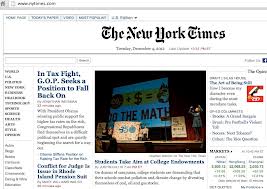
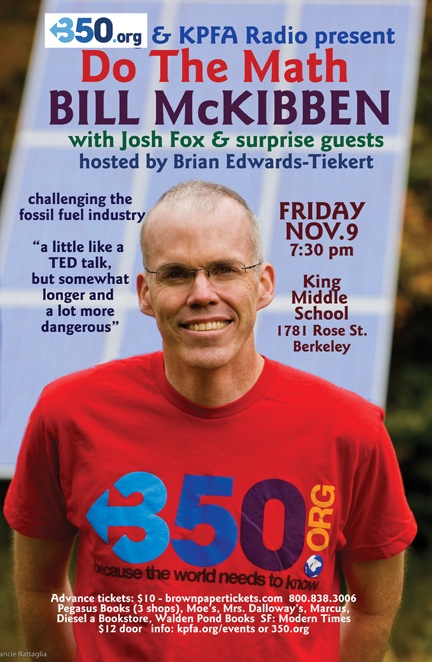
The other night I was overjoyed when I stopped by the New York Times site and saw Bill McKibben’s “Do the Math” tour foregrounded front and center on the homepage.

Unknown

Bill had the same reaction: he forwarded a screenshot of the page to his email list, trumpeting victory.

But what kind of victory is it, really?

Yes, McKibben’s Do the Math tour succeeded in finally penetrating the security perimeter of that gated community known as Mainstream Public Opinion.  If the Times prints an article, we can assume that at least a few of the sheltered, august heads within the insular circle of elite readers will pay attention.

Note that the article was ultimately filed in the Business section of the newspaper, by the way.  Evidently the Times thought its business-minded readers ought to know that those pesky students might be causing trouble for stockholders in major fossil fuel companies in the coming months.

This is the same way that the Times reported the Occupy Wall Street movement: as an annoying inconvenience, a public nuisance that our good police force is working to clear away ASAP.

It’s the same way they’ve reported on Hurricane Sandy, hitting right in their own backyard.  What a colossal inconvenience!  Let’s clear it away so we can get back down to business as usual.

What is it going to take to get through to the Times and its readers that there is not going to be any more business as usual?

The game is up.  Things are going to get much worse, and the only chance of avoiding total disaster is through immediate decisive action to curb carbon emissions and build up a massive supply of carbon sinks—ie, more forests, more seaweed and algae, more grasslands and croplands.

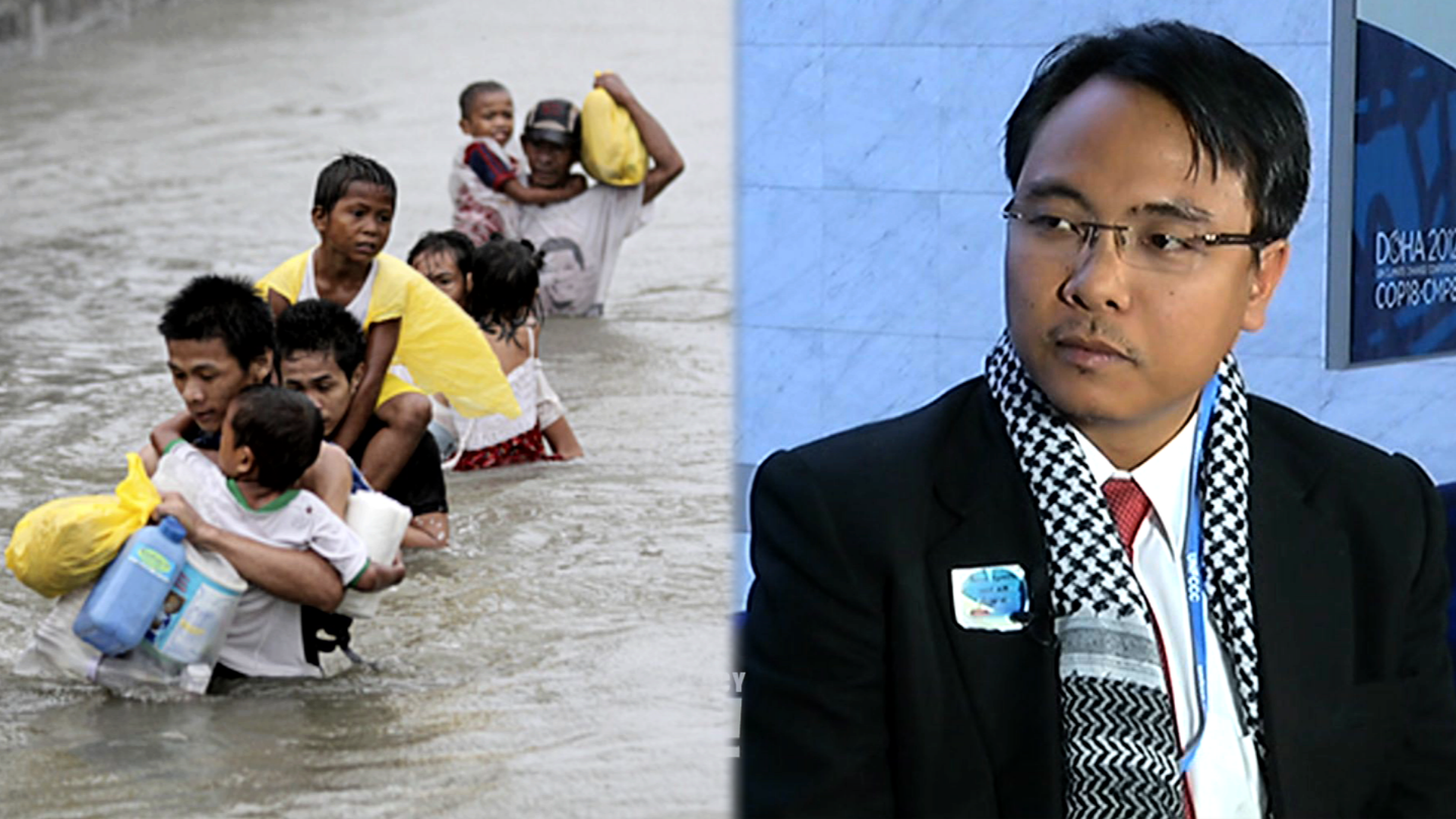
I was heartened, in a very melancholy sort of way, to see the chief negotiator for the Philippines, Naderev Saño, get all choked up as he made an impassioned speech to his comrades at COP18 this week to stop dilly-dallying and get down to the business of real change.

typhoon_yeb_sano

Referring to Typhoon Bopha, he said:

“As we sit here in these negotiations, even as we vacillate and procrastinate here, the death toll is rising. There is massive and widespread devastation. Hundreds of thousands of people have been rendered without homes. And the ordeal is far from over, as typhoon Bopha has regained some strength as it approaches another populated area in the western part of the Philippines.

“I appeal to the whole world, I appeal to leaders from all over the world, to open our eyes to the stark reality that we face. I appeal to ministers. The outcome of our work is not about what our political masters want. It is about what is demanded of us by 7 billion people.

“I appeal to all, please, no more delays, no more excuses. Please, let Doha be remembered as the place where we found the political will to turn things around. Please, let 2012 be remembered as the year the world found the courage to find the will to take responsibility for the future we want. I ask of all of us here, if not us, then who? If not now, then when? If not here, then where?”

Those are the right questions to be asking, and Saño is on the right track when he says that the work of stopping runaway climate change is not about what the “political masters” want.  It will only be possible if a sufficient number of people, all over the world, focus their attention and insist on the policy changes that will lead to real change.

The poor are the ones being disproportionately swept away by the floods and storms of climate change.  The problem may have their attention, but they’re not in much of a position to do anything about it.

I believe it is up to us, citizens of the so-called “developed” countries, to come out in force to demand change.

That is the kind of tsunami of U.S. public opinion that McKibben is trying to create with the Do the Math tour.

If we can succeed in catching the attention of young people, and getting them to understand how crucial this issue is to their futures, they can become a powerful force for change.

But in the end, this must be a multigenerational, multinational, multiethnic movement, of men and women from all walks of life, because if there’s one thing for sure, it’s that climate change does not play favorites.

It will blow away the fanciest palace just as soon as the flimsiest shanty (though the shanties will undoubtedly go first).

Ultimately, it will not be possible to build walls high enough to keep out the floodtides of a destabilized climate.

Does that get your attention?  No?  How about this: if we don’t get our act together on this issue now—I mean, NOW—we might as well just give it up and resign ourselves to roll with whatever punches are in store for us.  There will be many, and they will get progressively worse until our entire human civilization grinds to a halt.

Is that a risk you’re prepared to take?

I hope not.

So what can you do?

If you own stock, consider divesting your portfolio from fossil fuel companies until they shape up and get seriously green.

If you own a home, consider investing in alternative energy sources like solar or geothermal, and make your home as energy-efficient as possible.

Consider pressuring your town or city to do the same.

Start writing letters and emails to your elected representatives and the President of the United States and the fossil fuel barons and anyone else who might have influence, insisting that they think about our long-term welfare, not next quarter profits.

Talk to people about this.  You can never tell where ripples will go as the word goes out.

Do you want to go down fighting and active, or zoned out in front of your screen?

I echo the emotional words of the Filipino negotiator:

“Please, let 2012 be remembered as the year the world found the courage to find the will to take responsibility for the future we want. I ask of all of us here, if not us, then who? If not now, then when? If not here, then where?”

Telling the story of climate change: a call to action

You probably didn’t notice, but this past week another round of major international climate talks were held in Doha, Qatar, surely one of the least “green” locations on the globe.

The mainstream press barely bothered to give a nod to what has come to be a mind-numbing ritual of bait, switch and dodge.

The alternative press knew better than to look to the assembled ministers in Doha for any real news, focusing instead on the grim report released early last week by the Potsdam Institute for Climate Impact Research and Climate Analytics.

The 84-page report, titled “Turn Down the Heat” and funded by that radical fringe group known as the World Bank, demonstrates that if we continue our reckless heating of the planet at the present rate, all the scenarios of which readers of this blog are well aware—sea level rise, droughts and floods leading to severe food shortages, more frequent and more severe storms, loss of biodiversity and loss of human life on a biblical scale—will come to pass.

The executive summary of the report concludes with a measure of urgency:

“A 4C world is likely to be in which communities, cities and countries would experience severe disruptions, damage and dislocation, with many of these risks spread unequally.  It is likely that the poor will suffer most and the global community could become more fractured and unequal than today.  The projected 4C warming simply must not be allowed to occur–the heat must be turned down.  Only early, cooperative, international actions can make that happen.”

But this takes us in circular fashion back to Doha, where as we know, nothing substantive is going on.

Those of us who are aware of what’s happening on the climate front—and let’s face it, there aren’t that many of us, we probably form our own little 1% club—find it frustrating and frightening to have to sit by and watch as our beloved planet goes into drastic human-induced traumatic shock while our leaders bicker and fiddle and run down the clock.

I find myself constantly pulled between A) wanting to support political efforts like Bill McKibben’s “Do the Math” tour, which aims to educate and inspire action (specifically, divestment from fossil fuel companies to pressure them to reinvent themselves as bonafide green energy companies) and B) wanting to simply hunker down and build resilience at the local level, perhaps enrolling myself and my sons in a crash course in how to survive a disaster.

For the moment, I am focusing on doing what I can within my purview as a teacher to help the upcoming generation of young adults get a handle on what’s happening to our climate, and do their own productive thinking about how to engage in the struggle to turn things around.

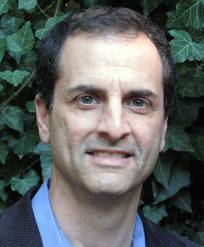
Yesterday I was fortunate to have had a chance to participate in a small way in my colleague Eban Goodstein’s C2C Fellows Workshop, a national program based at Bard College that seeks to give young people the skills and understanding to become successful leaders in the global effort to stabilize our climate and create a sustainable economy.

Eban Goodstein

Eban Goodstein

This is an ambitious undertaking, and Goodstein is going at it full tilt, holding weekend workshops several times a year at college campuses across the country, and bringing graduate students to Bard, with generous funding, to undertake Master’s degree programs in environmental policy with a special emphasis on climate-related policy and advocacy.

As Goodstein puts it, “Stabilizing the climate is not the work of a year, of a presidential term, or of a decade. It is the work of a generation.”

I see it as an essential commitment and responsibility to use my skills as a writer, scholar and teacher to help equip the upcoming generation for this great work we must all undertake now.

Goodstein is a unique blend of science policy wonk and communications guru, and I’m convinced that it’s at this very nexus that real change on the climate front will be forged.

All the dire scientific reports in the world won’t get people to wake up and change their daily habits, or insist that policy changes are made at the local, state, national and international levels, if the information is not presented in clear, compelling language.

A significant portion of the C2C Workshop, therefore, is spent in developing students’ storytelling skills.

It was interesting, and somewhat disheartening, to watch the students’ puzzled reaction when asked by Goodstein to talk about a favorite storyteller in their family.  Very few hands went up.

This is because most Americans today are reared listening to the TV tell us stories, not cherished individuals in our actual lives.  We are avid but passive consumers of prepackaged stories, and as a result most of us—unless we have the ambition to become stand-up comedians—don’t see storytelling as a skill we need to master.

Goodstein’s important insight is that storytelling is key to getting people’s attention, and telling a good story is essential to success in environmental advocacy and politics.

Good persuasive communication, he said, starts with a personal story, and then moves into the political.  Hook your audience with a personal anecdote, keep their attention with a strong narrative, and then finish up with a call to action.  And once you’ve got a strong story developed, practice telling it, over and over again, until you can do it in your sleep.

Armed with this advice, the group of some 80 students broke into smaller groups of five, each accompanied by a faculty or graduate student facilitator, for a two-hour intensive storytelling workshop.  Our task was to each come up with a short story about an inspiring person or event, write it up and tell it three times, to three different partners, then refine it and tell it again to the whole group.

The stories would be refined further the next day, told again to new audiences, and several would be singled out for telling to the entire big group, and given awards.

This is the kind of work for which I have been preparing my whole life.  There is nothing I would rather do than facilitate a writing workshop on inspiring stories!  And it gives me special joy to do it as part of a program aimed at giving young people the skills and mojo to tell the climate change story in a way that galvanizes action.

It may be that in the end, I would have been better served by spending my time learning survival tactics in the woods, but the truth is that even in the most dire circumstances, human beings have always needed their storytellers.  A good story well told can keep us warm in ways that may not be measurable, but that are profound nevertheless.

Here is the story that I wrote and told the students yesterday in our workshop.  I offered it to them—and now to you—with love and an earnest desire that it may inspire us all to each get to work on the climate change issue—in our own ways and spheres—before it’s too late.

My friend Pauline tells the story of how she came home from work one day and discovered that a civil war had started in her country, Congo-Brazzaville.  Suddenly she had ten people, mostly women and children, sheltering in her house as gunfire and bombs shook the streets of the city. 

When a bomb hit the house, she and her family and friends knew they needed to make a run for it.  They gathered what food and supplies they could carry, and left the house in the middle of the night, heading for the countryside. 

What followed was weeks of deprivation and terror as they huddled in the forest waiting for the conflict to die down so that it would be safe to return home.

I tell this story because it is emblematic of the many stories I have studied over the years, in which women and children are disproportionately affected as victims of social conflict and war. 

I tell it because I fear that in the age of climate change this is a story that will be repeated over and over again. Whether the violence is human—men with guns—or natural—hurricanes or droughts—the effects will be the same: women and children on the run, vulnerable and afraid.

Recent studies indicate that hundreds of millions of people will become climate refugees in the next half-century.  And they won’t all be in Bangladesh or the Maldives, either.  Just ask a former resident of Breezy Point in New York City, devastated by Hurricane Sandy, how it feels.

In our lifetimes we will all witness–and many of us will likely experience—the kind of fear and hardship that Pauline lived through, when the social order disintegrated and violence became the norm. 

There are many, many guns in America.  It would not take much in the way of food and energy shortages to trigger violence.

Sometimes I find myself wondering whether I should be learning and then teaching others survival skills, instead of critical thinking and writing. 

What good will my PhD in literature do me in an age of relentless, recurring Hurricane Sandys?  What good will a vaunted college degree do my students?

But I do continue to believe that the stories of survivors like Pauline matter, and increasingly these are the stories I offer students in my classes on human rights, environmental justice, politics and literature.

We all need to learn from Pauline and other survivors about the amazing resilience of the human spirit.  Even in the face of terror and chaos, people can choose to be compassionate, generous and respectful of one another. We don’t all choose the violent path. 

It will not help any of us to focus on fear right now, as the climate change crisis gains momentum and threatens to engulf us.  What we must concentrate on instead is hope, resilience and solidarity.  That’s what the world needs from us now.

Honoring the wisdom of Native Americans on Thanksgiving

Before I understood the real history behind the American tradition of Thanksgiving, I used to just innocently enjoy the chance to gather with family and friends to share a delicious meal.

I believed the story taught to me in grade school, about how the Pilgrims and their Native hosts sat down to a feast together, and lived happily ever after.

Such innocence, once lost, is impossible to recapture.

Now I know that the same Pilgrims who gave thanks for their delivery from starvation by the generous Native people of the region that would come to be known as New England would be the ones to turn on their benefactors and do their utmost to exterminate them.

My own ancestors were still fighting their own battles back in Europe at this time, but as an American, this is a shameful legacy that I need to confront and acknowledge.

As I wrote in my Thanksgiving post last year, the holiday of Thanksgiving should really be more of a day of atonement than a celebration of abundance, especially as we begin to realize that the abundance of food and natural resources that Americans have enjoyed over the past 500 years is not endless.

As we hit up against the limits to growth predicted years ago by Donella Meadows and others, we must recognize that the Native peoples who were so unceremoniously shoved aside during the Conquest of the Americas had so much more to offer Europeans than corn, squash, beans and turkey.

Indigenous worldviews, the world over, privilege balance over growth and accumulation, and this is the wisdom we need to pay attention to now.

Some argue that such a conservative position would not support the kind of technological innovation in which Europeans have excelled.

But I would ask whether our technological innovations have succeeded in making us happy as a culture, or as individuals within our culture?

Isn’t it true that the vast majority of our technological inventions have been used to foment and practice ever-more violent warfare?

Even our vaunted advances in medicine are primarily used, these days, to try to heal us from the sicknesses and imbalances our own technological inventions have afflicted upon us, by the poisoning of our food, air, water and earth with toxic chemicals and the byproducts of burning fossil fuels.

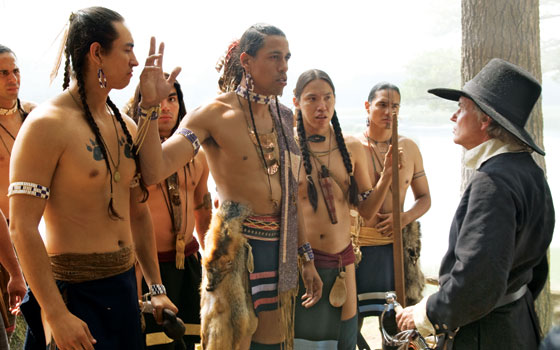
This image, from the PBS series “American Experience,” depicts members of the Wampanoag tribe meeting a white settler.

Before the Pilgrims landed in Massachusetts and started their inexorable push west, the indigenous people living here were happy, healthy, strong and long-lived.  They enjoyed the abundant food stocks of the ocean, rivers and forests, and lived in harmony with the land.

Yes, there were territorial skirmishes, but there were also strong intertribal councils and confederations, in many cases led by matriarchs who valued peace and did not want to lose their sons and grandsons to needless warfare.

This Thanksgiving, I give thanks that the Native peoples of this continent are still with us, despite all the brutality visited upon them by the European conquerors.

This Thanksgiving, I pray that all Americans begin to honor indigenous people as they deserve to be honored, by giving credence to the Native value of harmony with the Earth, and actually trying to live it.

Fossil Fuels R Us–but we can change, and so can they!

I am in one of those periods where I feel quite inadequate to comment on the events that dash across the world and national stages with madcap intensity.

What was it Shakespeare said? Life’s but a shadow, a poor player who struts and frets his hour upon the stage and then is heard no more…it is a tale told by an idiot, full of sound and fury, signifying nothing….

And yet for those of us who are caught up in the moment, our hour upon the stage, what happens does matter, it does signify something—even if we can’t always tell what that something is.

The General and his lover

What does it mean that a much-decorated general, Director of the CIA, abruptly resigns after being investigated for adultery by the FBI?

Is this scandal really just about a simple affair with a younger woman, or do the General’s neocon tendencies, which had him presiding over the escalation of the disastrous war in Afghanistan and advocating open hostility with Iran, have anything to do with the alacrity with which President Obama accepted his resignation?

We’ll find out when the blockbuster film comes out, a couple of years from now!

Meanwhile, the drumbeats of war are booming in Israel/Palestine, right on cue after the American elections ground to their quadrennial conclusion.

Once again photos of bloody children pop up on our computer and TV screens.  Once again passionate voices on both sides of this eternal conflict are raised.  This is a pageant that has taken place so many times it has become predictable and stale, like the Christmas pageants that will soon take their places on local church stages throughout Christendom.

Scenes from Gaza, November 2012

Why can’t those people just get along? Americans wonder before flipping the channel.  Few of us are aware of the extent to which the Israeli/Palestinian conflict continues to be fueled and armed by the taxpayers of the United States.

This is our conflict; we are responsible.  But as long as we dispassionately wait for someone else to stop it, it will continue to grind on.

The same is true with so many issues, from climate change to income disparity.  It’s time to stop waiting for someone else to step in and solve the problems, make the changes for us.  We have to do it ourselves.

There are a few encouraging signs that this is beginning to happen.

The 350.0rg “Do the Math” tour with Bill McKibben, Naomi Klein and many, many friends is making its historic way across the country, urging Americans to consider ways they can pressure the institutions with which they’re involved to divest from fossil fuel companies.

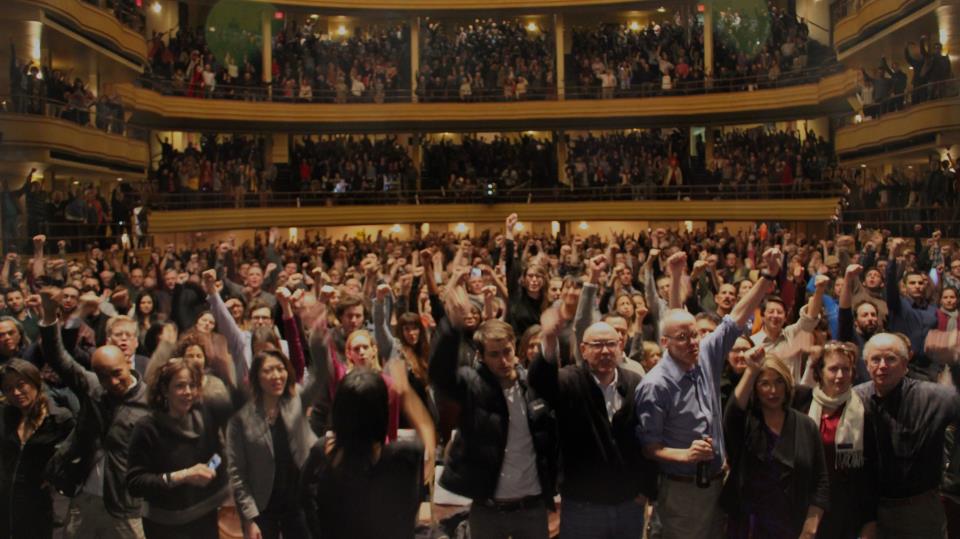
Scene from the Do the Math tour in New York City, 11/12

McKibben was talking about this last summer when I went to listen to him up at the top of Mount Greylock here in western Massachusetts, courtesy of Orion Magazine.  He invoked the successful divestiture movement of the international anti-apartheid struggle, which put enough pressure on the racist South African government that it eventually had to back down from its untenable position and begin working with the Black South Africans.

The sins of the fossil fuel companies are much bigger than those of the Boers: we’re not just talking about bigoted social policies in one country here, we’re talking about a mindset, policy brief and massive engineering effort that is inexorably endangering the entirety of human civilization on this planet, and indeed the well-being of all current life forms, perhaps excepting algae, bacteria and cockroaches.

And yet, it’s impossible to externalize the blame here, because the fossil fuel companies have only been trying to give us what we want: cheap and plentiful oil and gas.

It’s not their fault that we love their products so much we’re willing to do anything—including fight endless wars—to get it.

It’s incumbent on us to look inward and interrogate our own desires and dependencies in order to move forward.

Pressuring the fossil fuel companies to change is a good thing, as long as we’re willing to change with them.

Shifting to renewable energy is going to take a commitment from every player on the world stage today, from government leaders to manufacturers to the financial sector to ordinary consumers like you and me.

Let’s not allow the gloom of Shakespeare’s tragedies to engulf us and sap us of energy.  This play isn’t over yet and it doesn’t have to come to a bloody end.

Enough playing the handwringing Hamlet role!  Let’s roll up our sleeves and get to work to solve our problems and write ourselves a better script.

The Audacity of Hope, c. 2012

For those of us who supported President Obama, the last 24 hours or so have been positively giddy.

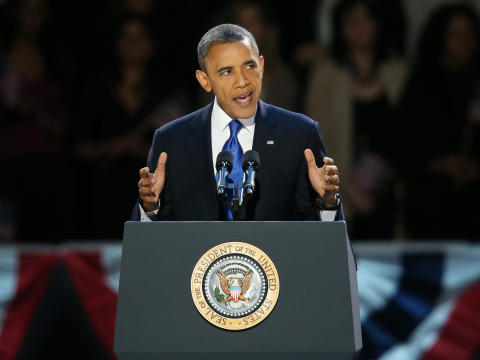
There were the nail-biting first few hours of the election results…followed by the glad tidings of more and more of the big electoral states turning a glorious blue…capped by the wonderful thrill of seeing the President stride out onto the stage in Chicago to give the most rousing acceptance speech most of us have ever heard.

What a big heart this man has, to include in his acceptance speech itself the invitation to his opponents to meet him in the aisle and try to seek common ground!

In the very first words of his speech, before he even thanked his running mate, he reached out to Mitt Romney, offering to work with him to move the country forward onto a better, firmer footing:

I just spoke with Governor Romney and I congratulated him and Paul Ryan on a hard-fought campaign. 

We may have battled fiercely, but it’s only because we love this country deeply and we care so strongly about its future. From George to Lenore to their son Mitt, the Romney family has chosen to give back to America through public service and that is the legacy that we honor and applaud tonight.

In the weeks ahead, I also look forward to sitting down with Governor Romney to talk about where we can work together to move this country forward.

And then, towards the end of the speech, he said so memorably:

America, I believe we can build on the progress we’ve made and continue to fight for new jobs and new opportunity and new security for the middle class. I believe we can keep the promise of our founders, the idea that if you’re willing to work hard, it doesn’t matter who you are or where you come from or what you look like or where you love. It doesn’t matter whether you’re black or white or Hispanic or Asian or Native American or young or old or rich or poor, able, disabled, gay or straight, you can make it here in America if you’re willing to try.

I believe we can seize this future together because we are not as divided as our politics suggests. We’re not as cynical as the pundits believe. We are greater than the sum of our individual ambitions, and we remain more than a collection of red states and blue states. We are and forever will be the United States of America.

This audacity of optimism is why we elected Barack Obama back in 2008, and why we continue to love him.

Whatever his personal or political failings, Barack Obama stands for the best hope of the USA: the raw immigrant passion and drive that founded this country and still makes it great.

He also represents, in his very skin, the polyglot future of the USA, the inexorable movement away from the European aristocracy of our founders to the broad multicultural diversity of our descendants.

Mitt Romney’s concession speech 2012

The Republicans are still stuck back in the good old days of the good old guys’ party.  As one commentator aptly noted, Republican political rallies look suspiciously like Ku Klux Klan rallies of the early 20th century.

For those who might rather not recall, let us remember that the Klan not only hated and lynched African Americans; they also hated and lynched Jews.  And they didn’t liked the Irish or the Italians much either!

Let’s not even talk about gay folk.  And women?  For the Klan and many contemporary conservatives, they belong in the kitchen or in the bed.

This is not the country we want to be as we move into the 21st century.

Although I thought the Obama campaign’s slogan “Forward, not back” was a little hokey when I heard it trotted out at various rallies, it does have the ring of truth to it.

We do not want to go back to the intolerance and violent hatred of our past.

We need to move forward, and we will need all hands on deck to confront the deeply unstable, uncertain future that awaits us in the age of climate change.

I want to see Barack Obama rise to the challenges of our time with all the power of his big heart.

I want to see him not just think about jobs, but think about green jobs, about jobs that will move our country forward into a longterm, sustainable future.

Enough kow-towing to Big Oil, Big Agriculture and Big Chemical.  It’s time to force these industries to bend to the winds of change, to adapt to the new paradigm of sustainability sweeping our country and our planet.

I applaud Bill McKibben for waiting until the election was over to come out swinging—and I applaud his continuing efforts to get the climate change issue into the center of political discourse.

Those who are still suffering from the after-effects of Hurricane Sandy, along with their insurers, should be his best allies.

We need to face the truth that all the matters of social justice that concern us will be moot if we don’t face the pressing need to get our planetary civilization onto a sustainable footing.

We need to convince our President of this, post-haste.

But let’s take a moment to breathe a big sigh of relief that it is Barack Obama we’re dealing with, and not Mitt Romney!

This election proves that Big Money is not infallible.

Democracy still matters; individual votes still matter; as a country, we are not as corrupt as many of us feared.

Now is the time for all of us to embrace the President’s big heart and let it reach out even further to encompass our entire beautiful planet and all of her creatures.

This is the task we humans were born to undertake: to become the thoughtful, compassionate stewards of our planet, and the collaborative leaders of our own multifarious tribes.

It is so good to see more and more women stepping up to the plate now.  We are sorely needed, but we can’t do it alone.

Men and women of all heritages must work together as never before to reestablish the equilibrium needed to move our civilization forward sustainably into the 21st century.

These are not just words.  This is our urgent reality.

Barack Obama has answered the call.

Will you?