Resisting the Vampires

This morning in class we were talking about the third essay in Nietzsche’s The Genealogy of Morals, in which one of the dominant metaphors is that of sickness and health.

Nietzsche argues that an “ascetic priest”, who tends the masses through religion, science, politics or any kind of dogmatism, acts as physician to the sufferer, but “he first has to wound; when he then stills the pain of the wound he at the same time infects the wound–for that is what he knows to do best of all, this sorcerer and animal-tamer, in whose presence everything healthy necessarily grows sick, and everything sick tame” (Kaufman, 1989, 126).

In other words, those who try to manipulate the masses (or the herd, in Nietzsche’s terminology), do so by wounding, and then claiming to have the cure–but the cure perpetuates the wound.

As with so much of Nietzsche, this seems remarkably prescient to me.  Take cancer, for example.  I have received many requests from people who are “walking for the cure” or “running for the cure.”  I never support these efforts, because I don’t believe we should be looking to cure to cancer through technological research.  The cure for most cancers lies upstream, as Sandra Steingraber pointed out more than a decade ago in her book Living Downstream.  In other words, we should be looking for ways to prevent cancer, not to cure it.

Preventing cancer doesn’t require a sorcerer or a physician.  It requires resisting the agro-industrial complex, which has saturated our food supply with synthetic chemicals.

The makers of chemical fertilizers, pesticides, fungicides and GMO seeds, all of which make us sick, are in cahoots with the medical industrial complex that now seeks our help in funding “the cure.”  Not to mention the pharmaceutical industry and the insurance companies, which have also been making out like bandits on the sickness of the masses.

Nietzsche wasn’t necessarily talking about literal sickness, but his model can be applied to our contemporary situation, in which social leaders, be they in advertising or the food industry, first lead us into sickness, and then claim (through pharmaceuticals and technology) to have the cure–but the cure is only a further sickness (radiation or chemotherapy, anyone?) that continues to make us dependent on the master, the physician/scientist, for life itself.

There is a way out of this.  Call it biodynamic farming, or permaculture, or localized organic farming, or what have you…the idea is to liberate ourselves from the tyranny of industrial agriculture, and go back to a simpler time, not very long ago, when the journey from farm to table did not involve chemical additives, feedlots or genetic modification.

Standing up for the cure may seem like a noble endeavor, but I’d like to propose something even better: standing up for health.  If we look further upstream and get at the root problems of the sickness, we won’t need to be looking for a cure.

Sad news for the pharmaceutical industry, but too bad!  Those vampires have fed on our blood long enough.

But what can we DO?

It’s not enough to simply lament the disappearance of species, or the poisoning of the air, water and soil of the planet.  The urgent question of our time is WHAT TO DO ABOUT IT?  How can any of us–how can I–act to staunch the hemorrhage and resuscitate this dying patient, our planet, before it’s too late?

Let’s review the options.

There is political reform, through various channels: appealing to our duly elected representatives and/or supporting environmental groups that lobby these politicians and try to pressure the relevant federal and state agencies charged with protecting the “natural resources” of our country.

I have to say that I am quite skeptical of this approach, which doesn’t seem to have worked at all in the 40 years or so since I first became a Ranger Rick reader and aware of the environmental movement.

Things have gotten much worse for the natural world in my lifetime, despite all the efforts of big, well-funded groups like the National Wildlife Federation, the Sierra Club, the Nature Conservancy, or even Greenpeace, the most radical of them all. Greenpeace is the most willing to go out on a limb to protect species and habitat, but its actions have failed to make the kind of global difference we need.

There is international peer pressure to do the right thing–conventions, treaties and protocols.  Even as I type these words, I inwardly despair.  From Kyoto onward, the U.S. has been the bully who refused to play nice in the community of nations whenever it’s come to putting the common good before the holy Free Market.

There is actually going around the blowing up the worst aspects of civilization, like dams, power plants, cell towers and chemical plants, as the proponents of Deep Green Resistance advocate.  Eco-terrorism, anyone?

Or there’s crowd power of the Occupy Wall Street variety, which certainly seems right now to hold the most promise.  ‘Never doubt that a small group of thoughtful, committed citizens can change the world. Indeed, it is the only thing that ever has,” Margaret Mead said.

But how to convince those crowds that the fate of seals, bees and goldfinches–not to mention the oceans and the boreal forests of North America–is actually more important than the injustices of economic inequality here in the U.S.?

Of course, it’s all important.  I have several friends who are on unemployment now and having serious trouble finding jobs.  If the Tea Party had their way, unemployment itself would be a thing of the past, a quaint relic of the old New Deal.  We can’t let these radical conservatives shred our social safety net, and we do need to start creating jobs again–green jobs, of course.

But there is no single issue more urgent than climate and environmental health, because if our climate goes haywire and our life support systems here on Earth fail, folks, we are all going down with the ship.

How to convey this to the crowds who are willing to turn out to protest economic injustice, but give it a miss when the issue is global warming?  How to convince people that what we should be demanding as we flood the squares and Main Streets of our country are well- subsidized options to reduce our energy consumption?

Doesn’t sound very glamorous, but the truth is that there’s nothing more important to be fighting for right now than subsidies to install solar roof tiles, like they’ve been doing in Europe for a decade already; and solar hot water heaters; and geothermal ducts for large buildings; and affordable green tech cars.

As Mark Hertsgaard and others have been saying, it’s not enough to make individual green lifestyle decisions, like recycling or composting or turning out the lights when you leave the room.  These individual actions are all well and good, but they’re not going to make the dramatic change we need to get our climate back into shape.

For the kind of change that will save the polar bears and the walruses and the coral, we need our government to step up and protect the interests of its people.  Not the interests of the corporations which have collectively driven our planet to the brink of ruin with their shortsighted greedy ethos of extraction and exploitation.

Government by the people, for the people.  And for the environment that sustains these people in a web of life that includes all living beings on this planet.

How to say this in a way that will light up the imaginations of the 99% and ignite an unstoppable movement for change?

I will keep trying.  What more can I do?

Our planet, ourselves: we must wake up to the destruction, before it’s too late

First the honey bee population crashed.  Then it was the bats, dying by the millions in their caves during the winter hibernation, of a strange white fungal infection.

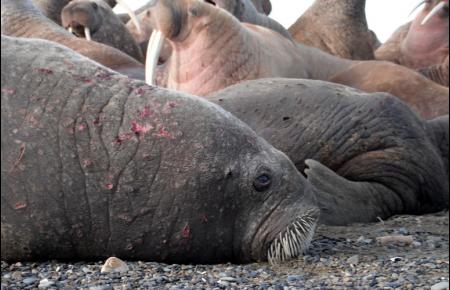
Now marine mammals, including walruses and ringed seals, are turning up dying on the beaches of Alaska and the far north.  Unidentified skin lesions and sores are the visible evidence of an unknown disease that is ravaging them.

Meanwhile, climate change is causing unprecedented surges in the populations of destructive insects like pine borers, which are killing off millions of acres of forests around the world.

I could go on, and on, and on.

Truly, Derrick Jensen is not exaggerating when he says that human civilization is killing our planet.

Last weekend I watched the new film “End:Civ,” by Franklin Lopez, based on Jensen’s book Endgame.  I had put off watching it for several weeks, because I knew it how upsetting it would be, and sure enough, it was disturbing, to say the least.

For me the hardest-hitting part of the film was about human beings’ casual tolerance of cruelty; our willingness to stand by, indifferent, as our fellow travelers on this planet are systematically hunted or poisoned or displaced to extinction.

Part of this detachment of ours may be rooted in the way we tell the stories of how these deaths occur.  We talk about “colony collapse disorder,” for example, rather than narrating the way that entire hives of bees–which are highly evolved, communicative insects–fail to return to the hive one day.

They get lost out there–maybe due to cell phone waves or other forms of chemical interference, we don’t really know–and never come home.  Imagine this happening on a global scale, a whole species of productive, social insects lost, one by one, by the million.

In the same way, it’s far easier to talk about “cancer victims” en masse than to live through the suffering death of your own loved one.  How many vibrant, creative, hardworking people have we lost to cancer the last ten years?  In the last year?  In the last month?  Wangari Maathai and Steve Jobs, to name two famous, very recent cancer victims.  The list goes on and on and on.

But still we remain passive.  We may mourn the disappearance of the honeybees or the songbirds, but we don’t make the effort to connect the dots and come to a true understanding of the extent to which our way of life has been poisoning our planet since the advent of industrialization, and especially since the beginning of the 20th century, which is when synthetic chemical production really took off.

Before she died of cancer, Rachel Carson managed to break through the wall of indifference and make the case against DDT.  Thanks to her efforts, the bald eagle and many other birds have rallied and come back from the brink of extinction.

It’s amazing how resilient life is.  If human civilization would just back off and give our natural systems on the planet a chance, they would heal themselves, and go back to providing the healthy ecological web that made our success as a species possible.

Our planet, ourselves.  We need to understand, in the deepest and most urgent possible terms, that we cannot dissociate ourselves from the poisoning and destruction that is being visited on the forests, oceans, swamps and grasslands of this planet.

The “Wall Street Awakening” cannot be only about jobs, about fixing a broken economy and continuing on our merry path of global domination and “resource extraction.”  The analysis has to go deeper than that, and the change has to be much more dramatic.

All the jobs in the world won’t bring back the walruses or the ringed seals or the polar bears.  What use will jobs be when the ocean is a giant dead zone, and industrial agriculture collapses?  Will we be worrying about jobs when the forests that provide our oxygen are all gone?

We need to focus on what’s important and go all the way this time.  As I keep saying, our future depends on it.  And I am not exaggerating.

An urgent message for the global elites: change is coming, like it or not!

America’s ‘Primal Scream’ – NYTimes.com.

It’s always nice to wake up and see the very thoughts I was writing last night trumpeted in the Sunday Review of the NY Times.  Nick Kristof cites many of the same statistics I did to make his case that income inequality is not only real, but “a cancer on our national well-being.”  

But where he ends his column wondering whether the movement will persist “once Zuccotti Park fills with snow and the novelty wears off,” I believe things are only going to get more intense as we move into this winter of discontent.

For one thing, there’s climate change looming over us.  Check out today’s big story on the fact that this imperative issue has lost traction in the U.S., even as most of the rest of the world is moving aggressively to regulate carbon emissions and develop more sustainable technologies.

It seems that the elites driving our economy believe that we can continue our comfortable insulated ride in the plush American Caddy, and let the plebes outside the walls of our national gated community deal with the unpleasantness.

How quickly we forget the major blizzard in New York City last year, or Hurricane Irene bearing down on the whole East Coast.  Climate change is only going to intensify in the coming years unless we get serious about it fast.  The natural disasters it will cause will cost far more than action to curb emissions proactively.

Unlike Nick Kristof, I don’t believe our society has a choice about whether or not to change.  We will be changing, like it or not.  The question is, will we change in an orderly fashion, through regulation and innovation that puts the common good ahead of the greedy goals of the men behind the tinted windows of those chauffeured limousines?

To me, this is what the Occupy protests are about.  The 99% are sick and tired of shouldering all the costs of our industrial capitalist way of life–the debt bondage, the toxic chemicals making us sick, the decimation of our environment wreaking havoc with our climate, the fading of the American dream–while a few fat cats sit pretty on top of the heap and enjoy the spoils.

I have news for you, global elites.  You can’t escape the impartial justice of climate change.  You should have realized by now that you will reap what you sow: if you seed our agriculture, air and water with toxic chemicals, you and your children will get cancer just like the rest of us.  If you continue to deforest the Earth at the current rate, you too will be gasping for oxygen along with the poorest inhabitants of what used to be a boreal forest.


Hiding behind police barricades in your plate-glass towers will only get you so far.  In the long run, it’s no way to live.

Come on out into Liberty Plaza with the rest of us, and let’s work together for a better life for all–while there’s still time.

Much to protest…and much work to be done to make it right

Riots in Rome, a huge protest in Times Square, New York, and rolling protests from New Zealand to London to L.A. Things haven’t been this globally lively since the 2003 protests against the imminent U.S. invasion of Iraq.  Where is it all leading?

None of us know.  But the police are getting out their riot gear, and it is very possible that there are going to be more violent clashes, as there were in Rome today.

As the protests gain momentum, it’s important to keep our eye on just what all the anger is about.

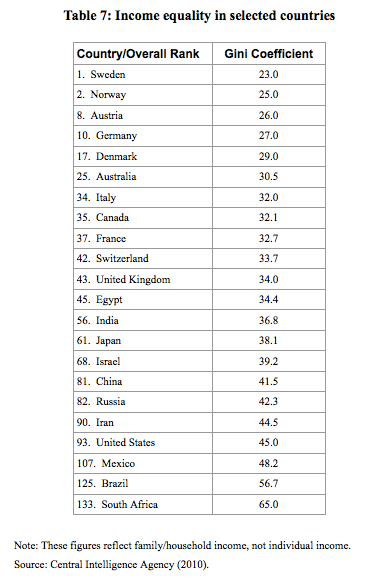
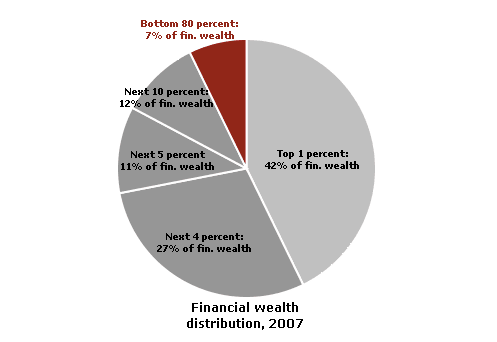
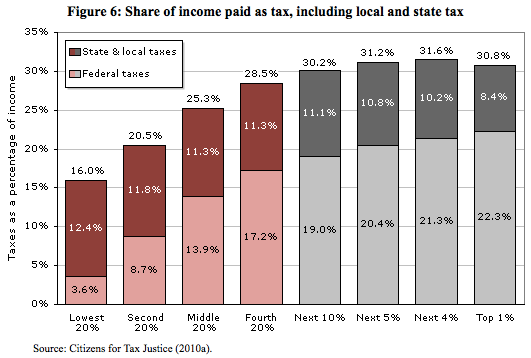
Business Insider, of all sites, published a very interesting set of charts and commentary last week promising to explain just what all the fuss was about down in Liberty Plaza.  Check it out, you won’t be disappointed.

Here are a few of the most damning charts:

The U.S. ranks below China, Iran and India in terms of income INEQUALITY.

Five percent of Americans own 69% of financial wealth.  The top 1% own 42% of this country’s financial wealth.

And the tax rate of these fabulously wealthy people is about the same as everyone else’s. That’s why they continue to get richer and richer, and everyone else slides inexorably downward.

While CEO pay is up nearly 300% since 1990, average workers’ pay is up 4%.  I don’t know about you, but the modest increases in my salary over the past decade have been totally absorbed by higher expenses, from food to gas to health insurance premiums and everything else.

So hell yes, there is something to be angry about!  There is a lot to protest!  There is a lot of work to be done to turn this country and this world around. The question is, how far will we go to rock the comfortable cruise ship of the one percenters?  And how far will they go to keep the status quo the way it is?

Police forces have always done the bidding of the wealthy in capitalist societies; is there any chance this could change?  The police are workers just like the protesters; is there any chance they will break their indoctrination and side with their own class interest?

Seems unlikely, but let’s not underestimate the forces of change.  Who would have believed, even six weeks ago, that people would be turning out in the thousands across the world to protest corporate greed and social inequality?

Look at this crowd.  It’s pretty clean cut, isn’t it?  This doesn’t look like a case for the riot police.  By and large, these people don’t want revolution. They just want to be able to live decent lives in a country they can be proud of.

Is this too much to ask?

No.  But, and this is a BIG BUT: what we’ve come to consider “a decent life” is going to have to change in the 21st century, given peak oil, the impending collapse of industrial agriculture, and the climate crisis.

So much will depend on our being smart enough to put these pieces together with the economic injustice we perceive so clearly, and see our way clear to a new, sustainably grounded society.

This is not too much to ask either.  But it will be a challenge to move from the fist-in-the-air stage to the creative visioning, and most of all to the implementation of a more just and sustainable economic system.

We have no choice but to meet this challenge.  Our global future as a species depends on it. This is the central task of our time.

Honoring Native Americans instead of Columbus

I’d like to suggest that instead of honoring Christopher Columbus on this day in October, we make this a national holiday in honor of the indigenous peoples of North America.

It is shameful that we have no national day of recognition for the native tribes who were here to welcome the first European explorers.  Perhaps this is no innocent oversight; if there was a day of recognition, we’d have to confront the ugly truth of what those Europeans did to the Native Americans–from smallpox to displacement, massacres and enslavement.

Still, that bloodstained history lurks beneath the surface of national holidays like Columbus Day and Thanksgiving.  It would be better to look squarely at the truth and do something to atone for it–at minimum, honoring the native ancestors of this land, and their contemporary descendants, who continue to struggle and resist the tsunami of Euramerican industrial civilization.  

For an idea of what that struggle looks like today, check out the Honor the Earth website.  Honor the Earth works “to address the two primary needs of the Native environmental movement: the need to break the geographic and political isolation of Native communities and the need to increase financial resources for organizing and change.”  It was founded in 1993 by native rights and environmental activist Winona LaDuke and the Indigo Girls.

In honoring the Native peoples of the United States instead of the European explorer who accelerated the invasion of their territories and the assault upon their cultures, we would be honoring the amazing resilience and wisdom of these ancient tribes, who have withstood the onslaught of European culture with incredible strength, courage and dignity.

We contemporary Americans are standing at a turning point in history where we may be able to get away from the destructive mode of domination represented by Columbus and a host of European explorers after him.

Changing Columbus Day to Native American Day (or perhaps selecting one significant representative Native person from history–I would not presume to suggest a single figure, but there are many to choose from) would be a good start at not only atoning for the bloody history of European-Native encounters, but also moving more harmoniously into the future.


Bill McKibben: The Sky Does Not Belong to Wall Street!


Thanks to the magic of You-Tube, we can see a terrific 6-minute speech by Bill McKibben today, linking the fight to save the climate to the fight against the Wall Street tycoons.

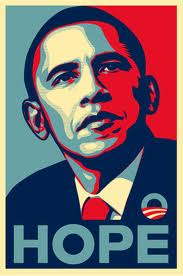
He’s planning another big action in D.C. next month: setting up a ring of protesters around the White House, standing siege until the real Barack Obama comes out–not the zombie who’s actually considering letting the oil industry raze the boreal forest in Alberta and run a leaky pipeline all the way to the Gulf.

We need our Obama to stand up to those guys and remind us why we elected him!

Let’s hope Bill McKibben and company can free the real Obama from the stranglehold of Big Oil, so he can be our champion in the White House, as we so hoped he would be.

“The sky does not belong to Exxon.  They cannot keep using it as a sewer into which to dump their carbon,” Bill reminds us.

Barack, are you listening?

Nobel Peace Prize honorees: why not Vandana Shiva?

How can I complain when the Nobel committee saw fit to grace not one but three women, two from Liberia and one from Yemen, with the annual Peace prize?

After all, I’ve been working for years now to help the women of the two-thirds world gain more power and recognition, and these three women–the towering elder and current President of Liberia, Ellen Johnson Sirleaf; Leymah Gbowee, the Liberian peace activist familiar to many from the portrait of her in the powerful documentary film “Pray the Devil Back to Hell”; and the young Yemeni human rights activist Tawakkol Karman– are certainly very deserving.

In fact, for our anthology African Women Writing Resistance: Contemporary Voices, my co-editors and I chose a quote from President Johnson Sirleaf as one of our epigraphs.  “Listening to the hopes and dreams of our people,” she said in a speech to the American Congress in 2006, “I recall the words of a Mozambican poet, who said ‘Our dream has the size of freedom.’ My people, like your people, believe deeply in freedom–and, in their dreams, they reach for the heavens.”

All three of this year’s Nobel Peace Prize winners have been channels for the hopes and dreams of their people, seeking political empowerment, social stability and security, and a sustainable path forward out of chaos (in Liberia’s case) and stagnation (in Yemen).  Ellen Johnson Sirleaf, who holds a Master’s degree in Public Administration from the Kennedy School of Government at Harvard, has done a lot of good things for her people in her tenure as President, including many development programs aimed specifically at empowering women.  She has succeeded in gaining major debt relief from Liberia’s creditors, as well as brokering deals with big transnational energy companies to extract Liberia’s oil.

The other two Nobel Peace Prize honorees are equally deserving.

But I wish the Nobel Committee had been a bit more forward-thinking, and seen fit to honor another woman from the two-thirds world, Vandana Shiva of India.  A Ph.D. in particle physics, Shiva has been way ahead of her time for most of her life.

Instead of taking her place comfortably in the ranks of the Indian elite, Shiva became aware as a young woman of the danger of the industrialization of agriculture in India. She founded an organization, Navdanya, dedicated to saving heirloom seeds and preserving the knowledge of how to farm using ancient, local, sustainable methods.

When Monsanto began moving aggressively into the Indian market, luring in farmers with fertilizers and GMO seed on credit, Vandana Shiva was just about the only one who seemed to perceive the huge risk they were taking.  When these same farmers began committing suicide in droves as their reliance on foreign seed, fertilizer and pesticide drove them inexorably into debt, Vandana Shiva was the one who went to court to defend their lands and the rights of their widows.
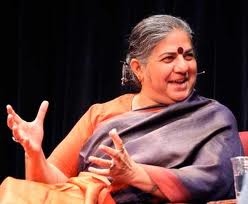
She has been a veritable David fighting the Goliath of Monsanto for the past twenty years or so.  And in many cases, she has won!

While I also honor Ellen Johnson Sirleaf and her younger co-awardees this year, I have to say that I would like to see them follow more in Vandana Shiva’s footsteps in the future.

Take Liberia, for instance, which in 2010 ranked 162 out of 169 countries on the United Nations Human Development Index.  Ellen Johnson Sirleaf is busy signing agreements with Chevron to extract the country’s oil, and hoping that some of the oil wealth will trickle down to ordinary Liberians, who are still hungry and poor today.

I’d like to respectfully suggest that instead of selling her soul to Big Oil, President Sirleaf follow the example of Vandana Shiva, and look to local, sustainable agriculture and manufacturing to build her country’s economy.

In a time of rapid climate change, it’s the countries and regions that are most self-sufficient and least plugged into the fossil-fuel-driven global economy that are going to be able to ride out the coming maelstrom.

It is clear that the corporate and political leaders of the world have no intention of acting decisively to stop global warming.  Last week’s major climate change story was about a report issued by a Washington D.C. think tank calling for more research into bioengineering of the climate, or “climate remediation.”  Specifically, they’re interested in getting the federal government to fund research into two major approaches:

  • Carbon Dioxide Removal (CDR): CDR strategies aim to remove greenhouse gases from the atmosphere, thereby addressing the root causes of climate change.
  • Solar Radiation Management (SRM): SRM strategies aim to counteract or mask the effect of rising greenhouse gas concentrations in the atmosphere by increasing the amount of solar energy that is reflected back into space.
The first method involves working with plants that will absorb more carbon dioxide, or finding ways to sequester the CO2 we produce back underground.  One could hardly argue with an aggressive tree-planting and conservation campaign, particularly in light of the appalling reality of deforestation across the world today (see this very cool interactive map for the gruesome details).
The second method is the environmental equivalent of Ronald Reagan’s infamous Star Wars missile defense system: a sci-fi-esque plan to install giant mirrors in space, or to seed the atmosphere with reflective particles that will deflect solar rays from Earth.  One can just imagine the military industrial complex salivating at the thought of such a project, particularly at a time when there is so little support for continuing the wars that are this industry’s usual diet.
The problem, of course, is that both of these approaches miss the central most important fact about climate change, which is that nothing will stop it other than aggressive changes to our carbon-based lifestyle.
Will that happen?  Can it happen in time?  Maybe the Occupy Wall Street movement can bring the necessary energy to this fight, and I certainly hope they do.  Recently Bill McKibben’s 350.org, a leader in climate change activism, became one of the many larger national organizations seeking to ally themselves with this young juggernaut of political action.

Meanwhile, so-called “less developed nations” like Liberia and Yemen and all the rest should seriously re-evaluate their acceptance of this designation, which means rethinking the whole rationale behind Western-style “development.”  Development, Western-imperialist style, has benefited a few people mightily but brought suffering to the vast majority of people on Earth, especially those in the areas of greatest resource extraction, which are, paradoxically, the “less-developed” nations.
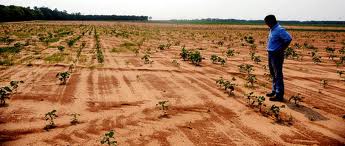
Now the time has come for us here in the heart of Empire to feel the blowback from our aggressive policies of development.  Climate change is upon us.  And in this new era, it is precisely those with the least reliance on oil, electricity and industrial agriculture that will have the best chance of adapting to the new realities of life on Earth.

President Johnson Sirleaf and all the other leaders of “less-developed nations” should stop and reconsider their friendships with the global corporate elite.  The urgent task now is to build resilient communities and economies based on the exchange and consumption of local resources–just like it was for the tens of thousands of years of human existence before the industrial revolution started us off on a different path.

It is people like Vandana Shiva, who are still in touch with older ways of living in harmony with the Earth, who may be able to lead us through the current crisis into a sustainable future.  Let us take heed while there’s still time.

Let’s take back Black Friday, and change history!

I have a suggestion for the Occupy America folks all over this country.  Let’s take back Black Friday.  You know, the Black Friday after Thanksgiving Day, supposed to be one of the biggest shopping days of the American year?

It’s a great day for a decentralized national protest, because nearly everybody, including all those college students, is on holiday.  It’s also a great day for an anti-Big Money protest, because it will hit the corporations where it hurts most: retail sales.

What if instead of swiping those credit cards and running up our consumer debt on Black Friday–making it a black day for consumers, but a golden day for corporations and financiers–we deliberately boycotted the malls?  Instead, let’s declare a day of participatory democracy in action, a chance to meet with our neighbors and fellow citizens out on the public square, in cities and towns all across this country, to collectively envision a new society based on the true ideals of Thanksgiving: joining together as human beings across superficial differences like ethnicity, nationality and creed, nourishing each other with the bounty of our natural world and helping each other through lean times.

We live on a rich and abundant planet where there are sufficient resources for all of us to live well–the problem is the inequitable distribution of those resources.  On the original Thanksgiving, the native hosts were kind enough to give their Puritan guests a helping hand.  The rest is history, and it’s not a happy history at all.

We are standing at a crossroads where we have a chance to step off the path we began as a nation when the Europeans colonized this country and the capitalist machine began to roar.  We may not get another chance, given the precarious state of our global climate.

Now is our time.  Let’s step up and change history together.  Black Friday organizers, let’s get busy!

Ruminating on the demand for “demands”: Protesters, stay on target!

This morning we were discussing Nietzsche in my Seminar class at Bard College at Simon’s Rock, and I asked the students to think about Nietzsche’s advice to his readers in the preface to The Genealogy of Morals.  “One thing is necessary above all if one is to practice reading as an art,” Nietzsche said; something that has been unlearned most thoroughly nowadays….something for which one almost has to be a cow and in any case not a “modern man”: rumination.”

In other words, Nietzsche says you have to read his work like a cow lying in a sunny field chewing her cud: slowly, deliberately, with total concentration.

If the “modern men” of 1887 had already “unlearned” this art, imagine how far away it seems to us now, in our age of the 24-hour media news circus, the Twitterati, and the sound bite.  Hardly anyone has the patience to just sit and ruminate anymore.  We are too busy clicking and chatting and running from one appointment to the next.

It’s in this busy, hectic spirit that, after having ignored the Occupy Wall Street protests entirely for their first ten days, we are now hearing impatient cries from the media for a list of “demands.”

It irritates me to no end that the media punditocracy, from Nick Kristof to Bill O’Reilly, are now pushing the protesters to get their collective act together and come up with a proper bullet-pointed list of all their grievances.  Unspoken is the subtext: tell us what’s upsetting you, dear children, so we can pat you on the head and make everything all right.

It’s condescending, again, and way too simplistic a response to the complex and serious nature of this rapidly spreading protest movement, which some are now calling the Tea Party of the left.

Some of the protesters, nettled by the insinuation that they lack focus and don’t know what they want, have hurried to put together a bonafide, if tentative, list of demands. These have been launched into the great wiki of the blogosphere, where thousands of minds are now busily turning them over and vetting them for possible political viability.  Not only the trade unions, but also Moveon.org and other big national political organizations are now poised to make hay in the sunshine of this nascent movement.

They all ought to take a deep breath and follow Nietzsche’s advice.  Take the time to ruminate.  Don’t leap too fast.  What is the hurry?  It took many years of steady, malicious manipulation to get us 99%-ers into this fix.  It’s going to take at least as long to get us out of it.

What the protesters really want cannot be contained by the old-fashioned concept of “demands.”  Their motivation comes from a much deeper place, a primal sense of justice and community.  They know that the 1%, the wealthiest Americans, have been living like parasites on the great sleeping flanks of the 99% for at least the past quarter-century.  If we 99 percenters wake up and stretch and begin to roar, there’s no telling what we might be able to accomplish together!

That’s why the protesters should not be lured in and fobbed off with the promise of a few candies or pats on the head.  What’s needed is deep systemic change of our social system.  There are some pretty radical ideas floating around out there right now, including complete debt forgiveness as a grand national “stimulus” plan.  Why bail out the banks?  Why not bail out the consumers?

This idea has merit, but it shouldn’t be just about getting us back into the same old groove of shopping for cheap foreign-produced goods, the production of which are contributing more and more to the destruction of our planetary environment.
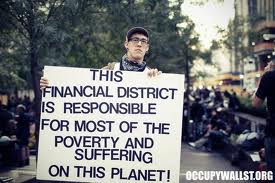
There should also be a massive subsidy plan for renewable energy.  Instead of destroying the boreal forest in Alberta and building a misbegotten pipeline, we should be investing in low-impact renewable energy, especially solar and geothermal, which seem like the least hazardous forms of energy production currently available.

Coming up with “demands” implies faith in a political system to respond.  The Occupy Wall Street protesters are down there on the front lines precisely because they know the current political system cannot be trusted.  They’re right.

“I am no man–I am dynamite,” Nietzsche wrote in his autobiography, Ecce Homo. The Occupy Wall Street protesters are, similarly, much more than a group of individuals assembled in one place.  They are the long fuse that has now been lit; or to use a more contemporary metaphor, they are the surge in the power line.

What will happen next we do not yet know, but one thing is certain: it will not be reducible to, or solvable by, a simplistic list of “demands.”