
 Kenyan Wangari Maathai, who died last night of ovarian cancer, was a woman who took everything she learned and used it for the benefit of her local community and the planetary community as a whole.
As a girl, she used to sit by a certain fig tree that grew near her family village. Beside the fig tree a clear, sparkling stream flowed, planted with arrowroots and hopping with small frogs. Her mother told her that this was a “tree of God,” which wasn’t to be harvested for firewood.
Later, Wangari realized that “there was a connection between the fig tree’s root system and the underground water reservoirs. The roots burrowed deep into the ground, breaking through the rocks beneath the surface soil and diving into the underground water table. The water traveled up along the roots until it hit a depression or weak place in the ground and fushed out as a spring. Indeed, wherever these trees stood, there were likely to be streams. The reverence the community had for the fig tree helped preserve the stream and the tadpoles that so captivated me. The trees also held the soil together, reducing erosion and landslides. In such ways, without conscious or deliberate effort, these cultural and spiritual practices contributed to the conservation of biodiversity” (Unbowed, 46).

Wangari came of age as the traditional wisdom of the village people was giving way before the onslaught of Western epistemologies. A girl who excelled in her schooling, she educated by Catholic nuns, and was fortunate enough to be chosen for the so-called Kennedy airlift of 1960, under which the Joseph P. Kennedy Foundation provided scholarships for promising young African students to study in America—the same program that brought Barack Obama’s father to the U.S. to study.
Wangari ended up at Mount St. Scholastica, a Benedictine women’s college in Kansas, where she majored in science, and she went on to earn a Master’s in biology at the University of Pittsburgh. She continued her studies in Germany, and in 1971 earned a Ph.D. in biology from the University College of Nairobi—the first women in East and Central Africa to earn a doctoral degree.
Like so many other highly educated women who join the workforce, Wangari experienced plenty of gender discrimination as she tried to advance her career. Frustrated with her lack of advancement within the university, she joined the National Council of Women of Kenya, which was a group of educated women who sought to improve the living conditions of all Kenyan women.
“We could either sit in an ivory tower wondering how so many people could be so poor and not be working to change their situation, or we could try to help them escape the vicious cycle they found themselves in,” she said. “This was not a remote problem for us. The rural areas were where our mothers and sisters still lived. We owed it to them to do all we could” (124).
For Wangari, the problems were clear:
“The connection between the symptoms of environmental degradation and their causes—deforestation, devegetation, unsustainable agriculture and soil loss—were self-evident. Something had to be done. We could not just deal with the manifestations of the problems. We had to get to the root causes of those problems.
“Now, it is one thing to understand the issues. It is quite another to do something about them. But I have always been interested in finding solutions. This is, I believe, the result of my education as well as my time in America: to think of what can be done rather than worrying about what cannot. I didn’t sit down and ask myself, ‘Now let me see, what shall I do?’ It just came to me: Why not plant trees?’ The trees would provide a supply of wood that would enable women to cook nutritious foods. They would also have wood for fencing and fodder for cattle and goals. The trees would offer shade for humans and animals, protect watersheds and bind the soil, and, if they were fruit trees, provide food. They would also heal the land by bringing back birds and small animals and regenerate the vitality of the earth.
“That is how the Green Belt Movement began” (125).
 The Green Belt Movement mobilized thousands of ordinary women in Kenya to start tree nurseries, and to plant trees near their homes. It also became a forest conservation movement, with Wangari leading women in protecting Kenya’s remaining forests against the loggers hired by giant transnational conglomerates. She made plenty of enemies in the government when her agenda threw a wrench in their greedy plans, and she was often afraid for her life. She was thrown in jail many times, and frequently confronted violence at the hands of police and goon squads.
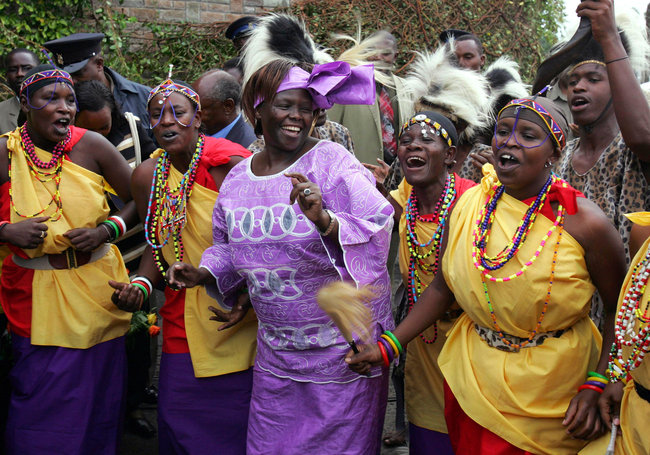 Through it all, she remained, as the title of her memoir suggests, UNBOWED. She would not be browbeaten into submission to authority. She knew that her cause was not only righteous but right for Kenyans and for the planet she loved, and this gave her the courage to stand firm against intimidation.
Wangari’s activism cost her her marriage: her husband, a Kenyan Member of Parliament, divorced her after she earned her Ph.D. and became more financially successful. She could have chosen the easy way and lived a very privileged, comfortable existence in Nairobi, if she had been willing to bow her head and put her husband’s needs and career before her own. Instead, she went through a humiliating public divorce trial:
“It became clear that I was being turned into a sacrificial lamb. Anybody who had a grudge against modern, educated and independent women was being given an opportunity to spit on me. I decided to hold my head up high, put my shoulders back, and suffer with dignity: I would give every woman and girl reasons to be proud and never regret being educated, successful and talented. ‘What I have,’ I told myself, ‘is something to celebrate and not to ridicule or dishonor’” (146).
The divorce trial ended, incredibly enough, with Wangari being sentenced to six months in prison for “contempt of court”; she was hauled off to prison without even having the time to say goodbye to her children. It was clearly an attempt to put this uppity woman in her place, but it did not work: Wangari would not be intimidated, and emerged from prison determined to put her talents to work for her people, come what might for herself personally.
 Her Green Belt Movement became a model for sustainable, grassroots-driven development throughout Africa and beyond, which worked not only for environmental sustainability, but also for women’s rights, human rights and participatory democracy. Wangari consistently provided an upright model of honest, steadfast leadership, leading by example in speaking truth to power and and refusing to be cowed.
“What I have learned over the years,” she said, “is that we must be patient, persistent and committed. When we are planting trees sometimes people will say to me, “I don’t want to plant this tree, because it will not grow fast enough.” I have to keep reminding them that the trees they are cutting today were not planted by them, but by those who came before. So they must plant the trees that will benefit communities in the future. I remind them that like a seedling, with sun, good soil, and abundant rain, the roots of our future will bury themselves in the ground and a canopy of hope will reach into the sky” (289).
Wangari Maathai herself grew that “canopy of hope” for all of us. May the seedlings she planted be nourished with care by those of us who aspire to walk in her footsteps, for all those who deserve a better world in the future here on our precious planetary home.





 Transition Times
