Webizens Unite!

The fuss over the SOPA/PIPA legislation last week is the marker of a generational shift in our understanding of the media: we’re at the transition point between 20th century media models, which rely on centralized, profit-driven control over production and consumption, and 21st century media models, which are all about open access and the free circulation of ideas.

While I’m generally a strong supporter of the open-access model, I do see some dangers to it.

For one thing, when we operate on a distributed intelligence model, information is so widely available that none of us really has to feel responsible about knowing anything.  We can just look it up, after all.

But when we rely so much on others to be the keepers of our collective intelligence, we become vulnerable on at least two crucial levels:

  • Vulnerable to being manipulated by the producers of that knowledge—think Fox News, for example, with its so-called “fair and balanced” reporting.  As long as we are aware that Fox News is reporting from a distinctly biased point of view, we can take their information under advisement, and balance it ourselves with other sources.  As long as there are other sources.  And as long as we have the education to be able to sift through it all and form our own informed opinions.
  • Vulnerable to loss of access—as in the one-day blackout on Wikipedia last week. It’s like kids who rely so completely on the calculator that they never learn their multiplication tables.  All well and good, until the day when they don’t have a machine available to make the calculations, and they’re left helpless.

Our society has become so totally tuned in to media that we would be lost without it.  And that kind of dependency is dangerous.

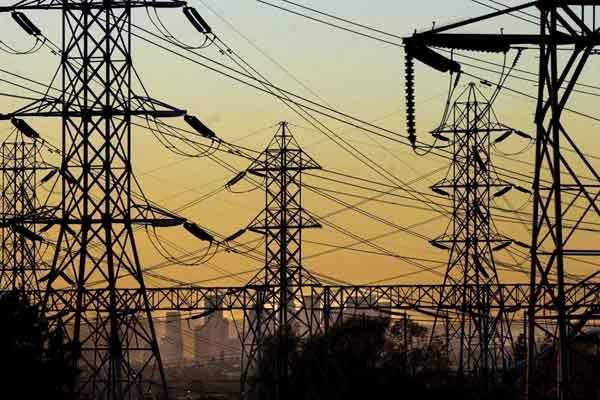
I think about the big push now to digitize libraries.  Of course, I love the idea of being able to carry 4,000 volumes around with me on one slim little e-reader.  It’s awesome!  But on the other hand, a little voice in the back of my head worries: what would happen if we lost ready access to electricity?  What would happen if there were shortages, so only the elites were able to power up their notebooks and Kindles?  Where would our libraries be then?

We’re already living in a society where social class, access to the Web and social influence form a tight, circular web.  Privileged kids today are growing up totally plugged in and able to make the best use of the amazing collective intelligence of the Web, while kids from poor backgrounds, worldwide, are growing up on the other side of the digital tracks, out there with the garbage and the weeds.

As the big media companies work ever more aggressively to stake their claim in the wild west of the Web, fencing off bigger and bigger areas of the digital commons, we need to become more vigilant about guarding our freedom of speech and our free access to the Web, and making sure that more and more of us really do have that access and the knowledge needed to make good use of it.

WordPress blogging platforms like the one I’m writing on are like little free information lanes alongside what are becoming ever more hulking, fenced and patrolled toll highways.  The fact that anyone can start up a blog or a Twitter feed or a Facebook page for free and get their voice out to the public immediately, with no censors, is a 21st century version of a time-tested Constitutional right that we need to make sure we defend.

Corporations don’t like the free circulation of “media content” because it escapes their profit-driven model.  That’s what they were trying to accomplish with their anti-piracy legislation—a way to shut down any website that did not pay its toll.

Looking into the brave new future that awaits us, I see increasing conflict over these basic issues of access to and control over the media.  I also see that unless we are successful in making the shift to renewable energy sources, it is conceivable that basic access to electricity, which we in the West now take for granted, may become less easily obtained.

As a blogger who relies on platforms and hardware that I could not possibly produce myself, I feel my vulnerability keenly.  I need Apple and WordPress to get me going, and the electric company to power me up, or I’d be dead in the water.

If I ever woke up and found the power out and my web browser blank, well…I could always go back to zining! But I would miss the incredible distribution powers of the World Wide Web.

Last week some 7 million webizens barraged Congress with protests of the proposed SOPA/PIPA legislation, and we won the battle!  We have to maintain our stations though.  As with the Keystone XL pipeline, it’s going to be a long siege.

I Won’t Go Quietly

So the question arises, how seriously should we be taking the prospect of imminent climate crisis and environmental collapse?  How serious is the threat?  What should we be doing to meet it?

On the one hand, there are the Deep Green Resistance folks, who advocate a guerilla warfare approach to industrial civilization: sabotage to infrastructure, with the goal of saving the planet from the destructive predation of human society.

The DGR point of view is that the salmon and the frogs and the polar bears can’t wait; if we hesitate, they will go extinct, and there is no coming back from extinction.  And by the way, we homo sapiens are next in line.

Well yes but…blowing up bridges, cell towers and power lines is hardly in a day’s work for most of us.  I can’t see myself heading for the hills with a knapsack of dynamite on my back!  And could such a resistance effort work? As the example of Tim DeChristopher shows, it doesn’t take much pushback to land in jail.

At the other end of the spectrum are the people who just don’t see that there’s any problem.

That’s most of us Americans.  Most of my peers really seem to see nothing at all to be concerned about, ecosystem-wise.  I often feel  paranoid and ridiculous to worry about global warming leading to conditions of scarcity that will destabilize the social order. No one else is worrying about this, why should I?

People who love me warn me not to go too far; my neighbor wonders when the FBI surveillance will start on our block.

Really, am I nuts to be even thinking about all this?

But I can’t forget historical scenarios where the majority maintained a go-with-the-flow, maintain-the-status-quo position, and were stunned when their efforts at conformity landed them in the gas chambers.

This was only a generation ago, my friends.

Today our fear is not so much gas chambers as it is mass poisonings by other means: for instance, fungicide in the orange juice, heavy metals in the well water, or mega-hurricanes caused by global warming.

It is already happening.  Of course the powers that be, the powers that are profiting from the status quo, don’t want us to question.  They don’t want us to wonder whether saving the salmon is more important than, say, mining for gold in a pristine river.  They don’t want us to demand cars that run on hydrogen.  They don’t want us to insist on a moratorium on Round-up ready seed and fertilizer.

I’m sorry, but I can’t stand down and go back to minding my own business like a good little girl.  I won’t go quietly into the night.  I won’t be one of the capos who cooperates and shepherds the others to their doom.

But maybe we don’t have to choose between these two extreme scenarios: conformity or resistance.  Maybe we can take a middle route, a resistance movement that works with the conformists to bring about change.

Yes, it’s a reformist hope that refuses to die in me.  It’s a hope that I find echoed in the recently published conversation between imprisoned activist Tim DeChristopher and the writer Terry Tempest Williams:

“TIM: Well there’s no hope in avoiding collapse. If you look at the worst-case consequences of climate change, those pretty much mean the collapse of our industrial civilization. But that doesn’t mean the end of everything. It means that we’re going to be living through the most rapid and intense period of change that humanity has ever faced. And that’s certainly not hopeless. It means we’re going to have to build another world in the ashes of this one. And it could very easily be a better world. I have a lot of hope in my generation’s ability to build a better world in the ashes of this one. And I have very little doubt that we’ll have to. The nice thing about that is that this culture hasn’t led to happiness anyway, it hasn’t satisfied our human needs. So there’s a lot of room for improvement.”

DeChristopher says something surprising towards the end of this interview.  He says that going to prison was the most freeing thing that could have happened to him.

“TIM: I thought I was sacrificing my freedom, but instead I was grabbing onto my freedom and refusing to let go of it for the first time, you know? Finally accepting that I wasn’t this helpless victim of society, and couldn’t do anything to shape my own future, you know, that I didn’t have that freedom to steer the course of my life. Finally I said, “I have the freedom to change this situation. I’m that powerful.” And that’s been a wonderful feeling that I’ve held onto since then.”

A lot of us are scared and angry and depressed for precisely this reason: we feel we don’t have control over our futures.  We are like the salmon and the polar bears and the bats, facing an ever more inhospitable environment, with no way to fight back.

But what if we did have control?  What if we have a lot more power than we realize?

This is the lesson of the Occupy movement.  Another world is possible.  And we can welcome her into existence.  We don’t have to go quietly wherever the powers that be lead us.

Not yet, anyway.  There’s still time.  Let’s seize it.

Chevron is Us. But we can change, and they can too

It’s not for nothing that the cliche “a picture worth a thousand words” was invented.

I came across such a picture in an unlikely venue this week: the current issue of The New Yorker, in a long article by Patrick Radden Keefe on attorney Steven Donziger’s efforts to represent the indigenous peoples of Ecuador whose lands have been been ruined by the toxic oil extraction practices of Texaco/Chevron.

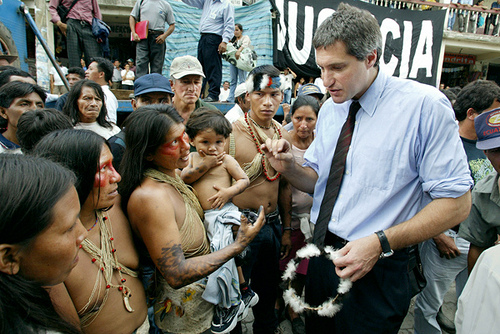
Here’s the picture:

Attorney Steven Donziger talks with indigenous people from the Lago Agrio region of Ecuador. Photo by Lou Dematteis

What fascinates me about this image is the huge differences evident between the indigenous people with their face paint and beads, and  the oversized white American lawyer, with his conservative haircut and business attire with watch and tie.

And yet despite the differences in culture and background, these people are on the same side.

The fact that I found this picture in The New Yorker speaks volumes about the success of Steven Donziger’s heroic crusade to bring justice to bear on the oil barons who have desecrated the rainforests of Ecuador.  The New Yorker has been known upon occasion to publish some anti-establishment material–think Elizabeth Kolbert‘s hard-hitting series on climate change, or Seymour Hersh‘s series blowing the lid on Abu Ghraib.  But by and large, the magazine doesn’t do much to challenge its cultured, white, upper-class New York readership.

But this is exactly what Keefe’s article on Donziger manages to do.

Keefe’s article describes how Donziger, a fellow of Barack Obama’s from the Harvard Law School Class of 1991, has spent the nearly two decades shuttling back and forth between Ecuador and New York, fighting a monumental court battle against Texaco/Chevron.

The reason we’re hearing about this case now is quite simple: Donziger’s efforts have led to the recent court decision ordering Chevron to pay the indigenous plaintiffs $18 billion dollars.

No, that is not a typo. That’s $18 billion with a b. 

Of course, Chevron’s army of lawyers is hitting back just as hard, and the case is going to be tied up in litigation for a lot longer.  As Keefe writes in The New Yorker piece:

“Chevron has been especially defiant in the face of the Lago Agrio accusations, which its lawyers have labelled “a shakedown.” In addition to defending itself in Ecuador, it has fought the case in more than a dozen U.S. federal courts, hiring hundreds of lawyers and producing what its own attorneys have called “an avalanche of paper.” Donziger has maintained that Chevron is motivated not merely by fear of an adverse judgment but by a desire “to destroy the very idea that indigenous people can bring an environmental lawsuit against an oil company.” In 2008, a Chevron lobbyist in Washington told Newsweek, “We can’t let little countries screw around with big companies like this.” One Chevron spokesman has said, “We’re going to fight this until Hell freezes over—and then we’ll fight it out on the ice.””

Not surprisingly, the fight has turned personal and nasty: Chevron has sued Donziger personally on civil racketeering charges, further muddying the murky waters of this gargantuan case.  It’s a rather classic attempt at defamation, reminding me of the Swift boat tactics used against John Kerry’s run for the presidency in 2004.  A good portion of Keefe’s article is dedicated to exploring the charges against Donziger, and questioning whether in his zeal to prosecute the environmental crimes of Chevron, he himself began gaming the system.

By doing due diligence and presenting both sides of the case, The New Yorker clearly aims to placate those readers and advertisers who are more likely to be on the side of Chevron than on the side of the indigenous peoples of the Ecuadorian rainforest.

But still, I’m heartened by The New Yorker‘s willingness to take the risk of angering its establishment readers and advertisers by printing a story that presents the sad tale of the destruction of the rainforest environment from the point of view of the Davids rather than the Goliaths.

As Keefe explains, “Chevron, which operates in more than a hundred countries, is America’s third-largest corporation. Its annual revenue, which often tops two hundred billion dollars, is nearly four times as much as Ecuador’s economic output. The plaintiffs, who named themselves the afectados—the affected ones—included indigenous people and uneducated settlers in the Oriente; some of them initially signed documents in the case with a fingerprint.”

The devastation left by Texaco/Chevron’s heedless oil extraction practices defies language–I can’t think of a strong enough word to express the disgust I feel reading Keefe’s description:

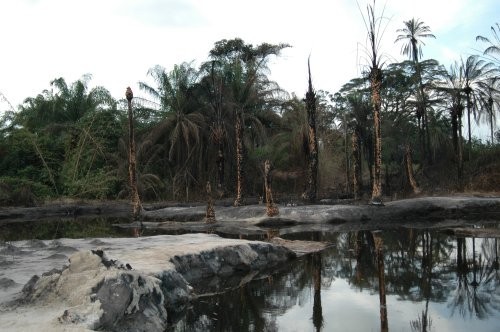
“During the decades when Texaco operated [in the Oriente state of Ecuador], the lawsuit maintained, it dumped eighteen billion gallons of toxic waste. When the company ceased operations in Ecuador, in 1992, it allegedly left behind hundreds of open pits full of malignant black sludge. The harm done by Texaco, the plaintiffs contended, could be measured in cancer deaths, miscarriages, birth defects, dead livestock, sick fish, and the near-extinction of several tribes; Texaco’s legacy in the region amounted to a “rain-forest Chernobyl.”

What’s especially sickening to contemplate is the fact that Chevron and all the other big oil corporations, despite their recent stepped-up efforts to brand themselves as “green,” are engaged in these kinds of destructive extraction practices all over the world.  Have you seen any images from the Niger Delta recently?

And next up: the boreal forest of Alberta, Canada.

Let’s be honest here.  Chevron is us.  We have created Chevron, all of us Americans, by our wasteful, unthinking consumption of fossil fuels wrenched from the earth at horrendous cost to local–and ultimately global–ecosystems.

The poisoning of watersheds and razing of forests has been going on for a long, long time–out of sight, out of mind of most of us here in the heart of empire.  But now the chickens are coming home to roost.

Hydro-fracking is getting so much attention because now these toxifying energy extraction methods are beginning to happen in our own backyards–that is, the backyards of the wealthy, educated readers of publications like The New Yorker and The New York Times.

What can we do, now that we’re aware of the scope and gravity of these issues?

Well, I am inspired by Steven Donziger’s determination to use his privileged educational background in the service of environmental justice, to hold the oil barons to account.  His fight, documented in the recent documentary film CRUDE: The Real Price of Oil, stands as a shining model for others coming along to emulate.

For example, this year’s graduating class at Harvard Law School.  I’m talking to you. 

The power of words for a world in crisis

So what am I, a Ph.D. in comparative literature with years of teaching experience in global women’s literature, gender studies and media studies, doing writing and thinking so much about the environment?

Why am I spending time blogging rather than diligently writing research-based articles for peer-reviewed academic journals?

I entered grad school part-time in 1984, first in English, and then in Comparative Literature.  Why those fields?

As an undergraduate, I started out wanting to major in environmental studies, but was soon turned off by the level of statistical empiricism required by my biology professors.  Having always loved to read and write, I gravitated towards English, and ended up interning for the local newspaper and becoming somewhat of a prodigy cub reporter.  I went on to work as a reporter for a daily newspaper, then a staff writer and editor for trade publications in New York City.

After a while, I missed the excitement of the classroom, began taking a class or two at night, and was soon drawn into the orbit of the comparative literature department at NYU, where things were really hopping in the late 1980s and early ’90s.  It was the time of the culture wars; of deconstruction and post-structuralist theory; of post-colonialism and eco-criticism and Marxist feminism.  It was an exciting time to be a budding scholar, learning to talk the talk and walk the walk.

And now here I am at mid-career, looking back and wishing that I hadn’t allowed myself to be discouraged from environmental studies so easily.

These reflections are spurred by the lead article in today’s Chronicle of Higher Education, about the Modern Language Association convention, which starts today in Seattle.  I’ve already written about why I’m not there, and reading today’s Chronicle article, I don’t feel too sorry to be missing this year’s conference.

The article, by Stacey Patton, presents a pretty bleak picture of the field of languages and literature–a picture I recognize only too well.  Enrollments in literature classes are at record lows, and many leading voices in the field are being called upon to explain just why an education in the humanities is of continued value in the 21st century.

The Chronicle article quotes James Donelan, a lecturer in English at the University of California at Santa Barbara: “We have been going about our business as if the study of literature were self-justifying, and that making an overt case for its relevance to society was somehow too mundane a task for us….The immediate consequence of this attitude is that we’re losing undergraduate majors and financial support at a terrifying rate, and the far-reaching consequence is that anti-intellectualism and a general lack of empathy are running rampant in civic life.”

Meanwhile, as many as 70% of English department faculty nationwide are so-called “contingent” faculty–hired as adjuncts, on a semester-to-semester basis, often earning minimum wage or less despite their doctorates and their publications.  As one angry commenter (evidently an adjunct English teacher) put it, “I for one will not encourage ANYONE to be an English major.  I will teach them their required composition classes for their OTHER majors because I know those majors will actually change their financial lives and allow them to support their families and move out of poverty.  This IS an elitist profession filled with elitist ivory tower ‘folks.’  Everybody knows it; that’s why the numbers in this field are dropping so much.  Get real.  Stop b.s.ing and face what is really going on.”

Yeah.  So we have an anti-intellectual student body, most of whom are highly resistant to reading books at all; combined with a demoralized and exploited faculty.  Although things are somewhat different at my college, it’s impossible to ignore what’s going on in the field as a whole.

And although some literature professors may be willing to put time and energy into justifying why it’s essential that we continue to study so-called “high literature,” like Shakespeare, Milton, Dante,  and Joyce–or even Pynchon, Rushdie, and Roth–I am not.

Egyptian author, doctor and activist Nawal El Saadawi

My whole career has been dedicated to the kind of literature that provides windows into the real material conditions of people living on the margins of society–people outside of the ivory tower, whose voices are rarely heard in the American classroom.  My own personal canon includes Rigoberta Menchu, Wangari Maathai, Buchi Emecheta, Gloria Anzaldua, Audre Lorde, Paula Gunn Allen, Shirin Ebadi, Nawal El Saadawi, Mahasweta Devi, Malalai Joya, Vandana Shiva, and many others, few of whom would be familiar to most of the scholars gathered at the MLA this year.

These writers have taught me, above all, to listen.  They’ve taught me to be aware of the intractability of my own privileged social conditioning, and to work hard at overcoming the elitist worldview into which I was born and raised.  And many of them have shown me again and again how in a patriarchal culture women are lumped together with Nature as commodified resources to be managed and controlled.

I never wanted to be a scientist.  My interest in environmental studies sprang from my love and reverence for the natural world, which was so strong in me as a child, and my horror at learning what human beings were doing to the flora and fauna of our planet.

Knowing what I know now about the dire urgency of the manmade threats to our ecological systems on Earth, I cannot sit by and write yet another academic essay on literary theory and disembodied “texts.”

Yes, I care about the sad state of English and literary studies in the academy.  But we’ve doomed ourselves, each of us, by the short-sighted and self-centered decisions we’ve made as individuals and as institutions.  If students today see reading books as irrelevant, and if administrators see English professors as expendable, well…who should we blame but ourselves?

As we hurtle into the 21st century with its multiple crises of climate, ecology and economics, I find myself  still reading, still writing, and circling back around to where I began, in environmental studies, where I will do all I can to use the power of the written word to ignite the social changes we so desperately need.

In narratives of women and the natural world, I have found my home–and my voice.

Shaking the crystal ball: the future is what we make it

As I slept on my last post, the ominous words “civil war” kept resounding discordantly in my mind.

Am I really advocating for civil war?  Me?  I’m so non-violent I won’t even let my kids bring an x-box or a Wii into the house, for fear they might play violent video games.  I’m so non-confrontational that when I get angry I get quiet, not loud.  I find violence of all kinds so abhorrent that probably the only thing that would get me enraged enough to fight back is, precisely, violence, especially if visited on the defenseless: animals, children, trees.

But leavergirl‘s comment this morning has got me thinking again.

She says: “We don’t have to toughen up, but we do have to get more cunning. No street demonstrations will bring a better world. Such things force surface changes with more or less the same problems underneath. The system knows how to coopt, and knows it very well. What will bring about a better world? Living the changes at the local level.

“It’s mindboggling that people think they can “force” changes via demonstrations and protests. After all, the people in power don’t know how, even if they wanted to. We all have to invent it as we go!”

Just as it doesn’t make sense to try to fight big money with more money, it doesn’t make sense to fight violence with more violence.  And she’s right that change has to happen at the local level–that is the whole “be the change” idea.

But can we afford, in this age of globalized capital and planetary climate change, to focus locally and ignore what’s happening on the national and global scale?

It seems to me that we have to do both.  We have to do our utmost in our own homes and backyards and town centers to push for the principles we believe in.  But we also have to keep an eye on the big picture, and add our voices to the chorus calling for a change in the grand narratives that drive social policy in boardrooms and legislative chambers.

Standing up and being counted in a protest does matter.  Voicing public dissent to master narratives, as I’ve been doing in this blog, also matters.  Practicing non-violence and respect in one’s home and community is also important.  That’s what the fourth point in my Manifesto is about:

4. Model egalitarian, collaborative, respectful social relations in the private sphere of the family as well as the public spheres of education, the profession, government and law.

Thoreau’s model of civil disobedience, like Gandhi’s and Martin Luther King’s high-minded non-violence, were effective tactics of resistance that had real, tangible results.

So no, I am not advocating for civil war.  I don’t want to see it come to that.  I am, however, saying that we cannot afford to sit back and hope for the best, or wait and see, or let others worry about it.  We just don’t have that luxury anymore.

I look around me and see so many of my friends who are parents investing so much time, energy, thought and care in the raising of their children.  We worry over every test score, we make sure they eat their organic vegetables, we carefully shield them from violence and pain.

How can we be so focused on the local care of our children that we miss the big picture, which is that the world we will soon be sending them out into is in crisis? How can we not take it as part of our parental duty to do all we can to ensure that when our children grow up, their planet will be intact and able to support them?

On New Year’s Day I had a conversation with my son that keeps ringing in my ears this week.  He expressed his anger at previous generations (including me, of course) who have so degraded our environment that as he now looks out into his own future, he cannot be sure that he will have any chance of realizing his dreams.

We talked about possible future scenarios, including one that seems to be coming up in various conversations lately: conditions of scarcity leading to armed gangs marauding in the streets and taking whatever they can find.  “We would be fucked,” he said bitterly.  “We don’t even have a gun in the house!”

There it is again.  Would having a gun in the house make us any safer?  Isn’t the problem precisely that there are too many guns in too many houses?

And is it inevitable that conditions of scarcity would lead to violence? Maybe it’s likely, but are there steps we can take now to promote a different outcome?

Back to the importance of the local.  Strengthening local communities can head off a dog-eat-dog mentality.  We are all in this together.  Together, we created the present moment we now stand on; and together we will create the future.

What future do we want?  We all want abundance; peace; stability; security.  I don’t think anyone in the world would argue with those general goals.

We have the knowledge and the technology, right now, to achieve these goals, worldwide.

We do!  If we turned our best and brightest minds to the task, we could drastically reduce our carbon emissions within a decade, while still enjoying electricity and heat through solar, geothermal and wind.  We could drastically improve energy efficiency and get rid of our wasteful consumerist mindset.  We could stop making bombs and missiles, and instead refocus those trillions of dollars into education and social welfare, including intensive sustainability efforts on all fronts.

We could do this.  But again, we need that unstoppable groundswell of demand for change. Locally and globally.  NOW.


They don’t play nice. Should we?

So manifestoes are all very well, in the visionary department, but things get harder when you get down into the nitty-gritty of making transformative change happen.  I thought I might take some time this New Year’s season, 2012, to reflect more deeply on what it would mean to turn my dreams into reality.

Let’s start with the first point in my recently penned Manifesto for a Sustainable Future, which is:

1. Move from a top-down hierarchical system to a horizontal, egalitarian model of social relations based on inclusivity across all of the traditional boundaries used to keep different groups apart, and also opening up the possibility for cross-species collaboration based on respect and stewardship.

People have been talking about coalition across artificial differences between humans for a long, long time, and in some cases it has worked: for instance, the privileged white folks who believed in “equality, fraternity and liberty for all” played a huge role in freeing the enslaved Africans during the 19th century, and then a later generation of freedom-loving people from various heritages worked together again in the 1960s to extend the earlier gains through civil rights, women’s rights, decolonization, etc.

It’s not that hard to get people to agree in principle that all human beings deserve equal treatment before the law, or that children should have equal access to quality education, good food and health care.  The Universal Declaration of Human Rights is based on just such agreement.  The problem is that principles and declarations are one thing–like manifestoes–while actions on the ground are quite another.

In practice, we know full well that people of color, poor people and immigrants are not treated equally before the law in the U.S. We also know that there are millions of children in this country whose public schooling is inadequate, sometimes terribly so, and who do not have access to healthy food or good quality health care.

We know this, and yet we choose to ignore what we know.
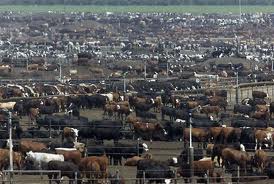
It’s the same thing with what is happening to animals in this country.  We know that scientific research, aka torture, is conducted on thousands, if not millions of defenseless animals every year.  We know that millions of pigs, cows and poultry are treated with total disregard for their well-being, as if they were machines being assembled for market, instead of living, sentient beings.  We know that millions of wild mammals, birds and marine life are relentlessly being pushed into extinction by the pitiless advances of human “civilization.”

We know this, but we choose to pretend we don’t know it.

Maybe that’s because if we really took this information in, the knowledge would be unbearable.  How could we live with ourselves, knowing that just by conforming to the status quo, we are responsible for so much suffering of others on this planet?

But we need to stop pretending and closing our eyes and turning away.
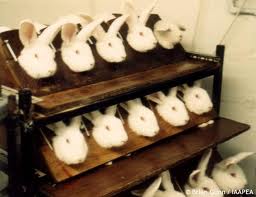
Because it is out of this deep knowledge of our connection with other living beings on this planet, and the inescapable awareness of the suffering we humans are causing, that a movement of solidarity, resistance and change will grow.

To bring up the term “movement” is to be clear that the kind of transformative change I’m envisioning could not possibly be the work of one person, or even a few people.  It has to be an unstoppable wave, demanding change and taking nothing less for an answer.

In the 19th century, the abolition movement ended up sparking a civil war in the United States.
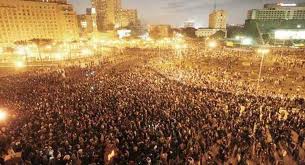
A second American civil war seems rather unthinkable to most of us now, even as we watch with amazement as regimes fall to enraged mobs all across the Middle East and North Africa.

In the US, free expression is tolerated far more widely than, say, in China, where journalists and bloggers are regularly beaten up and thrown in prison for daring to speak an unpopular truth.  The U.S. was shocked–shocked!–when the government called out the military and tanks began firing into the crowds at Tiananmen Square back in 1989.

But you have to wonder, watching the ruthless way city police are now trained to deal with street protests, how much it would take to provoke a similarly harsh response from our federal government.

What if there were a real movement of people united in their demands for “equality, liberty and justice for all,” as schoolchildren in the US are still trained to recite piously every morning, hands over hearts, when the Pledge of Allegiance is played over the PA system?

What if people got fed up enough with our bungling and corrupt national leaders, our deeply unfair and wildly overpriced medical system, the outrageous skewing of entitlements of all kinds to the wealthy, the militarization of our relations with other countries, the poisoning of our environment, the killing off of the natural world–fed up enough that we were willing to take to the streets and demand change, and not back down even when they brought out the tear gas, the tanks and the guns?

Then we might just have a Civil War II on our hands.  And like the first Civil War, it would be bloody, chaotic and uncertain in outcome.  But if the vision that guided it was sure and true, it might just lead to a whole new country arising out of the ashes of the old.

In this globalized age, such a civil war might easily turn into a global war, as the 99% the world over rose up against the tyranny of the rich corporate interests that are ruining the welfare of humans and the planet as a whole.

And here’s where I need to get back to the Manifesto, where I imagined a new social order based on a horizontal, inclusive, respectful, egalitarian model of social relations, with the welfare of the poor as important as the welfare of the rich; the welfare of the coral reef as valued as the welfare of the watershed feeding a city; the welfare of a livestock animal as important as the welfare of a cherished pet.

Not to say that everyone would necessarily be treated exactly the same–a cow wouldn’t want the same treatment as a dog, after all.  But whatever it takes to give a cow a comfortable, dignified life, should be undertaken.  Whatever it takes to give every child access to a high-quality education, should be done.  Decisions should be made in truly representative fashion, with no possibility of wealthy interests buying votes, no PAC lobbies or media manipulation allowed.

The devil is in the details in putting such a new world order in place, I know.  Many smart people maintain that human beings are irredeemably aggressive, competitive and greedy, and so we are incapable of creating such an ideal world.

But many other smart people say the opposite: that human beings are naturally empathic creatures, whose first instinct as infants is to love, not to hate.  Very few children are instinctively cruel to others.  The majority of us seem to be naturally good-natured, though easily swayed and corrupted by our social conditioning.
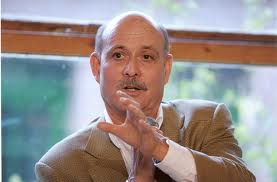
As Jeremy Rifkin has argued, “What is required now is nothing less than a leap to global empathic consciousness and in less than a generation if we are to resurrect the global economy and revitalize the biosphere. The question becomes this: what is the mechanism that allows empathic sensitivity to mature and consciousness to expand through history?”

Rifkin’s own answer to this question has to do with what he calls the “distributed Internet revolution,” which is “changing human consciousness” by “extending the central nervous system of billions of human beings and connecting the human race across time and space, allowing empathy to flourish on a global scale, for the first time in history.”

Rifkin envisions just the kind of transformation in social relations that I have also been dreaming of.  His description of a new human relation to what he calls our “biosphere” is worth quoting in full:

“The biosphere is the narrow band that extends some forty miles from the ocean floor to outer space where living creatures and the Earth’s geochemical processes interact to sustain each other. We are learning that the biosphere functions like an indivisible organism. It is the continuous symbiotic relationships between every living creature and between living creatures and the geochemical processes that ensure the survival of the planetary organism and the individual species that live within its biospheric envelope. If every human life, the species as a whole, and all other life-forms are entwined with one another and with the geochemistry of the planet in a rich and complex choreography that sustains life itself, then we are all dependent on and responsible for the health of the whole organism. Carrying out that responsibility means living out our individual lives in our neighborhoods and communities in ways that promote the general well-being of the larger biosphere within which we dwell.”

It would be nice if we could simply persuade the 1% corporate types of the necessity of this shift in human consciousness. But these people don’t play nice.

That’s why we dreamers who share this kind of transformative vision may have to toughen up, if we want to achieve our goals.

As Derrick Jensen keeps saying, how long will we wait until we realize that action is necessary to avoid annihilation?  It’s the birds, the bees and the bats who are dying now, but these creatures form the base of the pyramid on which current hierarchical human society rests.  If their populations crash, can ours be far behind?

Can we afford to wait and see?

A “Be the Change” Manifesto for the 21st Century

On New Year’s Day, 2012, I reaffirm my commitment to dedicate my talents and energies towards shifting our destructive global human society in a direction that values the ecological health of the entire web of life on Earth over the short-term gains of a minority of human beings.

I invite you to join me, and you would cheer me very much if you expressed your solidarity by responding to this post, if only with a “like.”

Manifesto for a Sustainable Future

Whereas human beings have acted in a dominating fashion towards each other and towards other living species on this planet, using the excuse of difference to justify aggressive and destructive behavior;

Whereas competition has been used as a rationale for economic systems based on hierarchical systems of power;

Whereas social exclusion and systematic discrimination has been seen as the normative right of dominant groups;

Whereas privileged groups have felt entitled to take more than their fair share from the environmental commons, and to deprive less powerful groups, whether human or of other species, of the resources necessary for well-being;

Whereas it is quickly becoming apparent, in the age of climate change, that the dominant paradigm of capitalist patriarchal social relations is resulting in the dangerous destabilization of the entire natural ecosystem;

The time has come to take action to change this paradigm in the following ways:

1. Move from a top-down hierarchical system to a horizontal, egalitarian model of social relations based on inclusivity across all of the traditional boundaries used to keep different groups apart, and also opening up the possibility for cross-species collaboration based on respect and stewardship;

2. Shift the worldwide economic system to a model of global cooperation and collaboration, with the focus of human industry and government on providing a baseline of well-being for all life forms on this planet, regardless of geographic origin or antiquated ideas of relative importance (ie, who is to say that a human being is more important than a songbird, or a sardine?);

3. Tailor the education system to teaching the history of the destructive cultural practices of homo sapiens up to the 21st century, and opening up constructive conversations across disciplines, where alternatives to these traditions can be envisioned and developed;

4. Model egalitarian, collaborative, respectful social relations in the private sphere of the family as well as the public spheres of education, the profession, government and law;

5. Shift from a violent conflict and punishment model of resolving disagreements to a peaceful persuasive model, with the goal always being the well-being of the community as a whole first, and secondly each member of it.

6. Destroy all weapons of mass destruction, as well as all bio and chemical weapons, and their blueprints.

7. Disallow any one person’s or minority group’s interests (with rich people and businesses or industries rightly being considered minorities)  to take precedence over the interests of the majority, including the non-human majority on this planet.

8. Develop an appropriate representative global governing council to administer these principles.

In the name of Mother Earth and ALL of her children, I call on the peoples of the world to act without delay to become the stewards of the planet and the collaborative, respectful individuals we were always meant to be.

“Let your life be a counter-friction to stop the machine”

I believe that we are coming to a crossroads as a nation.

Since 9/11, we’ve been traveling down a road bristling with guns, military technology, paranoia and fear.  Though most of our aggressive energy has been aimed outside our borders, there has also been a steady preparation for mass violence within the U.S. as well.  In the decade since 9/11, our national police forces have been armed with military hardware, and have trained extensively in riot control, with the results that we saw for the first time during the recent Occupy protests.

In the peaceful town of Fargo, North Dakota, report Andrew Becker and G.W. Schulz of the Center for Investigative Reporting, “Every city squad car is equipped today with a military-style assault rifle, and officers can don Kevlar helmets able to withstand incoming fire from battlefield-grade ammunition. And for that epic confrontation—if it ever occurs—officers can now summon a new $256,643 armored truck, complete with a rotating turret.”

Billions of federal tax dollars have been spent nationwide on this kind of military hardware for police, in the name of Homeland Security.

Security from what?  Security for whom?

Short of an all-out military invasion by a foreign force, which seems hugely unlikely, these weapons can only be meant to confront an insurgency within our own borders.

Are we thinking about a civil war, then?

Are these police being armed and trained to protect the interests of the 1% against the raging anger of the 99%?

A year ago it would not have occurred to me to ask these questions.  But obviously the Homeland Security crowd was already thinking ahead and planning for a time when such armor and weapons would be necessary to “maintain security” and “uphold law and order” on the home front.

Yes, they must have been aware, even as they were cashing in on our ignorance, that there would come a time when no more could be squeezed from the bottom two-thirds of American society.  When there would be so many homeless, so many poor, so many disenfranchised, that these people would feel they had no other recourse than violence, and nothing left to lose.


A new report by the National Center on Family Homelessness found that “more than 1.6 million children – or one in 45 children – are homeless annually in America. This represents an increase of 38% during the years impacted by the economic recession.”

I’m sorry, but that is just unacceptable in this country, which likes to think of itself as the wealthiest and most enlightened society on earth.

When you add up all the trials and tribulations being visited on the poor in this country–and “the poor” is a vast category that gets bigger day by day–and you weigh billions in Homeland Security anti-terrorism outfits for police against dwindling food and shelter for children–well, something just isn’t right here.  There’s something rotten in the state of America.

And yes, we are at a crossroads.

It may seem to some that I am over-reacting, but this is the way it feels to me: if we continue following along docilely on this daisy path that we’ve been led down by the architects of corporate capitalism, we are like the Jews of Germany in 1940, peacefully gathering our belongings and getting on that train to Auschwitz, or marching cooperatively out to the forest to be mowed down by machine guns into the mass grave.

We know enough now to know that the powers that be do not have our best interests at heart.

We’ve been sickened by their chemicals, and our health care system seems geared to treat sickness (at a profit) rather than to promote wellness.  Our oceans, air, soils and drinking water have been contaminated and rendered toxic. Our taxes have been used for guns and landmines instead of schools and social welfare.  Those who have gotten rich in this system have done so on the backs of the poor and those who cannot defend themselves: the natural world above all.

Are we going to continue down this path?

Or are we going to gather our courage at this crossroads, and strike off in a new direction?

A lot of people are asking this question now.  Over on the New Clear Vision blog, Charles Imboden suggests that the Occupy movement has ignited a renewed “commitment to direct democracy and shunning of ‘representative,’ republican forms of decision-making (so often susceptible to corruption and corporate influence) [which] can be further strengthened as the foundation of the egalitarian, ecological society.”

As one of my readers commented today, what would happen if they held an election and we just didn’t show up?

I don’t know if there is a way to cut ourselves loose from the federal government and its taxpayer-supported state terror apparatus.  Thoreau tried, back in the 19th century, and was promptly thrown in jail.

His letter from prison is worth re-reading today.

“Unjust laws exist: shall we be content to obey them, or shall we endeavor to amend them, and obey them until we have succeeded, or shall we transgress them at once? Men, generally, under such a government as this, think that they ought to wait until they have persuaded the majority to alter them. They think that, if they should resist, the remedy would be worse than the evil. But it is the fault of the government itself that the remedy is worse than the evil. It makes it worse. Why is it not more apt to anticipate and provide for reform? Why does it not cherish its wise minority?

“If the injustice is part of the necessary friction of the machine of government, let it go, let it go: perchance it will wear smooth—certainly the machine will wear out. If the injustice …is of such a nature that it requires you to be the agent of injustice to another, then I say, break the law. Let your life be a counter-friction to stop the machine. What I have to do is to see, at any rate, that I do not lend myself to the wrong which I condemn.”

Let your life be a counter-friction to stop the machine.

As we gear up for next year’s Presidential elections, we must take these wise words of Thoreau’s to heart.

But we must also be aware, as Thoreau certainly was, that there are other paths to take, outside of the machine.

We stand at a crossroads.  Each of us must make up our own minds, in our own time.

How much longer will we continue to docilely feed the machine our tax dollars, and march peacefully where they lead us?

Methane Burps and Political Disenfranchisement: People, Wake Up!

There are two pieces of news that have me really worried today, one environmental, the other political.

The environmental news, predictably, is about global warming.  I suppose most people have heard by now about the giant methane plumes being released into the atmosphere from the melting Arctic permafrost, but did you realize the scale of what is going on?  Here is a quote from the scientist who has spent more time than anyone else actually observing this issue in the Arctic, Dr. Igor Semiletov:

“In a very small area, less than 10,000 square miles, we have counted more than 100 fountains, or torch-like structures, bubbling through the water column and injected directly into the atmosphere from the seabed,” Dr Semiletov said. “We carried out checks at about 115 stationary points and discovered methane fields of a fantastic scale – I think on a scale not seen before. Some plumes were a kilometre or more wide and the emissions went directly into the atmosphere – the concentration was a hundred times higher than normal.”

As Andrew Revkin notes in his excellent Dot Earth NY Times blog, ““Given that methane, molecule for molecule, has at least 20 times the heat-trapping properties of carbon dioxide, it’s important to get a handle on whether these are new releases, the first foretaste of some great outburst from thawing sea-bed stores of the gas, or simply a longstanding phenomenon newly observed.”

Dr. Semiletov and his team caution that it’s too soon in their research to answer this question definitively.  But it stands to reason that melting permafrost and sea ice would provide an escape hatch for methane that had previously remained sequestered for millennia.  It seems likely that this trend will continue and worsen in the coming years.  Global warming, here we come.

The other news I’m fretting over this morning is the massive Republican attack on voter franchise in the U.S.–also on a vast scale, and with potentially disastrous results.  As Amy Goodman spells out in a column today on Truthdig,  “Across the country, state legislatures and governors are pushing laws that seek to restrict access to the voting booth, laws that will disproportionately harm people of color, low-income people, and young and elderly voters.”

This has been going on for at least a year now, and only last week did Attorney General Eric Holder finally act to declare one such state action, in South Carolina, unconstitutional.  The Democratic Party is finally waking up to the sinister plot afoot by the Republicans to steal the election they are unlikely to win in a fair fight.

We know what right-wing Republicans stand for: unfettered big business, dismantling of social safety net programs, Boss Tweed-style oligarchy of the wealthy, and an “are there no workhouses” Scrooge mentality towards everyone else.

Is this the country we want to become?

The United States needs to regain its stature as a beacon of hope in dark and dangerous times.  The stakes are so high now; the danger is so real and so close.  Although I have been writing about the importance of strengthening local “transition town” resources, we cannot afford to ignore big politics, because of the undeniable power possessed by federal and state governments, which can be used for good or for ill.

Although we can’t do anything to control those methane burps, we can work to shape and direct our political systems towards moving full steam ahead to transition to renewable energy and prepare for the systemic climate change that is already upon us, whether we want to admit it or not.

As the Occupy movements regroup in the New Year, I want to see the young people of this country stand up for their rights and the sane governance of our country and our planet.

Occupy the Elections must become a rallying cry for the coming months.

Solstice reflections: Women as Victims of Violence and as Peace Agents

Winter solstice eve, 2011.

The darkest day of the year, and yet presaging the return to light.  The stars and planets continue to wheel overhead, taking little notice of all the sturm und drang here on Earth.

Tonight there is one image that keeps calling out to me for comment.  It goes by the Web shorthand “woman with the blue bra, Cairo.”

Did you see that one?

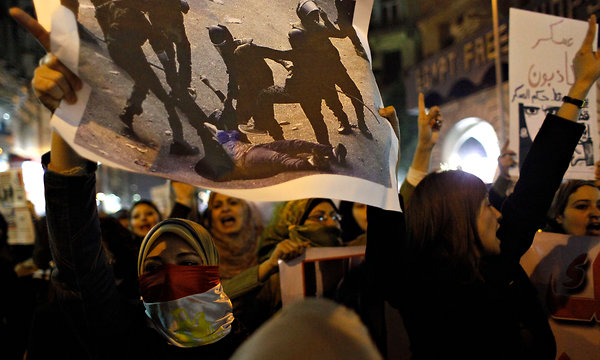
Someone captured on camera a brief two minutes of violence in Cairo, Egypt, when an unnamed protester was dragged by military forces in the street, then stripped of her abaya, under which she wore only a blue bra–and then beaten up some more.

WordPress has taken away my ability to post video, so you can watch it here.

It goes right up there with the video from New York City, towards the beginning of the OWS protests, of a police officer spraying peaceful, captive girls in the face with pepper spray.  This video has apparently been watched on You-Tube more than 1.5 million times.

There is something about seeing women being beaten up by masked, uniformed security forces that sets off particular triggers in most of us.  It’s certainly no accident that the Occupy protests swelled dramatically in numbers after that pepper-spray incident, or that more than 10,000 protesters, mostly women, turned out in Cairo following the posting of this image on the Web.

Part of me wants to question why it is that we get so upset when women protesters are attacked.  After all, they knew the risks they were running when they went out into the street.  And what’s the big difference between a man and a woman being beat up by goons, anyway?

But there is a difference.

The difference is that it’s always men doing the beating.

Yes, we have some women in police and military uniforms.  And yes, women can be violent.  But you will have to look long and hard to find cases where women bore the responsibility for killing or attacking civilians, in any circumstances.  It may happen, but it’s pretty rare.

So when we see a mob of men stripping and beating a woman–in a society where nudity is absolutely taboo, to boot–it’s impossible to ignore the full impact of the insult intended.  And in a society where women are forcibly kept out of leadership roles, the message is all the clearer.

Stay at home where you belong, or we’ll do this to you, too.

I’m so glad that the women of Cairo did not take this attempt at intimidation lying down. Just like the women in New York, who took the unwarranted police brutality as a gauntlet thrown down to test their protest mettle.

The question of whether men are in fact more aggressive than women is still a matter for debate in academic circles, but taking a look around the world, it’s pretty clear that men commit almost all the violence in every context.  When women murder or assault, it’s almost always in self-defense.

And yet women are still held back from leadership roles in most societies, and even held back from the peace-making negotiating tables in post-conflict regions.  A big exception is Rwanda, where women have taken a leadership role in rebuilding that shattered society–mostly because the men had succeeded so well in killing each other off.

We have moved past the point in the intellectual history of gender studies where feminists were striving to be “the same as” men.  Women don’t want to be the same as men if it means repeating the same old history of violence and abusiveness.

What we need is to move, as men and women, beyond the violence that has continually plagued human society.

Violence towards each other; violence towards other species and the rest of the world.

The only way to move forward as a species is to disable that aggressive switch, and become the consensus-seeking conciliators we have always been in our finest moments as human beings.

As we return to light this solstice night, this is my fervent prayer: that the aggressive, masculine energy that has dominated this planet for the past 5,000-plus years will begin to shift to a more peaceful, creative, feminine energy, from which both men and women–and the planet as a whole–will benefit.

Let it be so.