Sexual harassment, from 7th grade to Herman Cain

Observing my total lack of interest in Herman Cain’s sexual peccadilloes, I find myself amused, in a sad, resigned sort of way.  Another wanna-be politician trips himself up in his own boxer shorts.  Ho hum. What’s for dinner?
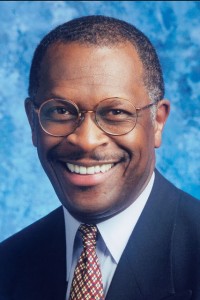
Something far more upsetting than the image of Herman Cain groping under a woman’s skirt while forcing her head in his lap was the recent report that more than half of American girls in 7th to 12th grades were sexually harassed in person–as opposed to online–in the past school year.

“The report documents many forms of harassment. The most common was unwelcome sexual comments, gestures or jokes, which was experienced by 46 percent of girls and 22 percent of boys. Separately, 13 percent of girls reported being touched in an unwelcome way, compared with 3 percent of boys; 3.5 percent of girls said they were forced to do something sexual, as did 0.2 percent of boys. About 18 percent of both boys and girls reported being called gay or lesbian in a negative way.”
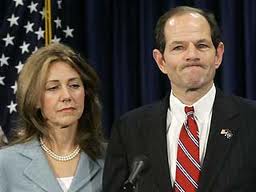
Should it surprise anyone that a culture that tolerates these kinds of conditions in public schools gives rise to politicians, from Bill Clinton to Elliot Spitzer to Herman Cain, who feel entitled by their power and success to indulge themselves sexually with subordinate women?

Sexual harassment of women by men is remarkably constant across cultures–it varies only in degree.  Some cultures deal with it by demanding that women cover themselves from head to toe; others pressure women to go around half-naked and inure themselves to the catcalls and feel-ups.

What few, if any, cultures do is demand that men be accountable for their own behavior and keep their hands and their whistles to themselves.
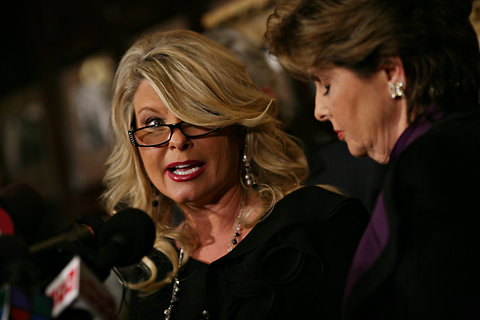
I admire women like the defendant in the DSK incident, or the Cain accuser who had the guts today to come forward on the record and in front of the cameras to tell her story.

Why should women make it easy for men to get away with blatant sexist bullying?

More to the point, why does our society make it so easy for men–all men, not just the rich and powerful, though those are the ones we hear about most frequently–to shrug off incidents of sexual harassment, or even assault, as minor, unimportant issues, hardly worthy of mention?

That was certainly Herman Cain’s position, until the tenacity of the women he had abused made it impossible for him to continue to play innocent.  The same playbook was used by countless politicians before him–which is why it’s so hard to get excited about any of it today.

I’m just relieved that the swampy pit of Republican contenders for President will almost certainly be shrinking by the end of tomorrow’s news cycle.

Or maybe I shouldn’t take that for granted.  Look at Clarence Thomas, after all–our Supreme Court Justice, for crying out loud!

Women of the world, unite!  Our silence on sexual harassment and assault will get us absolutely nowhere.  If you care about the mental and physical well-being of your daughters, your sisters, and yourselves, you need to condemn this destructive social norm in the strongest possible terms.

And then let’s get on with that dinner.

Sweet stirrings of a new world: fringe politics overturning the barricades

The venerable social critic Hendrik Hertzberg of The New Yorker contrasts the Tea Party with the Occupy movement in this week’s magazine, and finds the Occupy movement lacking in precisely what has made the Tea Party so strong: a willingness to get involved in (and take money from) the established American political parties.

“Occupy Wall Street and the Tea Party are both protest movements, not interest groups,” Hertzberg says, “and while both are wary, or claim to be, of established political figures and organizations, each welcomes their praise, if not their direction. Both have already earned places in the long, raucous history of American populism. But only one, so far, has earned a place in the history of American government.”

Are we supposed to be proud that the Tea Party has “earned” an infamous place as the launching pad for the new cadre of rightwing Republican zealots who have spent their time in Congress obstinately shooting down and stampeding every effort by President Obama and the Democrats to steer this nation towards a more compassionate and forward-looking political stance?

In its few years of existence, the Tea Party has happily wormed its way into the main arteries of American political power.  Hertzberg offers an apt metaphor of this tea as a new wonder drug, “injected into the scarred veins” of the GOP, which has quickly become addicted to this mainlined source of entranced, stupified frenzy.

“Now the Democrats are hoping the drug might be available as a generic,” Hertzberg continues, eying the Occupy movement as a way to enliven its own moribund political base.

I firmly hope that the Occupy movement does not allow itself to be used in this way by the political establishment, and I think it’s a reasonable, if remarkable, hope.

Remarkable because for so long Americans have been asleep, indifferent or unaware of what Hertzberg calls “the astounding growth of what can fairly be called plutocracy.”

Why it took so long for the sleeping giant of American popular opinion to wake up is a question for historians of the turn of the 21st century to ponder.

Why is it that Americans have been voting against their own class interests so long?  Why is the persistent myth of American equality, liberty and justice for all so teflon-coated?

We all want to believe that our country represents the moral high ground in the world, and that our leaders in government are as invested in upholding our idealism as we are.

Our public education system, which is responsible for the education of a great portion of the 99%, aids and abets this self-delusion by giving students the most doctrinaire and uncritical version of American history and civics, and teaching docility and proficiency at standardized testing above all.

Our media doesn’t help much; with the exception of a few poorly funded but stalwart independent outlets, the vast social landscape of contemporary media is focused at best on distraction, and very often on outright deception.

Under the pressures of this kind of social conditioning, it’s remarkable that the young idealists in the Occupy movement have had such success in galvanizing the country to wake up, shake ourselves, and stare around us with new eyes.

Hertzberg obviously intends his column as a signpost for the Occupy movement, pointing towards Washington D.C. as a more important battleground than Wall Street.  “Ultimately, inevitably, the route to real change has to run through politics,” he concludes; “the politics of America’s broken, god-awful, immutably two-party electoral system, the only one we have.”

Here is a glaring example of the kind of civics mis-education that has made our country so hard to reform over the years.

Who says our political system is limited to two parties?  Or at least, to the two parties we have now?

The Republicans and the Democrats have shown themselves to be chronically unable to lead this country out of the morass of special interests and ruthless corporate-driven capitalism that has bulldozed right over our cherished ideals of equality, not to mention the sacred ecological web that forms the real foundation of all our wealth and prosperity.

The Occupy movements are showing their intelligence in shying away from engagement with the established political system.  If anything, their political allies are more likely to be found in those perennial political organizations that have always camped out on the fringes of our electoral parks: the Green Parties or the Rainbow Coalitions.

Remember Ralph Nader, for example?  Remember how Big Media colluded with the established parties in denying so-called “outside” candidates a seat at the table at the televised Presidential debates?

This year the Ralph Naders of the political world have suddenly swelled their ranks dramatically, but without the figurehead of a single leader at the head of the crowd.  As Nader knows only too well, one man at the head of a true opposition movement is open to all the slings and arrows that the establishment can muster.  Even Gore and Kerry have felt the force of the muddy vomit pitched their way out of the far-right Republican swampland.

Far better for the Occupy movements to stay plural and collective, strong in the anonymity of the multitudes.  Those of us who are serious about doing more than simply rearranging the deck chairs on the great hulking Titanic of American politics realize that “America’s broken, god-awful, immutably two-party electoral system” is exactly what has to go.

OK, Hendrik, it may be the only one we HAVE HAD, but now the veil has been torn down, the people are awake, and we realize that another world is possible.  As Arundhati Roy famously put it, “on a clear day, I can hear her breathing.”

That clear day has dawned.

Scary Halloween Statistic: 7 Billion People on the Earth by Oct 31, 2011

If you’ve never seen the Worldomters clock ticking, it’s worth a click.

Watching those numbers spin by brings home how very fast the human species is multiplying, especially when you consider the following chart, which shows how recent this population explosion really is.

No wonder we’ve got a sustainability problem!

Population control has gotten a bad name in recent years, and justifiably so.  It cannot and should not be imposed upon women by force, as it has too often in the past.

But study after study has shown that when women are educated and respected in society, birth rates go down.

Want to slow down that worldometer population clock?  Start by educating girls and opening up career opportunities for them after graduation.

Educate a girl and save the planet?  Might not be hyperbole after all.

A Realist Assessment of Where We Are Now

Human beings are like crows.  We are attracted to glitter.  We make a lot of noise.  We are social and travel in flocks. We are not terribly sensitive.

It has taken us a long, long time to realize how our presence here on Earth has been harming the planet.  You would think, with our tremendous intelligence, that we would have realized it sooner.  But we are masters at denial.  200 species a day go extinct because of human activity, and we just shrug and go about our business, focusing on the glitter at hand.  Perhaps it’s the animal in us, that refuses to recognize peril as long as, in a material way, we ourselves are OK.

Well, that long period of denial is coming to an end.  Or at least, it’s coming to a head.  We can no longer deny that it makes no difference to us if the ocean acidifies to the point where it can no longer support life.  Or the deforestation of the planet begins to interfere with oxygen production and the sequestration of CO2.  Or that the fresh waters that sustain us are increasingly toxic.

Yes, this affects every one of us. At some point, not very far in the future, it could be the case that our local supermarket will no longer be able to supply our nutritional needs, because the agri-socio-economic system that supplies the supermarket will be totally disrupted by climate change.

No, I am not being alarmist.  I am being realist.

We need to focus on this with all the amazing intelligence of our species.  We have brought the Earth to the brink of catastrophe, and alone among all the species on the planet we have the power to turn things around.

Will we seize this opportunity?  Will the current upswelling of activism associated with the Occupy movement get that the issues go far beyond the little hopes, dreams and disappointments of the middle class individual?

I refuse to give up hope.  I refuse to give up hope.  I refuse to give up hope.

Stand with me.  Let’s turn things around, before it’s too late.

Is there an “American Spring” around the corner?

You have to admit my blog is aptly named.  Each day brings new evidence that we are living through a speeded-up period of rapid change.

Was it only a few short months ago that we were stuck in the August doldrums of Congressional gridlock, in which the Republicans seemed to have a total stranglehold on the nation’s very lifeblood, our Treasury?

Was it only a few short weeks ago that the first Occupy Wall Street protesters arrived on the scene, the vanguard of what has now become an international political movement that just might have the power to challenge the two-party American oligarchy?

The deep distrust and disappointment Americans feel in our government is represented in a new NY Times/CBS News poll published tonight.

Get this: only 9% of those polled approve of the way Congress is doing its job.

Only 10% say they trust the American government to do what’s right for its people.

 These are dreadful numbers, especially when compared with the 46% of those polled who said they believe the views of the Occupy Wall Street protesters reflect the views of most Americans.

The urgent question becomes, will this dissatisfaction with our government and strong identification with the protest movement lead to actual sociopolitical change?

In one of my classes we are reading Allan G. Johnson’s book Privilege, Power & Difference, which seeks to understand why those with social privilege so rarely lend their support to any movement that might upset the status quo, even when they profess to be sympathetic with the goals of social equality.

Johnson says that all of us, but especially the privileged, tend to follow the path of least resistance.  Our society is set up in such a way that the paths of least resistance all favor the privileged, making it very hard for anyone to rock the boat.

But, he says, if we are aware of the ills of social inequality and do nothing about it, we will become “like the person who loses the ability to feel pain and risks bleeding to death from a thousand tiny cuts that go unnoticed, untreated and unhealed” (124).

I think that many of us privileged folks have indeed become numb to the harsh realities of our social system, which we have come to accept as natural, like the weather or the usual background noise of civilization.

That this callousness is wounding in ways we are hardly aware of is less obvious, but it comes out in the deep malaise of privileged American society: our tendency to depression, self-destructive behaviors, and underlying rage.

We are living through a moment in time when it is just possible that the privileged will wake up and decide that enough is enough.  That is the hope and the lure of the 99% movement.

There are a lot of privileged people in that 99%: educated, wealthy people, who have a lot to gain, in material terms, by not rocking the boat–but who, it seems, are doing some real soul-searching right now about taking the right path, instead of the path of least resistance.

Think about it: only 10% of Americans think Congress is doing a good job.  If that isn’t a mandate for change, I don’t know what would be.

Everything is speeded up these days.  Even last night’s solar storm, which caused spectacular aurora borealis displays all over North America, apparently hit Earth eight hours faster than predicted, and spread out much further over the U.S. than usual–visible all the way down in the Deep South.

Could it be that we will have our own “American Spring” in 2012?

WHY NOT???

But what can we DO?

It’s not enough to simply lament the disappearance of species, or the poisoning of the air, water and soil of the planet.  The urgent question of our time is WHAT TO DO ABOUT IT?  How can any of us–how can I–act to staunch the hemorrhage and resuscitate this dying patient, our planet, before it’s too late?

Let’s review the options.

There is political reform, through various channels: appealing to our duly elected representatives and/or supporting environmental groups that lobby these politicians and try to pressure the relevant federal and state agencies charged with protecting the “natural resources” of our country.

I have to say that I am quite skeptical of this approach, which doesn’t seem to have worked at all in the 40 years or so since I first became a Ranger Rick reader and aware of the environmental movement.

Things have gotten much worse for the natural world in my lifetime, despite all the efforts of big, well-funded groups like the National Wildlife Federation, the Sierra Club, the Nature Conservancy, or even Greenpeace, the most radical of them all. Greenpeace is the most willing to go out on a limb to protect species and habitat, but its actions have failed to make the kind of global difference we need.

There is international peer pressure to do the right thing–conventions, treaties and protocols.  Even as I type these words, I inwardly despair.  From Kyoto onward, the U.S. has been the bully who refused to play nice in the community of nations whenever it’s come to putting the common good before the holy Free Market.

There is actually going around the blowing up the worst aspects of civilization, like dams, power plants, cell towers and chemical plants, as the proponents of Deep Green Resistance advocate.  Eco-terrorism, anyone?

Or there’s crowd power of the Occupy Wall Street variety, which certainly seems right now to hold the most promise.  ‘Never doubt that a small group of thoughtful, committed citizens can change the world. Indeed, it is the only thing that ever has,” Margaret Mead said.

But how to convince those crowds that the fate of seals, bees and goldfinches–not to mention the oceans and the boreal forests of North America–is actually more important than the injustices of economic inequality here in the U.S.?

Of course, it’s all important.  I have several friends who are on unemployment now and having serious trouble finding jobs.  If the Tea Party had their way, unemployment itself would be a thing of the past, a quaint relic of the old New Deal.  We can’t let these radical conservatives shred our social safety net, and we do need to start creating jobs again–green jobs, of course.

But there is no single issue more urgent than climate and environmental health, because if our climate goes haywire and our life support systems here on Earth fail, folks, we are all going down with the ship.

How to convey this to the crowds who are willing to turn out to protest economic injustice, but give it a miss when the issue is global warming?  How to convince people that what we should be demanding as we flood the squares and Main Streets of our country are well- subsidized options to reduce our energy consumption?

Doesn’t sound very glamorous, but the truth is that there’s nothing more important to be fighting for right now than subsidies to install solar roof tiles, like they’ve been doing in Europe for a decade already; and solar hot water heaters; and geothermal ducts for large buildings; and affordable green tech cars.

As Mark Hertsgaard and others have been saying, it’s not enough to make individual green lifestyle decisions, like recycling or composting or turning out the lights when you leave the room.  These individual actions are all well and good, but they’re not going to make the dramatic change we need to get our climate back into shape.

For the kind of change that will save the polar bears and the walruses and the coral, we need our government to step up and protect the interests of its people.  Not the interests of the corporations which have collectively driven our planet to the brink of ruin with their shortsighted greedy ethos of extraction and exploitation.

Government by the people, for the people.  And for the environment that sustains these people in a web of life that includes all living beings on this planet.

How to say this in a way that will light up the imaginations of the 99% and ignite an unstoppable movement for change?

I will keep trying.  What more can I do?

An urgent message for the global elites: change is coming, like it or not!

America’s ‘Primal Scream’ – NYTimes.com.

It’s always nice to wake up and see the very thoughts I was writing last night trumpeted in the Sunday Review of the NY Times.  Nick Kristof cites many of the same statistics I did to make his case that income inequality is not only real, but “a cancer on our national well-being.”  

But where he ends his column wondering whether the movement will persist “once Zuccotti Park fills with snow and the novelty wears off,” I believe things are only going to get more intense as we move into this winter of discontent.

For one thing, there’s climate change looming over us.  Check out today’s big story on the fact that this imperative issue has lost traction in the U.S., even as most of the rest of the world is moving aggressively to regulate carbon emissions and develop more sustainable technologies.

It seems that the elites driving our economy believe that we can continue our comfortable insulated ride in the plush American Caddy, and let the plebes outside the walls of our national gated community deal with the unpleasantness.

How quickly we forget the major blizzard in New York City last year, or Hurricane Irene bearing down on the whole East Coast.  Climate change is only going to intensify in the coming years unless we get serious about it fast.  The natural disasters it will cause will cost far more than action to curb emissions proactively.

Unlike Nick Kristof, I don’t believe our society has a choice about whether or not to change.  We will be changing, like it or not.  The question is, will we change in an orderly fashion, through regulation and innovation that puts the common good ahead of the greedy goals of the men behind the tinted windows of those chauffeured limousines?

To me, this is what the Occupy protests are about.  The 99% are sick and tired of shouldering all the costs of our industrial capitalist way of life–the debt bondage, the toxic chemicals making us sick, the decimation of our environment wreaking havoc with our climate, the fading of the American dream–while a few fat cats sit pretty on top of the heap and enjoy the spoils.

I have news for you, global elites.  You can’t escape the impartial justice of climate change.  You should have realized by now that you will reap what you sow: if you seed our agriculture, air and water with toxic chemicals, you and your children will get cancer just like the rest of us.  If you continue to deforest the Earth at the current rate, you too will be gasping for oxygen along with the poorest inhabitants of what used to be a boreal forest.


Hiding behind police barricades in your plate-glass towers will only get you so far.  In the long run, it’s no way to live.

Come on out into Liberty Plaza with the rest of us, and let’s work together for a better life for all–while there’s still time.

Much to protest…and much work to be done to make it right

Riots in Rome, a huge protest in Times Square, New York, and rolling protests from New Zealand to London to L.A. Things haven’t been this globally lively since the 2003 protests against the imminent U.S. invasion of Iraq.  Where is it all leading?

None of us know.  But the police are getting out their riot gear, and it is very possible that there are going to be more violent clashes, as there were in Rome today.

As the protests gain momentum, it’s important to keep our eye on just what all the anger is about.

Business Insider, of all sites, published a very interesting set of charts and commentary last week promising to explain just what all the fuss was about down in Liberty Plaza.  Check it out, you won’t be disappointed.

Here are a few of the most damning charts:

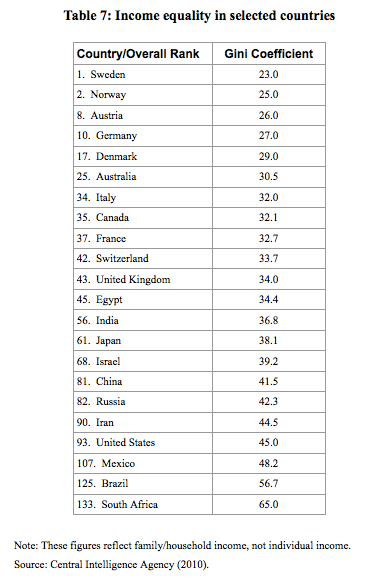
The U.S. ranks below China, Iran and India in terms of income INEQUALITY.

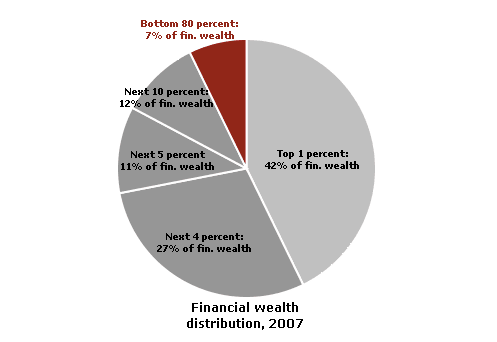
Five percent of Americans own 69% of financial wealth.  The top 1% own 42% of this country’s financial wealth.

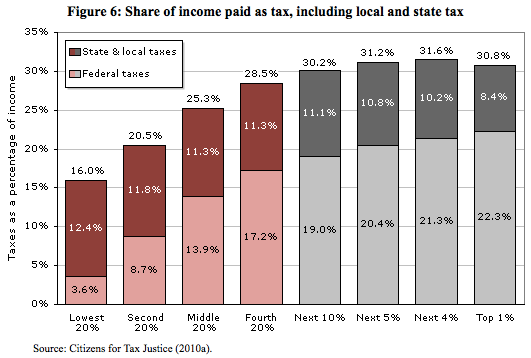
And the tax rate of these fabulously wealthy people is about the same as everyone else’s. That’s why they continue to get richer and richer, and everyone else slides inexorably downward.

While CEO pay is up nearly 300% since 1990, average workers’ pay is up 4%.  I don’t know about you, but the modest increases in my salary over the past decade have been totally absorbed by higher expenses, from food to gas to health insurance premiums and everything else.

So hell yes, there is something to be angry about!  There is a lot to protest!  There is a lot of work to be done to turn this country and this world around. The question is, how far will we go to rock the comfortable cruise ship of the one percenters?  And how far will they go to keep the status quo the way it is?

Police forces have always done the bidding of the wealthy in capitalist societies; is there any chance this could change?  The police are workers just like the protesters; is there any chance they will break their indoctrination and side with their own class interest?

Seems unlikely, but let’s not underestimate the forces of change.  Who would have believed, even six weeks ago, that people would be turning out in the thousands across the world to protest corporate greed and social inequality?

Look at this crowd.  It’s pretty clean cut, isn’t it?  This doesn’t look like a case for the riot police.  By and large, these people don’t want revolution. They just want to be able to live decent lives in a country they can be proud of.

Is this too much to ask?

No.  But, and this is a BIG BUT: what we’ve come to consider “a decent life” is going to have to change in the 21st century, given peak oil, the impending collapse of industrial agriculture, and the climate crisis.

So much will depend on our being smart enough to put these pieces together with the economic injustice we perceive so clearly, and see our way clear to a new, sustainably grounded society.

This is not too much to ask either.  But it will be a challenge to move from the fist-in-the-air stage to the creative visioning, and most of all to the implementation of a more just and sustainable economic system.

We have no choice but to meet this challenge.  Our global future as a species depends on it. This is the central task of our time.

What President Obama and Eve Ensler have in common

President Obama did something really, really good this week.  He sent 100 Special Ops military “advisors” to Central Africa to help local government forces get rid of the Lord’s Resistance Army, a group of crazed, vicious thugs who have been terrorizing people in four countries for as long as many in the region can remember.

The New York Times reports: “For more than two decades, the Lord’s Resistance Army (LRA) has murdered, raped and kidnapped tens of thousands of men, women and children in central Africa,” Mr. Obama wrote in a letter to Congress announcing the military deployment. “The LRA continues to commit atrocities across the Central African Republic, the Democratic Republic of the Congo and South Sudan that have a disproportionate impact on regional security.”

You don’t even want to know what kind of atrocities he’s talking about.  Joseph Kony and his men are depraved, sick torturers, rapists and murderers who have been at it so long that I doubt they can ever be rehabilitated.  They are part of a long cycle of violence in Africa that begins with the kidnapping or luring in of young children, boys and girls, who are then drugged, beaten and raped into total submission to the authority of the adults, and grow up indoctrinated into the lifestyle of terror.

For an inside story, read Ismael Beah’s memoir A Long Way Gone, or the chapter in my anthology African Women Writing Resistance by former girl child soldier China Keitetsi, whose memoir Child Soldier is available in an e-book edition.

I can’t help but think that there is an element of racism in the fact that it’s taken so long for the international community to unite behind the mission of bringing true security to Central Africa (including the Democratic Republic of Congo, where some of the worst human rights violations in the world are taking place daily, with women and girls disproportionately targeted.)

When Bosnian men were massacred, people thrown out of their homes, and women and girls imprisoned in rape camps by the Serbs, the Clinton Administration waged an all-out war to stop it.  All that and more has been happening in the DRC and neighboring countries for decades.  Decades.

Eve Ensler has done a tremendous amount to get the word out about the impact of all this violence on women, not just in Africa but throughout the world.  I particularly admire her because she has used art as the medium for her outspoken calls for solidarity and resistance with victims of rape and violence–starting with “The Vagina Monologues,” and moving on through a host of books and plays.

She’s also used digital media to get her word out and build a global movement to end violence against women, and I don’t think anyone does it better–check out her website, vday.org, to see for yourself.

Eve Ensler is a great example of a woman of privilege who has used all of her talents and gifts to reach out and help others–and not through begging, cajoling or guilt-tripping, either, but through the sheer power of her spoken and written word.

President Obama has the power to send in the military, and it’s good he’s at least taken the first step in that direction.

We ordinary people have power too, more than we often realize.  We can open our eyes to what’s really happening in our towns, our country and our world, and then allow our hearts to show us the way to action for positive social change.

There is no more urgent task for each of us in our lifetimes.  This is what we came here to do.

Hey Boston? Remember your roots! The world is watching you…and so are we!

Have you noticed that there hasn’t been any more pepper spray lately down on Liberty Square in New York?  If that gratuitous act of police brutality hadn’t been caught on videotape by an alert citizen journalist, the pepper-spray impunity might have continued.  Such is the power of the public sphere.

What’s different about this 21st century protest movement is that the public square has expanded to be as big as the whole networked world.

Even if we’re not physically present,we’re watching, we care, and, as Medea Benjamin of Code Pink said yesterday on Democracy Now, “We are here to stay….It really doesn’t matter to us that our permit has run out. We feel like this is a public square, we are the public, and we are occupying this square, so we will stay here.”

Last night the Boston PD unceremoniously removed Occupy Boston protesters from a park that turned out not to be public.  They manhandled Veterans for Peace representatives who were peacefully protesting under the banner of the American flag, and threw the protesters’ tents and belongings into a municipal garbage truck.  Check out this report in the Harvard Crimson, or watch this video and see for yourself.

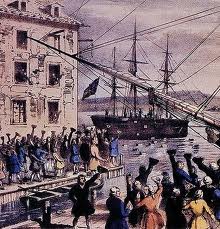
Bad move, Boston.  Aren’t you the home of the original Tea Partiers, the ones we celebrate as patriotic resisters of British oppression?  Do you really want to trample on American citizens’ right to the peaceful expression of dissent?  How un-American is that??

There was no way the Boston Tea Partiers could have predicted that their action in the harbor would spark the American Revolution.  All major watersheds in human history have unfolded in the same way, set off by the actions of a few dedicated individuals who are willing to stand up for their rights and their principles.

Why should our historical moment be any different? The truth is that every hundred protesters arrested will bring another thousand to the movement for change.  Get used to it, Boston–and Chicago, New York, Atlanta, San Francisco….This movement is just getting going.