Fossil Fuels R Us–but we can change, and so can they!

I am in one of those periods where I feel quite inadequate to comment on the events that dash across the world and national stages with madcap intensity.

What was it Shakespeare said? Life’s but a shadow, a poor player who struts and frets his hour upon the stage and then is heard no more…it is a tale told by an idiot, full of sound and fury, signifying nothing….

And yet for those of us who are caught up in the moment, our hour upon the stage, what happens does matter, it does signify something—even if we can’t always tell what that something is.

The General and his lover

What does it mean that a much-decorated general, Director of the CIA, abruptly resigns after being investigated for adultery by the FBI?

Is this scandal really just about a simple affair with a younger woman, or do the General’s neocon tendencies, which had him presiding over the escalation of the disastrous war in Afghanistan and advocating open hostility with Iran, have anything to do with the alacrity with which President Obama accepted his resignation?

We’ll find out when the blockbuster film comes out, a couple of years from now!

Meanwhile, the drumbeats of war are booming in Israel/Palestine, right on cue after the American elections ground to their quadrennial conclusion.

Once again photos of bloody children pop up on our computer and TV screens.  Once again passionate voices on both sides of this eternal conflict are raised.  This is a pageant that has taken place so many times it has become predictable and stale, like the Christmas pageants that will soon take their places on local church stages throughout Christendom.

Scenes from Gaza, November 2012

Why can’t those people just get along? Americans wonder before flipping the channel.  Few of us are aware of the extent to which the Israeli/Palestinian conflict continues to be fueled and armed by the taxpayers of the United States.

This is our conflict; we are responsible.  But as long as we dispassionately wait for someone else to stop it, it will continue to grind on.

The same is true with so many issues, from climate change to income disparity.  It’s time to stop waiting for someone else to step in and solve the problems, make the changes for us.  We have to do it ourselves.

There are a few encouraging signs that this is beginning to happen.

The 350.0rg “Do the Math” tour with Bill McKibben, Naomi Klein and many, many friends is making its historic way across the country, urging Americans to consider ways they can pressure the institutions with which they’re involved to divest from fossil fuel companies.
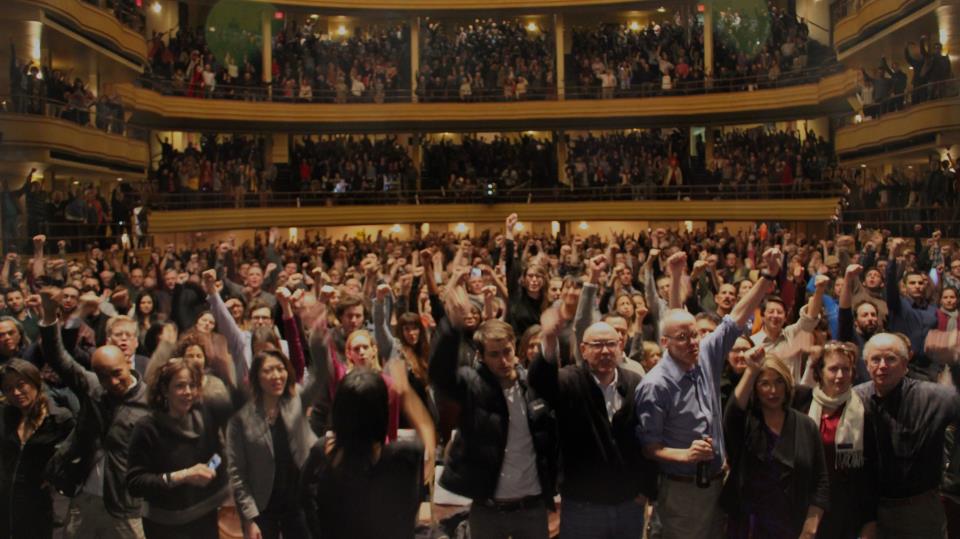
Scene from the Do the Math tour in New York City, 11/12

McKibben was talking about this last summer when I went to listen to him up at the top of Mount Greylock here in western Massachusetts, courtesy of Orion Magazine.  He invoked the successful divestiture movement of the international anti-apartheid struggle, which put enough pressure on the racist South African government that it eventually had to back down from its untenable position and begin working with the Black South Africans.

The sins of the fossil fuel companies are much bigger than those of the Boers: we’re not just talking about bigoted social policies in one country here, we’re talking about a mindset, policy brief and massive engineering effort that is inexorably endangering the entirety of human civilization on this planet, and indeed the well-being of all current life forms, perhaps excepting algae, bacteria and cockroaches.

And yet, it’s impossible to externalize the blame here, because the fossil fuel companies have only been trying to give us what we want: cheap and plentiful oil and gas.

It’s not their fault that we love their products so much we’re willing to do anything—including fight endless wars—to get it.

It’s incumbent on us to look inward and interrogate our own desires and dependencies in order to move forward.

Pressuring the fossil fuel companies to change is a good thing, as long as we’re willing to change with them.

Shifting to renewable energy is going to take a commitment from every player on the world stage today, from government leaders to manufacturers to the financial sector to ordinary consumers like you and me.

Let’s not allow the gloom of Shakespeare’s tragedies to engulf us and sap us of energy.  This play isn’t over yet and it doesn’t have to come to a bloody end.

Enough playing the handwringing Hamlet role!  Let’s roll up our sleeves and get to work to solve our problems and write ourselves a better script.

Will Frankenstorms Become the New Normal?

Yesterday’s images of the NY Stock Exchange with sandbags at the front doors, or cars floating by on Wall Street, were not taken from the latest science fiction disaster movie, not this time.

This time they were real.  And next time the storm could be worse.

But despite all the dramatic headlines declaring Hurricane Sandy the worst storm to hit the East Coast in human memory, there has been barely a whisper of climate change in any of the top weather-related news stories.

I was hoping that Sandy would prove to be a big wake-up call for the privileged denizens of the East Coast, many of whom hold influential positions in business, finance and government.

But instead of people acknowledging the climate elephant in the room and starting to talk about proactive steps we can take to avoid such scenarios in the future, they are just following the usual reactionary script: marshalling disaster relief, urging the citizenry to donate to the American Red Cross, assessing the cost of the clean-up and how long it will take to put Humpty back together again.

A storm like Sandy—or Irene, or Katrina—should prompt reflections on the awesome power of natural forces, and the puniness of human structures.

Take our power away and we are suddenly rocketed back into the early 19th century.  Take our food supplies away, and we become an angry mob in no time.  Do it on a scale that impacts millions of people all living crowded together, and you have a recipe for unprecedented horror.

This is not a pitch for the next action thriller film, and it’s not idle chatter.  These are the kinds of scenarios our governors and national leaders were worrying about yesterday when they authorized the shutting down of mass transit, schools and businesses.

We were lucky this time.  Sandy weakened as she came ashore and the damage, while serious, is manageable.

What we know is that with each passing month and year of inaction on global heating, the storms will become more frequent and more intense.  In the years to come, we will look back on Sandy as child’s play, just a warning of what is yet to come.

What should we be doing now, as individuals, as a nation, and as a global human community?

  • We should be starting a massive shift to renewable, clean energy sources.  And I’m not talking about “clean coal.”  Wind, solar, geothermal, tidal—these are the sources that can safely feed our energy addiction, without driving our climate into ruin.
  • We should be shifting away from cars and highways to trains and mass transit.  Bicycles, too.  And we should embrace the shift to online commerce and education, to avoid the need for a great portion of the horrendous morning commute.
  • We should start a concerted effort, especially in densely populated areas like the northeast corridor, to bury the power lines.  Tangled mats of downed overhead wires should become a thing of the past, and quickly.  We need to become much more resilient at surviving big storms, and our electric grid is a 19th century anachronism in need of immediate upgrade to the 21st century.
  • We need to start a serious citizens’ movement to resist the tripartite junta of the fossil fuel industry, Big Agriculture and Big Chemical.  These three industries must be held accountable for the tremendous destruction they are wreaking on our environment, and on us as individuals.  I’d like to see Big Insurance take our side in this battle; I am sure they’re getting tired of always being stuck holding the bill when the next disaster strikes….

These storms are not random events.  They are getting bigger and closer together and less predictable.  The hotter the climate, the more the ice melts at the poles, the more freakish our weather will become—except that freakish is going to be our new normal.

It’s time to stop the denial, stop allowing ourselves to be distracted from the very serious questions that face us now.

It boils down to this: are we going to leave a livable Earth to our children and grandchildren?  Or are we going to go down in history (if there are any left to carry history forward) as the most criminal generation of all time?

Politicos beware: the citizen journalists are coming!

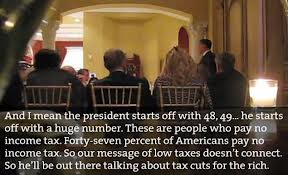
Mitt Romney really hit the jackpot this time, caught on video tape callously dismissing half the population of America as not worth his time because they don’t pay taxes.

As “The Caucus” blog in The New York Times pointed out today, in fact it’s only 18% of Americans who pay no federal or payroll taxes.  And of those, “more than half were elderly and more than a third were not elderly but had income under $20,000.”

What a way to make a winning pitch to potential donors in the 1%.  Let’s just throw all those poor old folks under a bus, shall we?  Are there no workhouses?

Ripostes like this have been coming in fast and heavy for the past 24 hours, since the incriminating video clip first appeared on the Mother Jones website, and thence made its way virally around the Web.

What I think has been insufficiently analyzed so far is the provenance of this video.

Today in my media studies class, we were talking about how the old media model, what the textbooks call “legacy media,” is crumbling, to be replaced by myriads of web-based information producers, often referred to as “citizen journalists.”

The guy who released that covert video of Mitt Romney talking up a GOP horse’s ass was a citizen journalist of a sort.

We still don’t know exactly who shot the film, but we do know that it was sent to Mother Jones by James Carter, a grandson of former President Jimmy Carter.

The point is, these are obviously very different channels of information flow than scripted “press conferences,” or even the kind of access granted to card-carrying members of the mainstream media.

The video has so captured the attention of America because it affords us a ringside seat in the inner echelons of political power.  Next thing you know, someone will be shooting video (or at least making a covert audio recording) of the proceedings of a closed-door Goldman Sachs board meeting.

Hey, Richard Nixon was the master of this kind of bugging.  Let us not forget Watergate, or the Oval Office recordings.

But now the tables are turned, and the technology genie is out of the brass lamp and running gleefully through the land.

No longer are wiretaps and tiny voice recorders the provenance of James Bond and the FBI.  Now anyone with a bit of tech smarts and some fortuitous access to the workings of power can record what goes on there, and send it out for the masses to interpret as they see fit.

Last week it was the crazy anti-Muslim film, cheaply and poorly produced but sent out like a message in a bottle on the high seas of the internet, which washed ashore in the Middle East and provided the spark for a new round of anti-American violence.

This week it’s a citizen journalist with a Flip cam in his pocket, pulling back the screen in the GOP Emerald (cash-green, that is) Palace to reveal the true face of the mean-spirited man who would be the Republican President.

As a teacher of media studies in the 21st century, I am excited by the possibilities that my students will enjoy of leaping past the old gatekeepers and getting their investigative work out to the public.

I’m also not quite sure how they are going to make a living doing it—that’s one small detail that remains to be worked out.

But one thing is sure: in this day and age, it is going to be a lot harder for a politician to maintain a public image that is at odds with who he really is when he’s at home.

I hope that means that the next generation of politicians is going to have to be—gasp!—sincere.


Internet Rage

Protests against the US this week, responding to the “Innocence of Muslims” trailer

That a boorish, crude, poorly made video could set a whole region on fire with righteous rage and cause the death of a highly respected American diplomat and his staff is a sign of the dangerous new world we live in.

I asked my media studies class yesterday to think about whether we are better off now than we were before the internet age, or whether the amount of time we all spend on the Web is dumbing us down by making us restless, superficial consumers of so much raw information and half-truths that we no longer have the time or inclination to sift through it all and figure out what really matters.

My students, digital natives all, were enthusiastic about the interactivity of the internet, the unparalleled opportunities it offers for entertainment and lightspeed communication.

But we all sobered down some when we contemplated the dark side of the internet promise, given form this week in the jump from You-Tube to Muslim Main Street.

We watched a few minutes of “Innocence of Muslims,” the purported “trailer” for a full-length movie that may very well not exist.  Actually we watched less than two minutes of the film, all that we needed to understand why it has angered religious Muslims.

The film makes a mockery of the Prophet Muhammed, and presents the religion he founded as bloody and uncouth.

I’d like to see how evangelical Christians would feel if a similar film was made about Jesus Christ and his religion.

The Egyptian government issued a statement today recognizing that American filmmakers have the right to freedom of speech, and therefore cannot be prosecuted for their insulting production.

But they can certainly be condemned.  Hate speech is not allowed in the U.S., and this film walks a fine line; it is certainly insulting and intolerant, if not outright hateful.

The film only made waves in the Middle East when someone translated it into Arabic, and then reposted it on You-Tube.

Maybe they thought Muslims would think it was funny.

No one is laughing, not at all.  And the rage comes out against America and all Americans, even though the majority of Americans would be just as turned off by this film as anyone in the Muslim world.

Even as I write that familiar phrase, “the Muslim world,” I know it’s false.  The internet has shrunk our globe so much that the old boundaries between cultures and nations no longer hold.

Out there on the internet, we’re all part of a vast interconnected universe of humanity, a distributed digital brain hosted by the global Cloud.

We have the capacity to send images and words around the world at lightening speed, but on the ground we’re still the same old people we have been for hundreds of years, weighed down by our enmities and prejudices, our pettiness and our greed.

The freedom of communication facilitated by the internet is marvelous, and few of us would want to see it censored.

But we need to understand the power of words and images to manipulate and twist our perceptions of the truth.

We need to learn how to become responsible producers and informed, discerning consumers of all the representations we send up to the Web.

That ugly film does not represent America, any more than the savage reprisal on the Libyan Embassy represents the Muslim community.

The internet should be used to connect us, not tear us apart. We need to be smarter than that.

Why are we punishing America’s schoolchildren and their teachers?

Jonathan Kozol in action

Every stakeholder in the current Chicago teachers’ strike who has not visited an inner city Chicago public school should take the time to read Jonathan Kozol’s powerful book Savage Inequalities, which chronicles the author’s explorations of conditions in schools in poor and rich neighborhoods in a series of American cities.

“One would not have thought that children in America would ever have to choose between a teacher or a playground or sufficient toilet paper,” wrote Kozol back in 1991.  “Like grain in a time of famine, the immense resources which the nation does in fact possess go not to the child in the greatest need but to the child of the highest bidder—the child of parents who, more frequently than not, have also enjoyed the same abundance when they were schoolchildren.

“’A caste society,’ wrote U.S. Commissioner of Education Francis Keppel 25 years ago, ‘violates the style of American democracy….The nation in effect does not have a truly public school system in a large part of its communities; it has permitted what is in effect a private school system to develop under public auspices….Equality of educational opportunity throughout the nation continues today for many to be more a myth than a reality.’  This statement is as true today as it was at the time when it was written.”

And it remains true twenty years later.

The bedrock issue here is one of inequality, which is measured along multigenerational racial and class lines.  As long as we continue to link public school funding to local property taxes we are going to be perpetuating an entrenched system of race and class segregation, from which there is little chance for escape.

Kozol observed that kids in suburban schools, no matter what state, already have what the CPS teachers are begging for in the urban schools, and then some.

Is it right that kids from wealthy neighborhoods go to college while kids from poor neighborhoods go to jail?

Kids in poor districts need more help from the state, not less, than kids in wealthy districts.

Chicago is not the only place in America where our schools are failing our neediest children, it is just the only place in America right now where the teachers have been pushed so far that they are taking to the streets in protest.

The Chicago teachers’ strike is being presented in the media as a case of selfish, whining teachers walking out on their students because they are greedy for more money, or afraid of being held to high standards.

But when you listen to the teachers, parents and students who have managed to penetrate the media gatekeepers and make their voices heard, what you hear is not greed or shortsightedness, but deep concern for the health of the school system and the welfare of the children.

The teachers are asking for smaller class sizes (would you want your child in a kindergarten class of 45?); improvements in the crumbling physical plants of their schools, including libraries and playgrounds; and support staff for troubled students, including nurses and social workers.  They don’t want their evaluations tied so tightly to how their students perform on standardized tests, and they want to be given seniority preference if they are laid off because of a school closing.

I don’t hear anything unreasonable in these demands.

Has anyone on the editorial boards of the newspapers who have condemned the Chicago teachers’ strike, which include the Chicago Tribune, the New York Times and the Washington Post, ever set foot in a Chicago public school?

I know for a fact that Mayor Emmanuel’s children attend private school, as did the Obama girls when they lived in Chicago.

President Obama and business leaders like to exhort American children to study hard and close the achievement gap between our country and others like China and India.

They need to put their money where their mouth is, and give our dedicated teachers the support they need to do the job right.

We eat by the grace of Nature, not by the grace of Monsanto

“Organic, schmorganic,” fumes New York Times columnist Roger Cohen sarcastically in an article entitled “The Organic Fable.”

He bases his sweeping dismissal of the organic foods movement on a new Stanford University study claiming that “fruits and vegetables labeled organic are, on average, no more nutritious than their cheaper conventional counterparts.”

Cohen does grant that “organic farming is probably better for the environment because less soil, flora and fauna are contaminated by chemicals…. So this is food that is better ecologically even if it is not better nutritionally.”

But he goes on to smear the organic movement as “an elitist, pseudoscientific indulgence shot through with hype.

“To feed a planet of 9 billion people,” he says, “we are going to need high yields not low yields; we are going to need genetically modified crops; we are going to need pesticides and fertilizers and other elements of the industrialized food processes that have led mankind to be better fed and live longer than at any time in history.

“I’d rather be against nature and have more people better fed. I’d rather be serious about the world’s needs. And I trust the monitoring agencies that ensure pesticides are used at safe levels — a trust the Stanford study found to be justified.”

Cohen ends by calling the organic movement “a fable of the pampered parts of the planet — romantic and comforting.”

But the truth is that his own, science-driven Industrial Agriculture mythology is far more delusional.

Let me count the ways that his take on the organic foods movement is off the mark:

  • Organic food may not be more “nutritious,” but it is healthier because it is not saturated with pesticides, herbicides, fungicides and preservatives, not to mention antibiotics, growth hormones and who knows what other chemicals.  There are obvious “health advantages” in this, since we know—though Cohen doesn’t mention—that synthetic chemicals and poor health, from asthma to cancer, go hand in hand.
  • Organic food is only elitist if it comes from Whole Foods—the one source Cohen mentions.  I grow organic vegetables in my backyard, and they save me money every summer.  We don’t need the corporatization of organic foods, we need local cooperatives (like the CSAs in my region) to provide affordable organic produce that doesn’t require expensive and wasteful transport thousands of miles from field to table.
  • About feeding 9 billion people: first of all, we should be working hard to curb population growth, for all kinds of good reasons.  We know we’ve gone beyond the carrying capacity of our planet, and we shouldn’t be deluding ourselves that we can techno-fix our way out of the problem.  Industrial agriculture is a big part of the problem.  It will never be part of the solution.  Agriculture must be relocalized and brought back into harmony with the natural, organic cycles of the planet.  If this doesn’t happen, and soon, all the GMO seed and fertilizers in the world won’t help us survive the climate cataclysm that awaits.
  • Mankind is better fed and longer lived now than any time in history?  Here Cohen reveals his own elitist, Whole-Foods myopia.  Surely he must know that some billion people go to bed hungry every night, with no relief in sight?  Mortality statistics are also skewed heavily in favor of wealthy countries.  So yes, those of us in the industrialized nations are—again, depending on our class standing—living longer and eating better than in the past, but only at the cost of tremendous draining of resources from other parts of the world, and at increasing costs in terms of our own health. Just as HIV/AIDS is the scourge of the less developed world, cancer, asthma, heart disease and diabetes are the bane of the developed world, and all are related to the toxic chemicals we ingest, along with too much highly processed, sugary, fatty foods.
  • For someone who is calling the organic movement “romantic,” Cohen seems to have an almost childlike confidence in authority figures.  He says he trusts “the monitoring agencies that ensure pesticides are used at safe levels — a trust the Stanford study found to be justified.” And I suppose he also still believes in Santa Claus?  We cannot trust that the “safe levels” established by the EPA or FDA are in fact safe, given the fact that we operate in an environment where thousands of chemicals enter the market without sufficient testing, presumed innocent unless proven guilty—but to win the case against them, first people must get sick and die.
  • Cohen’s zinger, “I’d rather be against nature and have more people better fed,” displays his own breathtaking blind spot as regards the human relation to the natural world.  Human beings cannot be “against nature” without being “against ourselves.”  We are a part of the natural world just like every other life form on this planet.  Our fantasy that we can use our technological prowess to completely divorce ourselves from our material, physical reality is just that—a fantasy.  We eat by the grace of nature, not by the grace of Monsanto.

For the entire history of homo sapiens, we have always eaten organic.  It’s only been in the last 50-odd years, post World War II, that wartime chemicals and technologies have found new uses in agriculture.

The result has been the rapid and wholesale devastation of vast swaths of our planet—biodiversity giving way to monoculture, killer weeds and pesticide-resistant superbugs going wild, the weakening and sickening of every strand of the ecological web of our planet.

The relevant fable to invoke might be the tale of Jack and the Beanstalk.  We might be able to grow a fantastically huge beanstalk if we fed it with enough chemical fertilizers, and we might even be able to climb it and bring back a goose that lays golden eggs.

But in the end, that beanstalk will prove to be more dangerous to us than it’s worth—we’ll have to chop it down, and go back to the slow but solid organic way of life that has sustained us unfailingly for thousands of years.

Enough Political Reality TV: Time to tune in to the planet

I tuned into the Democratic National Convention (DNC), thinking I’d catch a few minutes of the action before going to bed, and I was quickly entranced by the spectacle.

This, of course, is what political conventions are all about.  They’re a great primetime opportunity to dazzle the video-feed audience, and energize the base.

Deval Patrick

I enjoyed watching Deval Patrick, governor of my home state of Massachusetts, give a moving speech focusing on the right of all children to a good education.

I loved meeting a rising political star, Mayor Julian Castro of San Antonio, Texas, who was winningly introduced by his identical twin brother, state Representative Joachin Castro, currently running for a seat in the U.S. House of Representatives.

The Castro brothers are handsome, talented, and are buoyed by a classic American success story, coming from a poor background, working hard in school, winning scholarships to Stanford and Harvard Law, and moving on and up into politics.

Julian and Joaquin Castro

Who wouldn’t be charmed?

Michelle Obama

And then there was the woman we were all waiting for, First Lady Michelle Obama, looking tall, muscular, vigorous—and very beautiful.

Mrs. Obama was introduced not by a politico, but by an “ordinary woman,” a military mom with four sons serving in four different branches of the U.S. military, and a fifth still in high school, bound for the U.S. Coast Guard.  It was moving to hear her tell of how she had written to Michelle and been invited with her husband to the White House, to receive the Obamas’ thanks for the service their family provides to our country.

And it was moving to hear Michelle roll out the by-now familiar story of her humble family background, and how her parents’ hard work enabled her and her brother to go to college and on to graduate school, where she met Barack—himself a scholarship boy who chose to work as a community organizer in Chicago rather than take a high-paying job as a corporate lawyer in New York right out of law school.

Who wouldn’t enjoy hearing Michelle praise her husband as a father, a partner, and a dedicated professional, who truly cares about his country and ran for office not for the glory but because he believed he could make a positive difference?

I came away from the couple of hours of speeches with just the feel-good sensation the scriptwriters had worked so hard to achieve.

But that’s the problem.  It all felt too scripted.  Too perfect.  Too much like entertainment—maybe some kind of weird political reality TV show.

I didn’t watch the Republican National Convention, so I can’t compare and contrast the two, but from all I’ve read about it, it was more or less the same in form, if not in content.

The DNC emphasized the multicultural, hardworking, can-do ethos of the 99%, while the RNC emphasized the white-skinned, inherited-wealth, party-animal ethos of the 1%.

If those are my choices, I clearly belong with the Democrats.

But I can’t help but wonder what I’d see if the Green Party were able to have a  primetime convention opportunity like this.

Of course, the Greens probably wouldn’t even want to put on a big expensive consumerist circus typical of our American political conventions, so wasteful of energy and resources.

Stein and Honkala

Looking at the Green Party platform of Presidential hopeful Jill Stein and her running mate Cheri Honkala, it’s clear that  the Green Party would not just talk about personal rags-to-riches stories of success, but about the structural barriers that keep the 99%–or at least, let’s say, the bottom 50% of our population—locked in generational cycles of poverty and unfulfilled promise.

They would not just repeat the monotonous mantra of jobs creation, but would talk about the most daunting issues facing us today.

The tsunami of climate change that is like the elephant in the room of American politics.

What good will a better K-12 education or the promise of a job be if our climate becomes so compromised that food shortages become rampant?

I want to hear a politician talk candidly about the stranglehold that the chemical companies and the fossil fuel industry currently has on our children’s future on this planet.

I want to hear a politician who is not afraid to talk about the effects we can expect from the rapid melting of the ice packs at the poles.

A politician who is committed to building local resiliency, rather than continuing the death march down the road to globalization, which benefits only the corporate elite and the finance wizards who serve them.

Is Jill Stein that politician?

I wish I knew.  The problem is that I have to work pretty hard to find out what she’s all about.  And that makes me worry that she, and the party behind her, just don’t have the strength to compete in our political gladiators’ ring.

Perhaps it’s time to acknowledge that we are not going to find a political messiah who can part the seas and lead us to safety.

No one person, or even one party, can do that.

We individuals have to assume responsibility for our collective, interdependent future, and begin working harder in our own spheres, where we can have the most impact.

It matters who sits in the White House.  I believe the Obamas should get another four years, and hopefully a saner Congress to work with as well.

But it matters just as much what we do in our own states, cities and towns, with or without federal aid.

Mayor Castro and the Governor Patrick and Michelle Obama have been remarkable for working hard to make a difference at the local level.

Thanks to Michelle’s efforts, my son now has a mandated healthier lunch, with no sugary drinks or white bread allowed.

Governor Patrick continues to stand by our Massachusetts state health care program, one of the best in the nation (instituted under Mitt Romney, who now, to please his billionaire buddies, disavows it).

Massachusetts is working on alternative energy sources like wind and solar, with incentives for local municipalities and individuals to convert.

We need to continue to build community resilience and mutual support as we move into the brave new world that awaits us.

It is the only way we are going to make it through the coming climate-driven catastrophes.

We’ve got two more nights of DNC speeches ahead.  Is anyone going to acknowledge the climate elephant in the room, move us out of the polished entertainment arena and speak frankly to us about what’s ahead, and how to pull together to get through it?

No, we’re not crying wolf

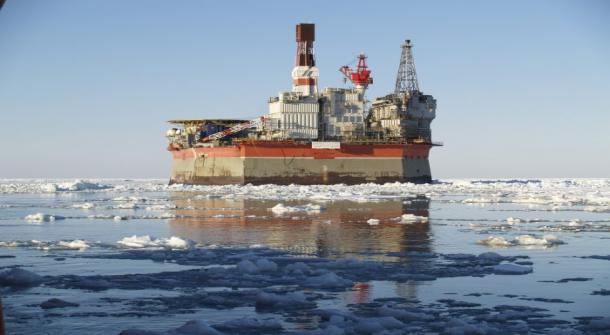
I gain a shred of hope for the future when I read about the heroic efforts of Kumi Naidoo, Executive Director of Greenpeace International, to draw attention to the criminal exploitation of the Arctic by fossil fuel prospectors.

Last week Naidoo braved hosing with cold water in the frigid temperatures of the North to take a stand on a huge Russian oil platform.

It was a publicity stunt, yes.  But how else are we going to attract the attention of the multitudes who need to know what is being done under the radar in the new Arctic Oil Rush?

As the pack ice melts at a historic pace, the fossil fuel industry is moving in.  Never mind the fact that oil spills in these waters will be almost impossible to stop.  Never mind the fact that this is the last refuge for so many endangered species, from polar bears and seals to whales and seabirds. Never mind that the more oil we pump out of the bowels of the earth, the faster we’ll wreck our fragile climate.

I am doing a lot of pondering lately about tactics.

The Occupy movement here in the States seems to have largely fizzled.  Oh yes, a couple of busloads of protestors did go down from NYC to Tampa to protest at the RNC—and it’s true that the hurricane warnings put a damper on people’s enthusiasm to venture forth.

But if Kumi Naidoo and his team can brave the Arctic to climb the side of an oil rig, it seems to me that we ought to be able to mount a better protest at our Stateside behemoth, the Republican National Convention.

But no.  The mainstream media is reporting on the Convention in level terms, as though it weren’t a circus aimed at gutting what is left of the social contract that, at least since FDR’s time, Americans have come to consider a birthright. It reminds me of how reporters went along with the “WMD mushroom cloud” nonsense in the build-up to the invasion of Baghdad, or how they all but waved American flags in our faces when publishing the photos of the American soldiers killed in Iraq.

Hardly anyone has bothered to remark on the fact that we just passed our two-thousandth dead American soldier in Afghanistan this summer.

These deaths just creep upon us, the same way that oil rigs spring up like weeds in previously pristine waters, along with aquaculture farms, chemical runoff, GMO seeds and fracking wells.

It all happens so quietly and so deftly, while we are busy trying to pay our bills, or getting in a little vacation, or saying farewell to another loved one who has succumbed to cancer.

The Kumi Naidoos and the Tim DeChristophers and the Rachel Corries of the world jerk us back to reality and remind us that while we weren’t paying attention, the thieves got in and began “minding the store.”  In their own fashion.

Their tactics are always the same.  Catch people unawares; get them to sign documents ceding their rights; then systematically go about the business of resource extraction as quickly as possible, with as high a profit margin as possible.  Get it done before the sleeping populace awakes, before the regulators notice anything amiss, before people and animals begin to sicken and the lawsuits begin.  After all, the legal process can be held up in appeals for generations, and meanwhile how many fortunes can be made?

What should our countering tactics be?

Visibility is important: hence the merit of the Greenpeace approach.

Building a movement is important—not just among those willing to camp out in city parks, but among senior citizens and the middle class, unemployed white collar workers and soccer moms, as well as the marching band kids.

People need to realize that this is deadly serious.  No one is crying wolf here.

If we don’t act now to break our fossil fuel addiction, our time on this planet is almost over.

Maybe if we’re lucky, we can come back as bacteria or cockroaches.  But humans?  We’re just about done.


The Foxification of Our Public Sphere

These days when I send one of my columns to Common Dreams, I do so with an inward cringe.  I know that CD has become infested with slavering rightwing drones, who lie in wait just waiting to do their best Bill O’Reilly imitation from the comment balcony.

In recent months, CD has tried to address the issue of attack-dog commenters, instituting a comment policy that is now posted at the bottom of every published article.

It doesn’t seem to have had much effect, and I am beginning to wonder:

a) Is it worth my time and effort to open myself up to this kind of harsh, superficial debate?  When I write, I write from the heart, and while I certainly welcome spirited discussion of my ideas, including intelligent disagreement, the vicious savaging of my ideas, usually taken out of the context of the column’s overall message, feels unproductive at best.

b) If I bow out of CD, am I allowing myself to be “silenced”?  Shouldn’t I stand up for freedom of speech and stand my ground, even if it means opening myself up to the snipers?  Public speakers have to have a thick skin, after all, right?

c) Are there other fora I might join where the level of commentary is more elevated, more thoughtful?  Am I being an elitist snob for even wishing for such a space?

d) If I can’t beat’em, should I join’em?  In other words, should I be jumping in and giving as good as I get?  Or would that be stooping to their level and just encouraging their attack-dog mentality all the more?

As I ready myself to teach my media studies class this fall, these certainly seem like important questions to be pondering.

For years now I have been celebrating and advocating “citizen journalism” in my classes, encouraging students to start their own blogs and get their voices into the public sphere.

But if even Common Dreams has been overrun by the Bill O’Reilly wannabes of the world, then our public sphere has become a skewed and dangerous place.

However, if people like me and my students opt out of it, that only leaves a greater vacuum for the rightwing ideologues to fill.

Anyone have any advice on how to grow a thicker skin?

American insanity

I admit to a feeling of dejection at being back in the USA again.

Same old callous attitude towards women vomiting out of the Republican Party (“legitimate rape,” my ass!).  Same old desperate pleas for money from the Democrats, who are forced to beg for funds from small fry like me to try to compete with the billionaire Republican funders.  Same old blithe disconnect between the reality of climate change (drought, anyone?) and the steady roar of the fracking drills in Pennsylvania and the oil rigs in the Gulf of Mexico.  Shrimp and fish turning up grotesquely deformed by tumors, eyeless and burned, for hundreds of miles around the BP spill.  Whatever.

Not that things were paradise in Canada.  The crash of the fish populations there is alarming, and they too are involved in the dirtiest of business in the Alberta boreal forest (which I refuse to call by the euphemism “tar sands,” implying as it does that there’s nothing there worth saving).  They clearcut forests and pollute rivers and all the rest of it.

But from just a few weeks of tuning into the media there, I can tell that there is much more clarity and focus there on environmental issues.  Every single issue of the Halifax Chronicle Herald has at least one article, and usually several, about energy or agricultural or fishery policy in relation to climate change.  They are actually working towards meeting the goal they set for themselves of generating 15% of the nation’s energy needs by renewable means by 2020, and many are calling for a more ambitious target.

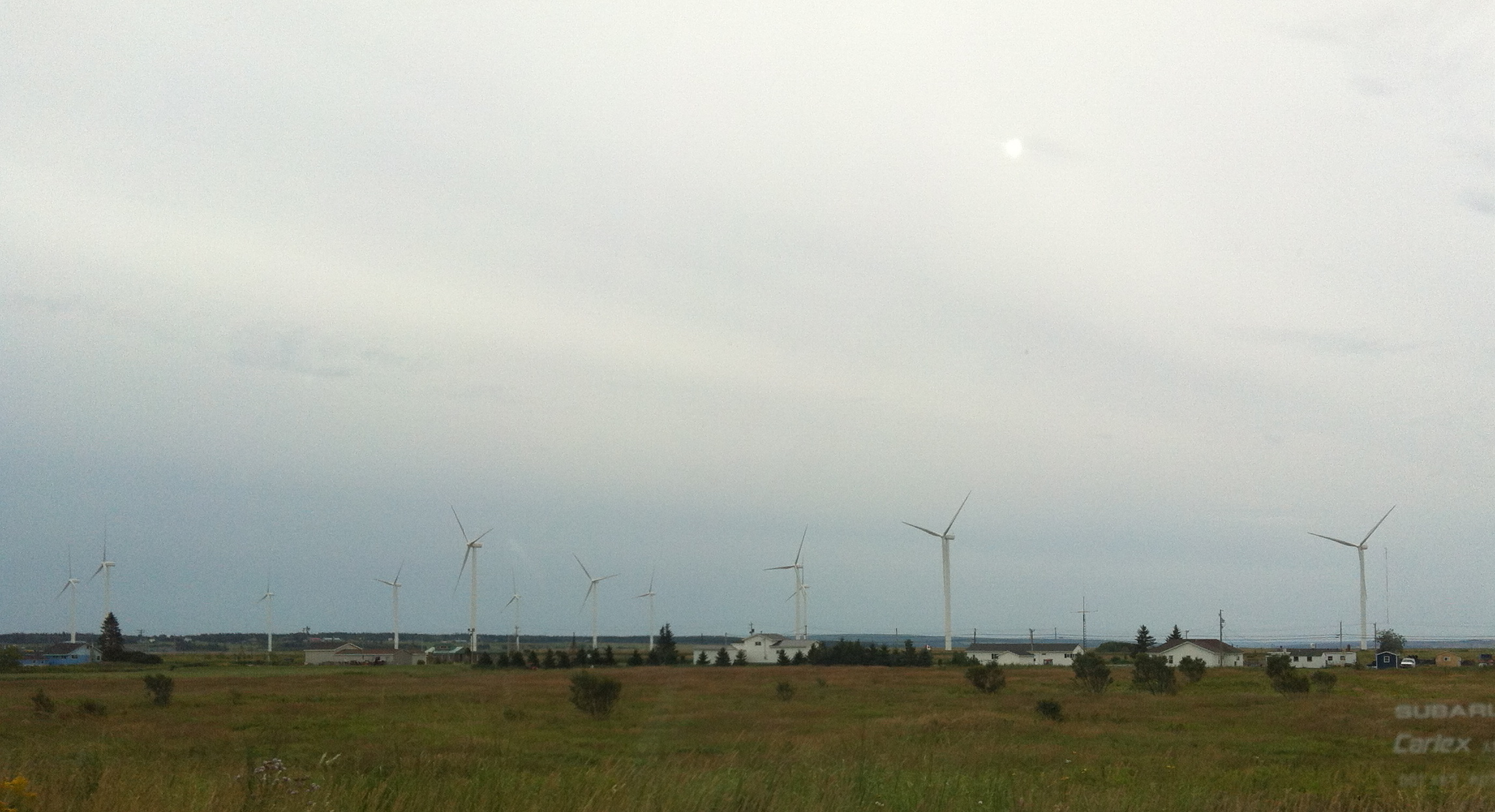
Coming across the land bridge into Nova Scotia one is now greeted by a newly erected forest of huge wind turbines, and there are water turbines churning in the nearby waters of the Bay of Fundy, too.  Many more are in the works.

Although there is political strife in Canada, such as has boiled up in Quebec in recent months, there is none of the viperous, self-destructive attack politics that goes by the bland name of “the election year cycle” here in the States.  Politicians campaign on the issues rather than on smearing and sniping at each other. Voter turnout is about 60%, as compared to the dismal 40% in the U.S.

Why do so many people feel disengaged, disillusioned, and disgusted with politics here in the U.S.?  Why do we feel like no matter how we vote, our values will not be reflected in Washington?

Because it’s true.

I happen to believe that Barack Obama shares my values.  I believe he is a genuinely caring, ethical man who sincerely wants to create a country in which politicians collaborate rather than backstab each other; in which government and corporations serve the public good; in which the goal of economic activity is raising all boats, rather than creating a few luxury liners for the richest 1% of Americans.  I believe he’s a good man.

And yet, he has been unable to make a dent in politics as usual in Washington.  The Republicans have shown repeatedly that they are the party of the wealthy boardrooms of Big Business and Big Finance, and since they own so much of the news media, and so many think tanks, and so many political seats, including Supreme Court seats, well, they can do as they wish and everyone else be damned.

I have noticed a certain grim set to Obama’s jaw in the last year, as the reality of his fly-in-the-web position has sunk in.  He knows that even if he wins re-election, he will be foiled at every turn.  And it doesn’t help that it’s getting harder and harder for him to inspire his base—people like me who are beyond frustrated with the status quo, and no longer believe he and his team can make a change.

When I get those daily emails from Democratic headquarters pressing me to donate to the campaign (just $12!), and then I hear about how the Koch brothers are donating millions to the Romney campaign, the little sprout of hope that springs eternal in me just starts to wither.

Yes, if 100 million Americans donated $12 to Obama it would make a big difference.  But frankly I would rather see some savvy crowdsourcing through social media, with the goal less raising money to burn up on TV than getting more people out to the polls on election day, and empowering ordinary Americans to rise up and insist on real representation in Washington.

I am not interested in betting on the horse race.  I can’t sanction the wasteful spending of huge sums on campaigning, while our planet burns and billions of people are locked in poverty.

Romney will be bad—very, very bad—for the health of the environment and all living things, including humans.

He, and all the slimy bastards who prop him up, must be defeated.

But this battle is about much more than just one country’s Presidential race.  It’s about our future on this planet.  A vote for Romney is a vote for business as usual, and then some—drill, baby, drill.

Why is it that so many Americans are so suicidal?

Maybe we need some collective social therapy more than anything else.

It really does seem that as a nation, we are insane.