Honoring Native Americans instead of Columbus

I’d like to suggest that instead of honoring Christopher Columbus on this day in October, we make this a national holiday in honor of the indigenous peoples of North America.

It is shameful that we have no national day of recognition for the native tribes who were here to welcome the first European explorers.  Perhaps this is no innocent oversight; if there was a day of recognition, we’d have to confront the ugly truth of what those Europeans did to the Native Americans–from smallpox to displacement, massacres and enslavement.

Still, that bloodstained history lurks beneath the surface of national holidays like Columbus Day and Thanksgiving.  It would be better to look squarely at the truth and do something to atone for it–at minimum, honoring the native ancestors of this land, and their contemporary descendants, who continue to struggle and resist the tsunami of Euramerican industrial civilization.  

For an idea of what that struggle looks like today, check out the Honor the Earth website.  Honor the Earth works “to address the two primary needs of the Native environmental movement: the need to break the geographic and political isolation of Native communities and the need to increase financial resources for organizing and change.”  It was founded in 1993 by native rights and environmental activist Winona LaDuke and the Indigo Girls.

In honoring the Native peoples of the United States instead of the European explorer who accelerated the invasion of their territories and the assault upon their cultures, we would be honoring the amazing resilience and wisdom of these ancient tribes, who have withstood the onslaught of European culture with incredible strength, courage and dignity.

We contemporary Americans are standing at a turning point in history where we may be able to get away from the destructive mode of domination represented by Columbus and a host of European explorers after him.

Changing Columbus Day to Native American Day (or perhaps selecting one significant representative Native person from history–I would not presume to suggest a single figure, but there are many to choose from) would be a good start at not only atoning for the bloody history of European-Native encounters, but also moving more harmoniously into the future.


Let’s take back Black Friday, and change history!

I have a suggestion for the Occupy America folks all over this country.  Let’s take back Black Friday.  You know, the Black Friday after Thanksgiving Day, supposed to be one of the biggest shopping days of the American year?

It’s a great day for a decentralized national protest, because nearly everybody, including all those college students, is on holiday.  It’s also a great day for an anti-Big Money protest, because it will hit the corporations where it hurts most: retail sales.

What if instead of swiping those credit cards and running up our consumer debt on Black Friday–making it a black day for consumers, but a golden day for corporations and financiers–we deliberately boycotted the malls?  Instead, let’s declare a day of participatory democracy in action, a chance to meet with our neighbors and fellow citizens out on the public square, in cities and towns all across this country, to collectively envision a new society based on the true ideals of Thanksgiving: joining together as human beings across superficial differences like ethnicity, nationality and creed, nourishing each other with the bounty of our natural world and helping each other through lean times.

We live on a rich and abundant planet where there are sufficient resources for all of us to live well–the problem is the inequitable distribution of those resources.  On the original Thanksgiving, the native hosts were kind enough to give their Puritan guests a helping hand.  The rest is history, and it’s not a happy history at all.

We are standing at a crossroads where we have a chance to step off the path we began as a nation when the Europeans colonized this country and the capitalist machine began to roar.  We may not get another chance, given the precarious state of our global climate.

Now is our time.  Let’s step up and change history together.  Black Friday organizers, let’s get busy!

Resisting the Zombies: At what point will we stop bearing witness to ecocide and begin to act?

My favorite chapter in Derrick Jensen’s new book Dreams is entitled “Zombies.”  Jensen describes the corporate elite as zombies, that is, as “flesh-eating…mindless monsters who are not only to be feared for their insatiability and ferocity, but because their sickness is highly contagious….Zombies eat human flesh, but they are also as relentlessly omnicidal as corporations.  They destroy forests, grasslands, rivers, oceans, mountain tops, and the mountains themselves.  They consume everything, and they shit out plastic” (367).

For Jensen, “zombie capitalists” are especially terrifying, because “on the one hand, they pursue their prey–I mean, profits–with an unfeeling, unrelenting, insatiable mindlessness, unheeding of all the pain and suffering they cause in their victims–I mean, in the resources they exploit (I mean, develop).  On the other hand, they fabricate extraordinarily complicated rationales for their zombie economics (or zombinomics) and for the further zombification of the world and all its inhabitants” (368).

Jensen imagines a “realistic zombie film” being made, in which “the remaining humans”–the ones who haven’t been consumed or infected yet by the zombies–are “refusing to resist, but instead hoping against reason that the zombies will stop on their own, that the zombies will undergo a miraculous awakening…or that if they personally could just live sustainably, then their shining examples will cause the zombies to suddenly stop, look at the torn flesh all around them, and say, ‘What have I done?  I need to make this right!’….In a realistic zombie movie,” Jensen says, “too many humans would try to stop the zombies by gardening, taking shorter showers, recycling, petitioning.  In a realistic zombie movie…many of those humans who opposed resistance would be revealed near the end to not really be on the side of the living but rather, unbeknownst even to them, already among the living dead” (369).

Unfortunately, all too often, even those who profess to be on the side of justice and environmental sanity are eventually shown to be soulless creatures of the corporate capitalist zombie machine.

It seems that the minute an authentic human leader arises who has the possibility of successfully resisting the zombies and making real change, s/he is either smeared and discredited; corrupted with financial payoffs; driven mad with frustration by repeated, humiliating obstructions; or simply imprisoned or killed off.

Thus we have watched with horror as our beloved Barack Obama, the young man we came to know and love in Dreams from my Father and The Audacity of Hope, has slowly had the soul sucked out of him by the zombification crucible of politics and media.  The face remains the same, but the eyes are hollow, and the spirit is clearly guttering.

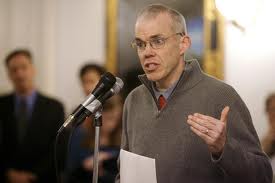
Bill McKibben is still holding out valiantly against the zombies–maybe it’s that pure Vermont air that is keeping his head clear of contagion so far.  Derrick Jensen has some harsh questions for Bill, though, which I think are entirely reasonable.  Given the steady destruction of the planet by the zombie forces of corporate capitalism, Jensen asks, “Would McKibben ever countenance the physical dismantling of infrastructure in order to stop civilization from killing the planet?” Jensen’s question, “for McKibben and for everyone,” is: “What is your threshold?”  At what point will we stop bearing silent witness to ecocide, and begin to seriously resist?

The reason the Occupy Wall Street protests have so seized the American imagination is because the young people out there on the street are so clearly NOT ZOMBIES.  Not yet, anyway.  They have not been corrupted; their souls are intact.  That’s why they can see so clearly that what the zombie nation accepts as normal–the enrichment of the few on the backs of the masses–is not normal at all, and is neither just nor sustainable.

There is another up-and-coming activist who is right now wavering on the border between zombie and human.  His name is Van Jones, and he’s the man behind the Rebuild the American Dream movement.  Jones is all about developing “green-collar jobs”; in other words, rebooting the old American Dream in a new, more sustainable version.  Unlike Occupy Wall Street, Jones comes armed with a nice bullet-pointed list of “demands.”

Nothing wrong with his list.  But it’s just not radical or visionary enough to ignite the minds and hearts of the young people out in Liberty Park Plaza.  Even the way his website is presented, with red-white-and-blue stars and flashy campaign-style graphics, is very likely to turn a lot of the Occupy Wall Streeters off.  It reeks of zombification.

When you look into Jones’ bio, you see why: “Jones served as the green jobs advisor in the Obama White House in 2009 and is currently a senior policy advisor at Green For All. He also holds a joint appointment at Princeton University as a distinguished visiting fellow in both the Center for African American Studies and in the Program in Science, Technology and Environmental Policy at the Woodrow Wilson School of Public and International Affairs.”

I’m sorry, but once Princeton and the Woodrow Wilson School get their hands on you, zombie contagion is almost assured.  You may not want to become one of them–the elite, the 1%–but like it or not, you will be beholden to them, and they will begin to mold you in ways you won’t even be aware of.

For example, contrast that slick Rebuild the Dream website, completely cleansed of its grassroots origins, to the Occupy Wall Street website, with its livestream coverage of the chaotic goings-on down on Liberty Square.  The livestream may be focusing on a dark corner, but you can hear people in the background singing together and talking in real human-speak–not the carefully crafted politician-speak of Rebuild the Dream’s “demands.”

I don’t like to dis Van Jones, any more than Derrick Jensen likes to dis Bill McKibben.  All of these men, including the old Barack Obama, are heroes for our time for having dared to at least try to resist.  Bill McKibben is still holding out, and we need to applaud him for it and help him in any way possible.

But most of all, we need to help those kids out in Liberty Square.  We need to make sure they know that what is best and most powerful about their nascent movement is the fact that it is not slick, not uber-organized, not hyper-networked.  It’s human, and I still dare to hope it will stay that way.  I still dare to hope that a real resistance to the zombie elite might just be getting underway.

Protest and social transformation–what do Uranus and Pluto have to do with it?

I said when I started this blog that I’d be open to all kinds of explorations of the transition times we’re living in.  Recently, after a long period of just reading his open-source work, I subscribed to the astrology reports produced by Eric Francis.  I am wondering: could it be that the motions of the planets have a real impact on how we think, feel and act here on Earth?

Francis just produced a terrific reading of the history of American protest movements since the Sixties, grounded in his knowledge of astrology and inspired by his visit to the Occupy Wall Street protest last weekend.

Apparently we have just returned to a period of astrological alignment of Uranus and Pluto.  Francis writes: “the most passionate and sustained uprisings are reasonably predictable: they tend to happen when Uranus and Pluto come into alignment. When the planet of revolution (Uranus) and the one about evolution (Pluto) get together, there is always an international revolt. The alignments spread out over 10 to 12 years, and we are still toward the beginning of this one.  The last time these two planets got together was between 1960 and 1972.”

Francis describes the “vibe” at Liberty Plaza Park as quite different from the militancy of the 1960s.  “The feeling was nothing but friendly. There was not the fist-in-the-air sensation that Sixties demonstrations are remembered with.…The vibe was open but also introspective. People were expressing concern and anger about the economic situation and there was a clear sense of understanding that Wall Street holds a lot of the responsibility for that — but no sense of rage being projected onto anyone. My sense from many things I’ve read and heard is that among this generation of activists, there’s the awareness that we need to change ourselves and change the world in the same gesture.”

So true—because there is only a difference of degree between the protesters’ privilege and that of the corporate and financial leaders they’re criticizing.  All of us Americans have benefited hugely from the corporate globalization of “free trade” and the easy accessibility of credit.  The problem is that now the chickens have come home to roost, and the same havoc that we–as a nation and as a leading member of the global elite–wreaked so thoughtlessly on the rest of the world is now coming back to haunt us.

When I listened to the news this morning and heard of the extreme hardship being forced down the throats of ordinary Greeks in the name of “fiscal austerity,” I remember the same scenario going down in Mexico and Argentina and so many other nations, as we continued to party here in the U.S.  Well, the party is over here too, at least for the 99% of us, and it’s not fun at all.

 But, as Eric Francis notes, there is a lot of potential in this moment of crisis.  “As you think about what this aspect represents,” he counsels,  “remember that the personal awakening process of Uranus in Aries is about to meet up with the changes in society represented by Pluto in Capricorn. There is potential for wide-scale cultural change, but it starts from the inside-out. That approach, if we follow it, will help us avoid many of the really huge mistakes that were made during the protests of the Sixties.

“Uranus in Aries also connects people to groups, but from the perspective of being an individual. Pluto in Capricorn turns over the soil of society’s institutions, bringing out their frailty and their fertility. It will be exciting to see what happens as this aspect builds to its first peak in June 2012 and then develops for the next three years.”

“Exciting” might not be the word most of us would choose for the crazy lurching of our society, both national and global, towards the tipping point forecast long ago to arrive in 2012.  It’s exciting the way a roller-coaster ride is exciting, and I have never in my life allowed myself to experience that thrill.

But maybe part of what is being asked of us now is that we let go of our fears and inhibitions, and allow ourselves to try something new—something other than what has been expected of us as we grew up and docilely took our place in the structures that had been established for us by previous generations.

It’s pretty plain to see that those structures have outlived their functionality, and were never good for this planet to begin with.

It’s the transition time, folks.  What are we going to become?


Empathy: Igniting Force for Social Action

Now that the mainstream media has finally caught on to the importance of the Occupy Wall Street protests, I feel like I can go back to using this space to explore some other questions that have been niggling at me lately.

Last week there were not one but TWO op-ed pieces in the NY Times about empathy–both responding to Harvard Professor of Psychology Steven Pinker’s new book The Better Angels of Our Nature: Why Violence Has Declined.  I haven’t read Pinker’s book yet, but I gather that he argues that humans have become more empathetic of late, and thus less violently aggressive towards one another.

Honestly, I haven’t noticed any decline in violence recently, have you? We still haven’t had a year go by without war erupting somewhere on the planet, and usually in many places at once. Men are still raping and battering women in alarming numbers all over the globe.  Suicides are up, and that deadly malaise I’ve talked about before subjects many of us to a constant low-level form of self-directed aggression.

But what I really want to think about are the two reactions to Pinker’s book, published last week in the Times by columnists David Brooks (conservative political pundit) and Benedict Carey (science reporter).  Both were extremely negative about the potential for empathy to be a positive force for social change.

Brooks argues that “Empathy makes you more aware of other people’s suffering, but it’s not clear that it actually motivates you to take moral action or prevents you from taking immoral action….

“Nobody is against empathy,” he says. “Nonetheless, it’s insufficient. These days empathy has become a shortcut. It has become a way to experience delicious moral emotions without confronting the weaknesses in our nature that prevent us from actually acting upon them. It has become a way to experience the illusion of moral progress without having to do the nasty work of making moral judgments.”

Brooks ends his column by proffering “sacred codes” as an alternative to mere empathy.  “Think of anybody you admire,” he says. “They probably have some talent for fellow-feeling, but it is overshadowed by their sense of obligation to some religious, military, social or philosophic code. They would feel a sense of shame or guilt if they didn’t live up to the code. The code tells them when they deserve public admiration or dishonor. The code helps them evaluate other people’s feelings, not just share them.”

The problem with this formula is obvious.  Sacred codes are all very well, as long as they don’t direct their adherents to, say, “exterminate the cockroaches,” as was the cry both in Nazi Germany and in Hutu Rwanda.

Benedict Carey comes up with another objection to empathy as a trigger for social action: people are much more likely to feel for and want to help a single victim whose story is well-told, than to reach out to help in a major disaster involving millions of unnamed victims.  We get “compassion fatigue” pretty quickly, and if we are fed enough sad stories, we begin to get “psychic numbing,” where we lose our ability to feel any empathy at all.

Carey ends his piece by suggesting that psychic numbing may actually serve a useful purpose.  People charged with trying to help victims of disaster or tragedy are better able to function, he says, if they are not wallowing in empathy.

“In his book “Death in Life: Survivors of Hiroshima,” the psychiatrist Robert Jay Lifton argued that rescue workers at Hiroshima were able to function at all only because they succeeded in “turning off” their feelings of compassion. He called that process “psychic numbing,” too, and it’s a reminder that empathy may be a limited resource for a reason.  Real action, when it’s called for, often requires a cool heart, if not a cold one.”

So here we have, within the space of a single week, two well-respected intellectuals arguing that empathy may be overrated. Both maintain that empathy can actually get in the way of constructive action.

I have thought quite a bit about this very issue, since so much of my teaching over the years has involved exposing young people to narratives of political struggle with the goal of awakening their empathy as a first step on the road to positive social action.

Very rarely have students complained to me that the narratives of testifiers like Ismael Beah, Fadumo Korn or Rigoberta Menchu have caused their circuits to bust into “psychic numbing” mode.

And while it may be true that the experience of empathy is not enough in itself to produce the kind of social change called for by the testifiers in these narratives, it is still an important and necessary first step for potential allies from outside the given cultural context of the narrative.

In her closing essay to my first anthology, Women Writing Resistance: Essays on Latin America and the Caribbean, Julia Alvarez invoked the simple, hopeful expression of human connection exemplified in the phrase, “Here, let me help you with that.”

Gloria Anzaldua also wrote about the importance of situating oneself in the liminal space between self and other, which she named “nepantla,” the space of the borderland.

Those of us who have been blessed with privilege may never venture into that borderland space of connection and social change unless we are jarred into awareness by a jolt of empathy.  It may just never occur to us to reach out a helping hand.

I teach literature because I believe in the power of stories to provide this crucial explosive charge of understanding, which Simona Sharoni, who visited the Simon’s Rock Junior Proseminar today, calls “compassionate resistance.”

It’s true that this is a starting point, not an end in itself.  But it’s a critical ignition stage, not to be under-estimated.

I wonder about the subtexts of these two Times columns this week, both putting down the value of empathy a means towards social change.  Just what are these guys afraid of?

Whatever it is, Rachel Corrie found out how dangerous that fear–or lack of empathy–can be.

Can’t you just play nice?

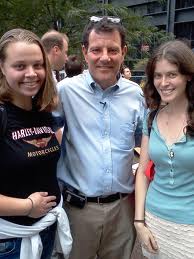
It’s one of the most popular NY Times articles on Facebook this morning.  Yes, a bonafide Times columnist, Nick Kristof, finally went down to Liberty Plaza to interview the Occupy Wall Street protesters.

But what does he come back with?  A strong personal defense of capitalism as a philosophy (“I don’t share the antimarket sentiments of many of the protesters”), and a condescending pat on the head for the demonstrators, who, he says, don’t really know why they’re there (“Where the movement falters is in its demands: It doesn’t really have any”).

Let me help, Kristof suggests.  His advice, listed in neat bullet points in his column today, is nothing you haven’t heard before from various left-of-center sources.  Tax financial transactions, close tax loopholes, regulate banks more carefully.  Nothing wrong with these ideas for reform–though they’re not exactly galvanizing.

But what’s infuriating is the way the establishment, from reporters to editors to cops & the Mayor, is treating the protests as child’s play: a source of amused wink-winks, not to be taken too seriously.  Give them some finger-wags, accompanied if necessary by some wrist-slaps (or pepper-spray, or tricky mass-arrest scenarios), and they’ll go home.  Let’s all just play nice.

Well, was it playing nice to “allow” hundreds of protesters to gain access to the Brooklyn Bridge roadway, and then round them up like cattle and haul them off to jail?

Is it nice to continuously infantilize the movement by pretending that the people in Liberty Square don’t know why they’re there or what they stand for?

Why are they there? The 99% says it all. To protest the ever-widening income disparity in this country, and the lack of political or ideological support for change.

A protest song from the 1960s has been running around in my brain this week.  It’s called “It isn’t nice,” and it goes like this:

It isn’t nice to block the doorways/It isn’t nice to go to jail/There are nicer ways to do it/But the nice ways always fail/It isn’t nice, it isn’t nice/Well thank you buddy for your advice/But if that’s freedom’s price/We don’t mind, no no no, we don’t mind!

Give it a listen, and pass it along.

SlutWalk, Occupy Wall Street and other sparks of resistance: let’s fan the flames!

Finally this morning The NYTimes.com is paying some attention to the Occupy Wall Street protests.  But the tone is still highbrow and dismissive–Charles Blow, who really should know better, labels the protesters “hippies and hipsters” and the movement overall as “a spark set down on wet grass,” with “no where to go.”

He also finds space to inform us that “a New York Times/CBS News poll released two weeks ago found that a third of those who make $30,000 a year or less don’t believe that the government should raise taxes on the wealthy to lower the budget deficit.”

Could that be because those who are living on the edge are so beaten down by a variety of forces, including lousy education and the constant scorn this country shows the poor, that they could care less about “lowering the budget deficit”?

I bet that the pollsters would get quite a different response if the question were worded more directly, as in: Should the government raise taxes on the wealthy to help the poor get a better education, promote job growth and tighten the social safety net?  Hell yes! they’d say.

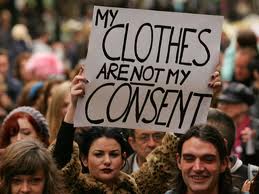
Meanwhile, up in Union Square, another protest is brewing today: SlutWalk, a new, international protest movement against “rape culture.”  In a rape culture like ours, the SlutWalkNYC site informs us, “sexual violence is made to be both invisible and inevitable; and these two practices are what normalizes rape, harassment and assault….The forces that normalize rape culture are not examined; rape is not seen as a culture or “practice” and if it is ever discussed, sexual violence is seen as an isolated act that occurs between individuals.”

SlutWalk began in Toronto last year, in response to an incident where a police officer told a rape victim that she had been “asking for it” because of the way she was dressed.  That the movement has caught on so quickly, especially among young women, is testament to the validity of its argument that no woman, no matter how she is dressed, is ever “asking” to be raped.

Both Occupy Wall Street and SlutWalk are driven by young people who are frustrated with the status quo and know that a better world is possible.  Their elders should know better than to dismiss these young folks as idealistic dreamers.  Hasn’t all change in human society, both positive and negative, been driven by those who dare to dream differently?

Lately I’ve been reading Derrick Jensen‘s latest book, a huge tome called simply, Dreams.  In it he argues that one of Western civilization’s crucial fallacies is our collective tendency to ignore and dismiss our dreams, as well as the possibility that through our dreams we may connect with “supernatural” forces that we don’t understand and cannot control.

Derrick sides with indigenous cultures who believe that the natural world is alive (“animism”) and can communicate with us.  His big question in Dreams is a weighty one: why hasn’t the natural world fought back harder in the face of the sustained murderous onslaught of humanity?

I would not presume to speak for the natural world.  But this question can be applied to a lot of other contexts today.

Why has it taken so long for Americans to get out and protest the takeover of our country by the corporate elite?  Why has it taken two weeks for the New York Times to deign to notice this gadfly protest on the flanks of the giant Wall Street bull?  The New York unions are finally stirring and considering joining the protesters–why has it taken so long for the American working class to awaken?

I think it might have something to do with the way we in the U.S. are caught up in a media-induced waking dream/nightmare, with a storyline that repeats over and over the following all-pervasive mantra: c’est la vie, there’s nothing to be done about it.  No fundamental change is possible.  The contamination of our environment is inevitable, and necessary if we want to maintain our comfortable fossil-fuel-driven lifestyle. The ever-growing gap between rich and poor is inevitable, as natural and normal as rape culture–boys will be boys, and you can’t expect rich boys to care about the poor.

Etc.

Someday analysts may look back on this period as one of remarkably successful mass indoctrination.  That is, if there are any shreds and shards left of our culture to examine after climate change is done with us.

To answer Derrick’s question, climate change is Nature fighting back.  Has anyone noticed that it’s been raining practically non-stop in New England for weeks now?  Here we are almost in leaf season, and our once-glorious maple trees are barely able to muster some mustardy brown color.  If this rain were snow, we’d be buried.  It may be an interesting winter season, to say the least.

However, resistance movements, both human and natural, are stirring all over the planet.  Like Occupy Wall Street, they may seem small, fragmented and disorganized to people who are accustomed to watching the huge, well-funded, tightly organized spectacles of mainstream political parties, or even mainstream-funded resistance movements like the Tea Party.

But it’s possible that dispersed, small-scale resistance may just what is called for under the present circumstances, when anything more obvious would simply be crushed by the iron fist of the corporate capitalist ruling class.

Resistance is happening when people take the time to relearn ancient human practices like small-scale biodynamic agriculture, bee-keeping, and storing food for the winter.  Resistance is happening when people refuse to let the dominant narratives ride rough-shod over their dreams of positive change.

Resistance is happening!  Let’s prove Charles Blow and the other naysayers wrong. It may be a rainy season, but let’s be the dry tinder for the spark of protest to fall on. It just takes one spark to start a wildfire, after all.

American-style debt bondage–how much longer can we go on this way?

A propos of this question of what the Occupy Wall Street protest is all about, I would like to raise the issue of debt bondage.

Usually when someone says “debt bondage,” we flash to images of Indian rice farmers or child brick carriers or trafficked women from Southeast Asia.

There is horrendous debt slavery in South and Southeast Asia, and the conditions under which men, women and children labor there are far worse than anything we face here in the U.S.

But at the same time, I don’t think it’s far-fetched to call the average American middle-class lifestyle a form of debt bondage.

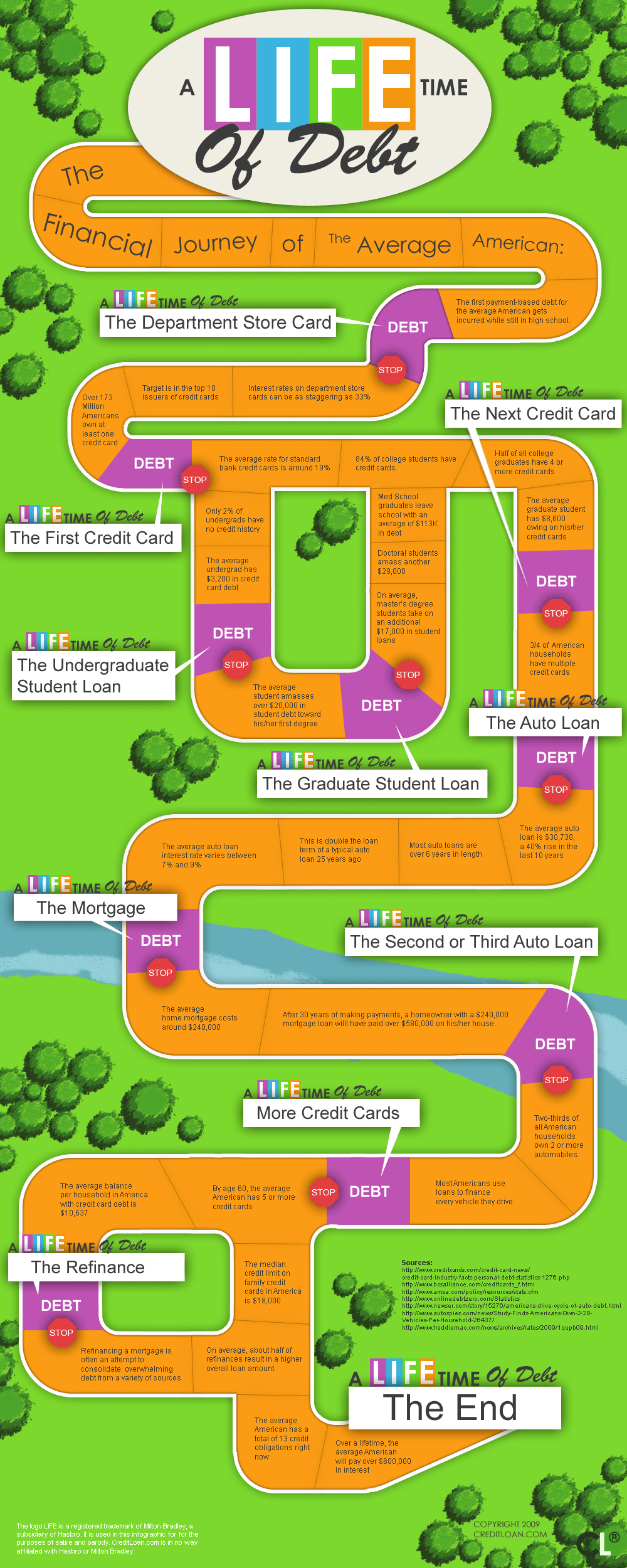
This graphic does a good job at giving us the picture:

In case you can’t read the fine print, the end of the “game” shows that Americans will pay about $600,000 in interest alone during their lifetimes.  [Source: Visual Economics.]

Working to pay off debt has become so commonplace that we scarcely even notice it anymore.  But it’s a relatively new phenomenon.  And all that interest, plus all those fees, are among the prime ways that the Wall Street bankers have gotten so phenomenally rich in the past 50 years or so.

What can be done about this?  For starters, a quality education should not so expensive that a middle-class student has to go into debt to attain it.

And we have to think much more deeply as a society about the job question.  We should not make it so easy for corporations to outsource jobs to cheaper labor markets.  Just as we are beginning to think about localizing agriculture and energy, we need to think about localizing jobs.

That’s the way human beings have made their livings for the past millennia, after all.  Only in the last 30 years or so has the world become so small (thanks to cheap fossil fuels) that it was conceivable to export manufacturing and other basic services to the other side of the globe.

Is outsourcing really more cost-effective, when you add in the costs of social welfare for all these displaced workers?  And the costs of millions of foreclosed homes?  And the costs of warehousing millions of poorly educated young people in jail? Not to mention the costs of global climate change?

Well, it depends on who is footing the bill, doesn’t it.  The Occupy Wall Street protesters are speaking for all American taxpayers in declaring that we should not have to pay for the greedy, short-sighted mistakes of the global corporate elite.

If they had to pay the true costs of the agendas they’ve pursued since World War II, well–it would be quite a different world we were living in, friends.  Maybe we would still be able to make a living that didn’t involve constantly adding more links to the chains of our debt bondage.

Unthinkable, you say?

Think again!

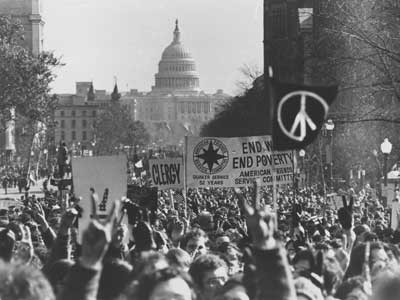
Occupy Wall Street, Day 10: Never doubt that a small group of thoughtful, committed citizens can change the world

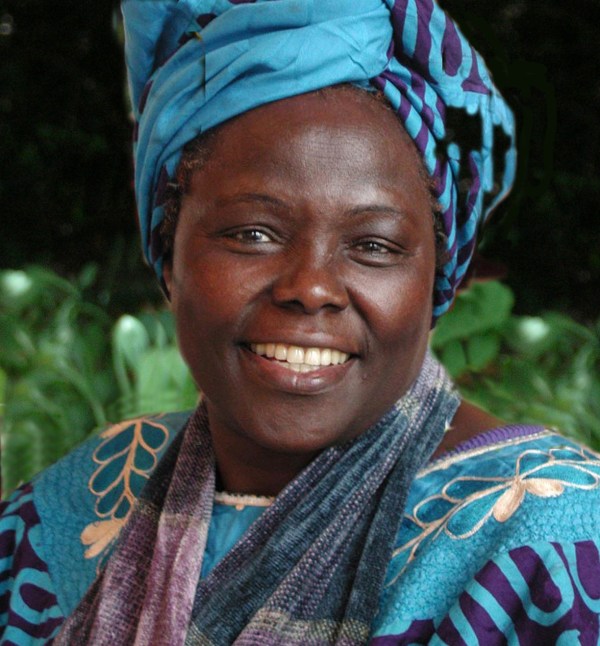
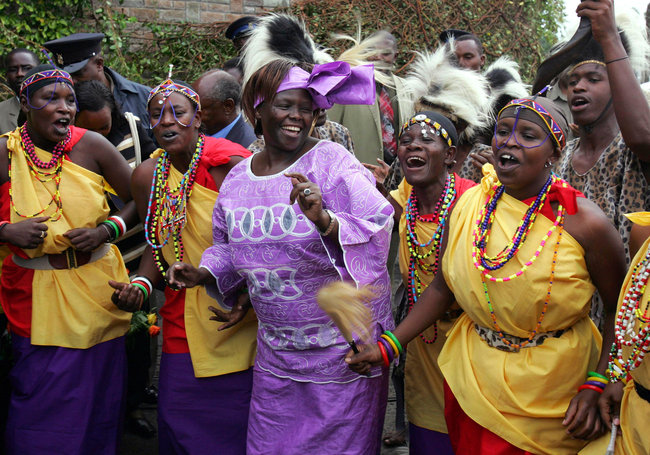
One of Wangari Maathai’s most powerful political actions was when she and a group of women occupied Uhuru (Freedom) Park in downtown Nairobi, to protest government plans to turn the tree-lined public park into a giant private office complex.

At first it was just twenty women with hand-painted signs, sitting down together in the center of the park in protest.  But as word spread, the protest grew, until soon hundreds of people, men and women, were sitting down in the park with Wangari, demanding the right to hold on to one of the last remaining green spaces in their city.

And you know what?  They won!

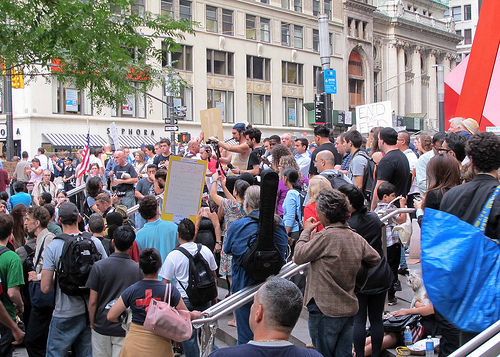
I’m thinking of that story tonight as I watch the coverage of the Occupy Wall Street protests in Liberty Plaza Park, NYC.  Protesters have been sitting down there for the past ten days, and despite nasty police pressure and arrests, they are not moving–and the crowd is growing.

Their demands are simple: they want the Masters of the Universe who run Wall Street, and through Wall Street, the world, to pay attention to the ordinary folks at the bottom of the heap.

There are all kinds of people down in Liberty Park–students, housewives, journalists, activists, the unemployed.  What they have in common is a deep and abiding belief that the corporate capitalist system symbolized by Wall Street is not serving Americans well–other than the narrow top layer of financiers and their creatures, the politicians and corporate business types.

I am disappointed to see that my hometown newspaper, The New York Times, has treated the protest like a minor disturbance, not worthy of front-page attention.  Of course, the Times can’t risk angering its corporate advertisers and sponsors…so they have to tread carefully.

But it’s surprising to see that even more progressive publications like The Nation, the Huffington Post and Moveon.org are also largely ignoring the significance of this protest.

Maybe it’s because there’s no one famous in charge–although some celebs have started dropping by and addressing the crowd now, including Michael Moore, Cornel West and Susan Sarandon.

The truth is that this is a REAL grassroots protest movement.  There is no charismatic leader calling the shots and getting the glory. There is no fancy media kit or PR person fielding questions.

There’s just “a small group of thoughtful, committed citizens,” seeking by their persistent accusatory presence to change the world.  As Margaret Mead said, we shouldn’t doubt their ability to do just that.

More than that–we should get out there and join them!

Wangari Maathai’s Canopy of Hope: remembering a warrior woman for the planet and role model for us all

Kenyan Wangari Maathai, who died last night of ovarian cancer, was a woman who took everything she learned and used it for the benefit of her local community and the planetary community as a whole.

As a girl, she used to sit by a certain fig tree that grew near her family village.  Beside the fig tree a clear, sparkling stream flowed, planted with arrowroots and hopping with small frogs.  Her mother told her that this was a “tree of God,” which wasn’t to be harvested for firewood.

Later, Wangari realized that “there was a connection between the fig tree’s root system and the underground water reservoirs.  The roots burrowed deep into the ground, breaking through the rocks beneath the surface soil and diving into the underground water table.  The water traveled up along the roots until it hit a depression or weak place in the ground and fushed out as a spring.  Indeed, wherever these trees stood, there were likely to be streams.  The reverence the community had for the fig tree helped preserve the stream and the tadpoles that so captivated me.  The trees also held the soil together, reducing erosion and landslides.  In such ways, without conscious or deliberate effort, these cultural and spiritual practices contributed to the conservation of biodiversity” (Unbowed, 46).

Wangari came of age as the traditional wisdom of the village people was giving way before the onslaught of Western epistemologies.  A girl who excelled in her schooling, she educated by Catholic nuns, and was fortunate enough to be chosen for the so-called Kennedy airlift of 1960, under which the Joseph P. Kennedy Foundation provided scholarships for promising young African students to study in America—the same program that brought Barack Obama’s father to the U.S. to study.

Wangari ended up at Mount St. Scholastica, a Benedictine women’s college in Kansas, where she majored in science, and she went on to earn a Master’s in biology at the University of Pittsburgh. She continued her studies in Germany, and in 1971 earned a Ph.D. in biology from the University College of Nairobi—the first women in East and Central Africa to earn a doctoral degree.

Like so many other highly educated women who join the workforce, Wangari experienced plenty of gender discrimination as she tried to advance her career. Frustrated with her lack of advancement within the university, she joined the National Council of Women of Kenya, which was a group of educated women who sought to improve the living conditions of all Kenyan women.

“We could either sit in an ivory tower wondering how so many people could be so poor and not be working to change their situation, or we could try to help them escape the vicious cycle they found themselves in,” she said.  “This was not a remote problem for us.  The rural areas were where our mothers and sisters still lived.  We owed it to them to do all we could” (124).

For Wangari, the problems were clear:

“The connection between the symptoms of environmental degradation and their causes—deforestation, devegetation, unsustainable agriculture and soil loss—were self-evident.  Something had to be done.  We could not just deal with the manifestations of the problems.  We had to get to the root causes of those problems.

“Now, it is one thing to understand the issues.  It is quite another to do something about them.  But I have always been interested in finding solutions.  This is, I believe, the result of my education as well as my time in America: to think of what can be done rather than worrying about what cannot.  I didn’t sit down and ask myself, ‘Now let me see, what shall I do?’ It just came to me: Why not plant trees?’ The trees would provide a supply of wood that would enable women to cook nutritious foods.  They would also have wood for fencing and fodder for cattle and goals.  The trees would offer shade for humans and animals, protect watersheds and bind the soil, and, if they were fruit trees, provide food.  They would also heal the land by bringing back birds and small animals and regenerate the vitality of the earth.

“That is how the Green Belt Movement began” (125).

 The Green Belt Movement mobilized thousands of ordinary women in Kenya to start tree nurseries, and to plant trees near their homes.  It also became a forest conservation movement, with Wangari leading women in protecting Kenya’s remaining forests against the loggers hired by giant transnational conglomerates.  She made plenty of enemies in the government when her agenda threw a wrench in their greedy plans, and she was often afraid for her life.  She was thrown in jail many times, and frequently confronted violence at the hands of police and goon squads.


 Through it all, she remained, as the title of her memoir suggests, UNBOWED. She would not be browbeaten into submission to authority.  She knew that her cause was not only righteous but right for Kenyans and for the planet she loved, and this gave her the courage to stand firm against intimidation.

Wangari’s activism cost her her marriage: her husband, a Kenyan Member of Parliament, divorced her after she earned her Ph.D. and became more financially successful.  She could have chosen the easy way and lived a very privileged, comfortable existence in Nairobi, if she had been willing to bow her head and put her husband’s needs and career before her own.  Instead, she went through a humiliating public divorce trial:

“It became clear that I was being turned into a sacrificial lamb.  Anybody who had a grudge against modern, educated and independent women was being given an opportunity to spit on me.  I decided to hold my head up high, put my shoulders back, and suffer with dignity: I would give every woman and girl reasons to be proud and never regret being educated, successful and talented.  ‘What I have,’ I told myself, ‘is something to celebrate and not to ridicule or dishonor’” (146).

The divorce trial ended, incredibly enough, with Wangari being sentenced to six months in prison for “contempt of court”; she was hauled off to prison without even having the time to say goodbye to her children. It was clearly an attempt to put this uppity woman in her place, but it did not work: Wangari would not be intimidated, and emerged from prison determined to put her talents to work for her people, come what might for herself personally.

Her Green Belt Movement became a model for sustainable, grassroots-driven development throughout Africa and beyond, which worked not only for environmental sustainability, but also for women’s rights, human rights and participatory democracy.  Wangari consistently provided an upright model of honest, steadfast leadership, leading by example in speaking truth to power and and refusing to be cowed.

“What I have learned over the years,” she said, “is that we must be patient, persistent and committed.  When we are planting trees sometimes people will say to me, “I don’t want to plant this tree, because it will not grow fast enough.” I have to keep reminding them that the trees they are cutting today were not planted by them, but by those who came before.  So they must plant the trees that will benefit communities in the future.  I remind them that like a seedling, with sun, good soil, and abundant rain, the roots of our future will bury themselves in the ground and a canopy of hope will reach into the sky” (289).

Wangari Maathai herself grew that “canopy of hope” for all of us.  May the seedlings she planted be nourished with care by those of us who aspire to walk in her footsteps, for all those who deserve a better world in the future here on our precious planetary home.