Talking Union with my Dad: A Father’s Day Tribute

I got my love of narrative and my awareness of social justice very early in life, from my father’s vast repertory of American folk songs.

My dad, Joe Browdy, learned guitar as a teenager in the 1950s, taking his inspiration from the great folk singers of the time, like Woody Guthrie, Pete Seeger, Odetta, Cisco Houston, The Weavers and the New Lost City Ramblers.  He developed his repertoire while working as the music counselor at the camp where he and my mother met, and he continued to sing and play guitar for audiences while he earned his B.A. in history at Oberlin, and his law degree at NYU.

Joe Browdy and Alan Chartock

Joe Browdy and Alan Chartock

Some of my earliest memories are sitting with a group of relaxed, happy people by a crackling bonfire listening to my dad belting out his signature songs, with everyone joining in on the chorus.  Although there were some special children’s songs in his repertoire, he didn’t censor his songbook for me and my brother: we learned about the tragedies and the murders, the drunkenness and the fighting, wars, poverty and injustice, making sense of it as best we could over years of repetition.

Although he got busy with his law practice around the time that I was born, my dad  never stopped singing.  On Friday nights we’d get into the car around 8 p.m. for the two and a half hour ride to our country house in Hillsdale, N.Y., and to keep himself awake my dad would start singing, my mom adding her sweet tones in harmony on the chorus, my brother and I joining in sleepily when we knew the words.  On Saturday nights all through my childhood, our entertainment was to build a fire after dinner—outside in the summer, in the living room in the winter—and sit around it for a few hours, my dad leading us in the familiar songs that took us traveling far and wide in time, space, and experience.

The folk song tradition is a living oral history, passed from one generation to the next.  As soon as we could, my brother and I learned how to play guitar, and the words and tunes of those old songs now live on in us, and in our children who are learning them too.  With folk music, it’s not about the perfection of the sound, or the accuracy of the lyrics: it’s about the interest of the stories being told through music, and the emotion with which they’re conveyed.

My father has the ability to make the songs he loves come alive through the heartfelt nature of his singing and playing—getting slow and quiet for the tragic love songs, letting it rip and roar on the fighting union songs, modulating into a plaintive tone for his signature delivery of “One Meatball,” about a poor man who is sneered at by the waiter because all he can afford to buy is a single meatball for his dinner.  When my dad plays guitar, he’s not just singing some songs, he’s taking us on a journey through the American spirit.

Live at the Linda Norris Auditorium, Albany NY

Live at the Linda Norris Auditorium, Albany NY

Dad’s repertoire includes cowboy songs, songs about the laying of the train tracks across the West, and songs about the building of dams across mighty American rivers. There are feisty union songs from the 1920s and 30s; songs inveighing against the greed of bankers and bosses, and lamenting the hardships faced by miners, factory workers and farm hands. There are stirring political songs, about the founding of the United Nations, or the dream of world peace.

There are work songs from the African American South, about picking cotton or working on a train line, and older songs from the slave times, about dreaming of freedom, and making a break for it.  There are songs—some sad, some funny—about traveling around the country during the Dust Bowl refugee time.

There are many love songs, most of them mournful, bluesy songs about loves lost to drowning, train accidents, or just never heard from again.  But there are also some sweet romantic ballads about lifelong happiness spent by the side of one’s beloved.  The songs never fail to come alive when my dad adds his voice and driving guitar to the mix.

These days, my dad sings for the public most often with the Berkshire Ramblers, led by his old friends Alan and Roselle Chartock, and joined by a varying cast of other folk musicians.  But I still like it best when we sing together around a fire, not for an audience but just for our own amusement and delight.  This Father’s Day, I want to thank my dad for sharing this powerful, inspiring musical legacy with me, and so many others.  May the circle be unbroken!

DSCN2248 copy


When the union’s inspiration through the workers’ blood shall run

There can be no power greater anywhere beneath the sun

Yet what force on earth is weaker than the feeble strength of one

For the union makes us strong.


Solidarity forever, solidarity forever, solidarity forever

For the union makes us strong.

Mother’s Day Salute to my Mom

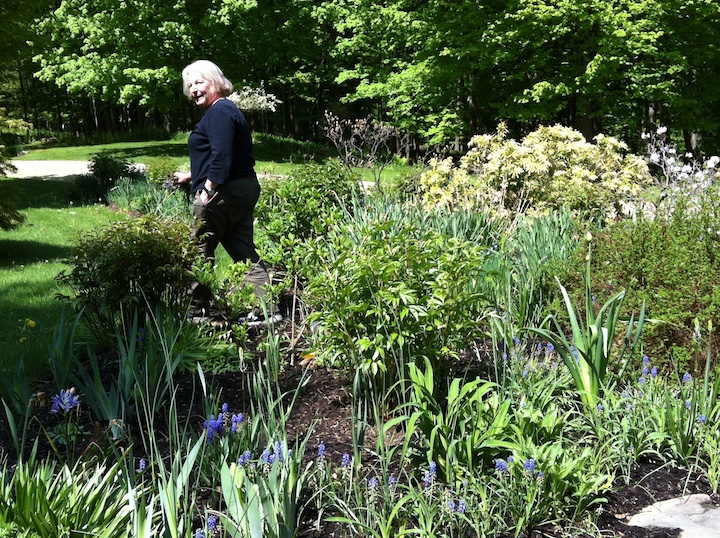
Throughout my childhood, my mother always spent a lot of time and energy tending and shaping the land around the house, following her own instincts of landscaping and working almost entirely with hand tools.

The little house; I am standing where the big thicket was

The little house; I am standing where the big thicket was

She started just outside the sliding glass doors in the living room, where she planted a small lawn, beyond which was an expansive swamp dogwood thicket, laced with black raspberries and bordered by a young maple forest on one side, and a few barely visible pine trees on the other.  Armed only with loppers, my mother began cutting down the thicket stalk by stalk, a project that took a couple of years of slow, patient labor.

Once the thicket was gone, and grass had been seeded in its place, my mom turned her attention to the huge limestone ledge that ran down alongside the house, part of it visible as mossy, grassy outcroppings, but most of it underground.  She set to work with her shovel, hand rake and trowel, her intention to create a rock garden out of that long, sloping rock ledge.  That project provided a focus for the long summers she spent with me and my brother in the country while my father went back to the city to work during the weeks.

The rock garden runs up the whole length of the lawn beside the house.  It's hard to see the rocks here, as they've been covered with plants, which my mom regularly scrapes off to reveal the contours of the rock again.   This big rock garden took years to accomplish.

The rock garden runs up the whole length of the lawn beside the house. It’s hard to see the rocks here, as they’ve been covered with plants, which my mom regularly scrapes off to reveal the contours of the rock again. This big rock garden took years to accomplish.

I can see her standing, sweaty and red-faced at the end of a hot morning’s work, with a fine layer of black earth coating her bare shoulders, drinking iced tea out of a tall green glass and surveying the ledge with a squinted sculptor’s eye.  She would be quietly exultant as her shovel and trowel gradually revealed new curves or deep, smooth walls of rock, a small, determined woman with a strong back and great patience, tracing out the rock with hand tools and as much love as if she were carving out the sweet, benevolent face and voluptuous body of the Earth Mother herself.

IMG_2168 copy

She also dug out a vegetable garden, in which she planted her morning coffee grounds and eggshells, which yielded crunchy sugar snap peas and big shiny zucchinis and a tangle of tomato plants loaded down with plum, cherry and huge oxheart tomatoes.  In time, every contour of the ten acres or so around the houses on the property had felt the gentle touch of her hands, and yielded to the influence of her spades and trowels.  Every young maple or oak grew there because she had judiciously allowed it to advance past sapling-hood.

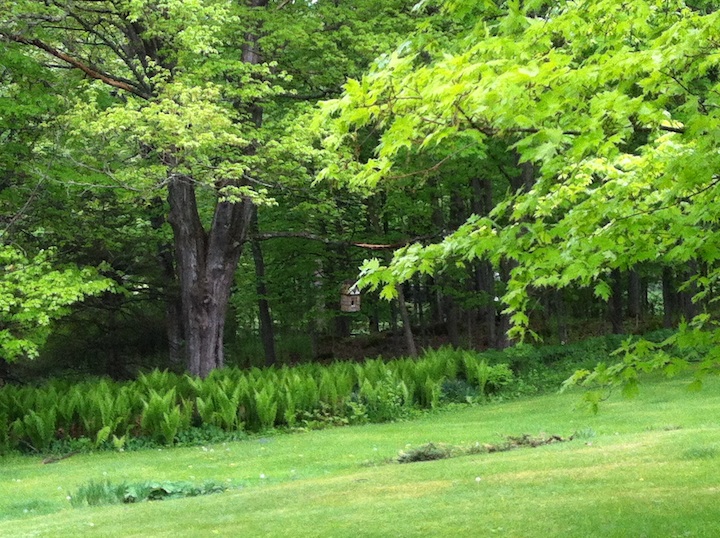
This was my favorite climbing tree in childhood; a sugar maple named Cricket

This was my favorite climbing tree in childhood; a sugar maple named Cricket

What had once been a rocky, harum-scarum cow pasture became, over the course of many years, an orderly oasis of verdant green lawns, perennial flower beds and raised vegetable gardens, with the long ridge of the rock garden sloping down through the middle of it all to the elegantly landscaped pool.  Now, more than forty years later, she’s still out there with her shovel, trowel and hand tools, tending and stroking her gardens into ever more radiant beauty.

The view from the "new" house (c. 1989), down towards the pool

The view from the “new” house (c. 1989), down towards the pool

This Mother’s Day, I salute my mother, whose outstanding gardening talents I have admired and learned from all my life.  I can only hope that in some small way her greenest of thumbs has rubbed off on me.

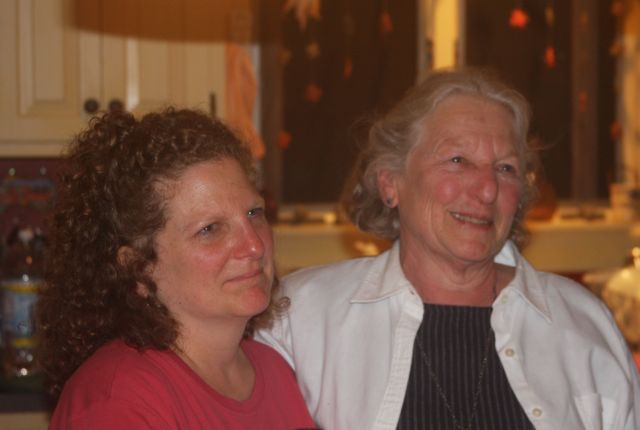
Jenny and Sue 1

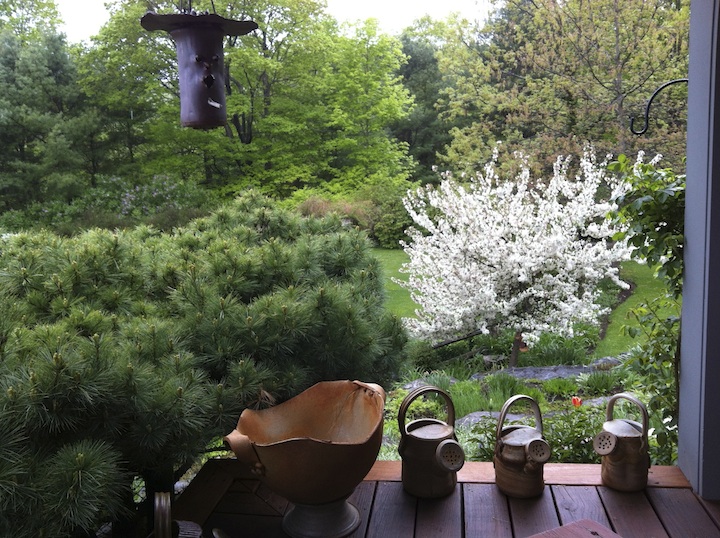
Did I mention that my mom is an outstanding potter?

Did I mention that my mom is an outstanding potter?

She is as talented at architectural design as she is at landscape design

She is as talented at architectural design as she is at landscape design


IMG_2148 copy


IMG_2144 copy

Innumerable shrubs, trees and fruit trees have been planted over the years, most often by my mom and her trusty spade.


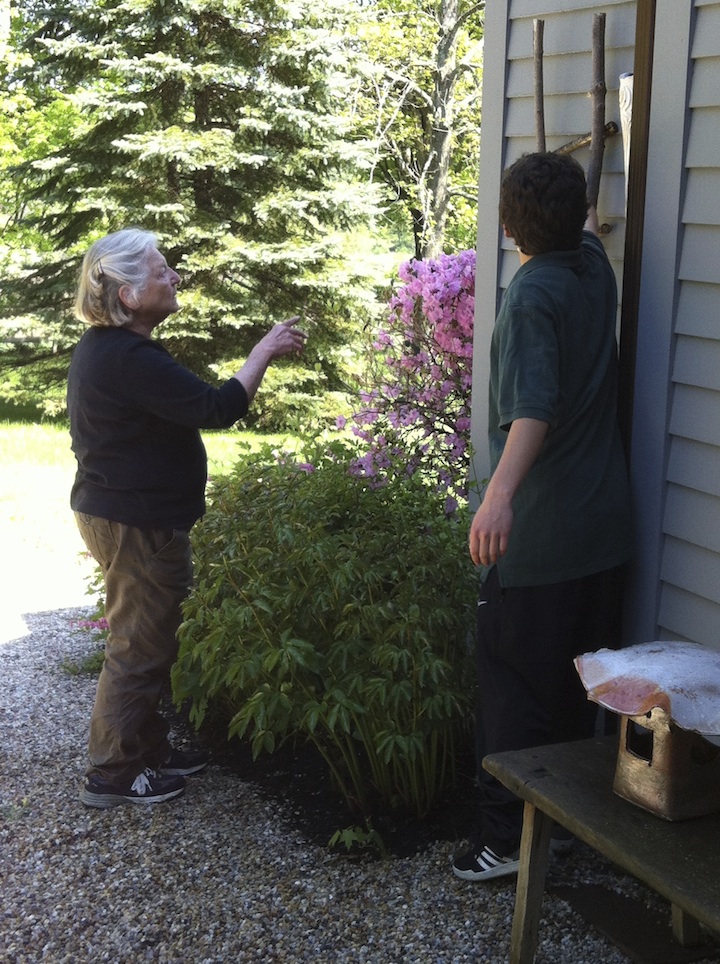
Making plans for the next project with grandson Eric.  The work of a gardener is never done....

Making plans for the next project with grandson Eric. The work of a gardener is never done….


This is one of the most recent gardens, just outside the pottery studio, next to the oldest tree on the property, a venerable sugar maple

This is one of the most recent gardens, just outside the pottery studio, next to the oldest tree on the property, a venerable sugar maple


Sparks fly around the table–of the seminar room or the lunchroom

There’s something seriously wrong when the dominant methods of education do not foster the skills most valued by potential employers.

In a recent spate of op-ed pieces in The New York Times, pundits have explored this disconnect, which seems to be grower wider as we advance into the 21st century.

David Brooks, making a distinction between what he calls “technical knowledge” and “practical knowledge,” says that online education is good for transmitting and measuring students’ mastery of technical knowledge, but does little for helping students gain the practical knowledge they’ll need to be successful in the workplace.

“Practical knowledge is not about what you do, but how you do it,” Brooks says. “It is the wisdom a great chef possesses that cannot be found in recipe books. Practical knowledge is not the sort of knowledge that can be taught and memorized; it can only be imparted and absorbed. It is not reducible to rules; it only exists in practice.”

Brooks points to the college seminar as one of the important incubators of important workplace skills, and as someone who teaches exclusively in seminar style, I agree with him.  The college seminar is where students learn how to listen to each other, build on each other’s ideas, articulate their own ideas clearly and concisely, and take away crucial insights that they’ll use to construct their more fully elaborated written papers (which in the workplace might be called briefs or reports).

But Brooks and I part company when he suggests that seminars should be used as laboratories for the dissection of intellectual exchange.  He thinks that a smart use of online education technology would be “to take a free-form seminar and turn it into a deliberate seminar….Seminars could be recorded with video-cameras, and exchanges could be reviewed and analyzed to pick apart how a disagreement was handled and how a debate was conducted. Episodes in one seminar could be replayed for another. Students could be assessed, and their seminar skills could be tracked over time.”

Deep groan.  This sounds like a perfect recipe for a disastrous seminar in which students—and faculty–would be made to feel increasingly self-conscious, where the delight of the “free-form” exchange of ideas would degenerate into a stilted, scripted, uber-careful caricature of what a seminar should be.

Occasionally taping a seminar and analyzing it might be fruitful, especially in one of those inevitable groups where the dynamics are terrible and everyone, by mid-semester, wants to just crawl under the table and hide. But making the focus of the semester the “how” rather than the “what” seems like a terrible idea.

It’s also in sharp contrast to the most cutting-edge ideas of how to spur human innovation and creativity, which lord knows we desperately need as the 21st century advances.

In his own recent column on education, NY Times columnist Tom Friedman interviewed Harvard education specialist Tony Wagner, also looking for ways that educational practices could better connect to workplace imperatives. According to Wager, who just wrote a book called Creating Innovators: The Making of Young People Who Will Change the World, “because knowledge is available on every Internet-connected device, what you know matters far less than what you can do with what you know. The capacity to innovate — the ability to solve problems creatively or bring new possibilities to life — and skills like critical thinking, communication and collaboration are far more important than academic knowledge. As one executive told me, ‘We can teach new hires the content, and we will have to because it continues to change, but we can’t teach them how to think — to ask the right questions — and to take initiative.’ ”

Critical thinking, asking the right questions, and taking initiative are indeed what should be taught at every level of education, from kindergarten to college and beyond.  Interestingly, Wagner also points to another important goal of education, which is to motivate students to want to learn.

“Young people who are intrinsically motivated — curious, persistent, and willing to take risks — will learn new knowledge and skills continuously,” Wagner says. “They will be able to find new opportunities or create their own — a disposition that will be increasingly important as many traditional careers disappear.”

Unfortunately, in our current education environment, where passing standardized tests becomes a goal in itself, keeping kids engaged is a serious challenge.

I saw this myself when I taught at a large state university, where the students were much more interested in finding the best watering holes for their weekend parties than in any of their classes.

As Friedman reports: “We teach and test things most students have no interest in and will never need, and facts that they can Google and will forget as soon as the test is over,” said Wagner. “Because of this, the longer kids are in school, the less motivated they become. Gallup’s recent survey showed student engagement going from 80 percent in fifth grade to 40 percent in high school.”

Wagner’s solution is to re-imagine the classroom, and the educational system, so that teachers are focused on “teaching the skill and will to learn and to make a difference and bring the three most powerful ingredients of intrinsic motivation into the classroom: play, passion and purpose.”

That is a tall order, really, and it has to do not just with the classroom, but also with the dining room table—with what happens at home, in students’ family environment.  How to inspire passion and persistence in students who are being reared on smash-em up video games?  How to foster critical thinking and collaboration in students who come from plugged-in families who rarely spend much quality time together?

Somewhat paradoxically, it appears that it’s precisely in web-based interactive technology companies like Google, Facebook, Yahoo and others that the qualities of human innovation and creativity are most dogged sought.

And how are they trying to foster these skills among their workers?

Google350x233By going back to good old-fashioned lunchroom tables, at which, it appears, the unstructured back and forth of ideas is what prompts the greatest leaps in creative thinking.  Just like that other good old-fashioned table, the one in the college seminar room!

In a New York Times article provocatively entitled “Engineering Serendipity,” Greg Lindsay points to a recent study in which “researchers at Arizona State University used sensors and surveys to study creativity within teams.” The study found that “employees who ate at cafeteria tables designed for 12 were more productive than those at tables for four, thanks to more chance conversations and larger social networks. That, along with things like companywide lunch hours and the cafes Google is so fond of, can boost individual productivity by as much as 25 percent.”

If our best, most innovative companies most value creative, collaborative thinking, which is best fostered in face to face interactions, why in the world is K-12 education focused on teaching technical knowledge measured by standardized tests, while higher education is flocking to online learning, which isolate students in front of their computer screens?

Give me the old-fashioned seminar table any day, with a smart, dedicated teacher and a roomful of students who are absolutely forbidden to use their computers or phones or tablets for the duration of the class session! Give us some provocative material to discuss, and just watch the creative sparks fly!

Why are we punishing America’s schoolchildren and their teachers?

Jonathan Kozol in action

Every stakeholder in the current Chicago teachers’ strike who has not visited an inner city Chicago public school should take the time to read Jonathan Kozol’s powerful book Savage Inequalities, which chronicles the author’s explorations of conditions in schools in poor and rich neighborhoods in a series of American cities.

“One would not have thought that children in America would ever have to choose between a teacher or a playground or sufficient toilet paper,” wrote Kozol back in 1991.  “Like grain in a time of famine, the immense resources which the nation does in fact possess go not to the child in the greatest need but to the child of the highest bidder—the child of parents who, more frequently than not, have also enjoyed the same abundance when they were schoolchildren.

“’A caste society,’ wrote U.S. Commissioner of Education Francis Keppel 25 years ago, ‘violates the style of American democracy….The nation in effect does not have a truly public school system in a large part of its communities; it has permitted what is in effect a private school system to develop under public auspices….Equality of educational opportunity throughout the nation continues today for many to be more a myth than a reality.’  This statement is as true today as it was at the time when it was written.”

And it remains true twenty years later.

The bedrock issue here is one of inequality, which is measured along multigenerational racial and class lines.  As long as we continue to link public school funding to local property taxes we are going to be perpetuating an entrenched system of race and class segregation, from which there is little chance for escape.

Kozol observed that kids in suburban schools, no matter what state, already have what the CPS teachers are begging for in the urban schools, and then some.

Is it right that kids from wealthy neighborhoods go to college while kids from poor neighborhoods go to jail?

Kids in poor districts need more help from the state, not less, than kids in wealthy districts.

Chicago is not the only place in America where our schools are failing our neediest children, it is just the only place in America right now where the teachers have been pushed so far that they are taking to the streets in protest.

The Chicago teachers’ strike is being presented in the media as a case of selfish, whining teachers walking out on their students because they are greedy for more money, or afraid of being held to high standards.

But when you listen to the teachers, parents and students who have managed to penetrate the media gatekeepers and make their voices heard, what you hear is not greed or shortsightedness, but deep concern for the health of the school system and the welfare of the children.

The teachers are asking for smaller class sizes (would you want your child in a kindergarten class of 45?); improvements in the crumbling physical plants of their schools, including libraries and playgrounds; and support staff for troubled students, including nurses and social workers.  They don’t want their evaluations tied so tightly to how their students perform on standardized tests, and they want to be given seniority preference if they are laid off because of a school closing.

I don’t hear anything unreasonable in these demands.

Has anyone on the editorial boards of the newspapers who have condemned the Chicago teachers’ strike, which include the Chicago Tribune, the New York Times and the Washington Post, ever set foot in a Chicago public school?

I know for a fact that Mayor Emmanuel’s children attend private school, as did the Obama girls when they lived in Chicago.

President Obama and business leaders like to exhort American children to study hard and close the achievement gap between our country and others like China and India.

They need to put their money where their mouth is, and give our dedicated teachers the support they need to do the job right.

Having it all: my own story

Jennifer Browdy de Hernandez

Today marks a milestone for me professionally: 18 years after earning my doctorate in Comparative Literature, after a demanding year-long evaluation process, I have finally been granted a ten-year contract, the closest thing to tenure at my institution.

Why did it take me so long, despite the fact that I had all the requisite publishing and service work and teaching excellence?

Two reasons.

One, I stepped off the tenure track right out of grad school to prioritize the needs of my two sons, the first born two years before I finished my Ph.D., the second six years later.   I chose to work part-time in those early parenting years, not realizing how hard it would be to get back on the fulltime track.

Two, once it became apparent to me that simply moving from part-time to fulltime at my home institution would be difficult, I accepted a lucrative lecturer position at a nearby state university, and did both—two-thirds time at the small liberal arts college, half time at the university—for nine years, while also raising my sons, publishing two edited collections, and directing various major conferences.

Last year the state funding dried up so I lost my second job; and at the same time I finally got a green light to go for that ten-year contract at my primary institution.

It’s still officially only two-thirds time, a fact that may surprise many who work with me, as I have actually taught fulltime every semester for the past three years, and often in the years before that, in addition to carrying a more than full load of committee and service work of all kinds.

If I were a man, would things be different?

Yes, I think so. I would probably have let my kids’ mother make the professional sacrifices, allowing me to go full throttle towards a tenure track position right out of grad school.  As a man, I would probably have been a better negotiator, able to make a persuasive case for why I should be earning a fulltime salary for the important work I put in for my institution.  I might have spent less time cooking dinners and reading bedtime stories, and more time writing that Important Book.

I don’t want this to be true.  I want parents of both genders to be equally likely to intensively parent, write great books or play the cut-throat negotiator.

But in my own case, I know that my gender did matter.  I was raised by a mother who put her parenting role first, and a father who focused primarily on professional success.  Put together, they made for a stellar parenting team.  But I certainly did absorb the gendered messages from them: a mother’s first obligation is to her children, while fathers are out bringing home the bacon.

The problem is that I have needed to be both mother and father to my children, in the sense of parenting AND bringing home the bacon, and there are only so many hours in the day, only so much of me to go around.

I feel fortunate to have chosen a field that gave me enough flex-time to approach something like “having it all”: doing a good job at home as well as at work.  I do not take it for granted, and firmly believe that this precious scenario should be the norm rather than the exception–for the health of our kids, their parents and our society as a whole.

Work-life balance is not just a women’s issue

Anne Marie Slaughter

I decided to bite my tongue and wait to see the reaction to the recent Atlantic Monthly cover story by Anne Marie Slaughter on women and the work-life balance—I knew as soon as I started reading it that it would set off a firestorm of commentary, and I have not been disappointed.

Slaughter, in case you have not been following this story, is a Princeton University professor and dean, who was drafted into the State Department by Hillary Clinton and worked there for two stressful years.  She wrote the article after returning to the snug harbor of Princeton, where, thanks to the flex time allowed by the higher ranks of academia, she is far better able to manage her professional and family commitments.

Slaughter’s main point in writing seems to be that our society needs to adapt itself better to the needs of working women. She calls for more women to get into leadership positions in business and government, and make workplace and policy changes that will make parenting and working outside the home more manageable.

Lori Gottleib, in a blog post on the Atlantic site, has little patience for Slaughter’s hand-wringing over the travails of long hours outside the home.

“The real problem here isn’t about women and their options,” she says. “The real problem is that technology has made it possible to work 24/7, so that the boundary between work and our personal lives has disappeared. Our cubicles are in our pockets, at the dinner table, next to our beds and even next to our children’s beds as we’re tucking them in. In many households, one income isn’t enough, and both men and women have to work long hours — longer hours than ever before — to make ends meet…. The problem here is that many people work too much — not just women, and not just parents.”

Hallelujah and amen to that, Lori!

For myself, I know the only way I can give myself some true down time is to get myself to a place where there is no wireless and no way to plug in my computer—ie, camping, hiking or at the beach—although even there I’ve caught myself using my iPhone to check messages or text people on the fly.  It’s been years—YEARS—since I’ve been unplugged for more than a day.

I can imagine a scenario where our society benevolently decides to use technology to allow more people to work from home, which will make things easier for parents in some ways, but will result in all of us becoming wired-in cogs in the capitalist machine, never really getting any time to ourselves unless we are able to set our own firm boundaries, something that most of us have trouble doing.

I agree with Professor Slaughter that family-friendly workplace policies are needed. I especially appreciated her anecdote about how when she was Dean at Princeton she always made a point of announcing at faculty meetings that she had to go home to have dinner with her family, to give other women permission to do the same without guilt or embarrassment.

But I share Lori Gottlieb’s sense that for most of us parents, the pressures of making a living are simply getting to be inhuman.

At the Strategies for a New Economy conference I attended a few weeks ago, several sessions dealt with the possibility of transitioning to a shorter work week.  This was the focus of a 2010 report by the New Economics Foundation, which argues for a 21-hour work week.  “There is nothing natural or inevitable about what’s considered ‘normal’” working hours today,” the authors write. “Time, like work, has become commodified – a recent legacy of industrial capitalism. Yet the logic of industrial time is out of step with today’s conditions, where instant communications and mobile technologies bring new risks and pressures, as well as opportunities. The challenge is to break the power of the old industrial clock without adding new pressures, and to free up time to live sustainable lives.”

The report’s authors suggest that “to meet the challenge, we must change the way we value paid and unpaid work. For example, if the average time devoted to unpaid housework and childcare in Britain in 2005 were valued in terms of the minimum wage, it would be worth the equivalent of 21 per cent of the UK’s gross domestic product.”

Imagine if we could invent a society where housework and childcare actually “counted” for something in real economic terms?

Imagine if parents were actually rewarded for spending quality time with their children, for doing all the time-intensive work it takes to raise healthy, productive, happy kids who will become healthy, productive, happy adults?

What if we spent less money on anti-depressants, stimulants and treadmills, and instead gave ourselves room to breathe, and time to relax?

No society can hope to survive without the good work being done by mothers and fathers, unpaid and unsung, day and after day and year after year.

This should not be just a women’s issue.  If more fathers got involved in the day-to-day nitty-gritty of parenting—unglamorous and tedious as it sometimes can be—there would be twice as much impetus to make the changes Slaughter is calling for.

How about it, Dads?

Commencement reflections, 2012

This weekend my first-born son will graduate at age 20 with a B.A. in Biology.  He will join thousands of other graduates across the country marching to the dais to accept his hard-earned degree from school officials dressed in the medieval cap and gowns we still wear for such occasions.

And then he will march out into the world to join the hordes of recently graduated young adults, confronting one of the worst job markets ever seen in American history.

When I graduated college back in 1982, there was also a bit of a recession on, but things quickly rallied, and I had no trouble finding a job in journalism, and working my way up from reporter to staff writer to editor at publications in New York City.

When I chose to go to graduate school, it wasn’t hard to find a part-time job as an assistant editor to make room in my schedule for my studies.

And so it went, one step leading to the next with a steady predictability.

For my son, now, that kind of reliable future is out of the question.

We live in such a fast-changing world that there is no way to predict with certainty what kind of challenges we’ll be facing in, say, the next five years.

Will climate change come to a head and rain environmental devastation down on us?  Will an antibiotic-resistant bacteria strike?  Will the risky behavior of the financial sector finally put us completely at the economic mercy of the Chinese?

We can’t know the answers to any of these big global questions, any more than we can know the answer to the very small, local question that I am sure is in the minds of all the parents and grandparents who will be watching their graduates march this weekend: will s/he be able to find a job next year?

Many of the graduates will choose to put off confronting that question by diving back into graduate school.  That is certainly what my son has in mind, and it is the right thing to do, given his desire to work as a marine biologist.

Even a Ph.D. is no guarantee of a living wage anymore, although things are somewhat brighter in the sciences than for those of us stuck in the doldrums of the humanities.

I am proud of what my son has accomplished in his first two decades, and proud of the fine human being he has become.

I am much less proud of the world we, his elders, have created, into which he’ll now be stepping as a young adult.

As a teacher, I see clearly that what is needed is a collaboration of older, more experienced minds, with the open, energetic and passionate young minds who are now coming into their full powers.

I don’t want my son and all the other graduates to follow blindly in our path, doing things as they’ve always been done, which is largely what I myself did as a young adult.

Knowing how desperately we need to change our habits in order to shift our society on to a sustainable path, we can’t afford to give young people the luxury of just following along the paths that are already established.

We need them to be blazing new trails, and we older folk need to work with them closely in this crucial undertaking.

As my son strides off the dais with his BA in hand on Saturday, this is the blessing that will be in my mind:

May you take your knowledge and talents and use them for the benefit of our planetary home.  May you be a warrior for good, and become a leader in your sphere.  May you prosper and find happiness in working for the prosperity and happiness of all. 

Celebrating the DIY Mom on Mother’s Day

Although I feel it’s my duty to write a celebration of mothers on Mother’s Day, every time I think about what I might write for this post, all that comes up in my mind is a kind of lament.

Becoming a mother was definitely the best thing I’ve done in my life.  When I look at my two big, handsome, talented boys, I am thrilled beyond measure with the knowledge that I nurtured them in my womb for nine months, I gave birth to them, I did all the loving labor a mother must do to successfully bring children up from helpless infants to strong, independent young men.

My boys setting sail

So where does the lament come in?

Shift to a small, smothered voice: I just wish I hadn’t had to do so much of it all by myself.

I suppose I am writing the lament of the single mom, or the “do-it-all” mom, the mom who doesn’t get much help or support from her partner in bringing up baby.

Even when I was married, I did the lioness’s share of the household and child care labor, while also bringing home a paycheck that grew in time to be the larger portion of the family bacon.

My marriage foundered on my partner’s inflexibility when it came to the idea of a man doing housework, and my exhaustion and resentment over having to do it all.

In addition to working two demanding jobs for nine years straight, while also publishing two books and organizing a major annual conference and doing all the other extra labor of being a fulltime academic, I also did all the shopping, cooking, laundry, cleaning and yard work; all the supervising of homework and staying involved with my children’s schools through parent-teacher meetings, volunteer work and car pooling; I made sure all the medical appointments were taken care of, I did all the bill-paying and taxes, and if there was anything left over for a small vacation or a purchase for the house, I handled that too.

I am sure this is sounding very familiar to all those single and DIY moms out there, right?  We know the list could go on and on.

My own mom did all that household stuff too, but without the added pressure of bringing home the paycheck.

It’s probably my traditional upbringing, where my dad went out to earn the money and my mom stayed home to run a smooth, highly functioning household and do her creative work on the side, that makes me feel like having to play both roles myself is somehow too much.

I should be able to do it all with grace and good cheer, without getting crabby with my children or frustrated when things don’t go quite as planned.

That’s what a mother does, right?

At least I can take some comfort in knowing I am not alone.

There were some 10 million single moms in the U.S. as of 2010, and the number keeps climbing.

This Mother’s Day, I want to give a big shout-out to all of us single moms, and the DIY moms who may someday decide that enough is enough, and go down the single mom route.

We need to keep our chins up and not let the pressures, obligations and yes, sacrifices of our position get us down.

We have to just do our best, and not beat ourselves up when we get overwhelmed.

We must remind ourselves that we are doing the most important work in this nation, bringing up the next generation to take their place responsibly and soberly in the difficult social and environmental landscape we must confront together.

I love this picture of me because I look the way I feel: as weathered, but as solid, as the rock behind me

No More Leave it to Beaver

In the lively “Room for Debate” series in this week’s New York Times, provocatively entitled “Motherhood vs. Feminism,” the piece I like best is the one by Annie Urban, who reminds us that “it’s about parenting, not mothering.”

“Too often the discussion about women’s choices (stay at home, go back to work) ignores the role of fathers. To achieve meaningful equality, we need to push for a society that values fathers who strike a balance between their career and their family life too. Women shouldn’t have to be equally uninvolved parents to reach their goals; they should be able to ask their spouses to step up too.”

Hear hear, Annie!

Amazingly, she was the only one of the seven women columnists commenting on Elisabeth Badinter’s slamming indictment of “attachment mothering” who thought to look to the fathers.

Is it because for the six other women, the fathers are so absent from the parenting landscape that their input is immaterial?

Erica Jong, who describes herself as a “zipless gran,” is the only one to point out that the intensive, at-home parenting required of the “attachment” model “takes resources”: “An affluent mom who doesn’t need to earn can afford co-sleeping, making pure food, using cloth diapers and being perfectly ecological,” Jong rightly observes.

She doesn’t say, but it’s easy to assume, that such a mom is supported by a hardworking spouse.  The unspoken assumption about fathers, unchanged since the Leave it to Beaver days, rears its head: the primary function of a father is to pull in the bucks.

But times have changed. For mothers who must work to keep our kids in food and shelter, short-cuts are necessary, and juggling too many responsibilities becomes a fine art. Should I miss the cocktail party after work today, where all the important networking takes place, or should I pick my kid up from day care in time for dinner and a relaxed bedtime story?

How about calling dad to pitch in here? Why can’t he do the bedtime story so mom can go to her cocktail party and chat up the boss?

In my experience, the answer to such a query is too often a flat no—you handle it, honey.  And so she will, making those tough choices day after day, doing the best she can.

It is no accident that women still earn 77 cents on the male dollar.  The other 23 cents go to our unpaid, unsung attention to mothering and family care of all kinds.

Elisabeth Badinter says we should get over our obsession with the “voluntary servitude” of mothering and go play the career game with the boys, giving it all we’ve got.

I’d rather see a kinder, gentler scenario, in which parents, both male and female, work together to balance the conflicting demands of work and child care.

As a society, we could encourage this in a material way by acknowledging the value of parenting via Social Security and other benefits.

By dint of hard struggle we have enshrined the concept of family leave and parental leave in law, but we could do a lot more to support parents through the difficult years when so much is demanded of them on the home front while they are also in their prime career-building years.

Instead, our society seems to be pushing women back into the unpaid homemaker roles, by sinking our efforts to balance career and mothering under the weight of guilt, frustration and sheer exhaustion.

Do we really want to focus the bright minds and creative spirits of 50% of our population exclusively on issues of breast-feeding, diaper rash and what to have for dinner?

Do young men really want to return to the good old days of being the sole provider for a houseful of dependents?

Feminism needs to demand that fathers fully engage in the struggle to make parenting a joyful, cooperative stage of life, rather than a gendered minefield.

And mothers and fathers need to insist on the social support they deserve for the valuable labor they perform every day, both in the home and outside of it.

America, land of the brain-damaged and debt-enslaved

Is it any surprise that we Americans treat animals and the natural world so badly, given the way we treat even our own cherished children?

This week there were two grim news stories illustrating the callousness of American society towards its young adults.

The first was a disturbing column by Nicholas Kristof revealing to the public what research scientists have known for a while: the skyrocketing rates of PTSD and suicide among young veterans returning from the Iraq and Afghanistan wars are due not to mental instability, but to the physical effects of repeated exposure to shock waves caused by bomb detonations.

The military is in the process of performing autopsies on veterans who committed suicide, and so far an alarming number of them have shown evidence of chronic traumatic encephalopathy (C.T.E.), a degenerative disease of the brain best known for affecting boxers and football players who endure repeated concussions.

“In people with C.T.E.,” writes Kristof, “an abnormal form of a protein accumulates and eventually destroys cells throughout the brain, including the frontal and temporal lobes. Those are areas that regulate impulse control, judgment, multitasking, memory and emotions.”

In other words, even young soldiers who return home physically intact may in fact be suffering from the hidden effects of shock wave concussions, which will destroy their lives over time; apparently the disease “typically develops in midlife, decades after exposure. If we are seeing C.T.E. now in war veterans, we may see much more in the coming years,” says Kristof.

***

Number two, we learned yesterday that the combined student debt in the United States reached $1 trillion. 

Occupy Wall Street demonstrators participating in a street-theater production wear signs around their neck representing their student debt during a protest against the rising national student debt in Union Square, in New York, April 25, 2012. The protest eventually marched to Wall Street; two people were arrested during the protest. REUTERS/Andrew Burton

I can’t even wrap my mind around a number that big, but one thing I can understand is that this is an egregious example of how we as a society are condemning our best and brightest young people to spending the best years of their lives in debt bondage to the banks.

For the wealthy, college and graduate school continue to serve as playgrounds for the young, a place to have fun, learn a few things and pair up before joining the family business.

For the rest of us, college is an essential step along the road to personal and professional success.  It’s not optional, and the price tag just keeps rising, while the ability of parents to pay for their children’s higher education keeps falling.

And so we find kids still in their teens signing loans for tens of thousands of dollars.  It is not uncommon for these kids to find themselves, just a few years later, with a B.A. and $200,000 worth of debt.

If you have ever tried to pay the interest on that much debt on a typical entry-level salary, you know that it’s nearly impossible.  Certainly it’s daunting to try to achieve the American dream—the car, the house, the spouse and two kids—with that kind of stranglehold of debt around your neck.

***

So this is the way we treat our precious children in America.

In a new twist on “friendly fire,” we send them to war without even realizing the longterm effects that our fancy new bombs will have on them.

And we blithely tell them that a) a college education is the only way to get ahead; and b) if you want one, you have to get in line at the loan office and spend the first 20 years of your working life paying off that interest.

There is something deeply, hauntingly wrong with this picture.

And you know what the worst thing is?  There is no widespread outrage about it!

If you are a young person, a parent, or any person with a conscience, you should be working furiously to end war and to end debt bondage for students.

How?

Well, start by standing up and saying NO MORE!!!!