Idle No More: Exposing the Suicidal Cult of Global Capitalism

Once again we are seeing how the democratic power of social media can thwart the efforts of the state political apparatus to keep the people in line.

This time it’s happening in Indian Country, beginning in northernmost Canada and spreading like wildfire through social media networks down south and out into the broader world.

The movement is called Idle No More, and it was started by a coalition of four indigenous and non-indigenous women from Saskatchewan—Sylvia McAdam, Jess Gordon, Nina Wilson and Sheelah Mclean—who decided last fall that enough was enough with the steady assault on the environment and protections for First Nations lands in Canada.

Idle No More Founders

Idle No More Founders

Taking specific aim at an omnibus bill in the Canadian Parliament, known as Bill C45, the women began teach-ins and protests around their homes in northern Canada.  Word spread quickly across North America and beyond via social media channels, and a global solidarity movement was born.
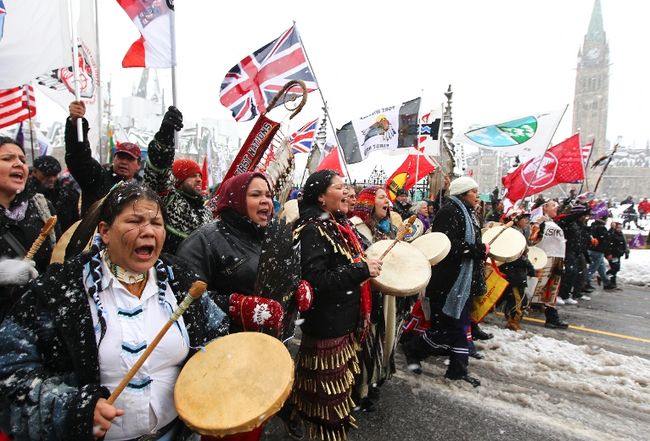
Idle No More protest in Toronto last month

Idle No More protest in Toronto last month

According to the Idle No More website, this is what happened:

 Bill C45 brings forward changes specifically to the Indian Act that will lower the threshold of community consent in the designation and surrender process of Indian Reserve Lands. 

Sheelah McLean reminds us that the bill is about everyone.  She says “the changes they are making to the environmental legislation is stunning in terms of the protections it will take away from the bodies of water – rivers and lakes, across the country.”  She further adds, “ how can we not all be concerned about that?”

The Idle No More efforts continued in Alberta with an informational meeting held at the Louis Bull Cree Nation.  The organizer for that event, Tanya Kappo, took to Twitter and Facebook to help generate awareness on the matter as the passage of Bill C45 was imminent. 

Kappo says, “the people in our communities had absolutely no idea what we were facing, no idea what plans Stephen Harper had in store for us.”  The events leading up to the National Day of Action have been focused on bringing awareness to people in First Nations communities and the rest of Canada. 

Jess Gordon says, “The essence of the work we are doing and have been doing will remain a grassroots effort, and will continue to give a forum to the voices of our people.”

When Bill C45 was brought to the House of Commons for a vote, First Nations leaders demonstrated that they are hearing these voices loud and clear.  They joined the efforts against Bill C 45 and went to Parliament Hill where they were invited into the House of Commons by the New Democratic Party. 

However, they were refused entry.  This refusal to allow First Nations leadership to respectfully enter the House of Commons triggered an even greater mobilization of First Nation people across the country. 

Nina Wilson says, “what we saw on Parliament Hill was a true reflection of what the outright disregard the Harper Government has towards First Nation people.”

With the passage of Bill C45, Idle No More has come to symbolize and be the platform to voice the refusal of First Nations people to be ignored any further by any other Canadian government.
Unknown

Yesterday I happened to catch a call-in program on the CBC (Canadian Broadcasting Co.) on the Idle No More protests, which have apparently taken most Canadians by surprise.  The host interviewed a representative of the Canadian environmental protection agency, and it was shameful to listen to the way he sputtered when asking whether the bill in question really would result in damaged waters and fisheries.

Although he refused to come out and say it, the short answer was clearly, “Yes.”

As always, for mainstream politicians and businessmen the lure of short-term profits outweighs longterm planning for the health and welfare of the planet and her denizens.

Some of the callers on the CBC program displayed evident racism in their attitudes towards the Native peoples behind the Idle No More protests, which have blockaded railways and highways in recent weeks, in an effort to gain the attention of the Canadian prime minister, Stephen Harper.

Attawapiskat Chief Theresa Spence

Attawapiskat Chief Theresa Spence

One Native Chief, Theresa Spence, has been on a hunger strike for nearly a month now, her immediate goal simply being an audience with Mr. Harper and a chance to present the First Nations case.  Harper has finally agreed to meet with Spence and other chiefs, on January 11, 2013, one month after she started her hunger strike.

Spence is a controversial figure in this movement, which began with a grassroots coalition and has displayed some reluctance to let the indigenous chiefs steal the thunder.

There have been rumors of corruption among the chiefs, including Spence herself, who has just now, conveniently enough, been subjected to a humiliating government audit of her finances.

It’s not clear whether all the chiefs are truly after the protection of the environment, or if they just want to have their fair share of the economic action when it comes to the rapid development of Canada’s northern territories.

What is clear is that the immense land and resource grab in the Americas, which began with the colonial conquests and has continued to the present day, provides short-term financial gains for the few—mostly non-indigenous corporations and financiers—while the majority of Native peoples languish in poverty, sitting on environmentally devastated lands.
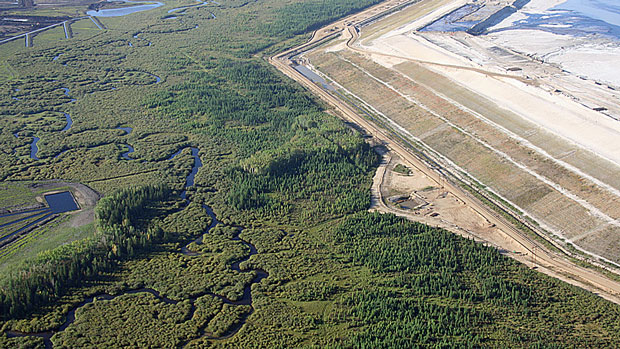
Aerial view of Alberta tar sands development, aka the destruction of the Alberta boreal forest. (Global Forest Watch Canada)

Aerial view of Alberta tar sands development, aka the destruction of the Alberta boreal forest. (Global Forest Watch Canada)

In case after case worldwide, rapacious corporations sweep in, negotiate favorable leases on the land, extract the resources and move on, leaving behind a toxic, degraded landscape and a broken people.

Now we have finally come to the time when it is becoming obvious that the damage that is being wreaked on people and their environments in specific parts of the world is not just “their own problem.”

As the founders of the Idle No More movement correctly perceived, if the waters of Canada are not protected, it will affect all Canadians, not just the First Nations folk who sit closest to those waterways.

If the boreal forests of northern Canada are razed, it will affect the entire planet, just as the steady destruction of the rainforests in the southern latitudes is inexorably destabilizing our climate worldwide.

It appears that our politicians only understand the language of dollars and cents.  In New York and New Jersey now, a serious discussion is underway about how to pay for the cost of adapting to the climate change that almost everyone sees now as inevitable.

Yes, we have to adapt, we have to mitigate the damage by changing the way we develop our coastlines.

But we also have to adapt our mindsets when it comes to “development of natural resources”—a green-washed euphemism for what has really been “the wholesale destruction of the planet.”

This is as true for the destruction of the boreal forests of Canada as it is for the fracking of the Marcellus Shale in the U.S.

If the real costs of this kind of destructive “development” were added up, no sane financier or politician would be able to support such a suicidal undertaking.

If our politicians and business leaders want to commit hari-kari by reckless short-term myopic thinking, good riddance to them.

But they have no right to take the rest of us along with them.

It reminds me of suicide cults like the infamous one in Jonestown, Guyana, in the 1970s.  A whole group of people was so taken in by the charismatic leadership of their guru, Jim Jones, that they obeyed his order to commit ritual suicide.
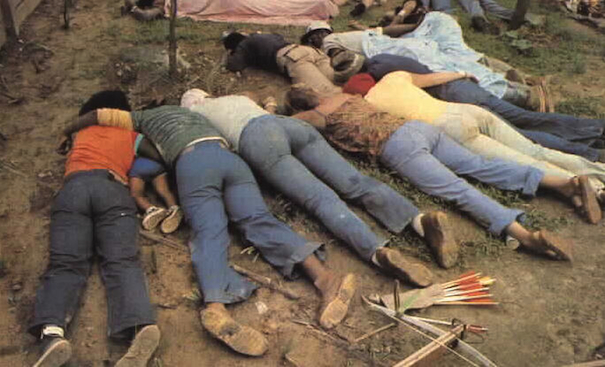
Victims of the Jonestown suicide cult

Victims of the Jonestown suicide cult

In our case, it’s the entire global capitalist leadership that has us all in thrall. We have been seduced, charmed and entranced by the siren call of “development,” which has given mainstream North Americans—the ones who agree to play by the rules—the benefits of a comfortable lifestyle.

The hidden underbelly of this lifestyle—the environmental destruction, the extermination of thousands of species annually, the annihilation of entire groups of indigenous peoples worldwide, the irrevocable destabilization of our climate—is now coming into view, thanks in large part to the democratization of the media through the World Wide Web.

I continue to believe that when ordinary, good-hearted people understand their own role in this planetary destruction, they will stand up and insist, like the four women who founded Idle No More, that enough is enough.

The question is, how far will we be willing to go to insist that our leaders respect our values and stop dragging us down the road to ruin?

How far will we have to go?

“Never doubt that a small group of thoughtful, committed citizens can change the world. Indeed, it is the only thing that ever has.”

–Margaret Mead

Time to end the slaughter of innocents!

Newtown School children right after shooting.  Photo by Shannon Hicks, The Newtown Bee

Newtown School children right after shooting. Photo by Shannon Hicks, The Newtown Bee

And so, once again, we all play the role of passive, horrified bystanders as yet another mass murder erupts into the news headlines.

Last week it was three dead in a shooting in a crowded mall, with police saying it was remarkably fortunate that “only” two were shot before the gunman took his own life.

This time it’s 20 Connecticut elementary school children gunned down in their classrooms, along with seven adults.  Again, the shooter himself is dead, so it will be hard to ever know for sure what in the world led him to commit such a wanton act of violence.

And let’s not forget about last summer’s shooting in a crowded cinema in Aurora, Colorado.  The violence just goes on and on, and no one seems to have the will to put a stop to it.

What would it take?

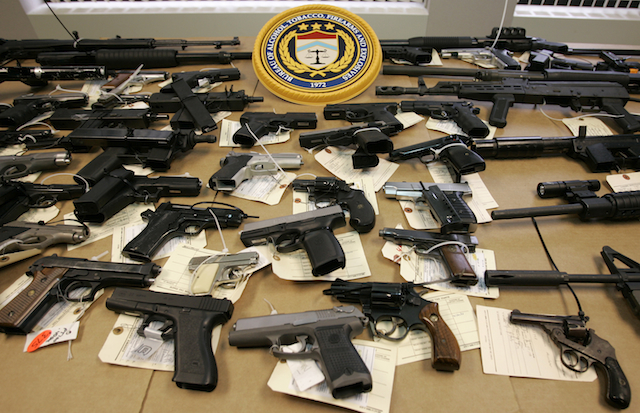
It would take politicians with the gumption to stand up to the gun lobby and bring the “right to bear arms” code up to 21st century standards.

Back in 1776, citizens were encouraged to bear arms in territorial wars against the French, British and the Native tribes.   That’s the context in which the Second Amendment should be read.

Today there is no reason why anyone who is not a soldier or a law enforcement officer should be bearing the kinds of handguns used by today’s school shooter.

Hunters can keep their shotguns, provided they receive adequate training in how to use them, and maybe some small, simple handguns could be allowed for personal defense, although those tend too often to backfire—just last week two small boys, ages 7 and 11, were taken into custody for threatening a woman with a cocked, loaded gun that they must have taken from their father’s desk drawer.

AP A OH USA 501 Guns

But the semi-automatic assault weapons like the one used by the cinema shooter, or the high-powered pistols used by today’s school shooter should not be casually floating around in civil society.

It is just too easy for a kid undergoing a psychotic break, as today’s 20-year-old shooter must have been—to grab these weapons and go crazy with them, slaughtering innocent people.

It is also too easy to imagine what could happen in situations of shortages and crises brought on by climate-change-induced storms, if men with guns are calling the shots in neighborhoods and villages cut off from law enforcement.

Unknown-1We’ve seen it happen in places in Africa and the Middle East, when the toxic mix of desperate civilians and power-hungry men with guns erupts on to the streets.  Does anyone really think we’d be immune to these kinds of scenarios here?

It’s past time for peace-loving Americans to stand up to the NRA and insist that the long-awaited gun control laws be enacted.

How many more children have to die unnecessarily before we stop being silent witnesses and start taking action?

Building a Tsunami of a Climate Change Movement: What Will it Take?

In the seething, saturated media environment we live in, victory is measured in whether or not you’re able to get people to slow down and pay attention.

It’s getting harder and harder, especially for young people, to sustain attention for more than a few minutes.

Life is a restless prowl for something new, and in a manmade environment where we’re seen it all before, it’s got to be pretty damned new and exciting to get us to pause for even a moment.

As a teacher, I find myself adapting to this in ways that I would never have predicted when I first started teaching undergraduates, nearly a quarter-century ago.

I know I have to be more exaggerated in my classroom presence.  She who drones is lost.

I also don’t expect the level of reading comprehension these days that I used to take for granted among my students.

I know I’m going to have to excerpt and digest for them, and I’d better do it in an enthusiastic, engaging way, or they’ll be surfing away, in their heads if not literally, on their screens.

I have to do constant daily battle with those screens, too—even when I outright forbid them, they creep back in with all the force of a compulsion, or an addiction.

In this kind of environment, why should we be surprised that it seems to be impossible to get people to pay attention to a big, remote problem like climate change for more time than it takes to say “Hurricane Sandy”?

The other night I was overjoyed when I stopped by the New York Times site and saw Bill McKibben’s “Do the Math” tour foregrounded front and center on the homepage.

Unknown

Bill had the same reaction: he forwarded a screenshot of the page to his email list, trumpeting victory.

But what kind of victory is it, really?

Yes, McKibben’s Do the Math tour succeeded in finally penetrating the security perimeter of that gated community known as Mainstream Public Opinion.  If the Times prints an article, we can assume that at least a few of the sheltered, august heads within the insular circle of elite readers will pay attention.

Note that the article was ultimately filed in the Business section of the newspaper, by the way.  Evidently the Times thought its business-minded readers ought to know that those pesky students might be causing trouble for stockholders in major fossil fuel companies in the coming months.

This is the same way that the Times reported the Occupy Wall Street movement: as an annoying inconvenience, a public nuisance that our good police force is working to clear away ASAP.

It’s the same way they’ve reported on Hurricane Sandy, hitting right in their own backyard.  What a colossal inconvenience!  Let’s clear it away so we can get back down to business as usual.

What is it going to take to get through to the Times and its readers that there is not going to be any more business as usual?

The game is up.  Things are going to get much worse, and the only chance of avoiding total disaster is through immediate decisive action to curb carbon emissions and build up a massive supply of carbon sinks—ie, more forests, more seaweed and algae, more grasslands and croplands.

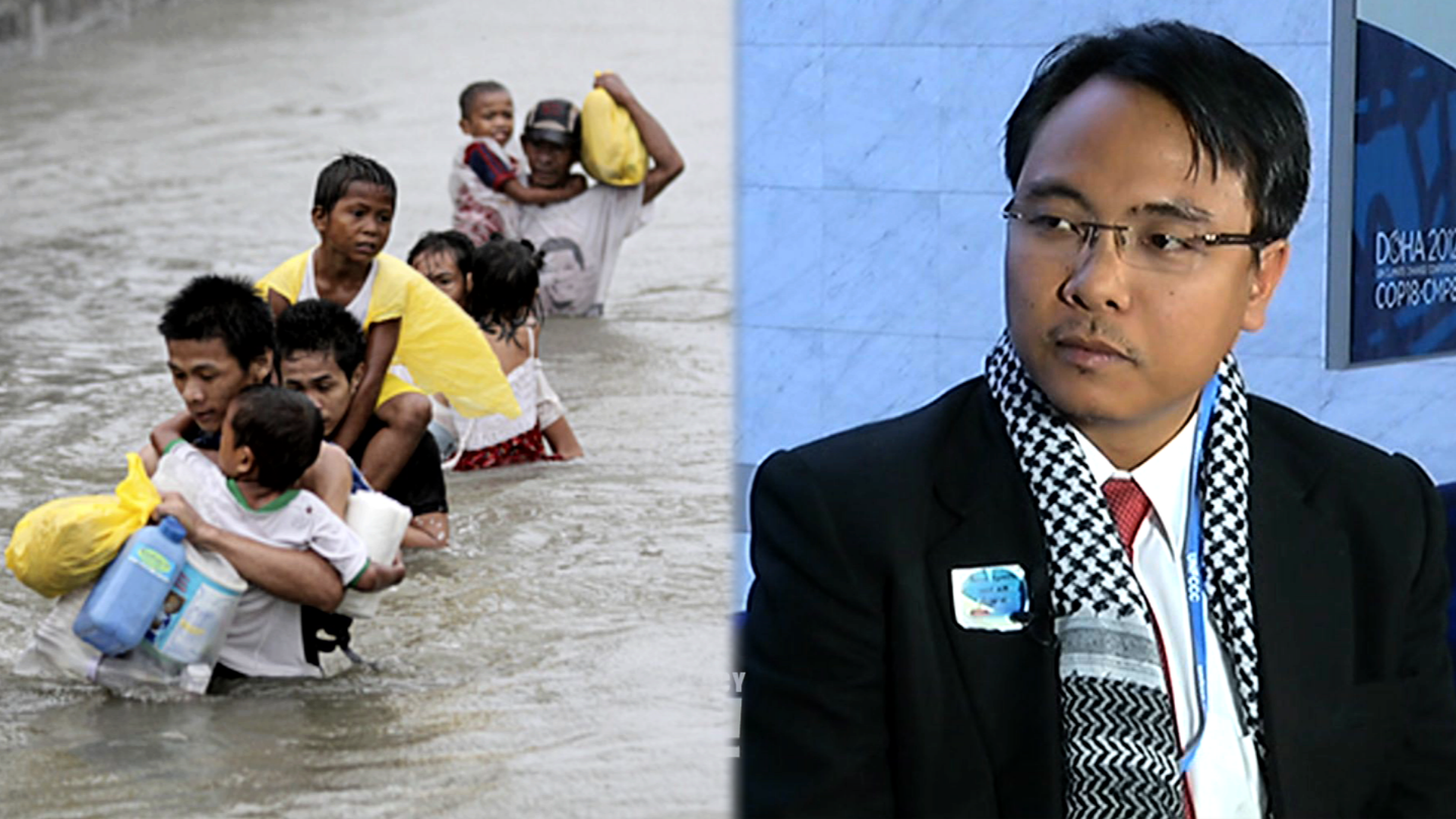
I was heartened, in a very melancholy sort of way, to see the chief negotiator for the Philippines, Naderev Saño, get all choked up as he made an impassioned speech to his comrades at COP18 this week to stop dilly-dallying and get down to the business of real change.

typhoon_yeb_sano

Referring to Typhoon Bopha, he said:

“As we sit here in these negotiations, even as we vacillate and procrastinate here, the death toll is rising. There is massive and widespread devastation. Hundreds of thousands of people have been rendered without homes. And the ordeal is far from over, as typhoon Bopha has regained some strength as it approaches another populated area in the western part of the Philippines.

“I appeal to the whole world, I appeal to leaders from all over the world, to open our eyes to the stark reality that we face. I appeal to ministers. The outcome of our work is not about what our political masters want. It is about what is demanded of us by 7 billion people.

“I appeal to all, please, no more delays, no more excuses. Please, let Doha be remembered as the place where we found the political will to turn things around. Please, let 2012 be remembered as the year the world found the courage to find the will to take responsibility for the future we want. I ask of all of us here, if not us, then who? If not now, then when? If not here, then where?”

Those are the right questions to be asking, and Saño is on the right track when he says that the work of stopping runaway climate change is not about what the “political masters” want.  It will only be possible if a sufficient number of people, all over the world, focus their attention and insist on the policy changes that will lead to real change.

The poor are the ones being disproportionately swept away by the floods and storms of climate change.  The problem may have their attention, but they’re not in much of a position to do anything about it.

I believe it is up to us, citizens of the so-called “developed” countries, to come out in force to demand change.

That is the kind of tsunami of U.S. public opinion that McKibben is trying to create with the Do the Math tour.

If we can succeed in catching the attention of young people, and getting them to understand how crucial this issue is to their futures, they can become a powerful force for change.

But in the end, this must be a multigenerational, multinational, multiethnic movement, of men and women from all walks of life, because if there’s one thing for sure, it’s that climate change does not play favorites.

It will blow away the fanciest palace just as soon as the flimsiest shanty (though the shanties will undoubtedly go first).

Ultimately, it will not be possible to build walls high enough to keep out the floodtides of a destabilized climate.

Does that get your attention?  No?  How about this: if we don’t get our act together on this issue now—I mean, NOW—we might as well just give it up and resign ourselves to roll with whatever punches are in store for us.  There will be many, and they will get progressively worse until our entire human civilization grinds to a halt.

Is that a risk you’re prepared to take?

I hope not.

So what can you do?

If you own stock, consider divesting your portfolio from fossil fuel companies until they shape up and get seriously green.

If you own a home, consider investing in alternative energy sources like solar or geothermal, and make your home as energy-efficient as possible.

Consider pressuring your town or city to do the same.

Start writing letters and emails to your elected representatives and the President of the United States and the fossil fuel barons and anyone else who might have influence, insisting that they think about our long-term welfare, not next quarter profits.

Talk to people about this.  You can never tell where ripples will go as the word goes out.

Do you want to go down fighting and active, or zoned out in front of your screen?

I echo the emotional words of the Filipino negotiator:

“Please, let 2012 be remembered as the year the world found the courage to find the will to take responsibility for the future we want. I ask of all of us here, if not us, then who? If not now, then when? If not here, then where?”

Telling the story of climate change: a call to action

You probably didn’t notice, but this past week another round of major international climate talks were held in Doha, Qatar, surely one of the least “green” locations on the globe.

The mainstream press barely bothered to give a nod to what has come to be a mind-numbing ritual of bait, switch and dodge.

The alternative press knew better than to look to the assembled ministers in Doha for any real news, focusing instead on the grim report released early last week by the Potsdam Institute for Climate Impact Research and Climate Analytics.

The 84-page report, titled “Turn Down the Heat” and funded by that radical fringe group known as the World Bank, demonstrates that if we continue our reckless heating of the planet at the present rate, all the scenarios of which readers of this blog are well aware—sea level rise, droughts and floods leading to severe food shortages, more frequent and more severe storms, loss of biodiversity and loss of human life on a biblical scale—will come to pass.

The executive summary of the report concludes with a measure of urgency:

“A 4C world is likely to be in which communities, cities and countries would experience severe disruptions, damage and dislocation, with many of these risks spread unequally.  It is likely that the poor will suffer most and the global community could become more fractured and unequal than today.  The projected 4C warming simply must not be allowed to occur–the heat must be turned down.  Only early, cooperative, international actions can make that happen.”

But this takes us in circular fashion back to Doha, where as we know, nothing substantive is going on.

Those of us who are aware of what’s happening on the climate front—and let’s face it, there aren’t that many of us, we probably form our own little 1% club—find it frustrating and frightening to have to sit by and watch as our beloved planet goes into drastic human-induced traumatic shock while our leaders bicker and fiddle and run down the clock.

I find myself constantly pulled between A) wanting to support political efforts like Bill McKibben’s “Do the Math” tour, which aims to educate and inspire action (specifically, divestment from fossil fuel companies to pressure them to reinvent themselves as bonafide green energy companies) and B) wanting to simply hunker down and build resilience at the local level, perhaps enrolling myself and my sons in a crash course in how to survive a disaster.

For the moment, I am focusing on doing what I can within my purview as a teacher to help the upcoming generation of young adults get a handle on what’s happening to our climate, and do their own productive thinking about how to engage in the struggle to turn things around.

Yesterday I was fortunate to have had a chance to participate in a small way in my colleague Eban Goodstein’s C2C Fellows Workshop, a national program based at Bard College that seeks to give young people the skills and understanding to become successful leaders in the global effort to stabilize our climate and create a sustainable economy.

Eban Goodstein

Eban Goodstein

This is an ambitious undertaking, and Goodstein is going at it full tilt, holding weekend workshops several times a year at college campuses across the country, and bringing graduate students to Bard, with generous funding, to undertake Master’s degree programs in environmental policy with a special emphasis on climate-related policy and advocacy.

As Goodstein puts it, “Stabilizing the climate is not the work of a year, of a presidential term, or of a decade. It is the work of a generation.”

I see it as an essential commitment and responsibility to use my skills as a writer, scholar and teacher to help equip the upcoming generation for this great work we must all undertake now.

Goodstein is a unique blend of science policy wonk and communications guru, and I’m convinced that it’s at this very nexus that real change on the climate front will be forged.

All the dire scientific reports in the world won’t get people to wake up and change their daily habits, or insist that policy changes are made at the local, state, national and international levels, if the information is not presented in clear, compelling language.

A significant portion of the C2C Workshop, therefore, is spent in developing students’ storytelling skills.

It was interesting, and somewhat disheartening, to watch the students’ puzzled reaction when asked by Goodstein to talk about a favorite storyteller in their family.  Very few hands went up.

This is because most Americans today are reared listening to the TV tell us stories, not cherished individuals in our actual lives.  We are avid but passive consumers of prepackaged stories, and as a result most of us—unless we have the ambition to become stand-up comedians—don’t see storytelling as a skill we need to master.

Goodstein’s important insight is that storytelling is key to getting people’s attention, and telling a good story is essential to success in environmental advocacy and politics.

Good persuasive communication, he said, starts with a personal story, and then moves into the political.  Hook your audience with a personal anecdote, keep their attention with a strong narrative, and then finish up with a call to action.  And once you’ve got a strong story developed, practice telling it, over and over again, until you can do it in your sleep.

Armed with this advice, the group of some 80 students broke into smaller groups of five, each accompanied by a faculty or graduate student facilitator, for a two-hour intensive storytelling workshop.  Our task was to each come up with a short story about an inspiring person or event, write it up and tell it three times, to three different partners, then refine it and tell it again to the whole group.

The stories would be refined further the next day, told again to new audiences, and several would be singled out for telling to the entire big group, and given awards.

This is the kind of work for which I have been preparing my whole life.  There is nothing I would rather do than facilitate a writing workshop on inspiring stories!  And it gives me special joy to do it as part of a program aimed at giving young people the skills and mojo to tell the climate change story in a way that galvanizes action.

It may be that in the end, I would have been better served by spending my time learning survival tactics in the woods, but the truth is that even in the most dire circumstances, human beings have always needed their storytellers.  A good story well told can keep us warm in ways that may not be measurable, but that are profound nevertheless.

Here is the story that I wrote and told the students yesterday in our workshop.  I offered it to them—and now to you—with love and an earnest desire that it may inspire us all to each get to work on the climate change issue—in our own ways and spheres—before it’s too late.

My friend Pauline tells the story of how she came home from work one day and discovered that a civil war had started in her country, Congo-Brazzaville.  Suddenly she had ten people, mostly women and children, sheltering in her house as gunfire and bombs shook the streets of the city. 

When a bomb hit the house, she and her family and friends knew they needed to make a run for it.  They gathered what food and supplies they could carry, and left the house in the middle of the night, heading for the countryside. 

What followed was weeks of deprivation and terror as they huddled in the forest waiting for the conflict to die down so that it would be safe to return home.

I tell this story because it is emblematic of the many stories I have studied over the years, in which women and children are disproportionately affected as victims of social conflict and war. 

I tell it because I fear that in the age of climate change this is a story that will be repeated over and over again. Whether the violence is human—men with guns—or natural—hurricanes or droughts—the effects will be the same: women and children on the run, vulnerable and afraid.

Recent studies indicate that hundreds of millions of people will become climate refugees in the next half-century.  And they won’t all be in Bangladesh or the Maldives, either.  Just ask a former resident of Breezy Point in New York City, devastated by Hurricane Sandy, how it feels.

In our lifetimes we will all witness–and many of us will likely experience—the kind of fear and hardship that Pauline lived through, when the social order disintegrated and violence became the norm. 

There are many, many guns in America.  It would not take much in the way of food and energy shortages to trigger violence.

Sometimes I find myself wondering whether I should be learning and then teaching others survival skills, instead of critical thinking and writing. 

What good will my PhD in literature do me in an age of relentless, recurring Hurricane Sandys?  What good will a vaunted college degree do my students?

But I do continue to believe that the stories of survivors like Pauline matter, and increasingly these are the stories I offer students in my classes on human rights, environmental justice, politics and literature.

We all need to learn from Pauline and other survivors about the amazing resilience of the human spirit.  Even in the face of terror and chaos, people can choose to be compassionate, generous and respectful of one another. We don’t all choose the violent path. 

It will not help any of us to focus on fear right now, as the climate change crisis gains momentum and threatens to engulf us.  What we must concentrate on instead is hope, resilience and solidarity.  That’s what the world needs from us now.

Privilege, Difference and the Challenge of Creating a “Beloved Community”

The recent Presidential election showed in concrete terms that the demograhics of the United States are shifting quickly.  The old majority of people of European descent (“Caucasians”) is rapidly shrinking to minority status in numerical terms, although white folks retain a lock on the gears of power and privilege so far in this country.

How do white folks continue to maintain dominance?

The key is still education.

When my Eastern European Jewish forebears came to the US through Ellis Island back at the turn of the 20th century, the adults in the family spoke no English, but they were hardworking and ambitious for their children to assimilate and succeed.

One of my great-grandfathers fixed sewing machines on the Lower East Side; another great-grandmother sold fish wrapped in newspaper on the street to support her children.

Within a generation, the children of these immigrants were living the middle-class American dream, and their children did even better, becoming doctors, lawyers, teachers and professionals.

My grandmother, a first-generation American whose mother tongue, before entering kindergarten, was Yiddish, got her B.A. and Masters in biology from Hunter College, and became a high school biology teacher.  Her son, my father, graduated from Oberlin and NYU and became a successful professional.  I followed the pattern and got my Ph.D.

This is what’s known in Americanese as pulling oneself up by the bootstraps.

What is too often unacknowledged is how the privilege accorded to whiteness in America has helped families like mine succeed.

It starts with where you are able to live, because property taxes still determine the quality of the primary and secondary education you’ll receive.

In the first half of the 20th century, there were a lot of places in the U.S. where Jews weren’t welcome, including many selective colleges and universities.

But just like the Irish and the Italians, soon enough Jews became “white,” and that was all that mattered—they were welcome in all but the snootiest bastions of American WASP-dom, and their privileges were helped along by the exclusion of others.

The color of one’s skin still matters in this country.  We still live in largely segregated neighborhoods, and thus most of our children attend largely segregated schools.

And they’re not “separate but equal” schools either.  They are, as Jonathan Kozol so eloquently documented, deeply unequal schools, where children with darker skin tones—who are often the most in need of support–are given less, financially and  intellectually.

The fight over “race-blind” college admissions is so fraught because what tends to happen without any affirmative action policy for Americans of color is that the people with the best “grooming” win out, and the best-groomed high school seniors tend to be those from affluent families, living in affluent neighborhoods, going to affluent schools.

As The New York Times noted in a recent editorial, “Those from the top fifth of households in income are at least seven times as likely to go to selective colleges as those in the bottom fifth. The achievement gap between high- and low-income groups is almost twice as wide as between whites and blacks,” and “blacks and Hispanics are also substantially underrepresented at selective colleges and universities. In 2004, they were 14.5 percent and 16 percent, respectively, of those graduating from high schools, but only 3.5 percent and 7 percent of those enrolling in selective colleges and universities. The underrepresentation has gotten worse over the past generation.”

***

All this is on my mind today because of a recent stir at the college where I teach, which has made a strong effort over the past decade to recruit more students from under-represented groups.

We have more people of color on the campus today than we’ve ever had, which should be a cause for celebration.

But this semester has brought some simmering tensions to the surface, showing how difficult it can be to put a group of passionate young people together on a campus and expect them to “just get along.”

The flashpoint this semester was Diversity Day, a day started several years ago by a group of disgruntled students who felt that not enough time was spent during regular classes focusing on issues of social diversity.

Students, staff and faculty organized workshop classes on a range of topics related to the experience of marginalized groups in America, and theories and praxes of social justice.

The day was so successful that it was subsequently institutionalized, with regular classes cancelled and all students required to attend at least three workshops.

This year, an influential group of students decided they were going to “boycott” Diversity Day.  Many of them were the student leaders of workshops, which meant that they were actually sabotaging their own event.

They took this extreme measure because they were angry at what they perceived as a lack of strong response from the college administration to the provocation of a student who questioned not just the value of diversity day, but the value of diversity itself in American society.

This student distributed posters on campus asking students to “Take the Diversity Challenge” by answering the following question: “Name 5 benefits of Diversity (besides ethnic food and music).”

His challenge was taken as a white supremacist assault on students who wear the mantle of diversity with pride, and he did not do much to dispel that perception, according to students who said he also sent them a link to a You-Tube talk by Jared Taylor, the controversial founder of the New Century Foundation and editor of its American Renaissance magazine.

The anti-discrimination watchdog organization Southern Poverty Law Center, which keeps tabs on Taylor, says that he “regularly publishes proponents of eugenics and blatant anti-black and anti-Latino racists,” and also “hosts a conference every other year where racist intellectuals rub shoulders with Klansmen, neo-Nazis and other white supremacists.”

In the video link shared on our campus, Taylor argues that because there is often friction when you put different social groups into close proximity (and he’s especially attentive to different racial groups)—say, in neighborhoods or schools or college campuses—the better thing to do is to back away and re-segregate, thereby eliminating the sources of tension.

This attitude is wrong on so many levels that I find it hard to know where to start.

Besides the obvious truth that race is just an illusion, as far as a real biological marker of human difference, it’s also true that ghetto-izing certain individuals, for whatever reason, has never been a good social strategy in the past, and it won’t work now.

We don’t want a balkanized, fearful, hateful America any more than we want a bland, homogenized America.

We want a society where, as Audre Lorde put it, “difference [is] not merely tolerated, but seen as a fund of necessary polarities between which our creativity can spark like a dialectic.”

In her famous essay “The Master’s Tools Will Never Dismantle the Master’s House,” Lorde continued: “Within the interdependence of mutual (nondominant) differences lies that security which enables us to descend into the chaos of knowledge and return with true visions of our future, along with the concomitant power to effect those changes which can bring that future into being” (Sister Outsider, 111-12).

***

Audre Lorde

At my college, we like to say that we teach “critical thinking skills,” by which we mean that we encourage students to question authority and think for themselves.

We shouldn’t be surprised or upset, then, when they do just that by questioning our own institutional authority.

The students who organized the Diversity Day boycott this year—many of them women of color–were angry that a student advocating white supremacy was allowed to remain in our campus community.

While the administration deliberated over whether this student presented any danger to the community, and whether his words had crossed the line into hate speech, they said, they felt unsafe and unheard.

So they staged a protest, quite in keeping with Audre Lorde’s injunction to “transform silence into language and action.”

“I have come to believe,” Lorde says, “that what is most important to me must be spoken, made verbal and shared, even at the risk of having it bruised or misunderstood.”  She urges her readers to ask themselves “What do you need to say?  What are the tyrannies you swallow day by day and attempt to make your own, until you will sicken and die of them, still in silence? ….We can sit in our corners mute forever while our sisters and our selves are wasted, while our children are distorted and destroyed, while our earth is poisoned; we can sit in our safe corners mute as bottles, and we will still be no less afraid” of speaking out.

But, she continues, “We can learn to work and speak when we are afraid in the same way we have learned to work and speak when we are tired.  For we have been socialized to respect fear more than our own needs for language and definition, and while we wait in silence for that final luxury of fearlessness, the weight of that silence will choke us….

“It is not difference that immobilizes us, but silence.  And there are so many silences to be broken” (“The Transformation of Silence into Language and Action,” Sister Outsider, 4144).

On our campus, Diversity Day originated as an attempt to break the silences between different social groups, including students, faculty and administration, in the cause of mutual understanding and communication.

But this year, it was the boycott that spoke loudest, and what it said, loud and clear, was that there are still so many silences to be broken.

Speaking as a faculty member who teaches classes in human rights and social justice, and who has organized many Diversity Day workshops over the years, the problem is that it’s often too little, too late.

By the time Diversity Day rolls around in November, tensions between social groups on campus have often already come to the fore, and the workshops provide opportunities to let off steam that can end up sparking further conflagrations that take place in the dorms or on social media sites, without the mediating influence of faculty and staff present to help channel discussions productively.

One day out of the school year is not enough to create the social bonds necessary to establish a cohesive, harmonious diverse student body.

We are going to have to try harder, to do better.

***

An opening has been created for us by the students this year. From my perspective as a faculty member, this is a prime teachable moment, an opportunity to advance our ideals of social justice and strengthen the ties of community on our campus.

Those with more privilege, on whatever grounds, must stand as firm allies with the less privileged.

Every class, every conversation, every interaction is an opportunity for respectful communication that encourages the breaking of the deep-seated silences that separate us.

The truth is that every college campus is a microcosm of the larger society from which our students are drawn.  In the small, sheltered community we create—a kind of Beloved Community, in Martin Luther King Jr.’s terms—we have an opportunity to envision and manifest new frameworks and understandings that our students will then carry with them out into the broader world.

In this struggle, as in all others, we are the ones we’ve been waiting for, and the time for thoughtful action is now.

Fossil Fuels R Us–but we can change, and so can they!

I am in one of those periods where I feel quite inadequate to comment on the events that dash across the world and national stages with madcap intensity.

What was it Shakespeare said? Life’s but a shadow, a poor player who struts and frets his hour upon the stage and then is heard no more…it is a tale told by an idiot, full of sound and fury, signifying nothing….

And yet for those of us who are caught up in the moment, our hour upon the stage, what happens does matter, it does signify something—even if we can’t always tell what that something is.

The General and his lover

What does it mean that a much-decorated general, Director of the CIA, abruptly resigns after being investigated for adultery by the FBI?

Is this scandal really just about a simple affair with a younger woman, or do the General’s neocon tendencies, which had him presiding over the escalation of the disastrous war in Afghanistan and advocating open hostility with Iran, have anything to do with the alacrity with which President Obama accepted his resignation?

We’ll find out when the blockbuster film comes out, a couple of years from now!

Meanwhile, the drumbeats of war are booming in Israel/Palestine, right on cue after the American elections ground to their quadrennial conclusion.

Once again photos of bloody children pop up on our computer and TV screens.  Once again passionate voices on both sides of this eternal conflict are raised.  This is a pageant that has taken place so many times it has become predictable and stale, like the Christmas pageants that will soon take their places on local church stages throughout Christendom.

Scenes from Gaza, November 2012

Why can’t those people just get along? Americans wonder before flipping the channel.  Few of us are aware of the extent to which the Israeli/Palestinian conflict continues to be fueled and armed by the taxpayers of the United States.

This is our conflict; we are responsible.  But as long as we dispassionately wait for someone else to stop it, it will continue to grind on.

The same is true with so many issues, from climate change to income disparity.  It’s time to stop waiting for someone else to step in and solve the problems, make the changes for us.  We have to do it ourselves.

There are a few encouraging signs that this is beginning to happen.

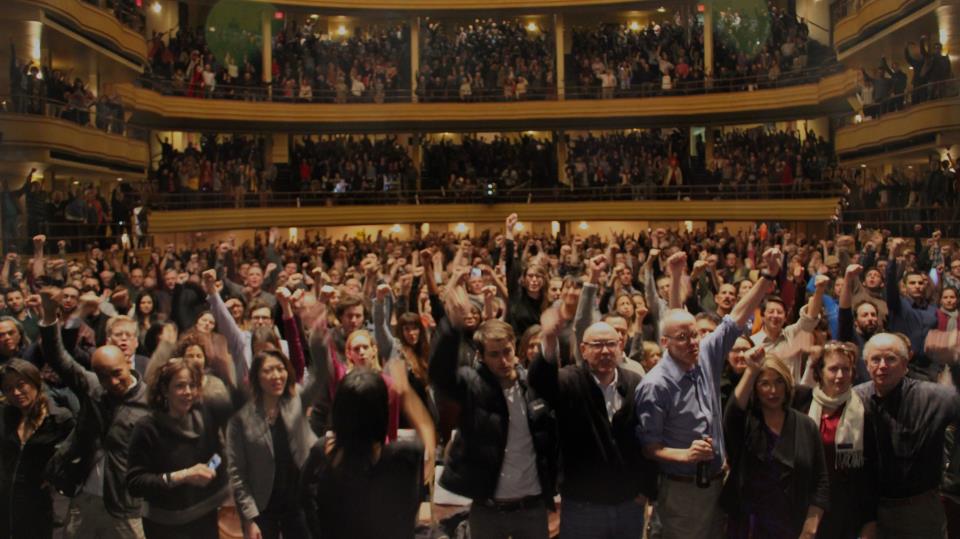
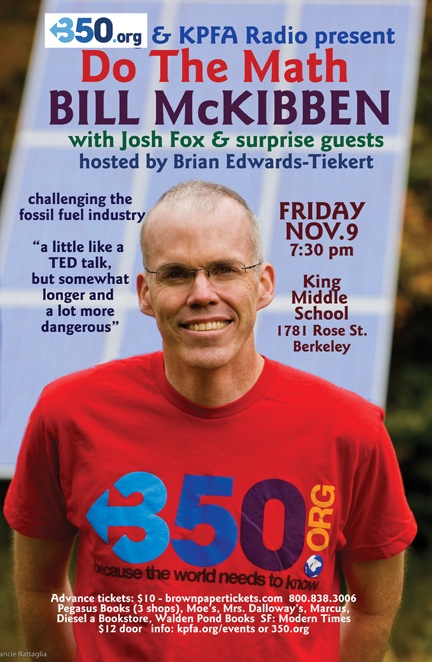
The 350.0rg “Do the Math” tour with Bill McKibben, Naomi Klein and many, many friends is making its historic way across the country, urging Americans to consider ways they can pressure the institutions with which they’re involved to divest from fossil fuel companies.

Scene from the Do the Math tour in New York City, 11/12

McKibben was talking about this last summer when I went to listen to him up at the top of Mount Greylock here in western Massachusetts, courtesy of Orion Magazine.  He invoked the successful divestiture movement of the international anti-apartheid struggle, which put enough pressure on the racist South African government that it eventually had to back down from its untenable position and begin working with the Black South Africans.

The sins of the fossil fuel companies are much bigger than those of the Boers: we’re not just talking about bigoted social policies in one country here, we’re talking about a mindset, policy brief and massive engineering effort that is inexorably endangering the entirety of human civilization on this planet, and indeed the well-being of all current life forms, perhaps excepting algae, bacteria and cockroaches.

And yet, it’s impossible to externalize the blame here, because the fossil fuel companies have only been trying to give us what we want: cheap and plentiful oil and gas.

It’s not their fault that we love their products so much we’re willing to do anything—including fight endless wars—to get it.

It’s incumbent on us to look inward and interrogate our own desires and dependencies in order to move forward.

Pressuring the fossil fuel companies to change is a good thing, as long as we’re willing to change with them.

Shifting to renewable energy is going to take a commitment from every player on the world stage today, from government leaders to manufacturers to the financial sector to ordinary consumers like you and me.

Let’s not allow the gloom of Shakespeare’s tragedies to engulf us and sap us of energy.  This play isn’t over yet and it doesn’t have to come to a bloody end.

Enough playing the handwringing Hamlet role!  Let’s roll up our sleeves and get to work to solve our problems and write ourselves a better script.

Election 2012: Avoiding the Same Old, Same Old In the Redistribution of Power

Bravo to Maureen Dowd, who nailed the delusion of the Republican party with her typical biting humor.  “Mitt Romney is the president of white male America,” she said. Just not of the rest of us.

And—surprise!—we are a hell of a lot more numerous and, in an honest-to-God democracy, more powerful than they are.

White male America did turn out to elect Mitt their hero of the privileged status quo.  Imagine their surprise to discover that a status quo they thought undefeatable was already gone!

Karl Rove

It was interesting to see the little white men behind the curtain coming out after their Mitt-marionette went down in flames—men like Karl Rove, who flat-out refused to believe, on national TV (Fox News, of course) that his horse had actually lost the race.

It’s true that there wasn’t anything inherently “less Presidential” about Mitt than about that other wealthy political scion, George W. Bush—unless perhaps it was Romney’s conservative, highly patriarchal Mormonism, evidenced in the remarkable spread of his lily-white grandchildren—even if, as far as we know, he and his five sons only have one wife each.

Romney family

Both Bush Jr. and Romney expected the Republicans wizards to deliver them the White House with minimal effort on their part; and in return they would deliver the Supreme Court and the dismantling of regulatory inconveniences for Big Business, while keeping the women in the parlor and the help in the kitchen.

As Dowd pointed out, “the more they tried to force chastity belts on women, and the more they made Hispanics, blacks and gays feel like the help, the more these groups burned to prove that, knitted together, they could give the dead-enders of white male domination the boot.”

And so we did, so resoundingly that even the most obtuse of Republican strategists must have gotten the point.

Women, Latinos, Blacks and queer folk in this country make up a majority, and if you goad us with sticks and prods, you will see us turn out at the polls in record numbers to kick you out and get our own people to represent us in the halls of power.

The election of 2012 marks the dawn of a new age in America, when the so-called “minorities,” buoyed by a wave of powerful women voters of every ethnic, religious and even political stripe, showed the Man who’s boss.

No, Obama may not be the perfect hero to lead this charge, but as a mixed race American and a thoughtful man who obviously loves and respects his wife and daughters, he will do for now.

Obama family on Election night 2012

After all, as Dowd concludes: “If 2008 was about exalting the One, 2012 was about the disenchanted Democratic base deciding: “We are the Ones we’ve been waiting for.”

The newly empowered voting block of women, gays and ethnic “minorities” (a quaint term that will soon bite the dustbin of history) must take a good hard look at the hierarchical structure upon which the white male patriarchy was founded, and which it upheld so religiously for so long.

Our Founding Fathers were as guilty of this as their old masters back in Europe.  And indeed those who have studied colonialist and post-colonialist politics tell us that the biggest obstacle for newly emerging political bodies, whether they be newly independent nations or, as in 21st century America, newly emerging political landscapes, is that as humans we tend to replicate what we know, rather than take the risk of imagining and executing something truly new.

Thus we found, in state after state, the ideals of Communism crushed beneath the iron boots of dictators who used the banner of Communism to re-enact the oppressive structures of the past.

The challenge for all politically engaged Americans as we move on from Election 2012 is to keep the momentum going, rather than subsiding back into the same old, same old of structural American power hierarchies.

President Obama introduces Sonia Sotomayor

President Obama, over the past four years, was not able to resist the immense gravitational pull of the Beltway, although he did have a few shining moments of independence, like his successful appointment of Sonia Sotomayor to the Supreme Court.

The truth is, it’s not only unrealistic to expect him to be our knight in shining armor, it’s antithetical to the spirit of true liberty and democracy.

The 21st century is about the redistribution of power in all its forms, including wealth, politics and energy.

We are the ones we’ve been waiting for, and we have to create change ourselves—in our homes, in our workplaces, in our schools, in our stores, and in local politics.

We have to change our relation to the natural world, which has long held the sad position of totally disrespected base in the patriarchal white hierarchy.

No one is going to do this for us—not Obama, and not even Jill Stein.  We have to do it ourselves, and the time to start is now.

The Audacity of Hope, c. 2012

For those of us who supported President Obama, the last 24 hours or so have been positively giddy.

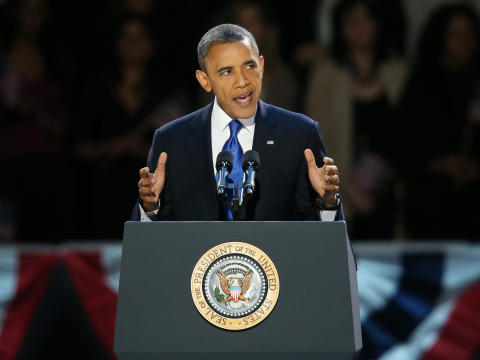
There were the nail-biting first few hours of the election results…followed by the glad tidings of more and more of the big electoral states turning a glorious blue…capped by the wonderful thrill of seeing the President stride out onto the stage in Chicago to give the most rousing acceptance speech most of us have ever heard.

What a big heart this man has, to include in his acceptance speech itself the invitation to his opponents to meet him in the aisle and try to seek common ground!

In the very first words of his speech, before he even thanked his running mate, he reached out to Mitt Romney, offering to work with him to move the country forward onto a better, firmer footing:

I just spoke with Governor Romney and I congratulated him and Paul Ryan on a hard-fought campaign. 

We may have battled fiercely, but it’s only because we love this country deeply and we care so strongly about its future. From George to Lenore to their son Mitt, the Romney family has chosen to give back to America through public service and that is the legacy that we honor and applaud tonight.

In the weeks ahead, I also look forward to sitting down with Governor Romney to talk about where we can work together to move this country forward.

And then, towards the end of the speech, he said so memorably:

America, I believe we can build on the progress we’ve made and continue to fight for new jobs and new opportunity and new security for the middle class. I believe we can keep the promise of our founders, the idea that if you’re willing to work hard, it doesn’t matter who you are or where you come from or what you look like or where you love. It doesn’t matter whether you’re black or white or Hispanic or Asian or Native American or young or old or rich or poor, able, disabled, gay or straight, you can make it here in America if you’re willing to try.

I believe we can seize this future together because we are not as divided as our politics suggests. We’re not as cynical as the pundits believe. We are greater than the sum of our individual ambitions, and we remain more than a collection of red states and blue states. We are and forever will be the United States of America.

This audacity of optimism is why we elected Barack Obama back in 2008, and why we continue to love him.

Whatever his personal or political failings, Barack Obama stands for the best hope of the USA: the raw immigrant passion and drive that founded this country and still makes it great.

He also represents, in his very skin, the polyglot future of the USA, the inexorable movement away from the European aristocracy of our founders to the broad multicultural diversity of our descendants.

Mitt Romney’s concession speech 2012

The Republicans are still stuck back in the good old days of the good old guys’ party.  As one commentator aptly noted, Republican political rallies look suspiciously like Ku Klux Klan rallies of the early 20th century.

For those who might rather not recall, let us remember that the Klan not only hated and lynched African Americans; they also hated and lynched Jews.  And they didn’t liked the Irish or the Italians much either!

Let’s not even talk about gay folk.  And women?  For the Klan and many contemporary conservatives, they belong in the kitchen or in the bed.

This is not the country we want to be as we move into the 21st century.

Although I thought the Obama campaign’s slogan “Forward, not back” was a little hokey when I heard it trotted out at various rallies, it does have the ring of truth to it.

We do not want to go back to the intolerance and violent hatred of our past.

We need to move forward, and we will need all hands on deck to confront the deeply unstable, uncertain future that awaits us in the age of climate change.

I want to see Barack Obama rise to the challenges of our time with all the power of his big heart.

I want to see him not just think about jobs, but think about green jobs, about jobs that will move our country forward into a longterm, sustainable future.

Enough kow-towing to Big Oil, Big Agriculture and Big Chemical.  It’s time to force these industries to bend to the winds of change, to adapt to the new paradigm of sustainability sweeping our country and our planet.

I applaud Bill McKibben for waiting until the election was over to come out swinging—and I applaud his continuing efforts to get the climate change issue into the center of political discourse.

Those who are still suffering from the after-effects of Hurricane Sandy, along with their insurers, should be his best allies.

We need to face the truth that all the matters of social justice that concern us will be moot if we don’t face the pressing need to get our planetary civilization onto a sustainable footing.

We need to convince our President of this, post-haste.

But let’s take a moment to breathe a big sigh of relief that it is Barack Obama we’re dealing with, and not Mitt Romney!

This election proves that Big Money is not infallible.

Democracy still matters; individual votes still matter; as a country, we are not as corrupt as many of us feared.

Now is the time for all of us to embrace the President’s big heart and let it reach out even further to encompass our entire beautiful planet and all of her creatures.

This is the task we humans were born to undertake: to become the thoughtful, compassionate stewards of our planet, and the collaborative leaders of our own multifarious tribes.

It is so good to see more and more women stepping up to the plate now.  We are sorely needed, but we can’t do it alone.

Men and women of all heritages must work together as never before to reestablish the equilibrium needed to move our civilization forward sustainably into the 21st century.

These are not just words.  This is our urgent reality.

Barack Obama has answered the call.

Will you?

Thank you, Hurricane Sandy

Hurricane Sandy did the planet a favor by hitting hard right at some of our most elite enclaves.

This time it’s not the poor residents of the Ninth Ward facing the horror of flooding, it’s the wealthy owners of some of the most valuable coastal property in the country.

When I heard Mayor Bloomberg of New York, one of the richest men on the planet, finally come and out say the words “climate change” with urgency, I had to smile despite the seriousness of the context, because it meant that at last the rich and powerful are getting the message that the status quo cannot go on—at least, not if we expect to survive as a civilization into the 22nd century.

The truth is that Americans in the ruling class—the business owners, the politicians, the finance and computer wizards, the media producers, the educators, even the artists–have been living in a luxurious gated community our whole lives.

We have been watching the travails of those outside, including the accelerating extinction of other species and the poisoning of the environment, from what has seemed like a safe, secure vantage point, behind several layers of bullet-proof glass.

Americans have watched impassively as people in other parts of the world have been forced to deal with terrible storms, flooding, and droughts with increasing regularity over the past decade.

As long as the electricity stays on and the supermarkets and gas stations are full and open for business, we just don’t pay much attention to what’s going on with the weather.  As long as our homes are heated in the winter and cooled in the summer, what’s the problem?

People like James Hansen, Bill McKibben, and Elizabeth Kolbert have been knocking futilely on the windows for years, trying to get the ruling class to wake up and pay attention to the looming threat of climate change before it’s too late.

They’ve made little progress up to now.

But Hurricane Sandy is a game changer.  Blowing into town the week before the Presidential elections, she put climate change on to the front page of the New York Times at last.  She forced her way into the bland discourse of Presidential politics.

She tossed her windy head and in just a few hours paralyzed the “greatest city on Earth,” creating $50 billion of damage that will take weeks if not months to clean up.

All of a sudden, city planners are talking seriously about flood gates, and some are saying it might be foolish to rebuild in the same way, right down along the coast.

I don’t hear many in our ruling class yet saying what needs to be said, which is that our entire lifestyle has been built up in an unsustainable way, and must be changed if we are to leave a livable legacy to our children and grandchildren.

We must wean ourselves from the addiction to fossil fuels.  We must shift from highways and cars to mass transit.  We must immediately start reducing emissions in every way possible, with special attention to the agriculture sector, which has to be completely redesigned with sustainability and health—our own, and that of the animals and plants we cultivate—in mind.

We must build a much more resilient, collaborative culture.  Competition and aggression may have been the watchwords of the capitalist and imperialist 19th and 20th century, but following their star has landed us in our current grave circumstances. We can’t go any further down that path.

For thousands of years prior to the Christian era, human beings lived tribally and cooperatively in harmony with the land.  Our population has now grown so large that we are reduced to fighting each other for increasingly scarce resources.

Going forward, if we are to survive, we must transcend the pettiness of national boundaries and ethnic differences, recognize our common goals as humans, and start to work together to provide strategically for the good of all.

This may seem like an impossibly idealistic goal, but if there is one thing that I believe can unite human beings, it is the awareness now dawning about how interconnected we are through our dependence on the life support of our planet.

It is sad that the Earth has had to sink to such an unbalanced, depleted state before we began to pay attention.  I would not wish a Hurricane Sandy on anyone.  But it seems that we need wake-up calls of her magnitude to get us up and out of the stupor of denial and inaction.

As I step over the threshold into my sixth decade today, I can feel a new resoluteness building in me; a new determination to use my time in a more focused way.

I vow to give the best of myself to the struggle for a sustainable future, and to encourage others to join me in this effort.  There is nothing more important any of us can be doing now.

Will Frankenstorms Become the New Normal?

Yesterday’s images of the NY Stock Exchange with sandbags at the front doors, or cars floating by on Wall Street, were not taken from the latest science fiction disaster movie, not this time.

This time they were real.  And next time the storm could be worse.

But despite all the dramatic headlines declaring Hurricane Sandy the worst storm to hit the East Coast in human memory, there has been barely a whisper of climate change in any of the top weather-related news stories.

I was hoping that Sandy would prove to be a big wake-up call for the privileged denizens of the East Coast, many of whom hold influential positions in business, finance and government.

But instead of people acknowledging the climate elephant in the room and starting to talk about proactive steps we can take to avoid such scenarios in the future, they are just following the usual reactionary script: marshalling disaster relief, urging the citizenry to donate to the American Red Cross, assessing the cost of the clean-up and how long it will take to put Humpty back together again.

A storm like Sandy—or Irene, or Katrina—should prompt reflections on the awesome power of natural forces, and the puniness of human structures.

Take our power away and we are suddenly rocketed back into the early 19th century.  Take our food supplies away, and we become an angry mob in no time.  Do it on a scale that impacts millions of people all living crowded together, and you have a recipe for unprecedented horror.

This is not a pitch for the next action thriller film, and it’s not idle chatter.  These are the kinds of scenarios our governors and national leaders were worrying about yesterday when they authorized the shutting down of mass transit, schools and businesses.

We were lucky this time.  Sandy weakened as she came ashore and the damage, while serious, is manageable.

What we know is that with each passing month and year of inaction on global heating, the storms will become more frequent and more intense.  In the years to come, we will look back on Sandy as child’s play, just a warning of what is yet to come.

What should we be doing now, as individuals, as a nation, and as a global human community?

  • We should be starting a massive shift to renewable, clean energy sources.  And I’m not talking about “clean coal.”  Wind, solar, geothermal, tidal—these are the sources that can safely feed our energy addiction, without driving our climate into ruin.
  • We should be shifting away from cars and highways to trains and mass transit.  Bicycles, too.  And we should embrace the shift to online commerce and education, to avoid the need for a great portion of the horrendous morning commute.
  • We should start a concerted effort, especially in densely populated areas like the northeast corridor, to bury the power lines.  Tangled mats of downed overhead wires should become a thing of the past, and quickly.  We need to become much more resilient at surviving big storms, and our electric grid is a 19th century anachronism in need of immediate upgrade to the 21st century.
  • We need to start a serious citizens’ movement to resist the tripartite junta of the fossil fuel industry, Big Agriculture and Big Chemical.  These three industries must be held accountable for the tremendous destruction they are wreaking on our environment, and on us as individuals.  I’d like to see Big Insurance take our side in this battle; I am sure they’re getting tired of always being stuck holding the bill when the next disaster strikes….

These storms are not random events.  They are getting bigger and closer together and less predictable.  The hotter the climate, the more the ice melts at the poles, the more freakish our weather will become—except that freakish is going to be our new normal.

It’s time to stop the denial, stop allowing ourselves to be distracted from the very serious questions that face us now.

It boils down to this: are we going to leave a livable Earth to our children and grandchildren?  Or are we going to go down in history (if there are any left to carry history forward) as the most criminal generation of all time?