Challenging the culture of (white male) entitlement: Come on, Occupy, let’s do it!

I spent several hours today listening to a friend tell me, with much anger, sadness and frustration, the story of how her marriage of more than 20 years has crumbled.

Then I went up to see my son’s soccer game, and could not bring myself to say more than “hello” to my own ex-husband, who chose freedom and autonomy over his 25-year relationship with me, and the satisfaction of living in the same house as our children.

When I got home, I checked the Occupy Wall Street website and found a statement from the “sexual assault survivors team,” describing and condemning the recent attack on a female protester by a man who apparently already had a record of sexual assault.

I also got a blog post from a student in my gender studies class, about an organization called About Face, which strives to get viewers to question the fashion industry norm of presenting emaciated women as “beautiful.”

What connects these dots?

A culture in which men feel more interested in following their own selfish desires for personal fulfillment (aka, sexual fulfillment) than in upholding their roles as fathers and husbands.A society that makes it easy for them to choose this route: why struggle to please a demanding wife when you can have sex with someone else with no strings attached?

A society that tells women that the more pale, limp and weak-looking they appear, the more beautiful they are in the eyes of men.

A society where women have to be guarded, even at protests that supposedly entertain no gender disparity, because there could be sexual predators around any corner.

A society that makes it terribly difficult for women to find independent means to self-respect.

Too often, in previous revolutions, women have supported the movement but found that the men in charge were not willing to give women’s issues equal footing with class issues.

If the young men and women of the Occupy movements are serious about creating true social change, they must put the issue of entitlement squarely on the table.

Not just the entitlement of the 1%, but specifically male entitlement, and white entitlement.

We will not be able to bring a new social structure into being unless we hit these areas of privilege and entitlement head on.

And no, we are not substituting women’s empowerment for men’s.

We are after another world entirely, in which gender, class and race are not the arbiters of power.  In which power flows from the collective wisdom of the group, rather than top-down in hierarchical fashion.
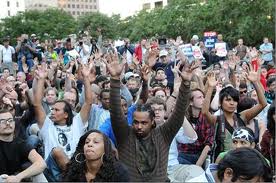
The Occupy movements are on to this shift with the general assemblies and the consensual mode of decision-making.  Breaking with the gendered conditioning of Western society, which gives men all the power, all the time, is not going to be easy.  But if anyone could achieve it, it’s the young men and women of the Occupy movements.

I want to see these young people make this an explicit focus of their movements.  Because otherwise, on a certain level, it’s just business as usual, no matter if the masters of Goldman Sachs come out to lick your boots.

Change the disrespectful attitude of men towards women, and you REALLY change the world.

Let’s give it a try, and see what happens.  Things could not get much worse, and they could get a whole lot better if men and women worked together for the good of ALL.

Sweet stirrings of a new world: fringe politics overturning the barricades

The venerable social critic Hendrik Hertzberg of The New Yorker contrasts the Tea Party with the Occupy movement in this week’s magazine, and finds the Occupy movement lacking in precisely what has made the Tea Party so strong: a willingness to get involved in (and take money from) the established American political parties.

“Occupy Wall Street and the Tea Party are both protest movements, not interest groups,” Hertzberg says, “and while both are wary, or claim to be, of established political figures and organizations, each welcomes their praise, if not their direction. Both have already earned places in the long, raucous history of American populism. But only one, so far, has earned a place in the history of American government.”

Are we supposed to be proud that the Tea Party has “earned” an infamous place as the launching pad for the new cadre of rightwing Republican zealots who have spent their time in Congress obstinately shooting down and stampeding every effort by President Obama and the Democrats to steer this nation towards a more compassionate and forward-looking political stance?

In its few years of existence, the Tea Party has happily wormed its way into the main arteries of American political power.  Hertzberg offers an apt metaphor of this tea as a new wonder drug, “injected into the scarred veins” of the GOP, which has quickly become addicted to this mainlined source of entranced, stupified frenzy.

“Now the Democrats are hoping the drug might be available as a generic,” Hertzberg continues, eying the Occupy movement as a way to enliven its own moribund political base.

I firmly hope that the Occupy movement does not allow itself to be used in this way by the political establishment, and I think it’s a reasonable, if remarkable, hope.

Remarkable because for so long Americans have been asleep, indifferent or unaware of what Hertzberg calls “the astounding growth of what can fairly be called plutocracy.”

Why it took so long for the sleeping giant of American popular opinion to wake up is a question for historians of the turn of the 21st century to ponder.

Why is it that Americans have been voting against their own class interests so long?  Why is the persistent myth of American equality, liberty and justice for all so teflon-coated?

We all want to believe that our country represents the moral high ground in the world, and that our leaders in government are as invested in upholding our idealism as we are.

Our public education system, which is responsible for the education of a great portion of the 99%, aids and abets this self-delusion by giving students the most doctrinaire and uncritical version of American history and civics, and teaching docility and proficiency at standardized testing above all.

Our media doesn’t help much; with the exception of a few poorly funded but stalwart independent outlets, the vast social landscape of contemporary media is focused at best on distraction, and very often on outright deception.

Under the pressures of this kind of social conditioning, it’s remarkable that the young idealists in the Occupy movement have had such success in galvanizing the country to wake up, shake ourselves, and stare around us with new eyes.

Hertzberg obviously intends his column as a signpost for the Occupy movement, pointing towards Washington D.C. as a more important battleground than Wall Street.  “Ultimately, inevitably, the route to real change has to run through politics,” he concludes; “the politics of America’s broken, god-awful, immutably two-party electoral system, the only one we have.”

Here is a glaring example of the kind of civics mis-education that has made our country so hard to reform over the years.

Who says our political system is limited to two parties?  Or at least, to the two parties we have now?

The Republicans and the Democrats have shown themselves to be chronically unable to lead this country out of the morass of special interests and ruthless corporate-driven capitalism that has bulldozed right over our cherished ideals of equality, not to mention the sacred ecological web that forms the real foundation of all our wealth and prosperity.

The Occupy movements are showing their intelligence in shying away from engagement with the established political system.  If anything, their political allies are more likely to be found in those perennial political organizations that have always camped out on the fringes of our electoral parks: the Green Parties or the Rainbow Coalitions.

Remember Ralph Nader, for example?  Remember how Big Media colluded with the established parties in denying so-called “outside” candidates a seat at the table at the televised Presidential debates?

This year the Ralph Naders of the political world have suddenly swelled their ranks dramatically, but without the figurehead of a single leader at the head of the crowd.  As Nader knows only too well, one man at the head of a true opposition movement is open to all the slings and arrows that the establishment can muster.  Even Gore and Kerry have felt the force of the muddy vomit pitched their way out of the far-right Republican swampland.

Far better for the Occupy movements to stay plural and collective, strong in the anonymity of the multitudes.  Those of us who are serious about doing more than simply rearranging the deck chairs on the great hulking Titanic of American politics realize that “America’s broken, god-awful, immutably two-party electoral system” is exactly what has to go.

OK, Hendrik, it may be the only one we HAVE HAD, but now the veil has been torn down, the people are awake, and we realize that another world is possible.  As Arundhati Roy famously put it, “on a clear day, I can hear her breathing.”

That clear day has dawned.

Fighting for Change with Hearts Wide Open

The environmental philosopher Kathleen Dean Moore looks out at the Occupied social landscape and sees “The Big One”–a movement that will bring all the disparate struggles of our society together on common ground, and effect deep, lasting, structural changes.

“The lines that connect climate change to jobs to the environment to education to health to justice are strong and undeniable,” she says. “The time has passed for an environmental movement. The time has passed for a climate change movement. The time has passed for isolated grassroots movements. We stand on ground that trembles with tectonic movement. Along the straining fault lines of our civilization, we feel the forces building for justice, sanity, and lasting ecological and cultural thriving.”

She’s certainly right that isolated movements are not going to change the world. That’s what’s been so great about the Occupy movements–they’ve been widespread and inclusive,a big big tent spread out over a lot of ground, coast to coast.

As Moore says, the moral ground of the Occupy movements is quite simple and clear: “it’s wrong to wreck the world.”

That’s something I knew instinctively as a child, as most children do.  Part of the great tragedy of our society has been the way we slowly deaden and numb the compassionate, empathic instinct of our children, teaching them to ignore pain and injustice, to just keep walking and mind their own business.

I know that’s what I was taught as a privileged young American growing up in a deeply unequal, unjust and exploitative society.  I know now that it was wrong.

And thanks to Occupy Wall Street and the other Occupy movements, I am beginning to know what to do about it.

We need to stop going about our business as usual, and relearn how to see and feel suffering and inequity.

We need to think outside the box of our normalized capitalist assumptions, making well-being rather than profit the goal of human effort.

We need to make protecting our planetary home our highest priority, because without a healthy environment, we will never build a healthy society, and things are so far gone that bringing back ecological balance will take everything we’ve got.

One of the reasons that revolutions are almost always carried out by the young is because they are closer to the instinctual compassion of their childhoods.

If only the stuffed shirts in Congress and in corporate office buildings all over America could remember what it was like to live with their hearts wide open, we might start to see the great boulder of social change really start to pick up steam.

Is there an “American Spring” around the corner?

You have to admit my blog is aptly named.  Each day brings new evidence that we are living through a speeded-up period of rapid change.

Was it only a few short months ago that we were stuck in the August doldrums of Congressional gridlock, in which the Republicans seemed to have a total stranglehold on the nation’s very lifeblood, our Treasury?

Was it only a few short weeks ago that the first Occupy Wall Street protesters arrived on the scene, the vanguard of what has now become an international political movement that just might have the power to challenge the two-party American oligarchy?

The deep distrust and disappointment Americans feel in our government is represented in a new NY Times/CBS News poll published tonight.

Get this: only 9% of those polled approve of the way Congress is doing its job.

Only 10% say they trust the American government to do what’s right for its people.

 These are dreadful numbers, especially when compared with the 46% of those polled who said they believe the views of the Occupy Wall Street protesters reflect the views of most Americans.

The urgent question becomes, will this dissatisfaction with our government and strong identification with the protest movement lead to actual sociopolitical change?

In one of my classes we are reading Allan G. Johnson’s book Privilege, Power & Difference, which seeks to understand why those with social privilege so rarely lend their support to any movement that might upset the status quo, even when they profess to be sympathetic with the goals of social equality.

Johnson says that all of us, but especially the privileged, tend to follow the path of least resistance.  Our society is set up in such a way that the paths of least resistance all favor the privileged, making it very hard for anyone to rock the boat.

But, he says, if we are aware of the ills of social inequality and do nothing about it, we will become “like the person who loses the ability to feel pain and risks bleeding to death from a thousand tiny cuts that go unnoticed, untreated and unhealed” (124).

I think that many of us privileged folks have indeed become numb to the harsh realities of our social system, which we have come to accept as natural, like the weather or the usual background noise of civilization.

That this callousness is wounding in ways we are hardly aware of is less obvious, but it comes out in the deep malaise of privileged American society: our tendency to depression, self-destructive behaviors, and underlying rage.

We are living through a moment in time when it is just possible that the privileged will wake up and decide that enough is enough.  That is the hope and the lure of the 99% movement.

There are a lot of privileged people in that 99%: educated, wealthy people, who have a lot to gain, in material terms, by not rocking the boat–but who, it seems, are doing some real soul-searching right now about taking the right path, instead of the path of least resistance.

Think about it: only 10% of Americans think Congress is doing a good job.  If that isn’t a mandate for change, I don’t know what would be.

Everything is speeded up these days.  Even last night’s solar storm, which caused spectacular aurora borealis displays all over North America, apparently hit Earth eight hours faster than predicted, and spread out much further over the U.S. than usual–visible all the way down in the Deep South.

Could it be that we will have our own “American Spring” in 2012?

WHY NOT???

The minefield of unearned privilege: tread carefully!

It was not surprising when in a discussion of privilege in class the other day, we spent more time talking about affirmative action in higher education than we did about, say, white or male privilege.

When I paused the conversation to point this out, some students suggested it might be due to their firsthand knowledge of the inequities of the affirmative action system.  Many in the room had conflicted feelings and ideas about the question of merit vs. need-based scholarships.  Why should a student who can afford to pay for college, they asked, be granted a scholarship on the basis of merit, thus denying a place and funds to a student who may be less well-prepared, but is far more needy?

One can argue these issues for a long time without coming anywhere near the deeper issues that lie buried under the surface, like mines just waiting to go off.

Why are white students more likely to be both better-prepared and less needy than students of color?

WHITE PRIVILEGE.  It’s the elephant in the room that no one really wants to deal with, because it doesn’t feel good to admit that if your skin is pinkish beige in color, it’s given you systematic unearned advantages your whole life long.

There are also students—generally white male–who will complain that women now get unfair preferential treatment in higher education admissions.  This may have been true a decade ago, but in fact what’s happened of late is that affirmative action for women has been so successful that now it is men, especially men of color but white men too, who are sought after by college recruiters.

Does this mean that MALE PRVILEGE is all over and done with?  Hell no.  Men still earn at least 20% more than women doing the same job, whether blue collar, white collar or CEO.  Women still have a tougher time rising to leadership positions, and are judged much more harshly if and when they do succeed.  Women still have disproportionate responsibility for keeping the home fires burning and the children taken care of, even when they’re happily married and earning the same as or more than their husbands.

Male privilege is alive and well—but no one really wants to talk about it, not even women.

At least at the college level, students seem more comfortable talking about HETEROSEXUAL PRIVILEGE than about race/class/gender privilege.  It seems trendy to be aware of how queer folk are bullied and discriminated against, and to be sympathetic about it.  But there’s a lot less sympathy when it comes to women who point to male privilege, or people of color pointing to white privilege, or poor folks pointing to elite privilege.

Why is that?

For one thing, if the complaint comes from someone who belongs to the subordinate group, there is an immediate perception that they are speaking in self-interest, and overt action on behalf of one’s self-interest is never well-received by dominant groups when it comes from subordinates, particularly from women.  It’s labeled as “strident” or “whining.”

All the while, dominant groups–say, men, or white people–may be acting in their own self-interest, but it’s just accepted as normal striving, part of the great American way.

For people in subordinate groups and their allies, it can be a difficult challenge to raise the issue of dominant groups’ unearned privilege without setting off all kinds of defensive reactions or tricky deflections, as when a whole class is spent talking about affirmative action instead of about unearned privilege.

If I knew the answer to this conundrum, I would be a much better teacher than I am.  All I can do is keep trying to pull students’ attention back to that minefield of privilege and oppression, and tread carefully–but without turning back.

An urgent message for the global elites: change is coming, like it or not!

America’s ‘Primal Scream’ – NYTimes.com.

It’s always nice to wake up and see the very thoughts I was writing last night trumpeted in the Sunday Review of the NY Times.  Nick Kristof cites many of the same statistics I did to make his case that income inequality is not only real, but “a cancer on our national well-being.”  

But where he ends his column wondering whether the movement will persist “once Zuccotti Park fills with snow and the novelty wears off,” I believe things are only going to get more intense as we move into this winter of discontent.

For one thing, there’s climate change looming over us.  Check out today’s big story on the fact that this imperative issue has lost traction in the U.S., even as most of the rest of the world is moving aggressively to regulate carbon emissions and develop more sustainable technologies.

It seems that the elites driving our economy believe that we can continue our comfortable insulated ride in the plush American Caddy, and let the plebes outside the walls of our national gated community deal with the unpleasantness.

How quickly we forget the major blizzard in New York City last year, or Hurricane Irene bearing down on the whole East Coast.  Climate change is only going to intensify in the coming years unless we get serious about it fast.  The natural disasters it will cause will cost far more than action to curb emissions proactively.

Unlike Nick Kristof, I don’t believe our society has a choice about whether or not to change.  We will be changing, like it or not.  The question is, will we change in an orderly fashion, through regulation and innovation that puts the common good ahead of the greedy goals of the men behind the tinted windows of those chauffeured limousines?

To me, this is what the Occupy protests are about.  The 99% are sick and tired of shouldering all the costs of our industrial capitalist way of life–the debt bondage, the toxic chemicals making us sick, the decimation of our environment wreaking havoc with our climate, the fading of the American dream–while a few fat cats sit pretty on top of the heap and enjoy the spoils.

I have news for you, global elites.  You can’t escape the impartial justice of climate change.  You should have realized by now that you will reap what you sow: if you seed our agriculture, air and water with toxic chemicals, you and your children will get cancer just like the rest of us.  If you continue to deforest the Earth at the current rate, you too will be gasping for oxygen along with the poorest inhabitants of what used to be a boreal forest.


Hiding behind police barricades in your plate-glass towers will only get you so far.  In the long run, it’s no way to live.

Come on out into Liberty Plaza with the rest of us, and let’s work together for a better life for all–while there’s still time.

Much to protest…and much work to be done to make it right

Riots in Rome, a huge protest in Times Square, New York, and rolling protests from New Zealand to London to L.A. Things haven’t been this globally lively since the 2003 protests against the imminent U.S. invasion of Iraq.  Where is it all leading?

None of us know.  But the police are getting out their riot gear, and it is very possible that there are going to be more violent clashes, as there were in Rome today.

As the protests gain momentum, it’s important to keep our eye on just what all the anger is about.

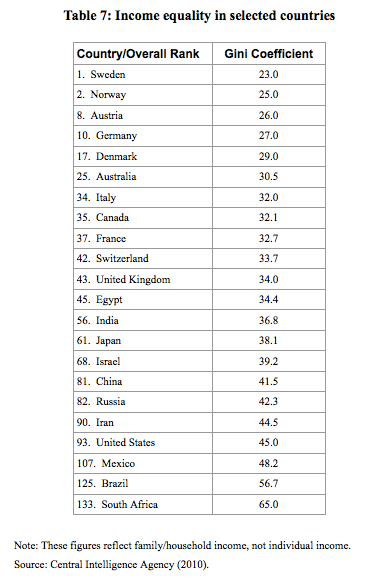
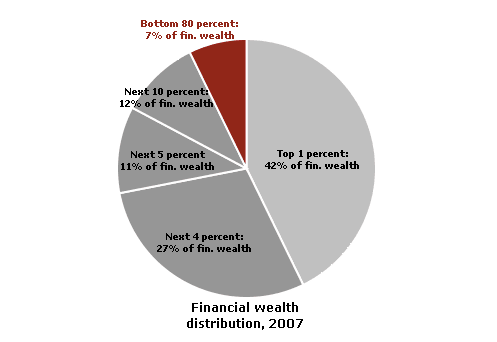
Business Insider, of all sites, published a very interesting set of charts and commentary last week promising to explain just what all the fuss was about down in Liberty Plaza.  Check it out, you won’t be disappointed.

Here are a few of the most damning charts:

The U.S. ranks below China, Iran and India in terms of income INEQUALITY.

Five percent of Americans own 69% of financial wealth.  The top 1% own 42% of this country’s financial wealth.

And the tax rate of these fabulously wealthy people is about the same as everyone else’s. That’s why they continue to get richer and richer, and everyone else slides inexorably downward.

While CEO pay is up nearly 300% since 1990, average workers’ pay is up 4%.  I don’t know about you, but the modest increases in my salary over the past decade have been totally absorbed by higher expenses, from food to gas to health insurance premiums and everything else.

So hell yes, there is something to be angry about!  There is a lot to protest!  There is a lot of work to be done to turn this country and this world around. The question is, how far will we go to rock the comfortable cruise ship of the one percenters?  And how far will they go to keep the status quo the way it is?

Police forces have always done the bidding of the wealthy in capitalist societies; is there any chance this could change?  The police are workers just like the protesters; is there any chance they will break their indoctrination and side with their own class interest?

Seems unlikely, but let’s not underestimate the forces of change.  Who would have believed, even six weeks ago, that people would be turning out in the thousands across the world to protest corporate greed and social inequality?

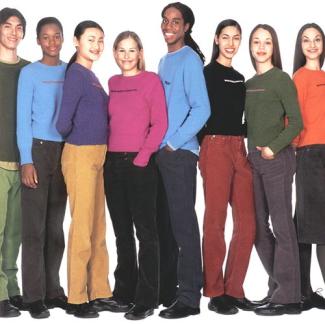
Look at this crowd.  It’s pretty clean cut, isn’t it?  This doesn’t look like a case for the riot police.  By and large, these people don’t want revolution. They just want to be able to live decent lives in a country they can be proud of.

Is this too much to ask?

No.  But, and this is a BIG BUT: what we’ve come to consider “a decent life” is going to have to change in the 21st century, given peak oil, the impending collapse of industrial agriculture, and the climate crisis.

So much will depend on our being smart enough to put these pieces together with the economic injustice we perceive so clearly, and see our way clear to a new, sustainably grounded society.

This is not too much to ask either.  But it will be a challenge to move from the fist-in-the-air stage to the creative visioning, and most of all to the implementation of a more just and sustainable economic system.

We have no choice but to meet this challenge.  Our global future as a species depends on it. This is the central task of our time.

What President Obama and Eve Ensler have in common

President Obama did something really, really good this week.  He sent 100 Special Ops military “advisors” to Central Africa to help local government forces get rid of the Lord’s Resistance Army, a group of crazed, vicious thugs who have been terrorizing people in four countries for as long as many in the region can remember.

The New York Times reports: “For more than two decades, the Lord’s Resistance Army (LRA) has murdered, raped and kidnapped tens of thousands of men, women and children in central Africa,” Mr. Obama wrote in a letter to Congress announcing the military deployment. “The LRA continues to commit atrocities across the Central African Republic, the Democratic Republic of the Congo and South Sudan that have a disproportionate impact on regional security.”

You don’t even want to know what kind of atrocities he’s talking about.  Joseph Kony and his men are depraved, sick torturers, rapists and murderers who have been at it so long that I doubt they can ever be rehabilitated.  They are part of a long cycle of violence in Africa that begins with the kidnapping or luring in of young children, boys and girls, who are then drugged, beaten and raped into total submission to the authority of the adults, and grow up indoctrinated into the lifestyle of terror.

For an inside story, read Ismael Beah’s memoir A Long Way Gone, or the chapter in my anthology African Women Writing Resistance by former girl child soldier China Keitetsi, whose memoir Child Soldier is available in an e-book edition.

I can’t help but think that there is an element of racism in the fact that it’s taken so long for the international community to unite behind the mission of bringing true security to Central Africa (including the Democratic Republic of Congo, where some of the worst human rights violations in the world are taking place daily, with women and girls disproportionately targeted.)

When Bosnian men were massacred, people thrown out of their homes, and women and girls imprisoned in rape camps by the Serbs, the Clinton Administration waged an all-out war to stop it.  All that and more has been happening in the DRC and neighboring countries for decades.  Decades.

Eve Ensler has done a tremendous amount to get the word out about the impact of all this violence on women, not just in Africa but throughout the world.  I particularly admire her because she has used art as the medium for her outspoken calls for solidarity and resistance with victims of rape and violence–starting with “The Vagina Monologues,” and moving on through a host of books and plays.

She’s also used digital media to get her word out and build a global movement to end violence against women, and I don’t think anyone does it better–check out her website, vday.org, to see for yourself.

Eve Ensler is a great example of a woman of privilege who has used all of her talents and gifts to reach out and help others–and not through begging, cajoling or guilt-tripping, either, but through the sheer power of her spoken and written word.

President Obama has the power to send in the military, and it’s good he’s at least taken the first step in that direction.

We ordinary people have power too, more than we often realize.  We can open our eyes to what’s really happening in our towns, our country and our world, and then allow our hearts to show us the way to action for positive social change.

There is no more urgent task for each of us in our lifetimes.  This is what we came here to do.

From brooms of resistance to guerilla tactics…let’s keep it going!

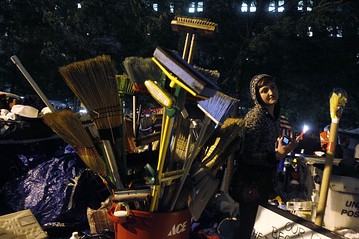
Congratulations to the Occupy Wall Streeters for making weapons out of mops and brooms and holding off the Bloomberg eviction forces!  A major victory!  I wonder when was the last time Bloomberg held a broom–probably so long ago he couldn’t conceive of such a strategy of resistance.

Looking out on this rainy, cool morning, I can’t help but wonder what’s going to happen when the cold winds of winter start to blow.  Those of us supporting this movement from the comfort of our homes don’t want to see the protesters getting frostbite out by the Wall Street bull!

I saw a great suggestion this morning: why not turn the Occupy movement into a guerilla resistance, with daily occupations happening in designated strategic sites all over the country, the occupiers called in via cell phones and social media?  A movement like this would have the flexibility of motion, and would be able to respond to current events.

It could also be fun–like the spontaneous street parties that often happen in European cities, with the partiers called in by cell phone.

Now almost a month old, the Occupy movement has done an outstanding job of waking up this nation.  Let’s keep the momentum going even as the cold winds of winter begin to blow.

Citigroup’s CEO Says He’d Be Happy to Talk With Wall Street Protesters

Pandit Says He’d Be Happy to Talk With Wall Street Protesters – Businessweek.

I think the Occupy Wall Street folks should take him up on his offer to talk!  But he should go down to the park just like everyone else, and meet the people at Liberty Plaza.  It would be a thrill for him, I’m sure, to rub elbows with the common folk, and hear his voice amplified by thousands of sets of vocal cords!

The article says that “Pandit also confirmed that Citigroup would make a profit in the third quarter, the bank’s seventh profitable quarter in a row since losing a total of $29.3 billion during 2008 and 2009. The bank may post earnings of $2.49 billion, according to a survey of 14 analysts surveyed by Bloomberg.”

I’d like to politely suggest that this income should be fully taxed….