Confessions from Park Avenue: Ignorance, Privilege and Change

This week the Occupy Wall Street protest ventured uptown, to the Upper East Side of Manhattan–where I grew up.

I have always been reluctant to admit that for a good portion of my life I called Park Avenue home.  I knew what kinds of stereotypes would instantly leap to my interlocuters’ minds upon hearing these gilded signifiers: “Upper East Side,” “Park Avenue,” even “Manhattan.”  And indeed, I have known many neighbors who fit the model of the wealthy socialite snob.  But there are also thinking, feeling, compassionate people living on Park Avenue.  They are guilty, above all, of the privilege of ignorance.  They truly don’t know how the other half lives.

I can just hear the scornful snickers and groans that greet this statement.  But it’s true.  I know it because I lived it.  And to some extent, you’ve lived it too.  All of us Americans have this privilege relative to people living in desperate material circumstances in other parts of the world.  At least our society pays lip service to the ideal of equality.
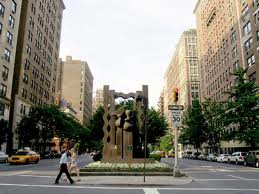
The tony apartment buildings lining Park Avenue are urban gated communities.  Most are co-ops, and it is difficult to buy your way into them–money alone won’t do the trick, you also have to be thoroughly vetted by the co-op board, and depending on the building, you may or may not pass muster.  The people living inside tend to be very reserved with one another.  You might not get to know your neighbors even if you live in the building for twenty years or more.  You might know your daytime and nighttime doorman better than the person who lives on the other side of your bedroom wall.

As for knowing more of the world, and how ordinary people live, well–there is television. There is the internet.  But in terms of flesh and blood, there is very little connection.  Back at the turn of the 20th century, Jacob Riis captured the lives of the less fortunate in his sensational book How the Other Half Lives, which shocked the nation and inspired some excellent reforms.  That kind of documentary expose has become much more commonplace in our time, to the point where even the most shocking revelations–sex slaves in Westchester, sweatshop labor in Chinatown, human organ thieves in Brazil–have lost their power to shock.

A crowd of people chanting, holding up signs and making merry through the hushed, tranquil streets of the Upper East Side, though–now that is shocking!  In my 20+ years of living in that august quartier, I can only remember a few times when anything like this happened.

Once was on a long-ago St. Patrick’s Day, when the Fifth Avenue parade-goers got a little too drunk, a little too rowdy, and the police had to step in and reimpose order.  My mom, brother and I watched in amazement from our the 9th floor window overlooking Park Avenue.  Quiet was soon restored.

Another time was when the lights went out back in 1977, and there was some looting over on Lexington Avenue.  We heard the shouting and sounds of glass breaking, but of course nothing could touch us, secure behind the gates and under the watchful eyes of our uniformed doormen.

This is the central fact of privileged existence, Park Avenue-style.  Nothing can touch you.  The red carpet of privilege rolls out in front of you effortlessly; you live in an enchanted bubble, from which the distant rumors of unrest are just that–distant rumors, which you don’t understand, and don’t care about enough to investigate.

I say this now to underscore the success of the Occupy Wall Street protesters in breaking through that bubble, at least a little bit.  The tight membrane of privilege surrounding the NY Times popped after three weeks of pressure.  It will take a lot longer to penetrate the hearts and minds of the men and women who work on Wall Street and live up on Park and Fifth Avenues.  But just because it will take a while to get through is absolutely no reason to be discouraged.  It can be done!  And it should be done.

I have a feeling that there are probably a lot of people like me living on Park and Fifth Avenues today.  Privileged by birth, but with the same hearts, minds and sense of compassion as any other American.  Just ignorant of what’s up with the 99%.

For instance, one observer of the “Millionaire’s March” noticed “a chic young mother,” who “turned to a puzzled daughter in a tony school uniform, “People don’t have jobs right now,” she explained. Whether Mom connected this fact to the actions of any of her neighbors was anyone’s guess.”

Did Mom connect this fact to her own actions, is more to the point.  For the privileged, it’s too easy to pass the buck.

I am currently working on a book, which I call a “political memoir,” in which I try to understand the social dynamics of privilege, and how and why some people become “privilege traitors” and go against their own class interests.  Judging from this week’s events in New York, I am going to have a lot of interesting material to study, beyond my own story.  Stay tuned.

Protest and social transformation–what do Uranus and Pluto have to do with it?

I said when I started this blog that I’d be open to all kinds of explorations of the transition times we’re living in.  Recently, after a long period of just reading his open-source work, I subscribed to the astrology reports produced by Eric Francis.  I am wondering: could it be that the motions of the planets have a real impact on how we think, feel and act here on Earth?

Francis just produced a terrific reading of the history of American protest movements since the Sixties, grounded in his knowledge of astrology and inspired by his visit to the Occupy Wall Street protest last weekend.

Apparently we have just returned to a period of astrological alignment of Uranus and Pluto.  Francis writes: “the most passionate and sustained uprisings are reasonably predictable: they tend to happen when Uranus and Pluto come into alignment. When the planet of revolution (Uranus) and the one about evolution (Pluto) get together, there is always an international revolt. The alignments spread out over 10 to 12 years, and we are still toward the beginning of this one.  The last time these two planets got together was between 1960 and 1972.”

Francis describes the “vibe” at Liberty Plaza Park as quite different from the militancy of the 1960s.  “The feeling was nothing but friendly. There was not the fist-in-the-air sensation that Sixties demonstrations are remembered with.…The vibe was open but also introspective. People were expressing concern and anger about the economic situation and there was a clear sense of understanding that Wall Street holds a lot of the responsibility for that — but no sense of rage being projected onto anyone. My sense from many things I’ve read and heard is that among this generation of activists, there’s the awareness that we need to change ourselves and change the world in the same gesture.”

So true—because there is only a difference of degree between the protesters’ privilege and that of the corporate and financial leaders they’re criticizing.  All of us Americans have benefited hugely from the corporate globalization of “free trade” and the easy accessibility of credit.  The problem is that now the chickens have come home to roost, and the same havoc that we–as a nation and as a leading member of the global elite–wreaked so thoughtlessly on the rest of the world is now coming back to haunt us.

When I listened to the news this morning and heard of the extreme hardship being forced down the throats of ordinary Greeks in the name of “fiscal austerity,” I remember the same scenario going down in Mexico and Argentina and so many other nations, as we continued to party here in the U.S.  Well, the party is over here too, at least for the 99% of us, and it’s not fun at all.

 But, as Eric Francis notes, there is a lot of potential in this moment of crisis.  “As you think about what this aspect represents,” he counsels,  “remember that the personal awakening process of Uranus in Aries is about to meet up with the changes in society represented by Pluto in Capricorn. There is potential for wide-scale cultural change, but it starts from the inside-out. That approach, if we follow it, will help us avoid many of the really huge mistakes that were made during the protests of the Sixties.

“Uranus in Aries also connects people to groups, but from the perspective of being an individual. Pluto in Capricorn turns over the soil of society’s institutions, bringing out their frailty and their fertility. It will be exciting to see what happens as this aspect builds to its first peak in June 2012 and then develops for the next three years.”

“Exciting” might not be the word most of us would choose for the crazy lurching of our society, both national and global, towards the tipping point forecast long ago to arrive in 2012.  It’s exciting the way a roller-coaster ride is exciting, and I have never in my life allowed myself to experience that thrill.

But maybe part of what is being asked of us now is that we let go of our fears and inhibitions, and allow ourselves to try something new—something other than what has been expected of us as we grew up and docilely took our place in the structures that had been established for us by previous generations.

It’s pretty plain to see that those structures have outlived their functionality, and were never good for this planet to begin with.

It’s the transition time, folks.  What are we going to become?


Empathy: Igniting Force for Social Action

Now that the mainstream media has finally caught on to the importance of the Occupy Wall Street protests, I feel like I can go back to using this space to explore some other questions that have been niggling at me lately.

Last week there were not one but TWO op-ed pieces in the NY Times about empathy–both responding to Harvard Professor of Psychology Steven Pinker’s new book The Better Angels of Our Nature: Why Violence Has Declined.  I haven’t read Pinker’s book yet, but I gather that he argues that humans have become more empathetic of late, and thus less violently aggressive towards one another.
Honestly, I haven’t noticed any decline in violence recently, have you? We still haven’t had a year go by without war erupting somewhere on the planet, and usually in many places at once. Men are still raping and battering women in alarming numbers all over the globe.  Suicides are up, and that deadly malaise I’ve talked about before subjects many of us to a constant low-level form of self-directed aggression.

But what I really want to think about are the two reactions to Pinker’s book, published last week in the Times by columnists David Brooks (conservative political pundit) and Benedict Carey (science reporter).  Both were extremely negative about the potential for empathy to be a positive force for social change.

Brooks argues that “Empathy makes you more aware of other people’s suffering, but it’s not clear that it actually motivates you to take moral action or prevents you from taking immoral action….

“Nobody is against empathy,” he says. “Nonetheless, it’s insufficient. These days empathy has become a shortcut. It has become a way to experience delicious moral emotions without confronting the weaknesses in our nature that prevent us from actually acting upon them. It has become a way to experience the illusion of moral progress without having to do the nasty work of making moral judgments.”

Brooks ends his column by proffering “sacred codes” as an alternative to mere empathy.  “Think of anybody you admire,” he says. “They probably have some talent for fellow-feeling, but it is overshadowed by their sense of obligation to some religious, military, social or philosophic code. They would feel a sense of shame or guilt if they didn’t live up to the code. The code tells them when they deserve public admiration or dishonor. The code helps them evaluate other people’s feelings, not just share them.”

The problem with this formula is obvious.  Sacred codes are all very well, as long as they don’t direct their adherents to, say, “exterminate the cockroaches,” as was the cry both in Nazi Germany and in Hutu Rwanda.

Benedict Carey comes up with another objection to empathy as a trigger for social action: people are much more likely to feel for and want to help a single victim whose story is well-told, than to reach out to help in a major disaster involving millions of unnamed victims.  We get “compassion fatigue” pretty quickly, and if we are fed enough sad stories, we begin to get “psychic numbing,” where we lose our ability to feel any empathy at all.

Carey ends his piece by suggesting that psychic numbing may actually serve a useful purpose.  People charged with trying to help victims of disaster or tragedy are better able to function, he says, if they are not wallowing in empathy.

“In his book “Death in Life: Survivors of Hiroshima,” the psychiatrist Robert Jay Lifton argued that rescue workers at Hiroshima were able to function at all only because they succeeded in “turning off” their feelings of compassion. He called that process “psychic numbing,” too, and it’s a reminder that empathy may be a limited resource for a reason.  Real action, when it’s called for, often requires a cool heart, if not a cold one.”

So here we have, within the space of a single week, two well-respected intellectuals arguing that empathy may be overrated. Both maintain that empathy can actually get in the way of constructive action.
I have thought quite a bit about this very issue, since so much of my teaching over the years has involved exposing young people to narratives of political struggle with the goal of awakening their empathy as a first step on the road to positive social action.

Very rarely have students complained to me that the narratives of testifiers like Ismael Beah, Fadumo Korn or Rigoberta Menchu have caused their circuits to bust into “psychic numbing” mode.

And while it may be true that the experience of empathy is not enough in itself to produce the kind of social change called for by the testifiers in these narratives, it is still an important and necessary first step for potential allies from outside the given cultural context of the narrative.

In her closing essay to my first anthology, Women Writing Resistance: Essays on Latin America and the Caribbean, Julia Alvarez invoked the simple, hopeful expression of human connection exemplified in the phrase, “Here, let me help you with that.”

Gloria Anzaldua also wrote about the importance of situating oneself in the liminal space between self and other, which she named “nepantla,” the space of the borderland.
Those of us who have been blessed with privilege may never venture into that borderland space of connection and social change unless we are jarred into awareness by a jolt of empathy.  It may just never occur to us to reach out a helping hand.

I teach literature because I believe in the power of stories to provide this crucial explosive charge of understanding, which Simona Sharoni, who visited the Simon’s Rock Junior Proseminar today, calls “compassionate resistance.”

It’s true that this is a starting point, not an end in itself.  But it’s a critical ignition stage, not to be under-estimated.

I wonder about the subtexts of these two Times columns this week, both putting down the value of empathy a means towards social change.  Just what are these guys afraid of?

Whatever it is, Rachel Corrie found out how dangerous that fear–or lack of empathy–can be.

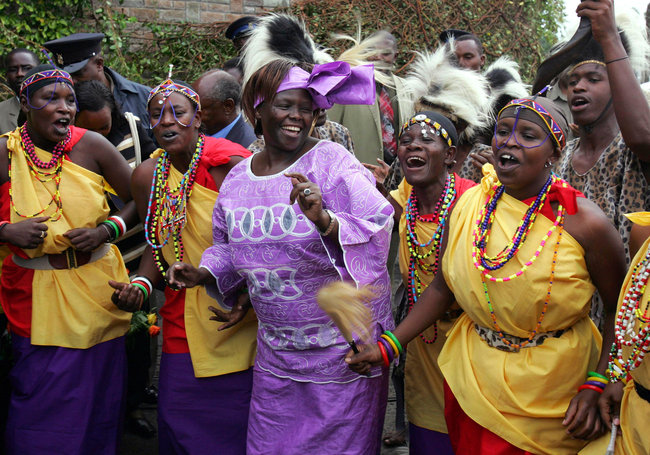
Wangari Maathai’s Canopy of Hope: remembering a warrior woman for the planet and role model for us all

Kenyan Wangari Maathai, who died last night of ovarian cancer, was a woman who took everything she learned and used it for the benefit of her local community and the planetary community as a whole.

As a girl, she used to sit by a certain fig tree that grew near her family village.  Beside the fig tree a clear, sparkling stream flowed, planted with arrowroots and hopping with small frogs.  Her mother told her that this was a “tree of God,” which wasn’t to be harvested for firewood.

Later, Wangari realized that “there was a connection between the fig tree’s root system and the underground water reservoirs.  The roots burrowed deep into the ground, breaking through the rocks beneath the surface soil and diving into the underground water table.  The water traveled up along the roots until it hit a depression or weak place in the ground and fushed out as a spring.  Indeed, wherever these trees stood, there were likely to be streams.  The reverence the community had for the fig tree helped preserve the stream and the tadpoles that so captivated me.  The trees also held the soil together, reducing erosion and landslides.  In such ways, without conscious or deliberate effort, these cultural and spiritual practices contributed to the conservation of biodiversity” (Unbowed, 46).

Wangari came of age as the traditional wisdom of the village people was giving way before the onslaught of Western epistemologies.  A girl who excelled in her schooling, she educated by Catholic nuns, and was fortunate enough to be chosen for the so-called Kennedy airlift of 1960, under which the Joseph P. Kennedy Foundation provided scholarships for promising young African students to study in America—the same program that brought Barack Obama’s father to the U.S. to study.

Wangari ended up at Mount St. Scholastica, a Benedictine women’s college in Kansas, where she majored in science, and she went on to earn a Master’s in biology at the University of Pittsburgh. She continued her studies in Germany, and in 1971 earned a Ph.D. in biology from the University College of Nairobi—the first women in East and Central Africa to earn a doctoral degree.

Like so many other highly educated women who join the workforce, Wangari experienced plenty of gender discrimination as she tried to advance her career. Frustrated with her lack of advancement within the university, she joined the National Council of Women of Kenya, which was a group of educated women who sought to improve the living conditions of all Kenyan women.

“We could either sit in an ivory tower wondering how so many people could be so poor and not be working to change their situation, or we could try to help them escape the vicious cycle they found themselves in,” she said.  “This was not a remote problem for us.  The rural areas were where our mothers and sisters still lived.  We owed it to them to do all we could” (124).

For Wangari, the problems were clear:

“The connection between the symptoms of environmental degradation and their causes—deforestation, devegetation, unsustainable agriculture and soil loss—were self-evident.  Something had to be done.  We could not just deal with the manifestations of the problems.  We had to get to the root causes of those problems.

“Now, it is one thing to understand the issues.  It is quite another to do something about them.  But I have always been interested in finding solutions.  This is, I believe, the result of my education as well as my time in America: to think of what can be done rather than worrying about what cannot.  I didn’t sit down and ask myself, ‘Now let me see, what shall I do?’ It just came to me: Why not plant trees?’ The trees would provide a supply of wood that would enable women to cook nutritious foods.  They would also have wood for fencing and fodder for cattle and goals.  The trees would offer shade for humans and animals, protect watersheds and bind the soil, and, if they were fruit trees, provide food.  They would also heal the land by bringing back birds and small animals and regenerate the vitality of the earth.

“That is how the Green Belt Movement began” (125).

 The Green Belt Movement mobilized thousands of ordinary women in Kenya to start tree nurseries, and to plant trees near their homes.  It also became a forest conservation movement, with Wangari leading women in protecting Kenya’s remaining forests against the loggers hired by giant transnational conglomerates.  She made plenty of enemies in the government when her agenda threw a wrench in their greedy plans, and she was often afraid for her life.  She was thrown in jail many times, and frequently confronted violence at the hands of police and goon squads.


 Through it all, she remained, as the title of her memoir suggests, UNBOWED. She would not be browbeaten into submission to authority.  She knew that her cause was not only righteous but right for Kenyans and for the planet she loved, and this gave her the courage to stand firm against intimidation.

Wangari’s activism cost her her marriage: her husband, a Kenyan Member of Parliament, divorced her after she earned her Ph.D. and became more financially successful.  She could have chosen the easy way and lived a very privileged, comfortable existence in Nairobi, if she had been willing to bow her head and put her husband’s needs and career before her own.  Instead, she went through a humiliating public divorce trial:

“It became clear that I was being turned into a sacrificial lamb.  Anybody who had a grudge against modern, educated and independent women was being given an opportunity to spit on me.  I decided to hold my head up high, put my shoulders back, and suffer with dignity: I would give every woman and girl reasons to be proud and never regret being educated, successful and talented.  ‘What I have,’ I told myself, ‘is something to celebrate and not to ridicule or dishonor’” (146).

The divorce trial ended, incredibly enough, with Wangari being sentenced to six months in prison for “contempt of court”; she was hauled off to prison without even having the time to say goodbye to her children. It was clearly an attempt to put this uppity woman in her place, but it did not work: Wangari would not be intimidated, and emerged from prison determined to put her talents to work for her people, come what might for herself personally.

Her Green Belt Movement became a model for sustainable, grassroots-driven development throughout Africa and beyond, which worked not only for environmental sustainability, but also for women’s rights, human rights and participatory democracy.  Wangari consistently provided an upright model of honest, steadfast leadership, leading by example in speaking truth to power and and refusing to be cowed.

“What I have learned over the years,” she said, “is that we must be patient, persistent and committed.  When we are planting trees sometimes people will say to me, “I don’t want to plant this tree, because it will not grow fast enough.” I have to keep reminding them that the trees they are cutting today were not planted by them, but by those who came before.  So they must plant the trees that will benefit communities in the future.  I remind them that like a seedling, with sun, good soil, and abundant rain, the roots of our future will bury themselves in the ground and a canopy of hope will reach into the sky” (289).

Wangari Maathai herself grew that “canopy of hope” for all of us.  May the seedlings she planted be nourished with care by those of us who aspire to walk in her footsteps, for all those who deserve a better world in the future here on our precious planetary home.

Peace Day Travesties

Last night my son reminded me that it was Peace Day yesterday, and my heart sank even lower.  How could it be that on the day dedicated to world peace, the U.S. allowed an improperly tried man to be put to death by lethal injection?

Perhaps even worse, how could it be that our President chose this day to appear before the United Nations opposing the Palestinian government’s efforts to negotiate a two-state resolution with Israel?

Obama’s speech was laden with bitter irony for those who could hear between the lines.  How could he laud the people of other Middle Eastern states like Egypt, Libya and Yemen for taking matters in their own hands and violently overthrowing oppressive rulers, while at the same time telling the Palestinians that they should wait, be patient and let others decide their fate?

What difference is there, really, between an oppressive dictator like Qaddafi and an oppressive state dictatorship like the one Israel exercises over Palestine?  In both cases it’s a matter of people’s basic human rights being violated.  In neither case do the people have the “democracy” that Obama praised in his speech yesterday.  Why is it OK for the Libyans to rise up and throw out the oppressors, but not for the Palestinians?

Of course, we know the answer.  Because American Jews have too much invested in the success of the state of Israel, and are too afraid of the Palestinians to see them as anything other than potential terrorists.  Because American Jews wield considerable power in the U.S. government, and their support can make or break a political candidate here at home.

Under these circumstances, I am not proud to be an American of Jewish descent (I can’t call myself a Jew because I have never practiced the religion and am largely unfamiliar with it).

I’m not happy to be a white American either, given the clear racialization of the American criminal justice system, with people of color receiving much harsher treatment, from the police on the streets to the courts and the prisons, than people of European descent.

What do I do with my guilt over the way “my people” are treating others?  I can “pass” as a non-Jew and distance myself from that community, but I can’t exactly “pass” as a person of color.

What I have to do, and what all of us who deplore the oppression that was blazoned across the headlines on World Peace Day should do, is to ally myself firmly with those who stand for freedom.  In many cases, sad to say, this would mean opposing the policies of the U.S. government and many of its cronies, like the state of Israel.

Dissent from majority opinion has a long and proud history in our country and we should not be afraid to stand up for what we believe, even if we appear to be opposing the powers that be.

Yesterday the Supreme Court of the United States declined to step in and save the life of Troy Davis even though it was plain to hundreds of thousands of onlookers that he did not deserve execution.  Yesterday President Obama went on record as opposing the efforts of President Abbas of Palestine to finally take his rightful place among the league of nations at the U.N.

Justices and President, I respectfully disagree with you.  A lot of us disagree with you, a lot of the time.  You need to start listening to us ordinary folks again, and give us a government we can be proud of.

Otherwise, you might just wake up one morning and find the Arab Spring has come to America–with you, or at least the oppressive establishment you represent–as the targets this time.


The Problem of the Color Line Persists

A Grievous Wrong on Georgia’s Death Row – NYTimes.com.

A moment of silence this morning for Troy Davis, unjustly sentenced to be executed today in Georgia for the alleged killing of a police officer in 1989.  There is no doubt in my mind that if Mr. Davis were white, he would be in a very different place in his life right now.

His predicament hangs over me as I prepare to discuss W.E.B. DuBois this morning with my students–The Souls of Black Folk (1903), which is where DuBois famously and prophetically announced not only that “the problem of the 20th century is the problem of the color line,” but also formulated his theory of double-consciousness, the idea that the African American has to look at him/herself through white eyes.

“It is a peculiar sensation, this double-consciousness, this sense of always looking at one’s self through the eyes of others, of measuring one’s soul by the tape of a world that looks on in amused contempt and pity.  One ever feels his two-ness–an American, a Negro; two souls, two thoughts, two unreconciled strivings; two warring ideals in one dark body, whose dogged strength alone keeps it from being torn asunder.”

DuBois goes on to say that he wants neither to “Africanize America,” nor to “bleach his Negro soul in a flood of white Americanism,” but to “make it possible for a man to be both a Negro and an American, without being cursed and spit upon by his fellows, without having the doors of Opportunity closed roughly in his face.”

These words were written at the turn of the 20th century.  How sad it is that after a century of struggle for equality and full citizenship for African Americans, DuBois’s insights still ring true today!

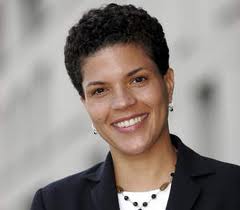
According to legal scholar Michelle Alexander, “More African American men are in prison or jail, on probation or parole than were enslaved in 1850, before the Civil War began.”  In her book on this topic, Alexander calls this “the new Jim Crow,” in which racial segregation and increased police presence in African American communities, combined with poorer schools and lack of economic opportunities have led to a straighter road to prison for young African Americans than to college.

Yes, things have improved since the time of THE HELP, but the road to equality still runs uphill–the playing field is hardly level for blacks and whites in our society, or anywhere in the world.

Troy Davis is yet another victim in the on-going low-level war against people of color in this country.  When are we going to stand up against racial discrimination?  When are we going to say no to the unjust tying of school funding to property taxes, a holdover from colonial times that is holding so many in our nation back? When are we going to insist that the prison-industrial complex stop profiting on the broken lives of young people who never had any chances in life, and start do the job it should be all about: rehabilitation?

Let’s not let the problem of the color line be the problem of the 21st century too.  We have too many other problems to deal with, and we need the creativity and energy of every citizen to remake our civilization into the just and sustainable global society it has always dimly aspired to be.

How Did I Get Here?

Letting the days go by….

If there’s one thing that I can point to that landed me where I am today, it’s the fact that I chose to put my parenting ahead of my career.

Should I be feeling guilty about this?

What does it say about our society that I have to even ask myself that question?

I had my first child when I was 30 and two years away from finishing my doctorate. I wrote my dissertation while he napped as an infant.  When I finished, I half-heartedly went on the job market, but knew, even as I made the rounds of MLA interviews, that I was not willing to subject myself to the rigors of the tenure clock while also caring for a small child.

I ended up at my undergraduate alma mater, Simon’s Rock, teaching as an adjunct.  I thought it would be temporary, a way of “keeping my hand in,” and that when I was ready I would be able to get back on to the tenure track.

If I had known then what I know now–that making the leap from adjunct to tenured faculty is incredibly difficult, even if you have everything going for you–would I have chosen differently?

I don’t think so.  I wanted to work part-time so I would have time to mother my sons the way I myself had been mothered–carefully, tenderly, in a relaxed and open-hearted way.  I did not want to subject them to long hours at day care.  I didn’t want to have to commute long distances, making family dinners impossible.  I didn’t want to have to move far from their grandparents, my parents, who sustained our growing family in so many ways.

Still.  I didn’t realize how much of a stigma would be attached to a professional like me making a decision like that. I didn’t realize how even at Simon’s Rock, moving from adjunct to regular fulltime (the school has no tenure track) would be difficult, to say the least–notwithstanding my impressive publication record, teaching prowess and evident commitment to the institution.

And so I took on a second job, working two-thirds time at Simon’s Rock and half-time at SUNY.  Finally I was making a real living.

But over the nine years that I did both jobs, while also parenting, publishing, making the rounds of professional conferences and organizing my own major annual conference and now month-long festival, my marriage deteriorated.  I thought that as I made more income and had more responsibilities outside the home, my partner would step up and do more parenting.

If anything, he did less.  The more successful I appeared, the more insecure and irritable he became.  This is apparently a common pattern among husbands who are less professionally successful than their wives.

And so I got more and more burnt out.  I remember coming home one day after a full day of teaching, with a car full of groceries, and just being in tears carrying the heavy bags into the house while the boys and their dad looked on, apparently unmoved. It was too much.

Eventually my body said NO MORE and I had a major back spasm, forcing me to do less, and the boys to do more.  Not long after, my husband checked out.

I would never have chosen to give up my second job, but one month into this situation, I have to say that it feels like a blessing.  What a luxury it is to have time to properly prepare my classes, instead of being constantly on the run, playing catch up!  What a pleasure to have more time to visit with family and friends!

Apparently I’m not alone in feeling this way.  As Juliet Schor reports in this month’s YES Magazine, “people who voluntarily start working less are generally pleased. In the New Dream survey, 23 percent said they were not only happier, but they didn’t miss the money. Sixty percent reported being happier, but missed the money to varying degrees. Only 10 percent regretted the change. And I’ve also found downshifters who began with a job loss or an involuntary reduction in pay or hours, but came to prefer having a wealth of time.”

It’s been nine years since I’ve had this kind of luxury of time.  I want to use it wisely–making new networks of friends, being a kinder, less snappish mom, putting time into pleasures that cost nothing, like writing, weeding my garden, walking my dog.  Or just sitting still in the slanting afternoon sunshine, dreaming up another world.

On Becoming a Statistic

I have never felt like such a statistic as I do now.

As of the past few months, I have lost a job, and the health insurance that went with it; gotten divorced and become a single mom; and so suddenly found myself the proud possessor of a mortgage I can no longer afford.

The full catastrophe.

I take some small measure of comfort from the knowledge that it is not just me.  Women have been hit harder in this recession than men, and single women, especially single moms, worst of all.

“In today’s economic and political climate, women are being dealt a triple blow,” says Anika Rahman, President and CEO of the Ms. Foundation for Women. “Indeed, what was once termed a ‘mancession’ is now a ‘womancession.’ Women are losing jobs faster than men because of drastic cuts in areas like education and health care where they make up the majority of the workforce. As the majority of state and local public-sector workers, women are affected most by attacks on public-sector unions. And women suffer most from cuts to social services because they’re more likely to be poor and care for children and the elderly.”

As a matter of fact, the job I lost was in the public education sector. I taught for nine years at SUNY Albany as a Lecturer in Humanities (ie, a salaried professor on a three-year renewable contract), and I was a member of the union, United University Professionals (UUP).  Because it is very difficult for the university to fire individual union members who have been performing well in their jobs, the administration decided, in the interests of saving money, to terminate my entire program, an innovative first year “living & learning” community that had just been shown by external reviewers to have positively impacted students’ success rate at the university.

The administrators I talked with about the program termination made no bones about the fact that it made better financial sense for them to fire a salaried worker like me and hire a few adjunct professors instead.  Why would you pay someone a living wage and benefits when you can get away with paying someone else a pittance with no benefits?

Sadly this is the state of our higher education system these days.  At least 50% of college and university teachers are now adjunct; at many places, including Harvard and my alma mater, New York University, some 70% of the professors are employed on an adjunct basis.

And we’re not talking about graduate students; we’re talking about people with doctorates, who have worked very hard and spent a lot of time and money to attain the highest degree in their discipline, now reduced to working on a semester-to-semester contract, generally for about $4,000 a course (much less at community colleges), with no benefits.  And no end in sight.

So here I am, living in a house I love bought just before the housing bubble burst, when I was married to a man with a decent job, and working two jobs myself–a house that my current income will not cover.  I am lucky that I have the other job to fall back on; but because I worked two jobs all those years, I am still only part-time at Bard College at Simon’s Rock.  I have two teenage children to support, financially and emotionally, at a time when I myself feel like the one needing support.

There is no doubt that I am one of the lucky ones.  Coming even this close to the edge makes me empathize all the more with the millions of Americans, especially women, who are having to roll with the punches of unemployment and economic contraction.

The stresses on the family are huge.  How many men and women are turning up at the doctors’ office begging for anti-depressants to help them get through the day, or drinking too much, or simply zoning out in front of the TV set in order to escape a crushing reality?  Domestic violence is on the rise; so is suicide.

Listening to the political debate over jobs infuriates me because the whole discussion is so superficial.  We need more than a “stimulus” in our society.  We need more than “shovel-ready” jobs.  We need more than an extension of unemployment benefits, or even a restructuring of our tax system.

What we need is to put the soul back into our social relations.  We need to think deeply, as a society, about our priorities and goals.  Do we really want to become a society where the elite managers live in luxury and ease behind heavily guarded gates, while the masses toil miserably on the edge of ruin, and the prison populations grow ever larger, serving the function of Scrooge’s infamous “workhouses”?

We live in a country, and a world, that is rich in natural resources and talented people.  With proper stewardship, there could be enough for everyone to enjoy a decent existence on this planet, a life lived in dignity, with meaning and reward found in service to the common good.

Where is the social movement that will mobilize people like me to stand up and insist on a better future?  Who will throw the spark that ignites the fire for change?

9/11 beyond the hype: What are YOU going to do about it?

Someone asked me today, What do you remember about 9/11?

I remember that at the moment the Twin Towers were hit, I was walking down to the Simon’s Rock College Center from the parking lot, on my way to my morning class—Sophomore Seminar.  It was a gorgeous September day, cool and bright.

My first indication something was wrong was inside the College Center, where there was a strange aura of people scurrying around, consulting with each other in the halls.  I quickly caught on to what at first seemed like a malicious rumor: a plane had hit the World Trade Center.  An accident?

But then no—a second plane had hit.  And the building was on fire.  People were jumping out of windows.  It was a terrorist attack.  Another plane had been hijacked.

And so, within an hour, the whole ghastly event unfolded.  The world that had seemed so safe, predictable and sane to me just minutes earlier, rocked crazily on its axis.

I met my students in the classroom, told them the news, and we all went over to the Lecture Center to watch CNN on the big screen.  The beautiful sunny day faded into the darkness and virtual screenlight.  The towers, falling over and over.  The people, jumping out of the flames to their deaths.

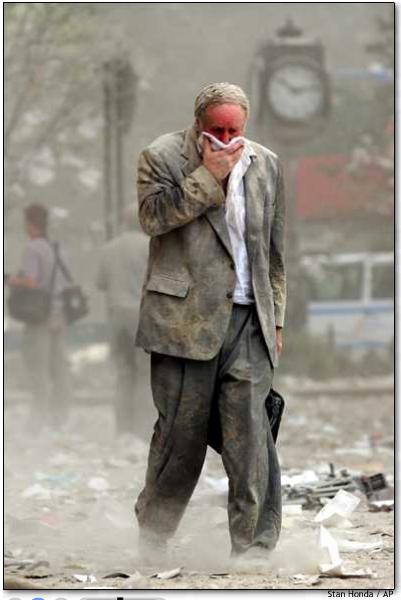
The firefighters, covered with eerie white ash.  The streams of people walking uptown, away from the Towers, like refugees leaving the scene of a genocide.

Manhattan is my hometown.  I have many memories of visiting the Twin Towers.

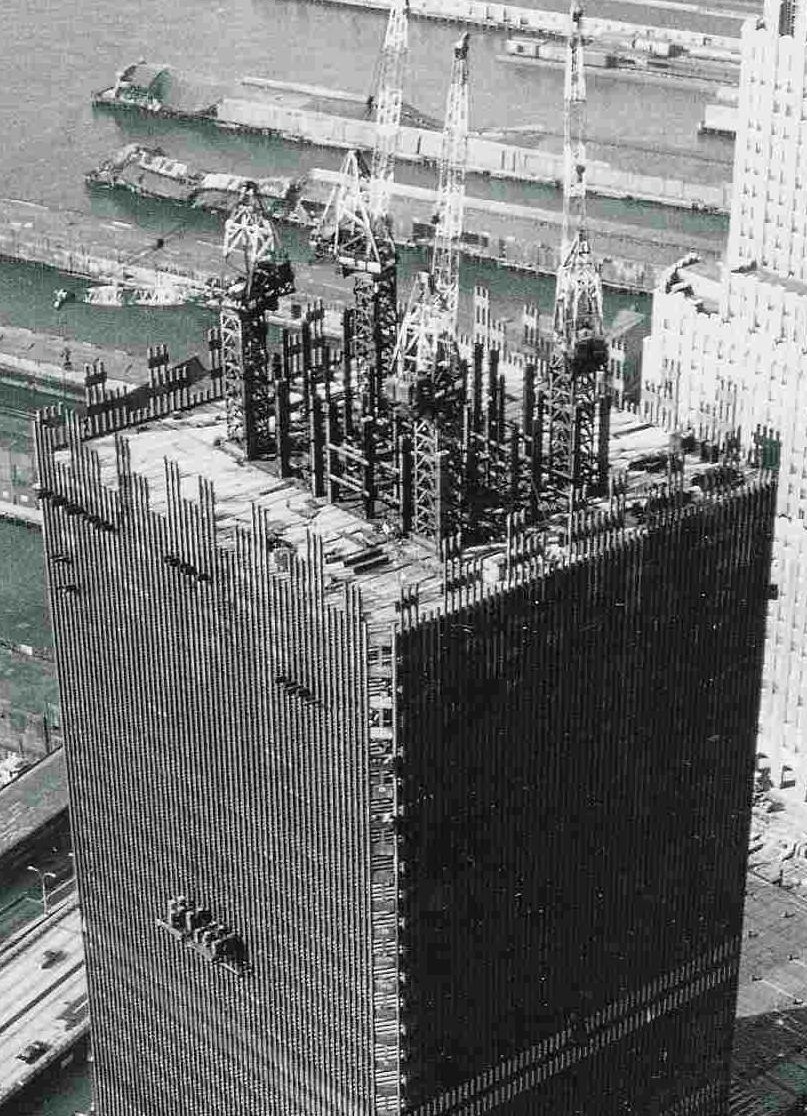
As a child, I remember when they were built, two identical towers rising on the skyline, bristling with huge cranes rendered tiny by distance.  I remember riding the elevator to the observation deck, the sick, scary feeling in my stomach as the elevators accelerated to a speed I didn’t want to fully imagine.

The wind up there, laden with the faint salty tang of the nearby sea; the tourists pointing cameras at the Statue of Liberty, or uptown at the rows of orderly buildings broken up by the green oasis of Central Park.

I have very fond memories, too, of eating dinner at Windows on the World, and the even more exclusive Cellar in the Sky, restaurants that my parents took me to for special occasions, like my 20th birthday.  At Cellar in the Sky, in addition to the fabulous food, you would get a different exclusive wine for each of seven prix fixe courses, ending up with a deep snifter of fine cognac with dessert.  We would leave the restaurant tipsy and glowing with a sense of well-being, the animal satisfaction of being relaxed and truly well-fed.

All gone, after 9/11.

What I lost on 9/11 was far more than just a physical place holding pleasant memories.  I lost my naïve belief that bombings and terrorist attacks only happened somewhere else in the world, never in my hometown.  I lost my sense of privileged aloofness from the rest of the world.

Mind you, by 2001 I was already a college professor, had already finished a dissertation that focused on personal narratives by human rights survivors from Latin America and the Caribbean, as well as North America.  I should not have been so naïve.

But somehow, until the Towers crumbled, it did not fully hit home to me how inevitable it was that the arrogance of American imperialism abroad would boomerang back around to hit us.

And it certainly did not occur to me that this strike would be used to initiate a regime of “homeland security” that brought our country closer to fascism than we had ever come before.

Ten years later, I am still feeling the pain that spread out from Ground Zero like the low ringing of a gong.  It is the pain of all of the peoples exploited by American-led capitalist imperialism, for whom World Trade is synonymous with oppression.  It is the pain of the widows, widowers and orphans, left not only by the terrorist strikes, but also by the ensuing vengeful wars in Iraq and Afghanistan.

The pain only deepens as I begin to understand the extent to which the effects of Western imperialism have hurt the natural world, and destabilized the delicate ecological balance that has made our planet so fruitful.

9/11 hurt America, yes.  But America has been a leader in a global assault on our planet, on a scale that dwarfs the Al Qaeda strike.

 I would never support Al Qaeda, or its methods.  But neither can I support American-led corporate capitalism, with its chemicals and clear-cutting, its cowboy swagger as regards regulation, that has inflicted us with BP-style disasters replaying again and again in excruciating, devastating slow-motion.


What I lost on 9/11 was the sense that none of this had anything to do with me as an individual.

9/11 launched me on a difficult period of self-reflection, in which I realized the extent to which my own privilege as a member of the ruling elites had blinded me to my complicity in the oppressive system that spawned the anger that led to the World Trade Center attacks.

Once you realize your own complicity, you can either wallow in unproductive guilt, or you can roll up your sleeves and resolve to do whatever you can to make a change for the better.

History has shown us that it is the insiders–the wives, sisters and daughters of the masters of the universe—who have tremendous power over the men who love them.  In our day and age, women too can be “masters”—that is, members of the ruling class who control our society.

I think the question for us, ten years after 9/11, is a simple one.  What are you going to do about it?  Are you going to support the status quo, which may benefit you and your family greatly, but which ultimately leads to greater social instability, through political and environmental vulnerability?

Or are you going to be a change agent, someone who is not afraid to speak truth to power and insist on positive change?

On 9/11, there is no more important question to be asking ourselves.

Eco-terrorist? Or freedom fighter?

Well, as President Clinton famously put it, it depends what you mean by “eco-terrorist.”

One man’s “terrorist” is another’s “freedom fighter,” after all.

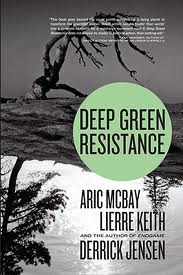
I didn’t need Derrick Jensen, Aric McBay and Lierre Keith to tell me that our planet was in trouble. As someone who has always been tuned into the natural world, I noticed when the dawn chorus of songbirds diminished to a few lone, defiant voices.  I noticed when the summer clouds of butterflies were reduced to single wanderers, here and there.  I noticed when the tree frogs stopped singing, and there were no longer any toads hiding in the damp leaves of the garden.

I noticed.

But I did not react.  Or if anything, I reacted with a kind of sad resignation.  I blamed some kind of faceless “Progress” for the loss of these dearly beloved fellow travelers on the planet; I did not take any kind of personal responsibility for their disappearance, and I did not see anything I might do to slow “Progress” or change its impact on the environment.

Giving money to environmental groups did not seem to make any difference.  Petitioning Congress–ditto.  And so there was just that kind of paralyzed melancholy, a sense of inexorable doom, that only increased as the full scale of our climate change crisis became apparent.

And then I started reading  Deep Green Resistance.  It was hardly my first foray into environmental manifestoes–I’d started with Rachel Carson and Jane Goodall, years ago, and kept up with Bill McKibben, Wangari Maathai, Julia Butterfly and many others.

But this book is different.  It is not only a call to action, but a manual for how to accomplish change–whether you are a middle-aged armchair activist like me, or a stalwart young guerilla resistance fighter.  There is a role for all of us, and it’s spelled out more clearly in this book than I have ever seen it done before.

What inspires me most about this vision of resistance is that it springs most profoundly from love.

“Whatever work you are called to do, the world can wait no longer,” Lierre Keith writes in the conclusion to the book.  “Power in all its versions–the arrogant, the sadistic, the stupid–is poised to kill every last living being.  If we falter, it will win.  Gather your heart and all its courage; fletch love into an arrow that will not bend; and take aim” (515).

“The carbon is swelling; the heat is rising; the rivers are fading and somewhere a black tern is giving up in exhaustion.  The same noose that took Ken Saro-Wiwo is tightening, and there is only time for one last breath.  Will you close your eyes and let the earth fall, with a sickening snap of species and forests and rivers?  Or will you fight?

“Whatever you love, it is under assault.  Love is a verb.  So take that final breath and fight” (495).

The question is, what form will my fighting take?

I don’t see myself as someone who blows up power plants or takes out dams.  Nor am I a computer hacker.

In DGR terms, I am an aboveground activist.  What I want to do more than anything is to awaken “my people,” that is, the privileged ones, the denizens of Park Avenue and Westchester County and Long Island, the ones whose grandparents and great-grands came to this country around the turn of the century and found a land of peace and plenty, and have ridden the 20th century wave of “Progress” to a life of luxury and comfort.

These are the people who need to understand that this lifestyle we have all enjoyed so much IS NO LONGER SUSTAINABLE.  In fact, it is what is driving our entire planet into climate ruin, from which, for us as a species at least, there will be no return.

It is frightening to think about going “back” to the kind of “primitive” lifestyle that we human beings lived for all those thousands of years before the advent of the industrial revolution.  We don’t want to go back to the time before antibiotics, before computers, before hot showers, before TV, before cars, before supermarkets.

But we have to think seriously about what all these “modern conveniences” and “advances” have really given us.  We have to weigh the pros and cons.

I want to believe I come from reasonable people.  I want to believe if the case is made for them in a reasonable way, they will be able to understand.

Understanding is not action, but it is a necessary first step.

Will you take that step with me?