Calling all Occupiers: Join the Deep Green Resistance of the Earth, before it’s too late

Occupy the Machine – Stop the 1%, Literally | Deep Green Resistance.

I had a feeling that the Deep Green Resistance movement would have something interesting to say about the Occupy movement, and I wasn’t disappointed.

As might be expected from a radical environmental group, they are envisioning a massive escalation of the movement, swelling the numbers and multiplying the targets so as to overwhelm the police who will be called in to maintain order.

DGR is imagining an occupation at the sites of worst destruction of the environment, like the boreal forest of Alberta, known to the energy mafia as the tar sands; the coal-burning power plants; the pipelines and the shipping routes.

I might add factory farms to the list, like the beef and hog farms out West that generate the toxic runoff that is poisoning the ocean for miles around the outlet of the Mississippi River.

Naming targets is one thing, but what’s really important is being clear on what the occupations are for. I don’t think the Occupy movement is especially focused on the environment.  It seems to be focused on social inequality–excessive wealth that has destabilized our economy, and the lack of jobs for the middle class.

These are all worthy issues.  But as I’ve said before, it won’t matter a rat’s ass if you have a job–or if you’re dripping in gold or starving and naked–if the climate changes decisively due to global warming.

To turn global warming around will require a movement like the Occupy movement, filled with idealistic, dedicated, thoughtful people who are willing to give it their all.  This struggle has to be linked with a critical rethinking of the industrial capitalist economic model of ruthless extraction and production in the name of profit.

That is the model that has driven our planet to the brink of systemic correction.

Not collapse.  The planet will be fine, she will regenerate.  She has time.  But to do it she will need to effect a serious correction of a species gone haywire, the human species, which in a very short time has altered the planetary environment to such an extent that millions of other species have gone extinct, and supplies of the basic life support systems like oxygen and water are threatened.

The Earth has survived such challenges before, and she will survive this time again.  But human beings, and most of the countless other beautiful life forms that share the planet with us at this time, will be doomed if industrial civilization is not rebooted and recreated as an ecologically sustainable system.

That is where the pressure of the Occupy movement needs to be applied.

Will the Occupiers step up to such an enormous challenge, much bigger than the one they initially envisioned?  Hard to say.  But at the moment they seem to be the best hope of deep change of our society and our terribly destructive economic system.

It’s in the Liberty Parks all across the world that the conversations are beginning that might have the potential to lead to real change.

All the money in the world is not going to buy safety or plenty once the Earth herself begins her own form of Deep Green Resistance.

Our planet, ourselves: we must wake up to the destruction, before it’s too late

First the honey bee population crashed.  Then it was the bats, dying by the millions in their caves during the winter hibernation, of a strange white fungal infection.

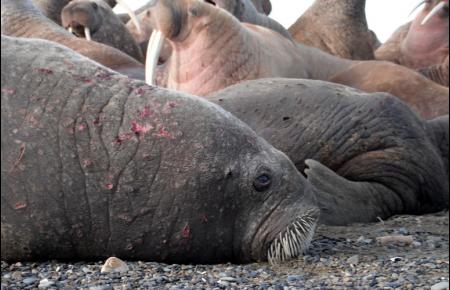
Now marine mammals, including walruses and ringed seals, are turning up dying on the beaches of Alaska and the far north.  Unidentified skin lesions and sores are the visible evidence of an unknown disease that is ravaging them.

Meanwhile, climate change is causing unprecedented surges in the populations of destructive insects like pine borers, which are killing off millions of acres of forests around the world.

I could go on, and on, and on.

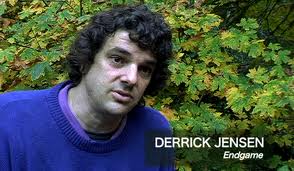
Truly, Derrick Jensen is not exaggerating when he says that human civilization is killing our planet.

Last weekend I watched the new film “End:Civ,” by Franklin Lopez, based on Jensen’s book Endgame.  I had put off watching it for several weeks, because I knew it how upsetting it would be, and sure enough, it was disturbing, to say the least.

For me the hardest-hitting part of the film was about human beings’ casual tolerance of cruelty; our willingness to stand by, indifferent, as our fellow travelers on this planet are systematically hunted or poisoned or displaced to extinction.

Part of this detachment of ours may be rooted in the way we tell the stories of how these deaths occur.  We talk about “colony collapse disorder,” for example, rather than narrating the way that entire hives of bees–which are highly evolved, communicative insects–fail to return to the hive one day.

They get lost out there–maybe due to cell phone waves or other forms of chemical interference, we don’t really know–and never come home.  Imagine this happening on a global scale, a whole species of productive, social insects lost, one by one, by the million.

In the same way, it’s far easier to talk about “cancer victims” en masse than to live through the suffering death of your own loved one.  How many vibrant, creative, hardworking people have we lost to cancer the last ten years?  In the last year?  In the last month?  Wangari Maathai and Steve Jobs, to name two famous, very recent cancer victims.  The list goes on and on and on.

But still we remain passive.  We may mourn the disappearance of the honeybees or the songbirds, but we don’t make the effort to connect the dots and come to a true understanding of the extent to which our way of life has been poisoning our planet since the advent of industrialization, and especially since the beginning of the 20th century, which is when synthetic chemical production really took off.

Before she died of cancer, Rachel Carson managed to break through the wall of indifference and make the case against DDT.  Thanks to her efforts, the bald eagle and many other birds have rallied and come back from the brink of extinction.

It’s amazing how resilient life is.  If human civilization would just back off and give our natural systems on the planet a chance, they would heal themselves, and go back to providing the healthy ecological web that made our success as a species possible.

Our planet, ourselves.  We need to understand, in the deepest and most urgent possible terms, that we cannot dissociate ourselves from the poisoning and destruction that is being visited on the forests, oceans, swamps and grasslands of this planet.

The “Wall Street Awakening” cannot be only about jobs, about fixing a broken economy and continuing on our merry path of global domination and “resource extraction.”  The analysis has to go deeper than that, and the change has to be much more dramatic.

All the jobs in the world won’t bring back the walruses or the ringed seals or the polar bears.  What use will jobs be when the ocean is a giant dead zone, and industrial agriculture collapses?  Will we be worrying about jobs when the forests that provide our oxygen are all gone?

We need to focus on what’s important and go all the way this time.  As I keep saying, our future depends on it.  And I am not exaggerating.

From brooms of resistance to guerilla tactics…let’s keep it going!

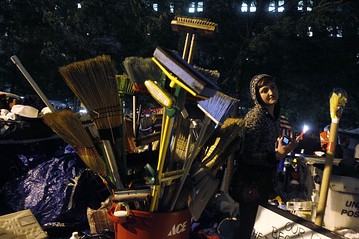
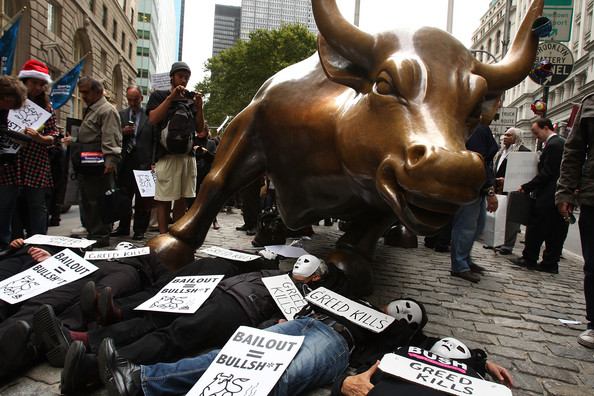
Congratulations to the Occupy Wall Streeters for making weapons out of mops and brooms and holding off the Bloomberg eviction forces!  A major victory!  I wonder when was the last time Bloomberg held a broom–probably so long ago he couldn’t conceive of such a strategy of resistance.

Looking out on this rainy, cool morning, I can’t help but wonder what’s going to happen when the cold winds of winter start to blow.  Those of us supporting this movement from the comfort of our homes don’t want to see the protesters getting frostbite out by the Wall Street bull!

I saw a great suggestion this morning: why not turn the Occupy movement into a guerilla resistance, with daily occupations happening in designated strategic sites all over the country, the occupiers called in via cell phones and social media?  A movement like this would have the flexibility of motion, and would be able to respond to current events.

It could also be fun–like the spontaneous street parties that often happen in European cities, with the partiers called in by cell phone.

Now almost a month old, the Occupy movement has done an outstanding job of waking up this nation.  Let’s keep the momentum going even as the cold winds of winter begin to blow.

Honoring Native Americans instead of Columbus

I’d like to suggest that instead of honoring Christopher Columbus on this day in October, we make this a national holiday in honor of the indigenous peoples of North America.

It is shameful that we have no national day of recognition for the native tribes who were here to welcome the first European explorers.  Perhaps this is no innocent oversight; if there was a day of recognition, we’d have to confront the ugly truth of what those Europeans did to the Native Americans–from smallpox to displacement, massacres and enslavement.

Still, that bloodstained history lurks beneath the surface of national holidays like Columbus Day and Thanksgiving.  It would be better to look squarely at the truth and do something to atone for it–at minimum, honoring the native ancestors of this land, and their contemporary descendants, who continue to struggle and resist the tsunami of Euramerican industrial civilization.  

For an idea of what that struggle looks like today, check out the Honor the Earth website.  Honor the Earth works “to address the two primary needs of the Native environmental movement: the need to break the geographic and political isolation of Native communities and the need to increase financial resources for organizing and change.”  It was founded in 1993 by native rights and environmental activist Winona LaDuke and the Indigo Girls.

In honoring the Native peoples of the United States instead of the European explorer who accelerated the invasion of their territories and the assault upon their cultures, we would be honoring the amazing resilience and wisdom of these ancient tribes, who have withstood the onslaught of European culture with incredible strength, courage and dignity.

We contemporary Americans are standing at a turning point in history where we may be able to get away from the destructive mode of domination represented by Columbus and a host of European explorers after him.

Changing Columbus Day to Native American Day (or perhaps selecting one significant representative Native person from history–I would not presume to suggest a single figure, but there are many to choose from) would be a good start at not only atoning for the bloody history of European-Native encounters, but also moving more harmoniously into the future.


Nobel Peace Prize honorees: why not Vandana Shiva?

How can I complain when the Nobel committee saw fit to grace not one but three women, two from Liberia and one from Yemen, with the annual Peace prize?

After all, I’ve been working for years now to help the women of the two-thirds world gain more power and recognition, and these three women–the towering elder and current President of Liberia, Ellen Johnson Sirleaf; Leymah Gbowee, the Liberian peace activist familiar to many from the portrait of her in the powerful documentary film “Pray the Devil Back to Hell”; and the young Yemeni human rights activist Tawakkol Karman– are certainly very deserving.

In fact, for our anthology African Women Writing Resistance: Contemporary Voices, my co-editors and I chose a quote from President Johnson Sirleaf as one of our epigraphs.  “Listening to the hopes and dreams of our people,” she said in a speech to the American Congress in 2006, “I recall the words of a Mozambican poet, who said ‘Our dream has the size of freedom.’ My people, like your people, believe deeply in freedom–and, in their dreams, they reach for the heavens.”

All three of this year’s Nobel Peace Prize winners have been channels for the hopes and dreams of their people, seeking political empowerment, social stability and security, and a sustainable path forward out of chaos (in Liberia’s case) and stagnation (in Yemen).  Ellen Johnson Sirleaf, who holds a Master’s degree in Public Administration from the Kennedy School of Government at Harvard, has done a lot of good things for her people in her tenure as President, including many development programs aimed specifically at empowering women.  She has succeeded in gaining major debt relief from Liberia’s creditors, as well as brokering deals with big transnational energy companies to extract Liberia’s oil.

The other two Nobel Peace Prize honorees are equally deserving.

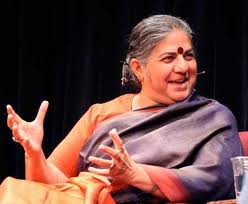
But I wish the Nobel Committee had been a bit more forward-thinking, and seen fit to honor another woman from the two-thirds world, Vandana Shiva of India.  A Ph.D. in particle physics, Shiva has been way ahead of her time for most of her life.

Instead of taking her place comfortably in the ranks of the Indian elite, Shiva became aware as a young woman of the danger of the industrialization of agriculture in India. She founded an organization, Navdanya, dedicated to saving heirloom seeds and preserving the knowledge of how to farm using ancient, local, sustainable methods.

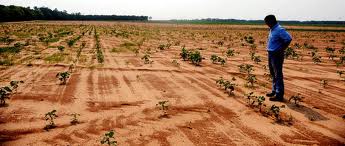
When Monsanto began moving aggressively into the Indian market, luring in farmers with fertilizers and GMO seed on credit, Vandana Shiva was just about the only one who seemed to perceive the huge risk they were taking.  When these same farmers began committing suicide in droves as their reliance on foreign seed, fertilizer and pesticide drove them inexorably into debt, Vandana Shiva was the one who went to court to defend their lands and the rights of their widows.

She has been a veritable David fighting the Goliath of Monsanto for the past twenty years or so.  And in many cases, she has won!

While I also honor Ellen Johnson Sirleaf and her younger co-awardees this year, I have to say that I would like to see them follow more in Vandana Shiva’s footsteps in the future.

Take Liberia, for instance, which in 2010 ranked 162 out of 169 countries on the United Nations Human Development Index.  Ellen Johnson Sirleaf is busy signing agreements with Chevron to extract the country’s oil, and hoping that some of the oil wealth will trickle down to ordinary Liberians, who are still hungry and poor today.

I’d like to respectfully suggest that instead of selling her soul to Big Oil, President Sirleaf follow the example of Vandana Shiva, and look to local, sustainable agriculture and manufacturing to build her country’s economy.

In a time of rapid climate change, it’s the countries and regions that are most self-sufficient and least plugged into the fossil-fuel-driven global economy that are going to be able to ride out the coming maelstrom.

It is clear that the corporate and political leaders of the world have no intention of acting decisively to stop global warming.  Last week’s major climate change story was about a report issued by a Washington D.C. think tank calling for more research into bioengineering of the climate, or “climate remediation.”  Specifically, they’re interested in getting the federal government to fund research into two major approaches:

  • Carbon Dioxide Removal (CDR): CDR strategies aim to remove greenhouse gases from the atmosphere, thereby addressing the root causes of climate change.
  • Solar Radiation Management (SRM): SRM strategies aim to counteract or mask the effect of rising greenhouse gas concentrations in the atmosphere by increasing the amount of solar energy that is reflected back into space.
The first method involves working with plants that will absorb more carbon dioxide, or finding ways to sequester the CO2 we produce back underground.  One could hardly argue with an aggressive tree-planting and conservation campaign, particularly in light of the appalling reality of deforestation across the world today (see this very cool interactive map for the gruesome details).
The second method is the environmental equivalent of Ronald Reagan’s infamous Star Wars missile defense system: a sci-fi-esque plan to install giant mirrors in space, or to seed the atmosphere with reflective particles that will deflect solar rays from Earth.  One can just imagine the military industrial complex salivating at the thought of such a project, particularly at a time when there is so little support for continuing the wars that are this industry’s usual diet.
The problem, of course, is that both of these approaches miss the central most important fact about climate change, which is that nothing will stop it other than aggressive changes to our carbon-based lifestyle.
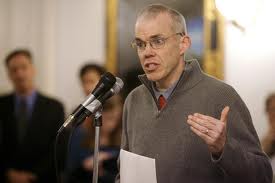
Will that happen?  Can it happen in time?  Maybe the Occupy Wall Street movement can bring the necessary energy to this fight, and I certainly hope they do.  Recently Bill McKibben’s 350.org, a leader in climate change activism, became one of the many larger national organizations seeking to ally themselves with this young juggernaut of political action.

Meanwhile, so-called “less developed nations” like Liberia and Yemen and all the rest should seriously re-evaluate their acceptance of this designation, which means rethinking the whole rationale behind Western-style “development.”  Development, Western-imperialist style, has benefited a few people mightily but brought suffering to the vast majority of people on Earth, especially those in the areas of greatest resource extraction, which are, paradoxically, the “less-developed” nations.

Now the time has come for us here in the heart of Empire to feel the blowback from our aggressive policies of development.  Climate change is upon us.  And in this new era, it is precisely those with the least reliance on oil, electricity and industrial agriculture that will have the best chance of adapting to the new realities of life on Earth.

President Johnson Sirleaf and all the other leaders of “less-developed nations” should stop and reconsider their friendships with the global corporate elite.  The urgent task now is to build resilient communities and economies based on the exchange and consumption of local resources–just like it was for the tens of thousands of years of human existence before the industrial revolution started us off on a different path.

It is people like Vandana Shiva, who are still in touch with older ways of living in harmony with the Earth, who may be able to lead us through the current crisis into a sustainable future.  Let us take heed while there’s still time.

Let’s take back Black Friday, and change history!

I have a suggestion for the Occupy America folks all over this country.  Let’s take back Black Friday.  You know, the Black Friday after Thanksgiving Day, supposed to be one of the biggest shopping days of the American year?

It’s a great day for a decentralized national protest, because nearly everybody, including all those college students, is on holiday.  It’s also a great day for an anti-Big Money protest, because it will hit the corporations where it hurts most: retail sales.

What if instead of swiping those credit cards and running up our consumer debt on Black Friday–making it a black day for consumers, but a golden day for corporations and financiers–we deliberately boycotted the malls?  Instead, let’s declare a day of participatory democracy in action, a chance to meet with our neighbors and fellow citizens out on the public square, in cities and towns all across this country, to collectively envision a new society based on the true ideals of Thanksgiving: joining together as human beings across superficial differences like ethnicity, nationality and creed, nourishing each other with the bounty of our natural world and helping each other through lean times.

We live on a rich and abundant planet where there are sufficient resources for all of us to live well–the problem is the inequitable distribution of those resources.  On the original Thanksgiving, the native hosts were kind enough to give their Puritan guests a helping hand.  The rest is history, and it’s not a happy history at all.

We are standing at a crossroads where we have a chance to step off the path we began as a nation when the Europeans colonized this country and the capitalist machine began to roar.  We may not get another chance, given the precarious state of our global climate.

Now is our time.  Let’s step up and change history together.  Black Friday organizers, let’s get busy!

Resisting the Zombies: At what point will we stop bearing witness to ecocide and begin to act?

My favorite chapter in Derrick Jensen’s new book Dreams is entitled “Zombies.”  Jensen describes the corporate elite as zombies, that is, as “flesh-eating…mindless monsters who are not only to be feared for their insatiability and ferocity, but because their sickness is highly contagious….Zombies eat human flesh, but they are also as relentlessly omnicidal as corporations.  They destroy forests, grasslands, rivers, oceans, mountain tops, and the mountains themselves.  They consume everything, and they shit out plastic” (367).

For Jensen, “zombie capitalists” are especially terrifying, because “on the one hand, they pursue their prey–I mean, profits–with an unfeeling, unrelenting, insatiable mindlessness, unheeding of all the pain and suffering they cause in their victims–I mean, in the resources they exploit (I mean, develop).  On the other hand, they fabricate extraordinarily complicated rationales for their zombie economics (or zombinomics) and for the further zombification of the world and all its inhabitants” (368).

Jensen imagines a “realistic zombie film” being made, in which “the remaining humans”–the ones who haven’t been consumed or infected yet by the zombies–are “refusing to resist, but instead hoping against reason that the zombies will stop on their own, that the zombies will undergo a miraculous awakening…or that if they personally could just live sustainably, then their shining examples will cause the zombies to suddenly stop, look at the torn flesh all around them, and say, ‘What have I done?  I need to make this right!’….In a realistic zombie movie,” Jensen says, “too many humans would try to stop the zombies by gardening, taking shorter showers, recycling, petitioning.  In a realistic zombie movie…many of those humans who opposed resistance would be revealed near the end to not really be on the side of the living but rather, unbeknownst even to them, already among the living dead” (369).

Unfortunately, all too often, even those who profess to be on the side of justice and environmental sanity are eventually shown to be soulless creatures of the corporate capitalist zombie machine.

It seems that the minute an authentic human leader arises who has the possibility of successfully resisting the zombies and making real change, s/he is either smeared and discredited; corrupted with financial payoffs; driven mad with frustration by repeated, humiliating obstructions; or simply imprisoned or killed off.

Thus we have watched with horror as our beloved Barack Obama, the young man we came to know and love in Dreams from my Father and The Audacity of Hope, has slowly had the soul sucked out of him by the zombification crucible of politics and media.  The face remains the same, but the eyes are hollow, and the spirit is clearly guttering.

Bill McKibben is still holding out valiantly against the zombies–maybe it’s that pure Vermont air that is keeping his head clear of contagion so far.  Derrick Jensen has some harsh questions for Bill, though, which I think are entirely reasonable.  Given the steady destruction of the planet by the zombie forces of corporate capitalism, Jensen asks, “Would McKibben ever countenance the physical dismantling of infrastructure in order to stop civilization from killing the planet?” Jensen’s question, “for McKibben and for everyone,” is: “What is your threshold?”  At what point will we stop bearing silent witness to ecocide, and begin to seriously resist?

The reason the Occupy Wall Street protests have so seized the American imagination is because the young people out there on the street are so clearly NOT ZOMBIES.  Not yet, anyway.  They have not been corrupted; their souls are intact.  That’s why they can see so clearly that what the zombie nation accepts as normal–the enrichment of the few on the backs of the masses–is not normal at all, and is neither just nor sustainable.

There is another up-and-coming activist who is right now wavering on the border between zombie and human.  His name is Van Jones, and he’s the man behind the Rebuild the American Dream movement.  Jones is all about developing “green-collar jobs”; in other words, rebooting the old American Dream in a new, more sustainable version.  Unlike Occupy Wall Street, Jones comes armed with a nice bullet-pointed list of “demands.”

Nothing wrong with his list.  But it’s just not radical or visionary enough to ignite the minds and hearts of the young people out in Liberty Park Plaza.  Even the way his website is presented, with red-white-and-blue stars and flashy campaign-style graphics, is very likely to turn a lot of the Occupy Wall Streeters off.  It reeks of zombification.

When you look into Jones’ bio, you see why: “Jones served as the green jobs advisor in the Obama White House in 2009 and is currently a senior policy advisor at Green For All. He also holds a joint appointment at Princeton University as a distinguished visiting fellow in both the Center for African American Studies and in the Program in Science, Technology and Environmental Policy at the Woodrow Wilson School of Public and International Affairs.”

I’m sorry, but once Princeton and the Woodrow Wilson School get their hands on you, zombie contagion is almost assured.  You may not want to become one of them–the elite, the 1%–but like it or not, you will be beholden to them, and they will begin to mold you in ways you won’t even be aware of.

For example, contrast that slick Rebuild the Dream website, completely cleansed of its grassroots origins, to the Occupy Wall Street website, with its livestream coverage of the chaotic goings-on down on Liberty Square.  The livestream may be focusing on a dark corner, but you can hear people in the background singing together and talking in real human-speak–not the carefully crafted politician-speak of Rebuild the Dream’s “demands.”

I don’t like to dis Van Jones, any more than Derrick Jensen likes to dis Bill McKibben.  All of these men, including the old Barack Obama, are heroes for our time for having dared to at least try to resist.  Bill McKibben is still holding out, and we need to applaud him for it and help him in any way possible.

But most of all, we need to help those kids out in Liberty Square.  We need to make sure they know that what is best and most powerful about their nascent movement is the fact that it is not slick, not uber-organized, not hyper-networked.  It’s human, and I still dare to hope it will stay that way.  I still dare to hope that a real resistance to the zombie elite might just be getting underway.

Enough already!

I know it’s not just me.  So many people I’ve talked to this week are feeling it.

It’s a kind of low-grade malaise, nothing you can put your finger on, just a weary, burned out sense of ENOUGH ALREADY.

Enough bad news.  Enough of the stock market endlessly gyrating downward.  Enough unmanned drones picking off clerics in desert hideouts.  Enough executions.  Enough police brutality.  Enough racism.  Enough bullying in the schools, and in the Congress.  Enough global warming.  Just ENOUGH ALREADY!!

But you know what?  There is no magic wand that can make these problems go away. We’re sleep-walking in some kind of collective cultural trance, living through a waking nightmare in excruciating slow motion.  What we need to do is WAKE UP and stop our goose-stepping death march.

That’s what the people sitting out in Liberty Plaza Park, Wall Street, are trying to do.  They’re trying to break the trance by doing something radically unexpected.

In our country, we sign online petitions and donate funds by cell phone, but we don’t sit out in the rain and use our collective voices as natural amplifiers. We don’t publicly put our bodies on the line.

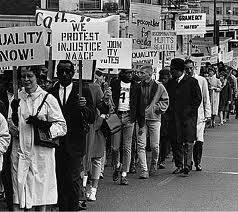
Or maybe we do.  I am too young to remember the Civil Rights protests or the Stonewall riots.  I’m way too young to remember the workers’ strikes of the 1930s.  But these acts of resistance live on in our American collective unconscious, and it’s time to tap into them now.

The antidote to the vague sense of despair and depression that so many of us seem to be feeling these days is, quite simply, ACTION!  If we let this creeping malaise get to us, it’s all over.  We might as well just admit defeat.

And that, my friends, is unthinkable!  So let’s rouse ourselves, let’s prick ourselves in the flanks, let’s get out there and fight the good fight!  It’s the least we can do for the country and the planet that needs us–terribly.

Wangari Maathai’s Canopy of Hope: remembering a warrior woman for the planet and role model for us all

Kenyan Wangari Maathai, who died last night of ovarian cancer, was a woman who took everything she learned and used it for the benefit of her local community and the planetary community as a whole.

As a girl, she used to sit by a certain fig tree that grew near her family village.  Beside the fig tree a clear, sparkling stream flowed, planted with arrowroots and hopping with small frogs.  Her mother told her that this was a “tree of God,” which wasn’t to be harvested for firewood.

Later, Wangari realized that “there was a connection between the fig tree’s root system and the underground water reservoirs.  The roots burrowed deep into the ground, breaking through the rocks beneath the surface soil and diving into the underground water table.  The water traveled up along the roots until it hit a depression or weak place in the ground and fushed out as a spring.  Indeed, wherever these trees stood, there were likely to be streams.  The reverence the community had for the fig tree helped preserve the stream and the tadpoles that so captivated me.  The trees also held the soil together, reducing erosion and landslides.  In such ways, without conscious or deliberate effort, these cultural and spiritual practices contributed to the conservation of biodiversity” (Unbowed, 46).

Wangari came of age as the traditional wisdom of the village people was giving way before the onslaught of Western epistemologies.  A girl who excelled in her schooling, she educated by Catholic nuns, and was fortunate enough to be chosen for the so-called Kennedy airlift of 1960, under which the Joseph P. Kennedy Foundation provided scholarships for promising young African students to study in America—the same program that brought Barack Obama’s father to the U.S. to study.

Wangari ended up at Mount St. Scholastica, a Benedictine women’s college in Kansas, where she majored in science, and she went on to earn a Master’s in biology at the University of Pittsburgh. She continued her studies in Germany, and in 1971 earned a Ph.D. in biology from the University College of Nairobi—the first women in East and Central Africa to earn a doctoral degree.

Like so many other highly educated women who join the workforce, Wangari experienced plenty of gender discrimination as she tried to advance her career. Frustrated with her lack of advancement within the university, she joined the National Council of Women of Kenya, which was a group of educated women who sought to improve the living conditions of all Kenyan women.

“We could either sit in an ivory tower wondering how so many people could be so poor and not be working to change their situation, or we could try to help them escape the vicious cycle they found themselves in,” she said.  “This was not a remote problem for us.  The rural areas were where our mothers and sisters still lived.  We owed it to them to do all we could” (124).

For Wangari, the problems were clear:

“The connection between the symptoms of environmental degradation and their causes—deforestation, devegetation, unsustainable agriculture and soil loss—were self-evident.  Something had to be done.  We could not just deal with the manifestations of the problems.  We had to get to the root causes of those problems.

“Now, it is one thing to understand the issues.  It is quite another to do something about them.  But I have always been interested in finding solutions.  This is, I believe, the result of my education as well as my time in America: to think of what can be done rather than worrying about what cannot.  I didn’t sit down and ask myself, ‘Now let me see, what shall I do?’ It just came to me: Why not plant trees?’ The trees would provide a supply of wood that would enable women to cook nutritious foods.  They would also have wood for fencing and fodder for cattle and goals.  The trees would offer shade for humans and animals, protect watersheds and bind the soil, and, if they were fruit trees, provide food.  They would also heal the land by bringing back birds and small animals and regenerate the vitality of the earth.

“That is how the Green Belt Movement began” (125).

 The Green Belt Movement mobilized thousands of ordinary women in Kenya to start tree nurseries, and to plant trees near their homes.  It also became a forest conservation movement, with Wangari leading women in protecting Kenya’s remaining forests against the loggers hired by giant transnational conglomerates.  She made plenty of enemies in the government when her agenda threw a wrench in their greedy plans, and she was often afraid for her life.  She was thrown in jail many times, and frequently confronted violence at the hands of police and goon squads.


 Through it all, she remained, as the title of her memoir suggests, UNBOWED. She would not be browbeaten into submission to authority.  She knew that her cause was not only righteous but right for Kenyans and for the planet she loved, and this gave her the courage to stand firm against intimidation.

Wangari’s activism cost her her marriage: her husband, a Kenyan Member of Parliament, divorced her after she earned her Ph.D. and became more financially successful.  She could have chosen the easy way and lived a very privileged, comfortable existence in Nairobi, if she had been willing to bow her head and put her husband’s needs and career before her own.  Instead, she went through a humiliating public divorce trial:

“It became clear that I was being turned into a sacrificial lamb.  Anybody who had a grudge against modern, educated and independent women was being given an opportunity to spit on me.  I decided to hold my head up high, put my shoulders back, and suffer with dignity: I would give every woman and girl reasons to be proud and never regret being educated, successful and talented.  ‘What I have,’ I told myself, ‘is something to celebrate and not to ridicule or dishonor’” (146).

The divorce trial ended, incredibly enough, with Wangari being sentenced to six months in prison for “contempt of court”; she was hauled off to prison without even having the time to say goodbye to her children. It was clearly an attempt to put this uppity woman in her place, but it did not work: Wangari would not be intimidated, and emerged from prison determined to put her talents to work for her people, come what might for herself personally.

Her Green Belt Movement became a model for sustainable, grassroots-driven development throughout Africa and beyond, which worked not only for environmental sustainability, but also for women’s rights, human rights and participatory democracy.  Wangari consistently provided an upright model of honest, steadfast leadership, leading by example in speaking truth to power and and refusing to be cowed.

“What I have learned over the years,” she said, “is that we must be patient, persistent and committed.  When we are planting trees sometimes people will say to me, “I don’t want to plant this tree, because it will not grow fast enough.” I have to keep reminding them that the trees they are cutting today were not planted by them, but by those who came before.  So they must plant the trees that will benefit communities in the future.  I remind them that like a seedling, with sun, good soil, and abundant rain, the roots of our future will bury themselves in the ground and a canopy of hope will reach into the sky” (289).

Wangari Maathai herself grew that “canopy of hope” for all of us.  May the seedlings she planted be nourished with care by those of us who aspire to walk in her footsteps, for all those who deserve a better world in the future here on our precious planetary home.
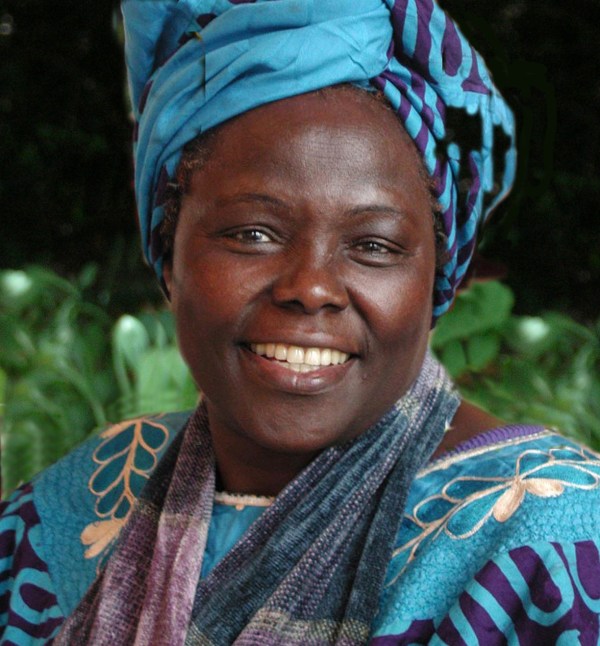
Wangari Maathai, Nobel Peace Prize Laureate, Dies at 71 – NYTimes.com

Wangari Maathai, Nobel Peace Prize Laureate, Dies at 71 – NYTimes.com.

Truly a great leader, I can’t believe she is gone.  So fast!  I can’t help but think that had she been living in the West, the cancer would have been caught earlier and she would still be with us.  A great loss for the world.  More later.