The Civilization We Grew Up In Is Already Dead. So now what?

“If we want to learn how to live in the Anthropocene, we must first learn how to die.”

This is the last line in a fine essay by Roy Scranton, former U.S. soldier and currently a doctoral candidate in English at Princeton University.  The essay, published in the New York Times philosophy blog “The Stone,” is one of those rare attempts to really lay out the gravity of the situation we face today, as humans on a rapidly destabilizing planet.

Readers of Transition Times have been hearing me give my doom-and-gloom warnings for years now.  But it’s very rare that such grim scenarios break into the gilded precincts inhabited by readers of The New York Times.

Here is Scranton:

“The challenge the Anthropocene poses is a challenge not just to national security, to food and energy markets, or to our “way of life” — though these challenges are all real, profound, and inescapable. The greatest challenge the Anthropocene poses may be to our sense of what it means to be human.

“Within 100 years — within three to five generations — we will face average temperatures 7 degrees Fahrenheit higher than today, rising seas at least three to 10 feet higher, and worldwide shifts in crop belts, growing seasons and population centers.

“Within a thousand years, unless we stop emitting greenhouse gases wholesale right now, humans will be living in a climate the Earth hasn’t seen since the Pliocene, three million years ago, when oceans were 75 feet higher than they are today.
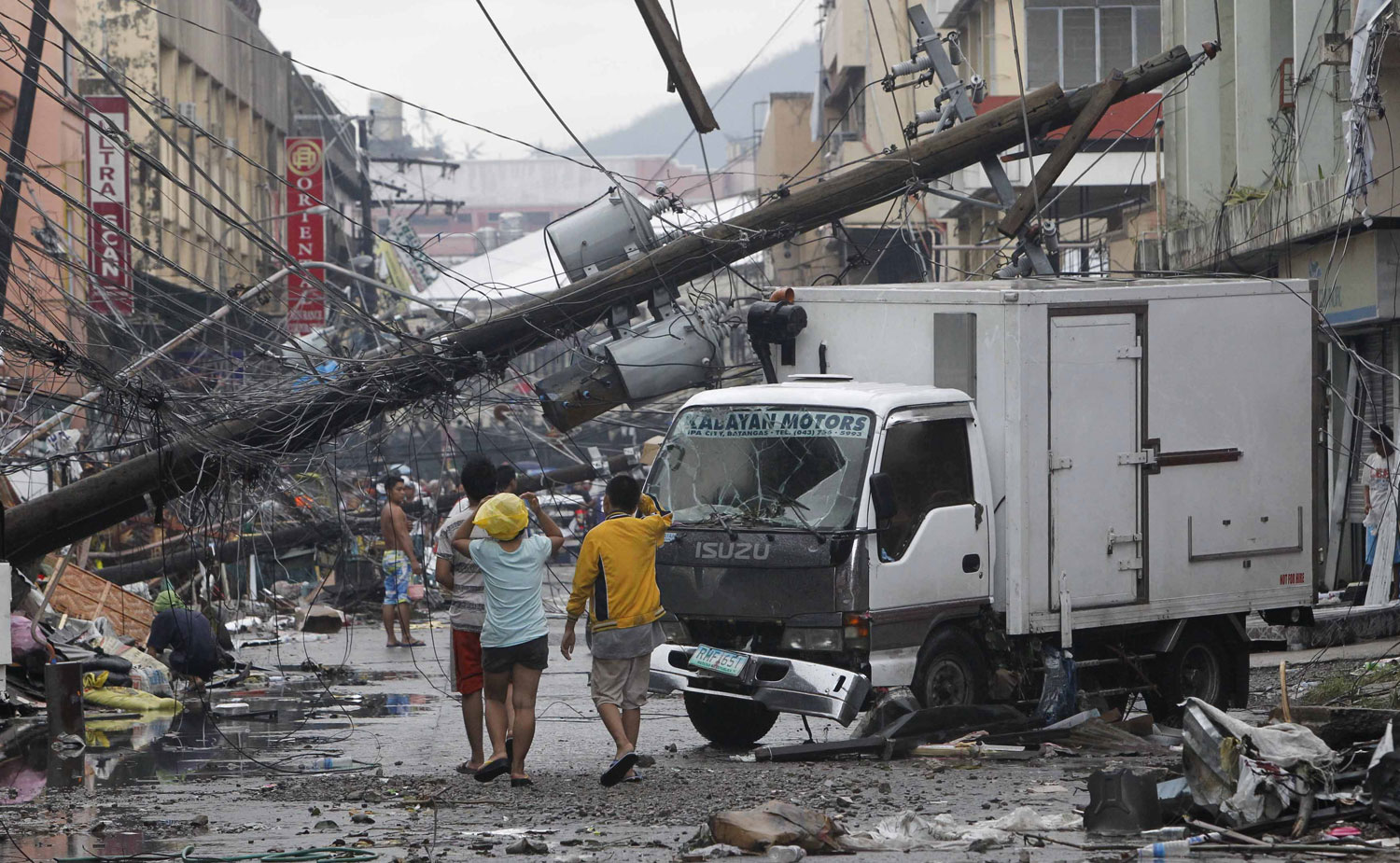
Aftermath of Typhoon Haiyan

Aftermath of Typhoon Haiyan

“We face the imminent collapse of the agricultural, shipping and energy networks upon which the global economy depends, a large-scale die-off in the biosphere that’s already well on its way, and our own possible extinction.

“If homo sapiens (or some genetically modified variant) survives the next millenniums, it will be survival in a world unrecognizably different from the one we have inhabited.”

Yes.  We know this.  It’s actually what Scranton does next in his essay that most interests me.

He makes a turn into the humanities, arguing that since “studying philosophy is about learning how to die,” then we have now “entered humanity’s most philosophical age — for this is precisely the problem of the Anthropocene. The rub is that now we have to learn how to die not as individuals, but as a civilization.”

Scranton reminds us that “the biggest problems the Anthropocene poses are precisely those that have always been at the root of humanistic and philosophical questioning: ‘What does it mean to be human?’ and ‘What does it mean to live?’

“In the epoch of the Anthropocene, the question of individual mortality — ‘What does my life mean in the face of death?’ — is universalized and framed in scales that boggle the imagination. What does human existence mean against 100,000 years of climate change? What does one life mean in the face of species death or the collapse of global civilization? How do we make meaningful choices in the shadow of our inevitable end?”

These are the kind of questions I ruminate about daily.  It comes back to Mary Oliver’s signature question, in her haunting poem “The Summer Day”—“What will I do with my one wild and precious life?”

We never know if our own deaths are right around the corner.  Will the truck driver around the next bend be distracted by his phone, cross the yellow line and blow me to oblivion?  Will my next physical exam reveal a terminal illness?  It could happen any time.

But as Scranton says, the climate change issue is much bigger than any of our individual lives.  It’s about the future of human civilization on the planet.

He ends his essay provocatively, saying that the problem of climate change cannot be solved by “buying a Prius, signing a treaty, or turning off the air-conditioning.” What is needed is a profound philosophical shift; to go from a civilization built on the illusion of endless growth and consumption, to a steady-state civilization that the planet can sustain.

We need to realize, Scranton says, that the human civilization all of us grew up in “is already dead. The sooner we confront this problem, and the sooner we realize there’s nothing we can do to save ourselves, the sooner we can get down to the hard work of adapting, with mortal humility, to our new reality.”

Yeb Sano breaks down speaking about the devastation in the Philippines after Typhoon Haiyan, and begs the climate negotiators to act decisively to curb carbon emissions

Yeb Sano breaks down speaking about the devastation in the Philippines after Typhoon Haiyan, and begs the climate negotiators to act decisively to curb carbon emissions

Watching the desperation on the faces and in the voices of the climate negotiators from sea-level nations like the Philippines, Bangladesh, and the Maldives, it’s clear that these folks have already absorbed the lesson we in the higher-terrain countries have yet to confront.

We cannot go on with business as usual any longer.

Not if we want to bequeath a livable Earth to our descendants.

Severn Suzuki speaking out

Severn Suzuki speaking out

Severn Suzuki said it all, so eloquently, speaking to a climate change summit way back in 1992, when she was just a girl of 12.  Are we ready to listen yet?

In the Body of the World: Cancer as Catalyst for Revolution

Eve Ensler

Eve Ensler

I have been reading Eve Ensler’s incredibly powerful cancer memoir, In the Body of the World, with my students this week.  We watched Ensler’s 2010 TED Talk, “Suddenly My Body,” given while she was still practically bald from the chemo treatments; and you could have heard a pin drop in the room, everyone was so swept away by Ensler’s passionately delivered paean to the intricate interconnections between the individual body and what she later came to call “the body of the world.”

This is a concept I have most often heard expressed in Buddhist circles.  Thich Nhat Hanh and the Dalai Lama talk about “inter-being,” and how it is egotistical, arrogant, androcentric and just plain wrong for human beings to imagine that we are somehow separate, over and above other livings beings on the planet.

Joanna Macy

Joanna Macy

Joanna Macy, extending Arne Naess’ concept of the “ecological self,” uses the body as a metaphor to describe the futility of imagining ourselves as immune from the destruction we are wreaking on our planet.

The concept of the “ecological self,” Macy says, is important now because “moral exhortation does not work.  Sermons seldom hinder us from following our self-interest as we conceive it.

“The obvious choice, then, is to extend our notions of self-interest.  For example, it would not occur to me to plead with you, ‘Don’t saw off your leg.  That would be an act of violence.’ It wouldn’t occur to me (or to you) because your leg is part of your body.  Well, so are the trees in the Amazon rain basin.  They are our external lungs.  We are beginning to realize that the world is our body” (World as Lover, World as Self, 157).

Eve Ensler has spent much of her life recovering from violence (she was a sexually assaulted and battered by her father as a child), bearing witness to violence against other women and girls, and creating powerful creative works, organizations and movements to end violence against women and girls.

And yet, she says, it was not until the jolt of realizing that her body had been invaded by cancer that she was able to overcome her ingrained alienation from her own body, born of the dissociation that was a survival tactic in her childhood.

Once she allowed herself to become fully connected with her body, it was but a short step to see the cancer in her uterus as symbolic of the much greater cancers of over-consumption and unsustainable growth afflicting the body of the world.

“Cancer is essentially built in our DNA, our self-destruction programmed into our original design—biologically, psychologically.  We spend our days, most of us consciously or unconsciously doing ourselves in.  Think building a nuclear power plant on a fault line, close to the water.  Think poisoning the Earth that feeds us, the air that lets us breathe….We are a suicidal lot, propelled toward self-eradication” (194).

But as Ensler discovers how fiercely she wants to live, to survive the cancer, she realizes that human beings are propelled as much toward life as toward death.  In a further twist of Freud’s insight into the immortal battle between Eros and Thanatos, she realizes that love is the answer—a fierce, unstoppable love for the battered, assaulted but still beautiful Earth, our mother, our home, our self.

Like Eve Ensler, I have spent much of my life focusing on the stories of women, and working to empower women to speak our truths and change the world for the better.

As I ponder the way forward now, in these end times of environmental tragedy, I am wondering whether women have a special role to play in bringing about the kind of radical social change that we need to survive into the future.

City of Joy openingEnsler uses the City of Joy, which she worked so hard to build in Bukavu, DRC (with the help of women all over the world contributing through the V-Day infrastructure), as a model for the kind of new life-giving, life-enhancing community that the world needs now.

It’s a City of Women, founded on the following ten principles:

1. TELL THE TRUTH

2. STOP WAITING TO BE RESCUED; TAKE INITIATIVE

3. KNOW YOUR RIGHTS

4. RAISE YOUR VOICE

5. SHARE WHAT YOU’VE LEARNED

6. GIVE WHAT YOU WANT THE MOST

7.  FEEL AND TELL THE TRUTH ABOUT WHAT YOU’VE BEEN THROUGH

8. USE IT TO FUEL A REVOLUTION

9. PRACTICE KINDNESS

10. TREAT YOUR SISTER’S LIFE AS IF IT WERE YOUR OWN

These seem like sound principles on which to base any human community, and particularly one founded on ashes, corpses and pain, as is the case in the Congo (but isn’t almost every human society founded, as Marx said, on blood?).

Women stay for six months at the City of Joy, during which they recover their physical and mental health with all kinds of therapies, participate in skills training, and get ready to return to their homes as leaders who can become change agents for peace and sanity in one of the most brutal and brutalized regions of the planet.

I know that there can be no lasting change that doesn’t also include men.  There can be no “City of Women” that survives past a single generation.

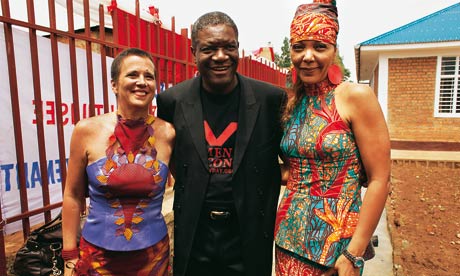
Eve Ensler, Dr. Denis Mukwege and Christine Deschryver, co-founders of the City of Joy.  Dr. Mukwege is a Congolese gynecologist who has operated on hundreds of women and girls left incontinent by tears in their vaginas due to violent rape.

Eve Ensler, Dr. Denis Mukwege and Christine Deschryver, co-founders of the City of Joy. Dr. Mukwege is a Congolese gynecologist who has operated on hundreds of women and girls left incontinent by tears in their vaginas (fistulas) due to violent rape.

I also know that it is important to recognize and acknowledge righteous anger at those responsible for all the destruction and violence.

We have to speak the truth that in the Congo, as on Earth overall, it has been men, acting with the blessing of our patriarchal religious, political, legal and social structures, who have been responsible for the machines, technologies and brutalities that have been so destructive to individual women and men, as well as to the environment without which we cannot live.

Women have often been complicit and have enjoyed the fruits of industrialization.  Women, especially privileged women, have gone along for the ride.

But it was never the vision of women that created the weapons and bulldozers, the chain saws and cars, the nuclear power plants and oil rigs.  All of those implements were envisioned, created and deployed by the men in charge of human society—especially the Europeans and their colonized offshoots—these last few centuries.

We can’t know now whether it would have been different if women had been allowed education and access to the board rooms and laboratories and congressional chambers where society-changing decisions got made, particularly during the crucial two centuries of industrialization.

We can’t change the past.  We can only look forward and, as mandated in the City of Joy’s Guiding Principles, “stop waiting to be rescued, tell the truth, and use it to fuel a revolution.”

eve-ensler-approved-photo_193x290[1]At death’s door, Eve Ensler realized that human beings and the world we have so profoundly altered are now at the threshold of a new era.

“What is coming is not like anything we have known before,” she says. “Your dying, my dying, is necessary and irrelevant and inevitable.  Do not be afraid, no, death will not be our end.  Indifference will be, disassociation will be, collateral damage, polar caps melting, endless hunger, mass rapes, grotesque wealth.

“The change will come from those who know they do not exist separately but as part of the river….You worry about germs and stockpile your herbs, but they will not save you, nor will your fancy house or gated villages.  The only salvation is kindness.  The only way out is care” (214).

I would like to quote the entire last chapter of Ensler’s remarkable memoir, but I won’t—just go buy the book and read it for yourself.  And then, as she says, “let us turn our pain to power, our victimhood to fire, our self-hatred to action, our self-obsession to service” (216).

Unknown-1Women, it’s time for us to rise and give birth to a new human relationship with the planet and with each other.  It’s past time.

Men are most welcome to join us in this life-saving mission, as long as they are men in touch with their feminine side, their life-giving, nurturing, relational side.

All of us humans possess both masculine and feminine energies and traits.  What we need now is balance.  Balance within each one of us that can become a catalyst for the balance our planet so desperately needs.

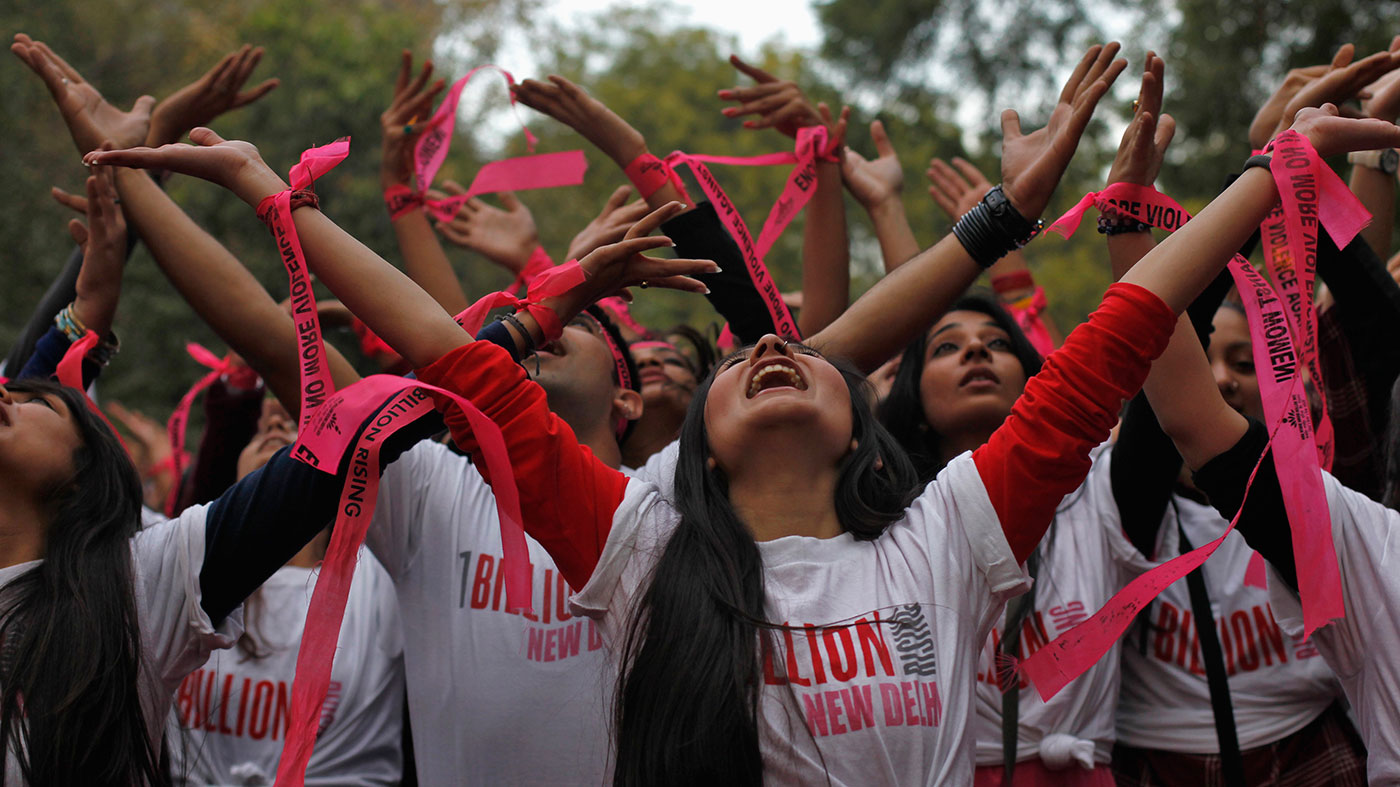
1billion-home-india

PS: Check out this TED Talk by Eve from just before she came down with cancer, talking, miraculously, about the importance of the “girl cell” in both men and women.

A message from the wounded heart of our magnificent Earth

This week, as in the foreground Washington politics continued as usual, a remarkable animal came like a messenger sent to remind me of the state of things in the background, where what’s really important is going on.

I’m using Mary Daly’s terminology here: she calls everything that mainstream society generally focuses on part of the “foreground,” which distracts us from the deeper and more significant issues and events going on in the “background.”

Instead of worrying about how the “snools” are jerking the country around from their headquarters inside the Beltway, Daly urges us to pay attention to the bigger, deeper picture of what’s happening on a global level to the ecological systems that keep us all alive.

Sometimes it’s hard to wrench my attention away from all the grotesqueries going on in the foreground.  This week, I had help.

***

On Tuesday, as I was walking along a trail by a small river near my house, in the gathering gloom of dusk, I looked back to see my dog Loki standing stock-still near a large object that I couldn’t immediately identify.

Afraid it might be a big and potentially dangerous animal, like a raccoon, I hurried back, and was astonished to perceive that Loki was standing nose to beak with an enormous eagle-like bird.

osprey

Both animals were calm, and Loki came to me at once when I called.

The eagle, which I later identified as an osprey, turned and looked at me keenly, with a gaze I can only call commanding.  Its huge, hooked beak was intimidating; this was not the kind of wild animal I would consider going anywhere near.

And yet here it was, down on the ground, strong and well-fed, clearly in its prime, but immobilized by a badly broken right wing, which was hanging twisted and useless at its side.

A human being in that condition would have been writhing and crying desperately for help.

The osprey merely stood its ground, calmly and regally, waiting.

It was still there the next morning when I went back to check on it.  I had called the state Fish & Wildlife Service, and as I stood there by the eagle, a wildlife biologist called me to ask directions to the bird.  He was going to bring it to a veterinarian to have its wing set, and then bring it to a shelter.

Wild raptors with broken wings almost never fly again, but there are raptor rescue centers that maintain them as ambassadors for their kind, educating the public about the beauty and importance of these magnificent birds.

 ***

I don’t know how that bird came to break its wing. There was a house not far away from where I found it; perhaps it flew into a window at full tilt?

I do know that if it had come down elsewhere, away from the trail, it would have certainly died of starvation or been eaten by a coyote, which I have seen in those woods.

In this case, human beings could be of use to this osprey, and indeed I felt very strongly, when it trained its sharp, steely gaze upon me, that it was demanding my help.

More broadly, I take my encounter with the eagle this week as a reminder to keep my focus on the bigger, deeper picture of the continual wounding of the natural world.

For every damaged osprey there are literally millions of creatures I can’t see personally, who are wounded and dying all over the Earth.

I can’t afford to lose myself in the busy-ness and distraction of foreground concerns—the headlines of mainstream media outlets, the daily housework, the struggle to make enough money to pay bills and keep my family going.

Those concerns will continue and as a functioning member of human society, I have to keep my eye on them.

But my inner eye–my third eye, my most deeply aware sense of vision–must be ceaselessly trained on the slowly unfolding planetary tragedy that is occurring relentlessly in the background.  I must stay alert for opportunities to be of help to those who cannot help themselves.

I thank the beautiful osprey for this reminder, and wish it, most fervently, Godspeed.

IMG_4053 copy

Tell me a different story, somebody, please!

As a college professor with a focus on media and issues of social and environmental justice, it’s my responsibility, I believe, to be tuned into the news of the day.

I need to know that, as reported by Jennifer Steinhauer in The New York Times, “For roughly 30 hours over several days, defense lawyers for three former United States Naval Academy football players grilled a female midshipman about her sexual habits. In a public hearing, they asked the woman, who has accused the three athletes of raping her, whether she wore a bra, how wide she opened her mouth during oral sex and whether she had apologized to another midshipman with whom she had intercourse “for being a ho.”

I need to know that the Obama Administrations efforts to regulate and clean up the American coal industry “are certain to be denounced by House Republicans and the industry as part of what they call the president’s “war on coal.”

I have to follow the progress of the latest massive floods in Colorado, noting that they involve the release of unknown quantities of toxic chemicals into the region’s waterways; these floods happened in a populated area of Colorado that also happens to be the site of thousands of gas fracking wells.

Then there are those unprecedented wildfires in California, finally under control after having burned 400 square miles in and around Yosemite National Park, with “a solid 60 square miles burned so intensely that everything is dead.”

California Rim Fire, 8-21-13 Photo by Robert Martinez

California Rim Fire, 8-21-13
Photo by Robert Martinez

I have to pay attention when our nation threatens missile strikes on another Middle Eastern country, or there’s another crazy gunman on the rampage with assault weapons in a peaceful civilian setting, or a bunch of ideologically blinkered Republican politicians threaten to shut down the U.S. government and force us to default on our international debt obligations, putting the world financial system in jeopardy, simply in order to embarrass the country’s popular Democratic African-American President.

To do my job well, I have to know about these issues and episodes, and so I follow the media daily.  And yet day by day I grow more resentful of being dragged along on storylines that I find so—so—well, so boring.

They’re boring because they’re so repetitive.  Another fire, another flood, another mass shooting, another U.S. missile or drone strike, another government shutdown to be averted at the last minute.  Another woman raked over the coals when she tries to bring a rapist to justice.

And in the background, the real story, the Big News of our time, grinds on relentlessly, it too so endlessly repeated that we have all become blind, deaf and dumb to it.

I’m referring, of course, to the story of global climate change, with its attendant melting ice, rising seas, rising temperatures, erratic weather and, ultimately, mass extinction of life as we know it on Earth.

I understand why very few humans alive today want to grapple with that story.

If the news episodes I listed above are boring in their repetitiveness, the Big News of climate change is just too scary to take in.

No wonder so many people of all ages just don’t bother following the news, preferring instead to focus on televised sports or the latest mini-series or movies.

People seem to have a fatalistic approach to reality lately.

Obamacare will go through or it will be defunded, no matter what we think or do.  Fossil fuel plants will continue to burn, not only unregulated but subsidized at that; politicians will continue to act in criminal ways (shutting down the U.S. government is an act of treason in my book!), boys will continue to be boys and get slapped on the wrist when a woman dares to cry rape–no matter what we do.

The entire American populace seems to be locked in some kind of slumped-over apathy, just trying to keep up the mortgage payments, trying to stay healthy in an increasingly toxic environment, trying to raise decent kids despite the toxic media entertainment landscape in which the kids spend most of their time.

I’m slumped over with the rest, a lot of the time.

But there is something in me that resists this posture, too.  There is something in me that yearns for a different narrative.  Tell me a different story, somebody, please!

Not a return to the triumphalist patriarchal Manifest Destiny that led us inexorably to the disastrous brink on which we now perch.

Not the macho environmentalism that tries to beat the fossil fuel villains in the courts and the high seas.

Not the moralistic sermonizing of those who see the world in strictly black-and-white, Good-and-Evil binary oppositions.

I’m hungering for something deeper.  Something bigger.  A story that truly acknowledges where we are today as a species, and can help us to perceive the way forward out of the current slumped-over morass of bad news.

Briane Swimme

Briane Swimme

The closest I’ve been able to come to such a story so far is the work of Thomas Berry and Brian Swimme.  In their visionary description of the “Ecozoic Era” that we could create, acting in the best interests of the planet as a whole, I find the map and the compass I’ve been seeking to guide me to a livable future.

In the final chapter of their book The Universe Story, Berry and Swimme lay out a vision that, tragically, we have not heeded in the more than 20 years since the book appeared in 1992.

“In economics it is clear that our human economy is derivative from the Earth economy.  To glory in a rising Gross Domestic Product with an irreversibly declining Gross Earth Product is an economic absurdity.  So long as our patterns of consumption overwhelm the upper reaches of Earth’s sustainable productivity, we will only drive the Earth community further into ruin.  The only viable human economy is one that is integral with the Earth economy” (256).

“We need an inter-species economy, an inter-species well-being, an inter-species education, an inter-species governance, an inter-species religious mode, inter-species ethical norms,” they say (257).

Berry and Swimme end their vast “journey of the universe” by describing the celebratory aspect of the universe, which perhaps only humans, at least of the beings on Earth, can fully appreciate.

The cosmic celebration--courtesy of the Hubble telescope

The cosmic celebration–courtesy of the Hubble telescope

“Everything about us seems to be absorbed into a vast celebratory experience,” they say.  “There is no being that does not participate in this experience and mirror it forth in some way unique to itself and yet in a bonded relationship with the more comprehensive unity of the universe itself.  Within this context of celebration we find ourselves, the human component of this celebratory community.  Our own special role is to enable this entire community to reflect on and to celebrate itself and its deepest mystery in a special mode of self-conscious awareness” (264).

In other words, our role is to be the storytellers of past, present and future.  Of all the amazing beings on the planet, no one else can fill this particular niche.

It is our privilege and our curse as humans to KNOW so much about what we are doing at any given moment on the planet, and to ceaselessly narrate that knowledge.  Now in the 21st century, aided by the global neural network of the World Wide Web, we have never been more tuned into the on-going global story, but this knowledge often becomes oppressive, since so much of what we are asked to absorb is negative, bad news.

It’s time to rebel–to resist the battering of the bad news, to become producers rather than just passive consumers of knowledge.

We need to start telling new stories.  Empowering, positive stories that light the way towards the human beings we could become, the human civilization we could create, in concert and harmony with the rest of the Earth community.

What stories do you hold locked in your heart, tenderly sheltered from the glare and cacophony of contemporary pop culture?

I suggest you look to the home ground of your deep childhood for inspiration.  Remember the stories you told to yourself then, or that you heard the flowers and the insects singing.  Remember the way the motes of dust twirling in the sunlight spoke to you.

Remember what it felt like to have an unmediated, imaginative connection with the world around you.

Then speak the truths that come out of that primary knowledge.

Women Writing from the Heart: What the world needs now

This time tomorrow night I’ll be sharing, for the first time, a piece of the memoir I’ve been working on for a good three years now.

il_570xN.378782406_r41jI’ll be reading at a gathering I organized on behalf of the Berkshire Festival of Women Writers, called “Writing from the Heart.”  It features seven of us in all, each sharing a piece of writing that comes from the deep, sometimes aching, sometimes exuberant place at our core, which we rarely trot out and share in public settings.

I organized “Writing from the Heart” because I believe it is so important, now more than ever, for women to get over our social conditioning to “be nice,” “be polite,” “go with the flow,” and cede the floor.  It’s so important that we start expressing, loud and clear, the truths we hold inside us, which are often far from self-evident.

Each one of us has her own perspective on the world, her own experiences to share, her own passions and convictions.  I am less concerned with the content than with the character: what matters to me is that you say what is in your heart, and listen to the heartfelt ideas of others, and that out of this exchange we begin a dialogue on what’s important in this deep, rich, rarely mined terrain.

Let us be frank: although women have made great strides in the past century, we still live in a male-dominated world.

Old, masculinist stories of domination, penetration, exploitation and subordination still prevail over many of the world’s societies.

We live in a violent world on many levels, and the violence, whether against the natural world or against other human beings, is overwhelmingly committed by men.

Women have been forcibly kept out of the male-dominated public sphere in most societies, for much of human history.

We have been the ones bearing and raising the sons who go off to war.  We have been the ones keening and mourning over the coffins that return.  We have been the ones who have been silent while our daughters have been forced into marriages too young, or to men we knew would be abusive.  We have been the ones raising our grandchildren as best we could when our sons and daughters died of AIDS, or ended up in prison.  We have done the best we could with the tools and strengths we had available.

But this is a new time.  Without really realizing it, we have stepped over the threshold into an era that calls for an extraordinary effort on the part of women and men of good heart and far-reaching vision.

Women and men must work together to create new social, economic and environmental frameworks that will enable us to survive and even flourish in the brave new world of climate change that is now upon us.

Women, who have centuries of experience of nourishing, cultivating, collaborating, and surviving against all kinds of odds, have a special role to play in this new era.

Women need to teach these skills to men; and men need to share with us their warrior spirit.

In this new age, the feminine and the masculine must come together in the service of generations to come, each learning from the other and together becoming greater than they could ever be apart.

Every human being has both estrogen and testosterone coursing through hir system, and every human being is capable of both nurturing and violence.

Today, we need women to have the courage to defend the rights of future generations, both human and non-human, and we need men to stand with us in acknowledging that the age of masculine privilege and dominance has been terribly destructive, and must now come to an end.

This is what is in my heart on this 12th anniversary of 9/11, this 40th anniversary of the Chilean coup, this 50th anniversary of the bombing of the 16th Street Baptist Church in Birmingham, Alabama.

Tomorrow evening at this time, six other women will share writing that comes right from the depths of their hearts.  This sharing must become a great, passionate tide, an upwelling of feeling and action that will sweep us away into a better future.

Let it be so.

Pete Seeger, Still Braving the Storm

Every generation there are a few great souls that rise up so full of the sap of life that their cup brims over and carries everyone around them along with it.

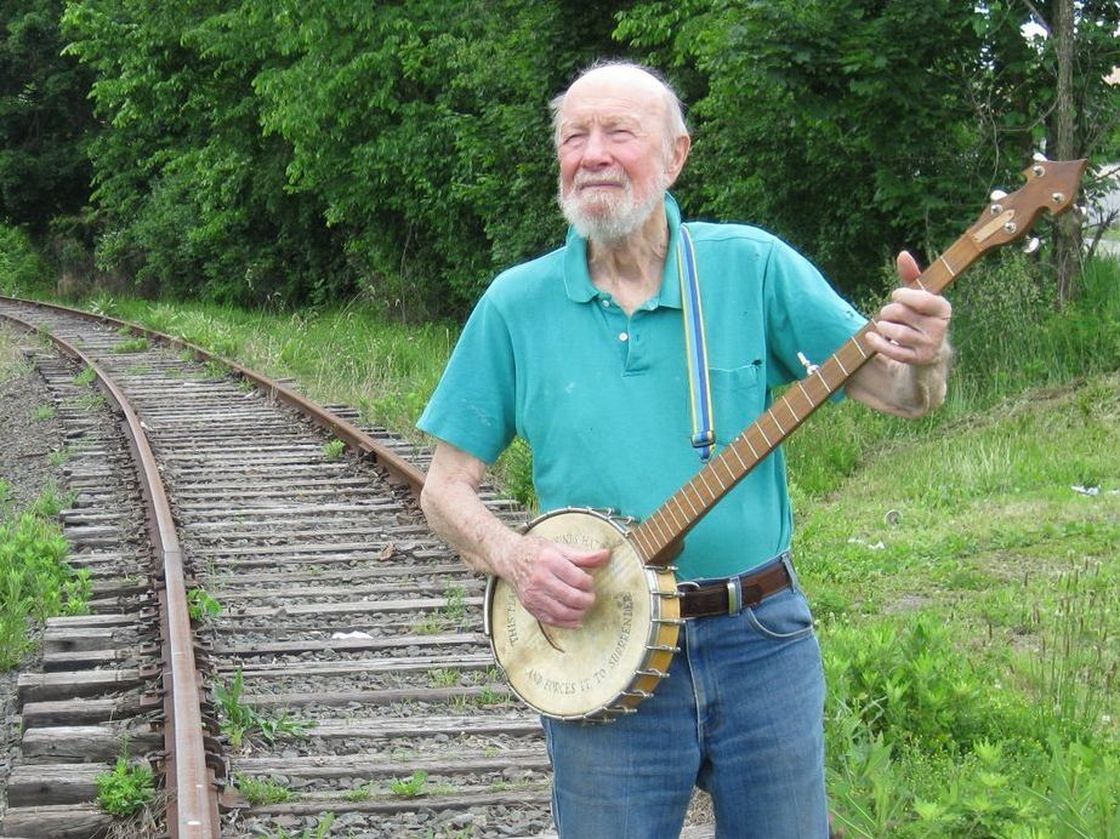
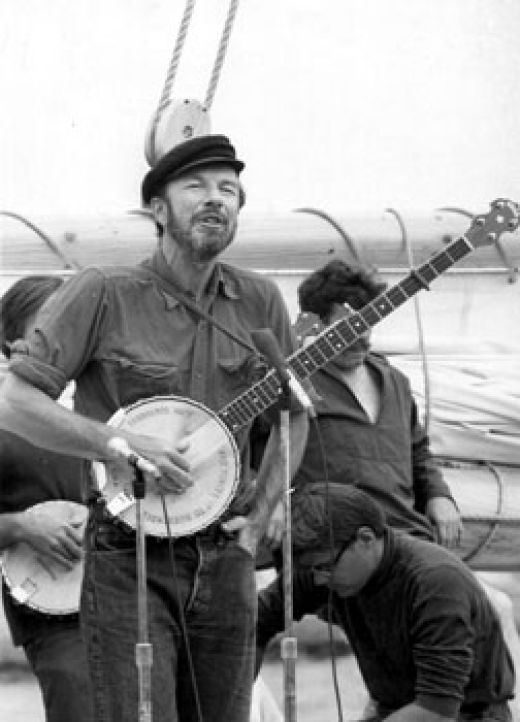
img_2137_2-photo-15Pete Seeger is one of those great souls.  Born in 1919, coming of age during the Great Depression and the American labor movement, he channeled his gift for moving others into his music, and became the voice of several generations of Americans restless with the status quo, searching for a better world.

I grew up with the songs of Pete and his soulmate Woody Guthrie, another bright flame who burned himself out after only 55 years on the planet, dying in 1967.

Pete, now 94 years old, has been steady and unwavering all these years, staying focused on social and environmental justice through all the ups and downs, through all the changes in leadership and the rise and fall of various organizations and movements.

In the iconic song about Joe Hill, the labor organizer framed on a murder charge and executed in 1915, the ghost of Joe comes back to the narrator in a dream, defiantly insisting that he “ain’t dead”:

And standing there as big as life

and smiling with his eyes.

Says Joe “What they can never kill

went on to organize,

went on to organize.”

From San Diego up to Maine,

in every mine and mill,

Where working men defend their rights,

it’s there you’ll find Joe Hill,

it’s there you’ll find Joe Hill!

Pete Seeger, still very much alive, is like Joe Hill in that his spirit seems to infuse every struggle for social justice.

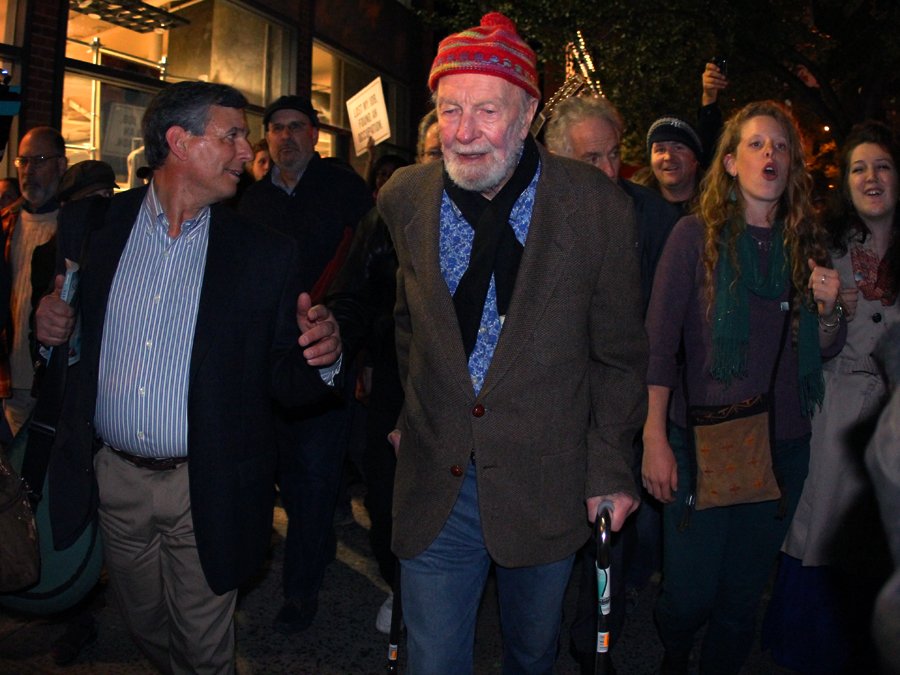
During the Occupy Wall Street movement in Fall 2011, he was there in person, galvanizing a crowd after a concert to follow him in a spontaneous march down Fifth Avenue and join him in singing a heartfelt round of “We Shall Overcome.”

here-was-tonights-special-guest-pete-seeger

His Clearwater environmental organization has become a model in inspiring communities to clean up waterways all over the nation, and indeed the world.

pete-seeger-328

Pete’s special gift is using music to inspire the best in people.

He doesn’t heckle, he doesn’t scold, he doesn’t scorn.

He just lifts up his head and his heart and seems to channel the love of the universe straight through his fingers and his vocal chords, irresistibly bringing everyone in range along with him.

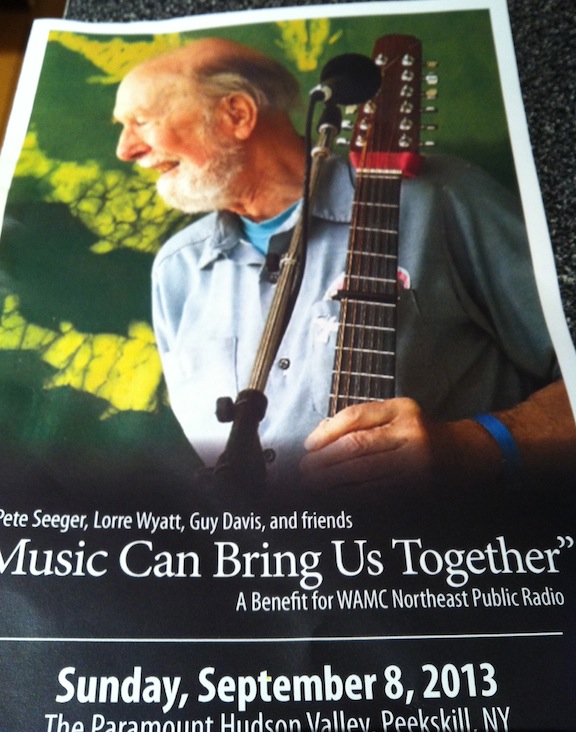
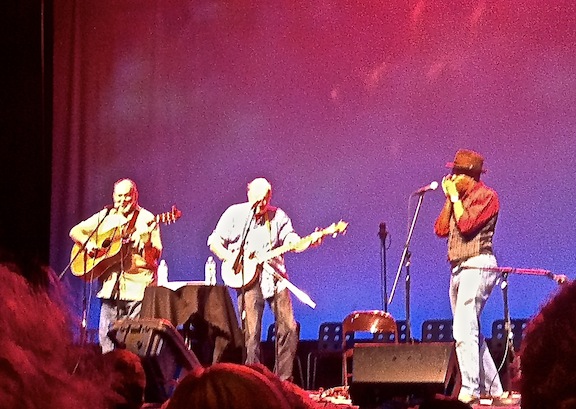
IMG_3818At a benefit concert for WAMC, Northeast Public Radio on September 8 at the Paramount Theater in Peekskill, NY, Pete’s power to inspire was undiminished, though his age is finally beginning to catch up with him in terms of his physical strength.

Nevertheless, he was onstage for a full three-hour concert, with only a brief intermission, and the delight he took in the younger people accompanying him was palpable and infectious.

For Pete, music has never been a power trip; it’s always been about creating an open-hearted place for human spirits to mingle in search of justice and beauty.

He waved off the standing ovations he received from the audience, most of whom were his longtime admirers, now going gray themselves.  He made it clear that what he had to offer was not about him, it was about the power of the music to make a positive difference in the world.

While Pete could easily have led the hall down nostalgia lane, singing all his old classics, instead he chose to give his musical partners of the day, Lorre Wyatt and Guy Davis, the chance to step in the spotlight and take a leadership role, and he took special delight in the youngsters who were singing along with him on stage.

IMG_3806

Pete sang a new song by Lorre Wyatt, “Braving the Storm,” which honored change agents like Rachel Carson, Cesar Chavez and WAMC’s tireless Alan Chartock, the chorus acknowledging “You could have stayed safe and warm but you showed us the way, braving the storm—thank you for braving the storm….”

He also sang some old fighting favorites like “We Shall Overcome,” “Where Have All the Flowers Gone,” and “Turn, Turn Turn,” his voice rising loud and strong in reminding us that “there’s a time for peace, I say it’s not too late.”

108213_f520He ended with a rousing song about the Clearwater and the Hudson River revival, reminding us that though the river has been dirty, “she’s getting cleaner every day.”

Focus on the positive, Pete seemed to be telling us—on what can be done, what should be done, what is being done to make our world a safer, saner, more loving place.  Do the work together, joyfully, singing all the while.  Have courage, be of good heart, and don’t be afraid to brave the storm, together.

Like Joe Hill, wherever people are working together for a better world, it’s there you’ll find Pete Seeger, in body and in spirit.

Thanks, Pete, for showing us the way all these years, and being a tremendously inspiring model of an elder who only grows more powerful, active and courageous with age.  We’re with you in spirit too, always!

85074216

The September 8 concert was dedicated to Pete’s late wife, Toshi, who died earlier this year.

What are we waiting for? Violence and climate change in our brave new world.

Finally, in the Sunday New York Times, a report giving empirical evidence of what we already knew intuitively, that climate change leads to violence, and that it’s going to get worse as the planet continues to warm.

For a couple of years now I’ve had a haunting premonition that violence is going to come even to the comfortable, beautiful corner of the world where I live.

We saw how fast tempers flared when Hurricane Sandy created gas shortages down in the New York metropolitan area.

What happens when our industrial food supply starts to fail, given the inevitable and already-occurring wildfires, droughts, tornados and floods?

When people get hungry, survival-of-the-fittest kicks in, and it will take serious riot police to keep order when the supermarkets run out of food.

The authors of the new report say that their findings “are particularly important for what they imply about the future. Many global climate models project global temperature increases of at least 3.6 degrees Fahrenheit (2 degrees Celsius) over the next half-century. Our results imply that if nothing changes, this rise in temperature could amplify the rate of group conflicts like civil wars by an astonishing 50 percent in many parts of the world — a frightening possibility for a planet already awash in conflict.”

Frightening indeed. What to do with this new knowledge?

The authors urge political leaders to “call for new and creative policy reforms designed to tackle the challenge of adapting to the sorts of climate conditions that breed conflict — for instance, through the development of more drought- and heat-resistant agricultural technologies.”

I hardly think that the answer lies in agricultural engineering.

In the time we have left before chaos sets in we should be re-localizing agriculture, setting up distributed energy networks and re-learning the old arts of drying, salting, canning and cold storing agricultural products.

Indian Line CSA, one of the first in the nation

Indian Line CSA, one of the first in the nation

We should also be disarming our civilian population and focusing on creating strong community networks of mutual support.

For all our cleverness, humans are just primitive beasts when our bellies are empty—primitive beasts armed, at least in Fortress America, with deadly assault weapons.

The nightmares of the Congo, Somalia and Sudan, not to mention Afghanistan, Syria and Iraq, could easily start up here too, when food is scarce and sectarian violence begins to flare.

The truth is that we can’t rely on national and international leaders to undertake meaningful “policy reforms”—not when they are being held hostage by Big Carbon, Big Ag, Big Chemical/Pharma and Big Finance.

Delusional these corporate giants may be, but they will be going down with the ship holding fast to their belief in the value of limitless human economic growth, stable climate be damned.

We who believe that another world is possible need to hold fast to our own belief that the world won’t end when those giant glass towers in financial districts worldwide go down.

We can build that new world—not through technology and arms, but through community and collaboration.  Bottom-up, not top-down.

It’s true: we are the ones we’ve been waiting for.  And given the impending climate crisis, there’s no point in waiting anymore.

Harvesting at Indian Line Farm, Berkshire County MA

Harvesting at Indian Line Farm, Berkshire County MA

A Prayer to Mother Earth

Amazon rain forest

Amazon rain forest

In an emotional speech this week, the President Rafael Correa of Ecuador announced that he would be opening more of the country’s pristine Amazon rain forest to oil drilling, cancelling an earlier initiative to have wealthy countries fund the maintenance of a huge natural reserve.

The money simply did not come through, and Correa felt he had no other choice but to start selling oil drilling permits to the highest bidder, to keep his small country afloat.

This is terrible news for the planet.

Once again, short-term gain is being put over longterm health.

My mind immediately leaps to all the animals and people who live in that green and glowing forest, who will soon be hearing the whine of the chain saw and the roar of the bulldozer, and smelling the bitter odor of ancient oil fouling land and water.

Species we have not even met yet will perish.

Of course, this is happening every day, all over the planet.  But when you hear about yet another safety wall being breached, opening up a brand new, as-yet-untouched area to drilling, you have to stop and say a silent prayer.

A prayer to what, to whom?  What power can stop the relentless spread of our destructive species over this globe?

To me it seems clear that only Gaia herself can do it, by her usual methods—fire, flood, famine, great shaking of land and sea.  Epidemics of viruses and bacteria.  It has happened before and it will—it must—happen again.

I know I sound apocalyptic here, but apocalypse is in the air.

I don’t believe in a conventional form of afterlife, but I do believe that when we die our bodies return to the earth, and our spirits return to the energetic field of the planet.

We will return to the great dance of life in this biosphere.  Time is different there—fluid, stretched, endlessly long.  Our little human lifetimes are no more than brief flashes, like the shooting of stars against the August night sky.

Human beings do represent a great leap from the last dominant species on the planet, the dinosaurs.  But unlike the dinosaurs, when we perish it will be by our own hands—by our drills, our combustion engines and our inability to curb our own numbers.

My prayer is to our great Mother Earth, that she welcome us back into her bosom when we fall, and bring us back into the fold of endless regeneration.  If some of us humans survive the cataclysms that await, I pray we become wiser in our use of our tremendous, tragic intelligence.

Which Side Are You On?

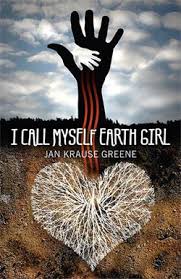
imagesFor the past few nights I have been putting myself to sleep by reading an advance copy of my friend Jan Krause Greene’s new novel, I Call Myself Earth Girl.

It’s not exactly a feel-good bedtime story, dealing as it does with rape, environmental disaster, death and bereavement.

But it’s also about empathy and love, between family members and also on a worldwide scale.

In Greene’s vision, the Earth and its denizens can be saved from catastrophe by mindful attention to what really matters: affirming life, both our own and that of the unborn generations to come.

Not since Starhawk’s 1994 masterpiece The Fifth Sacred Thing have I come across a book that so clearly matches my own waking nightmare of the terrible times that await us in the future, if we do not succeed in changing our ways now.

Let’s face it: it is possible that the kind of violence afflicting resource-starved places like Afghanistan, Syria and Somalia will become the norm in much more of the world, as climate instability creates food shortages and accelerates the pace of natural disasters beyond our capacity to recover.

America is a tinderbox just waiting to go off.  Imagine what would happen if suddenly it was not possible to go down to the supermarket and get your week’s worth of groceries?

Such a scenario is more or less unthinkable to people like me, who have grown up cradled by the richest breadbasket in the world.

We are only beginning to realize the costs that have come with our cornucopia: the destruction of the virgin prairies in the Midwest, the poisoning of the earth, water and air with chemical fertilizers, pesticides and herbicides; the grotesque factory farms of livestock and fish; the genetic alteration of seeds; the destruction of local farming by the huge predatory monster of American-style factory farms.

We have grown fat on these practices.  And now it’s time for us to accept responsibility for the outcomes of our heedlessness.

Those of us alive today have the privilege, and the responsibility, of presiding over what could very well be the end times for human civilization.

It’s somewhat analogous to the end times of specific human cultures, like the Greeks, the Romans, the Egyptians, the Ottomans, the great Chinese dynasties….except that this time, we’re not just talking about the end of a single culture, we’re talking about the demise of humanity as a species.

It is possible to imagine, as Jan Krause Greene did, that our lush green planet could turn brown from environmental disaster, provoking a culture of armed militias surviving by means of ruthless violence—with women, as always, at the bottom of the heap.

Tornado bearing down on Moore, OK; May 21, 2013

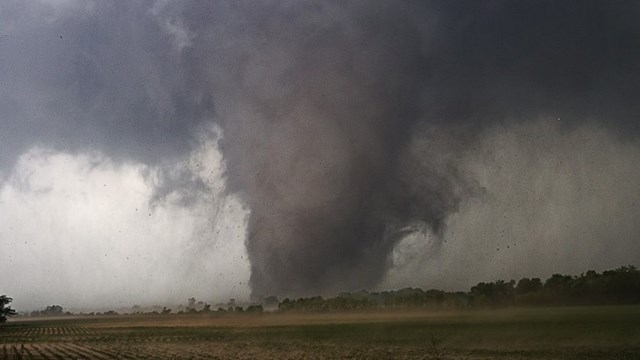
Tornado bearing down on Moore, OK; May 21, 2013

It is already happening—just not yet here, in the gated community we call America.

Can we wake up in time to forestall total, worldwide environmental melt-down?

In the past week we had a deadly two-mile-wide tornado in Oklahoma, and the Russian science station in the Arctic Circle had to be evacuated because the ice was melting at an unprecedented rate.

Here in New England we are expecting temperatures in the 30s Farenheit this weekend—way below normal for what should be the start of the growing season.

What’s next?

We don’t know.  But I take heart from local initiatives like the rehabilitation of the long-dormant Great Barrington Fairgrounds into a vibrant community-supported agriculture site.

We are going to have to re-localize agriculture if we want to survive the shocks of the 21st century.  We need to re-imagine not just agriculture, but community along with it.

As I Call Myself Earth Girl shows well, the antidote to violence and fear is love and empathy.

We still have a choice. Which way will you turn?  Which side are you on?  How far will you go to protect the planet and the generations to come?

fifth-sacred-thing

Commencement 2013: Questions for Ben Bernanke

Tis the season of college Commencement ceremonies, where speakers are invited to address the graduates, giving them some advice and words of wisdom for this major transition time in their lives.

Ben Bernanke

Ben Bernanke

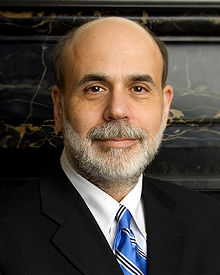
At my institution, Bard College at Simon’s Rock, the Class of 2013 will be addressed by none other than Ben Bernanke, chairman of the Federal Reserve, whose son and daughter-in-law met as Simon’s Rock students.

Of course I am curious to hear what Mr. Bernanke will tell these spanking-new A.A. and B.A. graduates.

I wonder if he will mention the touchy issue of student debt, which the eminent economist Joseph Stiglitz just called a contemporary crisis on the same order of magnitude as the housing bubble crisis of 2008.

Stiglitz doesn’t mince his words in responding to the news that “total student debt, around $1 trillion, surpassed total credit-card debt last year.”  While it’s possible to learn to control credit card spending, he says, “curbing student debt is tantamount to curbing social and economic opportunity. College graduates earn $12,000 more per year than those without college degrees; the gap has almost tripled just since 1980. Our economy is increasingly reliant on knowledge-related industries.”

In other words, young Americans and their families can’t afford not to do whatever it takes—including going into debt—to get that college degree, and beyond that graduate degrees as well.

The students I know are increasingly aware of their place in the big picture of American society.

Those who must take out loans to afford their college educations do so with eyes open, knowing that these loans will form a ball and chain around their ankles for many years to come.

I wonder if Ben Bernanke will talk about this?

Will he talk to this year’s graduating class about how, unlike with credit card or mortgage debt, it is almost impossible to discharge a student loan in bankruptcy court?

Will he explain why interest rates on Federal student loans are so much higher than the interest rates on the loans the Federal Reserve has made to the banks that caused the financial crisis of 2008?

As Mr. Stiglitz observes, “if the Federal Reserve is willing to lend to the banks that caused the crisis at just 0.75 percent, shouldn’t it be willing to lend to students, who will be crucial to our long-term recovery, at an appropriately low rate? The government shouldn’t be profiting from our poorest while subsidizing our richest.”

Besides the $1 trillion in student debt, there have been other major records broken in the past few weeks that Mr. Bernanke could address.  The Dow Jones has climbed above 15,000 this spring, a benchmark many thought would never be reached; and the carbon emissions rate has climbed above 400 parts per million, causing polar sea ice melt at rates and levels not seen in human history.

Will Mr. Bernanke talk about how and why it is that in a time when wealth disparity between the 1% and the rest is growing ever vaster, while the planet heats up and becomes ever more unstable and vulnerable, the stock market is soaring as never before?

I would be quite interested to hear his take on that.

Generally Commencement addresses are exhortatory in style.  Go forth, ye graduates, and conquer the world!  Or make it a better place!  Or do well for yourselves at least!

Today’s graduates need all the encouragement they can get as they make their way out into a society, a world and a planet where only the richest can feel secure—and even for those folks, climate change may make a mockery of that sense of stability.

The qualities most needed today are collaboration, creativity and resilience, along with a willingness to think outside the box and go for the roads less traveled.

Students at Simon’s Rock, a non-traditional early college for brilliant non-conformists, have all of these qualities and more.

I am proud to have accompanied some of them on a piece of their journey, and look to them to lead the way into the future we must all confront.

I hope that Ben Bernanke, who well knows the school and the type of students it attracts, will speak to them frankly and in good faith about the challenges ahead and how best to be not part of the problem, but cutting-edge leaders in the quest for solutions.