Winter Solstice Reflections: Returning to Light, Swimming Against the Tide

Lately I have been feeling that I am constantly struggling against a strong current pulling me away from the work I want to be doing.

The current is composed of all the day-to-day chores of life, along with all the busyness of the holiday season, and the relentless tide of bad news about the state of our beloved planet and her living communities, from trees to fish to birds and bees.

The more I become aware of the dire ecological state of our planet, the more I want to devote myself to swimming against that current of devastation, trying to bring our planetary systems back into balance.

I want to do that work on the personal level, starting with my own life, and moving out into my community and the broader Earth communities in which we all live.

The climate issue, like no other in human history, has made our planetary connectedness clear. We must work together, from pole to pole, to solve the problem of climate instability that industrial civilization has wrought.

If we don’t get on in immediately, we may very well spiral into another Great Extinction, possibly soon enough for current generations of humans—me and my children and their children—to live and die through.

Faced with a negative reality of this magnitude, many of us tend to just turn away in numbed grief and try to ignore it because, sadly, “there’s nothing we can do about it.”

My own sense of being caught in a tidal current pulling me back from whatever it is I’m supposed to be doing may have a lot to do with the despairing feeling that whatever I try to do will not be enough.

But I have to do it anyway, and so do you.

Winter Solstice is the time of year when I try to retreat from the furious churning of life and recalibrate, retune, reflect.

How can I use the gifts I have been given to make a positive difference, moving outward from myself, my family and local community, to the larger circles of life I love?

My greatest gift and abiding passion has always been writing. As soon as I learned to write, I began writing stories and poems that celebrated the natural world and honored the spirits of the Earth.

As a 21st century writer, I have the ability to project my words and perspectives far beyond the confines of the old spiral-bound notebooks I used to keep as a child. I have the potential to engage in dialogue with people all across the globe, and if you’re reading this, so do you.

As a teacher, I have the ability to begin conversations with students about the difficult ecological crises that are already beginning to unfold, and the social and environmental injustices that they are spawning. I can offer students the tools and strategies for continuing these conversations across the globe through our amazing new digital technologies.

In the past year, without a great deal of focus on my part, my blog has been viewed more than 20,000 times by visitors from more than 130 countries around the world.

My little blog is just a very small drop in the great ocean of digital conversations, but even so, it is possible that some of those 20,000 readers came away with a new idea or an affirmation of their own thinking, or a challenge to their habitual perspectives, that could start a chain reaction among their friends and digital connections that could, seriously, change the world.

Rupert Sheldrake argues that “The fields organizing the activity of the nervous system are inherited through morphic resonance, conveying a collective, instinctive memory. Each individual both draws upon and contributes to the collective memory of the species. This means that new patterns of behaviour can spread more rapidly than would otherwise be possible.”

Sheldrake’s theory is exciting and controversial because if it’s true, it means that none of us has to be bound by the heavy burden of habit and cultural inertia, the industrial tide that seems to sweep us along so inexorably.

We have a choice. We can pick up our heads, think for ourselves, seek out others who also want to preserve the ecological health of the planet, and together use our great digitally connected human brain trust to steward and safeguard this planet, not destroy her.

Working together, we could, within a couple of generations, be swimming together joyously in an entirely different sea.

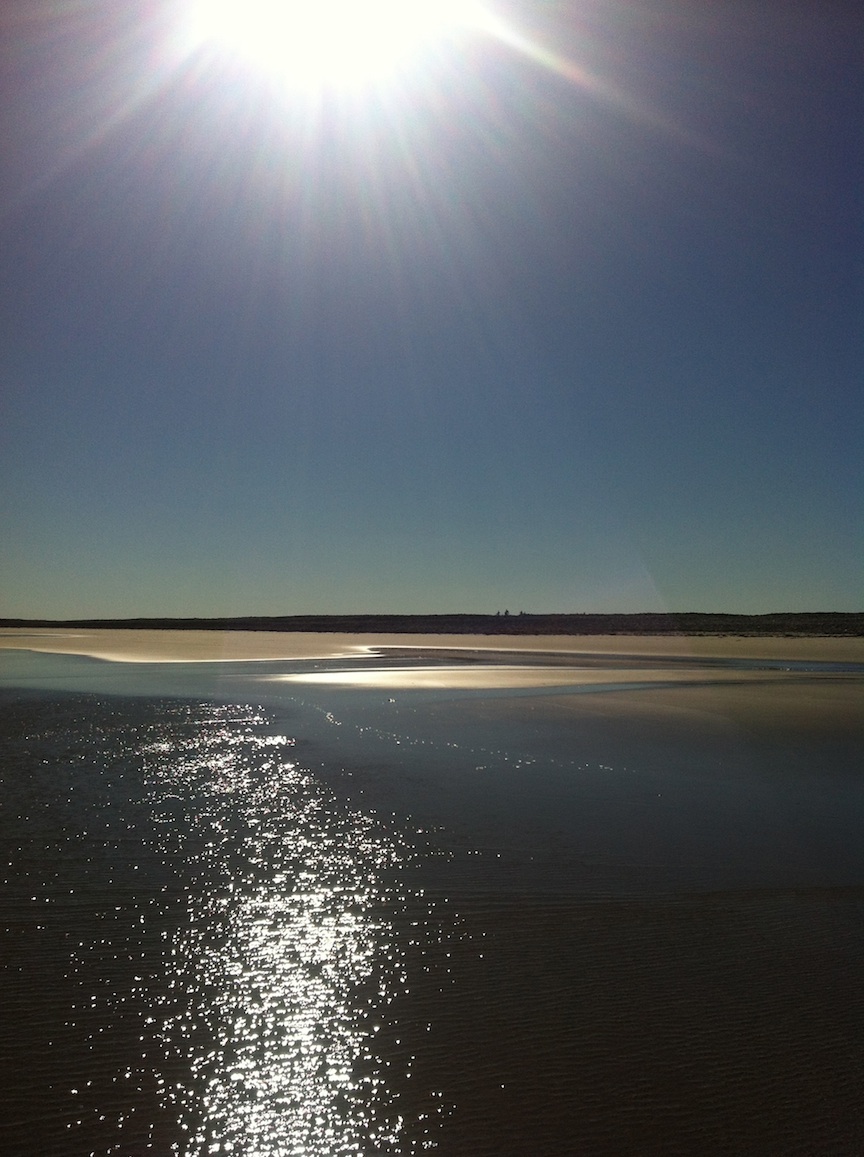
As the Earth wheels slowly back towards the Sun today, this is my steady vow: to keep my head above water, to reach out a hand to others who share my reverence for our beautiful planet and its magnificent life, and to give myself without reserve to the mission of building a strong interconnected movement dedicated to the shift into a sustainable, ecologically sound, joyful future.
Browdy de Hernandez 2013

c. Browdy de Hernandez 2013

Keeping Mandela’s Dream Alive–Not Just for South Africa, but for the Planet!

Nelson Mandela

Nelson Mandela

Nelson Mandela was imprisoned for 27 years as a terrorist.

And then he was released and became one of the greatest freedom fighters the world has ever known.

For me, the lesson is clear.

We cannot rely on others for a moral compass.

I am thinking of Chelsea Manning, Edward Snowden, Julian Assange, Tim DeChristopher and Lord knows how many others who have been exiled or imprisoned for “treason” in the United States.

I believe they will be exonerated in the long run, just as Mandela was, and shown to be on the side of justice.

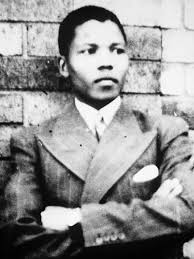
Nelson Mandela as a young man

Nelson Mandela as a young man

We shake our heads incredulously when we hear that Nelson Mandela was in jail and at hard labor for 27 years.

Twenty-seven years!  He was imprisoned just a few months before I was born, and released a few months before I married.

He came out to have a whole new life, like a butterfly breaking out of an unwanted cocoon.

The news media seems to be playing up the aspect of Nelson Mandela’s story that deals with forgiveness.

He forgave his captors.  He was not vindictive.  He believed in reconciliation.

Yes.

But I do not forgive them.  And the part of Mandela’s story I would like to focus on is his incredible perseverance in achieving his lifework of overcoming the evil of apartheid in South Africa.

Unknown

It takes great self-awareness and rock-solid confidence to maintain one’s moral compass in the face of a whole state and social apparatus set up to prove one wrong.

For example, climate activists today, like the Greenpeace 30–locked up in Russia for daring to challenge Russian drilling rights in the Arctic–need to be incredibly resolute in their insistence that we must do what we can to stop the runaway warming of the planet.

Today we have many ways of expressing our solidarity—ways that were not available to sympathizers of Mandela back in the 1960s, ‘70s and ‘80s.  We need to use these communication channels to send a solid wave of support back to those who dare to challenge today’s rulers—the fossil fuel industry, the National Security Agency, and the like.

Mandela fought the good fight and he won.  Today, our fight is not for justice in one country, but for the very survival of the human race—and so many other species—on this planet.

We owe it to the memory of Nelson Mandela to stand firm and refuse to be bullied or intimidated.  We who are fighting for a sustainable planetary future are on the side of justice and will be vindicated as such, just like Mandela, if we are not all washed away first.

Nelson Mandela was great because he never gave up.  He remained true to his own moral compass and he lived his ideals.

We must do the same today, and then some, to keep Mandela’s flame alive and burning brightly for a new day on this sad beleaguered planet of ours.

Dreams of terror, dreams of peace

This morning my son came down to breakfast with a queasy look on his face.  “I had a dream that I killed a baby,” he said.  “I was shooting with a machine gun at these guys, and the baby was in the way.”

I hate the fact that this kind of violence, which kids are exposed to through the media constantly these days, creeps insidiously into their sleep, invading their dreams.

The subliminal violence is everywhere.   This same son, a 9th grader in a typical American public high school, is reading Lord of the Flies for English class and All Quiet on the Western Front for Social Studies.

Lord-of-the-Flies-1963-fi-007Lord of the Flies, you’ll remember, is about how a group of adolescent boys, turned loose on an island without any adult authority present, morph into “beasts” who bully, torture and kill one another.

All Quiet on the Western Front is about World War I, and my son’s teacher is sparing the class none of the gory details of that war; in fact, a whole section of the paper my son has to write about the book is supposed to enumerate all the challenges ordinary soldiers in that war faced, from freezing muddy trenches to disease to field amputations, rats and artillery fire.

Last month, this same teacher had the kids reading 1984 and spent a lot of class time talking about how the surveillance tactics and physical brutality in that book related to real-life episodes of torture and detention camps in the history of China and the Soviet Union.

In short, my son’s imaginative life lately has been saturated with violence, for which the peacefulness of our home is no match.  And he is one of the more sheltered boys growing up today; I do my best to keep him away from violent movies or military-style and gangster video games.  We don’t even have TV at home.

When dreams like this emerge at our breakfast table, they remind me that the apparent peacefulness of a small American town like mine is terribly fragile.

With every mass-murder shooting incident that occurs, the fine veil of civility frays just a little more.

The truth is that the United States has one of the most heavily armed civilian populations in the world.

It would not take much, in terms of social unrest, for those guns to come out and the “beastly” side of humanity to emerge, a la Lord of the Flies.

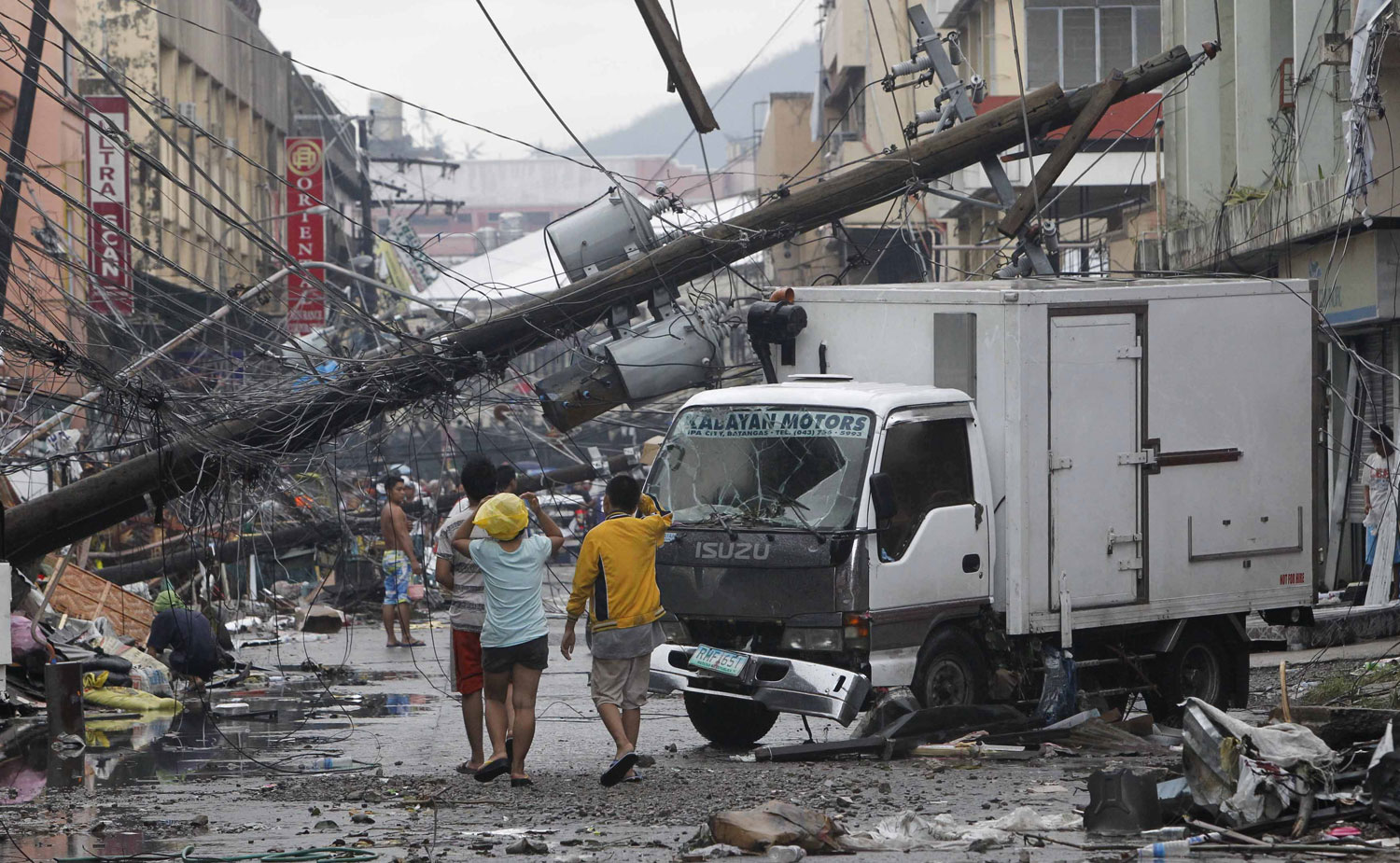
That’s what worries me when I contemplate climate change scenarios involving catastrophic storms like Haiyan that result in power outages, fuel and food shortages—which could happen here in the U.S. just as easily as anywhere else.

What we should be doing now, in the time we have left before climate change gets truly out of hand, is strengthening our bonds as communities.

Never mind the dysfunctionality of our Congress, the bashing and competitive trash-talking that too often passes for ordinary public discourse in America today.

On the local level, we can do better, and indeed we must.

Every community in America should be starting to plan for how it would respond to disruptions in power, fuel and food supplies.

We can’t rely on FEMA to ride in to the rescue.  We can’t afford to entrust our survival to the guys with the biggest guns in our area.

The Transition Town movement has it right in their focus on building strong, resilient communities and re-learning valuable pre-industrial skills.  But they need a greater sense of urgency.

My son’s dream is a warning that we ignore at our peril.  There is no time to waste.

The Civilization We Grew Up In Is Already Dead. So now what?

“If we want to learn how to live in the Anthropocene, we must first learn how to die.”

This is the last line in a fine essay by Roy Scranton, former U.S. soldier and currently a doctoral candidate in English at Princeton University.  The essay, published in the New York Times philosophy blog “The Stone,” is one of those rare attempts to really lay out the gravity of the situation we face today, as humans on a rapidly destabilizing planet.

Readers of Transition Times have been hearing me give my doom-and-gloom warnings for years now.  But it’s very rare that such grim scenarios break into the gilded precincts inhabited by readers of The New York Times.

Here is Scranton:

“The challenge the Anthropocene poses is a challenge not just to national security, to food and energy markets, or to our “way of life” — though these challenges are all real, profound, and inescapable. The greatest challenge the Anthropocene poses may be to our sense of what it means to be human.

“Within 100 years — within three to five generations — we will face average temperatures 7 degrees Fahrenheit higher than today, rising seas at least three to 10 feet higher, and worldwide shifts in crop belts, growing seasons and population centers.

“Within a thousand years, unless we stop emitting greenhouse gases wholesale right now, humans will be living in a climate the Earth hasn’t seen since the Pliocene, three million years ago, when oceans were 75 feet higher than they are today.

Aftermath of Typhoon Haiyan

Aftermath of Typhoon Haiyan

“We face the imminent collapse of the agricultural, shipping and energy networks upon which the global economy depends, a large-scale die-off in the biosphere that’s already well on its way, and our own possible extinction.

“If homo sapiens (or some genetically modified variant) survives the next millenniums, it will be survival in a world unrecognizably different from the one we have inhabited.”

Yes.  We know this.  It’s actually what Scranton does next in his essay that most interests me.

He makes a turn into the humanities, arguing that since “studying philosophy is about learning how to die,” then we have now “entered humanity’s most philosophical age — for this is precisely the problem of the Anthropocene. The rub is that now we have to learn how to die not as individuals, but as a civilization.”

Scranton reminds us that “the biggest problems the Anthropocene poses are precisely those that have always been at the root of humanistic and philosophical questioning: ‘What does it mean to be human?’ and ‘What does it mean to live?’

“In the epoch of the Anthropocene, the question of individual mortality — ‘What does my life mean in the face of death?’ — is universalized and framed in scales that boggle the imagination. What does human existence mean against 100,000 years of climate change? What does one life mean in the face of species death or the collapse of global civilization? How do we make meaningful choices in the shadow of our inevitable end?”

These are the kind of questions I ruminate about daily.  It comes back to Mary Oliver’s signature question, in her haunting poem “The Summer Day”—“What will I do with my one wild and precious life?”

We never know if our own deaths are right around the corner.  Will the truck driver around the next bend be distracted by his phone, cross the yellow line and blow me to oblivion?  Will my next physical exam reveal a terminal illness?  It could happen any time.

But as Scranton says, the climate change issue is much bigger than any of our individual lives.  It’s about the future of human civilization on the planet.

He ends his essay provocatively, saying that the problem of climate change cannot be solved by “buying a Prius, signing a treaty, or turning off the air-conditioning.” What is needed is a profound philosophical shift; to go from a civilization built on the illusion of endless growth and consumption, to a steady-state civilization that the planet can sustain.

We need to realize, Scranton says, that the human civilization all of us grew up in “is already dead. The sooner we confront this problem, and the sooner we realize there’s nothing we can do to save ourselves, the sooner we can get down to the hard work of adapting, with mortal humility, to our new reality.”

Yeb Sano breaks down speaking about the devastation in the Philippines after Typhoon Haiyan, and begs the climate negotiators to act decisively to curb carbon emissions

Yeb Sano breaks down speaking about the devastation in the Philippines after Typhoon Haiyan, and begs the climate negotiators to act decisively to curb carbon emissions

Watching the desperation on the faces and in the voices of the climate negotiators from sea-level nations like the Philippines, Bangladesh, and the Maldives, it’s clear that these folks have already absorbed the lesson we in the higher-terrain countries have yet to confront.

We cannot go on with business as usual any longer.

Not if we want to bequeath a livable Earth to our descendants.

Severn Suzuki speaking out

Severn Suzuki speaking out

Severn Suzuki said it all, so eloquently, speaking to a climate change summit way back in 1992, when she was just a girl of 12.  Are we ready to listen yet?

Of Climate Change and the Humanities

This week, most unusually, two topics that are of great interest to me, but which rarely make it into the mainstream media, suddenly surfaced in The New York Times.

It was not glad tidings.

ipcc_altlogo_full_rgbAn article about a “leaked draft” of a report by the United Nations Intergovernmental Panel on Climate Change, strategically placed in the Saturday edition of the NYT–generally the least read—warned that global warming is going to severely disrupt food supplies in the near future.

A burgeoning global human population, expected to reach 9.6 billion by 2050, is going to need more food—but climate change is predicted to reduce agricultural production by as much as 2 percent each decade for the rest of this century, with predictable results in terms of famine and civil unrest.

Meanwhile, back on the higher-education ranch, it was doom and gloom for the humanities this week, with a “Room for Debate” discussion in the New York Times about whether or not the study of the humanities has become vestigial in these science-focused times, just an “academic luxury.”

The answer I liked best to the question “what good are the humanities today” came from Lisa Dolling, an associate professor of philosophy, and dean of the College of Arts and Letters at Stevens Institute of Technology, who said:

“While science and engineering can tell us the “what” and “how” of the world, the humanities and social sciences provide insights to answering the “why” — along with the skills necessary to communicate it all to others.”

i-f38d8b0bf62d6e656f1e4bf2c111d9b2-IPCCScience and engineering can tell us all about the problems we face due to global warming, but it is the humanities that will be able to tell us why it is so impossible for human beings to agree on reducing carbon emissions and shifting into a sustainable economic framework.

And perhaps it is the humanities that will be able to persuade us to overcome our collective inertia…find the necessary fire in our bellies…and insist that corporations and politicians join hands to make a livable future for us all.


Personally, I have never been more excited to be a humanities professor than I am today.

All of my courses this year are focusing on urgent issues of social and environmental justice, giving students the models and tools they need to become the kinds of change agents our world so desperately needs.

In science & engineering courses, students will learn how to measure and impact biofeedback systems.

But in my courses, they will learn how to communicate these statistics in ways that not only inform, but also inspire a thoughtful response in others.

It is not enough today to understand what is going on, although that is a crucial first step.

We must also be able to take the next steps of a) explaining to others why global warming is important and b) creating channels through which people’s fear, passion and courage can flow into positive efforts at social change.

According to the Stanford University website, “the humanities can be described as the study of the myriad ways in which people, from every period of history and from every corner of the globe, process and document the human experience. Since humans have been able, we have used philosophy, literature, religion, art, music, history and language to understand and record our world.”

I find it sad that humanities scholars have to defend the utility and validity of our field today.

Science without the humanities would be a cold social environment indeed, and I think even scientists probably recognize this.

In the age of climate change, we need the humanities more than ever to understand where we are, and to provide the moral framework for where we want to go.

It is not enough to simply describe population growth or agricultural decline. We need to explain why it is imperative that we work to curb human populations and create economic and biological systems for sustainable growth.

We need history to show us how we got here; philosophy to show us our ethical responsibility; and literature and rhetoric to show us how to most effectively communicate with others.

What an impoverished human society it would be if empirical evidence was all we focused on.

Scientists need the humanities, and vice-versa.  To suggest otherwise is to greatly undersell the capacity of human beings to think with both sides of our large, ambidextrous brains—with potentially disastrous results for human society and planet Earth.

We can do better than that.  And we will.

It’s time to Occupy Congress!

What is happening in Washington, DC these days could lead not to anarchy but to monarchy, says political philosophy professor Michael Lynch in a New York Times op-ed piece today.

“Should shutdowns, debt-ceiling fights and the radical political legislative gridlock they represent really become a fixture of American political life, it will be more tempting, more reasonable, to think that someone should  “step in” to make the decisions,” Lynch says. “The chorus calling for action — for the president, for example, to go around the Congress — will only increase. If you are on the left, and Obama is still in power, you may even tell yourself that is a good thing. But it is a bad precedent, the type of precedent that causes democracies to erode.”

To me it seems clear that the someone who should be stepping in here is WE THE PEOPLE!!!

Judging by the Republicans’ abysmal and rapidly sliding approval rates, the obstructionists in Congress no longer represent the will of the people.  It’s up to us to show them the door and get on with all the much more important issues that face us.

gty_occupy_washington_dc_thg_111107_wg

Where is Occupy when you need it?  Why haven’t any progressive groups been calling for a march on Washington to demonstrate on behalf of what we believe and what we want to see our elected representatives doing for us?

It seems like social media has frozen us in the sidelines as spectators rather than actors in this political tragi-farce that is unfolding day by depressing day.

Expressing one’s outrage to one’s circle of Facebook friends is like looking at one’s own reflection in a hall of mirrors.

Let’s get out of the funhouse and go march on the State House!

And not a tame weekend march, either.  Let’s march on a weekday, calling a general strike of work and school and civil business as usual until the Congress gets its act together and unclamps its stranglehold on Federal business as usual.

If there was ever a time when the President needed us to turn out and support him it is now.  Not just in donations, not just in approving tweets, but in the flesh.

Let’s Occupy Congress and stay there until the job is done.  Who’s in?

Turns out “Crazy Mary” isn’t crazy after all: Homage to Mary Daly’s Green Philosophy

In my quest to drown out the drone of the mindless Republican obstinacy-for-its-own-sake that is currently taking up so much of our media bandwidth, I have been reading the work of Dr. Mary F. Daly, someone I’ve known about for many years, but never actually sat down and read.

You may have heard about Mary Daly too—she was a professor of philosophy and theology at Jesuit-run Boston College, whose first three books, Beyond God the Father, The Church and the Second Sex, and Gyn/Ecology, were runaway bestsellers among women readers, but so infuriated the powers that be at her institution that they mounted campaigns to discredit her, first trying to deny her tenure and then harassing her to step down from her tenured position.

Who was this oh-so-threatening gadfly on the flanks of the Church and Academia?

Mary Daly wielding the Labrys

Mary Daly wielding the Labrys

Daly called herself by many names—one of her projects was to take back the English language from the patriarchy that she saw used language as yet another misogynist weapon against women and the natural world.  She was a self-proclaimed “Radical Lesbian Feminist Philosopher,” a “Wild, Wicked Woman,” a “Postively Revolting Hag” who “proclaimed that Laughing Out Loud is the Virtue of Crackpot Crones who know we have Nothing to lose.”

“As an Offensive, Tasteless, Haggard Pirate,” Daly wrote in her 1992 memoir Outercourse, “I was inspired to acquire the Courage to Leave the doldrums of Stag-nation, Sailing off with as much loot as my Craft could carry.  I tried to foster in myself and in Others the Courage to Live Wildly, that is, to refuse inclusion in the State of the Living Dead, to break out from the molds of archetypal deadtime (a.d.), to take leap after leap of Living Faith, becoming Fiercely Biophilic” (198).

Biophilic as opposed necrophilic, which is how she described Western society—a society built on and organized around sucking the lifeblood from the planet.

Although the dominant feminist movement has resisted the eco-feminist tendency to link women and nature “essentially,” Mary Daly saw women as having a special role to play as bearers and defenders of life—not in terms of the conventional “right to life” type of discourse, but in terms of the right and indeed the responsibility to protect and nurture the planet and other life forms on it from the predations of patriarchal society.

“By being the originator of my own Green Philosophy,” she wrote, “which is the tabooed woman-identified/nature-identified philosophy, I have uttered a Great Refusal of the patriarchal prescription of Self-lobotomy for and by women” (326).

The truth is that most people I know automatically turn off and turn away when a woman dares to utter the word “patriarchy.”

It’s a word-bomb wielded by feminist terrorists, and “we don’t negotiate with terrorists,” do we?

Maybe it’s time to remember that one man’s “terrorist” is another’s “freedom fighter.”

Maybe it’s time to be honest about the fact that the rape and pillage of our planet has in fact been a male-dominated project.

To criticize the patriarchy as a system of knowledge and action is not to condemn any individual man.  All individual humans are free to choose how they will act in the world, and many individual men have acted honorably and with loving care towards women, animals and the planet as a whole.

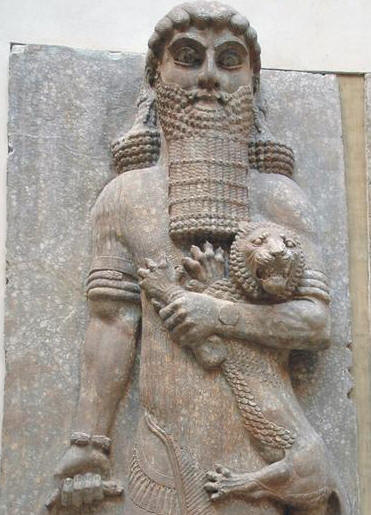
Gilgamesh

Gilgamesh

But in general, I have to agree with Mary Daly that since the advent of patriarchal human civilization–say, around the time when Gilgamesh defied the gods and cut down an entire cedar forest to build his city—humanity has lived by extractive, exploitative, often cruel and extremely destructive frameworks of ideology, policy and praxis.

Women in power, or women close to men in power, have often gone along for the ride and enjoyed their entitlements.  For example, in education: education for centuries was the exclusive prerogative of men, and when women were finally admitted to the august halls of higher learning, they tended to conform to whatever it was the authorities expected of them.

A woman like Mary Daly, who was able to think for herself outside the box of patriarchal philosophy, and who dared to criticize the masters, would be undercut by whatever means possible—dismissed as a lunatic, ignored and disdained, exiled and excommunicated.

Mary Daly was gutsy enough to survive all the attacks that were lobbed at her, and come back swinging.  Each of her books is more radical and free-thinking than the last, and she never wavers from her central insight, which she credits to her interchange with a clover blossom at age 14, that every form of life on the planet has intrinsic value, meaning, and a purpose on the planet.

Unknown-1“There was the Moment…when one particular clover blossom Announced its be-ing to me.  It Said starkly, clearly, with utmost simplicity, ‘I am.’…The encounter with that clover blossom had a great deal with my becoming a Radical Feminist Philosopher.  If a clover blossom could say ‘I am’ then why couldn’t I?” (23).

Daly takes a great leap here away from the artificial structures of the kind of “post-structuralist” philosophy that I, for example, spent countless hours studying during my years in graduate school in the 1980s.

Like Derrida, Daly is interested in words and language and how the “binary oppositions” of Western philosophy, starting with the mother of them all, Good and Evil, have played out in socio-political frameworks that conspire to maintain the patriarchal status quo.

But she is not interested in staying in the labyrinthine worlds of textuality; she is very much engaged with how these linguistic issues affect real, flesh-and-blood women and other beings.  She not only dares to call out the patriarchy, she also dares to discourse with other species in her writing—not just clovers, but also cats, cows, and trees—and to raise what she calls “Fore-Sisters” of earlier times to engage in philosophical dialogue.

Daly was not afraid to call herself a Witch, and to reclaim the demonized power of magic to confront the necrophilia of dominant society.

For instance, in Boston in 1989, she worked with friends and students to create a multimedia performance called “The Witches Return,” which would “expose the gynocidal/biocidal atrocities [of patriarchy] and the connections among them.”

On Mother’s Day, 1989, the group acted out with intense emotion a Witches’ Trial that culminated in the symbolic beheading of those who were accused of “the massacre of women’s minds, bodies and spirits.” Daly wrote, “Our dramatic indictment was created with utterly Fiercely Focused Rage and Elemental, Creative Power” (398).

The performance was a rejection of what she called the “foreground,” ordinary day-to-day life so totally saturated in atrocity that people became numb to it—and a reaching into the “background,” the deeper truths that, if accessed, could light the way to real change.

Daly’s description of the difference between the foreground and the background makes so much sense to me, now in 2013 even more than in 1989.

In our media-saturated lives, it is so easy to spend most of our waking hours tuned in to someone else’s vision, listening to someone else’s insights, digesting information packaged for us by someone else.  And most often, that someone else is—let’s face it—a white man, or someone who is reacting to the dominant white-male patriarchal vision.

How often do we allow ourselves to simply sit down in a field and commune with a clover?  How often to we allow ourselves to listen to ideas that seem radical or weird or crazy?

Isn’t it interesting that radical ideas coming from white males get plenty of press time and are entertained with great seriousness by the entire world (I’m referring to the crazy, weird, radical ideas of the Republican Tea Partiers) while when a woman dares to utter the taboo word “patriarchy” she is immediately not only dismissed, but completely ignored and excommunicated?

In the last book she wrote before her death in 2010, Amazon Grace, Mary Daly called on women who understand the connections between gynocide and ecocide to come together and dare to, as she phrased it, “Sin Big”—dare to call out the patriarchy and insist that, as Arundhati Roy memorably put it, “Another world is possible. On a clear day, I can hear her breathing.”

Yes.

Tell me a different story, somebody, please!

As a college professor with a focus on media and issues of social and environmental justice, it’s my responsibility, I believe, to be tuned into the news of the day.

I need to know that, as reported by Jennifer Steinhauer in The New York Times, “For roughly 30 hours over several days, defense lawyers for three former United States Naval Academy football players grilled a female midshipman about her sexual habits. In a public hearing, they asked the woman, who has accused the three athletes of raping her, whether she wore a bra, how wide she opened her mouth during oral sex and whether she had apologized to another midshipman with whom she had intercourse “for being a ho.”

I need to know that the Obama Administrations efforts to regulate and clean up the American coal industry “are certain to be denounced by House Republicans and the industry as part of what they call the president’s “war on coal.”

I have to follow the progress of the latest massive floods in Colorado, noting that they involve the release of unknown quantities of toxic chemicals into the region’s waterways; these floods happened in a populated area of Colorado that also happens to be the site of thousands of gas fracking wells.

Then there are those unprecedented wildfires in California, finally under control after having burned 400 square miles in and around Yosemite National Park, with “a solid 60 square miles burned so intensely that everything is dead.”

California Rim Fire, 8-21-13 Photo by Robert Martinez

California Rim Fire, 8-21-13
Photo by Robert Martinez

I have to pay attention when our nation threatens missile strikes on another Middle Eastern country, or there’s another crazy gunman on the rampage with assault weapons in a peaceful civilian setting, or a bunch of ideologically blinkered Republican politicians threaten to shut down the U.S. government and force us to default on our international debt obligations, putting the world financial system in jeopardy, simply in order to embarrass the country’s popular Democratic African-American President.

To do my job well, I have to know about these issues and episodes, and so I follow the media daily.  And yet day by day I grow more resentful of being dragged along on storylines that I find so—so—well, so boring.

They’re boring because they’re so repetitive.  Another fire, another flood, another mass shooting, another U.S. missile or drone strike, another government shutdown to be averted at the last minute.  Another woman raked over the coals when she tries to bring a rapist to justice.

And in the background, the real story, the Big News of our time, grinds on relentlessly, it too so endlessly repeated that we have all become blind, deaf and dumb to it.

I’m referring, of course, to the story of global climate change, with its attendant melting ice, rising seas, rising temperatures, erratic weather and, ultimately, mass extinction of life as we know it on Earth.

I understand why very few humans alive today want to grapple with that story.

If the news episodes I listed above are boring in their repetitiveness, the Big News of climate change is just too scary to take in.

No wonder so many people of all ages just don’t bother following the news, preferring instead to focus on televised sports or the latest mini-series or movies.

People seem to have a fatalistic approach to reality lately.

Obamacare will go through or it will be defunded, no matter what we think or do.  Fossil fuel plants will continue to burn, not only unregulated but subsidized at that; politicians will continue to act in criminal ways (shutting down the U.S. government is an act of treason in my book!), boys will continue to be boys and get slapped on the wrist when a woman dares to cry rape–no matter what we do.

The entire American populace seems to be locked in some kind of slumped-over apathy, just trying to keep up the mortgage payments, trying to stay healthy in an increasingly toxic environment, trying to raise decent kids despite the toxic media entertainment landscape in which the kids spend most of their time.

I’m slumped over with the rest, a lot of the time.

But there is something in me that resists this posture, too.  There is something in me that yearns for a different narrative.  Tell me a different story, somebody, please!

Not a return to the triumphalist patriarchal Manifest Destiny that led us inexorably to the disastrous brink on which we now perch.

Not the macho environmentalism that tries to beat the fossil fuel villains in the courts and the high seas.

Not the moralistic sermonizing of those who see the world in strictly black-and-white, Good-and-Evil binary oppositions.

I’m hungering for something deeper.  Something bigger.  A story that truly acknowledges where we are today as a species, and can help us to perceive the way forward out of the current slumped-over morass of bad news.

Briane Swimme

Briane Swimme

The closest I’ve been able to come to such a story so far is the work of Thomas Berry and Brian Swimme.  In their visionary description of the “Ecozoic Era” that we could create, acting in the best interests of the planet as a whole, I find the map and the compass I’ve been seeking to guide me to a livable future.

In the final chapter of their book The Universe Story, Berry and Swimme lay out a vision that, tragically, we have not heeded in the more than 20 years since the book appeared in 1992.

“In economics it is clear that our human economy is derivative from the Earth economy.  To glory in a rising Gross Domestic Product with an irreversibly declining Gross Earth Product is an economic absurdity.  So long as our patterns of consumption overwhelm the upper reaches of Earth’s sustainable productivity, we will only drive the Earth community further into ruin.  The only viable human economy is one that is integral with the Earth economy” (256).

“We need an inter-species economy, an inter-species well-being, an inter-species education, an inter-species governance, an inter-species religious mode, inter-species ethical norms,” they say (257).

Berry and Swimme end their vast “journey of the universe” by describing the celebratory aspect of the universe, which perhaps only humans, at least of the beings on Earth, can fully appreciate.

The cosmic celebration--courtesy of the Hubble telescope

The cosmic celebration–courtesy of the Hubble telescope

“Everything about us seems to be absorbed into a vast celebratory experience,” they say.  “There is no being that does not participate in this experience and mirror it forth in some way unique to itself and yet in a bonded relationship with the more comprehensive unity of the universe itself.  Within this context of celebration we find ourselves, the human component of this celebratory community.  Our own special role is to enable this entire community to reflect on and to celebrate itself and its deepest mystery in a special mode of self-conscious awareness” (264).

In other words, our role is to be the storytellers of past, present and future.  Of all the amazing beings on the planet, no one else can fill this particular niche.

It is our privilege and our curse as humans to KNOW so much about what we are doing at any given moment on the planet, and to ceaselessly narrate that knowledge.  Now in the 21st century, aided by the global neural network of the World Wide Web, we have never been more tuned into the on-going global story, but this knowledge often becomes oppressive, since so much of what we are asked to absorb is negative, bad news.

It’s time to rebel–to resist the battering of the bad news, to become producers rather than just passive consumers of knowledge.

We need to start telling new stories.  Empowering, positive stories that light the way towards the human beings we could become, the human civilization we could create, in concert and harmony with the rest of the Earth community.

What stories do you hold locked in your heart, tenderly sheltered from the glare and cacophony of contemporary pop culture?

I suggest you look to the home ground of your deep childhood for inspiration.  Remember the stories you told to yourself then, or that you heard the flowers and the insects singing.  Remember the way the motes of dust twirling in the sunlight spoke to you.

Remember what it felt like to have an unmediated, imaginative connection with the world around you.

Then speak the truths that come out of that primary knowledge.

Women Writing from the Heart: What the world needs now

This time tomorrow night I’ll be sharing, for the first time, a piece of the memoir I’ve been working on for a good three years now.

il_570xN.378782406_r41jI’ll be reading at a gathering I organized on behalf of the Berkshire Festival of Women Writers, called “Writing from the Heart.”  It features seven of us in all, each sharing a piece of writing that comes from the deep, sometimes aching, sometimes exuberant place at our core, which we rarely trot out and share in public settings.

I organized “Writing from the Heart” because I believe it is so important, now more than ever, for women to get over our social conditioning to “be nice,” “be polite,” “go with the flow,” and cede the floor.  It’s so important that we start expressing, loud and clear, the truths we hold inside us, which are often far from self-evident.

Each one of us has her own perspective on the world, her own experiences to share, her own passions and convictions.  I am less concerned with the content than with the character: what matters to me is that you say what is in your heart, and listen to the heartfelt ideas of others, and that out of this exchange we begin a dialogue on what’s important in this deep, rich, rarely mined terrain.

Let us be frank: although women have made great strides in the past century, we still live in a male-dominated world.

Old, masculinist stories of domination, penetration, exploitation and subordination still prevail over many of the world’s societies.

We live in a violent world on many levels, and the violence, whether against the natural world or against other human beings, is overwhelmingly committed by men.

Women have been forcibly kept out of the male-dominated public sphere in most societies, for much of human history.

We have been the ones bearing and raising the sons who go off to war.  We have been the ones keening and mourning over the coffins that return.  We have been the ones who have been silent while our daughters have been forced into marriages too young, or to men we knew would be abusive.  We have been the ones raising our grandchildren as best we could when our sons and daughters died of AIDS, or ended up in prison.  We have done the best we could with the tools and strengths we had available.

But this is a new time.  Without really realizing it, we have stepped over the threshold into an era that calls for an extraordinary effort on the part of women and men of good heart and far-reaching vision.

Women and men must work together to create new social, economic and environmental frameworks that will enable us to survive and even flourish in the brave new world of climate change that is now upon us.

Women, who have centuries of experience of nourishing, cultivating, collaborating, and surviving against all kinds of odds, have a special role to play in this new era.

Women need to teach these skills to men; and men need to share with us their warrior spirit.

In this new age, the feminine and the masculine must come together in the service of generations to come, each learning from the other and together becoming greater than they could ever be apart.

Every human being has both estrogen and testosterone coursing through hir system, and every human being is capable of both nurturing and violence.

Today, we need women to have the courage to defend the rights of future generations, both human and non-human, and we need men to stand with us in acknowledging that the age of masculine privilege and dominance has been terribly destructive, and must now come to an end.

This is what is in my heart on this 12th anniversary of 9/11, this 40th anniversary of the Chilean coup, this 50th anniversary of the bombing of the 16th Street Baptist Church in Birmingham, Alabama.

Tomorrow evening at this time, six other women will share writing that comes right from the depths of their hearts.  This sharing must become a great, passionate tide, an upwelling of feeling and action that will sweep us away into a better future.

Let it be so.

Pete Seeger, Still Braving the Storm

Every generation there are a few great souls that rise up so full of the sap of life that their cup brims over and carries everyone around them along with it.

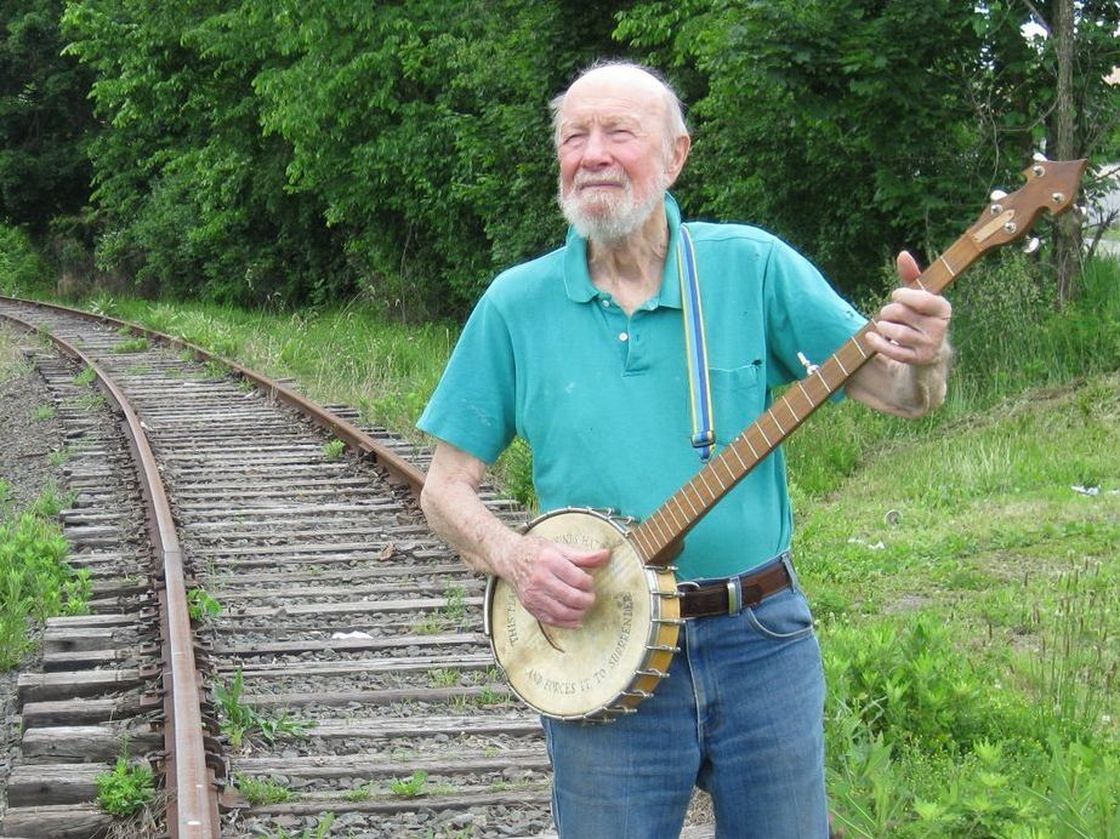
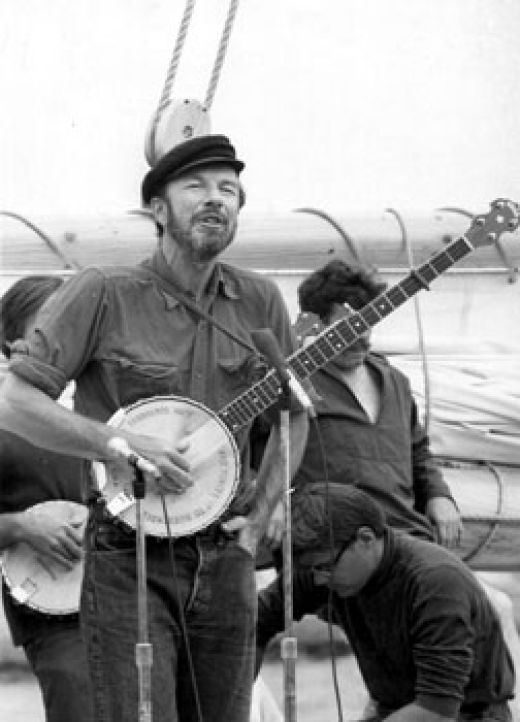
img_2137_2-photo-15Pete Seeger is one of those great souls.  Born in 1919, coming of age during the Great Depression and the American labor movement, he channeled his gift for moving others into his music, and became the voice of several generations of Americans restless with the status quo, searching for a better world.

I grew up with the songs of Pete and his soulmate Woody Guthrie, another bright flame who burned himself out after only 55 years on the planet, dying in 1967.

Pete, now 94 years old, has been steady and unwavering all these years, staying focused on social and environmental justice through all the ups and downs, through all the changes in leadership and the rise and fall of various organizations and movements.

In the iconic song about Joe Hill, the labor organizer framed on a murder charge and executed in 1915, the ghost of Joe comes back to the narrator in a dream, defiantly insisting that he “ain’t dead”:

And standing there as big as life

and smiling with his eyes.

Says Joe “What they can never kill

went on to organize,

went on to organize.”

From San Diego up to Maine,

in every mine and mill,

Where working men defend their rights,

it’s there you’ll find Joe Hill,

it’s there you’ll find Joe Hill!

Pete Seeger, still very much alive, is like Joe Hill in that his spirit seems to infuse every struggle for social justice.

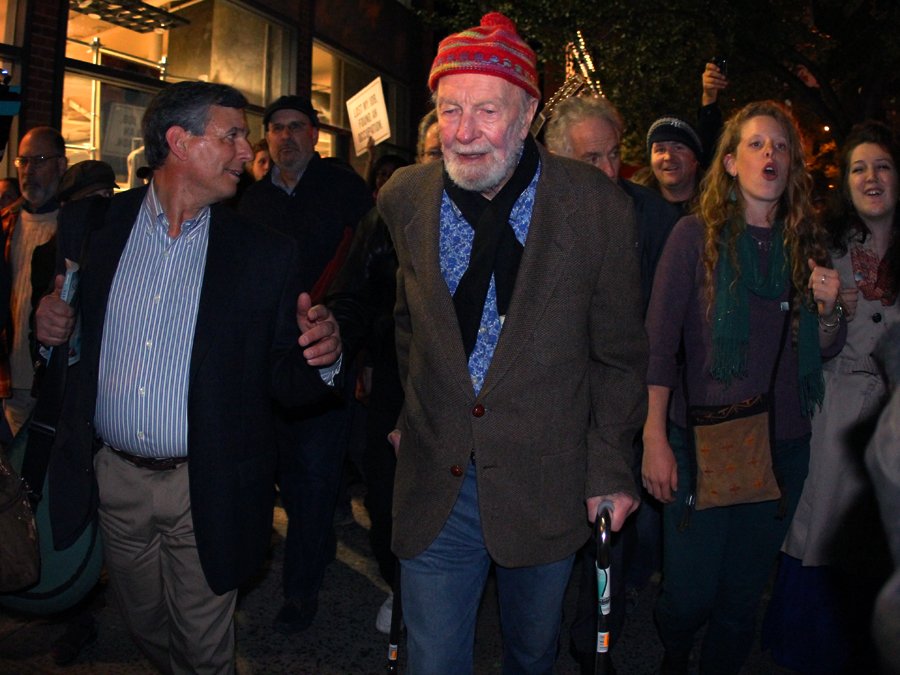
During the Occupy Wall Street movement in Fall 2011, he was there in person, galvanizing a crowd after a concert to follow him in a spontaneous march down Fifth Avenue and join him in singing a heartfelt round of “We Shall Overcome.”

here-was-tonights-special-guest-pete-seeger

His Clearwater environmental organization has become a model in inspiring communities to clean up waterways all over the nation, and indeed the world.

pete-seeger-328

Pete’s special gift is using music to inspire the best in people.

He doesn’t heckle, he doesn’t scold, he doesn’t scorn.

He just lifts up his head and his heart and seems to channel the love of the universe straight through his fingers and his vocal chords, irresistibly bringing everyone in range along with him.

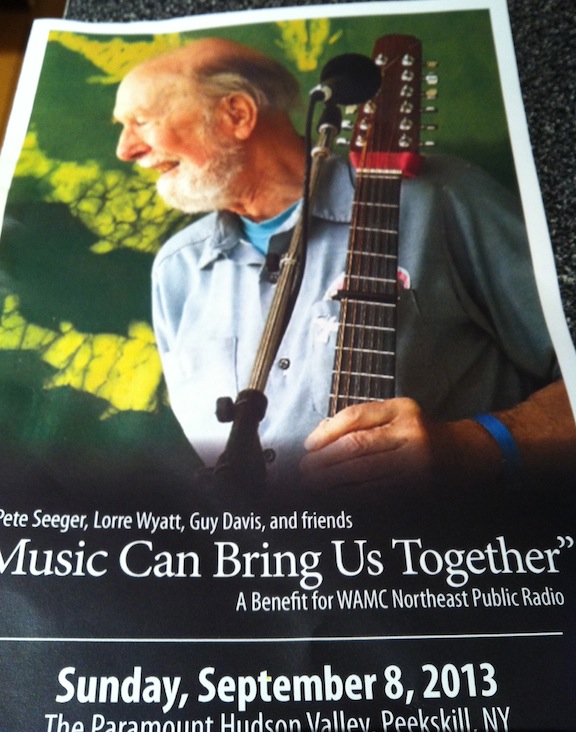
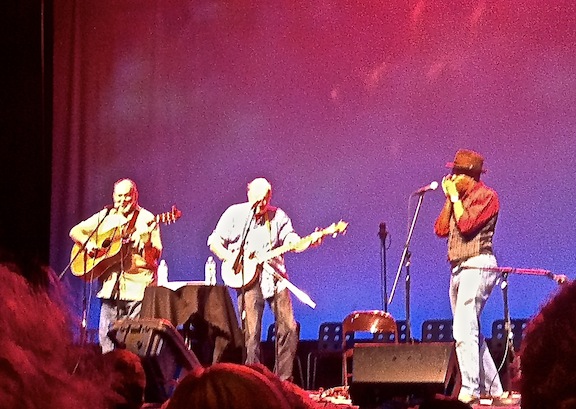
IMG_3818At a benefit concert for WAMC, Northeast Public Radio on September 8 at the Paramount Theater in Peekskill, NY, Pete’s power to inspire was undiminished, though his age is finally beginning to catch up with him in terms of his physical strength.

Nevertheless, he was onstage for a full three-hour concert, with only a brief intermission, and the delight he took in the younger people accompanying him was palpable and infectious.

For Pete, music has never been a power trip; it’s always been about creating an open-hearted place for human spirits to mingle in search of justice and beauty.

He waved off the standing ovations he received from the audience, most of whom were his longtime admirers, now going gray themselves.  He made it clear that what he had to offer was not about him, it was about the power of the music to make a positive difference in the world.

While Pete could easily have led the hall down nostalgia lane, singing all his old classics, instead he chose to give his musical partners of the day, Lorre Wyatt and Guy Davis, the chance to step in the spotlight and take a leadership role, and he took special delight in the youngsters who were singing along with him on stage.

IMG_3806

Pete sang a new song by Lorre Wyatt, “Braving the Storm,” which honored change agents like Rachel Carson, Cesar Chavez and WAMC’s tireless Alan Chartock, the chorus acknowledging “You could have stayed safe and warm but you showed us the way, braving the storm—thank you for braving the storm….”

He also sang some old fighting favorites like “We Shall Overcome,” “Where Have All the Flowers Gone,” and “Turn, Turn Turn,” his voice rising loud and strong in reminding us that “there’s a time for peace, I say it’s not too late.”

108213_f520He ended with a rousing song about the Clearwater and the Hudson River revival, reminding us that though the river has been dirty, “she’s getting cleaner every day.”

Focus on the positive, Pete seemed to be telling us—on what can be done, what should be done, what is being done to make our world a safer, saner, more loving place.  Do the work together, joyfully, singing all the while.  Have courage, be of good heart, and don’t be afraid to brave the storm, together.

Like Joe Hill, wherever people are working together for a better world, it’s there you’ll find Pete Seeger, in body and in spirit.

Thanks, Pete, for showing us the way all these years, and being a tremendously inspiring model of an elder who only grows more powerful, active and courageous with age.  We’re with you in spirit too, always!

85074216

The September 8 concert was dedicated to Pete’s late wife, Toshi, who died earlier this year.