De-coupling our wagons from the locomotive of global capitalism

There is a clear spectrum of response to the urgency of the environmental and economic challenges that face us.

On the one end is the Deep Green Resistance movement, calling for a complete take-down of industrialized civilization, violently if necessary (and it would be necessary, of course–industrial civilization won’t go down without a fight, unless it’s wiped out by natural disasters).

On the other end are those who believe we will be able to find our way into a sustainable world order via technology, ie, renewable energy sources that will keep the capitalist engines burning bright.

On this spectrum, I would have to locate myself somewhere in the middle.  While I see the necessity of deindustrialization, I don’t really want to live through the violent havoc a strong de-civ movement would cause.

But I know things can’t go on as they have been.  We must shift from an economic model built on endless growth to one that seeks to maintain a steady state, both for human societies and for the natural world (as if there were a separation between these two).

We must also shift from the capitalist system of accumulated wealth for the few based on the commodified labor of the masses, to a system in which people’s labor is more directly connected to their well-being, and wealth is not allowed to concentrate in a few disproportionately powerful, distant hands.

The only movement I’ve found so far that is actively working to accomplish a vision similar to what I’ve sketched out above is the Transition Town movement.  The brainchild of UK visionary activist Rob Hopkins, the movement describes itself as follows:

“The Transition Movement is comprised of vibrant, grassroots community initiatives that seek to build community resilience in the face of such challenges as peak oil, climate change and the economic crisis.

“Transition Initiatives differentiate themselves from other sustainability and “environmental” groups by seeking to mitigate these converging global crises by engaging their communities in home-grown, citizen-led education, action, and multi-stakeholder planning to increase local self reliance and resilience.

“They succeed by regeneratively using their local assets, innovating, networking, collaborating, replicating proven strategies, and respecting the deep patterns of nature and diverse cultures in their place.

“Transition Initiatives work with deliberation and good cheer to create a fulfilling and inspiring local way of life that can withstand the shocks of rapidly shifting global systems.”

What appeals to me about the Transition Town movement as a strategy for change is that it’s locally based and collaborative.  The first step is getting to know your neighbors, finding out what skills you can share, and taking stock of how you can prepare intelligently to cope with whatever environmental and economic shocks may lie ahead in our future.  It doesn’t dictate a one-size-fits-all model, but rather gives communities credit for being smart enough to figure out their own, locally adapted solutions.

As a society, America seems to be in collective denial about the reality of climate change.  We don’t want to hear that if we continue down the path of capitalist growth based on fossil fuels, the planet will heat up past the point where we could expect life as we know it to continue.  We don’t want to put the pieces together, because if we do, we will be forced to face the fact that we need to change. 

If we could accept this fact, we could begin to talk seriously about directions to take to make that change happen.  It would be nice if we could count on our world leaders to step up and face the challenge squarely, in a concerted effort.  But given the reality of global politics, still based on competition and armed power struggles, it seems very unlikely that we can look to the United Nations, or individual national governments, for the kind of decisive leadership we need now.

So we need to turn to each other, on the local level, and begin asking, as the Transition Town movement envisions, what can we do right here, together, to become more resilient?  What resources do we have, right here, that are not dependent on current systems of international or long-distance national trade?  How can we plan together for a sustainable future?

In a way, it’s an effort to de-couple our personal wagons from the locomotive of capitalist growth, which is proving so destructive to everything in its path, and seems to be on the verge of careening out of control.

I’ve been hearing a fair amount of fear expressed about “going backwards.” When people imagine stepping down from the capitalist growth model, they picture having to give up modern conveniences like advanced medical technologies, ready access to electricity, indoor plumbing, etc.

It doesn’t have to be that way.  We have to work on developing new ways of generating those conveniences, that are less destructive to the planet (the technological fix) and also work swiftly to dismantle those features of industrial civilization that are throwing our whole ecological system out of balance (de-industrialization).

The Transition Town movement calls this “the great re-skilling” approach.  We need to remember older, more sustainable ways of doing things, while also keeping the best of new technologies and learning how to apply them in smarter, more efficient and ecologically sound ways.

There are over 100 full-fledged Transition Town initiatives in the U.S., and hundreds more worldwide, along with many start-up groups forming all the time.  Although all of us seem to have so much to do, and so little time these days, this is really a movement we need to be focusing on now to prepare for the decade ahead.

Given the lack of effective top-down leadership, should we really be wasting our time worrying about national elections, for example?  Or bothering to go to international conferences on climate change?

Or is the smarter thing to do to begin, quietly and with determination and hopeful good cheer, to make our own preparations for a very different sort of future, in our own transition towns?

The Silence of the Bees

Usually during the holidays I catch the frenzied good cheer from everyone else and wind myself up to make merry.  This year, I just can’t seem to find the spark.

Maybe it’s a case of SAD (seasonable affective disorder).  Maybe it’s the fact that it’s the first holiday after my divorce was finalized, and that new reality is sinking in.  Maybe it’s the gloomy state of the economy, which is certainly negatively affecting my financial outlook.

But I think it goes deeper and broader than these personal issues.

I feel like I’m grieving, but not for any one person.  I’m grieving for the loss of my future, and all of our futures.  Even as I stoutly maintain that we can’t give up hope, and we need to keep fighting, there is something in me that keens, heartbroken, for the huge loss that we all face.

It’s already started, the great dying-off.

I keep remembering a certain perfect May morning in my childhood, when I waded out into the deep, fragrant grass under the old, half-wild apple trees, which were glorious in full pink-and-white bloom.  I lay in a grassy nest under one of the trees–no worries about ticks and Lyme disease in those days–looking up at the blossoms outlined against the startling blue of the sky.  The petals rustled gently in the breeze, and the sound of thousands of busy buzzing honey bees filled the air.  Watching carefully, I could see the bees moving from blossom to blossom, carrying their saddlebags full of bright golden pollen.  My heart swelled with the sheer joy of being alive in that moment, a part of the humming life of that orchard on that beautiful spring day.

Flash forward to last spring, when I went out into the same old orchard on another lovely May morning, and was aghast to realize that not a single bee was working the blossoms of the tree.  The silence was frightening, like the desolate silence of a wasteland, though visually it all looked very much the same.

This is just one small example of so many countless instances of the glorious richness of life on our planet, profoundly and irrevocably being silenced.

So yes, I am grieving.  And I am angry.  And I do not know the best way to try to head off the end that seems so inevitable now.

Sometimes it feels like I’m living in a sci-fi movie, where everything seems so hopeless, the bad guys are winning…and then at the last moment, the heroes sweep in and save the day.  I want to believe that we can be those heroes.  Perhaps it will be like the TV series “Heroes,” where many of us who are preparing ourselves now for the fight will come together and really be able to make a difference.

But I don’t count on it.  Because, in large part, the “bad guys” are us.  We’re doing this to the planet.  The laptop I type on is part of the problem, the electric lights I just strung up on my porch are part of the problem, the car I drive is part of the problem.

What would it mean, really, to stop being one of the bad guys?  To become one of the vast army of everyday heroes needed to save this planet?

I keep asking this question, and I will keep asking it until the answer becomes clear.  I feel I am taking some sort of step in the right direction just by asking the question in this public forum, seeking out like-minded people who may have answers I could not come to on my own.

I know we need each other now, more than ever.  The old individualist way of doing things is part of the problem.  Interconnection should be the buzzword of the second decade of this century.  As the planet heats up, our survival will depend on our being able to cooperate and collaborate on adapting to the new, much harsher environment.


 Sometimes I have moments of hysteria, when I feel like I’ve been diagnosed with a terminal illness, and need to decide how I want to spend my last days.  Maybe this isn’t so hysterical after all…this may be a rather sober assessment of the way things stand.

Of course, we are all living under a life sentence, all the time!  But I no longer feel I can count on living into old age, dying a natural death.  Saving for retirement seems like a pipe dream, left over from a 20th century mindset that no longer makes sense.

The only  antidote I know for the grief and depression born of full apprehension of the reality of our very bleak and uncertain future is simply this: carpe diem, seize the day.

Unless we ordinary heroes come together to create a mighty and unstoppable wave of change very soon, the planet will heat up beyond our comfort zone, causing severe weather that will send us floods, famine, conflict and extinctions on a biblical scale.

Yes, ultimately the planet will regenerate, and new forms of life will emerge.  But we will not be here to play our part–to love, appreciate, tend and respect the other living beings on Earth.

It is too soon to give in to grief.  I will shake it off, rouse myself, continue as long as I can to stand up and be counted among the opposition to the terrible destruction that our way of life has visited on so many others on this planet.

Meet me out in the apple orchard, listening for the bees….

College climate activists lead the way at COP 17 in Durban

You have to hand it to the college students attending the U.N.-sponsored climate talks in Durban.  They know how to cut through the nonsense and tell it like it is.

Watch 21-year-old Middlebury College junior Abigail Borah telling the august assembly that they can no longer afford to drag their feet on curbing carbon emissions.

“I am speaking on behalf of the United States of America because my negotiators cannot,” said Ms. Borah, a representative of the International Youth Climate Movement. “The obstructionist Congress has shackled justice and delayed ambition for far too long. I am scared for my future. 2020 is too late to wait. We need an urgent path to a fair, ambitious and legally binding treaty.”

The response to her entreaty?  A swift escort off the premises.

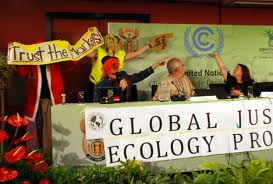
Another group of students dressed as “corporate clowns” to bring some levity to the grim discussions.  As documented by the Climate Connections blog, they too were met with hostility by the powers that be.

While talking with the press, student clown Kevin Buckland “was grabbed and hauled away. His badge was taken, and he was barred from the International Conference Center.”

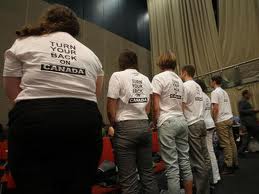
Then there was the group of Canadian students who were removed from the assembly hall just for displaying tee-shirts with the words “Turn Your Back on Canada,” a criticism of the Canadian government’s support for the oil extraction of the Alberta boreal forests (aka “tar sands”).

What kind of message are these young people going to take away from these incidents about the efficacy of trying to participate peacefully in global assemblies?  No wonder they’re turned off and turning to their own “people’s assemblies.”

As Laura Carlsen points out in an article posted on Common Dreams today, climate change activists need to “broaden the focus from once-a-year meetings in high-carbon conference centers, to the fields, communities and town halls where alternatives are already growing and a stronger political consensus can be built from the bottom up.”

The top-down approach favored by the U.N. and the international governmental community is showing itself to be not only ineffectual, but morally bankrupt.

Outsourced pollution rides the trade winds home

How timely, that just as the U.N.-sponsored climate talks are going on in Durban, a new report comes out  from the Global Carbon Project informing us that global greenhouse gas emissions grew by a whopping 5.9 percent last year, the largest leap in any year since the Industrial Revolution began.

The U.S. remains the world’s second-largest greenhouse gas emitter, trailing only China.  But as we all know, China has become a factory state of the U.S. and Europe–isn’t virtually every manufactured thing you own “made in China”?

As I hear all the time from travelers to China, air quality is noticeably bad there.  Most cities seem to be in a permanent miasma of smog, sometimes approaching the sooty fog Charles Dickens used to describe as veiling London in the coal-burning 19th century.

Here in the U.S., air quality has improved since I was a kid in New York, when smog was a daily occurrence and you just learned to live with noxious blue bus fumes blown in your face on every street corner.

But apparently what we’ve done is simply outsource our pollution to China.  Let them deal with the smog over there; we’re paying for the goods they produce aren’t we?  If they can’t figure out how to manufacture cleanly, that’s not our problem.

So goes the smug line of American entitlement.

But welcome to the new century.

First of all, the great American credit bubble has burst, and the middle class is having trouble affording those imported manufactured goods, no matter how “cheap” they are.

Second, it’s obvious that the trade winds are blowing Chinese smog our way, in the form of global climate change that will affect us here as much as it affects them over there.

Politicians the world over continue to take a short-sighted view of both of these issues, imagining that a little re-tooling is going to get us past the bumps in the road.

The media isn’t helping matters–you will have to peer deeply into the New York Times this morning to find the small buried news story about the biggest leap in global carbon emissions on record.

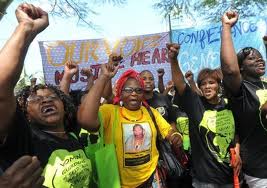
People who are already living on the edge understand the stakes.  Thousands of African women farmers have been marching in Durban, along with indigenous forest defenders from around the globe.  They’ve been kept away from the politicians inside the gates by riot police.

Guess what?  All the riot police in the world cannot keep climate change havoc from our doorstep.  Here in the U.S., in China, in Africa, and all over the world.

It’s time to deal with it.

Occupy the Climate Talks in Durban–Virtually

If you lived on a small island nation that was losing precious feet of shoreline every year due to rising seas and storm erosion, you might be forgiven for having high expectations for the current international climate change negotiations going on in Durban, SA.

In the the heart of the developed world, meanwhile, you’d have a hard time finding any news about the climate talks.  You have to search the Web pretty carefully to even find a mention.

That goes to show how it’s all about location, location, location.

I learned yesterday, by careful Web search, that Canada is planning to pull out of the Kyoto treaty, just like the U.S.

Canadians want developing countries like China and India to also agree to reduced emissions.

But meanwhile, Canada’s government is pushing the extraction of oil from the Alberta boreal forests.

As Tom Zeller of the Huffington Post reports,””What’s astonishing is watching Canada emerge as a rogue among developed countries,” said Bill McKibben, the author and activist who has spearheaded a grassroots movement aimed at combatting a pipeline proposal designed to deliver some 700,000 barrels of oil each day from the tar sands to refineries and ports on the Texas Gulf Coast. “Of course, they have no choice but to ditch serious climate policy if they want to develop the tar sands in a big way — and that pool of gunky oil is clearly the tail wagging the dog up there.”

We’re all the dog that’s being wagged by powerful oil extraction companies.  If we don’t watch out, we’re going to be wagged right into extinction.

Notice how the climate talks are always held in inaccessible places where it’s hard for activists to congregate.  Who can afford a ticket to Durban, SA?

But now, with the World Wide Web, we can all hold ring seats to the climate talks, and we need to make our voices heard.

Read the Climate Connections blog, produced in Durban by the Global Justice Ecology Project, for up-to-the-minute information about what’s going on in Durban.

Check out the results of the General Assembly held there today under the Occupy Durban banner: #OccupyCop17

The climate talks may be far away, but they are one of the most crucial sites for “occupation” as we move into the 21st century.  We can’t let the big oil companies, with their deep pockets created from our dependence on an oil-based economy, dominate the agenda.

If you care about leaving a healthy planet to the next generation, the time to speak up is NOW.

Occupying the Climate Talks & College Campuses–Full Speed Ahead!

Could be an interesting day today.  Word has it that the less-developed nations are threatening to “occupy” the climate talks at Durban if the big polluters–that’s us, America, and you too, Europe and China–won’t get serious about limiting emissions and working for systemic change.

Meanwhile, a student movement begun at UC Davis is calling for a General Strike today–no classes, no work–to create a space for student-run General Assemblies to discuss issues like police violence against peaceful protesters, as well as sky-rocketing tuition and debt-funded education that is putting college out of reach for more and more Americans.

I continue to be amazed at the speed with which awareness now spreads, thanks to how many of us are now plugged into what is coming to seem more and more like a collective brain.

Could the collective consciousness represented by the World Wide Web be an evolutionary leap forward?  Or could it at least be speeding up our evolutionary progression as a species?

Of course, it’s all dependent on electricity.  If the lights go out, our collective brain goes dead.

Or maybe not?  The General Assemblies, with their human microphones and patient face-to-face discussions give me hope that the new connections that are being forged in this time of transition are real and could stand alone, without the crutch of the Web.

In fact, maybe that’s what this is all about.  Building the human connections, virtual and real, to withstand the great shocks that are coming our way as the climate shifts and the Earth seeks to return to a steady state.

In Durban, South Africa and on college campuses and public parks across the country, people are turning out to be the change we want to see.

It’s an exciting time to be alive.


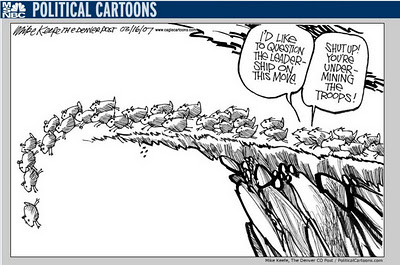
Human beings are not lemmings–so let’s get organized and get away from that cliff!

This happens to be my 100th post on Transition Times, and to mark the occasion I want to reflect on where I’ve come with this blog project, and what themes have emerged along the way.

When I started Transition Times, back in mid-July, I was away in Nova Scotia, trying not to think about the crazy shenanigans going on back home, where the Republicans were threatening to shut down the U.S. government and destroy our credit rating in the world, rather than negotiate reasonably towards consensus with the Democrats (otherwise known as “the debt-ceiling crisis”).

I was also reading Mark Hertsgaard’s Hot: Living Through the Next Fifty Years On Earth, along with Bill McKibben’s Eaarth: Making a Life on a Tough New Planet, both of which paint a stark portrait of how the climate change crisis will be affecting our lives in the foreseeable future.

All in all, I was in a pretty gloomy state of mind.

But then surprising things started to happen.

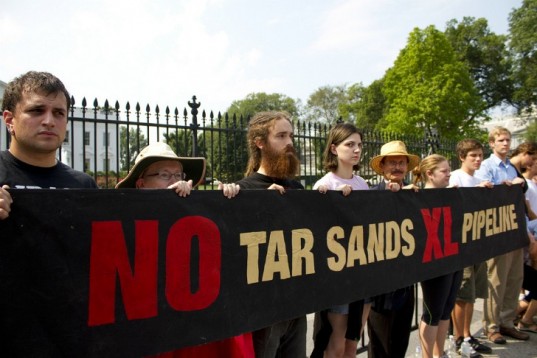
In the middle of the dog days of August, Bill McKibben and 350.org began a sit-in next to the White House, protesting the Keystone XL Pipeline and the development of the boreal forests of Alberta (otherwise known as “the tar sands”).

A month later, the Occupy Wall Street movement sprang up seemingly out of nowhere, protesting the government’s collusion with the super-wealthy (otherwise known as “the 1%”) and abandonment of ordinary Americans (otherwise known as “the 99%”).

The Occupy movement spread like wildfire, and the Keystone XL protest succeeded in at least postponing the pipeline and American support of Alberta tar sands extraction, giving the nascent climate change movement a boost and more of a chance to grow.

Along the way a historic hurricane ripped across the Eastern Seaboard, and a freak snowstorm dumped a good two feet of heavy wet snow on leafy trees in southern New England, knocking out power for some folks for days, and even weeks, and reinforcing the unavoidable reality of climate change.

Most recently, public awareness of the militarization of American policing has suddenly taken a giant leap forward, thanks to images of police brutality inflicted on old and young white people of the well-dressed, college-educated variety.  Over in Europe, the debt crisis threatens the dissolution of the euro zone, something unthinkable just a few months ago.

All in all, it’s been a dramatic few months, and blogging my reactions to and thoughts about all this has been a rewarding experience.

I’ve been struck by the power of the World Wide Web as a vehicle for social communication and movement-building.  Just as the Arab Spring showed us how cell phone texting technology could be used to ignite and build, at lightening speed, an effective resistance movement, the Occupy movement has demonstrated the extent to which Americans are plugged into the vast collective consciousness we call the Web.

While the captains of industry sold us smart phones and tablet computers intending to make us more agile shoppers and financial traders, they unwittingly put into our hands the tools of our liberation from the capitalist machine that has dominated us for the past 50 years or so.

Marx predicted long ago that the very instruments that enabled capitalism–globalization and technological prowess–would also be the instruments with which the bourgeoisie would dig their own graves.

In the age of global warming and climate change, this has never seemed more prescient.

But Marx also imagined that out of the ashes of the old world a new order would arise.  He believed that it would be possible for the proletariat, the working class, to create a better world, based on collaboration and compassion rather than ruthless competition.

It seems like Americans are finally awakening out of a long, dark sleep of obliviousness to the ways in which our corporate capitalist economic and governmental system has been leading us down a blind alley, at the end of which, it turns out, is a steep cliff.

Are we waking up in time to back ourselves out of that alley, away from that fearsome cliff?

It is too soon to tell. But those of us who are aware of the gravity of the situation today not just for our society, but for our species and the planet as a whole, need to be out there on the frontlines, both physical and virtual, making the connections that may enable us to successfully build a movement for change and avert disaster.

Human beings are not lemmings, but we are indeed susceptible to being led.  We want to believe that our leaders are competent and have our best interests at heart.  We hold on to this belief even when all evidence points to the contrary.

It’s time now to stop putting our faith in our elected officials and their paid enforcers, and listen instead to our own hearts and minds.  We know what needs to be done to bring the ecological web of life on this planet back into balance.  It is time to reach out to each other and find the determination to get the job done.

Building on the Keystone “victory”–from endless growth to steady states

In his Op-Ed in today’s NY TimesMichael Levi, senior fellow for energy and the environment at the Council on Foreign Relations, argues that the Administration only agreed to put off the construction of the Keystone XL pipeline because of “not-in-my-backyard” pressure from Nebraskans, which had little or nothing to do with the urgent issue of cutting carbon emissions in order to avert climate disaster.

“For green groups,” Levi says, “the shortest route to blocking fossil fuel development appears to be leveraging local opposition.” The problem with this approach, from Levi’s point of view, is that there is going to be “local opposition” to green energy initiatives like solar and wind farms too.

What Levi, like most Beltway insiders, doesn’t seem to appreciate is that the green movement is not just about opposition.  It’s about positive action.  It’s not just about environmental protection.  It’s about social change.

It’s about a shift from a mentality that seeks to keep growing our energy-dependent economy indefinitely, to a mentality that seeks a sustainable steady state.

Steady states are anathema to capitalism–a quarter without growth is a quarter wasted, as any CEO would tell you.

But steady states are exactly what have made our planet a livable environment for the past several thousand years, during which the human species, along with countless others, has thrived.

Rejecting the Keystone XL Pipeline is just a small step in the right direction, towards a society that puts effort and money first into reducing energy consumption, and second into developing energy infrastructure that has the lowest possible impact on the ecological web of life.

The Michael Levis of America don’t understand that this is the real push behind the green movement today.

Yes, we’ll seek allies where we can find them, and make use of whatever sources of power we can find (even pro-oil Republican Nebraskans) to achieve our goals.

But our movement is not about “leveraging opposition.”  It’s about mobilizing support, through raising awareness about the threats to our civilization and our planet if we continue along with business as usual.

It’s also about leading the way towards the alternatives that are already within reach if we choose to veer off the beaten path into new, much more stable territory.

Endless growth is a social model that has proven itself to be highly unstable, whether we’re talking about national economies or energy systems.

It’s time to use our intelligence as a species for the good of ourselves and our planet.  There is really no other way forward.

Pipeline put off, but I’m not celebrating, are you?

Bill MicKibben: We won a temporary victory on Keystone XL, but the fight goes on | Grist.

It’s hard to feel elated about President Obama’s decision this week to kick the can of the Alberta tar sands extraction down the road a ways, until after the 2012 election.

Yes, any victory is a good victory, and the environmentalists who took the trouble to go to Washington and raise a ruckus in opposition to the proposed pipeline deserve our accolades and thanks.

The cranes who use the Nebraska Sand Hills refuge will have another year or two of peace.  The Ogllala aquifer is protected for the moment.

But it’s discouraging to see how the Administration is trying to limit discussion to the pipeline, as if it, in itself, were the problem.

No, the pipeline is just a symptom of a much larger problem: the potential destruction of the Canadian boreal forests, with their countless species of flora and fauna, and their tremendous carbon-trapping properties.

Without the Alberta forests, global warming is a done deal.

Does anyone there in Washington understand what that means?

Earth to Washington: do you copy?

Go ahead, Earth.

We haven’t got much time left.  The temperature is rising.  Once the climate destabilizes, we won’t be able to turn things around for a long, long time.  We’re talking geological time here.

Copy that, Earth.

So can we get some serious action there, Washington?  Can we light a fire under those politicians and get going with solar energy already?

Copy that, Earth.

Like–now?

Washington to Earth, connection is down.  Can you repeat?  Over.

Yes, that’s right.  Over.

Climate Change Blues: The one thing the 100% of us have in common is that we can’t afford to ignore the weather!

President Obama, venturing outside during last night’s storm, called the weather “less than ideal” for trick-or-treating.

What an understatetment.

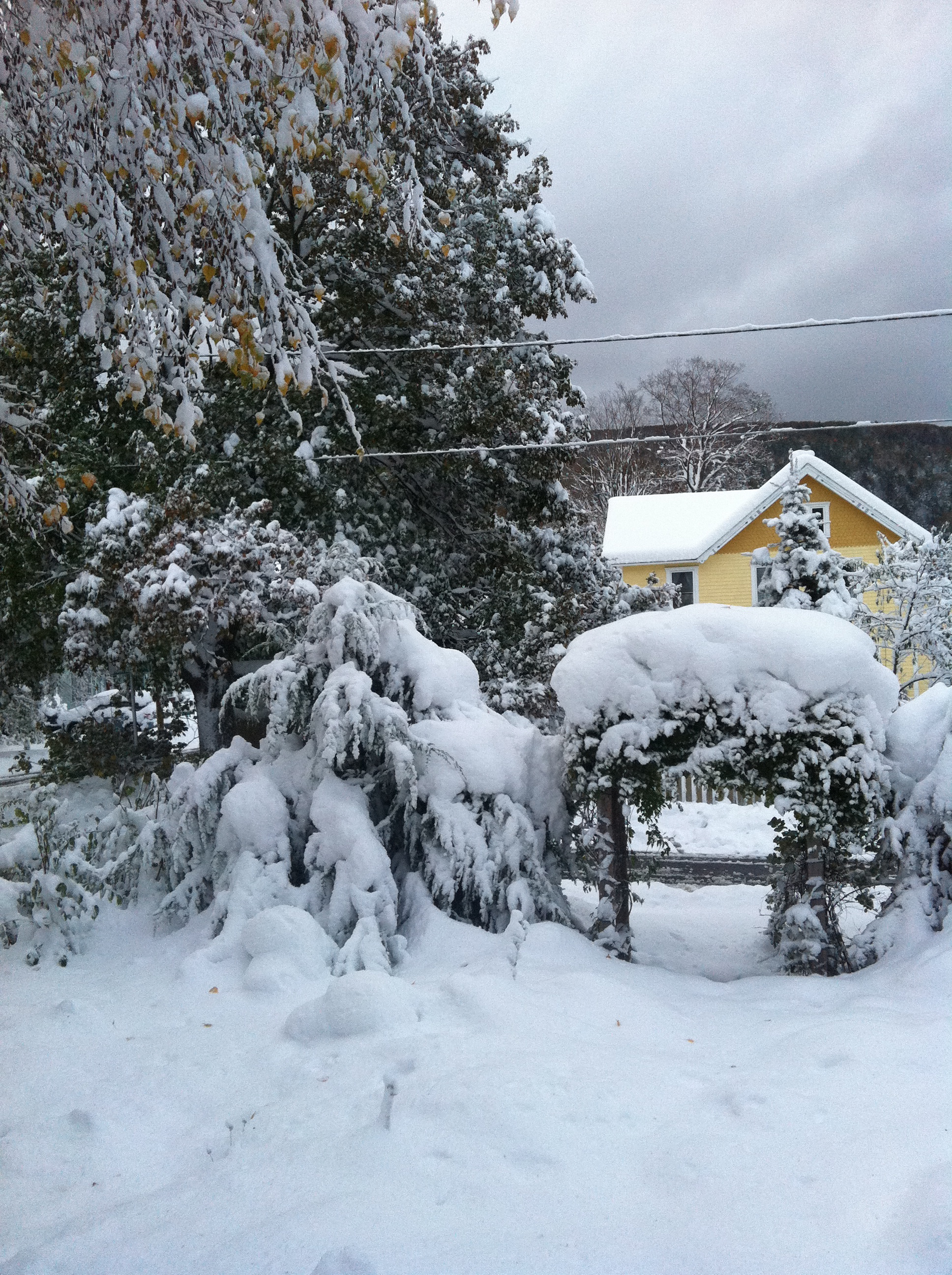
Here’s what it looks like at my house in western Massachusetts this morning:

All those trees in the background are tall maples, bent over with the weight of snow on their leaves.  So far no big limbs have snapped, but that could change any moment, and many of them are hanging over an outbuilding and my car….

So the question we should all be asking this morning is whether this freak October snowstorm is just an aberration, or if it’s part of a developing and accelerating pattern of climate change.

Yes, there have been October snowstorms before.  But has there been a three-month period before with record high temperatures (August), record rainfall (September), a hurricane hit to the entire East Coast (Irene) AND a record-breaking snowstorm?

Not being a meterologist, I can’t answer this question, but I’d sure like to know.

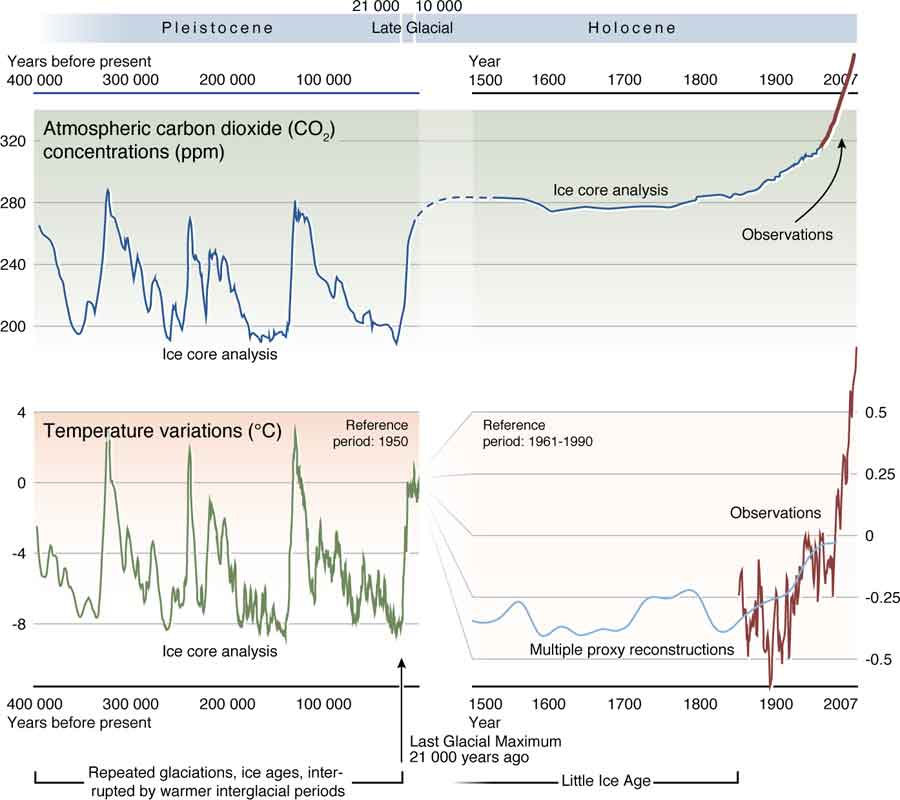
One thing I do know is that if we don’t start reducing carbon emissions, weather events like this are going to become more frequent and more severe.  This is not “Day After Tomorrow” hysteria, this is scientific truth.

So again, the question becomes, what can we DO?

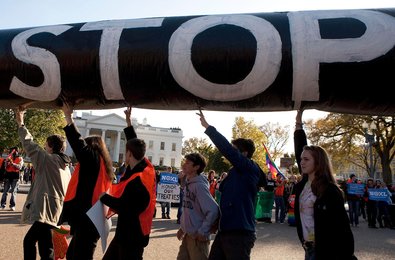
Well, next weekend in Washington DC there will be an action at the White House; the plan is to assemble enough people to make a linked-arms ring around the White House, in the hopes of persuading President Obama to stand with the people on the anti-tar sands extraction, anti-Keystone pipeline issue, rather than with the energy corporations.

You can hear actor Mark Ruffalo explain it here:

My hope is that weather events like last night’s “freak” snowstorm will raise people’s awareness about the reality of climate change, and how it will affect all of us–our food supply, our physical security, our ability not just to carry on as usual, but to carry on at all.

All of us–the rich, the poor, the inbetween–the 100% of us, and not just in the US but in the world, are already feeling the effects of manmade climate change.  We’ll be feeling it increase exponentially in the coming months and years.

So all of us need to step off the path of least resistance and start demanding government support for a huge Apollo Project-style transition to sustainable energy and a serious commitment to energy conservation.

If you can’t get to Washington DC next Sunday for the demonstration at the White House, you can be part of the virtual ring that will surround the people on the ground there, and build support wherever you are for the movement for responsible and caring stewardship of our Earth.

We cannot afford to ignore these issues any longer.