What should we do with our one wild and precious lifetime?

It is the last Full Moon of 2012, but the sky is overcast here, with snow on the way for tomorrow.

Having the moon obscured feels appropriate, as I am searching for a clarity that continually eludes me.

One thing for sure: this is the new normal, me alone with my dog by my side, sipping a quiet glass of wine by the fire, while my sons are out with their girlfriends.

Get used to it, honey!

After 20 years of hardly ever being alone, now it is coming around again, the long quiet hours I remember from my twenties, when I had seemingly endless time to think and read and write.

It saddens me to think of how I spent those hours, poring over the dry tomes of literary critics and deconstructionists, writing my own oh-so-alienated prose in a weak attempt at mimicry.

I wish I had instead been traveling the world in those years, voyaging and adventuring, meeting interesting people and learning new things.

I went as far as Paris and came home attached to a Mexican.

Married to him, I found myself locked into an endless loop of returning to his home in Mexico City year after year.  There I learned first hand about the power of internal colonization; the subtle and not-so-subtle debasement of women in Mexican society; and how to dance, drink and have a superficially good time.

I spent the past 20 years in what seems in retrospect like hard labor, being the primary caretaker in my home as well as—for nine of those years—working two demanding academic jobs.

Now my second job is gone, eliminated by state budget cuts, and one of my sons is almost launched, having gotten his B.A. last spring and moved to Florida for a job.

I am at the threshold of a new period in my life, and this time, knowing how short and precious a lifetime really is, I want to be more intentional–to make the best use of my time.

That is where I am seeking clarity.  What do I want to be doing with my one wild and precious life?

Where should I be putting my energies? What do I have to give? What do I want to be doing with my time?

In the current issue of Orion Magazine, the environmental writer Paul Kingsnorth asks this question too, and provides some answers that I find useful as pointers for myself.

After discussing how likely it is that we are on the cusp of civilizational and ecological collapse, he asks, “what, at this moment in history, would not be a waste of my time?”

His answers are fivefold: 1) Withdraw; 2) Preserve nonhuman life; 3) Insist that nature has a value beyond human utility, and proclaim this loudly to all and sundry; 4) Build refuges; 5) Get your hands into the earth.

This sounds like tremendously good advice to me.  I am especially glad to be reassured that my current retreat into solitary, meditative reflection is not a cop-out, but a necessary stage in the life-cycle of the bodhisattva for the planet that I want to become.

“Withdraw not with cynicism, but with a questing mind.  Withdraw so that you can allow yourself to sit back quietly and feel, intuit, work out what is right for you and what nature might need from you….Withdraw because action is not always more effective than inaction.  Withdraw to examine your worldview: the cosmology, the paradigm, the assumptions, the direction of travel.  All real change starts with withdrawal,” Kingsnorth says.

Preserving non-human life, and proclaiming its inherent value…well, I can try, within my sphere, but let’s face it, the very fact that I type these words on an Apple laptop with my refrigerator whirring quietly in the background means that I am part of the problem.

As Paul Kingsnorth knows and has expressed eloquently, there is nothing any one of us can do that will change the fate of the 200 species that go extinct every day on our planet.

Even if we come together collectively, it will be very hard, maybe impossible, to stop the juggernaut of climate change now.

That’s why the idea of building refuges and relearning off-the-grid skills makes a lot of sense to me.

UnknownI have a persistent vision of building a kind of hobbit-house in the side of a hill, off the grid and sheltered from the coming storms, in the company of others who share my dream of resilience.

It is not for nothing that JRR Tolkien’s classic The Hobbit and The Lord of the Rings are more popular than ever in these opening years of the 21st century.

We are engaged in an epic struggle once again, faced with the spread of a Mordor-esque wasteland over the entire planet.

Will those of us who share the ethos of hobbits, elves and dwarfs be able to save the day?

Will enough of our contemporary wizards—scientists, they call themselves now—weigh in on the side of life and health rather than the oppressive bondage of the capitalist technocracy?

In Tolkien’s novel, Evil comes even to the sheltered little Shire, but is vanquished in the end by the forces of Good.

That is how the stories we like to tell each other go.  It remains to be seen whether reality, this time, will follow this “happily-ever-after” fairytale motif.

I don’t know how it will all end. But I do know that in these dark months of winter, when even the bright full moon is obscured, it feels right to be retreating within to reflect on how best to pursue the struggle in the coming years.

Unknown-2

Standing strong against the Furies

AUDIO OF THIS PIECE READ BY JBH ON WAMC-NORTHEAST PUBLIC RADIO, DECEMBER 21, 2012

Just as people in places like the Maldives, Bangladesh and Japan shook their heads at the cluelessness of Americans who suddenly woke up to climate change when Sandy came to town, people living in hot spots of violence around the world now have every right to be shaking their heads at the collective American refusal to see and understand how, in the wake of the Newtown massacre, we are the cause of our own misery.

t1larg.pakistandronerally.giThe U.S. is the largest arms manufacturer and exporter in the world.  We have by far the largest military.  We are also by far the most heavily armed civilian population in the world, with some 300 million guns circulating among our population of about 300 million people.  Americans, we need to acknowledge that collectively, as a nation, we have been responsible for hundreds, and probably thousands of deaths of children worldwide through the weapons we sell abroad.

There is not a conflict in the world today that has not been fueled by American weaponry.

It is hypocritical to weep crocodile tears for the slaughter of innocent children in a kindergarten in Connecticut but to callously ignore the slaughter of innocent children by American drone fire in places like Afghanistan and Pakistan.

We need to start connecting the dots and realizing that the violence we mete out to the world will come back to haunt us a thousand-fold.

I’m not just talking about gun violence or missiles. I’m talking about the violence of inhuman labor practices and poverty, leading to rage that is sometimes turned inward, as in the spikes of farmer suicides due to heavy-handed Monsanto tactics in places like India and Asia, and sometimes outward, as in the terrorist strikes against targets inside the U.S. (9/11, anyone) or at our representatives abroad (did someone say Benghazi?).

I’m talking about the violence Western-style “development” has wreaked on the natural world, which is now boomeranging back to slam us against the wall of a destabilized climate.

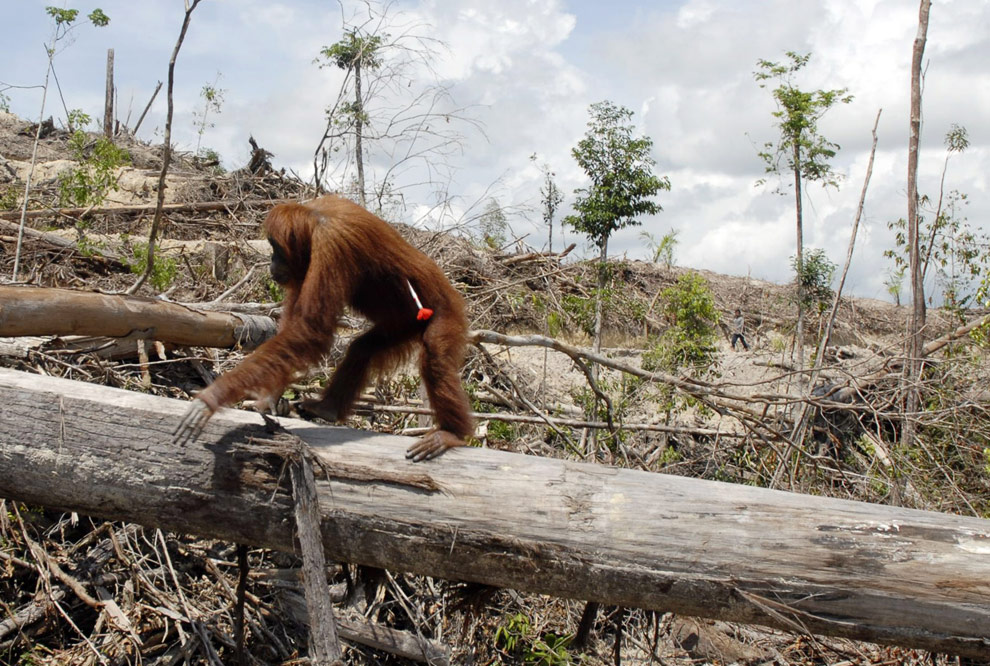
Orangutan with a tranquilizer dart in his side; will be relocated away from palm oil plantation site

Orangutan with a tranquilizer dart in his side; will be relocated away from palm oil plantation site

If you create lethal weapons and spread them widely among the populace, you should not be surprised when they discharge and kill people.

If you overheat the climate and bulldoze all the trees, you should not be surprised at the deadly droughts, wildfires, storms and temperature swings that result.

Back in the 19th century, Charles Darwin taught us to understand that competition is good, that the strongest and fittest will survive, and that if the weak perish it’s all for the best.  It was a perfect rationale for the capitalist/imperialist narrative of the past 500 years, domination as evolution, at gunpoint and bulldozer blade.

Would Darwin look out at today’s dangerous world and proclaim serenely that the coming population drop of humans, due to violence of our own making, is simply part of the grand scheme of Evolution?

If the answer is “yes,” does this mean we should just sit back and watch it all unfold with detachment?

I don’t think so.  I believe it’s the great task of our generation to meet the violence of our time with unwavering, clear-eyed resistance.

To a large extent, the damage has already been done.  The guns are circulating out there in the world; the nuclear power plants are whirring; the oil and gas rigs are pumping; the myriad plants and creatures with whom we grew up in our era on the planet are disappearing.

Pandora’s box is wide open, and the Furies have been released in the world.

We may not be able to get them back, but we can continue to insist that they do not represent us.  We can continue to stand as beacons to another mode of living, based not on competition and aggressiveness, but on collaboration and respect.

As we move into the darkest week of the year, let us not give up hope that as the planet swings back towards the Sun on December 22, we can collectively climb up out of the abyss of violence and pain and unite around the finest human values of life, peace and love, for our fellow human beings, and for the planet as a whole.

Building a Tsunami of a Climate Change Movement: What Will it Take?

In the seething, saturated media environment we live in, victory is measured in whether or not you’re able to get people to slow down and pay attention.

It’s getting harder and harder, especially for young people, to sustain attention for more than a few minutes.

Life is a restless prowl for something new, and in a manmade environment where we’re seen it all before, it’s got to be pretty damned new and exciting to get us to pause for even a moment.

As a teacher, I find myself adapting to this in ways that I would never have predicted when I first started teaching undergraduates, nearly a quarter-century ago.

I know I have to be more exaggerated in my classroom presence.  She who drones is lost.

I also don’t expect the level of reading comprehension these days that I used to take for granted among my students.

I know I’m going to have to excerpt and digest for them, and I’d better do it in an enthusiastic, engaging way, or they’ll be surfing away, in their heads if not literally, on their screens.

I have to do constant daily battle with those screens, too—even when I outright forbid them, they creep back in with all the force of a compulsion, or an addiction.

In this kind of environment, why should we be surprised that it seems to be impossible to get people to pay attention to a big, remote problem like climate change for more time than it takes to say “Hurricane Sandy”?

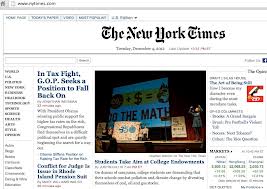
The other night I was overjoyed when I stopped by the New York Times site and saw Bill McKibben’s “Do the Math” tour foregrounded front and center on the homepage.

Unknown

Bill had the same reaction: he forwarded a screenshot of the page to his email list, trumpeting victory.

But what kind of victory is it, really?

Yes, McKibben’s Do the Math tour succeeded in finally penetrating the security perimeter of that gated community known as Mainstream Public Opinion.  If the Times prints an article, we can assume that at least a few of the sheltered, august heads within the insular circle of elite readers will pay attention.

Note that the article was ultimately filed in the Business section of the newspaper, by the way.  Evidently the Times thought its business-minded readers ought to know that those pesky students might be causing trouble for stockholders in major fossil fuel companies in the coming months.

This is the same way that the Times reported the Occupy Wall Street movement: as an annoying inconvenience, a public nuisance that our good police force is working to clear away ASAP.

It’s the same way they’ve reported on Hurricane Sandy, hitting right in their own backyard.  What a colossal inconvenience!  Let’s clear it away so we can get back down to business as usual.

What is it going to take to get through to the Times and its readers that there is not going to be any more business as usual?

The game is up.  Things are going to get much worse, and the only chance of avoiding total disaster is through immediate decisive action to curb carbon emissions and build up a massive supply of carbon sinks—ie, more forests, more seaweed and algae, more grasslands and croplands.

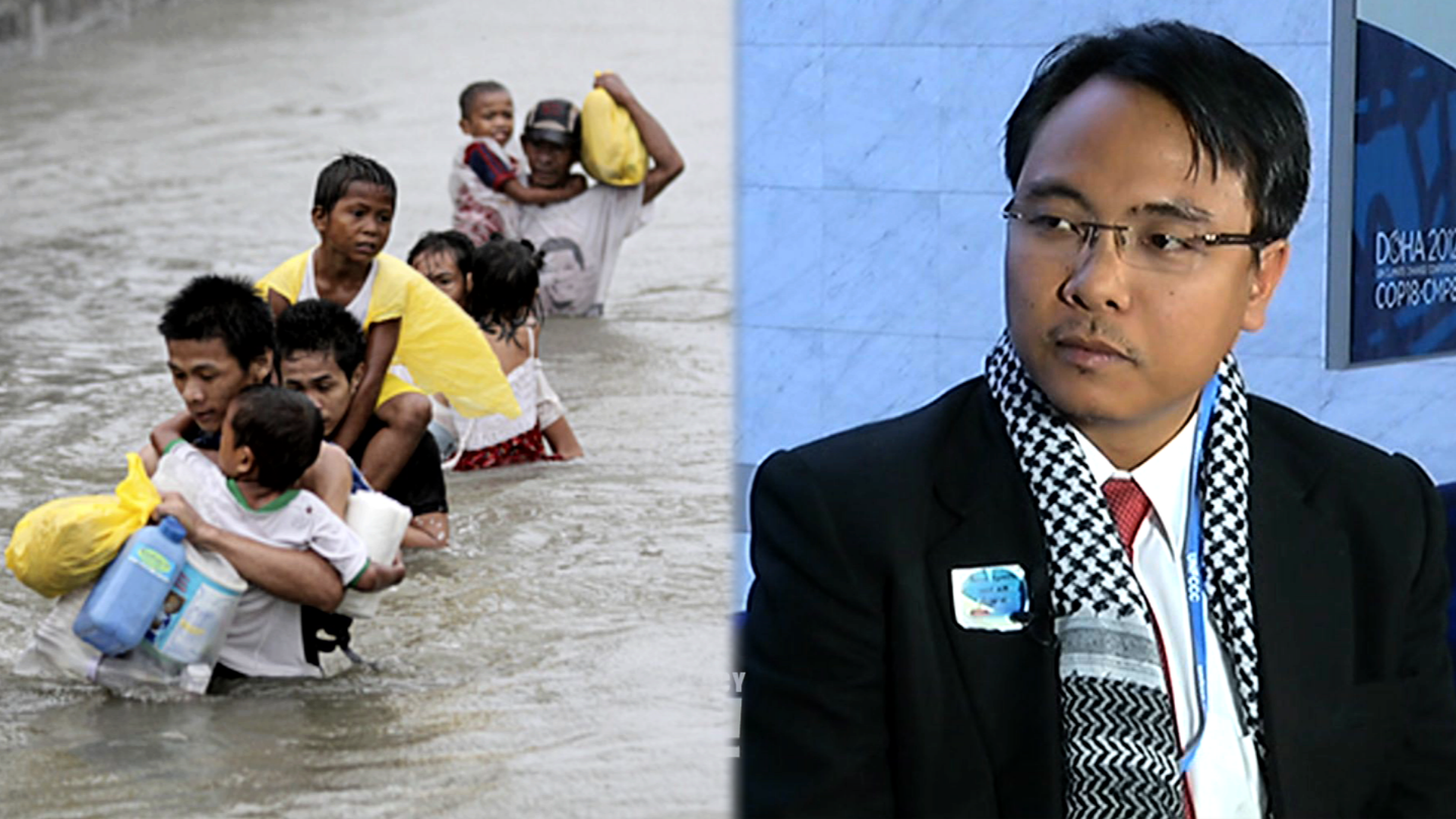
I was heartened, in a very melancholy sort of way, to see the chief negotiator for the Philippines, Naderev Saño, get all choked up as he made an impassioned speech to his comrades at COP18 this week to stop dilly-dallying and get down to the business of real change.

typhoon_yeb_sano

Referring to Typhoon Bopha, he said:

“As we sit here in these negotiations, even as we vacillate and procrastinate here, the death toll is rising. There is massive and widespread devastation. Hundreds of thousands of people have been rendered without homes. And the ordeal is far from over, as typhoon Bopha has regained some strength as it approaches another populated area in the western part of the Philippines.

“I appeal to the whole world, I appeal to leaders from all over the world, to open our eyes to the stark reality that we face. I appeal to ministers. The outcome of our work is not about what our political masters want. It is about what is demanded of us by 7 billion people.

“I appeal to all, please, no more delays, no more excuses. Please, let Doha be remembered as the place where we found the political will to turn things around. Please, let 2012 be remembered as the year the world found the courage to find the will to take responsibility for the future we want. I ask of all of us here, if not us, then who? If not now, then when? If not here, then where?”

Those are the right questions to be asking, and Saño is on the right track when he says that the work of stopping runaway climate change is not about what the “political masters” want.  It will only be possible if a sufficient number of people, all over the world, focus their attention and insist on the policy changes that will lead to real change.

The poor are the ones being disproportionately swept away by the floods and storms of climate change.  The problem may have their attention, but they’re not in much of a position to do anything about it.

I believe it is up to us, citizens of the so-called “developed” countries, to come out in force to demand change.

That is the kind of tsunami of U.S. public opinion that McKibben is trying to create with the Do the Math tour.

If we can succeed in catching the attention of young people, and getting them to understand how crucial this issue is to their futures, they can become a powerful force for change.

But in the end, this must be a multigenerational, multinational, multiethnic movement, of men and women from all walks of life, because if there’s one thing for sure, it’s that climate change does not play favorites.

It will blow away the fanciest palace just as soon as the flimsiest shanty (though the shanties will undoubtedly go first).

Ultimately, it will not be possible to build walls high enough to keep out the floodtides of a destabilized climate.

Does that get your attention?  No?  How about this: if we don’t get our act together on this issue now—I mean, NOW—we might as well just give it up and resign ourselves to roll with whatever punches are in store for us.  There will be many, and they will get progressively worse until our entire human civilization grinds to a halt.

Is that a risk you’re prepared to take?

I hope not.

So what can you do?

If you own stock, consider divesting your portfolio from fossil fuel companies until they shape up and get seriously green.

If you own a home, consider investing in alternative energy sources like solar or geothermal, and make your home as energy-efficient as possible.

Consider pressuring your town or city to do the same.

Start writing letters and emails to your elected representatives and the President of the United States and the fossil fuel barons and anyone else who might have influence, insisting that they think about our long-term welfare, not next quarter profits.

Talk to people about this.  You can never tell where ripples will go as the word goes out.

Do you want to go down fighting and active, or zoned out in front of your screen?

I echo the emotional words of the Filipino negotiator:

“Please, let 2012 be remembered as the year the world found the courage to find the will to take responsibility for the future we want. I ask of all of us here, if not us, then who? If not now, then when? If not here, then where?”

Telling the story of climate change: a call to action

You probably didn’t notice, but this past week another round of major international climate talks were held in Doha, Qatar, surely one of the least “green” locations on the globe.

The mainstream press barely bothered to give a nod to what has come to be a mind-numbing ritual of bait, switch and dodge.

The alternative press knew better than to look to the assembled ministers in Doha for any real news, focusing instead on the grim report released early last week by the Potsdam Institute for Climate Impact Research and Climate Analytics.

The 84-page report, titled “Turn Down the Heat” and funded by that radical fringe group known as the World Bank, demonstrates that if we continue our reckless heating of the planet at the present rate, all the scenarios of which readers of this blog are well aware—sea level rise, droughts and floods leading to severe food shortages, more frequent and more severe storms, loss of biodiversity and loss of human life on a biblical scale—will come to pass.

The executive summary of the report concludes with a measure of urgency:

“A 4C world is likely to be in which communities, cities and countries would experience severe disruptions, damage and dislocation, with many of these risks spread unequally.  It is likely that the poor will suffer most and the global community could become more fractured and unequal than today.  The projected 4C warming simply must not be allowed to occur–the heat must be turned down.  Only early, cooperative, international actions can make that happen.”

But this takes us in circular fashion back to Doha, where as we know, nothing substantive is going on.

Those of us who are aware of what’s happening on the climate front—and let’s face it, there aren’t that many of us, we probably form our own little 1% club—find it frustrating and frightening to have to sit by and watch as our beloved planet goes into drastic human-induced traumatic shock while our leaders bicker and fiddle and run down the clock.

I find myself constantly pulled between A) wanting to support political efforts like Bill McKibben’s “Do the Math” tour, which aims to educate and inspire action (specifically, divestment from fossil fuel companies to pressure them to reinvent themselves as bonafide green energy companies) and B) wanting to simply hunker down and build resilience at the local level, perhaps enrolling myself and my sons in a crash course in how to survive a disaster.

For the moment, I am focusing on doing what I can within my purview as a teacher to help the upcoming generation of young adults get a handle on what’s happening to our climate, and do their own productive thinking about how to engage in the struggle to turn things around.

Yesterday I was fortunate to have had a chance to participate in a small way in my colleague Eban Goodstein’s C2C Fellows Workshop, a national program based at Bard College that seeks to give young people the skills and understanding to become successful leaders in the global effort to stabilize our climate and create a sustainable economy.

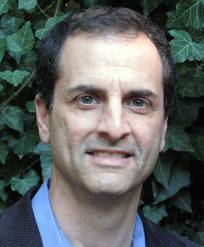
Eban Goodstein

Eban Goodstein

This is an ambitious undertaking, and Goodstein is going at it full tilt, holding weekend workshops several times a year at college campuses across the country, and bringing graduate students to Bard, with generous funding, to undertake Master’s degree programs in environmental policy with a special emphasis on climate-related policy and advocacy.

As Goodstein puts it, “Stabilizing the climate is not the work of a year, of a presidential term, or of a decade. It is the work of a generation.”

I see it as an essential commitment and responsibility to use my skills as a writer, scholar and teacher to help equip the upcoming generation for this great work we must all undertake now.

Goodstein is a unique blend of science policy wonk and communications guru, and I’m convinced that it’s at this very nexus that real change on the climate front will be forged.

All the dire scientific reports in the world won’t get people to wake up and change their daily habits, or insist that policy changes are made at the local, state, national and international levels, if the information is not presented in clear, compelling language.

A significant portion of the C2C Workshop, therefore, is spent in developing students’ storytelling skills.

It was interesting, and somewhat disheartening, to watch the students’ puzzled reaction when asked by Goodstein to talk about a favorite storyteller in their family.  Very few hands went up.

This is because most Americans today are reared listening to the TV tell us stories, not cherished individuals in our actual lives.  We are avid but passive consumers of prepackaged stories, and as a result most of us—unless we have the ambition to become stand-up comedians—don’t see storytelling as a skill we need to master.

Goodstein’s important insight is that storytelling is key to getting people’s attention, and telling a good story is essential to success in environmental advocacy and politics.

Good persuasive communication, he said, starts with a personal story, and then moves into the political.  Hook your audience with a personal anecdote, keep their attention with a strong narrative, and then finish up with a call to action.  And once you’ve got a strong story developed, practice telling it, over and over again, until you can do it in your sleep.

Armed with this advice, the group of some 80 students broke into smaller groups of five, each accompanied by a faculty or graduate student facilitator, for a two-hour intensive storytelling workshop.  Our task was to each come up with a short story about an inspiring person or event, write it up and tell it three times, to three different partners, then refine it and tell it again to the whole group.

The stories would be refined further the next day, told again to new audiences, and several would be singled out for telling to the entire big group, and given awards.

This is the kind of work for which I have been preparing my whole life.  There is nothing I would rather do than facilitate a writing workshop on inspiring stories!  And it gives me special joy to do it as part of a program aimed at giving young people the skills and mojo to tell the climate change story in a way that galvanizes action.

It may be that in the end, I would have been better served by spending my time learning survival tactics in the woods, but the truth is that even in the most dire circumstances, human beings have always needed their storytellers.  A good story well told can keep us warm in ways that may not be measurable, but that are profound nevertheless.

Here is the story that I wrote and told the students yesterday in our workshop.  I offered it to them—and now to you—with love and an earnest desire that it may inspire us all to each get to work on the climate change issue—in our own ways and spheres—before it’s too late.

My friend Pauline tells the story of how she came home from work one day and discovered that a civil war had started in her country, Congo-Brazzaville.  Suddenly she had ten people, mostly women and children, sheltering in her house as gunfire and bombs shook the streets of the city. 

When a bomb hit the house, she and her family and friends knew they needed to make a run for it.  They gathered what food and supplies they could carry, and left the house in the middle of the night, heading for the countryside. 

What followed was weeks of deprivation and terror as they huddled in the forest waiting for the conflict to die down so that it would be safe to return home.

I tell this story because it is emblematic of the many stories I have studied over the years, in which women and children are disproportionately affected as victims of social conflict and war. 

I tell it because I fear that in the age of climate change this is a story that will be repeated over and over again. Whether the violence is human—men with guns—or natural—hurricanes or droughts—the effects will be the same: women and children on the run, vulnerable and afraid.

Recent studies indicate that hundreds of millions of people will become climate refugees in the next half-century.  And they won’t all be in Bangladesh or the Maldives, either.  Just ask a former resident of Breezy Point in New York City, devastated by Hurricane Sandy, how it feels.

In our lifetimes we will all witness–and many of us will likely experience—the kind of fear and hardship that Pauline lived through, when the social order disintegrated and violence became the norm. 

There are many, many guns in America.  It would not take much in the way of food and energy shortages to trigger violence.

Sometimes I find myself wondering whether I should be learning and then teaching others survival skills, instead of critical thinking and writing. 

What good will my PhD in literature do me in an age of relentless, recurring Hurricane Sandys?  What good will a vaunted college degree do my students?

But I do continue to believe that the stories of survivors like Pauline matter, and increasingly these are the stories I offer students in my classes on human rights, environmental justice, politics and literature.

We all need to learn from Pauline and other survivors about the amazing resilience of the human spirit.  Even in the face of terror and chaos, people can choose to be compassionate, generous and respectful of one another. We don’t all choose the violent path. 

It will not help any of us to focus on fear right now, as the climate change crisis gains momentum and threatens to engulf us.  What we must concentrate on instead is hope, resilience and solidarity.  That’s what the world needs from us now.

Fossil Fuels R Us–but we can change, and so can they!

I am in one of those periods where I feel quite inadequate to comment on the events that dash across the world and national stages with madcap intensity.

What was it Shakespeare said? Life’s but a shadow, a poor player who struts and frets his hour upon the stage and then is heard no more…it is a tale told by an idiot, full of sound and fury, signifying nothing….

And yet for those of us who are caught up in the moment, our hour upon the stage, what happens does matter, it does signify something—even if we can’t always tell what that something is.

The General and his lover

What does it mean that a much-decorated general, Director of the CIA, abruptly resigns after being investigated for adultery by the FBI?

Is this scandal really just about a simple affair with a younger woman, or do the General’s neocon tendencies, which had him presiding over the escalation of the disastrous war in Afghanistan and advocating open hostility with Iran, have anything to do with the alacrity with which President Obama accepted his resignation?

We’ll find out when the blockbuster film comes out, a couple of years from now!

Meanwhile, the drumbeats of war are booming in Israel/Palestine, right on cue after the American elections ground to their quadrennial conclusion.

Once again photos of bloody children pop up on our computer and TV screens.  Once again passionate voices on both sides of this eternal conflict are raised.  This is a pageant that has taken place so many times it has become predictable and stale, like the Christmas pageants that will soon take their places on local church stages throughout Christendom.

Scenes from Gaza, November 2012

Why can’t those people just get along? Americans wonder before flipping the channel.  Few of us are aware of the extent to which the Israeli/Palestinian conflict continues to be fueled and armed by the taxpayers of the United States.

This is our conflict; we are responsible.  But as long as we dispassionately wait for someone else to stop it, it will continue to grind on.

The same is true with so many issues, from climate change to income disparity.  It’s time to stop waiting for someone else to step in and solve the problems, make the changes for us.  We have to do it ourselves.

There are a few encouraging signs that this is beginning to happen.

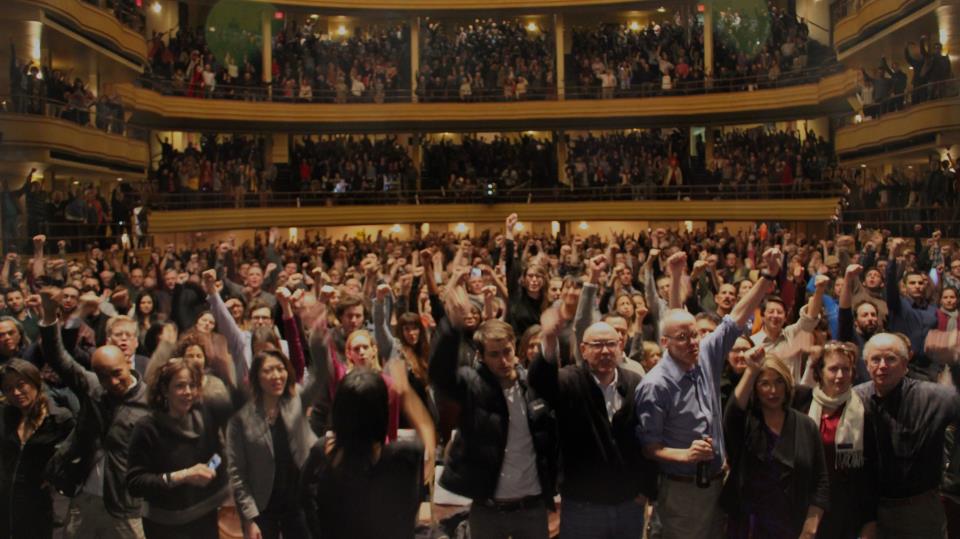
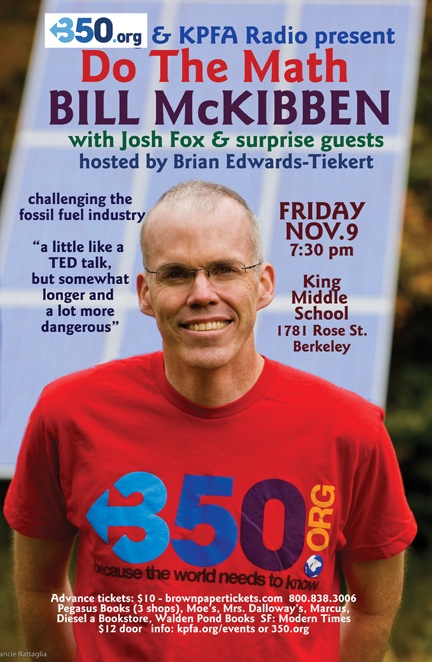
The 350.0rg “Do the Math” tour with Bill McKibben, Naomi Klein and many, many friends is making its historic way across the country, urging Americans to consider ways they can pressure the institutions with which they’re involved to divest from fossil fuel companies.

Scene from the Do the Math tour in New York City, 11/12

McKibben was talking about this last summer when I went to listen to him up at the top of Mount Greylock here in western Massachusetts, courtesy of Orion Magazine.  He invoked the successful divestiture movement of the international anti-apartheid struggle, which put enough pressure on the racist South African government that it eventually had to back down from its untenable position and begin working with the Black South Africans.

The sins of the fossil fuel companies are much bigger than those of the Boers: we’re not just talking about bigoted social policies in one country here, we’re talking about a mindset, policy brief and massive engineering effort that is inexorably endangering the entirety of human civilization on this planet, and indeed the well-being of all current life forms, perhaps excepting algae, bacteria and cockroaches.

And yet, it’s impossible to externalize the blame here, because the fossil fuel companies have only been trying to give us what we want: cheap and plentiful oil and gas.

It’s not their fault that we love their products so much we’re willing to do anything—including fight endless wars—to get it.

It’s incumbent on us to look inward and interrogate our own desires and dependencies in order to move forward.

Pressuring the fossil fuel companies to change is a good thing, as long as we’re willing to change with them.

Shifting to renewable energy is going to take a commitment from every player on the world stage today, from government leaders to manufacturers to the financial sector to ordinary consumers like you and me.

Let’s not allow the gloom of Shakespeare’s tragedies to engulf us and sap us of energy.  This play isn’t over yet and it doesn’t have to come to a bloody end.

Enough playing the handwringing Hamlet role!  Let’s roll up our sleeves and get to work to solve our problems and write ourselves a better script.

The Audacity of Hope, c. 2012

For those of us who supported President Obama, the last 24 hours or so have been positively giddy.

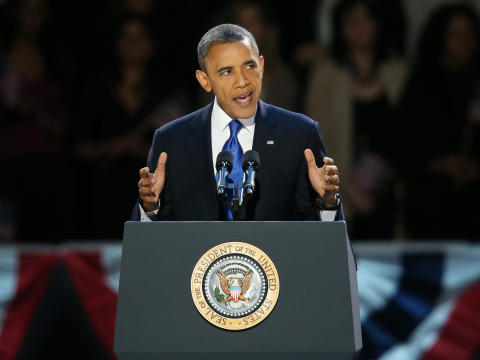
There were the nail-biting first few hours of the election results…followed by the glad tidings of more and more of the big electoral states turning a glorious blue…capped by the wonderful thrill of seeing the President stride out onto the stage in Chicago to give the most rousing acceptance speech most of us have ever heard.

What a big heart this man has, to include in his acceptance speech itself the invitation to his opponents to meet him in the aisle and try to seek common ground!

In the very first words of his speech, before he even thanked his running mate, he reached out to Mitt Romney, offering to work with him to move the country forward onto a better, firmer footing:

I just spoke with Governor Romney and I congratulated him and Paul Ryan on a hard-fought campaign. 

We may have battled fiercely, but it’s only because we love this country deeply and we care so strongly about its future. From George to Lenore to their son Mitt, the Romney family has chosen to give back to America through public service and that is the legacy that we honor and applaud tonight.

In the weeks ahead, I also look forward to sitting down with Governor Romney to talk about where we can work together to move this country forward.

And then, towards the end of the speech, he said so memorably:

America, I believe we can build on the progress we’ve made and continue to fight for new jobs and new opportunity and new security for the middle class. I believe we can keep the promise of our founders, the idea that if you’re willing to work hard, it doesn’t matter who you are or where you come from or what you look like or where you love. It doesn’t matter whether you’re black or white or Hispanic or Asian or Native American or young or old or rich or poor, able, disabled, gay or straight, you can make it here in America if you’re willing to try.

I believe we can seize this future together because we are not as divided as our politics suggests. We’re not as cynical as the pundits believe. We are greater than the sum of our individual ambitions, and we remain more than a collection of red states and blue states. We are and forever will be the United States of America.

This audacity of optimism is why we elected Barack Obama back in 2008, and why we continue to love him.

Whatever his personal or political failings, Barack Obama stands for the best hope of the USA: the raw immigrant passion and drive that founded this country and still makes it great.

He also represents, in his very skin, the polyglot future of the USA, the inexorable movement away from the European aristocracy of our founders to the broad multicultural diversity of our descendants.

Mitt Romney’s concession speech 2012

The Republicans are still stuck back in the good old days of the good old guys’ party.  As one commentator aptly noted, Republican political rallies look suspiciously like Ku Klux Klan rallies of the early 20th century.

For those who might rather not recall, let us remember that the Klan not only hated and lynched African Americans; they also hated and lynched Jews.  And they didn’t liked the Irish or the Italians much either!

Let’s not even talk about gay folk.  And women?  For the Klan and many contemporary conservatives, they belong in the kitchen or in the bed.

This is not the country we want to be as we move into the 21st century.

Although I thought the Obama campaign’s slogan “Forward, not back” was a little hokey when I heard it trotted out at various rallies, it does have the ring of truth to it.

We do not want to go back to the intolerance and violent hatred of our past.

We need to move forward, and we will need all hands on deck to confront the deeply unstable, uncertain future that awaits us in the age of climate change.

I want to see Barack Obama rise to the challenges of our time with all the power of his big heart.

I want to see him not just think about jobs, but think about green jobs, about jobs that will move our country forward into a longterm, sustainable future.

Enough kow-towing to Big Oil, Big Agriculture and Big Chemical.  It’s time to force these industries to bend to the winds of change, to adapt to the new paradigm of sustainability sweeping our country and our planet.

I applaud Bill McKibben for waiting until the election was over to come out swinging—and I applaud his continuing efforts to get the climate change issue into the center of political discourse.

Those who are still suffering from the after-effects of Hurricane Sandy, along with their insurers, should be his best allies.

We need to face the truth that all the matters of social justice that concern us will be moot if we don’t face the pressing need to get our planetary civilization onto a sustainable footing.

We need to convince our President of this, post-haste.

But let’s take a moment to breathe a big sigh of relief that it is Barack Obama we’re dealing with, and not Mitt Romney!

This election proves that Big Money is not infallible.

Democracy still matters; individual votes still matter; as a country, we are not as corrupt as many of us feared.

Now is the time for all of us to embrace the President’s big heart and let it reach out even further to encompass our entire beautiful planet and all of her creatures.

This is the task we humans were born to undertake: to become the thoughtful, compassionate stewards of our planet, and the collaborative leaders of our own multifarious tribes.

It is so good to see more and more women stepping up to the plate now.  We are sorely needed, but we can’t do it alone.

Men and women of all heritages must work together as never before to reestablish the equilibrium needed to move our civilization forward sustainably into the 21st century.

These are not just words.  This is our urgent reality.

Barack Obama has answered the call.

Will you?

Lessons of the Wreck of the Bounty

Although it is a small tragedy compared with the multifarious disasters occurring in the New York region in the wake of Hurricane Sandy, I can’t get the wreck of the tall ship Bounty out of my mind.

As someone who has written about 18th century pirates quite a bit over the past decade, I have an abiding fascination with sailing ships of that era.

HMS Bounty at Lunenburg, NS, August 2012

Last summer, when I heard the Bounty was docked for a few days at the Maritime Museum wharf in Lunenburg, Nova Scotia, I made sure I was at the head of the line at the gangplank.

The crew welcomed us aboard, and we had the vessel nearly to ourselves to explore at leisure.

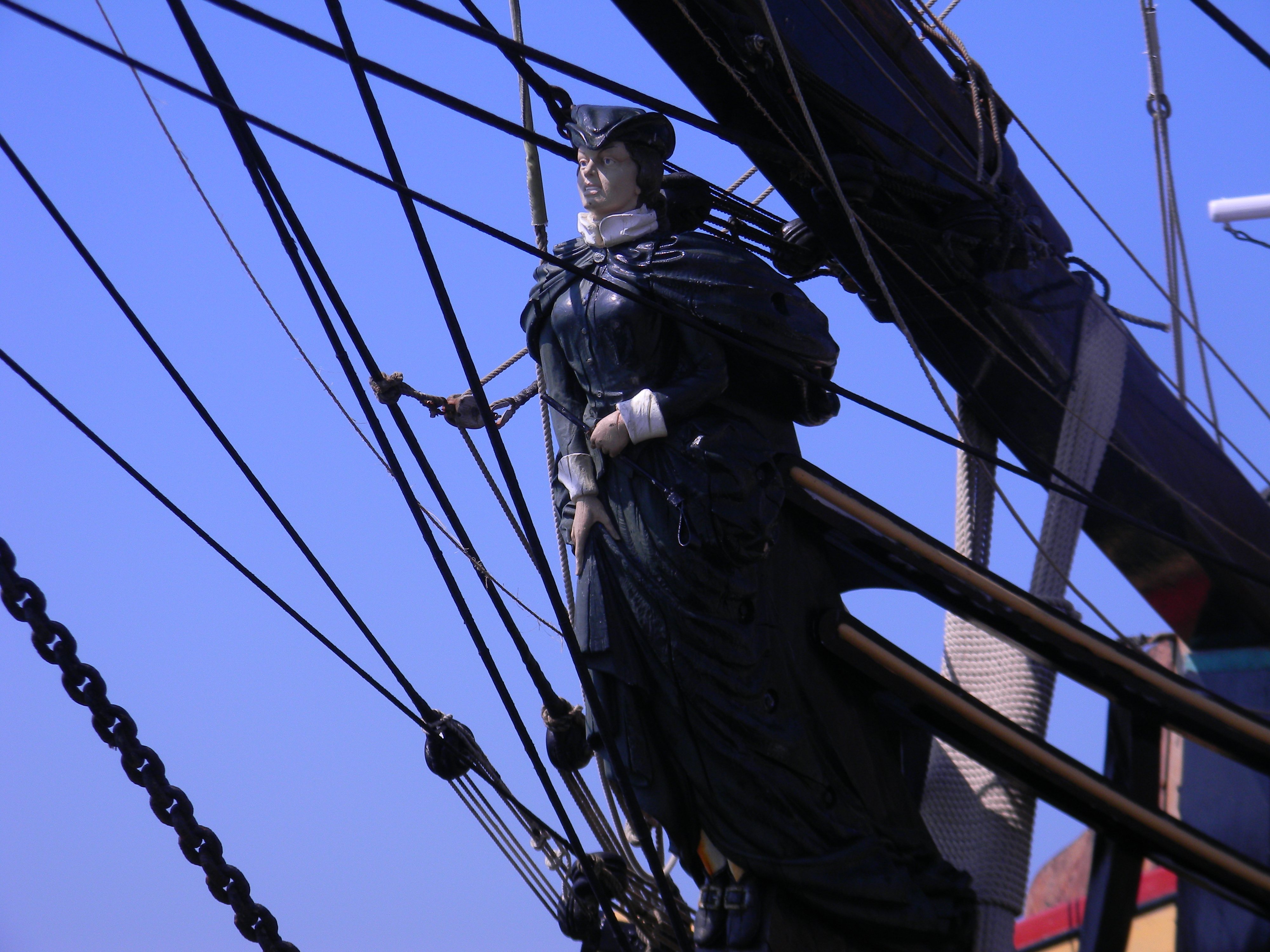
The Bounty, a 1962 replica of the original 18th century British ship, was obviously built with great attention to authenticity of detail.  The timbers above and below looked rough-hewn and weathered, the sails dingy and hardworking, the masthead newly painted and resolute.

She was a solid piece of work, and her captain, Robin Walbridge, had steered her well for 17 years.


But last week something went badly awry in his thinking.

Lunenburg photos by Eric Hernandez

He decided to take the Bounty out to sea knowing full well that Hurricane Sandy was making directly for his route from New London, CT to St. Petersburg, Fla.

Bounty masthead on a clear day

It seems that Captain Walbridge decided to try to “skirt” the storm, heading far out to sea in an effort to miss the brunt of it.

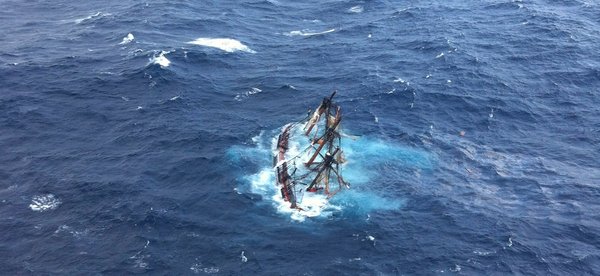
Sandy proved far to big to avoid, and by the night of Sunday, Oct. 28, the Bounty was facing 10 to 30-foot seas about 90 miles off the coast of North Carolina.  A first distress call put out to the Coast Guard at about sundown that evening was rescinded, as the crew must have been frantically working the pumps and still hoping to save the ship.

Not until 4 a.m. did the crew receive the order to abandon ship, and by then the deck was awash.

Fourteen of the fifteen crew members made it into the life rafts and were rescued by the Coast Guard  within a few hours.  A fifteenth crew member, Claudene Christian, was found floating nearby, and was pronounced dead at the scene.

Claudene Christian

Captain Walbridge’s body has not been recovered as of this writing.  The last one to abandon ship, he may simply have not made it out in time.

Captain Robin Walbridge

Here is a tragedy that could easily have been avoided if the captain had been more respectful of the forces of nature.  Apparently he thought the ship would be safer out at sea than docked during the hurricane; but in trying to save the ship he endangered the crew, and two lives were lost, one of them his own.

The story reminds me of the tale of Moby Dick, where the recklessness of the captain resulted, ultimately, in his being dragged to his death by the great white whale.

There is a lesson here for all of us.

We cannot underestimate the forces of nature.  We cannot “skirt” the climate change disaster that is staring us in the face.  We cannot outrun the storm, and we cannot hide from her.

As people in the wealthy enclaves of New Jersey and Long Island are finding out now, we are all equal before the awesome might of the natural world.

True, the plight of New Yorkers in dark, cold public housing is far more serious than that of coastal Long Islanders who have had to seek shelter with inland friends and family.

Class still matters.

But on the Bounty, the captain’s quarters were swamped just like those of the sailors.

So it will be with us all, if we fail to heed Sandy’s warning.

The Bounty sinking on Oct 29; Coast Guard photo

This is not a movie, and it’s not child’s play.  It’s real, and we’d better be paying attention, because next time it could be my turn, or yours.

We need to be taking measures now to make sure that the next time the winds start to blow, we will be prepared.

First things first: we need to go to the polls to defeat Mitt Romney and his fossil fuel masters on Tuesday.

And then on Wednesday, it will be time to start making plans to pressure President Obama to do the right thing when it comes to climate change.

Some say he’ll be a lame duck in his second term, but I think he’ll have more leeway to be his own man.  We have to prevail on his intelligence and good sense to use the power of the executive office to stand up to Big Oil on behalf of ordinary folks the world over, who trust their leaders to make the right decisions to keep them out of harm’s way.

And if he can’t or won’t do the right thing, well…there may have to be yet another “mutiny on the Bounty….”

Thank you, Hurricane Sandy

Hurricane Sandy did the planet a favor by hitting hard right at some of our most elite enclaves.

This time it’s not the poor residents of the Ninth Ward facing the horror of flooding, it’s the wealthy owners of some of the most valuable coastal property in the country.

When I heard Mayor Bloomberg of New York, one of the richest men on the planet, finally come and out say the words “climate change” with urgency, I had to smile despite the seriousness of the context, because it meant that at last the rich and powerful are getting the message that the status quo cannot go on—at least, not if we expect to survive as a civilization into the 22nd century.

The truth is that Americans in the ruling class—the business owners, the politicians, the finance and computer wizards, the media producers, the educators, even the artists–have been living in a luxurious gated community our whole lives.

We have been watching the travails of those outside, including the accelerating extinction of other species and the poisoning of the environment, from what has seemed like a safe, secure vantage point, behind several layers of bullet-proof glass.

Americans have watched impassively as people in other parts of the world have been forced to deal with terrible storms, flooding, and droughts with increasing regularity over the past decade.

As long as the electricity stays on and the supermarkets and gas stations are full and open for business, we just don’t pay much attention to what’s going on with the weather.  As long as our homes are heated in the winter and cooled in the summer, what’s the problem?

People like James Hansen, Bill McKibben, and Elizabeth Kolbert have been knocking futilely on the windows for years, trying to get the ruling class to wake up and pay attention to the looming threat of climate change before it’s too late.

They’ve made little progress up to now.

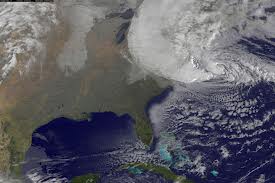
But Hurricane Sandy is a game changer.  Blowing into town the week before the Presidential elections, she put climate change on to the front page of the New York Times at last.  She forced her way into the bland discourse of Presidential politics.

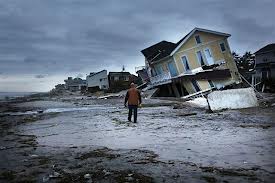
She tossed her windy head and in just a few hours paralyzed the “greatest city on Earth,” creating $50 billion of damage that will take weeks if not months to clean up.

All of a sudden, city planners are talking seriously about flood gates, and some are saying it might be foolish to rebuild in the same way, right down along the coast.

I don’t hear many in our ruling class yet saying what needs to be said, which is that our entire lifestyle has been built up in an unsustainable way, and must be changed if we are to leave a livable legacy to our children and grandchildren.

We must wean ourselves from the addiction to fossil fuels.  We must shift from highways and cars to mass transit.  We must immediately start reducing emissions in every way possible, with special attention to the agriculture sector, which has to be completely redesigned with sustainability and health—our own, and that of the animals and plants we cultivate—in mind.

We must build a much more resilient, collaborative culture.  Competition and aggression may have been the watchwords of the capitalist and imperialist 19th and 20th century, but following their star has landed us in our current grave circumstances. We can’t go any further down that path.

For thousands of years prior to the Christian era, human beings lived tribally and cooperatively in harmony with the land.  Our population has now grown so large that we are reduced to fighting each other for increasingly scarce resources.

Going forward, if we are to survive, we must transcend the pettiness of national boundaries and ethnic differences, recognize our common goals as humans, and start to work together to provide strategically for the good of all.

This may seem like an impossibly idealistic goal, but if there is one thing that I believe can unite human beings, it is the awareness now dawning about how interconnected we are through our dependence on the life support of our planet.

It is sad that the Earth has had to sink to such an unbalanced, depleted state before we began to pay attention.  I would not wish a Hurricane Sandy on anyone.  But it seems that we need wake-up calls of her magnitude to get us up and out of the stupor of denial and inaction.

As I step over the threshold into my sixth decade today, I can feel a new resoluteness building in me; a new determination to use my time in a more focused way.

I vow to give the best of myself to the struggle for a sustainable future, and to encourage others to join me in this effort.  There is nothing more important any of us can be doing now.

Will Frankenstorms Become the New Normal?

Yesterday’s images of the NY Stock Exchange with sandbags at the front doors, or cars floating by on Wall Street, were not taken from the latest science fiction disaster movie, not this time.

This time they were real.  And next time the storm could be worse.

But despite all the dramatic headlines declaring Hurricane Sandy the worst storm to hit the East Coast in human memory, there has been barely a whisper of climate change in any of the top weather-related news stories.

I was hoping that Sandy would prove to be a big wake-up call for the privileged denizens of the East Coast, many of whom hold influential positions in business, finance and government.

But instead of people acknowledging the climate elephant in the room and starting to talk about proactive steps we can take to avoid such scenarios in the future, they are just following the usual reactionary script: marshalling disaster relief, urging the citizenry to donate to the American Red Cross, assessing the cost of the clean-up and how long it will take to put Humpty back together again.

A storm like Sandy—or Irene, or Katrina—should prompt reflections on the awesome power of natural forces, and the puniness of human structures.

Take our power away and we are suddenly rocketed back into the early 19th century.  Take our food supplies away, and we become an angry mob in no time.  Do it on a scale that impacts millions of people all living crowded together, and you have a recipe for unprecedented horror.

This is not a pitch for the next action thriller film, and it’s not idle chatter.  These are the kinds of scenarios our governors and national leaders were worrying about yesterday when they authorized the shutting down of mass transit, schools and businesses.

We were lucky this time.  Sandy weakened as she came ashore and the damage, while serious, is manageable.

What we know is that with each passing month and year of inaction on global heating, the storms will become more frequent and more intense.  In the years to come, we will look back on Sandy as child’s play, just a warning of what is yet to come.

What should we be doing now, as individuals, as a nation, and as a global human community?

  • We should be starting a massive shift to renewable, clean energy sources.  And I’m not talking about “clean coal.”  Wind, solar, geothermal, tidal—these are the sources that can safely feed our energy addiction, without driving our climate into ruin.
  • We should be shifting away from cars and highways to trains and mass transit.  Bicycles, too.  And we should embrace the shift to online commerce and education, to avoid the need for a great portion of the horrendous morning commute.
  • We should start a concerted effort, especially in densely populated areas like the northeast corridor, to bury the power lines.  Tangled mats of downed overhead wires should become a thing of the past, and quickly.  We need to become much more resilient at surviving big storms, and our electric grid is a 19th century anachronism in need of immediate upgrade to the 21st century.
  • We need to start a serious citizens’ movement to resist the tripartite junta of the fossil fuel industry, Big Agriculture and Big Chemical.  These three industries must be held accountable for the tremendous destruction they are wreaking on our environment, and on us as individuals.  I’d like to see Big Insurance take our side in this battle; I am sure they’re getting tired of always being stuck holding the bill when the next disaster strikes….

These storms are not random events.  They are getting bigger and closer together and less predictable.  The hotter the climate, the more the ice melts at the poles, the more freakish our weather will become—except that freakish is going to be our new normal.

It’s time to stop the denial, stop allowing ourselves to be distracted from the very serious questions that face us now.

It boils down to this: are we going to leave a livable Earth to our children and grandchildren?  Or are we going to go down in history (if there are any left to carry history forward) as the most criminal generation of all time?

Earth to Obama: Come in please! Or do we have to take to the trees to get your attention?

Of course I knew it would be too much to expect President Obama, during the second Presidential debate on Tuesday, to actually break the great taboo of contemporary American politics and mention—Shhhh—climate change.

But I didn’t expect him to come out pandering so shamelessly to Big Fossil Fuel.

Yes, he managed to create a mild distinction between his position and his opponent’s.

Romney is 100% for exploiting fossil fuels as fast as we can possibly get them up out of the ground.

Obama, on the other hand, is 100% for exploiting fossil fuels as fast as we can possibly get them up out of the ground.

And oh yeah, he’s not against throwing a little money at solar, wind and biofuels (let’s not even talk about how destructive existing biofuels like ethanol have actually been on multiple levels—let’s give the guy a break).

While Romney just wants to hammer home the assertion that his Administration will bring us lower gas prices (no doubt as a result of all the frantic drilling he intends to support), Obama is interested in encouraging conservation by raising fuel economy standards, an idea right out of the late 1970s if I ever heard one.

A 21st century idea would be to get rid of oil subsidies and insist that the price of gas and oil reflect the true costs of its production and consumption, which are actually way higher than whatever the current price of a gallon of crude might be.

Then there’s coal, which both of these guys are apparently in favor of continuing to exploit.  Did someone say “mountaintop removal”?  Just point Romney/Obama at the mountain, and let’s go!

The nadir of the whole energy discussion of the second Presidential debate came when, in response to a little goading from Romney, Obama said he was “all for pipelines.”

In nearly the same breath, he proudly proclaimed that his Administration has supported lots of oil and gas drilling on public lands—how many leases, and what percentage of increase or decrease they may represent from the Bush years, may be a bit fuzzy, but the gist is clear: both Romney and Obama are all for opening up our public lands to drilling, in the name of energy independence from foreign fuel sources.

Oh Lord. The truth is that our dependence on so-called foreign fuel suppliers (who are mostly multinational corporations anyway) is the least of our worries.

The one thing we most need to be focusing on is the one thing that no one wants to deal with at all.

The effect of global heating, caused by the ever-escalating burning of fossil fuels worldwide.

And instead of working soberly and swiftly to turn the climate juggernaut around, our politicians are acting like easy-going traffic cops, just waving those bulldozers and oil rigs right on through.

***

Take the Keystone pipeline, which both Romney and Obama were unabashed in supporting.

Did you know that right at this moment, there are dedicated Earth defenders sitting in trees in Texas, trying to block the construction of the southern leg of the Keystone XL Pipeline?

Daryl Hannah at Keystone XL Pipeline protest, October 2012

Why?

Well, you probably realize that the bitumen that pipeline is designed to carry is so thick and sludgy that it has to be mixed with toxic chemicals in order to make it flow.

You’ve probably heard about the damage that could be caused by a spill from a pipeline like this, if the chemicals leaked into the major aquifers that are along the way.

This on top of the destruction of the forests that is already happening on a vast scale to get those “tar sands” out.

On top of the chemical contamination of our aquifers from hydro-fracking for gas.

On top of mountain-top removal and strip-mining for coal.

On top of the whole lousy cap and trade system, by which dirty Northern-hemisphere commercial polluters can continue to pollute as long as they buy credits in Southern hemisphere forest preserves—except that what’s actually been happening is that first they buy the preserves, then they log them, then they replant with palm oil trees, heavily sprayed with pesticide, herbicide and fungicide to keep the rainforest from returning, and then they proudly collect their credits for having maintained some semblance of soylent green!

All this is the reality behind the puffery that passed for politics at the debate last night.

What is our national energy policy?  For both the Republicans and the Democrats, it’s drill faster!  Drill harder!  Drill everywhere possible!

President Obama chided his opponent at one point for thinking only of short-term prospects.

“We have to think about what’s coming in 10, 20, 30 years,” he said, the implication being that we shouldn’t entirely neglect the prospects of wind and solar energy.

But the truth is that if we continue drilling at the rate both candidates support, there won’t be a stable environment left to build an alternative energy future for our grandchildren and future generations.

They won’t be building wind turbines and solar panels in 2050, they’ll be building underground shelters and modern-day Noah’s arks.

***

Still, yes, I am going to go grumbling to the polls on Nov. 6 and pull the lever for Obama.  There is no question in my mind that he is the better man.

I understand that right now he is trying to walk the centrist line and please as many American constituencies as he can.

But once re-elected, he must be pushed to take a stronger stand on environmental policy, including energy policy.

If that means that more of us have to take to the trees in protest, well, so be it.  I always did love climbing trees!