May Day: Here, There and Everywhere

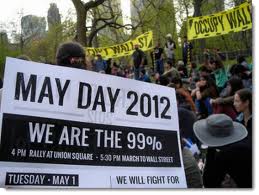
A reader asks why I did not stay home from work and join the May Day protests today, and I feel like this question deserves a serious response.

Partly, I have always had a phobia about crowds, and never willingly put myself into a crowd situation.  I don’t even like to go to an agricultural fair, or a peaceful parade.  In my Manhattan youth, crowds and violence often went together, or at least crowds and the fear of violence.  I am a wimp.

Partly, I felt like I could do more good in my classroom today than anonymously out on the streets.  It is the last full week of classes at my institution; students are finishing up projects that need response and guidance.  If I didn’t show up to work today, it would throw a monkey wrench in the plans I made for a graceful and productive ending to our semester together.

Partly, I don’t have any beef against my own employer, so not showing up for work today would affect the wrong target, while making no difference at all to the intended target, the 1%.

I guess the biggest reason I felt like my presence was expendable to today’s protest is because no one would notice if I was or was not out there on the street, but I would definitely be missed from my classroom.

However, in at least one of my two classes today, I did spend some time talking about May Day and the reasons for the protest.

I was surprised to learn that very few of my students had any clue as to what May Day signified to the labor movement, or why the protests today were taking place.

I don’t know why I assumed that my students would be more politically aware than I was at their age.

Turns out, few of them even realized there were going to be significant protests today, much less what they were all about.  Some also had their doubts as to whether the Occupy approach was likely to be effective.

Well, I pressed them, if occupying public spaces is not an effective means of protest, what would be more effective?  Joining a political campaign?  Writing a letter to the editor?

No one had an answer to that, but I could see the wheels turning.

And that’s why I am glad I decided to stay at work today.  At least with this one small group of students, I was able to foreground these historic May Day protests in their minds, and ask some questions that no one else probably would have asked them today.

Maybe as a result they will be paying attention to the news in a different way, and thinking more concretely about how the issues blazoned across all those posters and banners are relevant to their own particular lives.

Whether working on the small canvas, in the classroom, or the big canvas, out in the street, we are working together to build up the necessary momentum to blast our way to a better world.


Who’s Afraid of Distance Learning?

It used to be that a smart, motivated young person could work hard, earn a doctorate, do a good job as a junior professor, and live happily ever after as a tenured professor.

It also used to be that a smart young person could work hard, get into a good college, and expect to be taught with passion and enthusiasm by a corps of dedicated professors.

Despite the ever-increasing cost of college tuition, neither of these expectations holds water any more.

Academia, as a profession and as a social landscape, is deeply troubled right now, in ways that are profoundly connected to wider social and economic problems in our society.

In today’s New York Times, pundit David Brooks suggests that colleges need to do more to ensure that their high sticker price is delivering measurable value. However, his solution—standardized exit testing of college seniors—shows how out of touch he is with the real issues and problems facing academia today.

At a recent high-level conference hosted by Lafayette College, ponderously titled “The Future of the Liberal Arts College in America and its Leadership in Education Around the World,” “Lafayette President Daniel H. Weiss laid out four major challenges facing liberal arts colleges — affordability, public skepticism about the value of a liberal arts degree and college in general, decline in the share of U.S population who fit the demographic patterns of students who traditionally attend liberal arts colleges, and questions about how to incorporate technology into the college and serve a generation of students that is increasingly networked.”

Smith College

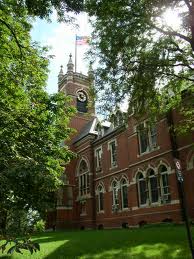
At small liberal arts colleges like Bard College at Simon’s Rock, where I teach, we pride ourselves on a low student-faculty ratio. At Simon’s Rock the ratio is only 9 students to each professor.  But of course that’s a big part of why our tuition is so high, to pay for the one-on-one, intensive engagement with each student.

From the perspective of college presidents and administrators trying to make ends meet, this educational model may not be sustainable.

Certainly that was the case at the University at Albany, SUNY, where I taught for nine years in an interdisciplinary first-year seminar program designed to “give a small college experience in the big university.”  The program, which had just received an enthusiastic external review that trumpeted its successes in retention and learning outcomes for the roughly 800 students we served each year, was axed in 2011.

Now those 800 students are sitting in the big lecture halls with 500 others at a time—or, just as likely, not bothering to go to class at all.  It was a common complaint among my SUNY students that the professor wouldn’t know or care if you showed up or not—all it took to pass the course was cramming for the exam with the textbook.

Given this scenario, it’s not surprising that more and more of our large universities are shifting to distance learning.  Why go through the trouble of housing thousands of undergraduates, when you can deliver the lecture and the exam to them in their own bedrooms at home?

There is truth to this, and I have no doubt that networked, globalized distance learning is going to be the standard form of higher education delivery in the years to come.  It’s already happening incredibly fast, and even small liberal arts colleges need to be thinking about how to jump on that train before they miss it entirely.

As someone who teaches media studies, with a special interest in new media, I am in many ways delighted and intrigued by the potential of distance learning in higher education.  I have even been trying to persuade the administrators at my college to give it a try.

While it is never going to be the same as the old-fashioned model of nine students sitting around a seminar table with a professor, with current video capabilities it can come pretty close, as anyone who has tried a Google “hang-out” can attest.

And wouldn’t it be exciting to “hang out” in a seminar classroom with students from around the world?  We higher ed folks like to trumpet the value of diversity and international education—well, distance learning provides the platform to make the dream of a truly diverse and globalized classroom a reality.

However, there is a catch, and it is the same catch that has dogged other American industries as they have leaped on to the globalization bandwagon.

U.S. higher ed is already troubled from within by the shift from stable, tenured fulltime faculty to legions of roving part-time adjunct faculty.  With distance learning, the adjunct model gains even more steam, and goes global.

Why not outsource that first year Calculus course to a professor in India, who will teach 1,000 students for a fraction of what even an adjunct in the U.S. would earn?

Welcome to the knowledge sweatshop of the future.

According to the Inside Higher Ed article on the Lafayette conference, “Williams College President Adam F. Falk argued that the principal reason for adopting technological innovation should be for educational improvement, not just productivity gains. ‘College education isn’t simply about most efficient or innovative means of delivering content,’ he said, arguing that the engagement component of what colleges like his do was over all more important. ‘It’s hard for even the best students to learn on their own.’ Falk’s presentation was warmly received by the crowd.”

But Williams College is one of the richest liberal arts colleges in the nation, with an endowment of nearly $2 billion even after the economic downturn of 2008.

The social stratification that is affecting every aspect of American society is no less marked in higher education.

In the near future, we will be looking at an academic landscape where there will be a few highly paid tenured research professors and a vast majority of poorly paid adjunct professors all over the world, working mostly from their home offices via distance learning networks.  While there will always be a few lucky students who will be able to gain access to ivied classrooms through scholarships, those classrooms will increasingly be reserved for the children of the super-elites of the world.  Ordinary kids who have the motivation and discipline to go to college will do it from home, a financial decision their parents will have no choice but to support.

Distance learning is often lauded as a way to level the playing field, since it makes higher education accessible to kids who would not otherwise be able to go to college.

This may be so.  But it is also going to be yet another way to divide our society into Alphas, Betas, Gammas, Deltas and Epsilons—in other words, to harden the de facto caste walls that are already making the old rags-to-riches, pull-yourself-up-by-the-bootstraps American dream a quaint memory.

A Crucible Moment in Education

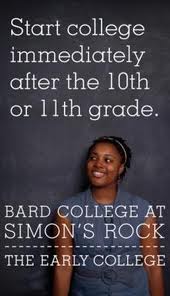
There was some rolling of eyes in my community when President Obama announced he would like to see high school mandatory until age 18.  That’s because at Bard College of Simon’s Rock, my alma mater, where I’ve been teaching for the past 17 years, the standard procedure for students is to leave high school at about age 16, generally after 10th grade, and shift into our early college program.

Most Simon’s Rock students are motivated to step off the beaten path and try a different approach to college because they’re high achievers who are bored in high school.  A few come to us because they’ve been so socially mauled in high school that Simon’s Rock becomes not only an academic, but also a social refuge for them.

In any case, for my students, being compelled to stay in high school until they were 18 years old would have been torturous, and would not have improved their future chances of success any more than “dropping out” to try a more innovative form of education—early college.

President Obama’s instinct that staying in school is better than dropping out altogether is absolutely correct.  It’s just that if we’re going to compel kids to stay in school, we need to make their schooling compelling.

Lots of great minds have already weighed in on the question of how to make learning fun and meaningful, but somehow we do not seem to have made a dent in the great battleship Education, which is still plowing its way implacably through the cold waters of Teaching to the Test.

It’s true that there is a certain amount of knowledge that you simply have to be taught, in that passive sense of receiving information and committing it to memory.  For instance, the alphabet.  The multiplication tables.

And having got these basic tools, you need to be taught how to use them: how to read, how to manipulate numbers.  If you’re going to be a doctor, you need to be taught how human systems work, just the way an engineer learns how a mechanical system works, or a mechanic learns how a car works.  OK.

But beyond mastering these kinds of basics in any field, there are two things students most need to get out of their education: learning how to figure things out for themselves, and learning how important their educated selves are to their communities and the larger society as a whole.

In today’s networked world, we no longer need to have kids waste their time memorizing all the state capitols, or learning by rote anything that can be measured in a multiple-choice test.  What kids need to learn is how to find the information they need to answer the questions they have about the world.  They need to learn how to frame their questions, understanding that the way a question is asked will often guide or predetermine its answer.

Reading is still a fundamentally important skill, but what we need to be teaching kids is how to read between the lines.  How to see through propaganda that passes for “fair and balanced” journalism, for instance.  How to sift through multiple sources of information on a given topic, and understand the criteria for determining which source is most credible.

But even that is not enough. Students not only need to become active readers, but also nimble thinkers, capable of taking in a spread of ideas on a given topic, and responding with their own original thinking.  A society where kids only learn how to feed back to their elders old, predigested ideas is a stagnant society, and we can’t afford that kind of stagnation at this time.

And here we get to my second point: kids not only need to learn to think for themselves, they need to understand how important this activity is for our rapidly changing society.  And that means taking the skills they’ve gained through their education out of the school and the academy into the street.

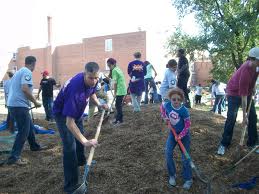
Students at every level, even the littlest ones, will benefit from a much more active engagement with the social and natural environment beyond the walls of their classrooms.  Little kids should be planting gardens in their schoolyards and composting the remains of their lunch. In Waldorf kindergartens like the one my sons attended, kids partake in preparing their mid-morning snack, and in keeping their classroom clean and neat.

What kids learn through activities like these is the importance of collaboration to community—an invaluable life lesson that needs to start early and be reinforced in different ways as they grow older.

Instead of our current competitive test-based system, we need collaborative learning that anticipates the kind of team-based environments of the most successful communities and businesses.  Instead of seeing kids hunched on their own behind raised folders taking a test—no cheating!—we should see groups of kids assembled around a problem, working collaboratively, noisily, joyfully to solve it.

The task of the teacher in this kind of learning environment would be to set the kids ever more challenging and interesting problems, with clearly visible and defined real-world applications, and guide the kids to the tools they need to solve the problems and evaluate their successes or setbacks.

Lord knows there is no shortage of serious problems in our world today, problems that demand every ounce of our most focused attention to surmount.  We need to get kids out of their classrooms and into their communities, bringing their creativity, their intelligence, their caring and their wonderful energy to bear on the challenges that lie just outside their classroom doors.

The Obama administration has just released a major new report, A Crucible Moment: College Learning and Democracy’s Future, prepared by the National Task Force on Civic Learning and Democratic Engagement, which brought together leaders in higher education from around the country to come up with recommendations for ways that education can help students become engaged, responsible local and global citizens.

The report concludes that given all the “pressing issues” facing us today—“growing global economic inequalities, climate change and environmental degradation, lack of access to quality health care, economic volatility, and more,” educators need to focus on “expanding students’ capacities to be civic problem-solvers using all their powers of intellect and inventiveness.

“The kind of graduates we need at this moment in history,” the authors say, “need to possess a strong propensity for wading into an intensely interdependent, pluralist world. They need to be agile, creative problem solvers who draw their knowledge from multiple perspectives both domestic and global, who approach the world with empathy, and who are ready to act with others to improve the quality of life for all.”

The report “urges every college and university to foster a civic ethos that governs campus life, make civic literacy a goal for every graduate, integrate civic inquiry within majors and general education, and advance civic action as lifelong practice.”

Specifically, the task force advocates developing service learning and community engagement programs that move beyond simple volunteerism to actually involving young people as active participants and innovators in making their social environments more vibrant, more responsible, and more equitable.

Sounds good, and sounds simple to implement, but as I know from trying to develop community engagement structures for students at my home institution, it takes staffing—and therefore funding—to provide the channels students need to quickly jump into productive off-campus programs.  Commitment to this kind of active learning environment needs to come from the top, and that’s why I am excited to see such an array of distinguished leaders in education come together as the signatories of this new National Task Force report.

Let’s hope some of that energy and enthusiasm will trickle down to schools and campuses all over the country, and soon.  The tone of urgency evident in the title of this report, A Crucible Moment, and in the President’s remarks about education this past week, is not exaggerated.

We are in a crucible moment in so many ways, and we desperately need to equip our young people with the skills and outlook they will require to bring us safely through the turbulence that awaits us in the foreseeable future as the globe heats up and pressures on human society increase.

Keeping our kids in high school until they’re 18 is only a good idea if high school becomes a meaningful, active learning environment.  Let’s do what needs to be done to make that so—or let’s come up with another model.  Early college, for example—a good idea whose time may finally have come.

Green Teaching: What the World Needs Now

In President Obama’s speech last night, he talked a fair amount about the importance of making higher education affordable for all Americans, and about how essential a highly skilled workforce is to America’s future.

I felt like I was in some kind of time warp.  Wasn’t Bill Clinton talking about just the same things, almost generation ago? Not only has insufficient progress been made, but while we’ve been fiddling and squabbling amongst ourselves, the whole landscape behind us has shifted radically.

It reminds me of one of those cartoon scenes where the mice are fighting amongst themselves and don’t even notice the huge cat face looming over them licking its chops.

The huge cat face, today, is the drastic heating of the planet.  Obama went on and on last night about manufacturing—we need a skilled workforce to support American manufacturing, we need to bring outsourced manufacturing back home, we need to adjust the tax code to benefit workers and manufacturers.

All the while, looming above the statehouse, is the runaway monster of climate change, which is at on the one hand fattened by all this manufacturing, while at the same time threatening to blow it all away.

I quite agree with Obama that we need to be pouring resources into education.  The question is, what kind of education is going to be most valuable for today’s children, tomorrow?

At the very least, we need an education that does not have its “eyes wide shut” about the fact of global heating and the impact this will have on us all in the near future.

I was encouraged this week when I picked up a print copy of the journal Green Teacher, and found an article by David Selby and Fumiyo Kagawa entitled “Unleashing Blessed Unrest as the Heating Happens.”  In it, the authors offer concrete curricular suggestions for how to introduce students in grades 5-12 to the reality of climate change, without sugar-coating it but also without leaving them so devastated that they lapse into denial or despair.  Since the article is not available online, I’m going to quote from it liberally in what follows, because this is news we can use.

The authors quote Jess Worth, who likens climate change denial to “finding out that you have cancer, but then delaying going to the doctor’s for treatment for a few months because you want to repaint your house.”

Selby and Kagawa speculate that because the “ever more dire accounts of a global climate lurching towards ever-deepening crisis” are so frightening, we tend to practice a kind of avoidance, which in education takes the form of “characterizing climate change as a technical problem that can be managed by a mix of technological innovation and policy solutions that avoid challenge to ‘business as usual.’”

For example, they say, “the recycling bin in most classrooms is…often cited as evidence of the school’s commitment to sustainability,” but “it can easily convey the subliminal message that consumerism approached responsibly can be benign.”

Reviewing American curricular materials for K-12, the authors found “a reluctance to investigate the culpability of neo-liberal economic growth models and to explore slow growth or no growth alternatives…. There is, too, an avoidance of envisioning and addressing personal and societal climate change scenarios that are likely to be played out in the learner’s lifetimes.”

This is certainly the kind of education I see my own son getting in his American public middle school.  The focus in his social studies, English and science classes has so far been squarely on the distant past.  There has been no discussion that I’m aware of about the fact that here we are at the end of January, and we are still seeing green grass outside.  NASA has just confirmed that nine of the ten warmest winters on record have occurred since the year 2000, and 2011 was the 9th warmest since 1880. Excuse me, shouldn’t we talk about that?

Selby and Kagawa say that instead of maintaining an “eyes wide shut” avoidance pattern with our youngsters, we need to engage in “an honest education facing up to the onset of what Alastair McIntosh describes as ‘a great dying time of evolutionary history’” and “overturning…the comfortable delusion that major disruption of Earth’s climate can be avoided or neutralized.

“Recognizing that present and future generations need hope, we have to ask what the hope is grounded in and what kind of hope it is.  Is it a spurious optimism, a comfortable fiction based on what we would prefer to see happen while keeping our ‘eyes wide shut’?  Or is it a pared down and realistically straitened optimism born of confronting the present and future earth condition?”

We have a responsibility as educators, parents, and elders to tell our children the truth about where we are as a global civilization, and where we are likely headed.  Wouldn’t you rather be forewarned, rather than bowled over by surprise when the shocks start coming?  Don’t you see it as the responsible thing to do to start preparing for those shocks now, both emotionally and practically?

The educators brought together in Selby and Kagawa’s new anthology Education and Climate Change advocate for a transformative learning agenda, involving “conscious, deep and sustained processes of engaging with pain, despair and grief over what we are losing, moving towards acceptance while searching for radically new meaning and values, and equipping ourselves for personal and collective empowerment and action.”

Concretely, they offer classroom exercises to guide students through these stages, including some pretty heavy-duty visioning of possible future scenarios that we may all have to live through.  The goal is not to depress students, but to empower them by moving from the disaster scenarios to hopeful plans of action to stave off the worst effects of climate change, or adapt successfully to whatever comes.

“A citizenship education for “blessed unrest” in a time of rampant climate change,” the authors say, “needs to be shaped by engagement in community-based action that creates, resists and transgresses in the name of sustainability.”

The time to start talking about these issues with our students and children is now, while we still have options as to how to confront the changes that are coming.  To do any less is to fail in our responsibility as the adults who should be out blazing the trail for the kids following behind us.  If we know there’s white water up ahead, let’s at least give those behind us a heads-up and see what we can do to ride out the rapids safely, together.

Censorship in Academe, 21st century style

Unfortunately, the banning of books by Mexican Americans in Tucson last week was not an isolated incident.  It’s part of a larger pattern in American education.

At the elementary school level, it takes the form of resisting bilingual education for students whose family language is not English, and—for example—still teaching “Thanksgiving” as though it were the happy, peaceful start of a triumphant positive march towards a shining, splendid American empire.

At the middle school level, it’s about teaching Egyptian history—mummies, anyone?—instead of Native American or Mexican history.  Mummies are safe—there’s no politics left in them, they’ve been dead too long.

In high school, students are asked to stand and pledge allegiance by rote to the American flag representing “one nation, under God, indivisible, with liberty and justice for all,” but not asked to interrogate the proposition that liberty and justice really are available to all in our great land.

In undergraduate education, after a brief, highly contested period in the 1980s and 90s when the gates guarding the required curricula were wrenched open to let literature by ethnic minorities and women in, the tides have turned again.

Just as in middle school it’s safer to teach about the ancient Egyptians, in college the safest route is towards ancient Greece.  “After all,” I was once told blandly by a senior (white male) colleague in the course of a heated meeting on the core curriculum, “the Greeks are a minority too.”

The modern Greeks may be struggling, but the ancient Greeks are alive and well and generously represented in curricula throughout the Western world, where ancient figures like Plato, Sophocles and Aristotle still exert remarkable influence.

Meanwhile, graduate schools in the humanities are focused on jazzing up the study of history and literature through fancy digital applications.

I’m as digitally oriented as the next prof, but I won’t support “digital humanities” if it means that we no longer have the time or resources to engage in what I see as the most important functions of the humanities: teaching students how to analyze and wield the tools of narrative and argument; giving them the time and space to explore complex ethical issues; and most of all, empowering them to become informed, autonomous individuals who can research and think for themselves.

In theory, this could be done within a digital framework.  But the problem is that much of the push towards “digital humanities” is coming from the great surge towards online education as a business model for universities.  Of course you can do online education much better if you have high-tech online tools.  No argument there.

The problem is the bigger picture of online education, where tenured professors are being replaced with adjunct faculty who can teach in their pajamas from home, at a fraction of the salary or responsibility and no influence at all over what gets taught.  If you have an army of part-time online instructors working with students from remote locations all over the world, it’s pretty hard to have the kind of discussions that I’m remembering from my department’s deliberations over the core curriculum.

Most decisions over what gets taught in those burgeoning online courses are made by administrators who remain faceless to the instructors, with the result that professors become paid employees rather than professionals who are not only engaged in the process of teaching, but also in the process of deciding what gets taught.

It’s as easy as the push of a button for some administrator to decide that HUM 26X, Chicano/a History, will not be taught, while HUM 25X, History of Ancient Greece, will. And for the most part, no one will even notice.

This is going on all the time.  The incident in Tucson last week, when administrators were so sloppy as to order physical books pulled from the shelves, was a rare slip-up that brought the insidious practice of censorship into the public eye.

Most of the time it’s going on invisibly, under the radar, and so subtly that most of us won’t notice it until all of a sudden we look up and find that there are only a handful of Ethnic Studies Departments or Women’s Studies Departments left in the country, so there are hardly any graduate degrees being offered in those fields, so within a generation the whole hard-won movement to open the curriculum will be gone.

No, I am not over-reacting.  I am not hysterical.  I am not crazy.  Open your eyes, people, and you will see what I’m talking about.  Open your eyes, before it’s too late.

A new generation rises, and with them, our hopes

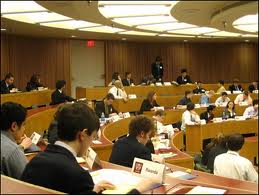
Today I gave the keynote address at the regional Model UN student conference sponsored by Bard College at Simon’s Rock.

On the one hand, it was heart-warming to look out and see that crowded lecture hall filled with bright, eager young faces, ready to step on to the world stage, if only in theory, and play leadership roles.

On the other hand, it was sobering to have to be the bearer of such grim tidings.

I started out by taking them back to a choral Ode in the Antigone that has always haunted me, the one where the Chorus sings the praises of human technological prowess, while at the same time sounding a warning note about how mankind’s “cunning…is the fertile skill which brings him, now to evil, now to good.

“When he honors the laws of the land, and that justice which he has sworn by the gods to uphold, proudly stands his city: no city has he who, for his rashness, dwells with sin.”

In other words, I told the students, we humans can do all kinds of amazing things with our great intelligence, but we will only prosper if we keep our moral compass and use our powers for good.

The Ode is basically a list of areas in which human beings have excelled, and that list is as valid today as it was in the 5th century B.C.: our power of navigation and transportation; agriculture; our dominion over other animals, wild and domestic; our ability to withstand the elements by building shelter and creating fire; our medical arts; our facility with language and “wind-swift thought.”

Truly we are a “wondrous” species.  And yet the fact that this list is recited in the tragedy of Antigone bears witness to the fact that our great “cunning” does not always guide us well.

In Antigone, Creon is a proud, vindictive tyrant who demands absolute allegiance from his subjects, including his niece Antigone.  When Antigone defies his order to let her brother’s remains be left in the open for the crows to feast on, and goes out alone to bury him, Creon goes into a fury and orders her arrested and sentenced to death.

It’s clear that the Chorus in this play believes Creon’s action is wrong.  Antigone was obeying her own moral judgement, putting her filial and religious obligations before her allegiance to the King. And just as the Chorus predicted in the initial Ode, because he is not using his power wisely and ethically, in the end Creon’s house will fall.

In our time, I told the students, the same kinds of battles rage, of good people standing up for their beliefs against oppressive tyrants, who don’t hesitate to imprison and even execute any who defy their power.

The Arab Spring showed us what can happen when enough people dare to speak truth to power and defy an authoritarian state  In the United States, the Occupy movements are now standing up, not so much against the state, as against the corporate capitalist elites—who often are the power behind the thrones of the various nations.

Even in our own country, the price of defying the status quo can be high.

But, I told the students, given the perilous state of the world today, the price of staying quiet and going along with the flow is inevitably going to be much higher.

I reminded them of the many dangers that face us today, including:

  • the homogenization of media and the reduction of education to multiple choice tests, instead of a media that stands strong in its watchdog role and an educational system that focuses on teaching students how to think creatively and question authority;
  • the tremendous militarization of police and national forces, with most countries fairly bristling with lethal weapons, from handguns to bombs;
  • environmental degradation and loss of biodiversity, including the contamination of our air, soils and waters with toxic chemicals caused by the very agriculture celebrated in the Antigone Ode;
  • serious health problems caused by environmental toxins and chemical additives in our food supply;
  • and above all, the looming menace of anthropogenic global warming.

These will be familiar themes to anyone who has been reading my blog these past few months.  But it was good to speak these ideas out loud this time, to the young people who are going to have to bear the brunt of the problems.

I quoted U.N. Secretary General Ban Ki-Moon, who told negotiators from 200 nations gathered at the recent COP17 climate conference in Durban that the situation was so urgent that they could not afford to wait for unified global action.

“Don’t wait for a binding agreement,” he said. “It could take years. All member states should take their own measures,” before it’s too late.

“Last year we saw the highest emissions ever,” Mr. Ban said. “If we carry on as though it is business as usual we will be out of business.”

Those are pretty stark, unequivocal words from the leader of the closest thing we have to a global government.

Given the need for drastic change in the way we do business as a civilization, I challenged the students to dare to think outside the box.

I encouraged them to let Antigone be their guide as they began their Model UN negotiations. “If you know that a policy is wrong, don’t be afraid to say so, and to fight for what you believe,” I told them.

I urged them not to let artificial boundaries like nation, race, class, religion or gender cloud their vision of what is needed to succeed in the goal of making human society safer, more nurturing, and more sustainable for us all.

“It is a deeply flawed, damaged world you will all soon be stepping out into as young adults,” I said.  “We live in a time of accelerated change and unprecedented transition.  None of us knows what lies around the bend.  But we do know that no matter what, we will be better off if we work proactively to overcome narrow national self-interests and begin to think in planetary terms—and not just about human interests, but in terms of the good of the entire web of life of which we are a part.”

Our only chance at changing the way we do business as a civilization, I said,  rests with our ability to successfully communicate with one another–to use the powers of “speech and wind-swift thought” commended by the Chorus of Antigone. 

What we need are not the stylized battles of debate, but the true, open-hearted communication of consensus building, where all viewpoints are listened to respectfully, and all positions are judged both on their own merits and on how well they’ll contribute to the collective goal of making the world a better place.

As I stepped away from the podium, I felt sad that I had to lay such a heavy burden on these bright young people, who through no fault of their own have inherited a planet in such disarray.

But I also felt the surge of hope that always rises again with each new generation.  Maybe this generation will be the one to turn off the beaten path and forge a new relationship with our planetary home.  Perhaps they will be able to resist the centripetal pull towards conformity.

As they all filed out of the room to take up their places at the Model UN negotiating tables, my heart went with them.  They are our last best hope.


Scary Halloween Statistic: 7 Billion People on the Earth by Oct 31, 2011

If you’ve never seen the Worldomters clock ticking, it’s worth a click.

Watching those numbers spin by brings home how very fast the human species is multiplying, especially when you consider the following chart, which shows how recent this population explosion really is.

No wonder we’ve got a sustainability problem!

Population control has gotten a bad name in recent years, and justifiably so.  It cannot and should not be imposed upon women by force, as it has too often in the past.

But study after study has shown that when women are educated and respected in society, birth rates go down.

Want to slow down that worldometer population clock?  Start by educating girls and opening up career opportunities for them after graduation.

Educate a girl and save the planet?  Might not be hyperbole after all.

Paradigm Shift: From Competition and Destruction to Nurturance & Collaboration

I am almost 50 years old, and in my current lifetime I have lived through one of the most intense, rapidly changing periods of human civilization on this planet.  The technological discoveries of the 19th and 20th centuries were steadily gaining steam when I was born in the early 1960s; “progress” seemed infinite, and infinitely exciting.  Advances in medical understanding and treatment, the speed of computing, the mechanization of every aspect of our economic systems, and the explosion in information technologies, all made our civilization seem powerful—even invincible.  The blip of failure that registered when we “lost” the Vietnam War was quickly swallowed up in a huge wave of optimism as the economy surged in the 1980s, and the collapse of Soviet Communism, as well as the softening of Chinese Communism, made Euramerican Capitalism seem like a global Manifest Destiny.

And yet there was always the dark underbelly of the beast, clear to anyone who had the will to see it.  Rachel Carson sounded the first alarm on the dangers of synthetic chemicals, released haphazardly into the environment.  Chernobyl was the first major indicator of the serious dangers of “clean” nuclear power.  The slow epidemic of cancers (in the wealthy countries) and AIDS (in the poorer countries), and a myriad of antibiotic-resistant bacterial infections, have begun to make clear how we have poisoned our environment even for ourselves.  And now, in the first decade of the 21st century, it has finally become apparent even to the most resolute deniers that climate change is a dangerous reality to which we must adapt or perish.

So these are the transition times we live in.  I don’t think it’s too dramatic to compare our times to the last years of other great human civilizations in the past: the Romans, the Mayans, the Inca, the Ming.  All of these civilizations were based on the possibility of exploiting resources—human and natural—to such a great extent that tremendous wealth could be amassed for the rulers.  This was the same model followed by the English, French and Spanish during their colonial periods (16th-19th centuries, roughly), and the U.S. is playing by the same rules with the rise of corporate capitalism backed by the biggest, most deadly military the world has ever known.  The U.S. has become the political center of a global Empire that any feudal European would recognize, the only difference being the advantages that the contemporary wizards of technology afford our leaders.  King Arthur would have been lost without Merlin, and our leaders today would be lost without the magic of electricity.  Truly, our civilization would entirely grind to a halt were we to lose power for even a short period of time.

This is why the frantic quest for energy sources has turned so ugly in recent years.  To the average household, losing power is an inconvenience—but we know the power company will come out and fix it sooner or later, we don’t get too bent out of shape about it.  As worldwide demand for electric power grows, along with demand for easy, cheap means of moving people and goods through space, the question becomes one of supply.  Our scientists are telling us that the Earth is finite, that she has reached her carrying capacity in terms of sustainable growth.  And yet the human population keeps growing exponentially, and the global reach of corporate capitalism keeps creating more and more demand for modern conveniences: cars, refrigerators, air conditioning, computers.

Clever leaders manipulate the demand of the populace for the luxuries on display through every TV set.  We have become familiar, in the late 20th, early 21st century, with the term “debt bondage,” now not just applying to serfs in feudal Asia, but common in any American suburb, where it takes two adults working more than fulltime to support the average mortgage, car loans and consumer loans, not to mention the school loans and home equity loans.

In the 1960s and ‘70s, when I was a kid, people who opted out of all this, who chose a simpler life, perhaps even living “off the grid,” without running water, were derogatively termed “hippies,” weird fringe folks who spent their time smoking too much dope and having too much sex.  Some joined cults, and some of these cults were headed up by dangerous psychotics who led entire communities into suicide.  The media effectively demonized anyone who tried to resist the prevailing forces of modernity.  The most powerful dissenters were silenced by the oldest method in the book: assassination.  Since the 1960s, there has been an ever-growing list of charismatic leaders, educators and journalists who have been assassinated by the political elites, all over the world.  In the old days, the colonists would come into an indigenous community and immediately pick out the smartest ones, the ones who looked like the leaders.  Those who proved incorruptible would be enslaved or simply killed.

This is still going on, but now, in addition to the old-fashioned methods of violence, there are subtler ways to neutralize dissent and channel resistance.  Antidepressants, anyone?  Addictive media games?  Above all, educational systems that teach obedience to authority from earliest childhood, backed by drug therapy (think Ritalin or Adderall) and indoctrination into an acceptance of inequality and environmental destruction.

There are still pockets of clear thinking and resistance to be found, even in the heart of Empire where I live.  I don’t claim to have answers or to know the “right” way forward.  But I do have a fierce desire to explore our present reality in all its dimensions, even some of those that many people would find too “out there” for comfort—the spiritual realms, the astrological and the psychic.  Nothing should be off limits to inquiry; in many ways I still feel as curious as a young child, open to every nuance the world has to show me.

Just before a baby is born, the laboring mother is said to be “in transition.”  This is what happens when the birth canal is dilating enough to allow the child’s big head to drop down into the free air.  Our world is in transition now.  Something new and different is about to be born.  Whether we humans will still have a role to play remains to be seen.  But it certainly is an interesting time to observe, and I believe there is still time to try to intervene and create a more positive outcome, not just for us but for all the species we will take with us if there is a major environmental cataclysm.

We must be both the midwife and the laboring mother, in this case.  And the baby about to be born.  Our job above all is to nurture, to love, to stroke, to build a deep resilience so that we can survive whatever may be thrown at us.  This is the work of my second half of life.  And this is what I’ll be exploring and documenting in this blog.