I Won’t Go Quietly

So the question arises, how seriously should we be taking the prospect of imminent climate crisis and environmental collapse?  How serious is the threat?  What should we be doing to meet it?

On the one hand, there are the Deep Green Resistance folks, who advocate a guerilla warfare approach to industrial civilization: sabotage to infrastructure, with the goal of saving the planet from the destructive predation of human society.

The DGR point of view is that the salmon and the frogs and the polar bears can’t wait; if we hesitate, they will go extinct, and there is no coming back from extinction.  And by the way, we homo sapiens are next in line.
Well yes but…blowing up bridges, cell towers and power lines is hardly in a day’s work for most of us.  I can’t see myself heading for the hills with a knapsack of dynamite on my back!  And could such a resistance effort work? As the example of Tim DeChristopher shows, it doesn’t take much pushback to land in jail.

At the other end of the spectrum are the people who just don’t see that there’s any problem.

That’s most of us Americans.  Most of my peers really seem to see nothing at all to be concerned about, ecosystem-wise.  I often feel  paranoid and ridiculous to worry about global warming leading to conditions of scarcity that will destabilize the social order. No one else is worrying about this, why should I?

People who love me warn me not to go too far; my neighbor wonders when the FBI surveillance will start on our block.

Really, am I nuts to be even thinking about all this?

But I can’t forget historical scenarios where the majority maintained a go-with-the-flow, maintain-the-status-quo position, and were stunned when their efforts at conformity landed them in the gas chambers.

This was only a generation ago, my friends.

Today our fear is not so much gas chambers as it is mass poisonings by other means: for instance, fungicide in the orange juice, heavy metals in the well water, or mega-hurricanes caused by global warming.

It is already happening.  Of course the powers that be, the powers that are profiting from the status quo, don’t want us to question.  They don’t want us to wonder whether saving the salmon is more important than, say, mining for gold in a pristine river.  They don’t want us to demand cars that run on hydrogen.  They don’t want us to insist on a moratorium on Round-up ready seed and fertilizer.

I’m sorry, but I can’t stand down and go back to minding my own business like a good little girl.  I won’t go quietly into the night.  I won’t be one of the capos who cooperates and shepherds the others to their doom.

But maybe we don’t have to choose between these two extreme scenarios: conformity or resistance.  Maybe we can take a middle route, a resistance movement that works with the conformists to bring about change.
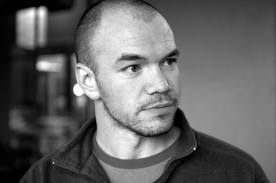
Yes, it’s a reformist hope that refuses to die in me.  It’s a hope that I find echoed in the recently published conversation between imprisoned activist Tim DeChristopher and the writer Terry Tempest Williams:

“TIM: Well there’s no hope in avoiding collapse. If you look at the worst-case consequences of climate change, those pretty much mean the collapse of our industrial civilization. But that doesn’t mean the end of everything. It means that we’re going to be living through the most rapid and intense period of change that humanity has ever faced. And that’s certainly not hopeless. It means we’re going to have to build another world in the ashes of this one. And it could very easily be a better world. I have a lot of hope in my generation’s ability to build a better world in the ashes of this one. And I have very little doubt that we’ll have to. The nice thing about that is that this culture hasn’t led to happiness anyway, it hasn’t satisfied our human needs. So there’s a lot of room for improvement.”

DeChristopher says something surprising towards the end of this interview.  He says that going to prison was the most freeing thing that could have happened to him.

“TIM: I thought I was sacrificing my freedom, but instead I was grabbing onto my freedom and refusing to let go of it for the first time, you know? Finally accepting that I wasn’t this helpless victim of society, and couldn’t do anything to shape my own future, you know, that I didn’t have that freedom to steer the course of my life. Finally I said, “I have the freedom to change this situation. I’m that powerful.” And that’s been a wonderful feeling that I’ve held onto since then.”

A lot of us are scared and angry and depressed for precisely this reason: we feel we don’t have control over our futures.  We are like the salmon and the polar bears and the bats, facing an ever more inhospitable environment, with no way to fight back.

But what if we did have control?  What if we have a lot more power than we realize?

This is the lesson of the Occupy movement.  Another world is possible.  And we can welcome her into existence.  We don’t have to go quietly wherever the powers that be lead us.

Not yet, anyway.  There’s still time.  Let’s seize it.
Chevron is Us. But we can change, and they can too

It’s not for nothing that the cliche “a picture worth a thousand words” was invented.

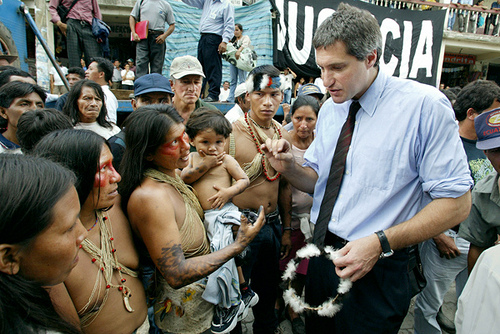
I came across such a picture in an unlikely venue this week: the current issue of The New Yorker, in a long article by Patrick Radden Keefe on attorney Steven Donziger’s efforts to represent the indigenous peoples of Ecuador whose lands have been been ruined by the toxic oil extraction practices of Texaco/Chevron.

Here’s the picture:

Attorney Steven Donziger talks with indigenous people from the Lago Agrio region of Ecuador. Photo by Lou Dematteis

What fascinates me about this image is the huge differences evident between the indigenous people with their face paint and beads, and  the oversized white American lawyer, with his conservative haircut and business attire with watch and tie.

And yet despite the differences in culture and background, these people are on the same side.

The fact that I found this picture in The New Yorker speaks volumes about the success of Steven Donziger’s heroic crusade to bring justice to bear on the oil barons who have desecrated the rainforests of Ecuador.  The New Yorker has been known upon occasion to publish some anti-establishment material–think Elizabeth Kolbert‘s hard-hitting series on climate change, or Seymour Hersh‘s series blowing the lid on Abu Ghraib.  But by and large, the magazine doesn’t do much to challenge its cultured, white, upper-class New York readership.

But this is exactly what Keefe’s article on Donziger manages to do.

Keefe’s article describes how Donziger, a fellow of Barack Obama’s from the Harvard Law School Class of 1991, has spent the nearly two decades shuttling back and forth between Ecuador and New York, fighting a monumental court battle against Texaco/Chevron.

The reason we’re hearing about this case now is quite simple: Donziger’s efforts have led to the recent court decision ordering Chevron to pay the indigenous plaintiffs $18 billion dollars.

No, that is not a typo. That’s $18 billion with a b. 

Of course, Chevron’s army of lawyers is hitting back just as hard, and the case is going to be tied up in litigation for a lot longer.  As Keefe writes in The New Yorker piece:

“Chevron has been especially defiant in the face of the Lago Agrio accusations, which its lawyers have labelled “a shakedown.” In addition to defending itself in Ecuador, it has fought the case in more than a dozen U.S. federal courts, hiring hundreds of lawyers and producing what its own attorneys have called “an avalanche of paper.” Donziger has maintained that Chevron is motivated not merely by fear of an adverse judgment but by a desire “to destroy the very idea that indigenous people can bring an environmental lawsuit against an oil company.” In 2008, a Chevron lobbyist in Washington told Newsweek, “We can’t let little countries screw around with big companies like this.” One Chevron spokesman has said, “We’re going to fight this until Hell freezes over—and then we’ll fight it out on the ice.””

Not surprisingly, the fight has turned personal and nasty: Chevron has sued Donziger personally on civil racketeering charges, further muddying the murky waters of this gargantuan case.  It’s a rather classic attempt at defamation, reminding me of the Swift boat tactics used against John Kerry’s run for the presidency in 2004.  A good portion of Keefe’s article is dedicated to exploring the charges against Donziger, and questioning whether in his zeal to prosecute the environmental crimes of Chevron, he himself began gaming the system.

By doing due diligence and presenting both sides of the case, The New Yorker clearly aims to placate those readers and advertisers who are more likely to be on the side of Chevron than on the side of the indigenous peoples of the Ecuadorian rainforest.

But still, I’m heartened by The New Yorker‘s willingness to take the risk of angering its establishment readers and advertisers by printing a story that presents the sad tale of the destruction of the rainforest environment from the point of view of the Davids rather than the Goliaths.

As Keefe explains, “Chevron, which operates in more than a hundred countries, is America’s third-largest corporation. Its annual revenue, which often tops two hundred billion dollars, is nearly four times as much as Ecuador’s economic output. The plaintiffs, who named themselves the afectados—the affected ones—included indigenous people and uneducated settlers in the Oriente; some of them initially signed documents in the case with a fingerprint.”

The devastation left by Texaco/Chevron’s heedless oil extraction practices defies language–I can’t think of a strong enough word to express the disgust I feel reading Keefe’s description:

“During the decades when Texaco operated [in the Oriente state of Ecuador], the lawsuit maintained, it dumped eighteen billion gallons of toxic waste. When the company ceased operations in Ecuador, in 1992, it allegedly left behind hundreds of open pits full of malignant black sludge. The harm done by Texaco, the plaintiffs contended, could be measured in cancer deaths, miscarriages, birth defects, dead livestock, sick fish, and the near-extinction of several tribes; Texaco’s legacy in the region amounted to a “rain-forest Chernobyl.”

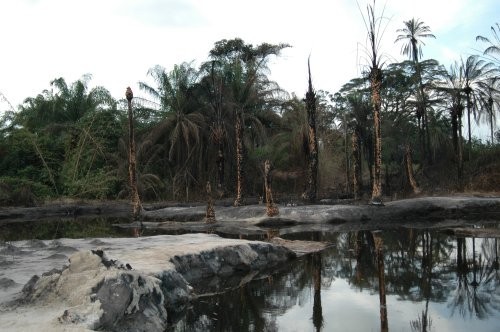
What’s especially sickening to contemplate is the fact that Chevron and all the other big oil corporations, despite their recent stepped-up efforts to brand themselves as “green,” are engaged in these kinds of destructive extraction practices all over the world.  Have you seen any images from the Niger Delta recently?

And next up: the boreal forest of Alberta, Canada.

Let’s be honest here.  Chevron is us.  We have created Chevron, all of us Americans, by our wasteful, unthinking consumption of fossil fuels wrenched from the earth at horrendous cost to local–and ultimately global–ecosystems.

The poisoning of watersheds and razing of forests has been going on for a long, long time–out of sight, out of mind of most of us here in the heart of empire.  But now the chickens are coming home to roost.

Hydro-fracking is getting so much attention because now these toxifying energy extraction methods are beginning to happen in our own backyards–that is, the backyards of the wealthy, educated readers of publications like The New Yorker and The New York Times.

What can we do, now that we’re aware of the scope and gravity of these issues?

Well, I am inspired by Steven Donziger’s determination to use his privileged educational background in the service of environmental justice, to hold the oil barons to account.  His fight, documented in the recent documentary film CRUDE: The Real Price of Oil, stands as a shining model for others coming along to emulate.

For example, this year’s graduating class at Harvard Law School.  I’m talking to you. 

Moving beyond fear and denial, or: Whither Environmentalism?

I have been hearing two forms of gentle criticism from some of my readers.

One is: omigod, this is so depressing, can’t you write about something else???

The other is: okay, we get it, enough with the exhortations, start telling us WHAT TO DO about all this scary stuff you’re laying on us.

I have been pondering both these responses, wondering how use my time and energy in this blog most effectively.

My major goal is to awaken more people to:

a) the realities of climate change bearing down on us all;

b) the incredibly fast, harsh and irrevocable impact that human over-population and careless industry has been having on the flora & fauna of our world–the real 99%;

c) the way big corporate interests have a stranglehold on crucial areas of our political system, our media, and our food supply, and thus on our political, mental and physical health, as well as the ability to control what we see, what we think and how we think it;

d) the way our education system is falling into line and failing to rise to the challenges of educating young citizens who will be forces for positive change in this dismal scenario;

e) and yes, depressing as it may be to contemplate, the dire consequences that will ensue if enough of us fail to wake up and act now to shift human society and our interactions with the natural world (of which we are a part) in a very different, more life-enhancing direction.

So that brings us back around to this key question: what should we do?

Believe you me, if I knew, I’d be trumpeting it loud and clear on this blog.  I wish I could claim to be the next Messiah!

Times have changed since the Biblical days when Moses could part the waters and lead everyone to safety–although I do find myself thinking more, as the sea levels rise worldwide, about good old Noah and his ark.

Moses drew on metaphysical powers to help him through dark times, while Noah got out his hammer and used technology to weather the storm.

In our own time and place, we are busy looking for technological fixes; those who believe in divine intervention seem to be resigned to Apocalypse, preparing themselves for Armageddon and the ascent to another, nonphysical realm of existence.

I think I am beginning to get glimmers of a middle path.

Yes, we need to be applying ourselves to the collective task of using technology to enable us to survive climate change, but our technological efforts need to be driven by a new reverence for all life on this planet, out of which a new ethics can grow that will replace greed and selfishness as the driving forces of human industry.

***

In the latest issue of Orion Magazine, environmental activists Derrick Jensen and Paul Kingsnorth both express their frustrations with the current environmental movement.

Jensen takes movement organizers to task for their drift towards actions that are “fun and sexy.”  “The fact that so many people routinely call for environmentalism to be more fun and more sexy reveals not only the weakness of our movement but also the utter lack of seriousness with which even many activists approach the problems we face.  When it comes to stopping the murder of the planet, too many environmentalists act more like they’re planning a party than building a movement,” Jensen says bitterly.

This criticism speaks to the first category of comments about my blog–the “oh it’s too depressing to think about” crowd.  Let’s face it, this is a big crowd!  The environmentalist party-planners are trying to reach these folks, who were suckled from birth on cheery feel-good media, by presenting environmental action as fun and sexy, rather than as scary and angst-ridden.  It’s environmentalism on anti-depressants, and it fits a big swath of our population, who don’t want to dwell on anything sad or depressing, unless maybe it’s a movie that you know will ultimately have a happy ending.

Harriet Tubman

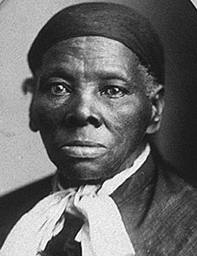
Jensen ends his column by invoking the spirits of Harriet Tubman, Tecumseh and the Jews of the Warsaw Ghetto, who were deadly serious in their resistance, and willing to do whatever it took to succeed.

People like to be inspired by memories of heroes past; one of my most popular blog posts has been “Let Your Life Be a Counter-Friction to Stop the Machine,” which recalled Thoreau’s famous refusal to pay taxes to support a government whose policies he did not believe in.

In all these cases individuals were inspired by moral outrage to stand up and resist the powers that be in order to change the status quo.

That is certainly what each of us needs to be doing, in our own spheres, in our daily lives.  We need to become more aware of what is going on around us; of our place in the ecological web, and how the small actions we take each day contribute to a huge assault on the natural world that will soon lead to a climate crisis that will force us, willy-nilly, to change.

***

It is January, 2012, and when I look out my window I see brown grass, not a speck of snow.  It was 54 degrees Fahrenheit yesterday, for crying out loud!  You won’t find this story in the New York Times, but Brad Johnson’s recent report in  Alternet paints an unmistakeable portrait of serious climate change, not in the future, but right now:

“Fueled by billions of tons of greenhouse pollution, a surge of record warmth has flooded the United States, shattering records from southern California to North Dakota. “Temperatures have reached up to 40 degrees above early January averages in North Dakota,” the Weather Channel reports. Cities are seeing late-April temperatures at the start of January — Minot, ND hit 61 degrees, Aberdeen, SD hit 63 degrees, and Williston, ND hit 58 degrees, all-time record highs for the month of January.”

All very nice in midwinter, but what happens next summer, when temperatures are suddenly 40 degrees above average?  We won’t be laughing then, will we?

Which brings us back to the second criticism of my blog, that I only talk endlessly about the bad news, and exhort people to act, without giving any concrete suggestions for what to do.

Paul Kingsnorth

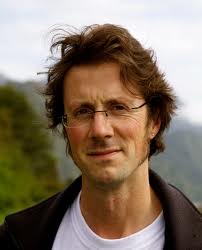
It also brings me to Paul Kingsnorth, whose long article in Orion, “Confessions of Recovering Environmentalist,” will be the subject of an open conference phone call on January 18.

Like Jensen, Kingsnorth is critical of the environmental movement–not for being too party-oriented, but for being too “utilitarian.”  Kingsnorth deplores environmentalists who have happily jumped on the technological fix bandwagon–the solar farm, wind farm, sustainable energy crowd–who are fixated on finding new ways to continue our same old depredation of the environment–just more sustainably.

“Today’s environmentalism,” he says,  “is…an adjunct to hypercapitalism: the catalytic converter on the silver SUV of the global economy. It is an engineering challenge: a problem-solving device for people to whom the sight of a wild Pennine hilltop on a clear winter day brings not feelings of transcendence but thoughts about the wasted potential for renewable energy. It is about saving civilization from the results of its own actions: a desperate attempt to prevent Gaia from hiccupping and wiping out our coffee shops and broadband connections. It is our last hope.”

Kingsnorth declares he wants nothing of this “soulless” form of environmentalism.  “What is to be done about this? Probably nothing. It was, perhaps, inevitable that a utilitarian society would generate a utilitarian environmentalism….But for me—well, this is no longer mine, that’s all. I can’t make my peace with people who cannibalize the land in the name of saving it. I can’t speak the language of science without a corresponding poetry. I can’t speak with a straight face about saving the planet when what I really mean is saving myself from what is coming.”

Disturbingly, Kingsnorth ends his article by telling us he’s turning his back on the environmental movement, and striking off on his own.  “I am leaving. I am going to go out walking.”

What he means is that he’s going to go and quietly reconnect with the land herself.  That’s important for all of us to do.  But I can’t advocate “going out walking” as a strategy for the urgent task of changing human relations with our planet.

More positively, Kingsnorth calls for a renewed “ecocentrism,” as opposed to the environmentalism that he sees as having become hollow and “plastic.”

“The “environment”—that distancing word, that empty concept—does not exist. It is the air, the waters, the creatures we make homeless or lifeless in flocks and legions, and it is us too. We are it; we are in it and of it, we make it and live it, we are fruit and soil and tree, and the things done to the roots and the leaves come back to us.”

That is indeed the central message I have been trying to send in my blog posts about “the environment.”  We are part of the web of life on this planet, and every tree that falls, every bird that is poisoned, every tree frog that goes extinct, is a leaf on the great tree of life that includes us humans too.  Kill all the leaves, and the great tree will die.

Tree of Life--Guadalupe, by Jane Lafazio

***

What to do?  Don’t stand there asking what to do!  Look around, roll up your sleeves and get busy!  Offer your talents to the task.  If you can write, start writing and share your thoughts with ever wider circles of readers.  If you can farm, start an organic CSA.  If you are an engineer, you should be focusing on renewable energy.  If you are a chemical engineer, you should be calling out the Monsantos and the Dows, even if it costs you your job.

We all need to be working on overcoming our media addictions and our socially reinforced tendencies to pull the covers over our heads.  We need to be engaging, Occupy-style, with our political system, and sending a clear message that business as usual is no longer acceptable.

There is so much to do, and so little time.  Let’s get out there, each bearing our own gifts and energies, and turn this earthship around.

Parents, listen up! You need to know, and you need to act–now.

We raise our children so carefully, so thoughtfully.  We make them eat their vegetables, organic if possible.  We send them to the best schools we can find and afford.  We screen their friends and text them anxiously if they’re late coming home.  We worry about their careers, their futures. Will there be any jobs for our precious children when we finally, with great effort and care, get them through high school and college?

Jobs are important, sure.  But why is it easier for us to think about the economy than about the biggest issue confronting our children, and all of us, in the next few years?  I’m talking about the climate crisis and the degradation of the environment. The loss of species, the toxifying of the air, soil and water.  The fact that the planet our children are inheriting is not the planet we were born on to.

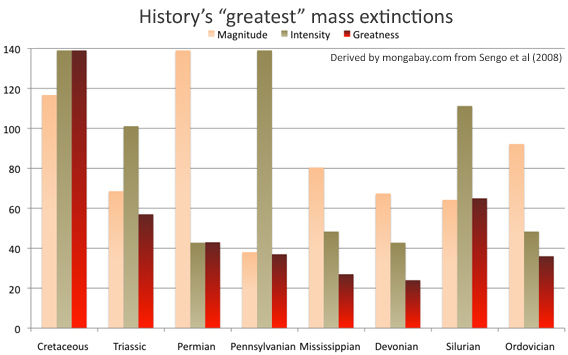
Of course, that’s always been true.  The planet has always been changing, evolving, sometimes in violent increments.  But it’s different now.  It’s different because never before, in the history of homo sapiens, have we been so close to the brink of a major, fast shift in our climate.  Never before, at least since we humans have been on the planetary stage, have we come so close to a global extinction event.

Global extinction event.  Where did I get a phrase like that?  It’s surely not my own language.  It’s one of those memes making the rounds of the Web.  But it’s not part of the lexicon of any of the parents I know.  They don’t want to think about it.  They don’t want to talk about it.  They don’t want to know.

How irresponsible is that, and how surprising, for parents who have been so conscientious, so completely invested in their role as primary caretakers and nurturers of their children.

It’s the privileged parents to whom I address myself most fervently. Parents who put so much time, energy and money into the task of raising their children, and do so with all their intelligence, responsibility and good will.  Parents who often have extra money to put towards a winter vacation someplace warm, or a summertime break by the beach.  Parents who are happy to send their kids to specialty camps in the summer, and who come up with the cash for school trips, afterschool lessons, an educational weekend in the city, a junior year abroad.

Privileged parents, listen up!  If you continue to turn a blind eye to the intertwined issues of environmental degradation and climate change, both of which are caused above all by enforced, ruthless economic growth based on the heedless consumption of fossil fuels and distribution of chemicals in the water, earth and air, your beloved children will face a future in which they cannot thrive.

A future in which none of us can thrive, unless it be perhaps the cockroaches, the ants and—for a while at least—scavengers like vultures and crows.

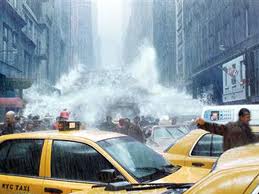
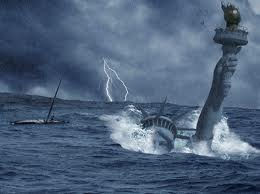
There have been so many disaster movies produced in the past few years—The Day After Tomorrow, 2012, WALL-E—putting out on the big screen our fears about what kind of future awaits us in an age of climate crisis and ecological collapse.  These movies represent our collective unconscious talking to us, presenting worse-case scenarios so that we can prepare ourselves for what may come.

We seem to like these movies because they give us the pleasure of stepping back afterwards and reassuring ourselves that it was just fantasy, not real.

The reports of the International Panel on Climate Change have none of the glamour of the big screen.  But they are saying the same thing as those disaster pictures.  They paint the same picture in different language.

It turns out that those disaster scenarios are real.

Sit with that knowledge for a bit, and then check in with yourself as a parent.  Once you accept that the looming environmental crisis is real, how can you continue to live your life blithely as though everything is OK?

Parents above all have a responsibility not just to take this knowledge seriously, but to act on what we know.  And parents of privilege–the 10%, the 25%–most of all.

We should be vehemently protesting the poisoning of our food, air and water.  We should be doing our utmost to stop the corporations who are wreaking this havoc, to change our own participation in the system, and to envision and manifest a better society that engages sustainably with the planetary ecological systems upon which we all depend.

Never before have we stood at such a juncture as a species.  Now is the tipping point.  Now is the time for us to stand up and be counted.  Now is the time for us to dare to take a path less traveled, to think for ourselves, to do what’s right for us and our children and the world we live in, before it’s too late.

It will not be easy, the road ahead.  There is so much to be done to turn this environmental train wreck around, and so little time.  We may not succeed.

But we cannot continue to play dumb any more.  We cannot continue to keep playing the game as if nothing were wrong, as if the biggest crisis of the past 10,000 years of human history were not on the horizon.  We cannot keep dancing to the band on deck as the iceberg looms before us.

There is too much at stake, for ourselves and especially for our children, whose lives—with any luck, and a lot of hard work—will reach further into the 21st century than ours.  If we care about our world—if we care about our children—we must act decisively, do whatever it takes.  Now.

Shaking the crystal ball: the future is what we make it

As I slept on my last post, the ominous words “civil war” kept resounding discordantly in my mind.

Am I really advocating for civil war?  Me?  I’m so non-violent I won’t even let my kids bring an x-box or a Wii into the house, for fear they might play violent video games.  I’m so non-confrontational that when I get angry I get quiet, not loud.  I find violence of all kinds so abhorrent that probably the only thing that would get me enraged enough to fight back is, precisely, violence, especially if visited on the defenseless: animals, children, trees.

But leavergirl‘s comment this morning has got me thinking again.

She says: “We don’t have to toughen up, but we do have to get more cunning. No street demonstrations will bring a better world. Such things force surface changes with more or less the same problems underneath. The system knows how to coopt, and knows it very well. What will bring about a better world? Living the changes at the local level.

“It’s mindboggling that people think they can “force” changes via demonstrations and protests. After all, the people in power don’t know how, even if they wanted to. We all have to invent it as we go!”

Just as it doesn’t make sense to try to fight big money with more money, it doesn’t make sense to fight violence with more violence.  And she’s right that change has to happen at the local level–that is the whole “be the change” idea.

But can we afford, in this age of globalized capital and planetary climate change, to focus locally and ignore what’s happening on the national and global scale?

It seems to me that we have to do both.  We have to do our utmost in our own homes and backyards and town centers to push for the principles we believe in.  But we also have to keep an eye on the big picture, and add our voices to the chorus calling for a change in the grand narratives that drive social policy in boardrooms and legislative chambers.

Standing up and being counted in a protest does matter.  Voicing public dissent to master narratives, as I’ve been doing in this blog, also matters.  Practicing non-violence and respect in one’s home and community is also important.  That’s what the fourth point in my Manifesto is about:

4. Model egalitarian, collaborative, respectful social relations in the private sphere of the family as well as the public spheres of education, the profession, government and law.

Thoreau’s model of civil disobedience, like Gandhi’s and Martin Luther King’s high-minded non-violence, were effective tactics of resistance that had real, tangible results.

So no, I am not advocating for civil war.  I don’t want to see it come to that.  I am, however, saying that we cannot afford to sit back and hope for the best, or wait and see, or let others worry about it.  We just don’t have that luxury anymore.

I look around me and see so many of my friends who are parents investing so much time, energy, thought and care in the raising of their children.  We worry over every test score, we make sure they eat their organic vegetables, we carefully shield them from violence and pain.

How can we be so focused on the local care of our children that we miss the big picture, which is that the world we will soon be sending them out into is in crisis? How can we not take it as part of our parental duty to do all we can to ensure that when our children grow up, their planet will be intact and able to support them?

On New Year’s Day I had a conversation with my son that keeps ringing in my ears this week.  He expressed his anger at previous generations (including me, of course) who have so degraded our environment that as he now looks out into his own future, he cannot be sure that he will have any chance of realizing his dreams.

We talked about possible future scenarios, including one that seems to be coming up in various conversations lately: conditions of scarcity leading to armed gangs marauding in the streets and taking whatever they can find.  “We would be fucked,” he said bitterly.  “We don’t even have a gun in the house!”

There it is again.  Would having a gun in the house make us any safer?  Isn’t the problem precisely that there are too many guns in too many houses?

And is it inevitable that conditions of scarcity would lead to violence? Maybe it’s likely, but are there steps we can take now to promote a different outcome?

Back to the importance of the local.  Strengthening local communities can head off a dog-eat-dog mentality.  We are all in this together.  Together, we created the present moment we now stand on; and together we will create the future.

What future do we want?  We all want abundance; peace; stability; security.  I don’t think anyone in the world would argue with those general goals.

We have the knowledge and the technology, right now, to achieve these goals, worldwide.

We do!  If we turned our best and brightest minds to the task, we could drastically reduce our carbon emissions within a decade, while still enjoying electricity and heat through solar, geothermal and wind.  We could drastically improve energy efficiency and get rid of our wasteful consumerist mindset.  We could stop making bombs and missiles, and instead refocus those trillions of dollars into education and social welfare, including intensive sustainability efforts on all fronts.

We could do this.  But again, we need that unstoppable groundswell of demand for change. Locally and globally.  NOW.


A “Be the Change” Manifesto for the 21st Century

On New Year’s Day, 2012, I reaffirm my commitment to dedicate my talents and energies towards shifting our destructive global human society in a direction that values the ecological health of the entire web of life on Earth over the short-term gains of a minority of human beings.

I invite you to join me, and you would cheer me very much if you expressed your solidarity by responding to this post, if only with a “like.”

Manifesto for a Sustainable Future

Whereas human beings have acted in a dominating fashion towards each other and towards other living species on this planet, using the excuse of difference to justify aggressive and destructive behavior;

Whereas competition has been used as a rationale for economic systems based on hierarchical systems of power;

Whereas social exclusion and systematic discrimination has been seen as the normative right of dominant groups;

Whereas privileged groups have felt entitled to take more than their fair share from the environmental commons, and to deprive less powerful groups, whether human or of other species, of the resources necessary for well-being;

Whereas it is quickly becoming apparent, in the age of climate change, that the dominant paradigm of capitalist patriarchal social relations is resulting in the dangerous destabilization of the entire natural ecosystem;

The time has come to take action to change this paradigm in the following ways:

1. Move from a top-down hierarchical system to a horizontal, egalitarian model of social relations based on inclusivity across all of the traditional boundaries used to keep different groups apart, and also opening up the possibility for cross-species collaboration based on respect and stewardship;

2. Shift the worldwide economic system to a model of global cooperation and collaboration, with the focus of human industry and government on providing a baseline of well-being for all life forms on this planet, regardless of geographic origin or antiquated ideas of relative importance (ie, who is to say that a human being is more important than a songbird, or a sardine?);

3. Tailor the education system to teaching the history of the destructive cultural practices of homo sapiens up to the 21st century, and opening up constructive conversations across disciplines, where alternatives to these traditions can be envisioned and developed;

4. Model egalitarian, collaborative, respectful social relations in the private sphere of the family as well as the public spheres of education, the profession, government and law;

5. Shift from a violent conflict and punishment model of resolving disagreements to a peaceful persuasive model, with the goal always being the well-being of the community as a whole first, and secondly each member of it.

6. Destroy all weapons of mass destruction, as well as all bio and chemical weapons, and their blueprints.

7. Disallow any one person’s or minority group’s interests (with rich people and businesses or industries rightly being considered minorities)  to take precedence over the interests of the majority, including the non-human majority on this planet.

8. Develop an appropriate representative global governing council to administer these principles.

In the name of Mother Earth and ALL of her children, I call on the peoples of the world to act without delay to become the stewards of the planet and the collaborative, respectful individuals we were always meant to be.

De-coupling our wagons from the locomotive of global capitalism

There is a clear spectrum of response to the urgency of the environmental and economic challenges that face us.

On the one end is the Deep Green Resistance movement, calling for a complete take-down of industrialized civilization, violently if necessary (and it would be necessary, of course–industrial civilization won’t go down without a fight, unless it’s wiped out by natural disasters).

On the other end are those who believe we will be able to find our way into a sustainable world order via technology, ie, renewable energy sources that will keep the capitalist engines burning bright.

On this spectrum, I would have to locate myself somewhere in the middle.  While I see the necessity of deindustrialization, I don’t really want to live through the violent havoc a strong de-civ movement would cause.

But I know things can’t go on as they have been.  We must shift from an economic model built on endless growth to one that seeks to maintain a steady state, both for human societies and for the natural world (as if there were a separation between these two).

We must also shift from the capitalist system of accumulated wealth for the few based on the commodified labor of the masses, to a system in which people’s labor is more directly connected to their well-being, and wealth is not allowed to concentrate in a few disproportionately powerful, distant hands.

The only movement I’ve found so far that is actively working to accomplish a vision similar to what I’ve sketched out above is the Transition Town movement.  The brainchild of UK visionary activist Rob Hopkins, the movement describes itself as follows:

“The Transition Movement is comprised of vibrant, grassroots community initiatives that seek to build community resilience in the face of such challenges as peak oil, climate change and the economic crisis.

“Transition Initiatives differentiate themselves from other sustainability and “environmental” groups by seeking to mitigate these converging global crises by engaging their communities in home-grown, citizen-led education, action, and multi-stakeholder planning to increase local self reliance and resilience.

“They succeed by regeneratively using their local assets, innovating, networking, collaborating, replicating proven strategies, and respecting the deep patterns of nature and diverse cultures in their place.

“Transition Initiatives work with deliberation and good cheer to create a fulfilling and inspiring local way of life that can withstand the shocks of rapidly shifting global systems.”

What appeals to me about the Transition Town movement as a strategy for change is that it’s locally based and collaborative.  The first step is getting to know your neighbors, finding out what skills you can share, and taking stock of how you can prepare intelligently to cope with whatever environmental and economic shocks may lie ahead in our future.  It doesn’t dictate a one-size-fits-all model, but rather gives communities credit for being smart enough to figure out their own, locally adapted solutions.

As a society, America seems to be in collective denial about the reality of climate change.  We don’t want to hear that if we continue down the path of capitalist growth based on fossil fuels, the planet will heat up past the point where we could expect life as we know it to continue.  We don’t want to put the pieces together, because if we do, we will be forced to face the fact that we need to change. 

If we could accept this fact, we could begin to talk seriously about directions to take to make that change happen.  It would be nice if we could count on our world leaders to step up and face the challenge squarely, in a concerted effort.  But given the reality of global politics, still based on competition and armed power struggles, it seems very unlikely that we can look to the United Nations, or individual national governments, for the kind of decisive leadership we need now.

So we need to turn to each other, on the local level, and begin asking, as the Transition Town movement envisions, what can we do right here, together, to become more resilient?  What resources do we have, right here, that are not dependent on current systems of international or long-distance national trade?  How can we plan together for a sustainable future?

In a way, it’s an effort to de-couple our personal wagons from the locomotive of capitalist growth, which is proving so destructive to everything in its path, and seems to be on the verge of careening out of control.

I’ve been hearing a fair amount of fear expressed about “going backwards.” When people imagine stepping down from the capitalist growth model, they picture having to give up modern conveniences like advanced medical technologies, ready access to electricity, indoor plumbing, etc.

It doesn’t have to be that way.  We have to work on developing new ways of generating those conveniences, that are less destructive to the planet (the technological fix) and also work swiftly to dismantle those features of industrial civilization that are throwing our whole ecological system out of balance (de-industrialization).

The Transition Town movement calls this “the great re-skilling” approach.  We need to remember older, more sustainable ways of doing things, while also keeping the best of new technologies and learning how to apply them in smarter, more efficient and ecologically sound ways.

There are over 100 full-fledged Transition Town initiatives in the U.S., and hundreds more worldwide, along with many start-up groups forming all the time.  Although all of us seem to have so much to do, and so little time these days, this is really a movement we need to be focusing on now to prepare for the decade ahead.

Given the lack of effective top-down leadership, should we really be wasting our time worrying about national elections, for example?  Or bothering to go to international conferences on climate change?

Or is the smarter thing to do to begin, quietly and with determination and hopeful good cheer, to make our own preparations for a very different sort of future, in our own transition towns?

The Silence of the Bees

Usually during the holidays I catch the frenzied good cheer from everyone else and wind myself up to make merry.  This year, I just can’t seem to find the spark.

Maybe it’s a case of SAD (seasonable affective disorder).  Maybe it’s the fact that it’s the first holiday after my divorce was finalized, and that new reality is sinking in.  Maybe it’s the gloomy state of the economy, which is certainly negatively affecting my financial outlook.

But I think it goes deeper and broader than these personal issues.

I feel like I’m grieving, but not for any one person.  I’m grieving for the loss of my future, and all of our futures.  Even as I stoutly maintain that we can’t give up hope, and we need to keep fighting, there is something in me that keens, heartbroken, for the huge loss that we all face.

It’s already started, the great dying-off.

I keep remembering a certain perfect May morning in my childhood, when I waded out into the deep, fragrant grass under the old, half-wild apple trees, which were glorious in full pink-and-white bloom.  I lay in a grassy nest under one of the trees–no worries about ticks and Lyme disease in those days–looking up at the blossoms outlined against the startling blue of the sky.  The petals rustled gently in the breeze, and the sound of thousands of busy buzzing honey bees filled the air.  Watching carefully, I could see the bees moving from blossom to blossom, carrying their saddlebags full of bright golden pollen.  My heart swelled with the sheer joy of being alive in that moment, a part of the humming life of that orchard on that beautiful spring day.

Flash forward to last spring, when I went out into the same old orchard on another lovely May morning, and was aghast to realize that not a single bee was working the blossoms of the tree.  The silence was frightening, like the desolate silence of a wasteland, though visually it all looked very much the same.

This is just one small example of so many countless instances of the glorious richness of life on our planet, profoundly and irrevocably being silenced.

So yes, I am grieving.  And I am angry.  And I do not know the best way to try to head off the end that seems so inevitable now.

Sometimes it feels like I’m living in a sci-fi movie, where everything seems so hopeless, the bad guys are winning…and then at the last moment, the heroes sweep in and save the day.  I want to believe that we can be those heroes.  Perhaps it will be like the TV series “Heroes,” where many of us who are preparing ourselves now for the fight will come together and really be able to make a difference.

But I don’t count on it.  Because, in large part, the “bad guys” are us.  We’re doing this to the planet.  The laptop I type on is part of the problem, the electric lights I just strung up on my porch are part of the problem, the car I drive is part of the problem.

What would it mean, really, to stop being one of the bad guys?  To become one of the vast army of everyday heroes needed to save this planet?

I keep asking this question, and I will keep asking it until the answer becomes clear.  I feel I am taking some sort of step in the right direction just by asking the question in this public forum, seeking out like-minded people who may have answers I could not come to on my own.

I know we need each other now, more than ever.  The old individualist way of doing things is part of the problem.  Interconnection should be the buzzword of the second decade of this century.  As the planet heats up, our survival will depend on our being able to cooperate and collaborate on adapting to the new, much harsher environment.


 Sometimes I have moments of hysteria, when I feel like I’ve been diagnosed with a terminal illness, and need to decide how I want to spend my last days.  Maybe this isn’t so hysterical after all…this may be a rather sober assessment of the way things stand.

Of course, we are all living under a life sentence, all the time!  But I no longer feel I can count on living into old age, dying a natural death.  Saving for retirement seems like a pipe dream, left over from a 20th century mindset that no longer makes sense.

The only  antidote I know for the grief and depression born of full apprehension of the reality of our very bleak and uncertain future is simply this: carpe diem, seize the day.

Unless we ordinary heroes come together to create a mighty and unstoppable wave of change very soon, the planet will heat up beyond our comfort zone, causing severe weather that will send us floods, famine, conflict and extinctions on a biblical scale.

Yes, ultimately the planet will regenerate, and new forms of life will emerge.  But we will not be here to play our part–to love, appreciate, tend and respect the other living beings on Earth.

It is too soon to give in to grief.  I will shake it off, rouse myself, continue as long as I can to stand up and be counted among the opposition to the terrible destruction that our way of life has visited on so many others on this planet.

Meet me out in the apple orchard, listening for the bees….

On Human Rights Day, Calling the Next ‘Greatest Generation’

Today, Human Rights Day, I call upon the peoples of the world to understand that if we don’t focus on reducing human impact on the global environment in this new century, all the other more isolated issues will be moot.

Issues from the militarization of the police, to the use of rape as a weapon of war, to the stifling of free speech and democracy, are important—but they’re just minor skirmishes.

The real battle for human rights is taking place in the realm of energy politics.

It’s taking place on the thousands of oil rigs out in the Gulf of Mexico.

It’s taking place in the hundreds of new hydro-fracking wells being dug in upstate New York and Pennsylvania.

It’s taking place in the coal mines of China and the tar sands of Canada.

All of us are players in this deadly game.  Every time we turn the key in the ignition of our car, or buy food produced by a factory farm, or pay our electric bill.  We participate as consumers, and as consumers, we have more power than we realize.

On Human Rights Day, we need to remember three things:

•   The Universal Declaration of Human Rights guarantees the human right to health

•   A healthy environment, including healthy food, water and air, is essential to human health

•   Corporations, not being people, must not be allowed to trample on human rights.

Indeed, corporations, being human creations, should be serving human rights.

If a healthy environment is essential to human rights, then corporations should be working on making our environment as healthy as possible.  Corporations work for us.  They need to meet our needs, and uphold our rights.

There is a new movement afoot to define and uphold the Rights of Nature, which is a totally laudable goal. But in my view, the rights of the natural world and the rights of human beings are inextricably intertwined.

To truly uphold human rights would be to truly uphold the rights of Nature.

We are animals.  We are part of the natural environment of this planet.  If we foul and destroy our environment, we will die, along with countless other living beings: animals, insects, marine life, birds and plants.

This is a big battle; these are momentous times. We need to step up and be the new “greatest generation.”  We need to hold corporations accountable for their destructive, life-threatening actions.  We need to insist on change.

If we don’t, will anyone be left to lament our failure?

College climate activists lead the way at COP 17 in Durban

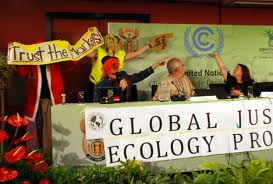
You have to hand it to the college students attending the U.N.-sponsored climate talks in Durban.  They know how to cut through the nonsense and tell it like it is.

Watch 21-year-old Middlebury College junior Abigail Borah telling the august assembly that they can no longer afford to drag their feet on curbing carbon emissions.

“I am speaking on behalf of the United States of America because my negotiators cannot,” said Ms. Borah, a representative of the International Youth Climate Movement. “The obstructionist Congress has shackled justice and delayed ambition for far too long. I am scared for my future. 2020 is too late to wait. We need an urgent path to a fair, ambitious and legally binding treaty.”

The response to her entreaty?  A swift escort off the premises.

Another group of students dressed as “corporate clowns” to bring some levity to the grim discussions.  As documented by the Climate Connections blog, they too were met with hostility by the powers that be.

While talking with the press, student clown Kevin Buckland “was grabbed and hauled away. His badge was taken, and he was barred from the International Conference Center.”

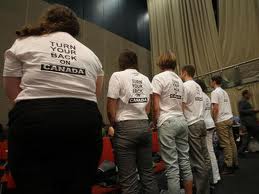
Then there was the group of Canadian students who were removed from the assembly hall just for displaying tee-shirts with the words “Turn Your Back on Canada,” a criticism of the Canadian government’s support for the oil extraction of the Alberta boreal forests (aka “tar sands”).

What kind of message are these young people going to take away from these incidents about the efficacy of trying to participate peacefully in global assemblies?  No wonder they’re turned off and turning to their own “people’s assemblies.”

As Laura Carlsen points out in an article posted on Common Dreams today, climate change activists need to “broaden the focus from once-a-year meetings in high-carbon conference centers, to the fields, communities and town halls where alternatives are already growing and a stronger political consensus can be built from the bottom up.”

The top-down approach favored by the U.N. and the international governmental community is showing itself to be not only ineffectual, but morally bankrupt.