An Unlikely Environmental Evangelist

There were two reasons, many years ago, why I ended up choosing literature as my field of study rather than environmental studies or law.

I was turned off from environmental studies, my initial choice for an undergraduate major, by a scary required statistics class and no options for getting remedial help to bring my weak math skills up to speed.  I ended up with a B.A. in English and Journalism.

I briefly flirted with the idea of law school after college, but could not fathom spending the rest of my life reading and writing legalese.

So I gravitated towards literature, comparative literature, literature of the world, and my dissertation focused on testimonials and political personal narratives of the Americas.  I knew early on that what interested me most about literature was opportunity it presents for passionate narratives about the intersections of the personal and the political.

That has remained my interest all these years later.  But it has finally become clear to me, over the longer arc of my life, that my early, instinctive connection to the natural world, my recognition of the importance of law, and my duck-in-water ease with the discourses of both journalism and personal narrative, are all finally coming together in what I see as the imperative task to which I must dedicate the last third of my life: awakening my fellow and sister human beings to the urgency of heading off climate catastrophe.

If this sounds like a moral crusade, well, so be it.

I was not raised in any religion, nor do I follow any religious practices now.  I don’t believe in God as a benevolent white man in the sky, nor do I believe that one needs to sit in a particular building, listening to a particular preacher, to reach out to the divine.

But I have always felt a deep spiritual connection to the natural world.  When I was 8 or 9, I used to go out into the woods and sit alone in my “spot,” which was a circle of mossy stones at the top of a big stone ridge, ringed by maples and centered around a grassy glade.  It was a small circle, no bigger than 10 feet in diameter.  I would just sit there and look and listen to the birds in the trees above me, the small insects on patrol in the grass, feeling the wind ruffling against my face and a kind of inner exultation and delight that I can only describe as religious ecstasy.

No one taught me to do this, and it wasn’t until much later, reading personal narratives by indigenous elders, that I was able to put this early spiritual connection with nature into a broader polytheistic cultural framework.

I believe that everything in our world is tinged with spiritual significance.  And I believe that human beings, because we are unique among animals in being able to see the effects of our actions on the larger landscape of the planet, and to both predict and alter the future, have a special moral imperative to do what we can to be the responsible stewards of the natural world of which we are a part.

I have never said that out loud.

But thanks to environmental activist educator Eban Goodstein, I now recognize that this is exactly what I should be doing, whenever I can, as urgently and passionately as possible.
Goodstein, who founded the national organization Focus the Nation and now heads up the Center for Environmental Policy at Bard College, writes in his 2007 book Fighting for Love in the Century of Extinction that it is crucial that people who understand the seriousness of the pivotal moment at which we stand begin to speak up—not in legalese or scientific jargon, but in the clear, ringing tones of moral conviction.

“The real problem that nontheistic environmentaists face is not a depth of passion, but a failure of moral language with which to cultivate and nuture that passion,” Goodstein says.  “Unless passion about life on Earth is nurtured, and mass extinction is understood clearly in terms of good and evil, then political opposition to the great extinction wave of our generation will be weak and it will sweep across the next century unabated.”

Goodstein recommends that each of us “develop a thirty-second ‘elevator speech’ that is a response to the question: ‘Why do you care about global heating?’” What you say won’t be convincing or memorable to people unless you can quickly tell them why this issue is deeply important to you, and why they should also care.

It can’t be a laundry list of words that have been so often used they’ve become clichés: sustainability, clean energy, even droughts or wildfires.  Goodstein suggests that when it comes right down to it, we should care about global heating because it is “just plain MORALLY WRONG” to ignore the prospect of the sixth great extinction of life on Earth, when we not only know it’s coming, but have a pretty good idea of how to head it off.

Given my non-religious upbringing, I’m not that comfortable with the language of good and evil or moral righteousness.  And yet it is no accident that all human religions do codify a moral code that seems to be hardwired into our species.

Goodstein refers to Harvard biologist E.O. Wilson’s 1984 book Biophilia, which set the stage for evolutionary psychology in arguing that human beings have evolved to love life and work to extend life by interacting positively with our environment.

Whether we come at the issue of climate change from a religious perspective (God made us the stewards of life on Earth, we have a moral injunction to protect all God’s creatures) or a nontheistic but nevertheless spiritual reverence for the natural world, or even a simple scientific recognition that the current fabric of our ecosystem will live or die depending on human choices now, there is no doubt at all that each of us needs to get our elevator speech nailed down and go out to become evangelists for the natural world.

I don’t use the term evangelist lightly.  Christian evangelists have a reputation for single-mindedness bordering on fanaticism.  They believe deeply, and they are willing to take the risk of expressing their beliefs out loud, and actively trying to convert others.

I am someone who has been known to hide in my own house when the Jehovah’s Witnesses knocked at the door.  I have never followed any preacher or religious dictate, nor have I ever considered trying to persuade others to any given point of view.

But the situation we face now is unprecedented in my lifetime, or human history as a whole.  It demands an unprecedented degree of commitment.  It demands taking the risk of climbing up on a soapbox and speaking out loudly and passionately enough to draw a crowd.

Those of us who are awake to the gravity of the coming environmental catastrophe need to be getting out there trying to instigate change through every possible channel: electoral politics, grassroots activism, legal challenges, moral persuasion, standing on our heads–whatever it takes to wake people up and get them moving.

So what’s your elevator speech about?  Mine, I think, is about love.

Whether we call it love for God’s green earth, or the love for the natural world, what we mean is the same: love for our children and future generations, who should not be denied the pleasure of listening to birdsong in the trees on a peaceful spring morning, knowing that their world is stable and secure.

Censorship in Academe, 21st century style

Unfortunately, the banning of books by Mexican Americans in Tucson last week was not an isolated incident.  It’s part of a larger pattern in American education.

At the elementary school level, it takes the form of resisting bilingual education for students whose family language is not English, and—for example—still teaching “Thanksgiving” as though it were the happy, peaceful start of a triumphant positive march towards a shining, splendid American empire.

At the middle school level, it’s about teaching Egyptian history—mummies, anyone?—instead of Native American or Mexican history.  Mummies are safe—there’s no politics left in them, they’ve been dead too long.

In high school, students are asked to stand and pledge allegiance by rote to the American flag representing “one nation, under God, indivisible, with liberty and justice for all,” but not asked to interrogate the proposition that liberty and justice really are available to all in our great land.

In undergraduate education, after a brief, highly contested period in the 1980s and 90s when the gates guarding the required curricula were wrenched open to let literature by ethnic minorities and women in, the tides have turned again.

Just as in middle school it’s safer to teach about the ancient Egyptians, in college the safest route is towards ancient Greece.  “After all,” I was once told blandly by a senior (white male) colleague in the course of a heated meeting on the core curriculum, “the Greeks are a minority too.”

The modern Greeks may be struggling, but the ancient Greeks are alive and well and generously represented in curricula throughout the Western world, where ancient figures like Plato, Sophocles and Aristotle still exert remarkable influence.

Meanwhile, graduate schools in the humanities are focused on jazzing up the study of history and literature through fancy digital applications.

I’m as digitally oriented as the next prof, but I won’t support “digital humanities” if it means that we no longer have the time or resources to engage in what I see as the most important functions of the humanities: teaching students how to analyze and wield the tools of narrative and argument; giving them the time and space to explore complex ethical issues; and most of all, empowering them to become informed, autonomous individuals who can research and think for themselves.

In theory, this could be done within a digital framework.  But the problem is that much of the push towards “digital humanities” is coming from the great surge towards online education as a business model for universities.  Of course you can do online education much better if you have high-tech online tools.  No argument there.

The problem is the bigger picture of online education, where tenured professors are being replaced with adjunct faculty who can teach in their pajamas from home, at a fraction of the salary or responsibility and no influence at all over what gets taught.  If you have an army of part-time online instructors working with students from remote locations all over the world, it’s pretty hard to have the kind of discussions that I’m remembering from my department’s deliberations over the core curriculum.

Most decisions over what gets taught in those burgeoning online courses are made by administrators who remain faceless to the instructors, with the result that professors become paid employees rather than professionals who are not only engaged in the process of teaching, but also in the process of deciding what gets taught.

It’s as easy as the push of a button for some administrator to decide that HUM 26X, Chicano/a History, will not be taught, while HUM 25X, History of Ancient Greece, will. And for the most part, no one will even notice.

This is going on all the time.  The incident in Tucson last week, when administrators were so sloppy as to order physical books pulled from the shelves, was a rare slip-up that brought the insidious practice of censorship into the public eye.

Most of the time it’s going on invisibly, under the radar, and so subtly that most of us won’t notice it until all of a sudden we look up and find that there are only a handful of Ethnic Studies Departments or Women’s Studies Departments left in the country, so there are hardly any graduate degrees being offered in those fields, so within a generation the whole hard-won movement to open the curriculum will be gone.

No, I am not over-reacting.  I am not hysterical.  I am not crazy.  Open your eyes, people, and you will see what I’m talking about.  Open your eyes, before it’s too late.

On MLK Day, Opening the Hearts of the Privileged

When I first heard the phrase “privilege is invisible to those who have it,” it seemed like the answer to a question I didn’t even know to ask:

How can people who are so nice, who would never hurt a fly, be so oblivious to the ways in which their lifestyles are deeply hurting others?

Oblivious is the operative word here.  Most privileged people really don’t have a clue as to how “the other half lives”–or make that, the other 90% or so. Just as I don’t understand how it is to be a child slave working on a cocoa farm in Africa, or for that matter a honeybee bringing poisoned pollen back to the hive and dying of it myself, people way up on the class ladder in the US can’t understand what deprivation feels like–and if you can’t get to that feeling place, it will be very hard to arrive at any sort of comprehension or even curiosity.

There are so many examples of what I’m talking about, but having just signed a petition to President Obama calling attention to the issue of contingent faculty, my mind is going to a memory I can’t shake, from my days of adjunct teaching.

I had been teaching as an adjunct at my alma mater for a couple of years, having decided to forgo a serious tenure-track search while my first son was an infant.  In the spring, after a busy year of adjunct teaching, I went to talk to the Dean, to see whether it would be possible to improve my status at the college so my salary would not be cut off during the summer.  I don’t remember the exact words of her response, but her attitude was plain: what happens to you over the summer, when we don’t need you, is none of our concern.  Next!

I was naive, I guess, to imagine that she would care that she was not paying me a living wage.  But I had grown up among the privileged, for whom it was really unfathomable, the idea of not making a living wage.  If you weren’t making enough to live on, then something must be wrong with you.  You’re not trying hard enough, you’re not talking to the right people, you just don’t have what it takes.

In this situation, I felt the duality of on the one hand being outraged, as any privileged person would be, at being treated in such an unfair, exploitative fashion, and on the other hand, feeling shamed and inadequate because of course it must be true, it must be my fault that I’m being treated so badly.

For people from a different background than mine, it would be quite easy to internalize those feelings of shame and self-doubt, to the point where one would begin to believe them.  I have studied many autobiographies by people who were marginalized and disadvantaged from birth by their race, ethnicity, gender, etc, and this self-loathing is a common feature of what W.E.B. DuBois called “double-consciousness,” seeing oneself through the eyes of another.

But I grew up with every advantage, and was always a star in the academic realm, a child prodigy in reading and writing who received a BA magna cum laude at 19 (it would have been summa if I hadn’t had to take those damned statistics classes!), a straight A student through grad school who excelled at jumping through every hoop set out for me.

Thus my amazement at finally attaining my goal of teaching at the college level, and being told that while I was doing a great job, there was no chance of being paid fairly for it.

My point in relating this story is that most people who grew up like me would never have such a story to tell.  For us the red carpet rolls out automatically wherever we go; people bow and beckon, smiling; life is easy and delightful. And when you live that kind of existence 24/7, when it’s your whole life from earliest childhood, it’s just inconceivable that it could be otherwise.  Or if it is, then as I said, there must be something wrong with you personally.  It’s not the system that’s at fault if things aren’t going your way, it’s your own personal inadequacies.

That seems to be the explanation that many among the 99% accept when they fall upon hard times.  Home foreclosed? What a fool you were for signing that mortgage!  Lost your job?  Why didn’t you go into a more stable field?  Single mom?  Honey, don’t you know how to keep a man?  And so on and so forth.

Both sides of the class divide need reminding that we are all born into a pre-existing social structure, some with gold spoons, and some with plastic spoons in our mouths.  The playing field is most assuredly not level.  Those who are living well need to realize that they owe their good fortune as much to their favorable placement in the Game of Life as to their own smarts and hard work; and those who are struggling need to realize that it’s not all their fault.

Pointing fingers at individuals is not going to lead to a fruitful discussion.

Was it the Dean’s fault that it was standard practice at the college to pay adjuncts by the semester?  She was just going along with the flow, wasn’t she?  Was it the mortgage lender’s fault that people took on more debt than they could repay?  The mortgage officer was bending over backwards trying to give that family the house of their dreams, wasn’t she?

Right. Rather than seeking to cast blame, we need to be looking for ways to make the system fairer for all the new children being born into it every minute.  One of the most basic steps we can take is making privilege visible to those who have it.  The privileged, who have more social power than the disadvantaged, need to know and understand how their complacency with a warped social system impacts the less well-placed.

Knowledge is the first step towards compassion, and from compassion comes the desire to make what’s wrong right.

It’s not about casting stones.  It’s about sharing experiences, and hoping that those in power will listen with open minds and hearts.

On the eve of MLK Day, that is my fervent wish and prayer.


Follow the Money–Somewhere New!

People in the know always advise us to “follow the money.”

Thanks to the Occupy movement, it’s become plain to a lot more of us that huge amounts of money are concentrated in a very few, very influential hands.  Big business interests control politics at every level, and the name of the game is profit for the top managers and owners, with the bare minimum allowed to “trickle down” through taxes and philanthropy.

Nothing new in that picture.  But there are some provocative new ideas arising about how to change a system that seems so entirely entrenched that most of us don’t even bother to think too hard about alternatives.

Last night I had dinner with some folks who are working on an alternative local finance program, called Common Good Finance.  The idea is somewhat similar to local currencies like, for example, our homegrown BerkShares.  But instead of paper money, Common Good will be an electronic credit system, based on R-credits.

One R-credit will equal $1 US, but the use of R-credits will be incentivized: if I spend R-credits rather than dollars, I’ll get a 5% rebate on every purchase, and even better, the merchant will get a 10% kickback for accepting my R-credits.  That sure sounds win-win!  What’s the catch?

There doesn’t seem to be a catch as far as the ordinary consumer and local vendor is concerned.  The ultimate goal of Common Good Finance is to create a local, democratically governed credit union, to which businesses and individuals in a community could apply for low-interest loans and grants.  The main criteria for approval would be: would extending this credit line be in the interests of the common good?

Forget about bankers getting rich on those exorbitant interest rates attached to every debt.  Forget about too-big-to-fail banks preying on consumers in every town and city in the nation.  Forget about municipalities cutting back on social services, including health care, education and affordable housing, because there simply isn’t enough money.

The people behind Common Good Finance believe that scarcity is a convenient fiction created and upheld by the central bankers who control the Federal Reserve.  It’s convenient because it keeps the pace of debt constantly accelerating, and it’s the interest on all these debts that provides the profits that line the bankers’ pockets.

Common Good would create a monetary system where money circulates locally, and any surplus in the form of interest is plowed right back into the local community in the form of loans and grants to worthy individuals and causes.  The local members of the R-credit system would be the ones to decide democratically, by facilitated consensus-building, who would get what.

As we talked about these intriguing ideas over dinner, the question came up of cronyism and conflict in this collective decision-making process.  But as John G. Root Jr., one of the founders of the Common Good initiative, put it, “We know the system we have now is not working well for the majority of Americans.  Why not try something new?”

In making his case for the R-credit system, John referred often to the American revolutionaries who decided to throw off the yoke of British tyranny and strike off on their own, founding a new country.  Now, going on 300 years later, Americans find ourselves under a new yoke: multinational corporate interests that may make judicious grants to communities and non-profits through their well-heeled foundations, but would not want to see communities empowered to divorce themselves from the thrall of big business.

Having R-credits would encourage people to shop local, and it would encourage businesses to source locally too, since they could keep their R-credits in circulation that way and keep earning those 10% kickbacks on every R-credit exchange.  Pricechopper and WalMart wouldn’t like this–but who knows, maybe they could be drawn into this network too!  Maybe the idea of democratically controlled local finance is an idea whose time has come, an idea could even go global!

As an example, take the Grameen Bank, which was founded in one of the poorest countries in the world to provide poor women with low-interest micro-loans to start local businesses.  It has grown exponentially; its founder, Muhammad Yunus, won a Nobel Prize in 2006; and its model is being replicated in many other parts of the world.  Why not in the U.S.?

Common Good Finance is not alone in searching for outside-the-box answers to our current financial predicament.  Economist David Korten has been working on what he calls “living economies” for about twenty years now; he is one of the leaders of the New Economy Working Group, which includes free thinkers like Gus Speth and Gar Alperovitz.  The New Economy mission statement sums up the vision quite well:

“Effective action will shift the economic system’s defining value from money to life, its locus of decision making from global to local, its favored dynamic from competition to cooperation, its defining ethic from externalizing costs to embracing responsibility, and its primary purpose from growing individual financial fortunes for a few to building living community wealth to enhance the health and well-being of everyone. We humans face an epic choice between the certain outcome of continuing business as usual and the possible future it is within our means to create through conscious collective action.”

It does feel like an epic moment, a transition time pregnant with the possibility for positive change.

Let’s follow the money and let the revolution begin!


I Won’t Go Quietly

So the question arises, how seriously should we be taking the prospect of imminent climate crisis and environmental collapse?  How serious is the threat?  What should we be doing to meet it?

On the one hand, there are the Deep Green Resistance folks, who advocate a guerilla warfare approach to industrial civilization: sabotage to infrastructure, with the goal of saving the planet from the destructive predation of human society.

The DGR point of view is that the salmon and the frogs and the polar bears can’t wait; if we hesitate, they will go extinct, and there is no coming back from extinction.  And by the way, we homo sapiens are next in line.

Well yes but…blowing up bridges, cell towers and power lines is hardly in a day’s work for most of us.  I can’t see myself heading for the hills with a knapsack of dynamite on my back!  And could such a resistance effort work? As the example of Tim DeChristopher shows, it doesn’t take much pushback to land in jail.

At the other end of the spectrum are the people who just don’t see that there’s any problem.

That’s most of us Americans.  Most of my peers really seem to see nothing at all to be concerned about, ecosystem-wise.  I often feel  paranoid and ridiculous to worry about global warming leading to conditions of scarcity that will destabilize the social order. No one else is worrying about this, why should I?

People who love me warn me not to go too far; my neighbor wonders when the FBI surveillance will start on our block.

Really, am I nuts to be even thinking about all this?

But I can’t forget historical scenarios where the majority maintained a go-with-the-flow, maintain-the-status-quo position, and were stunned when their efforts at conformity landed them in the gas chambers.

This was only a generation ago, my friends.

Today our fear is not so much gas chambers as it is mass poisonings by other means: for instance, fungicide in the orange juice, heavy metals in the well water, or mega-hurricanes caused by global warming.

It is already happening.  Of course the powers that be, the powers that are profiting from the status quo, don’t want us to question.  They don’t want us to wonder whether saving the salmon is more important than, say, mining for gold in a pristine river.  They don’t want us to demand cars that run on hydrogen.  They don’t want us to insist on a moratorium on Round-up ready seed and fertilizer.

I’m sorry, but I can’t stand down and go back to minding my own business like a good little girl.  I won’t go quietly into the night.  I won’t be one of the capos who cooperates and shepherds the others to their doom.

But maybe we don’t have to choose between these two extreme scenarios: conformity or resistance.  Maybe we can take a middle route, a resistance movement that works with the conformists to bring about change.

Yes, it’s a reformist hope that refuses to die in me.  It’s a hope that I find echoed in the recently published conversation between imprisoned activist Tim DeChristopher and the writer Terry Tempest Williams:

“TIM: Well there’s no hope in avoiding collapse. If you look at the worst-case consequences of climate change, those pretty much mean the collapse of our industrial civilization. But that doesn’t mean the end of everything. It means that we’re going to be living through the most rapid and intense period of change that humanity has ever faced. And that’s certainly not hopeless. It means we’re going to have to build another world in the ashes of this one. And it could very easily be a better world. I have a lot of hope in my generation’s ability to build a better world in the ashes of this one. And I have very little doubt that we’ll have to. The nice thing about that is that this culture hasn’t led to happiness anyway, it hasn’t satisfied our human needs. So there’s a lot of room for improvement.”

DeChristopher says something surprising towards the end of this interview.  He says that going to prison was the most freeing thing that could have happened to him.

“TIM: I thought I was sacrificing my freedom, but instead I was grabbing onto my freedom and refusing to let go of it for the first time, you know? Finally accepting that I wasn’t this helpless victim of society, and couldn’t do anything to shape my own future, you know, that I didn’t have that freedom to steer the course of my life. Finally I said, “I have the freedom to change this situation. I’m that powerful.” And that’s been a wonderful feeling that I’ve held onto since then.”

A lot of us are scared and angry and depressed for precisely this reason: we feel we don’t have control over our futures.  We are like the salmon and the polar bears and the bats, facing an ever more inhospitable environment, with no way to fight back.

But what if we did have control?  What if we have a lot more power than we realize?

This is the lesson of the Occupy movement.  Another world is possible.  And we can welcome her into existence.  We don’t have to go quietly wherever the powers that be lead us.

Not yet, anyway.  There’s still time.  Let’s seize it.

Chevron is Us. But we can change, and they can too

It’s not for nothing that the cliche “a picture worth a thousand words” was invented.

I came across such a picture in an unlikely venue this week: the current issue of The New Yorker, in a long article by Patrick Radden Keefe on attorney Steven Donziger’s efforts to represent the indigenous peoples of Ecuador whose lands have been been ruined by the toxic oil extraction practices of Texaco/Chevron.

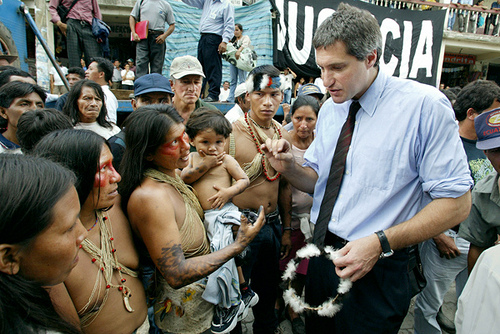
Here’s the picture:

Attorney Steven Donziger talks with indigenous people from the Lago Agrio region of Ecuador. Photo by Lou Dematteis

What fascinates me about this image is the huge differences evident between the indigenous people with their face paint and beads, and  the oversized white American lawyer, with his conservative haircut and business attire with watch and tie.

And yet despite the differences in culture and background, these people are on the same side.

The fact that I found this picture in The New Yorker speaks volumes about the success of Steven Donziger’s heroic crusade to bring justice to bear on the oil barons who have desecrated the rainforests of Ecuador.  The New Yorker has been known upon occasion to publish some anti-establishment material–think Elizabeth Kolbert‘s hard-hitting series on climate change, or Seymour Hersh‘s series blowing the lid on Abu Ghraib.  But by and large, the magazine doesn’t do much to challenge its cultured, white, upper-class New York readership.

But this is exactly what Keefe’s article on Donziger manages to do.

Keefe’s article describes how Donziger, a fellow of Barack Obama’s from the Harvard Law School Class of 1991, has spent the nearly two decades shuttling back and forth between Ecuador and New York, fighting a monumental court battle against Texaco/Chevron.

The reason we’re hearing about this case now is quite simple: Donziger’s efforts have led to the recent court decision ordering Chevron to pay the indigenous plaintiffs $18 billion dollars.

No, that is not a typo. That’s $18 billion with a b. 

Of course, Chevron’s army of lawyers is hitting back just as hard, and the case is going to be tied up in litigation for a lot longer.  As Keefe writes in The New Yorker piece:

“Chevron has been especially defiant in the face of the Lago Agrio accusations, which its lawyers have labelled “a shakedown.” In addition to defending itself in Ecuador, it has fought the case in more than a dozen U.S. federal courts, hiring hundreds of lawyers and producing what its own attorneys have called “an avalanche of paper.” Donziger has maintained that Chevron is motivated not merely by fear of an adverse judgment but by a desire “to destroy the very idea that indigenous people can bring an environmental lawsuit against an oil company.” In 2008, a Chevron lobbyist in Washington told Newsweek, “We can’t let little countries screw around with big companies like this.” One Chevron spokesman has said, “We’re going to fight this until Hell freezes over—and then we’ll fight it out on the ice.””

Not surprisingly, the fight has turned personal and nasty: Chevron has sued Donziger personally on civil racketeering charges, further muddying the murky waters of this gargantuan case.  It’s a rather classic attempt at defamation, reminding me of the Swift boat tactics used against John Kerry’s run for the presidency in 2004.  A good portion of Keefe’s article is dedicated to exploring the charges against Donziger, and questioning whether in his zeal to prosecute the environmental crimes of Chevron, he himself began gaming the system.

By doing due diligence and presenting both sides of the case, The New Yorker clearly aims to placate those readers and advertisers who are more likely to be on the side of Chevron than on the side of the indigenous peoples of the Ecuadorian rainforest.

But still, I’m heartened by The New Yorker‘s willingness to take the risk of angering its establishment readers and advertisers by printing a story that presents the sad tale of the destruction of the rainforest environment from the point of view of the Davids rather than the Goliaths.

As Keefe explains, “Chevron, which operates in more than a hundred countries, is America’s third-largest corporation. Its annual revenue, which often tops two hundred billion dollars, is nearly four times as much as Ecuador’s economic output. The plaintiffs, who named themselves the afectados—the affected ones—included indigenous people and uneducated settlers in the Oriente; some of them initially signed documents in the case with a fingerprint.”

The devastation left by Texaco/Chevron’s heedless oil extraction practices defies language–I can’t think of a strong enough word to express the disgust I feel reading Keefe’s description:

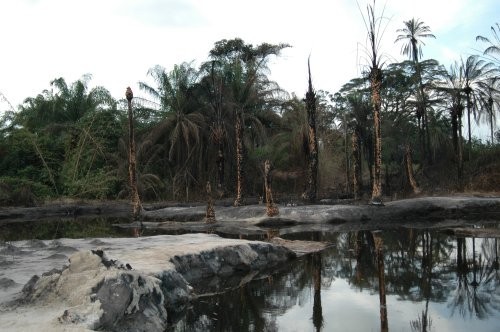
“During the decades when Texaco operated [in the Oriente state of Ecuador], the lawsuit maintained, it dumped eighteen billion gallons of toxic waste. When the company ceased operations in Ecuador, in 1992, it allegedly left behind hundreds of open pits full of malignant black sludge. The harm done by Texaco, the plaintiffs contended, could be measured in cancer deaths, miscarriages, birth defects, dead livestock, sick fish, and the near-extinction of several tribes; Texaco’s legacy in the region amounted to a “rain-forest Chernobyl.”

What’s especially sickening to contemplate is the fact that Chevron and all the other big oil corporations, despite their recent stepped-up efforts to brand themselves as “green,” are engaged in these kinds of destructive extraction practices all over the world.  Have you seen any images from the Niger Delta recently?

And next up: the boreal forest of Alberta, Canada.

Let’s be honest here.  Chevron is us.  We have created Chevron, all of us Americans, by our wasteful, unthinking consumption of fossil fuels wrenched from the earth at horrendous cost to local–and ultimately global–ecosystems.

The poisoning of watersheds and razing of forests has been going on for a long, long time–out of sight, out of mind of most of us here in the heart of empire.  But now the chickens are coming home to roost.

Hydro-fracking is getting so much attention because now these toxifying energy extraction methods are beginning to happen in our own backyards–that is, the backyards of the wealthy, educated readers of publications like The New Yorker and The New York Times.

What can we do, now that we’re aware of the scope and gravity of these issues?

Well, I am inspired by Steven Donziger’s determination to use his privileged educational background in the service of environmental justice, to hold the oil barons to account.  His fight, documented in the recent documentary film CRUDE: The Real Price of Oil, stands as a shining model for others coming along to emulate.

For example, this year’s graduating class at Harvard Law School.  I’m talking to you. 

Shaking the crystal ball: the future is what we make it

As I slept on my last post, the ominous words “civil war” kept resounding discordantly in my mind.

Am I really advocating for civil war?  Me?  I’m so non-violent I won’t even let my kids bring an x-box or a Wii into the house, for fear they might play violent video games.  I’m so non-confrontational that when I get angry I get quiet, not loud.  I find violence of all kinds so abhorrent that probably the only thing that would get me enraged enough to fight back is, precisely, violence, especially if visited on the defenseless: animals, children, trees.

But leavergirl‘s comment this morning has got me thinking again.

She says: “We don’t have to toughen up, but we do have to get more cunning. No street demonstrations will bring a better world. Such things force surface changes with more or less the same problems underneath. The system knows how to coopt, and knows it very well. What will bring about a better world? Living the changes at the local level.

“It’s mindboggling that people think they can “force” changes via demonstrations and protests. After all, the people in power don’t know how, even if they wanted to. We all have to invent it as we go!”

Just as it doesn’t make sense to try to fight big money with more money, it doesn’t make sense to fight violence with more violence.  And she’s right that change has to happen at the local level–that is the whole “be the change” idea.

But can we afford, in this age of globalized capital and planetary climate change, to focus locally and ignore what’s happening on the national and global scale?

It seems to me that we have to do both.  We have to do our utmost in our own homes and backyards and town centers to push for the principles we believe in.  But we also have to keep an eye on the big picture, and add our voices to the chorus calling for a change in the grand narratives that drive social policy in boardrooms and legislative chambers.

Standing up and being counted in a protest does matter.  Voicing public dissent to master narratives, as I’ve been doing in this blog, also matters.  Practicing non-violence and respect in one’s home and community is also important.  That’s what the fourth point in my Manifesto is about:

4. Model egalitarian, collaborative, respectful social relations in the private sphere of the family as well as the public spheres of education, the profession, government and law.

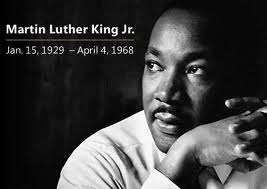
Thoreau’s model of civil disobedience, like Gandhi’s and Martin Luther King’s high-minded non-violence, were effective tactics of resistance that had real, tangible results.

So no, I am not advocating for civil war.  I don’t want to see it come to that.  I am, however, saying that we cannot afford to sit back and hope for the best, or wait and see, or let others worry about it.  We just don’t have that luxury anymore.

I look around me and see so many of my friends who are parents investing so much time, energy, thought and care in the raising of their children.  We worry over every test score, we make sure they eat their organic vegetables, we carefully shield them from violence and pain.

How can we be so focused on the local care of our children that we miss the big picture, which is that the world we will soon be sending them out into is in crisis? How can we not take it as part of our parental duty to do all we can to ensure that when our children grow up, their planet will be intact and able to support them?

On New Year’s Day I had a conversation with my son that keeps ringing in my ears this week.  He expressed his anger at previous generations (including me, of course) who have so degraded our environment that as he now looks out into his own future, he cannot be sure that he will have any chance of realizing his dreams.

We talked about possible future scenarios, including one that seems to be coming up in various conversations lately: conditions of scarcity leading to armed gangs marauding in the streets and taking whatever they can find.  “We would be fucked,” he said bitterly.  “We don’t even have a gun in the house!”

There it is again.  Would having a gun in the house make us any safer?  Isn’t the problem precisely that there are too many guns in too many houses?

And is it inevitable that conditions of scarcity would lead to violence? Maybe it’s likely, but are there steps we can take now to promote a different outcome?

Back to the importance of the local.  Strengthening local communities can head off a dog-eat-dog mentality.  We are all in this together.  Together, we created the present moment we now stand on; and together we will create the future.

What future do we want?  We all want abundance; peace; stability; security.  I don’t think anyone in the world would argue with those general goals.

We have the knowledge and the technology, right now, to achieve these goals, worldwide.

We do!  If we turned our best and brightest minds to the task, we could drastically reduce our carbon emissions within a decade, while still enjoying electricity and heat through solar, geothermal and wind.  We could drastically improve energy efficiency and get rid of our wasteful consumerist mindset.  We could stop making bombs and missiles, and instead refocus those trillions of dollars into education and social welfare, including intensive sustainability efforts on all fronts.

We could do this.  But again, we need that unstoppable groundswell of demand for change. Locally and globally.  NOW.


They don’t play nice. Should we?

So manifestoes are all very well, in the visionary department, but things get harder when you get down into the nitty-gritty of making transformative change happen.  I thought I might take some time this New Year’s season, 2012, to reflect more deeply on what it would mean to turn my dreams into reality.

Let’s start with the first point in my recently penned Manifesto for a Sustainable Future, which is:

1. Move from a top-down hierarchical system to a horizontal, egalitarian model of social relations based on inclusivity across all of the traditional boundaries used to keep different groups apart, and also opening up the possibility for cross-species collaboration based on respect and stewardship.

People have been talking about coalition across artificial differences between humans for a long, long time, and in some cases it has worked: for instance, the privileged white folks who believed in “equality, fraternity and liberty for all” played a huge role in freeing the enslaved Africans during the 19th century, and then a later generation of freedom-loving people from various heritages worked together again in the 1960s to extend the earlier gains through civil rights, women’s rights, decolonization, etc.

It’s not that hard to get people to agree in principle that all human beings deserve equal treatment before the law, or that children should have equal access to quality education, good food and health care.  The Universal Declaration of Human Rights is based on just such agreement.  The problem is that principles and declarations are one thing–like manifestoes–while actions on the ground are quite another.

In practice, we know full well that people of color, poor people and immigrants are not treated equally before the law in the U.S. We also know that there are millions of children in this country whose public schooling is inadequate, sometimes terribly so, and who do not have access to healthy food or good quality health care.

We know this, and yet we choose to ignore what we know.

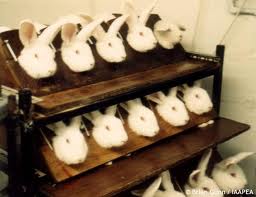
It’s the same thing with what is happening to animals in this country.  We know that scientific research, aka torture, is conducted on thousands, if not millions of defenseless animals every year.  We know that millions of pigs, cows and poultry are treated with total disregard for their well-being, as if they were machines being assembled for market, instead of living, sentient beings.  We know that millions of wild mammals, birds and marine life are relentlessly being pushed into extinction by the pitiless advances of human “civilization.”

We know this, but we choose to pretend we don’t know it.

Maybe that’s because if we really took this information in, the knowledge would be unbearable.  How could we live with ourselves, knowing that just by conforming to the status quo, we are responsible for so much suffering of others on this planet?

But we need to stop pretending and closing our eyes and turning away.

Because it is out of this deep knowledge of our connection with other living beings on this planet, and the inescapable awareness of the suffering we humans are causing, that a movement of solidarity, resistance and change will grow.

To bring up the term “movement” is to be clear that the kind of transformative change I’m envisioning could not possibly be the work of one person, or even a few people.  It has to be an unstoppable wave, demanding change and taking nothing less for an answer.

In the 19th century, the abolition movement ended up sparking a civil war in the United States.

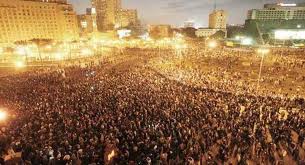
A second American civil war seems rather unthinkable to most of us now, even as we watch with amazement as regimes fall to enraged mobs all across the Middle East and North Africa.

In the US, free expression is tolerated far more widely than, say, in China, where journalists and bloggers are regularly beaten up and thrown in prison for daring to speak an unpopular truth.  The U.S. was shocked–shocked!–when the government called out the military and tanks began firing into the crowds at Tiananmen Square back in 1989.

But you have to wonder, watching the ruthless way city police are now trained to deal with street protests, how much it would take to provoke a similarly harsh response from our federal government.

What if there were a real movement of people united in their demands for “equality, liberty and justice for all,” as schoolchildren in the US are still trained to recite piously every morning, hands over hearts, when the Pledge of Allegiance is played over the PA system?

What if people got fed up enough with our bungling and corrupt national leaders, our deeply unfair and wildly overpriced medical system, the outrageous skewing of entitlements of all kinds to the wealthy, the militarization of our relations with other countries, the poisoning of our environment, the killing off of the natural world–fed up enough that we were willing to take to the streets and demand change, and not back down even when they brought out the tear gas, the tanks and the guns?

Then we might just have a Civil War II on our hands.  And like the first Civil War, it would be bloody, chaotic and uncertain in outcome.  But if the vision that guided it was sure and true, it might just lead to a whole new country arising out of the ashes of the old.

In this globalized age, such a civil war might easily turn into a global war, as the 99% the world over rose up against the tyranny of the rich corporate interests that are ruining the welfare of humans and the planet as a whole.

And here’s where I need to get back to the Manifesto, where I imagined a new social order based on a horizontal, inclusive, respectful, egalitarian model of social relations, with the welfare of the poor as important as the welfare of the rich; the welfare of the coral reef as valued as the welfare of the watershed feeding a city; the welfare of a livestock animal as important as the welfare of a cherished pet.

Not to say that everyone would necessarily be treated exactly the same–a cow wouldn’t want the same treatment as a dog, after all.  But whatever it takes to give a cow a comfortable, dignified life, should be undertaken.  Whatever it takes to give every child access to a high-quality education, should be done.  Decisions should be made in truly representative fashion, with no possibility of wealthy interests buying votes, no PAC lobbies or media manipulation allowed.

The devil is in the details in putting such a new world order in place, I know.  Many smart people maintain that human beings are irredeemably aggressive, competitive and greedy, and so we are incapable of creating such an ideal world.

But many other smart people say the opposite: that human beings are naturally empathic creatures, whose first instinct as infants is to love, not to hate.  Very few children are instinctively cruel to others.  The majority of us seem to be naturally good-natured, though easily swayed and corrupted by our social conditioning.

As Jeremy Rifkin has argued, “What is required now is nothing less than a leap to global empathic consciousness and in less than a generation if we are to resurrect the global economy and revitalize the biosphere. The question becomes this: what is the mechanism that allows empathic sensitivity to mature and consciousness to expand through history?”

Rifkin’s own answer to this question has to do with what he calls the “distributed Internet revolution,” which is “changing human consciousness” by “extending the central nervous system of billions of human beings and connecting the human race across time and space, allowing empathy to flourish on a global scale, for the first time in history.”

Rifkin envisions just the kind of transformation in social relations that I have also been dreaming of.  His description of a new human relation to what he calls our “biosphere” is worth quoting in full:

“The biosphere is the narrow band that extends some forty miles from the ocean floor to outer space where living creatures and the Earth’s geochemical processes interact to sustain each other. We are learning that the biosphere functions like an indivisible organism. It is the continuous symbiotic relationships between every living creature and between living creatures and the geochemical processes that ensure the survival of the planetary organism and the individual species that live within its biospheric envelope. If every human life, the species as a whole, and all other life-forms are entwined with one another and with the geochemistry of the planet in a rich and complex choreography that sustains life itself, then we are all dependent on and responsible for the health of the whole organism. Carrying out that responsibility means living out our individual lives in our neighborhoods and communities in ways that promote the general well-being of the larger biosphere within which we dwell.”

It would be nice if we could simply persuade the 1% corporate types of the necessity of this shift in human consciousness. But these people don’t play nice.

That’s why we dreamers who share this kind of transformative vision may have to toughen up, if we want to achieve our goals.

As Derrick Jensen keeps saying, how long will we wait until we realize that action is necessary to avoid annihilation?  It’s the birds, the bees and the bats who are dying now, but these creatures form the base of the pyramid on which current hierarchical human society rests.  If their populations crash, can ours be far behind?

Can we afford to wait and see?

A “Be the Change” Manifesto for the 21st Century

On New Year’s Day, 2012, I reaffirm my commitment to dedicate my talents and energies towards shifting our destructive global human society in a direction that values the ecological health of the entire web of life on Earth over the short-term gains of a minority of human beings.

I invite you to join me, and you would cheer me very much if you expressed your solidarity by responding to this post, if only with a “like.”

Manifesto for a Sustainable Future

Whereas human beings have acted in a dominating fashion towards each other and towards other living species on this planet, using the excuse of difference to justify aggressive and destructive behavior;

Whereas competition has been used as a rationale for economic systems based on hierarchical systems of power;

Whereas social exclusion and systematic discrimination has been seen as the normative right of dominant groups;

Whereas privileged groups have felt entitled to take more than their fair share from the environmental commons, and to deprive less powerful groups, whether human or of other species, of the resources necessary for well-being;

Whereas it is quickly becoming apparent, in the age of climate change, that the dominant paradigm of capitalist patriarchal social relations is resulting in the dangerous destabilization of the entire natural ecosystem;

The time has come to take action to change this paradigm in the following ways:

1. Move from a top-down hierarchical system to a horizontal, egalitarian model of social relations based on inclusivity across all of the traditional boundaries used to keep different groups apart, and also opening up the possibility for cross-species collaboration based on respect and stewardship;

2. Shift the worldwide economic system to a model of global cooperation and collaboration, with the focus of human industry and government on providing a baseline of well-being for all life forms on this planet, regardless of geographic origin or antiquated ideas of relative importance (ie, who is to say that a human being is more important than a songbird, or a sardine?);

3. Tailor the education system to teaching the history of the destructive cultural practices of homo sapiens up to the 21st century, and opening up constructive conversations across disciplines, where alternatives to these traditions can be envisioned and developed;

4. Model egalitarian, collaborative, respectful social relations in the private sphere of the family as well as the public spheres of education, the profession, government and law;

5. Shift from a violent conflict and punishment model of resolving disagreements to a peaceful persuasive model, with the goal always being the well-being of the community as a whole first, and secondly each member of it.

6. Destroy all weapons of mass destruction, as well as all bio and chemical weapons, and their blueprints.

7. Disallow any one person’s or minority group’s interests (with rich people and businesses or industries rightly being considered minorities)  to take precedence over the interests of the majority, including the non-human majority on this planet.

8. Develop an appropriate representative global governing council to administer these principles.

In the name of Mother Earth and ALL of her children, I call on the peoples of the world to act without delay to become the stewards of the planet and the collaborative, respectful individuals we were always meant to be.

Talking ’bout revolution on New Year’s Eve

New Year’s Eve puts some people in a rah-rah kind of mood, and others get pensive and reflective.  Although I’ve done my share of partying in the past, this year I’m feeling pretty subdued.

The rainy weather outside doesn’t help matters.  Yes, we’ve got a cold nasty rain going on this year in New England–not a snowflake in sight on December 31.

And it’s depressing to open my email inbox and find hordes of outstretched hands from excellent NGOs, begging for last-minute donations.

As someone who has often been in the position of asking for donations to fund various initiatives I’ve worked on, I know that these end-of-year gifts can literally make or break a small organization.  They’re the lifeblood that keeps so many worthy causes alive.

Of course, we all know that if we give to these organizations we can write down our taxable income and give less to the federal government, and many people take satisfaction in being able to direct their giving, instead of sending it into the amorphous federal pool to be redistributed according to the whim of our so-called representatives in Congress.

So why am I resisting giving this year?

I am just irritated with the system that starves worthy social and environmental causes while lavishly feeding the maw of the military industrial complex.

I am irritated that the Democratic Party keeps asking me for small donations of $15 or $25, sums that actually matter to me, sad to say–while at the same time courting the big corporate interests whose millions of campaign spending will control the election.

I am irritated that no matter how much each of us gives, it’s never enough to solve the problems that face us.

And I’m beginning to think that money is not the answer.

It’s such a revolutionary thought, and yet once out of the box it seems so clear.

Just as giving a dollar to a beggar on the street may help that poor guy get through one more night, but does nothing to solve the bigger problems that landed him on the street in the first place, throwing money at the dozens of worthy charities that are hunting us all down today is simply not going to effect the kind of deep systemic change our society and our world needs.

It’s not about money.

Yes, it’s true that corporate money has corrupted our political system.  But just as fighting violence with more violence only escalates the conflict, trying to fight big money with more money will accomplish nothing because we’re still allowing the guys with the deep pockets to set the agenda.  We’re being reactionary, and our thinking, along with our dollars, stay inside the established sociopolitical framework.

In the coming year, we need to quiet down the ambient noise in our minds–the shouting, the screams, the piteous begging, the brash hawking of wares, the political sloganeering–and do some deep thinking about the ways in which we have been limited by the system we grew up in.

It’s time to re-establish our priorities, as individuals, as a nation, and as a global society.  Throwing good money after bad accomplishes nothing when the values that drive the system are warped and destructive.  We’ve got to go deeper in our approach to change.

Yes, I’m talking about revolution this New Year’s Eve.  Not reform.  I’m talking about going all the way, because we’re at an economic and ecological breaking point now.

We have little to lose, and so much to gain by decisive action.  Think about it.