Occupy the Climate Talks in Durban–Virtually

If you lived on a small island nation that was losing precious feet of shoreline every year due to rising seas and storm erosion, you might be forgiven for having high expectations for the current international climate change negotiations going on in Durban, SA.

In the the heart of the developed world, meanwhile, you’d have a hard time finding any news about the climate talks.  You have to search the Web pretty carefully to even find a mention.

That goes to show how it’s all about location, location, location.

I learned yesterday, by careful Web search, that Canada is planning to pull out of the Kyoto treaty, just like the U.S.

Canadians want developing countries like China and India to also agree to reduced emissions.

But meanwhile, Canada’s government is pushing the extraction of oil from the Alberta boreal forests.

As Tom Zeller of the Huffington Post reports,””What’s astonishing is watching Canada emerge as a rogue among developed countries,” said Bill McKibben, the author and activist who has spearheaded a grassroots movement aimed at combatting a pipeline proposal designed to deliver some 700,000 barrels of oil each day from the tar sands to refineries and ports on the Texas Gulf Coast. “Of course, they have no choice but to ditch serious climate policy if they want to develop the tar sands in a big way — and that pool of gunky oil is clearly the tail wagging the dog up there.”

We’re all the dog that’s being wagged by powerful oil extraction companies.  If we don’t watch out, we’re going to be wagged right into extinction.

Notice how the climate talks are always held in inaccessible places where it’s hard for activists to congregate.  Who can afford a ticket to Durban, SA?

But now, with the World Wide Web, we can all hold ring seats to the climate talks, and we need to make our voices heard.

Read the Climate Connections blog, produced in Durban by the Global Justice Ecology Project, for up-to-the-minute information about what’s going on in Durban.

Check out the results of the General Assembly held there today under the Occupy Durban banner: #OccupyCop17

The climate talks may be far away, but they are one of the most crucial sites for “occupation” as we move into the 21st century.  We can’t let the big oil companies, with their deep pockets created from our dependence on an oil-based economy, dominate the agenda.

If you care about leaving a healthy planet to the next generation, the time to speak up is NOW.

Occupying the Climate Talks & College Campuses–Full Speed Ahead!

Could be an interesting day today.  Word has it that the less-developed nations are threatening to “occupy” the climate talks at Durban if the big polluters–that’s us, America, and you too, Europe and China–won’t get serious about limiting emissions and working for systemic change.

Meanwhile, a student movement begun at UC Davis is calling for a General Strike today–no classes, no work–to create a space for student-run General Assemblies to discuss issues like police violence against peaceful protesters, as well as sky-rocketing tuition and debt-funded education that is putting college out of reach for more and more Americans.

I continue to be amazed at the speed with which awareness now spreads, thanks to how many of us are now plugged into what is coming to seem more and more like a collective brain.

Could the collective consciousness represented by the World Wide Web be an evolutionary leap forward?  Or could it at least be speeding up our evolutionary progression as a species?

Of course, it’s all dependent on electricity.  If the lights go out, our collective brain goes dead.

Or maybe not?  The General Assemblies, with their human microphones and patient face-to-face discussions give me hope that the new connections that are being forged in this time of transition are real and could stand alone, without the crutch of the Web.

In fact, maybe that’s what this is all about.  Building the human connections, virtual and real, to withstand the great shocks that are coming our way as the climate shifts and the Earth seeks to return to a steady state.

In Durban, South Africa and on college campuses and public parks across the country, people are turning out to be the change we want to see.

It’s an exciting time to be alive.


Ripples of change, from kitchen tables to public parks

This morning, in my parents’ house, a scene took place that underscored for me the extent to which the Occupy movement has entered the collective consciousness.

The man who has taken care of my parents’ property for the past 30 years or so had come by to say hello, and was standing in the kitchen complaining about how the oil companies are making billions while the price of fuel oil and gasoline goes ever higher for ordinary consumers.

He is a lifelong Republican, but voted for Obama in the last presidential election, having had enough of the Bush crowd with their lies and their wars.

Listening to his critique of the mega-oil companies, my mother turned to him and said teasingly, “So who should we occupy now?”

We all laughed and the conversation moved on, but there is an underlying element of seriousness there that amazes me when I think about it.

A few months ago, we might have complained, but without any thought of actually doing something to bring about change.

Now, suddenly, options are open to us.  We could go down and occupy the local gas station with some homemade signs, and probably get a lot of support from people filling their tanks.

Yes, we all do fill our tanks.  But instead of holding the resentment inside, there is now an outlet for it, a way to talk about it together that is not about the two parties and their endless childish jockeying for power, but about something deeper: the longing for and the pull to real change.

I have to admit I was disappointed that apparently Black Friday consumer shopping was more vigorous than ever this year. But it’s surely no accident that fights broke out at WalMarts across the country, where people who have precious few dollars to spend on their holiday shopping turned out on Black Friday to try to get some bargains.

What’s fascinating, and under-reported, is that on Black Friday, thousands of Chinese factory workers went out on strike to demand living wages and job security.  These are the workers who are supplying the products being sold as “bargains” in America, mostly to workers whose jobs have been outsourced–to China!

Marx’s dream of an international uprising of the proletariat has never been more possible, thanks to be magic of the internet.

And somehow the barriers between American consumers and Chinese producers–or between professional-class employers like my parents and blue collar workers like their property caretaker–are coming down.

There seems to be a new zeitgeist stirring the stagnant air of American social relations.  Is it the age of Aquarius?  The alignment of the planets?  The infamous Mayan 2012?

Whatever it is, let’s seize the moment and make the most of it.  Let’s talk up a storm, sharing ideas and encouragement with everyone we meet.

If a butterfly in Brazil can cause a hurricane in Texas, then maybe a casual conversation in your kitchen can be the catalyst for a change that will sweep the nation, and the world.  It’s certainly worth a try.

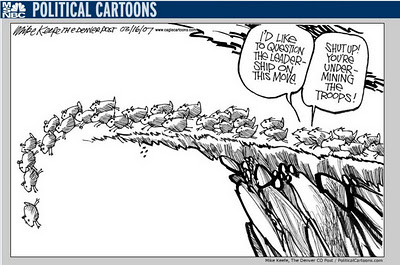
Human beings are not lemmings–so let’s get organized and get away from that cliff!

This happens to be my 100th post on Transition Times, and to mark the occasion I want to reflect on where I’ve come with this blog project, and what themes have emerged along the way.

When I started Transition Times, back in mid-July, I was away in Nova Scotia, trying not to think about the crazy shenanigans going on back home, where the Republicans were threatening to shut down the U.S. government and destroy our credit rating in the world, rather than negotiate reasonably towards consensus with the Democrats (otherwise known as “the debt-ceiling crisis”).

I was also reading Mark Hertsgaard’s Hot: Living Through the Next Fifty Years On Earth, along with Bill McKibben’s Eaarth: Making a Life on a Tough New Planet, both of which paint a stark portrait of how the climate change crisis will be affecting our lives in the foreseeable future.

All in all, I was in a pretty gloomy state of mind.

But then surprising things started to happen.

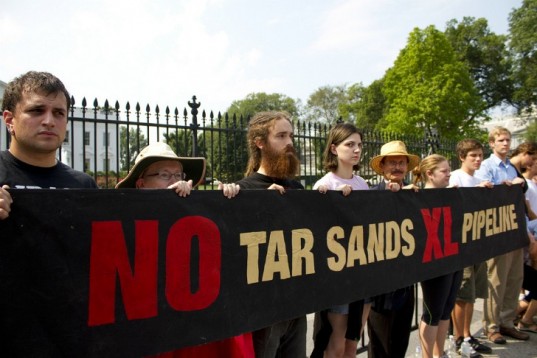
In the middle of the dog days of August, Bill McKibben and 350.org began a sit-in next to the White House, protesting the Keystone XL Pipeline and the development of the boreal forests of Alberta (otherwise known as “the tar sands”).

A month later, the Occupy Wall Street movement sprang up seemingly out of nowhere, protesting the government’s collusion with the super-wealthy (otherwise known as “the 1%”) and abandonment of ordinary Americans (otherwise known as “the 99%”).

The Occupy movement spread like wildfire, and the Keystone XL protest succeeded in at least postponing the pipeline and American support of Alberta tar sands extraction, giving the nascent climate change movement a boost and more of a chance to grow.

Along the way a historic hurricane ripped across the Eastern Seaboard, and a freak snowstorm dumped a good two feet of heavy wet snow on leafy trees in southern New England, knocking out power for some folks for days, and even weeks, and reinforcing the unavoidable reality of climate change.

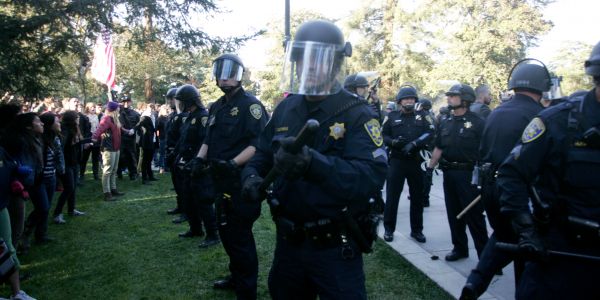
Most recently, public awareness of the militarization of American policing has suddenly taken a giant leap forward, thanks to images of police brutality inflicted on old and young white people of the well-dressed, college-educated variety.  Over in Europe, the debt crisis threatens the dissolution of the euro zone, something unthinkable just a few months ago.

All in all, it’s been a dramatic few months, and blogging my reactions to and thoughts about all this has been a rewarding experience.

I’ve been struck by the power of the World Wide Web as a vehicle for social communication and movement-building.  Just as the Arab Spring showed us how cell phone texting technology could be used to ignite and build, at lightening speed, an effective resistance movement, the Occupy movement has demonstrated the extent to which Americans are plugged into the vast collective consciousness we call the Web.

While the captains of industry sold us smart phones and tablet computers intending to make us more agile shoppers and financial traders, they unwittingly put into our hands the tools of our liberation from the capitalist machine that has dominated us for the past 50 years or so.

Marx predicted long ago that the very instruments that enabled capitalism–globalization and technological prowess–would also be the instruments with which the bourgeoisie would dig their own graves.

In the age of global warming and climate change, this has never seemed more prescient.

But Marx also imagined that out of the ashes of the old world a new order would arise.  He believed that it would be possible for the proletariat, the working class, to create a better world, based on collaboration and compassion rather than ruthless competition.

It seems like Americans are finally awakening out of a long, dark sleep of obliviousness to the ways in which our corporate capitalist economic and governmental system has been leading us down a blind alley, at the end of which, it turns out, is a steep cliff.

Are we waking up in time to back ourselves out of that alley, away from that fearsome cliff?

It is too soon to tell. But those of us who are aware of the gravity of the situation today not just for our society, but for our species and the planet as a whole, need to be out there on the frontlines, both physical and virtual, making the connections that may enable us to successfully build a movement for change and avert disaster.

Human beings are not lemmings, but we are indeed susceptible to being led.  We want to believe that our leaders are competent and have our best interests at heart.  We hold on to this belief even when all evidence points to the contrary.

It’s time now to stop putting our faith in our elected officials and their paid enforcers, and listen instead to our own hearts and minds.  We know what needs to be done to bring the ecological web of life on this planet back into balance.  It is time to reach out to each other and find the determination to get the job done.

This Thanksgiving, Imagine Another World…

The idea of Occupying the Malls on Black Friday, which I first posted about here, is gaining momentum day by day.

Occupy Seattle and other Occupations in various cities will be protesting WalMart this Friday, and I have a feeling that between now and Nov. 25, Black Friday, the idea will continue to gain traction.

The movement is not just protesting against what it objects to (in this case, excessive consumerism); it’s also offering positive alternatives, like the massive Occupy Thanksgiving that will take place in Liberty Square tomorrow, offering free Thanksgiving meals to all comers.

On Thanksgiving, it’s traditional for the privileged to donate food to the needy, so that they can celebrate this foodie holiday too.

This Thanksgiving we need to be thinking about more than turkey, stuffing and cranberry sauce, and simply extending charity is not going to make the grade.

We should be asking why it is that some people have so much, and others nothing at all.  It’s not about laziness or inherent intelligence, as some social analysts have tried to suggest.  It’s about a society in which the playing field is sharply tilted from the beginning in the favor of those who already have certain characteristics.

People who are tall, thin, fair-skinned, attractive, Judeo-Christian, male and born into educated families are far more likely to succeed in America than anyone else (with attractive white women a close second).

For these privileged people, extending charity on Thanksgiving or Christmas may make make them feel better about themselves, but it does nothing to change the circumstances for those born on the other side of the playing field–the other side of the tracks.

In 2010, 46.9 million people were in poverty, up from 37.3 million in 2007 — the fourth consecutive annual increase in the number of people in poverty .  This is the largest number in the 52 years for which poverty rates have been published (USDA Economic Research Service, 2011). 

In 2010, 17.2 million households, 14.5 percent of households (approximately one in seven), were food insecure, the highest number ever recorded in the United States (US Census, 2010). 

These numbers are unconscionable for the wealthiest nation on earth.

We’re often reminded that the U.S. spends more on its military than the next FOURTEEN military powers combined–seven times more than China, the nearest competitor.

Imagine if even a portion of those billions of dollars being spent on bombs, mines, drones, fighter planes and tanks were redirected to civil society.

Imagine if we thought not in terms of charity and “food aid” but restructuring social systems so as to stitch together a global safety net.

Imagine if the U.S. really got behind the United Nations Millennium Development Goals, announced in 2000, calling for an end to world poverty by 2015.

This Thanksgiving, let’s usher in a new era, in which competition and consumerism give way to collaboration and a focus on using the wealth of our nation–and our planet–for positive, life-enhancing purposes.

Whether we occupy the malls this holiday season or serve soup in a food kitchen, we should be thinking seriously about how to reshape our society to bring our national spending in line with our ideals.

Occupy Democracy! Reich is listening….


Is Anybody Listening?

Just curious: why is it that today’s NY Times front page features social protest in Egypt, Yemen and Hamas, but nothing about California?

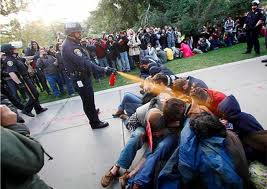
Way below the digital “fold,” in small print, there’s a piece with the bland headline “From Crowd Control to Mocking Images,” but it’s more about pepper spray itself than about the serious issues raised by the UC Davis incident.

The opinion pages are similarly focused on Egypt and Israel–nothing on the Occupy movement.

Somehow it reminds me of the classic situation where a kid is trying to get her parents’ attention, and Dad is buried behind his newspaper, Mom is talking away on the phone, and NOBODY IS LISTENING!

What does that kid have to do to get the adults’ attention?

Something outrageous. And even then, the focus will most likely be more on returning things to the status quo as fast as possible, rather than on talking through the issues deeply and seriously considering change.

That seems to be the posture of the UC system officials, who are in the current hot seat of the Occupy movement.  They want this whole mess to just go away, so that students will return to their classrooms and dorm rooms and keep paying their ever-higher tuition to earn degrees for jobs that don’t exist.

Things turned violent in the Middle East when people had enough of leaders who refused to listen.  There, soldiers and tanks were called in against civilians.  Here, we have armed riot police called in against students who were doing nothing more challenging than sitting cross-legged in a quad.

 Imagine what could happen here if protesters stopped being so polite and nonviolent and began demanding attention in a no-nonsense way.

How far would our leaders–from university chancellors to mayors to governors and the politicians in Washington DC–go in choosing to repress and stifle dissent rather than listening and engaging in thoughtful dialogue about the best way forward for all?

A couple of decades ago, when people took to the streets to protest working conditions and lack of freedom in Latin America, the U.S. demonized “the Communists” and sent military aid to the dictators to maintain order in the banana republics.  The civil wars there claimed hundreds of thousands of lives.

It is impossible to blame “the Communists” this time, and the unrest is not far away in some other country, it’s right here in our own heartland.

It’s our own sons and daughters who are feeling the crack of the police baton, the burn of the chemical sprays.

What are we going to do about it?

First of all, we’d better start listening.

Shades of Kent State?

Coast to coast, the Occupy movement is shaking things up, demanding engagement and accountability from those in power.

A contingent of Occupy Wall Streeters arrived in Washington DC today, with plans to set up a “temporary occupation” in front of Capitol Hill and “discuss the failure of the U.S. Government to be accountable to its people.”

In California, a huge General Assembly at UC Davis–the site of the criminal attack on students by a police officer–has called for a general strike on all of the University of California campuses in order to “reclaim the UC” from its corporate Board of Regents.

According to the strike motion:

“The continued destruction of higher education in California, and the repressive forms of police violence that sustain it, cannot be viewed apart from larger economic and political systems that concentrate wealth and political power in the hands of the few.

“Since the university has long served as one of the few means of social mobility and for the proliferation of knowledge critical to and outside of existing structures of power, the vital role it plays as one of the few truly public resources is beyond question.”

Interestingly, a prominent tenured UC Davis professor, Cynthia Carter Ching, has chosen to stand with the students against the administration, blaming “the people running this campus” for thinking of students as “data points and dollar signs, rather than as whole human beings.”  Had the administrators seen the students as human beings, she says, they would never “have called in armed riot police to deal with a peaceful protest, tents or no tents.”

Professor Ching also blames the faculty of UC Davis for being “too busy” with teaching and research to pay much attention to how the university as a whole was being run.

“You know, it wasn’t malicious,” she says. “We thought it would be fine, better even. We’d handle the teaching and the research, and we’d have administrators in charge of administrative things. But it’s not fine. It’s so completely not fine. There’s a sickening sort of clarity that comes from seeing, on the chemically burned faces of our students, how obviously it’s not fine.

“So, to all of you, my students, I’m so sorry. I’m sorry we didn’t protect you. And I’m sorry we left the wrong people in charge.

“And to my colleagues, I ask you, no, I implore you, to join with me in rolling up our sleeves, gritting our teeth, and getting back to the business of running this place the way it ought to be run. Because while our students have been bravely chanting for a while now that it’s their university (and they’re right), it’s also ours. It’s our university. And as such, let’s make sure that the inhuman brutality that occurred on this campus last Friday can never happen again. Not to our students. And not at our university.”

It should surprise no one that the students in the UC system are unwilling to entrust their welfare to the “busy busy” faculty or the stone-faced administrators.
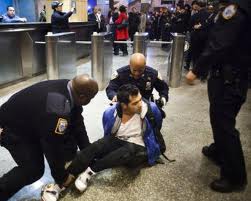
And it’s not just the University of California.  There were arrests at Baruch College in New York today, and an open letter from a Yale philosophy professor has gone viral on the Web, with over 1,200 faculty signatories calling on university and college presidents to enforce “campus safe zones” for student protest.

It seems to me that the spirits of the four students killed by police at the Kent State protests a generation ago, back in 1970, are hovering over us these days.

Could it happen again?

Yes, in a heartbeat.  If anything police training has only gotten tougher in the new millennium, with less and less tolerance for any public “disorder.”

Those of us who work with college students know that if they have gone out into the quads and commons to protest, it is because there are very serious issues afoot that must be addressed now.

Generally speaking, college students would much rather be focusing on either their studies or their parties.

If they are participating in general assemblies and sit-ins, it is because the system in which they were raised, and in which they expected to find comfortable berths, has been shredded to the point where they can clearly see the gaping holes in the framework.

No longer can students expect to find jobs that will help them dutifully pay off their exorbitant student loans.  Can we blame them for glaring balefully at the administrators and politicians running the show, and asking angrily, “So what is it all for?”

The sad truth is that California now spends more on its prisons than on its universities, despite the fact that crime rates have fallen steadily since the 1990s.

As Juan Cole puts it in his excellent Truthdig column today,”the defunding of higher education in favor of an enormous gulag dovetails with a rise in the paramilitary repression of the population as one of America’s premier industries.

“Not only are UC Davis students being hit with massive tuition increases to pay for the penitentiaries and their policing, they are also being treated like unruly inmates by a militarizing police force.”

This is not the America we want to be, or to become.  It is time to stand with the Occupy movement and demand the demilitarization of our society, and the redirecting of resources towards education, innovation, creativity and social well-being.

The students are leading the way.  We older folk, who bear the responsibility for the current national and international crisis, must break the dark spell of conformity and accompany  them.  Now.

Violence against peaceful protesters–a federal crime?

So far I have not been able to get past the still image of the latest shocking example of police violence inflicted on unresisting young people.

I don’t need to watch the students begin to writhe and cry out in pain, I don’t have to hear the gasps of the onlookers or the shouts of the cops as the situation shifts suddenly from quiet resistance to chaotic disarray.  My imagination can set it all in motion, without the aid of video.

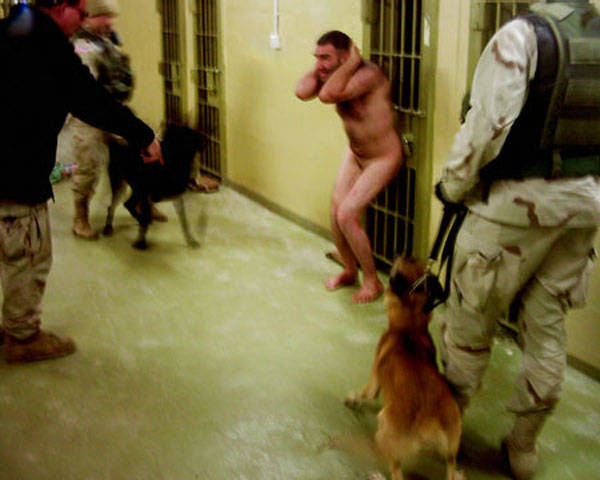
But the video was shot, and is now making its viral way around the Web, just like those shocking images, from not very long ago, of the abused prisoners in Abu Ghraib.

There too, what was striking was the imbalance of power–the heavily armed and aggressively clothed military police, against unarmed, and, in the case of Abu Ghraib, naked civilians, whose only crime, in most cases, was being in the wrong place at the wrong time.

At both UC Davis and Abu Ghraib, the victims may have lacked firepower, but they have something even more potent on their side: the moral outrage of the onlookers.  Once those moments of violation are caught on film and sent out into cyberspace, it doesn’t take long for public opinion to rise up against such an obvious abuse of power.

I am always curious, in a morbid sort of way, about the mentality of the perpetrators of this kind of violence.  Are they the grown-up version of the 7th grade bully, who takes pleasure in making other kids squirm?  Has their capacity for empathy been dulled or extinguished?  Are they simply sick, psychopathic sadists?

If any of these are the case, how could we have entrusted the crucial job of maintaining social order–otherwise known as policing–to such people?

The same old boys’ club that protected Jerry Sandusky and the Catholic priest pedophiles all those years is a strong force in the military and the police forces.  But at some point an individual will push things too far, and the club will no longer be able to protect him.  Thus Charles Graner, the mastermind behind the Abu Ghraib abuses, was eventually thrown in prison himself, and the officer who took it upon himself to casually pepper-spray those innocent UC Davis students has been suspended.

Nobody in the U.S. wants to see an eruption here of the kind of civil violence that overtook Egypt, Yemen, Libya, and so many other countries where civilians have been pitted against police or soldiers deployed by government officials who cared more about their own power than about the rights of their citizens.

Here in the U.S., we simply want to be able to exercise our constitutional right to peaceably gather in public places to express our political views.

Any city, state or federal government official who inflicts violence on such a peaceful gathering is guilty not only of a serious human rights violation, but also of violating the U.S. Constitution.

Last time I looked, this was a federal crime.

Dispatch from Washington DC: On History and the Human Spirit

In Washington DC this weekend, I couldn’t help but be impressed by the majesty and wealth of the buildings and institutions spread out grandly in the heart of the city.

The many museums of the Smithsonian, all of which are free, boast what must be the best-displayed, best-run, most impressive set of collections to be found in such concentrations anywhere.  They are a reminder of what American wealth and ingenuity can accomplish, when tax dollars are put to good use!

But there is a darker side on display in the museums too, which links back to the political establishment and the way the reality of this country has never quite lived up to our ideals.

At the Museum of Natural History there is a remarkable exhibit, funded by David Koch no less, on the origins of the human species.  The scale of human evolution is made quite clear: our ancestry reaches back millions of years, but homo sapiens as we know ourselves today is a young species, a mere footnote to the huge sweep of terrestrial mammalian existence.

In that very short period of time, we have managed to wipe out millions of other species, many of them also present the museum in stuffed form, or as skeletons, or—in the case of the butterfly and insect exhibit—as specimens locked behind glass.

Most of that destruction occurred since the 1950s, when the American corporate capitalist assault began in earnest, with chemical warfare-style agriculture, the razing of the forests, the strip mines, and the suburban sprawl.

The Museum of American History tells more of this sad story, albeit inadvertently, in an unspoken subtext.  The transportation exhibit is the biggest and best I’ve ever seen, but makes no mention of how the invention of the combustion engine paved the way for human destruction of wildlife and wild lands on a vast and unprecedented scale.

The huge exhibit on the military history of the United States, from the American Revolution to Afghanistan, brilliantly illustrates the military development of the country, from our start as “rebels” fighting against heavy taxation by the King, through the trench warfare of World War I, the ignoble nuclear bombing of Hiroshima and Nagasaki, to Vietnam and beyond.

The exhibits are lavish and beautifully curated, but the untold story is the staggering waste of human life, treasure and creativity, drawn to the service of Thanatos, Freud’s famous “death instinct.”

The American Indian Museum, built like a sandstone mesa with its prow defiantly facing the U.S. Capitol, reminds us that the human spirit has many facets, and it’s hard to keep Eros down.

From the ashes of near annihilation by savage Euramerican military forces, as well as the ravages of disease and cultural tyranny, the native tribes of North America built this beautiful museum as a testament to the resilience and creativity of their peoples, as well as their South American brethren, who are also represented at the museum.

This is no monument to vanished cultures, but rather a tribute to peoples who have survived, proud and independent and eager to tell their stories and preserve their cultures for the future.

In Washington DC I found much to be proud of, and also many reminders of the shamefulness of our history over the past 235 years of our official existence as a nation.

Time is a funny thing—it certainly seems like history has been speeding up in the past 50 years, as our technological innovations continue to connect, concentrate and expand our collective knowledge base at an exponential rate.

What happens between now and November 2012, the next Presidential election, could have the power to radically change the course of history yet again.  The key seems to lie in those restive crowds turning out in ever larger droves under the Occupy banners.

Will we be creative and innovative enough as a people to reinvent ourselves as a nation truly dedicated to life, liberty and the pursuit of happiness—not just for the 1%, and not just for human beings, but for all the magnificent living beings, flora and fauna, with whom we have shared this planet since we all first emerged out of the frozen wastelands of the Holocene thousands of years ago?