Barefoot and pregnant in the kitchen? Hell no!

Parsing the memes dealing with women in this election season is almost dizzying.

From “binders full of women” to the insinuation that if women get pregnant from a rape, it’s “something that God intended,” Republicans seem determined to put their feet their mouths over and over again.

There are signs now that women are getting the message, and getting more politically active as a result.

Yesterday I received the new Lesley Gore video, “You Don’t Own Me,” from several sources; if you have’t seen it yet, it’s worth a look: it’s a composite of many different women (most of them young) telling the politicians to get their f**king hands off our bodies (emphasis mine).

The specter of Roe v. Wade being reversed has a lot of women frightened.

We seem to be heading eerily towards the scenario imagined by Margaret Atwood some thirty years ago in The Handmaid’s Tale: a nightmare landscape of environmental devastation and societal breakdown, where the elite, safe in their gated communities, feel righteously justified in considering forced childbearing the only function of fertile young women.

I am still trying to wrap my head around the reality of the fact that we live in a country where Viagra is fully covered by insurance, but contraception often is not.

We live in a world where powerful men can get away with assaulting women and boys repeatedly, with the collusion of those around them. Sandusky and DSK, I’m looking at YOU—but these just the most scandalous recent cases, there are so many more in their club.

And if we move over to the virtual world, the violence against women’s bodies grows exponentially.  People always tell me that there’s all kinds of porn out there, from the soft & cuddly to the whips and chains, but from what I know, there are an awful lot of men jerking off to women’s pain.

I really don’t like calling men out like this.  I believe that many–probably most—men are fine upstanding citizens who would never hurt a woman.

But the truth is that we women need all those fine upstanding men to stand up for us now.

I was shocked at the statistics released last week showing that if only men voted in the Presidential election, Romney would win.

That means that an awful lot men support the kind of patriarchal social structure Romney indisputably stands for.

When is the last time you heard of a Mormon woman running a big company, or holding political office, or doing much of anything outside of doing the admittedly fulltime work of raising a big brood of children?

And then there’s the other half of the ticket, Paul Ryan—a Roman Catholic who seems to be Scrooge re-issued in a virile young package.

These two are the front men for a huge back-to-the-future wave of religious conservatism that employs much more subtle means than the Islamic Brotherhood, but with the same ends: to uphold male privilege and keep women securely ensconced in the private sphere.

A Romney might take a look at those “binders of women,” but in the end he’ll choose a nice young white man as the “most qualified” of the lot.

A Ryan might approve of a married woman leaving the home to earn some extra bread for her husband’s table, but if her daughter was raped while mom was out and got pregnant, too bad—suck it up, have the child, life goes on, and it’s just too bad that rapists are so rarely punished.  After all, boys will be boys, and girls ask for it.

If all American women voted in this election, President Obama would win by a landslide.

Obama has been good to women where it counts: he’s drastically improved health care and fought off the insurance dragons who want to label even pregnancy a “re-existing condition”; he’s stood up for women’s ownership of our reproductive health; the stimulus he put into place in his first year has kept our economy limping along,despite the repeated and concerted efforts of Republican Congressmen to sabotage it; and his government showcases a number of powerful, strong women who provide excellent leadership models for all Americans.

Shortly after he was sworn in as President of the United States, Barack Obama wrote a public letter to his two daughters, Malia and Sasha, in which he says:

“These are the things I want for you—to grow up in a world with no limits on your dreams and no achievements beyond your reach, and to grow into compassionate, committed women who will help build that world. And I want every child to have the same chances to learn and dream and grow and thrive that you girls have. That’s why I’ve taken our family on this great adventure.”

The historic election of the nation’s first African American President represented a giant step forward for this country.  A racial barrier that had seemed insurmountable fell, just as suddenly as the Berlin Wall fell two decades ago, ending what had seemed to be an everlasting Cold War.

We need the gender barriers to fall too. I know there are young women in the political pipeline today who have the dream of breaking through all the glass ceilings and reaching the sky, and we should be doing all we can to support them.

Today, what we need to do is prevent the takeover of this nation by rightwing religious conservatives.  We need to vote President Obama back into office.

And then we need to keep going, to make this a nation where all our children—no matter their gender, their race, their class, their religion or their ethnicity—can soar.

Surmounting the challenges facing us not just as a country, but as a planet, will take every ounce of creative, innovation and intelligence we can muster.

We need all our children to turn their minds to this task.  We can’t afford to leave half the population—our women—barefoot and pregnant in the kitchen.
Love in the end times

The political horserace in American politics has begun, with both Presidential candidates running full-tilt but ponderously towards each other like armored knights on horseback, wielding the lances of millions of dollars’ worth of attack ads and backed up by slick, smart campaign pages.

Meanwhile, it continues to be hot, hotter and unbearably hot here in the Northeast.  It was a blessing to wake up this morning to a brief soaking rain, breaking weeks of drought.

But there is no way to fool myself into hoping that things will go back to normal, weather-wise.

As many people have been saying lately, this is the new normal.

Just as we’ve gotten used to a political climate in which it’s normal for a Presidential candidate to hide his tax returns, refuse to comment on moving his millions into off-shore tax havens, and totally repudiate everything he once stood for in order to lick the shoes of his political bosses, we’re going to have to get used to a climate that lurches from one extreme to another–from blizzards to heat waves, from floods to droughts.

Those extremes also characterize the new economic normal.  These days, I’m having trouble convincing myself that the global economy that has been built up over my lifetime, since the end of World War II, is ever going to be able to function in such a way as to provide security and prosperity for the majority of the world’s people.

Maybe it never did.  There has always been a vast underclass of the disenfranchised, for whom globalization was just another name for displacement, oppression and exploitation.

The difference is that now we’re seeing a huge spike in the ranks of the poor right in the heart of what used to be called the First World—right in our backyards.

For a middle-class earner like me, it is getting harder and harder to make ends meet, and there are no substantial raises or bonuses in sight.

For the millions who are unemployed or under-employed or scraping by with under-the-table jobs in the informal economy, this new normal has got a distinctly  Dust Bowl feel to it.

Jill Stein and Cheri Honkala

The Occupy encampments have faded away, victims perhaps of effective police surveillance, infiltration and undermining.  The only Presidential candidate who has any new ideas to offer about improving the economy is the one we never see or hear on prime time, Green Party candidate Jill Stein, along with her running mate Cheri Honkala.

Most people aren’t saying much about the panic that runs like a live wire through their interior lives.

We are trying to enjoy this hot summer in the usual ways: going to the beach, having barbecues with friends and family, taking in a nice air-conditioned movie now and then.

But every once in a while a voice will break through our heat-addled stupor, crying to us to Wake up, wake up, before it’s too late!!

So, for example, we hear marine scientist Roger Bradbury shouting out from the Opinion Pages of the New York Times today, telling us to pay attention now, in these crucial last years before the planet’s entire coral reef ecosystem collapses, setting off a chain reaction of events that may very well include the starvation of millions of people, particularly in the tropics, who depend on the ocean for food.

Bleached coral

“Overfishing, ocean acidification and pollution are pushing coral reefs into oblivion,” Bradbury says. “What we will be left with is an algal-dominated hard ocean bottom, as the remains of the limestone reefs slowly break up, with lots of microbial life soaking up the sun’s energy by photosynthesis, few fish but lots of jellyfish grazing on the microbes. It will be slimy and look a lot like the ecosystems of the Precambrian era, which ended more than 500 million years ago and well before fish evolved.”

Bradbury advocates “an enormous reallocation of research, government and environmental effort” towards the “ecological engineering” necessary “to make the economic structural adjustment that communities and industries that depend on coral reefs urgently need.”

Even though Bradbury aims to be pragmatic and forward-thinking with his wake-up call, I still wonder if he’s living in a dream world.

Governments and the United Nations can’t even agree on basic protocols to begin to cut carbon emissions and pump up our renewable energy industries.  They don’t appear to give a damn about the hundreds of millions of poor, hand-to-mouth folk who are already being hard hit by climate change pressures, and they are not even willing to act when it comes to trying to assure the safe passage of the elites into the Anthropocene, air conditioners and all.

What should we be doing in these end times?  Where should we be putting our energies?

Not in the political side show of the Presidential race.

Not in the mindless distractions of our media-saturated cultural environment.

No, I believe we need to do two things above all as the world warms and our precious days of “normal” existence come to a close.

One: stay close to friends and family; strengthen the bonds of community.  We will be needing each other more than ever in the times ahead.

Two: Try to stay in the present moment as much as possible.  We humans are very good at casting our minds forward into the future, but in this case, the scenarios are only going to be pushing our panic buttons.  It’s important to stay calm and focused.

Tend the parts of the earth you can reach.  Keep your love flowing.

Help Wanted: Strong Leadership on Climate Change, Starting Immediately

Now if only President Obama could show the same leadership on climate change as he has just demonstrated on the divisive same- sex-marriage issue.

The same narrow-minded interests that made same-sex marriage such a boogeyman for the President are also controlling the GOP-dominated boardrooms of Big Oil, from Mr. Cheney on down.

These people seem to be motivated by one thing only: the bottom line.  And they seem to be able to think only as far as a quarter or two ahead.

They don’t see that they are driving us as fast as possible over a cliff from which there will be no recovery.  Or maybe they see, but just don’t care.

It was with great appreciation that I opened up The New York Times Opinion pages today and saw the indefatigable James Hansen offering the lead op-ed, once more displaying his vision and leadership in 1) insisting that the comfortable NYT readers pay attention to the imminent and grave threat of climate change, and 2) offering a practical solution for bringing about the swift change of course we need to avert disaster.

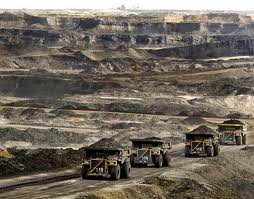
Those of us who have been thrown into gloom by the prospect of Canada scraping down the boreal forest to exploit their tar sands will be somewhat heartened by the strong language Hansen uses to condemn this approach to “solving” the peak oil crisis.

Alberta, Canada: from boreal forest to tar sand devastation

“Canada’s tar sands, deposits of sand saturated with bitumen, contain twice the amount of carbon dioxide emitted by global oil use in our entire history. If we were to fully exploit this new oil source, and continue to burn our conventional oil, gas and coal supplies, concentrations of carbon dioxide in the atmosphere eventually would reach levels higher than in the Pliocene era, more than 2.5 million years ago, when sea level was at least 50 feet higher than it is now. That level of heat-trapping gases would assure that the disintegration of the ice sheets would accelerate out of control. Sea levels would rise and destroy coastal cities. Global temperatures would become intolerable. Twenty to 50 percent of the planet’s species would be driven to extinction. Civilization would be at risk.”

This is not some crazy Armageddon-spouting evangelical talking here.  This is James Hansen, senior scientist and director of the NASA Goddard Institute for Space Studies.

The way to head off this catastrophic scenario, as Hansen and many other scientists have been telling us now for at least a decade, is to reduce our use of fossil fuels.

It’s not rocket science, it’s common sense, and Hansen has an easy, no-nonsense solution for forcing Americans to change our ways and start doing what we have to do to save our planet and our civilization.

“We should impose a gradually rising carbon fee, collected from fossil fuel companies, then distribute 100 percent of the collections to all Americans on a per-capita basis every month. The government would not get a penny,” Hansen says. “This market-based approach would stimulate innovation, jobs and economic growth, avoid enlarging government or having it pick winners or losers. Most Americans, except the heaviest energy users, would get more back than they paid in increased prices. Not only that, the reduction in oil use resulting from the carbon price would be nearly six times as great as the oil supply from the proposed pipeline from Canada, rendering the pipeline superfluous, according to economic models driven by a slowly rising carbon price.”

As Hansen observes, in practice what we have been doing is just the opposite: “instead of placing a rising fee on carbon emissions to make fossil fuels pay their true costs, leveling the energy playing field, the world’s governments are forcing the public to subsidize fossil fuels with hundreds of billions of dollars per year. This encourages a frantic stampede to extract every fossil fuel through mountaintop removal, longwall mining, hydraulic fracturing, tar sands and tar shale extraction, and deep ocean and Arctic drilling.”

These subsidies must stop.

Canada and the US must stop playing poker with the future of our children and our planetary epoch.

All of us, from President Obama and Prime Minister Harper right on down to each one of us ordinary folks who drive cars, heat our houses and run our air conditioning, need to stop pretending that business-as-usual can continue any longer.

Calling on President Obama: Be Our Warrior for Peace

Although most Americans think of Presidents’ Day mainly in terms of sales on home appliances and electronics, as well as a welcome mid-winter day off, it’s worth stopping to think for a moment about what we are actually celebrating on this day.

Why take a day out of the national calendar to honor Washington and Lincoln?  What is there about these two heroic figures to inspire us today?

Both Washington and Lincoln were warriors.  They took our nation into bloody wars fought on idealistic principles.

Washington led an insurgency against British troops, an outrageous act of treason against the powerful British Crown.

Lincoln led American troops into battle against our own Southern states, which were threatening to secede from the Union.

In both cases, wars were fought and many lives were lost but survivors agreed that the cause had been just, and the sacrifices necessary.

Both Washington and Lincoln were able to build political coalitions and persuade Americans of the rightness of the course of action they were about to undertake.  They did not lie to the people about the dangers or the costs; they appealed to Americans to support the Revolutionary and Civil Wars on the basis of the moral justice of the cause.

What a contrast this presents to the most recent time America mobilized for war, in 2002-03, when our president relied on smoke, mirrors, propaganda and outright lies to manipulate Americans to support the invasions of Iraq and Afghanistan.

A president should never lie to the people, especially when lives are at stake.

On Presidents’ Day, 2012, we face another round of saber-rattling, this time with Iran.  The regional politics of this conflict are deep, complex and ancient, dating back to pre-modern quarrels among the Jews, Sunnis and Shias.  They are of concern to us, way over here in America, mainly because of our reliance on Middle East oil, and secondarily because of our ideological support of the state of Israel.

Today, our President is weighing the possibility of an escalation of this conflict. Pakistan has just made a defiant announcement that it will stand with Iran in the event of war.  Pakistan is a nuclear power; Iran may be too.

We have not teetered so close to the brink of nuclear war since the scary days of the 1980s, before the Berlin Wall came down and the Soviet Union was revealed as just a small Wizard projecting a big image from behind a screen.  Unlike the harmless Wizard of Oz, however, these generals are armed with nuclear warheads, and they may be prepared to use them.

When nuclear weapons are used, civilians suffer.  Innocent civilians; innocent animals, birds and flora.  Surely the recent release of radiation in Japan should serve as a reminder of just how obscenely dangerous even peaceful applications of nuclear technology can be.

What we need in our President today is that he be a warrior, yes, but a warrior for peace, not war.

Just as Washington had the courage to risk treason to break away from the established bond with Britain, and Lincoln had the courage to stand up to the South to end the established reliance on slave labor, today we need our President to take a stand against the addiction to fossil fuels that is proving so destabilizing to human  civilization and our entire planetary environment.

On Presidents’ Day 2012 I call on President Obama to restore America’s role in the world as a beacon of “liberty and justice for all,” but now with a new, 21st century inflection.

When Washington thought of liberty and justice for all, he did not include women or enslaved Africans in that “all.”  Lincoln turned a corner, demanding liberty and justice for the slaves, but ignoring the disenfranchisement of women.

As we enter the 21st century, we need to again rethink the “all” for whom we intend liberty and justice.  Every living being on this planet deserves to live its life peacefully, without undue suffering.

It is now abundantly clear that the path America has laid down since the 1940s—a path littered with spent shells and warheads, paved with an oily slick of asphalt, and reeking with pesticides, herbicides, and chemical treatments of all kinds—has proven to be a disaster for us, and for the world that has followed along behind us.

Industrial civilization and a consumer-based society has proven to be a disaster to every living being on this planet, and the planetary ecosystem as a whole.

We need our President to stand up to the oil barons, the merchant princes and the corporate bankers and insist that they now funnel all of their resources into creating a new path into a different kind of future.

We need our President to rally the sick, bewildered, overburdened populace and lead us not into another insane war, but into a vast new Americorps project to restore education and health to our communities.  We need America to become once again a model and a support for the rest of the world.

President Obama, when we elected you we believed you would be a different kind of president. Yes we can was your motto, and we believed you would be able to lead us out of the nightmares of the 20th century, into a cleaner, healthier, kinder  21st century.

There is still time for you to make this vision a reality, Mr. President. On Presidents’ Day, I challenge you to live up to the best aspects of Washington and Lincoln, and lead us out of danger…lead us home.

A Crucible Moment in Education

There was some rolling of eyes in my community when President Obama announced he would like to see high school mandatory until age 18.  That’s because at Bard College of Simon’s Rock, my alma mater, where I’ve been teaching for the past 17 years, the standard procedure for students is to leave high school at about age 16, generally after 10th grade, and shift into our early college program.

Most Simon’s Rock students are motivated to step off the beaten path and try a different approach to college because they’re high achievers who are bored in high school.  A few come to us because they’ve been so socially mauled in high school that Simon’s Rock becomes not only an academic, but also a social refuge for them.

In any case, for my students, being compelled to stay in high school until they were 18 years old would have been torturous, and would not have improved their future chances of success any more than “dropping out” to try a more innovative form of education—early college.

President Obama’s instinct that staying in school is better than dropping out altogether is absolutely correct.  It’s just that if we’re going to compel kids to stay in school, we need to make their schooling compelling.

Lots of great minds have already weighed in on the question of how to make learning fun and meaningful, but somehow we do not seem to have made a dent in the great battleship Education, which is still plowing its way implacably through the cold waters of Teaching to the Test.

It’s true that there is a certain amount of knowledge that you simply have to be taught, in that passive sense of receiving information and committing it to memory.  For instance, the alphabet.  The multiplication tables.

And having got these basic tools, you need to be taught how to use them: how to read, how to manipulate numbers.  If you’re going to be a doctor, you need to be taught how human systems work, just the way an engineer learns how a mechanical system works, or a mechanic learns how a car works.  OK.

But beyond mastering these kinds of basics in any field, there are two things students most need to get out of their education: learning how to figure things out for themselves, and learning how important their educated selves are to their communities and the larger society as a whole.

In today’s networked world, we no longer need to have kids waste their time memorizing all the state capitols, or learning by rote anything that can be measured in a multiple-choice test.  What kids need to learn is how to find the information they need to answer the questions they have about the world.  They need to learn how to frame their questions, understanding that the way a question is asked will often guide or predetermine its answer.

Reading is still a fundamentally important skill, but what we need to be teaching kids is how to read between the lines.  How to see through propaganda that passes for “fair and balanced” journalism, for instance.  How to sift through multiple sources of information on a given topic, and understand the criteria for determining which source is most credible.

But even that is not enough. Students not only need to become active readers, but also nimble thinkers, capable of taking in a spread of ideas on a given topic, and responding with their own original thinking.  A society where kids only learn how to feed back to their elders old, predigested ideas is a stagnant society, and we can’t afford that kind of stagnation at this time.

And here we get to my second point: kids not only need to learn to think for themselves, they need to understand how important this activity is for our rapidly changing society.  And that means taking the skills they’ve gained through their education out of the school and the academy into the street.

Students at every level, even the littlest ones, will benefit from a much more active engagement with the social and natural environment beyond the walls of their classrooms.  Little kids should be planting gardens in their schoolyards and composting the remains of their lunch. In Waldorf kindergartens like the one my sons attended, kids partake in preparing their mid-morning snack, and in keeping their classroom clean and neat.

What kids learn through activities like these is the importance of collaboration to community—an invaluable life lesson that needs to start early and be reinforced in different ways as they grow older.

Instead of our current competitive test-based system, we need collaborative learning that anticipates the kind of team-based environments of the most successful communities and businesses.  Instead of seeing kids hunched on their own behind raised folders taking a test—no cheating!—we should see groups of kids assembled around a problem, working collaboratively, noisily, joyfully to solve it.

The task of the teacher in this kind of learning environment would be to set the kids ever more challenging and interesting problems, with clearly visible and defined real-world applications, and guide the kids to the tools they need to solve the problems and evaluate their successes or setbacks.

Lord knows there is no shortage of serious problems in our world today, problems that demand every ounce of our most focused attention to surmount.  We need to get kids out of their classrooms and into their communities, bringing their creativity, their intelligence, their caring and their wonderful energy to bear on the challenges that lie just outside their classroom doors.

The Obama administration has just released a major new report, A Crucible Moment: College Learning and Democracy’s Future, prepared by the National Task Force on Civic Learning and Democratic Engagement, which brought together leaders in higher education from around the country to come up with recommendations for ways that education can help students become engaged, responsible local and global citizens.

The report concludes that given all the “pressing issues” facing us today—“growing global economic inequalities, climate change and environmental degradation, lack of access to quality health care, economic volatility, and more,” educators need to focus on “expanding students’ capacities to be civic problem-solvers using all their powers of intellect and inventiveness.

“The kind of graduates we need at this moment in history,” the authors say, “need to possess a strong propensity for wading into an intensely interdependent, pluralist world. They need to be agile, creative problem solvers who draw their knowledge from multiple perspectives both domestic and global, who approach the world with empathy, and who are ready to act with others to improve the quality of life for all.”

The report “urges every college and university to foster a civic ethos that governs campus life, make civic literacy a goal for every graduate, integrate civic inquiry within majors and general education, and advance civic action as lifelong practice.”

Specifically, the task force advocates developing service learning and community engagement programs that move beyond simple volunteerism to actually involving young people as active participants and innovators in making their social environments more vibrant, more responsible, and more equitable.

Sounds good, and sounds simple to implement, but as I know from trying to develop community engagement structures for students at my home institution, it takes staffing—and therefore funding—to provide the channels students need to quickly jump into productive off-campus programs.  Commitment to this kind of active learning environment needs to come from the top, and that’s why I am excited to see such an array of distinguished leaders in education come together as the signatories of this new National Task Force report.

Let’s hope some of that energy and enthusiasm will trickle down to schools and campuses all over the country, and soon.  The tone of urgency evident in the title of this report, A Crucible Moment, and in the President’s remarks about education this past week, is not exaggerated.

We are in a crucible moment in so many ways, and we desperately need to equip our young people with the skills and outlook they will require to bring us safely through the turbulence that awaits us in the foreseeable future as the globe heats up and pressures on human society increase.

Keeping our kids in high school until they’re 18 is only a good idea if high school becomes a meaningful, active learning environment.  Let’s do what needs to be done to make that so—or let’s come up with another model.  Early college, for example—a good idea whose time may finally have come.

President Obama, looking for solutions on student debt, should not overlook the issue of contingent faculty labor

The student protests around the country have been focused largely on three key concerns: the high cost of a college education, the resulting weight of student debt after graduation, and the scarcity of jobs.

Put together, it’s a recipe for frustration, if not outright desperation.  Students who lack substantial family support these days have to make incredibly tough sacrifices to get their B.A. degrees, and with no jobs at the end of the tunnel, many are rightly asking–is it worth it?

A lot of thoughtful people have been considering this very question for some time now.  On Monday at the Berkman Center for Internet and Society at Harvard University, there will be a panel discussion on “The Fate of Civic Education in a Connected World,” featuring, among others, Ellen Condliffe Lagemann of Bard College, who just co-edited a book called What is College For? The Public Purpose of Higher Education.

In the book, Lagemann and co-author Harry Lewis argue that colleges and universities need to renew their commitment to fostering ethical, responsible student engagement with the public sphere.  Higher education should not just be a credential to string around one’s neck, the passport to a decent job, they say, but should challenge students to think deeply about their role as citizens and stakeholders in society.

This message certainly seems timely.  If getting a college degree can no longer be valued in purely instrumental terms, as a ticket to a job, then it had better be providing some deeper value, both for the students and for society.

On the same day as the Harvard panel, President Obama will be meeting at the White House with a group of ten influential college and university presidents, along with Secretary of Education Arne Duncan and other key players in higher education, to discuss “increasing access and success as well as how to make higher education  more affordable,” according to an article in today’s online Inside Higher Ed magazine.

The article says that “amid an increasing focus on student debt and college prices, the event seems to signal that the Obama administration will make the issue a focus going into the 2012 campaign. In a speech Monday, Education Secretary Arne Duncan called on colleges to address rising tuition prices “with much greater urgency.” The House of Representatives held a subcommittee hearing Tuesday on rising costs, discussing a broad range of possible solutions.”

As someone who has been teaching in higher education for more than 20 years, I am of course concerned about the rising costs for students.

But I’m also concerned with the way budgets are increasingly being balanced by reducing fulltime tenured faculty teaching lines.

The phenomenon of using adjunct faculty, graduate student teaching assistants, temporary “visiting” faculty and any other form of contingent labor available is under-discussed, both within the institutions perpetrating these practices, and in the broader society.

Within the institutions, it’s under-discussed partly because it’s so humiliating for Ph.Ds, respected scholars when they present their research at conferences or publish articles, to admit how little money they’re making as adjunct or visiting faculty.  College adjunct teachers are typically paid $2,000 to $4,000 a course.  Most faculty teach 3-4 courses a semester.  You do the math.

Also, there’s the fear factor: if you speak out, your contract may not be renewed next semester, or next year.  There is no job security for what we call in the business “term contracts.”

At the White House meeting, the college presidents aren’t going to want to tell the President that they’re reigning in the cost of tuition by hiring contingent faculty at bargain basement salaries.  But that’s the truth of the matter.

And it’s been very difficult for adjuncts to unionize, in part because the Labor Board in recent years has ruled that college and university faculty are “managers” because we make a salary rather than an hourly wage, and get to set our own hours. Managers aren’t entitled to a union.

There are a host of reasons why it’s bad for American higher education to use cheap faculty labor.  If we want to get serious about student success, as the Obama Administration claims, focusing on contingent faculties would be a good starting point.

A harried professor who’s working at two or three institutions to barely make ends meet is not going to do as a good a job for her students as someone making a living wage with a longterm contract at a single institution.

American institutions of higher education need to model the kind of society we want our students to create when they move out into the world as newly minted young citizens.  They won’t want to be temporary workers any more than their teachers do.

President Obama, if you really want to make a difference, you need to push those college presidents for deeper, systemic changes.

Activists circle the White House; Obama plays golf

Mainstream media reports that some 8,000 people showed up in Washington D.C. today to link hands around the White House to protest the Keystone XL pipeline and the development of the Alberta boreal forest (aka “tar sands”).

The energy and determination of this crowd is wonderful. But It’s heartbreaking to learn that President Obama “missed most of the protest while he played golf at Fort Belvoir in Virginia.”

Last week I went for a walk on a golf course near my home, and was reminded again of how terrible these private parks are for the environment.

If lawns are destructive monocultures, just imagine the exponential scale of the golf mono-lanscape: acres and acres of closely cropped, artificially bright green  turf, with not a single broad-leaved plant to be seen.

Golf parks are anathema to butterflies and other insects, of course, since they are regularly treated with pesticides and herbicides.  They suck up precious water for a use that is 100% non-necessary: a pleasant game for the 1%.

I admit it, golf courses are one of my pet peeves.  I have never liked them, and never will.  So I suppose it was a sort of trigger to hear that Obama was off golfing this afternoon, instead of paying his respects to the thousands of activists streaming into Washington to communicate with him–the man we sent to represent us in the White House.

He is not the first American President to dodge attempts by the citizenry to communicate our wishes.  I think of President Bush off on his ranch while activists like Cindy Sheehan, whose son Casey died in the Iraq War, tried to send him an anti-war message.

Mr. President, if your citizens make the effort to go all the way to Washington DC to speak with you, I think the least you could do is show up.  We are depending on you to make the right decision on the tar sands/pipeline issue, which is clearly NO PIPELINE, and no development of the boreal forest.

We expect you to make a decision in favor of the health and well-being of your citizens.  Instead of investing in tired, dirty old energy platforms like oil and pipelines, we should be investing in solar and geothermal.  We need an Apollo Project for renewable energy, and we need it now!

Sure, you deserve your R&R on a Sunday afternoon, Mr. President.  But if you make the wrong call on this issue, those luxurious golf courses you enjoy may soon be relics of the wasteful bygone days.

Future social historians might point to golf as one of the many foolish 20th century habits that left us crouching bewildered in the 21st century in the midst of a full-blown climate crisis.

You’re the Decider now, Mr. President.  We are expecting you to make the right decision–for your precious children, and ours.

Climate Change Blues: The one thing the 100% of us have in common is that we can’t afford to ignore the weather!

President Obama, venturing outside during last night’s storm, called the weather “less than ideal” for trick-or-treating.

What an understatetment.

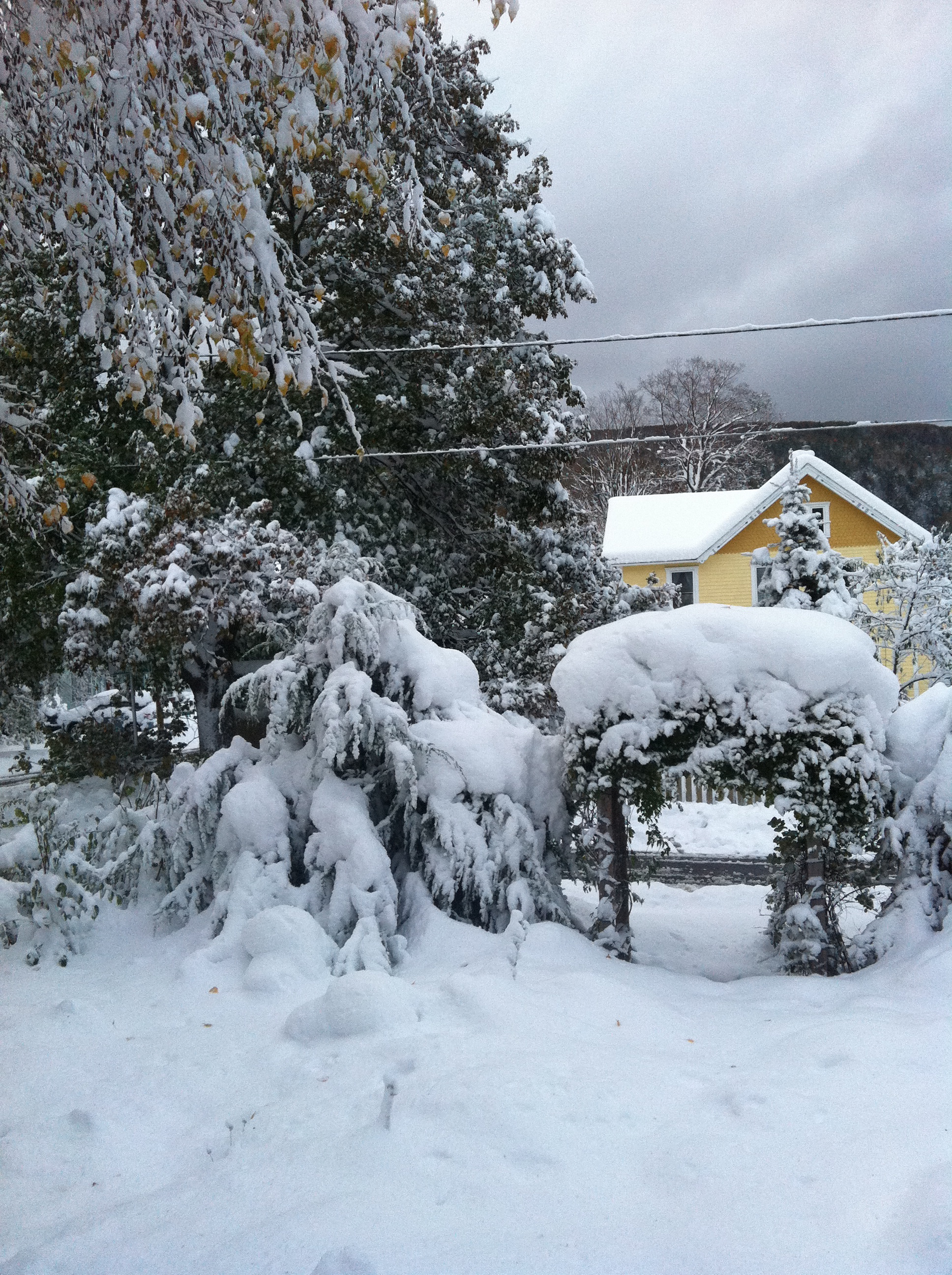
Here’s what it looks like at my house in western Massachusetts this morning:

All those trees in the background are tall maples, bent over with the weight of snow on their leaves.  So far no big limbs have snapped, but that could change any moment, and many of them are hanging over an outbuilding and my car….

So the question we should all be asking this morning is whether this freak October snowstorm is just an aberration, or if it’s part of a developing and accelerating pattern of climate change.

Yes, there have been October snowstorms before.  But has there been a three-month period before with record high temperatures (August), record rainfall (September), a hurricane hit to the entire East Coast (Irene) AND a record-breaking snowstorm?

Not being a meterologist, I can’t answer this question, but I’d sure like to know.

One thing I do know is that if we don’t start reducing carbon emissions, weather events like this are going to become more frequent and more severe.  This is not “Day After Tomorrow” hysteria, this is scientific truth.

So again, the question becomes, what can we DO?

Well, next weekend in Washington DC there will be an action at the White House; the plan is to assemble enough people to make a linked-arms ring around the White House, in the hopes of persuading President Obama to stand with the people on the anti-tar sands extraction, anti-Keystone pipeline issue, rather than with the energy corporations.

You can hear actor Mark Ruffalo explain it here:

My hope is that weather events like last night’s “freak” snowstorm will raise people’s awareness about the reality of climate change, and how it will affect all of us–our food supply, our physical security, our ability not just to carry on as usual, but to carry on at all.

All of us–the rich, the poor, the inbetween–the 100% of us, and not just in the US but in the world, are already feeling the effects of manmade climate change.  We’ll be feeling it increase exponentially in the coming months and years.

So all of us need to step off the path of least resistance and start demanding government support for a huge Apollo Project-style transition to sustainable energy and a serious commitment to energy conservation.

If you can’t get to Washington DC next Sunday for the demonstration at the White House, you can be part of the virtual ring that will surround the people on the ground there, and build support wherever you are for the movement for responsible and caring stewardship of our Earth.

We cannot afford to ignore these issues any longer.

What President Obama and Eve Ensler have in common

President Obama did something really, really good this week.  He sent 100 Special Ops military “advisors” to Central Africa to help local government forces get rid of the Lord’s Resistance Army, a group of crazed, vicious thugs who have been terrorizing people in four countries for as long as many in the region can remember.

The New York Times reports: “For more than two decades, the Lord’s Resistance Army (LRA) has murdered, raped and kidnapped tens of thousands of men, women and children in central Africa,” Mr. Obama wrote in a letter to Congress announcing the military deployment. “The LRA continues to commit atrocities across the Central African Republic, the Democratic Republic of the Congo and South Sudan that have a disproportionate impact on regional security.”

You don’t even want to know what kind of atrocities he’s talking about.  Joseph Kony and his men are depraved, sick torturers, rapists and murderers who have been at it so long that I doubt they can ever be rehabilitated.  They are part of a long cycle of violence in Africa that begins with the kidnapping or luring in of young children, boys and girls, who are then drugged, beaten and raped into total submission to the authority of the adults, and grow up indoctrinated into the lifestyle of terror.

For an inside story, read Ismael Beah’s memoir A Long Way Gone, or the chapter in my anthology African Women Writing Resistance by former girl child soldier China Keitetsi, whose memoir Child Soldier is available in an e-book edition.

I can’t help but think that there is an element of racism in the fact that it’s taken so long for the international community to unite behind the mission of bringing true security to Central Africa (including the Democratic Republic of Congo, where some of the worst human rights violations in the world are taking place daily, with women and girls disproportionately targeted.)

When Bosnian men were massacred, people thrown out of their homes, and women and girls imprisoned in rape camps by the Serbs, the Clinton Administration waged an all-out war to stop it.  All that and more has been happening in the DRC and neighboring countries for decades.  Decades.

Eve Ensler has done a tremendous amount to get the word out about the impact of all this violence on women, not just in Africa but throughout the world.  I particularly admire her because she has used art as the medium for her outspoken calls for solidarity and resistance with victims of rape and violence–starting with “The Vagina Monologues,” and moving on through a host of books and plays.

She’s also used digital media to get her word out and build a global movement to end violence against women, and I don’t think anyone does it better–check out her website, vday.org, to see for yourself.

Eve Ensler is a great example of a woman of privilege who has used all of her talents and gifts to reach out and help others–and not through begging, cajoling or guilt-tripping, either, but through the sheer power of her spoken and written word.

President Obama has the power to send in the military, and it’s good he’s at least taken the first step in that direction.

We ordinary people have power too, more than we often realize.  We can open our eyes to what’s really happening in our towns, our country and our world, and then allow our hearts to show us the way to action for positive social change.

There is no more urgent task for each of us in our lifetimes.  This is what we came here to do.

Occupy Wall Street: Finally, the New York Times Gets It!! Now, how about Obama?

Protesters Against Wall Street – NYTimes.com.

This is a big victory for the Occupy Wall Street movement.  To move the staid NY Times from complete indifference to disdainful incomprehension to vigorous approval in the space of just three weeks is truly remarkable!

Haven’t I been saying that the young people today are the sleeping giant that needs to awaken, stretch and roar?  Any subordinate class (and make no mistake, the young ARE a subordinate class) is only kept down through ignorance of the true extent of their power.

In the past, it’s usually been a charismatic leader who has seized the microphone and shaken the masses out of their beaten-down stupor.  Think Frederick Douglass or Martin Luther King Jr., for example.

With Occupy Wall Street, we’re onto something new: a “leaderless movement,” without microphones, but with the extraordinary amplifying power of the World Wide Web.

Social media couldn’t have done it alone–we need the resolute presence of those flesh and blood people down at Liberty Square and in parks and street corners all across America.  But their resistance is exponentially strengthened by the social network around them, spreading like wildfire throughout the country and the world.

President Obama responded at least obliquely in last week’s press conference, showing at least a glimmer of understanding of what the movement is about.

If he had a shred of political sense, he’d be looking for ways to harness the intelligence, social commitment and determination of these young people to stand up to the Tea Party crowd and the drill-and-kill Republicans who have shown themselves again and again to be against social equality in any way, shape or form.

This could turn into the political juggernaut needed to push the Republicans back into their holes, and give the Democrats some much-needed backbone.

One thing is certain: these kids are not backing down, and they’re not going to be fobbed off with half-hearted gestures of appeasement.  They are after real social change, from the ground up.

What was it Arundhati Roy used to say?   “Another world is not only possible, she is on her way.  On a quiet day, I can hear her breathing.”

Yes.