Coming to you live from the studios of WBCR-LP, 97.7 FM, Great Barrington….

This spring, students from Bard College at Simon’s Rock and Monument Mountain Regional High School are getting ready to go on the air with a series of Citizen Journalism Project news shows, broadcasting stories of local, national and even international interest from the intimate studios of WBCR-LP in Great Barrington MA.

Bard College at Simon's Rock students in radio board training

In preparation, students in my digital media studies class have been listening to great radio from NPR affiliates, Pacifica and other serious news radio outlets, as well as to homegrown shows on 97.7 FM, WBCR-LP.

We’re not sure yet how polished our programs are going to sound this spring, but in this first go-round, it’s really all about learning the process, from conceptualizing and pitching interesting stories, to interviewing and structuring the script, to recording, editing and putting it all together live on the air.

What could be more fun?

But also, what could be more important for young people than to hone their civic engagement skills through becoming not just consumers, but also producers of informational media on topics that really matter?

In keeping with the state of the profession of journalism, my class will also be working on student-produced video and online print stories, recognizing that in today’s media environment, it’s essential to be able to move fluidly across a variety of platforms.

When I came up with the Citizen Journalism Project initiative, combining my service on the WBCR-LP Board with my media studies teaching and my interest in getting Simon’s Rock students out into the local community and collaborating productively with their peers, it was one of those moments when you get into the flow and know the universe is with you.

Everyone I talked to about the idea loved it, from students to school administrators and the WBCR-LP programming committee staff, all volunteer, who are contributing their time and talents to getting the students trained and on the air in just a few short weeks.

When internet radio burst on to the media scene a few years back, some predicted the end of old-fashioned broadcast radio.

But there’s still something very special about being part of a community radio station grounded in the heart of a particular dot on the planet, where the people who live there are the ones running the board, conceiving and hosting the shows, and pumping out the music–not for money, but for the sheer joy of it.

When you drive through Great Barrington and tune in to 97.7 FM, it’s your friends and neighbors you’ll be hearing on the radio. And now, some cheerful, intelligent and very media-savvy students, too!

If you miss the live broadcasts, or you live far away, we’ll be archiving our shows at WBCR-LP later this spring.  Come by and check us out!


Hope springs eternal in our Garden of Earthly Delights

Today I was fortunate to attend a slide lecture by a truly talented photographer, Tanya Marcuse, an alum of Bard College at Simon’s Rock who has been teaching there for the past decade.  She showed images from her current project, “Earthly Delights,” and talked about her process of composing and selecting these images.

Photo credit Tanya Marcuse

Tanya explained how she drew her inspiration from the famous triptych by Hieronymus Bosch, “The Garden of Earthly Delights“, in which images of love and beauty are juxtaposed with macabre scenes of suffering and death.

How strange that the odd, carefully painted fantasies of a medieval Dutchman should be the inspiration for the secular landscape portraits of a thoroughly modern contemporary photographer!

And yet as Tanya talked about her work, I understood her fascination with the strange contradictions of human existence, still so potent despite the five centuries between Bosch’s artistic vision and her own.

We are loving creatures, and yet no one can hate more powerfully than we can.

We worship beauty, and yet we create ugliness.

We wish to be admired, and yet we do shameful things.

We revere life, and yet we, like all living forms, are inexorably moving towards death.

The insight that Tanya offers us through her images is that even in death there is life.  Even in the ugliness of decay there is beauty.

Hers is a powerful message of hope, shared through beautiful art that cuts a blazing path through these dark times.

All things must pass, George Harrison crooned.  All things must pass away.

But in our Garden of Earthly Delights, our lovely, perishable, indestructible planet, all things will rise again, too.

Photo credit: Tanya Marcuse

There is hope and a shred of security in that knowledge.

Climate Change Denial at the NY Times

I opened up Joe Nocera’s column in today’s NY Times, “The Poisoned Politics of the Keystone XL,” with anticipation, thinking that at last the Times was going to deliver a column roundly critiquing the pipeline and the oil-drenched politics from which it sprang.

My expectations could not have been more disappointed.

To put it mildly, Joe Nocera does not know what the hell he is talking about.  And I have to wonder whether some clumps of sticky tar-sandy dollars might have found their way into his pockets in return for the little PR gift he just gave, with flourishes, to the Canadian oil industry.

You will have to read Nocera’s column for yourself–I really can’t bear to summarize it.  Suffice it to say that he believes that:

  • 1) extracting the Canadian tar sands will make the US, and North America generally, “energy secure”;
  •  2) there is no point in pushing for energy conservation or a shift to renewable energy;
  • 3) Canadian tar sand oil “may be a little dirtier than the crude that pours forth from the Saudi Arabian desert…but is hardly the environmental disaster many suppose”;
  • 4) the US is foolish to cede our interest in this oil to the Chinese.

To which I (and some 300 other respondents to his column on NYT.com, as of this writing) have to say, Joe, are you out of your mind????  Or are you just being willfully blind?

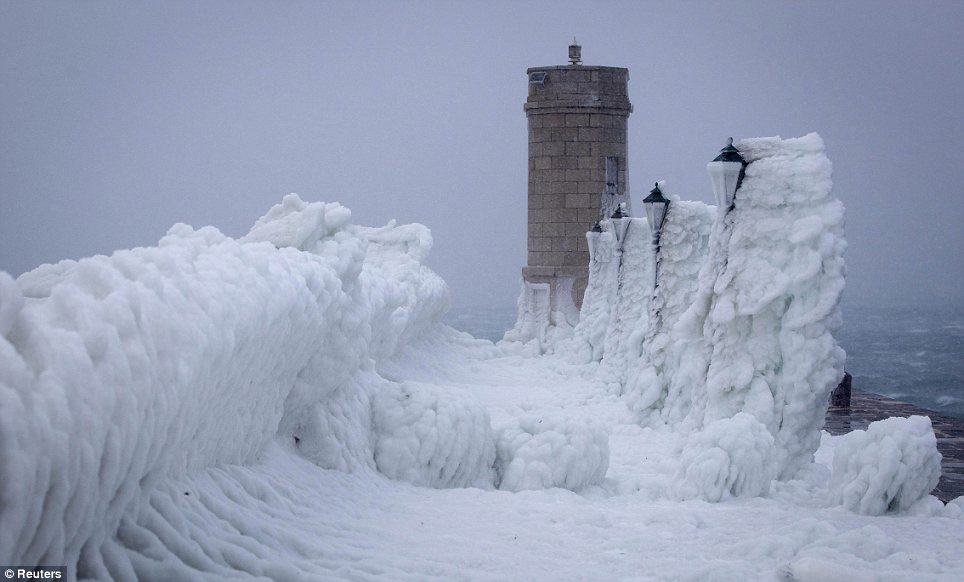
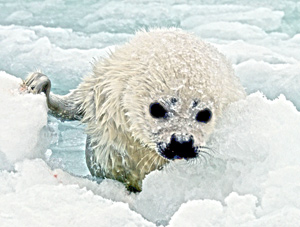
Yesterday I was writing about the holocaust of harp seals in the Gulf of St. Lawrence, where for the past decade global heating has been melting the ice at an alarming rate, leaving newly born seal pups at the mercy of thin, fragile ice floes.  I have also been thinking a great deal about the Little Ice Age that seems to be occurring in Europe this winter.  While we here in New England are enjoying springlike temperatures and a total lack of snowfall, Europe is getting dumped on with snow, and frigid temperatures to boot.

You’ll be hard-pressed to find solid information about this in the NY Times or other mainstream press outlets, but if you look hard enough, it’s there.  Climate scientists are pointing to the steadily melting Arctic ice cap as the culprit in the change in wind and weather patterns that are bringing more extreme weather to Europe–remember the 2010 hot spells that cost hundreds of lives?  This severe cold is also to blame for hundreds of deaths.

Let’s connect the dots.  Tar sands extraction can only be done by burning lots more fossil fuels.  That’s why environmentalists oppose it.  Not so much because of the destruction of millions of acres of pristine wildlife habitat, though that is generally acknowledged as sad collateral damage.

No, the main problem with extracting the Alberta tar sands is that doing so will speed the heating of the planet.  Heating the planet will lead to melting polar ice, rising sea levels, and ever more bizarre and destructive weather patterns.

Heating the planet will lead to death and destruction on a vast scale.

As the authors of a recent Royal Society special issue on climate change put it, if temperatures rise 4°C , “the limits for human adaptation are likely to be exceeded in many parts of the world, while the limits for adaptation for natural systems would largely be exceeded throughout the world. Hence, the ecosystem services upon which human livelihoods depend would not be preserved.”

This is science-speak for a basic premise I think anyone could understand: if the temperatures continue to rise, human beings, and the ecosystems that have evolved alongside us, are TOAST (expletive deleted).

Going full-bore at the Alberta tar sands is signing the final death sentence for millions and millions of living beings on this planet, including millions of human beings.

Humans in heretofore privileged spots on the globe, like Europe and the USA, will not be excepted from the general ecocide.

Do you have any children or grandchildren, Joe?

Can you really in good conscience assure them that selling the Alberta tar sands, to the US or the Chinese, will contribute to their “energy security”?

If you answer yes, then my original hypothesis is confirmed.

You are out of your (expletive deleted) mind.

Dare to love

Like most people I know, I have just a very narrow sphere of knowledge that I’m willing to let penetrate my consciousness at any given time.

There’s so much I know but don’t want to know. So much I choose not to acknowledge.

It’s a form of self-preservation, because if I were to allow myself to really feel the unnecessary pain and suffering that floods our world like an endless terrorized scream into the night wind, all the time…I could not bear it.  I would go insane.

What prompts these reflections today is the news that hundreds of thousands of seal pups are drowning in the Gulf of St. Lawrence this season, after a straight run of disastrously warm winters where the pack ice on which harp seal moms give birth has been too thin to provide the shelter the pups need to survive.

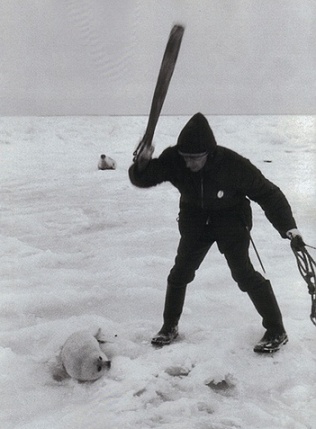
Add to this the fact that the Canadian government, knowing full well that the harp seal populations are in dramatic decline due to global heating, is still going ahead with the annual seal pup hunt, allowing as many as 330,000 pups to be clubbed to death by hunters this season.

This despite the fact that Russia and the European Union, the principal clientele for seal fur, have banned imports this year.  Despite the fact, too, that a huge backlog of seal pelts is sitting in warehouses.

It’s one thing to kill animals for food. Human beings are carnivores, after all.  But killing for sport…killing for unnecessary furs…killing for no good reason makes me feel deeply ashamed of my species, and heartsick for the loss of life.

I don’t know what to do with these feelings.  Signing yet another online petition or sending yet another contribution to a Save the Seals campaign does not seem anywhere near adequate.

I am not capable of practicing tonglen, taking in the suffering and sending out lovingkindness to both the victims and the perpetrators, as Buddhists like Pema Chodrun recommend.  I can neither bear to take in the suffering, nor stomach sending anything akin to kindness to the perpetrators.

So I do what most people do.  I close my eyes.  I grow some kind of hard shell around my heart.  I choose, without even consciously realizing what I’m doing, to ignore news and information that will upset me.

I remember clearly that as a child, I was not yet capable of this degree of callousness.  I very rarely was exposed to any suffering, since I grew up in a very sheltered environment, but every so often something would manage to get through into my sweetly padded cocoon, and leave me gasping in empathetic pain.

Once I was standing outside on the lawn in front of the house, and a bird whizzed by me and flew straight into a window.  It fell to the ground, stunned.  I ran to it and picked it up, cradling its trembling body in my arms.  Its neck was probably broken…it died within an hour.  I held it and cried over it and mourned it so deeply that even now, so many years later, I still tear up thinking about the sorrow that small death called up in me.

I can’t live with that kind of sorrow all the time; I would be paralyzed with grief.  And so I compartmentalize.  I go about my business and actively avoid thinking about the thousands of seal pups dying today.  Or the wolf pups being poisoned by the Canadian government to clear out the boreal forest in preparation to extract oil.  Or the millions of songbirds and waterfowl killed each year by US federal government agencies because they get in the way of industrial agriculture or airplanes or golf courses.

Just for a moment, let’s dare to imagine what the world could be like if adults like me did not deliberately silence and smother our empathy for the creatures who need our help to survive.

Love might just be the most radical gift we could bring to the world.

What could be more potent than action fueled by love?  Do we dare?  Can we afford not to?

Planetary Superbowl

So it’s Superbowl Sunday in the US, a day that millions of Americans look forward to for months.  I am always amazed at the passion with which sports fans engage in following teams, and I often think: if only we could harness that energy, dedication and drive and put it towards more important things like saving the planet, why, we’d do just that, right away!

If even a fraction of the money spent on sports teams, sports telecasting, sports advertising and sports merchandise were put towards improving children’s education, nutrition and health worldwide, we’d make giant strides towards achieving the Millennium Development Goals.

If we could get fans to analyze climate and biodiversity statistics the way they analyze the minutia of sports wins and losses, what a brain trust we could call upon to solve the pressing environmental problems of our time!

In the 21st century, the same goes for video game aficionados.  When I hear teenage boys talking with such enthusiasm about the latest iteration of World of War or Grand Theft Auto, I think wistfully that if only they were as engaged with the real, natural world as they are with these violent artificial environments, their incredible warrior energy could be channeled to such positive purposes.

No amount of wishful thinking is going to change the fact that testosterone and aggressive energy go together.  But aggressive energy does not have to be used to hurt people or destroy animals and the environment. Aggressive energy does not have to be hierarchical, meaning that I can only raise myself up by pushing you down.

The truth is that the multiple crises that are staring us in the face right now need aggressive, bold tactics to solve.  Putting the brakes on global heating, shifting to renewable energy, ending our romance with biochemically engineered agriculture and halting the deforestation of the great lungs of our planet will take all the creativity, ingenuity and yes, aggressive, take-charge energy that we can muster as a species.

It will also take something that the testosterone-fueled among us are less proficient at: collaboration, negotiation, cooperation.  That’s where we women come in.

I recently noticed a tweet from Desmond Tutu to Nick Kristof, two men for whom I have the highest admiration, in which the archbishop said to the journalist that if women were given more political power, the world would be a safer, more peaceful place.

Absolutely.  But what is really needed is an androgynous fusion of the best of masculine and feminine attributes.

We need our menfolk to fight for our species, and indeed our entire planetary ecosystem, with the same kind of enthusiastic passion that they lavish on sports and video games.

And we need our womenfolk to insist on getting engaged at every level of politics, business and education, not as token men, but true to our own deepest, estrogen-driven instincts for nurturing communities and societies.

On this Superbowl Sunday, I call on Americans to think about the bigger picture.  How important will it be which team wins or loses once climate change starts taking us all down?

Turn those pink ribbons green

I’m going to make a confession.  I never could stand those pink ribbons.  I’ve never done a “Walk for the Cure” or bought daffodils for cancer victims or even picked a cancer-cure-themed postage stamp.

I’m glad to hear that the Komen Foundation has bowed to pressure and is restoring funding to Planned Parenthood, a worthwhile organization if there ever was one.

But in general, the idea of putting the energy and effort of well-meaning citizens behind “the search for a cure for cancer” just irritates me, because let’s face it, we know what causes cancer, and therefore we can do better than cure it, we can prevent it!  Maybe not 100%, but we can take it back to the modest rates that previous generations of human beings enjoyed.

For my grandparents’ generation, a diagnosis of cancer was frightening because it was so often a death sentence, but it was rare. Not one of my four grandparents came down with cancer, and I don’t believe their parents did either.  This isn’t due to some genetic serendipity, it’s just a fact that cancer rates in the first half of the 20th century (and every century before that) were way lower than they are now.

Cancer rates are skyrocketing now thanks to the environmental toxins that humans have introduced into our air, soil and water, and thus our agricultural crops, drinking water and the very air we breathe.  Rachel Carson saw the effects of DDT on birds, and gave the warning just before she succumbed to cancer.  

We may have removed DDT from the US market, but it’s still being used in other countries, and here it has been replaced by a whole host of alphabet-soup chemicals, each one more potent and carcinogenic than the last.

If you really want to make a difference in the war against cancer, forget about those ridiculous pink ribbons.  Use the power of your wallet and your ballot to insist that the government step up and do its job in regulating the industrial agriculture sector.

Or better yet, let’s allow the specter of industrial agriculture to fade away into the dustbin of the 20th century, and start a real “green revolution,” dedicated to the health and well-being of our planet and all her denizens.

What color is your ribbon?  Mine is green.

Reproductive Rights Redux

Americans hate to be told what to do–even when it’s in our own best interests.

Today’s brouhaha over the Obama Administration’s decision to require employers to provide insurance fully covering birth control is a case in point.

Catholic employers are protesting that “It’s not the issue of contraception, but religious freedom,” according to today’s Washington Post, which quoted one Sister Carol Keehan as saying: “It’s not about preventing women from buying anything themselves, but telling the church what it has to buy, and the potential for that to go further.”

Let’s remember that no one is making women go out and buy contraception.  The ruling is simply intended to make contraception, including the morning-after pill, available to all employees free of charge through normal employer health coverage.

Excuse me, isn’t this a great thing?

I remember when Viagra was first introduced commercially, women were outraged over the fact that insurance companies were willing to give men coverage to maintain their erections, but women who wanted to prevent pregnancy had to pay for it out of pocket.

And women’s contraception isn’t cheap!  Whether it’s a diaphragm, an IUD, or hormone pills and implants, it’s expensive for women to opt out of reproduction.  It’s not equivalent to a man picking up a condom over the counter at the drug store.  All of the methods I’ve listed above involve visits to a prescribing doctor, which significantly ups the price.

Although men may beg to differ, I’d maintain that the question of reproductive freedom is of far more importance to women than erections are to men.  An erection may come and go, but a child is here to stay.  And a child has a far more powerful repercussion on her mother’s life than she does on her father’s life.
Both of my pregnancies were undertaken intentionally and with joy.  I am not complaining, but it’s undeniable that having children has impacted my life much more than it affected my ex-husband (even when we were still together).  I know this is not true for every couple, but it’s true for a lot of us women.  Our gender still gives us a special extra role to play in bringing the next generation along.
And that’s a pretty important role!  So why shouldn’t society help us to ensure that when we bring children into the world, it’s with our eyes wide open and every intention of taking our parenting seriously?
Making it more affordable for women to obtain birth control will increase the likelihood that more children will be born to mothers–and families–that are ready and able to support them.  In this day and age, with 7 billion human beings crowding our Earth, that is an important goal in itself.
No one is advocating that we actually limit reproduction, as the Chinese have done, but at least let’s make it easy and affordable for women who want to postpone or avoid childbirth to do so.
The Obama Administration deserves our gratitude and applause for having the courage to turn the corner on this contentious issue.  President Obama should hold his ground.

Climate refugees–who’s next?

This week it was reported that thousands of people of the Tarahumara indigenous group, who live in the Sierra Madre range in northwest Mexico, have been coming down out of the mountains to seek food aid, because after two years of severe drought, coupled with unusual cold this winter, they are reaching their breaking point.  Faced with starvation, they have become climate refugees.

The Tarahumara are known in Mexico for their incredible endurance in long-distance running.  They are a proud people who have held themselves aloof from modernized Mexican culture, still keeping their ancient traditions of weaving, hunting and farming.  They still speak their ancestral language, and they have always been able to take care of themselves.

Until now.

In what is sure to be a trend in the coming years, it is the people who live furthest out on the margins of Empire who are affected first and most harshly by climate change.  People living on South Sea atoll islands or on the Arctic tundra are already seeing the effects of the rising seas and thawing permafrost.  Mountain people who depend on glacial melt for their freshwater are coming up dry.

We here in the heart of modern Western civilization are still feeling no pain.  In fact, I can’t count how many people have grinned at me this week as they celebrated the lovely spring weather we’re having in January—in the fifties, Farenheit, in midwinter.

Yes, it’s just grand—until summer comes and we’re still 40 degrees above normal, roasting at 120 degrees F on a typical August day.

In Mexico, the severe drought has left some two million people without access to potable water and basic food supplies, and authorities say they expect the situation to worsen.

This is bad enough, but it gets worse:

“The drought, which has been compounded by freezing temperatures, has already pushed up the cost of some produce, including corn and beans….But government officials have said they do not expect the price of exports to be affected.”

I am sure all readers of that NY Times article were reassured to hear that the cost of their imported avocados, tomatoes and other vegetables will be unaffected.  Who cares that corn and beans, the staff of life for millions of Mexicans, will cost poor people more?  That’s their problem!

Until it becomes ours.  If corn and beans become unaffordable in Mexico, and sustenance farming is no longer an option in a drought-stricken landscape, what comes next?  You guessed it, illegal emigration al Norte.  What other choice do these people have but to take the risk of trying to cross the border?

Up here, anti-immigrant fervor continues to burn.  Just this week House Republicans passed a law seeking to deny cash refunds under the child tax credit to anyone filing tax returns using “individual taxpayer identification numbers” rather than Social Security numbers.

Most of the people filing taxes without Social Security numbers are hardworking Latino immigrants who are paying taxes even though their earnings are at or below the poverty level.  Their children, many of whom are American-born citizens, will pay the brunt of their parents’ loss of the child care tax credit.

But really–who cares? Who gives a good goddamn if the poor can eat?  Just so long as we can still buy gleaming fresh produce year-round, and no one messes with our electricity or gasoline, let the rest of the world go to hell.

In case you couldn’t tell, I’m being sarcastic.  Seriously, this arrogant attitude is only going to be able to go so far.  Today’s climate refugees, tomorrow’s undocumented workers, are the harbinger of what may very well befall all of us as the climate keeps spinning out of control.

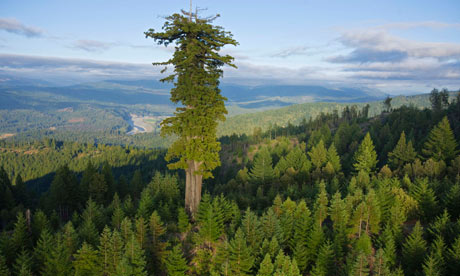
Just as in our forests, it is often the oldest, most majestic trees that are under the greatest strain from climate change, our oldest, proudest ethnic groups are also under tremendous strain now.  The Tarahumara managed to survive the Spanish Conquest, the Mexican Revolutionary War and the Industrial Revolution…but if they can no longer grow crops in their homeland, they must move or die.

Indigenous people like the Tarahumara have the best chance of actually surviving a catastrophic climate shift, because they still know how to live a low-consumption lifestyle, close to the earth.  We would do well to learn from them, and other indigenous groups worldwide, while their cultural traditions are still intact.

Those of us still enjoying the luxuries of Empire should be cognizant that for us too, it’s only a matter of time.