IWD 2012: If not you, who? If not now, when?

Is it coincidence that on International Women’s Day 2012, Earth was bombarded by one of the most intense solar flares ever?

I can’t see them from my window, but apparently Northern Lights are visible way further south than normal tonight, thanks to the extra radiation from the Sun.

Could it be that the Sun is urging us on, sending us the pulse of a solar storm to motivate us to action?

What do I wish for women, this IWD? What do I want from women today?

I am tired of women being held hostage on the basis of their reproductive capabilities.

Yes, we are the ones who bear the babies after sex.

Sex happens and we love it.

Babies happen, too.

If a woman doesn’t want to bear the baby that takes root after sex, she has every right to decide what to do about it.

Period, end of statement.

Women have the right to be educated about their reproductive options.

Women have the right to have access to contraception, no matter their age.

Insurance companies have no right to treat contraception differently than they would treat any other drug.

Men are very happy to have insurance cover their Viagra so they can screw to their heart’s delight.

Fine.  But don’t deny women the same right to manage our reproductive capabilities as we see fit.
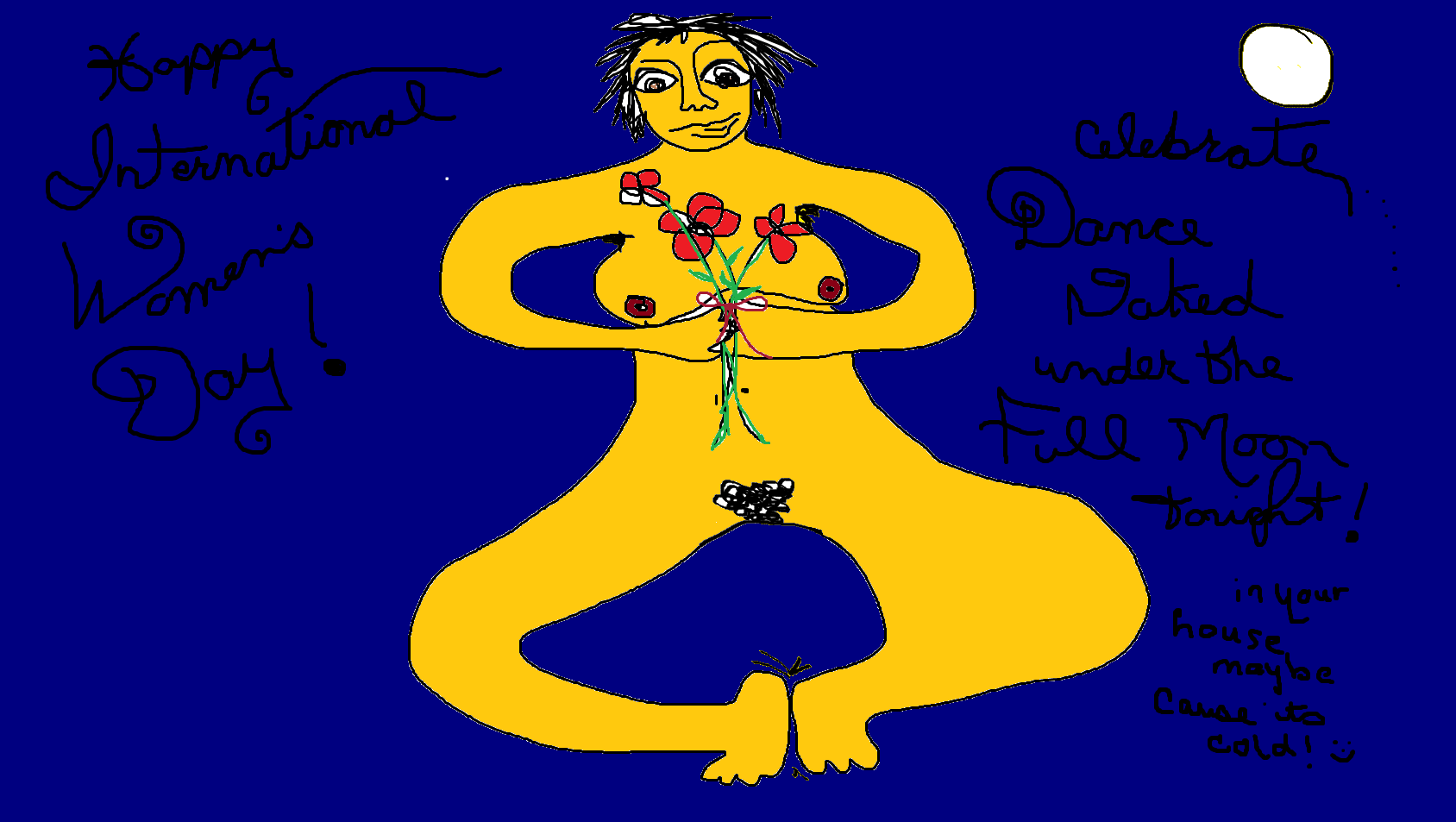
***

Today in class, when we briefly discussed IWD and women’s equality, it was inevitable that one young woman present had to tell the group how much she enjoyed cleaning house, so that she couldn’t imagine that the “second shift” would be a burden.

I just let it go.  Honey, let’s talk again in another 15 years, I wanted to say (my students are generally under 20 years old).

I would like you to come back to me in 15 or 20 years, when you have a toddler and an infant and are working fulltime, and tell me that you love cleaning and it’s perfectly OK that you do more of it than your so-called partner.

***

Yeah, OK, a little bit of anger there.

I was glad to see an article on Common Dreams today entitled “That’s Enough Politeness – Women Need to Rise Up in Anger.”

Hell yeah.

Women like me have been trained to be oh-so-polite.

We don’t rock the boat.

We are grateful for our jobs.

We are grateful for our mates.

We are grateful for our home and our children.

We don’t talk about the personal sacrifices needed to maintain all of the above.

As Laurie Penny puts it, “Women, like everyone else, have been duped. We have been persuaded over the past 50 years to settle for a bland, neoliberal vision of what liberation should mean. Life may have become a little easier in that time for white women who can afford to hire a nanny, but the rest of us have settled for a cheap, knock-off version of gender revolution. Instead of equality at work and in the home, we settled for “choice”, “flexibility” and an exciting array of badly paid part-time work to fit around childcare and chores. Instead of sexual liberation and reproductive freedom, we settled for mitigated rights to abortion and contraception that are constantly under attack, and a deeply misogynist culture that shames us if we’re not sexually attractive, dismisses us if we are, and blames us if we are raped or assaulted, as one in five of us will be in our lifetime….

“Politeness is a habit that what’s left of the women’s movement needs to grow out of. Most women grow up learning, directly or indirectly, how to be polite, how to defer, how to be good employees, mothers and wives, how to shop sensibly and get a great bikini body. We are taught to stay off the streets, because it’s dangerous after dark. Politeness, however, has bought even the luckiest of us little more than terminal exhaustion, a great shoe collection, and the right to be raped by the state if we need an abortion. If we want real equality, we’re going to have to fight for it.”

***

This International Women’s Day 2012, I want women to dare to take some risks. Dare to get angry!  Dare to think outside the box!  Dare to want more than whatever you think you should have!

Women of the world, you are needed as never before.

The Earth Mother herself lies bleeding, prostrate, raped and pillaged and on the edge of complete surrender—which will mean the death and destruction of all of us , her children.

She needs us to stand up for her, to stand up for ourselves, to insist that the old conquistador’s model of forced rape will not cut it in the 21st century.

This International Women’s Day, I want American women to stand with our sisters all over the world to insist that we are more than the sum of our reproductive organs.  We are more than house slaves.  We are more than corporate slaves.  We are not reducible to any of the ciphers by which some of us are regularly netted and ensnared.

Women of the world, there has never been a time when your input, your perspectives, your influence has been more important.

Don’t assume that someone else will take care of it for you.

We are depending on you now.

The Earth herself is depending on you now.

This International Women’s Day, I say to the world’s women: there has never been a more crucial time to step into your power and act to protect your communities and our planetary home.

If not now, when?

If not you, who?

Now.  You.  And us, together.  Men and women, all over the world.   Now, you.  Now.

Cupid, go home!

It’s fascinating to me that the Transition Times blog post that has gotten the most attention, by far, is “There’s more to love than Cupid and his arrows,” my Valentine’s Day 2012 post, which has been read hundreds of times since February 14.

Of course, people are always interested in love and romance.  And this is a positive, peaceful essay about being very thankful for the love I have in my life through my parents and children, to the point where I’m not missing romantic engagement.

Truly, I’m not.

There has been a spate of articles lately about so-called “singletons,” men and women who choose to remain happily single.

Some of the articles fret that such people may have troubles as they age, since they have no companions to help care for them.  A recent New York Times Room for Debate series, “Being Alone Together,” explored both sides of the issue, with many of the writers arguing that solitude has significant benefits.

I am not living alone; I am living with my two teenage sons at the moment.  I have to say that I do enjoy the rare times when I have the house to myself, and have no one but myself to please.

When I was in my early twenties, before I married, I lived on my own in Greenwich Village while I studied as a graduate student at NYU.  Although I had never felt confined or fettered while I lived with my parents, the freedom of living alone was fantastic, as was the convenience of living so close to the NYU campus and the stimulation of the Village.

But nevertheless, during those years I felt a tremendous pressure to marry, to have children—to paraphrase Mrs. Ramsay in Virginia Woolf’s To the Lighthouse.

Did it come straight from my ovaries?

It wasn’t like my parents were pushing me at all. But I felt a kind of insecurity about being single, like I was lacking or missing something. I was incomplete.

In those days, the 1980s, there was a lot of talk about how if you didn’t find a mate in your twenties or early thirties, you’d be over the hill and never find one.  Believe it or not!  Stories of unhappy women in their forties abounded—women who had never been married, and were totally, miserably fixated on finding the ever-elusive Mr. Right.

Although I was living alone and perfectly content with my life, I still felt like it was temporary, and I’d better be constantly on the look-out for the man who would come along to complete me and open the door to my real adult life, which could only begin with those wedding vows.

Now, on the other side of two decades of marriage and a divorce, I am once again single and enjoying the freedom, this time without that little Cupidlike imp sitting on my shoulder warning me that I’d better focus on love and get myself hitched.

I have young friends getting married now and of course I wish them much happiness and fervently hope that they will be better marriage partners than my ex and I were for each other.

But I have to say, from my current vantage point it seems rather miraculous that one’s chosen mate at age 25 could still be the perfect partner at age 50.  What an amazing feat to grow together so harmoniously that you still complement and satisfy each other after so many years of married life.

I know it happens; I have witnessed it for myself with others.

I just suspect it’s the exception, not the norm.

I have no illusions about finding—or being–such an exceptional partner in the next chapter of my life.

And you know what?  That’s just fine.

Pleasure plus meaning equals happiness: homage to my mom

Maria Sirois

Yesterday I went to a Berkshire Festival of Women Writers workshop facilitated by psychologist and inspirational speaker Maria Sirois.  The workshop was called “Happiness: Writing as a Path to Positive Transformation,” and since I am always looking for ways to link all those terms—happiness, writing, path, positive, transformation—I was eager to see how Maria would lay it out for us.

I was not disappointed.  She quickly got the group writing about happiness, and not surprisingly, when I started freewriting about joy, it wasn’t long before I began writing about my childhood summers spent at my family’s country house…long, endless, happy weeks where my brother and I seemed to be perfectly in synch with our mother’s rhythm, where life was peaceful, idyllic and beautiful…the epitome of joy.

Later, when we went around the room and everyone shared a short bit of their freewriting, I was struck by how many of the women present (we were all women that day) associated joy with childhood, and with nature.

Many people shared moments of joy connected with childhood memories of trees—climbing trees, wandering in the forest, listening to the wind in the trees.  Others had written about communion with animals, or remembered ecstatic time spent by the ocean in childhood.

A small corner of my mother's garden

What I remembered was watching my mother dig a rock garden out of the cow pasture in which she and my father had built their small country house when I was 5 years old.  Here are the two sentences I wrote during the workshop, and shared aloud:

“My mother would be quietly exultant as her shovel and trowel revealed new curves or deep, smooth walls of rock, and at the end of a hot morning’s work she would stand, sweaty and red-faced with a fine layer of black earth coating her bare shoulders, drinking iced tea out of a tall green glass and surveying her landscape with a squinted sculptor’s eye.  The work progressed slowly, since it was all done by hand, just one small, determined woman with a strong back and great patience, tracing out the rock with hand tools and as much love as if she were carving out the sweet, benevolent face and voluptuous body of the Earth Mother herself.”

***

Later in the workshop, Maria shared with us a memorable formula for happiness.

Happiness, she said, is the balance of pleasure and meaning.

If life is all pleasure, it can feel empty and meaningless.  If it’s all meaning, then you’re working too hard.

But if you can find the right balance of pleasure and meaning, you can hit that sweet spot of joy, in which you thrive and grow like a well-cultivated garden.

Maria suggested that there is something about creativity itself that brings us to this sweet spot.

My mother, spending her summers relaxing with her children and turning her surroundings into a beautiful landscape sculpture, was drinking from that creative well.

For me there are various creative taps I draw from: writing, teaching, creating programs like the Festival, bringing people together in harmonious, productive alliances.

Platter and dinner by my mom!

My brother recently observed that our mother has always been a wonderful model of someone who is completely focused, passionate about and committed to her art—whether that art is tonight’s dinner, or her magnificent pottery, or her lovingly tended garden.

Since earliest childhood, it has always been clear to me that she put every ounce of creativity she possessed into everything she did—not for external recognition or praise, but just because it was the right way—the most pleasurable way—to approach any task at hand.

Pleasure plus meaning equals happiness.

It strikes me that although my mom has had her share of ups and downs, hers has been by and large a very happy life.

No wonder when Maria asked me to write about joy, I went straight to my primary teacher: Sue Browdy, my mom.

Looking catastrophe in the eye

Denial of climate change is deep and it is wide.

We woke up this morning to news of record-breaking tornadoes touching down across a wide swath of the American Midwest, flattening entire townships and leaving behind multiple trails of devastation.

Reading the mainstream media reports, the focus was all on the damage; very little was said about the cause.

Again, a case of focusing on symptoms rather than on the motivating problems.  The news media focuses on the “what” but ignores the “why.”

And they are even further away from what’s most important: looking for solutions.

Senator Bernie Sanders

Yesterday, thanks to the ever-impressive leadership of Senator Bernie Sanders, representatives of the national and international insurance industry came together in Washington to discuss the business implications of climate change.

Co-sponsored by the Ceres Foundation, which has been working to bring business into the sustainable future fold, the meeting was unequivocal in its acknowledgement that climate change is here, it is real, and it must be dealt with head on, before it runs right over us like a tornado.

The reinsurance industry reps were pretty blunt.

“We need a national policy related to climate change and weather,” said Franklin Nutter, president of the Reinsurance Association of America.

Pete Thomas of Willis Re, a global reinsurance broker, cited an alarming statistic: 4 out of 5 Americans now live in federally declared disaster areas.  “”Demographics and coastal urbanization are catastrophic force multipliers, making weather events increasingly costly,” he said.

In case you didn’t know, reinsurance companies are the ones that insure the insurers.

A difficult industry, in the age of climate change.

If I were an economist, I would be doing the math to figure out whether we are really coming out ahead as a society when we fight to pay less than $5 a gallon for oil.

What may seem cheap up front is often outrageously expensive in the long run.

Like eating cheap food laced with chemicals to keep costs down, to find yourself paying the exorbitant bills for chemotherapy in midlife.

It just doesn’t make sense.

There has never been a more important time to come forward and demand that government and industry work together to ensure (not insure!) our future.

Indiana Tornado, March 2, 2012

Let’s stop hiding our heads in the sand and pretending that everything will be all right–until the next tornado, hurricane, wildfire or drought rides roughshod over our house and town.

Sitting at home worrying is of no use at all.

If you want to be of use to your grandchildren and all future generations, you should be out on the frontlines, insisting that:

a) the media does its job as a watchdog and reports the whole story;

b) our elected representatives do their job and create policy aimed at saving lives by mitigating and adapting to the effects of climate change; and

c) our fellow citizens get off their butts and start taking responsibility for our collective future.

Get going now, before “catastrophic force multipliers” blow us all away.