A New Year’s Vision for 2014

IMG_4297 copyAs the year wheels slowly to a close, I am distracted and repelled by the frantic pleading coming into my email inbox…it seems that every nonprofit and political organization I have ever expressed the least interest in is desperately vying for a few pennies from my ever-shrinking purse.

I too have been fundraising these last few months, trying to raise enough money to sustain the Berkshire Festival of Women Writers, which I founded on a shoe-string and a dream three years ago.  The more successful it becomes, the more time it takes to organize, and the more money is required to keep the wheels turning.

I certainly understand the need to seek funds to support these worthy endeavors, and yet I find myself wishing there was some other way.

Wouldn’t it be a better use of my time, talents and energy to focus on creating the vibrant programs the Festival is known for, rather than constantly having to cast about for financial support?

And what is true for me must be true for the organizers of all these causes that are flooding my inbox with urgent last-minute appeals for funding.

This New Year’s Eve, let me pause to envision a social landscape in which people are encouraged to do what they’re best at doing—whether it’s planting a tree or building a house or writing a poem—without having to worry about whether or not they will be paid in cash for their labor.

What if good ideas could just grow vigorously like weeds in the warm, pungent, nurturing earth of collective human society?

What if instead of all fighting amongst each other to be heard and rewarded for our cleverness, sex appeal and charm, we worked graciously together to create the vast interlocking human machine of collective creative endeavor, each of us contributing the pieces we do best and knowing we’ll be fairly rewarded for work done well?

What if instead of working for dollars and cents, we worked for goods and services that we needed, on a barter system to which everyone could contribute and rely on?

I know this is a pie-in-the-sky fantasy, but on this night, when the Earth wheels around the Sun into a brand new calendar year, I want to allow myself to dream big—to imagine that the impossible could come true.

What a beautiful world it would be.

Happy New Year everyone!

Winter Solstice Reflections: Returning to Light, Swimming Against the Tide

Lately I have been feeling that I am constantly struggling against a strong current pulling me away from the work I want to be doing.

The current is composed of all the day-to-day chores of life, along with all the busyness of the holiday season, and the relentless tide of bad news about the state of our beloved planet and her living communities, from trees to fish to birds and bees.

The more I become aware of the dire ecological state of our planet, the more I want to devote myself to swimming against that current of devastation, trying to bring our planetary systems back into balance.

I want to do that work on the personal level, starting with my own life, and moving out into my community and the broader Earth communities in which we all live.

The climate issue, like no other in human history, has made our planetary connectedness clear. We must work together, from pole to pole, to solve the problem of climate instability that industrial civilization has wrought.

If we don’t get on in immediately, we may very well spiral into another Great Extinction, possibly soon enough for current generations of humans—me and my children and their children—to live and die through.

Faced with a negative reality of this magnitude, many of us tend to just turn away in numbed grief and try to ignore it because, sadly, “there’s nothing we can do about it.”

My own sense of being caught in a tidal current pulling me back from whatever it is I’m supposed to be doing may have a lot to do with the despairing feeling that whatever I try to do will not be enough.

But I have to do it anyway, and so do you.

Winter Solstice is the time of year when I try to retreat from the furious churning of life and recalibrate, retune, reflect.

How can I use the gifts I have been given to make a positive difference, moving outward from myself, my family and local community, to the larger circles of life I love?

My greatest gift and abiding passion has always been writing. As soon as I learned to write, I began writing stories and poems that celebrated the natural world and honored the spirits of the Earth.

As a 21st century writer, I have the ability to project my words and perspectives far beyond the confines of the old spiral-bound notebooks I used to keep as a child. I have the potential to engage in dialogue with people all across the globe, and if you’re reading this, so do you.

As a teacher, I have the ability to begin conversations with students about the difficult ecological crises that are already beginning to unfold, and the social and environmental injustices that they are spawning. I can offer students the tools and strategies for continuing these conversations across the globe through our amazing new digital technologies.

In the past year, without a great deal of focus on my part, my blog has been viewed more than 20,000 times by visitors from more than 130 countries around the world.

My little blog is just a very small drop in the great ocean of digital conversations, but even so, it is possible that some of those 20,000 readers came away with a new idea or an affirmation of their own thinking, or a challenge to their habitual perspectives, that could start a chain reaction among their friends and digital connections that could, seriously, change the world.

Rupert Sheldrake argues that “The fields organizing the activity of the nervous system are inherited through morphic resonance, conveying a collective, instinctive memory. Each individual both draws upon and contributes to the collective memory of the species. This means that new patterns of behaviour can spread more rapidly than would otherwise be possible.”

Sheldrake’s theory is exciting and controversial because if it’s true, it means that none of us has to be bound by the heavy burden of habit and cultural inertia, the industrial tide that seems to sweep us along so inexorably.

We have a choice. We can pick up our heads, think for ourselves, seek out others who also want to preserve the ecological health of the planet, and together use our great digitally connected human brain trust to steward and safeguard this planet, not destroy her.

Working together, we could, within a couple of generations, be swimming together joyously in an entirely different sea.

As the Earth wheels slowly back towards the Sun today, this is my steady vow: to keep my head above water, to reach out a hand to others who share my reverence for our beautiful planet and its magnificent life, and to give myself without reserve to the mission of building a strong interconnected movement dedicated to the shift into a sustainable, ecologically sound, joyful future.

Browdy de Hernandez 2013

c. Browdy de Hernandez 2013

Let’s Face It, Charity is Not Enough

When I was a kid, I didn’t read “the funny pages” of the newspaper; in fact, the only newspaper that came into my parents’ home did not stoop to such trivia.  We read, exclusively, The New York Times.

I remember the first time—it must have been around sixth grade—that I happened upon “The Neediest Cases” articles in The Times.

The stories hit me like a ton of bricks.

Comfortably ensconced in my parents’ Park Avenue apartment, I had no idea—no idea—that just a few blocks away, on the other side of the 96th Street divide between the wealthy Upper East Side and dirt-poor Spanish Harlem, ordinary people just like me and my family were living in abject poverty.

With a kind of morbid fascination, I read about the kids whose parents were locked away in prison; the kids whose parents were drug users; the kids whose parents were homeless, sleeping in the dark, rat-infested recesses of the infamous New York City train tunnels.

Unknown-2Every article ended with the same words: Give to The New York Times Neediest Cases Fund.

This went on year after year.  Every year there were more “neediest cases,” each one more dire and depressing than the last.

Eventually I began to actively avoid reading those pages in December.  The contrast between the clean, glowing, opulent New York I knew and the dark, dank margins of poverty I was reading about was just too much for me to take.

And it was clear to me, at least on a subliminal level, that giving to the Neediest Cases Fund did not accomplish much—not if every year the need continued, unabated and even growing worse.


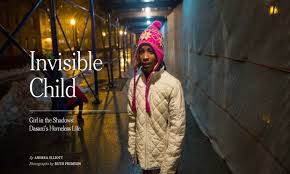
This week I opened my Ipad while still in bed and found myself drawn, despite myself, into a Neediest Cases article on 21st century media steroids—complete with an elegant magazine presentation and fabulous photographs of the squalor of homelessness.

It was the story of a 12-year-old girl named Dasani (after the bottled water), the oldest child of two methadone-dependent former addicts.  Unemployed and homeless, the parents live in a single room in a mouse-infested city shelter with their seven children, from Dasani on down to an infant.

As with the 19th century New York tenement photographs of Jacob Riis, the pictures themselves tell a powerful story.  Dasani is still full of optimistic determination to succeed at school; she hasn’t yet been beaten down, like her sad-faced mother.

I can just imagine Park Avenue New Yorkers—at least The New York Times readers among them—reaching in droves for their checkbooks to send some relief to Dasani and her family.

It happens every time there is a story about a disaster or a particularly shocking needy case.  Wealthy people open up their wallets and give what they can.

But the need goes on, and on.

Photo by Ruth Fremson of The New York Times

Photo by Ruth Fremson of The New York Times

What will happen to Dasani’s little sister, the one who is legally blind?  What will become of her rambunctious little brothers?  What will prevent them from following the same path that ensnared their parents, drug addiction born of desperation?  What will keep them out of prison and make them into the productive citizens our society claims to admire?


When I was a girl, I naively believed that the “neediest cases” were an aberration.  I thought that most people lived the way I did, in comfortable security.

In fact, it’s the other way around in our America.  More and more Americans are falling into poverty day by day.  Our minimum wage cannot sustain a family, not even with both parents working.  We don’t have decent health care or child care for lower income working people.  Food pantries are scarcely able to keep up with the need, as food prices continue to rise.

There are 22,000 homeless children in New York City alone, according to The Times.

Nationally, according to the U.S. Department of Education, there are 1,168,354 homeless students, a figure that many believe to be an underestimate.

It’s outrageous that the richest, most powerful nation on Earth is willing to allow more than a million of its children to go homeless year after year.

We spend billions on nuclear weapons annually, which Lord knows we do not need and cannot use.  This taxpayer money could provide a stellar education for all American children—not just the ones who are fortunate enough to live in a wealthy school district.

Dasani and her siblings have as much right to the American dream as any other American child.

Donating to the charities that hand out teddy bears at Christmastime is just not enough.

The great activist Eve Ensler wrote in her latest memoir that she “despises charity.”

Why?  Because it doesn’t go far enough.

It’s a sop to the consciences of those who give, without addressing the root causes of the need in a way that might actually alleviate it in the longterm.

Structural changes are needed at every level of our society.  For starters, let’s do away with the policy that ties school district funding to property tax revenues.

American public schools should provide a level playing field for all children, regardless of where they live.

Next, don’t just warehouse poor families like Dasani’s in miserable rundown housing.  Give them jobs, give them respect, give them an incentive to work their way out of poverty.

At the very least, they could be organized to clean up their city-run housing, plant gardens and provide services to each other as a way to supplement their welfare checks.

Nothing breeds hopelessness faster than powerlessness, and charity perpetuates the illusion of powerlessness in its recipients.

Dasani’s resilience and determination, as brought to light in the outstanding reporting of Andrea Elliot and her photographer Ruth Fremson, needs no charity.  All Dasani needs is a fair chance.

Photo by Ruth Fremson of The New York Times

Photo by Ruth Fremson of The New York Times

Keeping Mandela’s Dream Alive–Not Just for South Africa, but for the Planet!

Nelson Mandela

Nelson Mandela

Nelson Mandela was imprisoned for 27 years as a terrorist.

And then he was released and became one of the greatest freedom fighters the world has ever known.

For me, the lesson is clear.

We cannot rely on others for a moral compass.

I am thinking of Chelsea Manning, Edward Snowden, Julian Assange, Tim DeChristopher and Lord knows how many others who have been exiled or imprisoned for “treason” in the United States.

I believe they will be exonerated in the long run, just as Mandela was, and shown to be on the side of justice.

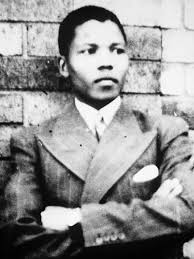
Nelson Mandela as a young man

Nelson Mandela as a young man

We shake our heads incredulously when we hear that Nelson Mandela was in jail and at hard labor for 27 years.

Twenty-seven years!  He was imprisoned just a few months before I was born, and released a few months before I married.

He came out to have a whole new life, like a butterfly breaking out of an unwanted cocoon.

The news media seems to be playing up the aspect of Nelson Mandela’s story that deals with forgiveness.

He forgave his captors.  He was not vindictive.  He believed in reconciliation.

Yes.

But I do not forgive them.  And the part of Mandela’s story I would like to focus on is his incredible perseverance in achieving his lifework of overcoming the evil of apartheid in South Africa.

Unknown

It takes great self-awareness and rock-solid confidence to maintain one’s moral compass in the face of a whole state and social apparatus set up to prove one wrong.

For example, climate activists today, like the Greenpeace 30–locked up in Russia for daring to challenge Russian drilling rights in the Arctic–need to be incredibly resolute in their insistence that we must do what we can to stop the runaway warming of the planet.

Today we have many ways of expressing our solidarity—ways that were not available to sympathizers of Mandela back in the 1960s, ‘70s and ‘80s.  We need to use these communication channels to send a solid wave of support back to those who dare to challenge today’s rulers—the fossil fuel industry, the National Security Agency, and the like.

Mandela fought the good fight and he won.  Today, our fight is not for justice in one country, but for the very survival of the human race—and so many other species—on this planet.

We owe it to the memory of Nelson Mandela to stand firm and refuse to be bullied or intimidated.  We who are fighting for a sustainable planetary future are on the side of justice and will be vindicated as such, just like Mandela, if we are not all washed away first.

Nelson Mandela was great because he never gave up.  He remained true to his own moral compass and he lived his ideals.

We must do the same today, and then some, to keep Mandela’s flame alive and burning brightly for a new day on this sad beleaguered planet of ours.

Solstice dreams–an endangered resource!

So we’ve turned the corner on Thanksgiving, and now we’re going full-throttle into “the holiday season.”

Christmas-lights-on-Fiedler-HouseHere in the Northeast, that means the dwindling hours of daylight are aggressively bolstered with burgeoning strings of Christmas lights, endless shopping trips to the mall and so many holiday parties that they all begin to blur into one long month of compulsive merrymaking, carefully manufactured to cancel out the intrinsic darkness of the shortest days of the year.

I suggest that we consider actually focusing on that quiet solstice darkness, instead of working so hard to hold it at bay with our artificial lights and nonstop motion.

It worries me to see the way kids today, including my own two sons, have a hard time relaxing enough to simply space out and enjoy the quiet of a long winter evening.

They hardly even notice the festive lights that are twinkling all around us, much less the cold, distant glitter of the stars, because their eyes are so consistently trained on the soul-less white light of their smart phone screens.

506b04f7d9127e30f00016a6._w.270_s.fit_

My younger son, age 15, never leaves home without his i-phone gripped in his hand.  When we drive together I have to prompt him to look up and take in the lovely sunset, or the crescent moon hanging low on the horizon.

If I weren’t there to nag him about looking up and taking a break from his phone, it’s possible to imagine that he might literally be glued to it all day, playing shoot-em-up games or sports games, watching mainstream TV shows and movies, or texting with his friends.

When he does take a break, he often bounces around restlessly, not sure how to amuse himself.

Just sitting and staring into space—allowing oneself the luxury of quiet unfocused space-out time—doesn’t even occur to him, so accustomed is he to constantly consuming the pre-packaged ideas of others.

Fuego del HogarI know for myself that my most creative ideas come when my brain is most relaxed and open…when I am walking in the woods, or staring aimlessly into a fire, or curled up in bed with my purring cat on my chest.

If I didn’t allow myself those unfocused moments—if I was incessantly plugged into the collective internet brain that was constantly feeding me pre-packaged stimulation—I might never have an original thought.

How sad would that be!  And multiplied out across millions of others like me, how impoverishing for humanity!  Do we really want to turn into a kind of collective species like ants, bees or termites, where the creativity of the individual is completely irrelevant?

This solstice season, I suggest you detach yourself from the busy-ness and the artificial lights for a bit, take your loved ones by the hand and see if you can all slow down for a good long while.  A whole weekend would be good, or at least a long winter’s night.

IMG_3811Find a fire to stare at.  Bundle up well and find a dark hillside from which to watch the constellations wheeling overhead.  Banish those smart phones and tablets, at least for a night, and try making some music together.  Try telling some stories, or reading a good book out loud.

Everything great that human beings have achieved has come out of the freedom of our creative dreams.  We can’t afford to let that precious dreamtime be taken away from us by our own addiction to the constant stimulation of virtual reality.

Give your overworked, over-stimulated computer brain a break this solstice and enjoy the season of darkness.  Go to bed early!  Dream!

Blessings on the blossom…

UnknownWhen I compiled the anthology Women Writing Resistance: Essays on Latin America and the Caribbean, I put an excerpt from the Puerto Rican-American writer Aurora Levins Morales right up front, because what she had to say about the invisibility of working women was so powerful.

“Let’s get one thing straight.  Puerto Rico was a woman’s country….Whatever there was to be cooked, we cooked it.  Whoever was born, we birthed and raised them.  Whatever was to be washed, we washed it….Whatever was grown, we grew it…We were never still, our hands were always busy….Ours is the work they decided to call unwork.  The tasks as necessary as air.  Not a single thing they did could have been done without us.  Not a treasure taken.  Not a crop brought in.  Not a town built up around its plaza, not a fortress manned without our cooking, cleaning, sewing, laundering, childbearing.  We have always been here, doing what had to be done.  As reliable as furniture, as supportive as their favorite sillón.  Who thanks his bed? But we are not furniture.  We are full of fire, dreams, pain, subversive laughter.  How could they not honor us?

I have to admit that never, in all my years of studying the history of the Americas, had I even noticed the absence of accounts of these women from its annals.

But it’s so true.  What famous explorer could have sailed the ocean blue without his mother and/or nurse giving him the loving care he needed to survive infancy and childhood? What town could have been built without the crucial work of women supporting its foundations?

Just as we are often blind to the crucial life-giving value of women’s work, we also have a tendency to arrogantly overlook the essential work done by the foundation of the planetary biosphere. I’m talking about PLANTS.

100_2483 copy

Without the plants—from algae and seaweeds in the ocean to trees and grasses on land—our planet would quickly become a barren desert.

Without the microbes in the water and soil digesting decayed matter and nourishing those plants, the entire food chain would collapse, with humans falling along with all other “higher” species.

IMG_1916 copy

This Thanksgiving, I want to honor and thank the marvelous plants of our planet, who silently, efficiently and ceaselessly convert sunlight and water to living tissue, and give themselves without protest to nourishing the lives of so many other species on Earth.

As we enjoy our Thanksgiving feasts, let’s remember that none of this abundance would be possible without our unsung plant kingdom heroes, and let us perhaps take a moment to sing their praises, as in this simple blessing I learned from my son’s Waldorf teacher many years ago:

Blessings on the blossom, blessings on the fruit.

Blessings on the leaf and stem, blessings on the seed and root.

IMG_4088 copy

For a more extended version of this blessing, see the Mohawk Thanksgiving prayer.

Amen.


PHOTOS COPYRIGHT JENNIFER BROWDY DE HERNANDEZ.

A Milkweed Railroad for Monarch Butterflies

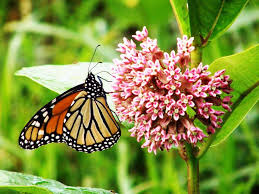
I will never forget that sun-washed September day back in the 1970s, when a Monarch butterfly landed on my finger and hung on there trustingly, resting its gaudy black-and-white polka-dotted abdomen on my warm skin.

close-up-of-monarch-butterfly-on-fingerA girl of about ten, dreamy and prone to tree-climbing and rock-sitting, I froze and observed the butterfly’s gorgeous gleaming wings, which beat back and forth slowly as it perched; and then, to my great delight, it unfurled its long, slim black tongue and began gently probing my skin, daintily sipping the beads of sweat it found there.

After a few minutes, it gave a carefree beat of its wings and caught an updraft over to a nearby stand of purple asters.  I watched it with delight, wishing it luck and Godspeed on its long migration south to Mexico, which I knew about thanks to my avid reading of Ranger Rick and National Wildlife.

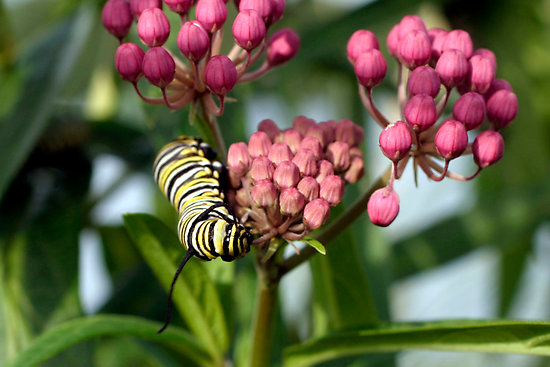
Many years later, my son, also a keen observer of the natural world, brought a Monarch butterfly caterpillar that he’d found on a stand of milkweed home to munch milkweed on our kitchen counter.

UnknownWe watched, fascinated, as the caterpillar hung itself upside down in a J-form from a branch of milkweed.  Overnight, the soft striped body of the caterpillar hardened into a glossy green cocoon, and its the rear feet solidified into a strong stem, firmly cemented to the branch.

The cocoon hung quietly, quivering now and then as the mysterious transformation took place inside.

One morning we began to see the familiar black and orange outlines of the Monarch wings coming into view just beneath the green wall of the cocoon, now turning translucent.

65207-004-57F046F4

“You’d better put it outside,” I told my son.  “We don’t want it to hatch in the house!”

He put the vase with the milkweed and the trembling cocoon out on the porch, and we left for work and school.  By the time we came back, the miracle had occurred—the cocoon had been abandoned, and the beautiful Monarch had sailed away regally, following its destiny.

images

This year not a single Monarch butterfly visited our garden, although I planted two butterfly bushes for them, and a stand of Asclepias, a whole bed full of bee balm, phlox and asters, and even left a few stubborn stalks of milkweed growing up through my roses.

“Did you see any Monarchs?” my son and I kept asking each other, knowing the answer but still hopeful.

No.

This is how extinction happens.  One year, a beloved species just doesn’t show up.  Life goes on.  But a hole opens  in the tightly stitched fabric of the ecosystem.  When there are enough holes like this, the whole fabric begins to unravel.

Jim Robbins wrote last Sunday in The New York Times:

Monarch butterflies on tree trunks

Monarch butterflies turn the forest orange. They return to a specific mountain forest in Michoacan, Mexico, year after year.

“On the first of November, when Mexicans celebrate a holiday called the Day of the Dead, some also celebrate the millions of monarch butterflies that, without fail, fly to the mountainous fir forests of central Mexico on that day. They are believed to be souls of the dead, returned.

“This year, for or the first time in memory, the monarch butterflies didn’t come, at least not on the Day of the Dead. They began to straggle in a week later than usual, in record-low numbers. Last year’s low of 60 million now seems great compared with the fewer than three million that have shown up so far this year.”

Why are the butterflies disappearing?  It’s not just the Monarchs, although these large, showy insects are among the most beloved.  I saw very few butterflies of any stripe in my garden last summer.

As with the precipitous decline in the wild bee population, the culprit is industrial agriculture.

Butterflies rely on wildflowers for their bread and butter during the summer breeding months.  For Monarchs, milkweed is especially crucial.

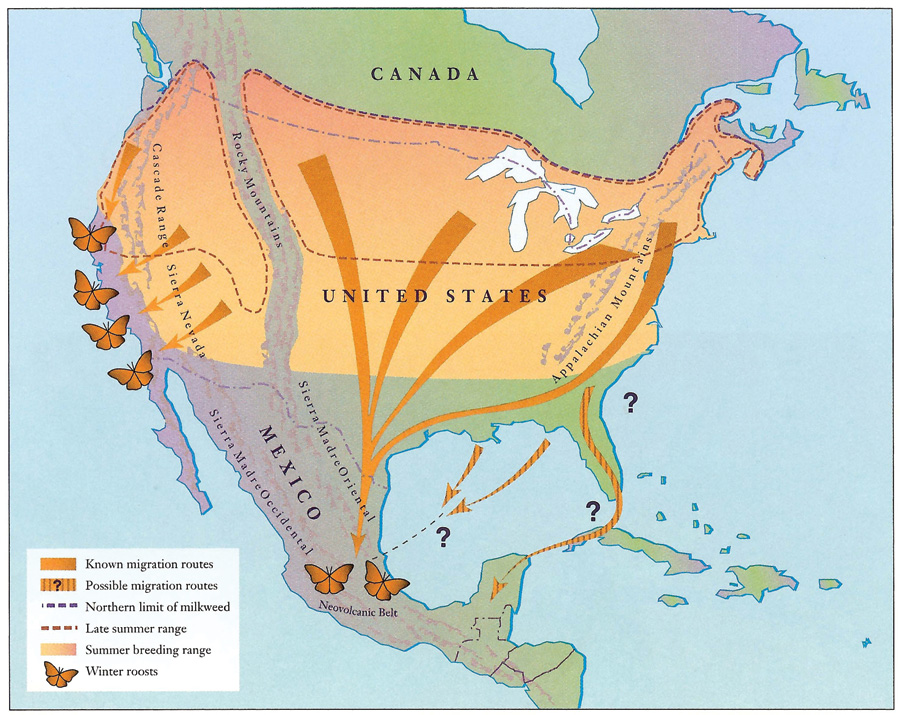
tam_map_webThe long route from the Mexican forest where they winter to their North American breeding grounds used to be lushly planted with native wildflowers like milkweed.  No single butterfly makes the round-trip from Mexico up to my garden in New England.  Rather, each generation lives long enough to lay its eggs on a convenient stand of milkweed, and those caterpillars hatch, eat their milkweed, cocoon and turn into butterflies to carry the migration on.

It’s a mysterious, miraculous process, the knowledge of the route handed down across scores, perhaps hundreds of generations each season, year after year for untold millennia.

And then human beings invented Round-up.

agriculture-impact-climate-change-monoculture-farm-photoThe tragic decline, not just in the Monarch population but in all our native insects, can be traced directly to the use of chemicals in agriculture.  The herbicide Round-up, sprayed indiscriminately on the ever-spreading farmlands of the American Midwest, kills everything except those seeds genetically engineered to withstand it.

That is, it kills everything a butterfly would need to survive.

Thanks to Round-up and all the other pesticides, herbicides and fungicides used in American agriculture—combined with suburban sprawl, golf courses, lawns, malls and parking lots—much of the U.S. has become an ecological desert, from a butterfly’s point of view.

And without the butterflies and other insects, the bird populations crash too.

The bats die off.  The run-off from these poisoned fields kills the frogs and toads.  And before we know it, that one small hole left by the disappearance of the Monarchs has turned into a gaping, hemorrhaging wound from which there is no recovery.

What can we do?

Hawthorne Valley Farm, Ghent NY--biodynamic & organic

Hawthorne Valley Farm, Ghent NY–biodynamic & organic

One thing we can do as consumers is to support organic agriculture as much as we possibly can.  Yes, it’s more expensive, but think of those extra pennies as a donation to the Save the Bees, Birds and Butterflies effort.

You can also think of buying organic as an investment in your own health.  Pesticides and herbicides build up in our bodies too—we’re at the top of the food chain after all, just like the eagles and hawks who were dying from DDT back when that poison was still being sprayed on the fields.

It’s no accident that we have a cancer epidemic in America today.  What goes around comes around.

We can also be more thoughtful in how we compose our landscapes.  Those of us who are fortunate enough to have green space around our homes can get rid of grass lawns, which are green deserts to butterflies, and plant vegetable and flower beds instead.

05517F2I often find Swallowtail butterfly caterpillars munching away on my dill in the early summer, and I’m happy to share my crop with them.

Even the big tomato hornworm, which can chomp through a whole tomato branch in a single day, is cause for celebration in my backyard, especially now that I know they turn into the spectacular sphinx moth, a daytime moth so big and fast I’ve sometimes mistaken it for a hummingbird.

Imagine a Milkweed Railroad for the Monarchs, running from their winter home in Mexico all the way up to the far reaches of their breeding grounds in Canada.

Stands of milkweed would be planted in every park in every town along the way, so that wherever the butterflies spiraled down from the high updrafts that carry them along the ancient migratory route, there would be milkweed waiting to host their eggs, feed their caterpillars and provide sturdy stalks for their cocoons.

This is not a dream.  This is how it used to be, until the last few decades when human sprawl and wanton chemical use got out of hand.

What humans broke, we can fix.  We just need to set our hearts and minds to the task of repairing the holes in the fabric of our beautiful planet.  And in tending to the planet, we’ll be tending to ourselves.

flat,550x550,075,f

Dreams of terror, dreams of peace

This morning my son came down to breakfast with a queasy look on his face.  “I had a dream that I killed a baby,” he said.  “I was shooting with a machine gun at these guys, and the baby was in the way.”

I hate the fact that this kind of violence, which kids are exposed to through the media constantly these days, creeps insidiously into their sleep, invading their dreams.

The subliminal violence is everywhere.   This same son, a 9th grader in a typical American public high school, is reading Lord of the Flies for English class and All Quiet on the Western Front for Social Studies.

Lord-of-the-Flies-1963-fi-007Lord of the Flies, you’ll remember, is about how a group of adolescent boys, turned loose on an island without any adult authority present, morph into “beasts” who bully, torture and kill one another.

All Quiet on the Western Front is about World War I, and my son’s teacher is sparing the class none of the gory details of that war; in fact, a whole section of the paper my son has to write about the book is supposed to enumerate all the challenges ordinary soldiers in that war faced, from freezing muddy trenches to disease to field amputations, rats and artillery fire.

Last month, this same teacher had the kids reading 1984 and spent a lot of class time talking about how the surveillance tactics and physical brutality in that book related to real-life episodes of torture and detention camps in the history of China and the Soviet Union.

In short, my son’s imaginative life lately has been saturated with violence, for which the peacefulness of our home is no match.  And he is one of the more sheltered boys growing up today; I do my best to keep him away from violent movies or military-style and gangster video games.  We don’t even have TV at home.

When dreams like this emerge at our breakfast table, they remind me that the apparent peacefulness of a small American town like mine is terribly fragile.

With every mass-murder shooting incident that occurs, the fine veil of civility frays just a little more.

The truth is that the United States has one of the most heavily armed civilian populations in the world.

It would not take much, in terms of social unrest, for those guns to come out and the “beastly” side of humanity to emerge, a la Lord of the Flies.

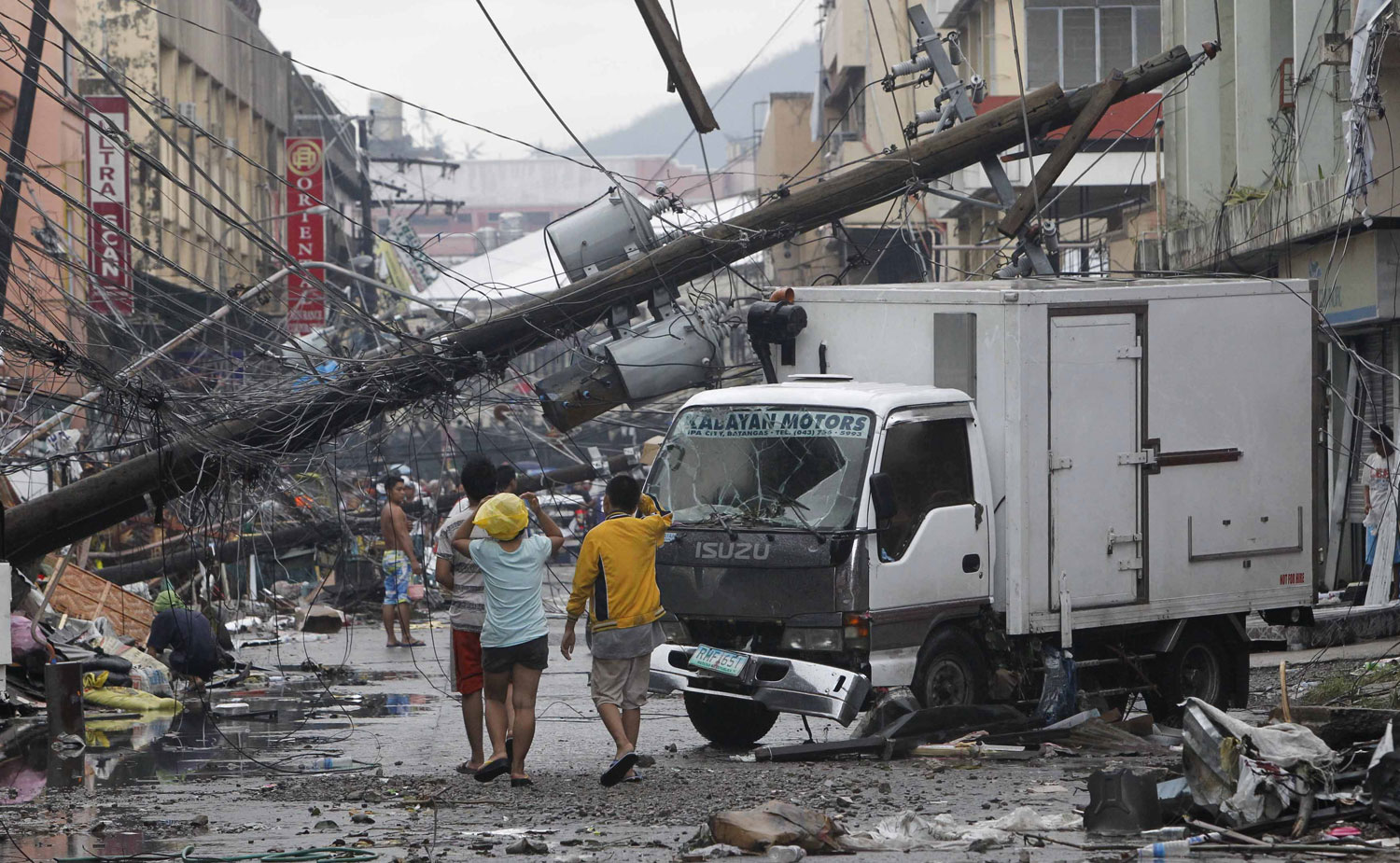
That’s what worries me when I contemplate climate change scenarios involving catastrophic storms like Haiyan that result in power outages, fuel and food shortages—which could happen here in the U.S. just as easily as anywhere else.

What we should be doing now, in the time we have left before climate change gets truly out of hand, is strengthening our bonds as communities.

Never mind the dysfunctionality of our Congress, the bashing and competitive trash-talking that too often passes for ordinary public discourse in America today.

On the local level, we can do better, and indeed we must.

Every community in America should be starting to plan for how it would respond to disruptions in power, fuel and food supplies.

We can’t rely on FEMA to ride in to the rescue.  We can’t afford to entrust our survival to the guys with the biggest guns in our area.

The Transition Town movement has it right in their focus on building strong, resilient communities and re-learning valuable pre-industrial skills.  But they need a greater sense of urgency.

My son’s dream is a warning that we ignore at our peril.  There is no time to waste.

The Civilization We Grew Up In Is Already Dead. So now what?

“If we want to learn how to live in the Anthropocene, we must first learn how to die.”

This is the last line in a fine essay by Roy Scranton, former U.S. soldier and currently a doctoral candidate in English at Princeton University.  The essay, published in the New York Times philosophy blog “The Stone,” is one of those rare attempts to really lay out the gravity of the situation we face today, as humans on a rapidly destabilizing planet.

Readers of Transition Times have been hearing me give my doom-and-gloom warnings for years now.  But it’s very rare that such grim scenarios break into the gilded precincts inhabited by readers of The New York Times.

Here is Scranton:

“The challenge the Anthropocene poses is a challenge not just to national security, to food and energy markets, or to our “way of life” — though these challenges are all real, profound, and inescapable. The greatest challenge the Anthropocene poses may be to our sense of what it means to be human.

“Within 100 years — within three to five generations — we will face average temperatures 7 degrees Fahrenheit higher than today, rising seas at least three to 10 feet higher, and worldwide shifts in crop belts, growing seasons and population centers.

“Within a thousand years, unless we stop emitting greenhouse gases wholesale right now, humans will be living in a climate the Earth hasn’t seen since the Pliocene, three million years ago, when oceans were 75 feet higher than they are today.

Aftermath of Typhoon Haiyan

Aftermath of Typhoon Haiyan

“We face the imminent collapse of the agricultural, shipping and energy networks upon which the global economy depends, a large-scale die-off in the biosphere that’s already well on its way, and our own possible extinction.

“If homo sapiens (or some genetically modified variant) survives the next millenniums, it will be survival in a world unrecognizably different from the one we have inhabited.”

Yes.  We know this.  It’s actually what Scranton does next in his essay that most interests me.

He makes a turn into the humanities, arguing that since “studying philosophy is about learning how to die,” then we have now “entered humanity’s most philosophical age — for this is precisely the problem of the Anthropocene. The rub is that now we have to learn how to die not as individuals, but as a civilization.”

Scranton reminds us that “the biggest problems the Anthropocene poses are precisely those that have always been at the root of humanistic and philosophical questioning: ‘What does it mean to be human?’ and ‘What does it mean to live?’

“In the epoch of the Anthropocene, the question of individual mortality — ‘What does my life mean in the face of death?’ — is universalized and framed in scales that boggle the imagination. What does human existence mean against 100,000 years of climate change? What does one life mean in the face of species death or the collapse of global civilization? How do we make meaningful choices in the shadow of our inevitable end?”

These are the kind of questions I ruminate about daily.  It comes back to Mary Oliver’s signature question, in her haunting poem “The Summer Day”—“What will I do with my one wild and precious life?”

We never know if our own deaths are right around the corner.  Will the truck driver around the next bend be distracted by his phone, cross the yellow line and blow me to oblivion?  Will my next physical exam reveal a terminal illness?  It could happen any time.

But as Scranton says, the climate change issue is much bigger than any of our individual lives.  It’s about the future of human civilization on the planet.

He ends his essay provocatively, saying that the problem of climate change cannot be solved by “buying a Prius, signing a treaty, or turning off the air-conditioning.” What is needed is a profound philosophical shift; to go from a civilization built on the illusion of endless growth and consumption, to a steady-state civilization that the planet can sustain.

We need to realize, Scranton says, that the human civilization all of us grew up in “is already dead. The sooner we confront this problem, and the sooner we realize there’s nothing we can do to save ourselves, the sooner we can get down to the hard work of adapting, with mortal humility, to our new reality.”

Yeb Sano breaks down speaking about the devastation in the Philippines after Typhoon Haiyan, and begs the climate negotiators to act decisively to curb carbon emissions

Yeb Sano breaks down speaking about the devastation in the Philippines after Typhoon Haiyan, and begs the climate negotiators to act decisively to curb carbon emissions

Watching the desperation on the faces and in the voices of the climate negotiators from sea-level nations like the Philippines, Bangladesh, and the Maldives, it’s clear that these folks have already absorbed the lesson we in the higher-terrain countries have yet to confront.

We cannot go on with business as usual any longer.

Not if we want to bequeath a livable Earth to our descendants.

Severn Suzuki speaking out

Severn Suzuki speaking out

Severn Suzuki said it all, so eloquently, speaking to a climate change summit way back in 1992, when she was just a girl of 12.  Are we ready to listen yet?

The Philippines Today; Where in the World is Next, Tomorrow?

The media silence before Typhoon Haiyan hit was as eerie as the sickly green calm before a violent summer tornado.

In the days while the storm churned its way across the sea to landfall in the Phillippines, only the BBC seemed to be paying attention.

Super-typhoon Haiyan

Super-typhoon Haiyan

I had that familiar tightness in the pit of my stomach, watching the satellite images of the storm’s progress.  I knew that even though there had been evacuations, this was going to be a storm of historic proportions.

And it was.

And now the American media is paying attention, but it’s the usual kind of attention, which is to say, they’re asking the usual questions: how many dead?  How many wounded?  What humanitarian relief effort is being mounted?

I had yet to hear the words CLIMATE CHANGE raised, until this afternoon—and no surprise about who uttered those words.

Bill McKibben sent one of his pithy, no-nonsense emails out to the 350.org list today.

“Lines of communication are in still in chaos, but we managed to get in touch with Zeph, our amazing 350 Southeast Asia Coordinator in the Philippines. Here’s what she just emailed to our team: “This lends urgency to our work. I think we need to be twice as strong as Typhoon Haiyan.”

Concretely, McKibben is asking us to send funds to the survivors, and here’s the link provided by 350.org for more information on humanitarian aid.

Secondly, he says, we need to raise our voices.  The link connects to a petition that will be delivered to negotiators at the UN climate summit going on right now in Warsaw (surprise surprise, I didn’t know that was going on—did you?).

With characteristic bluntness, McKibben says:

“We need to let world leaders know that their inaction is wrecking the world, and the time is long past for mere talk — we need action, and we need it now.”

UnknownPhilippine negotiator Yeb Sano, who has been working for years to persuade the developed world to act aggressively on climate change, is fasting for the two weeks of the talks until and unless countries make real commitments around climate finance and reducing emissions.

McKibben quotes Sano: “Let Poland, let Warsaw, be remembered as the place where we truly cared to stop this madness. Can humanity rise to this occasion? I still believe we can.”

Call me a fool, but I still believe we can too.  One thing is for sure, this is no time to give up.


More Info and Links, courtesy of 350.org