Pete Seeger, Still Braving the Storm

Every generation there are a few great souls that rise up so full of the sap of life that their cup brims over and carries everyone around them along with it.
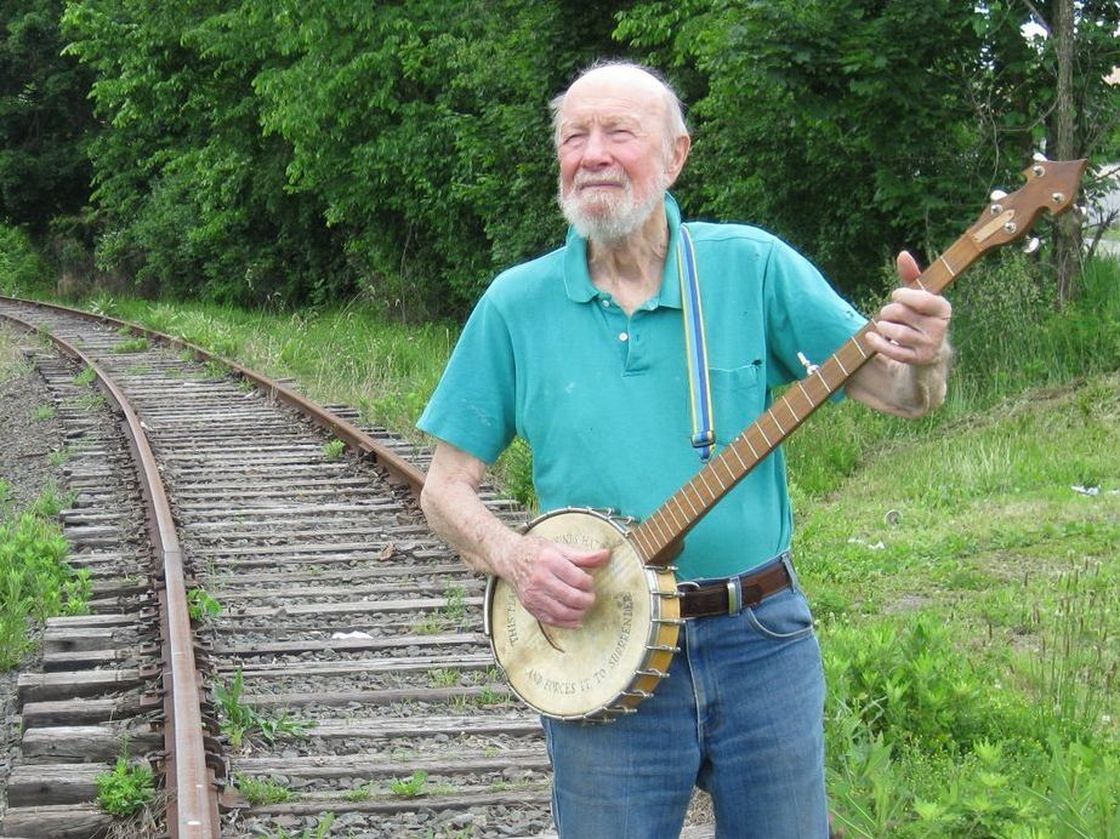
img_2137_2-photo-15Pete Seeger is one of those great souls.  Born in 1919, coming of age during the Great Depression and the American labor movement, he channeled his gift for moving others into his music, and became the voice of several generations of Americans restless with the status quo, searching for a better world.

I grew up with the songs of Pete and his soulmate Woody Guthrie, another bright flame who burned himself out after only 55 years on the planet, dying in 1967.

Pete, now 94 years old, has been steady and unwavering all these years, staying focused on social and environmental justice through all the ups and downs, through all the changes in leadership and the rise and fall of various organizations and movements.

In the iconic song about Joe Hill, the labor organizer framed on a murder charge and executed in 1915, the ghost of Joe comes back to the narrator in a dream, defiantly insisting that he “ain’t dead”:

And standing there as big as life

and smiling with his eyes.

Says Joe “What they can never kill

went on to organize,

went on to organize.”

From San Diego up to Maine,

in every mine and mill,

Where working men defend their rights,

it’s there you’ll find Joe Hill,

it’s there you’ll find Joe Hill!

Pete Seeger, still very much alive, is like Joe Hill in that his spirit seems to infuse every struggle for social justice.

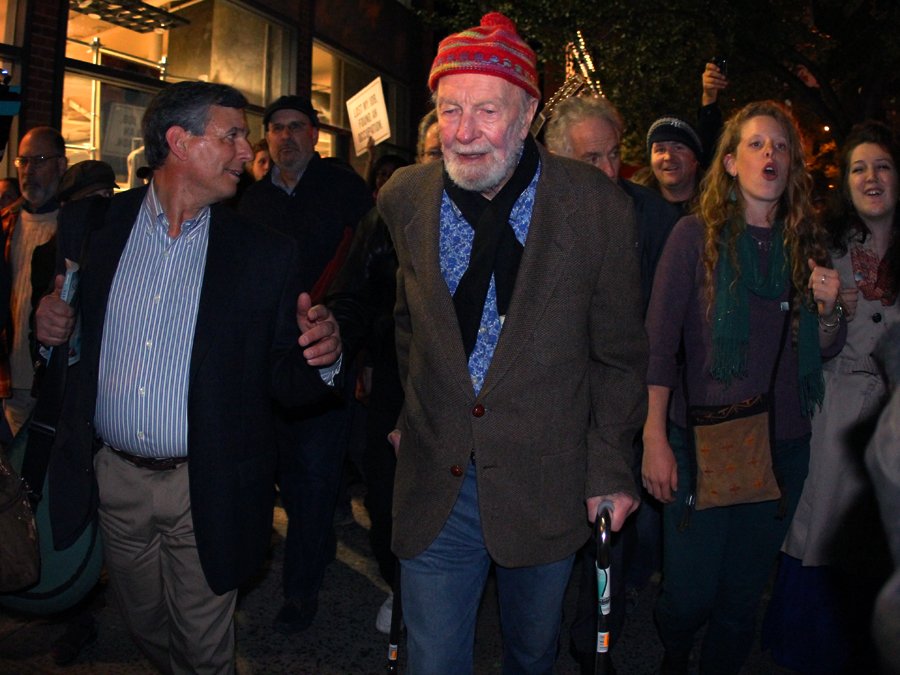
During the Occupy Wall Street movement in Fall 2011, he was there in person, galvanizing a crowd after a concert to follow him in a spontaneous march down Fifth Avenue and join him in singing a heartfelt round of “We Shall Overcome.”
here-was-tonights-special-guest-pete-seeger

His Clearwater environmental organization has become a model in inspiring communities to clean up waterways all over the nation, and indeed the world.

pete-seeger-328

Pete’s special gift is using music to inspire the best in people.

He doesn’t heckle, he doesn’t scold, he doesn’t scorn.

He just lifts up his head and his heart and seems to channel the love of the universe straight through his fingers and his vocal chords, irresistibly bringing everyone in range along with him.
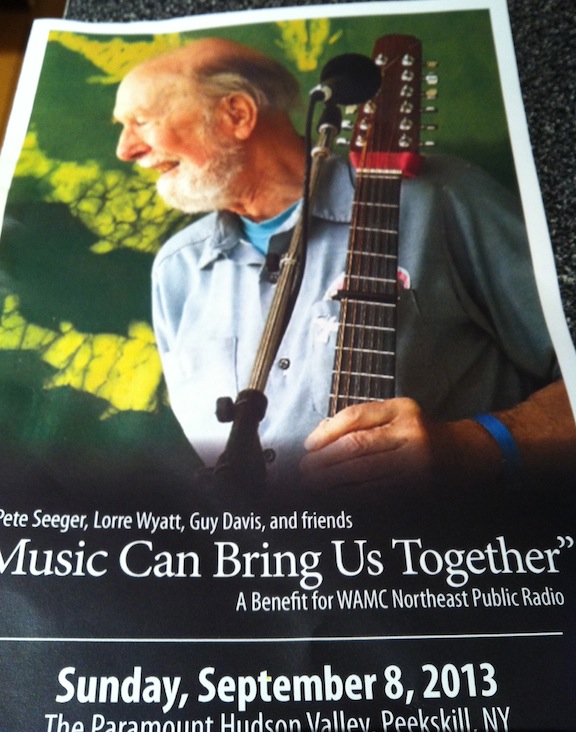
IMG_3818At a benefit concert for WAMC, Northeast Public Radio on September 8 at the Paramount Theater in Peekskill, NY, Pete’s power to inspire was undiminished, though his age is finally beginning to catch up with him in terms of his physical strength.

Nevertheless, he was onstage for a full three-hour concert, with only a brief intermission, and the delight he took in the younger people accompanying him was palpable and infectious.

For Pete, music has never been a power trip; it’s always been about creating an open-hearted place for human spirits to mingle in search of justice and beauty.

He waved off the standing ovations he received from the audience, most of whom were his longtime admirers, now going gray themselves.  He made it clear that what he had to offer was not about him, it was about the power of the music to make a positive difference in the world.

While Pete could easily have led the hall down nostalgia lane, singing all his old classics, instead he chose to give his musical partners of the day, Lorre Wyatt and Guy Davis, the chance to step in the spotlight and take a leadership role, and he took special delight in the youngsters who were singing along with him on stage.
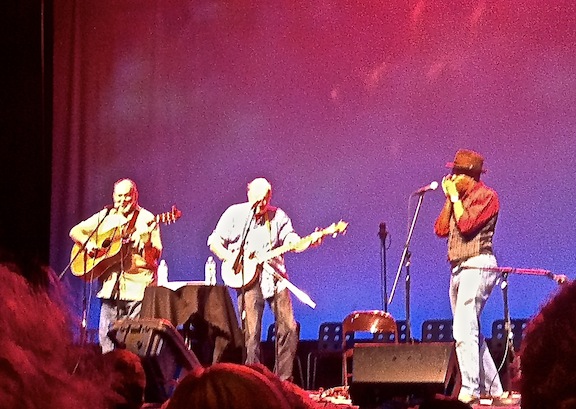
IMG_3806

Pete sang a new song by Lorre Wyatt, “Braving the Storm,” which honored change agents like Rachel Carson, Cesar Chavez and WAMC’s tireless Alan Chartock, the chorus acknowledging “You could have stayed safe and warm but you showed us the way, braving the storm—thank you for braving the storm….”

He also sang some old fighting favorites like “We Shall Overcome,” “Where Have All the Flowers Gone,” and “Turn, Turn Turn,” his voice rising loud and strong in reminding us that “there’s a time for peace, I say it’s not too late.”
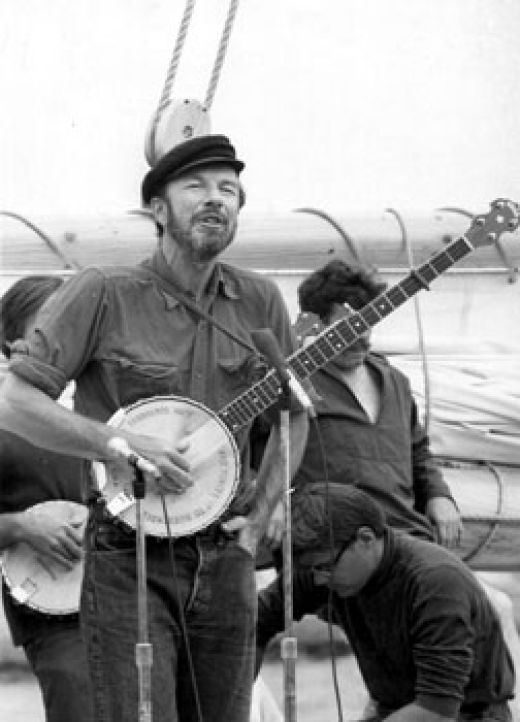
108213_f520He ended with a rousing song about the Clearwater and the Hudson River revival, reminding us that though the river has been dirty, “she’s getting cleaner every day.”

Focus on the positive, Pete seemed to be telling us—on what can be done, what should be done, what is being done to make our world a safer, saner, more loving place.  Do the work together, joyfully, singing all the while.  Have courage, be of good heart, and don’t be afraid to brave the storm, together.

Like Joe Hill, wherever people are working together for a better world, it’s there you’ll find Pete Seeger, in body and in spirit.

Thanks, Pete, for showing us the way all these years, and being a tremendously inspiring model of an elder who only grows more powerful, active and courageous with age.  We’re with you in spirit too, always!

85074216

The September 8 concert was dedicated to Pete’s late wife, Toshi, who died earlier this year.

From Syria to Sunshine

And so we find ourselves, once again, on the brink of sending our military to attack another country, about which, again, we seem to know pathetically little.

Will it be possible to perform a “surgical strike” in Syria, preventing the government armed forces from using chemical weapons without actually taking sides in the civil war?

To what extent have the “rebel forces” been infiltrated by radical Muslim fighters coming over from Afghanistan and Iran?

What are the motives of the shadowy big players looming in the background—China, Russia, Saudia Arabia, Iran, Israel?

Why has the United Nations been so silent?

But here’s the big question that no one is asking: why aren’t we working like banshees to reduce our dependence on Middle East oil?

The fact is that the sheikdoms of the Persian Gulf were insular, off-the-the-beaten track kingdoms until the advent of the modern Western addiction to oil.  It’s all about resources.

If humans replaced our dependence on fossil fuels with a dependence on the mother fuel of it all, the Sun, we would be so much better off.

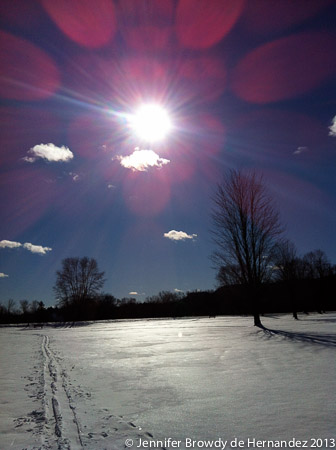
The Sun is one of those resources, like air, that is free and available to all.  Every tree, every blade of grass, every phytoplankton, benefits from the sun.  The sun plays no favorites, though sometimes clouds intervene.

If we put anything near the amount of dollars we currently put into weapons development, production, and the waging of war, into research & development of solar energy capture, storage and distribution, we would suddenly find ourselves accelerating into a whole new era of human civilization, as dramatic as the shift from coal to oil, or from horsepower to steam.

IMG_1174 copy

The Middle Eastern nations, being naturally sunny, would do fine in a new solar-based economy.

But there’s no part of our globe that is cut off from sunshine.

In fact, the sun shines in my backyard just as brightly as it does in yours.

Exxon/Mobil/BP and all the rest couldn’t lay claim to a monopoly on sunshine, although I am sure they will try to control the storage and distribution networks.

But solar is naturally inclined to egalitarian distribution.  Just as every daisy in the field and every apple on the tree has an equal claim on sunshine, so every human being is also entitled to soak up those rays.

DSCN2769 copy

Photo by Eric Hernandez

Wake up, humanity!  Wake up, Americans!  Understand that we do not have to spend our hard-earned tax dollars on war instead of peacetime priorities like education, health and social security.

Understand that the same forces that want to wage war are the ones that want to frack and drill and build pipelines to Kingdom Come.

Gone is the time when oil came gushing up out of the wells, black gold that would make us all rich.

Now oil is a fool’s gold, bankrupting the majority even while it enriches the few who control the wells, the refineries and the gas stations.

Another world is possible—a world that looks to the sun to warm us and the wind to cool us, at a fraction of the cost of the 21st century extraction of oil.

When we think about intervening in Syria, or Iraq, or Iran, or Afghanistan, or Colombia, or Venezuela, or Ecuador—understand that whatever the stated moral goal, the real reason is a very simple three-letter word: O-I-L.

To which we can respond with some very simple words of our own: S-U-N, W-I-N-D.

N-O-W.

What are we waiting for? Violence and climate change in our brave new world.

Finally, in the Sunday New York Times, a report giving empirical evidence of what we already knew intuitively, that climate change leads to violence, and that it’s going to get worse as the planet continues to warm.

For a couple of years now I’ve had a haunting premonition that violence is going to come even to the comfortable, beautiful corner of the world where I live.

We saw how fast tempers flared when Hurricane Sandy created gas shortages down in the New York metropolitan area.

What happens when our industrial food supply starts to fail, given the inevitable and already-occurring wildfires, droughts, tornados and floods?

When people get hungry, survival-of-the-fittest kicks in, and it will take serious riot police to keep order when the supermarkets run out of food.

The authors of the new report say that their findings “are particularly important for what they imply about the future. Many global climate models project global temperature increases of at least 3.6 degrees Fahrenheit (2 degrees Celsius) over the next half-century. Our results imply that if nothing changes, this rise in temperature could amplify the rate of group conflicts like civil wars by an astonishing 50 percent in many parts of the world — a frightening possibility for a planet already awash in conflict.”

Frightening indeed. What to do with this new knowledge?

The authors urge political leaders to “call for new and creative policy reforms designed to tackle the challenge of adapting to the sorts of climate conditions that breed conflict — for instance, through the development of more drought- and heat-resistant agricultural technologies.”

I hardly think that the answer lies in agricultural engineering.

In the time we have left before chaos sets in we should be re-localizing agriculture, setting up distributed energy networks and re-learning the old arts of drying, salting, canning and cold storing agricultural products.

Indian Line CSA, one of the first in the nation

Indian Line CSA, one of the first in the nation

We should also be disarming our civilian population and focusing on creating strong community networks of mutual support.

For all our cleverness, humans are just primitive beasts when our bellies are empty—primitive beasts armed, at least in Fortress America, with deadly assault weapons.

The nightmares of the Congo, Somalia and Sudan, not to mention Afghanistan, Syria and Iraq, could easily start up here too, when food is scarce and sectarian violence begins to flare.

The truth is that we can’t rely on national and international leaders to undertake meaningful “policy reforms”—not when they are being held hostage by Big Carbon, Big Ag, Big Chemical/Pharma and Big Finance.

Delusional these corporate giants may be, but they will be going down with the ship holding fast to their belief in the value of limitless human economic growth, stable climate be damned.

We who believe that another world is possible need to hold fast to our own belief that the world won’t end when those giant glass towers in financial districts worldwide go down.

We can build that new world—not through technology and arms, but through community and collaboration.  Bottom-up, not top-down.

It’s true: we are the ones we’ve been waiting for.  And given the impending climate crisis, there’s no point in waiting anymore.

Harvesting at Indian Line Farm, Berkshire County MA

Harvesting at Indian Line Farm, Berkshire County MA

I have a dream: the 20th century visions of King and Obama and the “fierce urgency” of our time

mlkihaveadreamgogoFifty years ago today Dr. Martin Luther King Jr. shared his dreams with the American nation:

“I have a dream that one day this nation will rise up and live out the true meaning of its creed: We hold these truths to be self-evident, that all men are created equal.’

“I have a dream that one day on the red hills of Georgia, the sons of former slaves and the sons of former slave owners will be able to sit down together at the table of brotherhood.

“I have a dream that one day even the state of Mississippi, a state sweltering with the heat of injustice, sweltering with the heat of oppression, will be transformed into an oasis of freedom and justice.

“I have a dream that my four little children will one day live in a nation where they will not be judged by the color of their skin but by the content of their character.

“I have a dream today!”

Today President Obama, himself the fulfillment of Dr. King’s dream, honored the legacy of the Civil Rights movement, telling us that because people in Dr. King’s generation marched for justice, “America changed. Because they marched, the civil rights law was passed. Because they marched, the voting rights law was signed. Because they marched, doors of opportunity and education swung open so their daughters and sons could finally imagine a life for themselves beyond washing somebody else’s laundry or shining somebody else’s shoes. Because they marched, city councils changed and state legislatures changed and Congress changed and, yes, eventually the White House changed.”

967-16eslj.AuSt.55

But Obama’s dream remains too limited.  He is still dreaming a 20th century dream of middle class jobs and security: the longing for a society offering  “decent wages, fair working conditions, livable housing, old age security, health and welfare measures — conditions in which families can grow, have education for their children and respect in the community.”

Such a scenario assumes the stability of the real workers of our economy: the trees and plankton that supply our oxygen and the microorganisms that make our crops grow.  It takes for granted steady, predictable rains and moderate temperatures.

We can no longer make such assumptions, and President Obama is wrong to preach to the nation as though 20th century problems and concerns were still paramount today.

Yes, the problem of the color line still exists in 21st century America.  The unemployed still need jobs.  The racial disparity in prison populations is disgraceful.  But these are not the most pressing issues of our time.

President Obama lauded the young of the 1960s for being “unconstrained by habits of fear, unconstrained by the conventions of what is. They dared to dream different and to imagine something better.”

He argued that “that same imagination, the same hunger of purpose serves in this generation.   We might not face the same dangers as 1963, but the fierce urgency of now remains.”

In fact, we face even greater dangers today than in 1963, and it was dishonest of our President not to allude to the much more serious problems now bearing down on us full force: the juggernaut of global climate change.

The wildfires burning in California this week are the among largest ever recorded in the United States.

The rate of species extinction is faster now than it ever has been in the history of human civilization.

The ice melting at the poles promises to release heat-trapping methane gas at rates not seen since prehistoric eras.

Human population is on track to reach 9 billion or more in this century, way beyond the carrying capacity of the Earth.

We don’t know where all this is leading, but surely we cannot expect positive outcomes from these dramatic planetary shifts.

These interconnected environmental issues are the great challenges of our time, and it is to them that President Obama should have alluded, if he was being honest with himself and with the American people.

Whether or not the Syrians used chemical weapons against their own people; whether or not African Americans get to the voting booth; whether or not the American middle class sinks into poverty…all this will not matter at all when accelerating climate change begins to bring food shortages even to the most cosseted Americans.

Here is what our President should have said today:

‘I have a dream that Americans will step into a leadership role in the great fight of our time, the transition to a sustainable, renewable-energy-based society.

‘I have a dream that people of all nations, all creeds and from every culture on Earth will embrace our common challenge of finding ways to mitigate human damage to the planet, and adapt to the changes that are rapidly coming our way.

‘I have a dream that men and women from all over the globe will stand together, knowing that divided we will fall, but united we have a chance to safely ride out the storms that face us.’

My own personal dream is that our political leaders will stop lying to us, and will summon us to step up to the great ethical and empirical challenge of our time: creating lifeboats on which our children and grandchildren may sail safely into a sustainable future.

Queer Visions of a Better World

Bradley Manning at work

Bradley Manning at work

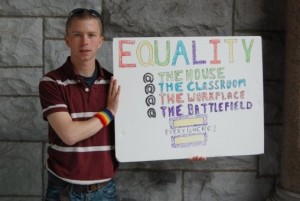
The news this week that Private Bradley Manning had come out as Chelsea made me think first that truth is way stranger than fiction, and second that it makes perfect sense that one of the most courageous warriors of our time would be a queer woman.

Gloria Anzaldua, who has been one of my heroines since I first read her seminal work Borderlands/La frontera back in the 1980s, always insisted that queer folk have a special role to play in bringing about a change in human consciousness—moving us from the patriarchal mold of the past 5,000 years or so to what she called “a new mestiza consciousness,” a much more holistic, inclusive, planetary awareness.

Anzaldua extended Virginia Woolf’s famous statement, in her anti-war tract Three Guineas, that “as a woman, I have no country.  As a woman, I want no country.  As a woman, my country is the whole world,” giving it a new queer mestiza twist:

Gloria Anzaldua

Gloria Anzaldua

“As a mestiza I have no country, my homeland cast me out; yet all countries are mine because I am every woman’s sister or potential lover.  (As a lesbian I have no race, my own people disclaim me; but I am all races because there is the queer of me in all races.)  I am cultureless because, as a feminist, I challenge the collective cultural/religious male-derived beliefs of Indo-Hispanics and Anglos; yet I am cultured because I am participating in the creation of yet another culture, a new story to explain the world and our participation in it, a new value system with images and symbols that connect us to each other and to the planet.  Soy un amasamiento, I am an act of kneading, of uniting and joining that not only has produced both a creature of darkness and a creature of light, but also a creature that questions the definitions of light and dark and gives them new meanings.”

Because queer folk have lived in their own bodies this awareness of being more—more than meets the eye, more than can be limited by any label or category—Anzaldua believed that they would be able to lead the way towards a new human civilization founded not on dominance and subordination, not on hierarchies of value, not on black-and-white binary systems, but on synthesis and what she called “a tolerance for contradictions, a tolerance for ambiguity.”

Some, like Anzaldua herself, would be called upon to become what she called nepantleras, boundary crossers and bridge builders who would go through the wounds and pain of traumatic life experiences to access courage and wisdom to lead others into a new awareness of human potential.

Chelsea Manning is such a nepantlera.

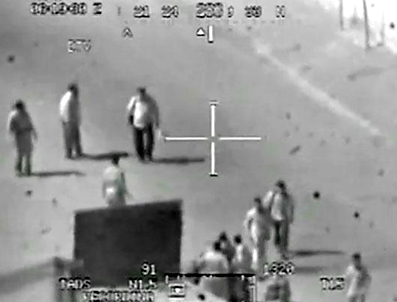
Several years ago, in a class I offered on human rights, my students and I watched, horrified, a recently leaked video called “Collateral Damage,” which clearly showed a group of American soldiers in a helicopter searching out and gunning down unarmed Iraqi civilians who were simply talking together on a quiet, sunny, bombed-out village street.

Still image from the Wikileaks Collateral Damage video--before the machine guns started

Still image from the Wikileaks Collateral Damage video–before the machine guns started

The language the soldiers used as they hunted down their targets was straight out of a violent video game, which is probably where they had learned the shoot-em up skills they displayed.  But this was no game.  Of the several men who lost their lives that day, one was a journalist on assignment for the Western media, armed only with his digital camera.

My students and I agreed that we needed to know that this kind of behavior was taking place under the banner of the American flag.  Keeping us in the dark about the reality of what was happening in Iraq, at the cost of enormous sums of taxpayer monies, was a violation of the rights of every American citizen in whose name this war was being fought.

Many obviously agree: the clip “Collateral Damage” has now been viewed more than 14 million times on You-Tube. Only because of the courage of Chelsea Manning and Julian Assange of Wikileaks, both now branded political heretics, did we find out this information.

imagesWe like to think that America is a free country, but it turns out that our freedom has very carefully regulated borders and boundaries.  We are free to dissent as long as we have a permit.

The World Wide Web knows no such boundaries.  It is truly a queer space, a space that has room for every kind of human activity and belief.  In exercising her freedom to circulate information on the Web, Chelsea Manning ran afoul of those who would try to dam the flow, controlling access to knowledge.

Some insist that it is essential that knowledge be controlled, in the name of national security, counter-terrorism, American interests, etc, etc.

It’s past time to start asking questions about whose interests are really served by restricting the free flow of information.

Are we going to become another China, where all individual freedoms are subordinate to the will of the State?  Has it already happened?

What all totalitarian states have eventually learned is that the more human beings are repressed, the more our will to resist is strengthened.

In this country, for the past few decades, our attention has been dulled by the opiates of the entertainment media, consumerism and drugs of many kinds.  A majority of us have slipped without even realizing it into a new form of labor bondage, in service to the almighty Bank, by whose credit and in whose debt we live.

During this time, the military-industrial-financial-media corporate conglomerates have grown huge and menacingly well-armed, to the point where it seems almost impossible that those of us who dare to imagine another way of living—another way of relating to the planet and to each other—might prevail.

We must not allow our vision of a better world to be limited by those who are currently in power.

We must insist on the freedom of the World Wide Web as a queer space for those who understand that “our country is the whole world.”

Chelsea Manning, I salute you!  You had the courage to shine a light into the dark corners of our government, no matter the consequences, and now you courageously step into the full measure of your own identity.

May we each learn to be so bold.

A Prayer to Mother Earth

Amazon rain forest

Amazon rain forest

In an emotional speech this week, the President Rafael Correa of Ecuador announced that he would be opening more of the country’s pristine Amazon rain forest to oil drilling, cancelling an earlier initiative to have wealthy countries fund the maintenance of a huge natural reserve.

The money simply did not come through, and Correa felt he had no other choice but to start selling oil drilling permits to the highest bidder, to keep his small country afloat.

This is terrible news for the planet.

Once again, short-term gain is being put over longterm health.

My mind immediately leaps to all the animals and people who live in that green and glowing forest, who will soon be hearing the whine of the chain saw and the roar of the bulldozer, and smelling the bitter odor of ancient oil fouling land and water.

Species we have not even met yet will perish.

Of course, this is happening every day, all over the planet.  But when you hear about yet another safety wall being breached, opening up a brand new, as-yet-untouched area to drilling, you have to stop and say a silent prayer.

A prayer to what, to whom?  What power can stop the relentless spread of our destructive species over this globe?

To me it seems clear that only Gaia herself can do it, by her usual methods—fire, flood, famine, great shaking of land and sea.  Epidemics of viruses and bacteria.  It has happened before and it will—it must—happen again.

I know I sound apocalyptic here, but apocalypse is in the air.

I don’t believe in a conventional form of afterlife, but I do believe that when we die our bodies return to the earth, and our spirits return to the energetic field of the planet.

We will return to the great dance of life in this biosphere.  Time is different there—fluid, stretched, endlessly long.  Our little human lifetimes are no more than brief flashes, like the shooting of stars against the August night sky.

Human beings do represent a great leap from the last dominant species on the planet, the dinosaurs.  But unlike the dinosaurs, when we perish it will be by our own hands—by our drills, our combustion engines and our inability to curb our own numbers.

My prayer is to our great Mother Earth, that she welcome us back into her bosom when we fall, and bring us back into the fold of endless regeneration.  If some of us humans survive the cataclysms that await, I pray we become wiser in our use of our tremendous, tragic intelligence.

We are the Albatross

Lately I have been wondering how on earth it was possible to live without plastic.

I’m not even talking about marvelous inventions like disposable contact lenses, PVC piping, or neoprene wetsuits.

I’m just thinking about my kitchen routine, and how much I rely on—and take for granted—a never-ending stream of plastic wrap, plastic bags, and plastic containers as I go about my daily business.

I am so habituated to using plastic that I really had to ponder a while on the question of alternatives, until finally I remembered glass.  Of course, my grandmothers must have had a big shelf full of glass jars that they washed and re-used to store food in.

I also remembered that back in the 1980s, when I visited my in-laws in Mexico, I was surprised to see that they did not have any plastic wrap or boxed plastic bags in their kitchen.  They put things like cold cuts on plates, covered with another plate.  They left their leftover soups, stews and rice in the cooking pots, and placed them in the refrigerator with the lids on.

It also astounded me to see that in that household of seven, with numerous friends and relatives always dropping in for a meal, there was no trash container in the kitchen.  My mother-in-law saved plastic bags that she got when she went, once every couple of weeks, to the supermarket, and used these to collect the small amount of garbage that accumulated day to day.  Their little dog ate most of the food scraps, and they just didn’t generate that much of any other kind of garbage.

Why?

Because they bought their meat and produce from the little market down the street, carrying it home in their heavy-duty mesh bags (once made of straw, by the 1980s these were made of plastic threads).  My mother-in-law had a round wire egg basket that she’d bring to the market to refill.  The poultry would come from the butcher stand wrapped in paper, and rice or beans would come in brown paper bags.

There was just hardly any packaging.  And packaging, I’ve come to realize, is what generates most of the kitchen garbage in an ordinary American household like mine.

Here in Canada, we are mandated to separate our garbage carefully.  The bottles, cans and plasticized paper containers go in one bin, the paper and cardboard in another, and the compostable items in a small bin under the sink.  Then there’s the “trash.”  That’s the one where all the miscellaneous plastic packaging and used plastic bags go, and it tends to be the most bulky.

Since I watched the marvelously poignant and persuasive film BAG IT a few weeks ago (shout out to my friend and neighbor Anni Crofut for making us dinner and sitting us down to watch the film!), I have not been able to look at plastic trash in the same way.

The film starts from a simple question: why on earth would we use as our primary disposable material an indestructible synthetic chemical known to be an endrocrine disrupter and carcinogen?

And yet we do, over and over, in vast quantities.  We buy our drinks in plastic bottles and toss the empties in the trash.  We walk out of the superstore with carts piled high with groceries packed into small plastic bags.  We bring home our carrots in one plastic bag, our potatoes in another, and if they don’t come pre-bagged, we pull off a plastic bag from the conveniently placed roll and fill it ourselves.

Most of these bags will be dumped into the trash bin by the next day, and we’ll put them out of our houses in bigger plastic trash bags, and not give another thought to what may become of them next.

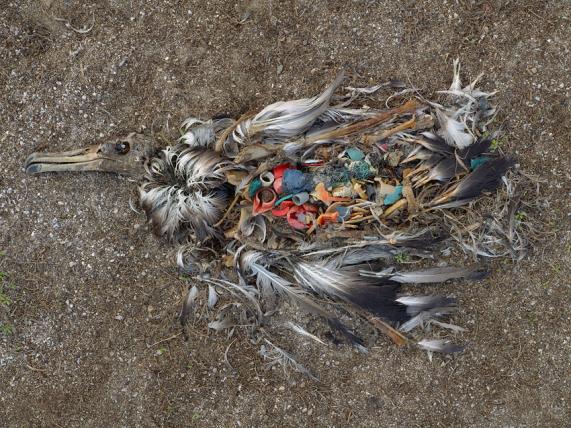
Some of our plasticized culture is being used to build huge land-fill mountains visible from space.  But a lot more of it is ending up in the oceans, where it becomes an indigestible, non-degradable part of the food chain.

These photographs by artist Chris Jordan, of dead albatross on Midway Atoll, near Hawaii, tell a tragic story.

 chrisjordan7

chrisjordan2

chrisjordan1

Look a little deeper into what’s happening to our thoughtless use and disposal of plastic, and you’ll learn about the vast gyres of rotating plastic trash out in the oceans, some as big as the state of Texas.

You’ll discover that the chemicals that compose plastic are gyrating around in human blood streams and fat as well, causing cancer and hormonal malfunction. 

American plastics are exported all over the world.  My Mexican mother-in-law now has plastic wrap and plastic bags in her kitchen, and if the plastics industry had its way, so would households from Azerbaijan to Zimbabwe and beyond.

Plastic is a fabulous, miraculous material and of course it’s not something we can imagine of doing without.  But there is such a thing as compostable plastic, made of  plant-derived chemicals that do break down again.

IMG_2956IMG_2954Once the Canadian government mandated that compost had to be disposed of in compostable bags, manufacturers like Glad stepped right up and began producing the necessary product.
It’s not even much more expensive than petroleum-based plastic bags—this box of 20 bags sells for $2.99 here in Nova Scotia, and I bet if I shopped around I could find them for less.

This is an issue where ordinary consumers can have a big impact.

We can remember to bring our reusable bags to the grocery store, including the small bags or containers for produce and bulk foods.

We can wean ourselves off plastic bottles for drinks, except on those unavoidable occasions, like in airports where we’re not allowed to bring in our own bottles of water or other liquids.

We can be much more thoughtful about our use of plastic wrap and other disposable plastics in the kitchen.

We can talk with our friends and families like my friend Anni did with me, trying to gently raise awareness.  We can even bring it up with our local government officials and see if we can get local ordinances passed banning plastic bags in supermarkets.

I am proud to say that the little town of Great Barrington, MA, where I live, is one of the first towns in the country to do just that.

The plastics industry would like nothing better than for everyone to use as much plastic as we possibly can, and throw it away just as fast.  What happens to the trash is not their concern.

But if we care about the health of our oceans, airs and land, as well as the very chemistry of our bodies, it is our concern.

And we have more power than we realize.  The fossil fuel industry depends on the docile cooperation of all of us fossil fuel addicts.  Sometimes I really think that there’s some kind of conspiracy going on between the fossil fuel, agri-chemical, pharmaceutical and insurance industries, who act as a giant many-tentacled cabal that sucks us in, addicts us to their products, and then watches complacently as we become sick and dependent on expensive tests and treatments.

We do not have to fall for this any longer!  It’s not hard to eat healthy, it’s not hard to bring your own bags to the supermarket, it’s not hard to ride your bike or at least decide to purchase a hybrid car next time around.

IMG_3145 copyWhat is hard is to isolate yourself from a contaminated natural world.  It simply can’t be done.  Our land, oceans and air are an extension of us.  We are the world, the world is us, as Joanna Macy recognized long ago.  That’s why we have to be concerned about what’s happening with the plastic trash in the oceans, or the greenhouse gases in the air, or the toxic chemicals in the soil.

The bottle caps and syringes that the poor albatross is carrying around may be bigger and easier to see, but the truth is that each of us carries an unbearable burden of toxins in our own bodies every day.

And we’re doing it to ourselves, by our own unconscious collaboration with the industries that are sickening us and our world.

It’s time to say ENOUGH, disengage ourselves from the herd, and stand up for what we know is right.  Be the change.  Be the change.

R.O.I.—From Mother Earth’s P.O.V.

imagesPeter Buffett, one of billionaire Warren Buffett’s sons, published a brave, thoughtful op-ed piece in the New York Times the other day.  In it, Buffett takes to task what he calls “the Charitable-Industrial Complex,” the philanthropic crowd who piously seek to save the world, as long as the R.O.I. is sufficiently rosy and the status quo is not upset.

Buffett knows he sounds like a class traitor here as he proffers this description of “Philanthropic Colonialism” (his term):

“As more lives and communities are destroyed by the system that creates vast amounts of wealth for the few, the more heroic it sounds to “give back.” It’s what I would call “conscience laundering” — feeling better about accumulating more than any one person could possibly need to live on by sprinkling a little around as an act of charity.

“But this just keeps the existing structure of inequality in place. The rich sleep better at night, while others get just enough to keep the pot from boiling over. Nearly every time someone feels better by doing good, on the other side of the world (or street), someone else is further locked into a system that will not allow the true flourishing of his or her nature or the opportunity to live a joyful and fulfilled life.”

Buffett says he’s “really not calling for an end to capitalism; I’m calling for humanism…. It’s time for a new operating system,” he declares. “Not a 2.0 or a 3.0, but something built from the ground up. New code.”

Buffett says that philanthropy should be dedicated to  “trying out concepts that shatter current structures and systems that have turned much of the world into one vast market. Is progress really Wi-Fi on every street corner? No. It’s when no 13-year-old girl on the planet gets sold for sex. But as long as most folks are patting themselves on the back for charitable acts, we’ve got a perpetual poverty machine.

“It’s an old story,” he concludes; “we really need a new one.”

Yes.  And philanthropy is not the only sector of our society that needs to reinvent itself.

Although I respect Buffett for his willingness to sound what will be taken as a heretical note in his own social circles (at one point he adds self-consciously “now I’m going to upset people who are wonderful folks and a few dear friends”), I don’t think he goes far enough.

I don’t want to see a merely “humanist” social system, I want to see humans develop an ecological understanding of our place and role on the planet.

I want us to repudiate our colonialist mindset, which persists not only in our tendency to give “humanitarian aid” with one hand while seizing economic control of a country’s most valuable resources with the other, but also in predatory capitalism at home and abroad—the debt bondage that the majority of people on the planet who buy into the system find themselves lashed to, laboring to pay the bank without ever being able to accumulate enough capital, social or financial, to buy their way into the promised land of security and ease.

The “new story” I’d like to see us live by would rewrite human attitudes towards other animals, insisting on the rights of every living being on this planet to a decent life.

That doesn’t mean a pig needs a condo with a swimming pool, but she does need enough space to breathe and move around in, healthy food and a clean, sanitary living environment.  Her wastes need to be disposed of the same way human wastes are—not sent into the rivers to create dead zones the size of states out in the sea.

100_2435Every aspect of the planet, from trees to minerals to water to fossil fuels, should be seen as precious resources to be safeguarded and cherished for the good of all who rely on them, not merely as sources of income for the few who sit on the boards or own stock in the mega-companies that develop, extract, exploit, and sell before moving on, leaving the devastated land as “collateral damage”— someone else’s problem.

The question is, how to get through to the corporate titans who are very happy with the status quo?

These are the folks who live their whole lives in such a fabulous cocoon of wealth and privilege that they have the illusion that they and their families can remain entirely insulated from the shocks of our poisoned, over-populated, over-heated planet.

If even in their philanthropy these people are thinking in terms of R.O.I., it must be a totally foreign concept to them to imagine conducting business in terms of gross social gain rather than gross individual profit.

Andrew Harvey, in his book The Hope: A Guide to Sacred Activism, recounts a lunch conversation he had with one such business tycoon, “the head of a major agribusiness corporation.”  The businessman chews Harvey out for being a “naïve do-gooder” who does not understand how the real world functions.

“Most of you that I have met truly believe that if the CEOs—like me, for instance—really knew what harm their corporate policies were doing, they would rend their Armani suits, fling out their Rolex-wreathed arms, burst into tears and change.  This is madness and shows how little you dare to know about what is really going on.  And how can you even begin to be effective until you understand what you are up against?

Of course, the businessman then enlightens Harvey on what he and other “naïve do-gooders” are up against in the quest to change the world for the better.

“You are up against people like me,” the man says.  “I know exactly what my company is doing and what devastation it is causing to thousands of lives.  I should know; I am running it.  I know and I do not care.  I have decided I want a grand gold-plated lifestyle and the perks and jets and houses that go with it and I will do anything—bend the law, have people ‘removed,’ bribe local governmental officials, you name it—to get what I want.  I know, too, that none of my shareholders care a rat’s ass what I do or how I do it, providing I keep them swimming in cash.”

I thought of this blunt, self-satisfied description of the view from the top of the capitalist heap when I read recently about how the American electricity industry is responding to the rising popularity of home-based solar panels.

images-1Rooftop solar panels are being compared to cell phones, which, if you remember, created a major sea change in the telecom industry.  In the end, the telecom giants made out like bandits, after initially having spent a lot of money and political capital to try to put the brakes on what was perceived as a threat to the traditional landline phone system.

Today it’s the turn of the electricity industry, which is terrified of losing market share if every homeowner can make their own energy on their own roof.

If homeowners are no longer paying the fees that subsidize the public grid, industry officials argue sanctimoniously, how will this public system be maintained?

No where in the New York Times article about this, which appeared in the Business section, was there any mention of the broader social, global benefits of distributed solar electric generation as compared to fossil fuels or nuclear electric sources.

No mention of the many reasons why every government on the planet should be encouraging homeowners and businesses to convert their energy sources to solar, along with wind, hydro and geothermal, just as fast as they possibly can.

When are the CEOs who are so busy buying off Congressional delegations and creating expensive self-advertising campaigns going to realize that what they really need to be worrying about is not thrifty homeowners taking advantage of tax incentives to install solar panels, but the mega-storms, wildfires and floods that will be coming our way every year, increasing in intensity the longer we wait to make up our minds, as a global society, to give up our addiction to fossil fuels?

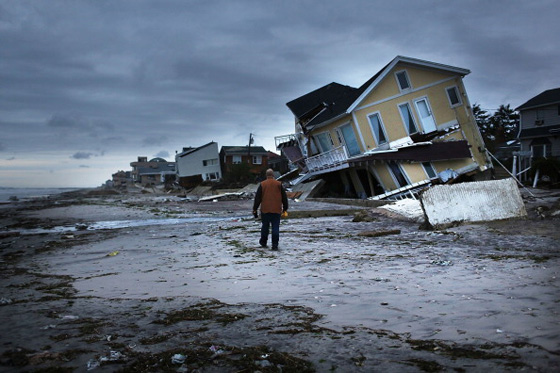
hurricane-sandy-damage

Apparently most human beings can only be swayed by self-interest.

OK—we can work with that.  It’s quite clear that it’s in the interests of every human being on the planet to develop a sustainable relationship with our Mother Earth.

If we don’t, she will just give a great shrug of her climatic shoulders and be done with us.

Where will the R.O.I. be then?

Time for change

Jen light 3 copyIf my blog posts have been a bit few and far between lately, it’s because I’ve been focusing my writing efforts this summer on the bigger project I have underway, the personal/political memoir I’ve been working on for some years now.

The political subtext will be somewhat familiar to followers of my blog these past two years: the necessity for more ordinary folks like me to wake up to the realities of climate change and environmental destruction, and begin to take action in both the personal and the political spheres.

The personal narrative will be somewhat familiar to friends and family who have followed my life, or pieces of my journey, these past 50 years.  Good moments and bad, easy stretches when everything seemed to be going right, followed by inevitable patches of heartache and turmoil.

In the course of charting my experiences in depth through this memoir project, I’ve realized that I have two qualities that have often led me into troubled waters.

One, probably because I grew up in a family with strong values of caring, respect and integrity, I have tended to be very trusting—to believe that people mean well and want to do the right thing by others.

And two, I have been slow to respond to situations that make me unhappy.  I tend to try to stick with whatever I’ve started or gotten myself into, to try make it work even when it’s become quite obvious—even to me!—that things are never going to change for the better.

I’m trying to make some connections between these personal traits of mine, and the larger social landscape that I inhabit.

For example, it seems to me that we have all tended to be too trusting of authority figures like politicians and business leaders, expecting that they have our best interests at heart.

As a kid growing up, it would never have occurred to me that corporations would produce, package and market products aimed to appeal to children, that would, over time at least, make us seriously sick.

I remember begging my mom to buy me Froot Loops and Lucky Charms breakfast cereal, which looked so yummy and appealing on TV.

I wanted Ring Dings, too, and Yodels, and Twinkies.  I wanted Coke, of course, and Dr. Pepper.  I wanted McDonald’s hamburgers, fries, and McMuffins.

I was lucky that my mom was not swayed by the seductive advertising, and went her own way with food, raising my brother and me on fresh fruits and vegetables (often grown in our own garden), premium meats, and homemade, preservative-free desserts.

Others, who bought the advertising and fell for the products, are finding themselves now, at midlife, with diabetes, cancer, asthma, arthritis and all the rest of our common American ailments.  To some degree at least, the explosion of health problems in the developed world can be directly traced back to our societal trust that Big Business, Big Agriculture and Big Government were doing their best to safeguard our health.

Turns out we needed to be more discerning—a theme that runs through both my private and public spheres.

Likewise, I can relate my own slowness to realize and respond to untenable situations in my personal life to our broader social reluctance, as human beings, to go against the flow.

Let’s face it, we humans are herd animals, as Nietzsche saw clearly more than a century ago. We run in packs, and we fear nothing so much as social isolation and disapproval.

For me personally, the kinds of situations that I’ve been slow to wake up to and act upon have been ones in which taking action means going against the grain of social expectations.

For example, my marriage.  It was very hard for me to let go of my own attachment to being married.  There are so many positive perceptions surrounding married people, while divorced people, on the other hand, are perceived as unstable, difficult, dissatisfied, disloyal, probably neurotic, bad parents, bad partners, bad lovers—in short, failures overall.

Even though some 50% of marriages in the U.S. end in divorce, these stigmas still hold a great deal of power, and for me it was hard to finally concede that I could go no further in my marriage.  After more than 20 years, I had to cry uncle and admit that yes, I had failed.  I could not make it work.

The thing is that once I got to that nadir, I didn’t care anymore what people thought, and I came to see the major life change of divorce as a positive liberation, not a failure at all.

Once I’d made the leap and let go of my inertia and fear of change, I discovered that it wasn’t nearly as hard as I’d imagined, nor were the repercussions as severe.

It turns out that most of the fears I’d had around becoming single—and a single parent—at midlife had much more to do with my own perceptions than with any reality out there in the world.

I believe that these kinds of fears in the personal realm apply just as much in the political realm.

CWindmillhome

Wind turbines on the Bay of Fundy, Nova Scotia

For instance, we know that our longterm relationship to fossil fuels is, in the words of JT, “driving us down the road to ruin,” but so many of us feel stuck, afraid to go against the tribe in seeking out new, more positive relations to energy use on the planet.

We tend to just go with the flow, running our AC on hot days, driving our cars, using our oil furnaces for heat in the winter.  Even though we’re beginning to see that this makes us unhappy—who, after all, enjoys prolonged heat waves, out-of-control wildfires, destructive storms and raging floods?—we still stick to what’s familiar, what appears to be socially acceptable, what everyone else is doing.

It’s time for each one of us to stiffen our backbones and be honest with ourselves about the situation we’re in now.

Climate change is upon us.  It’s past time to start working hard to cut carbon emissions by reducing use and switching to cleaner energy like wind, solar and geothermal.  We need to stand with 350.org and other environmental groups to pressure our government to do the right thing—to put the health and welfare of we, the people, ahead of the profits of them, the corporations.

On a personal level, too, we can also make changes.  We can use bicycles more, and AC less.  We can hang out our laundry to dry.  We can start weaning ourselves off disposable plastics, and put some raised beds in our backyards or on our rooftops.

It used to be that only “granola people” did things like this—“granola people” pronounced with a dismissive smirk.

It turns out that those crunchy folks had it right, and we’re the ones who have stayed in our unhappy fossil fuel-based relationship too long.

We may imagine that breaking with the herd and striking out alone on the path of ecological sanity is going to earn us smirks and sneers.  But a) this is probably just in our heads; and b) who cares, if it makes us happier in the long run?

Here’s what I’ve finally realized, at midlife, on both the personal and the political levels: life is way too short to waste time being unhappy if a path toward happiness is available.

Letting go of our attachment to the status quo is the crucial first step on that path, and it’s not easy.  But it is necessary now, given the critical juncture we’re at as a planet and a human civilization.

Think about it.  And then—act.

Being the change–beyond hope, beyond fear

Every time I write an exhortatory post like the last one, I imagine my readers getting to the end and clucking their tongues in frustration.

“OK, we get it, now the is time to act—but what does she want us to DO?  Doesn’t she have any practical suggestions on what to do in this terrible transition time?  Isn’t she going to lead by example?”

Well, yeah.  In relentlessly focusing my attention, and by extension my readers’ attention, on the frightening facts of environmental degradation–from climate change to toxic pollution to the precipitous decline of millions of species—I am doing something.  It may not be much, but at least it’s better than sticking my head in the sand and ignoring the gathering storm, or selfishly trying to live it up as long as possible—let the band play on!

There are many things I dream of doing, but right now simply cannot.

I cannot build myself an environmentally sustainable, off-the-grid house, nor can I pick myself up and move to an eco-village at this time.

I cannot spend all my time sitting in trees to protest logging or marching on Washington D.C. to protest inaction on climate change.

I cannot devote myself 100% to environmental communications work.

And I can’t wave my wand and stop the poles from melting, or make all the toxic chemicals just go away.

What I can do is take the strengths I’ve been given, in writing and communicating, and use them to try to spread awareness among others, in the hope that the little ripple I may be able to start will grow to a mighty wave of positive change.

***

I need to think more about this question of hope, though.

Margaret Wheatley

Margaret Wheatley

Lately I’ve been reading and re-reading Margaret Wheatley’s latest book, So Far From Home, in which she talks, rather surprisingly, about the need for activists to move beyond hope.

The problem with hoping for change, she says, is that “fear is the constant, unavoidable companion of hope. What this simply means is that I hope for a certain outcome and I’m afraid I won’t get it. I hope for a certain result and I’m fearful it won’t happen. This is the way that hope and fear are wedded together….So, it might be that the road to fearlessness is only found by giving up hope. By giving up outcomes, by giving up goals.”

This is a challenging idea.  If we give up on goals, doesn’t it mean that we give up, period?  That we just bow our heads in resignation and accept the anthropogenic destruction of our planet as inevitable?

Not according to Wheatley.

Quoting from Thomas Merton, who says that we need to “concentrate not on the results but on the value, the rightness, the truth of the work itself,” Wheatley gently asks:

“What if we could offer our work as a gift so lightly, and with so much love, that that’s really the source of fearlessness? We don’t need it to be accepted in any one way. We don’t need it to create any certain outcome. We don’t need it to be any one thing. It is in the way we offer it, that the work transforms us. It is in the way we offer our work as a gift to those we love, to those we care about, to the issues we care about. It is in the way we offer the work that we find fearlessness. Beyond hope and fear, I think, is the possibility of love.”

Could this be a kind of answer to those skeptics who would take me to task for writing about environmental issues without doing enough to be the change I want to see?

By giving myself to this work of raising the alarm, motivated by my deep love for the planet and my awareness of the inter-being of all her denizens, am I doing the work I came here to do in this lifetime?

The truth is that I don’t have much hope, anymore, that we will be able to “save the world.”  Nevertheless, I keep on writing, because writing is my way of working through and releasing myself from fear.

Having spent a lot of my life in fear, and having come to know it intimately, I can say with some authority that fear is a useless, paralyzing emotion.  Fear holds us back, it pinions our wings, it pushes us to do things we will later regret.

What we need, Wheatley says, is the clarity that resides beyond fear and its twin sister, hope.  The clarity that comes with knowing that since our time is going to come sooner or later, what’s important is how we spend each one of our days.

We need to do the work we came here to do, as well as we can, without expecting reward or recognition, without depending on external acclaim or tangible, material successes.

Beyond hope, beyond fear, I will keep going on, day to day, raising my children, doing my teaching and writing, enjoying beauty, pleasure and loving-kindness as they cross my path, and conjuring them myself in the way I live my life.  In that sense, yes, I will be the change.

100_2487 copy