Becoming part of Gaia’s cure, instead of what ails her

Milkweed-with-Monarch-ButterflyI will never forget one hot summer day when I was about eight years old, and a Monarch butterfly took it into its head to land on my arm and delicately lick up my sweat with its long, probing tongue.

I froze, wanting the Monarch to stay with me as long as possible, and watched with total fascination and delight as it balanced on my warm brown skin and enjoyed the salty treat I had to offer.

Eventually, with a graceful swish of its elegant wings, it rose up in the air and twirled off to land on a nearby stand of sweet-smelling pink milkweed flowers.

I felt blessed by the encounter, and ever after, when I see a Monarch I approach cautiously and respectfully proffer my arm, hoping to feel again the light touch of those fragile black legs and tiny tongue.

My childhood connection with Monarchs came to mind this week as I read the deeply disturbing news that “the number of monarch butterflies that completed an annual migration to their winter home in a Mexican forest sank this year to its lowest level in at least two decades, due mostly to extreme weather and changed farming practices in North America.”

Mexican conservation authorities report that “The area of forest occupied by the butterflies, once as high at 50 acres, dwindled to 2.94 acres in the annual census conducted in December,” which is “a 59 percent decline from the 7.14 acres of butterflies measured in December 2011.”

So now, along with the bats and the goldfinches and so many other species that I have known and loved in my 50 years on the planet, I must bid farewell to the Monarch butterflies too?

Carolyn Baker

Carolyn Baker

Trying to find a way to cope with the pervasive sense of grief I feel on a daily basis, I turned this week to the works of Carolyn Baker, who has self-published two books that have been striking a chord with thousands of people.

In 2009, she published Sacred Demise: Walking the Spiritual Path of Industrial Civilization’s Collapse, followed in 2011 by Navigating the Coming Chaos: A Handbook for Inner Transition.

Baker comes out of a psychology background, having served as a consulting psychotherapist for many years, but she draws on a wide range of sources that I too have been poring over in recent years, from Joanna Macy to Derrick Jensen to James Lovelock and many more.  Andrew Harvey, author of two books on “spiritual activism,” wrote the forward to her second book.

What all these folks have in common is the strong, level-headed recognition that human civilization is headed for a collapse.

The butterflies and the bats may be going first into the void, but we will not be far behind.

The current noise and controversy over questions like “to frack or not to frack,” “to build wind turbine generators or deep-sea oil rigs in the Arctic,” or “to erect solar arrays or thousand-mile oil pipelines” are just that—so much noise, which obscures our ability to focus on what is driving the debate on all these issues: the fact that our planet cannot and will not support 7 billion people at current levels of consumption.

James Lovelock

James Lovelock

The eminent eco-scientist James Lovelock, who, with Lynne Margulis, developed the theory of Earth as a complex living system he calls Gaia, has just published what may be his final book (he was born in 1919, making him now just seven years short of 100 years old).

Grimly titled The Vanishing Face of Gaia, Lovelock sadly predicts that global heating will force the die-off of much of humanity, and a retreat of the survivors to “lifeboat” places on the planet that will remain habitable on a subsistence basis for those able to live close to the land.

Lovelock uses the metaphor of disease to describe what is happening to our planet these days.  This passage is worth quoting in full:

“When we are first infected by fatal disease organisms, they grow in our bodies without our noticing.  We call this the incubation period, and it can be as long as several weeks.  Then at some stage in their growth, or in our bodily reaction to it, we feel unwell, with fever and pain.  Soon, a matter of hours with the most virulent influenza, homeostasis starts to fail and we collapse and die.  This is when physicians speak of massive organ failure.  In the whole course of fatal disease there is no tipping point but instead a downslide that starts imperceptibly and then grows ever steeper until we fall.

“We became the Earth’s infection a long and uncertain time ago when we first used fire and tools purposefully.  But it was not until about two hundred years ago that the long incubation period ended and the Industrial Revolution began; then the infection of the Earth became irreversible….

“The disease that afflicts the Earth is not just climate change—manifest by drought, heat, and an ever-rising sea.  Added to this there is the changing chemistry of the air and the oceans, and the way the sea grows acidic.  Then there is the shortage of food for all consumers of the animal kingdom.  As important is the loss of that vital biodiversity that enables the working of an ecosystem.  All these affect the working of the Earth’s operating system and are the consequences of too many people.  Individuals occasionally suffer a disease called polycythanemia, an overpopulation of red blood cells.  By analogy, Gaia’s illness could be called polyanthroponemia, where humans overpopulate until they do more harm than good” (232-33).

Lovelock sees the demise of the current terrestrial epoch as inevitable.  But he also reminds us that Gaia is a tough old planet, who has survived many other total collapses of biodiversity in her past.  “After every one of these catastrophes Gaia recovered, taking her own time—sometimes as long as millions of years,” Lovelock says.  “During these periods of convalescence there was always somewhere on Earth a refuge for living organisms, a place where the climate and the chemistry still favored life.  And so it surely will be when polyanthroponemia resolves” (235).

Lovelock faults our human tribalism and the selfish, competitive shortsightedness of a predator species for our current predicament, quoting the biologist E.O. Wilson, who said towards the end of his life, “How unfortunate that the Earth’s first intelligent social animal is a tribal carnivore” (239).

This is “our agonizing condition,” Lovelock says; “we have the intelligence to begin to expand our minds to understand life, the universe and ourselves; we can communicate and exchange our deep thoughts and keep them outside our minds as a permanent record.  We have all this but are quite unable to live with one another or with our living planet.  Our inherited urge to be fruitful and multiply and to ensure that our own tribe rules the Earth thwarts our best intentions” (240).

Lovelock ends his book by looking ahead to a mythical time in the future, when the survivors of the collapse of human civilization “evolve to become as beneficial a part of Gaia as were the photosynthesizers and the methanogens,” who “might serve within her as our brains do in each of us.  We would be an important part of what had become in effect an intelligent planet better able to sustain habitability” (248).

It is our duty, he says, as human beings living through these great Transition Times to ensure that enough of us survive to pass on our genes to the future, in the hopes that future iterations of human beings will overcome our tribalism and selfishness and put our remarkable creative intelligence to work for the good of the planet and all her denizens.

The question becomes then, what should we be doing now to prepare for the future that awaits?

This is where Carolyn Baker’s work becomes so important.  Navigating the Coming Chaos is nothing less than a workbook for inner and outer transition where the focus is on strengthening one’s resilience and connection with a sense of purpose and meaning in a world gone increasingly mad.

“I am not a survivalist,” Baker says.  “I have never believed that the prime objective in preparing for the Long Emergency is to remain alive.  None of us is enthusiastic about death, but we will all die.  To deny this fact and focus primarily on survival is to embrace the heroic perspective and, in my opinion, to miss the point….

“I believe that navigating a collapsing world will entail constant observation of various forms of death—the death of infrastructure, the death of abundance, the increasing absence of goods and services that we now take for granted, the death of institutions, the disappearance of employment and shelter, the increased scarcity of food and water, the death of landscapes and yes, the literal deaths of people and animals.  The collapse of industrial civilization and the lifestyle it has provided is a catastrophic death of a paradigm and a way of life.  While we may look ahead to the ultimate blessings unleashed by this death, it will nevertheless be traumatic to live through the magnitude of losses it will manifest.

“If, however, we can begin now to make friends with death, as the Buddhist tradition has taught for thousands of years, we may be better prepared emotionally and spiritually to navigate a civilization dying on myriad levels….

“Simply put, the essential question is not: How can I survive the collapse of industrial civilization?  But rather: Why am I here, right now, in this place, at this time, experiencing the end of the world as I and my species have known it? (166).

Much of Baker’s book, like Starhawk’s most recent book The Empowerment Manual, is dedicated to prompting self-reflection leading to the recognition of what we are here on this Earth to do—and how we can successfully work with other awakened humans to accomplish our purpose.

The biggest challenge seems to be how to learn to work together harmoniously with each other and with the other living elements of our planetary home.

Gaia callingFor me, it seems clear that what I need to be doing now is to rekindle the instinctive sense of kinship I had with the natural world as a little girl; to find ways to become a channel for the love I felt, and still feel, for the gaudy Monarch butterflies who sailed regally through the fields of my childhood.

Sooner or later I will be following them into oblivion. But let it not be before I’ve had a chance to do my utmost to wake up my fellow travelers on this planet to the state of emergency we now face, and to help create the community structures that will enable at least a critical few of us to survive into the distant future.

Morning pages for humanity…and the Earth

Julia Cameron

Julia Cameron

This week, in preparation for Julia Cameron’s presentation at the Berkshire Festival of Women Writers, I have been doing quite a bit of thinking about creativity.

Cameron’s great insight, back in the late 1980s when she was doing the teaching that led to her blockbuster creativity self-help guide The Artist’s Way, was that human beings are all naturally creative.  We just tend to get “blocked” by our upbringing, and need to work on ourselves in a systematic way to unlearn bad habits of self-doubt and defeatism, so that our creative juices can flow freely out into the world.

One question I wish I’d asked Julia at her lecture last night at Kripalu is this: I wonder whether women have any particular creative challenges, different from those faced by men?

The Artist’s Way does not seem to draw any distinction. Cameron uses the gender-neutral term “creatives” and her examples are drawn from the experiences of both men and women.

And yet it seems to me that women are particularly susceptible to the kind of distraction, hyperactive multi-tasking and withering self-doubt that Cameron says are anathema to artists.

One woman in the audience at Cameron’s lecture described herself as “frantic,” or maybe she said “panicked,” facing such a huge to-do list of projects she’d like to accomplish that she was paralyzed by the enormity of it all.

Julia’s response was characteristically calm and pragmatic: slow down, write your morning pages faithfully, ask for guidance from your higher self, and be patient—it will come.

This is certainly good advice for anyone who wants to accomplish creative goals, but it seems especially relevant for me, and all the busy women like me who so often do not take the time out for ourselves, to recharge our own creative batteries.

Cameron’s “morning pages” are deliberately unfocused.  They are not meant to be a to-do list, or an outline for a project, or a mission statement.  They are simply meant to provide a regular, rhythmic opening for the creative spirit, which Cameron clearly conceptualizes as coming from a higher source.

“I learned to turn my creativity over to the only god I could believe in, the god of creativity,” she says in The Artist’s Way, “the life force Dylan Thomas called “the force that through the green fuse drives the flower.”

By allowing ourselves the time and space to be open to the creative life force that gave birth to us, we are allowing ourselves to become channels through which those creative juices can flow out into the world, manifesting all in kinds of ways, depending on our particular gifts.

As Cameron said last night, this can sound a bit “woo-woo.”

But the life force is in a way the final frontier for human understanding, the one mystery we still have not been able to penetrate via science.

We argue about when life begins—at conception?  in utero?  at birth?—and we recognize that there seems to be much more to the universe than we can measure with our physical senses or scientific instruments.

We know in an intuitive way that when we are “in the flow,” allowing ourselves to be creative channels, things can start happening that seem entirely beyond our control, and not at all coincidental.

Julia Cameron calls this synchronicity: “we change, and the universe furthers and expands that change….It is my experience both as an artist and as a teacher that when we move out on faith into the act of creation,” she says, “the universe is able to advance.”

The thing is that not all creations are equal.

Human creativity is not always a good thing.

It’s fair to say that over the past 500 years, since the Catholic Inquisition began its war on the older, nature-based religions and the European powers began their colonial assault on the rest of the world, the dominant paradigm of human creativity on the planet has been materialistic, channeled by our rulers into paths shaped by greed and lust.

Domination and aggression have driven the leading edges of human invention: we have proven very adept at creating guns, machinery and synthetic chemicals, haven’t we?

We have also created a might-makes-right philosophy that has literally bulldozed away any impediments to the harnessing of the natural resources of our planet, including the vast majority of humankind, in the service of short-term gain for the elite.

But at the same time, human creativity has always flowered anew, with each new generation having the potential to choose a different way of channeling that divine universal flow.

We stand at a juncture in history when it seems that the planet is poised to hit the evolutionary reset button, sweeping human beings away to make room for the emergence of new physical vessels for its irrepressible life force.

I believe there is still time for human beings to come to our collective senses and begin to shape our creative output into inventions and ethical paradigms that support and enhance life, rather than torture and destroy it.

I worry about the role the media plays today in limiting and predefining children’s creative imagination.  Little children who used to spend hours playing pretend games, making up elaborate stories complete with visualizations and acting, now spend those same hours playing violent video games or passively watching commercial television, with its monotonous message that consumption equals happiness.

But I take heart from the teenagers I teach, who continually show themselves able to see through the mesmerizing power of the media and think creatively for themselves.

We human beings all need to be doing our “morning pages” in these crucial final years of the modern era, seeking to tap into the “pure positive energy of the universe” and open ourselves to the possibility of different, more harmonious and balanced creative forms.

Because I believe that women have an important role to play in this shift, I am totally dedicated to the work I’m undertaking in this month’s Berkshire Festival of Women Writers, opening up lots of opportunities for women to share their creative visions.

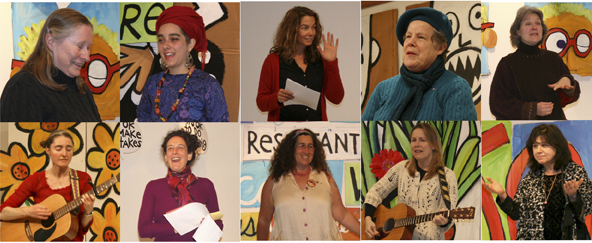
Women sharing their creative visions at the Deb Koffman open mic in Housatonic, MA

Women sharing their creative visions at the Deb Koffman open mic in Housatonic, MA

This is not just about women writers patting each other on the back and trying to advance our individual careers.

This is about women forming what Julia Cameron unabashedly calls “Sacred Circles” to propel humanity beyond the destructive domination-and-extraction model of the human relationship to our Mother Earth.

Next year’s Festival will have a special focus on women, creativity and environmental sustainability, to help us train our focus on the most urgent matter at hand: the destruction and contamination of the planet, with the resulting drastic climate change shifts that are coming in this century no matter what we do now.

Women and men worldwide need to rise to this challenge with every ounce of our creative energies.  On this International Women’s Day, 2013, I call on women, especially, to make a commitment to using our creative power for the good of the planet and all her denizens.

We need new stories to help us imagine a new, brighter future

Will someone please do the math on how adding thousands of Americans to the unemployment rolls, thanks to the new “sequester,” is going to save the country money?

Not only will we (as in, we the taxpayers supporting the Federal government) be paying unemployment compensation for those folks, but their communities will also be suffering as they cut back on personal spending…perhaps lose their cars or their homes…and end up needing a lot more in the way of social services.

Sometimes when I check in with American politics, I have to wonder who is writing the scripts.

President Obama sailed into office in 2008 promising that as an outsider to Beltway machinations, he would champion the ordinary American and set the country on a kinder, more humane path.

The Republicans, perhaps rightly, read his conciliatory gestures as weakness, and have taken the bully’s path of stonewalling, denunciation and manipulation of the truth.

Presidential Inauguration, 2013

Presidential Inauguration, 2013

Speaker Boehner’s sour face as he sat behind the President on Inauguration Day this year said it all.  He would not—could not—cooperate in any way with our country’s popularly elected leader.  Not even if his obstinacy brought America to its knees.

The whole scenario was eerily reminiscent of the script from the one-season TV show Commander in Chief, starring Geena Davis as the first woman President of the United States.

She too was pitted against a demonic Speaker, who would stop at nothing to discredit, provoke and undermine her, even if his reckless bullying endangered the welfare of the country overall.

Interestingly, Commander in Chief was cancelled after just one season, just as Ms. Davis’s character, President Mackenzie Allen, was gearing up to run for re-election against—of course—her nemesis, the Speaker of the House.

At the time the explanation given for the cancellation was that audiences were not yet ready for a woman President (the show ran in 2005-06).

But watching the first 18 episodes again recently, it was clear that what really did it in was the daring script, which showed a powerful woman POTUS who was a popular Independent determined to stand up for ordinary Americans and to keep her hands clean of the usual muck of party politics.

Geena Davis as Mackenzie Allen, President of the United States

Geena Davis as Mackenzie Allen, President of the United States

In the last couple of episodes, President Allen decides to champion the Equal Rights Amendment for women, which still to this day has not been ratified by enough states to make it federal law.

Her political advisor tells her it’s suicidal to touch that hot potato if she’s seriously thinking about running for a second term, but she’ll have none of his cynical advice, and indeed ends up summarily firing him.

Could it be that the TV Gods cancelled Commander in Chief precisely because the show demonstrated that there is no reason why our country has to be held hostage to the Republicans—or the Democrats?

11-geena-davis-commander-in-chief-2005-2006Did they cancel the show because it showed that there is no reason why a woman can’t govern with equal or greater smarts, decisiveness and wisdom as a man—even as she remains a loving mother, wife and daughter?

President Allen was shown in every episode facing down stereotypes, garnering the respect of even her crustiest generals and most ruthless homeland security czars.

And the more she succeeds, the more ordinary people applaud and support her, the more determined her political adversaries become to take her down.

The show didn’t end with a bullet to her head; it didn’t have to.  It just got struck from the airwaves by one wave of a TV executive’s red pen.

So ended the daring career of the nation’s first television representation of a woman President of the United States.

***

Cronogram-BFWW-ad-webThis week I have been busy preparing for the opening of the Berkshire Festival of Women Writers, a month-long, grassroots, homegrown Festival that I founded three years ago to give women writers more opportunities to raise our voices in the public sphere.

My whole professional career has been dedicated to this mission of amplifying the voices of women writers, bringing them into classrooms and conference halls, into print and on to stages, because I firmly believe that if women had more power in the world, we would change human society for the better.

Gender is a spectrum: all men and women have both estrogen and testosterone pumping through our hearts, and all of us need to call on both the warrior energy of testosterone and the nurturing energy of estrogen to heal our damaged planet and create a stronger, wiser, more sustainable human civilization.

We cannot afford to wait for our political leaders to grow up and stop playing games with our future, and the future of our children.

We have to each do what we can, in our own spheres, to balance out the bullying and the guns and the lack of compassionate imagination with new stories, different voices speaking a different truth into being.

For me this means shutting out the cacophony of political heckling and sniping and tuning into the voices of the women of my community and our invited guests during this Festival month, as together we change the tenor of public discourse by daring to step out on stage and speak our truths to power.

No matter what happens down in Washington D.C.—no matter if our political representatives continue to lick the boots of the oil and gas industries, build billion-dollar fighter planes instead of mass transit, kick our veterans and young people to the gutter, deny women equal pay for equal work and make young women fight for the right to say no to pregnancy—we still have something they cannot take away from us.

We have our capacity for independent thought and we have our voices.

We must rise to the occasion and write our own scripts, bridges of words and dreams that will carry us into a livable future.

Great Barrington Select Board representative and author Alana Chernila reads her work--an open letter to Fox News anchor Bill O'Reilly--on opening night of the Berkshire Festival of Women Writers (3-1-13)

Great Barrington Select Board representative and author Alana Chernila reads her work–an open letter to Fox News anchor Bill O’Reilly–on opening night of the Berkshire Festival of Women Writers (3-1-13). Author Janet Reich Elsbach looks on.

Holding the Fort for the Humanities

Michael Berube

Michael Berube

In a recent address to the American Council on Graduate Schools, out-going Modern Language Association president Michael Bérubé argues trenchantly that American graduate education in the humanities is in a state of crisis, and in urgent need of structural revision.

But to my mind, he does not go nearly far enough in his thinking.

“Graduate programs in the humanities have been designed precisely to replenish the ranks of the professoriate; that is why they have such a strong research component, also known as the dissertation,” Bérubé says.

But “the overall job system in the humanities has been in a state of more or less permanent distress for more than 40 years,” with doctoral programs “producing many more job candidates than there are jobs; and yet this is not entirely a supply-side problem, because over those 40 years, academic jobs themselves have changed radically. Of the 1.5 million people now employed in the profession of college teaching, more than one million are teaching off the tenure track, with no hope or expectation of ever winding up on the tenure track.”

So, he asks, how can we, in good conscience, continue to encourage students to enter graduate programs in the humanities, knowing the grim future that awaits most of them?

Bérubé reminds us that “the study of the humanities is more vibrant, more exciting, and (dare I say it) more important than it was a generation ago….The sheer intellectual excitement of the work, whether it is on globalization or subjectivity or translation or sustainability or disability, is one thing. This work is so valuable—and it offers such sophisticated and necessary accounts of what “value” is.

“And yet when we look at the public reputation of the humanities; when we compare the dilapidated Humanities Cottage on campus with the new $225-million Millennium Science Complex (that’s a real example, from my home institution); when we look at the academic job market for humanists, we can’t avoid the conclusion that the value of the work we do, and the way we theorize value, simply isn’t valued by very many people, on campus or off.”

Unfortunately, Bérubé doesn’t bring up the deeper questions about why our society currently values science and business so much more highly than the humanities.

Why is it that professors in the humanities make a fraction of what professors in business, law or science earn?

Why is it that academic programs in the humanities are under constant threat of the budget ax, while programs in business and science continue to attract huge inputs of resources?

Is it any surprise that students take a look at the depressed adjunct faculty in their dingy offices and take the nearest exit for the shiny new science building?

To me it’s pretty obvious: in our capitalist society, the academic fields that are most highly valued are those that create the possibility of more profit—with profit crudely conceived of as dollars in the bank.

My work in the field of comparative literature over the past 20 years, for example, has little to show for it in terms of money in the bank.

I’ve been focused on bringing the voices of marginalized or lesser-known women writers and activists to wider audiences within and outside of the Ivory Tower, because I believe that the perspectives offered by these women writers bring important, under-recognized and certainly under-valued ideas to the intellectual table.

For example, writers I study, like Rigoberta Menchu (technically not a “writer,” as her texts are transcriptions of her oral testimony), Vandana Shiva, Audre Lorde and Gloria Anzaldua, have been arguing for many years that human society must begin to honor our differences and value our interconnections with each other and with the natural world, in order to create a just and sustainable society.

Lorde, long ago, recognized that the “masters” are interested in keeping the oppressed divided, competitive, fighting with each other for the crumbs.  She urged us to think outside the box, “for the master’s tools will never dismantle the master’s house.”

The truth is that the humanities are dangerous ground for the “masters” of Euramerican society, because it is in the various academic terrains of the humanities that moral and human values are debated and interrogated.

It is no accident that critiques of capitalism itself, along with capitalist tools like elitism, militarism and globalization, have found their strongest purchase in the humanities.

Humanists who follow the lines of intellectual inquiry stretching back to the dawn of human written traditions and forward into the speculative reaches of science fiction and futurism, often find ourselves thinking outside the box of the current capitalist structures into which we have been born and indoctrinated to accept.

The moral questions raised in many humanities classrooms are themselves alternatives to “the master’s tools,” and they have the potential to dismantle the master’s house.

That is why, I believe, the humanities are currently being starved and derided by the masters.

That is why adjuncts in the humanities are being paid less than a living wage, discouraging the best and brightest from choosing that educational and career path—unless they are independently wealthy.

Bérubé ends his speech by suggesting that graduate programs in the humanities need to begin to combine the traditional focus on research, writing and teaching with the development of skills and connections that can help Ph.D.s secure good jobs outside of the professoriate, since he does not foresee any change to the current trend of an overwhelmingly low-paid, adjunct humanities workforce.

He points to the “digital humanities” as a prospect, since highly trained academics who can translate their knowledge into digital formats are more likely to find work in business, publishing or media.

I wish he would think a bit more radically.

As one of the humanities thought leaders of our time, I would like to see him come out and say that the deep questions of the humanities–questions about society, ethics and social and ecological justice–are precisely the ones that we need to be asking most urgently today, whether the masters like it and support it or not.

I know, up close and personal, how hard it is to wage this lonely battle, watching all the honors and riches going to colleagues who are willing to do the masters’ bidding more compliantly.

Sure, biotechnologists and creative financiers are going to get more funding and more accolades than someone like me, who studies ethics via personal narratives by little-known women writers.

But in the long run—or what is increasingly, in our era of climate change, seeming like the short run!—I believe that the wisdom these women have to offer will be more important than the latest patent on bio-engineered corn, or the most ingenious restructuring of debt derivatives.

Humanities education is one of the last outposts of oppositional thinking within the Academy.

Let’s hold our positions with honor, knowing that even if the material rewards are scant, we do get to keep our integrity, and do our best on behalf of the planet and all its denizens.

Climate change is no joke

What a totally spurious pro-Keystone pipeline column from Joe Nocera in the New York Times today!  He doesn’t even bother to mention the 35,000-plus people who turned out in Washington to protest, focusing instead on “boneheaded” Bill McKibben and James Hansen and others who got themselves arrested at the White House last week as though that were the end of the story of citizen protest of this issue.

He dismisses the idea of a carbon tax on fossil fuel companies as ineffective, arguing, inexplicably, that this would “make expensive tar sands more viable.”  Huh?  Is anyone fact-checking this columnist, NYT?

“If you really want to eliminate expensive new fossil fuel sources, the best way is to lower the price of oil, which would render them uneconomical.”  Anyone follow that logic?

Nocera does not once mention the real reason for the protest against the tar sands extraction, which is the environmental hazards, from toxic waterways to exponential increase in the greenhouse gases causing global heating.  If that isn’t an insidious, dishonest omission, I don’t know what would be.

His only mention of climate change is dismissive: “Like it or not, fossil fuels are going to remain the dominant energy source for the foreseeable future, and we are far better off getting our oil from Canada than, say, Venezuela.  And the climate change effects of tar sands oil are, all in all, pretty small.”

There are so many things wrong in this sentence I hardly know where to start, and most of my readers probably can do the parsing themselves anyway.

The truth is that if, as Joe would have it, “fossil fuels are going to remain the dominant energy source for the foreseeable future,” then our foreseeable future is going to be very brief.

Yesterday while in DC I went back to the Smithsonian Museum of Natural History to see the Human Origins exhibit, which is, strangely enough, funded by the climate-change denying billionaire Koch brothers.

Once again I lingered at the opening display, a huge poster depicting the changes in Earth’s climate over the past few hundred thousand years, showing how the swings between extremes of hot and cold forced our ancestors to adapt or die.

The last inch or so of the immense timeline (I’m guessing it’s 12 feet wide) shows the last 10,000 years, the era of homo sapiens.  The swings between hot and cold get more jagged as we get closer to the present, with the last hundred years–a mere quarter-inch of the vast scale of human history–showing aggressive upward spikes of heat.

There is no mistaking the message of this chart.  We are now in a period of rapidly escalating climate change.  If we don’t adapt just as rapidly, a major correction to our population will ensue. Millions, even billions of humans may die off, very much in the “foreseeable future.”

For those left to tell the tale, one thing is for sure: the Keystone Pipeline, rusting and derelict on the western plains, will be a less-than-useless monument to the immense folly of men like Joe Nocera, who thought climate change was just a joke.

Dispatch from the heart of the American clean energy movement


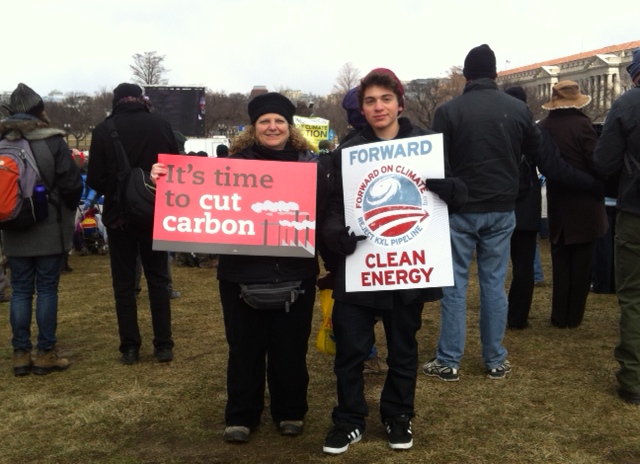
My son Eric and I at the rally

My son Eric and I at the rally

On this cold, blustery day in Washington D.C., thousands of people braved the elements to send a resounding message that we will not stand idly by and let Big Oil continue to run the great ship Earth straight on to the reef of global heating.

Although my body feels battered and tense from standing clenched against the wind so many hours, my physical discomforts pale beside the sheer joy of the memories of today’s climate rally.

The most exciting part was when the whole huge, enthusiastic, orderly crowd began marching from the meet-up point by the Washington Monument, signs and banners and flags flying high, drumbeats and chants rising up into the clear sky above Washington, winding ourselves into a huge coiling serpent wrapping itself around the White House, parading and prancing and stomping and making all the joyful news we could as we passed by the iron gates under the watchful eyes of security.

On the march!

On the march!

It was somewhat deflating to know that the President was not home–and even worse to get word that he was golfing in Florida, no less (my regular readers will recall how much I detest golf courses and consider them symbolic of all that is wrong with humanity’s relation to the natural world).

But it was gratifying to see the media out in fairly substantial numbers covering the march; many, many video cameras were rolling and iphones were snapping and people were even wandering around the crowd doing spot interviews about what had drawn the protestors to DC this fine, cold Sunday.

I think I can speak for many when I say that what drew us out was a deep concern for our planet, and a desire to draw a line in the sand–in this case, the Keystone XL serving as that iconic line–to indicate our opposition to the continued rape and pillage of our Mother Earth.

No more impunity! If the fossil fuel magnates win this round and the Keystone is built, let it not be with impunity. Let our whote-hearted opposition to this misguided investment be duly registered in Washington, today and at re-election time next November.

At one point today as the wind whipped over the crowd the speaker observed wryly that “we like wind!” and everyone waved their “Forward with Clean Energy!” signs vigorously and laughed.

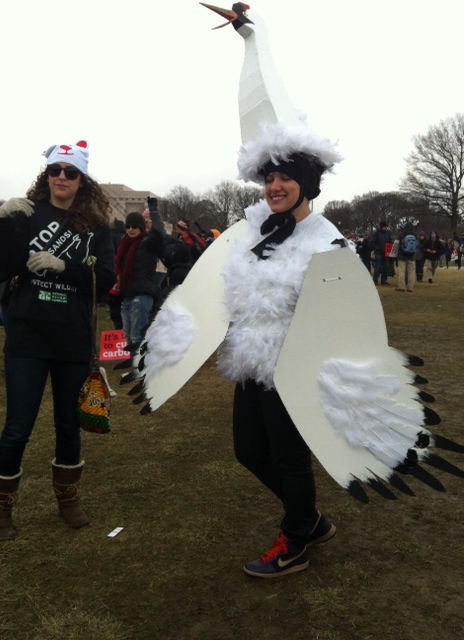
Standing up for the Sandhill Cranes of North Dakota!

Standing up for the Sandhill Cranes of North Dakota!

A small tribe of seagulls circled overhead for a while, wondering if there would be potato chips on offer at this gathering, and a young woman dressed in a lifesize Sandhill Crane outfit poked her long, elegant neck way above the crowd.

The gong has rung to signal the start of another round in the long struggle for a transition to a sustainable human relationship with the planet.

A good 35,000 people turned out today to tell the President and Congress, loud and clear, that we want real action on the climate disaster-in-the-making, and we want it to start RIGHT NOW.

If the New York Times is any indication of whether those in the mainstream halls of power are getting our message, the prospects look good, because the front-page story this evening is precisely about the Keystone XL issue and today’s big rally.

We the people do have the power to direct our elected officials to safeguard our interests. Our interests, not the corporate “persons'” interests.

As the chant went in the march today, “This is what democracy looks like!”

YES!

r-RALLY-huge

Postscript, President’s Day 2013:

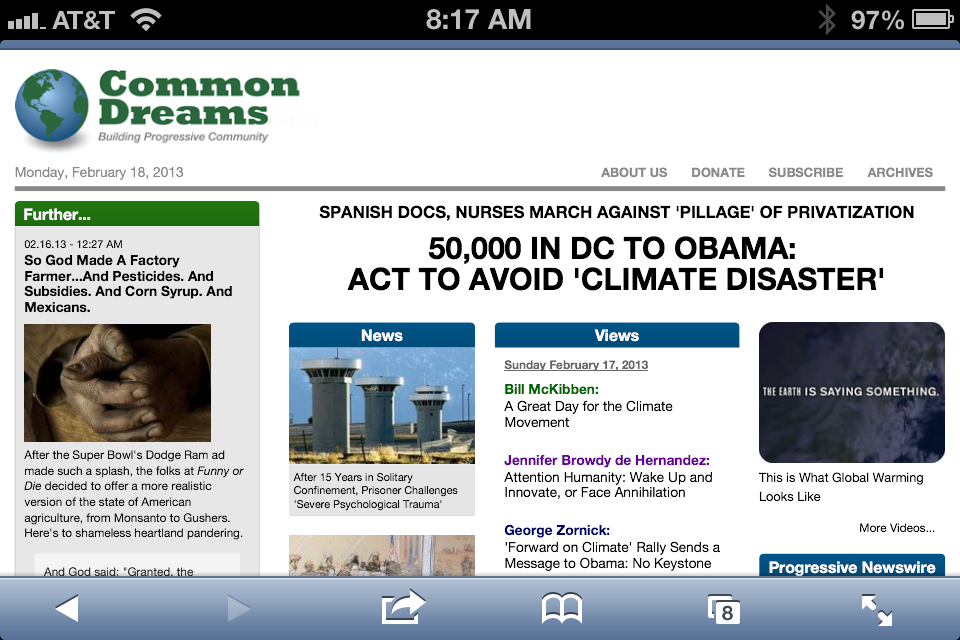
Even the MSM press was on to this rally!  The New York Times covered it, as did The Washington Post.  HuffPost Green did a good job, and of course we could count on Common Dreams to be one of the first to cover Bill McKibben’s victory speech at the end of the day!  Right next to yours truly, I am truly honored to say.

photo

Attention humanity: wake up and innovate, or face annihilation

I am going to Washington DC this weekend to stand up for the planet.

I have never been much of a protest person.  I didn’t even go down to New York for the Occupy protests, although I followed them avidly on Livestream.

First of all, I hate crowds.  My element is alone, among the trees, or out on a deserted beach somewhere.

And I always had the feeling that one small body more or less could not possibly make a difference to whatever cause was being advocated.

I thought I’d be more useful as an active observer on the sidelines, using my writing and teaching to amplify the message.

But this time is different.

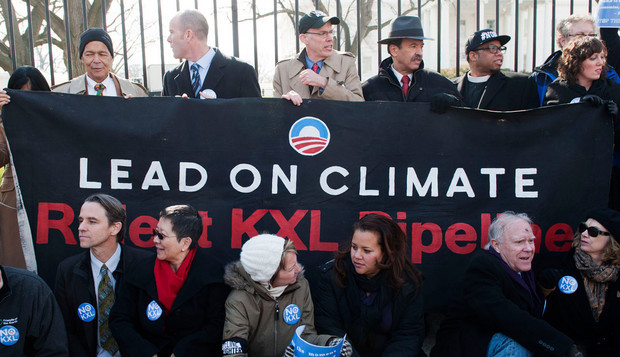
This week I watched Bill McKibben lead a group of about 50 people—not grubby hippies, but distinguished professionals like NASA scientist James Hansen and Sierra Club Executive Director Michael Brune—to  protest at the White House, submitting to arrest in a desperate bid to get some airtime for their pro-Earth movement.

iNSoZ.mGR4AY

This week I watched with relief as President Obama acknowledged in his State of the Union address that it is time to “do more to combat climate change,” and then was amazed and appalled to find the mainstream media pretending he had never even said anything about it, focusing their attention exclusively on the parts of his State of the Union speech dealing with the economy, jobs, and minimum wage.

In the mirrored echo chamber of the mediasphere, unless it’s a natural disaster, the environment doesn’t merit a second thought.  I had to search deep into the bowels of the New York Times site to find any mention of McKibben’s arrest and the upcoming climate rally.

UnknownIn a week when a Carnival cruise liner the size of four football fields, filled with 4,000 people, found itself adrift without power in the Gulf of Mexico and it took four days to rescue the passengers and get them off the stinking, sweltering, rancid ship, I find the old Titanic coming back to me insistently as an emblem of where we are at as a human civilization.

The media is down in the ballroom frantically snapping photos and grabbing interviews with the rich celebrities as the inept captain and crew sail the ship straight into an iceberg.

When that crash comes, the glitter and glitz of the ballroom will go down just as surely as the shabby steerage quarters.

But this time there will be no safety net, no welcoming shelter from the good people of Halifax.  Or, to take the Carnival cruise as an example, no sturdy tug to tow the disabled ship to safety.

How many storms is it going to take before people wake up to the reality that we truly are at an environmental breaking point?

It is past time to focus on the fact that we face a planetary tipping point at which the concerns that most occupy our thoughts—jobs, romance, social justice, vacations, children, whatever—are going to fade away like morning dreams before the nightmare that it will be to live through the end of the Anthropocene, the human epoch.

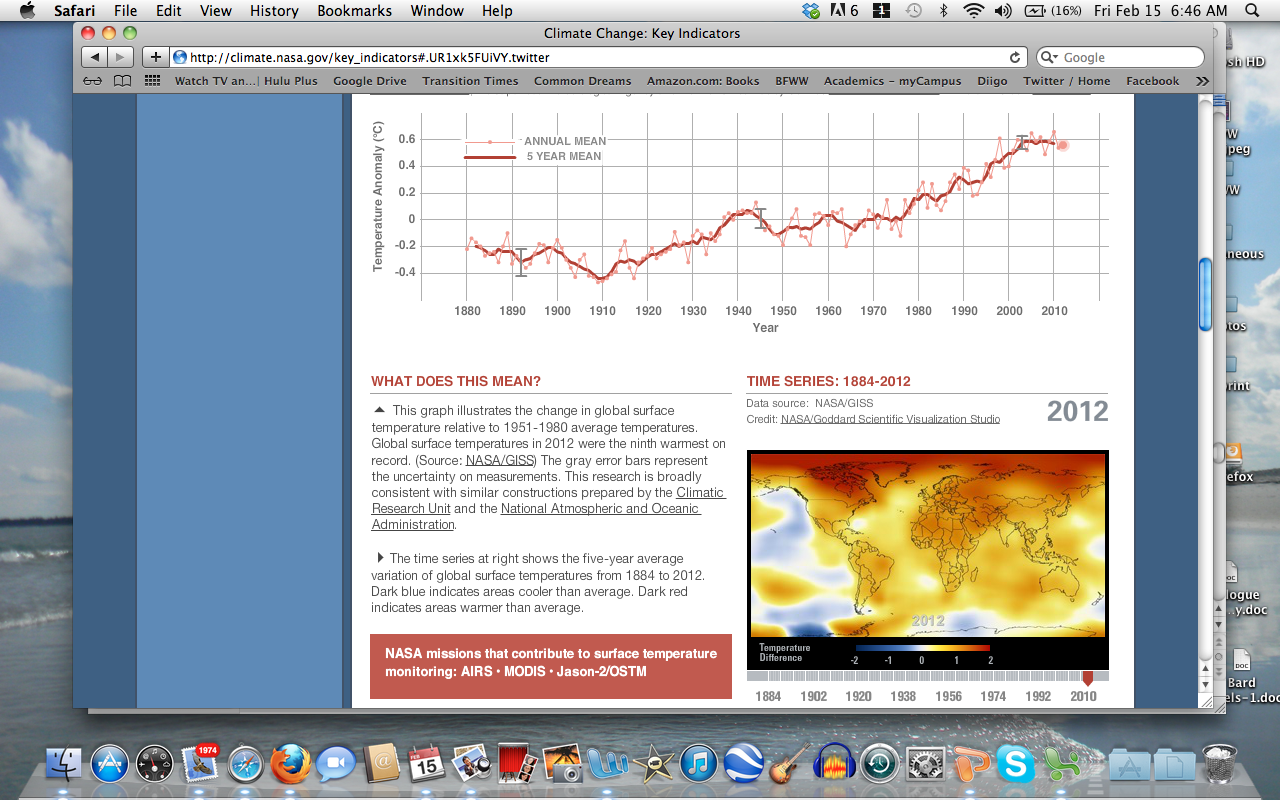
No one wants to hear this.  No one wants to imagine that it could really happen.  But take a look at the latest charts just released by that terribly radical organization, the National Aeronautics and Space Administration, and you will see what should be dominating the headlines this week.

Please don’t take my word for it—go and see the data yourself.

Screen shot 2013-02-15 at 6.46.49 AM

I especially recommend the interactive graphic chart of global surface temperatures between 1884 and 2012.  If the glaring red swirling over the planet in 2010 doesn’t wake you up to the slow-motion nightmare we’re living through, well, see you on the other side.

I don’t honestly know if anything any of us can do right now will make a difference.

The poles are melting, and the methane being released from under centuries-old ice is going to dramatically speed up the warming trend over the foreseeable future.

At best, we’ve got to ADAPT to our new warmer environment, and quickly!

We need our government to stop bickering and sweating the small stuff and start focusing on the real challenge at hand: reengineering human civilization to survive a drastic change in our planetary climate.

121101-staten-island-03.photoblog600
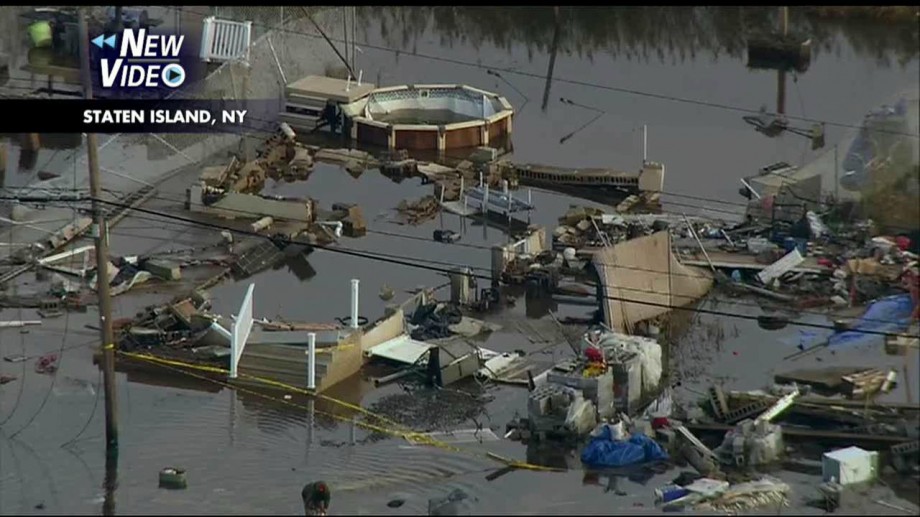
There will be collapses of biodiversity, accompanied by population surges of some less savory species, like ticks, jellyfish, and bacteria.  There will be food shortages as croplands dry up or are flooded out.  Our 20th century electrical grid will be battered over and over by intense storms, which will also wipe out roads and bridges and eat away relentlessly at the coastlines.  There will be violence, as people start hoarding and fighting each other for increasingly scarce resources.

We need our government to start putting its might, muscle and treasure into the greatest battle of our time: surviving climate change.

President Obama tried to cast the challenge of adaptation in economic terms, talking about the potential sweet deals that could be made as we pivot to a green economy.

Sure, we need our engineers and inventors to get to work creating the tools we’ll need to survive.  We need our venture capitalists to get behind them, along with our research universities and labs.

But let’s be honest with ourselves about the situation we’re in.  We don’t have a choice between business as usual and innovation.

Our choice is between innovation or annihilation.

So I’m finally overcoming my own inertia and getting myself down to Washington DC this Sunday to stand with Bill McKibben and thousands of other protestors to insist that our President and Congress stop fiddling while the planet burns; stop sending up the smoke and mirrors to distract the populace; stop investing in fossil fuels and outdated technology; and start doing the work our generation must do to provide a livable future for the generations to come.

Looking for Valentinaville….

So far, my number one, all-time most popular blog post on Transition Times has been my 2012 Valentine’s Day post, “There’s More to Love than Cupid and His Arrows,” which was read by nearly 30,000 people worldwide in the past year.

In that post, I reflected on how the Valentine’s Day celebration of love could and should extend to more than just romantic love—we should celebrate family love, I said, the kind of love that runs “like molten gold at the core of a happy family like mine.”

A year later, and still without a romantic attachment this Valentine’s Day, I feel no different—but my thoughts on this issue are more defined.

marilyn-monroe-diamonds-gentlemen-prefer-blondes-blonde-movieIn American culture, and I am sure in many other cultures around the world, it is viewed as a shortcoming to be without a romantic partner.

To be alone, without a significant other on Valentine’s Day, is a source of shame.

Well to hell with that, especially for mature women!

I see so many women my age, midlife or older, without partners.

Is this just an American phenomenon?  I wish my non-American friends would chime in and let me know.

Here in the States, the divorce rate is astronomical, and we seem to have a surfeit of single women—either the 30- to 40-something put-career-first-and-never-married cohort, or the 40- to 50-something just-couldn’t-take-it-anymore divorced group.

And then at the upper edge of the age scale, there are the 70-something widows, too.

For men in all of these age groups, there are plenty of women to choose from.

After all, it’s not unusual for a man of 60 to take up with a woman 20 years his junior.

But when was the last time you heard of a woman of 60 partnering with a 40-year-old man?

For heterosexual women, the field narrows considerably as we age.

And the risks grow.  Why would I, as a 50-year-old, really want to take up with a man twenty years my senior?

If I were to enter the dating market now, I’d be lucky to find a guy my age to partner with.  Most guys my age are looking for younger women, and they don’t seem to have any trouble finding a match.

On Valentine’s Day, 2013, I’d like to affirm the fact that women don’t need romantic love to be happy.

I’d like to suggest that women be more appreciative of the love and support we get from each other, and from all kinds of non-romantic attachments.

In the old days, women who sought to avoid marriage ensconced themselves in nunneries, and had a pretty good life there (check out the life of Sor Juana for an example).

I am wondering if today we need a modern form of the nunnery, a place where women of a certain age could go to live full, empowered, mutually supportive lives free from the pressure of romantic attachments.

Maybe we should found such an institution, and call it Valentinaville.  Just for us.

Why waste away in Margaritaville when we can be happy in Valentinaville?

Late-night thoughts on human hubris

It’s 7 a.m.

Do you know where the songbirds are?

I have been struck by the silence of the woods as I take my daily walks.

Once in a while a chickadee will call in a high hemlock.

More rarely, I’ll see a nuthatch making its way sideways up a tree trunk.

Goldfinch

Goldfinch

But for the most part, the forest is eerily silent, and even at my bird feeder the once lively ranks of brightly colored birds—goldfinches, purple finches, blue jays, cardinals, woodpeckers, juncos, titmice—have thinned.

It’s not an illusion, and it’s not an anomaly.

The Silent Spring predicted by Rachel Carson 50 years ago is well on its way to becoming a reality.

And the emptiness of the air is being mirrored in the waters.

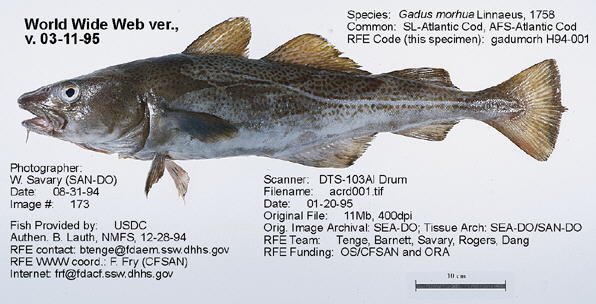
Last week, over the protests of commercial fisherman, New England fishery management officials voted to sharply reduce the catch limits on cod, in the hope of saving this iconic Atlantic fish from extinction.

Cod was once the passenger pigeon of the sea, so numerous it was used as farm fertilizer and treated as if it were in endless supply.

cod

After just a few years of commercial trawling—a blink of the eye in relation to cod’s million-year history on the planet—the cod, along with so many other fish species, is almost gone.

“The United States has watched the near total collapse of cod stocks in Canada,” reports The New York Times. “The demise of the fish populations was hastened by the widespread use of big trawlers equipped with radar and sonar systems that enhanced the ability to catch the fish. They expanded the area and depths that could be fished and sped up the process, diminishing the ability of the remaining fish stocks to replenish themselves.

“The big trawlers also swept up other fish that had little commercial value but played important predator-prey roles in maintaining the ecological balance of the species. Today the cod stock in the Gulf of Maine is at 18 percent of what scientists deem to be a healthy population; in Georges Bank, it is 7 percent.”

I well remember my sons’ disappointment when they threw some fishing lines into the glistening ocean off the coast of Nova Scotia.  Not a fish was to be had, and when we asked local people about it, they just shook their heads sadly.

The fish are gone.

Because we don’t eat songbirds, there is no “management agency” keeping track of their populations.

At best, there are conservationists and wildlife biologists trying to sound the alarm.

But the truth is that the collapse of biodiversity is too huge a problem for any one agency to deal with.  In the ocean it’s about greedy, reckless trawling; on land it’s about the relentless destruction of the forests and the poisoning of farmland and fresh water.

It’s about the continuing reliance on dirty fossil fuels, despite the robust evidence of the impact of climate change on planetary health.

It’s about the hubris of human beings, thinking that we alone can survive the biodiversity collapse we have engineered.

buffalofThe saddest story I’ve read in a long time is about the bison in Montana.

You remember, the ones that were shot and left to rot by the hundreds of thousands in the late 19th century?

The ones that were a hairs-breath from extinction, but were painstakingly brought back by breeders, and now roam “free” in national parks?

Well, the Montana legislature is proposing to restore the 19th century practice of shooting bison on sight, treating any who dare to stray onto private property as “vermin.”

The once noble buffalo herds that thundered across the open prairies and mountain valleys of North America, reduced to a tiny fraction of their original population, are now to be shot for daring to step across an invisible property boundary to eat the green grass on the other side.

In the 1980s and 1990s, reports The New York Times, “Department of Livestock officials gunned down hundreds of famished Yellowstone bison that migrated into Montana in search of forage.”

Now a group of landowners and ranchers in Montana wants their state Legislature to make this practice law.

If Americans cared about the demise of the innocent creatures of the natural world a fraction as much as they care about their oh-so-beloved Superbowl, we would find the will and the way to solve the slow-motion nightmare of extinction.

We would figure out how to live sustainably on the magnificent planet that has enabled our remarkable rise as a species.

The truth is that human beings are the ultimate invasive species.

We are over-populating to the point where everything else is being crowded out beneath our monolithic spread.

What will happen when there are no more coral reefs, no more fish, no more forests, no more birds?

I’d like to give myself some comfort by saying I won’t live to see that day.

But realistically I have to face the fact that that day is just around the corner.

MOOCs for the Masses

imagesThe automation of education is one of the big issues of the early 21st century, and in the halls of higher education, where I hang out, it’s very controversial.

The leaders of small colleges like mine are watching nervously as the big boys jump on the MOOC bandwagon, throwing their immense resources behind the development of sophisticated online learning platforms designed to serve hundreds of thousands of students at a clip.

So far these courses are not available for actual degree credit, but the accrediting corps is not far behind, busily working on the conceptual architecture needed to award students college credit no matter which institution’s logo is on the screen.

Once this is fully operational, students will be able to work towards a college degree in patchwork fashion, taking math and science courses from MIT, liberal arts from Yale, and philosophy from Princeton along the way to their shiny new 21st century B.A.

The minute the technical hurdles to this system are worked out, the floodgates of online learning are going to open for real.

Those who are skeptical of the quality of online learning argue that even video conferencing, now widely available through Adobe Connect or Google Hang-out platforms, cannot match the electricity of ideas exchanged face to face, facilitated by a well-trained, talented instructor.

This is the argument used by small liberal arts colleges like mine to justify the continued emphasis on bricks-and-mortar institutions, and there is truth it, as long as the class sizes are small and the instructors are not only knowledgeable, but also  skilled at facilitating discussion.

But let’s be honest: most American students do not have the benefit of attending small liberal arts colleges, because the small student/teacher faculty ratio is incredibly expensive to maintain.

LectureHallHaving spent nearly a decade teaching on a State University of New York campus, I can attest that most undergraduates there sit in large lecture halls where they watch powerpoint shows narrated by a teacher down at the podium.  That is, when they bother to go to class.

There is no question that such lectures could be more easily and cheaply delivered online, sparing the professor the travails of explaining Chemistry 101 yet again to another generation of yawning, surfing students.

Big institutions are now getting excited about “flipping the classroom,” meaning: the student watches the lecture on her own time, as homework, and then comes into the classroom for a discussion about the material.

My question, as a higher education insider, is: who is going to lead that discussion?

My guess is it will be graduate students and adjunct professors doing the discussion leading, as it has been for many years already with tenure-track professors who give the lectures and leave the work of actually interacting with students to their teaching assistants.

The ramifications of this for higher education as a field of employment remain to be seen.  For the moment, most people who are thinking about online learning are much more focused on the students (the “clients”) than on the labor issues involved.

Clearly, a professor who can teach 100,000 students at a time is going to be offering a lot more value to the institution than a professor who teaches 20 students at a time, especially if at least a percentage of those thousands of online learners start to pay for credits towards a degree.

As the century goes on, we’re going to see fewer tenure-track professors and a lot more adjuncts.  The field was going this way anyway; online learning is just going to put the trend on hyperdrive.

Faculty advocates in higher education need to be focusing on the issue of a living wage for adjunct professors now, because once American adjuncts are competing with part-timers all over the world, we’re going to see the out-sourcing of American education bigtime, with unpredictable results.


Meanwhile, globalization cheerleaders like Tom Friedman are waxing enthusiastic about the idea of beaming lectures by Harvard professors to remote locations around the world.

“For relatively little money,” Friedman said in a recent column, the U.S. could rent space in an Egyptian village, install two dozen computers and high-speed satellite Internet access, hire a local teacher as a facilitator, and invite in any Egyptian who wanted to take online courses with the best professors in the world, subtitled in Arabic.”

Yes, this would be globalization with gloves on, and certainly far better than spreading American-style ideology at gun and loan-point, as we did in the 20th century.

MOOCs are already opening up the previously hallowed halls of the best American institutions of higher education to new, worldwide audiences.

As Friedman reports, the head of the new Harvard/MIT online platform EdX, Anant Agarwal, said that “since May, some 155,000 students from around the world have taken edX’s first course: an M.I.T. intro class on circuits. ‘That is greater than the total number of M.I.T. alumni in its 150-year history,” he said.’”

In the next few years, we’re going to see online learning take off bigtime, as more and more students clamor for the opportunities it affords, and higher education leaders perceive the huge benefits in cost savings that will result from not having to house all the students they serve.

We’re going to see more and more students living at home with Mom and Dad right through their undergraduate years, whether it’s here in the U.S. or, as Friedman imagines, in some Egyptian village.

From the point of view of the average student, the one who would not in any case be able to afford or get into a selective liberal arts college, this may be for the best.  Certainly it would be better to live at home a few more years than to incur heavy debt burdens for the privilege of living on campus.

Students and their parents are already viewing education in increasingly utilitarian terms; as they contemplate getting on the B.A. track they want to know What can I do with this degree? What jobs will it prepare me for?

They’re looking for the most practical, value-added route to the goal—a secure, interesting, well-paying career.

images-1There are always going to be elite undergraduate colleges ready to give a premium, face-to-face educational experience to those who can pay for it, just the way there are still deluxe prep schools available even though most Americans go to the public high school down the road.

Faculty at these colleges will continue to teach small classes, where students are encouraged to be creative, critical thinkers, to question authority, to write papers rather than take tests, and to get to know each other both in and outside of class.

Just as future queen bees are given a far richer diet than future worker bee, there will be different educational strokes for different folks.

The real question, as we enter the MOOC era, is whether education will continue to serve as a vehicle for social mobility, as it did so strongly in the 20th century, or whether we’ll have online learning for the masses and bricks-and-mortar for the elite, with the gap between the two growing ever wider.