Sex 101: From Plan B to Pleasure

I have mixed feelings about the decision of Secretary of Health Kathleen Sebelius to overrule the FDA’s recommendation to allow over-the-counter sales of Plan B, without any age restrictions.

On the one hand, the knee-jerk liberal in me says wait a minute–access to contraception in any form should not be restricted.

On the other hand, it makes me a little nervous to think about young kids–say, 12-year-old girls–being able to buy morning-after pills as casually as they might buy cold medicine.

Our society is already sexualizing young girls way more than I think is healthy.  If Plan B were widely available, it might be used as just another reason why girls should open themselves up to sex at a younger age.

Another part of my hesitation comes from knowing full well that Big Pharma is pushing over-the-counter (OTC) sales just to make more profits on the drug.  I don’t think they are really that concerned with the welfare of young women.

Rather than simply making Plan B available OTC, I would like to see a national conversation (let’s call it a national general assembly) on the issue of the hypersexualization of youth, on the one hand, and the with-holding of sex education and contraception, on the other.

It saddens me that students in my gender studies classes are still reporting that sex education in their high schools consisted mainly of scare tactics ranging from “have sex before marriage and you’ll go to hell” (Catholic school) to “have sex and you’ll get disgusting STDs” (public school) to abstinence-only “just say no” programs.

In an age where the answer to any question is readily available on the Web, we owe it to our teenagers to present these issues in much more depth.  We should be discussing sexuality in all its multivalent nuances, from issues of sexualized violence (what happens if you say no and he doesn’t listen?) to the pros and cons of each of the many contraceptive options, to what I see as very often the missing link in contemporary discussions of sexual relations: pleasure.

Sex isn’t just about contraception, it’s not just about STDs, it’s not just about violence, it’s not just about worrying over drawing limits of one kind or another.

It’s about pleasure.

Her pleasure as much as his.  Mutual pleasure.  Mutual desire, mutual satisfaction.

Any sex ed worth its salt needs to be honest with young people, both boys and girls, about why sex makes the world go round.  It shouldn’t just be discussed in terms of threats, warnings and prohibitions.

Sex for pleasure is one of those defining human characteristics that too often gets lost in discussions of Plan B, abortion rights, and HIV-AIDS prevention.  These are all important issues, but let’s not lose sight, along the way, of what it’s all about.

The drug companies have not yet figured out how to package pleasure.  Let’s hope they never will.

Challenging rape culture

In my Gender Studies class this week, we’ve been talking about “rape culture.”  It’s a term that’s bandied about somewhat cavalierly on college campuses, and is probably much less familiar out in the ordinary workaday world.

Well, wake up world.  Rape culture is here.  And it doesn’t need the ironic scare quotes.  It’s real, and it’s not funny at all.

You know you’re living in a rape culture when women’s bodies are suggestively displayed, commodified, in sexually enticing poses obviously intended for the male gaze.

In the culture of rape, “no” means “try harder” and it’s always the woman’s fault if she doesn’t like what’s going on.  Stupid bitch, if she didn’t want it, she shouldn’t have worn those heels/had that drink/come to the party.

Rape culture sanctions violence when necessary to overcome resistance.  She was asking for it, anyway.

Rape culture oppresses dissenting men, too.  Men who fail to conform to the code of dominant masculinity are “faggots,” and being called out as anything akin to feminine–pussy, for example–is the worst insult you can throw at a guy.

Lately I’ve been realizing that rape culture extends a lot further than women’s bodies.  It’s also responsible for the prevailing attitudes towards our environment–our Mother Earth.

Not for nothing are both Mother Earth and Mother Nature gendered female.

Some patriarchal cultures manage to respect Mother Nature while still maintaining a stranglehold on her female children.  For instance, in Chinua Achebe’s Things Fall Apart, which I’m re-reading now for another class, the all-powerful Oracle of the Hills, a goddess, is interpreted by a priestess whose pronouncements no men dare question.  This doesn’t stop the protagonist, Okonkwo, from beating up his wives on a regular basis.

In Judeo-Christian and Islamic cultures, the patriarchy dispenses with goddesses.  Or at least, goddesses of the truly powerful, fearsome kind.

In Euramerican cultures, we have sex goddesses, who exist to pleasure their men.  Islamic cultures shroud their women in veils, but towards the same end: women exist to please their men.

The explosive growth of the international pornography industry, in which it is still rare for women’s pleasure to be of any interest at all, bears testimony to the extent to which rape culture rules.

In 2006, the pornography industry had larger revenues than Microsoft, Google, Amazon, eBay, Yahoo, Apple and Netflix combined–and it’s only grown in the past five years.

Porn is a vast unregulated jungle.  It’s not all bad.  But some of it is really terrible.  Some of it is sexualized violence–rape–thinly veiled as entertainment.

Yes, the girls get paid.  But many studies have shown that female porn stars often come from sexually abusive childhoods, or are teen runaways, or are lured into the trade through drug addiction and prostitution.

In Euramerican porn, women exist to give men pleasure.  Doesn’t matter if they get fucked over in the process.  Doesn’t matter if all that’s left in the end is a hollow shell.  There’s always another slut waiting in line.

Yeah.  It hurts me to talk like this, but I want to convey the mind-set of this industry.

And then I want you to think about how this mind-set translates to the Euramerican assault on the environment, our Mother Earth.

Or the sub-prime loan scandal (it’s Occupy Foreclosures Day, after all).  Fuck’em over, make a profit and move on.  All that matters is the bottom line, baby.

Sometimes it seems as though the more powerful actual women become in real life–ie, successful at playing the formerly all-male games of education and career–the more frantically obsessive men’s consumption of pornography becomes.  The power they miss in real life, they can find acted out for them in porn fantasies.

But the environment is another story.  Mother Earth is not going to play men’s games–that is, she doesn’t care to beat them at their own game.  When she starts to resist, the game will be over.

In porn, women go along with the game for a variety of reasons.  Generally speaking, women do it to survive.

Likewise, women collude with the patriarchy in the rape of the Earth because it’s just easier to go along than to resist.  And the lifestyle has been pretty comfortable over the last 50 years, hasn’t it.

I would like to see a frank discussion of the connections between rape culture as played out in porn and rape culture as played out between humans and the environment.

We need to acknowledge that there is a serious problem in both the private and the public realms (along these lines, we are just beginning to see confessions of “sex addiction” hit the media.  How about “fossil fuel addiction”?).

The problem is a symptom of much deeper ills in human social relations, which transgress the usual boundaries of race, class, gender & nation.

Why are porn and energy extraction biggest, the fastest growing industries in the world?

What does it mean to live in a rape culture?  Who benefits, and who loses?

Most importantly, how can a rape culture be transformed?  And what is our alternative vision?

My vision is this:

The one-sided model of domination and extraction (“getting some”) needs to shift to a dialogic model of sustainable mutual pleasure.

Human beings should serve in a steward relation to our Mother Earth, tending and enriching her in exchange for the nourishment and pleasure she can afford us.

Likewise, sex should not be about domination and debasement, but about mutual pleasure and uplift.

In these transition times, such a transformative shift should be possible, if each of us begins with our own selves, our own backyards, and lets the ripples of range move outward.

Let it be so.

Outsourced pollution rides the trade winds home

How timely, that just as the U.N.-sponsored climate talks are going on in Durban, a new report comes out  from the Global Carbon Project informing us that global greenhouse gas emissions grew by a whopping 5.9 percent last year, the largest leap in any year since the Industrial Revolution began.

The U.S. remains the world’s second-largest greenhouse gas emitter, trailing only China.  But as we all know, China has become a factory state of the U.S. and Europe–isn’t virtually every manufactured thing you own “made in China”?

As I hear all the time from travelers to China, air quality is noticeably bad there.  Most cities seem to be in a permanent miasma of smog, sometimes approaching the sooty fog Charles Dickens used to describe as veiling London in the coal-burning 19th century.

Here in the U.S., air quality has improved since I was a kid in New York, when smog was a daily occurrence and you just learned to live with noxious blue bus fumes blown in your face on every street corner.

But apparently what we’ve done is simply outsource our pollution to China.  Let them deal with the smog over there; we’re paying for the goods they produce aren’t we?  If they can’t figure out how to manufacture cleanly, that’s not our problem.

So goes the smug line of American entitlement.

But welcome to the new century.

First of all, the great American credit bubble has burst, and the middle class is having trouble affording those imported manufactured goods, no matter how “cheap” they are.

Second, it’s obvious that the trade winds are blowing Chinese smog our way, in the form of global climate change that will affect us here as much as it affects them over there.

Politicians the world over continue to take a short-sighted view of both of these issues, imagining that a little re-tooling is going to get us past the bumps in the road.

The media isn’t helping matters–you will have to peer deeply into the New York Times this morning to find the small buried news story about the biggest leap in global carbon emissions on record.

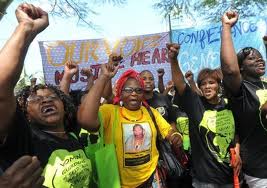
People who are already living on the edge understand the stakes.  Thousands of African women farmers have been marching in Durban, along with indigenous forest defenders from around the globe.  They’ve been kept away from the politicians inside the gates by riot police.

Guess what?  All the riot police in the world cannot keep climate change havoc from our doorstep.  Here in the U.S., in China, in Africa, and all over the world.

It’s time to deal with it.

President Obama, looking for solutions on student debt, should not overlook the issue of contingent faculty labor

The student protests around the country have been focused largely on three key concerns: the high cost of a college education, the resulting weight of student debt after graduation, and the scarcity of jobs.

Put together, it’s a recipe for frustration, if not outright desperation.  Students who lack substantial family support these days have to make incredibly tough sacrifices to get their B.A. degrees, and with no jobs at the end of the tunnel, many are rightly asking–is it worth it?

A lot of thoughtful people have been considering this very question for some time now.  On Monday at the Berkman Center for Internet and Society at Harvard University, there will be a panel discussion on “The Fate of Civic Education in a Connected World,” featuring, among others, Ellen Condliffe Lagemann of Bard College, who just co-edited a book called What is College For? The Public Purpose of Higher Education.

In the book, Lagemann and co-author Harry Lewis argue that colleges and universities need to renew their commitment to fostering ethical, responsible student engagement with the public sphere.  Higher education should not just be a credential to string around one’s neck, the passport to a decent job, they say, but should challenge students to think deeply about their role as citizens and stakeholders in society.

This message certainly seems timely.  If getting a college degree can no longer be valued in purely instrumental terms, as a ticket to a job, then it had better be providing some deeper value, both for the students and for society.

On the same day as the Harvard panel, President Obama will be meeting at the White House with a group of ten influential college and university presidents, along with Secretary of Education Arne Duncan and other key players in higher education, to discuss “increasing access and success as well as how to make higher education  more affordable,” according to an article in today’s online Inside Higher Ed magazine.

The article says that “amid an increasing focus on student debt and college prices, the event seems to signal that the Obama administration will make the issue a focus going into the 2012 campaign. In a speech Monday, Education Secretary Arne Duncan called on colleges to address rising tuition prices “with much greater urgency.” The House of Representatives held a subcommittee hearing Tuesday on rising costs, discussing a broad range of possible solutions.”

As someone who has been teaching in higher education for more than 20 years, I am of course concerned about the rising costs for students.

But I’m also concerned with the way budgets are increasingly being balanced by reducing fulltime tenured faculty teaching lines.

The phenomenon of using adjunct faculty, graduate student teaching assistants, temporary “visiting” faculty and any other form of contingent labor available is under-discussed, both within the institutions perpetrating these practices, and in the broader society.

Within the institutions, it’s under-discussed partly because it’s so humiliating for Ph.Ds, respected scholars when they present their research at conferences or publish articles, to admit how little money they’re making as adjunct or visiting faculty.  College adjunct teachers are typically paid $2,000 to $4,000 a course.  Most faculty teach 3-4 courses a semester.  You do the math.

Also, there’s the fear factor: if you speak out, your contract may not be renewed next semester, or next year.  There is no job security for what we call in the business “term contracts.”

At the White House meeting, the college presidents aren’t going to want to tell the President that they’re reigning in the cost of tuition by hiring contingent faculty at bargain basement salaries.  But that’s the truth of the matter.

And it’s been very difficult for adjuncts to unionize, in part because the Labor Board in recent years has ruled that college and university faculty are “managers” because we make a salary rather than an hourly wage, and get to set our own hours. Managers aren’t entitled to a union.

There are a host of reasons why it’s bad for American higher education to use cheap faculty labor.  If we want to get serious about student success, as the Obama Administration claims, focusing on contingent faculties would be a good starting point.

A harried professor who’s working at two or three institutions to barely make ends meet is not going to do as a good a job for her students as someone making a living wage with a longterm contract at a single institution.

American institutions of higher education need to model the kind of society we want our students to create when they move out into the world as newly minted young citizens.  They won’t want to be temporary workers any more than their teachers do.

President Obama, if you really want to make a difference, you need to push those college presidents for deeper, systemic changes.

From occupations to manifestations: Arundhati Roy imagines another world

I was excited to find in my inbox today an interview with one of my favorite women writers of resistance, Arundhati Roy.

Roy may be most famous for her novel, The God of Small Things, but I am most moved by her political writings.  She is the one who coined that very popular saying, which became a motto of the World Social Forum in the 1990s: “Another world is not only possible, she is on her way.  On a quiet day, I can hear her breathing.”

She has been a shrewd and no-holds-barred critic of transnational corporate capitalism for decades now, long before it became a trendy position to take.

As she wrote in An Ordinary Person’s Guide to Empire, “So much of what I write, fiction as well as non-fiction, is about the relationship between power and powerlessness and the endless, circular conflict they’re engaged in.”

Since she’s been thinking about these issues for so long, it’s not surprising that the comments she made to Arun Gupta, published today in The Guardian,” are right on target.

“I don’t think the whole protest is only about occupying physical territory, but about reigniting a new political imagination.

“I don’t think the state will allow people to occupy a particular space unless it feels that allowing that will end up in a kind of complacency, and the effectiveness and urgency of the protest will be lost.

“The fact that in New York and other places where people are being beaten and evicted suggests nervousness and confusion in the ruling establishment.

“I think the movement will, or at least should, become a protean movement of ideas, as well as action, where the element of surprise remains with the protesters.

“We need to preserve the element of an intellectual ambush and a physical manifestation that takes the government and the police by surprise.

It has to keep re-imagining itself, because holding territory may not be something the movement will be allowed to do in a state as powerful and violent as the United States.”

This certainly speaks to the question that has been worrying at me all day today, as news spread of the violent evictions of Occupy encampments in L.A. and Philadelphia.
Once the physical encampments are gone, will the movement die away?
Or can it keep bubbling up in guerilla fashion, as I advocated in an earlier piece on this blog, like the spontaneous street parties of European cities, that materialize, stage an intervention, and then vanish before they can be contained?
Also, what role will the internet continue to play over the winter?  Perhaps we should be moving from a stage of “occupations” to a new stage of “manifestations,” where the focus will be not on resistantly occupying a physical territory, but on proactively gathering, both virtually and actually, to manifest a new vision of social relations.
In the Guardian interview, Roy ends by pointing to indigenous people, and people who live close to the land, as key mentors in the days and months and years ahead.
As climate change and environmental degradation accelerates,  Roy says, “we are going to confront a crisis from which we cannot return. The people who created the crisis in the first place will not be the ones that come up with a solution.
“That is why we must pay close attention to those with another imagination: an imagination outside of capitalism, as well as communism. We will soon have to admit that those people, like the millions of indigenous people fighting to prevent the takeover of their lands and the destruction of their environment – the people who still know the secrets of sustainable living – are not relics of the past, but the guides to our future.”
There are many of us who are now waking up to the certain knowledge that the leaders we thought were our trusty guides have been taking us on a joy ride to nowhere, ending up barreling towards a cliff.
There have been those all along who have refused to go along for the ride, who have maintained their independent imaginations and worldviews despite intense efforts by the corporate capitalist world to beat them down.
Those are the people we need to heed now–if, as Roy says, we want to learn “the secrets of sustainable living” and survive.  And if, of course, they’ll have us.

Carbon Colonialism: Just Say No!

Do ordinary people need to commit suicide to gain the attention of the global elites?

You may remember, back in 2003, a Korean farmer named Lee Kyung Hae committed suicide outside the grounds of the World Trade Organization meetings in Cancun, Mexico, as a protest against the impact of first world subsidies of grain production, which effectively pushed small farmers in developing countries out of business.

He set himself on fire right in front of the police barricades keeping him and others like him outside of the WTO talks.

Afterwards, there was a movement by the representatives of developing countries to form a bloc of resistance to the demands of the global elites.  It worked, for a while.

But now, 8 years later, the global elites are at it again, worse than ever.

At this year’s climate talks in Durban, South Africa, representatives of indigenous communities worldwide are protesting at the barricades again, locked out of the talks on complex trade negotiations over carbon offsets, sequestration and deforestation.

It’s not easy to understand the documents produced by the U.N. and government agencies, laying out what’s called the REDD accords: Reducing Emissions from Deforestation and Forest Degradation.

It all sounds very nice when you read the summary on the U.N. website.

“Reducing Emissions from Deforestation and Forest Degradation (REDD) is an effort to create a financial value for the carbon stored in forests, offering incentives for developing countries to reduce emissions from forested lands and invest in low-carbon paths to sustainable development. “REDD+” goes beyond deforestation and forest degradation, and includes the role of conservation, sustainable management of forests and enhancement of forest carbon stocks.

“It is predicted that financial flows for greenhouse gas emission reductions from REDD+ could reach up to US$30 billion a year. This significant North-South flow of funds could reward a meaningful reduction of carbon emissions and could also support new, pro-poor development, help conserve biodiversity and secure vital ecosystem services.”

Yes, well, it does sound nice.  But in fact, when that much money is at stake, corruption is not far behind.

As detailed in an important new report called the No REDD Papers, what’s been happening in the name of REDD is a gigantic forest grab, with major multinational energy corporations ruthlessly buying up and bullying their way into land rights to forests in the global south, so that they can not only make money by going on their merry way of fostering carbon emissions in the North, but also make money by collecting the rewards for forest conservation in the south.

And there’s more.  Under REDD+, reforestation is also potentially a growth industry.  But there are insufficient regulations on what constitutes reforestation.  A complex rainforest environment could be harvested, destroyed, and “reforested” with a monocultural non-native cash crop, like bamboo or eucalyptus or palm, which will be “sustainably harvested,” yes, but will actually store a fraction of the carbon of the original rainforest, and will support a tiny fraction of the original biodiversity.

It also results in Native people being pushed off their ancestral lands, by swindle or by force.

The indigenous people, from Niger to Alberta to the Amazon, are not stupid.  They’re wise to what they’re calling “carbon colonialism.”

“REDD/ REDD+ is bad for people, bad for politics and bad for the climate,” says Tom B.K. Goldtooth of the Indigenous Environmental Network. “It will inevitably give more control over Indigenous Peoples’ forests to state forest departments, loggers, miners, plantation companies, traders, lawyers, speculators, brokers, Washington conservation organisations and Wall Street, resulting in violations of rights, loss of livelihoods—and, ultimately, more forest loss.”

I don’t want to be part of this scheme.  To me, as to the indigenous forest defenders, it’s all quite simple.  We must reduce carbon emissions.  We must not only reduce deforestation, but encourage forest regeneration–and not of plantations, but of natural biodiverse forest habitats.

It’s not about making money any more.  It’s about sustaining life–our lives, our children’s lives, the entire web of life upon which we depend.

This time the neocolonial cowboys are not going to be able to get away with murder.  The glare of the internet is upon them.  We will not stand by passively and let a new era of displacement and exploitation take place under the euphemism of “conservation.”

Not this time.  Never again.

And we shouldn’t have to be committing suicide to get attention, either.  There has been enough death and destruction in our world these first years of the 21st century.  Let’s go forward under the banner of Eros, not Thanatos.

Let’s work together for Life.

Who’s Afraid of Women’s Writing?

Last night I participated in a panel discussion on Virginia Woolf and Margaret Mead called “Who’s Afraid of Women(‘s) Writing,” with Bard College of Simon’s Rock colleagues Maryann Tebben and Asma Abbas.

We were talking about how women’s writing is often oppositional, representing an outsider’s point of view to male-dominated mainstream discourse, whatever the discipline.

One of the students in the audience asked whether women’s writing would therefore always be reactionary, simply responding to the dominant rather than staking new ground.

I have been thinking about that question all day, off and on.

What I answered at the time was that while women’s writing is often a response to the dominant discourse, it also goes off in its own directions, which are not simply reactions to the mainstream, but rather true departures.

Of course, all writing occurs in dialogue with other writers, so even a departure is part of a larger conversation.  But I do believe that women, as outsiders, have something unique to contribute to any conversation.

Indeed, it is staggering to think of how impoverished literature, philosophy, history and all the other disciplines have been (and still are) in cultures where women have not been allowed to add our voices to the chorus.

Worst of all is that so few people (read: men) even noticed our absence.

I can recall so many times when have I had to fight for the inclusion of texts by women in our General Education curriculum at Simon’s Rock, arguing with colleagues who could say, with a sad shake of the head, that it was just too bad that women had never written any great, canonical literature.  For the past 20 years, out of the 16 required texts in our Gen Ed canon, which stretches from Gilgamesh to Achebe, only three are by women–though as of this year, after much lobbying, the ratio has finally improved slightly.

First deny women literacy and keep those few who do manage to become literate tightly locked in the private realm.  Then look back over history and note complacently that, as Woolf has the “odious Mr. Tansley” tell the artist Lily Briscoe in To The Lighthouse, “women can’t write, women can’t paint.”

In our time and place, young women now outnumber young men in higher education, and no one would dare to argue that women are innately less intelligent and talented than men.

But still, women in the U.S. earn 78 cents on the male dollar, for a variety of reasons, including the fact that we still shoulder more responsibility for housework and child care even when we work fulltime.

Women are still valued more highly as ornaments and service workers than as autonomous creative agents, and we still have to struggle harder to make our voices heard, especially if what we have to say is not what the mainstream wants to hear.

In To the Lighthouse, Lily Briscoe worries that her painting will be rolled up and thrown under a couch to gather dust.  Today, women still seem to have less self-confidence than men, perhaps because we’ve absorbed the prevailing ethos that considers a strong woman to be a “ball-breaker” or a “bitch on wheels.”

As MaryAnn Baenninger, President of the College of St. Benedict, wrote in a recent piece in The Chronicle of Higher Education, studies continue to show thatwomen underestimate their abilities and express lower levels of self-confidence than their abilities suggest. Men overestimate their abilities and express higher levels of confidence than their abilities warrant. This difference arrives with them as first-year students and leaves with them as seniors. When I talk about this, or I hear researchers describe this finding, the audience always chuckles (boys will be boys, after all).”

Baenninger concludes that while American women “have access to just about every educational opportunity and every career…access doesn’t guarantee outcomes. A gendered culture, mostly in unconscious ways, limits women’s expectations for themselves and our expectations for them.”

In other words, our gender role conditioning as women too often tends to silence us, while amplifying the voices of our brothers.

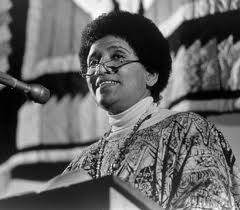
Soon after the great poet Audre Lorde was diagnosed with the cancer than would eventually kill her, she gave an address at the 1977 Modern Language Association annual convention in Chicago, called “The Transformation of Silence into Language and Action,” later published in the collection Sister Outsider.

In thinking back over her life, she said, “what I most regretted were my silences.”

“In the cause of silence,” she continued, “each of us draws the face of her own fear–fear of contempt, of censure, or some judgment….But most of all we fear the visibility without which we cannot truly live….That visibility which makes us most vulnerable…is also the source of our greatest strength.

“Because the machine will try to grind us into dust anyway, whether or not we speak.  We can sit in our corners mute forever while our sisters and our selves are wasted, while our children are distorted and destroyed, while our earth is poisoned; we can sit in our safe corners mute as bottles, and we will still be no less afraid.”

What we need to do, she said, is to “learn to work and speak when we are afraid in the same way we have learned to work and speak when we are tired.  For we have been socialized to respect fear more than our own needs for language and definition, and while we wait in silence for that final luxury of fearlessness, the weight of that silence will choke us.”

So many women today are still feeling the same fear and insecurity Lorde wrote about in 1977.  So many of us will go through our entire lives not daring to utter the truths we can hardly bring ourselves to acknowledge even in our most private thoughts.

In the same way that the richness of the Earth is diminished every time a species is lost, no matter how small and seemingly insignificant to the bigger ecological tapestry, the great canvases of literature, philosophy, science and all the other disciplines are impoverished and dulled when 50% of the population is not enthusiastically welcomed into the conversation.

Yes, we women can have our own conversations, outside the male-dominated mainstream.  There’s always “women’s writing.”  But what we should really be striving for is what Virginia Woolf called “androgynous writing,” where the masculine and feminine energies are brought together in a fecund explosion of cross-pollinating difference.

As Lorde put it so memorably in another of her important essays, “The Master’s Tools Will Never Dismantle the Master’s House,” “Difference must not be merely tolerated, but seen as a fund of necessary polarities between which our creativity can spark like a dialectic.  Only then does the necessity for interdependency become unthreatening.”

Maybe there will come a time when interdependency and androgyny will be the accepted standard of gender relations.  Until then, we still need to meet periodically and consider questions like “Who’s Afraid of Women’s Writing?” and why? and at what cost?


Occupy the Climate Talks in Durban–Virtually

If you lived on a small island nation that was losing precious feet of shoreline every year due to rising seas and storm erosion, you might be forgiven for having high expectations for the current international climate change negotiations going on in Durban, SA.

In the the heart of the developed world, meanwhile, you’d have a hard time finding any news about the climate talks.  You have to search the Web pretty carefully to even find a mention.

That goes to show how it’s all about location, location, location.

I learned yesterday, by careful Web search, that Canada is planning to pull out of the Kyoto treaty, just like the U.S.

Canadians want developing countries like China and India to also agree to reduced emissions.

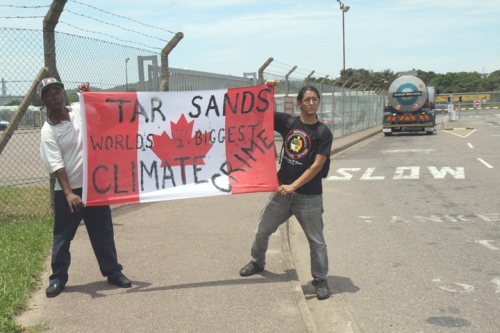
But meanwhile, Canada’s government is pushing the extraction of oil from the Alberta boreal forests.

As Tom Zeller of the Huffington Post reports,””What’s astonishing is watching Canada emerge as a rogue among developed countries,” said Bill McKibben, the author and activist who has spearheaded a grassroots movement aimed at combatting a pipeline proposal designed to deliver some 700,000 barrels of oil each day from the tar sands to refineries and ports on the Texas Gulf Coast. “Of course, they have no choice but to ditch serious climate policy if they want to develop the tar sands in a big way — and that pool of gunky oil is clearly the tail wagging the dog up there.”

We’re all the dog that’s being wagged by powerful oil extraction companies.  If we don’t watch out, we’re going to be wagged right into extinction.

Notice how the climate talks are always held in inaccessible places where it’s hard for activists to congregate.  Who can afford a ticket to Durban, SA?

But now, with the World Wide Web, we can all hold ring seats to the climate talks, and we need to make our voices heard.

Read the Climate Connections blog, produced in Durban by the Global Justice Ecology Project, for up-to-the-minute information about what’s going on in Durban.

Check out the results of the General Assembly held there today under the Occupy Durban banner: #OccupyCop17

The climate talks may be far away, but they are one of the most crucial sites for “occupation” as we move into the 21st century.  We can’t let the big oil companies, with their deep pockets created from our dependence on an oil-based economy, dominate the agenda.

If you care about leaving a healthy planet to the next generation, the time to speak up is NOW.

Occupying the Climate Talks & College Campuses–Full Speed Ahead!

Could be an interesting day today.  Word has it that the less-developed nations are threatening to “occupy” the climate talks at Durban if the big polluters–that’s us, America, and you too, Europe and China–won’t get serious about limiting emissions and working for systemic change.

Meanwhile, a student movement begun at UC Davis is calling for a General Strike today–no classes, no work–to create a space for student-run General Assemblies to discuss issues like police violence against peaceful protesters, as well as sky-rocketing tuition and debt-funded education that is putting college out of reach for more and more Americans.

I continue to be amazed at the speed with which awareness now spreads, thanks to how many of us are now plugged into what is coming to seem more and more like a collective brain.

Could the collective consciousness represented by the World Wide Web be an evolutionary leap forward?  Or could it at least be speeding up our evolutionary progression as a species?

Of course, it’s all dependent on electricity.  If the lights go out, our collective brain goes dead.

Or maybe not?  The General Assemblies, with their human microphones and patient face-to-face discussions give me hope that the new connections that are being forged in this time of transition are real and could stand alone, without the crutch of the Web.

In fact, maybe that’s what this is all about.  Building the human connections, virtual and real, to withstand the great shocks that are coming our way as the climate shifts and the Earth seeks to return to a steady state.

In Durban, South Africa and on college campuses and public parks across the country, people are turning out to be the change we want to see.

It’s an exciting time to be alive.


Ripples of change, from kitchen tables to public parks

This morning, in my parents’ house, a scene took place that underscored for me the extent to which the Occupy movement has entered the collective consciousness.

The man who has taken care of my parents’ property for the past 30 years or so had come by to say hello, and was standing in the kitchen complaining about how the oil companies are making billions while the price of fuel oil and gasoline goes ever higher for ordinary consumers.

He is a lifelong Republican, but voted for Obama in the last presidential election, having had enough of the Bush crowd with their lies and their wars.

Listening to his critique of the mega-oil companies, my mother turned to him and said teasingly, “So who should we occupy now?”

We all laughed and the conversation moved on, but there is an underlying element of seriousness there that amazes me when I think about it.

A few months ago, we might have complained, but without any thought of actually doing something to bring about change.

Now, suddenly, options are open to us.  We could go down and occupy the local gas station with some homemade signs, and probably get a lot of support from people filling their tanks.

Yes, we all do fill our tanks.  But instead of holding the resentment inside, there is now an outlet for it, a way to talk about it together that is not about the two parties and their endless childish jockeying for power, but about something deeper: the longing for and the pull to real change.

I have to admit I was disappointed that apparently Black Friday consumer shopping was more vigorous than ever this year. But it’s surely no accident that fights broke out at WalMarts across the country, where people who have precious few dollars to spend on their holiday shopping turned out on Black Friday to try to get some bargains.

What’s fascinating, and under-reported, is that on Black Friday, thousands of Chinese factory workers went out on strike to demand living wages and job security.  These are the workers who are supplying the products being sold as “bargains” in America, mostly to workers whose jobs have been outsourced–to China!

Marx’s dream of an international uprising of the proletariat has never been more possible, thanks to be magic of the internet.

And somehow the barriers between American consumers and Chinese producers–or between professional-class employers like my parents and blue collar workers like their property caretaker–are coming down.

There seems to be a new zeitgeist stirring the stagnant air of American social relations.  Is it the age of Aquarius?  The alignment of the planets?  The infamous Mayan 2012?

Whatever it is, let’s seize the moment and make the most of it.  Let’s talk up a storm, sharing ideas and encouragement with everyone we meet.

If a butterfly in Brazil can cause a hurricane in Texas, then maybe a casual conversation in your kitchen can be the catalyst for a change that will sweep the nation, and the world.  It’s certainly worth a try.