Bloomberg the Grinch vs. Occupy: This movement is not going away

The question in the air this morning is obvious: what comes next for the Occupy movement now that the tents and tarps in Liberty Park have been trashed by the NYPD?

The New York Times is giving way more coverage to the eviction than it ever did to the occupation, proving once again whose side those folks are on.

This protest movement is not going to go away.  It’s not going to go into hibernation for the winter.

City officials who see the movement as an expensive civil nuisance will learn the hard way that their heavy-fisted efforts at intimidation are going to backfire.

If anything, such tactics only strengthen the resistance of the core groups on the street, and draw the attention of the virtual spectators in cyberspace, who may now become more engaged.

Whither the Occupation now?  Occupy Wall Street said last night that the protesters have “the feeling of a movement that is rising, building, and making headway.”

Their statement is worth “reblogging” in full:

“They showed us their power. And we’re showing them ours.

“We are here because we believe a better world is possible. We are willing to endure mistreatment, if by doing so we can help re-enfranchise the 99% and reclaim our democracy from the stranglehold of Wall Street and the top one percent.

“We will push back against billionaire Michael Bloomberg and any politician who wantonly tramples on proud American freedoms: freedom of the press, freedom of speech, and the freedom of Americans to peaceably assemble and petition for change.

“We will overcome the obstacles placed before us. We will not be deterred. We will persevere. Our message is resonating across America, and our cause is shared by millions around the world. We are the 99%, and we want to live in a world that is for all of us — not just for those who have amassed great wealth and power.

“You cannot evict an idea whose time has come.”

Hmm, that does not sound like the voice of a group ready to pack it up and go home.  Those are stirring words and sentiments, in the tradition of our most heroic American freedom fighters, from Thomas Jefferson to Martin Luther King.

If you can’t beat them, Bloomberg and Co., you might just have to figure out how to join them.  And I don’t mean infiltrate or co-opt.  I mean open your hearts and hear the justice in their ideals and goals.

Like the Grinch who Stole Christmas, the hearts of the 1% are several sizes too small.  They would find the world to be a much warmer, happier place, if they would allow themselves to feel again.

You can’t evict an idea whose time has come

My title comes from the Occupy Wall Street website, posted on a gray, gloomy morning after the police eviction of protesters in Liberty Park.

Occupations are going on in cities and towns in all 50 states now.  What the mayors and police chiefs of these locales need to understand is that the more they try to contain and stamp out this protest movement, the faster it will spread.

Beatings, gassings, intimidation, arrests, evictions…history has shown time and again that the human spirit refuses to be quenched by such brutality, especially when we face the firing squad together.

Occupy is a “leaderless movement”; it’s multigenerational and cuts across many social differences that have previously been used by the status quo to divide us.

United by a fierce and ardent hope that refuses to be extinguished, the Occupy protests all across America call on each of us to stand up in support of a new American dream.

In this new vision, our government representatives will put the well-being of the majority ahead of any narrowly defined special interests.

This means that the health of our citizens will come before the profits of industries like agriculture and energy. It means that the health of our global environment will be more important than corporate competition for resource extraction.

It means that the social safety net will be expanded and strengthened, not allowed to fray or be deliberately shredded.

It means that American public education will once again rise like a beacon throughout the world, giving all children, regardless of their social background, the knowledge, tools and creativity to move boldly and joyfully into the 21st century.

It means that our democracy will once again be broadly participatory.  We are done with politicians who are slaves to their corporate owners.

And no, we will not accept higher taxes on the working families who can least afford to bear the brunt of holding our creaky and corrupt system together.

We want a new system, with a radical reorganization of priorities.  Let our foreign policy be run by diplomats, not by bombers and drones.  Let an age of international cooperation in the service of urgent global needs begin.

Working together across borders, we can solve the world’s problems and move forward into a new era of sustainable, widespread prosperity.

Truly the Occupy protesters have it right.  You can’t evict an idea whose time has come.

Watch out, Grey Lady! We’re watching you….

Maybe I should just do the right thing and swear off reading The New York Times. 

I’ve been reading The Times more or less every day since the time I could read–going on forty years now, give or take.

Never have I felt less confident that I can rely on the editors there for solid, unbiased information.  Never has it been more obvious to me that The Times represents the viewpoint of the 1%.  The liberal 1%, perhaps, but the 1% after all.

Why am I ranting about this today?  I just got around to reading a piece from the Sunday Magazine section, “It’s Not Just About the Millionaires,” in which author Adam Davidson, co-founder of NPR’s Planet Money show, argues that to solve our financial crisis in this country, “we have to go to where the money is — the middle class.”

Davidson constructs a cockamamie story about how it makes more financial sense to raise taxes on the middle class–families earning less than $68,000 a year–as well as close “despised loopholes (or beloved incentives)” for these middle class folks (we’re talking about the mortgage interest deduction, for example) than to raise taxes and close loopholes for corporations and those making more than $1 million a year.

Excuse me?

Has Mr. Davidson and his family ever tried to live on $68,000 a year?

As someone who is struggling as a single mom in this tax bracket right now myself–in a home that is now worth less than its mortgage–I can say with personal conviction that raising my taxes would have a huge impact on my life.  For most people in my position, it would mean the difference between starting a life of permanent credit card debt bondage, or staying very precariously in the black.

But that’s not all.  Mr. Davidson proposes that the middle class should also “give up some benefits (Social Security, Medicare).”

So not only are you proposing to raise my taxes, Mr. Planet Money, you’re also going to shrink the paltry benefits I may receive when I’m old and worn out and expecting at least some support from the society to which I’ve given all the best years of my life?

What’s wrong with this picture?

In Mr. Davidson’s scenario, a middle-class worker like me works hard every day, both in the public arena and at home (and remember, no benefits accrue for the years and years of unpaid home labor I’ve put in since I married and had children), and because of a downturn that I had nothing to do with, I am now going to be squeezed harder through taxes, and then hung out to dry in my old age with reduced Social Security and Medicare benefits.

This kind of attitude is EXACTLY what the Occupy America movements are protesting.

Hell no, we are not going to take this kind of B.S. anymore.

If you want to raise taxes, Mr. Planet Money, it will have to be on the wealthy and the corporations who are making out like bandits while the rest of us tighten our belts and do the best we can.

If that’s not enough money to make our national ends meet, then how about reducing the military budget?  How about reducing the billions we spent on the nuclear arms program?  How about directing more taxpayer funds into programs that actually benefit taxpayers?

I am beyond frustrated with the one-sided reporting of The New York Times.

I know statistics can be manipulated to support any side of an argument.  But I expect the most respected source of news on the planet to do a better job at being truly even-handed.  Sure, give Mr. Davidson and his monied folks some space.  But his should not be the only voice we hear.

Fortunately, in the internet age, there are plenty of alternatives to The New York Times.  

Watch out, Grey Lady, or even longterm devoted readers like me may be simply switching the channel.

Resisting the Energy Vultures

Today’s New York Times Sunday Review piece by White House correspondent Mark Landler, “A New Era of Gunboat Diplomacy,” gives disturbing insight into the mindset not only of the men and women who preside over national foreign policies, but also into the media lapdogs who cover them.

Landler reports that China and the U.S., along with practically every other country in possession of a serviceable Navy fleet, are entering into “a new type of maritime conflict — one that is playing out from the Mediterranean Sea to the Arctic Ocean, where fuel-hungry economic powers, newly accessible undersea energy riches and even changes in the earth’s climate are conspiring to create a 21st-century contest for the seas.”

Secretary of State Hillary Rodham Clinton, one of Landler’s sources, explains blandly that “This hunt for resources is going to consume large bodies of water around the world for at least the next couple of decades.”

Clinton has got the right metaphor there.  What Landler describes all too flippantly as “a watery Great Game” could well indeed “consume large bodies of water around the world.”

What neither Clinton nor anyone else interviewed for Landler’s article bring up is the cardinal question:  When the game is over, what will be left of the living beings that used to populate those waters in unimaginably vast numbers?

Landler describes the navies and drill ships of countries from China and the U.S. to Turkey and Israel jockeying for control of huge troves of oil and natural gas deposits that have been discovered beneath the sea.

Of especial interest to these circling energy vultures are the deposits beneath the Arctic ice.  Landler reports that “melting ice has opened up the fabled Northwest Passage,” making resource extraction in the Arctic more viable than before.

This offhand and veiled reference to climate change provides a window into the sociopathic mindsets of the men who rule the Energy Kingdoms.  The cowboys of global fossil fuel extraction are essentially warlords, relying on the national armies of their nominal countries of origin to clear the way of opposition to their reckless drilling.

From their warped point of view, global warming can be seen as a bonus.

If the Arctic ice melts, so much the better–it’ll make it easier to get those billions of barrels of oil out of the sea and into the global market.

No matter that deep sea drilling has been proven to be highly risky and lethal to the environment.  Hello, does anyone remember BP in the Gulf of Mexico?
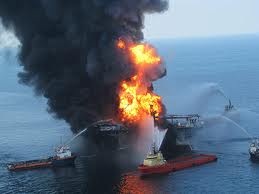
Imagine a spill like that going on in frigid northern waters.

Imagine billions of barrels worth of oil or gas gushing into the Arctic Ocean, to be picked up by the currents and spread all over the world.

Imagine the destruction of marine wildlife, and indeed the entire marine food chain, that this would entail.

NY Times reporter Landler doesn’t waste time contemplating such grim scenarios.  The focus of his article is “gunboat diplomacy,” a glamorous new competition among national navies to dominate the oceans, seen strictly in utilitarian terms.  His only mention of fish, or indeed any maritime creature, is a brief aside that icebreakers are being sent into the Arctic circle by countries like China and Korea, “to explore weather patterns and fish migration.”

Landler’s article, which is billed as “news analysis,” reveals the extent to which the chillingly disturbing values of the Energy Kings have permeated not only the governments who are supposed to be regulating their industry and safeguarding the natural world, but also the media “watchdogs,” who are obviously sitting cozily in the laps of Big Oil.

Questions of environmental sustainability and health are simply outside the picture for these folks.  It’s not relevant to them whether or not the polar bears survive.  They don’t care about the coral reefs, or the plankton.  They don’t care about whales.  Their only concern is the bottom line.

What is the most effective opposition to such monomania?

Trying to think of persuasive strategies gives me a touch of hysteria.  We could appeal to their love of seafood!  Wouldn’t they miss their caviar and oysters?

They will figure out how to grow these in tanks.

We could appeal to them as property owners: what’s going to happen to their beachfront homes, not to mention their office towers in coastal cities around the world, when the waters begin to rise?

They will have armies of lawyers figuring out ways to make the taxpayers bear the burden of their lost properties.

We could appeal to their brand image.  Does Exxon-Mobil really want to go down in history as the biggest perpetrator of maritime omnicide in world history?

They will throw this back at us, and rightly so: they were just doing their job of giving the consumer what she wants, a steady supply of affordable energy.

It’s true that we all share the blame for this tragedy unfolding in front of our eyes. It’s also true that we have the power to stop it.

How? We need to demand that the rights of the denizens of the natural world be respected.  A new Declaration of the Rights of Nature has been written–it needs to be circulated, popularized and upheld.

We need to insist that our politicians report to the people, the taxpayers, not to the corporations. Yes, people want energy; we want cars, we want electricity.  But we want to direct our tax dollars into R&D of renewable sources of energy–solar, geothermal, wind–not into dangerous oil and gas extraction or nuclear fission, and not into dirty coal mining either.

We need to call the mainstream media on its dereliction of duty when it presents one-sided reports like Landler’s industry white paper today.

Extracting those billions of barrels of oil buried below the earth’s surface miles beneath the sea would not just be a death sentence for marine life.  It would drive the nails on the human coffin as well, along with all the other species on this planet who will not be able to adapt to the erratic climate extremes of floods, droughts and storms that will inevitably ramp up once the planet heats beyond the point of no return.

Under these circumstances, if the governments won’t listen, radical action may prove a necessity.  The French Resistance to the Nazis were considered criminals in their own time and place, but look like heroes to us today, with the power of hindsight.
We are in the midst of a new, much larger Holocaust now, one that threatens not just one group of people, but all of us, and our natural world as well.

Each of us has a choice to make.  You can go along with the crowd, watching impassively as the train leaves the station for the gas chambers, or you can dare to raise your voice in opposition, and maybe even to throw a wrench in the gears of power.

Each of us is going to die sooner or later.  Wouldn’t you rather die knowing you had done your utmost to make a difference, to safeguard the world for your children and all life on this planet?

What do Derrick Jensen and George Washington Have in Common?

Derrick Jensen was speaking to the Occupy Oakland and San Francisco folks today, and I had hoped to catch the livestream, but ended up missing it.  I did find, however, a video from about a month ago, when Jensen spoke to Occupy DC via Skype.

True to form, Jensen told the crowd that when people ask him whether he’s calling for the overthrow of the U.S. Government, ie, real revolution, he answers that “this question comes far too late.

“For the government was long since overthrown.  And those who overthrew it are known as Exxon Mobil, British Petroleum, Halliburton, Monsanto, ADM, WalMart, Massey, Goldman Sachs, Citibank.

“They are the real governors, and the United States Government is a wholly owned subsidiary brought to you by McDonalds, Pfizer and Lockheed Martin.

“So then you can ask, am I advocating the overthrow of the corporations?  Am I advocating the overthrow of the corporate state?

“To which I will say hell yes!”

For someone like me who came of age in the 1970s and 80s, it’s very hard to imagine a world without corporations.  How would we get our stuff?  What would I type on if there was no Apple?  How would we communicate without Google, Facebook or WordPress, not to mention Twitter?

And of course, how would any of these products see the light of day without the industrial supply lines that go from oil extraction to factory production to tanker ships to retail store?

Well, somehow for the vast majority of human history, your ancestors and mine managed to live and procreate and die just fine without any corporate help or interference.

I’m no Luddite: I love my computer, car, cell phone and dishwasher just as much as the next American.

But somewhere along the way to the bank, we ceded far too much power to these corporations. Derrick Jensen has it right when he says that “a government worth a good goddamn” should answer to human beings, not corporations.

And not just to human beings, but to all of the beings on our planet who are fading away day by day–at the rate of 200 extinctions a day, as Jensen never tires of reminding us.

Will we join the polar bears and the wolves and the rhinos in fading away quietly into the night when our time comes, as it surely will if we do nothing to stop the steamroll of oil-driven climate change?

Or will we stand up now and demand that our government obey its mandate to be of the people, by the people, and for the people, recognizing that what is good for the people is what is good for the earth as an ecological system?

Jensen closed his talk in DC on a positive and galvanizing note:

“When the government becomes destructive of life, liberty and the pursuit of happiness, it is the right of the people to alter or abolish it.  It is long past time we made full use of our rights.”

Just like our colonial-era forebears, we have the right to throw off the yoke of oppressive government to found a better system.

The Occupy movements are the advance guard of what needs to be a massive campaign of civil disobedience and relentless pressure on the government to listen to us, the people–not them, the corporations.

We celebrate those rabble-rousers, Washington and Jefferson, as national heroes.  Let’s get behind today’s rabble-rousers and turn the corner into a new era.  It can’t happen too soon.

An older form of Deep Green Resistance rises from the rainforest. Euramericans, ignore this at your peril.

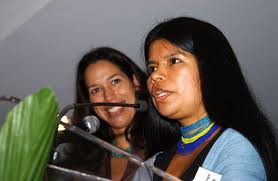
If you want to see something really inspiring, watch and listen to Patricia Gualinga, an Achuar woman from the Ecuadorian rainforest, talking about how her people are standing firm on the frontlines of the siege of the forest by multinational oil extraction companies.

Listening to this indigenous activist, you see shades of all the millions of indigenous peoples around the world who lived in harmony with their environment, respecting and sustainably stewarding their lands.

To say that this balance was altered when the Europeans began their voyages around the world is not to blame or guilt-trip.  It is simply to speak the truth.

To say that the European Enlightenment period, which gave us Manifest Destiny, “I think therefore I am,” the closing off of the commons and the capitalist drive to resource exploitation, was actually a time of deepening darkness, is simply to pronounce the self-evident.

While we contemporary heirs to this 500-year history may be individually blameless, collectively we have been bystanders who have followed the paths of least resistance and allowed the destruction of our planet to proceed apace.

The Pachamama Alliance, on whose behalf Patricia Gualinga spoke last week, is an unusual partnership between Euramericans and these South American indigenous survivors, warriors who are defending the great Amazonian rainforest, the dynamic lungs of the Southern Hemisphere, against rapacious encroachers.

We need another alliance like this between the peoples of the far North and those Euramericans who know that destroying the Canadian boreal forests would be equally catastrophic.

The Pachamama Alliance has developed a powerful model of collaboration across the boundaries of nationality and race in the service of a higher vision of earth-based spiritual activism.

This is a vision that needs to grow exponentially in the coming years.

For too long we have been held captive by the media-induced trance of relentless growth and consumerism.  It’s time to break the spell and allow the pendulum of human evolution on this planet to swing back to balance.

To do this, we need to listen to new voices, heed new calls.  We Euramericans have had our shot at leading the world our way.  It has been a disaster.

It’s time to cede the stage to our indigenous sisters and brothers, and try following their lead for a change.  This is a whole new level of Deep Green Resistance, based on creation rather than destruction.

 It’s time to co-create a new story with the indigenous peoples of the planet, who still know how to live harmoniously with the natural world.

Listen to the Pachamama story, and then it’s up to you–what comes next?  What role will YOU play?

Building on the Keystone “victory”–from endless growth to steady states

In his Op-Ed in today’s NY TimesMichael Levi, senior fellow for energy and the environment at the Council on Foreign Relations, argues that the Administration only agreed to put off the construction of the Keystone XL pipeline because of “not-in-my-backyard” pressure from Nebraskans, which had little or nothing to do with the urgent issue of cutting carbon emissions in order to avert climate disaster.

“For green groups,” Levi says, “the shortest route to blocking fossil fuel development appears to be leveraging local opposition.” The problem with this approach, from Levi’s point of view, is that there is going to be “local opposition” to green energy initiatives like solar and wind farms too.

What Levi, like most Beltway insiders, doesn’t seem to appreciate is that the green movement is not just about opposition.  It’s about positive action.  It’s not just about environmental protection.  It’s about social change.

It’s about a shift from a mentality that seeks to keep growing our energy-dependent economy indefinitely, to a mentality that seeks a sustainable steady state.

Steady states are anathema to capitalism–a quarter without growth is a quarter wasted, as any CEO would tell you.

But steady states are exactly what have made our planet a livable environment for the past several thousand years, during which the human species, along with countless others, has thrived.

Rejecting the Keystone XL Pipeline is just a small step in the right direction, towards a society that puts effort and money first into reducing energy consumption, and second into developing energy infrastructure that has the lowest possible impact on the ecological web of life.

The Michael Levis of America don’t understand that this is the real push behind the green movement today.

Yes, we’ll seek allies where we can find them, and make use of whatever sources of power we can find (even pro-oil Republican Nebraskans) to achieve our goals.

But our movement is not about “leveraging opposition.”  It’s about mobilizing support, through raising awareness about the threats to our civilization and our planet if we continue along with business as usual.

It’s also about leading the way towards the alternatives that are already within reach if we choose to veer off the beaten path into new, much more stable territory.

Endless growth is a social model that has proven itself to be highly unstable, whether we’re talking about national economies or energy systems.

It’s time to use our intelligence as a species for the good of ourselves and our planet.  There is really no other way forward.

Pipeline put off, but I’m not celebrating, are you?

Bill MicKibben: We won a temporary victory on Keystone XL, but the fight goes on | Grist.

It’s hard to feel elated about President Obama’s decision this week to kick the can of the Alberta tar sands extraction down the road a ways, until after the 2012 election.

Yes, any victory is a good victory, and the environmentalists who took the trouble to go to Washington and raise a ruckus in opposition to the proposed pipeline deserve our accolades and thanks.

The cranes who use the Nebraska Sand Hills refuge will have another year or two of peace.  The Ogllala aquifer is protected for the moment.

But it’s discouraging to see how the Administration is trying to limit discussion to the pipeline, as if it, in itself, were the problem.

No, the pipeline is just a symptom of a much larger problem: the potential destruction of the Canadian boreal forests, with their countless species of flora and fauna, and their tremendous carbon-trapping properties.

Without the Alberta forests, global warming is a done deal.

Does anyone there in Washington understand what that means?

Earth to Washington: do you copy?

Go ahead, Earth.

We haven’t got much time left.  The temperature is rising.  Once the climate destabilizes, we won’t be able to turn things around for a long, long time.  We’re talking geological time here.

Copy that, Earth.

So can we get some serious action there, Washington?  Can we light a fire under those politicians and get going with solar energy already?

Copy that, Earth.

Like–now?

Washington to Earth, connection is down.  Can you repeat?  Over.

Yes, that’s right.  Over.

A teachable moment at Penn State?

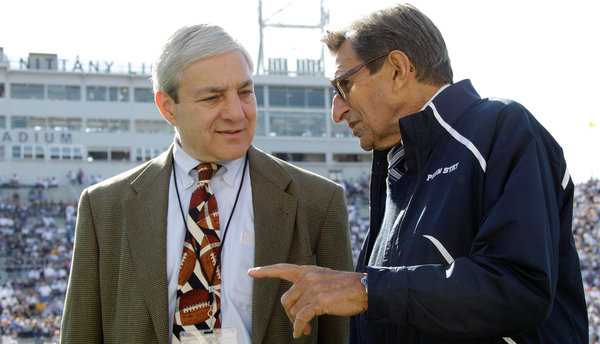
What is most shocking to me about the current scandal at Penn State (sports and sexual abuse of boys, in case you hadn’t heard) is the response of the students to the announcement last night that longtime head football coach Joe Paterno was fired.

Do the hundreds of students who poured into the streets to smash car windows and pull down lamp posts believe that it was OK that the coach turned a blind eye to the repeated rape of boys, some as young as 10 years old, in the university’s football locker room showers?

Do they want to be part of an institution that condones this kind of behavior?

If anything, the students should have taken to the streets to demand Paterno’s resignation, along with that of his boss, Penn State president Graham Spanier.

But no.  To these rampaging students, what happened in those showers with the pedophile assistant coach Jerry Sandusky was less important than hanging on to their beloved head coach.

This is reminiscent of so many other, similar scandals, in which men’s loyalty to social groups, whether it’s the military, a fraternity, a gang, or a football team, is so strong that it completely skews their independent moral compasses.

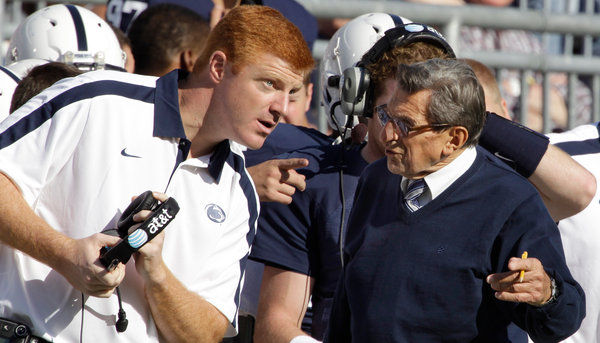
If you presented a group of unaffiliated students with a scenario like what we’ve just witnessed at Penn State, and asked them whether assistant coach Mike McQueary was right to blow the whistle on Sandusky after witnessing him rape a 10-year-old boy in the football locker room shower late one night in 2002, I think most of those students would say McQueary was in the right.  They would also most likely come to the conclusion that it was the duty of McQueary and Sandusky’s boss, Joe Paterno, to report the crime.

But obviously things don’t look so clearcut when various conflicting loyalties come into play.  When McQueary realized that Paterno and other school officials were not going to report Sandusky, should he have pursued the matter independently–even when it might very well have cost him his job?

Of course, the answer is yes.  How could McQueary and Paterno sleep at night knowing that Sandusky was using university facilities to lure in boys?  Boys, who, by the way, he met through a charity he belonged to, the Second Mile Foundation, which purports to help disadvantaged children in Pennsylvania.

It saddens but does not surprise me that the students at Penn State who protested the firing of Coach Paterno are willing to put their team loyalty ahead of the pursuit of justice and integrity in this case.

It’s very similar to the loyalty of the Catholic priesthood, which chose to protect its own rather than stand up for the rights of the young children, mostly boys, who were being molested by pedophile priests for years and years.

Or like the loyalty of fraternity boys who would never rat out a “brother” who raped a girl during a party.

I’m sorry, guys, but this is not brotherhood.  It’s bullying: one person taking advantage of someone with less social power or physical strength, and a whole bunch of bystanders letting it happen.

This is what the Penn State students are proud of?  They should be ashamed.

At least Joe Paterno, at 84, does seem to be showing some signs of moral rectitude.  “This is a tragedy,” he said yesterday. “It is one of the great sorrows of my life. With the benefit of hindsight, I wish I had done more.”

Yeah, Joe.  You may have had more football game victories than any other college coach, but you sure could have done more.

Student-driven learning: Diversity Day at Simon’s Rock

Tomorrow is Diversity Day at Bard College at Simon’s Rock, a day when regular classes are cancelled so that the whole student body can attend workshops prepared by students, with some faculty guidance, on a range of topics related to social difference.

I am participating in three workshops: “Bros Before Hoes: When Male Loyalty Becomes Oppressive,” which comes out of my Explorations in Gender, Culture & Society class, in which we recently read Michael Kimmel’s Guyland; “Sex in the Media,” about the objectification of women (and men) in the media; and “The Green Belt Movement: Planting Trees, Saving Lives” about the life and legacy of environmental activist Wangari Maathai.

There are a whole host of workshops I wish I could attend, if only I could clone myself!  For instance, “The Prison Industrial Complex,” “Occupy Wall Street: A Discussion on Political Engagement,” “I Don’t Do Black Girls,” and many more.

As someone who regularly teaches classes in world literature, human rights, gender studies and related topics, I sometimes have mixed feelings about trying to cram so much politically charged information into a single day.  The danger is that we stir up a whole host of raw, unprocessed ideas, emotions and opinions, and then go back to business as usual, leaving many loose ends and open questions dangling.

The hope is that students who would not otherwise be drawn to explore issues of social class, race, ethnicity, gender, etc. in an academic class will at least get some exposure through these workshops to what their peers are thinking about or experiencing, and may be inspired to continue the conversations outside the classroom, or even to take a class in sociology or gender studies in a future semester.

What’s most positive about this annual event at Simon’s Rock is how it encourages the student workshop leaders to put to good use all the pedagogical modeling we’ve done for them in our classes. I am always so impressed at how carefully student leaders prepare for their 90-minute sessions, and how easily they are able to use the tools and skills we’ve been working on since Day One at Simon’s Rock: focused freewriting, small group discussion, coming to consensus, reporting back to the big group, sharing ideas in a thoughtful, respectful manner.

Once in a while things I’ve seen things get out of hand at a Diversity Day workshop, if a group is too big and rowdy, or the chemistry between the session leaders and some of the students in the class just clashes.  But that is very rare.  Most of the time students are respectful and kind, appreciative of each other’s efforts in sharing their knowledge and experiences.

Andrew Revkin of The New York Times blogged recently about progressive secondary education, citing with approval a Long Island high school student’s call for “project-based learning,” which is “designed to put students in the driver seat.

“No longer is the teacher the only hub of information,” writes student Nikhil Goyal. “No longer do kids work in silos, isolated from their peers and the community around them….Projects drive the curriculum, rather than the reverse. And they incorporate a wide range of interdisciplinary subjects to achieve real-world relevance. Learning isn’t supposed to be boring and a process of nailing facts in students’ heads. It’s hands-on, it’s practical, and it’s creative. And project-based learning offers constant feedback and revision to develop higher quality work.”

So true!  Diversity Day at Simon’s Rock is a great example of just this kind of student-driven, project based learning, as the student workshop leaders define the topics that interest them, work on structuring the class time, put together audio-visual aids, and then go in to lead their sessions.

Could there be any better hands-on training for life in the real world?