World on fire

I had to dig deep into the New York Times, my usual go-to source for “all the news that’s fit to print,” to find any mention of this weekend’s train explosion in the province of Quebec, not far from the Maine border.

canada-floater-articleLarge

Lac-Megantic on fire July 6, 2013

I knew about it only because here in Canada it’s at the top of the headlines, with Prime Minister Stephen Harper taking the time this Sunday to journey to the small town of Lac-Megantic, where the disaster occurred, to size up the situation and offer his condolences.

Officially, so far, five have been confirmed dead, with scores still missing; Lac-Megantic, pop. 6,000, is said to look like a war zone, with black fumes rising from the burning crude oil carried by the 73-car train.

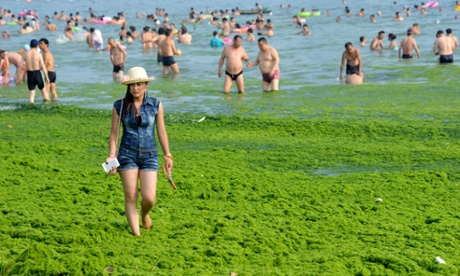
This on a weekend when temperatures in the Canadian Maritimes soared to record-breaking heights, and harmful algal blooms worldwide choked out marine life along all the coasts.

91fb3c94-086c-4470-a98e-23ec4ff993d8-460x276

Algae bloom on the Yellow Sea in China, July 2013

Astoundingly, at least one Canadian pundit responded to the burning crude and the smoldering township by calling for increased building of pipelines!

Another columnist, in the very same newspaper that reported on Nova Scotia’s unprecedented heat wave, had the nerve to call for more drilling and fracking for oil and natural gas on land and sea in the province.

If there are no more fish in the sea, we can at least extract the last of the fossil fuels, eh?

It’s time to get a grip, people.

What we need is not more oil and gas, but more wind and solar.

We need clean sources of energy, and we need to lower our consumption dramatically.

The window of possibility is smaller and tighter than most of us care to realize.

The tipping point is upon us.

This is not another action movie, a “White House Down”-style disaster flick, ending with the good guys reliably saving the day.

As we saw with the Arizona fires the other day, even the most hot-shot of heroes can go down in a blaze of glory when the fires burn out of control.

Do we really want to wait until the entire world is going up in flames, literally and figuratively speaking, before we act?

This is not a rhetorical question.  And the answer, I believe, is NO.  We can’t afford to sit on our hands any longer.

The time to act is NOW.

Which side are you on?

This past week was a perfect illustration of how many compelling distractions there are to the main business at hand.

After all, it’s much more interesting to focus on the good news of a Supreme Court blessing for gay marriage, or to follow the spy-novel intrigue of the Edward Snowden case, or to watch President Obama set foot in the tiny prison cell that kept Nelson Mandela captive for 18 years—much more fun than thinking seriously about the elephant in the room, climate change.

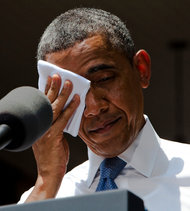
I was happy, and somewhat astonished, to see Obama finally seize that elephant by the tusks and deliver a speech that acknowledged how important climate change will be to our collective, planetary future.

Christopher Gregory/The New York Times

Christopher Gregory/The New York Times

In the speech, Obama declared that “the question is not whether we need to act. The overwhelming judgment of science — of chemistry and physics and millions of measurements — has put all that to rest. Ninety-seven percent of scientists…have now…acknowledged the planet is warming and human activity is contributing to it.

“So the question now is whether we will have the courage to act before it’s too late. And how we answer will have a profound impact on the world that we leave behind not just to you, but to your children and to your grandchildren.

“As a President, as a father, and as an American, I’m here to say we need to act.

“I refuse to condemn your generation and future generations to a planet that’s beyond fixing. And that’s why, today, I’m announcing a new national climate action plan, and I’m here to enlist your generation’s help in keeping the United States of America a leader — a global leader — in the fight against climate change.”

To me what’s most important in this speech is that way that the President is appealing to the country as a father. 

Those of us who are parents know that there is no higher priority for us than the welfare of our children.

We practically kill ourselves to provide for our children.  We go into debt to buy them high-quality food, medical care and education.  We go without so that they can have whatever it is that they need.

We would never knowingly feed them poison.  We would never knowingly do something that would undermine their future.

And yet, let’s be honest: most of us are doing just that, all the time, every day.

If you buy your kid a fast-food meal, you are contributing to the Monsantification of the world.

If you drive your car, heat your house with fossil fuels, or run your air conditioner, you are contributing to the super-heating of the atmosphere.

The vaunted American lifestyle is the problem.  President Obama didn’t quite come out and say so in his speech, but it’s not hard to read between his carefully calibrated lines and see what he is implying.

“Someday, our children, and our children’s children, will look at us in the eye and they’ll ask us, did we do all that we could when we had the chance to deal with this problem and leave them a cleaner, safer, more stable world? And I want to be able to say, yes, we did. Don’t you want that?”

Yes, of course we all want that.

We don’t want to end up shivering and starving in a blighted, devastated world, knowing that it was our own greed and short-sighted stupidity that brought us to this point of no return.

If we care about our own dear children, we need to make improving our relationship with the planet a priority.

That means no more poisons, no more GMO food, no more fossil fuel extraction at the expense of the natural environment, no more heedless burning our way to kingdom come.

As the President said, “those of us in positions of responsibility, we’ll need to be less concerned with the judgment of special interests and well-connected donors, and more concerned with the judgment of posterity. Because you and your children, and your children’s children, will have to live with the consequences of our decisions.”

Will have to live or die with the consequences of our decisions, that is.

Are you willing to condemn your grandson or granddaughter to a short, miserable existence on Earth, brought to a rapid end by climate-induced super-storms or famine?

I’m sorry to be so bald about it, but these are the stakes.

Which side are you on?  And what are you willing to do to ensure that future generations on this planet have a chance to enjoy the abundance and beauty that we and our parents have taken for granted?

100_2435

No more fish in the sea?

Last summer when I was in Nova Scotia, I wrote about how startled I was to struggle, in the local supermarket, to find anything but frozen fish with origin stamps of China and Southeast Asia.  The fresh fish offerings were meager, taking up just a small portion of the case allotted to them, and besides the lobsters, only the ocean trout and small haddock filets were wild caught.

product-lg-seafoodLast week, in a Puerto Rican supermarket, I had an unhappy feeling of déjà vu as I searched in vain for any locally caught seafood at all.  There was no fresh fish counter there, just a case of packaged frozen filets and shellfish, every one of them with their label pointing to China or India.

When I asked the locals about whether it was possible to get fresh fish on the island, they shook their heads.  “Maybe if you meet the fishing boats at the dock, they might sell you something,” one man told me.  “But it all goes to the restaurants and resorts.”

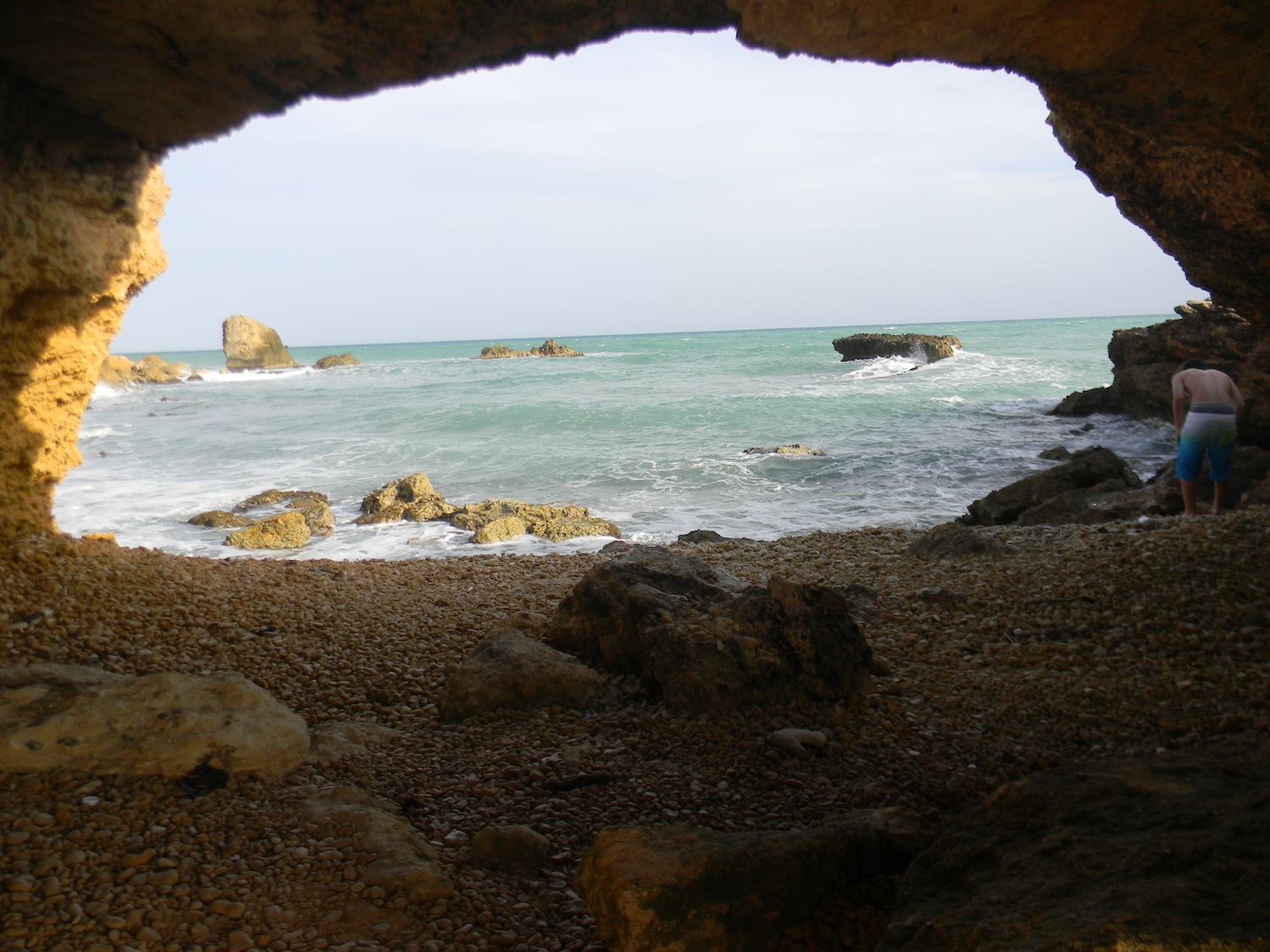
Other than crabs, there were few sea creatures to be seen on the beach, either.  One morning we watched a local man with snorkel gear and a fishing spear go back and forth in front of the beach collecting lobsters—undoubtedly illegally.

The only coral we saw was bleached and dead.

The amount of plastic garbage on the beach and in the coastal waters was depressing.

And although there was some bird life, it was thin, even in the beautiful coastal land designated as a “national wildlife refuge”: a single frigate bird, a couple of pelicans, a handful of herons and sandpipers.

DSCN3856

What frightens me is how quickly we normalize whatever situation we live in.

It’s normal now to live on an island surrounded by magnificent turquoise waters and not be able to find fresh local seafood to eat.

DSCN3895

It’s normal to buy water in plastic bottles and throw them casually away, without any clue of what happens to them once they’re deposited on the curb for the garbage men to pick up, and it’s normal to find those bottles washing up at the beach.

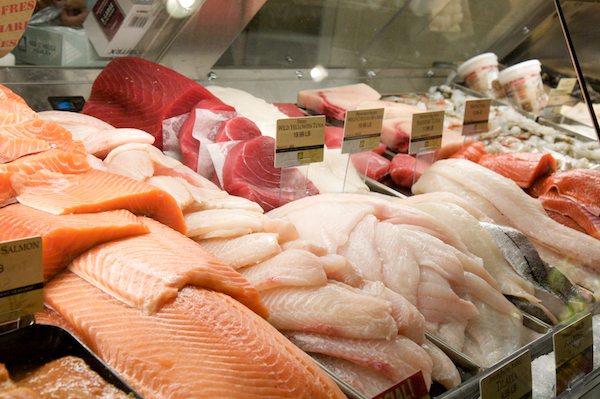
I_Fresh_Market_FishIt’s normal to return to the U.S. and find, in the local gourmet food store, a big gleaming fresh fish counter, with huge slabs of “sustainably farmed” salmon, leaner wild-caught Alaskan salmon ($25 a pound!), swordfish steaks, flounder filets, sea bass from Chile, fresh shellfish of every description.

Here in the heart of Empire, it’s normal to remain ignorant of the fact that this kind of abundance is rare, and carefully manufactured.

And when those who can afford that $25 a pound fish go abroad, they travel in bubbles of luxury that keep them cushioned in the comfortable delusion that all is well.

After all, in the restaurants at the resorts, there’s fresh salmon on the menu.  Never mind that it arrived on this Caribbean island packed in ice, on a flight from a fish farm in New Brunswick, New Zealand, or Scotland.

It’s normal, now, to feel sad but resigned to the fact that fish and seafood is becoming a rarity.

As omnivorous human beings, we have other choices. No seafood available?  Eat chicken then, or vegetables.

But what about the shorebirds and the ocean food chains that have evolved in tight symbiosis over millions of years?

Try telling a pelican or a seal to go eat some chicken.

DSCN3836

On the southern California coast this spring, there has been a wave of emaciated, starving sea lion pups washing up on the beaches.

baby-sea-lion-2edit

Starving sea lion pup being transferred to a rescue center for rehabilitation.

They’re starving because the fish their parents and grandparents caught so easily have been trawled up by factory fish vessels, frozen in plastic pouches and sent around the world on ice.

This is the new normal.

I am not resigned, and I will never get used to it.

Which Side Are You On?

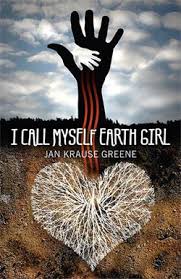
imagesFor the past few nights I have been putting myself to sleep by reading an advance copy of my friend Jan Krause Greene’s new novel, I Call Myself Earth Girl.

It’s not exactly a feel-good bedtime story, dealing as it does with rape, environmental disaster, death and bereavement.

But it’s also about empathy and love, between family members and also on a worldwide scale.

In Greene’s vision, the Earth and its denizens can be saved from catastrophe by mindful attention to what really matters: affirming life, both our own and that of the unborn generations to come.

Not since Starhawk’s 1994 masterpiece The Fifth Sacred Thing have I come across a book that so clearly matches my own waking nightmare of the terrible times that await us in the future, if we do not succeed in changing our ways now.

Let’s face it: it is possible that the kind of violence afflicting resource-starved places like Afghanistan, Syria and Somalia will become the norm in much more of the world, as climate instability creates food shortages and accelerates the pace of natural disasters beyond our capacity to recover.

America is a tinderbox just waiting to go off.  Imagine what would happen if suddenly it was not possible to go down to the supermarket and get your week’s worth of groceries?

Such a scenario is more or less unthinkable to people like me, who have grown up cradled by the richest breadbasket in the world.

We are only beginning to realize the costs that have come with our cornucopia: the destruction of the virgin prairies in the Midwest, the poisoning of the earth, water and air with chemical fertilizers, pesticides and herbicides; the grotesque factory farms of livestock and fish; the genetic alteration of seeds; the destruction of local farming by the huge predatory monster of American-style factory farms.

We have grown fat on these practices.  And now it’s time for us to accept responsibility for the outcomes of our heedlessness.

Those of us alive today have the privilege, and the responsibility, of presiding over what could very well be the end times for human civilization.

It’s somewhat analogous to the end times of specific human cultures, like the Greeks, the Romans, the Egyptians, the Ottomans, the great Chinese dynasties….except that this time, we’re not just talking about the end of a single culture, we’re talking about the demise of humanity as a species.

It is possible to imagine, as Jan Krause Greene did, that our lush green planet could turn brown from environmental disaster, provoking a culture of armed militias surviving by means of ruthless violence—with women, as always, at the bottom of the heap.

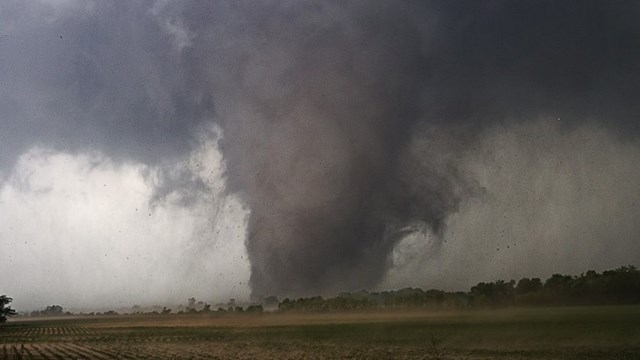
Tornado bearing down on Moore, OK; May 21, 2013

Tornado bearing down on Moore, OK; May 21, 2013

It is already happening—just not yet here, in the gated community we call America.

Can we wake up in time to forestall total, worldwide environmental melt-down?

In the past week we had a deadly two-mile-wide tornado in Oklahoma, and the Russian science station in the Arctic Circle had to be evacuated because the ice was melting at an unprecedented rate.

Here in New England we are expecting temperatures in the 30s Farenheit this weekend—way below normal for what should be the start of the growing season.

What’s next?

We don’t know.  But I take heart from local initiatives like the rehabilitation of the long-dormant Great Barrington Fairgrounds into a vibrant community-supported agriculture site.

We are going to have to re-localize agriculture if we want to survive the shocks of the 21st century.  We need to re-imagine not just agriculture, but community along with it.

As I Call Myself Earth Girl shows well, the antidote to violence and fear is love and empathy.

We still have a choice. Which way will you turn?  Which side are you on?  How far will you go to protect the planet and the generations to come?

fifth-sacred-thing

The jig is up for military sexual assault

No fewer than 26,000 sexual assaults were reported by U.S. military service men and women in the year 2012 alone.

You read that right.

According to The New York Times, “Pentagon officials said nearly 26,000 active-duty men and women had responded to the sexual assault survey. Of those, 6.1 percent of women and 1.2 percent of men said they had experienced sexual assault in the past year, which the survey defined as everything from rape to “unwanted sexual touching” of genitalia, breasts, buttocks or inner thighs.

“From those percentages, the Pentagon extrapolated that 12,100 of the 203,000 women on active duty and 13,900 of the 1.2 million men on active duty had experienced some form of sexual assault.”

These numbers are simply unacceptable, especially when contrasted with the small number of sexual assault cases that were officially reported (ie, not via anonymous survey)–3,374—and the abysmal rate of actual conviction: only 238 assailants were convicted in 2012.

Lt. Col. Krusinski; booking photo

Lt. Col. Krusinski; booking photo

Most embarrassing for the military brass was the arrest last Sunday of the officer in charge of sexual assault prevention programs for the Air Force, Lt. Col. Jeffrey Krusinski, who was accused of having sexually assaulted a woman he did not know in a parking lot.

Way to lead, Air Force!  Just when we thought the Tailhook scandal was becoming a distant memory.

I’m glad to see that some members of Congress—especially the women—are hopping mad and on the case, as today’s column from Maureen Dowd details.

Women who put their lives on the line to serve in the U.S. military deserve nothing but respect from their superiors and peers.

The question is, how is the military going to re-program its entire culture, from raw recruit to brigadier general, who have been raised to believe that “all women (and all gay men) want it,” that might makes right, and that superior officers can act with impunity towards those under their command?

How is the military—and, indeed, American culture at large—going to counter the billion-dollar American porn industry, that thrives on presenting women as objects of desire, yes, but also as objects of violence?

The truth is that what we’re seeing in military culture is just the tip of the iceberg of a much more deeply-rooted cultural problem.

Just as the military stood up to become the model for racial integration in the 1970s, it must now trailblaze the path to gender equality for us in the second decade of the 21st century.

Women who are now going to serve in combat, just the same as men, should not have to worry about “friendly fire” from male supervisors and peers.

To be honest, the idea of women breaking glass ceilings in the military does not thrill me.

I’d rather women work to create and broker non-violent institutions and solutions to problems.

But there is no excuse, ever, for sexualized violence against women or men.

The Lt. Col. Krusinskis of the world need to get their rocks off some other way, and the old-boy networks that have stood in the way of change on this issue have got to go.

Senator Kirsten Gillibrand, Democrat of New York, plans to introduce legislation that would take the adjudication of sexual assault cases outside of a victim’s chain of command. According to the New York Times editorial board, which supports the measure, “It would end the power of senior officers with no legal training but lots of conflicts of interest to decide whether courts-martial can be brought against subordinates and to toss out a jury verdict once it is rendered.”

President Obama said the right thing in response to the Krusinski arrest scandal, but it remains to be seen whether he can follow up his words with actions.

“If we find out somebody’s engaging in this stuff, they’ve got to be held accountable, prosecuted, stripped of their positions, court-martialed, fired, dishonorably discharged — period,” Mr. Obama said.

Got that, all 26,000 of you who committed sexual assault last year?

The jig is up.

Playing hardball with the fossil fuel industry: if not now, when? if not us, who?

Bittersweet sadness fills me this morning as I read an excerpt at Women’s E-News from Eve Ensler’s new memoir, In the Body of the World, about her long, determined, agonizing battle with uterine cancer.

Eve Ensler

Eve Ensler

Her TED talk, “Suddenly, My Body” is one that I have returned to watch several times over, and have recommended to many friends as a pulsating, powerful performance that makes perfectly clear what many of us are coming to realize: that there is no separation between our bodies and the world around us.
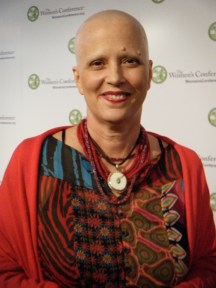
Eve Ensler

Eve Ensler

Not only is it true, as Joanna Macy and Brian Swimme tell us, that we are the most recent emanations of the stardust that created the life on our planet eons ago, it is also true that our fragile bodies are porous and open, made of the air, earth and water that we move through each day.

If we poison our environment, we poison ourselves.

So many of us are learning that the hard way.

Warrior lionesses like Rachel Carson, Audre Lorde, Wangari Maathai and Eve Ensler—each one snared by her own body’s encounter with the internal malignancy of cancer.

How many powerful, active, full-of-life people do you know who are no longer with us, felled by cancer?

A quick look at the cancer statistics kept by the Centers for Disease Control shows cancer rates soaring, especially for Americans 50 and older, and especially in the South, Midwest and Northeast of the country.

In the South and Midwest, they make and use those toxic chemicals—the ones that lace our food supply and flow into our waters, creating a dead zone the size of the state of New Jersey at the mouth of the Mississippi River; the ones that ride the prevailing winds east to fill the skies of the eastern United States and Canada with sooty particulates and airborne toxins.

None of us is immune from this.  No matter how careful we are to buy organic produce or grow our own, to keep BPA plastics out of our kitchens, even to pull up stakes and move to an area of the country that appears to be cleaner—we cannot hide from the reality that we live in a contaminated country, on a planet that is crazily out of balance and on the verge of a major correction.

When the colonizers came to the Americas, they were careful to try to pick off the leaders among the native peoples they encountered, knowing that if you deprive people of their most charismatic, powerful leaders, you will demoralize them and leave them open to takeover.

Although there is no devilish intelligence at work in the cancer epidemic, this dynamic still applies: when cancer takes from us leaders like Rachel Carson, Audre Lorde, Eve Ensler or Wangari Maathai, it leaves the rest of us stricken and reeling, spinning like a rudderless boat.
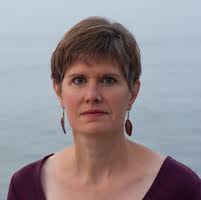
Sandra Steingraber

Sandra Steingraber

There are those, like Sandra Steingraber, who have been fighting cancer for a long, long time, and using it as a spur to work harder to save our planet/ourselves.

Steingraber was recently put behind bars for two weeks as punishment for her protest of the fossil fuel companies’ plan to hydrofrack for gas in her home territory of upstate New York.

She wrote from prison that it was her love, for her children and for all livings beings on the planet, that drove her to civil disobedience:

“It was love that brought me to this jail cell.

“My children need a world with pollinators and plankton stocks and a stable climate. “They need lake shores that do not have explosive hydrocarbon gases buried underneath.

“The fossil fuel party must come to an end. I am shouting at an iron door. Can you hear me now?”

Yes, we hear you Sandra, and we’re with you!

And yet, so many of us do not act on what we hear and know.

A low-level depression seems to afflict a great swath of the American public, and I would wager that the feelings of powerlessness that come with being unable to control the health of our environment or our selves may have something to do with it.

No matter how many times we go down to Washington D.C. to protest, it seems that the fossil fuel and chemical industries have the U.S. Congress sewn up tight.

Even someone like me, living in what appears to be a clean, leafy rural place, has to contend with farmers who still spray Roundup on their cornfields every spring, or rivers, including the Housatonic, just blocks from my home, heavily contaminated with PCBs from the upstream General Electric plant.

Since there is no way to play it safe, what we need to do is forget about safety now, in these end times, and play hard.

It’s time to give everything we’ve got to the fight to preserve the capacity of our planet to support life on down the generations into the future.

If humans are to be part of that future, we have to rise to the challenges we face now.

Like Eve Ensler, wracked with cancer and yet still leading the charge of One Billion Rising to fight violence against women this spring, we cannot afford to take time out.

Wangari Maathai

Wangari Maathai

Like Kenyan Wangari Maathai, felled so quickly by cancer even as she received the Nobel Peace Prize for her work in preventing the desertification of her country by teaching ordinary women to raise and plant trees, we have to be creative in our approaches, working at the grassroots when those at the top won’t listen.

Like Sandra Steingraber and so many other activists, we have to be willing to face the consequences of our disobedience to those in power.

Playing nice, following the rules, being polite—where has that gotten us?  When the polluters of the planet are playing hardball, we have to respond in kind—although our life-affirming version of hardball might involve planting trees, or raising flash mobs of dancers, or forming human chains of resistance at the boundaries of old-growth forests.

Rachel, Audre, Wangari, Eve, Sandra…we’re right behind you.  Fighting all the way.

Taking up arms against a sea of troubles

marathon-explosion-people-on-sidewalkIn the wake of the Boston Marathon bombing this week, like everyone else I’ve been thinking again about violence.

I am not a total pacifist. I do think that there are some situations in which violence is the only sane route to follow.

I could never be one of those Buddhists who try to send loving-kindness to their torturer.  Sometimes I even have trouble “turning the other cheek” if someone has offended me.

I am a Scorpio: I hold grudges, I brood, I sometimes lash out (though mostly in fantasy, very rarely in real life).

I am very sensitive to oppression, injustice and abuse—although sometimes this sensitivity manifests as a willed numbness, a deliberate refusal to see, because if I allowed myself to really take in all the oppression, injustice and abuse that saturates our planet daily, I would drown in my own howling depression and the guilt of not doing enough to combat it.

To combat it.  The verb choice there, which came out instinctively, is not innocent.

Is it possible to combat the violence of oppression, injustice and abuse without using violence?

What does sending tong-len or turning the other cheek accomplish besides emboldening one’s opponent to ever more impunity?

I believe there are times and occasions where violence is the only answer and the right answer to oppression, injustice and abuse.

But that is quite a different kind of violence from what happened in Boston this week.

Random violence that breaks into a festive, sunny day and kills and maims innocent bystanders is a totally different form of violence than the measured, carefully aimed violence of righteous resistance.

0415-boston-marathon-bomb-13Bombs loaded with nails and bb pellets, set off low in a dense crowd, are calculated to inflict maximum damage on soft exposed flesh and limbs.

Did whoever set those bombs enjoy the panic that ensued, the blood in the streets, the shock, the horror?

I can only imagine this perpetrator as a sadist, because unlike with the 9/11 attack or even the bombing of the Federal Building in Oklahoma City, there isn’t any apparent symbolism in this attack that makes any sense.

I can understand rage against the U.S. Government, and against the World Trade Center.  Although I could never condone killing innocent people in the service of that rage, I can at least see and comprehend the mindset that saw such collateral damage as instrumental in making a larger statement.

But what possible message could be sent through killing athletes and sports enthusiasts on the streets of an ordinary American city like Boston?

I wish the perpetrator would come forward and stand behind this act of violence.  I want to try to understand the motive, the fury that could have prompted such a carefully calculated crime.

I am not naïve; I know there are many very good reasons that people all over the world hate the U.S. and Americans.

And there are good reasons for Americans ourselves to be angry at our society and government, with its ever-increasing inequality, its investment in environmentally destructive policies and products, its build-up of weapons at the expense of the services that citizens have a right to expect and demand.

There is a staggering amount of oppression, injustice and abuse in the world, not just by people against people, but also by people against the natural world—and thus there is a hell of a lot to be angry about—and even to take up arms about.

But setting off bombs on a street crowded with families and athletes?

That is just more senseless violence–meaningless, useless, a squandering of lives and of anger that could be much more appropriately focused and channeled.

Yes, sometimes violence is necessary, sometimes it’s a good thing.

But the violence we are seeing on at ever-increasing rate here in the U.S. is an empty, hollow kind of violence; the violence of a sadist kid who likes to pull the wings off flies.

And worst part of it is, we seem to be on a roll with it.  Our young people entertain themselves with violent movies and video games; our military-industrial complex continues to grow with ever more sophisticated means to inflict violence abroad; our chemical and industrial destruction of the environment continues unabated.

We live in a violent world of our own making.

Can we who believe in peace, harmony and justice make things right without taking up arms ourselves?

I wish I knew the answer.

“Our lives begin to end the day we become silent about things that matter.”

So OK, having slept fitfully and woken up resigned to accepting the basic premise that it is unlikely that the world as I have always known it will continue into the foreseeable future…what then?

How do I spend my one wild and precious life on the planet?

I am quite clear that I want to put my time, talents and energies into doing my best to head off catastrophe for the natural world.

But this often feels like trying to stick my finger in a huge roaring dyke of bad news—how can I, a small and ordinary person, make a difference for the trees and animals and birds and bees that I so want to protect?

All I can say is that making the attempt is better than giving up.

My gift has always been writing, and so I am using that gift to try to reach out to others, in the hope that if many of us, in our small, ordinary lives, can join our voices together, the resulting chorus could indeed change the world.

I am continually amazed at how the technological innovation of the World Wide Web has facilitated the meeting of minds and the catalyzing of movements.  There has never been a better moment for human progress and connected intellectual growth.

I wake up with a new thought, write it down and send it out into the gushing waters of the internet, where, within the hour, it will be read by someone living on the other side of the planet, who will bat it back to me with comments that will cause me to see the idea from a whole new perspective.  All within the space of an hour! How remarkable is that?

But sadly, it is precisely our reliance on and success with technology that is causing our demise, from simple overpopulation to the poisoning of our environment.

This is the challenge of our time: to very quickly learn to adapt to our rapidly changing climate, and to find environmentally sustainable ways to hang on to our positive technological inventions.

I believe it can be done, which is why I am totally invested in the challenge of waking people up and getting them engaged in fighting the good fight to make our epoch, which many call the Anthropocene, a positive transition to a better human relationship with the Earth, rather than a nightmare ending in the dark night of extinction.

If we were to shift our resources from weapons of destruction–guns, bombs and missiles, chemical poisons, and ever-bigger drills, earth-movers and chain saws—to implements of cultivation and the harmless harvesting of the bounty of our natural world, what a huge difference that would make!

People say that over-population will continue no matter what, but I know from years of studying women’s issues worldwide that when women are educated and respected in a society, they have fewer children.

Between fewer children in the developing world, a lower rate of consumption in the developed world, and the invention of new technologies that act in harmony with nature rather than against her, we could transform our planet within a generation or two.

J.R.R. Tolkien’s classic fantasy The Lord of the Rings is looking more and more prophetic, and it’s surely no accident that the films have come out now, to appeal to the current generation of young people.

We are the ones who must enter the fight to hold off the dark forces of Mordor, in order to preserve the happy, healthy lives in the Shire that all humans are meant to live.

tumblr_m9hm5vDG2h1qzhkvho1_500Today is the anniversary of Dr. Martin Luther King Jr.’s assassination, and I invoke his memory to remind us that although it is true that by ourselves each one of us is puny and limited, it is also true that if we pool our resources and act together we have tremendous power.

We must each start by determining what gifts we can bring to the table of this new movement, and then start where we are, doing what we can, and sharing our insights and passions by all the channels of communication that are open to us, from talking face to face with friends and neighbors to sending our ideas out into the World Wide Web.

Now is the time, and we are the ones we’ve been waiting for.

I will close with two quotes from Dr. King:

“Our lives begin to end the day we become silent about things that matter.”

“If you can’t fly then run, if you can’t run then walk, if you can’t walk then crawl, but whatever you do you have to keep moving forward.”

Amen, brother.

Confronting taboos: death and the afterlife, American-style

It is one of those unspoken social contracts that Americans won’t say anything to each other that might indicate any doubt that life as we know it will continue.

If you dare to bring up the subject of climate change, with its attendant erratic weather, major storms, sea-level rises, wildfires and crop losses, people roll their eyes and change the subject.

If you voice any doubt that the economy—local, national and global—will recover, you are dismissed as a negative Pollyanna, and again, the subject is changed.

If you were, just hypothetically, to express the opinion that our increasing reliance on digital technology might have the quality of an unhealthy addiction, and to worry aloud at the effect that all that unrelenting screen time is having on the current generation of tiny tots, you are dismissed as a raving Luddite.

Nobody talks about the fact that both of our political parties are thoroughly corrupt, and our Supreme Court even more so.

No one mentions the disappointment so many of us feel with President Obama, who has proven himself incapable of effectively standing up to Beltway politics—if indeed that was ever his goal.

We are living through a massive period of collective denial of social and physical reality, with no exit in sight from the crazy funhouse we inhabit, with its motto, “Everything is going to be OK” blazoned on every door.

It’s about time we accepted the fact that everything is not going to be OK.

Not by a long shot.

I have been a little bit quieter than usual this past month, with my attention turned to the Berkshire Festival of Women Writers, but I have been paying attention nonetheless to what’s going on in the world.

The elephants of Africa are under siege and conservationists are now using the E-word to describe their future.

American bees are dying off at record rates due to pesticide poisoning, which is now not only killing the adults, but also the larva of the bee colonies.

The ice at the poles continues to melt at an accelerated rate, while down in Australia it was by far the hottest summer on record.

Just this week, record rainfall brought flooding to Argentina that killed scores of people.

There will be no escape from the severe weather that our degenerating climate system will wreak upon all of us.

As retiring climate scientist James Hansen has testified over and over, we are already at the tipping point from which there will be no return to what was “normal” for the past 10,000 years.

I totally understand the impetus to denial, because really, what can any of us do about all this?

What should we be doing?

Marching on Washington DC?  Setting up survivalist camps in the wilderness?  Sabotaging pipelines and coal-fired power plants?  Buying hybrid vehicles and solar panels?

Damned if I know.

I am on a list-serve that broadcasts a newsletter written by Alex Kochkin, who focuses more on the spiritual side of our current crisis on Earth.  Kochkin insists that we should not be wasting time worrying about the physical issues here on the planet, but instead should be focusing our attention on getting ready for our transition into the spiritual realm—in other words, for death.

Kochkin predicts that there will be a massive die-off of humanity in the coming years, but he casts this in positive terms, as a necessary cleansing that will enable the Earth to reboot and start on yet another spiritual and evolutionary journey.

Believing firmly in a nonphysical afterlife, he is unafraid of death.

This is so counter-cultural that it gives me pause.

Unafraid of death?  Really?

Our culture is so fixated on avoiding death at all costs that it is hard to wrench my mind around to another way of seeing things.

11857232-life-after-death-religious-concept-illustrationWhat if death were just a transition to another (non-physical) stage of existence?

What if it were in fact the best thing that could happen to our planet if the majority of human beings transitioned out of physical existence?

What if the tenacity with which we Americans hold on to our lives was entirely misplaced?

What if instead of focusing all of our technical and intellectual know-how on physical survival, we began to focus on learning more about the non-physical realms that we have so far relegated to the backward precincts of religion, New Age quackery, and woo-woo tales of near-death experiences?

There is a noticeable trend in popular culture reflecting an uptick in interest in explorations of the spiritual/non-physical dimensions.  From Harry Potter to Twilight and beyond, we have a fascination with stories that can take us beyond the bounds of ordinary physical reality.

So strong is the cultural taboo on discussing this seriously that it is hard for me to push the “publish” button and let this blog post out in the world.

But another part of me rebels and is just done with listening to the soothing murmur of the mainstream: don’t worry, dear, everything is going to be OK….

No, everything is not going to be OK.  Just like the elephants and the bees and the polar bears, human beings are going to face a massive die-off due to the changes in our climate system, and soon.

It is that, above all else, that we should be preparing ourselves for.  How? I am not sure.  But one thing is certain: insisting that all will be well, despite all the evidence to the contrary, is just silly and delusional.

It’s time to wake up.

The Alchemy of Privilege

Nancy Slonim Aronie

Nancy Slonim Aronie

At the Berkshire Festival of Women Writers last night, Nancy Slonim Aronie, author of Writing from the Heart: Tapping into the Power of Your Inner Voice, declared that every powerful writer must be an alchemist: “every writer must turn shit into gold.”

She told the story of the life and death of her angry, terminally ill son, Dan, as an example of how the bad stuff that happens to you can be turned into gold—in her case, a documentary film about her son, whose death, she says, taught her so much about life.

Aronie said that the video editor working with her on the movie decided at one point to cut out a scene where Dan’s girlfriend struggles with his urine bag, which had gotten snagged on a bedpost.

“No!” she roared.  “Don’t cut out the urine bag!  Don’t try to protect us from the tough stuff!  Go ahead and make us uncomfortable!  That’s the stuff we most need to hear and learn from.”

She led a short writing exercise, in which she told the group to “start with your brain, drop into your heart, then your gut, and let it out onto the page.”  Writing from your brain alone, she said, will not get you into the zone of authentic, powerful expression that every writer seeks.

She gave us the starting prompt: “Dinner at our house was…” and told us to go back to our childhood dinner table.

When people stood up to read their pieces afterwards, I was astonished how most of them reported dinner tables that were frightening and painful.  One woman remembered how no one listened to her at the dinner table, leading to a lifetime of wondering whether she had anything valuable to say.  Another wrote about how she couldn’t wait for dinner to be over so she could get away from her threatening, angry father.

Nancy Aronie applauded them all, and kept insisting that powerful writing needs to write out of that “core wound.”

But what if you don’t have a core wound?

What if you grew up in a happy, peaceful household, with kind, productive, harmonious parents who did not wound you in any way?

Can your writing still be powerful?

In the memoir that I am working on, I recognize that I had an almost magically privileged childhood.  No, it wasn’t perfect, but it was pretty damned good, and my good fortune continued well into my adulthood.  I sum it up in the memoir by describing the feeling I got in my twenties, when I was working as a journalist in Manhattan, of a “red carpet rolling out in front of me wherever I went.”

It didn’t last forever, of course, but it is that early experience of privilege that I am interrogating in my book, not just in my own personal experience, but also in our general culture as Americans in my lifespan of the past 50 years.

For all the bumps in the road we’ve had, we have still been extraordinarily privileged and comfortable as Americans, relative to so many of the other billions on the planet.  While we’ve been riding around in our air-conditioned Cadillacs, figuratively speaking at least, so many others have been living and dying precariously on the garbage heaps and slums, the brothels and the prisons of tough, violent cities.

As a scholar of comparative literature, I’ve made a career of studying texts by women from all over the world that tell stories of suffering and oppression in order shine a light in dark corners, raise awareness among the more privileged, and act as catalysts for political action and positive change.

In introducing these stories to generations of students, and editing the related anthologies that have made their way out into the world, I have felt myself to be working on the side of justice, doing my small part to help make things right.

Now, in my memoir, I want to shine the light in a different direction: back at myself, as someone who grew up in privilege yet did not become inured and deaf to the suffering cries of others.

I am certainly not alone. I believe that most people of privilege do have a social conscience; do care about how the other half live; and are willing to be part of a movement for positive change if they can see a clear, trustworthy channel through which to pour their energies.

The “shit” that I need to alchemize in my memoir is precisely the lovely bubble of privilege itself, which protected me–and others who grew up like me–from setting foot outside of our comfort zones.

We enjoyed ourselves poolside and planned our next vacation; got married and had children; bought houses and cars and ever-faster computers and gadgets; and had no clue at all how our lifestyles were contributing to the accelerating disaster of global heating and climate change.

In my case, the “shit” I need to write about is as squeaky clean and wide-eyed as my own innocence as a young woman seeing Third World poverty for the first time and having no clue, none at all, of the role of my country in creating and sustaining it.

That cluelessness seems to be the “core wound” that I have to interrogate in my memoir, recognizing how very comfortable it has been to be so protected, and yet how destructive it has been too, as generations of elite young people like me have been raised to take our place in established social frameworks without questioning the underpinnings of social and environmental injustice on which we stand.

It is not easy to call out your tribe, to criticize a way of life that has been so easy and sweet. I have only gratitude for the gentle, loving upbringing my parents gave me, and the support they provided that made it possible for me to step out into the world on a strong footing. I am not being glib when I say that everyone should be so lucky.

It’s the bigger picture that I am questioning: how all of us privileged Americans, without realizing it, have contributed to the twin crises of social inequality and environmental holocaust that we now must face today.

It’s not about casting blame; it’s about accepting responsibility and putting our shoulders to the wheel of the enormous task of making things right again on our planet.

That is the alchemy I seek as a writer in these dark transition times.