Staring down the crystal ball

I really want to believe it’s all a hoax.

Why else would not one mainstream media outlet be reporting on the massive danger posed by the unused fuel rods in Fukushima Reactor 4?

Today I learned (through a link posted by on Facebook by my friend, the author Susan Griffin) that a group of high-level scientists, diplomats and civil society organizations has issued an urgent call to U.N. Secretary General Ban Ki-Moon, requesting U.N. leadership in an international effort to stabilize the fuel the wrecked Fukushima plant.

This call has been endorsed by U.S. Senator Roy Wyden, who visited the plant in April and reiterated the call for urgent international action.

If the fuel in the plant were released into the atmosphere, which would be almost inevitable in the event of another earthquake, “this could result in a catastrophic radiological fire involving nearly 10 times the amount of Cesium-137 released by the Chernobyl accident,” according to the letter to Secretary Ban.

Fukushima burning

Given the climatological realities of wind and ocean currents, this could potentially put hundreds of millions of people at risk of radiation poisoning—not to mention the devastating effects on flora and fauna.

Remember the reports of thousands seals with fatal skin lesions washing up in the Arctic? Apparently polar bears and whales are also known to be affected.
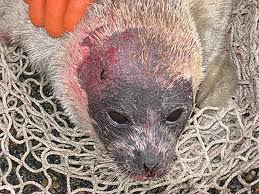
Imagine that multiplied tenfold, and affecting not just marine life, but humans as well.

And then ask yourself, why is only one U.S. Senator engaged with this issue?

Why are we frittering away our precious time on White House Correspondents Dinners and sports events, when in so many ways our future hangs in the balance, connected by a very short fuse to multiple forms of total catastrophe?

Sometimes I look down at my peacefully sleeping dog and think, maybe he has the right idea.

Why fret and worry about the future?  It will come soon enough…might as well enjoy life while it lasts.

But that is what separates us humans from other species.  We can see into the future.  We can spin out possible future scenarios based on how we act today.

And given these crystal balls of ours, can we really in good conscience shrug our shoulders and head off peacefully to bed?
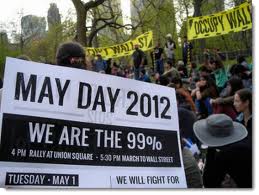
May Day: Here, There and Everywhere

A reader asks why I did not stay home from work and join the May Day protests today, and I feel like this question deserves a serious response.

Partly, I have always had a phobia about crowds, and never willingly put myself into a crowd situation.  I don’t even like to go to an agricultural fair, or a peaceful parade.  In my Manhattan youth, crowds and violence often went together, or at least crowds and the fear of violence.  I am a wimp.

Partly, I felt like I could do more good in my classroom today than anonymously out on the streets.  It is the last full week of classes at my institution; students are finishing up projects that need response and guidance.  If I didn’t show up to work today, it would throw a monkey wrench in the plans I made for a graceful and productive ending to our semester together.

Partly, I don’t have any beef against my own employer, so not showing up for work today would affect the wrong target, while making no difference at all to the intended target, the 1%.

I guess the biggest reason I felt like my presence was expendable to today’s protest is because no one would notice if I was or was not out there on the street, but I would definitely be missed from my classroom.

However, in at least one of my two classes today, I did spend some time talking about May Day and the reasons for the protest.

I was surprised to learn that very few of my students had any clue as to what May Day signified to the labor movement, or why the protests today were taking place.

I don’t know why I assumed that my students would be more politically aware than I was at their age.

Turns out, few of them even realized there were going to be significant protests today, much less what they were all about.  Some also had their doubts as to whether the Occupy approach was likely to be effective.

Well, I pressed them, if occupying public spaces is not an effective means of protest, what would be more effective?  Joining a political campaign?  Writing a letter to the editor?

No one had an answer to that, but I could see the wheels turning.

And that’s why I am glad I decided to stay at work today.  At least with this one small group of students, I was able to foreground these historic May Day protests in their minds, and ask some questions that no one else probably would have asked them today.

Maybe as a result they will be paying attention to the news in a different way, and thinking more concretely about how the issues blazoned across all those posters and banners are relevant to their own particular lives.

Whether working on the small canvas, in the classroom, or the big canvas, out in the street, we are working together to build up the necessary momentum to blast our way to a better world.


Which Side Are You On?

So here we sit on the eve of May Day 2012, and there is an eerie calm-before-the-storm kind of feeling.

The mainstream media is still doing its best to pretend that nothing out of the ordinary is going on.

The only May-Day related event reported in the NY Times today was that a lawsuit was filed in federal court to keep police from using “pen” barricades to hold demonstrators against their will.

Apparently news of the remarkable energy, creativity and defiant spirit showed by the Occupy movement in the countdown to May Day is not fit to print, ie, not important to the intended audience of The Times.

But if you move over to Twitter and search #Occupy, #OccupyWallSt, or #MayDay, you get a whole different picture of what’s going on.

Instead of the nose-in-the-air ho-hum of the fat-cat NY Times, suddenly you’re plunged into a hum of activity, down on the ground with a million twittering mice running around energetically, purposefully and thoughtfully.

There is @OccupyColleges calling for a student strike to protest the debt-bondage of student loans.

#OWS is trumpeting the latest total of 135 U.S. cities where general strikes have been organized for tomorrow.

The Nation, Democracy Now, and Truthout are publishing advance stories preparing for what’s coming.

The media landscape itself bears evidence of the huge and widening gap between the 1%-dominated old guard, napping on its laurels, and the feisty up-and-at-‘em new media webizens, who are vigilant and unafraid to welcome in something new and different.

For make no mistake, the General Strike planned for tomorrow is something new.

International Workers Day has not been celebrated in the U.S. for a long time.  In fact, during most of my lifetime it was demonized as a Communist holiday, which you’d be unpatriotic–unAmerican!–to take seriously.

We’ve come a long way in a very short time.

Thanks to the Occupy movement, being a worker, rather than a boss, is no longer a sign of personal shortcomings, as in: what’s wrong with you, that you’re still only earning minimum wage, bub?  You dumb or something?

Likewise, the Occupy Foreclosures movement has taught us that it’s not that we were stupid to apply for that tempting mortgage, it’s that the banks were predatory and sleazy to talk us into it.

Thanks to the Occupy movement, the onus has shifted to the 1% to prove that what they’re doing is responsible and for the good of all, rather than motivated by naked greed and self-interest.

The rapacious vulture Capitalism that has dominated the U.S., and hence the world, since the end of World War II has been exposed, and there is no going back.

It may be true that many of the strikers are motivated by self-interest rather than pure altruism.  They want jobs, along with affordable housing, education and health care.

But it’s also true that the Capitalist masters of the universe have lost control of the ship and can no longer pull levers to make jobs and other social benefits magically appear.

Unless, that is, the ultra-rich 1% can be persuaded to part with a fair portion of their loot.

History shows that when the gap between the haves and have-nots widens too far, something snaps and the mob takes over to reset the balance.  Think the American, French and Haitian Revolutions.  Think the Communist takeovers of Russia and China.

When it happens, it isn’t pretty.  Haven’t those in power learned their lesson?  Don’t they realize that they can only push the 99% so far before all the police barricades in the world won’t be able to hold us back?

I don’t think we’ve hit that snapping point yet.  But May Day 2012 is going to be something to watch, and something to participate in, too, if the spirit moves you.

Me, I’ll be teaching my classes this May Day, but with a tip of my hat to what’s going on down at the barricades in New York and all across the country.

And you?  Where will you be on this historic International Worker’s Day?

“Which side are you on, boys, which side are you on?”

(AP Photo/John Minchillo)

Stop the holocaust of migrating birds

Lately I have been sitting with the brooding knowledge that at least 7 million migrating songbirds were killed this spring running the gauntlet of 84,000 American communication towers that rise as high as 2,000 feet into the sky, braced by invisible guy wires that garotte the birds right out of the air.

This is actually just a fraction of the number of birds killed each year by running a collision course with human activity.

This spring has been more silent than ever. The traditional dawn chorus of birdsong has ebbed to a few lonely little souls, most belonging to non-migratory species like cardinals, bluejays, chickadees and sparrows.

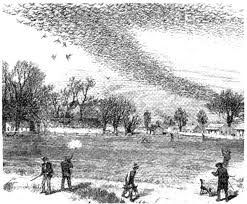
They say that when Europeans first arrived on this continent, the migration of the passenger pigeons would literally darken the sky for minutes on end.

I have never seen a living passenger pigeon, and it seems that my grandchildren will not know what I mean when I talk about the dawn chorus of riotously busy, happy birdsong, any more than they will be able to imagine an apple orchard in full bloom buzzing with the diligent harvest of a million droning bees.

Knowledge like this makes me sick at heart.  My rational side is aware that mourning is not productive, but another side of me knows that it is one of the special gifts of us humans to feel grief; to locate particular sadnesses in the larger landscape of suffering; and to use our sadness and anger at injustice as a lightening rod for change.

Other animals and birds feel grief as well, but you won’t find the great community of birds gathering together to make plans to topple all the communication towers in North America.

No, the birds will go quietly, one by one, into the endless night of extinction.

Just as it was our ingenuity that created those needle-like structures, held up by steel deathwires, it is our job as humans to recognize the destruction we are causing and make sure it changes.

I am not suggesting that we give up our communications towers—that would truly be a quixotic quest!

I am suggesting that we place value on the lives of 7 million birds—the number that scientists estimate are killed annually by communications towers taller than 180 feet.

What can be done?  Well, there must be some way to make those wires visible to the birds.  We could drape them with some kind of fabric, or coat them with a glittering reflective paint.  We could emit some kind of sound signal that would alert the birds to avoid the tower area.

The scientists studying this issue noted that simply changing the lights on the towers from solid red lights, which apparently mesmerize the birds in bad weather, to blinking lights, “could reduce mortality about 45 percent, or about 2.5 million birds. The study also recommended that businesses share towers to reduce their number and build more freestanding towers to reduce the need for guy wires.”

As we saw when Rachel Carson succeeded in getting DDT banned, bird populations can and do rebound if given the chance.

But not once they’re extinct.

We must act now, before the songbirds follow the passenger pigeons into permanent silence.

From Big Tobacco to Big Corn: the time to stand up for the right to health is NOW

Two years ago, I was taking multiple steroid inhalers every day for asthma, which began in the aftermath of a couple of bouts of pneumonia, and was always accompanied by typical seasonable allergy issues—coughing, sneezing, runny nose.

In the summer of 2010, in addition to the usual asthma and allergy symptoms, I also came down with a severe intestinal infection, requiring antibiotics to overcome.

When, in the wake of the course of antibiotics, my digestion was still troubled, I decided to experiment and see if removing gluten from my diet made any difference.

Lo and behold!  After just a month without gluten, my intestinal issues made huge progress.  And even more impressively–and completely unexpectedly–my asthma and allergies also disappeared.

When, after a while, I also decided to give up meat, except for the occasional small portion of chicken, the results were nothing short of miraculous.

Longstanding feelings of intestinal bloating disappeared overnight.  Bleeding hemorrhoids totally cleared up.  And the asthma and allergies, which had sometimes been so severe that I ended up in the ER begging for more drugs, were gone for good.

This remarkable shift in my own personal health, as a result of giving up meat and gluten, really makes me wonder.

Why is it that the gluten-free market is one of the fastest growing packaged food sectors right now?

Why are so many of us getting sick from our food supply?

Could it have something to do with the fact that most of our nation’s food supply is produced by industrial agriculture, relying on GMO seeds, as well as herbicides, fungicides, and pesticides in the growing process, not to mention all kinds of preservatives once the corn and wheat is on its way to the table?

I am heartened by the news that hundreds of thousands of farmers and consumers are pressuring the USDA to reject Dow AgroScience’s 2,4,D-resistant corn.

It is high time that all of us stood up to Big Ag and said enough is enough!  Why should we have to spend top dollar to buy organic, when the truth is that all food should be produced in an organic and sustainable manner?

Big Ag will reply that it would be too expensive to produce tons of corn, wheat and soybeans–not to mention beef and pork– organically.

But you know what?  Being sick is very expensive.  Health care is a huge drain on our national economy, as anyone who has been paying attention knows.

Could it be that the industrial agriculture/pharmaceutical/insurance conglomerates actually want a sick populace?

Imagine the outrage if that story were to break.

Imagine if it were proven that the incredible spike in autistic children is due to pesticide poisoning.

Imagine if we could prove that the asthma epidemic in this country is due to auto-immune problems generated by toxic food.

Imagine if we could nail the chemical companies for the explosive growth in cancers, diabetes and heart disease!

I don’t think this is far-fetched at all.

In fact, it’s low-hanging fruit for a cadre of well-trained lawyers with the guts to go up against the big bad guys.

In our parents’ generation, it happened with Big Tobacco.

The evidence is staring us in the face.

What are we waiting for?

America, land of the brain-damaged and debt-enslaved

Is it any surprise that we Americans treat animals and the natural world so badly, given the way we treat even our own cherished children?

This week there were two grim news stories illustrating the callousness of American society towards its young adults.

The first was a disturbing column by Nicholas Kristof revealing to the public what research scientists have known for a while: the skyrocketing rates of PTSD and suicide among young veterans returning from the Iraq and Afghanistan wars are due not to mental instability, but to the physical effects of repeated exposure to shock waves caused by bomb detonations.

The military is in the process of performing autopsies on veterans who committed suicide, and so far an alarming number of them have shown evidence of chronic traumatic encephalopathy (C.T.E.), a degenerative disease of the brain best known for affecting boxers and football players who endure repeated concussions.

“In people with C.T.E.,” writes Kristof, “an abnormal form of a protein accumulates and eventually destroys cells throughout the brain, including the frontal and temporal lobes. Those are areas that regulate impulse control, judgment, multitasking, memory and emotions.”

In other words, even young soldiers who return home physically intact may in fact be suffering from the hidden effects of shock wave concussions, which will destroy their lives over time; apparently the disease “typically develops in midlife, decades after exposure. If we are seeing C.T.E. now in war veterans, we may see much more in the coming years,” says Kristof.

***

Number two, we learned yesterday that the combined student debt in the United States reached $1 trillion. 

Occupy Wall Street demonstrators participating in a street-theater production wear signs around their neck representing their student debt during a protest against the rising national student debt in Union Square, in New York, April 25, 2012. The protest eventually marched to Wall Street; two people were arrested during the protest. REUTERS/Andrew Burton

I can’t even wrap my mind around a number that big, but one thing I can understand is that this is an egregious example of how we as a society are condemning our best and brightest young people to spending the best years of their lives in debt bondage to the banks.

For the wealthy, college and graduate school continue to serve as playgrounds for the young, a place to have fun, learn a few things and pair up before joining the family business.

For the rest of us, college is an essential step along the road to personal and professional success.  It’s not optional, and the price tag just keeps rising, while the ability of parents to pay for their children’s higher education keeps falling.

And so we find kids still in their teens signing loans for tens of thousands of dollars.  It is not uncommon for these kids to find themselves, just a few years later, with a B.A. and $200,000 worth of debt.

If you have ever tried to pay the interest on that much debt on a typical entry-level salary, you know that it’s nearly impossible.  Certainly it’s daunting to try to achieve the American dream—the car, the house, the spouse and two kids—with that kind of stranglehold of debt around your neck.

***

So this is the way we treat our precious children in America.

In a new twist on “friendly fire,” we send them to war without even realizing the longterm effects that our fancy new bombs will have on them.

And we blithely tell them that a) a college education is the only way to get ahead; and b) if you want one, you have to get in line at the loan office and spend the first 20 years of your working life paying off that interest.

There is something deeply, hauntingly wrong with this picture.

And you know what the worst thing is?  There is no widespread outrage about it!

If you are a young person, a parent, or any person with a conscience, you should be working furiously to end war and to end debt bondage for students.

How?

Well, start by standing up and saying NO MORE!!!!

Nuclear famine: the future that must never happen

“I am convinced that nuclear weapons must be abolished. Their use in a military conflict is unthinkable; using them to achieve political objectives is immoral.”

Who said this?  Not your average peacenik hippie.  Not even a pie-in-the-sky anti-war activist.

No, it was Mikhail Gorbachev who called for the total abolishment of nuclear weapons, in a recently released report by the renowned International Physicians for the Prevention of Nuclear War (IPPNW) and its US affiliate, Physicians for Social Responsibility (PSR).

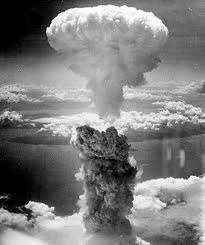
A-bomb on Nagasaki

The report is grimly entitled “Nuclear Famine: A Billion People at Risk—Global Impacts of Limited Nuclear War on Agriculture, Food Supplies, and Human Nutrition.” Its lead author, Dr. Ira Helfand, draws upon new modeling evidence showing that  “even the relatively small nuclear arsenals of countries such as India and Pakistan could cause long lasting, global damage to the Earth’s ecosystems andthreaten hundreds of millions of people….It would not cause the extinction of the human race, but it would bring an end to modern civilization as we know it.”

Even a limited nuclear exchange would affect the production of staple foods like corn and rice worldwide. “Significant agricultural shortfalls over an extended period would almost certainly lead to panic and hoarding on an international scale, further reducing accessible food,” the report says.

It is hard to get a handle on how to stop the steam roller of global carbon consumption, which in itself is a recipe for disaster.

Nuclear weapons, by contrast, are controlled by nation states, and can be precisely counted.

Nuclear weapons can be disabled and destroyed.

There is no sane reason for the U.S. and the U.S.S.R. to maintain hundreds of nuclear warheads ready to go at a moment’s notice.

That 20th century Cold War mentality has to be consigned to the dustbin of a very dangerous, outmoded and counterproductive history.

Imagine what would be possible if instead of investing billions of dollars in nuclear weapons each year, those funds were invested in renewable energy sources, sustainable agriculture, and devising methods of increasing human health and welfare while also creating a sustainable human footprint on the planet.

There is so much to protest these days, and nuclear weapons seem beyond the ken of most ordinary citizens.

But these are our lives the generals are gambling with.

We need a concerted people’s movement to insist that the time of nuclear weaponry has come and gone.

We vote for peace and life. Tell me, Mr. Politician, are you going to vote against us?

Let a million local media outlets and citizen journalists bloom

As we head into the 10-day countdown to May Day, once again the mainstream media is snoozing its way into irrelevance.

Check out today’s New York Times and you will find nary a mention of the busy preparations going on now for the day of action in New York and around the country on May 1.

This seems to just prove the point of media pundit Dr. Alan Chartock, founding president and CEO of the 20-station, seven-state Northeast Public Radio Network here in my neck of the woods.

Speaking last Sunday at Bard College at Simon’s Rock, Dr. Chartock depicted a coming media landscape dominated by a few big national and international players, reaching audiences principally through the World Wide Web.

Progressive media analysts have long been concerned about the homogenization of the news that comes as a result of corporate conglomerates controlling vast swaths of the airwaves, as well as almost all print news outlets.

The good news is that at least so far, it has been impossible to impose corporate control over the internet.  Witness the huge outcry over the proposed PIPA and SOPA legislation last winter, which critics said would have limited free speech on the Web.  Millions of signatures were collected on petitions against the legislation, and the proponents backed down—at least for now.

Dr. Alan Chartock

Dr. Chartock is worried about the wholesale media move to the internet for two good reasons.

One, accuracy: it is often impossible to know for sure that the information on a given blog or even larger online media outlet has been carefully and objectively reported.

Two, money: Where is the business model that will support the reporters and editors needed to continue to perform the traditional watchdog role of the press?

It seems to me that his own Northeast Public Radio Network provides a good answer to these issues.  It is supported by local listeners and underwriters who put their dollars behind the station because they recognize a good thing when they see one.  They would start to withdraw their support if the quality of the programming went down.

To counter the drift to a globalized corporate media desert, let’s let a million local radio stations, blogs, vlogs, livestreams, tweets and You-Tube videos bloom!

Let’s not only support our locally owned, locally produced media, let’s start producing it too!

Here in the Berkshires, we not only have WAMC and other Northeast Public Radio affiliate stations, we also have WBCR-LP, which is not only 100% listener-supported but also all-volunteer and open to any citizen journalist who takes the trouble to get trained as a programmer.

We have the Berkshire Record, our hometown print newspaper in Great Barrington, and we also have iBerkshires and various locally produced blogs and small websites.

And let’s not forget the countless Facebook pages, Twitter accounts and You-Tube channels devoted to getting us localized news we can use.

The truth is that the Occupy movement doesn’t need the New York Times to reach its target audience.  The fact that the mainstream media is ignoring the upcoming May Day protests is just one more example of how dominated by the 1% these big media corporations are.

Whose media?  Our media!  Mainstream media?  Who needs’em?

The question your grandchildren will ask: Where were you on May Day 2012?

Although you’d never know it from following the mainstream media, there are big plans afoot for this year’s May Day.

The global General Strike of the 99% called for May 1 is gaining steam as we move into the final days of preparation.

It’s going to be big.  It’s going to be loud.  It is meant to be an unsettling reminder to the 1% of how much their privilege depends on the cooperation and docility of the 99%.

What if everyone just decided to go on strike with their credit card interest payments?  Their student loan interest payments?  Their mortgage interest payments?

What if everyone decided to redirect their energies to revitalizing local economies, forming their own credit cooperatives, issuing their own currencies, reinstating barter and time banks, growing their own food?

What if everyone just opted out of the huge, unwieldy and oppressive structures that corporate globalization has imposed on us?


I am reminded of the Leo Lionni story about the snail who was so entranced with his creative power to build an ever bigger and more intricate shell that eventually he was pinned down by the enormous, gaudy fruits of his labors and had to abandon that monster shell and start anew, humbly admitting that bigger was not better.

Collectively, and with Americans in the lead, human civilization has created a monster that now holds us captive.

Collectively, we can work together to shift course and rebuild a more humane society where the wealth we generate with our creativity and hard work is shared fairly and is not used to destroy our beautiful planetary home.

It is true that the Obama administration has tried to move things in this direction, in important areas like health care and finance reform.  I believe Obama’s heart is in the right place, but he is held captive like all the rest of us by a rigid system created by the 1% to pander to the 1%.

When even our Supreme Court has been coopted to represent the super-elite above the vast majority of Americans, as was quite evident in the Citizens United decision, it becomes clear that working through the system is like swimming in place, swimming against an overwhelming tide.

So we need to try something different.  We are essentially at the same breaking point our American founding fathers were at back in the 1770s, when they knew that the only way they could move forward was to get the King’s boot off their necks—and the only way to do that was to fight.

I don’t want to see another armed revolution or civil war on American soil.  I am a pacifist through and through.

That’s why I support the concept of the General Strike as a peaceful way to withdraw from the system and remind the elites that the gears of their privilege won’t turn without the grease of our labor and cooperation.

This May Day, wherever you are, whatever you’re doing, take up the gauntlet Thoreau threw down back in 1849 in his famous essay on civil disobedience: “Let your life be a counter-friction to stop the machine.”

Loving Earth

To save the Earth, we must fall in love with her, writes Robert Koehler, taking his inspiration from the work of Charles Eisenstein, author of Sacred Economics.

Koehler and Eisenstein say that in the trajectory of human evolution, we have been locked in the selfish adolescent phase for a long, long time, just seeking to take what we need from our Earth mother, without thought of giving much in return, or of the reality of finite limits.

When we fall in love, Eisenstein says, “perfect selfishness falls apart as the self expands to include the beloved within its bounds.”

I remember falling in love like that as an adolescent, and as a young adult too.

It’s true that when you’re in love, the boundaries between the self and other dissolve, and you exist in a harmonious utopia of mutual beneficence.

But at least for most of us fallen humans, that kind of all-encompassing love doesn’t last forever.

It can’t.  It’s too intense.  Eventually the first ecstatic glow fades and the angelic beloved assumes normal, human proportions, with all the associated warts and odors and quirks of behavior and thought that our human bodies and minds possess.

What happens to love then?

If we are compatible for the longterm, the initial heady crush transforms into a much more solid platform of respect, shared interests, and deep concern for each other.  We care about each other, we enjoy being together no matter what we’re doing, and we respect each other’s views, goals, and talents.

We become partners in the truest sense of the word.

Is it necessary to go through the romantic, boundary-dissolving “falling in love” stage to get to the mature relationship of partnership?

In our culture, we believe it to be.  Our young people, tutored by every aspect of media and pop culture, assume that being swept away with love is a pre-requisite to successful marriage.

And yet how many of their parents, who followed that same script, ended up in bitter divorce fights?

Although I understand the intent behind Koehler’s and Eisenstein’s valorization of “falling in love” as a model for the depth of passion needed to fuel successful environmental action on behalf of the Earth, I am not convinced that this is the right message to be sending.

Young people today may still harbor romantic dreams, but they live day-to-day in a casual hook-up culture that prides itself on separating sexual enjoyment from commitment.

Fifty percent of their parents have made the journey from early romance to disillusioned divorce.

Another 25% or so of adults are either unhappily married, or unhappily single.

The “falling in love” model thus hits home with too few Americans to be effective as a rallying call for environmental action, and it is too limited a metaphor for the depth and breadth of passion that we must summon now to be effective Earth stewards and activists.

Instead we must love with the unconditional devotion of a mother for her child, with the sincere, selfless wish to see that new life grow and prosper and move forward beyond us.

We must love the Earth with the intensity of devotion that recognizes that for her to thrive, it may be necessary for us to part.

Earth has loved us with this kind of pure altruism all these many years of human emergence.  Now, as in the terrifying story of The Giving Tree, she has given so much that she has practically sacrificed herself entirely.

Nothing we can do to the Earth will wreck her forever.  Forever is a long, long time, in geologic terms.

But there is still time to shift from heedless destruction to the kind of loving tending that the Earth herself has modeled for us all these years.

There is still time to develop the kind of deeply caring reciprocal partnership that will last a lifetime, and beyond.