On Building Solidarity in Social Justice Movements: Reflections on Ferguson and Beyond

As a scholar of personal narratives by marginalized women activists from around the world, I have been studying the dynamics of privilege and oppression at close range for many years.
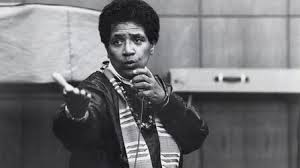
Audre Lorde

Audre Lorde

For those on the receiving end of repressive treatment, an essential strategy of resistance is one voiced by the poet-activist Audre Lorde years ago: “the transformation of silence into language and action.”

We’ve been seeing this transformation since the murder of Michael Brown last summer. The people of Ferguson refused to take this outrage silently, and others, of all ethnicities and from all across the country, have rallied to their cause. Since the moment the grand jury decision letting the police off the hook—again—was handed down, my social media feeds have been on fire with declarations of sympathy and anger, along with demands for positive social change.

It has been heartening to see so many Americans marching together in cities all across the country in support of racial justice. Lots of white faces mixed in with the black and brown ones, all united in demanding that our government and legal system protect the rights of all Americans, not just the ones with privilege and power granted by a discriminatory system.

Unknown-1An oppressive system will try to protect those in power and maintain its status quo by discouraging dissent, sometimes silencing its critics by force (as in, for example, the assassinations of Martin Luther King Jr. and Malcolm X) or longterm imprisonment (think Leonard Peltier or Nelson Mandela).

Sometimes the silencing is imposed by shaming (think how women are often made to feel embarrassed and “unfeminine” when we dare to speak out against oppression by men); sometimes by peer pressure and the judicious distribution of rewards to those who go with the flow (for instance, young men can be rewarded by fraternity membership or sports glory when they go along with oppressive treatment of women or younger recruits).

One aspect of privilege I have been especially struck by is this formulation, which I learned from the gender studies scholar Michael Kimmel: “privilege is invisible to those who have it.”

Too often, those in power don’t realize how they participate in the oppression of others. Or maybe they choose to turn a blind eye, because acknowledging the effects of privilege would make them feel uncomfortable about themselves.

Privilege and oppression are relative terms, and very few people fit entirely into one category or another. In other words, I might be privileged by my white skin, but disadvantaged by my gender. I might be privileged by my gender, but disadvantaged by being born into poverty. And so on.

Those of us who believe in justice and want to live in a country that protects the rights of all its citizens equally need to understand how important it is to use our privileges, whatever they may be, to fight oppression in all of its guises.

photo-d

Immigrants arriving at Ellis Island, NY, early 20th century

For example, immigration reform: Americans who remember that just a few generations back their families were fortunate enough to be able to enter this country legally need to stand up for the rights of today’s immigrants.

Or women’s rights: we need to cheer on men like Nick Kristof, who consistently serves as an ally for oppressed women, using his privilege as a New York Times columnist to call attention to violations of women’s human rights worldwide.

In the environmentalist and animal rights movements, we see human beings using our privilege to advocate for the rights of wild animals and farmed animals to a life well lived.

And so on. Social movements are strongest and most successful when they draw their power from solidarity between the privileged and the oppressed.

History shows us that when a social system veers too far into an oppressive dynamic, it becomes weak and liable to fall. Social revolutions occur when enough people are fed up and have little to lose by challenging the status quo.

Americans know that we’re in a precarious state right now, with our politicians being bought and paid for by industry, the super-rich growing ever wealthier while the vaunted American middle class slips down into the ranks of the struggling working poor.

We are living through a dangerous time, but a time of opportunity too: a time when those of us who are awake to the dangers can speak out against oppression, stand up for justice, and insist on the structural changes needed to make our country live up to its own ideals.

I’m not talking about riots here, although those are sometimes the only way the system can be made to focus on the rage of the oppressed.

I’m talking about recognizing the dynamics of privilege and oppression, understanding our own place in the system, and using whatever privileges we have to support those with less power.

Only this kind of broad-based solidarity, based in our own communities but with a nation-wide reach, can shift the oppressive system that was stacked against Michael Brown in Ferguson. When to start? Now.

Moving from Anger and Cynicism to Gratitude: Thanksgiving in Dark Times

It’s Thanksgiving time, the time when we’re supposed to be counting our blessings and giving thanks. Given the current bombardment of bad news, it’s hard not to feel cynical.

Do I give thanks for the American justice system, which once again has valued the rights of a white man over the rights of a (dead) Black man?

Should I give thanks that a growing roster of universities are finally being pushed to take fraternity gang rape seriously, after years of turning a blind eye?

Maybe I should be giving thanks that the Kinder Morgan fossil fuel group, responding to public outcry, is thinking about routing its gas pipeline through “an existing utility corridor” rather than through backyards and recreational areas in the heart of Berkshire County, the tourist-friendly resort area where I live.

It’s easy to get angry about the injustice and casual brutality of our world. And one of the problems of modern existence is that when something bad happens, we know about it almost instantaneously, and have to grapple in our own hearts and minds with its disturbing reverberations.

Any wonder why so many people in media-saturated modern societies turn to drugs (prescription and recreational) or alcohol to get some relief?

I don’t think we should insulate ourselves from the reality of what’s happening in our world, even when the news is very bad. But we do need to find ways to retain our own sense of balance and inner resilience in the face of the constant heartbreak that characterizes contemporary life.

I try to remind myself, at Thanksgiving time and all year round, of all the things I do truly have to be thankful for.

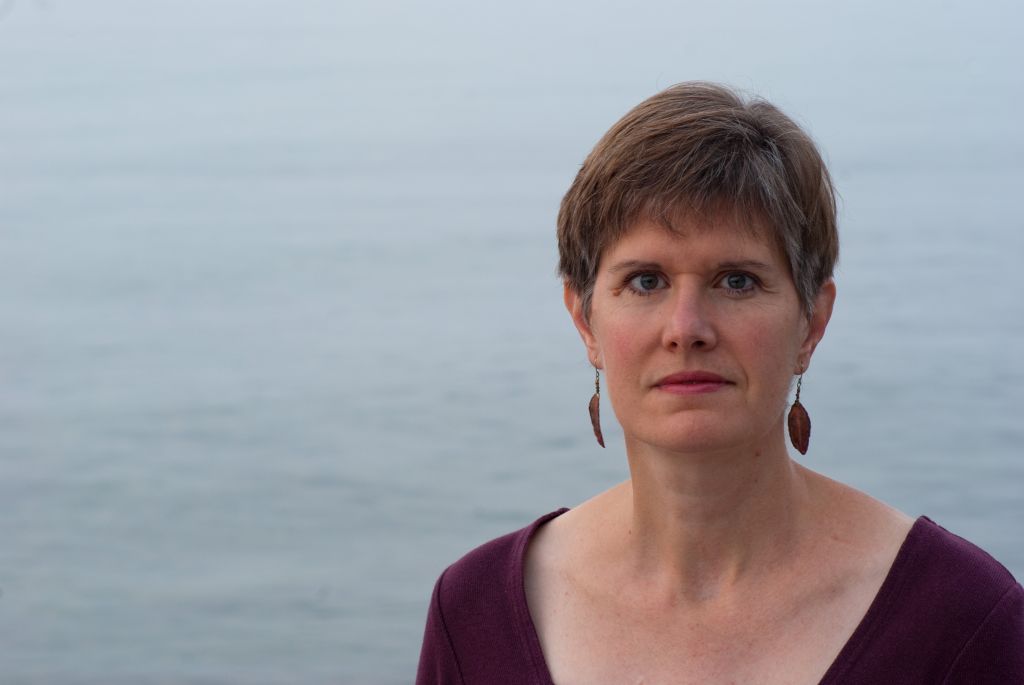
I give thanks for the protesters who have been standing up to the fracking and drilling industry giants all over North America, and indeed all over the world. I am thankful that Sandra Steingraber has been released early from jail, so she can spend Thanksgiving with her family.

Sandra Steingraber by Seneca Lake

Sandra Steingraber by Seneca Lake

I give thanks for the many innovative scientists who are working hard to develop viable alternative forms of energy, from better solar panels to clean battery cells to geothermal, tidal and wind generators. I am thankful for entrepreneurs like Elon Musk of Tesla, leading the way towards a clean-energy future.

I give thanks for the health workers who are at this very moment risking their own lives in order to bring the Ebola epidemic under control. I thank all the health workers, worldwide, who give so much to others day in and day out.

I give thanks for my family, friends and comrades—for all the good people who are working in their own spheres to be sources of love and compassion.

On dark days like this one, it can be hard to feel confident that the human capacity for love and empathy will prevail over the less admirable side of our nature; that our ethical intelligence and social creativity will succeed in tempering our greedy self-interest and destructiveness.

Every day presents opportunities to live in ways that elevate the human condition and spirit. Even the greatest events in human history always depend on the actions of individuals, each within our own sphere. All we can do, as human beings alive on the planet in these frightening transition times, is strive to embody love.

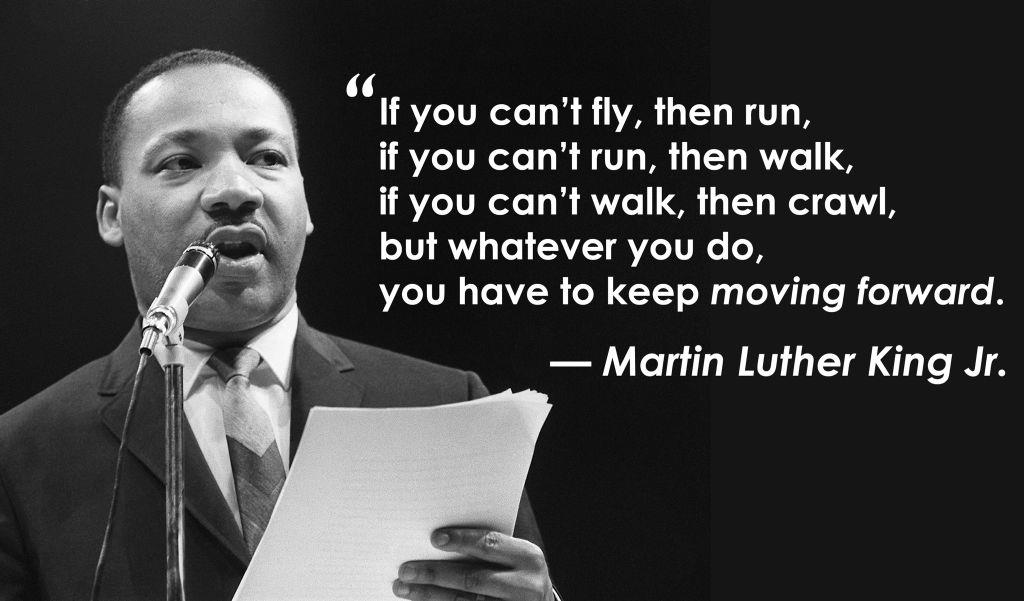
We won’t always succeed; no one of us is perfect. But as Martin Luther King Jr. famously said, “The arc of the moral universe is long, but it bends towards justice.” Let us place ourselves on that arc, with gratitude for being able to help it bend towards justice now, in our own time.

martinlutherkingjr

Letter to Sandra Steingraber: Civil Disobedience and the Fossil Fuel Monster

Dear Sandra,

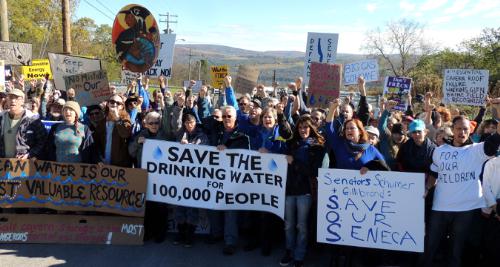
I have been thinking about you for days now, ever since I heard the news that you were leading the peaceful protests defending Seneca Lake. Now you’re sitting in jail, taking your turn along with several others who also chose to serve jail time as an extension of the protest, rather than taking the “get out easy” card of paying a fine.

Sandra Steingraber going to jail

Sandra Steingraber going to jail

Thoreau would be proud of you! You are a living example of his famous injunction on civil disobedience, written from the jail cell that served as his bastion of protest against slavery and a war he knew was wrong: “Let your life be a counter friction to stop the machine.”

The machine of our time is the fossil fuel industry. It is an industrial monster, with mining claw arms, a drill bit mouth and a huge bloated body belching stinking carbon smoke. It has no eyes to see the destruction it causes, nor ears to hear the screams and wails of the innocent creatures—including human beings—mown down in its path or sickened beyond recovery.

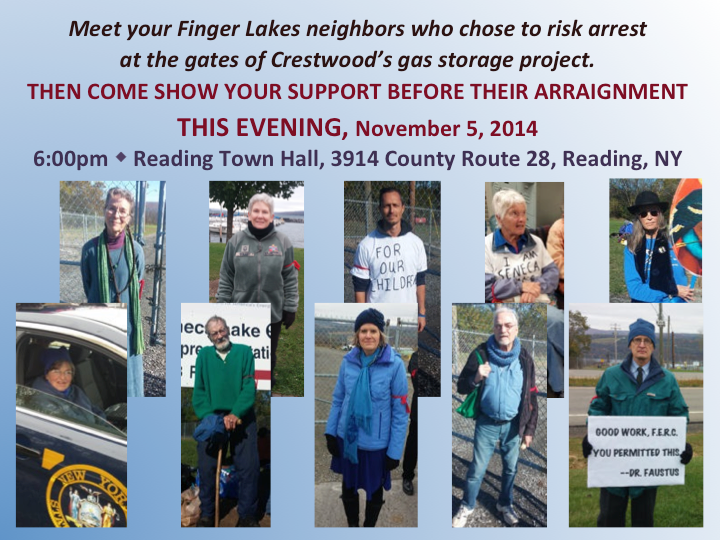
Over four hundred members of We Are Seneca Lake blockade the gates of Crestwood Midstream and stand up to the expansion of dangerous gas storage in the crumbling salt caverns next to Seneca Lake and under the beautiful wine country of the Finger Lakes. Lead by renown biologist, author, Sandra Steingraber. Pictured; Yvonne Taylor, Gas Free Seneca, Doug Couchon, People for a Healthy Environment, Members of Finger Lakes CleanWaters Initiative, Seneca Lake Pure Waters, ShaleShock, DJ Astro Hawk. (PRNewsFoto/We Are Seneca Lake)

Over four hundred members of We Are Seneca Lake blockade the gates of Crestwood Midstream and stand up to the expansion of dangerous gas storage in the crumbling salt caverns next to Seneca Lake and under the beautiful wine country of the Finger Lakes. Lead by renown biologist, author, Sandra Steingraber. Pictured; Yvonne Taylor, Gas Free Seneca, Doug Couchon, People for a Healthy Environment, Members of Finger Lakes CleanWaters Initiative, Seneca Lake Pure Waters, ShaleShock, DJ Astro Hawk. (PRNewsFoto/We Are Seneca Lake)

You and a handful of courageous resisters have gathered on the shores of the mighty Seneca Lake, to put your bodies on the line to stop this monster at all costs, before it can carry out its federally sanctioned intention of making the fragile salt caverns beneath the water into a volatile gas depot.

Did we learn nothing from the tragedy of the BP gas spill in the Gulf of Mexico? Haven’t we learned that fossil fuels and pristine waters do not mix?

Drinking water is a finite and precious resource on this planet. We can find other ways to create energy—solar, wind, tidal, geothermal, hydrogen—but if we pollute the precious aquifers and freshwater reservoirs upon which our very life depends, there will be no return.

I know you of all people know this well, Sandra. Your first book, Living Downstream, tells the story of how you uncovered a serious cancer cluster in your own hometown, caused by the toxic runoff of chemicals into the groundwater.

‘Look upstream,’ you admonished us then. ‘What we need more than a cure for cancer,’ you said (still recovering from cancer yourself) ‘is strong action to prevent cancer, which means strong regulation against environmental pollution.’

Now one of the magnificent Finger Lakes is under direct threat of contamination. A gas rupture there would ruin the drinking water for tens of thousands of people; destroy the aquatic environment for millions of fish and other lake creatures; and severely impact the recreational use of the lake.

Seneca Lake

Seneca Lake

Is it really worth the risk? Can’t a safer place be found to store gas, away from the fragile ecosystem of the lake?

It’s beyond disappointing that our government caved to the fossil fuel monster in granting a permit to put a gas storage chamber beneath the floor of Seneca Lake. The people can do for ourselves what our craven politicians could not. We can make our lives “a counter friction to stop the machine.”

You are showing us the way, and I am with you in spirit, helping to spread the word and extend the protest into the potent realm of cyberspace.  It’s time to banish the fossil fuel monster once and for all.

In solidarity,

Jennifer

NOTE TO READERS:  Please read the comment below which gives more ideas for taking action in solidarity with Sandra and the other Seneca Lake defenders.  For starters, visit this site and voice your support: http://www.wearesenecalake.com/pledge-protect-seneca-lake/

Envisioning a Cosmic Religion, Rooted in Mother Earth: Homage to Thich Nhat Hanh

It must have something to do with reaching midlife. The beat of elders moving on out of this lifetime has picked up for me, and it’s so hard to let them go, knowing that as each life ends, those of us remaining are called ever more strongly to step into their shoes and become the elders leading our society.

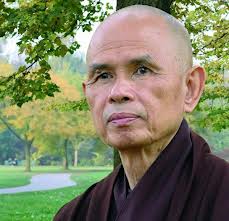
Thich Nhat Hanh

Thich Nhat Hanh

Few people alive today could step easily into the humble, powerful shoes of Thich Nhat Hanh. Like the Dalai Lama, he is a Buddhist monk who has been so generous and warm in inviting others into his orbit. Whether or not you practice Buddhism, whether or not you follow any religious tradition at all, there is so much wisdom and guidance in Thich Nhat Hanh’s writings, so much to learn and gain from listening to him.

I regret that I never had the chance to be physically in his presence, but as with so many of the other great leaders I admire, I know him through the writings he has shared and through his public persona and the good works he has accomplished.

At 88 years old, Thich Nhat Hanh is in the hospital with a brain hemorrhage from which he may still recover. He is still with us today but even after he is gone, I know his spirit will be showering us with the lovingkindness he knows we need to overcome the negativity that besets so many of us as individuals and as societies.

Today, in homage to Thay (as his students call him lovingly), I want to quote at some length from one of his last books, the beautiful Love Letter to the Earth. I urge you to buy a copy of this small bright gem of a book, and use it as a guide and inspiration—maybe you will be moved to write some love letters of your own to our dear battered planet.

“Dear Mother Earth,

“The human species is but one of your many children. Unfortunately, many of us have been blinded by greed, pride, and delusion, and only a few of us have been able to recognize you as our Mother. Not realizing this, we have done you great harm, compromising both your health and your beauty. Our deluded minds push us to exploit you and create more and more discord, putting you and all your forms of life under stress and strain. Looking deeply, we also recognize that you have enough patience, endurance and energy to embrace and transform all the damage we have caused, even if it takes you hundreds of millions of years.

“When greed and pride overtake our basic survival needs, the result is always violence and unnecessary devastation. We know that whenever one species develops too rapidly, exceeding its natural limit, there is great loss and damage, and the lives of other species are endangered. For equilibrium to be restored, causes and conditions naturally arise to bring about the destruction and annihilation of that species. Often these causes and conditions originate from within the destructive species itself. We have learned that when we perpetrate violence toward our own and other species, we are violent toward ourselves. When we know how to protect all beings, we are protecting ourselves.

“We understand that all things are impermanent and without a separate self-nature. You and Father Sun, like everything else in the cosmos, are constantly changing, and you are only made of non-you elements. That is why we know that, in the ultimate dimension, you transcend birth and death, being and nonbeing. Nonetheless, we need to protect you and restore balance, so that you can continue for a long time in this beautiful and precious form, not just for our children and their children but for five hundred million years and beyond. We want to protect you so you can remain a glorious jewel within our solar system for eons to come.

Northern lights, photographed from space

Northern lights, photographed from space

We know that you want us to live in such a way that in each moment of our daily lives we can cherish life and generate the energies of mindfulness, peace, solidity, compassion and love. We vow to fulfill your wish and respond to your love. We have the deep conviction that generating these wholesome energies, we will help reduce the suffering on Earth and contribute to alleviating the suffering caused by violence, war, hunger and illness. In alleviating our suffering, we alleviate yours.

“Dear Mother, there have been times when we suffered greatly as a result of natural disasters. We know that whenever we suffer, you suffer through us. The floods, tornadoes, earthquakes and tsunamis aren’t punishments or manifestations of your anger, but are phenomena that must occur on occasion, so that balance can be restored. The same is true of a shooting star. For balance in nature to be achieved, at times some species have to endure loss. In those moments, we have turned to you, dear Mother, and asked whether or not we could count on you, on your stability and compassion. You didn’t answer us right away. Then, beholding us with great compassion, you replied, “Yes, of course you can count on your Mother. I will always be here for you.” But then you said, “Dear children, you must ask yourselves, can your Mother Earth count on you?”

“Dear Mother, today we offer you our solemn reply, “Yes, Mother, you can count on us.””

Love Letter to the Earth concludes on a vision of a new kind of spirituality, a new kind of religion, founded on the Buddhist principle of interbeing—which, like deep ecology, understands that every form of life on earth, and indeed every element of our planetary biosphere is profoundly interconnected and interdependent, not in a hierarchy but in a rhizomatic web. Every strand in that web must be honored and tended, and this is the work that human beings, especially, are called upon to take up.

If Thich Nhat Hanh’s vision of a new religion for the 21st century could be realized, what a wonderful world it could be. Listen:

“We can build a deep spiritual practice based not on dogmas or beliefs in things we can’t verify, but entirely on evidence. To say that the Earth is a great being is not just an idea; each of us can see this for ourselves. Each of us can see that the Earth has the qualities of endurance, stability and inclusiveness. We can observe the Earth embracing everyone and everything without discrimination. When we say that the Earth has given birth to many great beings, including buddhas, bodhisattvas and saints, we are not exaggerating. The Buddha, Jesus Christ, Moses and Mohammed are all children of the Earth. How can we describe the Earth as mere matter when she has given birth to so many great beings?

“When we say the Earth has created life, we know it’s only possible because she contains within herself the whole cosmos. Just as the Earth is not only the Earth, so too are we not only humans. We have the Earth and the whole cosmos within us. We are made of the sun. We are made of stars. Touching the true nature of reality, we can transcend the dualistic view that the cosmos is something greater than ourselves or different from ourselves. Getting deeply in touch with the phenomenal realm, the historical dimension, we can realize our true nature of no-birth and no-death. We can transcend all fear and touch eternity.

Orionid-shooting-star

“Every advance in our understanding of ourselves, our nature and our place in the cosmos deepens our reverence and love. To understand and to love are fundamental desires. Understanding has some kind of connection with love. Understanding can take us in the direction of love. When we understand and become aware of the great harmony, elegance and beauty of the cosmos, we may feel great admiration and love. This is the most basic kind of religious feeling: it is based on evidence and our own experience. Humanity needs a kind of spirituality that we can all practice together.

“Dogmatism and fanaticism have been the cause of great separation and war. Misunderstanding and irreverence have been the cause of enormous injustice and destruction. In the twenty-first century it should be possible for us to come together and offer ourselves the kind of religion that can help unite all peoples and all nations, and remove all separation and discrimination. If existing religions and philosophies, as well as science, can make an effort to go in this direction, it will be possible to establish a cosmic religion based not on myth, belief or dogma, but on evidence and the insights of interbeing. And that would be a giant leap for humankind.”

Amen, Thay. Go lightly.  We will carry on.

Quotes from Thich Nhat Hanh, Love Letter to the Earth

Parallax Press, 2013

Joining Humanity’s Immune System: In the Body, in the Classroom, in the World

I had a tough day today in the classroom. I guess I brought it on myself by daring to raise unmentionable issues like violence against women and cancer….daring to follow Eve Ensler’s lead by assigning my students to read her remarkable cancer/incest survivor memoir, In the Body of the World. Unknown I assigned it for my class on “Media Strategies for Social and Environmental Justice.” The first book we read was Bill McKibben’s activist memoir Oil and Honey, about how he founded 350.org in a college classroom and how it grew to be a hugely successful global movement aimed at raising awareness about climate change and pressing for swift transition to renewable energy models.

This week we’ve been looking at Eve Ensler’s trajectory from a theater artist interviewing women about their vaginas and creating the series of monologues that would become “The Vagina Monologues,” to founding the V-Day movement to end violence against women, and now the One Billion Rising for Justice global phenomenon. Eve Ensler TED

But along the way, Eve Ensler got cancer. It arrived, she says in her viral TED Talk “Suddenly My Body,” with the force of a bird smashing into a plate glass window.

Her cancer memoir, In the Body of the World, is remarkable in its fearless interweaving of the personal and the political, the individual and the global, the violent rape of a daughter (Eve herself) with the violent rape of our Mother Earth by Western capitalist culture.

 ***

My plan for the class was to focus mostly on the cancer issue…to look at the horrifying statistics of cancer in the U.S., to name it as the runaway pandemic it is, and to think with the students about how we might most effectively employ media tactics and tools to raise awareness and push for social change. But I didn’t realize how deeply Eve Ensler’s description of violence against women, as related the violence of our chemical assault on Mother Earth, would resonate with these young people. Some of them were deeply troubled, even to the point of having to leave the class.

With the students who stayed, I had a good discussion about cancer itself. We looked at the most recent statistics of cancer in the U.S. (1.6 million NEW cases projected for 2014 by the American Cancer Society) and discussed the most common media strategies for dealing with the issue of cancer in the U.S.: walks, runs and galas “for the cure.” LivingDownstream_Portrait1

It took some pushing, but eventually I got the students to begin to discuss how activism that only focuses on “the cure” is missing the huge point: we need to focus on preventing cancer, not just curing it once it’s appeared. In Sandra Steingraber’s famous formulation in her cancer memoir Living Downstream, we need to start looking upstream.

What would looking upstream really mean? Buried deep in the American Cancer Society report is a short section on the environmental causes of cancer. This is what it says: “Environmental factors (as opposed to hereditary factors) account for an estimated 75%-80% of cancer cases and deaths in the U.S.”

Let me say that again.

“Environmental factors (as opposed to hereditary factors) account for an estimated 75%-80% of cancer cases and deaths in the U.S.” Environmental factors in the context of this report mean manmade chemicals and toxins present in our environment, from water to air to soils to our bloodstreams and mothers’ milk.

So what would it mean, I asked the students, to really probe this issue with the intent of stopping cancer before it begins—going to the source of the problem? It would mean, of course, we agreed after some discussion, pursuing the mining, chemical, pharmaceutical, atomic energy, fossil fuel and industrial agriculture companies. Oh yes, those—the ones that rule the world. It’s a tall order. Just like stopping violence against women, or reining in the carbon polluters and shifting to renewable energy. These are the major issues of our time, though. If we’re not stepping up to work on these issues, what are we doing with our brief, precious lifetimes?

***

In my next class, “Islamic Women Writing Resistance,” we were talking about violence against women, this time in the geographical context of Afghanistan.

Malalai Joya

Malalai Joya

Since we were reading the autobiography of Malalai Joya, the young woman who was elected a member of the Afghan Loya Jirga and famously called out the mullahs on their oppression of women, I steered the conversation into a discussion of leadership. How was it that despite the horrifically violent Afghan society under the Taliban and the warlords, where 90% of women are subjectd to physical, mental and sexual abuse, Malalai had managed to retain her confidence and bravado, her sense of herself as a leader?

And more importantly, what are the costs to a society that not only doesn’t respect and include the talents of 50% of the population, but actively works to suppress these gifts?

The answer to the first question has everything to do with Malalai’s father, who encouraged her to go to school, to become a teacher, and eventually to become an activist politician. Without his support, she could never have succeeded as she did. Chalk one up to the power of allies.

The second question is the one that really interests me. It seems to me that it takes tremendous energy to oppress half the population. Eventually so much is going into terrorizing the women and their potential male allies that there is nothing left over, in terms of psychic energy, to build a healthy, vibrant society.

It’s a true zombie society, with the powerful preying on the weak and the whole social fabric fraying into oblivion.

Is it an accident that the societies where women are being most savagely oppressed are also the societies that are poorest, most chaotic and most violent? Think Somalia, Afghanistan, Democratic Republic of Congo, Bosnia….

There are some countries where wealth has made it possible for strict patriarchal control of women to proceed without terrible violence and disorder: Saudi Arabia and the other Emirates, Iran, Iraq, Egypt. Even, maybe, the U.S., Russia and the E.U., where women tend to self-regulate their own subservience to the patriarchy, conditioned by high doses of media and peer education.

In every case, though, what we’re talking about is the same. We’re losing millions of bright, talented, gifted people to cancer every year. We’re losing millions of bright, talented, gifted women to violence and self-sabotage every year. And at the same time, this is happening against the backdrop that Eve Ensler describes so movingly in her book: the interweaving of the violence against women, the violence against individual bodies, and the violence human civilization is perpetuating against the Earth.

“Cancer is essentially built into our DNA, our self-destruction programmed into our original design—biologically, psychologically,” she says. “We spend our days, most of us consciously or unconsciously doing ourselves in. Think building a nuclear power plant on a fault line close to the water. Think poisoning the Earth that feeds us, the air that lets us breathe. Think smoking, drugging. Think abusing our children who are meant to care for us in old age, think mass raping women who carry the future in their bodies, think overeating or starving ourselves to look a certain way, think unprotected sex in the age of AIDS. We are a suicidal lot, propelled toward self-eradication” (194).

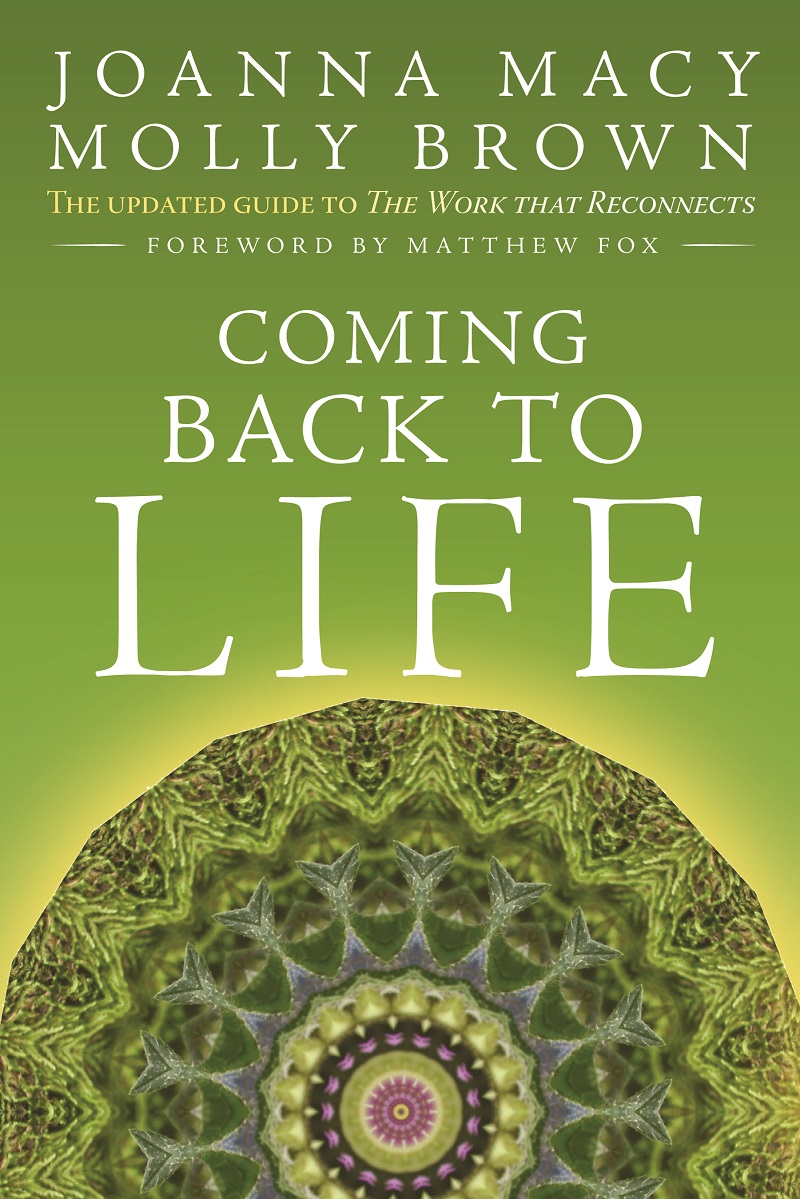
??????????????????????It doesn’t have to be this way. I am so glad to be reading the new edition of Joanna Macy’s classic work Coming Back to Life, as an antidote to the darkness described by Ensler and Joya. Macy quotes Paul Hawken, who refers to activists and activist organizations as “humanity’s immune system to toxins like political corruption, economic disease and ecological degradation.”

This immune system, Hawken continues, “can best be understood as intelligence, a living, learning, self-regulating system—almost another mind. Its function does not depend on its firepower but on the quality of its connectedness….The immune system depends on its diversity to maintain resiliency, with which it can maintain homeostasis, respond to surprises, learn from pathogens and adapt to sudden changes” (qtd in Macy, 55).

A current example of such an immune system in action is Sandra Steingraber’s anti-fracking movement in upstate New York. She and her Seneca Lake defenders have come to the rescue of the fragile environment of the Finger Lake region and its jewel, Seneca Lake, putting their own bodies on the line just like Eve Ensler did when she allied herself with the women of the Congo, vowing to stop the violence. 10470955_854714074549076_2405675760464249402_n Any one of us has the power to become a defender of life. All we have to do is to pay attention to what’s happening, start asking the hard questions, stop going along with the flow. We need to do this is in a proactive way. We’re not looking for a cure to violence against women/against the Earth—we want to address the underlying causes of the violence, to look upstream and stop it at the source.
This necessitates a willingness to spend some time outside of our own comfort zones of denial and voluntary blindness. It involves looking at painful, messy, upsetting aspects of human existence, and taking responsibility for the ways in which each of us contribute to the status quo, if only by looking away. It will be personal as well as political in ways that will often hit entirely too close to home.

We need to open our eyes and really look at what our Industrial Growth Economy and the society it has created is doing to our bodies and the body of the world. We need to look at the way women’s bodies, in particular, are forced to bear the brunt of the pain, even though women account for just a fraction of inflicted violence in the world.

Don’t look away. Take it in. And then think about what you can do to join “humanity’s immune system.” Look for me on the front lines—I’ll meet you there. Dandelion_seeds_Computer_backgrounds

Finding Hope in Hard Times

Amid all the darkness and chaos overtaking our world—the beheadings of journalists and the enslavement of women, the bloody flux of Ebola, the melting of the poles and the relentless advance of the bulldozers and chain saws into the forests—amid and despite all that, I am still seeing the frail but determined light of hope burning.

And the best thing is, I see this light growing in places that surprise me.

In recent weeks some huge financial players have announced their intention to fight the stranglehold of fossil fuel companies over our political economy.

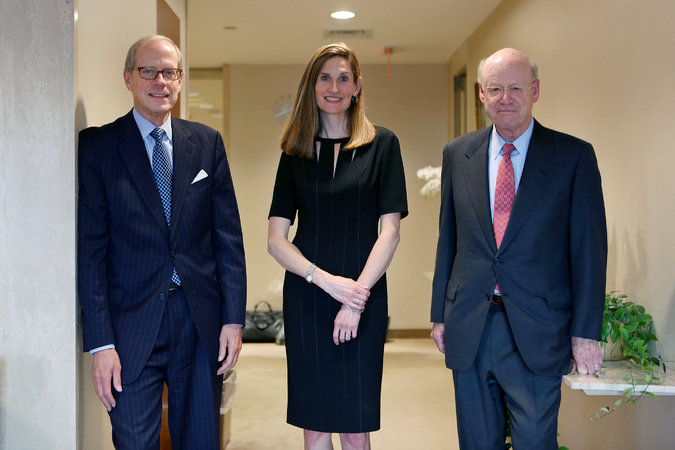
Stephen Heintz, left, with Valerie Rockefeller Wayne and Steven Rockefeller.  Photo: Hiroko Masuike/The New York Times

Stephen Heintz, left, with Valerie Rockefeller Wayne and Steven Rockefeller. Photo: Hiroko Masuike/The New York Times

Right after the dramatically successful People’s Climate March in September 2014, the Rockefeller family declared it would join forces with the nascent fossil fuel divestment movement. John D. Rockefeller built a vast fortune on oil. Now his heirs are abandoning fossil fuels,” trumpeted the lede in the New York Times article by John Schwartz.

“The family whose legendary wealth flowed from Standard Oil… [announced] that its $860 million philanthropic organization, the Rockefeller Brothers Fund, is joining the divestment movement that began a couple years ago on college campuses.”

This is big news indeed! In a society where money rules, the people with the most privilege are the ones with the most social power to create change, and the Rockefeller family can catalyze other wealthy philanthropists to start to think outside their parents’ box.

Not that the rest of us have no power. It’s only because college students and their adult mentors dreamed up the divestment movement and pushed vigorously for it that the Rockefellers made this move.

Student divestment activists at Tufts University

Student divestment activists at Tufts University

We ordinary folks—those of us who are awake to the critical state of our planet and human civilization today—can and must apply pressure to the rich and powerful in our society to shift their resources from our current death-dealing economic model to a life-giving, ecologically sound human relationship to the planet that sustains us.

timthumb.phpWhen current economic top dogs start to pay attention at last, we know we’re making progress. It was heartening to hear that the Women Donors Network is focusing its 2014 annual conference on strategic visioning of future scenarios for the year 2030.

At this year’s annual conference, the organizers state, “we will get the chance to step out of the urgent demands of the present to think big and strategize for the long term. What kind of future do we want to create? How can we work with the major trends we know are going to shape the future? And what can a powerful group of progressive women philanthropists do together to make the most of this critical moment?”

I find hope in the fact that this big group of wealthy women will be spending their valuable time not at a spa or a vacation in Paris, but at a conference where they’ll be, according to the conference Program, “’transported’ to 2030 to experience what our collective future could look like based on the decisions we make now, in this critical moment….We will participate in three “future scenarios” that are designed to help us clarify the role we hope WDN and all of us as individual philanthropists can play in helping strengthen the progressive social change movement.”

Go women go! The more of us become aware of the extent to which our choices today affect the futures that await us, the more we can act to create the green and glowing future we want.

Chief Oren Lyons

Chief Oren Lyons

I find hope too in the news that Chief Oren Lyons of the Onondaga Nation will be making a special visit to the Bioneers conference this month to talk about the new international initiative, the Plantagon urban agriculture system. A joint venture of the Onondaga Nation, Sweden and several East Asian investors, the Plantagon aims to revolutionize urban agriculture by making it possible for cities to feed themselves locally—a shift that will have enormous benefits in relieving pressure on rural water and land, reducing dependence on fossil-fuel transportation of produce, and also reducing or eliminating the need for harmful chemical inputs.

Artists' rendering of the Plantagon

Artists’ rendering of the Plantagon

To me, the word “Plantagon” summons up a word that has very different connotations, “Pentagon.” When we Americans hear the word Pentagon, we think immediately of military force and the way American military might has most often been called upon to defend “American interests”—politico-speak for access to resources, principally oil and precious minerals, often at great cost to local people and environments.

The U.S. Pentagon

The U.S. Pentagon

Although it may seem counter-intuitive, I find hope in the recent announcement that the Pentagon is now taking climate change into account in its strategic planning, not just for the distant future, but for next week.

In a new report, the Pentagon asserts unequivocally that “climate change poses an immediate threat to national security, with increased risks from terrorism, infectious disease, global poverty and food shortages,” reported Coral Davenport in The New York Times. Whereas “before, the Pentagon’s response to climate change focused chiefly on preparing military installations to adapt to its effects, like protecting coastal naval bases from rising sea levels,” Davenport writes, “the new report…calls on the military to incorporate climate change into broader strategic thinking about high-risk regions — for example, the ways in which drought and food shortages might set off political unrest in the Middle East and Africa.

“Experts said that the broadened approach would include considering the role that climate change might have played in contributing to the rise of extremist groups like the Islamic State.”

Well hallelujah! At last the most powerful force in the world is recognizing that climate change is here, it’s real, and it’s already a major destabilizing factor in world politics.

The challenge now will be to see if civil society can exert enough pressure on the military to get them thinking in proactive ways, rather than being a reactionary, often highly destabilizing force in the world.

Why can’t we use the wealth and resources of the U.S. military-industrial complex to support and sustain life on the planet?

Let’s get those military planners, along with the big boys at the World Bank, IMF and the U.S. Congress to understand that building schools and investing in sustainable agriculture and distributed energy networks is a far smarter and saner use of funds than blowing things up and rebuilding them (which has been our strategy in the Middle East over the past decade).

I see glimmers of hopeful light behind many of the dire stories in the news right now. We need to focus on those flickers of consciousness, blow on them gently and encourage them to grow brighter and stronger.

Hope is a verb, and we do it together. I’m working on it; how about you?

images-1

Ebola & Islamic Extremism: An Ounce of Prevention is Worth a Pound of Cure

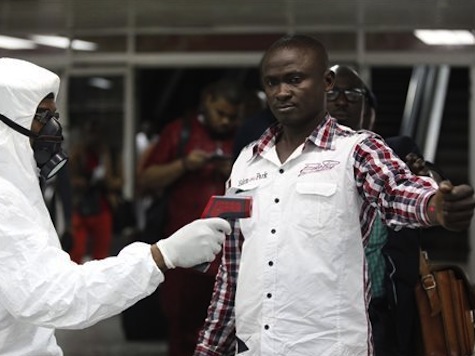
airport Ebola screening

Airport Ebola screening

Although American officials are making lots of reassuring noises about screening passengers coming from West Africa for signs of the dreaded Ebola virus, the truth is that the only way to totally safeguard against the spread of the disease is to close our borders entirely. And I don’t see that happening anytime soon.

Talk about an unexpected side effect of globalization. Goods and services spread around the globe at the stroke of a keyboard or the roar of a jet engine, but the same mechanisms we celebrate as having pumped up the global economy also, potentially, have a darker side.

What was it Marx said about the bourgeoisie digging its own grave?

I keep hearing the undertone, in the media reporting on Ebola, of the “blame-the-victim” complaint, “What’s wrong with these people? Why are they living in such poverty? Why don’t they have doctors, nurses, hospitals? Look how their squalor is putting us all at risk?!”

There is truth to this. The poor folks in Liberia, Guinea and Sierre Leone, former colonies of the U.S., France and Great Britain, respectively, have not managed to modernize their societies. This is due to a number of factors, including corrupt leadership (strongmen often propped up by the Western powers), violent civil wars (armed by Western weapons manufacturers and distributors), and banana republic-style economies where Western corporations rule by extraction, extortion and exploitation, without giving anything back in taxes, infrastructure or education for the local people.

This is where the West has made its big mistake. How could we in the so-called developed world be so naïve as to think that we could ignore the poverty and suffering of other parts of the globe without that poverty and suffering coming back to haunt us?

Liberian child soldier

Liberian child soldier

If we had invested in schools, medical facilities and housing in Liberia, instead of sending endless supplies of assault rifles and ammunition, we would not be worrying about Ebola now.

Likewise, if we had invested in education and economic development in the Middle East, instead of relying corrupt warlords to keep the population in line, we would not be dealing with a seemingly endless morphing insurgency of Taliban-Al Quaeda-Islamic State terrorists.

It really is true that an ounce of prevention is worth a pound of cure.

In a globalized society, pretending that vast disparities of wealth don’t matter is just plain stupid. Imagining that a vicious virus can be contained by airport thermometer checks is as ridiculous as imagining that an international terrorist network can be stopped by a few fly-by bombings.

The world’s leaders need to take a lesson from Malala Yousefzai, the 17-year-old girl who won the 2014 Nobel Peace Prize for her steadfast insistence, even after nearly having her head blown off by the Taliban, that girls should be educated.

Malala Yousefzai, winner of the 2014 Nobel Peace prize

Malala Yousefzai, winner of the 2014 Nobel Peace prize

Study after study has shown that when a society educates and empowers women, it becomes more economically successful and more politically stable.

Ellen Johnson Sirleaf, President of Liberia

Ellen Johnson Sirleaf, President of Liberia

This week, in my African Women Writing Resistance class, I’ve been reading and discussing the autobiography of Ellen Johnson Sirleaf, President of Liberia and first woman head of state in modern Africa.

Sirleaf, who won the Nobel Peace Prize in 2011, has been in the news a lot lately, begging for help in containing the spread of Ebola and warning grimly of the consequences of international inaction.

She came to office vowing to take her country back from the warlords and reintegrate child soldiers, to educate girls and boys and build a sustainable economy. She’s made great strides, but the stark pictures of the pathetic state of the nation’s health care infrastructure make it clear how far Liberia, like other poor African nations, still has to go.

The bottom line is this: if we want safety, we have to build towards it, step by step, from the ground up. We can’t ignore poverty and then get mad when impoverished sick people dare to infect us, or when desperate people turn to radical Islam as a way out of their misery.

Child worker on Firestone rubber plantation in Liberia

Child worker on Firestone rubber plantation in Liberia

There is no excuse, in our globalized world, for the dramatic disparities of wealth and poverty that exist today. Those of us lucky enough to live comfortably in the U.S. or Europe should be using our privilege to advocate for those less fortunate.

Not just out of altruism. Out of self-preservation, too.

If we had been helping Liberia and other West African nations build good social infrastructure, instead of extracting profits from diamonds, rubber and gun sales, we would not be worrying about the spread of Ebola today.

If we had been educating children in Syria, Yemen and Iraq instead of supporting corrupt dictators and ignoring the plight of ordinary people, we would not be facing the spread of Islamic extremism today.

How many innocent humans will have to die before we begin to understand that simple adage? An ounce of prevention is worth a pound of cure.

Reconnecting with the Earth…with Joanna Macy

images

Joanna Macy

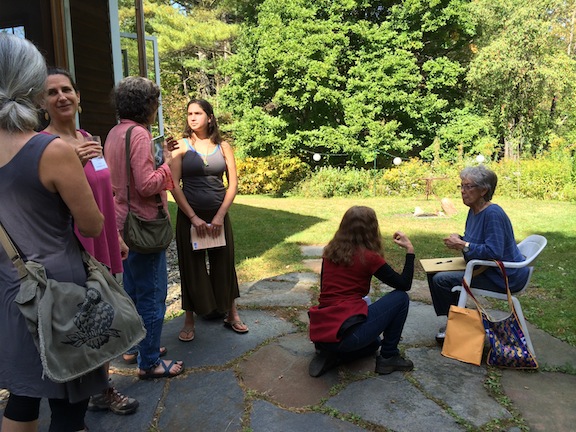
At 85, Joanna Macy is still a beautiful tiger of a woman: fierce, focused, passionate. At a recent weekend workshop at Rowe on her signature Work That Reconnects, she was a keen and generous leader, with an impeccable sense of when to speak and when to be silent, when to share the microphone with younger leaders, when to get out in front and show the way.

Joanna has been refining the Work That Reconnects since the 1980s, when it grew out of her engaged Buddhist practice and her anti-nuclear activism. Its premise is simple: that we are integral parts of the Earth, having emerged out of carbon and water billions of years ago just like everything else on the planet; but we humans, having caused the near-collapse of the current epoch with our fixation on industrial growth run on chemicals and fossil fuels, have a special role to play in shifting our civilization to a sustainable footing.

To step into our power as change agents, we must first undo the social conditioning that has alienated us from our primary relationship with the Earth. The Work That Reconnects accomplishes this through a series of exercises and meditations, which can take a day or a week or much longer to accomplish, depending on how much time you have and how deep you want to go.

In the weekend version of the workshop, we spent a three-hour session on each of the three stations on Joanna’s Spiral of the Great Turning, led through a series of interactive activities designed to get us thinking about ourselves as bodhisattvas, awakened ones willing to give our lives in service to the higher good of all life.

tree

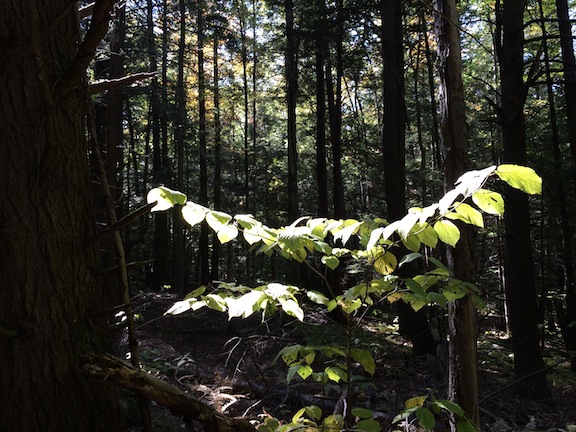
In the forest at Rowe. Photo by J. Browdy

First came Gratitude: appreciating and giving thanks for being alive in this beautiful place, alongside myriad other complex and beautiful creatures who call the Earth home; and also giving thanks for our own strengths and capacities to become active warriors on behalf of the planet.

Then there was the grief and despair work for which Joanna is justly famous: she calls it Honoring Our Pain for the World, and it is a radical, counter-cultural push to sit with and confront all the sadness, despair, anger and pain we feel when we allow ourselves to become fully conscious of the destruction and devastation human beings are wreaking on the planet. Grief for individual loved ones lost to cancer mingles with grief and anger at the loss of the Great Blue Herons and the paved-over forests, in a powerful and galvanizing outpouring of rage and pain.

After an evening break that featured song and dance around the warmth of community, we turned the next morning to the last two stations on the spiral: Seeing with New Eyes and Going Forth.

Joanna talked about the necessary shift from the alienated form of seeing our relationship to the Earth as “our supply house and our sewer” to a new form of seeing, an understanding that we are embedded in the sacred living body of the Earth, and what we do to her we do to ourselves.

leaves

A closer look. Photo by J. Browdy

One of the reasons I love Joanna’s approach to activism is because she is unafraid to call on the imagination as one of our primary tools for social change. In a powerful closing exercise, she arranged us in pairs and asked one person to take the role of a descendant seven generations in the future—about 200 years hence, in 2214. The other person remained herself, in 2014.

The future being, prompted by Joanna, asked a series of questions of the ancestor, and then listened to the answers—this was not a conversation or a dialogue, but a witnessing of the struggles of this ancestor—you and me, in our time—to bequeath a livable world to our children, grandchildren, and on down the line.

After listening to three different present-day people talk about their work for the planet—what makes it hard, what makes it rewarding, what keeps them going day to day—the future being had a chance to respond, and it was an incredibly powerful experience to imaginatively inhabit the spirit of the future encouraging us embattled ones in today’s world to find the strength to persevere.

Joanna at Rowe

Joanna signs books and talks with workshop participants. Photo by J. Browdy

In the call to Go Forth, the final turn on the spiral, Joanna reminded the gathering that this work is impossible to do alone—“it’s impossible to even take it in alone,” she said. We need to create communities of “Shambala warriors for the planet,” who can function like “the immune system of the Earth,” a potent metaphor she attributed to Paul Hawken.

In the Shambala prophecy that Joanna has been sharing ever since she heard it from one of her Tibetan Buddhist teachers back in the 1970s, it is said that great courage is required of those who work for the good of the world, because we must go right to the heart of the “barbarian empire,” armed only with two critical weapons: compassion for all living beings, and the radical insight of interbeing—that everything in this biosphere is intricately and integrally interdependent and connected.

And of course the truth is that the “barbarians” who inhabit this destructive empire are not strangers. They are, quite simply, us.

At the very end of the workshop, Joanna led us through a series of affirmations honoring our perceived enemies as our most important teachers.

Through our awareness of what we don’t want, we learn what we care about most. And through our caring—what Joanna calls the awakening of our “heart-mind”—we find the courage, passion and commitment to do the most important work of our time: transitioning from our current dead-end, greed-based, exploitative society to a society that honors the sacred in all life and works respectfully for the well-being of each participant in the dance of planetary life.

old tree

An elder maple in the forest at Rowe. Photo by J. Browdy

As I walked out under the ancient maples and hemlocks in the forests around Rowe, lit up in all their autumnal glory on this beautiful September weekend, I could feel the warrior spirit rising in me and in all of us who came from near and far to learn from Joanna.

Now is our time, and time is precious: there is none to waste as the forces unleashed by the industrial growth of the past 300 years threaten so many life forms on the planet with extinction.

Will we succeed in transitioning to a sustainable future? Will we humans grow into our potential as stewards and nurturers of our beautiful garden, this Earth? Or will we all slip away into the history of the planet, as the march of evolution and transformation continues on to the next era?

All we can do is go forth with good heart and brave spirit into our own communities and carry on the work that reconnects in our own spheres. I am so grateful to Joanna Macy for continuing to lead the way and for so generously sharing the powerful tools and practices she has developed over a lifetime, for others to take up and carry forward into the Great Turning.

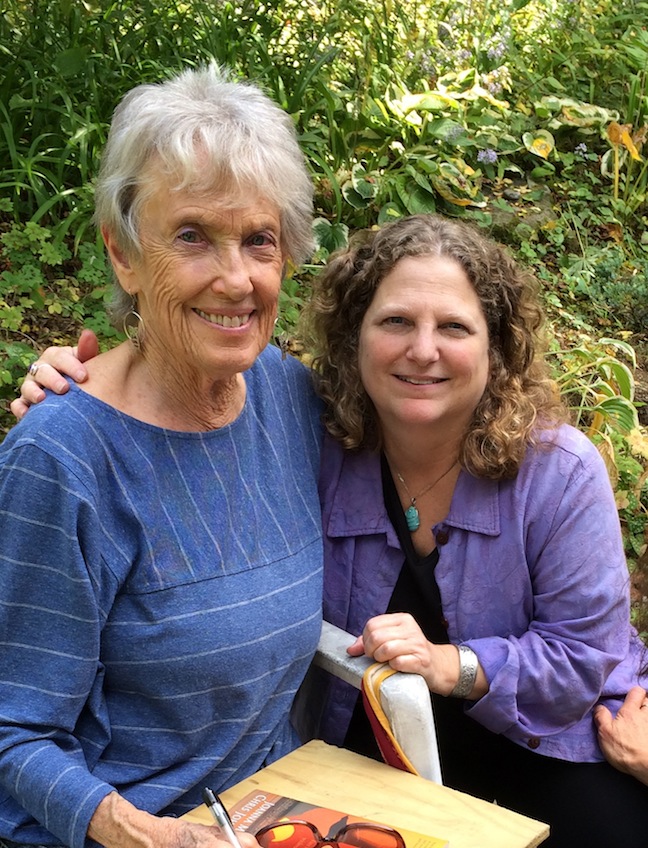
JB & Joanna Macy

Joanna and Jennifer

N.B. Joanna’s classic book Coming Back to Life, a guidebook for doing the Work That Reconects by yourself or (preferably) with groups, has just been re-issued by New Society Publishers in a revised and updated edition. Joanna is hoping that people will gather in schools and church basements, in Transition Towns and activist organizations, to do the inner work that can sustain and fuel the outer work we must all undertake to transition to a life-enhancing human relationship to Earth.

The People’s Climate March: Taking the Evolutionary Leap of Radical Democracy

The People’s Climate March in New York City is just one manifestation of a huge sea-change sweeping through our culture. Or perhaps “seeping” would be a better verb—this shift in awareness is not happening with the tsunami force of a revolution, but more with the steady, determined drip-drip-drip of water undermining rock.

Humans are paradoxical. On the one hand, we love everything that’s new and innovative, we all want to be out ahead of the curve when it comes to technological breakthroughs and new ideas. On the other hand, we hold tight to the received wisdom of our forebears, living by enshrined writings thousands of years old (the Bible, the Koran, the Mahabharata, Confucius, etc.) or hundreds of years old (the Declaration of Independence, the Constitution, the Bill of Rights).

We have established elaborate educational, political and legal systems designed to hold us to a particular form of society, permitting free, innovative thinking only along narrow channels carefully defined by the interests of business and commerce.

The arts and humanities, traditionally the realm of creative, imaginative exploration, have been steadily starved in this brave new world, which can only imagine creativity in the service of profit.

What happens to a society that can only envision creative energy in an instrumental, utilitarian light?

We become a society of robots. We lose our connection to the soul of the world, the anima mundi that sustains us humans along with all other living beings on the planet.

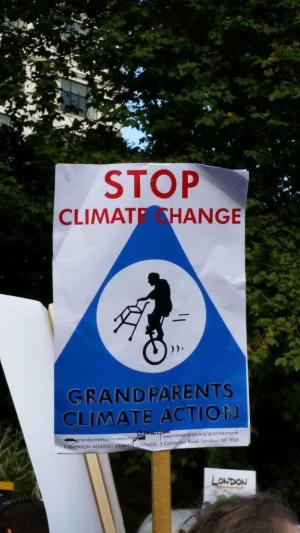
http---pbs.twimg.com-media-ByDzJSPIYAA_RHcThe People’s Climate March, which is happening not only in New York City but worldwide, with 2,808 marches and events in 166 countries, bears welcome witness to the fact that the sparks of creative, independent thinking have not totally gone out.

There are many, many people worldwide who are aware, and aghast, at the failure of our political and business leaders to act in the best interests of the people and all the beautiful, innocent creatures who are slipping away into the night of extinction day by day due to the relentless human assault on our shared planet.

We are here, we are aware, and we are engaged. We are not going to stand by silently and let corporate greed and shortsightedness overwhelm us.

It is true that business and government have a stranglehold on official channels of communication, education and social change.

They control the curricula taught in our schools, what appears on our major media channels, and what projects and areas of creative exploration are funded. They keep us in line with the debt bondage of school loans, mortgages, car payments and the fear of not having enough money in the bank for a comfortable old age. We’re so busy running on the treadmills they’ve set up we have no time or energy to think about changing the system.

Or do we?

So far, the one social area that has not been overtaken by corporate/governmental control is the World Wide Web. It’s still a Wild West space, a place where you can find everything and everyone, from dangerous sadists to beneficent spiritual leaders. There’s room for every kind of idea out there to percolate through our collective consciousness. And make no mistake: the energy we’re seeing in the People’s Climate March is fueled in large part by the distribution power of the Web, the ability to get the word out and get people fired up to come together to take a stand.

We saw it happen in the Arab Spring, where people used cell phones and texts to organize themselves to resist oppression.

We saw those people get beaten back, the promise of their revolution squashed by the entrenched power of men with guns and tear gas.

The rise of the Islamic State, like the rise of Al Quaeda and the Taliban, is all about conservative forces resisting change.

I am just as afraid of men with guns and tear gas as the next woman. I am happier making revolution on my laptop than in the streets. But at some point we have to come out from behind our screens, get off the treadmills of debt bondage, look around us at the beauty of the world, and say: this is what I want to live for, and this is what I’m willing to die for.

Terry Tempest Williams.  Photo by Cheryl Himmelstein

Terry Tempest Williams. Photo by Cheryl Himmelstein

Environmental activist and writer Terry Tempest Williams, in her book The Open Space of Democracy, says that the time has come to “move beyond what is comfortable” (81) in pursuit of what she calls a “spiritual democracy.”

“We have made the mistake of confusing democracy with capitalism and have mistaken political engagement with a political machinery we all understand to be corrupt,” she says.

“It is time to resist the simplistic, utilitarian view that what is good for business is good for humanity in all its complex web of relationships. A spiritual democracy is inspired by our own sense of what we can accomplish together, honoring an integrated society where the social, intellectual, physical and economic well-being of all is considered, not just the wealth and health of the corporate few” (87)

Williams calls for a radical recognition of the interdependence of all life on Earth. “The time has come to demand an end to the wholesale dismissal of the sacredness of life in all its variety and forms,” she says. “At what point do we finally lay our bodies down to say this blatant disregard for biology and wild lives is no longer acceptable?” (86)

If we humans could step into our destiny as the stewards of our planet, the loving gardeners and caretakers of all other living beings, we would harness our incredible intelligence and creativity to re-stabilize our climate and do what needs to be done to ensure the well-being of all.

Williams calls this “the next evolutionary leap” for humanity: “to recognize the restoration of democracy as the restoration of liberty and justice for all species, not just our own” (89).

DSC_2200WIf we are able to take this leap, we will not only avert climate-related disaster on a Biblical scale, we will also overcome many of the social problems that we currently struggle with. “To be in the service of something beyond ourselves—to be in the presence of something other than ourselves, together—this is where we can begin to craft a meaningful life where personal isolation and despair disappear through the shared engagement of a vibrant citizenry,” says Williams (89).

Williams’ small gem of a book grew out of a speech she gave at her alma mater, the University of Utah, in the spring of 2003, as America was rushing into its ill-conceived War on Terror in Iraq. She describes her heart pounding as she got up to make a speech advocating a different form of democracy than that embraced and espoused by all the conservative friends and family sitting in the audience before her.

Challenging one’s own friends and family, betraying one’s own tribe, is the hardest aspect of being a social revolutionary. You have to question the very people you love most, who have given you so much and made your whole life possible.

But if we become aware that the social systems that gave birth to us are the very social systems that are undermining the possibility of a livable future on this planet, can we continue to just go with the flow, to avoid asking the difficult questions?

Or will we become change agents who work slowly and steadily, drip by drip, to awaken those around us, those we love most, to the necessity of undertaking “the next evolutionary leap” in the human saga on the planet?

1604741_560811498264_7010113564277153021_n

Are We Going to Stand By Silently in the Face of Ecocide? Hell no!

In my talk the other night, “The Personal is Planetary,” which I gave as the opening lecture of the Berkshire Human Rights Speaker Series, I set out to point to climate stabilization as the most important issue of our time, the one that dwarfs all the other social and environmental struggles we may be engaged with.

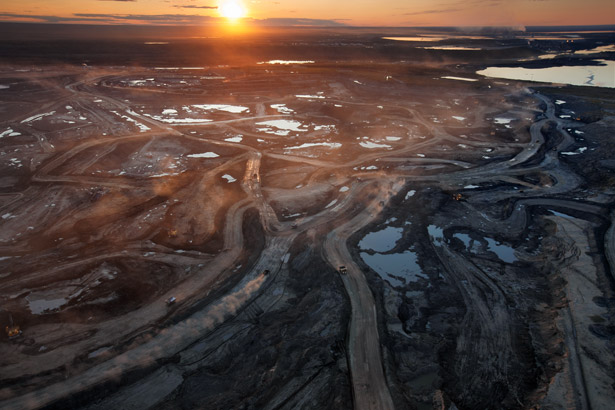
candian-oil-sands-615Most people know by now that if we don’t shift to renewable sources of energy like solar and wind, the greenhouse gases caused by the profligate burning of fossil fuels are going to wreck our planetary environment so badly that our beautiful Earth will become unlivable for most of her current inhabitants, including humans.

“We know and we don’t know,” I told the audience. “We know but we see no role for ourselves as change agents. We know but we’re afraid of the consequences of protest. We know but we don’t want to know. Life is comfortable; why rock the boat?”

I wondered aloud how bad things would have to get before we sunpower_maincomfortable Americans finally understand that it is past time for our active engagement in forcing our government and our corporations to do what needs to be done to ensure a livable future for us all.

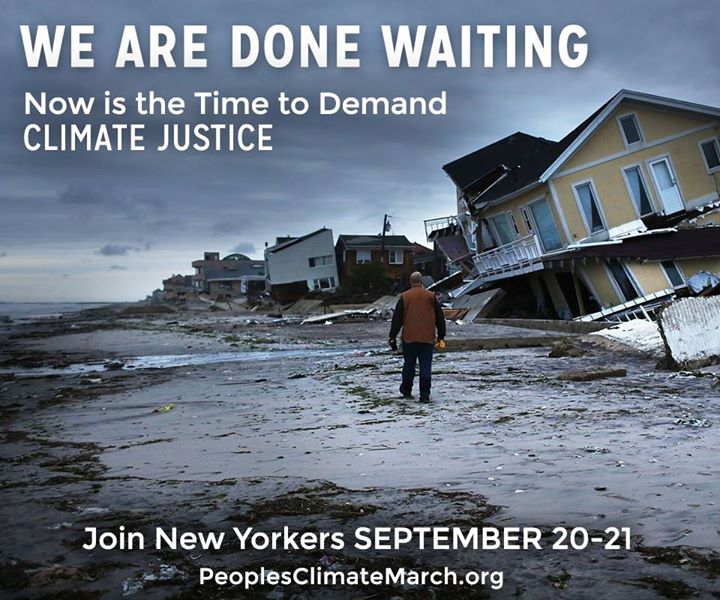
Shocks can be necessary, and we’ve already had a few: Hurricanes Katrina, Irene and Sandy, along with regional droughts, floods and wildfires in many parts of the country, all weather-related events exacerbated by global warming.

But Americans are still pretty cushioned from the full effects of climate change. Around the world, for people of other nationalities and for millions of non-human species, things are already reaching a tipping point beyond which recovery will be difficult, even impossible.

We Americans, privileged and coddled as we are, need to open up our eyes and take in the full enormity of the crisis that confronts us.

This is bigger than any individual war, even against evil empires like the Islamic State. It’s bigger than any individual social justice issue, even the ones I’ve spent a good part of my life fighting for, like women’s equality and anti-racism.

As I said in my talk, “I don’t think it’s an exaggeration to compare our role as bystanders to the destruction of the forests and oceans and all their inhabitants to the role of the ‘good Germans’ who watched the trains full of Jews roll into the concentration camps and professed to not know what was going on behind those walls.”

Six million Jews died in the Holocaust, some of them my distant relatives. I’ve been taught all my life that we must remember this genocide, and others like it, so that it will never happen again.

And yet all of us are willing to stand by, deaf, blind and mute, as millions upon millions of innocent living beings on the planet are sacrificed to the maw of human industry in its current greedy, profit-driven guise.

Tens of thousands of albatross are dying from eating plastic out of the Pacific Ocean

Tens of thousands of albatross are dying from eating plastic out of the Pacific Ocean

Fossil fuel extraction, from fracking to tar sands to deep-sea drilling; industrialized agriculture, with its chemical poisoning of the earth and waters; mining and deforestation; plastic garbage on land and sea; endless urban and suburban sprawl—all this is driving what scientists now refer to as the Sixth Great Extinction, which will only intensify as the planet continues to heat up.

Eventually, if we stand by and do nothing, we humans too will join the long death march to extinction, or at least to a total collapse of our ruinous global civilization.

Are we going to stand by and do nothing while the planet burns? Are we going to allow our government and our corporations to commit planetary ecocide? Are we going to continue to pretend that we don’t know what’s going on?

10453020_1454513064799672_5914704337046021387_oThis Sunday there will be an opportunity to take to the streets to demand effective action on climate change. Tens of thousands of Americans from all over the country will be converging on midtown Manhattan for the People’s Climate March to show the world that we care about our future and we know that our destiny is bound up in the health and welfare of the entire planetary ecosystem.

It is truly a legendary moment in the history of humanity. We have the grand opportunity to be the generation that succeeds in abandoning the deadly playbook of industrialized capitalism, and opens up a new epoch based on caring, balance and good stewardship of the Earth.

Endless growth of human industry is not possible on our finite planet—not without driving us all to ruin. The sooner we can adjust our economies and industries to this new worldview, the sooner we will all begin to learn how to recalibrate human activity accordingly, and redistribute the current massive imbalances of wealth so that everyone has enough—including all the non-human species that we must also learn to value and protect.

As I concluded in my talk the other night, “The future of so many living beings on this planet depends on our ability to overcome our fear, move beyond our silences and step into the power of our own transformative visions. Opportunities to work for positive change will open up as we begin to look for them. Now is the time for action, and we are the ones we’ve been waiting for. Let’s not wait any longer.”

10516849_1457572994493679_8105942018734494795_n

PS: I was glad to see an excellent op-ed piece by Mark Bittman in The New York Times about the importance of the People’s Climate March. The Times is also providing a “Countdown to the Climate March” this week: here’s a story that goes behind the scenes with the organizers, featuring an interview with Bill McKibben.

Also, if you haven’t seen the new film DISRUPTION yet, here is the You-Tube link.  It begins with a quote: “Power concedes nothing without a demand. It never did and it never will.” –Frederick Douglass.  Check it out!