Facebook vs. Dead Space 2: which 21st century geo-political model will win?

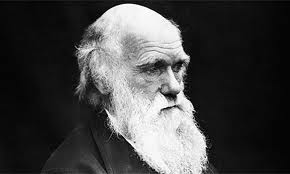
This week I am teaching Darwin again, Darwin being a staple of the Simon’s Rock Sophomore Seminar, required of all students.  I have always found The Origin of Species difficult to read, but lately I am realizing why: because Darwin seems so sure that aggressive competition, the infamous “survival of the fittest,” is THE biological paradigm on our planet. All species are locked in a relentless “battle for life,” from which only the strongest and best adapted (which often means the most ruthless) will emerge evolutionarily victorious.

However, there have been some persistent voices in the past few years arguing that Darwin understated the case for altruism and empathy as an evolutionary advantage for human beings.  Jeremy Rifkin, in The Empathic Civilization, argues that cognitive neuroscience is now proving that we are in fact at least as empathetic, as a species, as we are aggressive.  He believes that the linking potential of the internet age has the power to help us overcome the divisiveness that marred the past 500 years or so of human history, and make a great leap forward in our social evolution.

“The information communication technologies (ICT) revolution is quickly extending the central nervous system of billions of human beings and connecting the human race across time and space, allowing empathy to flourish on a global scale, for the first time in history,” he says.

“If we can harness our empathic sensibility to establish a new global ethic that recognizes and acts to harmonize the many relationships that make up the life-sustaining forces of the planet, we will have moved beyond the detached, self-interested and utilitarian philosophical assumptions that accompanied national markets and nation state governance and into a new era of biosphere consciousness. We leave the old world of geopolitics behind and enter into a new world of biosphere politics, with new forms of governance emerging to accompany our new biosphere awareness.”

Human beings’ amazing use of technology has always been both our blessing and our curse.  Technology is enabling me to send these ideas out into the ocean of the Web, a digital message in a bottle that could potentially reach millions of people across the globe.  Amazing!

But my reliance on electricity generated by oil and coal to perform this technological wonder is the Achilles heel of the whole enterprise, since collectively we as a species are overloading the biosphere with our wastes and driving the planet to the brink of what Darwin would call an “extinction event.”  Our own.

Will we make that great leap forward that Rifkin is foretelling, waking up to the necessity of moving from global competition to global collaboration in a new, more localized model?

Rifkin imagines a future global society based on the localization of energy sources like solar, wind, tidal and geo-thermal, as well as the re-localization of agricultural and manufacturing economies.

“In this new era of distributed energy,” he says, “governing institutions will more resemble the workings of the ecosystems they manage. Just as habitats function within ecosystems, and ecosystems within the biosphere in a web of interrelationships, governing institutions will similarly function in a collaborative network of relationships with localities, regions, and nations all embedded within the continent as a whole. This new complex political organism operates like the biosphere it attends, synergistically and reciprocally. This is biosphere politics.”

I believe that this rosy vision is theoretically possible, but I sure don’t see anything like it on the horizon today.  Rifkin puts his faith in the upcoming generation, who have grown up as “digital natives” and are more likely, he thinks, to be collaborative across traditional national and political boundaries. Facebook Nation!

Maybe so, if the young can be roused from their entertainment media trance and made to see the urgency of the mission.

I read with dismay yesterday that the U.S. video-game industry is one of the most highly subsidized sectors of our economy, rewarding, for example, the makers of “Dead Space 2, which challenges players to advance through an apocalyptic battlefield by killing space zombies.”  Dead Space 2 shipped 2 million copies in its first week of sales.

How can we expect young people to focus on serious, urgent issues like global climate change when they’re so busy chatting with friends on Facebook and killing zombies on Wii?

If this is the best we can do as a society, then I’m sorry, folks, but maybe an extinction event is not only on the horizon, but, as Darwin would say, “for the good of all.”


Counter-Memory and the Politics of Loss After 9/11 | Truthout

Counter-Memory and the Politics of Loss After 9/11 | Truthout.

Excellent analysis by social critic Henry Giroux.  At least he still has the heart to end his tirade on a positive note!

“Within the last decade, America has taken a dire turn to the dark side and embraced a ruthless kind of moral Darwinism in which a survival-of-the-fittest logic and a cult-of-the-winner mentality legitimate a war of all against all and pernicious cynicism as the prevailing attitude toward everyday life.  We now live in a society driven by a hyped-up market fundamentalism that thrives on a culture of hardness to the point of cruelty. How else to explain the lack of public response over a Republican Congress that wants to tax the poor while refusing to raise taxes on the exorbitantly rich and hedge fund millionaires?”

9/11–Let’s Get Real!

All right, I have to say it.  I find the coverage of the 9/11 10-year anniversary nauseating.

The way we are collectively wallowing in our victimhood, while at the same time celebrating our oh-so-macho response to being attacked.

The way so few voices are talking about the reasons for the anger that launched those pilots at the US; the money that funded them; the horrendous aftermath of the attack, in which we rattled our sabers, swore vengeance against the “axis of evil,” and started a war in Iraq that cost hundreds of thousands of people their lives.

The way we aren’t talking about the corporate capitalist policies of exploitation and greed that led to widespread misery in the places where Al Qaeda operatives like to hide, places where starving parents opt to send their sons to the madrassa so they can eat, not knowing or caring what kind of indoctrination may be occurring between bites.

The way we aren’t talking about the indoctrination our children are getting here in our schools, through the sanitized version of the 9/11 story, in which the U.S. is always the good cop, policing the rest of the world in a superior and politically correct manner.

No one ever mentions anything about our status as the largest military operation in the world and the largest exporter of guns and military hardware—the biggest fomenter, therefore of violence on the planet.  How could we naively expect that this violence would not come home to roost?

And now those same policies of profit-seeking callousness have reached their limit in the natural world, and the violence we have wreaked on our environment can and will return to bite us—in fact, it is already visible in the erratic weather patterns of global warming, leading to natural disasters and food instability even here in the heart of Empire.

Instead of the obsessive repetition of schizophrenic patriotic self-congratulation alongside whining victimhood, we aren’t we talking about what really matters: moving forward in a way that radically changes the culture, both national and international, that produced 9/11?

Until we begin to have this forward-looking conversation, in which all the cards are put on the table and no credible way out of the morass of violence, greed and destructive exploitation is ignored, we will be stuck in a sick Groundhog Day of our own making, with no way to stop the repetitive madness.

I don’t know about you, but I want to wake up to a new day.

California Black-out: Eco-terrorist Strike? Wake-up Call?

Last night, while all the pundits and news editors were focused on President Obama’s jobs speech to Congress, a small news item at the bottom of the page caught my eye: blackout in southern California.  1.4 million without power, from Arizona to Baja California, including San Diego and Tijuana. No explanation.

This morning, the blackout is still on, and there is still no explanation.

With a strange blend of fear and hope, I find myself wondering whether it could possibly be the result of a Deep Green Resistance strike.  According to the DGR website, the mission of the underground resistance movement is to “dismantle the strategic infrastructure of power” that has brought our planet to “the brink of complete biotic collapse.”

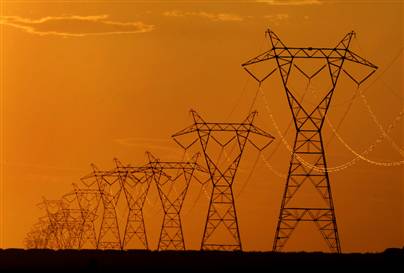
What could be more critical to the continued functioning of industrial civilization than electricity?

Really, folks, all of this dithering about tax cuts, monetary policy and jobs creation would instantly be totally beside the point if the energy that fuels our society were to sputter and die.  To say this is not to be alarmist, it’s simply to be real.

As anyone who has had to go through a power blackout of more than a few hours knows, we 20th-21st century Americans are uber-dependent on our electric juice.  We are so addicted that we no longer know how to live without it, in a literal sense: our food and water supplies are almost completely reliant on fossil fuel-based energy.

No gas, no ATMs, no refrigeration, no supermarkets, no water pumps, and for many of us, no heat in the winter, never mind AC in the summer.  Oh, and did I mention no internet?  No video games?  No email, voice mail or cell service?

Science fiction has tried to imagine what the collapse of civilization as we know it would look like.  We have all seen films like The Day After Tomorrow, or read books like Margaret Atwood’s chilling Handmaid’s Tale.  Mostly, our imagination of this kind of future seems pretty grim.

But it doesn’t have to be that way.

Just as there is already a guerilla movement bent on taking down industrial civilization, there is also an aboveground movement looking to put in place the building blocks for a new, sustainable civilization.  It’s called the Transition Town movement.  It started in the UK, and is now gathering steam in the US as well as around the world.

While the Deep Green Resistance folks seek an aggressive approach to dismantling what is, the Transition Town movement is more about working with what is to create something better.

It’s a bit tamer, but will be far more digestible to the majority of Americans.  It has a role for everyone, and a focus on the positive: on what can be done if we work together in the service of a strong vision of positive change to a sustainable future.

There is no doubt that the climate crisis is upon us.  The signs are apparent on a daily basis.  Wildfires out of control in Texas; flooding in the Northeast; blackouts in California; droughts in the Midwest.

Fear, panic or depression will get us nowhere.  Anger is useless unless channelled into positive action.

The most important thing you can do to prepare for what’s coming is to strengthen your relationships with your local friends, neighbors and community.  We are going to need each other in the months and years ahead.  We’re going to need all the love, resilience and solidarity we can muster.

The time to start is now.


9/11 beyond the hype: What are YOU going to do about it?

Someone asked me today, What do you remember about 9/11?

I remember that at the moment the Twin Towers were hit, I was walking down to the Simon’s Rock College Center from the parking lot, on my way to my morning class—Sophomore Seminar.  It was a gorgeous September day, cool and bright.

My first indication something was wrong was inside the College Center, where there was a strange aura of people scurrying around, consulting with each other in the halls.  I quickly caught on to what at first seemed like a malicious rumor: a plane had hit the World Trade Center.  An accident?

But then no—a second plane had hit.  And the building was on fire.  People were jumping out of windows.  It was a terrorist attack.  Another plane had been hijacked.

And so, within an hour, the whole ghastly event unfolded.  The world that had seemed so safe, predictable and sane to me just minutes earlier, rocked crazily on its axis.

I met my students in the classroom, told them the news, and we all went over to the Lecture Center to watch CNN on the big screen.  The beautiful sunny day faded into the darkness and virtual screenlight.  The towers, falling over and over.  The people, jumping out of the flames to their deaths.

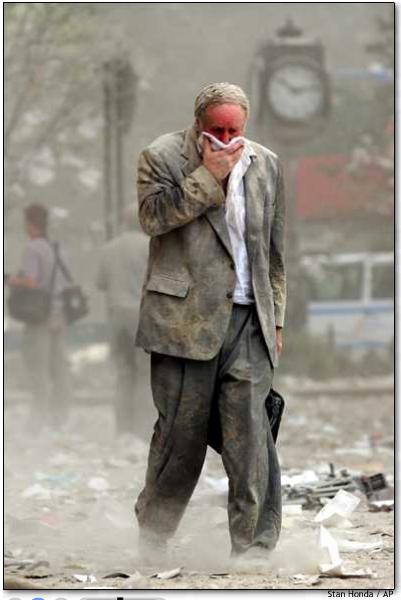
The firefighters, covered with eerie white ash.  The streams of people walking uptown, away from the Towers, like refugees leaving the scene of a genocide.

Manhattan is my hometown.  I have many memories of visiting the Twin Towers.

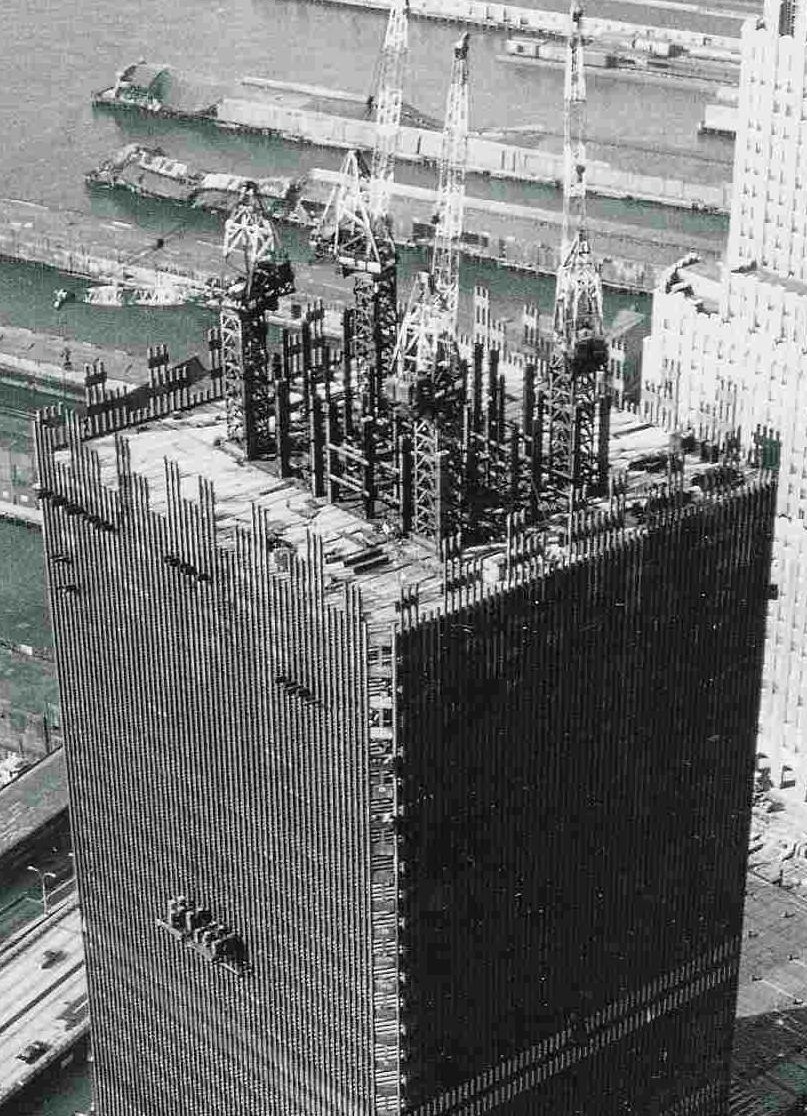
As a child, I remember when they were built, two identical towers rising on the skyline, bristling with huge cranes rendered tiny by distance.  I remember riding the elevator to the observation deck, the sick, scary feeling in my stomach as the elevators accelerated to a speed I didn’t want to fully imagine.

The wind up there, laden with the faint salty tang of the nearby sea; the tourists pointing cameras at the Statue of Liberty, or uptown at the rows of orderly buildings broken up by the green oasis of Central Park.

I have very fond memories, too, of eating dinner at Windows on the World, and the even more exclusive Cellar in the Sky, restaurants that my parents took me to for special occasions, like my 20th birthday.  At Cellar in the Sky, in addition to the fabulous food, you would get a different exclusive wine for each of seven prix fixe courses, ending up with a deep snifter of fine cognac with dessert.  We would leave the restaurant tipsy and glowing with a sense of well-being, the animal satisfaction of being relaxed and truly well-fed.

All gone, after 9/11.

What I lost on 9/11 was far more than just a physical place holding pleasant memories.  I lost my naïve belief that bombings and terrorist attacks only happened somewhere else in the world, never in my hometown.  I lost my sense of privileged aloofness from the rest of the world.

Mind you, by 2001 I was already a college professor, had already finished a dissertation that focused on personal narratives by human rights survivors from Latin America and the Caribbean, as well as North America.  I should not have been so naïve.

But somehow, until the Towers crumbled, it did not fully hit home to me how inevitable it was that the arrogance of American imperialism abroad would boomerang back around to hit us.

And it certainly did not occur to me that this strike would be used to initiate a regime of “homeland security” that brought our country closer to fascism than we had ever come before.

Ten years later, I am still feeling the pain that spread out from Ground Zero like the low ringing of a gong.  It is the pain of all of the peoples exploited by American-led capitalist imperialism, for whom World Trade is synonymous with oppression.  It is the pain of the widows, widowers and orphans, left not only by the terrorist strikes, but also by the ensuing vengeful wars in Iraq and Afghanistan.

The pain only deepens as I begin to understand the extent to which the effects of Western imperialism have hurt the natural world, and destabilized the delicate ecological balance that has made our planet so fruitful.

9/11 hurt America, yes.  But America has been a leader in a global assault on our planet, on a scale that dwarfs the Al Qaeda strike.

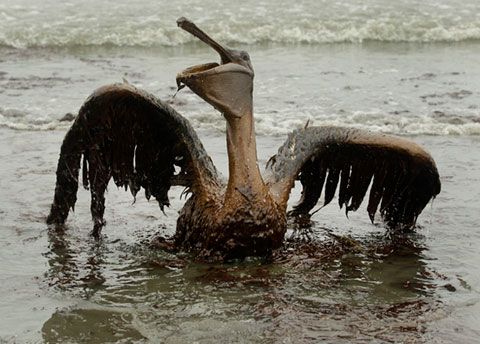
 I would never support Al Qaeda, or its methods.  But neither can I support American-led corporate capitalism, with its chemicals and clear-cutting, its cowboy swagger as regards regulation, that has inflicted us with BP-style disasters replaying again and again in excruciating, devastating slow-motion.


What I lost on 9/11 was the sense that none of this had anything to do with me as an individual.

9/11 launched me on a difficult period of self-reflection, in which I realized the extent to which my own privilege as a member of the ruling elites had blinded me to my complicity in the oppressive system that spawned the anger that led to the World Trade Center attacks.

Once you realize your own complicity, you can either wallow in unproductive guilt, or you can roll up your sleeves and resolve to do whatever you can to make a change for the better.

History has shown us that it is the insiders–the wives, sisters and daughters of the masters of the universe—who have tremendous power over the men who love them.  In our day and age, women too can be “masters”—that is, members of the ruling class who control our society.

I think the question for us, ten years after 9/11, is a simple one.  What are you going to do about it?  Are you going to support the status quo, which may benefit you and your family greatly, but which ultimately leads to greater social instability, through political and environmental vulnerability?

Or are you going to be a change agent, someone who is not afraid to speak truth to power and insist on positive change?

On 9/11, there is no more important question to be asking ourselves.

Labor Day 2011: in which we watch capitalism dig its own grave, and plant the seeds for a better world

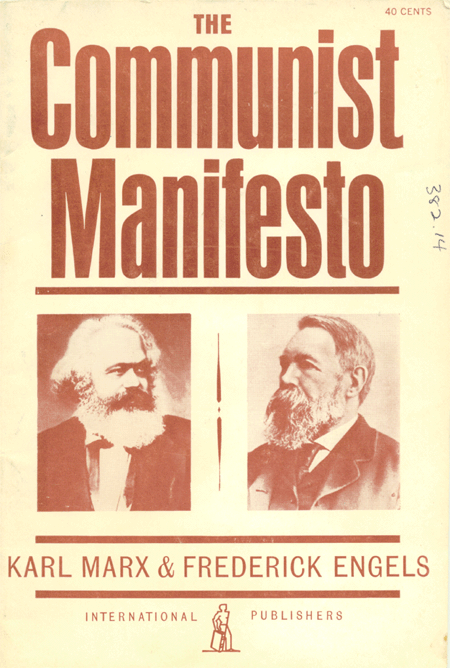
On Labor Day, my students and I discussed “The Communist Manifesto” by Marx & Engels.  We found the Manifesto remarkably prophetic, describing corporate globalization to a T long before either word had been invented, as well as the recurring, ever-more-destructive cycles of boom and bust that Marx predicted would cause capitalism to “dig its own grave.”

We talked about how Marx didn’t envision the final limit to growth being the carrying capacity of our planet, and how the climate crisis may be what finally does the job of sending capitalism over the edge.

But no one could muster much enthusiasm for Marx’s conviction that the proletariat–ie, working folks–would then rise, take over, and make the world a better place.

Looking at the disastrous social experiments in the USSR, China and Cuba, it’s hard to put much credence in Communism as a viable alternative.

It’s also hard to imagine that a social system led by the working class would automatically be any better than the one we have now, dominated by the technocrats and financiers. We’re all human, after all.

Human in our failings–but also human in our creative power to envision new possibilities.

We finished off Labor Day at Simon’s Rock yesterday by having the whole Sophomore class gather to watch “Metropolis,” a visionary film that shows how a young man from the ruling elite is moved by love to become the “heart” that joins the “head”–the technocratic elite–and the “hands,” the workers who actually do the physical labor that makes the vision a reality.

In the allegory of the film, this young, well-educated man provides the missing link, compassion, that can heal a society that has become terribly unhappy in its alienation–the coddled rulers as unhappy, apparently, as the oppressed workers.

It has always been the case that the educated elite have a powerful role to play in social change, if our action springs from the heart.  To survive the coming cataclysms of the 21st century, humanity is going to need all its technological prowess, joined with the age-old wisdom of the peoples who have never embraced western “civilization,” who still know how to make subsistence a happy and healthy way of life.

Head, hands and heart, joining in the common goal of survival.

There are groups now who are forming these kinds of alliances and working actively to create the path towards a sustainable future.  For instance, the Pachamama Alliance, and all the groups who worked on creating the Earth Charter.

The only way capitalism is likely to survive climate change is if the economic elites crack down on the masses with military power–mind controlling hands in heartless fashion. We’re seeing that happen now in various smaller countries in the world.

As a strategy for global domination, I don’t think it will work–it just takes too much in the way of resources.

How much better it would be to have a blueprint for planetary survival based on heart, growing out of our deep love for the natural world that created us and continues to sustain us, despite all we have done and continue to do to destabilize and destroy her.

The Giving Tree is my least favorite book in the world, and I can’t imagine why parents continue to buy it for their children.  Let’s write a new book in which instead of destroying our giving tree, our planet, we nourish her and watch her grow with delight.

Let capitalism step off into the grave.  And let a new world be born, in love, light and laughter.

Eco-terrorist? Or freedom fighter?

Well, as President Clinton famously put it, it depends what you mean by “eco-terrorist.”

One man’s “terrorist” is another’s “freedom fighter,” after all.

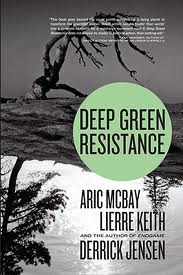
I didn’t need Derrick Jensen, Aric McBay and Lierre Keith to tell me that our planet was in trouble. As someone who has always been tuned into the natural world, I noticed when the dawn chorus of songbirds diminished to a few lone, defiant voices.  I noticed when the summer clouds of butterflies were reduced to single wanderers, here and there.  I noticed when the tree frogs stopped singing, and there were no longer any toads hiding in the damp leaves of the garden.

I noticed.

But I did not react.  Or if anything, I reacted with a kind of sad resignation.  I blamed some kind of faceless “Progress” for the loss of these dearly beloved fellow travelers on the planet; I did not take any kind of personal responsibility for their disappearance, and I did not see anything I might do to slow “Progress” or change its impact on the environment.

Giving money to environmental groups did not seem to make any difference.  Petitioning Congress–ditto.  And so there was just that kind of paralyzed melancholy, a sense of inexorable doom, that only increased as the full scale of our climate change crisis became apparent.

And then I started reading  Deep Green Resistance.  It was hardly my first foray into environmental manifestoes–I’d started with Rachel Carson and Jane Goodall, years ago, and kept up with Bill McKibben, Wangari Maathai, Julia Butterfly and many others.

But this book is different.  It is not only a call to action, but a manual for how to accomplish change–whether you are a middle-aged armchair activist like me, or a stalwart young guerilla resistance fighter.  There is a role for all of us, and it’s spelled out more clearly in this book than I have ever seen it done before.

What inspires me most about this vision of resistance is that it springs most profoundly from love.

“Whatever work you are called to do, the world can wait no longer,” Lierre Keith writes in the conclusion to the book.  “Power in all its versions–the arrogant, the sadistic, the stupid–is poised to kill every last living being.  If we falter, it will win.  Gather your heart and all its courage; fletch love into an arrow that will not bend; and take aim” (515).

“The carbon is swelling; the heat is rising; the rivers are fading and somewhere a black tern is giving up in exhaustion.  The same noose that took Ken Saro-Wiwo is tightening, and there is only time for one last breath.  Will you close your eyes and let the earth fall, with a sickening snap of species and forests and rivers?  Or will you fight?

“Whatever you love, it is under assault.  Love is a verb.  So take that final breath and fight” (495).

The question is, what form will my fighting take?

I don’t see myself as someone who blows up power plants or takes out dams.  Nor am I a computer hacker.

In DGR terms, I am an aboveground activist.  What I want to do more than anything is to awaken “my people,” that is, the privileged ones, the denizens of Park Avenue and Westchester County and Long Island, the ones whose grandparents and great-grands came to this country around the turn of the century and found a land of peace and plenty, and have ridden the 20th century wave of “Progress” to a life of luxury and comfort.

These are the people who need to understand that this lifestyle we have all enjoyed so much IS NO LONGER SUSTAINABLE.  In fact, it is what is driving our entire planet into climate ruin, from which, for us as a species at least, there will be no return.

It is frightening to think about going “back” to the kind of “primitive” lifestyle that we human beings lived for all those thousands of years before the advent of the industrial revolution.  We don’t want to go back to the time before antibiotics, before computers, before hot showers, before TV, before cars, before supermarkets.

But we have to think seriously about what all these “modern conveniences” and “advances” have really given us.  We have to weigh the pros and cons.

I want to believe I come from reasonable people.  I want to believe if the case is made for them in a reasonable way, they will be able to understand.

Understanding is not action, but it is a necessary first step.

Will you take that step with me?

What happened to the Obama we elected?

If you won’t do it, Mr. President, we will!

The Kids Are Not All Right

Corporate Interests Threaten Children’s Welfare – NYTimes.com.

I agree with much of what this author says about the damaging effect of corporate media and social media on not only the kids themselves, but on family dynamics.

He makes a kind of modified plea for “family values,” which he identifies with the 20th century’s focus on prioritizing the well-being of children (at least, in middle-class white North American families).

I’d like to suggest that we don’t need to look backward to find our way out of the morass of childhood media addiction…we need to look forward.  The digital media is here to stay, at least as long as civilization as we know it holds up.

How can we learn to navigate through it, for ourselves and our children, in a way that feels healthy, balanced and nourishing?

If we can’t figure this out, I fear the computers–and the corporations that are behind them–will suck our souls dry.

Women + Men = Change

The other day I, along with many thousands of others I’m sure, got an email from Jean Shinoda Bolen, the psychologist and activist–author of Goddesses in Everywoman, Urgent Message from the Mother, The Millionth Circle and many other books, most of them arguing that women have a special role to play in healing the world, and urging us to get busy.

This recent email said precisely that, but with a concrete focus: Jean is advocating that the United Nations support a Fifth World Conference on Women, as a follow-up to the Fourth World Conference held back in 1995, in Beijing.  Activists have been calling for another conference since 2004–when the hope was to mark the decade in 2005 with another big event by and for the women of the world.

At this point, we’ll be lucky to get the 5WCW, as insiders call it, in 2015.  But Jean’s letter brought up some deeper questions for me.

As I dutifully signed the online petition, I wondered whether it was really worth the time, effort and money it would take to create another major world conference on women again, UN-style.  Of course, now we have UNWomen, the new and much more powerful agency for women, headed up by the fabulous Michelle Bachelet.

But still–here come the deeper questions.

  • Do women really have some special role to play in peace-making and nurturing civil society, which would be strengthened for us by getting together in a symbolic–and also very real, remember the mud in Beijing?–conference on this scale?
  • If the men aren’t there in the meeting halls with us, will they be fully invested in whatever resolutions are brought forth?
  • Can women accomplish profound, lasting social change on our own, without bringing the men along with us?

Back to Eckhart Tolle for a moment.  I was struck while reading A New Earth that he, like so many other philosophers, seems to see women as fundamentally different from men.  He’s pretty unequivocal about it:

“Although women have egos, of course, the ego can take root and grow more easily in the male form than in the female.  This is because women are less mind-identified than men.  They are more in touch with the inner body and the intelligence of the organism where the intuitive faculties originate.  The female form is less rigidly encapsulated than the male, has greater openness and sensitivity toward other life-forms, and is more attuned to the natural world.

“If the balance between male and female energies had not been destroyed on our planet, the ego’s growth would have been greatly curtailed.  We would not have declared war on nature, and we would not be so completely alienated from our Being” (155).

He goes on to talk about the Inquisition and witch-burnings, and the ways in which, in all the major world religions, “women’s status was reduced to being child bearers and men’s property.  Males who denied the feminine even within themselves were now running the world, a world that was totally out of balance.  The rest is history or rather a case history of insanity….In time, the ego also took over most women, although it could never become as deeply entrenched in them as in men” (156-57).

The post-structuralist feminist in me says “whoa, Eckhart!  You’re claiming essentialism here, that women are essentially, that is, really and fundamentally different than men. Feminist philosophers have resisted this because so much oppression happened because women were said to be fundamentally different than (and lesser than) men. Do we really want to go there again?”

But then there are many older feminist camps, including the “goddess within” folks like Jean Bolen–and Audre Lorde, and Alice Walker, and Gloria Anzaldua, my heroines–who would be greatly cheered to hear this kind of admission coming out of a man like Eckhart.  He only talks about it for a couple of pages, and he makes a curious move of deflecting guilt onto “the ego,” which is oddly personified–see for yourself:

“Who was responsible for this fear of the feminine that could only be described as acute collective paranoia?  We could say: of course, men were responsible. But then why in many ancient pre-Christian civilizations such as the Sumerian, Egyptian and Celtic were women respected and the feminine principle not feared but revered?  What is it that suddenly made men feel threatened by the female?  The evolving ego in them.  It knew it could gain full control of our planet only through the male form, and to do so, it had to render the female powerless” (156).

This almost sounds like an angels and demons scenario, with demons, acting through “the ego” in each one of us, working to gain ascendancy, and being more successful in “the male form” than in women–because we women are more intuitive?  Or at least, we used to be, before the ego got to us too?

Eckhart finishes up his brief discussion of the differences between men and women on an upbeat note, saying that “because the ego was never as deeply rooted in woman, it is losing its hold on women more quickly than on men” (157).

And presumably, that means that he’d agree that women should step up and take a leadership role in helping humanity out of its current crises (environmental, economic, social) into “a new Earth.”

I think I’d have to agree.  But is convening thousands of women from all over the world in a physical place on Earth the way to go?  Or would it be a better strategy to focus on empowering women where we are, and maybe trying to do more with technology to link us so we can share strategies and become collectively empowered?

Just thinking about the amount of paper that would have to be shuffled at the United Nations to make a big women’s conference happen; and the amount of jet fuel and other resources that would have to be spent to get everyone into that one physical arena, makes me wince.

I’d rather see a series of smaller conferences, all happening simultaneously all over the world, linked by teleconferencing, with extensive, easily accessible video archives produced for later consultation.

And although these conferences would be led by women, I’d like to see men there in the audience too–and even at the podium, if they come to the microphone with their feminine half fully engaged.

Women do have something special to offer the world, but just as we need to activate our masculine side to become warrior leaders for change, we need men at our sides with their nurturing, peacemaking sides ascendant.

If we could manifest this vision, we could change the world.  For the better.