It’s Up to Us Now: Carrying on the Work of Pete Seeger

Unknown-1When I heard the news that Pete Seeger had died, my first thought was “oh no!” and my second thought was “now there goes a man who lived a good life.”

At 94, he had accomplished so much and lived so fully.  Even during his final months and weeks on the planet, he was still playing concerts to packed houses and inspiring people everywhere with his unwavering dedication to using music as a means of raising awareness and fomenting social change.

The New York Times obituary quotes him as saying in 2009 (the year he sang at President Obama’s Inauguration): “My job is to show folks there’s a lot of good music in this world, and if used right it may help to save the planet.”

Pete’s gift was for making music and getting others to sing along with him, and he used it not for fame, fortune or glory, but for the good of those who most needed him.

Whether he was singing in support of the Civil Rights Movement or the anti-war movement, singing for freedom against the red-baiting of the McCarthy era, singing against apartheid or singing for the environmental movement, he was always out in front leading the charge and showing others what true courage and conviction looked like—in a joyous register.

Image: File photo of Pete Seeger and his grandson Tao attending the We Are One - Inaugural Celebration at the Lincoln Memorial in Washington

That upbeat, “we-shall-overcome” personality probably played a big role in Pete’s longetivity—research shows that people who think positively tend to live longer, happier lives than those who tend to see the glass half-empty.

When I saw Pete play, at one of his last concerts last fall, there was a joyous glow about him that lit up the whole stage, and those of us in the audience would have followed him anywhere.

Well, it’s up to us now.  Pete has moved on, and we are left to carry on his legacy—to keep singing his songs and working for the positive social change he believed in and created.

Unknown-2Pete was so deeply engaged with humanity during his lifetime that in death he will still stay lodged in our hearts.

His is the kind of soul that will rise into heaven showering sparks and spores of bright beckoning energy, encouraging us to carry his tune, to keep his good spirit alive.

Today I start a new semester of classes, and I am excited to be teaching two classes that will enable me to do just that: “Women Write the World” and “Writing for Social and Environmental Justice.”

Pete, I’ll be thinking of you with love and admiration as I go to greet my students this morning.  I hope a little of your sweet, positive, hardworking energy will carry us forward this year, and forever.


If you get there before I do

Comin’ for to carry me home

Tell all my friends I’m comin’ too

Comin’ for to carry me home.


Swing low, sweet chariot

Comin’ for to carry me home

Swing low, sweet chariot

Comin’ for to carry me home.


Writing of Disaster, Writing of Hope

As a professor of literature, I tend to pay special attention to what my son is reading in school.  I wish I could say I paid attention to what he reads at home, for pleasure, but the truth is that he does not read for pleasure.  He reads on assignment, and that’s it.

So what is he reading, in his typical 9th grade American public high school?

So far this year he’s read 1984, Lord of the Flies, and Night. Now he’s reading a contemporary novel, How the Light Gets In, by a British author, M.J. Hyland, billed as a 21st century girls’ version of Catcher in the Rye.

In short, it’s been one depressing, upsetting book after another.  Thought-provoking would be the kind term to use, but it saddens me to recognize that generally speaking, “serious” literature is about the things that frighten us.

And it’s not just in literature that this is true.  In pop culture too, the violence that plays out over and over in every form of media entertainment is catering to what seems to be a human need to imagine and play out in fantasy our deepest fears.

Almost all science fiction series and movies that try to imagine the future show us disasters and social dystopias.  These are considered “realistic” (a positive attribute), as distinct from “utopian” scenarios (dismissed as unrealistic, hence not to be taken seriously).

As a parent, a teacher, and a member, like you, of the transitional generation on this planet, I worry about our apparent addiction to what 20th century philosopher Maurice Blanchot called “the writing of disaster.”

Certainly I have not shied away, in my own career, from making myself aware of the ugly side of human experience.  I have studied human rights abuses of every stripe and geographic origin, including sexual abuse, torture, war and genocide.

I have confronted the grotesque truth of the devastation we humans are wreaking on non-human animals and on our planetary environment—the chemical poisoning of air, waters, earth, along with the life forms that inhabit these strata; the factory farms; the mountaintop removal, clear-cutting and strip-mining; the plastics pollution of the oceans; and on and on.

I don’t bury my head in the sand, by any means.

But I question the wisdom of inundating our imaginations, especially those of young people, with violent stories.

Whether they’re historical like Night or futuristic fiction like 1984; whether they’re video game scenarios like GTA or Call of Duty; or TV series, movies, or the daily news—if all we see in virtual reality is human beings being violent, doesn’t this begin to affect the way we understand ordinary reality?

Doesn’t it make us more guarded with each other, less likely to trust, less likely to build community and bring out the best in each other?

Mary Pipher

Mary Pipher

In preparation for my new class this spring, “Writing for Social and Environmental Justice,” I’ve been re-reading Mary Pipher’s 2006 book Writing to Change the World. Mary Pipher, you may remember, is the psychologist who wrote Reviving Ophelia, a book from the late 1980s that provoked a major surge of attention to the way American girls self-sabotage as young teens, and what societal factors made their swan-dive of self-esteem more likely to occur.

In recent years, Pipher has become an environmentalist, leading the charge in her home state of Nebraska against the Keystone XL.  Although the pipeline is not dead yet, it has at least been re-routed away from the ecologically sensitive Sand Hills region.

In Writing to Change the World, she offers a how-to book for those, like me, who see writing as one of the best tools to raise awareness about the issues that matter most.

Pipher writes: “The finest thing we can do in life is to grow a soul and then use it in the service of humankind.  Writers foster the growth of readers’ souls, and the best soil for growth is love.  Writing can be love made visible….This is our challenge: to cultivate lives of reflection, love and joy and still manage to do our share for this beautiful broken planet of ours” (241-2).

However, it seems to me that the kinds of writing we are consuming as a culture, and especially what we’re feeding to our young people, will neither “cultivate lives of reflection, love and joy” nor inspire us to take arms against the sea of troubles that is our planet today.

On the contrary, the dominant narratives I see, at least in American culture, are violent, cynical and despairing, showing us the worst of humanity rather than enticing us forward with dreams of what could be.

I’d like to see the start of a new global literary movement of change narratives in every genre aimed at holding a positive mirror up to human nature, giving us examples of the good we have done and the good we are capable of doing if we draw on our positive qualities—our ability to love, to nurture, to steward, to protect.

Even our oh-so-human violence has a place, if it is used to protect rather than to abuse and wreak wanton havoc.

I would like school curricula to stop replaying the horrific stories of our past—or at least, to balance these negative stories with narratives that give students some positive, hopeful models of human beings as well.

Trying to “grow a soul” in today’s social climate is like trying to grow a plant without sunshine.

Writers, let’s take on the challenge of using our gift with words to change the world for the better.  Let’s be the sunshine, not the shadow.

Spiderweb

Drinking Deep from the Elixir of the Berkshire Festival of Women Writers

BFWW-vertical-logoJanuary is the season when I must work like mad to get the Program for the 2014 Berkshire Festival of Women Writers out to the printers, so that it will be ready to distribute in February.

For months now, program coordinator Jan Hutchinson and I have been finalizing all the details, gathering the descriptions and bios and photos for no fewer than 58 separate events, featuring more than 150 women and girls at some thirty different venues throughout Berkshire County, including of course our principal sponsor Bard College at Simon’s Rock.

We’ve also been soliciting advertising and sponsors with the help of our hard-working Miss Hall’s School Horizons interns, supervised by organizing committee volunteers Judy Nardacci and Lorrin Krouss.

And committee members Maureen Hickey, Joanne Cooney, Vera Kalm and Johanna Janssen have been helping to generate the funds necessary to sustain a growing Festival like this one, with considerable success—we have dozens of contributors to thank this year.

Once I finish my part of the Program, I’ll send the copy over to Festival graphic designers Alice and Anna Myers, who will work their magic and send it off to our fabulous printer, John DiSantis at Quality Printing, who always does such a stellar job for us.

Then we’ll turn out attention to getting the website up to speed, and getting out our own publicity in local and regional publications and calendars, aided by the very capable and calm Lynnette Lucy Najimy of Beansprout Productions.

In short, our Festival is a huge effort, representing the combined forces of so many talented people in the Berkshires, all coming together to brighten up the often drab month of March with readings, workshops, performances and discussions highlighting the creative energy of women and girls.

I may be grumbling about the frenetic workload now, but I know once March 1 rolls around and our Festival starts to gather steam, the delicious vitality of women’s words will carry me along to inspirational highs I could never have conjured on my own.

1528653_548356822534_515979881_nThat’s what the Festival is all about—it’s a grand collaborative gift that we give to our community, and not only in March.  This year we’ve begun to offer year-round programming as well: the monthly Lean In group for women writers, co-hosted by Lesley Ann Beck and yours truly at the Berkshire Museum; the Writing from the Heart readings, which we’ll be offering next on February 13 at The Mount; a special Mother’s Day event planned for May at the Sandisfield Arts Center; and the new weeklong Writing Workshops for Women, going on right now and again in June.

The energy of so many creative women and girls coming together to share their ideas and perspectives in the public sphere ignites an alchemical combustion that produces a heady, exhilarating kind of mental/emotional elixir.

We all feel it, presenters and audiences alike—the sheer joy of coming together to shine our creative lanterns at each other, beckoning and inspiring each other on to new heights.

Clarissa Pinkola Estes would call what we do in the Festival “displaying the lantern of the soul.”  In a recent blog post she said that “to display the lantern of soul in shadowy times like these – to be fierce and to show mercy toward others; both are acts of immense bravery and greatest necessity.
Struggling souls catch light from other souls who are fully lit and willing to show it.”

Meet us out on deck at the Berkshire Festival of Women Writers, and bring your lantern!  Let’s create beacons bright enough to illuminate the way forward, together.

Cherry Hill Beach copy

A New Year’s Vision for 2014

IMG_4297 copyAs the year wheels slowly to a close, I am distracted and repelled by the frantic pleading coming into my email inbox…it seems that every nonprofit and political organization I have ever expressed the least interest in is desperately vying for a few pennies from my ever-shrinking purse.

I too have been fundraising these last few months, trying to raise enough money to sustain the Berkshire Festival of Women Writers, which I founded on a shoe-string and a dream three years ago.  The more successful it becomes, the more time it takes to organize, and the more money is required to keep the wheels turning.

I certainly understand the need to seek funds to support these worthy endeavors, and yet I find myself wishing there was some other way.

Wouldn’t it be a better use of my time, talents and energy to focus on creating the vibrant programs the Festival is known for, rather than constantly having to cast about for financial support?

And what is true for me must be true for the organizers of all these causes that are flooding my inbox with urgent last-minute appeals for funding.

This New Year’s Eve, let me pause to envision a social landscape in which people are encouraged to do what they’re best at doing—whether it’s planting a tree or building a house or writing a poem—without having to worry about whether or not they will be paid in cash for their labor.

What if good ideas could just grow vigorously like weeds in the warm, pungent, nurturing earth of collective human society?

What if instead of all fighting amongst each other to be heard and rewarded for our cleverness, sex appeal and charm, we worked graciously together to create the vast interlocking human machine of collective creative endeavor, each of us contributing the pieces we do best and knowing we’ll be fairly rewarded for work done well?

What if instead of working for dollars and cents, we worked for goods and services that we needed, on a barter system to which everyone could contribute and rely on?

I know this is a pie-in-the-sky fantasy, but on this night, when the Earth wheels around the Sun into a brand new calendar year, I want to allow myself to dream big—to imagine that the impossible could come true.

What a beautiful world it would be.

Happy New Year everyone!

Winter Solstice Reflections: Returning to Light, Swimming Against the Tide

Lately I have been feeling that I am constantly struggling against a strong current pulling me away from the work I want to be doing.

The current is composed of all the day-to-day chores of life, along with all the busyness of the holiday season, and the relentless tide of bad news about the state of our beloved planet and her living communities, from trees to fish to birds and bees.

The more I become aware of the dire ecological state of our planet, the more I want to devote myself to swimming against that current of devastation, trying to bring our planetary systems back into balance.

I want to do that work on the personal level, starting with my own life, and moving out into my community and the broader Earth communities in which we all live.

The climate issue, like no other in human history, has made our planetary connectedness clear. We must work together, from pole to pole, to solve the problem of climate instability that industrial civilization has wrought.

If we don’t get on in immediately, we may very well spiral into another Great Extinction, possibly soon enough for current generations of humans—me and my children and their children—to live and die through.

Faced with a negative reality of this magnitude, many of us tend to just turn away in numbed grief and try to ignore it because, sadly, “there’s nothing we can do about it.”

My own sense of being caught in a tidal current pulling me back from whatever it is I’m supposed to be doing may have a lot to do with the despairing feeling that whatever I try to do will not be enough.

But I have to do it anyway, and so do you.

Winter Solstice is the time of year when I try to retreat from the furious churning of life and recalibrate, retune, reflect.

How can I use the gifts I have been given to make a positive difference, moving outward from myself, my family and local community, to the larger circles of life I love?

My greatest gift and abiding passion has always been writing. As soon as I learned to write, I began writing stories and poems that celebrated the natural world and honored the spirits of the Earth.

As a 21st century writer, I have the ability to project my words and perspectives far beyond the confines of the old spiral-bound notebooks I used to keep as a child. I have the potential to engage in dialogue with people all across the globe, and if you’re reading this, so do you.

As a teacher, I have the ability to begin conversations with students about the difficult ecological crises that are already beginning to unfold, and the social and environmental injustices that they are spawning. I can offer students the tools and strategies for continuing these conversations across the globe through our amazing new digital technologies.

In the past year, without a great deal of focus on my part, my blog has been viewed more than 20,000 times by visitors from more than 130 countries around the world.

My little blog is just a very small drop in the great ocean of digital conversations, but even so, it is possible that some of those 20,000 readers came away with a new idea or an affirmation of their own thinking, or a challenge to their habitual perspectives, that could start a chain reaction among their friends and digital connections that could, seriously, change the world.

Rupert Sheldrake argues that “The fields organizing the activity of the nervous system are inherited through morphic resonance, conveying a collective, instinctive memory. Each individual both draws upon and contributes to the collective memory of the species. This means that new patterns of behaviour can spread more rapidly than would otherwise be possible.”

Sheldrake’s theory is exciting and controversial because if it’s true, it means that none of us has to be bound by the heavy burden of habit and cultural inertia, the industrial tide that seems to sweep us along so inexorably.

We have a choice. We can pick up our heads, think for ourselves, seek out others who also want to preserve the ecological health of the planet, and together use our great digitally connected human brain trust to steward and safeguard this planet, not destroy her.

Working together, we could, within a couple of generations, be swimming together joyously in an entirely different sea.

As the Earth wheels slowly back towards the Sun today, this is my steady vow: to keep my head above water, to reach out a hand to others who share my reverence for our beautiful planet and its magnificent life, and to give myself without reserve to the mission of building a strong interconnected movement dedicated to the shift into a sustainable, ecologically sound, joyful future.

Browdy de Hernandez 2013

c. Browdy de Hernandez 2013

Let’s Face It, Charity is Not Enough

When I was a kid, I didn’t read “the funny pages” of the newspaper; in fact, the only newspaper that came into my parents’ home did not stoop to such trivia.  We read, exclusively, The New York Times.

I remember the first time—it must have been around sixth grade—that I happened upon “The Neediest Cases” articles in The Times.

The stories hit me like a ton of bricks.

Comfortably ensconced in my parents’ Park Avenue apartment, I had no idea—no idea—that just a few blocks away, on the other side of the 96th Street divide between the wealthy Upper East Side and dirt-poor Spanish Harlem, ordinary people just like me and my family were living in abject poverty.

With a kind of morbid fascination, I read about the kids whose parents were locked away in prison; the kids whose parents were drug users; the kids whose parents were homeless, sleeping in the dark, rat-infested recesses of the infamous New York City train tunnels.

Unknown-2Every article ended with the same words: Give to The New York Times Neediest Cases Fund.

This went on year after year.  Every year there were more “neediest cases,” each one more dire and depressing than the last.

Eventually I began to actively avoid reading those pages in December.  The contrast between the clean, glowing, opulent New York I knew and the dark, dank margins of poverty I was reading about was just too much for me to take.

And it was clear to me, at least on a subliminal level, that giving to the Neediest Cases Fund did not accomplish much—not if every year the need continued, unabated and even growing worse.


This week I opened my Ipad while still in bed and found myself drawn, despite myself, into a Neediest Cases article on 21st century media steroids—complete with an elegant magazine presentation and fabulous photographs of the squalor of homelessness.

It was the story of a 12-year-old girl named Dasani (after the bottled water), the oldest child of two methadone-dependent former addicts.  Unemployed and homeless, the parents live in a single room in a mouse-infested city shelter with their seven children, from Dasani on down to an infant.

As with the 19th century New York tenement photographs of Jacob Riis, the pictures themselves tell a powerful story.  Dasani is still full of optimistic determination to succeed at school; she hasn’t yet been beaten down, like her sad-faced mother.

I can just imagine Park Avenue New Yorkers—at least The New York Times readers among them—reaching in droves for their checkbooks to send some relief to Dasani and her family.

It happens every time there is a story about a disaster or a particularly shocking needy case.  Wealthy people open up their wallets and give what they can.

But the need goes on, and on.

Photo by Ruth Fremson of The New York Times

Photo by Ruth Fremson of The New York Times

What will happen to Dasani’s little sister, the one who is legally blind?  What will become of her rambunctious little brothers?  What will prevent them from following the same path that ensnared their parents, drug addiction born of desperation?  What will keep them out of prison and make them into the productive citizens our society claims to admire?


When I was a girl, I naively believed that the “neediest cases” were an aberration.  I thought that most people lived the way I did, in comfortable security.

In fact, it’s the other way around in our America.  More and more Americans are falling into poverty day by day.  Our minimum wage cannot sustain a family, not even with both parents working.  We don’t have decent health care or child care for lower income working people.  Food pantries are scarcely able to keep up with the need, as food prices continue to rise.

There are 22,000 homeless children in New York City alone, according to The Times.

Nationally, according to the U.S. Department of Education, there are 1,168,354 homeless students, a figure that many believe to be an underestimate.

It’s outrageous that the richest, most powerful nation on Earth is willing to allow more than a million of its children to go homeless year after year.

We spend billions on nuclear weapons annually, which Lord knows we do not need and cannot use.  This taxpayer money could provide a stellar education for all American children—not just the ones who are fortunate enough to live in a wealthy school district.

Dasani and her siblings have as much right to the American dream as any other American child.

Donating to the charities that hand out teddy bears at Christmastime is just not enough.

The great activist Eve Ensler wrote in her latest memoir that she “despises charity.”

Why?  Because it doesn’t go far enough.

It’s a sop to the consciences of those who give, without addressing the root causes of the need in a way that might actually alleviate it in the longterm.

Structural changes are needed at every level of our society.  For starters, let’s do away with the policy that ties school district funding to property tax revenues.

American public schools should provide a level playing field for all children, regardless of where they live.

Next, don’t just warehouse poor families like Dasani’s in miserable rundown housing.  Give them jobs, give them respect, give them an incentive to work their way out of poverty.

At the very least, they could be organized to clean up their city-run housing, plant gardens and provide services to each other as a way to supplement their welfare checks.

Nothing breeds hopelessness faster than powerlessness, and charity perpetuates the illusion of powerlessness in its recipients.

Dasani’s resilience and determination, as brought to light in the outstanding reporting of Andrea Elliot and her photographer Ruth Fremson, needs no charity.  All Dasani needs is a fair chance.

Photo by Ruth Fremson of The New York Times

Photo by Ruth Fremson of The New York Times

Solstice dreams–an endangered resource!

So we’ve turned the corner on Thanksgiving, and now we’re going full-throttle into “the holiday season.”

Christmas-lights-on-Fiedler-HouseHere in the Northeast, that means the dwindling hours of daylight are aggressively bolstered with burgeoning strings of Christmas lights, endless shopping trips to the mall and so many holiday parties that they all begin to blur into one long month of compulsive merrymaking, carefully manufactured to cancel out the intrinsic darkness of the shortest days of the year.

I suggest that we consider actually focusing on that quiet solstice darkness, instead of working so hard to hold it at bay with our artificial lights and nonstop motion.

It worries me to see the way kids today, including my own two sons, have a hard time relaxing enough to simply space out and enjoy the quiet of a long winter evening.

They hardly even notice the festive lights that are twinkling all around us, much less the cold, distant glitter of the stars, because their eyes are so consistently trained on the soul-less white light of their smart phone screens.

506b04f7d9127e30f00016a6._w.270_s.fit_

My younger son, age 15, never leaves home without his i-phone gripped in his hand.  When we drive together I have to prompt him to look up and take in the lovely sunset, or the crescent moon hanging low on the horizon.

If I weren’t there to nag him about looking up and taking a break from his phone, it’s possible to imagine that he might literally be glued to it all day, playing shoot-em-up games or sports games, watching mainstream TV shows and movies, or texting with his friends.

When he does take a break, he often bounces around restlessly, not sure how to amuse himself.

Just sitting and staring into space—allowing oneself the luxury of quiet unfocused space-out time—doesn’t even occur to him, so accustomed is he to constantly consuming the pre-packaged ideas of others.

Fuego del HogarI know for myself that my most creative ideas come when my brain is most relaxed and open…when I am walking in the woods, or staring aimlessly into a fire, or curled up in bed with my purring cat on my chest.

If I didn’t allow myself those unfocused moments—if I was incessantly plugged into the collective internet brain that was constantly feeding me pre-packaged stimulation—I might never have an original thought.

How sad would that be!  And multiplied out across millions of others like me, how impoverishing for humanity!  Do we really want to turn into a kind of collective species like ants, bees or termites, where the creativity of the individual is completely irrelevant?

This solstice season, I suggest you detach yourself from the busy-ness and the artificial lights for a bit, take your loved ones by the hand and see if you can all slow down for a good long while.  A whole weekend would be good, or at least a long winter’s night.

IMG_3811Find a fire to stare at.  Bundle up well and find a dark hillside from which to watch the constellations wheeling overhead.  Banish those smart phones and tablets, at least for a night, and try making some music together.  Try telling some stories, or reading a good book out loud.

Everything great that human beings have achieved has come out of the freedom of our creative dreams.  We can’t afford to let that precious dreamtime be taken away from us by our own addiction to the constant stimulation of virtual reality.

Give your overworked, over-stimulated computer brain a break this solstice and enjoy the season of darkness.  Go to bed early!  Dream!

Dreams of terror, dreams of peace

This morning my son came down to breakfast with a queasy look on his face.  “I had a dream that I killed a baby,” he said.  “I was shooting with a machine gun at these guys, and the baby was in the way.”

I hate the fact that this kind of violence, which kids are exposed to through the media constantly these days, creeps insidiously into their sleep, invading their dreams.

The subliminal violence is everywhere.   This same son, a 9th grader in a typical American public high school, is reading Lord of the Flies for English class and All Quiet on the Western Front for Social Studies.

Lord-of-the-Flies-1963-fi-007Lord of the Flies, you’ll remember, is about how a group of adolescent boys, turned loose on an island without any adult authority present, morph into “beasts” who bully, torture and kill one another.

All Quiet on the Western Front is about World War I, and my son’s teacher is sparing the class none of the gory details of that war; in fact, a whole section of the paper my son has to write about the book is supposed to enumerate all the challenges ordinary soldiers in that war faced, from freezing muddy trenches to disease to field amputations, rats and artillery fire.

Last month, this same teacher had the kids reading 1984 and spent a lot of class time talking about how the surveillance tactics and physical brutality in that book related to real-life episodes of torture and detention camps in the history of China and the Soviet Union.

In short, my son’s imaginative life lately has been saturated with violence, for which the peacefulness of our home is no match.  And he is one of the more sheltered boys growing up today; I do my best to keep him away from violent movies or military-style and gangster video games.  We don’t even have TV at home.

When dreams like this emerge at our breakfast table, they remind me that the apparent peacefulness of a small American town like mine is terribly fragile.

With every mass-murder shooting incident that occurs, the fine veil of civility frays just a little more.

The truth is that the United States has one of the most heavily armed civilian populations in the world.

It would not take much, in terms of social unrest, for those guns to come out and the “beastly” side of humanity to emerge, a la Lord of the Flies.

That’s what worries me when I contemplate climate change scenarios involving catastrophic storms like Haiyan that result in power outages, fuel and food shortages—which could happen here in the U.S. just as easily as anywhere else.

What we should be doing now, in the time we have left before climate change gets truly out of hand, is strengthening our bonds as communities.

Never mind the dysfunctionality of our Congress, the bashing and competitive trash-talking that too often passes for ordinary public discourse in America today.

On the local level, we can do better, and indeed we must.

Every community in America should be starting to plan for how it would respond to disruptions in power, fuel and food supplies.

We can’t rely on FEMA to ride in to the rescue.  We can’t afford to entrust our survival to the guys with the biggest guns in our area.

The Transition Town movement has it right in their focus on building strong, resilient communities and re-learning valuable pre-industrial skills.  But they need a greater sense of urgency.

My son’s dream is a warning that we ignore at our peril.  There is no time to waste.

Here come the health care refugees

It is stunning—and revolting–the depths to which ultra-conservative Republicans will go to harm their fellow Americans.  Particularly fellow Americans of color.

Living in Massachusetts, a state with an especiallly progressive health care safety net (thanks in part to the efforts of then-Governor Mitt Romney, a then-moderate Republican), I hadn’t been paying that much attention to what was happening with health care reform out in the rest of the country.

This morning’s headliner in The New York Times—“Millions of Poor Are Left Uncovered by Health Law”—was a real wake-up call.

How could it be that “two-thirds of poor blacks and single mothers and more than half of low-wage workers without insurance” will be left stranded by Obamacare?

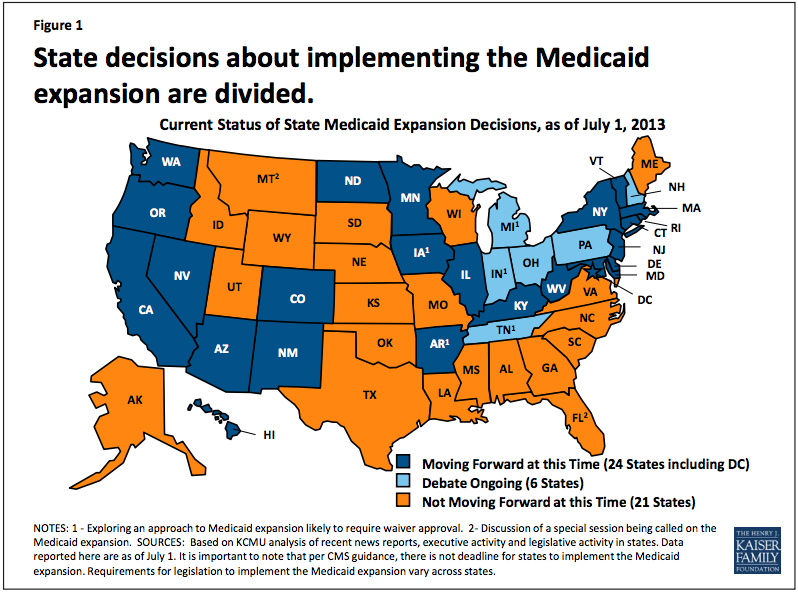
Simple.  The Supreme Court, although it upheld the health care exchange idea, also allowed states to choose to opt out of the expansion of federally funded Medicaid benefits.  Even though the federal government would cover the cost of the expansion through 2016, and at least 90% of Medicaid expenses thereafter, Republican-controlled state legislatures have balked at the prospect of picking up the tab for even 10% of an expanded Medicaid program that would provide health care for millions of people in their states.

It seems they’d rather let those people suffer and die.

http://theincidentaleconomist.com/wordpress/liberalia-and-teapartystan-divide-over-the-aca/

According to The Times, “The 26 states that have rejected the Medicaid expansion are home to about half of the country’s population, but about 68 percent of poor, uninsured blacks and single mothers. About 60 percent of the country’s uninsured working poor are in those states. Among those excluded are about 435,000 cashiers, 341,000 cooks and 253,000 nurses’ aides.”

What would happen if those working poor, the minimum wage earners who clean those Republican legislators’ houses, take care of their children, cook their meals, and tend to their aging parents in nursing homes—what would happen if they just up and left?

I have a vision of a vast migration of health care refugees, fleeing the red states just like they did after it became clear that the end of chattel slavery did not mean the end of bondage—it just morphed into debt bondage and serfdom.

If states can say “No thanks” to Federal Medicaid coverage, citizens should be able to say “No thanks” to states.  Let’s see how they like it down in Mississippi and Alabama when there’s no one left to flip their burgers and shine their shoes.

Rotten Tomatoes for Republicans

All right, I admit defeat. I can’t tune out those crazy Republican Congressmen who actually believe that they are acting righteously in preferring to shut down the U.S. Government rather than guarantee all Americans the right to affordable health care.

I need to let off a little steam, so bear with me.

First of all, WHO ELECTED THOSE CREEPS????

It is beyond depressing that we have such an apathetic, distracted, numbed electorate, of whom barely 50% generally even bother to show up to the polls.

Of the half who do show up, obviously they are the easily manipulated types, because these Tea Partiers have managed to convince them to vote against their own interests time and time again.

It’s no secret that the Tea Partiers have been most successful in the so-called Red States, where the egregious gap between rich and poor (ie, the gap between the 1% of extreme wealth and the 99% of everyone else, way down at the bottom of the mountain) is huge.

Why would people vote against their own best prospect of getting affordable health care?

Why would people vote against the political party that, while far from perfect, has at least shown a measure of human decency and responsibility in its approach to governing?

images-2It’s only fathomable if you remember how, in Tea Party country, education and the media are entirely controlled by these same craven elites, who will stop at nothing to seize power and control of the country.

In these parts of the country, people live in ideological bunkers, where party-controlled propaganda is the only message they get.  Red China anyone?  1984?

With the advent of the World Wide Web, in America at least, it’s hard to maintain a complete lockdown on information.  But as we all know, we tend to surf to places on the Web that are familiar and tell us what we want to hear.

So I get my news from The New York Times, while in Tea Party country the average citizen is more likely to check out Fox News.  The same story looks entirely different as reported by these different media—check it out and see for yourself.  Spin rules.

This is the only way I can explain the fact that these Tea Party maniacs were elected to Congress in the first place.

I can only hope—yes, I still do have hope—that in the next round of elections, they will be sent back to their Neanderthal caves where they belong.

Then the rest of us adults can get on with the much more important business of the day.

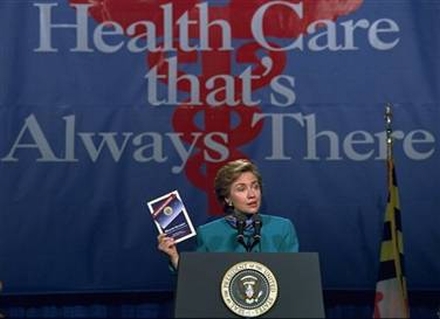
HillaryCare1993aAffordable health care—yes, of course!  We should have had it long ago, back when Hilary Clinton tried to get it going in the mid-1990s.  She was stymied by lack of authority as merely the First Lady, seen as overstepping her bounds (get thee back to the parlor, Mrs. Clinton!).

Now President Obama is getting blowback for daring to challenge the status quo and lobby openly for the rights of the poor and for all Americans who have gotten screwed by the medical industrial complex over and over again.

It’s the same old same old, which is why I have resisted taking up the Tea Party gauntlet this time.  Why should I waste my time and energy with their nonsense?

And yet, as the government shutdown looms, and behind it the mythical debt ceiling crisis, I just have to add my voice to the chorus of BOOS and throw some metaphorical rotten eggs at those stinking Tea Partiers who want to deprive ordinary Americans of the right to a functional government, along with the right to affordable health care and an economic system that at least attempts to lift all boats.

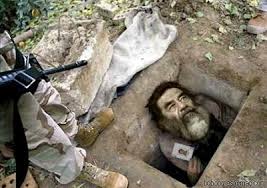
images-1I thank the President and the Democrats for holding the line on this one.  “We don’t negotiate with terrorists,” right?  Let’s let those terrorist Republicans dig their own fox holes and stew in their own SH*T.  I’d like to see John Boehner coming out when it’s all over like Saddaam did, dazed, dirty and totally deposed.

images