Women Writing from the Heart: What the world needs now

This time tomorrow night I’ll be sharing, for the first time, a piece of the memoir I’ve been working on for a good three years now.
il_570xN.378782406_r41jI’ll be reading at a gathering I organized on behalf of the Berkshire Festival of Women Writers, called “Writing from the Heart.”  It features seven of us in all, each sharing a piece of writing that comes from the deep, sometimes aching, sometimes exuberant place at our core, which we rarely trot out and share in public settings.

I organized “Writing from the Heart” because I believe it is so important, now more than ever, for women to get over our social conditioning to “be nice,” “be polite,” “go with the flow,” and cede the floor.  It’s so important that we start expressing, loud and clear, the truths we hold inside us, which are often far from self-evident.

Each one of us has her own perspective on the world, her own experiences to share, her own passions and convictions.  I am less concerned with the content than with the character: what matters to me is that you say what is in your heart, and listen to the heartfelt ideas of others, and that out of this exchange we begin a dialogue on what’s important in this deep, rich, rarely mined terrain.

Let us be frank: although women have made great strides in the past century, we still live in a male-dominated world.

Old, masculinist stories of domination, penetration, exploitation and subordination still prevail over many of the world’s societies.

We live in a violent world on many levels, and the violence, whether against the natural world or against other human beings, is overwhelmingly committed by men.

Women have been forcibly kept out of the male-dominated public sphere in most societies, for much of human history.

We have been the ones bearing and raising the sons who go off to war.  We have been the ones keening and mourning over the coffins that return.  We have been the ones who have been silent while our daughters have been forced into marriages too young, or to men we knew would be abusive.  We have been the ones raising our grandchildren as best we could when our sons and daughters died of AIDS, or ended up in prison.  We have done the best we could with the tools and strengths we had available.

But this is a new time.  Without really realizing it, we have stepped over the threshold into an era that calls for an extraordinary effort on the part of women and men of good heart and far-reaching vision.

Women and men must work together to create new social, economic and environmental frameworks that will enable us to survive and even flourish in the brave new world of climate change that is now upon us.

Women, who have centuries of experience of nourishing, cultivating, collaborating, and surviving against all kinds of odds, have a special role to play in this new era.

Women need to teach these skills to men; and men need to share with us their warrior spirit.

In this new age, the feminine and the masculine must come together in the service of generations to come, each learning from the other and together becoming greater than they could ever be apart.

Every human being has both estrogen and testosterone coursing through hir system, and every human being is capable of both nurturing and violence.

Today, we need women to have the courage to defend the rights of future generations, both human and non-human, and we need men to stand with us in acknowledging that the age of masculine privilege and dominance has been terribly destructive, and must now come to an end.

This is what is in my heart on this 12th anniversary of 9/11, this 40th anniversary of the Chilean coup, this 50th anniversary of the bombing of the 16th Street Baptist Church in Birmingham, Alabama.

Tomorrow evening at this time, six other women will share writing that comes right from the depths of their hearts.  This sharing must become a great, passionate tide, an upwelling of feeling and action that will sweep us away into a better future.

Let it be so.
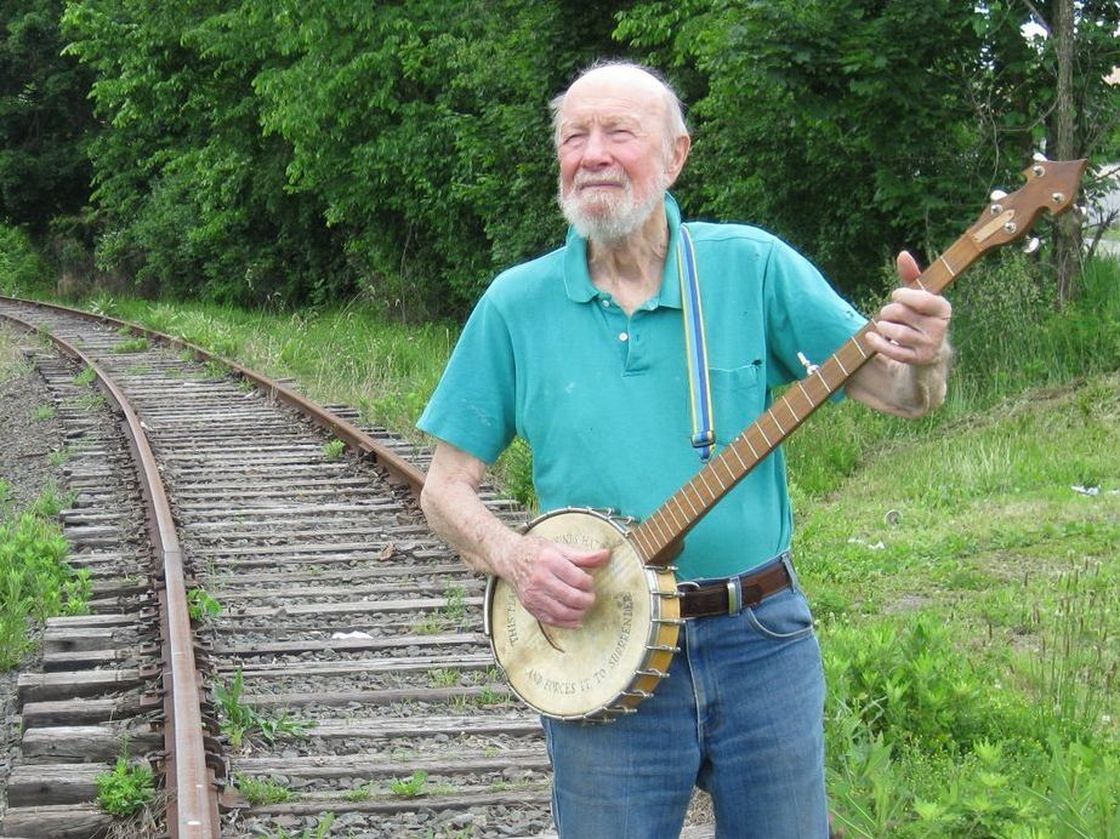
Pete Seeger, Still Braving the Storm

Every generation there are a few great souls that rise up so full of the sap of life that their cup brims over and carries everyone around them along with it.

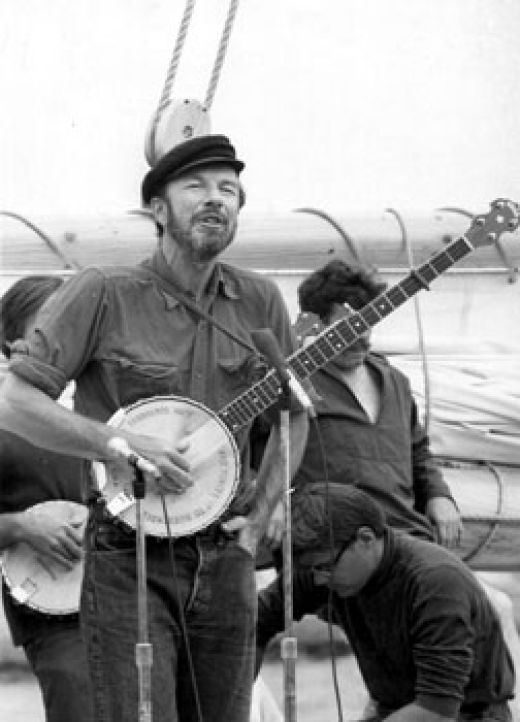
img_2137_2-photo-15Pete Seeger is one of those great souls.  Born in 1919, coming of age during the Great Depression and the American labor movement, he channeled his gift for moving others into his music, and became the voice of several generations of Americans restless with the status quo, searching for a better world.

I grew up with the songs of Pete and his soulmate Woody Guthrie, another bright flame who burned himself out after only 55 years on the planet, dying in 1967.

Pete, now 94 years old, has been steady and unwavering all these years, staying focused on social and environmental justice through all the ups and downs, through all the changes in leadership and the rise and fall of various organizations and movements.

In the iconic song about Joe Hill, the labor organizer framed on a murder charge and executed in 1915, the ghost of Joe comes back to the narrator in a dream, defiantly insisting that he “ain’t dead”:

And standing there as big as life

and smiling with his eyes.

Says Joe “What they can never kill

went on to organize,

went on to organize.”

From San Diego up to Maine,

in every mine and mill,

Where working men defend their rights,

it’s there you’ll find Joe Hill,

it’s there you’ll find Joe Hill!

Pete Seeger, still very much alive, is like Joe Hill in that his spirit seems to infuse every struggle for social justice.

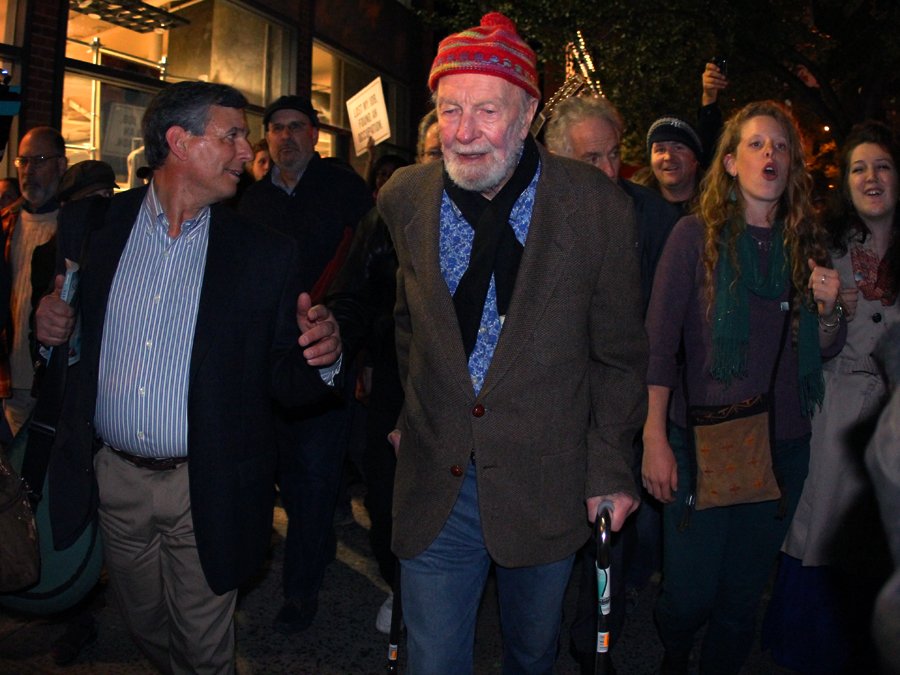
During the Occupy Wall Street movement in Fall 2011, he was there in person, galvanizing a crowd after a concert to follow him in a spontaneous march down Fifth Avenue and join him in singing a heartfelt round of “We Shall Overcome.”

here-was-tonights-special-guest-pete-seeger

His Clearwater environmental organization has become a model in inspiring communities to clean up waterways all over the nation, and indeed the world.

pete-seeger-328

Pete’s special gift is using music to inspire the best in people.

He doesn’t heckle, he doesn’t scold, he doesn’t scorn.

He just lifts up his head and his heart and seems to channel the love of the universe straight through his fingers and his vocal chords, irresistibly bringing everyone in range along with him.

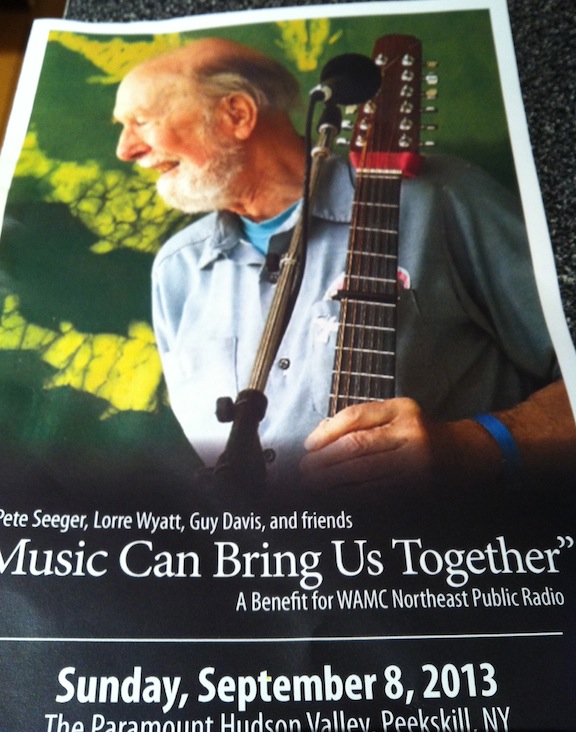
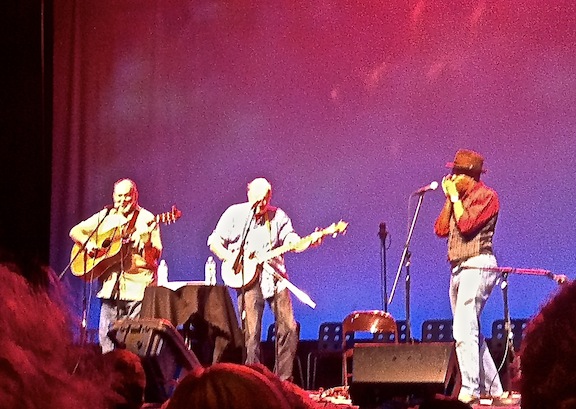
IMG_3818At a benefit concert for WAMC, Northeast Public Radio on September 8 at the Paramount Theater in Peekskill, NY, Pete’s power to inspire was undiminished, though his age is finally beginning to catch up with him in terms of his physical strength.

Nevertheless, he was onstage for a full three-hour concert, with only a brief intermission, and the delight he took in the younger people accompanying him was palpable and infectious.

For Pete, music has never been a power trip; it’s always been about creating an open-hearted place for human spirits to mingle in search of justice and beauty.

He waved off the standing ovations he received from the audience, most of whom were his longtime admirers, now going gray themselves.  He made it clear that what he had to offer was not about him, it was about the power of the music to make a positive difference in the world.

While Pete could easily have led the hall down nostalgia lane, singing all his old classics, instead he chose to give his musical partners of the day, Lorre Wyatt and Guy Davis, the chance to step in the spotlight and take a leadership role, and he took special delight in the youngsters who were singing along with him on stage.

IMG_3806

Pete sang a new song by Lorre Wyatt, “Braving the Storm,” which honored change agents like Rachel Carson, Cesar Chavez and WAMC’s tireless Alan Chartock, the chorus acknowledging “You could have stayed safe and warm but you showed us the way, braving the storm—thank you for braving the storm….”

He also sang some old fighting favorites like “We Shall Overcome,” “Where Have All the Flowers Gone,” and “Turn, Turn Turn,” his voice rising loud and strong in reminding us that “there’s a time for peace, I say it’s not too late.”

108213_f520He ended with a rousing song about the Clearwater and the Hudson River revival, reminding us that though the river has been dirty, “she’s getting cleaner every day.”

Focus on the positive, Pete seemed to be telling us—on what can be done, what should be done, what is being done to make our world a safer, saner, more loving place.  Do the work together, joyfully, singing all the while.  Have courage, be of good heart, and don’t be afraid to brave the storm, together.

Like Joe Hill, wherever people are working together for a better world, it’s there you’ll find Pete Seeger, in body and in spirit.

Thanks, Pete, for showing us the way all these years, and being a tremendously inspiring model of an elder who only grows more powerful, active and courageous with age.  We’re with you in spirit too, always!

85074216

The September 8 concert was dedicated to Pete’s late wife, Toshi, who died earlier this year.

What are we waiting for? Violence and climate change in our brave new world.

Finally, in the Sunday New York Times, a report giving empirical evidence of what we already knew intuitively, that climate change leads to violence, and that it’s going to get worse as the planet continues to warm.

For a couple of years now I’ve had a haunting premonition that violence is going to come even to the comfortable, beautiful corner of the world where I live.

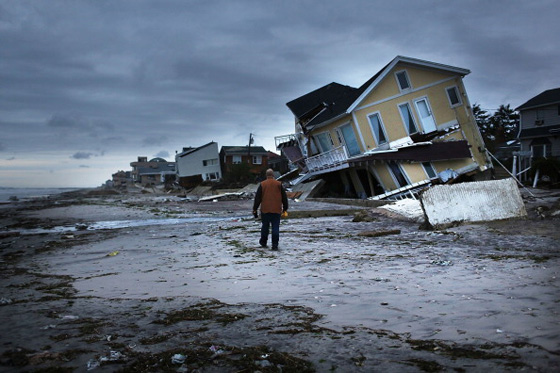
We saw how fast tempers flared when Hurricane Sandy created gas shortages down in the New York metropolitan area.

What happens when our industrial food supply starts to fail, given the inevitable and already-occurring wildfires, droughts, tornados and floods?

When people get hungry, survival-of-the-fittest kicks in, and it will take serious riot police to keep order when the supermarkets run out of food.

The authors of the new report say that their findings “are particularly important for what they imply about the future. Many global climate models project global temperature increases of at least 3.6 degrees Fahrenheit (2 degrees Celsius) over the next half-century. Our results imply that if nothing changes, this rise in temperature could amplify the rate of group conflicts like civil wars by an astonishing 50 percent in many parts of the world — a frightening possibility for a planet already awash in conflict.”

Frightening indeed. What to do with this new knowledge?

The authors urge political leaders to “call for new and creative policy reforms designed to tackle the challenge of adapting to the sorts of climate conditions that breed conflict — for instance, through the development of more drought- and heat-resistant agricultural technologies.”

I hardly think that the answer lies in agricultural engineering.

In the time we have left before chaos sets in we should be re-localizing agriculture, setting up distributed energy networks and re-learning the old arts of drying, salting, canning and cold storing agricultural products.

Indian Line CSA, one of the first in the nation

Indian Line CSA, one of the first in the nation

We should also be disarming our civilian population and focusing on creating strong community networks of mutual support.

For all our cleverness, humans are just primitive beasts when our bellies are empty—primitive beasts armed, at least in Fortress America, with deadly assault weapons.

The nightmares of the Congo, Somalia and Sudan, not to mention Afghanistan, Syria and Iraq, could easily start up here too, when food is scarce and sectarian violence begins to flare.

The truth is that we can’t rely on national and international leaders to undertake meaningful “policy reforms”—not when they are being held hostage by Big Carbon, Big Ag, Big Chemical/Pharma and Big Finance.

Delusional these corporate giants may be, but they will be going down with the ship holding fast to their belief in the value of limitless human economic growth, stable climate be damned.

We who believe that another world is possible need to hold fast to our own belief that the world won’t end when those giant glass towers in financial districts worldwide go down.

We can build that new world—not through technology and arms, but through community and collaboration.  Bottom-up, not top-down.

It’s true: we are the ones we’ve been waiting for.  And given the impending climate crisis, there’s no point in waiting anymore.

Harvesting at Indian Line Farm, Berkshire County MA

Harvesting at Indian Line Farm, Berkshire County MA

R.O.I.—From Mother Earth’s P.O.V.

imagesPeter Buffett, one of billionaire Warren Buffett’s sons, published a brave, thoughtful op-ed piece in the New York Times the other day.  In it, Buffett takes to task what he calls “the Charitable-Industrial Complex,” the philanthropic crowd who piously seek to save the world, as long as the R.O.I. is sufficiently rosy and the status quo is not upset.

Buffett knows he sounds like a class traitor here as he proffers this description of “Philanthropic Colonialism” (his term):

“As more lives and communities are destroyed by the system that creates vast amounts of wealth for the few, the more heroic it sounds to “give back.” It’s what I would call “conscience laundering” — feeling better about accumulating more than any one person could possibly need to live on by sprinkling a little around as an act of charity.

“But this just keeps the existing structure of inequality in place. The rich sleep better at night, while others get just enough to keep the pot from boiling over. Nearly every time someone feels better by doing good, on the other side of the world (or street), someone else is further locked into a system that will not allow the true flourishing of his or her nature or the opportunity to live a joyful and fulfilled life.”

Buffett says he’s “really not calling for an end to capitalism; I’m calling for humanism…. It’s time for a new operating system,” he declares. “Not a 2.0 or a 3.0, but something built from the ground up. New code.”

Buffett says that philanthropy should be dedicated to  “trying out concepts that shatter current structures and systems that have turned much of the world into one vast market. Is progress really Wi-Fi on every street corner? No. It’s when no 13-year-old girl on the planet gets sold for sex. But as long as most folks are patting themselves on the back for charitable acts, we’ve got a perpetual poverty machine.

“It’s an old story,” he concludes; “we really need a new one.”

Yes.  And philanthropy is not the only sector of our society that needs to reinvent itself.

Although I respect Buffett for his willingness to sound what will be taken as a heretical note in his own social circles (at one point he adds self-consciously “now I’m going to upset people who are wonderful folks and a few dear friends”), I don’t think he goes far enough.

I don’t want to see a merely “humanist” social system, I want to see humans develop an ecological understanding of our place and role on the planet.

I want us to repudiate our colonialist mindset, which persists not only in our tendency to give “humanitarian aid” with one hand while seizing economic control of a country’s most valuable resources with the other, but also in predatory capitalism at home and abroad—the debt bondage that the majority of people on the planet who buy into the system find themselves lashed to, laboring to pay the bank without ever being able to accumulate enough capital, social or financial, to buy their way into the promised land of security and ease.

The “new story” I’d like to see us live by would rewrite human attitudes towards other animals, insisting on the rights of every living being on this planet to a decent life.

That doesn’t mean a pig needs a condo with a swimming pool, but she does need enough space to breathe and move around in, healthy food and a clean, sanitary living environment.  Her wastes need to be disposed of the same way human wastes are—not sent into the rivers to create dead zones the size of states out in the sea.

100_2435Every aspect of the planet, from trees to minerals to water to fossil fuels, should be seen as precious resources to be safeguarded and cherished for the good of all who rely on them, not merely as sources of income for the few who sit on the boards or own stock in the mega-companies that develop, extract, exploit, and sell before moving on, leaving the devastated land as “collateral damage”— someone else’s problem.

The question is, how to get through to the corporate titans who are very happy with the status quo?

These are the folks who live their whole lives in such a fabulous cocoon of wealth and privilege that they have the illusion that they and their families can remain entirely insulated from the shocks of our poisoned, over-populated, over-heated planet.

If even in their philanthropy these people are thinking in terms of R.O.I., it must be a totally foreign concept to them to imagine conducting business in terms of gross social gain rather than gross individual profit.

Andrew Harvey, in his book The Hope: A Guide to Sacred Activism, recounts a lunch conversation he had with one such business tycoon, “the head of a major agribusiness corporation.”  The businessman chews Harvey out for being a “naïve do-gooder” who does not understand how the real world functions.

“Most of you that I have met truly believe that if the CEOs—like me, for instance—really knew what harm their corporate policies were doing, they would rend their Armani suits, fling out their Rolex-wreathed arms, burst into tears and change.  This is madness and shows how little you dare to know about what is really going on.  And how can you even begin to be effective until you understand what you are up against?

Of course, the businessman then enlightens Harvey on what he and other “naïve do-gooders” are up against in the quest to change the world for the better.

“You are up against people like me,” the man says.  “I know exactly what my company is doing and what devastation it is causing to thousands of lives.  I should know; I am running it.  I know and I do not care.  I have decided I want a grand gold-plated lifestyle and the perks and jets and houses that go with it and I will do anything—bend the law, have people ‘removed,’ bribe local governmental officials, you name it—to get what I want.  I know, too, that none of my shareholders care a rat’s ass what I do or how I do it, providing I keep them swimming in cash.”

I thought of this blunt, self-satisfied description of the view from the top of the capitalist heap when I read recently about how the American electricity industry is responding to the rising popularity of home-based solar panels.

images-1Rooftop solar panels are being compared to cell phones, which, if you remember, created a major sea change in the telecom industry.  In the end, the telecom giants made out like bandits, after initially having spent a lot of money and political capital to try to put the brakes on what was perceived as a threat to the traditional landline phone system.

Today it’s the turn of the electricity industry, which is terrified of losing market share if every homeowner can make their own energy on their own roof.

If homeowners are no longer paying the fees that subsidize the public grid, industry officials argue sanctimoniously, how will this public system be maintained?

No where in the New York Times article about this, which appeared in the Business section, was there any mention of the broader social, global benefits of distributed solar electric generation as compared to fossil fuels or nuclear electric sources.

No mention of the many reasons why every government on the planet should be encouraging homeowners and businesses to convert their energy sources to solar, along with wind, hydro and geothermal, just as fast as they possibly can.

When are the CEOs who are so busy buying off Congressional delegations and creating expensive self-advertising campaigns going to realize that what they really need to be worrying about is not thrifty homeowners taking advantage of tax incentives to install solar panels, but the mega-storms, wildfires and floods that will be coming our way every year, increasing in intensity the longer we wait to make up our minds, as a global society, to give up our addiction to fossil fuels?

hurricane-sandy-damage

Apparently most human beings can only be swayed by self-interest.

OK—we can work with that.  It’s quite clear that it’s in the interests of every human being on the planet to develop a sustainable relationship with our Mother Earth.

If we don’t, she will just give a great shrug of her climatic shoulders and be done with us.

Where will the R.O.I. be then?

Time for change

Jen light 3 copyIf my blog posts have been a bit few and far between lately, it’s because I’ve been focusing my writing efforts this summer on the bigger project I have underway, the personal/political memoir I’ve been working on for some years now.

The political subtext will be somewhat familiar to followers of my blog these past two years: the necessity for more ordinary folks like me to wake up to the realities of climate change and environmental destruction, and begin to take action in both the personal and the political spheres.

The personal narrative will be somewhat familiar to friends and family who have followed my life, or pieces of my journey, these past 50 years.  Good moments and bad, easy stretches when everything seemed to be going right, followed by inevitable patches of heartache and turmoil.

In the course of charting my experiences in depth through this memoir project, I’ve realized that I have two qualities that have often led me into troubled waters.

One, probably because I grew up in a family with strong values of caring, respect and integrity, I have tended to be very trusting—to believe that people mean well and want to do the right thing by others.

And two, I have been slow to respond to situations that make me unhappy.  I tend to try to stick with whatever I’ve started or gotten myself into, to try make it work even when it’s become quite obvious—even to me!—that things are never going to change for the better.

I’m trying to make some connections between these personal traits of mine, and the larger social landscape that I inhabit.

For example, it seems to me that we have all tended to be too trusting of authority figures like politicians and business leaders, expecting that they have our best interests at heart.

As a kid growing up, it would never have occurred to me that corporations would produce, package and market products aimed to appeal to children, that would, over time at least, make us seriously sick.

I remember begging my mom to buy me Froot Loops and Lucky Charms breakfast cereal, which looked so yummy and appealing on TV.

I wanted Ring Dings, too, and Yodels, and Twinkies.  I wanted Coke, of course, and Dr. Pepper.  I wanted McDonald’s hamburgers, fries, and McMuffins.

I was lucky that my mom was not swayed by the seductive advertising, and went her own way with food, raising my brother and me on fresh fruits and vegetables (often grown in our own garden), premium meats, and homemade, preservative-free desserts.

Others, who bought the advertising and fell for the products, are finding themselves now, at midlife, with diabetes, cancer, asthma, arthritis and all the rest of our common American ailments.  To some degree at least, the explosion of health problems in the developed world can be directly traced back to our societal trust that Big Business, Big Agriculture and Big Government were doing their best to safeguard our health.

Turns out we needed to be more discerning—a theme that runs through both my private and public spheres.

Likewise, I can relate my own slowness to realize and respond to untenable situations in my personal life to our broader social reluctance, as human beings, to go against the flow.

Let’s face it, we humans are herd animals, as Nietzsche saw clearly more than a century ago. We run in packs, and we fear nothing so much as social isolation and disapproval.

For me personally, the kinds of situations that I’ve been slow to wake up to and act upon have been ones in which taking action means going against the grain of social expectations.

For example, my marriage.  It was very hard for me to let go of my own attachment to being married.  There are so many positive perceptions surrounding married people, while divorced people, on the other hand, are perceived as unstable, difficult, dissatisfied, disloyal, probably neurotic, bad parents, bad partners, bad lovers—in short, failures overall.

Even though some 50% of marriages in the U.S. end in divorce, these stigmas still hold a great deal of power, and for me it was hard to finally concede that I could go no further in my marriage.  After more than 20 years, I had to cry uncle and admit that yes, I had failed.  I could not make it work.

The thing is that once I got to that nadir, I didn’t care anymore what people thought, and I came to see the major life change of divorce as a positive liberation, not a failure at all.

Once I’d made the leap and let go of my inertia and fear of change, I discovered that it wasn’t nearly as hard as I’d imagined, nor were the repercussions as severe.

It turns out that most of the fears I’d had around becoming single—and a single parent—at midlife had much more to do with my own perceptions than with any reality out there in the world.

I believe that these kinds of fears in the personal realm apply just as much in the political realm.

CWindmillhome

Wind turbines on the Bay of Fundy, Nova Scotia

For instance, we know that our longterm relationship to fossil fuels is, in the words of JT, “driving us down the road to ruin,” but so many of us feel stuck, afraid to go against the tribe in seeking out new, more positive relations to energy use on the planet.

We tend to just go with the flow, running our AC on hot days, driving our cars, using our oil furnaces for heat in the winter.  Even though we’re beginning to see that this makes us unhappy—who, after all, enjoys prolonged heat waves, out-of-control wildfires, destructive storms and raging floods?—we still stick to what’s familiar, what appears to be socially acceptable, what everyone else is doing.

It’s time for each one of us to stiffen our backbones and be honest with ourselves about the situation we’re in now.

Climate change is upon us.  It’s past time to start working hard to cut carbon emissions by reducing use and switching to cleaner energy like wind, solar and geothermal.  We need to stand with 350.org and other environmental groups to pressure our government to do the right thing—to put the health and welfare of we, the people, ahead of the profits of them, the corporations.

On a personal level, too, we can also make changes.  We can use bicycles more, and AC less.  We can hang out our laundry to dry.  We can start weaning ourselves off disposable plastics, and put some raised beds in our backyards or on our rooftops.

It used to be that only “granola people” did things like this—“granola people” pronounced with a dismissive smirk.

It turns out that those crunchy folks had it right, and we’re the ones who have stayed in our unhappy fossil fuel-based relationship too long.

We may imagine that breaking with the herd and striking out alone on the path of ecological sanity is going to earn us smirks and sneers.  But a) this is probably just in our heads; and b) who cares, if it makes us happier in the long run?

Here’s what I’ve finally realized, at midlife, on both the personal and the political levels: life is way too short to waste time being unhappy if a path toward happiness is available.

Letting go of our attachment to the status quo is the crucial first step on that path, and it’s not easy.  But it is necessary now, given the critical juncture we’re at as a planet and a human civilization.

Think about it.  And then—act.

Talking Union with my Dad: A Father’s Day Tribute

I got my love of narrative and my awareness of social justice very early in life, from my father’s vast repertory of American folk songs.

My dad, Joe Browdy, learned guitar as a teenager in the 1950s, taking his inspiration from the great folk singers of the time, like Woody Guthrie, Pete Seeger, Odetta, Cisco Houston, The Weavers and the New Lost City Ramblers.  He developed his repertoire while working as the music counselor at the camp where he and my mother met, and he continued to sing and play guitar for audiences while he earned his B.A. in history at Oberlin, and his law degree at NYU.

Joe Browdy and Alan Chartock

Joe Browdy and Alan Chartock

Some of my earliest memories are sitting with a group of relaxed, happy people by a crackling bonfire listening to my dad belting out his signature songs, with everyone joining in on the chorus.  Although there were some special children’s songs in his repertoire, he didn’t censor his songbook for me and my brother: we learned about the tragedies and the murders, the drunkenness and the fighting, wars, poverty and injustice, making sense of it as best we could over years of repetition.

Although he got busy with his law practice around the time that I was born, my dad  never stopped singing.  On Friday nights we’d get into the car around 8 p.m. for the two and a half hour ride to our country house in Hillsdale, N.Y., and to keep himself awake my dad would start singing, my mom adding her sweet tones in harmony on the chorus, my brother and I joining in sleepily when we knew the words.  On Saturday nights all through my childhood, our entertainment was to build a fire after dinner—outside in the summer, in the living room in the winter—and sit around it for a few hours, my dad leading us in the familiar songs that took us traveling far and wide in time, space, and experience.

The folk song tradition is a living oral history, passed from one generation to the next.  As soon as we could, my brother and I learned how to play guitar, and the words and tunes of those old songs now live on in us, and in our children who are learning them too.  With folk music, it’s not about the perfection of the sound, or the accuracy of the lyrics: it’s about the interest of the stories being told through music, and the emotion with which they’re conveyed.

My father has the ability to make the songs he loves come alive through the heartfelt nature of his singing and playing—getting slow and quiet for the tragic love songs, letting it rip and roar on the fighting union songs, modulating into a plaintive tone for his signature delivery of “One Meatball,” about a poor man who is sneered at by the waiter because all he can afford to buy is a single meatball for his dinner.  When my dad plays guitar, he’s not just singing some songs, he’s taking us on a journey through the American spirit.

Live at the Linda Norris Auditorium, Albany NY

Live at the Linda Norris Auditorium, Albany NY

Dad’s repertoire includes cowboy songs, songs about the laying of the train tracks across the West, and songs about the building of dams across mighty American rivers. There are feisty union songs from the 1920s and 30s; songs inveighing against the greed of bankers and bosses, and lamenting the hardships faced by miners, factory workers and farm hands. There are stirring political songs, about the founding of the United Nations, or the dream of world peace.

There are work songs from the African American South, about picking cotton or working on a train line, and older songs from the slave times, about dreaming of freedom, and making a break for it.  There are songs—some sad, some funny—about traveling around the country during the Dust Bowl refugee time.

There are many love songs, most of them mournful, bluesy songs about loves lost to drowning, train accidents, or just never heard from again.  But there are also some sweet romantic ballads about lifelong happiness spent by the side of one’s beloved.  The songs never fail to come alive when my dad adds his voice and driving guitar to the mix.

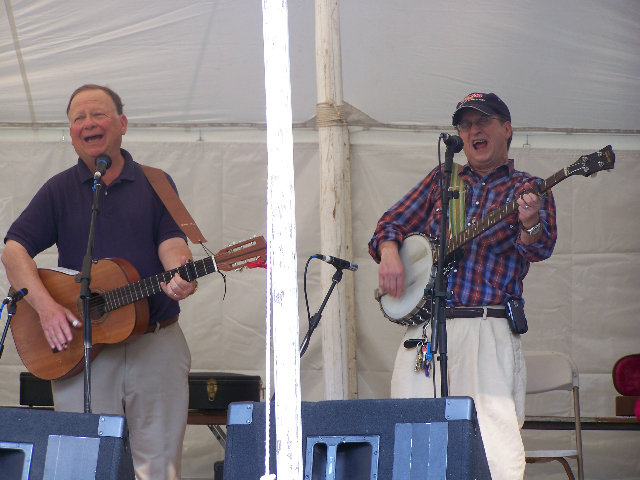
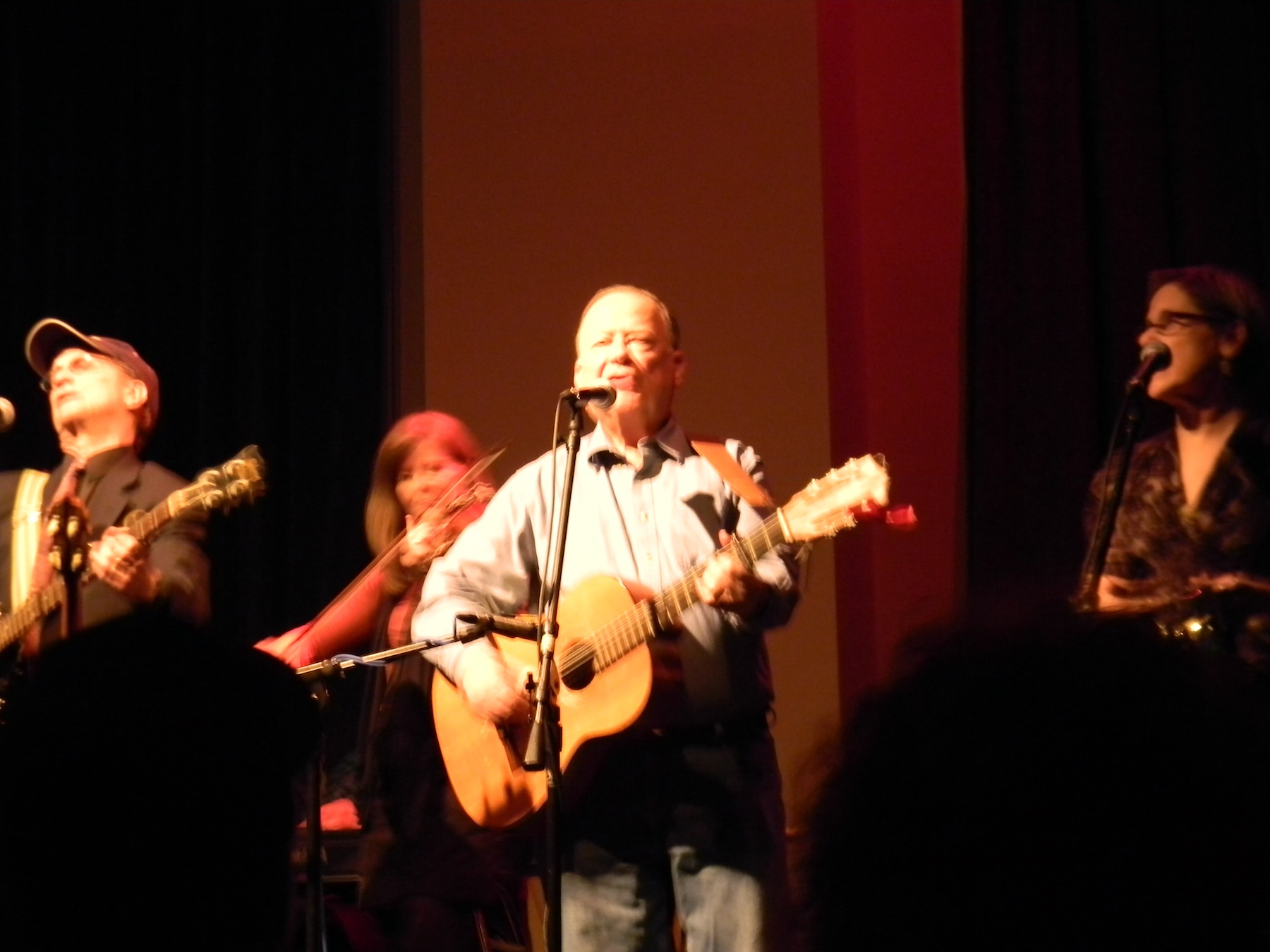
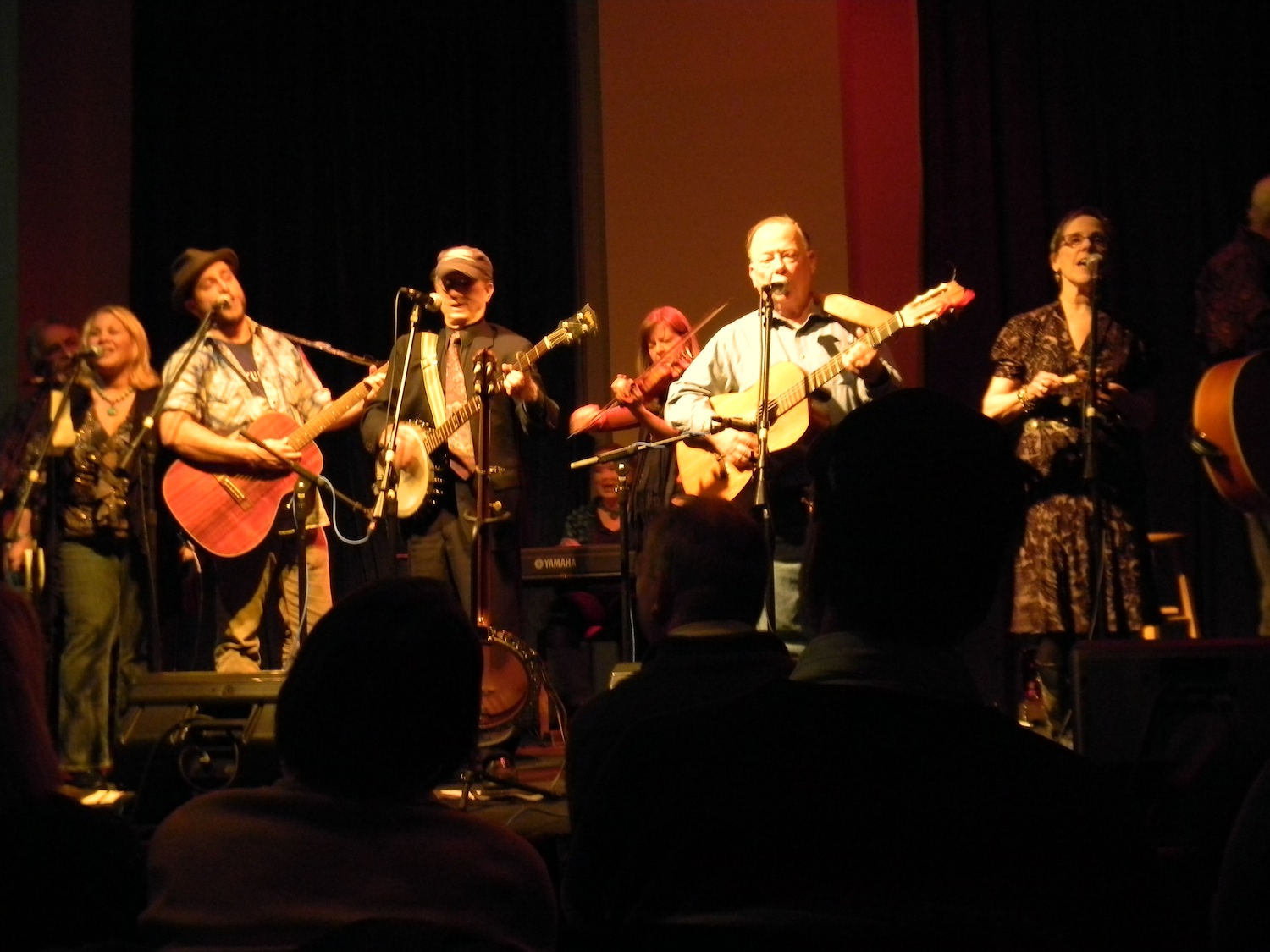
These days, my dad sings for the public most often with the Berkshire Ramblers, led by his old friends Alan and Roselle Chartock, and joined by a varying cast of other folk musicians.  But I still like it best when we sing together around a fire, not for an audience but just for our own amusement and delight.  This Father’s Day, I want to thank my dad for sharing this powerful, inspiring musical legacy with me, and so many others.  May the circle be unbroken!

DSCN2248 copy


When the union’s inspiration through the workers’ blood shall run

There can be no power greater anywhere beneath the sun

Yet what force on earth is weaker than the feeble strength of one

For the union makes us strong.


Solidarity forever, solidarity forever, solidarity forever

For the union makes us strong.

Which Side Are You On?

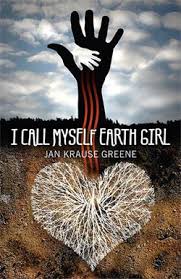
imagesFor the past few nights I have been putting myself to sleep by reading an advance copy of my friend Jan Krause Greene’s new novel, I Call Myself Earth Girl.

It’s not exactly a feel-good bedtime story, dealing as it does with rape, environmental disaster, death and bereavement.

But it’s also about empathy and love, between family members and also on a worldwide scale.

In Greene’s vision, the Earth and its denizens can be saved from catastrophe by mindful attention to what really matters: affirming life, both our own and that of the unborn generations to come.

Not since Starhawk’s 1994 masterpiece The Fifth Sacred Thing have I come across a book that so clearly matches my own waking nightmare of the terrible times that await us in the future, if we do not succeed in changing our ways now.

Let’s face it: it is possible that the kind of violence afflicting resource-starved places like Afghanistan, Syria and Somalia will become the norm in much more of the world, as climate instability creates food shortages and accelerates the pace of natural disasters beyond our capacity to recover.

America is a tinderbox just waiting to go off.  Imagine what would happen if suddenly it was not possible to go down to the supermarket and get your week’s worth of groceries?

Such a scenario is more or less unthinkable to people like me, who have grown up cradled by the richest breadbasket in the world.

We are only beginning to realize the costs that have come with our cornucopia: the destruction of the virgin prairies in the Midwest, the poisoning of the earth, water and air with chemical fertilizers, pesticides and herbicides; the grotesque factory farms of livestock and fish; the genetic alteration of seeds; the destruction of local farming by the huge predatory monster of American-style factory farms.

We have grown fat on these practices.  And now it’s time for us to accept responsibility for the outcomes of our heedlessness.

Those of us alive today have the privilege, and the responsibility, of presiding over what could very well be the end times for human civilization.

It’s somewhat analogous to the end times of specific human cultures, like the Greeks, the Romans, the Egyptians, the Ottomans, the great Chinese dynasties….except that this time, we’re not just talking about the end of a single culture, we’re talking about the demise of humanity as a species.

It is possible to imagine, as Jan Krause Greene did, that our lush green planet could turn brown from environmental disaster, provoking a culture of armed militias surviving by means of ruthless violence—with women, as always, at the bottom of the heap.

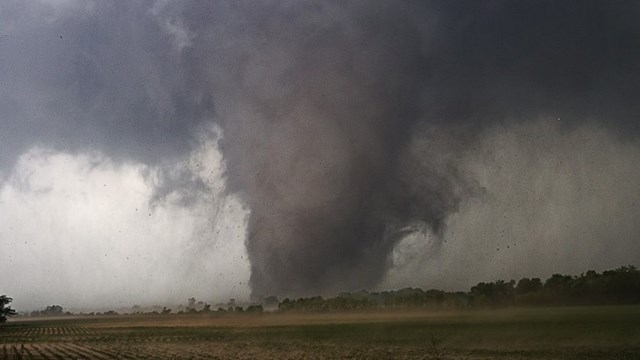
Tornado bearing down on Moore, OK; May 21, 2013

Tornado bearing down on Moore, OK; May 21, 2013

It is already happening—just not yet here, in the gated community we call America.

Can we wake up in time to forestall total, worldwide environmental melt-down?

In the past week we had a deadly two-mile-wide tornado in Oklahoma, and the Russian science station in the Arctic Circle had to be evacuated because the ice was melting at an unprecedented rate.

Here in New England we are expecting temperatures in the 30s Farenheit this weekend—way below normal for what should be the start of the growing season.

What’s next?

We don’t know.  But I take heart from local initiatives like the rehabilitation of the long-dormant Great Barrington Fairgrounds into a vibrant community-supported agriculture site.

We are going to have to re-localize agriculture if we want to survive the shocks of the 21st century.  We need to re-imagine not just agriculture, but community along with it.

As I Call Myself Earth Girl shows well, the antidote to violence and fear is love and empathy.

We still have a choice. Which way will you turn?  Which side are you on?  How far will you go to protect the planet and the generations to come?

fifth-sacred-thing

The jig is up for military sexual assault

No fewer than 26,000 sexual assaults were reported by U.S. military service men and women in the year 2012 alone.

You read that right.

According to The New York Times, “Pentagon officials said nearly 26,000 active-duty men and women had responded to the sexual assault survey. Of those, 6.1 percent of women and 1.2 percent of men said they had experienced sexual assault in the past year, which the survey defined as everything from rape to “unwanted sexual touching” of genitalia, breasts, buttocks or inner thighs.

“From those percentages, the Pentagon extrapolated that 12,100 of the 203,000 women on active duty and 13,900 of the 1.2 million men on active duty had experienced some form of sexual assault.”

These numbers are simply unacceptable, especially when contrasted with the small number of sexual assault cases that were officially reported (ie, not via anonymous survey)–3,374—and the abysmal rate of actual conviction: only 238 assailants were convicted in 2012.

Lt. Col. Krusinski; booking photo

Lt. Col. Krusinski; booking photo

Most embarrassing for the military brass was the arrest last Sunday of the officer in charge of sexual assault prevention programs for the Air Force, Lt. Col. Jeffrey Krusinski, who was accused of having sexually assaulted a woman he did not know in a parking lot.

Way to lead, Air Force!  Just when we thought the Tailhook scandal was becoming a distant memory.

I’m glad to see that some members of Congress—especially the women—are hopping mad and on the case, as today’s column from Maureen Dowd details.

Women who put their lives on the line to serve in the U.S. military deserve nothing but respect from their superiors and peers.

The question is, how is the military going to re-program its entire culture, from raw recruit to brigadier general, who have been raised to believe that “all women (and all gay men) want it,” that might makes right, and that superior officers can act with impunity towards those under their command?

How is the military—and, indeed, American culture at large—going to counter the billion-dollar American porn industry, that thrives on presenting women as objects of desire, yes, but also as objects of violence?

The truth is that what we’re seeing in military culture is just the tip of the iceberg of a much more deeply-rooted cultural problem.

Just as the military stood up to become the model for racial integration in the 1970s, it must now trailblaze the path to gender equality for us in the second decade of the 21st century.

Women who are now going to serve in combat, just the same as men, should not have to worry about “friendly fire” from male supervisors and peers.

To be honest, the idea of women breaking glass ceilings in the military does not thrill me.

I’d rather women work to create and broker non-violent institutions and solutions to problems.

But there is no excuse, ever, for sexualized violence against women or men.

The Lt. Col. Krusinskis of the world need to get their rocks off some other way, and the old-boy networks that have stood in the way of change on this issue have got to go.

Senator Kirsten Gillibrand, Democrat of New York, plans to introduce legislation that would take the adjudication of sexual assault cases outside of a victim’s chain of command. According to the New York Times editorial board, which supports the measure, “It would end the power of senior officers with no legal training but lots of conflicts of interest to decide whether courts-martial can be brought against subordinates and to toss out a jury verdict once it is rendered.”

President Obama said the right thing in response to the Krusinski arrest scandal, but it remains to be seen whether he can follow up his words with actions.

“If we find out somebody’s engaging in this stuff, they’ve got to be held accountable, prosecuted, stripped of their positions, court-martialed, fired, dishonorably discharged — period,” Mr. Obama said.

Got that, all 26,000 of you who committed sexual assault last year?

The jig is up.

Playing hardball with the fossil fuel industry: if not now, when? if not us, who?

Bittersweet sadness fills me this morning as I read an excerpt at Women’s E-News from Eve Ensler’s new memoir, In the Body of the World, about her long, determined, agonizing battle with uterine cancer.

Eve Ensler

Eve Ensler

Her TED talk, “Suddenly, My Body” is one that I have returned to watch several times over, and have recommended to many friends as a pulsating, powerful performance that makes perfectly clear what many of us are coming to realize: that there is no separation between our bodies and the world around us.

Eve Ensler

Eve Ensler

Not only is it true, as Joanna Macy and Brian Swimme tell us, that we are the most recent emanations of the stardust that created the life on our planet eons ago, it is also true that our fragile bodies are porous and open, made of the air, earth and water that we move through each day.

If we poison our environment, we poison ourselves.

So many of us are learning that the hard way.

Warrior lionesses like Rachel Carson, Audre Lorde, Wangari Maathai and Eve Ensler—each one snared by her own body’s encounter with the internal malignancy of cancer.

How many powerful, active, full-of-life people do you know who are no longer with us, felled by cancer?

A quick look at the cancer statistics kept by the Centers for Disease Control shows cancer rates soaring, especially for Americans 50 and older, and especially in the South, Midwest and Northeast of the country.

In the South and Midwest, they make and use those toxic chemicals—the ones that lace our food supply and flow into our waters, creating a dead zone the size of the state of New Jersey at the mouth of the Mississippi River; the ones that ride the prevailing winds east to fill the skies of the eastern United States and Canada with sooty particulates and airborne toxins.

None of us is immune from this.  No matter how careful we are to buy organic produce or grow our own, to keep BPA plastics out of our kitchens, even to pull up stakes and move to an area of the country that appears to be cleaner—we cannot hide from the reality that we live in a contaminated country, on a planet that is crazily out of balance and on the verge of a major correction.

When the colonizers came to the Americas, they were careful to try to pick off the leaders among the native peoples they encountered, knowing that if you deprive people of their most charismatic, powerful leaders, you will demoralize them and leave them open to takeover.

Although there is no devilish intelligence at work in the cancer epidemic, this dynamic still applies: when cancer takes from us leaders like Rachel Carson, Audre Lorde, Eve Ensler or Wangari Maathai, it leaves the rest of us stricken and reeling, spinning like a rudderless boat.

Sandra Steingraber

Sandra Steingraber

There are those, like Sandra Steingraber, who have been fighting cancer for a long, long time, and using it as a spur to work harder to save our planet/ourselves.

Steingraber was recently put behind bars for two weeks as punishment for her protest of the fossil fuel companies’ plan to hydrofrack for gas in her home territory of upstate New York.

She wrote from prison that it was her love, for her children and for all livings beings on the planet, that drove her to civil disobedience:

“It was love that brought me to this jail cell.

“My children need a world with pollinators and plankton stocks and a stable climate. “They need lake shores that do not have explosive hydrocarbon gases buried underneath.

“The fossil fuel party must come to an end. I am shouting at an iron door. Can you hear me now?”

Yes, we hear you Sandra, and we’re with you!

And yet, so many of us do not act on what we hear and know.

A low-level depression seems to afflict a great swath of the American public, and I would wager that the feelings of powerlessness that come with being unable to control the health of our environment or our selves may have something to do with it.

No matter how many times we go down to Washington D.C. to protest, it seems that the fossil fuel and chemical industries have the U.S. Congress sewn up tight.

Even someone like me, living in what appears to be a clean, leafy rural place, has to contend with farmers who still spray Roundup on their cornfields every spring, or rivers, including the Housatonic, just blocks from my home, heavily contaminated with PCBs from the upstream General Electric plant.

Since there is no way to play it safe, what we need to do is forget about safety now, in these end times, and play hard.

It’s time to give everything we’ve got to the fight to preserve the capacity of our planet to support life on down the generations into the future.

If humans are to be part of that future, we have to rise to the challenges we face now.

Like Eve Ensler, wracked with cancer and yet still leading the charge of One Billion Rising to fight violence against women this spring, we cannot afford to take time out.

Wangari Maathai

Wangari Maathai

Like Kenyan Wangari Maathai, felled so quickly by cancer even as she received the Nobel Peace Prize for her work in preventing the desertification of her country by teaching ordinary women to raise and plant trees, we have to be creative in our approaches, working at the grassroots when those at the top won’t listen.

Like Sandra Steingraber and so many other activists, we have to be willing to face the consequences of our disobedience to those in power.

Playing nice, following the rules, being polite—where has that gotten us?  When the polluters of the planet are playing hardball, we have to respond in kind—although our life-affirming version of hardball might involve planting trees, or raising flash mobs of dancers, or forming human chains of resistance at the boundaries of old-growth forests.

Rachel, Audre, Wangari, Eve, Sandra…we’re right behind you.  Fighting all the way.

Is the time ever right for suicide?

dsdepression_550pxWhat does it say about American society that more middle-aged people now die of suicide than of car accidents?

While I wouldn’t say that suicide rates are soaring–the suicide rate for middle-age men was 27.3 deaths per 100,000, while for women it was 8.1 deaths per 100,000, according to the most recent report from the Centers for Disease Control (CDC)—these numbers do represent a dramatic increase from previous norms.

For men in their 50s, suicide rates jumped by nearly 50 percent in the decade from 1999 to 2010. For women, the largest increase was seen in those ages 60 to 64, among whom rates increased by nearly 60 percent during that decade.

A few weeks ago I was stunned to hear that an old friend of mine, a woman in her 50s, had committed suicide by hanging.

I have bad days too, when I just want to lay down my load and become a lily in the field.  We all do.  But to actually plan and execute a self-hanging?  That I find hard to fathom.

Apparently most men commit suicide by self-inflicted gunshot wounds, while women are more likely to take their lives through overdoses of prescription medication.

According to the CDC report, poisoning deaths were up 24 percent overall from 1999-2010, while hangings were up 81 percent.

Whenever I find myself feeling too despairing, I remind myself that I have to hang on at least until my two children are independent and self-sufficient.

The truth is that if you have children, there can never be a right time to commit suicide.

Your children are always going to be counting on you to be blazing the trail ahead, setting the example, holding the fort.

It would be terribly selfish of me to give up and take my own life.

I believe that people should have the right to make their own end-of-life decisions.  If I were diagnosed with a terminal disease, I would want the ability to dictate the circumstances of my death.

And it’s true that in some ways, we are all living with a death sentence.  All of us will die sooner or later—of that we can rest assured.

For some people—for instance, the hunger-strikers at Guantanamo—courage wears a suicidal face.

All in all, it’s what we do with this short, precious lifetime that matters.  What do we want to be remembered for?  What do we want to leave behind?

I want to be remembered as a woman who confronted the challenges of my individual life, and my zeitgeist, head on.  Who did not give up, ever.  Who looked on the bright side and tried to see the glass as half-full.  Who blazed a trail for those behind me to follow.

There are some desperately serious situations to which suicide is a rational response.  If I were to come to such an impasse, I hope I would have the courage to do the right thing.

But in the meantime, I will continue to embrace all the challenges life throws at me, and meet my own expectations for being a stalwart mother, daughter, sister, friend and teacher.  It’s the least–and the best–that I can do.