Learning from mass murder: we must pay attention to our young men

If this past week had been written up as a movie script, I would have rejected it as totally over-the-top, beyond belief.

Two young Chechen immigrants successfully wreak mayhem and turn a city upside down with their improvised explosive devices, in the very same week that the U.S. Senate Republicans successfully beat back a bill designed to stiffen background checks for gun purchases.

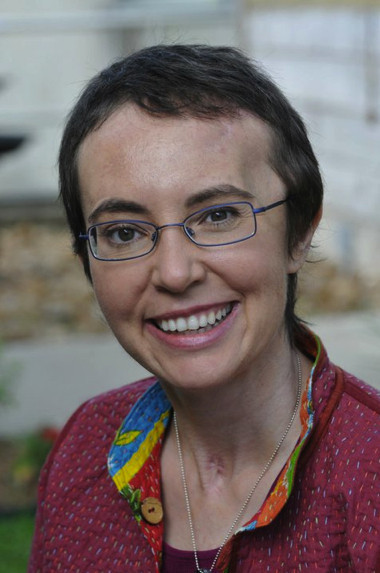
Gabrielle Giffords

Gabrielle Giffords

The beautiful, brave Gabrielle Giffords publishes an impassioned piece in The New York Times, condemning the cowardly Senators who put the interests of the National Rifle Association over and above the interests of the American people.

Meanwhile, down in Texas, an explosion in a chemical fertilizer factory flattened a whole neighborhood, killing at least 15 people and injuring more than 200.  The cause of the blast is still unknown.

And the whole middle section of the country was inundated by heavy rains, storms and severe floods.

Fire, air, earth and water, all the elements seem to be drawn into an intensified dance these days, speeded up along with the 24-hour news cycle.

As the bizarre manhunt for the two Chechen bombers unfolded, and the whole country went into virtual “lockdown” in sympathy with the people of Boston and eastern Massachusetts, it felt like we were suddenly waking up to find ourselves in Baghdad.  Things like that don’t happen here.

Until they do.

boston-bomber-suspect-dzhokhar-tsarnaev I don’t have TV in the house, so I got most of my information on the situation in Boston from print media and radio.  But even the few pictures I saw were enough to convey the sense that the official response to these boys’ stupid act of random violence was hugely disproportionate.

Against a lone 19-year-old kid, thousands of law enforcement officers of every stripe were deployed, in full riot gear, toting rifles, traveling around the deserted streets in armored vehicles.

The kid was presumed to be “extremely dangerous.”

How dangerous could one kid be?

I understand that the concern was that he might have had a bomb or a suicide vest that he could detonate at the very end.

But that is not the way the story went.  In the end, he came out with his hands up, just one stupid, confused kid who surrendered to the police without a peep.

His life is over.

Ours will go on.

In the wake of this latest act of violence within our own borders, we need to take a good hard look at the role of the U.S. as a fomenter of violence, both at home and abroad.

Unknown-1 Not only is the U.S. the largest exporter of arms and weaponry in the world, but we are also the biggest developer of violent video games worldwide, the ones I am betting those Chechen boys loved to play.

Why should we expect that we can promote violence by all kinds of channels, and remain immune to it within our own borders?

What goes around comes around.

If we were serious about wanting peace and security, we would start by radically shifting our focus from creating implements of destruction—be they chemical fertilizers, assault weapons or games that encourage violence—to waging peace.

Waging peace—what would that look like?

One of the most urgent tasks is to change the way young men are socialized.

Let us not for a moment forget that every single act of mass violence that has taken place here in the U.S.—every single mass shooting, every single bombing—has been the work of young men.

Young men are do-ers.  They have heroic dreams—and in Western culture, it’s the young men who can slay the dragon or vanquish the ogre who are considered heroic.

We can honor and nourish that warrior spirit in our young men in ways that celebrate heroes who use their strength and talents productively, to safeguard ordinary people.

I suspect that Dzhokhar Tsarnaev is someone who would have made an excellent warrior for good.  He was obviously smart, resourceful and could handle himself well under great pressure.

For reasons as yet unknown, he–like Newtown gunman Adam Lanza, Norway gunman Anders Breivik, Aurora, Colorado gunman James Holmes and so many other young men whose names stand for infamous mass murders—chose to walk on the dark side.

We need to be paying attention to the accelerating rate of these crimes.  They are a sign of the dark times we are living through.

Those of us who believe in peace must recommit ourselves to raising our own internal lights higher, beacons for others to rally around.  Those of us who have the great responsibility of raising the next generation of young men—parents, teachers, employers, mentors—must recognize the tremendous importance of our task.

In the past thirty years, there has been a great deal of attention paid to rethinking the way we socialize young women.  This is definitely essential work.  But we forget about our young men at our own peril.

Sparks fly around the table–of the seminar room or the lunchroom

There’s something seriously wrong when the dominant methods of education do not foster the skills most valued by potential employers.

In a recent spate of op-ed pieces in The New York Times, pundits have explored this disconnect, which seems to be grower wider as we advance into the 21st century.

David Brooks, making a distinction between what he calls “technical knowledge” and “practical knowledge,” says that online education is good for transmitting and measuring students’ mastery of technical knowledge, but does little for helping students gain the practical knowledge they’ll need to be successful in the workplace.

“Practical knowledge is not about what you do, but how you do it,” Brooks says. “It is the wisdom a great chef possesses that cannot be found in recipe books. Practical knowledge is not the sort of knowledge that can be taught and memorized; it can only be imparted and absorbed. It is not reducible to rules; it only exists in practice.”

Brooks points to the college seminar as one of the important incubators of important workplace skills, and as someone who teaches exclusively in seminar style, I agree with him.  The college seminar is where students learn how to listen to each other, build on each other’s ideas, articulate their own ideas clearly and concisely, and take away crucial insights that they’ll use to construct their more fully elaborated written papers (which in the workplace might be called briefs or reports).

But Brooks and I part company when he suggests that seminars should be used as laboratories for the dissection of intellectual exchange.  He thinks that a smart use of online education technology would be “to take a free-form seminar and turn it into a deliberate seminar….Seminars could be recorded with video-cameras, and exchanges could be reviewed and analyzed to pick apart how a disagreement was handled and how a debate was conducted. Episodes in one seminar could be replayed for another. Students could be assessed, and their seminar skills could be tracked over time.”

Deep groan.  This sounds like a perfect recipe for a disastrous seminar in which students—and faculty–would be made to feel increasingly self-conscious, where the delight of the “free-form” exchange of ideas would degenerate into a stilted, scripted, uber-careful caricature of what a seminar should be.

Occasionally taping a seminar and analyzing it might be fruitful, especially in one of those inevitable groups where the dynamics are terrible and everyone, by mid-semester, wants to just crawl under the table and hide. But making the focus of the semester the “how” rather than the “what” seems like a terrible idea.

It’s also in sharp contrast to the most cutting-edge ideas of how to spur human innovation and creativity, which lord knows we desperately need as the 21st century advances.

In his own recent column on education, NY Times columnist Tom Friedman interviewed Harvard education specialist Tony Wagner, also looking for ways that educational practices could better connect to workplace imperatives. According to Wager, who just wrote a book called Creating Innovators: The Making of Young People Who Will Change the World, “because knowledge is available on every Internet-connected device, what you know matters far less than what you can do with what you know. The capacity to innovate — the ability to solve problems creatively or bring new possibilities to life — and skills like critical thinking, communication and collaboration are far more important than academic knowledge. As one executive told me, ‘We can teach new hires the content, and we will have to because it continues to change, but we can’t teach them how to think — to ask the right questions — and to take initiative.’ ”

Critical thinking, asking the right questions, and taking initiative are indeed what should be taught at every level of education, from kindergarten to college and beyond.  Interestingly, Wagner also points to another important goal of education, which is to motivate students to want to learn.

“Young people who are intrinsically motivated — curious, persistent, and willing to take risks — will learn new knowledge and skills continuously,” Wagner says. “They will be able to find new opportunities or create their own — a disposition that will be increasingly important as many traditional careers disappear.”

Unfortunately, in our current education environment, where passing standardized tests becomes a goal in itself, keeping kids engaged is a serious challenge.

I saw this myself when I taught at a large state university, where the students were much more interested in finding the best watering holes for their weekend parties than in any of their classes.

As Friedman reports: “We teach and test things most students have no interest in and will never need, and facts that they can Google and will forget as soon as the test is over,” said Wagner. “Because of this, the longer kids are in school, the less motivated they become. Gallup’s recent survey showed student engagement going from 80 percent in fifth grade to 40 percent in high school.”

Wagner’s solution is to re-imagine the classroom, and the educational system, so that teachers are focused on “teaching the skill and will to learn and to make a difference and bring the three most powerful ingredients of intrinsic motivation into the classroom: play, passion and purpose.”

That is a tall order, really, and it has to do not just with the classroom, but also with the dining room table—with what happens at home, in students’ family environment.  How to inspire passion and persistence in students who are being reared on smash-em up video games?  How to foster critical thinking and collaboration in students who come from plugged-in families who rarely spend much quality time together?

Somewhat paradoxically, it appears that it’s precisely in web-based interactive technology companies like Google, Facebook, Yahoo and others that the qualities of human innovation and creativity are most dogged sought.

And how are they trying to foster these skills among their workers?

Google350x233By going back to good old-fashioned lunchroom tables, at which, it appears, the unstructured back and forth of ideas is what prompts the greatest leaps in creative thinking.  Just like that other good old-fashioned table, the one in the college seminar room!

In a New York Times article provocatively entitled “Engineering Serendipity,” Greg Lindsay points to a recent study in which “researchers at Arizona State University used sensors and surveys to study creativity within teams.” The study found that “employees who ate at cafeteria tables designed for 12 were more productive than those at tables for four, thanks to more chance conversations and larger social networks. That, along with things like companywide lunch hours and the cafes Google is so fond of, can boost individual productivity by as much as 25 percent.”

If our best, most innovative companies most value creative, collaborative thinking, which is best fostered in face to face interactions, why in the world is K-12 education focused on teaching technical knowledge measured by standardized tests, while higher education is flocking to online learning, which isolate students in front of their computer screens?

Give me the old-fashioned seminar table any day, with a smart, dedicated teacher and a roomful of students who are absolutely forbidden to use their computers or phones or tablets for the duration of the class session! Give us some provocative material to discuss, and just watch the creative sparks fly!

“Our lives begin to end the day we become silent about things that matter.”

So OK, having slept fitfully and woken up resigned to accepting the basic premise that it is unlikely that the world as I have always known it will continue into the foreseeable future…what then?

How do I spend my one wild and precious life on the planet?

I am quite clear that I want to put my time, talents and energies into doing my best to head off catastrophe for the natural world.

But this often feels like trying to stick my finger in a huge roaring dyke of bad news—how can I, a small and ordinary person, make a difference for the trees and animals and birds and bees that I so want to protect?

All I can say is that making the attempt is better than giving up.

My gift has always been writing, and so I am using that gift to try to reach out to others, in the hope that if many of us, in our small, ordinary lives, can join our voices together, the resulting chorus could indeed change the world.

I am continually amazed at how the technological innovation of the World Wide Web has facilitated the meeting of minds and the catalyzing of movements.  There has never been a better moment for human progress and connected intellectual growth.

I wake up with a new thought, write it down and send it out into the gushing waters of the internet, where, within the hour, it will be read by someone living on the other side of the planet, who will bat it back to me with comments that will cause me to see the idea from a whole new perspective.  All within the space of an hour! How remarkable is that?

But sadly, it is precisely our reliance on and success with technology that is causing our demise, from simple overpopulation to the poisoning of our environment.

This is the challenge of our time: to very quickly learn to adapt to our rapidly changing climate, and to find environmentally sustainable ways to hang on to our positive technological inventions.

I believe it can be done, which is why I am totally invested in the challenge of waking people up and getting them engaged in fighting the good fight to make our epoch, which many call the Anthropocene, a positive transition to a better human relationship with the Earth, rather than a nightmare ending in the dark night of extinction.

If we were to shift our resources from weapons of destruction–guns, bombs and missiles, chemical poisons, and ever-bigger drills, earth-movers and chain saws—to implements of cultivation and the harmless harvesting of the bounty of our natural world, what a huge difference that would make!

People say that over-population will continue no matter what, but I know from years of studying women’s issues worldwide that when women are educated and respected in a society, they have fewer children.

Between fewer children in the developing world, a lower rate of consumption in the developed world, and the invention of new technologies that act in harmony with nature rather than against her, we could transform our planet within a generation or two.

J.R.R. Tolkien’s classic fantasy The Lord of the Rings is looking more and more prophetic, and it’s surely no accident that the films have come out now, to appeal to the current generation of young people.

We are the ones who must enter the fight to hold off the dark forces of Mordor, in order to preserve the happy, healthy lives in the Shire that all humans are meant to live.

tumblr_m9hm5vDG2h1qzhkvho1_500Today is the anniversary of Dr. Martin Luther King Jr.’s assassination, and I invoke his memory to remind us that although it is true that by ourselves each one of us is puny and limited, it is also true that if we pool our resources and act together we have tremendous power.

We must each start by determining what gifts we can bring to the table of this new movement, and then start where we are, doing what we can, and sharing our insights and passions by all the channels of communication that are open to us, from talking face to face with friends and neighbors to sending our ideas out into the World Wide Web.

Now is the time, and we are the ones we’ve been waiting for.

I will close with two quotes from Dr. King:

“Our lives begin to end the day we become silent about things that matter.”

“If you can’t fly then run, if you can’t run then walk, if you can’t walk then crawl, but whatever you do you have to keep moving forward.”

Amen, brother.

Morning pages for humanity…and the Earth

Julia Cameron

Julia Cameron

This week, in preparation for Julia Cameron’s presentation at the Berkshire Festival of Women Writers, I have been doing quite a bit of thinking about creativity.

Cameron’s great insight, back in the late 1980s when she was doing the teaching that led to her blockbuster creativity self-help guide The Artist’s Way, was that human beings are all naturally creative.  We just tend to get “blocked” by our upbringing, and need to work on ourselves in a systematic way to unlearn bad habits of self-doubt and defeatism, so that our creative juices can flow freely out into the world.

One question I wish I’d asked Julia at her lecture last night at Kripalu is this: I wonder whether women have any particular creative challenges, different from those faced by men?

The Artist’s Way does not seem to draw any distinction. Cameron uses the gender-neutral term “creatives” and her examples are drawn from the experiences of both men and women.

And yet it seems to me that women are particularly susceptible to the kind of distraction, hyperactive multi-tasking and withering self-doubt that Cameron says are anathema to artists.

One woman in the audience at Cameron’s lecture described herself as “frantic,” or maybe she said “panicked,” facing such a huge to-do list of projects she’d like to accomplish that she was paralyzed by the enormity of it all.

Julia’s response was characteristically calm and pragmatic: slow down, write your morning pages faithfully, ask for guidance from your higher self, and be patient—it will come.

This is certainly good advice for anyone who wants to accomplish creative goals, but it seems especially relevant for me, and all the busy women like me who so often do not take the time out for ourselves, to recharge our own creative batteries.

Cameron’s “morning pages” are deliberately unfocused.  They are not meant to be a to-do list, or an outline for a project, or a mission statement.  They are simply meant to provide a regular, rhythmic opening for the creative spirit, which Cameron clearly conceptualizes as coming from a higher source.

“I learned to turn my creativity over to the only god I could believe in, the god of creativity,” she says in The Artist’s Way, “the life force Dylan Thomas called “the force that through the green fuse drives the flower.”

By allowing ourselves the time and space to be open to the creative life force that gave birth to us, we are allowing ourselves to become channels through which those creative juices can flow out into the world, manifesting all in kinds of ways, depending on our particular gifts.

As Cameron said last night, this can sound a bit “woo-woo.”

But the life force is in a way the final frontier for human understanding, the one mystery we still have not been able to penetrate via science.

We argue about when life begins—at conception?  in utero?  at birth?—and we recognize that there seems to be much more to the universe than we can measure with our physical senses or scientific instruments.

We know in an intuitive way that when we are “in the flow,” allowing ourselves to be creative channels, things can start happening that seem entirely beyond our control, and not at all coincidental.

Julia Cameron calls this synchronicity: “we change, and the universe furthers and expands that change….It is my experience both as an artist and as a teacher that when we move out on faith into the act of creation,” she says, “the universe is able to advance.”

The thing is that not all creations are equal.

Human creativity is not always a good thing.

It’s fair to say that over the past 500 years, since the Catholic Inquisition began its war on the older, nature-based religions and the European powers began their colonial assault on the rest of the world, the dominant paradigm of human creativity on the planet has been materialistic, channeled by our rulers into paths shaped by greed and lust.

Domination and aggression have driven the leading edges of human invention: we have proven very adept at creating guns, machinery and synthetic chemicals, haven’t we?

We have also created a might-makes-right philosophy that has literally bulldozed away any impediments to the harnessing of the natural resources of our planet, including the vast majority of humankind, in the service of short-term gain for the elite.

But at the same time, human creativity has always flowered anew, with each new generation having the potential to choose a different way of channeling that divine universal flow.

We stand at a juncture in history when it seems that the planet is poised to hit the evolutionary reset button, sweeping human beings away to make room for the emergence of new physical vessels for its irrepressible life force.

I believe there is still time for human beings to come to our collective senses and begin to shape our creative output into inventions and ethical paradigms that support and enhance life, rather than torture and destroy it.

I worry about the role the media plays today in limiting and predefining children’s creative imagination.  Little children who used to spend hours playing pretend games, making up elaborate stories complete with visualizations and acting, now spend those same hours playing violent video games or passively watching commercial television, with its monotonous message that consumption equals happiness.

But I take heart from the teenagers I teach, who continually show themselves able to see through the mesmerizing power of the media and think creatively for themselves.

We human beings all need to be doing our “morning pages” in these crucial final years of the modern era, seeking to tap into the “pure positive energy of the universe” and open ourselves to the possibility of different, more harmonious and balanced creative forms.

Because I believe that women have an important role to play in this shift, I am totally dedicated to the work I’m undertaking in this month’s Berkshire Festival of Women Writers, opening up lots of opportunities for women to share their creative visions.

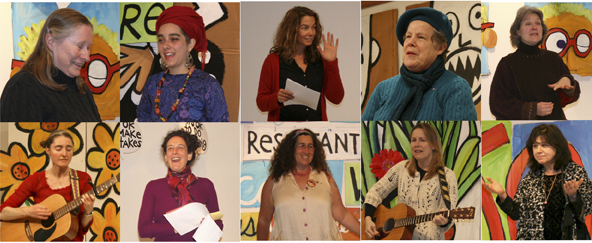
Women sharing their creative visions at the Deb Koffman open mic in Housatonic, MA

Women sharing their creative visions at the Deb Koffman open mic in Housatonic, MA

This is not just about women writers patting each other on the back and trying to advance our individual careers.

This is about women forming what Julia Cameron unabashedly calls “Sacred Circles” to propel humanity beyond the destructive domination-and-extraction model of the human relationship to our Mother Earth.

Next year’s Festival will have a special focus on women, creativity and environmental sustainability, to help us train our focus on the most urgent matter at hand: the destruction and contamination of the planet, with the resulting drastic climate change shifts that are coming in this century no matter what we do now.

Women and men worldwide need to rise to this challenge with every ounce of our creative energies.  On this International Women’s Day, 2013, I call on women, especially, to make a commitment to using our creative power for the good of the planet and all her denizens.

We need new stories to help us imagine a new, brighter future

Will someone please do the math on how adding thousands of Americans to the unemployment rolls, thanks to the new “sequester,” is going to save the country money?

Not only will we (as in, we the taxpayers supporting the Federal government) be paying unemployment compensation for those folks, but their communities will also be suffering as they cut back on personal spending…perhaps lose their cars or their homes…and end up needing a lot more in the way of social services.

Sometimes when I check in with American politics, I have to wonder who is writing the scripts.

President Obama sailed into office in 2008 promising that as an outsider to Beltway machinations, he would champion the ordinary American and set the country on a kinder, more humane path.

The Republicans, perhaps rightly, read his conciliatory gestures as weakness, and have taken the bully’s path of stonewalling, denunciation and manipulation of the truth.

Presidential Inauguration, 2013

Presidential Inauguration, 2013

Speaker Boehner’s sour face as he sat behind the President on Inauguration Day this year said it all.  He would not—could not—cooperate in any way with our country’s popularly elected leader.  Not even if his obstinacy brought America to its knees.

The whole scenario was eerily reminiscent of the script from the one-season TV show Commander in Chief, starring Geena Davis as the first woman President of the United States.

She too was pitted against a demonic Speaker, who would stop at nothing to discredit, provoke and undermine her, even if his reckless bullying endangered the welfare of the country overall.

Interestingly, Commander in Chief was cancelled after just one season, just as Ms. Davis’s character, President Mackenzie Allen, was gearing up to run for re-election against—of course—her nemesis, the Speaker of the House.

At the time the explanation given for the cancellation was that audiences were not yet ready for a woman President (the show ran in 2005-06).

But watching the first 18 episodes again recently, it was clear that what really did it in was the daring script, which showed a powerful woman POTUS who was a popular Independent determined to stand up for ordinary Americans and to keep her hands clean of the usual muck of party politics.

Geena Davis as Mackenzie Allen, President of the United States

Geena Davis as Mackenzie Allen, President of the United States

In the last couple of episodes, President Allen decides to champion the Equal Rights Amendment for women, which still to this day has not been ratified by enough states to make it federal law.

Her political advisor tells her it’s suicidal to touch that hot potato if she’s seriously thinking about running for a second term, but she’ll have none of his cynical advice, and indeed ends up summarily firing him.

Could it be that the TV Gods cancelled Commander in Chief precisely because the show demonstrated that there is no reason why our country has to be held hostage to the Republicans—or the Democrats?

11-geena-davis-commander-in-chief-2005-2006Did they cancel the show because it showed that there is no reason why a woman can’t govern with equal or greater smarts, decisiveness and wisdom as a man—even as she remains a loving mother, wife and daughter?

President Allen was shown in every episode facing down stereotypes, garnering the respect of even her crustiest generals and most ruthless homeland security czars.

And the more she succeeds, the more ordinary people applaud and support her, the more determined her political adversaries become to take her down.

The show didn’t end with a bullet to her head; it didn’t have to.  It just got struck from the airwaves by one wave of a TV executive’s red pen.

So ended the daring career of the nation’s first television representation of a woman President of the United States.

***

Cronogram-BFWW-ad-webThis week I have been busy preparing for the opening of the Berkshire Festival of Women Writers, a month-long, grassroots, homegrown Festival that I founded three years ago to give women writers more opportunities to raise our voices in the public sphere.

My whole professional career has been dedicated to this mission of amplifying the voices of women writers, bringing them into classrooms and conference halls, into print and on to stages, because I firmly believe that if women had more power in the world, we would change human society for the better.

Gender is a spectrum: all men and women have both estrogen and testosterone pumping through our hearts, and all of us need to call on both the warrior energy of testosterone and the nurturing energy of estrogen to heal our damaged planet and create a stronger, wiser, more sustainable human civilization.

We cannot afford to wait for our political leaders to grow up and stop playing games with our future, and the future of our children.

We have to each do what we can, in our own spheres, to balance out the bullying and the guns and the lack of compassionate imagination with new stories, different voices speaking a different truth into being.

For me this means shutting out the cacophony of political heckling and sniping and tuning into the voices of the women of my community and our invited guests during this Festival month, as together we change the tenor of public discourse by daring to step out on stage and speak our truths to power.

No matter what happens down in Washington D.C.—no matter if our political representatives continue to lick the boots of the oil and gas industries, build billion-dollar fighter planes instead of mass transit, kick our veterans and young people to the gutter, deny women equal pay for equal work and make young women fight for the right to say no to pregnancy—we still have something they cannot take away from us.

We have our capacity for independent thought and we have our voices.

We must rise to the occasion and write our own scripts, bridges of words and dreams that will carry us into a livable future.

Great Barrington Select Board representative and author Alana Chernila reads her work--an open letter to Fox News anchor Bill O'Reilly--on opening night of the Berkshire Festival of Women Writers (3-1-13)

Great Barrington Select Board representative and author Alana Chernila reads her work–an open letter to Fox News anchor Bill O’Reilly–on opening night of the Berkshire Festival of Women Writers (3-1-13). Author Janet Reich Elsbach looks on.

Be the change 2012

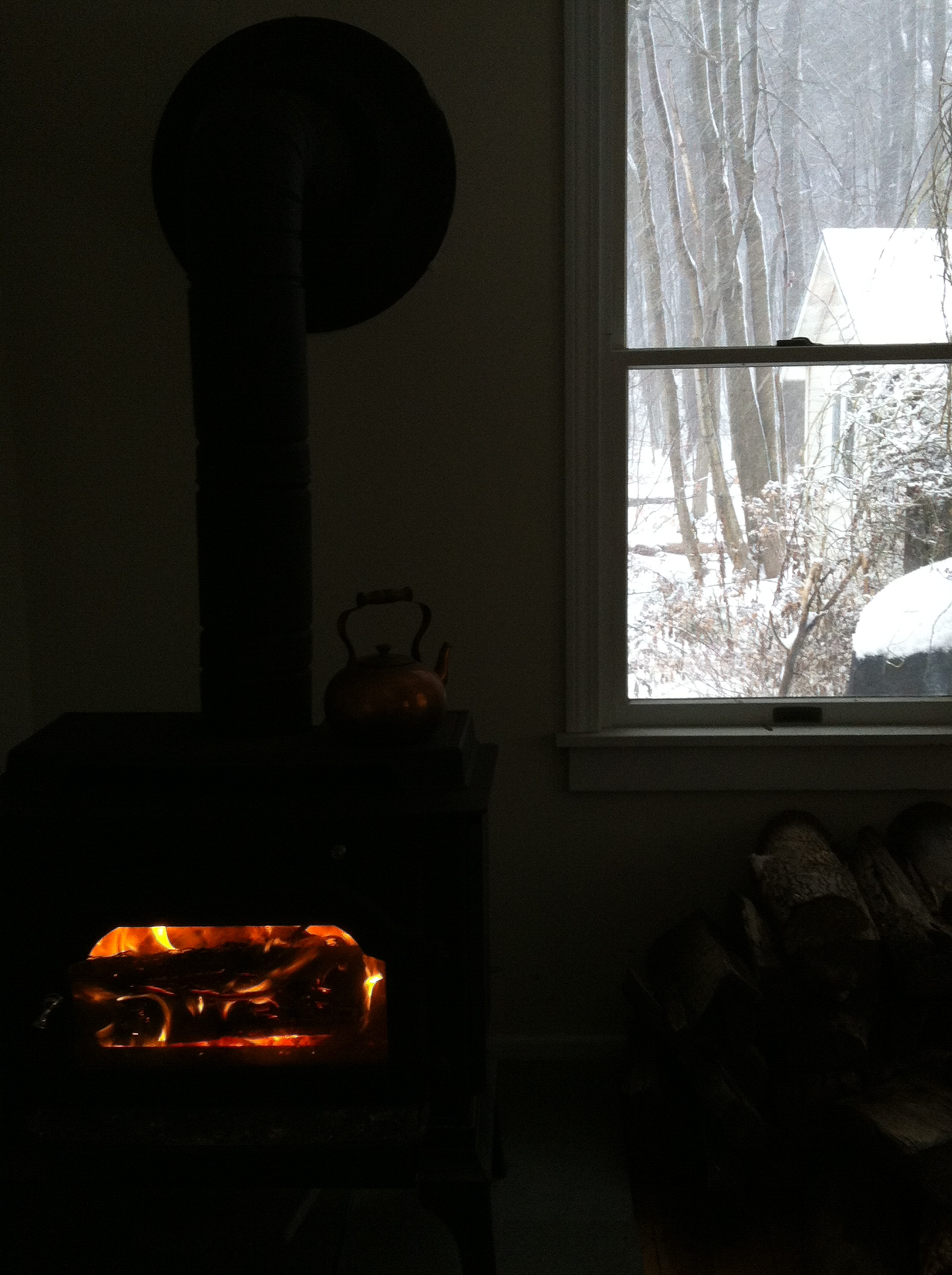
IMG_1102It is a dark, cold, winter’s morning, gray with a pelting mixture of sleet and freezing rain that has even the birds huddling for shelter in the thickest fir trees they can find.

I’ve just gotten up, lit the fire and the lights on the Christmas tree, made myself a cup of strong coffee, and thought to myself: where do I put my focus?

If I focus on the warmth and coziness inside the house right now, this seems like a wonderful morning, a perfect opportunity to curl up on the couch and make some progress on grading the papers students turned in to me before they left for the holidays.

If I focus on the sleet and wind outside, and begin to fixate on the way the trees are blowing around the icy power wires, I feel threatened, rather than protected, and start to worry in advance about whether or not I’ll be losing power later today.  Should I rush to take my shower and do some cooking before the power goes out?

Small dilemmas, and yet in the daily crucible of making these choices w of how to focus our attention, a lifelong habit is born of seeing the glass half-empty or half-full.

I must recognize that I have a tendency to see the glass half-empty.

I was a fearful, cautious, worrying sort of child, and I have not changed much as an adult.

In today’s age of aggravated climate change, random violence and the immediate potential for it all getting a whole lot worse in the near future, this attitude can make for a great deal of depression and anxiety.

But does it have to be that way?

Back in the 1980s, I spent a fair amount of time listening to recordings of Esther Hicks channeling the group of spiritual beings who called themselves Abraham.  The crux of their advice for us humans is to focus on what you want, with as much intensity and lavish detail as you can muster, and watch the Universe deliver it to you.

“You can have anything you want, if you exercise the Law of Attraction and call it to you,” Abraham would say over and over and over.

This idea has been picked up and popularized by others as well, and it is guaranteed to appeal to our can-do, feel-good American society.

We want to believe that we have the power to improve our lives, and it seems to happen often enough to keep the belief going.

But I always wondered, and wanted to ask Abraham, what about the people who were having terrible life experiences?  Did they “attract” these horrible situations to themselves too?

Did the 20 children who died in Newtown “attract” their destiny?

I cannot believe that they did.

It could be, however, that the killer’s vision was so strong that he was able to enact it, to make it come true.  Maybe he did what Abraham suggests, and replayed over and over again in his mind the details of what he wanted to do, until it was so well-thought-out and planned that he was able to unroll it in reality with no problem at all.

We need to pay more attention to the power of the human mind to affect reality.

It happens on an individual level, as when I can transform this gray, nasty morning into a warm, cozy one just by focusing on the peaceful interior of my house rather than the storm raging outside.

Focus on the outside

Focus on the outside

Focus on the inside

Focus on the inside

And it happens on a societal level, as when so many of us feel unsafe that we all start buying handguns and assault weapons, with the result that our feeling of peril becomes a self-fulfilling prophecy: with all those weapons circulating among our neighbors, we really are unsafe.

If we all settle into the mindset, amply seeded by the steady beat of the sci fi/disaster movies that have come out in the past decade, that the Earth is doomed and we are doomed with her, we will collectively give in to despair and simply go about business as usual while waiting passively for the end to come.

On the other hand, if we begin to collectively dream an alternative future, one based on respect for the Earth and respectful stewardship of her life systems, it is still possible that we may be able to manifest this positive vision.

The popular author Don Miguel Ruiz, whose book The Four Agreements has sold millions of copies worldwide, ends a recent interview by asserting that “We all came into this beautiful planet with a mission. The only mission, and it’s the same for every single human that we have on this beautiful planet earth, is to make ourselves happy.”

The only way I could agree with that principle of the human mission on Earth is if it is understood that we cannot be happy on an unhappy planet.

In other words, it is impossible for us to achieve real happiness when the dominant paradigm of human existence on the planet is based on oppression, suffering and violent destruction.

We may be able to achieve temporary “highs,” shelters in the storms of our lives, but real abiding happiness will elude us, at least those of us with enough sensitivity to be aware of the suffering always going on beneath the surface.

Events like the Newtown massacre break through the veneer of our superficially happy existence, here in the comfortable USA, and send many of us spiraling into depression.

And not just folks like me, who are habitually attuned to the malheur of life, but many more of us, who suddenly wake up and ask Why?

Why did this senseless massacre happen?

Perhaps it happened to remind us of the daily massacres of innocent wild creatures and feedlot animals, lab animals and vast flocks of birds, tons of fish in the sea and endless miles of coral and forest, all going down in a relentless bloodbath of human making.

Perhaps it happened to remind us of the children who are being trafficked into sex slavery or forced labor every day, of the children dying daily of hunger and preventable diseases, of the wasted lives of children whose poor-quality early education dooms them to lives of struggle and want.

When great tragedy strikes, survivors have a tendency to affirm to each other, Let their sacrifice not have been in vain. Let us learn from what happened and vow never to let it happen again.

Hence, in the wake of Newtown, the great outcry for better gun control laws, which may indeed, finally, be enacted in the coming year.

Abraham would say that you have to know what you don’t want in order to get clear on what you do want.

But the emphasis has to be on the positive; on building the vision, both personal and collective, of what we want for our society and our future.

We do not want an America where any random psychopath can get ahold of an assault weapon and wreak havoc in the neighborhood school or mall.

We do not want a lifestyle based on unsustainable consumption, oppression and callous disregard for the welfare of other living beings.

Now: what do we want?

We must get clear on our positive vision for a just and sustainable human civilization on our beloved planet, and then do the work of dreaming it into reality, day by day.

We must be intentional in where we focus our attention, not to ignore negative realities, but in order to put the power of our creative energies to work in manifesting the world we want to see.

In other words, as Gandhi said, be the change you want to see in the world, starting with your own thoughts and radiating outward.

Be the change.

IMG_1083

Dancing in the end times

And so here we find ourselves, finally, on the cusp of a great turning in solar time, the fabled 12-21-12.  It is a dark, wet, windy, wild morning here in the hills of western Massachusetts.

Since I started this blog back in the summer of 2011, with the optimistic URL “bethechange2012,” I have found many others who have beckoned to me like beacons of strength and inspiration on my somewhat lonely path of inquiry and discovery.

In the early days of Transition Times my own light was quite tentative and often overwhelmed with fear and distress, the product of my dawning realization of the tremendous gravity of the situation in which we find ourselves.

We cannot pretend to each other that the news is good for humanity, any more than for the rest of the living beings on the planet.

These are the transition times: the end of a long era of existence, as the ancient Mayan shamans rightly foresaw, and the beginning of something new.

I cannot and will not shy away from diving into the heart of the wreck that is our human civilization on this planet in the early 21st century.  Exposing what I find there is part of my mission with this blog.

However, it is also my purpose to be a channel and a beacon of hope for others who are searching for  meaning in these troubled times we live in.

We are all caught up in a vortex much greater than any individuals among us could produce, an accelerating forward surge that is hurtling humanity, and the planet we share with so many other life forms, towards a new era.

We cannot know what this means for each of us as individuals.  But I am coming to realize that the most important thing we can be doing in these transition times is to serve each other, and the other beings on the planet, as a form of shelter and anchor in the storm.

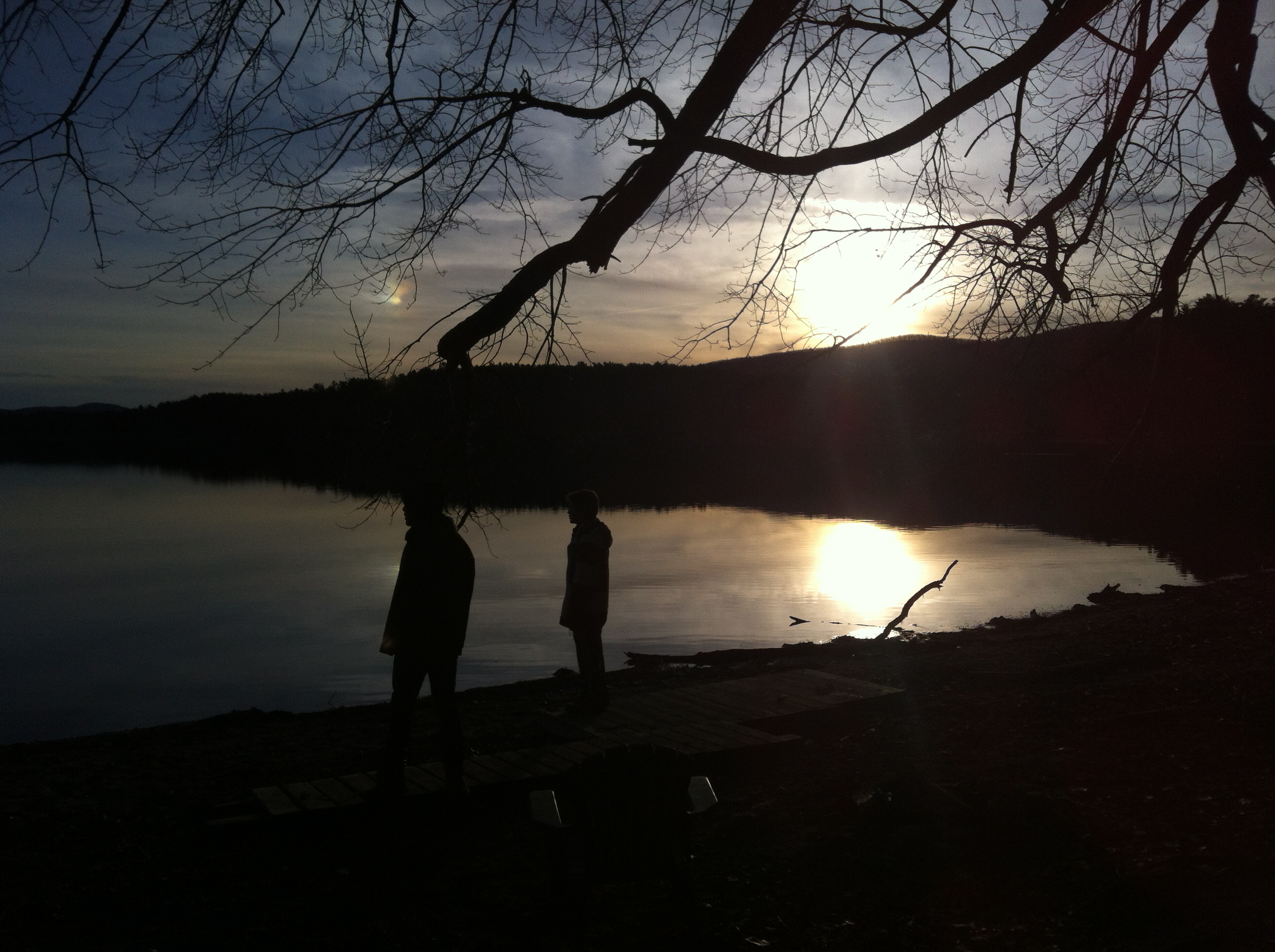
I will close with an image taken on one of my many thoughtful rambles over the past few months.  To me it represents the planet calling to me, and to all of us who love her, to continue to push back against the forces that would despoil and blight her.

The rocks, earth and waters of the Earth remind us that geological time is slow and very, very long.  Our dance on the planet as humans is so brief.  Let us enjoy our time here passionately, and turn our dancing to good works.

Benedict Pond, Monterey, November 2012

Benedict Pond, Monterey MA, November 2012

American Mothers Must Unite Against the Culture of Violence

A couple of weeks ago, when I heard that my 14-year-old son and his friend had been playing with the other boy’s air-soft pistols by shooting each other at close range, I saw red.

“But it just stings like a bee-sting, Mom,” my son protested.  “It just leaves a welt.  Why are you getting so upset?”

At the time, I wasn’t sure why I was getting so upset—after all, these were only toy guns.

My answer to my son was that a “bullet” could ricochet and end up hitting him in the eye, which is true and a rational explanation for why I flatly forbid him to engage in that kind of behavior any more with those guns.

“Target practice only!” I insisted. But of course, what he and his friends do when I’m not around is impossible to predict or monitor.

Nancy Lanza

Nancy Lanza

Now, after the Newtown massacre, I am thinking more deeply about the issue of guns, violence and kids.  I’m also thinking more about Nancy Lanza, the gunman’s mother, who he savagely shot in the face, leaving her dead in her pajamas in bed while he went out on his mission of mass murder.

I’m far from the only one who is asking what Nancy Lanza could have been thinking to make her home into an arsenal, complete with assault weapons and major ammunition, especially with a son living there who she knew to have social adjustment problems.

I hear that the good people of Newtown are shunning Nancy in death, focusing on the “26 victims” of Adam Lanza and refusing to light a candle in her memory.

This seems like a classic case of blaming the victim, and yet of course Nancy does bear responsibility for the horrific massacre of the 26 innocent victims.

If she hadn’t armed her son, he could not have carried out this crime.

So this begs the question of our responsibility as parents, especially, in this context, as parents to sons.

I have two sons, and like Nancy I am divorced, with my sons’ father very distant from their day-to-day lives.

It is my responsibility to raise them to be kind, good-hearted men, who use their warrior strength to protect and strengthen their communities, not to destroy.

But what a battle it is to keep the tremendously destructive tsunami of media and cultural violence at bay in our home!

I don’t have TV in my house, and my kids don’t own a Wii or Playstation.  But we do have computers, tablets and smartphones; we watch Netflix and go to the movies and have friends who are more casually accepting of (toy) guns than I am.

Unknown-1I have tried to hold the line on violent video games that the boys may have access to through the computer, and for the most part I think I’ve been successful.  Even if they may sneak a violent game or two when I’m not around, at least they don’t play these games obsessively, with impunity, the way most teenage boys do in America.

We’ve talked at length about my objections to media violence, and I know they understand, even if they occasionally express the wish that they could just join the crowd and go on a good virtual shooting rampage like all the other boys they know.

I’ve gotten into arguments with my older son, age 20, and some of my college students, who insist that there is no way they’d ever do in real life what they have so much fun doing in video games.

I hope they’re right.

But I want to know why, as Americans, we tolerate and indeed seem to relish representations of violence, while at the same time we’re so fearful of actual violence that some of us are stockpiling weapons in our homes to prepare ourselves for the worst.

In the old days—not that long ago, in the scale of human history—a whole town used to turn out for a festive viewing of a hanging.

Today in places where conservative Islam reigns, women are stoned to death in public spectacles of participatory violence.

But how different is that, really, from the great American past-time of engaging in virtual violence of the most vicious sort?

America is the most violent, militarized society on Earth and Americans are the greatest exporters of violence, both physical and virtual, to the rest of the world.

Most perpetrators of violence—again, both real and virtual—are men.  Men are the greatest victims of violence too, though women and children bear a disproportionate share, given that they are far less likely to be pulling the triggers.

We need to start looking much harder at the way our culture encourages violence by selling us the story that real men enjoy violence and can handle it with insouciance.

I don’t want my teenage son shooting an airsoft gun at his friend, and I don’t want him going on virtual “special ops” missions armed with a Bushmaster assault rifle.

I wish his father were on hand to back me up in this, and I think my situation as a mother trying to keep violence out of my home is probably far more common than we realize as a nation.

We know that half of marriages end in divorce, and I wouldn’t be surprised to learn that of the remaining married couples, half include men who enjoy guns, violent video games and violent movies, and teach their sons to do the same.

So that leaves a lot of us women either on our own trying to fight the prevailing winds of culture and raise peace-loving men, or tolerating or going along with the culture of violence within our most intimate relationships and the private sphere of our homes.

Yes, some women may themselves be violent.  We still don’t know why Nancy Lanza felt the need to arm herself with such terribly potent weapons.

But the fact remains that of the steadily mounting toll of mass shootings in this country, not one has been committed by a woman.

Women are way more likely to be victims of violence than perpetrators, and even as perpetrators they are generally acting in self-defense.

American women, I call on you to look deeply at this issue, and find the strength to stand up collectively against the violence.

Mothers, we need to support each other on this!

Just as the Mothers Against Drunk Driving took a stand and changed the pattern of teenagers driving drunk and killing themselves and others year after year, by forcing legislators, schools, merchants and other parents to take collective responsibility for raising responsible kids, we need to start a new movement against the culture of violence in our country, both virtual and physical.

Then perhaps we could say that the 27 victims of Adam Lanza did not die in vain.

Unknown

Honoring the wisdom of Native Americans on Thanksgiving

Before I understood the real history behind the American tradition of Thanksgiving, I used to just innocently enjoy the chance to gather with family and friends to share a delicious meal.

I believed the story taught to me in grade school, about how the Pilgrims and their Native hosts sat down to a feast together, and lived happily ever after.

Such innocence, once lost, is impossible to recapture.

Now I know that the same Pilgrims who gave thanks for their delivery from starvation by the generous Native people of the region that would come to be known as New England would be the ones to turn on their benefactors and do their utmost to exterminate them.

My own ancestors were still fighting their own battles back in Europe at this time, but as an American, this is a shameful legacy that I need to confront and acknowledge.

As I wrote in my Thanksgiving post last year, the holiday of Thanksgiving should really be more of a day of atonement than a celebration of abundance, especially as we begin to realize that the abundance of food and natural resources that Americans have enjoyed over the past 500 years is not endless.

As we hit up against the limits to growth predicted years ago by Donella Meadows and others, we must recognize that the Native peoples who were so unceremoniously shoved aside during the Conquest of the Americas had so much more to offer Europeans than corn, squash, beans and turkey.

Indigenous worldviews, the world over, privilege balance over growth and accumulation, and this is the wisdom we need to pay attention to now.

Some argue that such a conservative position would not support the kind of technological innovation in which Europeans have excelled.

But I would ask whether our technological innovations have succeeded in making us happy as a culture, or as individuals within our culture?

Isn’t it true that the vast majority of our technological inventions have been used to foment and practice ever-more violent warfare?

Even our vaunted advances in medicine are primarily used, these days, to try to heal us from the sicknesses and imbalances our own technological inventions have afflicted upon us, by the poisoning of our food, air, water and earth with toxic chemicals and the byproducts of burning fossil fuels.

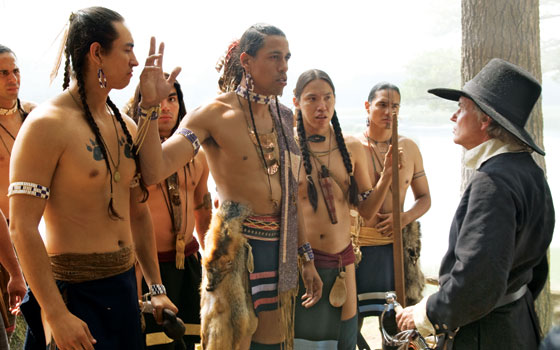
This image, from the PBS series “American Experience,” depicts members of the Wampanoag tribe meeting a white settler.

Before the Pilgrims landed in Massachusetts and started their inexorable push west, the indigenous people living here were happy, healthy, strong and long-lived.  They enjoyed the abundant food stocks of the ocean, rivers and forests, and lived in harmony with the land.

Yes, there were territorial skirmishes, but there were also strong intertribal councils and confederations, in many cases led by matriarchs who valued peace and did not want to lose their sons and grandsons to needless warfare.

This Thanksgiving, I give thanks that the Native peoples of this continent are still with us, despite all the brutality visited upon them by the European conquerors.

This Thanksgiving, I pray that all Americans begin to honor indigenous people as they deserve to be honored, by giving credence to the Native value of harmony with the Earth, and actually trying to live it.

Privilege, Difference and the Challenge of Creating a “Beloved Community”

The recent Presidential election showed in concrete terms that the demograhics of the United States are shifting quickly.  The old majority of people of European descent (“Caucasians”) is rapidly shrinking to minority status in numerical terms, although white folks retain a lock on the gears of power and privilege so far in this country.

How do white folks continue to maintain dominance?

The key is still education.

When my Eastern European Jewish forebears came to the US through Ellis Island back at the turn of the 20th century, the adults in the family spoke no English, but they were hardworking and ambitious for their children to assimilate and succeed.

One of my great-grandfathers fixed sewing machines on the Lower East Side; another great-grandmother sold fish wrapped in newspaper on the street to support her children.

Within a generation, the children of these immigrants were living the middle-class American dream, and their children did even better, becoming doctors, lawyers, teachers and professionals.

My grandmother, a first-generation American whose mother tongue, before entering kindergarten, was Yiddish, got her B.A. and Masters in biology from Hunter College, and became a high school biology teacher.  Her son, my father, graduated from Oberlin and NYU and became a successful professional.  I followed the pattern and got my Ph.D.

This is what’s known in Americanese as pulling oneself up by the bootstraps.

What is too often unacknowledged is how the privilege accorded to whiteness in America has helped families like mine succeed.

It starts with where you are able to live, because property taxes still determine the quality of the primary and secondary education you’ll receive.

In the first half of the 20th century, there were a lot of places in the U.S. where Jews weren’t welcome, including many selective colleges and universities.

But just like the Irish and the Italians, soon enough Jews became “white,” and that was all that mattered—they were welcome in all but the snootiest bastions of American WASP-dom, and their privileges were helped along by the exclusion of others.

The color of one’s skin still matters in this country.  We still live in largely segregated neighborhoods, and thus most of our children attend largely segregated schools.

And they’re not “separate but equal” schools either.  They are, as Jonathan Kozol so eloquently documented, deeply unequal schools, where children with darker skin tones—who are often the most in need of support–are given less, financially and  intellectually.

The fight over “race-blind” college admissions is so fraught because what tends to happen without any affirmative action policy for Americans of color is that the people with the best “grooming” win out, and the best-groomed high school seniors tend to be those from affluent families, living in affluent neighborhoods, going to affluent schools.

As The New York Times noted in a recent editorial, “Those from the top fifth of households in income are at least seven times as likely to go to selective colleges as those in the bottom fifth. The achievement gap between high- and low-income groups is almost twice as wide as between whites and blacks,” and “blacks and Hispanics are also substantially underrepresented at selective colleges and universities. In 2004, they were 14.5 percent and 16 percent, respectively, of those graduating from high schools, but only 3.5 percent and 7 percent of those enrolling in selective colleges and universities. The underrepresentation has gotten worse over the past generation.”

***

All this is on my mind today because of a recent stir at the college where I teach, which has made a strong effort over the past decade to recruit more students from under-represented groups.

We have more people of color on the campus today than we’ve ever had, which should be a cause for celebration.

But this semester has brought some simmering tensions to the surface, showing how difficult it can be to put a group of passionate young people together on a campus and expect them to “just get along.”

The flashpoint this semester was Diversity Day, a day started several years ago by a group of disgruntled students who felt that not enough time was spent during regular classes focusing on issues of social diversity.

Students, staff and faculty organized workshop classes on a range of topics related to the experience of marginalized groups in America, and theories and praxes of social justice.

The day was so successful that it was subsequently institutionalized, with regular classes cancelled and all students required to attend at least three workshops.

This year, an influential group of students decided they were going to “boycott” Diversity Day.  Many of them were the student leaders of workshops, which meant that they were actually sabotaging their own event.

They took this extreme measure because they were angry at what they perceived as a lack of strong response from the college administration to the provocation of a student who questioned not just the value of diversity day, but the value of diversity itself in American society.

This student distributed posters on campus asking students to “Take the Diversity Challenge” by answering the following question: “Name 5 benefits of Diversity (besides ethnic food and music).”

His challenge was taken as a white supremacist assault on students who wear the mantle of diversity with pride, and he did not do much to dispel that perception, according to students who said he also sent them a link to a You-Tube talk by Jared Taylor, the controversial founder of the New Century Foundation and editor of its American Renaissance magazine.

The anti-discrimination watchdog organization Southern Poverty Law Center, which keeps tabs on Taylor, says that he “regularly publishes proponents of eugenics and blatant anti-black and anti-Latino racists,” and also “hosts a conference every other year where racist intellectuals rub shoulders with Klansmen, neo-Nazis and other white supremacists.”

In the video link shared on our campus, Taylor argues that because there is often friction when you put different social groups into close proximity (and he’s especially attentive to different racial groups)—say, in neighborhoods or schools or college campuses—the better thing to do is to back away and re-segregate, thereby eliminating the sources of tension.

This attitude is wrong on so many levels that I find it hard to know where to start.

Besides the obvious truth that race is just an illusion, as far as a real biological marker of human difference, it’s also true that ghetto-izing certain individuals, for whatever reason, has never been a good social strategy in the past, and it won’t work now.

We don’t want a balkanized, fearful, hateful America any more than we want a bland, homogenized America.

We want a society where, as Audre Lorde put it, “difference [is] not merely tolerated, but seen as a fund of necessary polarities between which our creativity can spark like a dialectic.”

In her famous essay “The Master’s Tools Will Never Dismantle the Master’s House,” Lorde continued: “Within the interdependence of mutual (nondominant) differences lies that security which enables us to descend into the chaos of knowledge and return with true visions of our future, along with the concomitant power to effect those changes which can bring that future into being” (Sister Outsider, 111-12).

***
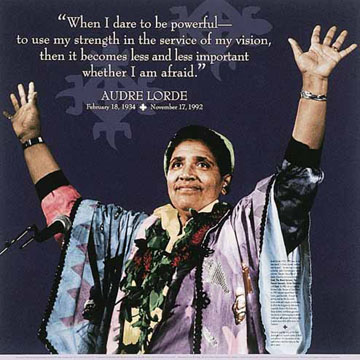
Audre Lorde

At my college, we like to say that we teach “critical thinking skills,” by which we mean that we encourage students to question authority and think for themselves.

We shouldn’t be surprised or upset, then, when they do just that by questioning our own institutional authority.

The students who organized the Diversity Day boycott this year—many of them women of color–were angry that a student advocating white supremacy was allowed to remain in our campus community.

While the administration deliberated over whether this student presented any danger to the community, and whether his words had crossed the line into hate speech, they said, they felt unsafe and unheard.

So they staged a protest, quite in keeping with Audre Lorde’s injunction to “transform silence into language and action.”

“I have come to believe,” Lorde says, “that what is most important to me must be spoken, made verbal and shared, even at the risk of having it bruised or misunderstood.”  She urges her readers to ask themselves “What do you need to say?  What are the tyrannies you swallow day by day and attempt to make your own, until you will sicken and die of them, still in silence? ….We can sit in our corners mute forever while our sisters and our selves are wasted, while our children are distorted and destroyed, while our earth is poisoned; we can sit in our safe corners mute as bottles, and we will still be no less afraid” of speaking out.

But, she continues, “We can learn to work and speak when we are afraid in the same way we have learned to work and speak when we are tired.  For we have been socialized to respect fear more than our own needs for language and definition, and while we wait in silence for that final luxury of fearlessness, the weight of that silence will choke us….

“It is not difference that immobilizes us, but silence.  And there are so many silences to be broken” (“The Transformation of Silence into Language and Action,” Sister Outsider, 4144).

On our campus, Diversity Day originated as an attempt to break the silences between different social groups, including students, faculty and administration, in the cause of mutual understanding and communication.

But this year, it was the boycott that spoke loudest, and what it said, loud and clear, was that there are still so many silences to be broken.

Speaking as a faculty member who teaches classes in human rights and social justice, and who has organized many Diversity Day workshops over the years, the problem is that it’s often too little, too late.

By the time Diversity Day rolls around in November, tensions between social groups on campus have often already come to the fore, and the workshops provide opportunities to let off steam that can end up sparking further conflagrations that take place in the dorms or on social media sites, without the mediating influence of faculty and staff present to help channel discussions productively.

One day out of the school year is not enough to create the social bonds necessary to establish a cohesive, harmonious diverse student body.

We are going to have to try harder, to do better.

***

An opening has been created for us by the students this year. From my perspective as a faculty member, this is a prime teachable moment, an opportunity to advance our ideals of social justice and strengthen the ties of community on our campus.

Those with more privilege, on whatever grounds, must stand as firm allies with the less privileged.

Every class, every conversation, every interaction is an opportunity for respectful communication that encourages the breaking of the deep-seated silences that separate us.

The truth is that every college campus is a microcosm of the larger society from which our students are drawn.  In the small, sheltered community we create—a kind of Beloved Community, in Martin Luther King Jr.’s terms—we have an opportunity to envision and manifest new frameworks and understandings that our students will then carry with them out into the broader world.

In this struggle, as in all others, we are the ones we’ve been waiting for, and the time for thoughtful action is now.