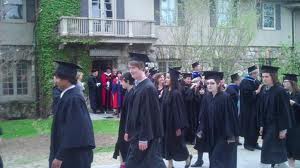
If I had been asked to speak at Commencement….

This is what I would have said:

It’s become a cliché to say that every day is the first day of the rest of your life, and yet like most clichés this one holds truth to it.

When you walk down that aisle today holding your B.A. diploma, achieving a goal which you have worked towards for many years, you will be stepping into your adulthood with all the rights and privileges, but also all the responsibilities that this maturity brings.

The year 2012, long prophesied as a time of great change and transition, is not an easy time to be reaching adulthood.

I don’t have to tell you that times are tough economically, or that our planetary environment is facing its own severe shifts due to anthropogenic global heating.  You have probably heard tell of a “sixth great extinction event” on the horizon, if climate change projections continue unabated on their current course, causing the heating and acidification of the oceans and resulting drought, floods and violent storms on land.

Most of us “know” about these issues the same way we “know” that toxic chemicals in our food, water, air and household products cause cancer.

We do our best not to think about it too much, because thinking about it just makes us scared and depressed, and what can we do about it, anyway?

I want to suggest to you, as you step out into the world this afternoon with your newly minted B.A., that you are stepping into an unprecedented opportunity to do more than any previous human generation has ever done.

It is not an exaggeration to say that you have the opportunity to turn this great Titanic of an earthship around, sailing her away from the iceberg and into safer waters.

There have been “greatest generations” before now.  But their challenges have been far less global and all-encompassing than the challenges we face now.

Now it’s not just a nation or even a group of nations that are faced with disaster.  It is the entire globe, human civilization writ large, which could in fact be toppled if the earth gives a great climatic shrug of her shoulders and goes back to the evolutionary drawing board.

Even the most sober earth scientists are predicting that if we do not change our habits of carbon emission, the resulting global heating will make the world uninhabitable for some 90% of current species on the planet by the year 2050, including 90% of current human populations.

I lay this out for you starkly not to depress you on what should be a happy and auspicious day, but to impress upon you the importance of the decisions you will be making and actions you will be taking in the coming years.

While it is true that lifestyle changes of individuals can only have limited effect on climate change, they are a start.  We can choose to support alternative energy whenever and however possible.  We can choose to push our elected representatives to shift subsidies and incentives away from fossil fuels and towards renewables.  We can encourage sustainable agricultural practices in our own communities and through our consumer choices.

What I would ask of you above all is to stay informed and engaged with these issues as you move forward into adulthood, and seize all opportunities to push governments and corporations to do the right thing not just for the bottom line or the national interest, but for the good of our planetary home and her current life forms, including humanity.

I am not proud of the condition of the world that my generation is now handing off to you.  I am not proud of what I and my cohort have allowed to happen on our watch.

The past cannot be undone.  But the future is yours to shape.

Don’t be afraid to try out completely new ideas. Listen to your dreams, listen to your intuition.  Be alert, be thoughtful, be creative.  Tune out the background buzz that will try to lull you into complacency and inaction.

I hope that when it’s your turn to witness your children stepping out into their adulthood, you will be able to be proud of the world you have created for them.

Truly, their future is in your hands.

Commencement reflections, 2012

This weekend my first-born son will graduate at age 20 with a B.A. in Biology.  He will join thousands of other graduates across the country marching to the dais to accept his hard-earned degree from school officials dressed in the medieval cap and gowns we still wear for such occasions.

And then he will march out into the world to join the hordes of recently graduated young adults, confronting one of the worst job markets ever seen in American history.

When I graduated college back in 1982, there was also a bit of a recession on, but things quickly rallied, and I had no trouble finding a job in journalism, and working my way up from reporter to staff writer to editor at publications in New York City.

When I chose to go to graduate school, it wasn’t hard to find a part-time job as an assistant editor to make room in my schedule for my studies.

And so it went, one step leading to the next with a steady predictability.

For my son, now, that kind of reliable future is out of the question.

We live in such a fast-changing world that there is no way to predict with certainty what kind of challenges we’ll be facing in, say, the next five years.

Will climate change come to a head and rain environmental devastation down on us?  Will an antibiotic-resistant bacteria strike?  Will the risky behavior of the financial sector finally put us completely at the economic mercy of the Chinese?

We can’t know the answers to any of these big global questions, any more than we can know the answer to the very small, local question that I am sure is in the minds of all the parents and grandparents who will be watching their graduates march this weekend: will s/he be able to find a job next year?

Many of the graduates will choose to put off confronting that question by diving back into graduate school.  That is certainly what my son has in mind, and it is the right thing to do, given his desire to work as a marine biologist.

Even a Ph.D. is no guarantee of a living wage anymore, although things are somewhat brighter in the sciences than for those of us stuck in the doldrums of the humanities.

I am proud of what my son has accomplished in his first two decades, and proud of the fine human being he has become.

I am much less proud of the world we, his elders, have created, into which he’ll now be stepping as a young adult.

As a teacher, I see clearly that what is needed is a collaboration of older, more experienced minds, with the open, energetic and passionate young minds who are now coming into their full powers.

I don’t want my son and all the other graduates to follow blindly in our path, doing things as they’ve always been done, which is largely what I myself did as a young adult.

Knowing how desperately we need to change our habits in order to shift our society on to a sustainable path, we can’t afford to give young people the luxury of just following along the paths that are already established.

We need them to be blazing new trails, and we older folk need to work with them closely in this crucial undertaking.

As my son strides off the dais with his BA in hand on Saturday, this is the blessing that will be in my mind:

May you take your knowledge and talents and use them for the benefit of our planetary home.  May you be a warrior for good, and become a leader in your sphere.  May you prosper and find happiness in working for the prosperity and happiness of all. 

Welcome to the Knowledge Factory

The lead article in this week’s Chronicle of Higher Education Review is titled “The Ph.D. Now Comes With Food Stamps.”

More than 350,000 Americans with advanced degrees applied for food stamps in 2010, part of “an often overlooked, and growing, subgroup of Ph.D. recipients, adjunct professors, and other Americans with advanced degrees who have had to apply for food stamps or some other form of government aid since late 2007.

“Some are struggling to pay back student loans and cover basic living expenses as they submit scores of applications for a limited pool of full-time academic positions. Others are trying to raise families or pay for their children’s college expenses on the low and fluctuating pay they receive as professors off the tenure track, a group that now makes up 70 percent of faculties. Many bounce on and off unemployment or welfare during semester breaks. And some adjuncts have found themselves trying to make ends meet by waiting tables or bagging groceries alongside their students.”

And the numbers of impoverished Ph.D.s may actually be much higher than this.

“Leaders of organizations that represent adjunct faculty members think that the number of people counted by the government does not represent the full picture of academics on welfare because many do not report their reliance on federal aid.

“Even as the number of highly educated aid recipients grows, shame has helped to keep the problem hidden.”

Yes, I know that shame well.

How could it be that a highly educated, well-groomed, extremely intelligent individual with everything going for her is so embarrassingly poor?

Why is it that after more than 20 years of teaching college—and doing a very good job of it, I might add—I  still make only $10,000 more now than I did as a freshly minted B.A. starting out in publishing in New York back in the 1980s?

It is very hard to earn a Ph.D., in case you didn’t realize.  It takes many years of study, great determination and self-motivation, the ability to see a major, high-quality independent research project through to its conclusion, generally a book-length manuscript.  It also takes a lot of money, especially in the poorly funded humanities.

By the time one finishes the intense slo-mo marathon of the Ph.D. program, one feels like someone of consequence: someone who has jumped through every hoop, earned lots of accolades, managed to accumulate a great deal of social capital.

And yet all that evaporates in the face of the reality of American higher education today.

Except for a very few lucky ones with good connections or true star quality, most of us discover that it’s a buyer’s market out there in higher ed, and whatever we’ve got to sell is a dime a dozen.

You take that first adjunct job telling yourself it’s going to be temporary, only to find five years later that you’re still doing the same frantic shuffle of trying to teach enough courses, at something like $4,000 apiece, to make ends meet.

If you want to get on with your life and have a child, good luck!  You’d better have a spouse working a real job—because adjunct pay and adjunct uncertainty is not what a family needs as its bedrock.

This is what 70% of American faculty—70%!!—are doing now.

And I am afraid it’s going to get worse.

Just as American manufacturing turned belly-up in the face of the out-sourcing of labor in the globalized market in the 1990s, higher ed is now poised to do exactly the same thing with the professoriate.

Distance learning, the fastest growing segment of the higher education market, will make it possible for a Ph.D. in New Delhi to teach that big section of Chemistry 100 to students from all over the world.  And in New Delhi, $4,000 will probably seem like pretty good money.

Within a few years, I will not be surprised to find that American Ph.D.s are competing with academics from all over the world for the same few positions.

What does it say about us as a society that we not only force our students into deep debt to buy their educations, but also refuse to pay their teachers a living wage?

***

There are some alternatives on the horizon, such as the free, online University of the People, a start-up that is attracting a fair amount of attention right now.

Maybe in the future education will be free, entirely online, and totally globalized.  I am not so enamored of bricks and mortar to cast this shift in a wholly negative light.

Perhaps the end result will be that American professors will simply have to up and move to cheaper locales…teaching their classes from an internet cafe in Central America, let’s say, or East Asia.

But we need to be careful, as the transition to online education shifts the sands beneath our feet at lightening speed, that we continue to focus on the most important aspect of any education: the shared excitement over common interests and new ideas that is the hallmark of a good student-teacher relationship.

This excitement can be transmitted just as easily over the internet as in the classroom, as long as the ratio of students to teacher remains humane, and as long as neither student nor teacher is driven to distraction by the bank creditors slavering in the background.

To tell the truth, I am more interested in strengthening local education, rather than following the dangerous globalized outsourcing model.  But I’m willing to play the game, as long as we, the players, are treated with respect as human beings, not wage slaves and pawns.

May Day: Here, There and Everywhere

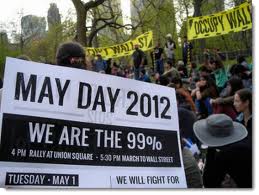
A reader asks why I did not stay home from work and join the May Day protests today, and I feel like this question deserves a serious response.

Partly, I have always had a phobia about crowds, and never willingly put myself into a crowd situation.  I don’t even like to go to an agricultural fair, or a peaceful parade.  In my Manhattan youth, crowds and violence often went together, or at least crowds and the fear of violence.  I am a wimp.

Partly, I felt like I could do more good in my classroom today than anonymously out on the streets.  It is the last full week of classes at my institution; students are finishing up projects that need response and guidance.  If I didn’t show up to work today, it would throw a monkey wrench in the plans I made for a graceful and productive ending to our semester together.

Partly, I don’t have any beef against my own employer, so not showing up for work today would affect the wrong target, while making no difference at all to the intended target, the 1%.

I guess the biggest reason I felt like my presence was expendable to today’s protest is because no one would notice if I was or was not out there on the street, but I would definitely be missed from my classroom.

However, in at least one of my two classes today, I did spend some time talking about May Day and the reasons for the protest.

I was surprised to learn that very few of my students had any clue as to what May Day signified to the labor movement, or why the protests today were taking place.

I don’t know why I assumed that my students would be more politically aware than I was at their age.

Turns out, few of them even realized there were going to be significant protests today, much less what they were all about.  Some also had their doubts as to whether the Occupy approach was likely to be effective.

Well, I pressed them, if occupying public spaces is not an effective means of protest, what would be more effective?  Joining a political campaign?  Writing a letter to the editor?

No one had an answer to that, but I could see the wheels turning.

And that’s why I am glad I decided to stay at work today.  At least with this one small group of students, I was able to foreground these historic May Day protests in their minds, and ask some questions that no one else probably would have asked them today.

Maybe as a result they will be paying attention to the news in a different way, and thinking more concretely about how the issues blazoned across all those posters and banners are relevant to their own particular lives.

Whether working on the small canvas, in the classroom, or the big canvas, out in the street, we are working together to build up the necessary momentum to blast our way to a better world.


America, land of the brain-damaged and debt-enslaved

Is it any surprise that we Americans treat animals and the natural world so badly, given the way we treat even our own cherished children?

This week there were two grim news stories illustrating the callousness of American society towards its young adults.

The first was a disturbing column by Nicholas Kristof revealing to the public what research scientists have known for a while: the skyrocketing rates of PTSD and suicide among young veterans returning from the Iraq and Afghanistan wars are due not to mental instability, but to the physical effects of repeated exposure to shock waves caused by bomb detonations.

The military is in the process of performing autopsies on veterans who committed suicide, and so far an alarming number of them have shown evidence of chronic traumatic encephalopathy (C.T.E.), a degenerative disease of the brain best known for affecting boxers and football players who endure repeated concussions.

“In people with C.T.E.,” writes Kristof, “an abnormal form of a protein accumulates and eventually destroys cells throughout the brain, including the frontal and temporal lobes. Those are areas that regulate impulse control, judgment, multitasking, memory and emotions.”

In other words, even young soldiers who return home physically intact may in fact be suffering from the hidden effects of shock wave concussions, which will destroy their lives over time; apparently the disease “typically develops in midlife, decades after exposure. If we are seeing C.T.E. now in war veterans, we may see much more in the coming years,” says Kristof.

***

Number two, we learned yesterday that the combined student debt in the United States reached $1 trillion. 

Occupy Wall Street demonstrators participating in a street-theater production wear signs around their neck representing their student debt during a protest against the rising national student debt in Union Square, in New York, April 25, 2012. The protest eventually marched to Wall Street; two people were arrested during the protest. REUTERS/Andrew Burton

I can’t even wrap my mind around a number that big, but one thing I can understand is that this is an egregious example of how we as a society are condemning our best and brightest young people to spending the best years of their lives in debt bondage to the banks.

For the wealthy, college and graduate school continue to serve as playgrounds for the young, a place to have fun, learn a few things and pair up before joining the family business.

For the rest of us, college is an essential step along the road to personal and professional success.  It’s not optional, and the price tag just keeps rising, while the ability of parents to pay for their children’s higher education keeps falling.

And so we find kids still in their teens signing loans for tens of thousands of dollars.  It is not uncommon for these kids to find themselves, just a few years later, with a B.A. and $200,000 worth of debt.

If you have ever tried to pay the interest on that much debt on a typical entry-level salary, you know that it’s nearly impossible.  Certainly it’s daunting to try to achieve the American dream—the car, the house, the spouse and two kids—with that kind of stranglehold of debt around your neck.

***

So this is the way we treat our precious children in America.

In a new twist on “friendly fire,” we send them to war without even realizing the longterm effects that our fancy new bombs will have on them.

And we blithely tell them that a) a college education is the only way to get ahead; and b) if you want one, you have to get in line at the loan office and spend the first 20 years of your working life paying off that interest.

There is something deeply, hauntingly wrong with this picture.

And you know what the worst thing is?  There is no widespread outrage about it!

If you are a young person, a parent, or any person with a conscience, you should be working furiously to end war and to end debt bondage for students.

How?

Well, start by standing up and saying NO MORE!!!!

Who’s Afraid of Distance Learning?

It used to be that a smart, motivated young person could work hard, earn a doctorate, do a good job as a junior professor, and live happily ever after as a tenured professor.

It also used to be that a smart young person could work hard, get into a good college, and expect to be taught with passion and enthusiasm by a corps of dedicated professors.

Despite the ever-increasing cost of college tuition, neither of these expectations holds water any more.

Academia, as a profession and as a social landscape, is deeply troubled right now, in ways that are profoundly connected to wider social and economic problems in our society.

In today’s New York Times, pundit David Brooks suggests that colleges need to do more to ensure that their high sticker price is delivering measurable value. However, his solution—standardized exit testing of college seniors—shows how out of touch he is with the real issues and problems facing academia today.

At a recent high-level conference hosted by Lafayette College, ponderously titled “The Future of the Liberal Arts College in America and its Leadership in Education Around the World,” “Lafayette President Daniel H. Weiss laid out four major challenges facing liberal arts colleges — affordability, public skepticism about the value of a liberal arts degree and college in general, decline in the share of U.S population who fit the demographic patterns of students who traditionally attend liberal arts colleges, and questions about how to incorporate technology into the college and serve a generation of students that is increasingly networked.”

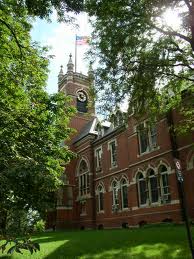
Smith College

At small liberal arts colleges like Bard College at Simon’s Rock, where I teach, we pride ourselves on a low student-faculty ratio. At Simon’s Rock the ratio is only 9 students to each professor.  But of course that’s a big part of why our tuition is so high, to pay for the one-on-one, intensive engagement with each student.

From the perspective of college presidents and administrators trying to make ends meet, this educational model may not be sustainable.

Certainly that was the case at the University at Albany, SUNY, where I taught for nine years in an interdisciplinary first-year seminar program designed to “give a small college experience in the big university.”  The program, which had just received an enthusiastic external review that trumpeted its successes in retention and learning outcomes for the roughly 800 students we served each year, was axed in 2011.

Now those 800 students are sitting in the big lecture halls with 500 others at a time—or, just as likely, not bothering to go to class at all.  It was a common complaint among my SUNY students that the professor wouldn’t know or care if you showed up or not—all it took to pass the course was cramming for the exam with the textbook.

Given this scenario, it’s not surprising that more and more of our large universities are shifting to distance learning.  Why go through the trouble of housing thousands of undergraduates, when you can deliver the lecture and the exam to them in their own bedrooms at home?

There is truth to this, and I have no doubt that networked, globalized distance learning is going to be the standard form of higher education delivery in the years to come.  It’s already happening incredibly fast, and even small liberal arts colleges need to be thinking about how to jump on that train before they miss it entirely.

As someone who teaches media studies, with a special interest in new media, I am in many ways delighted and intrigued by the potential of distance learning in higher education.  I have even been trying to persuade the administrators at my college to give it a try.

While it is never going to be the same as the old-fashioned model of nine students sitting around a seminar table with a professor, with current video capabilities it can come pretty close, as anyone who has tried a Google “hang-out” can attest.

And wouldn’t it be exciting to “hang out” in a seminar classroom with students from around the world?  We higher ed folks like to trumpet the value of diversity and international education—well, distance learning provides the platform to make the dream of a truly diverse and globalized classroom a reality.

However, there is a catch, and it is the same catch that has dogged other American industries as they have leaped on to the globalization bandwagon.

U.S. higher ed is already troubled from within by the shift from stable, tenured fulltime faculty to legions of roving part-time adjunct faculty.  With distance learning, the adjunct model gains even more steam, and goes global.

Why not outsource that first year Calculus course to a professor in India, who will teach 1,000 students for a fraction of what even an adjunct in the U.S. would earn?

Welcome to the knowledge sweatshop of the future.

According to the Inside Higher Ed article on the Lafayette conference, “Williams College President Adam F. Falk argued that the principal reason for adopting technological innovation should be for educational improvement, not just productivity gains. ‘College education isn’t simply about most efficient or innovative means of delivering content,’ he said, arguing that the engagement component of what colleges like his do was over all more important. ‘It’s hard for even the best students to learn on their own.’ Falk’s presentation was warmly received by the crowd.”

But Williams College is one of the richest liberal arts colleges in the nation, with an endowment of nearly $2 billion even after the economic downturn of 2008.

The social stratification that is affecting every aspect of American society is no less marked in higher education.

In the near future, we will be looking at an academic landscape where there will be a few highly paid tenured research professors and a vast majority of poorly paid adjunct professors all over the world, working mostly from their home offices via distance learning networks.  While there will always be a few lucky students who will be able to gain access to ivied classrooms through scholarships, those classrooms will increasingly be reserved for the children of the super-elites of the world.  Ordinary kids who have the motivation and discipline to go to college will do it from home, a financial decision their parents will have no choice but to support.

Distance learning is often lauded as a way to level the playing field, since it makes higher education accessible to kids who would not otherwise be able to go to college.

This may be so.  But it is also going to be yet another way to divide our society into Alphas, Betas, Gammas, Deltas and Epsilons—in other words, to harden the de facto caste walls that are already making the old rags-to-riches, pull-yourself-up-by-the-bootstraps American dream a quaint memory.

Pleasure plus meaning equals happiness: homage to my mom

Maria Sirois

Yesterday I went to a Berkshire Festival of Women Writers workshop facilitated by psychologist and inspirational speaker Maria Sirois.  The workshop was called “Happiness: Writing as a Path to Positive Transformation,” and since I am always looking for ways to link all those terms—happiness, writing, path, positive, transformation—I was eager to see how Maria would lay it out for us.

I was not disappointed.  She quickly got the group writing about happiness, and not surprisingly, when I started freewriting about joy, it wasn’t long before I began writing about my childhood summers spent at my family’s country house…long, endless, happy weeks where my brother and I seemed to be perfectly in synch with our mother’s rhythm, where life was peaceful, idyllic and beautiful…the epitome of joy.

Later, when we went around the room and everyone shared a short bit of their freewriting, I was struck by how many of the women present (we were all women that day) associated joy with childhood, and with nature.

Many people shared moments of joy connected with childhood memories of trees—climbing trees, wandering in the forest, listening to the wind in the trees.  Others had written about communion with animals, or remembered ecstatic time spent by the ocean in childhood.

A small corner of my mother's garden

What I remembered was watching my mother dig a rock garden out of the cow pasture in which she and my father had built their small country house when I was 5 years old.  Here are the two sentences I wrote during the workshop, and shared aloud:

“My mother would be quietly exultant as her shovel and trowel revealed new curves or deep, smooth walls of rock, and at the end of a hot morning’s work she would stand, sweaty and red-faced with a fine layer of black earth coating her bare shoulders, drinking iced tea out of a tall green glass and surveying her landscape with a squinted sculptor’s eye.  The work progressed slowly, since it was all done by hand, just one small, determined woman with a strong back and great patience, tracing out the rock with hand tools and as much love as if she were carving out the sweet, benevolent face and voluptuous body of the Earth Mother herself.”

***

Later in the workshop, Maria shared with us a memorable formula for happiness.

Happiness, she said, is the balance of pleasure and meaning.

If life is all pleasure, it can feel empty and meaningless.  If it’s all meaning, then you’re working too hard.

But if you can find the right balance of pleasure and meaning, you can hit that sweet spot of joy, in which you thrive and grow like a well-cultivated garden.

Maria suggested that there is something about creativity itself that brings us to this sweet spot.

My mother, spending her summers relaxing with her children and turning her surroundings into a beautiful landscape sculpture, was drinking from that creative well.

For me there are various creative taps I draw from: writing, teaching, creating programs like the Festival, bringing people together in harmonious, productive alliances.

Platter and dinner by my mom!

My brother recently observed that our mother has always been a wonderful model of someone who is completely focused, passionate about and committed to her art—whether that art is tonight’s dinner, or her magnificent pottery, or her lovingly tended garden.

Since earliest childhood, it has always been clear to me that she put every ounce of creativity she possessed into everything she did—not for external recognition or praise, but just because it was the right way—the most pleasurable way—to approach any task at hand.

Pleasure plus meaning equals happiness.

It strikes me that although my mom has had her share of ups and downs, hers has been by and large a very happy life.

No wonder when Maria asked me to write about joy, I went straight to my primary teacher: Sue Browdy, my mom.

Sparking Creativity at the 2012 Berkshire Festival of Women Writers

It’s finally snowing in Massachusetts!  My afternoon meetings were cancelled, and I can settle in by the fire and enjoy the peaceful quiet that always descends when we hunker down under a good New England snowfall.

This gives me a welcome chance to share something positive for a change with my blog readers.

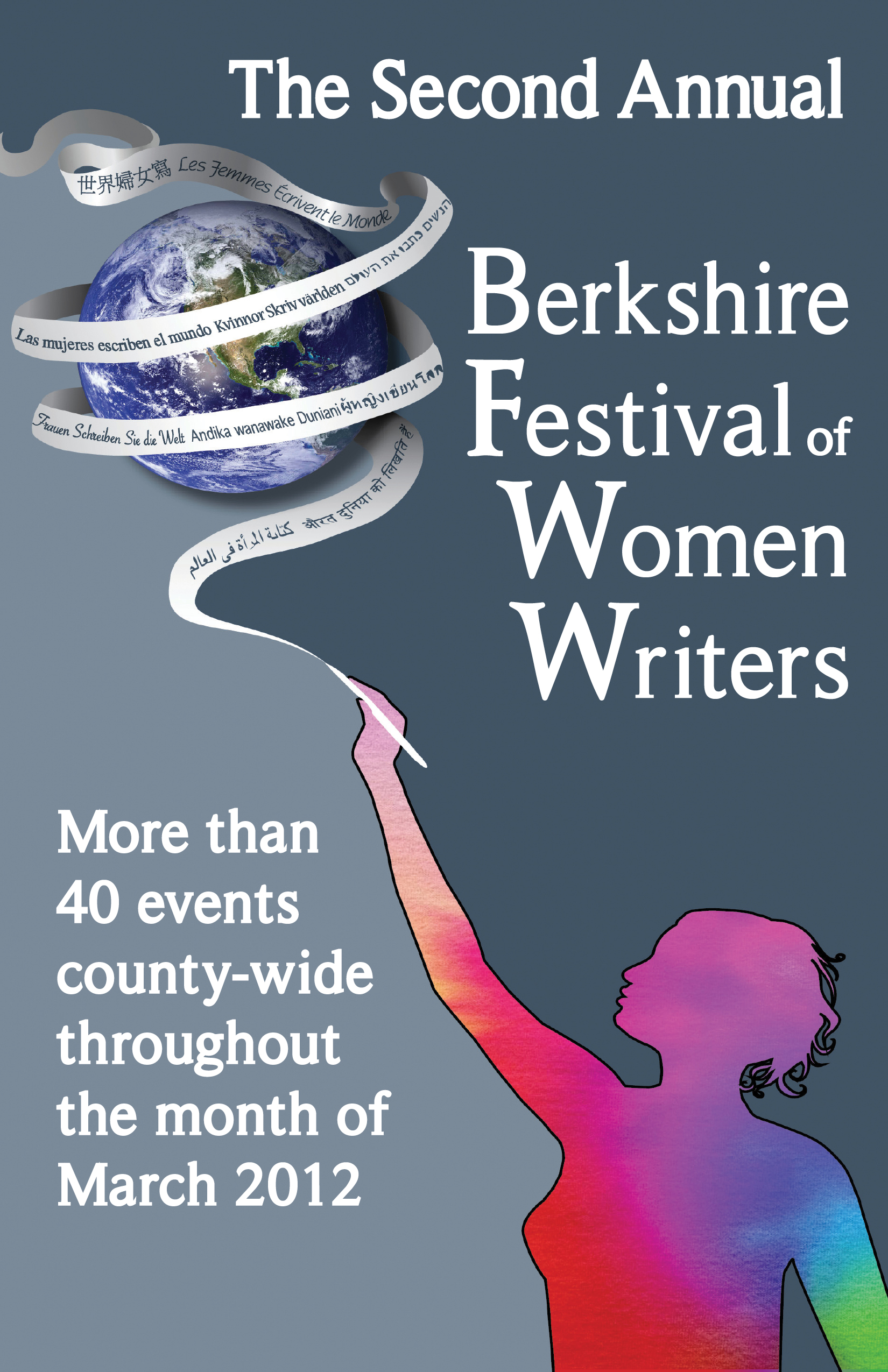
Tomorrow is the opening of the 2012 Berkshire Festival of Women Writers, a month-long celebration of the talents of local and regional women writers, taking place at venues from one end of Berkshire County to the other, with nearly 100 women participating.

I’ve been working over the past year with a dedicated local committee on planning and organizing this event, which is sponsored by Bard College at Simon’s Rock with the generous support of 11 Local Cultural Councils and many other donors, businesses and individuals, all listed on our website under “sponsors.”

This will be our second annual Festival, but it’s an event that grows out of the decade of annual conferences I organized at Bard College at Simon’s Rock in observance of International Women’s Day, co-sponsored by Berkshire Women for Women Worldwide, the Women’s Fund of Western Massachusetts, the Women’s Interfaith Institute and many other collaborators.

I’ve been at this a while.

Organizing events like these takes an extraordinary amount of energy, focus and commitment.  If you’ve ever organized a wedding, you have some idea of what’s involved–although for our conferences and Festivals, we’ve also had to do a fair amount of fundraising, which hopefully is not the case for wedding planners!

There always comes a point in the process where I bury my face in my hands and feel like crying, out of sheer exhaustion, “Why am I doing this to myself?!!”

After all, no one ever asked me to take on this extra commitment, year after year.

And sometimes I wonder whether anyone would notice if I stopped.

But then that low point passes, the brochure or Program comes back from the printers and starts to make its way in the world, the press inquiries pick up and I start hearing the oohs and ahhs of appreciation from participants and audience members, and I remember what it’s all about.

For women writers, in particular, it can be hard to find opportunities to come together and share our talents and achievements with each other and the larger world.

Hannah Fries

This weekend is the big AWP (Association of Writers and Writing Programs) conference in Chicago, and many women writers will be in attendance there, including one of our Festival organizers and participants, Orion Magazine editor Hannah Fries.  But that is a big, competitive event, which can be overwhelming for writers who are just starting out, or who just write for the personal satisfaction of it.

The Berkshire Festival of Women Writers is purposefully low-key and non-competitive.  We organizers wanted to create a broad, inclusive platform for all kinds of women writers, of all ages, backgrounds, and stages in their writing careers.  If you browse the Festival listings, you’ll see a few names you’ll probably recognize, like Francine Prose and Ruth Reichl, but many more whose fresh, innovative voices might not be heard publicly this year without the space provided by our Festival.

I also sometimes ask myself why I continue to focus on women writers in my classes, events organizing and in my own writing.

Lately I have been moving from a longstanding focus on global women’s rights to a broader human rights perspective, still with a strong interest in gendered human rights issues.  Although the goal for any social justice activist is to put herself out of business, it still seems important to me to draw attention to voices who might not otherwise be heard–and the 50% of us who are women are disproportionately represented among those quieter voices.

The participants and audiences who will be gathering at the 40 Festival events scheduled daily throughout the month of March will  together generate a host of collaborative creative sparks that will go shooting out like fireworks, energizing all of us and giving us new strength and determination to meet the challenges of the coming year, whether at our writing desks or in other areas of our lives.

I certainly hope that just as women always turn out to listen to and learn from writers who happen to be men, men will also be among the audiences at all of our Festival events.

In these sobering times, we need all the chances we can get to come together and fan the flames of our community and our creativity.  Let the Festival begin!

Out of the mouths of babes….

One of the most interesting aspects to me of Carol Gilligan’s research on childhood psychological development is her finding that as girls and boys mature, they lose touch with the instinctive, joyful, totally honest voice they were born with.

To some extent, this is necessary.  No one would want to live in a chaotic society of adult two-year-olds all shouting and crying and singing at the top of their lungs whenever they felt like it!

But it’s the loss of honesty that I find troubling, because it appears that when we lose touch with our own honest assessment of people and situations, we also lose the belief in our power to effect change.

***

When I was a young girl I was very sensitive to others’ pain, and it didn’t matter to me whether I was witnessing a tree being cut or a seal being tortured by a fishing net, I felt the pain so deeply that it became a wound in the innermost recesses of my own soul.

I’ll never forget one beautiful spring morning, when I was about nine years old. My family lived in the city, and we always arrived at our country house on Friday nights, in the dark.  On Saturday mornings it was my habit to get up early and go out for a walk by myself, reveling in the woods and fields and birdsong that I had missed during the week in the concrete canyons of New York.

On this particular May morning, full of sunshine and the fresh, moist air of spring, my buoyant good cheer was suddenly shattered by a shocking sight by the side of our driveway.  The telephone company had come during the week while we were away and cut down a big swath of young trees underneath the cables that ran along the road, leaving behind heaps of dying limbs and saplings, heavy with oozing sap and shriveling new leaves.

A gut-wrenching feeling of horror clutched at me; I began crying, crooning to the trees, overwhelmed with a feeling of shame and guilt—why were my people, humans, so destructive, so wanton, so careless and thoughtless? I was outraged, upset, furious, and went running back up the driveway to tell my parents, assuming they would share my reaction.

But instead they shrugged, resigned—it was too bad, but there was nothing to be done about it.

***

And of course now, as an adult, my reaction would be the same.  I witness road crews cutting back perfectly healthy trees all the time, and think nothing of it.

As we grow up, we get inured to the pain and suffering we visit on the natural world day after day.  We learn to tolerate injustice with casual lack of attention.  We lose the moral sensitivity with which we are born, and with it the fire within that impels little children to speak their truths and demand that the adults in their lives listen.

Told that it doesn’t matter whether some trees are cut, or a cell tower goes up, or a dam is built, or that there is so much artificial light at night that we can no longer see the stars, we are gradually lulled, as adults, into complacency, from which it takes a lot to dislodge us.

This is no accident.  Most educational practices consist of training the young to conform to authority and feed back the right answers to the questions asked.

It’s not about learning how to ask the questions that haven’t yet been formulated; the questions that come from one’s deepest reservoirs of knowledge.

Socrates believed that human beings enter the world already knowing everything we need to know, but we forget it in the first weeks of life.  We spend the rest of our lives, he believed, trying to remember.

As children, we know that we humans were born to live in harmony with the other living beings on this planet; to be a productive and positive part of the web of life that surrounds and sustains us.

Adults, I’m speaking to you: this is crucial knowledge that we need to remember, and act upon.

Coming to Voice, Saving the Planet

Yesterday acclaimed psychologist Carol Gilligan paid a visit to the class I am currently co-teaching at Bard College at Simon’s Rock with theater professor Karen Beaumont, “Human Rights, Activism and the Arts.”

Gilligan’s ground-breaking book, In A Different Voice, was the first to examine the psychological development of girls.

Yes, you read that right.  Before Carol Gilligan, American psychologists who studied child development based their model of the stages of human psychological development on their studies of boys.  Not until Carol came along in the early 1980s did anyone think to point out that girls and boys develop differently.

In her new book, Joining the Resistance, Gilligan explains that while girls start to silence their own voices in their early teen years, in conformity with social dictates about proper behavior for “good girls,” boys go through this self-regulation much earlier, around 5 or 6, when they learn that “crying is for sissies.”

Boys learn to suppress their caring, nurturing side because it’s too “feminine,” while girls learn to suppress their active, aggressive side because it’s too “masculine.”  In the process, both genders lose something crucial to their humanity, and our society as a whole is impoverished as a result.

Lately, Gilligan has been relating boys’ and girls’ resistance to the suppression of their natural androgynous voices to adults’ resistance to what she sees as a very destructive patriarchal culture.

She defines patriarchy as “those attitudes and values, moral codes and institutions, that separate men from men as well as from women and divide women into the good and the bad,” and argues that “as long as human qualities are divided into masculine and feminine, we will be alienated from one another and from ourselves.  The aspirations we hold in common, for love and for freedom, will continue to elude us.”

So much depends on whether we can come to voice.  And how we do so.  In the context of my human rights seminar, coming to voice may mean being able to speak out in an informed, passionate way about justice and injustice in specific circumstances, both here in the U.S. and abroad.

In the personal sphere too, we need to learn to express our needs clearly, without apology.  We women need to learn to value ourselves and insist on being treated fairly and with respect whether in the home or in the workplace.  Men need to demand that their emotional, nurturing sides be honored.

If it is hard for men to express emotions, it is hard for women to speak with authority.  As sociologist Michael Kimmel has shown, boys and men tend to over-estimate their own abilities while girls and women tend to have less self-confidence than their skills and talents warrant.

Boys and men need to learn to listen, to others and to their own innermost voices, the voices of compassion that were shut down when they were just little guys and learned that boys don’t cry.

Girls need to learn to speak up, to let their innermost voices out, to share freely what they know and what they imagine with the world.

My mother reminded me recently that when I was a young girl of 9 or 10, she considered me a “know-it-all.”  I used to read Ranger Rick and the National Wildlife magazines with voracious attention, and apparently I had a lot to say about the natural world and human beings’ role in it.

As I shared with my class yesterday, sometime around age 14, just as Carol Gilligan saw with her research subjects, I lost my voice.  I became the quiet girl in class.  I earned A’s on every literature paper I wrote, straight through grad school; but it was so hard for me to say out loud what I knew.  It’s taken me years to overcome that self-silencing and begin to recover the spunky, feisty voice that came pouring out of me naturally when I was a child.

As adults, knowing what we now know about the importance of voice to healthy psychological development, we should be working hard to encourage the boys in our lives to stay in touch with their emotional, caring, listening side; and the girls in our lives to continue to speak their truths even when they enter the maelstrom of puberty.

As Audre Lorde wrote long ago, “My silences had not protected me.  Your silence will not protect you…. We can sit in our corners mute forever while our sisters and ourselves are wasted, while our children are distorted and destroyed, while our earth is poisoned; we can sit in our safe corners mute as bottles, and we will still be no less afraid….

“We can learn to work and speak when we are afraid the same way we have learned to work and speak when we are tired.  For we have been socialized to respect fear more than our own needs for language and definition, and while we wait in silence for that final luxury of fearlessness, the weight of that silence will choke us.”

You got that right, Audre.  If anything, the dangers that you perceived back then–before you, like so many others, succumbed to cancer–have gotten worse.

If we care about our children, if we care about our Earth, we cannot afford to stay silent.  Indeed, there is more risk to staying quiet than to speaking out, with all the passion, emotion and authority we can muster as men and as women.

Cat got your tongue? Not mine.  Not any longer.