Which Side Are You On?

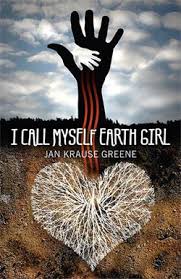
imagesFor the past few nights I have been putting myself to sleep by reading an advance copy of my friend Jan Krause Greene’s new novel, I Call Myself Earth Girl.

It’s not exactly a feel-good bedtime story, dealing as it does with rape, environmental disaster, death and bereavement.

But it’s also about empathy and love, between family members and also on a worldwide scale.

In Greene’s vision, the Earth and its denizens can be saved from catastrophe by mindful attention to what really matters: affirming life, both our own and that of the unborn generations to come.

Not since Starhawk’s 1994 masterpiece The Fifth Sacred Thing have I come across a book that so clearly matches my own waking nightmare of the terrible times that await us in the future, if we do not succeed in changing our ways now.

Let’s face it: it is possible that the kind of violence afflicting resource-starved places like Afghanistan, Syria and Somalia will become the norm in much more of the world, as climate instability creates food shortages and accelerates the pace of natural disasters beyond our capacity to recover.

America is a tinderbox just waiting to go off.  Imagine what would happen if suddenly it was not possible to go down to the supermarket and get your week’s worth of groceries?

Such a scenario is more or less unthinkable to people like me, who have grown up cradled by the richest breadbasket in the world.

We are only beginning to realize the costs that have come with our cornucopia: the destruction of the virgin prairies in the Midwest, the poisoning of the earth, water and air with chemical fertilizers, pesticides and herbicides; the grotesque factory farms of livestock and fish; the genetic alteration of seeds; the destruction of local farming by the huge predatory monster of American-style factory farms.

We have grown fat on these practices.  And now it’s time for us to accept responsibility for the outcomes of our heedlessness.

Those of us alive today have the privilege, and the responsibility, of presiding over what could very well be the end times for human civilization.

It’s somewhat analogous to the end times of specific human cultures, like the Greeks, the Romans, the Egyptians, the Ottomans, the great Chinese dynasties….except that this time, we’re not just talking about the end of a single culture, we’re talking about the demise of humanity as a species.

It is possible to imagine, as Jan Krause Greene did, that our lush green planet could turn brown from environmental disaster, provoking a culture of armed militias surviving by means of ruthless violence—with women, as always, at the bottom of the heap.

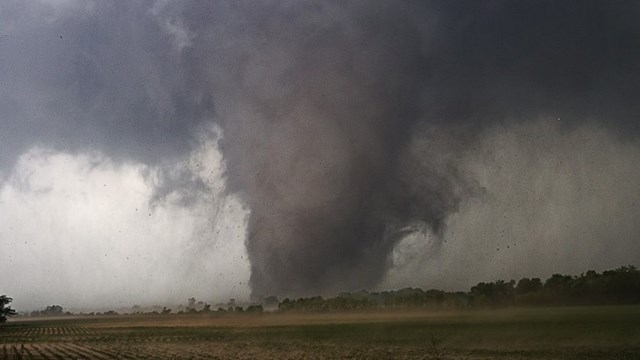
Tornado bearing down on Moore, OK; May 21, 2013

Tornado bearing down on Moore, OK; May 21, 2013

It is already happening—just not yet here, in the gated community we call America.

Can we wake up in time to forestall total, worldwide environmental melt-down?

In the past week we had a deadly two-mile-wide tornado in Oklahoma, and the Russian science station in the Arctic Circle had to be evacuated because the ice was melting at an unprecedented rate.

Here in New England we are expecting temperatures in the 30s Farenheit this weekend—way below normal for what should be the start of the growing season.

What’s next?

We don’t know.  But I take heart from local initiatives like the rehabilitation of the long-dormant Great Barrington Fairgrounds into a vibrant community-supported agriculture site.

We are going to have to re-localize agriculture if we want to survive the shocks of the 21st century.  We need to re-imagine not just agriculture, but community along with it.

As I Call Myself Earth Girl shows well, the antidote to violence and fear is love and empathy.

We still have a choice. Which way will you turn?  Which side are you on?  How far will you go to protect the planet and the generations to come?

fifth-sacred-thing

Living with fear

In the wake of the Newtown tragedy, I have been doing some thinking about fear.

I am no stranger to anxiety.  When I was a kid, between the ages of about 8 and 12, I suffered terrible anxiety attacks whenever I had to be separated from my mother.  I worried something would happen to her, and although I had a loving father, brother and extended family, I felt like I would be totally unable to cope with losing her.

When she would go out for the evening, I would get a full-blown anxiety attack, complete with hyperventilation, nausea and panic.  It wouldn’t subside until she was back home safe, and it was not rational—there was nothing she or anyone else could say to calm me down.  I just had to live through it, over and over, until finally, as I moved into puberty, the fear dissipated and went away.

Sometimes I have wondered whether this was related to a past-life experience.  Did I lose my mother in a previous life?  Was I left alone and unprotected?

Is it possible, as Linda Hogan and others have suggested, that we can be haunted by ancestral legacies of violence?

Both of my sons also suffered from irrational fear during their childhoods.

My older son went through a period of terrible night terrors, where he would sleep-walk under the influence of gut-wrenching anxiety and sobbing fear, not calming down until we managed, with great difficulty, to wake him up from whatever nightmare was possessing him.

He would not remember the episode in the morning, and would be sheepish when we’d tell him what had happened; in his waking life, he was calm and unencumbered by fear.  He hasn’t had one of these night terror attacks for about five years now.

My younger son developed a stutter and a nervous twitch in his early childhood, and would cry and talk about being almost paralyzed with what he called “worry.”  No amount of rational talking-through made any difference; he could not explain what he was afraid of, he was just deeply, inchoately fearful.

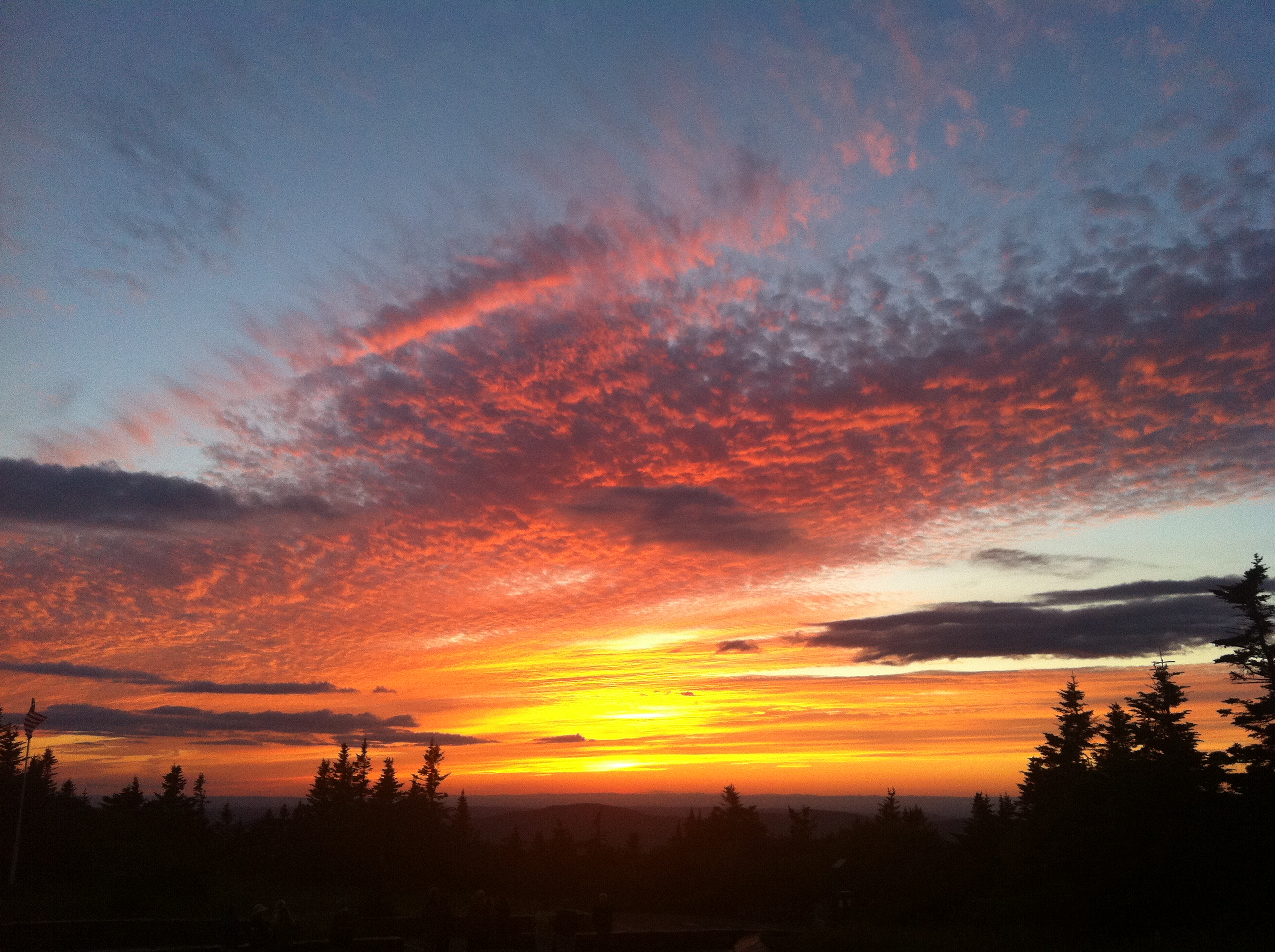
Mt. Greylock, MA; summer 2012

Mt. Greylock, MA; summer 2012

One day, when he was about five, I decided to take him on a long hike up a tall mountain, and we picked up small rocks along the way.  When we got to the top, I told him we were going to throw his worries over the edge of the mountain cliff, and they would be gone and leave him alone.  A smile lit up his face, and he began chucking the rocks off the cliff with intensity.  That day he was happy, and slowly, over the next couple of years, his unexplained anxiety did lift.

What’s perplexing to me about this “family anxiety” is that none of it has any basis in actual trauma.

Each of us did experience a minor trigger, it’s true.

I was separated from my mother when I was seven, for about two weeks, after a car accident landed her in the hospital; but then she came home and was fine.

My older son attributes his night terrors to an incident where he accidentally locked his younger brother, an infant, in the car on a very hot day, and the police had to come and break into the car to get the baby out.  But we were all fine, and of course we absolved the older child of any blame, it was just an innocent mistake.

My younger son developed asthma after an incident of severe pneumonia at seven months, and he was always afraid of the hospital, with the dark x-ray room, the menacing machines, and the possibility of separation from his parents.

But these are such minor precipitating incidents, compared to, say, the shock of bearing witness to a massacre, or living through a rape or domestic violence.

I can’t claim to have any inside knowledge of the kind of traumatic stress that survivors of serious violence must deal with, but having been taken for a ride by severe, irrational anxiety, I can sympathize deeply.

The truth is that all of us, in today’s hyper-linked media age, are living with the scars of bearing repeated witness to violence.

One of our greatest strengths as human beings is our imagination.  Put our active imaginations together with our empathy, and it should be no surprise to find that so many of us are feeling in our own bodies the fear and anxiety that are properly part of others’ experience, not our own.

How many murders and massacres, real and fictional, have we witnessed through the news and entertainment media?  How many times have we watched homes being bombed, people being shot, crazy predators on the loose?

The presence of 300 million guns in civilian hands in the U.S. does not make me feel safe.  It makes me feel afraid—and this time, the fear is rational.

IMG_0740

Responding to Racism or Sexism: The Transformation of Silence into Language and Action, Again and Again

I shouldn’t be surprised that once again the ugly specter of racism and unacknowledged privilege is raising its head on my own little campus community.

It happens almost every year like clockwork, generally in the fall semester around this time, and usually involving freshmen who are still in the process of adjusting to the new, often more racially/ethnically/socially diverse culture in which they have suddenly landed.

Understandably, people of color who have had to put up with racism and white privilege all their lives get angry when it turns up, in all its crude arrogance, here in our campus home as well.

One angry response leads to another angry retort, onlookers begin to take sides, and before you know it the campus is in an uproar, with some calling for apologies, others calling for calm, and the majority just plain mad and not willing to take it anymore.

I want to talk about anger.

As a woman, albeit a white woman, I know something about how members of subordinate groups are not supposed to respond with anger to actions by members of dominant groups.  We are supposed to keep our cool, to turn the other cheek, seek the higher ground, not stoop to their level.

So we pretend we didn’t hear that cutting remark, muttered just loud enough to be audible.  We pretend we didn’t want to go to that party anyway—the one to which our invitation somehow got lost in the mail. Above all, we don’t respond directly to provocation, because that will just give them an excuse to keep going, and make the whole situation worse—not for them, but for us.

So the anger, unexpressed, gnaws at us, sitting in the pit of our stomachs as unmetabolized bitterness that threatens to choke us when, at unexpected moments, its bile rises into our throats.
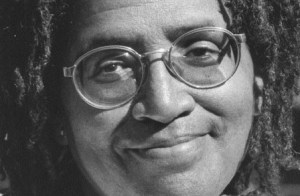
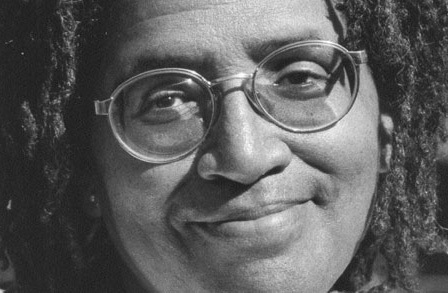
Audre Lorde

As a woman, I have felt this bitter resentment.  And yet as a white woman, I have also felt the other side, the ignorant innocence of privilege.  Growing up in a racist society, I did, as Audre Lorde famously put it, accept racism “as an immutable given in the fabric of [our] society, like eveningtime or the common cold” (“The Uses of Anger,” Sister Outsider, 128).

I didn’t think to question why there were no African American families living in my apartment building on the Upper East Side of Manhattan—other than, of course, the live-in maids who could be seen going in and out of the service entrance or trundling laundry down the service elevator. None of the doormen or elevator men were people of color either—most were Irish, like our superintendent, or perhaps German or Scandinavian.

I didn’t think to question why there were hardly any African Americans or Latinos in my public elementary school, or in the selective public high school I attended, Hunter College High School.  When I got to college, it was the same, and again, I was incurious, complacent.

When you grow up this way, in an insular environment of privilege, it is possible to be deluded into thinking that this is just the way the world is.  No one in my whole upbringing encouraged me to ask the kinds of questions that might have made me see the how the fabric of my existence was shot through with deep-seated, longstanding racism.  No one talked about it.  It just was, and since for me that privileged life was very comfortable, I had no incentive to rebel against it.

It was reading that eventually opened my eyes to how the other half (or, globally speaking, two-thirds) lives.

When I happened upon Lorde’s autobiography, Zami: A New Spelling of My Name, and read about how she too had gone to Hunter College High School, the only Black girl in a sea of white, and how hard that was for her in so many ways, I began to see my experience there through her outsider’s eyes.  I began to question the way I had lived in a vacuum of privileged blindness for so long.

Lorde’s essay on “The Uses of Anger” is one I go back to again and again.  The sentence that continues to resonate powerfully with me is this:

“I am not free while any woman is unfree, even when her shackles are very different from my own” (132).

Listening to Audre Lorde with an open heart, I understood why she was angry at the racist structures into which she was born and bred.  I knew I was not responsible for creating those structures, into which I too had been born and bred, but I did have the power to question them, and to ally myself with those who were working to change them.

When it comes to racism and other forms of identity-based oppression, it really is true that ‘you’re either with us or against us.”  There’s no way to hide behind a façade of neutrality.  To say nothing when someone drops a racial slur or pinches a woman’s behind is to become an accomplice to that act.  In these situations, silence is itself a form of tacit consent.

Audre wrote about that too, in an essay called “The Transformation of Silence into Language and Action.”

I often reread these lines when I am feeling fearful of speaking out on an issue I care about:

“We can sit in our corners mute forever while our sisters and our selves are wasted, while our children are distorted and destroyed, while our earth is poisoned; we can sit in our safe corners as mute as bottles, and we will still be no less afraid….We can learn to work and speak when we are afraid in the same way we have learned to work and speak when we are tired.  For we have been socialized to respect fear more than our own needs for language and definition, and while we wait in silence for that final luxury of fearlessness, the weight of that silence will choke us….it is not difference which immobilizes us, but silence.  And there are so many silences to be broken” (42-44).

As an ally with some measure of privilege, one of the best things I can do to advance the goal of a just society is to speak up when I see racism or sexism or any other form of discrimination taking place.  And not just speaking to my friends, but speaking up in public, inviting and sometimes even provoking a sustained conversation, with the aim of promoting greater awareness and understanding.

The flashpoint for the current unrest on my campus was a white male student challenging the validity of the school holding a campus-wide teach-in known as “Diversity Day,” in which students, staff and faculty organize workshops around issues related to the politics of identity.  Originally, Diversity Day was entirely a student-organized event, held on an extracurricular basis to compensate for a perceived lack of attention to non-white-western-male culture and experience in the curriculum.  The founding students lobbied hard, and ultimately successfully, to have their effort institutionalized by having classes cancelled, with all students required to attend at least two workshops during the day.

Whenever a revolutionary gesture becomes institutionalized, it loses some of its spark, and maybe this is an event that needs to continue to evolve.

But only someone who was ignorant of the extent to which discrimination and structural identity-based limitations continue to affect women and people of color in this country could argue in good faith that it was not worthwhile to spend some time discussing these issues one day out of the school year.

Of course, many students will take classes in sociology, anthropology, gender studies or ethnic studies and go a lot deeper. But those are often the students who already have an inkling that all is not well for subordinate groups.

It is the most privileged who are often the least aware of how systems of privilege operate, and therefore the least likely to elect to take classes in these topics.  These are the students who are most likely to benefit from being required to attend two eye-opening workshops on Diversity Day.

At many of these workshops, people of privilege will be asked to confront W.E.B. Dubois’s famous question in The Souls of Black Folk, “How does it feel to be a problem?”

Robert Jensen

Robert Jensen, one of the finest anti-racist, anti-sexist writers and educators I know, says that in the 21st century, “the new White People’s Burden is to understand that we are the problem, to come to terms with what that really means, and act based on that understanding.  Our burden is to do something that doesn’t seem to come naturally to people in positions of unearned power and privilege: Look in the mirror honestly and concede that we live in an unjust society and have no right to some of what we have” (Jensen, The Heart of Whiteness: Confronting Race, Racism and White Privilege, 92).

The next step, he says, is to “commit to dismantling white supremacy as an ideology and a lived reality”—not because it’s hurting other people, but because, as Lorde recognized, “none of us is free while some of us are still shackled.”

Or, as Alice Walker put it, “We care because we know this: The life we save is our own.”

Moving from suffering to pain to resistance

“Pain is an event, an experience that must be recognized, named and then used in some way in order for the experience…to be transformed into…strength or knowledge or action.  Suffering, on the other hand, is the nightmare reliving of unscrutinized and unmetabolized pain.  When I live through pain without recognizing it…I rob myself of the power that can come from using that pain, the power to fuel some movement beyond it.”

Audre Lorde,  Sister Outsider, 171

Too much of the time, we who are sensitive, aware human beings on the planet feel the burden of suffering, the “nightmare reliving of unscrutinized and unmetabolized pain.”

For example, when I read in the current National Geographic Magazine that 25,000 elephants have been killed this year in East Africa by poachers and even government soldiers who want to make money on their tusks, the nightmare of suffering descends upon me.  When I hear that the president of Kenya has declared that “elephants must pay for their room and board with ivory,” I begin to feel physically sick.

The same kind of nausea descends on me when I hear about the melting of the ice in the Arctic or the permafrost in Greenland—even more so when the loudest response to this calamity comes in the form of rapacious, competitive cheering and jostling for position to be the one to extract the greatest amount of riches now revealed beneath the ice.

Or when I read about the ongoing sexual abuse that is occurring rampantly on the Spirit Lake Indian Reservation in North Dakota, a kind of externalization, upon the defenseless bodies of small children, of the unmetabolized suffering of generations of Native peoples trying to survive in unspeakable conditions.

Brooding over all the news of suffering that comes my way each time I take a look at the daily news, I can quickly feel myself overwhelmed with a sense of my own powerlessness.

That is where I need Audre Lorde’s fierce courage to pick me up, dust me off and send me on my way again.

The challenge is to remain open to the suffering, in order to, as she says, recognize, name and use it “to fuel some movement beyond it.”

For many of us right now, the greatest challenge is the awareness that we don’t know what to do. And maybe, even, that there is nothing we can do.

I cannot heroically save the elephants, any more than I can refreeze the polar ice caps or swoop in to rescue the frightened child who is being raped right at this moment.

No.  But what I can do is to try to leave myself open to the suffering—in other words, to not turn away, not deliberately turn off my empathy in order to try to hide from a reality that is hard to confront.

It is my belief that if more of us were to commit to recognizing and naming suffering when we see it, we would find the strength and the right channels to collectively metabolize suffering into the kind of pain that leads to action.

Each of us needs to become a vortex through which the pain can be transmuted first into resistance, and then into an active seeking for alternative paths.

It is not necessary that tens of thousands of elephants die.  It is not necessary that we see the melting of the Arctic as an opportunity to extract more fossil fuels and heat up the atmosphere still more.  It is far from necessary that the children of Spirit Lake are tormented by their elders.

Do not turn away from this suffering.  See it, name it, and turn the pain that these events awaken in you to a righteous force for change.

You don’t need to have all the answers or know what to do with the pain.  Just allow yourself to feel.  Allow empathy to flow.  And then see what happens next.

Out of the mouths of babes….

One of the most interesting aspects to me of Carol Gilligan’s research on childhood psychological development is her finding that as girls and boys mature, they lose touch with the instinctive, joyful, totally honest voice they were born with.

To some extent, this is necessary.  No one would want to live in a chaotic society of adult two-year-olds all shouting and crying and singing at the top of their lungs whenever they felt like it!

But it’s the loss of honesty that I find troubling, because it appears that when we lose touch with our own honest assessment of people and situations, we also lose the belief in our power to effect change.

***

When I was a young girl I was very sensitive to others’ pain, and it didn’t matter to me whether I was witnessing a tree being cut or a seal being tortured by a fishing net, I felt the pain so deeply that it became a wound in the innermost recesses of my own soul.

I’ll never forget one beautiful spring morning, when I was about nine years old. My family lived in the city, and we always arrived at our country house on Friday nights, in the dark.  On Saturday mornings it was my habit to get up early and go out for a walk by myself, reveling in the woods and fields and birdsong that I had missed during the week in the concrete canyons of New York.

On this particular May morning, full of sunshine and the fresh, moist air of spring, my buoyant good cheer was suddenly shattered by a shocking sight by the side of our driveway.  The telephone company had come during the week while we were away and cut down a big swath of young trees underneath the cables that ran along the road, leaving behind heaps of dying limbs and saplings, heavy with oozing sap and shriveling new leaves.

A gut-wrenching feeling of horror clutched at me; I began crying, crooning to the trees, overwhelmed with a feeling of shame and guilt—why were my people, humans, so destructive, so wanton, so careless and thoughtless? I was outraged, upset, furious, and went running back up the driveway to tell my parents, assuming they would share my reaction.

But instead they shrugged, resigned—it was too bad, but there was nothing to be done about it.

***

And of course now, as an adult, my reaction would be the same.  I witness road crews cutting back perfectly healthy trees all the time, and think nothing of it.

As we grow up, we get inured to the pain and suffering we visit on the natural world day after day.  We learn to tolerate injustice with casual lack of attention.  We lose the moral sensitivity with which we are born, and with it the fire within that impels little children to speak their truths and demand that the adults in their lives listen.

Told that it doesn’t matter whether some trees are cut, or a cell tower goes up, or a dam is built, or that there is so much artificial light at night that we can no longer see the stars, we are gradually lulled, as adults, into complacency, from which it takes a lot to dislodge us.

This is no accident.  Most educational practices consist of training the young to conform to authority and feed back the right answers to the questions asked.

It’s not about learning how to ask the questions that haven’t yet been formulated; the questions that come from one’s deepest reservoirs of knowledge.

Socrates believed that human beings enter the world already knowing everything we need to know, but we forget it in the first weeks of life.  We spend the rest of our lives, he believed, trying to remember.

As children, we know that we humans were born to live in harmony with the other living beings on this planet; to be a productive and positive part of the web of life that surrounds and sustains us.

Adults, I’m speaking to you: this is crucial knowledge that we need to remember, and act upon.

Dare to love

Like most people I know, I have just a very narrow sphere of knowledge that I’m willing to let penetrate my consciousness at any given time.

There’s so much I know but don’t want to know. So much I choose not to acknowledge.

It’s a form of self-preservation, because if I were to allow myself to really feel the unnecessary pain and suffering that floods our world like an endless terrorized scream into the night wind, all the time…I could not bear it.  I would go insane.

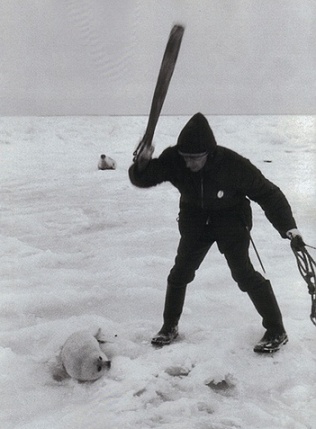
What prompts these reflections today is the news that hundreds of thousands of seal pups are drowning in the Gulf of St. Lawrence this season, after a straight run of disastrously warm winters where the pack ice on which harp seal moms give birth has been too thin to provide the shelter the pups need to survive.

Add to this the fact that the Canadian government, knowing full well that the harp seal populations are in dramatic decline due to global heating, is still going ahead with the annual seal pup hunt, allowing as many as 330,000 pups to be clubbed to death by hunters this season.

This despite the fact that Russia and the European Union, the principal clientele for seal fur, have banned imports this year.  Despite the fact, too, that a huge backlog of seal pelts is sitting in warehouses.

It’s one thing to kill animals for food. Human beings are carnivores, after all.  But killing for sport…killing for unnecessary furs…killing for no good reason makes me feel deeply ashamed of my species, and heartsick for the loss of life.

I don’t know what to do with these feelings.  Signing yet another online petition or sending yet another contribution to a Save the Seals campaign does not seem anywhere near adequate.

I am not capable of practicing tonglen, taking in the suffering and sending out lovingkindness to both the victims and the perpetrators, as Buddhists like Pema Chodrun recommend.  I can neither bear to take in the suffering, nor stomach sending anything akin to kindness to the perpetrators.

So I do what most people do.  I close my eyes.  I grow some kind of hard shell around my heart.  I choose, without even consciously realizing what I’m doing, to ignore news and information that will upset me.

I remember clearly that as a child, I was not yet capable of this degree of callousness.  I very rarely was exposed to any suffering, since I grew up in a very sheltered environment, but every so often something would manage to get through into my sweetly padded cocoon, and leave me gasping in empathetic pain.

Once I was standing outside on the lawn in front of the house, and a bird whizzed by me and flew straight into a window.  It fell to the ground, stunned.  I ran to it and picked it up, cradling its trembling body in my arms.  Its neck was probably broken…it died within an hour.  I held it and cried over it and mourned it so deeply that even now, so many years later, I still tear up thinking about the sorrow that small death called up in me.

I can’t live with that kind of sorrow all the time; I would be paralyzed with grief.  And so I compartmentalize.  I go about my business and actively avoid thinking about the thousands of seal pups dying today.  Or the wolf pups being poisoned by the Canadian government to clear out the boreal forest in preparation to extract oil.  Or the millions of songbirds and waterfowl killed each year by US federal government agencies because they get in the way of industrial agriculture or airplanes or golf courses.

Just for a moment, let’s dare to imagine what the world could be like if adults like me did not deliberately silence and smother our empathy for the creatures who need our help to survive.

Love might just be the most radical gift we could bring to the world.

What could be more potent than action fueled by love?  Do we dare?  Can we afford not to?

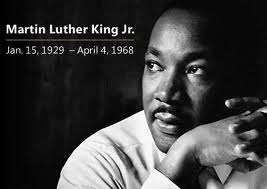
On MLK Day, Opening the Hearts of the Privileged

When I first heard the phrase “privilege is invisible to those who have it,” it seemed like the answer to a question I didn’t even know to ask:

How can people who are so nice, who would never hurt a fly, be so oblivious to the ways in which their lifestyles are deeply hurting others?

Oblivious is the operative word here.  Most privileged people really don’t have a clue as to how “the other half lives”–or make that, the other 90% or so. Just as I don’t understand how it is to be a child slave working on a cocoa farm in Africa, or for that matter a honeybee bringing poisoned pollen back to the hive and dying of it myself, people way up on the class ladder in the US can’t understand what deprivation feels like–and if you can’t get to that feeling place, it will be very hard to arrive at any sort of comprehension or even curiosity.

There are so many examples of what I’m talking about, but having just signed a petition to President Obama calling attention to the issue of contingent faculty, my mind is going to a memory I can’t shake, from my days of adjunct teaching.

I had been teaching as an adjunct at my alma mater for a couple of years, having decided to forgo a serious tenure-track search while my first son was an infant.  In the spring, after a busy year of adjunct teaching, I went to talk to the Dean, to see whether it would be possible to improve my status at the college so my salary would not be cut off during the summer.  I don’t remember the exact words of her response, but her attitude was plain: what happens to you over the summer, when we don’t need you, is none of our concern.  Next!

I was naive, I guess, to imagine that she would care that she was not paying me a living wage.  But I had grown up among the privileged, for whom it was really unfathomable, the idea of not making a living wage.  If you weren’t making enough to live on, then something must be wrong with you.  You’re not trying hard enough, you’re not talking to the right people, you just don’t have what it takes.

In this situation, I felt the duality of on the one hand being outraged, as any privileged person would be, at being treated in such an unfair, exploitative fashion, and on the other hand, feeling shamed and inadequate because of course it must be true, it must be my fault that I’m being treated so badly.

For people from a different background than mine, it would be quite easy to internalize those feelings of shame and self-doubt, to the point where one would begin to believe them.  I have studied many autobiographies by people who were marginalized and disadvantaged from birth by their race, ethnicity, gender, etc, and this self-loathing is a common feature of what W.E.B. DuBois called “double-consciousness,” seeing oneself through the eyes of another.

But I grew up with every advantage, and was always a star in the academic realm, a child prodigy in reading and writing who received a BA magna cum laude at 19 (it would have been summa if I hadn’t had to take those damned statistics classes!), a straight A student through grad school who excelled at jumping through every hoop set out for me.

Thus my amazement at finally attaining my goal of teaching at the college level, and being told that while I was doing a great job, there was no chance of being paid fairly for it.

My point in relating this story is that most people who grew up like me would never have such a story to tell.  For us the red carpet rolls out automatically wherever we go; people bow and beckon, smiling; life is easy and delightful. And when you live that kind of existence 24/7, when it’s your whole life from earliest childhood, it’s just inconceivable that it could be otherwise.  Or if it is, then as I said, there must be something wrong with you personally.  It’s not the system that’s at fault if things aren’t going your way, it’s your own personal inadequacies.

That seems to be the explanation that many among the 99% accept when they fall upon hard times.  Home foreclosed? What a fool you were for signing that mortgage!  Lost your job?  Why didn’t you go into a more stable field?  Single mom?  Honey, don’t you know how to keep a man?  And so on and so forth.

Both sides of the class divide need reminding that we are all born into a pre-existing social structure, some with gold spoons, and some with plastic spoons in our mouths.  The playing field is most assuredly not level.  Those who are living well need to realize that they owe their good fortune as much to their favorable placement in the Game of Life as to their own smarts and hard work; and those who are struggling need to realize that it’s not all their fault.

Pointing fingers at individuals is not going to lead to a fruitful discussion.

Was it the Dean’s fault that it was standard practice at the college to pay adjuncts by the semester?  She was just going along with the flow, wasn’t she?  Was it the mortgage lender’s fault that people took on more debt than they could repay?  The mortgage officer was bending over backwards trying to give that family the house of their dreams, wasn’t she?

Right. Rather than seeking to cast blame, we need to be looking for ways to make the system fairer for all the new children being born into it every minute.  One of the most basic steps we can take is making privilege visible to those who have it.  The privileged, who have more social power than the disadvantaged, need to know and understand how their complacency with a warped social system impacts the less well-placed.

Knowledge is the first step towards compassion, and from compassion comes the desire to make what’s wrong right.

It’s not about casting stones.  It’s about sharing experiences, and hoping that those in power will listen with open minds and hearts.

On the eve of MLK Day, that is my fervent wish and prayer.


They don’t play nice. Should we?

So manifestoes are all very well, in the visionary department, but things get harder when you get down into the nitty-gritty of making transformative change happen.  I thought I might take some time this New Year’s season, 2012, to reflect more deeply on what it would mean to turn my dreams into reality.

Let’s start with the first point in my recently penned Manifesto for a Sustainable Future, which is:

1. Move from a top-down hierarchical system to a horizontal, egalitarian model of social relations based on inclusivity across all of the traditional boundaries used to keep different groups apart, and also opening up the possibility for cross-species collaboration based on respect and stewardship.

People have been talking about coalition across artificial differences between humans for a long, long time, and in some cases it has worked: for instance, the privileged white folks who believed in “equality, fraternity and liberty for all” played a huge role in freeing the enslaved Africans during the 19th century, and then a later generation of freedom-loving people from various heritages worked together again in the 1960s to extend the earlier gains through civil rights, women’s rights, decolonization, etc.

It’s not that hard to get people to agree in principle that all human beings deserve equal treatment before the law, or that children should have equal access to quality education, good food and health care.  The Universal Declaration of Human Rights is based on just such agreement.  The problem is that principles and declarations are one thing–like manifestoes–while actions on the ground are quite another.

In practice, we know full well that people of color, poor people and immigrants are not treated equally before the law in the U.S. We also know that there are millions of children in this country whose public schooling is inadequate, sometimes terribly so, and who do not have access to healthy food or good quality health care.

We know this, and yet we choose to ignore what we know.

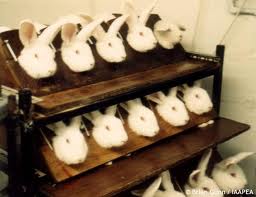
It’s the same thing with what is happening to animals in this country.  We know that scientific research, aka torture, is conducted on thousands, if not millions of defenseless animals every year.  We know that millions of pigs, cows and poultry are treated with total disregard for their well-being, as if they were machines being assembled for market, instead of living, sentient beings.  We know that millions of wild mammals, birds and marine life are relentlessly being pushed into extinction by the pitiless advances of human “civilization.”

We know this, but we choose to pretend we don’t know it.

Maybe that’s because if we really took this information in, the knowledge would be unbearable.  How could we live with ourselves, knowing that just by conforming to the status quo, we are responsible for so much suffering of others on this planet?

But we need to stop pretending and closing our eyes and turning away.

Because it is out of this deep knowledge of our connection with other living beings on this planet, and the inescapable awareness of the suffering we humans are causing, that a movement of solidarity, resistance and change will grow.

To bring up the term “movement” is to be clear that the kind of transformative change I’m envisioning could not possibly be the work of one person, or even a few people.  It has to be an unstoppable wave, demanding change and taking nothing less for an answer.

In the 19th century, the abolition movement ended up sparking a civil war in the United States.

A second American civil war seems rather unthinkable to most of us now, even as we watch with amazement as regimes fall to enraged mobs all across the Middle East and North Africa.

In the US, free expression is tolerated far more widely than, say, in China, where journalists and bloggers are regularly beaten up and thrown in prison for daring to speak an unpopular truth.  The U.S. was shocked–shocked!–when the government called out the military and tanks began firing into the crowds at Tiananmen Square back in 1989.

But you have to wonder, watching the ruthless way city police are now trained to deal with street protests, how much it would take to provoke a similarly harsh response from our federal government.

What if there were a real movement of people united in their demands for “equality, liberty and justice for all,” as schoolchildren in the US are still trained to recite piously every morning, hands over hearts, when the Pledge of Allegiance is played over the PA system?

What if people got fed up enough with our bungling and corrupt national leaders, our deeply unfair and wildly overpriced medical system, the outrageous skewing of entitlements of all kinds to the wealthy, the militarization of our relations with other countries, the poisoning of our environment, the killing off of the natural world–fed up enough that we were willing to take to the streets and demand change, and not back down even when they brought out the tear gas, the tanks and the guns?

Then we might just have a Civil War II on our hands.  And like the first Civil War, it would be bloody, chaotic and uncertain in outcome.  But if the vision that guided it was sure and true, it might just lead to a whole new country arising out of the ashes of the old.

In this globalized age, such a civil war might easily turn into a global war, as the 99% the world over rose up against the tyranny of the rich corporate interests that are ruining the welfare of humans and the planet as a whole.

And here’s where I need to get back to the Manifesto, where I imagined a new social order based on a horizontal, inclusive, respectful, egalitarian model of social relations, with the welfare of the poor as important as the welfare of the rich; the welfare of the coral reef as valued as the welfare of the watershed feeding a city; the welfare of a livestock animal as important as the welfare of a cherished pet.

Not to say that everyone would necessarily be treated exactly the same–a cow wouldn’t want the same treatment as a dog, after all.  But whatever it takes to give a cow a comfortable, dignified life, should be undertaken.  Whatever it takes to give every child access to a high-quality education, should be done.  Decisions should be made in truly representative fashion, with no possibility of wealthy interests buying votes, no PAC lobbies or media manipulation allowed.

The devil is in the details in putting such a new world order in place, I know.  Many smart people maintain that human beings are irredeemably aggressive, competitive and greedy, and so we are incapable of creating such an ideal world.

But many other smart people say the opposite: that human beings are naturally empathic creatures, whose first instinct as infants is to love, not to hate.  Very few children are instinctively cruel to others.  The majority of us seem to be naturally good-natured, though easily swayed and corrupted by our social conditioning.

As Jeremy Rifkin has argued, “What is required now is nothing less than a leap to global empathic consciousness and in less than a generation if we are to resurrect the global economy and revitalize the biosphere. The question becomes this: what is the mechanism that allows empathic sensitivity to mature and consciousness to expand through history?”

Rifkin’s own answer to this question has to do with what he calls the “distributed Internet revolution,” which is “changing human consciousness” by “extending the central nervous system of billions of human beings and connecting the human race across time and space, allowing empathy to flourish on a global scale, for the first time in history.”

Rifkin envisions just the kind of transformation in social relations that I have also been dreaming of.  His description of a new human relation to what he calls our “biosphere” is worth quoting in full:

“The biosphere is the narrow band that extends some forty miles from the ocean floor to outer space where living creatures and the Earth’s geochemical processes interact to sustain each other. We are learning that the biosphere functions like an indivisible organism. It is the continuous symbiotic relationships between every living creature and between living creatures and the geochemical processes that ensure the survival of the planetary organism and the individual species that live within its biospheric envelope. If every human life, the species as a whole, and all other life-forms are entwined with one another and with the geochemistry of the planet in a rich and complex choreography that sustains life itself, then we are all dependent on and responsible for the health of the whole organism. Carrying out that responsibility means living out our individual lives in our neighborhoods and communities in ways that promote the general well-being of the larger biosphere within which we dwell.”

It would be nice if we could simply persuade the 1% corporate types of the necessity of this shift in human consciousness. But these people don’t play nice.

That’s why we dreamers who share this kind of transformative vision may have to toughen up, if we want to achieve our goals.

As Derrick Jensen keeps saying, how long will we wait until we realize that action is necessary to avoid annihilation?  It’s the birds, the bees and the bats who are dying now, but these creatures form the base of the pyramid on which current hierarchical human society rests.  If their populations crash, can ours be far behind?

Can we afford to wait and see?

Violence against peaceful protesters–a federal crime?

So far I have not been able to get past the still image of the latest shocking example of police violence inflicted on unresisting young people.

I don’t need to watch the students begin to writhe and cry out in pain, I don’t have to hear the gasps of the onlookers or the shouts of the cops as the situation shifts suddenly from quiet resistance to chaotic disarray.  My imagination can set it all in motion, without the aid of video.

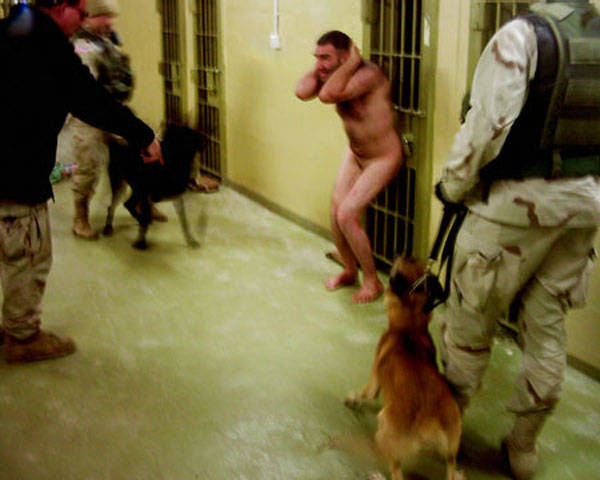
But the video was shot, and is now making its viral way around the Web, just like those shocking images, from not very long ago, of the abused prisoners in Abu Ghraib.

There too, what was striking was the imbalance of power–the heavily armed and aggressively clothed military police, against unarmed, and, in the case of Abu Ghraib, naked civilians, whose only crime, in most cases, was being in the wrong place at the wrong time.

At both UC Davis and Abu Ghraib, the victims may have lacked firepower, but they have something even more potent on their side: the moral outrage of the onlookers.  Once those moments of violation are caught on film and sent out into cyberspace, it doesn’t take long for public opinion to rise up against such an obvious abuse of power.

I am always curious, in a morbid sort of way, about the mentality of the perpetrators of this kind of violence.  Are they the grown-up version of the 7th grade bully, who takes pleasure in making other kids squirm?  Has their capacity for empathy been dulled or extinguished?  Are they simply sick, psychopathic sadists?

If any of these are the case, how could we have entrusted the crucial job of maintaining social order–otherwise known as policing–to such people?

The same old boys’ club that protected Jerry Sandusky and the Catholic priest pedophiles all those years is a strong force in the military and the police forces.  But at some point an individual will push things too far, and the club will no longer be able to protect him.  Thus Charles Graner, the mastermind behind the Abu Ghraib abuses, was eventually thrown in prison himself, and the officer who took it upon himself to casually pepper-spray those innocent UC Davis students has been suspended.

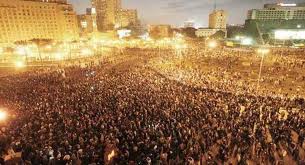
Nobody in the U.S. wants to see an eruption here of the kind of civil violence that overtook Egypt, Yemen, Libya, and so many other countries where civilians have been pitted against police or soldiers deployed by government officials who cared more about their own power than about the rights of their citizens.

Here in the U.S., we simply want to be able to exercise our constitutional right to peaceably gather in public places to express our political views.

Any city, state or federal government official who inflicts violence on such a peaceful gathering is guilty not only of a serious human rights violation, but also of violating the U.S. Constitution.

Last time I looked, this was a federal crime.

Bloomberg the Grinch vs. Occupy: This movement is not going away

The question in the air this morning is obvious: what comes next for the Occupy movement now that the tents and tarps in Liberty Park have been trashed by the NYPD?

The New York Times is giving way more coverage to the eviction than it ever did to the occupation, proving once again whose side those folks are on.

This protest movement is not going to go away.  It’s not going to go into hibernation for the winter.

City officials who see the movement as an expensive civil nuisance will learn the hard way that their heavy-fisted efforts at intimidation are going to backfire.

If anything, such tactics only strengthen the resistance of the core groups on the street, and draw the attention of the virtual spectators in cyberspace, who may now become more engaged.

Whither the Occupation now?  Occupy Wall Street said last night that the protesters have “the feeling of a movement that is rising, building, and making headway.”

Their statement is worth “reblogging” in full:

“They showed us their power. And we’re showing them ours.

“We are here because we believe a better world is possible. We are willing to endure mistreatment, if by doing so we can help re-enfranchise the 99% and reclaim our democracy from the stranglehold of Wall Street and the top one percent.

“We will push back against billionaire Michael Bloomberg and any politician who wantonly tramples on proud American freedoms: freedom of the press, freedom of speech, and the freedom of Americans to peaceably assemble and petition for change.

“We will overcome the obstacles placed before us. We will not be deterred. We will persevere. Our message is resonating across America, and our cause is shared by millions around the world. We are the 99%, and we want to live in a world that is for all of us — not just for those who have amassed great wealth and power.

“You cannot evict an idea whose time has come.”

Hmm, that does not sound like the voice of a group ready to pack it up and go home.  Those are stirring words and sentiments, in the tradition of our most heroic American freedom fighters, from Thomas Jefferson to Martin Luther King.

If you can’t beat them, Bloomberg and Co., you might just have to figure out how to join them.  And I don’t mean infiltrate or co-opt.  I mean open your hearts and hear the justice in their ideals and goals.

Like the Grinch who Stole Christmas, the hearts of the 1% are several sizes too small.  They would find the world to be a much warmer, happier place, if they would allow themselves to feel again.