The Solutions are Hidden in Plain Sight–if you look through 21st century eyes

IMG_4806A lot of us in the Northeast are doing our share of grumbling this year about the Arctic air that just won’t go away.  Usually March is the time when the winds start to blow, the sap starts to rise, the snow melts into the thawing earth and our thoughts turn to snowdrops and crocus.

This year, we’re still in the deep freeze with a hardpack of snow on the ground, and no end in sight.

It’s all part of the erratic weather of our climate change era.  The question for all of us now is, how, beyond bitching and moaning, are we going to respond?

Most of us just shrug and turn the dial on the heater up a little higher, not thinking about what that very small, ordinary act really entails.

If your thermostat is wired into an oil burner or a natural gas furnace, like most homes and apartment buildings in the Northeast, then when you turn up the dial in response to the bitter cold you are, perhaps unwittingly, enabling, supporting and becoming an integral part of the very industry that is relentlessly destroying our climate.

The fossil fuel industry is not some demonic force outside of our control.  It’s just a human business that is responding to human needs for energy—lots and lots of energy.

We Americans are used to getting what we want, and what we’ve wanted, in the 50 years I’ve been on the planet, is ease.  What could be easier than turning a dial to make your house warmer in the winter or cooler in the summer, or gassing up your comfy car before you get on the freeway?

1_RussetLikewise in terms of agricultural production—we like to get our vegetables pre-washed and sometimes even pre-cut, all even-sized, no blemishes, laid out attractively in faux crates under spotlights in our upscale grocery stores.

When we buy that bag of potatoes or carrots, we’re not thinking about the tons of pesticide, herbicide, fungicide and fossil fuels that went into making it easy for us to throw these items in our shopping cart.

We’re not thinking about the bees, butterflies and other valuable insects that have been driven to population collapse by industrial agricultural practices; or the huge dead zones in the ocean at the mouth of the Mississippi River, where fertilizer and chemical run-off from the Midwest runs down to the sea; or the millions of birds that are affected each year by the toxic chemicals we spread over the landscape.

We’re just throwing that bag of veggies into the cart, or turning up that dial.

Well, the time of such oblivious innocence is over.

The curtain has been pulled back, and the Wizard of Industrial Capitalism has been revealed—and lo and behold, he wears the ordinary face of each one of us.

Every step we take on this beautiful, battered planet of ours matters.

Eric and me at the February 2013 Forward on Climate rally in DC

Eric and me at the February 2013 Forward on Climate rally in DC

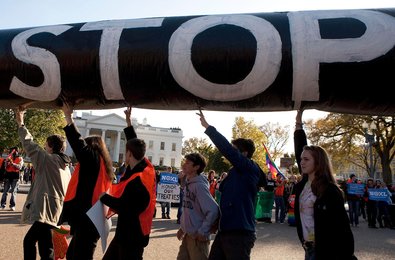
I am heartened to know that this very weekend, one year after the big climate change rally in Washington DC that I attended in the hopes of pressuring the Obama Administration to block the Keystone XL pipeline, thousands of activists, most of them college students, will be raising a ruckus at the White House gates to insist that the politicians stop gambling away their future.

Here in my backyard, in the Massachusetts-New York region, people have woken up to the fact that mile-long trains of crude oil and gas are being run through heavily populated neighborhoods.

We’re moving to block gas fracking in western Massachusetts as the sight of contaminated tap water in fracking regions brings the dangers right home.

We’re also starting to get serious about making solar energy accessible to homeowners and businesses.

UnknownThis week’s New Yorker magazine has a fascinating article about a little-known scientific program to create a controlled thermonuclear fusion power plant.  Unlike the current fission plants, which burn radioactive fuel and generate dangerous waste, the fusion plant, if it were successful, would run indefinitely on seawater and lithium, with no waste.  It would be ten times hotter than the core of the Sun.

Talk about an audacious plan!  You have to hand it to human beings, we are nothing if not hubristic.  It is our greatest strength and our most glaring weakness.

Why spend billions on creating an artificial sun here on earth?  Why not just learn from our cousins the plants, and start to use the sunlight we have more efficiently?

It’s time to take off our grimy 20th century glasses and start looking at the world and ourselves through 21st century eyes.  When we do, we’re going to find that the solutions to all the problems that beset us have been hidden in plain sight all along.
Of Oil, Honey and the Future of Human Civilization

do_the_math_image_1I have been reading Bill McKibben’s new book, Oil and Honey: The Education of an Unlikely Activist, with a group of students in a course called Media Strategies for Social and Environmental Justice Advocacy that I’m offering for the first time this semester at Bard College at Simon’s Rock.

Oil and Honey tells the story of how McKibben founded 350.org with a group of his students at Middlebury College in 2009, and how together they went on to become the most visible American environmental organization of our time, leading the U.S. protests against the Keystone XL pipeline and creating an international movement to put pressure on governments and policy makers to quickly and decisively address the mounting threats of climate change.

Most recently, McKibben has been focusing on divestment as a tactic to push the fossil fuel industry to shift into cleaner forms of energy production.

Taking its cue from the successful anti-apartheid divestment campaigns of the 1980s, the strategy is to awaken enough ordinary citizens–including college students, church-goers and workers of every stripe–to the perils of climate change, and get them to press their hometowns, companies, churches and colleges or schools to divest their endowments, retirement funds and other collectively held investment portfolios from the fossil fuel industry.

It seems like a good strategy, and yet it did not elicit much enthusiasm from the students in my class.

They were more interested in thinking about how to educate younger kids about the beauty and value of the natural world, and moving from that basic platform out into activism.

Kids today spend so much time indoors, in front of screens, that they have little sense of connection to nature, my students said.  And without that connection, it’s very hard to understand why it’s important.  What’s all the fuss about?

This is what it’s about.

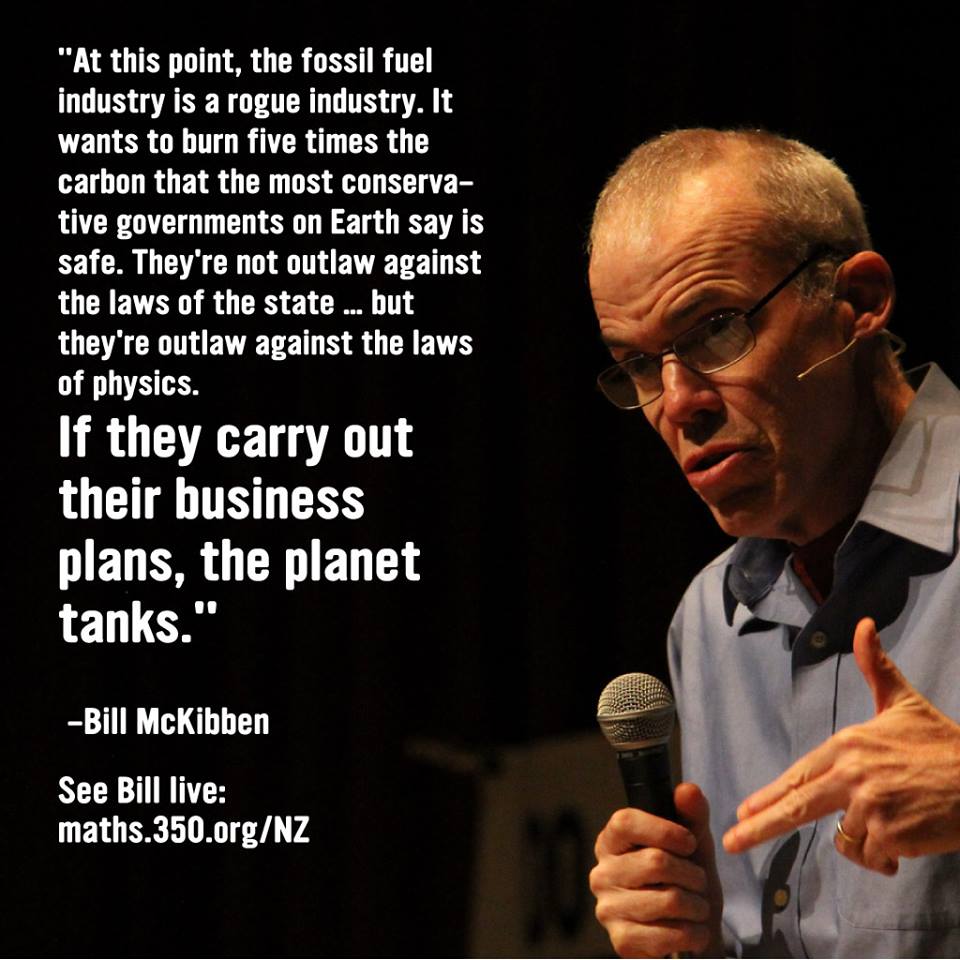
Bill McKibben asks us to “do the math” and understand that if we were to actually succeed in burning all the fossil fuels that are currently in the ground, we would heat our planet to a level not seen for millions of years.

It would definitely be game over for human civilization, and it would take millions of years for the planet to restabilize.

What it is about this simple math that human beings today do not want to see and understand?

Part of it is simply that we’re so easily distracted.

The big news yesterday was that Federal Aviation Administration will now allow airline passengers to use their computers and tablets right through take-off and landing.  We can be in front of our screens to the very last second of the day!

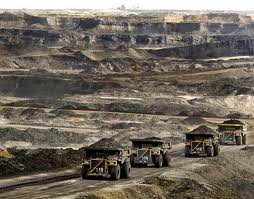
Meanwhile, while we’re busy on our computers, not paying attention, the fossil fuel industry is going around the resistance to the Keystone XL pipeline by massively investing in railway terminals, lines and cars for carrying its tar sands oil down to refineries and tankers on the coasts.

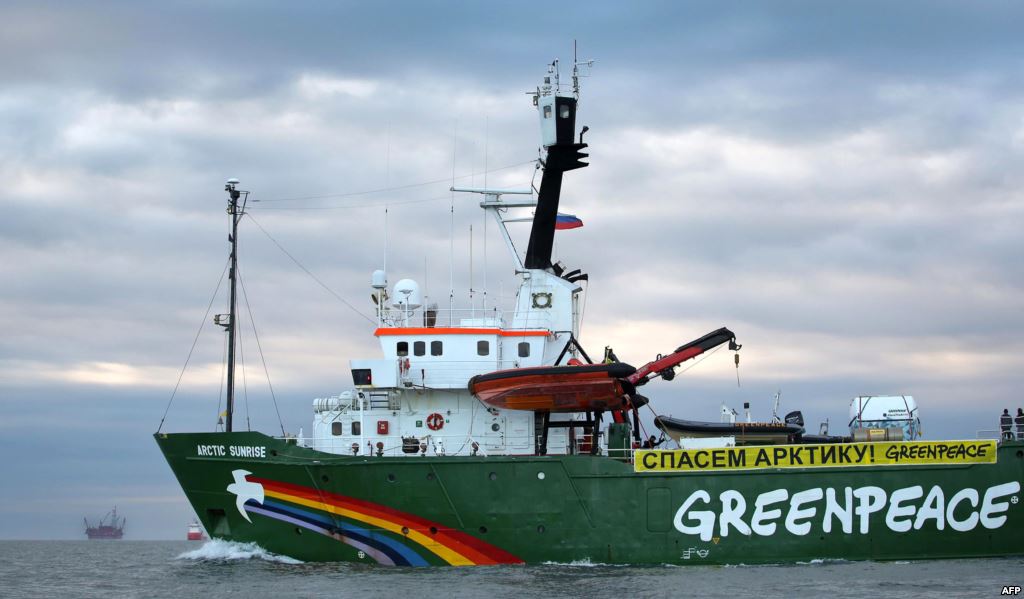
B3029FCC-5228-4E57-B879-F8A83ABF036B_mw1024_n_sAnd up in the darkness of the Russian tundra, 30 Greenpeace activists are languishing in cold solitary prison cells, held without trial for the crime of trying to raise awareness about the destruction of the Arctic by Russian and international oil drilling.

Where is the outrage?

In the book Oil and Honey, McKibben ingeniously compares corporate behavior to bee behavior.  Corporations are like bees, he says, in being relentlessly “simple” and focused on their one crucial task—for bees, making honey; for corporations, making profit.

They don’t change their focus, no matter what.

But humans are more complex than that.  We can change and adapt to new circumstances.  We can recognize and act upon moral imperatives.  We don’t have to follow suicidal corporations blindly over a cliff of their own making.

Although it’s true that the alarming dependence of Americans on screens of every size can get in the way of a connection to the natural world, on the other hand, the fact that so many people are networked together through the media presents great opportunities for activism and change.

With my students this semester, I’ll be thinking about how to harness the power of the media to create a different kind of swarm—not following our current corporate leaders, but moving in an entirely different direction.

We’re not alone—there are many groups working on this now, from the Transition Town movement to the Pachamama Alliance to even such formerly mainstream organizations as the Sierra Club.

The task: to awaken a critical mass of people, worldwide, to the reality that we are living in an end-time of biblical stature; and to get them to understand that we have the power to change the storyline from doom-and-gloom cataclysm to a positive shift into a whole new relationship of humans to our planetary home.

Working cooperatively, bees are able to turn small grains of pollen into vast tubs of honey.  Human beings can do that too–when we work together for a common cause we can do almost anything.

So what are we waiting for?

images-1

Building a Tsunami of a Climate Change Movement: What Will it Take?

In the seething, saturated media environment we live in, victory is measured in whether or not you’re able to get people to slow down and pay attention.

It’s getting harder and harder, especially for young people, to sustain attention for more than a few minutes.

Life is a restless prowl for something new, and in a manmade environment where we’re seen it all before, it’s got to be pretty damned new and exciting to get us to pause for even a moment.

As a teacher, I find myself adapting to this in ways that I would never have predicted when I first started teaching undergraduates, nearly a quarter-century ago.

I know I have to be more exaggerated in my classroom presence.  She who drones is lost.

I also don’t expect the level of reading comprehension these days that I used to take for granted among my students.

I know I’m going to have to excerpt and digest for them, and I’d better do it in an enthusiastic, engaging way, or they’ll be surfing away, in their heads if not literally, on their screens.

I have to do constant daily battle with those screens, too—even when I outright forbid them, they creep back in with all the force of a compulsion, or an addiction.

In this kind of environment, why should we be surprised that it seems to be impossible to get people to pay attention to a big, remote problem like climate change for more time than it takes to say “Hurricane Sandy”?

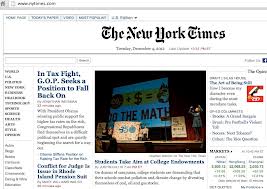
The other night I was overjoyed when I stopped by the New York Times site and saw Bill McKibben’s “Do the Math” tour foregrounded front and center on the homepage.

Unknown

Bill had the same reaction: he forwarded a screenshot of the page to his email list, trumpeting victory.

But what kind of victory is it, really?

Yes, McKibben’s Do the Math tour succeeded in finally penetrating the security perimeter of that gated community known as Mainstream Public Opinion.  If the Times prints an article, we can assume that at least a few of the sheltered, august heads within the insular circle of elite readers will pay attention.

Note that the article was ultimately filed in the Business section of the newspaper, by the way.  Evidently the Times thought its business-minded readers ought to know that those pesky students might be causing trouble for stockholders in major fossil fuel companies in the coming months.

This is the same way that the Times reported the Occupy Wall Street movement: as an annoying inconvenience, a public nuisance that our good police force is working to clear away ASAP.

It’s the same way they’ve reported on Hurricane Sandy, hitting right in their own backyard.  What a colossal inconvenience!  Let’s clear it away so we can get back down to business as usual.

What is it going to take to get through to the Times and its readers that there is not going to be any more business as usual?

The game is up.  Things are going to get much worse, and the only chance of avoiding total disaster is through immediate decisive action to curb carbon emissions and build up a massive supply of carbon sinks—ie, more forests, more seaweed and algae, more grasslands and croplands.

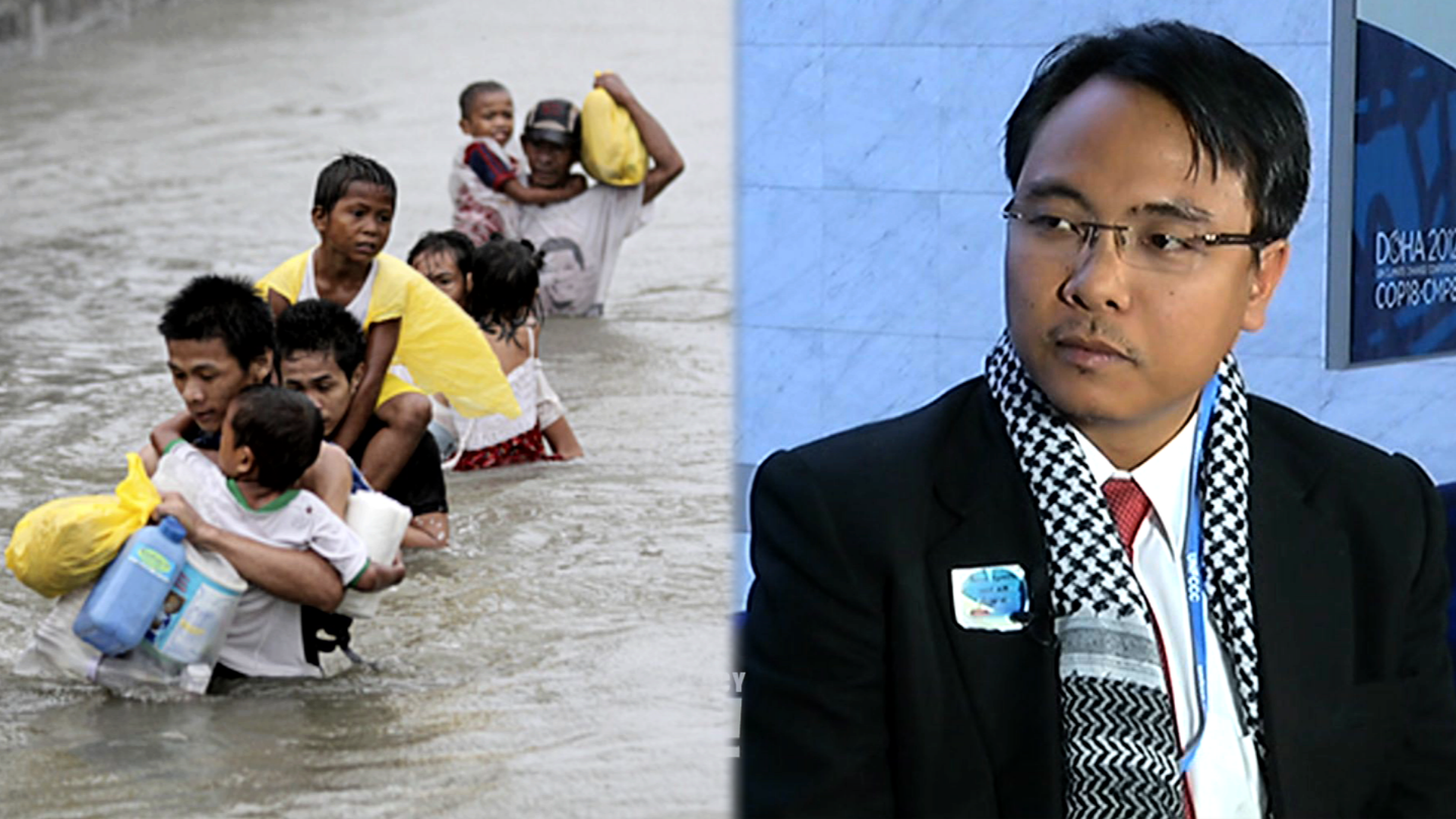
I was heartened, in a very melancholy sort of way, to see the chief negotiator for the Philippines, Naderev Saño, get all choked up as he made an impassioned speech to his comrades at COP18 this week to stop dilly-dallying and get down to the business of real change.

typhoon_yeb_sano

Referring to Typhoon Bopha, he said:

“As we sit here in these negotiations, even as we vacillate and procrastinate here, the death toll is rising. There is massive and widespread devastation. Hundreds of thousands of people have been rendered without homes. And the ordeal is far from over, as typhoon Bopha has regained some strength as it approaches another populated area in the western part of the Philippines.

“I appeal to the whole world, I appeal to leaders from all over the world, to open our eyes to the stark reality that we face. I appeal to ministers. The outcome of our work is not about what our political masters want. It is about what is demanded of us by 7 billion people.

“I appeal to all, please, no more delays, no more excuses. Please, let Doha be remembered as the place where we found the political will to turn things around. Please, let 2012 be remembered as the year the world found the courage to find the will to take responsibility for the future we want. I ask of all of us here, if not us, then who? If not now, then when? If not here, then where?”

Those are the right questions to be asking, and Saño is on the right track when he says that the work of stopping runaway climate change is not about what the “political masters” want.  It will only be possible if a sufficient number of people, all over the world, focus their attention and insist on the policy changes that will lead to real change.

The poor are the ones being disproportionately swept away by the floods and storms of climate change.  The problem may have their attention, but they’re not in much of a position to do anything about it.

I believe it is up to us, citizens of the so-called “developed” countries, to come out in force to demand change.

That is the kind of tsunami of U.S. public opinion that McKibben is trying to create with the Do the Math tour.

If we can succeed in catching the attention of young people, and getting them to understand how crucial this issue is to their futures, they can become a powerful force for change.

But in the end, this must be a multigenerational, multinational, multiethnic movement, of men and women from all walks of life, because if there’s one thing for sure, it’s that climate change does not play favorites.

It will blow away the fanciest palace just as soon as the flimsiest shanty (though the shanties will undoubtedly go first).

Ultimately, it will not be possible to build walls high enough to keep out the floodtides of a destabilized climate.

Does that get your attention?  No?  How about this: if we don’t get our act together on this issue now—I mean, NOW—we might as well just give it up and resign ourselves to roll with whatever punches are in store for us.  There will be many, and they will get progressively worse until our entire human civilization grinds to a halt.

Is that a risk you’re prepared to take?

I hope not.

So what can you do?

If you own stock, consider divesting your portfolio from fossil fuel companies until they shape up and get seriously green.

If you own a home, consider investing in alternative energy sources like solar or geothermal, and make your home as energy-efficient as possible.

Consider pressuring your town or city to do the same.

Start writing letters and emails to your elected representatives and the President of the United States and the fossil fuel barons and anyone else who might have influence, insisting that they think about our long-term welfare, not next quarter profits.

Talk to people about this.  You can never tell where ripples will go as the word goes out.

Do you want to go down fighting and active, or zoned out in front of your screen?

I echo the emotional words of the Filipino negotiator:

“Please, let 2012 be remembered as the year the world found the courage to find the will to take responsibility for the future we want. I ask of all of us here, if not us, then who? If not now, then when? If not here, then where?”

Looking catastrophe in the eye

Denial of climate change is deep and it is wide.

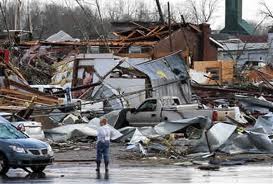
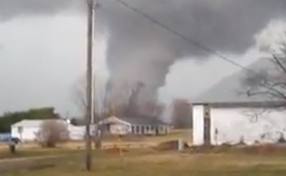
We woke up this morning to news of record-breaking tornadoes touching down across a wide swath of the American Midwest, flattening entire townships and leaving behind multiple trails of devastation.

Reading the mainstream media reports, the focus was all on the damage; very little was said about the cause.

Again, a case of focusing on symptoms rather than on the motivating problems.  The news media focuses on the “what” but ignores the “why.”

And they are even further away from what’s most important: looking for solutions.

Senator Bernie Sanders

Yesterday, thanks to the ever-impressive leadership of Senator Bernie Sanders, representatives of the national and international insurance industry came together in Washington to discuss the business implications of climate change.

Co-sponsored by the Ceres Foundation, which has been working to bring business into the sustainable future fold, the meeting was unequivocal in its acknowledgement that climate change is here, it is real, and it must be dealt with head on, before it runs right over us like a tornado.

The reinsurance industry reps were pretty blunt.

“We need a national policy related to climate change and weather,” said Franklin Nutter, president of the Reinsurance Association of America.

Pete Thomas of Willis Re, a global reinsurance broker, cited an alarming statistic: 4 out of 5 Americans now live in federally declared disaster areas.  “”Demographics and coastal urbanization are catastrophic force multipliers, making weather events increasingly costly,” he said.

In case you didn’t know, reinsurance companies are the ones that insure the insurers.

A difficult industry, in the age of climate change.

If I were an economist, I would be doing the math to figure out whether we are really coming out ahead as a society when we fight to pay less than $5 a gallon for oil.

What may seem cheap up front is often outrageously expensive in the long run.

Like eating cheap food laced with chemicals to keep costs down, to find yourself paying the exorbitant bills for chemotherapy in midlife.

It just doesn’t make sense.

There has never been a more important time to come forward and demand that government and industry work together to ensure (not insure!) our future.

Indiana Tornado, March 2, 2012

Let’s stop hiding our heads in the sand and pretending that everything will be all right–until the next tornado, hurricane, wildfire or drought rides roughshod over our house and town.

Sitting at home worrying is of no use at all.

If you want to be of use to your grandchildren and all future generations, you should be out on the frontlines, insisting that:

a) the media does its job as a watchdog and reports the whole story;

b) our elected representatives do their job and create policy aimed at saving lives by mitigating and adapting to the effects of climate change; and

c) our fellow citizens get off their butts and start taking responsibility for our collective future.

Get going now, before “catastrophic force multipliers” blow us all away.

Climate refugees–who’s next?

This week it was reported that thousands of people of the Tarahumara indigenous group, who live in the Sierra Madre range in northwest Mexico, have been coming down out of the mountains to seek food aid, because after two years of severe drought, coupled with unusual cold this winter, they are reaching their breaking point.  Faced with starvation, they have become climate refugees.

The Tarahumara are known in Mexico for their incredible endurance in long-distance running.  They are a proud people who have held themselves aloof from modernized Mexican culture, still keeping their ancient traditions of weaving, hunting and farming.  They still speak their ancestral language, and they have always been able to take care of themselves.

Until now.

In what is sure to be a trend in the coming years, it is the people who live furthest out on the margins of Empire who are affected first and most harshly by climate change.  People living on South Sea atoll islands or on the Arctic tundra are already seeing the effects of the rising seas and thawing permafrost.  Mountain people who depend on glacial melt for their freshwater are coming up dry.

We here in the heart of modern Western civilization are still feeling no pain.  In fact, I can’t count how many people have grinned at me this week as they celebrated the lovely spring weather we’re having in January—in the fifties, Farenheit, in midwinter.

Yes, it’s just grand—until summer comes and we’re still 40 degrees above normal, roasting at 120 degrees F on a typical August day.

In Mexico, the severe drought has left some two million people without access to potable water and basic food supplies, and authorities say they expect the situation to worsen.

This is bad enough, but it gets worse:

“The drought, which has been compounded by freezing temperatures, has already pushed up the cost of some produce, including corn and beans….But government officials have said they do not expect the price of exports to be affected.”

I am sure all readers of that NY Times article were reassured to hear that the cost of their imported avocados, tomatoes and other vegetables will be unaffected.  Who cares that corn and beans, the staff of life for millions of Mexicans, will cost poor people more?  That’s their problem!

Until it becomes ours.  If corn and beans become unaffordable in Mexico, and sustenance farming is no longer an option in a drought-stricken landscape, what comes next?  You guessed it, illegal emigration al Norte.  What other choice do these people have but to take the risk of trying to cross the border?

Up here, anti-immigrant fervor continues to burn.  Just this week House Republicans passed a law seeking to deny cash refunds under the child tax credit to anyone filing tax returns using “individual taxpayer identification numbers” rather than Social Security numbers.

Most of the people filing taxes without Social Security numbers are hardworking Latino immigrants who are paying taxes even though their earnings are at or below the poverty level.  Their children, many of whom are American-born citizens, will pay the brunt of their parents’ loss of the child care tax credit.

But really–who cares? Who gives a good goddamn if the poor can eat?  Just so long as we can still buy gleaming fresh produce year-round, and no one messes with our electricity or gasoline, let the rest of the world go to hell.

In case you couldn’t tell, I’m being sarcastic.  Seriously, this arrogant attitude is only going to be able to go so far.  Today’s climate refugees, tomorrow’s undocumented workers, are the harbinger of what may very well befall all of us as the climate keeps spinning out of control.

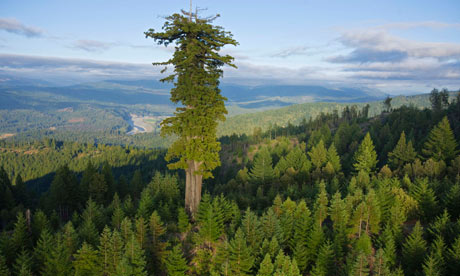
Just as in our forests, it is often the oldest, most majestic trees that are under the greatest strain from climate change, our oldest, proudest ethnic groups are also under tremendous strain now.  The Tarahumara managed to survive the Spanish Conquest, the Mexican Revolutionary War and the Industrial Revolution…but if they can no longer grow crops in their homeland, they must move or die.

Indigenous people like the Tarahumara have the best chance of actually surviving a catastrophic climate shift, because they still know how to live a low-consumption lifestyle, close to the earth.  We would do well to learn from them, and other indigenous groups worldwide, while their cultural traditions are still intact.

Those of us still enjoying the luxuries of Empire should be cognizant that for us too, it’s only a matter of time.

Outsourced pollution rides the trade winds home

How timely, that just as the U.N.-sponsored climate talks are going on in Durban, a new report comes out  from the Global Carbon Project informing us that global greenhouse gas emissions grew by a whopping 5.9 percent last year, the largest leap in any year since the Industrial Revolution began.

The U.S. remains the world’s second-largest greenhouse gas emitter, trailing only China.  But as we all know, China has become a factory state of the U.S. and Europe–isn’t virtually every manufactured thing you own “made in China”?

As I hear all the time from travelers to China, air quality is noticeably bad there.  Most cities seem to be in a permanent miasma of smog, sometimes approaching the sooty fog Charles Dickens used to describe as veiling London in the coal-burning 19th century.

Here in the U.S., air quality has improved since I was a kid in New York, when smog was a daily occurrence and you just learned to live with noxious blue bus fumes blown in your face on every street corner.

But apparently what we’ve done is simply outsource our pollution to China.  Let them deal with the smog over there; we’re paying for the goods they produce aren’t we?  If they can’t figure out how to manufacture cleanly, that’s not our problem.

So goes the smug line of American entitlement.

But welcome to the new century.

First of all, the great American credit bubble has burst, and the middle class is having trouble affording those imported manufactured goods, no matter how “cheap” they are.

Second, it’s obvious that the trade winds are blowing Chinese smog our way, in the form of global climate change that will affect us here as much as it affects them over there.

Politicians the world over continue to take a short-sighted view of both of these issues, imagining that a little re-tooling is going to get us past the bumps in the road.

The media isn’t helping matters–you will have to peer deeply into the New York Times this morning to find the small buried news story about the biggest leap in global carbon emissions on record.

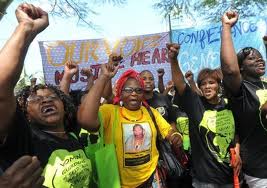
People who are already living on the edge understand the stakes.  Thousands of African women farmers have been marching in Durban, along with indigenous forest defenders from around the globe.  They’ve been kept away from the politicians inside the gates by riot police.

Guess what?  All the riot police in the world cannot keep climate change havoc from our doorstep.  Here in the U.S., in China, in Africa, and all over the world.

It’s time to deal with it.

Occupying the Climate Talks & College Campuses–Full Speed Ahead!

Could be an interesting day today.  Word has it that the less-developed nations are threatening to “occupy” the climate talks at Durban if the big polluters–that’s us, America, and you too, Europe and China–won’t get serious about limiting emissions and working for systemic change.

Meanwhile, a student movement begun at UC Davis is calling for a General Strike today–no classes, no work–to create a space for student-run General Assemblies to discuss issues like police violence against peaceful protesters, as well as sky-rocketing tuition and debt-funded education that is putting college out of reach for more and more Americans.

I continue to be amazed at the speed with which awareness now spreads, thanks to how many of us are now plugged into what is coming to seem more and more like a collective brain.

Could the collective consciousness represented by the World Wide Web be an evolutionary leap forward?  Or could it at least be speeding up our evolutionary progression as a species?

Of course, it’s all dependent on electricity.  If the lights go out, our collective brain goes dead.

Or maybe not?  The General Assemblies, with their human microphones and patient face-to-face discussions give me hope that the new connections that are being forged in this time of transition are real and could stand alone, without the crutch of the Web.

In fact, maybe that’s what this is all about.  Building the human connections, virtual and real, to withstand the great shocks that are coming our way as the climate shifts and the Earth seeks to return to a steady state.

In Durban, South Africa and on college campuses and public parks across the country, people are turning out to be the change we want to see.

It’s an exciting time to be alive.


Pipeline put off, but I’m not celebrating, are you?

Bill MicKibben: We won a temporary victory on Keystone XL, but the fight goes on | Grist.

It’s hard to feel elated about President Obama’s decision this week to kick the can of the Alberta tar sands extraction down the road a ways, until after the 2012 election.

Yes, any victory is a good victory, and the environmentalists who took the trouble to go to Washington and raise a ruckus in opposition to the proposed pipeline deserve our accolades and thanks.

The cranes who use the Nebraska Sand Hills refuge will have another year or two of peace.  The Ogllala aquifer is protected for the moment.

But it’s discouraging to see how the Administration is trying to limit discussion to the pipeline, as if it, in itself, were the problem.

No, the pipeline is just a symptom of a much larger problem: the potential destruction of the Canadian boreal forests, with their countless species of flora and fauna, and their tremendous carbon-trapping properties.

Without the Alberta forests, global warming is a done deal.

Does anyone there in Washington understand what that means?

Earth to Washington: do you copy?

Go ahead, Earth.

We haven’t got much time left.  The temperature is rising.  Once the climate destabilizes, we won’t be able to turn things around for a long, long time.  We’re talking geological time here.

Copy that, Earth.

So can we get some serious action there, Washington?  Can we light a fire under those politicians and get going with solar energy already?

Copy that, Earth.

Like–now?

Washington to Earth, connection is down.  Can you repeat?  Over.

Yes, that’s right.  Over.

Activists circle the White House; Obama plays golf

Mainstream media reports that some 8,000 people showed up in Washington D.C. today to link hands around the White House to protest the Keystone XL pipeline and the development of the Alberta boreal forest (aka “tar sands”).

The energy and determination of this crowd is wonderful. But It’s heartbreaking to learn that President Obama “missed most of the protest while he played golf at Fort Belvoir in Virginia.”

Last week I went for a walk on a golf course near my home, and was reminded again of how terrible these private parks are for the environment.

If lawns are destructive monocultures, just imagine the exponential scale of the golf mono-lanscape: acres and acres of closely cropped, artificially bright green  turf, with not a single broad-leaved plant to be seen.

Golf parks are anathema to butterflies and other insects, of course, since they are regularly treated with pesticides and herbicides.  They suck up precious water for a use that is 100% non-necessary: a pleasant game for the 1%.

I admit it, golf courses are one of my pet peeves.  I have never liked them, and never will.  So I suppose it was a sort of trigger to hear that Obama was off golfing this afternoon, instead of paying his respects to the thousands of activists streaming into Washington to communicate with him–the man we sent to represent us in the White House.

He is not the first American President to dodge attempts by the citizenry to communicate our wishes.  I think of President Bush off on his ranch while activists like Cindy Sheehan, whose son Casey died in the Iraq War, tried to send him an anti-war message.

Mr. President, if your citizens make the effort to go all the way to Washington DC to speak with you, I think the least you could do is show up.  We are depending on you to make the right decision on the tar sands/pipeline issue, which is clearly NO PIPELINE, and no development of the boreal forest.

We expect you to make a decision in favor of the health and well-being of your citizens.  Instead of investing in tired, dirty old energy platforms like oil and pipelines, we should be investing in solar and geothermal.  We need an Apollo Project for renewable energy, and we need it now!

Sure, you deserve your R&R on a Sunday afternoon, Mr. President.  But if you make the wrong call on this issue, those luxurious golf courses you enjoy may soon be relics of the wasteful bygone days.

Future social historians might point to golf as one of the many foolish 20th century habits that left us crouching bewildered in the 21st century in the midst of a full-blown climate crisis.

You’re the Decider now, Mr. President.  We are expecting you to make the right decision–for your precious children, and ours.

Climate Change Blues: The one thing the 100% of us have in common is that we can’t afford to ignore the weather!

President Obama, venturing outside during last night’s storm, called the weather “less than ideal” for trick-or-treating.

What an understatetment.

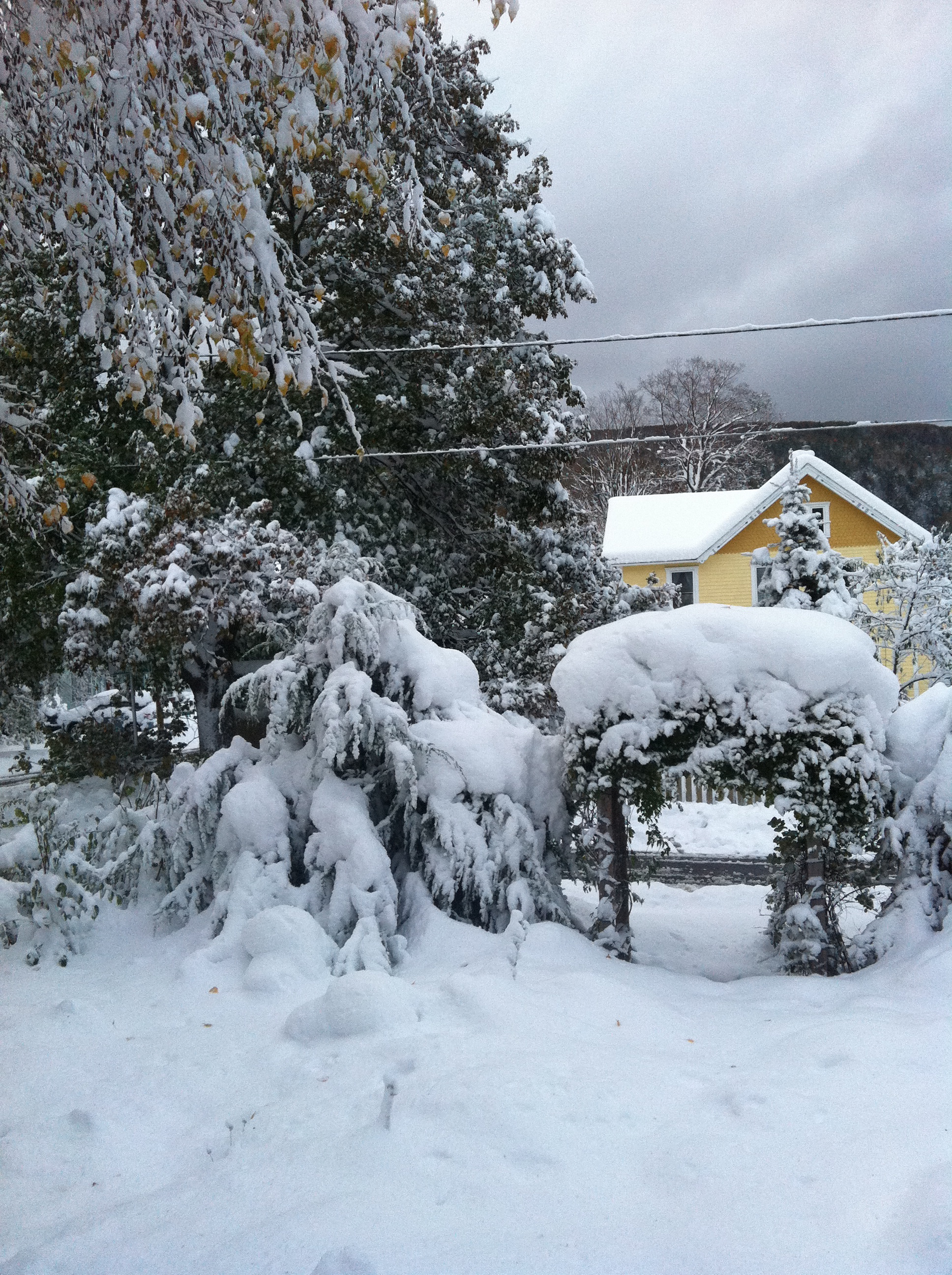
Here’s what it looks like at my house in western Massachusetts this morning:

All those trees in the background are tall maples, bent over with the weight of snow on their leaves.  So far no big limbs have snapped, but that could change any moment, and many of them are hanging over an outbuilding and my car….

So the question we should all be asking this morning is whether this freak October snowstorm is just an aberration, or if it’s part of a developing and accelerating pattern of climate change.

Yes, there have been October snowstorms before.  But has there been a three-month period before with record high temperatures (August), record rainfall (September), a hurricane hit to the entire East Coast (Irene) AND a record-breaking snowstorm?

Not being a meterologist, I can’t answer this question, but I’d sure like to know.

One thing I do know is that if we don’t start reducing carbon emissions, weather events like this are going to become more frequent and more severe.  This is not “Day After Tomorrow” hysteria, this is scientific truth.

So again, the question becomes, what can we DO?

Well, next weekend in Washington DC there will be an action at the White House; the plan is to assemble enough people to make a linked-arms ring around the White House, in the hopes of persuading President Obama to stand with the people on the anti-tar sands extraction, anti-Keystone pipeline issue, rather than with the energy corporations.

You can hear actor Mark Ruffalo explain it here:

My hope is that weather events like last night’s “freak” snowstorm will raise people’s awareness about the reality of climate change, and how it will affect all of us–our food supply, our physical security, our ability not just to carry on as usual, but to carry on at all.

All of us–the rich, the poor, the inbetween–the 100% of us, and not just in the US but in the world, are already feeling the effects of manmade climate change.  We’ll be feeling it increase exponentially in the coming months and years.

So all of us need to step off the path of least resistance and start demanding government support for a huge Apollo Project-style transition to sustainable energy and a serious commitment to energy conservation.

If you can’t get to Washington DC next Sunday for the demonstration at the White House, you can be part of the virtual ring that will surround the people on the ground there, and build support wherever you are for the movement for responsible and caring stewardship of our Earth.

We cannot afford to ignore these issues any longer.