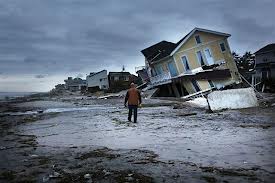
Lessons of the Wreck of the Bounty

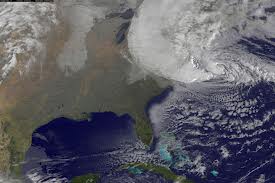
Although it is a small tragedy compared with the multifarious disasters occurring in the New York region in the wake of Hurricane Sandy, I can’t get the wreck of the tall ship Bounty out of my mind.

As someone who has written about 18th century pirates quite a bit over the past decade, I have an abiding fascination with sailing ships of that era.

HMS Bounty at Lunenburg, NS, August 2012

Last summer, when I heard the Bounty was docked for a few days at the Maritime Museum wharf in Lunenburg, Nova Scotia, I made sure I was at the head of the line at the gangplank.

The crew welcomed us aboard, and we had the vessel nearly to ourselves to explore at leisure.

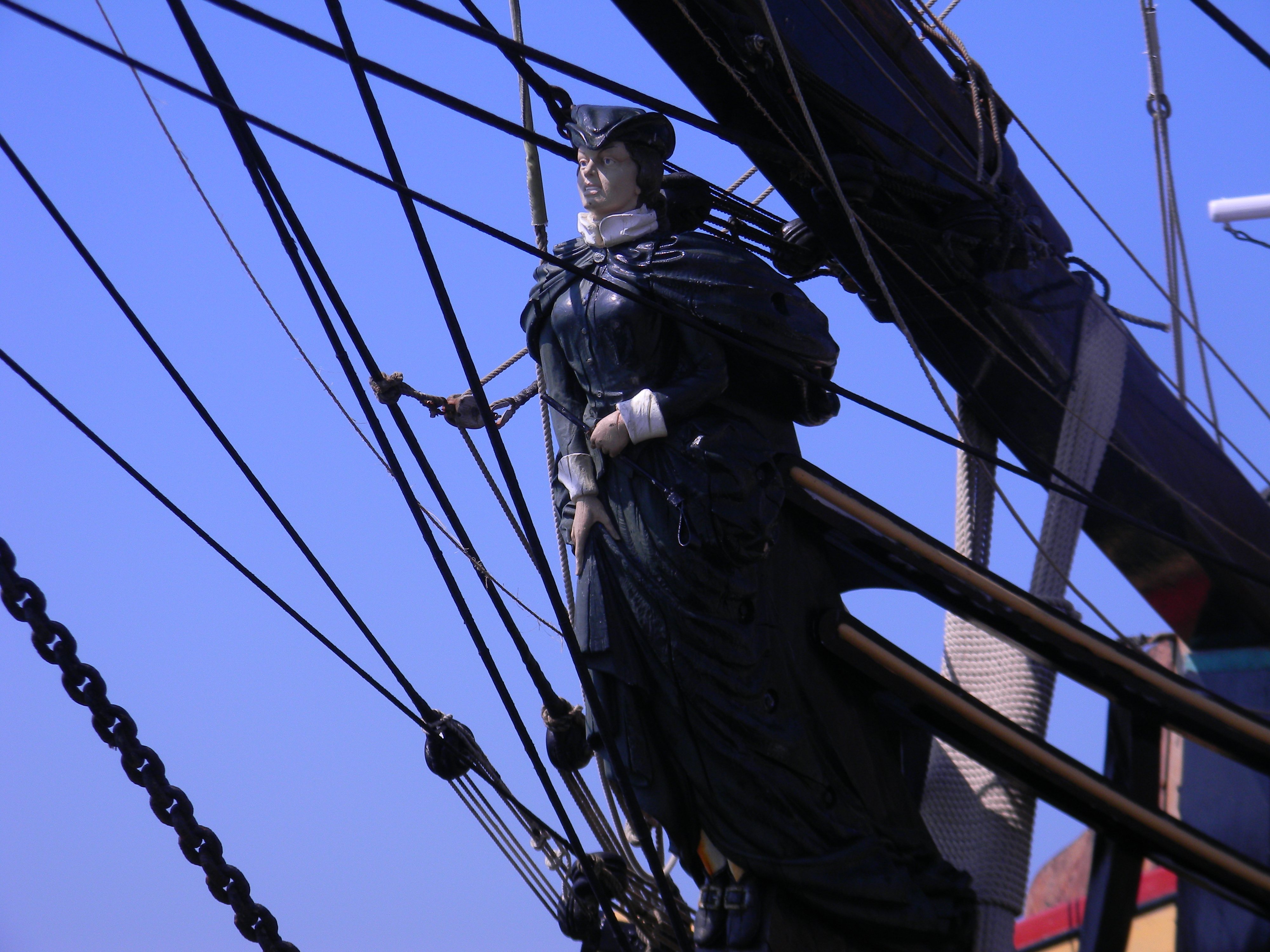
The Bounty, a 1962 replica of the original 18th century British ship, was obviously built with great attention to authenticity of detail.  The timbers above and below looked rough-hewn and weathered, the sails dingy and hardworking, the masthead newly painted and resolute.

She was a solid piece of work, and her captain, Robin Walbridge, had steered her well for 17 years.


But last week something went badly awry in his thinking.

Lunenburg photos by Eric Hernandez

He decided to take the Bounty out to sea knowing full well that Hurricane Sandy was making directly for his route from New London, CT to St. Petersburg, Fla.

Bounty masthead on a clear day

It seems that Captain Walbridge decided to try to “skirt” the storm, heading far out to sea in an effort to miss the brunt of it.

Sandy proved far to big to avoid, and by the night of Sunday, Oct. 28, the Bounty was facing 10 to 30-foot seas about 90 miles off the coast of North Carolina.  A first distress call put out to the Coast Guard at about sundown that evening was rescinded, as the crew must have been frantically working the pumps and still hoping to save the ship.

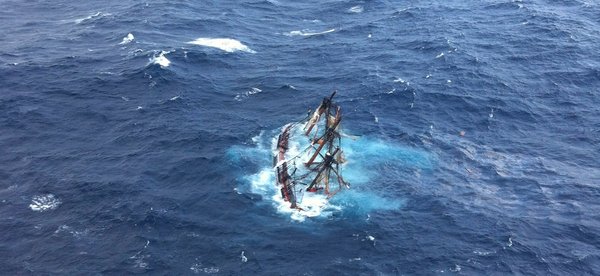
Not until 4 a.m. did the crew receive the order to abandon ship, and by then the deck was awash.

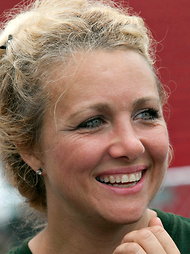
Fourteen of the fifteen crew members made it into the life rafts and were rescued by the Coast Guard  within a few hours.  A fifteenth crew member, Claudene Christian, was found floating nearby, and was pronounced dead at the scene.

Claudene Christian

Captain Walbridge’s body has not been recovered as of this writing.  The last one to abandon ship, he may simply have not made it out in time.

Captain Robin Walbridge

Here is a tragedy that could easily have been avoided if the captain had been more respectful of the forces of nature.  Apparently he thought the ship would be safer out at sea than docked during the hurricane; but in trying to save the ship he endangered the crew, and two lives were lost, one of them his own.

The story reminds me of the tale of Moby Dick, where the recklessness of the captain resulted, ultimately, in his being dragged to his death by the great white whale.

There is a lesson here for all of us.

We cannot underestimate the forces of nature.  We cannot “skirt” the climate change disaster that is staring us in the face.  We cannot outrun the storm, and we cannot hide from her.

As people in the wealthy enclaves of New Jersey and Long Island are finding out now, we are all equal before the awesome might of the natural world.

True, the plight of New Yorkers in dark, cold public housing is far more serious than that of coastal Long Islanders who have had to seek shelter with inland friends and family.

Class still matters.

But on the Bounty, the captain’s quarters were swamped just like those of the sailors.

So it will be with us all, if we fail to heed Sandy’s warning.

The Bounty sinking on Oct 29; Coast Guard photo

This is not a movie, and it’s not child’s play.  It’s real, and we’d better be paying attention, because next time it could be my turn, or yours.

We need to be taking measures now to make sure that the next time the winds start to blow, we will be prepared.

First things first: we need to go to the polls to defeat Mitt Romney and his fossil fuel masters on Tuesday.

And then on Wednesday, it will be time to start making plans to pressure President Obama to do the right thing when it comes to climate change.

Some say he’ll be a lame duck in his second term, but I think he’ll have more leeway to be his own man.  We have to prevail on his intelligence and good sense to use the power of the executive office to stand up to Big Oil on behalf of ordinary folks the world over, who trust their leaders to make the right decisions to keep them out of harm’s way.

And if he can’t or won’t do the right thing, well…there may have to be yet another “mutiny on the Bounty….”

Thank you, Hurricane Sandy

Hurricane Sandy did the planet a favor by hitting hard right at some of our most elite enclaves.

This time it’s not the poor residents of the Ninth Ward facing the horror of flooding, it’s the wealthy owners of some of the most valuable coastal property in the country.

When I heard Mayor Bloomberg of New York, one of the richest men on the planet, finally come and out say the words “climate change” with urgency, I had to smile despite the seriousness of the context, because it meant that at last the rich and powerful are getting the message that the status quo cannot go on—at least, not if we expect to survive as a civilization into the 22nd century.

The truth is that Americans in the ruling class—the business owners, the politicians, the finance and computer wizards, the media producers, the educators, even the artists–have been living in a luxurious gated community our whole lives.

We have been watching the travails of those outside, including the accelerating extinction of other species and the poisoning of the environment, from what has seemed like a safe, secure vantage point, behind several layers of bullet-proof glass.

Americans have watched impassively as people in other parts of the world have been forced to deal with terrible storms, flooding, and droughts with increasing regularity over the past decade.

As long as the electricity stays on and the supermarkets and gas stations are full and open for business, we just don’t pay much attention to what’s going on with the weather.  As long as our homes are heated in the winter and cooled in the summer, what’s the problem?

People like James Hansen, Bill McKibben, and Elizabeth Kolbert have been knocking futilely on the windows for years, trying to get the ruling class to wake up and pay attention to the looming threat of climate change before it’s too late.

They’ve made little progress up to now.

But Hurricane Sandy is a game changer.  Blowing into town the week before the Presidential elections, she put climate change on to the front page of the New York Times at last.  She forced her way into the bland discourse of Presidential politics.

She tossed her windy head and in just a few hours paralyzed the “greatest city on Earth,” creating $50 billion of damage that will take weeks if not months to clean up.

All of a sudden, city planners are talking seriously about flood gates, and some are saying it might be foolish to rebuild in the same way, right down along the coast.

I don’t hear many in our ruling class yet saying what needs to be said, which is that our entire lifestyle has been built up in an unsustainable way, and must be changed if we are to leave a livable legacy to our children and grandchildren.

We must wean ourselves from the addiction to fossil fuels.  We must shift from highways and cars to mass transit.  We must immediately start reducing emissions in every way possible, with special attention to the agriculture sector, which has to be completely redesigned with sustainability and health—our own, and that of the animals and plants we cultivate—in mind.

We must build a much more resilient, collaborative culture.  Competition and aggression may have been the watchwords of the capitalist and imperialist 19th and 20th century, but following their star has landed us in our current grave circumstances. We can’t go any further down that path.

For thousands of years prior to the Christian era, human beings lived tribally and cooperatively in harmony with the land.  Our population has now grown so large that we are reduced to fighting each other for increasingly scarce resources.

Going forward, if we are to survive, we must transcend the pettiness of national boundaries and ethnic differences, recognize our common goals as humans, and start to work together to provide strategically for the good of all.

This may seem like an impossibly idealistic goal, but if there is one thing that I believe can unite human beings, it is the awareness now dawning about how interconnected we are through our dependence on the life support of our planet.

It is sad that the Earth has had to sink to such an unbalanced, depleted state before we began to pay attention.  I would not wish a Hurricane Sandy on anyone.  But it seems that we need wake-up calls of her magnitude to get us up and out of the stupor of denial and inaction.

As I step over the threshold into my sixth decade today, I can feel a new resoluteness building in me; a new determination to use my time in a more focused way.

I vow to give the best of myself to the struggle for a sustainable future, and to encourage others to join me in this effort.  There is nothing more important any of us can be doing now.

Will Frankenstorms Become the New Normal?

Yesterday’s images of the NY Stock Exchange with sandbags at the front doors, or cars floating by on Wall Street, were not taken from the latest science fiction disaster movie, not this time.

This time they were real.  And next time the storm could be worse.

But despite all the dramatic headlines declaring Hurricane Sandy the worst storm to hit the East Coast in human memory, there has been barely a whisper of climate change in any of the top weather-related news stories.

I was hoping that Sandy would prove to be a big wake-up call for the privileged denizens of the East Coast, many of whom hold influential positions in business, finance and government.

But instead of people acknowledging the climate elephant in the room and starting to talk about proactive steps we can take to avoid such scenarios in the future, they are just following the usual reactionary script: marshalling disaster relief, urging the citizenry to donate to the American Red Cross, assessing the cost of the clean-up and how long it will take to put Humpty back together again.

A storm like Sandy—or Irene, or Katrina—should prompt reflections on the awesome power of natural forces, and the puniness of human structures.

Take our power away and we are suddenly rocketed back into the early 19th century.  Take our food supplies away, and we become an angry mob in no time.  Do it on a scale that impacts millions of people all living crowded together, and you have a recipe for unprecedented horror.

This is not a pitch for the next action thriller film, and it’s not idle chatter.  These are the kinds of scenarios our governors and national leaders were worrying about yesterday when they authorized the shutting down of mass transit, schools and businesses.

We were lucky this time.  Sandy weakened as she came ashore and the damage, while serious, is manageable.

What we know is that with each passing month and year of inaction on global heating, the storms will become more frequent and more intense.  In the years to come, we will look back on Sandy as child’s play, just a warning of what is yet to come.

What should we be doing now, as individuals, as a nation, and as a global human community?

  • We should be starting a massive shift to renewable, clean energy sources.  And I’m not talking about “clean coal.”  Wind, solar, geothermal, tidal—these are the sources that can safely feed our energy addiction, without driving our climate into ruin.
  • We should be shifting away from cars and highways to trains and mass transit.  Bicycles, too.  And we should embrace the shift to online commerce and education, to avoid the need for a great portion of the horrendous morning commute.
  • We should start a concerted effort, especially in densely populated areas like the northeast corridor, to bury the power lines.  Tangled mats of downed overhead wires should become a thing of the past, and quickly.  We need to become much more resilient at surviving big storms, and our electric grid is a 19th century anachronism in need of immediate upgrade to the 21st century.
  • We need to start a serious citizens’ movement to resist the tripartite junta of the fossil fuel industry, Big Agriculture and Big Chemical.  These three industries must be held accountable for the tremendous destruction they are wreaking on our environment, and on us as individuals.  I’d like to see Big Insurance take our side in this battle; I am sure they’re getting tired of always being stuck holding the bill when the next disaster strikes….

These storms are not random events.  They are getting bigger and closer together and less predictable.  The hotter the climate, the more the ice melts at the poles, the more freakish our weather will become—except that freakish is going to be our new normal.

It’s time to stop the denial, stop allowing ourselves to be distracted from the very serious questions that face us now.

It boils down to this: are we going to leave a livable Earth to our children and grandchildren?  Or are we going to go down in history (if there are any left to carry history forward) as the most criminal generation of all time?

Waiting for Sandy

As the Scorpio Full Moon slowly grows during these closing weeks of 2012, we are waiting for what forecasters are calling a “perfect storm”: a hurricane coming ashore from the Caribbean, going up the Atlantic seaboard and hitting a burst of cold air from the northwest.

Tonight, coastal cities are already in emergency mode: canceling school, closing public transportation, ordering evacuations, and preparing for power outages that may last days or even weeks.

Against this dramatic natural backdrop, we are watching the most artificial of scenarios: the unfolding of the closing chapters of the 2012 Presidential race.

What should be an easy sweep for the Democrats is seeming less secure, perhaps just through the clever manipulation of the Republican political marketing team.

We are at the late stage in politics when it becomes increasingly impossible to tell where reality ends and show business begins, and it almost doesn’t matter—it’s all show business, really.  Except that when the curtain comes down and it’s time for us to go home, we have to live with the real, often uncomfortable effects of the show.

Personally, I just keep feeling a tremendous sense of foreboding.  I can’t tell if it’s just part of the show—in other words, me being influenced by the heavy barometer of both the natural and the political climates—or if I might be picking up a legitimate sixth sense warning that I should be paying attention to.

Well, I am paying attention—I can’t not pay attention, the feeling of dread is too strong to ignore—but I have no idea what I should be doing in response.  So I am just going along from day to day, trying to keep my eyes on the road and ignore the looming threat that seems to be lurking just outside of my line of vision.

There are two kinds of people I feel envious of: those who have absolutely no clue of the larger forces at play in the fate of human civilization on the planet today, and those who are so consumed by their own manic determination to “win” that they are able to focus on their own narrow goals without admitting the least shred of doubt as to the correctness of their path.

Me, I am like a sea plant tossed in the tides, or a palm tree bending in the wind.  I can feel the strong currents of change sweeping through, but I lack the will or the conviction to strike out in the direction of some kind of focused action.

I bend, I toss, I wait, I dream.

I stoke the coals of my deep love for the planet, and know, as I stare into the glowing embers of humanity’s time on our beloved Earth, that though we may leave our current physical form, we remain bound into the dance of energy and matter cycling endlessly between our Sun and the molecules that compose us.

So much is at stake, and yet in the larger scheme of things, how inconsequential are our tiny concerns.

All things must pass…and what will be will be.

The future’s not ours to see.  Que sera, sera.

Earth to Obama: Come in please! Or do we have to take to the trees to get your attention?

Of course I knew it would be too much to expect President Obama, during the second Presidential debate on Tuesday, to actually break the great taboo of contemporary American politics and mention—Shhhh—climate change.

But I didn’t expect him to come out pandering so shamelessly to Big Fossil Fuel.

Yes, he managed to create a mild distinction between his position and his opponent’s.

Romney is 100% for exploiting fossil fuels as fast as we can possibly get them up out of the ground.

Obama, on the other hand, is 100% for exploiting fossil fuels as fast as we can possibly get them up out of the ground.

And oh yeah, he’s not against throwing a little money at solar, wind and biofuels (let’s not even talk about how destructive existing biofuels like ethanol have actually been on multiple levels—let’s give the guy a break).

While Romney just wants to hammer home the assertion that his Administration will bring us lower gas prices (no doubt as a result of all the frantic drilling he intends to support), Obama is interested in encouraging conservation by raising fuel economy standards, an idea right out of the late 1970s if I ever heard one.

A 21st century idea would be to get rid of oil subsidies and insist that the price of gas and oil reflect the true costs of its production and consumption, which are actually way higher than whatever the current price of a gallon of crude might be.

Then there’s coal, which both of these guys are apparently in favor of continuing to exploit.  Did someone say “mountaintop removal”?  Just point Romney/Obama at the mountain, and let’s go!

The nadir of the whole energy discussion of the second Presidential debate came when, in response to a little goading from Romney, Obama said he was “all for pipelines.”

In nearly the same breath, he proudly proclaimed that his Administration has supported lots of oil and gas drilling on public lands—how many leases, and what percentage of increase or decrease they may represent from the Bush years, may be a bit fuzzy, but the gist is clear: both Romney and Obama are all for opening up our public lands to drilling, in the name of energy independence from foreign fuel sources.

Oh Lord. The truth is that our dependence on so-called foreign fuel suppliers (who are mostly multinational corporations anyway) is the least of our worries.

The one thing we most need to be focusing on is the one thing that no one wants to deal with at all.

The effect of global heating, caused by the ever-escalating burning of fossil fuels worldwide.

And instead of working soberly and swiftly to turn the climate juggernaut around, our politicians are acting like easy-going traffic cops, just waving those bulldozers and oil rigs right on through.

***

Take the Keystone pipeline, which both Romney and Obama were unabashed in supporting.

Did you know that right at this moment, there are dedicated Earth defenders sitting in trees in Texas, trying to block the construction of the southern leg of the Keystone XL Pipeline?

Daryl Hannah at Keystone XL Pipeline protest, October 2012

Why?

Well, you probably realize that the bitumen that pipeline is designed to carry is so thick and sludgy that it has to be mixed with toxic chemicals in order to make it flow.

You’ve probably heard about the damage that could be caused by a spill from a pipeline like this, if the chemicals leaked into the major aquifers that are along the way.

This on top of the destruction of the forests that is already happening on a vast scale to get those “tar sands” out.

On top of the chemical contamination of our aquifers from hydro-fracking for gas.

On top of mountain-top removal and strip-mining for coal.

On top of the whole lousy cap and trade system, by which dirty Northern-hemisphere commercial polluters can continue to pollute as long as they buy credits in Southern hemisphere forest preserves—except that what’s actually been happening is that first they buy the preserves, then they log them, then they replant with palm oil trees, heavily sprayed with pesticide, herbicide and fungicide to keep the rainforest from returning, and then they proudly collect their credits for having maintained some semblance of soylent green!

All this is the reality behind the puffery that passed for politics at the debate last night.

What is our national energy policy?  For both the Republicans and the Democrats, it’s drill faster!  Drill harder!  Drill everywhere possible!

President Obama chided his opponent at one point for thinking only of short-term prospects.

“We have to think about what’s coming in 10, 20, 30 years,” he said, the implication being that we shouldn’t entirely neglect the prospects of wind and solar energy.

But the truth is that if we continue drilling at the rate both candidates support, there won’t be a stable environment left to build an alternative energy future for our grandchildren and future generations.

They won’t be building wind turbines and solar panels in 2050, they’ll be building underground shelters and modern-day Noah’s arks.

***

Still, yes, I am going to go grumbling to the polls on Nov. 6 and pull the lever for Obama.  There is no question in my mind that he is the better man.

I understand that right now he is trying to walk the centrist line and please as many American constituencies as he can.

But once re-elected, he must be pushed to take a stronger stand on environmental policy, including energy policy.

If that means that more of us have to take to the trees in protest, well, so be it.  I always did love climbing trees!

Will the Eagle and the Condor Land Together in the New Millennium?

At the Peace and Justice Studies Association annual conference, held this week at Tufts University with the theme “Anticipating Climate Disruption: Sustaining Justice, Greening Peace,” I presented a paper entitled “Changing the narrative and crafting alliances between Western and indigenous worldviews to create a sustainable global future.”

In it, I sketched out the standard Western triumphalist narrative of technological domination of Nature and the New World, starting with the voyages of Columbus and Darwin, continuing with the Manifest Destiny doctrine of the takeover of North America, and on into the present, where we continue to tell ourselves the story of living happily ever after in the brave new world established by the subduing and harnessing of the natural world, the routing of resistance, and the triumph of a technologically advanced global civilization.

Given that the premise of the conference theme anticipates serious climate disruption that will take the story to a very different, and much less rosy kind of conclusion, it’s clear that we need to start telling ourselves stories that reflect a different kind of understanding of our relation as humans to the natural world.

The kinds of stories we need to embrace are not new; in fact, they are ancient. I believe that the indigenous peoples left on the planet, who have survived the intense onslaught of Western culture over the past 500 years, are in the best position to survive the coming cataclysms, and to teach us how we can survive too. We just need to start listening to the stories they tell, rather than remaining spellbound by our own Western narratives.

I shared with the audience the voices and visions of two indigenous elders, Rigoberta Menchu Tum of Guatemala and Malidoma Some of Burkina Faso, who have both spent much of their adult lives reaching out to Westerners, trying to get us to see our relation to the natural world in a more holistic, less destructive way.

Rigoberta Menchu

Menchu, who won the Nobel Peace Prize in 1992 and ran for President of Guatemala in 2007, was a leader in the pan-indigenous drive to get the Declaration of the Rights of Indigenous Peoples ratified by the General Assembly of the United Nations, which it finally was in 2007.  She has worked tirelessly to promote the rights and improve the living conditions of the indigenous peoples in Guatemala, who are a majority in that country, but have little national political representation or power.

Central to Menchu’s political activism is her Mayan understanding of the importance of ecological balance.  “An indigenous people’s cosmovision is centered on their relationship with Mother Earth and Mother Nature,” Menchu says.  “In contrast, the majority of the world doesn’t give it a thought, doesn’t know what the source of life is.  They pollute the earth and do more and more damage.  One day the earth will exact a price for this disdain and destruction. When this happens, we will see that the earth is not just good and bountiful, it can also be vengeful.

“Indigenous people see Nature as a living mother, not as an inert organism that would allow itself to be destroyed,” she continues.  “All those who violate its laws must accept the consequences, because it is alive and will react. My grandfather always used to say that the day human beings violate our universe, they will receive signs and messages.  These messages will be very forceful, and will bring severe punishment.”

These words of Menchu’s come from her second book, Crossing Borders, in which she tried to reach out to the non-indigenous world with a challenge to the dominant narrative of “development,” which has been so terribly damaging not only to indigenous peoples, but to the ecological web of life itself. As she remarks bitterly in the book, “I often wonder why people criticize the Aztecs for offering human sacrifices to their gods while they never mention how many sons of this America…have been sacrificed over the past 500 years to the god Capital.”

These biting words would no doubt resonate with Dagara shaman Malidoma Somé, who was taken as a child by Catholic missionaries to be educated at their school some hundred miles from his village, and was not allowed to go home to visit his family or village for 20 years.

Malidoma Some

On the point of being sent to France to finish his Catholic education, he rebelled and ran away from the missionary school, somehow finding his way back to his village on foot, unaided.  Once there, he insisted that he be given the initiation he had missed out on, and he started on the path to becoming a traditional shaman, or healer.

His healing practice has taken the form of trying to reconnect Westerners with the indigenous knowledge that our culture long ago left behind and rejected as “primitive.”  Malidoma, whose name means  “he who makes friends with the stranger/enemy,” spends much of his time in the U.S. and traveling around the world, guiding groups of Westerners into a different kind of understanding of self, community, and natural world.

Both Menchu and Malidoma stress that they do not reject all of Western technology —just the way it has been used, and the narrative vision that guides and undergirds it.  “What indigenous and Western peoples have in common is the desire to understand the intricacies and complexities of the world we live in, and to harness the power of nature for certain practical purposes,” Malidoma says in his book The Healing Wisdom of Africa.

“Where we have taken different routes, however, is the context within which we have developed our technologies and the purposes for which we have used them.  In the West, technology is oriented toward industrial, commercial and military uses; among indigenous people, it serves to heal and help people remember and fulfill their purpose in life.”

Malidoma continues, “Individuals, as extensions of Spirit, come into the world with a purpose. At its core, the purpose of an individual is to bring beauty, harmony and communion to Earth.  Individuals live out their purpose through their work.  Thus the human work of maintaining the world, to indigenous people, is an extension of the work that Spirit does to maintain the pulse of nature.  The villager’s quest for wholeness is an extension of nature’s wholeness.”

Both Malidoma and Menchu describe a human relationship to the earth rooted not in dominion and conquest, but in a cyclical give and take that takes ecological balance as a core value.

I believe that theirs is the vision that must animate the narrative arc of our future as a species on the planet, if we are to survive the environmental challenges that are speeding towards us now.

The good news is that though you won’t find much about this in the mainstream media, there is a quiet but forceful movement building on several fronts that is heeding the call to craft a different kind of human life story.

There is the Transition Town movement, which is imagining communities that are less dependent on multinational corporations, and more interdependent as individuals and cooperatives working together to meet needs on the local level.  And there is the Pachamama Alliance, which I talked about in my Tufts presentation, which has been partnering with indigenous peoples to, as they put it, “change the dream” of Western-style domination, development and destruction.

The Pachamama Alliance is quite remarkable in that it sees itself as a solidarity movement guided by its indigenous partners, the Achuar and Shuar peoples of the Amazon rainforest in Ecuador.  It grew out of the connection with indigenous shamans established by John Perkins, who began in the 1990s to bring small groups of Americans and Europeans into the Andes and the rainforest to meet with indigenous shamans to learn a different way of understanding our relationship to the natural world.

Ecuador is one of the most beautiful places on earth, but is also one of the places that has been most devastated by the plundering of oil companies, specifically Texaco and Chevron.  Millions of acres of rainforest have been polluted by oil spills and the byproducts of unregulated drilling—and a landmark case has just been won against Chevron, ordering the company to pay $18 billion in damages to Ecuador for a clean-up.  The case is still in litigation, and meanwhile the people there are coming down with cancers and birth defects in astronomical numbers.  It is truly a place where you can see the worst conclusion of the Western narrative of development in action.

But it is also a place where another story is being told, and broadcast out into the world with increasing urgency.  It is a story that has been told by indigenous peoples of South America and beyond for hundreds of years.

According to the ancient prophecy of the Eagle and the Condor, which animates the work of the Pachamama Alliance, we are at a moment in history when the Eagle – representing intellect and the mind – and the Condor – representing wisdom and the heart – must come together to ensure the continued existence of humankind.

The human intellect and heart must realize that without the natural world we are nothing.  All the computers and synthetic chemicals and megawatts of electricity in the world will not enable us to survive in a world without plants and insects and animals.

It is that simple, and we know it scientifically, but we have not yet absorbed it in our hearts, and put our knowledge into practice in a different way of relating to the natural world.

So the question going forward, as Menchu so pointedly asked, is:

Will we sacrifice ourselves and most of the life forms currently on the planet to the great god Capital?

Or will we begin to understand wealth in a more balanced, ecologically sound way?

Will we have the strength to build a groundswell of resistance to the top-down hierarchies that hold such sway over our lives and the narratives we live by?

I believe we can do it.  I want to believe that we will.

Finding the fire in the belly to combat climate change

OK, I admit it, I fell asleep during the Presidential debate.

I got the lay of the land: the sober, restrained President; the overly aggressive, bulldog-style challenger; and poor Jim Lehrer, looking overly made up and rather frantic, trying to maintain order.

The truth is, I don’t like debates as a form of political discourse, especially not when we’re talking about something as important as who gets to hold the American presidency for the next four years.

This shouldn’t be decided on the basis of who is more aggressive at sniping at the opponent.

Pundits were quick to fault President Obama for not displaying sufficient fire in the belly, and I have to agree, I would have liked to see him put his rapier wit to better use.

But can we say that Mitt Romney “won” the debate simply because he showed more aplomb at throwing around inaccurate statistics?

Who do you want as your President, the man who can keep his cool and who believes in telling the truth, or the man who is all bombast and blather, and is quite comfortable with stretching the truth as need be?


The elephant in the room of this debate, and I suspect in the next debates as well, is climate change.

Neither candidate wants to talk about it, although it’s true that Romney is Mr. Fossil Fuel, while Obama is a tad more amenable to alternative energy.

All the projections about deficits and economic growth, etc etc ad nauseum, will be totally moot when and if the earth’s atmosphere goes way out of balance.  And all indications are that this is already happening, faster than anyone expected.

What we should be doing now is preparing for a brave new world that we have brought upon ourselves.  A world of violent storms, droughts, floods and wildfires, a world of acidified, dying oceans and rainforests turned to deserts.


No, this is not science fiction, this is real, and it’s already happening.

What we desperately need is a politician who will dare to stand up and tell the truth about where we’re heading, and the truth about what needs to be done to head off total catastrophe.

Obviously, neither Romney nor Obama is that leader.

Are we going to simply follow them over the cliff of climate change?


Although it may be hard to recognize, we do have other choices.

All involve taking the risk of stepping further off the beaten path. The lifestyle that most of us Americans were raised to see as normal is, in fact, a big part of what has brought the entire world to the brink of disaster.

We have to change.

And if we can’t find any leaders to show us the way, we have to do it ourselves.

Look into your heart and try to hear the deep, wise voice that lives there.

We know what to do.  It’s just a matter of summoning the courage to actually take those first baby steps into a new world.

Moving from suffering to pain to resistance

“Pain is an event, an experience that must be recognized, named and then used in some way in order for the experience…to be transformed into…strength or knowledge or action.  Suffering, on the other hand, is the nightmare reliving of unscrutinized and unmetabolized pain.  When I live through pain without recognizing it…I rob myself of the power that can come from using that pain, the power to fuel some movement beyond it.”

Audre Lorde,  Sister Outsider, 171

Too much of the time, we who are sensitive, aware human beings on the planet feel the burden of suffering, the “nightmare reliving of unscrutinized and unmetabolized pain.”

For example, when I read in the current National Geographic Magazine that 25,000 elephants have been killed this year in East Africa by poachers and even government soldiers who want to make money on their tusks, the nightmare of suffering descends upon me.  When I hear that the president of Kenya has declared that “elephants must pay for their room and board with ivory,” I begin to feel physically sick.

The same kind of nausea descends on me when I hear about the melting of the ice in the Arctic or the permafrost in Greenland—even more so when the loudest response to this calamity comes in the form of rapacious, competitive cheering and jostling for position to be the one to extract the greatest amount of riches now revealed beneath the ice.

Or when I read about the ongoing sexual abuse that is occurring rampantly on the Spirit Lake Indian Reservation in North Dakota, a kind of externalization, upon the defenseless bodies of small children, of the unmetabolized suffering of generations of Native peoples trying to survive in unspeakable conditions.

Brooding over all the news of suffering that comes my way each time I take a look at the daily news, I can quickly feel myself overwhelmed with a sense of my own powerlessness.

That is where I need Audre Lorde’s fierce courage to pick me up, dust me off and send me on my way again.

The challenge is to remain open to the suffering, in order to, as she says, recognize, name and use it “to fuel some movement beyond it.”

For many of us right now, the greatest challenge is the awareness that we don’t know what to do. And maybe, even, that there is nothing we can do.

I cannot heroically save the elephants, any more than I can refreeze the polar ice caps or swoop in to rescue the frightened child who is being raped right at this moment.

No.  But what I can do is to try to leave myself open to the suffering—in other words, to not turn away, not deliberately turn off my empathy in order to try to hide from a reality that is hard to confront.

It is my belief that if more of us were to commit to recognizing and naming suffering when we see it, we would find the strength and the right channels to collectively metabolize suffering into the kind of pain that leads to action.

Each of us needs to become a vortex through which the pain can be transmuted first into resistance, and then into an active seeking for alternative paths.

It is not necessary that tens of thousands of elephants die.  It is not necessary that we see the melting of the Arctic as an opportunity to extract more fossil fuels and heat up the atmosphere still more.  It is far from necessary that the children of Spirit Lake are tormented by their elders.

Do not turn away from this suffering.  See it, name it, and turn the pain that these events awaken in you to a righteous force for change.

You don’t need to have all the answers or know what to do with the pain.  Just allow yourself to feel.  Allow empathy to flow.  And then see what happens next.

We eat by the grace of Nature, not by the grace of Monsanto

“Organic, schmorganic,” fumes New York Times columnist Roger Cohen sarcastically in an article entitled “The Organic Fable.”

He bases his sweeping dismissal of the organic foods movement on a new Stanford University study claiming that “fruits and vegetables labeled organic are, on average, no more nutritious than their cheaper conventional counterparts.”

Cohen does grant that “organic farming is probably better for the environment because less soil, flora and fauna are contaminated by chemicals…. So this is food that is better ecologically even if it is not better nutritionally.”

But he goes on to smear the organic movement as “an elitist, pseudoscientific indulgence shot through with hype.

“To feed a planet of 9 billion people,” he says, “we are going to need high yields not low yields; we are going to need genetically modified crops; we are going to need pesticides and fertilizers and other elements of the industrialized food processes that have led mankind to be better fed and live longer than at any time in history.

“I’d rather be against nature and have more people better fed. I’d rather be serious about the world’s needs. And I trust the monitoring agencies that ensure pesticides are used at safe levels — a trust the Stanford study found to be justified.”

Cohen ends by calling the organic movement “a fable of the pampered parts of the planet — romantic and comforting.”

But the truth is that his own, science-driven Industrial Agriculture mythology is far more delusional.

Let me count the ways that his take on the organic foods movement is off the mark:

  • Organic food may not be more “nutritious,” but it is healthier because it is not saturated with pesticides, herbicides, fungicides and preservatives, not to mention antibiotics, growth hormones and who knows what other chemicals.  There are obvious “health advantages” in this, since we know—though Cohen doesn’t mention—that synthetic chemicals and poor health, from asthma to cancer, go hand in hand.
  • Organic food is only elitist if it comes from Whole Foods—the one source Cohen mentions.  I grow organic vegetables in my backyard, and they save me money every summer.  We don’t need the corporatization of organic foods, we need local cooperatives (like the CSAs in my region) to provide affordable organic produce that doesn’t require expensive and wasteful transport thousands of miles from field to table.
  • About feeding 9 billion people: first of all, we should be working hard to curb population growth, for all kinds of good reasons.  We know we’ve gone beyond the carrying capacity of our planet, and we shouldn’t be deluding ourselves that we can techno-fix our way out of the problem.  Industrial agriculture is a big part of the problem.  It will never be part of the solution.  Agriculture must be relocalized and brought back into harmony with the natural, organic cycles of the planet.  If this doesn’t happen, and soon, all the GMO seed and fertilizers in the world won’t help us survive the climate cataclysm that awaits.
  • Mankind is better fed and longer lived now than any time in history?  Here Cohen reveals his own elitist, Whole-Foods myopia.  Surely he must know that some billion people go to bed hungry every night, with no relief in sight?  Mortality statistics are also skewed heavily in favor of wealthy countries.  So yes, those of us in the industrialized nations are—again, depending on our class standing—living longer and eating better than in the past, but only at the cost of tremendous draining of resources from other parts of the world, and at increasing costs in terms of our own health. Just as HIV/AIDS is the scourge of the less developed world, cancer, asthma, heart disease and diabetes are the bane of the developed world, and all are related to the toxic chemicals we ingest, along with too much highly processed, sugary, fatty foods.
  • For someone who is calling the organic movement “romantic,” Cohen seems to have an almost childlike confidence in authority figures.  He says he trusts “the monitoring agencies that ensure pesticides are used at safe levels — a trust the Stanford study found to be justified.” And I suppose he also still believes in Santa Claus?  We cannot trust that the “safe levels” established by the EPA or FDA are in fact safe, given the fact that we operate in an environment where thousands of chemicals enter the market without sufficient testing, presumed innocent unless proven guilty—but to win the case against them, first people must get sick and die.
  • Cohen’s zinger, “I’d rather be against nature and have more people better fed,” displays his own breathtaking blind spot as regards the human relation to the natural world.  Human beings cannot be “against nature” without being “against ourselves.”  We are a part of the natural world just like every other life form on this planet.  Our fantasy that we can use our technological prowess to completely divorce ourselves from our material, physical reality is just that—a fantasy.  We eat by the grace of nature, not by the grace of Monsanto.

For the entire history of homo sapiens, we have always eaten organic.  It’s only been in the last 50-odd years, post World War II, that wartime chemicals and technologies have found new uses in agriculture.

The result has been the rapid and wholesale devastation of vast swaths of our planet—biodiversity giving way to monoculture, killer weeds and pesticide-resistant superbugs going wild, the weakening and sickening of every strand of the ecological web of our planet.

The relevant fable to invoke might be the tale of Jack and the Beanstalk.  We might be able to grow a fantastically huge beanstalk if we fed it with enough chemical fertilizers, and we might even be able to climb it and bring back a goose that lays golden eggs.

But in the end, that beanstalk will prove to be more dangerous to us than it’s worth—we’ll have to chop it down, and go back to the slow but solid organic way of life that has sustained us unfailingly for thousands of years.

Enough Political Reality TV: Time to tune in to the planet

I tuned into the Democratic National Convention (DNC), thinking I’d catch a few minutes of the action before going to bed, and I was quickly entranced by the spectacle.

This, of course, is what political conventions are all about.  They’re a great primetime opportunity to dazzle the video-feed audience, and energize the base.

Deval Patrick

I enjoyed watching Deval Patrick, governor of my home state of Massachusetts, give a moving speech focusing on the right of all children to a good education.

I loved meeting a rising political star, Mayor Julian Castro of San Antonio, Texas, who was winningly introduced by his identical twin brother, state Representative Joachin Castro, currently running for a seat in the U.S. House of Representatives.

The Castro brothers are handsome, talented, and are buoyed by a classic American success story, coming from a poor background, working hard in school, winning scholarships to Stanford and Harvard Law, and moving on and up into politics.

Julian and Joaquin Castro

Who wouldn’t be charmed?

Michelle Obama

And then there was the woman we were all waiting for, First Lady Michelle Obama, looking tall, muscular, vigorous—and very beautiful.

Mrs. Obama was introduced not by a politico, but by an “ordinary woman,” a military mom with four sons serving in four different branches of the U.S. military, and a fifth still in high school, bound for the U.S. Coast Guard.  It was moving to hear her tell of how she had written to Michelle and been invited with her husband to the White House, to receive the Obamas’ thanks for the service their family provides to our country.

And it was moving to hear Michelle roll out the by-now familiar story of her humble family background, and how her parents’ hard work enabled her and her brother to go to college and on to graduate school, where she met Barack—himself a scholarship boy who chose to work as a community organizer in Chicago rather than take a high-paying job as a corporate lawyer in New York right out of law school.

Who wouldn’t enjoy hearing Michelle praise her husband as a father, a partner, and a dedicated professional, who truly cares about his country and ran for office not for the glory but because he believed he could make a positive difference?

I came away from the couple of hours of speeches with just the feel-good sensation the scriptwriters had worked so hard to achieve.

But that’s the problem.  It all felt too scripted.  Too perfect.  Too much like entertainment—maybe some kind of weird political reality TV show.

I didn’t watch the Republican National Convention, so I can’t compare and contrast the two, but from all I’ve read about it, it was more or less the same in form, if not in content.

The DNC emphasized the multicultural, hardworking, can-do ethos of the 99%, while the RNC emphasized the white-skinned, inherited-wealth, party-animal ethos of the 1%.

If those are my choices, I clearly belong with the Democrats.

But I can’t help but wonder what I’d see if the Green Party were able to have a  primetime convention opportunity like this.

Of course, the Greens probably wouldn’t even want to put on a big expensive consumerist circus typical of our American political conventions, so wasteful of energy and resources.

Stein and Honkala

Looking at the Green Party platform of Presidential hopeful Jill Stein and her running mate Cheri Honkala, it’s clear that  the Green Party would not just talk about personal rags-to-riches stories of success, but about the structural barriers that keep the 99%–or at least, let’s say, the bottom 50% of our population—locked in generational cycles of poverty and unfulfilled promise.

They would not just repeat the monotonous mantra of jobs creation, but would talk about the most daunting issues facing us today.

The tsunami of climate change that is like the elephant in the room of American politics.

What good will a better K-12 education or the promise of a job be if our climate becomes so compromised that food shortages become rampant?

I want to hear a politician talk candidly about the stranglehold that the chemical companies and the fossil fuel industry currently has on our children’s future on this planet.

I want to hear a politician who is not afraid to talk about the effects we can expect from the rapid melting of the ice packs at the poles.

A politician who is committed to building local resiliency, rather than continuing the death march down the road to globalization, which benefits only the corporate elite and the finance wizards who serve them.

Is Jill Stein that politician?

I wish I knew.  The problem is that I have to work pretty hard to find out what she’s all about.  And that makes me worry that she, and the party behind her, just don’t have the strength to compete in our political gladiators’ ring.

Perhaps it’s time to acknowledge that we are not going to find a political messiah who can part the seas and lead us to safety.

No one person, or even one party, can do that.

We individuals have to assume responsibility for our collective, interdependent future, and begin working harder in our own spheres, where we can have the most impact.

It matters who sits in the White House.  I believe the Obamas should get another four years, and hopefully a saner Congress to work with as well.

But it matters just as much what we do in our own states, cities and towns, with or without federal aid.

Mayor Castro and the Governor Patrick and Michelle Obama have been remarkable for working hard to make a difference at the local level.

Thanks to Michelle’s efforts, my son now has a mandated healthier lunch, with no sugary drinks or white bread allowed.

Governor Patrick continues to stand by our Massachusetts state health care program, one of the best in the nation (instituted under Mitt Romney, who now, to please his billionaire buddies, disavows it).

Massachusetts is working on alternative energy sources like wind and solar, with incentives for local municipalities and individuals to convert.

We need to continue to build community resilience and mutual support as we move into the brave new world that awaits us.

It is the only way we are going to make it through the coming climate-driven catastrophes.

We’ve got two more nights of DNC speeches ahead.  Is anyone going to acknowledge the climate elephant in the room, move us out of the polished entertainment arena and speak frankly to us about what’s ahead, and how to pull together to get through it?