Pipeline put off, but I’m not celebrating, are you?

Bill MicKibben: We won a temporary victory on Keystone XL, but the fight goes on | Grist.

It’s hard to feel elated about President Obama’s decision this week to kick the can of the Alberta tar sands extraction down the road a ways, until after the 2012 election.

Yes, any victory is a good victory, and the environmentalists who took the trouble to go to Washington and raise a ruckus in opposition to the proposed pipeline deserve our accolades and thanks.

The cranes who use the Nebraska Sand Hills refuge will have another year or two of peace.  The Ogllala aquifer is protected for the moment.

But it’s discouraging to see how the Administration is trying to limit discussion to the pipeline, as if it, in itself, were the problem.

No, the pipeline is just a symptom of a much larger problem: the potential destruction of the Canadian boreal forests, with their countless species of flora and fauna, and their tremendous carbon-trapping properties.

Without the Alberta forests, global warming is a done deal.

Does anyone there in Washington understand what that means?

Earth to Washington: do you copy?

Go ahead, Earth.

We haven’t got much time left.  The temperature is rising.  Once the climate destabilizes, we won’t be able to turn things around for a long, long time.  We’re talking geological time here.

Copy that, Earth.

So can we get some serious action there, Washington?  Can we light a fire under those politicians and get going with solar energy already?

Copy that, Earth.

Like–now?

Washington to Earth, connection is down.  Can you repeat?  Over.

Yes, that’s right.  Over.

Activists circle the White House; Obama plays golf

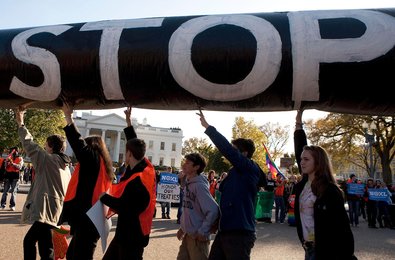
Mainstream media reports that some 8,000 people showed up in Washington D.C. today to link hands around the White House to protest the Keystone XL pipeline and the development of the Alberta boreal forest (aka “tar sands”).

The energy and determination of this crowd is wonderful. But It’s heartbreaking to learn that President Obama “missed most of the protest while he played golf at Fort Belvoir in Virginia.”

Last week I went for a walk on a golf course near my home, and was reminded again of how terrible these private parks are for the environment.

If lawns are destructive monocultures, just imagine the exponential scale of the golf mono-lanscape: acres and acres of closely cropped, artificially bright green  turf, with not a single broad-leaved plant to be seen.

Golf parks are anathema to butterflies and other insects, of course, since they are regularly treated with pesticides and herbicides.  They suck up precious water for a use that is 100% non-necessary: a pleasant game for the 1%.

I admit it, golf courses are one of my pet peeves.  I have never liked them, and never will.  So I suppose it was a sort of trigger to hear that Obama was off golfing this afternoon, instead of paying his respects to the thousands of activists streaming into Washington to communicate with him–the man we sent to represent us in the White House.

He is not the first American President to dodge attempts by the citizenry to communicate our wishes.  I think of President Bush off on his ranch while activists like Cindy Sheehan, whose son Casey died in the Iraq War, tried to send him an anti-war message.

Mr. President, if your citizens make the effort to go all the way to Washington DC to speak with you, I think the least you could do is show up.  We are depending on you to make the right decision on the tar sands/pipeline issue, which is clearly NO PIPELINE, and no development of the boreal forest.

We expect you to make a decision in favor of the health and well-being of your citizens.  Instead of investing in tired, dirty old energy platforms like oil and pipelines, we should be investing in solar and geothermal.  We need an Apollo Project for renewable energy, and we need it now!

Sure, you deserve your R&R on a Sunday afternoon, Mr. President.  But if you make the wrong call on this issue, those luxurious golf courses you enjoy may soon be relics of the wasteful bygone days.

Future social historians might point to golf as one of the many foolish 20th century habits that left us crouching bewildered in the 21st century in the midst of a full-blown climate crisis.

You’re the Decider now, Mr. President.  We are expecting you to make the right decision–for your precious children, and ours.

Sweet stirrings of a new world: fringe politics overturning the barricades

The venerable social critic Hendrik Hertzberg of The New Yorker contrasts the Tea Party with the Occupy movement in this week’s magazine, and finds the Occupy movement lacking in precisely what has made the Tea Party so strong: a willingness to get involved in (and take money from) the established American political parties.

“Occupy Wall Street and the Tea Party are both protest movements, not interest groups,” Hertzberg says, “and while both are wary, or claim to be, of established political figures and organizations, each welcomes their praise, if not their direction. Both have already earned places in the long, raucous history of American populism. But only one, so far, has earned a place in the history of American government.”

Are we supposed to be proud that the Tea Party has “earned” an infamous place as the launching pad for the new cadre of rightwing Republican zealots who have spent their time in Congress obstinately shooting down and stampeding every effort by President Obama and the Democrats to steer this nation towards a more compassionate and forward-looking political stance?

In its few years of existence, the Tea Party has happily wormed its way into the main arteries of American political power.  Hertzberg offers an apt metaphor of this tea as a new wonder drug, “injected into the scarred veins” of the GOP, which has quickly become addicted to this mainlined source of entranced, stupified frenzy.

“Now the Democrats are hoping the drug might be available as a generic,” Hertzberg continues, eying the Occupy movement as a way to enliven its own moribund political base.

I firmly hope that the Occupy movement does not allow itself to be used in this way by the political establishment, and I think it’s a reasonable, if remarkable, hope.

Remarkable because for so long Americans have been asleep, indifferent or unaware of what Hertzberg calls “the astounding growth of what can fairly be called plutocracy.”

Why it took so long for the sleeping giant of American popular opinion to wake up is a question for historians of the turn of the 21st century to ponder.

Why is it that Americans have been voting against their own class interests so long?  Why is the persistent myth of American equality, liberty and justice for all so teflon-coated?

We all want to believe that our country represents the moral high ground in the world, and that our leaders in government are as invested in upholding our idealism as we are.

Our public education system, which is responsible for the education of a great portion of the 99%, aids and abets this self-delusion by giving students the most doctrinaire and uncritical version of American history and civics, and teaching docility and proficiency at standardized testing above all.

Our media doesn’t help much; with the exception of a few poorly funded but stalwart independent outlets, the vast social landscape of contemporary media is focused at best on distraction, and very often on outright deception.

Under the pressures of this kind of social conditioning, it’s remarkable that the young idealists in the Occupy movement have had such success in galvanizing the country to wake up, shake ourselves, and stare around us with new eyes.

Hertzberg obviously intends his column as a signpost for the Occupy movement, pointing towards Washington D.C. as a more important battleground than Wall Street.  “Ultimately, inevitably, the route to real change has to run through politics,” he concludes; “the politics of America’s broken, god-awful, immutably two-party electoral system, the only one we have.”

Here is a glaring example of the kind of civics mis-education that has made our country so hard to reform over the years.

Who says our political system is limited to two parties?  Or at least, to the two parties we have now?

The Republicans and the Democrats have shown themselves to be chronically unable to lead this country out of the morass of special interests and ruthless corporate-driven capitalism that has bulldozed right over our cherished ideals of equality, not to mention the sacred ecological web that forms the real foundation of all our wealth and prosperity.

The Occupy movements are showing their intelligence in shying away from engagement with the established political system.  If anything, their political allies are more likely to be found in those perennial political organizations that have always camped out on the fringes of our electoral parks: the Green Parties or the Rainbow Coalitions.

Remember Ralph Nader, for example?  Remember how Big Media colluded with the established parties in denying so-called “outside” candidates a seat at the table at the televised Presidential debates?

This year the Ralph Naders of the political world have suddenly swelled their ranks dramatically, but without the figurehead of a single leader at the head of the crowd.  As Nader knows only too well, one man at the head of a true opposition movement is open to all the slings and arrows that the establishment can muster.  Even Gore and Kerry have felt the force of the muddy vomit pitched their way out of the far-right Republican swampland.

Far better for the Occupy movements to stay plural and collective, strong in the anonymity of the multitudes.  Those of us who are serious about doing more than simply rearranging the deck chairs on the great hulking Titanic of American politics realize that “America’s broken, god-awful, immutably two-party electoral system” is exactly what has to go.

OK, Hendrik, it may be the only one we HAVE HAD, but now the veil has been torn down, the people are awake, and we realize that another world is possible.  As Arundhati Roy famously put it, “on a clear day, I can hear her breathing.”

That clear day has dawned.

Fighting for Change with Hearts Wide Open

The environmental philosopher Kathleen Dean Moore looks out at the Occupied social landscape and sees “The Big One”–a movement that will bring all the disparate struggles of our society together on common ground, and effect deep, lasting, structural changes.

“The lines that connect climate change to jobs to the environment to education to health to justice are strong and undeniable,” she says. “The time has passed for an environmental movement. The time has passed for a climate change movement. The time has passed for isolated grassroots movements. We stand on ground that trembles with tectonic movement. Along the straining fault lines of our civilization, we feel the forces building for justice, sanity, and lasting ecological and cultural thriving.”

She’s certainly right that isolated movements are not going to change the world. That’s what’s been so great about the Occupy movements–they’ve been widespread and inclusive,a big big tent spread out over a lot of ground, coast to coast.

As Moore says, the moral ground of the Occupy movements is quite simple and clear: “it’s wrong to wreck the world.”

That’s something I knew instinctively as a child, as most children do.  Part of the great tragedy of our society has been the way we slowly deaden and numb the compassionate, empathic instinct of our children, teaching them to ignore pain and injustice, to just keep walking and mind their own business.

I know that’s what I was taught as a privileged young American growing up in a deeply unequal, unjust and exploitative society.  I know now that it was wrong.

And thanks to Occupy Wall Street and the other Occupy movements, I am beginning to know what to do about it.

We need to stop going about our business as usual, and relearn how to see and feel suffering and inequity.

We need to think outside the box of our normalized capitalist assumptions, making well-being rather than profit the goal of human effort.

We need to make protecting our planetary home our highest priority, because without a healthy environment, we will never build a healthy society, and things are so far gone that bringing back ecological balance will take everything we’ve got.

One of the reasons that revolutions are almost always carried out by the young is because they are closer to the instinctual compassion of their childhoods.

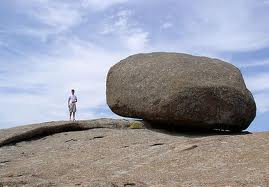
If only the stuffed shirts in Congress and in corporate office buildings all over America could remember what it was like to live with their hearts wide open, we might start to see the great boulder of social change really start to pick up steam.

Hope, Struggle, Dream, Persist: A Mantra for Dark Times

It is the day after Halloween, the Day of the Dead, and the day before my birthday.  It is one of the darkest days of the year, and a week from now, when American standard time “falls back,” it will seem darker still.

I was born in 1962, just after the Cuban Missile Crisis, as the Civil Rights movement and the Vietnam War began to pick up steam.  Each decade of my life has been marked by war and conflict, by a struggle between the forces of ruthless global capital, and the push-back from those who valued peace and a more equitable sharing of resources.

In my nearly half a century of life, I have witnessed a sharp decline in the ecological health of this planet.  Great flocks of many different types of birds have dwindled to a few sad outliers.  Clouds of multi-colored butterflies and swarms of busily working bees have vanished.  Delicate native wildflowers in the woods have been overrun by voracious invasive weeds, and the woods themselves have been overrun by a stampede of cookie-cutter tract housing in suburb after ugly suburb.

In my time, cancer has become a terrible epidemic, followed closely by diabetes and heart disease.  We humans have been sickened, just like the wild creatures, by the heedless spread of chemical treatments, pesticides, herbicides, fungicides, fertilizers, preservatives, additives and so many other toxins in our diet, soil, air and water.

What is there to celebrate on this birthday, the last in my fifth decade?

I look to my ancestors for hope and guidance, as is traditional on the Day of the Dead.

I see my Grandma Fannie, who believed in the power of the word, and practiced it by writing poems and stories that kept the wisdom of her Yiddish forebears alive.

I see my Grandma Mildred, who raised three kids, hosted and entertained her extended family frequently, and worked fulltime for a salary as well, year after year.  In her retirement she began the work she loved most of all, volunteering in her local public elementary school helping kids learn to read.

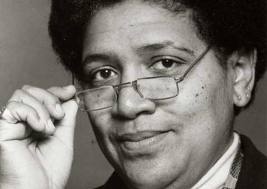
I see the ancestors I claim as kindred spirits, even though we do not share a blood relation: Gloria Anzaldua, who stands there arms akimbo telling me to “put my shit on paper,” no matter what the obstacles; and Audre Lorde, who reminds me constantly that “none of us is free as long as one of us is still shackled.”

As the Scorpio moon wheels overhead and I make my way to bed on my birthday eve, I can celebrate my own place as a link in this chain of strong women who spent their time on Earth trying to make it a better place for those who come after.

This has been a tough half-century, a period of decline and crisis in many ways.  It is a dark time.  But still the lights continue to shine defiantly: young people gather to Occupy the common ground and revive the dream of social equality; a Monarch butterfly sips a last meal at my butterfly bush before spiraling up to find the trade winds down to Mexico; the sun rises once again.

On this Day of the Dead, life goes on.  And while life goes on, we must hope and struggle for our children and their children, and the young creatures all over this planet that are being born today.  For their sakes, we must continue to work for a better future, and insist on our right to dream, and to make our dreams manifest.

This is my birthday mantra: hope, struggle, dream, persist, hope, struggle, dream, persist, endure.  And again.

Scary Halloween Statistic: 7 Billion People on the Earth by Oct 31, 2011

If you’ve never seen the Worldomters clock ticking, it’s worth a click.

Watching those numbers spin by brings home how very fast the human species is multiplying, especially when you consider the following chart, which shows how recent this population explosion really is.

No wonder we’ve got a sustainability problem!

Population control has gotten a bad name in recent years, and justifiably so.  It cannot and should not be imposed upon women by force, as it has too often in the past.

But study after study has shown that when women are educated and respected in society, birth rates go down.

Want to slow down that worldometer population clock?  Start by educating girls and opening up career opportunities for them after graduation.

Educate a girl and save the planet?  Might not be hyperbole after all.

Climate Change Blues: The one thing the 100% of us have in common is that we can’t afford to ignore the weather!

President Obama, venturing outside during last night’s storm, called the weather “less than ideal” for trick-or-treating.

What an understatetment.

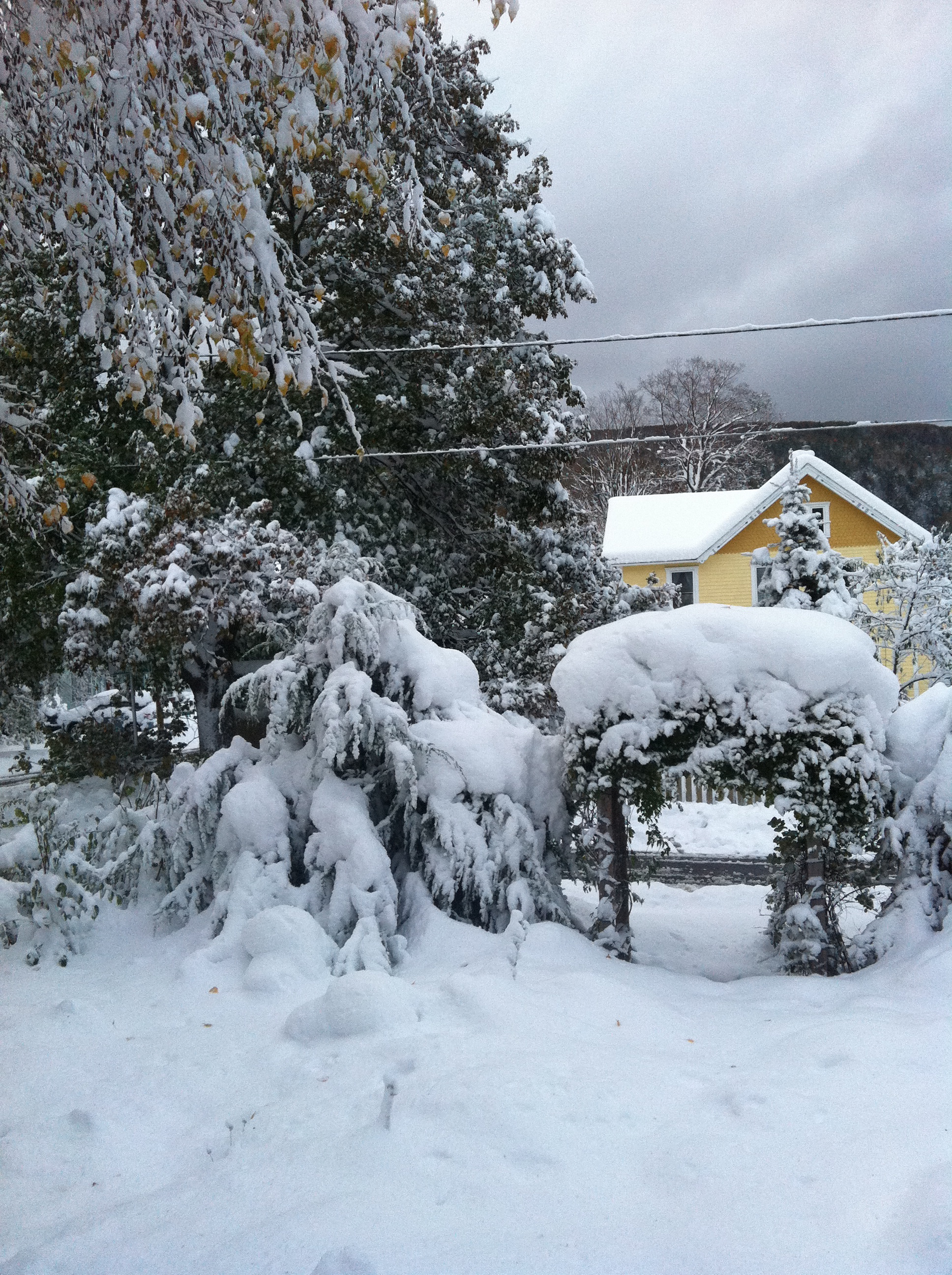
Here’s what it looks like at my house in western Massachusetts this morning:

All those trees in the background are tall maples, bent over with the weight of snow on their leaves.  So far no big limbs have snapped, but that could change any moment, and many of them are hanging over an outbuilding and my car….

So the question we should all be asking this morning is whether this freak October snowstorm is just an aberration, or if it’s part of a developing and accelerating pattern of climate change.

Yes, there have been October snowstorms before.  But has there been a three-month period before with record high temperatures (August), record rainfall (September), a hurricane hit to the entire East Coast (Irene) AND a record-breaking snowstorm?

Not being a meterologist, I can’t answer this question, but I’d sure like to know.

One thing I do know is that if we don’t start reducing carbon emissions, weather events like this are going to become more frequent and more severe.  This is not “Day After Tomorrow” hysteria, this is scientific truth.

So again, the question becomes, what can we DO?

Well, next weekend in Washington DC there will be an action at the White House; the plan is to assemble enough people to make a linked-arms ring around the White House, in the hopes of persuading President Obama to stand with the people on the anti-tar sands extraction, anti-Keystone pipeline issue, rather than with the energy corporations.

You can hear actor Mark Ruffalo explain it here:

My hope is that weather events like last night’s “freak” snowstorm will raise people’s awareness about the reality of climate change, and how it will affect all of us–our food supply, our physical security, our ability not just to carry on as usual, but to carry on at all.

All of us–the rich, the poor, the inbetween–the 100% of us, and not just in the US but in the world, are already feeling the effects of manmade climate change.  We’ll be feeling it increase exponentially in the coming months and years.

So all of us need to step off the path of least resistance and start demanding government support for a huge Apollo Project-style transition to sustainable energy and a serious commitment to energy conservation.

If you can’t get to Washington DC next Sunday for the demonstration at the White House, you can be part of the virtual ring that will surround the people on the ground there, and build support wherever you are for the movement for responsible and caring stewardship of our Earth.

We cannot afford to ignore these issues any longer.

A Realist Assessment of Where We Are Now

Human beings are like crows.  We are attracted to glitter.  We make a lot of noise.  We are social and travel in flocks. We are not terribly sensitive.

It has taken us a long, long time to realize how our presence here on Earth has been harming the planet.  You would think, with our tremendous intelligence, that we would have realized it sooner.  But we are masters at denial.  200 species a day go extinct because of human activity, and we just shrug and go about our business, focusing on the glitter at hand.  Perhaps it’s the animal in us, that refuses to recognize peril as long as, in a material way, we ourselves are OK.

Well, that long period of denial is coming to an end.  Or at least, it’s coming to a head.  We can no longer deny that it makes no difference to us if the ocean acidifies to the point where it can no longer support life.  Or the deforestation of the planet begins to interfere with oxygen production and the sequestration of CO2.  Or that the fresh waters that sustain us are increasingly toxic.

Yes, this affects every one of us. At some point, not very far in the future, it could be the case that our local supermarket will no longer be able to supply our nutritional needs, because the agri-socio-economic system that supplies the supermarket will be totally disrupted by climate change.

No, I am not being alarmist.  I am being realist.

We need to focus on this with all the amazing intelligence of our species.  We have brought the Earth to the brink of catastrophe, and alone among all the species on the planet we have the power to turn things around.

Will we seize this opportunity?  Will the current upswelling of activism associated with the Occupy movement get that the issues go far beyond the little hopes, dreams and disappointments of the middle class individual?

I refuse to give up hope.  I refuse to give up hope.  I refuse to give up hope.

Stand with me.  Let’s turn things around, before it’s too late.

Calling all Occupiers: Join the Deep Green Resistance of the Earth, before it’s too late

Occupy the Machine – Stop the 1%, Literally | Deep Green Resistance.

I had a feeling that the Deep Green Resistance movement would have something interesting to say about the Occupy movement, and I wasn’t disappointed.

As might be expected from a radical environmental group, they are envisioning a massive escalation of the movement, swelling the numbers and multiplying the targets so as to overwhelm the police who will be called in to maintain order.

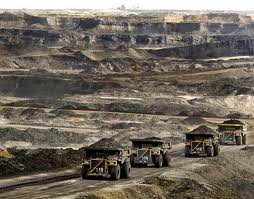
DGR is imagining an occupation at the sites of worst destruction of the environment, like the boreal forest of Alberta, known to the energy mafia as the tar sands; the coal-burning power plants; the pipelines and the shipping routes.

I might add factory farms to the list, like the beef and hog farms out West that generate the toxic runoff that is poisoning the ocean for miles around the outlet of the Mississippi River.

Naming targets is one thing, but what’s really important is being clear on what the occupations are for. I don’t think the Occupy movement is especially focused on the environment.  It seems to be focused on social inequality–excessive wealth that has destabilized our economy, and the lack of jobs for the middle class.

These are all worthy issues.  But as I’ve said before, it won’t matter a rat’s ass if you have a job–or if you’re dripping in gold or starving and naked–if the climate changes decisively due to global warming.

To turn global warming around will require a movement like the Occupy movement, filled with idealistic, dedicated, thoughtful people who are willing to give it their all.  This struggle has to be linked with a critical rethinking of the industrial capitalist economic model of ruthless extraction and production in the name of profit.

That is the model that has driven our planet to the brink of systemic correction.

Not collapse.  The planet will be fine, she will regenerate.  She has time.  But to do it she will need to effect a serious correction of a species gone haywire, the human species, which in a very short time has altered the planetary environment to such an extent that millions of other species have gone extinct, and supplies of the basic life support systems like oxygen and water are threatened.

The Earth has survived such challenges before, and she will survive this time again.  But human beings, and most of the countless other beautiful life forms that share the planet with us at this time, will be doomed if industrial civilization is not rebooted and recreated as an ecologically sustainable system.

That is where the pressure of the Occupy movement needs to be applied.

Will the Occupiers step up to such an enormous challenge, much bigger than the one they initially envisioned?  Hard to say.  But at the moment they seem to be the best hope of deep change of our society and our terribly destructive economic system.

It’s in the Liberty Parks all across the world that the conversations are beginning that might have the potential to lead to real change.

All the money in the world is not going to buy safety or plenty once the Earth herself begins her own form of Deep Green Resistance.

Help Wanted: Obama the Community Organizer, Please Come Back!

Here’s another video of unwarranted police brutality against peaceful protesters, this time in Oakland CA, that’s sure to go viral on the Web today:

How do you think the NY Times is covering this story? Not surprisingly, the Times presents the story largely from the establishment point of view, focusing on how cities are “losing patience” with the Occupy movement, with “officials…grappling with growing concerns about crime, sanitation and homelessness at the encampments.”

Well yes, we do need to be worrying about “crime, sanitation and homelessness.”  But not especially at the Occupy encampments.

The Occupy Wall Street folks have shown themselves able to handle these issues very well themselves, without any help from city officials or police, and we can expect that their example will be followed by other protesters across the country.

However, there are other, far more serious instances of crime, sanitation and homelessness on which city officials should be focusing.

For instance, the criminal behavior of the major American banks, which, as Nick Kristof observed in his column yesterday on American crony capitalism, “privatize profits while socializing risk.”

Or the criminal behavior of the U.S. military establishment, which, in a heinous disregard for the health of U.S. Marines and their families, ignored the fact that the water at Camp Lejeune was highly unsanitary–in fact, totally toxic–for years, until the undeniable incidence of cancer and birth defects, including the biggest cluster of male breast cancer victims in the nation, forced officials there to acknowledge the problem.

Then there’s the issue of homelessness.  Not the kind represented by the tents and sleeping bags that have sprung up in cities and towns across the country in a deliberate effort to draw attention to soaring American inequality.

No, what officials should be concerned about is actual homelessness caused by record numbers of home foreclosures by the very banks that manufactured this crisis to begin with.

I don’t think it’s any coincidence that President Obama has lately snapped out of the zombified sleepwalking he’s been stuck in for the past year or so.

The Occupy movement can and should claim the credit for waking him up and giving him the inspiration and courage to start fighting back again. These young people may be his salvation in the next election, too, if he can break the chains that have bound him to Wall Street and take up a more populist stance.

According to the U.S. Census Bureau, in 2010 there were 26.1 million Americans ages 18-23.  A good portion of those–say, 90% or so–have every right to be upset with the dismal state of the economy they’re about to enter as working adults.

Many of them have crushing student loans, and come from families that have been struggling to keep up with their mortgage payments in a flat-lining middle-class economic environment.

And seriously, do you know ANYONE who has not been touched by cancer at least indirectly, having to watch friends, neighbors and family members fight the good fight against this manufactured scourge?

Do you know anyone who doesn’t think we in the 99% need access to affordable health care, and better governmental protection from toxic chemicals in our food, water and air?

President Obama needs to get back to his community organizer roots, and come out as the man we thought we were electing, the defender of the 99%.

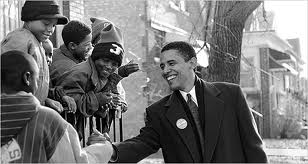
We need to hear from the youthful idealist Obama who worked so hard to improve conditions in Chicago’s ghettos.  I know he’s in there somewhere.

Maybe these young people in the nation’s streets, standing firm against the onslaught of the riot police, will rekindle the fire that’s been all but extinguished in the White House lately.

In this wet, gloomy autumn, there’s nothing we need more.