The Epic Stakes of the 2016 Presidential Election—Electing Clinton is Just the Beginning

Yes, it’s exciting—thrilling, even—to see a female-bodied person finally heading the ticket for the Democratic Party. Yes, it’s historic that a woman will be President of the United States. And yes, when we are shown footage of the original Hillary, the idealistic young college student, the hardworking young lawyer/mom, we can see shadows of the woman we’d like to elect.

unknown-1

But to contrast that earlier Hillary with the image of the tough-as-nails politician she has become is to understand why it’s so hard for women to succeed in the American political landscape—or the corporate workplace, for that matter. You have to learn the fine art of being a fe-male, a man in the guise of a woman.

unknownWhile outwardly conforming to the dominant beauty standards for women—dyed and coiffed hair, generous make-up, body-flattering clothing, heels—you also have to be commanding and aggressive, a no-nonsense sort of leader that everyone will automatically respect.

It’s no accident that our first woman president will be a woman in her golden years. Only when a woman has outlived the possibility of being a sex symbol can she command the necessary authority, with men and women alike, to hold the highest office in the land.

How many women have the stamina—to use a buzzword from the campaign trail—to stay the course over years of trials and hurdles, all the while walking the tightrope of being simultaneously attractive and authoritative?

Donald Trump, bless him, has brought right out into the open the everyday harassment that women have to deal with. Who is unluckier: the attractive woman who gets constantly groped and ogled, admired for her body while her ideas and smarts are ignored; or the unattractive woman who is ignored on both the bodily and mental planes, if not actively booed and hissed from the public arena?

gettyimages-613703308-0Trump is like a stand-in for every boorish man who ever held power in America, whether a boss or a husband, a rich client or a random stalker on the street. Men like Trump elevate their own fragile egos by putting down others, with women being a convenient, always-in-view set of targets.

Hillary has shown us just where to aim our defensive kicks, but she is also evidence of the toll this type of psychological warfare takes on a woman. She’s damned if she “acts like a man” and also damned if she’s “too womanly.” She basically has to become as genderless as possible, and we see that in her carefully chosen suits, cropped but coiffed hair, and in the cold tautness of her heavily made-up face.

I hope that when Hillary gets into the Oval Office, she will not pull up the drawbridge behind her, but will make every effort to use her power to make things better for the girls and women coming along behind her.

Women should not have to give up their femininity to become powerful. Men shouldn’t either! When are we going to understand that gender is a continuum, not a binary; that all humans have estrogen and testosterone running through them in different measures; that every human has the capacity to be both tender and tough, sensitive and aggressive?
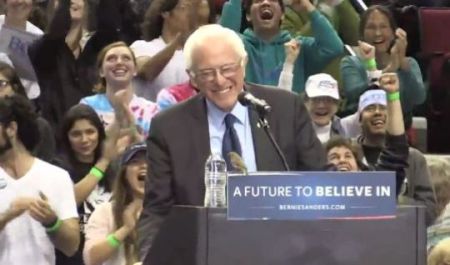
29906170001_4818348677001_capturePerhaps that was part of what I admired so much about Bernie Sanders—his easiness with being nurturing and warm, even cuddly, on the campaign trail. No doubt this gentleness comes easier for men as they age and no longer have to prove themselves through aggression.

My dream is that it won’t have to take so long for women like Hillary and men like Bernie to be accepted in the American public sphere.

My dream is that our society will shift away from cheering on the superficial, cartoonish values represented by the Donald Trumps among us, and get back in touch with what really matters: living in right relationship—that is, in respect and caring—for every person, no matter what they look like.

And of course, my dream goes beyond this re-valuing of human rights to encompass the rights of every living being on the planet.

jb-solstic-mountaintop-copyWhenever I turn away from the glare of the brightly lit television screens and stage sets of our political moment, back to the green and gold of the forest, I am reminded of what really matters. The water protectors at Standing Rock know it; the Treesisters know it; the Bioneers know it; the Buddhists know it. Human beings have not evolved on this planet to rape and pillage and turn the green to dust. With our unique intelligence and capacity to understand time—history as well as prophecy—we are here to be the wise stewards of the planet, to nurture and protect the complexity of the ecological web that nourishes us.

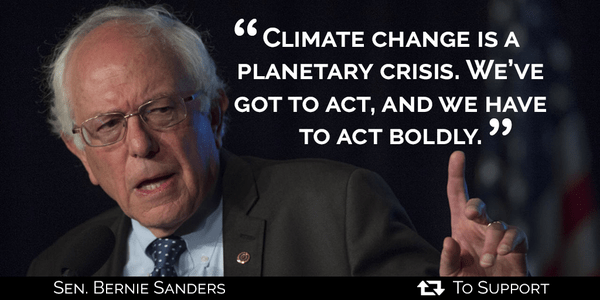
I can’t say I trust Hillary Clinton to understand or undertake this role. She is a 20th century woman, still living out a 20th century drama of war and destruction. That is why we will have to follow Senator Sanders’ model in creating a drama of our own, too big and urgent for her and her business cronies to ignore. Mother Earth will do her part—we can see it already in the constant litany of storms and floods, wildfires and searing heat.

If we humans fail in our evolutionary mission of stewardship, the Earth will simply start over, as she has many times in the past. It’s time to do everything we can, each one of us, to head off that epic fail—starting with defeating Trump and installing Clinton.

And then we will continue stubbornly, with determination and love, the great work of transforming our society into one based on a new fundamental watchword: no, not freedom this time.

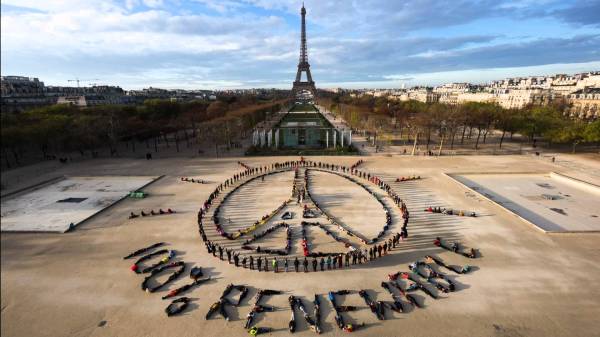
For the 21st century and beyond, our core value must be RESPECT.
Snowden and the Politics of Doing Good

Go see Oliver Stone’s new movie “Snowden,” starring Joseph Gordon-Levitt as the eponymous hero, if you need reminding about how important a single human being’s act of courageous resistance can be.

Granted, Edward Snowden had his finger on the pulse of information far beyond the ken of most of us ordinary folks. But we can all relate to the ethical questions he faced, which the movie details so well.

To whit: At what point is it more important to listen to your own internal moral compass, even when it means going against “public opinion,” company policy or—in Snowden’s case—the entire power elite of the U.S. military industrial complex?

We live in a time when this is a question will come up with increasing urgency for more and more of us. Our age is one of unprecedented access to information, as “Snowden” shows in horrifyingly graphic detail. And once we know something—say, how a pipeline leak can foul and destroy an entire river ecosystem, or how a radiation leak can play havoc with ocean systems for years, or how deforestation leads to mud slides, or how climate change is already changing coast lines and destroying planetary weather balance—once we know all this, and so much more, what do we do with our newfound knowledge?

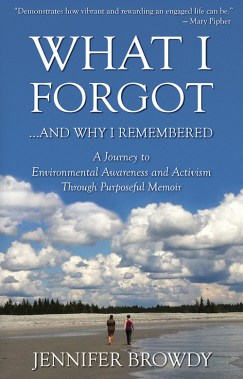
what-i-forgot-cover-draft-new-smThis question became increasingly central for me as I worked on my memoir, What I Forgot…And Why I Remembered, over the past several years. It was waking up to climate change that sparked my journey of looking back at my half-century on the planet, trying to understand how I had allowed myself to forget the connection to the natural world that had been so central to me as a child.

What I discovered was that as a young adult, I made some choices that led me to go with the predominant flow of American culture. Like Snowden, I was seduced by the possibility of attaining the American dream—my version of it being the husband, children, home, career. I put myself in the traces and began to focus on pulling that cart, and I found it took everything I had.

Not until the dream disintegrated along with my marriage did I pick my head up and look around me, instinctively seeking solace in the natural world but finding that things had changed a great deal since I was a dreamy child following the chickadees through the hemlock forest, or lying full-length on a high maple branch to feel the wind swaying through the tree.

While I had been focused on raising my family, trying to hold my marriage together and striving for success in my career, things had been going very badly for the chickadees, the hemlocks and the maples. Government policies and corporate greed, unleashed by the shortsightedness of millions of compliant citizens like me, had led us to the brink of a global catastrophe of biblical proportions.

There we sit now, on that brink. Did you notice the news, buried beneath all the election cycle noise, that the climate has now passed 400 ppm of carbon in the atmosphere, far beyond the 350 ppm that gave the scrappiest of the climate change warrior-organizations its name?

This means we are on track to melt, folks. The polar ice caps and the permafrost on land will thaw, releasing ancient methane; the oceans will warm, throwing off the food chains and the weather; insects and bacteria will do very well, but many if not most of the larger species will rather quickly go the way of the wooly mammoth and the saber-toothed tiger.

Including, dare I say it, homo sapiens. Future historians, if there are any, should rename our species homo ignoramus—the stupid ones who knew how they could save themselves and the ecosystem that sustained them, but let it all go to hell.

We have come to a time, as the Deep Green Resistance eco-warriors recognized several years ago, when it will be necessary to think for ourselves and stand up for what we believe in, just like Ed Snowden did.

ogxmhigg1ipam3wk7hpi

This is dangerous business, as Snowden knew. He is lucky to be living freely in Moscow rather than locked up as a traitor like fellow information resistance fighter Chelsea Manning. The fossil fuel lords and their military henchmen take mutiny very seriously, as the brave water protectors at Standing Rock know well.

But there comes a time when you have to listen to your gut, even if it goes against your upbringing and socialization. You have to do what you think is right.

Of course, in a black and white view of morality, what’s right for you may be totally wrong for me. How do we reconcile the disparate moral compasses of a jihadist suicide bomber or an American bomber pilot or a tar sands bulldozer operator or a pipeline resistance activist?

Each of us has to make up our own minds, fully cognizant of the implications of our actions, the bigger backdrops against which each of our little lives play out. That is why I continue to believe that there is no more important role these days than that of an awake, aware, independently minded educator.

We need teachers at every level of education who are dedicated to developing the capacity of young people to understand and analyze complex information, to weigh and debate different points of view, to use empathy as a pathway to decision-making, and to be open to shifting their views as their understanding increases.

14232542_1204250572949382_2583876020375066880_n.jpg

Edward Snowden and Chelsea Manning were both thoroughly indoctrinated by the military, but were still able to think for themselves and sacrifice their snug insider positions in service to the greater good. If they can do it, any of us can.

No need for spectacular defections or heroics. All that’s needed is a steady ongoing commitment to sifting through the barrage of information coming at us all the time, and pointing our internal compass at DO NO HARM or even better DO GOOD.

If you want to call me a pie-in-the-sky do-gooder, so be it. I can live with that.

do-no-harm.jpg

The Berkshire Festival of Women Writers: Cultivating Creative Community

virginia-woolf.gif

Virginia Woolf famously said that women writers need a room of their own. True enough, but that’s not all we need. We also need a community to nourish and support us and cheer us on through the challenges of the creative life.

So many people seem to think that the playing field has been leveled for women; that the feminist movement can just pack it up now and go home.

It’s not true, not yet.

For most women, a writing study of one’s own is not an achievable reality. We’re lucky if we can set up a desk of our own in a corner of our own…and get to it at least once a week.

Let’s face it, most women who become mothers must juggle the demands of pregnancy, child-rearing and home-making with the pressure to contribute to the family income—and for writers, that often means having a “day job” that necessitates doing the writing on the side of everything else.

At the other end of our lives, we’re the ones taking care of our own parents, too. There’s just never enough time to fit everything in, and often our writing slips down to the bottom of the endless to-do list.

cfed82894ce77d5eb912cd5c3fe77346My mentor Gloria Anzaldua urged her working-class sisters to “Forget the room of one’s own—write in the kitchen, lock yourself up in the bathroom. Write on the bus or on the welfare line, on the job or during meals….When you wash the floor or the clothes, listen to the chanting in your body,” she says. Write “when you’re depressed, angry, hurt, when compassion and love possess you. When you cannot help but write” (“Speaking in Tongues: A Letter to Third World Women Writers”).
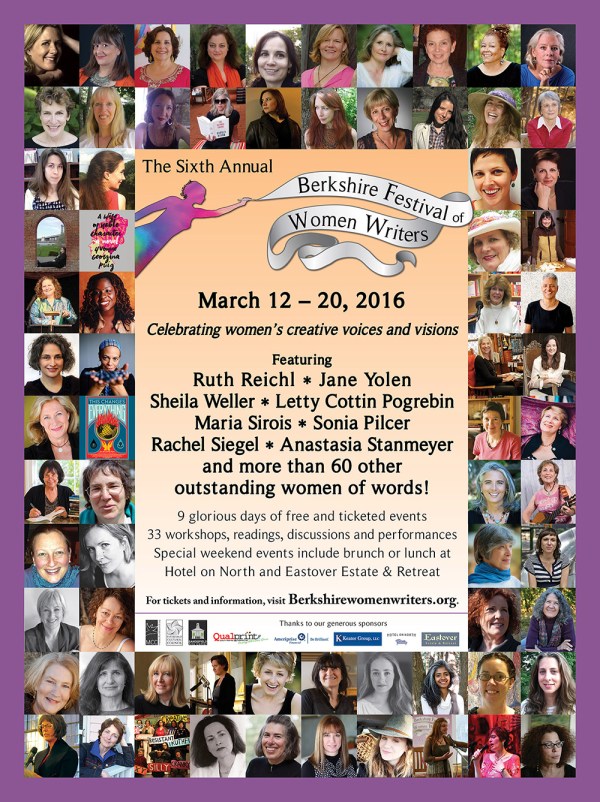
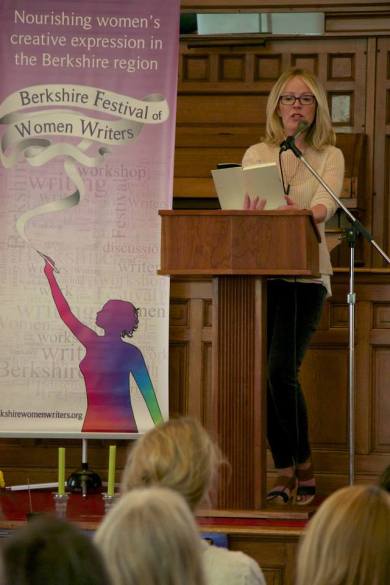
Before she died–too young–of diabetes complications, Gloria published several influential anthologies of women’s writing and worked hard to build a community that bridged all kinds of identities and differences.

She was a great inspiration for me, and when I founded the Berkshire Festival of Women Writers in 2011, I felt like I was carrying on her work, in my own corner of the world.

The sixth season of the Festival presents nine full days of readings, workshops, talks, discussions and performances featuring talented women writers from the Berkshire region and beyond.

BFWW-ad-FULL-Artful-Mind-WEB

For me, this is not about art for art’s sake. It’s about activating women to recognize that we all have important stories to share, which we can cultivate by developing the confidence to speak our truths, and the community that will encourage us to write, write and keep on writing.

11010606_934650809911488_2830181057542873053_nAt last year’s Festival, Dani Shapiro shared what she considered to be the essential ingredient of a successful writing career like her own, and it was surprisingly simple. You have to put your butt in the chair and write, she said. Just do it.

Having this discipline is much easier when you begin to trust that there are people out there in the world who care what you have to say; who will listen and applaud and come back for more.

That’s why it’s important, even if you don’t consider yourself a writer, to turn out at community-building events like the Berkshire Festival of Women Writers. Come to show your support of the writers on the stage; come to be inspired; come to share in the camaraderie of lunching and brunching with a roomful of writers and the people who love them.

The Berkshire Festival of Women Writers happens but once a year, in March. That’s Women’s History Month, and also the month, in New England, when the sap starts to rise. Come take a taste of our creativity and feel your own creative vision rise in response.

Check out our schedule of events, and mark your calendar. See you at the Festival!

11030824_910335575676345_4134623638509003026_n

DIY Media: Reading the Oil Glut and Stock Slide Against the Backdrop of Climate Change

I have been puzzling over the lack of media coverage, let alone analysis, of the huge stock market slide this past week, coupled with the oil glut and consequent low gas prices for consumers. What does this mean?

I went on a hunt through the media for explanation, or at least discussion, and turned up precious little—not in the mainstream media, not in the progressive media, not even in the business media. The facts were being reported, but no one, not even the pundit/oracles, were trying to tease out the deeper meanings of the current scenario.

For example, take this article in business section of The New York Times. It reports the story of oil as though climate change and alternative energy were non-existent. It’s all about production, investment and returns—not only financial returns, but pipe-dream returns to the naiveté of the 20th century, when the ability of the planet to support endless growth of human activity seemed limitless.

When we bring alternative energy into the picture, the analysis gets a bit more complicated.

It seems that the oil glut is good news for the planet (less exploration, less extraction), good news for the consumer (lower prices at the pump) but bad news for investors who had been banking on fossil fuels to be a never-ending gold mine.

More importantly, it’s also bad news for alternative energy developers and producers, because low gas and oil prices diminish consumer demand—we’re less incentivized to make the investment in a home solar array or make sure our next car is a hybrid or electric vehicle when oil and gas prices are so low.

In my search through the media for more explanation of the oil glut, I found some suggestions (by commenters, not by journalists) that the low oil prices might be a Saudi manipulation precisely to dampen enthusiasm for shifting to alternative energy, in order to slow down the transition away from oil.

If that were the case, the Saudis would be digging their own graves and bringing the rest of the planet down with them.

Given the bigger picture of undeniable, stark and looming climate change, governments, investors and consumers must use their purchasing power to drive the market towards clean energy. We should not be fooled by the smoke and mirrors of low oil prices, or intimidated by the stock market jitters into backing into the traditional “safe” investments of fossil fuels.

That way does not lie safety—it lies collapse.

maxresdefault

It would be nice if the pundits of the mainstream media (The New York Times, for example) would focus more attention on the biggest story of our time: the race to adapt to and mitigate climate change. It would be nice if instead of just blandly reporting the news, journalists would reach out to scientific, political and economic experts for deeper analysis.

But thanks to the Internet, we can do that work of reporting for ourselves now. We can read publications from all over the world, of all political stripes, in any discipline, any time. If we care about what’s happening to our planet, we need to become more alert, placing the superficial narratives reported in the media against the backdrop of the bigger and deeper realities that often cast quite a different slant on the news.

We live in a time when anyone with an Internet connection can become an engaged citizen of the world, able to exchange ideas, influence others, and galvanize social movements. The American rightwing, with their crude emotional ploys, seems to be doing a much better job of activating their base lately than the progressives, Bernie Sanders a lone and very active exception!

We can do better, and we must. It sounds weighty but it’s true: the future of the planet depends on the choices each of us makes now.

CKHjbf5WcAAD3JW


The Heart and Soul of Bernie Sanders

As a woman, I would have liked to be enthusiastic about Hillary Clinton’s candidacy for President of the United States. But when the Democratic primary comes to Massachusetts, I’ll be voting, enthusiastically, for Bernie Sanders.

It’s not that I think Hillary Clinton would make a bad president, or that she isn’t up to the job. It’s that a vote for Hillary Clinton is a vote for the status quo—a strange thing to say about the first viable female presidential candidate in U.S. history.

Like many women around the world who gained political power through their husband’s or father’s political legacy, Hillary represents an established—and an establishment—vision. She has a bunch of policy ideas thrown up in alphabetical order on her website, so that it appears,  bizarrely, that “fighting Alzheimer’s disease” is her number one priority. But her short takes on the issues don’t add up to a clear, convincing vision of her own. She appears to be running mostly on the strength of being a voice of moderation in the howling wilderness of the Republican field.

I want to hold back the Republican beast as much as anyone, but I’m not willing to settle for Hillary when I could have Bernie instead.

What Bernie has that Hillary lacks is, quite simply, heart and soul.

12510352_958567974198207_6726860435237900490_n-1

Like Barack Obama, he has the ability as an orator to connect with a crowd and get them on their feet and cheering. He does it by speaking clearly, without artifice or manipulation, about the injustices that have been woven into our social system here in America, which most Americans must navigate on a daily basis.

Bernie is not afraid to call out today’s robber barons and hold them accountable for a disparity in wealth not seen since the last gilded age, right before the Depression.

According to Emmanuel Saez of the University of California, Berkeley, and Gabriel Zucman of the London School of Economics, American inequality in wealth is approaching record levels. As The Economist summarizes, “In the late 1920s the bottom 90% held just 16% of America’s wealth—considerably less than that held by the top 0.1%, which controlled a quarter of total wealth just before the crash of 1929. From the beginning of the Depression until well after the end of the second world war, the middle class’s share of total wealth rose steadily, thanks to collapsing wealth among richer households, broader equity ownership, middle-class income growth and rising rates of home-ownership. From the early 1980s, however, these trends have reversed. The top 0.1% (consisting of 160,000 families worth $73m on average) hold 22% of America’s wealth, just shy of the 1929 peak—and almost the same share as the bottom 90% of the population.”

As we know, a handful of billionaires are spending a lot of money to maintain the status quo, by buying politicians to do it for them.

12512529_958065547581783_4427322255044418911_n

Bernie won’t have any of that. Like Barack Obama, he is raising record campaign contributions in small amounts—in fact, as of December he had more contributions than Obama did at that stage of his 2008 campaign.

Hillary still has a little more money in her war chest (according to a recent report, she has raised just $4 million more than Sanders), but that could change as Bernie continues to gain traction and momentum.

The rumor that he might choose Senator Elizabeth Warren as his running mate generated a ripple of delight among those of us who want to see a woman in a top U.S. office. Although presidential tickets are usually picked by geography (a Southern presidential candidate choosing a West Coast VP, for example), it might be time to make an exception and let these two amazingly inspiring leaders out of the starting gate to show what they can do together.

Bernie Sanders’ issues page has an entirely different feel than Hillary’s. He’s not just running down a laundry list of issues that have been generated by polls and focus groups as the ones every candidate should respond to. No, Bernie Sanders has a thoughtful and passionate take on every one of the issues he lists on his website, from climate change to a living wage, from health care and social security to foreign policy and educational reform. He’s got the big picture AND he’s got the details.

12439133_957873727600965_1642971065079700094_n

Most importantly, he really cares. He’s not running for President on some kind of ego trip. He’s running because he looked around and saw that he was the leader he’d been waiting for. No one else in the Democratic Party had the guts or the smarts to challenge the Clinton establishment and the status quo party backers. He looked and he leaped and he didn’t look back. He’s been giving it all he’s got, and he’s clearly got a tremendous amount to give.

I have always been a closet Green Party supporter, and I hate the fact that no one pays any attention to Jill Stein, who continues to run anyway, off in her own parallel universe. Bernie represents something new in American politics: a Green Democrat. He’s the homegrown hybrid we need to successfully navigate all the challenges facing Americans and the world in the 21st century.

Yes, I know the Republicans will do everything they can to stop him, during the campaign and if he were to gain the White House. I know they play dirty. But Bernie is tough, and he’s got something none of the other big players have: integrity.

Americans are hungry an honest politician who means it when he says he is on their side—and doesn’t just say it, but lives it. That’s why we elected Barack Obama in 2008 and 2012, despite all the Republicans’ dirty tricks, and that’s why we’ll elect a Democrat again in 2016.

Much as I’d like to see a woman President, what matters to me more than external appearance of our next leader is what’s inside that exterior shell. I’ll take Bernie’s heart and soul over Hillary’s, any day.

images

Check out Bernie’s Jan. 9, 2016 discussion of his “electability” here.

Transition Times: Personal, Political, Planetary

The Solstice is an opportunity to remind ourselves that the moment we hit the very darkest point of the year is also the transition into the next phase, the return of the light; every end point is also a new beginning.

The recent decision of The Berkshire Edge to end my EdgeWise column gives me time to return here, to Transition Times, with renewed energy and commitment. Transition Times began in 2011 as a space where I could write about human rights, social justice, issues of higher education and pedagogy, and my overriding concerns about the environment and climate change. It’s been a liberating and often exhilarating experience to write in my own personal/political voice, without having to meet any particular deadlines or answer to an editor or publisher. And I love that my readership is truly global.

I wish I could say that many of the issues that preoccupied me in the first several years of Transition Times have now been resolved. Sadly, violence—against people, against the natural world—is still a problem of epic proportions, worldwide. Climate change, chemical contamination, animal extinction deforestation and acidification of the oceans have all been accelerating. Our political establishment continues to be dominated by elites who seem to care only about maintaining their own wealth and power, not about preserving a livable world for the rest of us.

While all that is true, there is still cause for hope. When I first began writing about climate change, I felt like other than Bill McKibben and a handful of environmentalists, no one was paying attention to this looming issue. Now it’s common to see climate change on the front page of mainstream media. The Pope has written a whole Encyclical about it. World leaders converged in Paris to talk seriously about what can be done, including key players like the U.S., Russia, China and India, countries that must cooperate for real change to happen.

crppope650

I feel less optimistic about progress on the peace-building front. Gun violence in the U.S. continues to skyrocket, as do sales of assault weapons to civilians. Let’s face it, here in the U.S. we live in an armed and dangerous camp. Terrorism continues to rise with the spread of the violent, sexist, medieval principles and tactics of the Islamic State and Boko Haram. Civilians are also being constantly threatened by state-sponsored terrorism, otherwise known as warfare—especially in places where civil society has broken down or become dominated by corruption (think Afghanistan, Syria, Yemen, Libya, the list goes on).

Against this backdrop of global-scale violence, I see young Americans, who in earlier generations would have been our revolutionaries, struggling with up-close-and-personal issues that make it hard for them to focus on the bigger picture. Poverty, debt, lack of opportunity, institutional racism and sexism, anxiety, depression and addictions (including media addiction)—these immediate concerns are front and center for many young people I know. Mention climate change and they just flinch and turn away, unable to cope with one more problem, especially one so immense and seemingly intractable.

Butterfly-Effect-Logo-WEB-2015In my work—teaching, writing, organizing the Berkshire Festival of Women Writers and the new Butterfly Leadership Program, and running Green Fire Press—I am always seeking to empower others to recognize their own potential to become the leaders we are all waiting for. The old saying “We are the ones we’ve been waiting for” is so true, and we must wait no longer—there simply isn’t time.

What is needed now is a deep, grounded movement for peace, based on empathy, collaboration and alliances across superficial differences. We must recognize our kinship, not only with other human beings but with all life on Earth. We must re-learn to rightly value the “natural resources” without which none of us could survive a moment: clean air, clean water, fertile soil, a vibrant healthy planetary ecosystem.

We must re-learn and teach our children appreciation and even reverence for this beautiful battered planet of ours. We must institute social priorities based on peace and collective well-being, not violence and competitive profiteering.

UnknownWe have a candidate for the American Presidency now who is not afraid to take up these values and call them by their old, 20th century name: socialism.
While I have no problem with the moniker socialism, I wonder if it might be time for a new, 21st century political movement, with a new name that doesn’t come with all the blood-soaked baggage of the 19th and 20th centuries.

Your ideas of possible new names, emphasizing collective well-being and reverence for life, would be most welcome. Here’s one idea to get us started. How about Gaiaism?

Happy Solstice to all, and may this new year be a transition time to a new and better world for all of us Gaians.

11224451_580292333514_5740506175697213006_o

As above so below. Photo by J. Browdy c. 2015


Following Today’s Star of Bethlehem in a Time of Global Weirdness

It seems like there has been a lot of weirdness going on this fall.

In the celestial sphere, we’ve had the spectacular lunar eclipse, which I was so fortunate to watch out on a hillside under a huge old elm tree winking with stars. In Europe there have been unprecedentedly beautiful Northern light shows going on, which are the visible record of strong solar winds hitting our atmosphere.

Full moon before eclipse, September 2015

Full moon before eclipse, September 2015

There have been reports, which I have not been able to confirm, that the electromagnetic pulse of the planet, the Schumann Resonance, has spiked precipitously in the past few months. If this were true, it could be a sign that the feeling of acceleration so many of us have been feeling could be related to the speeding up of the background beat to which every living cell on Earth is attuned. Or it could be going the other way: perhaps the pell-mell acceleration of human activity is actually affecting the steady state of the planet itself.

On the human side, we had a marvelous visit from Pope Francis, aptly self-named after the patron saint of animals, who begged world leaders at the United Nations to become responsible stewards of the environment. I wrote about the blind spot in his analysis here: it’s population control, of course. If he’s serious about stepping up to the challenges of climate stabilization and human poverty, he MUST come forward in favor of women’s reproductive rights. There are signs that he may actually be the one to finally move the Catholic church in this direction—a weirdness that would be most welcome!

On the less positive side, we have had unrelenting violence this fall. More atrocities against innocent people by the American police; the “mistaken” targeting of a Doctors Without Borders hospital in Afghanistan; the entry of both Russia and the U.S. into the war theater of Syria, from which millions of civilians are now fleeing; more massacres of innocents by armed maniacs.

In a recent column, I called for the formation of a new movement to be led by mothers, along the lines of MADD (Mothers Against Drunk Driving), which has had remarkable success in getting state legislatures to crack down on young people driving under the influence. I thought we could call the organization MAGI, for Mothers Against Gun Impunity, and also harkening back to those wise men of another age, who recognized the baby in the manger as the future preacher of love and mutual respect. We need more of that Magi spirit today!

Star-of-Bethlehem_Burne-Jones_800px

The Star of Bethlehem, watercolor painting by Sir Edward Burne-Jones, 1890

In addition to all the violence, we have the on-going weirdness of the American political scene, which is more and more coming to resemble a comic reality TV show. I have little patience for any of the major players, though I continue to respect Barack and Michelle Obama, and to cheer underdog Bernie Sanders on in his Presidential campaign, which is picking up more and more steam despite all the skeptics and hecklers in the pundit bleachers.

Unknown

For the past few years, I have learned to trust my sixth sense when it comes to spikes of global weirdness. For several days before the Oregon massacre, I found myself checking the national news frequently, certain something unpleasant was about to happen soon. The fires out West and the floods in the Carolinas, though of unprecedented intensity, have become almost routine these days. It takes something really unusually weird and bad to break through our habitual numbness and make us pay attention.

OK, world, you’ve got my attention. Now what do you want me to do? It seems that I can only continue to chug along in my own sphere, focusing on tuning in to the natural world around me, trying to stay calm and centered, taking care of my family, and going about the work I’ve taken on, nourishing and strengthening the voices and visions of women.

Monet meets Escher in the Berkshires 2015I continue to believe that women’s creative leadership is going to be essential to the transition times we are living through. Everything points to the exhaustion of the masculinist paradigm that took us through the so-called Enlightenment, savage colonialism and the rise of industrial science and extraction capitalism. Now is the time of the feminist qualities of collaboration, community-building and compassion—accessible to all human beings, no matter our physical characteristics.

We adult women and men must take on the roles of the Magi, following the star that points to the potential of millions of girl-children now sleeping in their mangers. It is our duty, and our privilege, to bring to the next generation whatever gifts we most value, whatever wisdom we feel is worthy of being passed on.

Together we can survive this time of global weirdness, and bring humanity into a more positive resonance with our beautiful planet. I know it is possible. I want to believe we can make it happen.

Transitions at Transition Times

I am aware that I have not been posting very frequently on Transition Times, and there is a simple explanation for that: I have shifted my writing energy into my weekly column, Edge Wise, published on Thursdays at The Berkshire Edge.

I started Edge Wise thinking of it as a way of holding the publishing door open for other women who might like to get their voices and visions into virtual print. But more often than not, it’s me who’s holding the fort there, turning out weekly commentary on issues of social and environmental justice, of local, national, and international import.

If you are interested, you can take a look at the archives, going back about a year now to when I started Edge Wise. The inaugural column explained the name, including a personal anecdote about how, as a soft-spoken woman in various social contexts, I have often found it hard to get a word in edgewise.

Recent columns I think my Transition Times readers may especially appreciate include:

 I will continue to post on Transition Times, as I know we’re still very much in the thick of the transitions that started me off here back in 2011. The first four years of Transition Times charted the journey of my awakening to the seriousness of the political and planetary challenges that face us today; you, my readers, helped me understand how important it is to align the personal, political and planetary as we seek to become creative leaders in our rapidly transforming social and environmental landscape.

I have been putting theory into practice in a number of ways:

  • BFWW-sq-logo-WEBthrough the Berkshire Festival of Women Writers, an annual conference and a series of year-round events nourishing and showcasing the voices and visions of women of all ages;
  • through Green Fire Press, which offers high-quality publishing services for writers seeking an alternative to both traditional publishing and self-publishing, including the new anthology Writing Fire: Celebrating the Power of Women’s Words;
  • through the new Butterfly Effect Leadership Program for teen girls and young women, which encourages young women to step into their potential as creative leaders in ways that can change themselves and their communities—and ultimately, the world—for the better;
  • through the new Women’s Collaborative for Creativity and Leadership, which is the umbrella non-profit organization for the Berkshire Festival of Women Writers and The Butterfly Effect, with a mission of offering multiple entry points into an inspiring vision of a stronger role for women in leading the way towards a sustainable and harmonious future for us all;
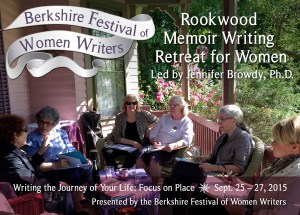
  • and through my teaching and the many workshops and talks I have been giving connected to all these endeavors, including two coming up this month, Gaia Calling and the Rookwood Writing Retreat on Memoir.

Rookwood-Post_Card-Sept_5x7

I am also working on several book projects that I will be bringing to fruition in the coming year:

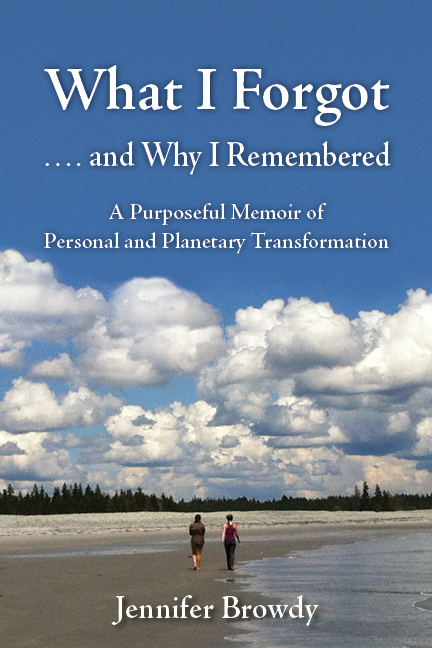
  • what-i-forgot-cover-WEBWhat I Forgot and Why I Remembered: A Purposeful Memoir of Personal and Planetary Transformation, my own story of how I lost and regained my deep and essential connection with the Earth, and why that matters for me and for every caring human on the planet today;
  • a companion book, The Elemental Journey: An Inspirational Guide to Purposeful Memoir, which will offer signposts along the road for those interested in embarking on a similar journey through their own life histories;
  • The Butterfly Effect: A Guide to Stepping into the Creative Leadership Our World Needs Now;
  • and several editing projects, including an anthology, Strong Shoulders: The Loves and Labors of Women, for which the Call for Proposals is still open.

Yes, I am busy trying to walk the walk as well as talk the talk of social transformation, seeking out and finding collaborators as I go, because building community is such a strong part of what I know we need to be doing in these transition times, as we move together along this part of the journey, where life—personal, political and planetary—seems to be constantly speeding up.

10153293_552008379784_8650399992315417237_nThis is a time when we need to come together, not only in the amazing virtual spaces of the Internet, but also physically, in our home communities. We need to create opportunities and spaces for deep reflection and sharing, so that we can build strong networks of kindred spirits and webs of support to carry us through what may very well be some turbulent times ahead.

As always, I invite you to come along with me on the journey through these transition times. As the old prophecy said, we are the ones we’ve been waiting for, and the time of the lone wolf is over. We must put hope into action collaboratively, with the goal of emerging stronger, clearer and more confident in our shared desire to create bridges to the future we want for ourselves and for those who will come after us.

Are you with me? Let’s go!

And the Walls Came Tumbling Down: Pope Francis Shows Us the Way

The Encyclical on climate change and the environment released by Pope Francis this week has all the magic of the fall of the Berlin Wall in 1991. Back then, the antagonism between the U.S. and the U.S.S.R. seemed implacable and unresolvable, a fight to the death. And then suddenly the wall came down and the world walked through, marveling, into a new era.

Now we have another abrupt shift, this time of a religious order. The leaders of the Catholic Church can hardly be accused of being “radical tree-huggers.” And yet here is Pope Francis, solemnly exhorting his flock of a billion Catholics worldwide to be respectful to Mother Earth and all the living beings she supports. In the blink of an eye, the language of Native American spirituality has been taken up by the same Catholic Church that once tortured and executed indigenous peoples precisely because of their different religious beliefs.

I urge you to read the entire Encyclical for yourself. It is a truly remarkable document, worth serious study. Of many passages I’d like to underline, here are two:

  1. Care for nature is part of a lifestyle which includes the capacity for living together and communion. Jesus reminded us that we have God as our common Father and that this makes us brothers and sisters. Fraternal love can only be gratuitous; it can never be a means of repaying others for what they have done or will do for us. That is why it is possible to love our enemies. This same gratuitousness inspires us to love and accept the wind, the sun and the clouds, even though we cannot control them. In this sense, we can speak of a “universal fraternity”.
  1. We must regain the conviction that we need one another, that we have a shared responsibility for others and the world, and that being good and decent are worth it. We have had enough of immorality and the mockery of ethics, goodness, faith and honesty. It is time to acknowledge that light-hearted superficiality has done us no good. When the foundations of social life are corroded, what ensues are battles over conflicting interests, new forms of violence and brutality, and obstacles to the growth of a genuine culture of care for the environment.

Here we find spiritual ecology enshrined as Catholic doctrine. And one thing about the Catholic Church—it is big on obedience. For believers, to ignore the Pope is to risk hellfire and damnation. In this case, though, the hellfire and damnation will be earthly, if we do not listen to the wise advice of Pope Francis and curb the insanity of industrial growth that goes beyond the limits of the planet to support.

Scientists appeal to our sense of reason, presenting compelling evidence that if we continue on our present path of wasteful consumption of the Earth’s resources, we will destroy our own future as a flourishing species. Religious leaders appeal to human beings’ moral conscience in invoking the responsibility of current parents and grandparents to leave a livable world to our descendants. It is up to the politicians, though, to translate vision into practice.

For too long, Christian conservatives in the U.S. have played the role of the ideological wing of Big Business, using money, manipulation and scare tactics to buy politicians and votes. In the face of the new Papal Encyclical, can American Christians really continue in good conscience to support the worst of the planet’s polluters and plunderers? Can they continue to elect mercenary politicians who hold our country hostage to the highest bidder?

If all good people who love our Earth and its creatures were to translate our love into action, as Pope Francis has just done so forcefully, I have no doubt the seemingly invincible wall of the industrial growth society we’ve been living with these past 200 years would melt away, revealing the path into a green, prosperous future.

“Where there’s a will, there’s a way,” the saying goes. Pope Francis has just shown us the will, and the way. It is now the task of us ordinary citizens to break the stranglehold of Big Business on politics and insist that our politicians follow his lead.

I close with an excerpt from the Pope’s “Christian Prayer in Union with Creation,” a vision of ecological interdependence if ever there was one:

“Triune Lord, wondrous community of infinite love,

teach us to contemplate you

in the beauty of the universe,

for all things speak of you.

“Awaken our praise and thankfulness

for every being that you have made.

Give us the grace to feel profoundly joined to everything that is.

God of love, show us our place in this world

as channels of your love

for all the creatures of this earth,

for not one of them is forgotten in your sight.

Enlighten those who possess power and money

that they may avoid the sin of indifference,

that they may love the common good, advance the weak,

and care for this world in which we live.”

Amen.

And the meek shall inherit the Earth....

And the meek shall inherit the Earth…. Photo by J. Browdy, 2015

Resisting Our Suicidal Culture: Are We All Aboard Germanwings?

We’ve passed the Spring Equinox and it continues to snow here in the Northeast. I feel like I’m stuck in Narnia under the Witch, and no sign of Aslan coming to the rescue.

IMG_9747

In the Narnia series, the Witch is a symbol of the dark side of humanity. Greedy, selfish, vain and cruel, she makes others suffer because it pleases her to do so.

C.S. Lewis, like J.R.R. Tolkien, took the struggle between Good and Evil right out of the Christian playbook. Both of these epic stories end with Good triumphing, but also with beloved characters simply moving on to a better world. In Christian traditions, that better world is called Heaven. You can only get there by dying.

For some of us, death does seem like a release, a chance to lay down one’s sorrows and find peace and comfort at last. We get a taste of it nightly when we dream—if we are able to sleep deeply and well.

Was it that pull toward peace that caused the Germanwings co-pilot to slam his plane into a mountain, killing himself and all 149 people aboard? Suicide that takes other innocent people along is reprehensible and incomprehensible. Yet it happens, more often than we might like to admit.

It’s easy to call the behavior of that suicidal co-pilot evil. But there are many other instances of human behavior resulting in cruelty and death that are harder to see and categorize. Often these actions are miniscule in their individual iterations, but together add up to horrifying, devastating impacts.

Most of what is going on with our relationship to our environment falls into this pattern of negligent evil.

For instance, when we buy a beautiful mahogany table and chair set for our porch, we don’t think about the rainforests that were bulldozed to create it. We don’t think about all the myriad life—the bright butterflies, exotic lizards and intelligent orangutans—that had to die so we could enjoy that table.

When we turn on the gas range to heat water for tea, we don’t think about the billions of gallons of water that are irrevocably contaminated through the fracking process to provide us with that gas. Likewise, when we fill up our car tank and rejoice to see the price of gas falling, we don’t think about the despoliation of the landscape and oceans that is going on in order to continue to provide us with cheap gas.

When we continue to support industries that destroy our environment, from industrial agriculture to the petrochemical industry to Big Oil and all the banks and subsidiaries that love them, we are each contributing to the crazy destabilization of our planet’s climate.

We are feeding the Witch that preys on every human being—the side of human nature that lacks empathy for other living beings and values short-term comfort and gratification over long-term well-being.

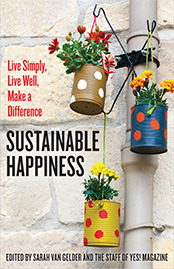
sustainable-happiness-lAs we round the corner into April, traditionally a month when human cultures of the northern hemisphere celebrate Spring and the return of warmth and green to the Earth, we must focus our attention on what Sarah van Gelder of YES! Magazine calls “sustainable happiness.”

In the introduction to her new edited collection, Sustainable Happiness: Live Simply, Live Well, Make a Difference, Van Gelder points to research showing that what truly makes human beings happy is “loving relationships, thriving natural and human communities, opportunities for meaningful work, and a few simple practices, like gratitude.”

Van Gelder insists that “sustainable happiness is possible,” but “you can’t achieve it with a quick fix and it can’t be achieved at the expense of others.” It all “depends on the choices we make individually and as a society.”  In the book, she gives us a list of five principles to help move us in the right direction:

  1. “Stop the causes of trauma and support healing;
  2. Build economic and social equity;
  3. Value the gifts we each bring;
  4. Protect the integrity of the natural world;
  5. Develop practices that support our own well-being.”

That about sums up a plan for right living, doesn’t it? Easy to say, harder to put in practice in a social landscape that is seems to be so eternally under the spell of the Witch of destructive extractivism.

There are signs that the spell is weakening, though. Rivulets of indignation are spouting up. Individuals are awakening to their own power to imagine a different way of life, a different relation to each other and our planet.

We are beginning to talk with one another about making change, and acting on our deepest intuitions of what happiness would mean for ourselves, our loved ones and our beloved world. Through the networked power of the World Wide Web, these conversations and new paradigms can spread faster than ever before, giving us hope that there is still time to right the wrongs and stabilize the imbalances that threaten to turn our planet into a mass grave on a scale never seen before in human history.

The captains of industry and their hired politicians are threatening to slam our entire civilization into the side of a mountain, metaphorically speaking. Are we going to sit quietly in our seats and let it happen? Or are we going to pound on the door, like the heroic pilot of the Germanwings airplane, who did everything he could to get through to the insane man at the controls and bring his plane home safely?

Looking out at the relentless snowfall of April, I know it’s time to awaken the Aslan in each one of us. It’s time to fight for the survival of the world we love.

Aslan