Winter Solstice Reflections: Returning to Light, Swimming Against the Tide

Lately I have been feeling that I am constantly struggling against a strong current pulling me away from the work I want to be doing.

The current is composed of all the day-to-day chores of life, along with all the busyness of the holiday season, and the relentless tide of bad news about the state of our beloved planet and her living communities, from trees to fish to birds and bees.

The more I become aware of the dire ecological state of our planet, the more I want to devote myself to swimming against that current of devastation, trying to bring our planetary systems back into balance.

I want to do that work on the personal level, starting with my own life, and moving out into my community and the broader Earth communities in which we all live.

The climate issue, like no other in human history, has made our planetary connectedness clear. We must work together, from pole to pole, to solve the problem of climate instability that industrial civilization has wrought.

If we don’t get on in immediately, we may very well spiral into another Great Extinction, possibly soon enough for current generations of humans—me and my children and their children—to live and die through.

Faced with a negative reality of this magnitude, many of us tend to just turn away in numbed grief and try to ignore it because, sadly, “there’s nothing we can do about it.”

My own sense of being caught in a tidal current pulling me back from whatever it is I’m supposed to be doing may have a lot to do with the despairing feeling that whatever I try to do will not be enough.

But I have to do it anyway, and so do you.

Winter Solstice is the time of year when I try to retreat from the furious churning of life and recalibrate, retune, reflect.

How can I use the gifts I have been given to make a positive difference, moving outward from myself, my family and local community, to the larger circles of life I love?

My greatest gift and abiding passion has always been writing. As soon as I learned to write, I began writing stories and poems that celebrated the natural world and honored the spirits of the Earth.

As a 21st century writer, I have the ability to project my words and perspectives far beyond the confines of the old spiral-bound notebooks I used to keep as a child. I have the potential to engage in dialogue with people all across the globe, and if you’re reading this, so do you.

As a teacher, I have the ability to begin conversations with students about the difficult ecological crises that are already beginning to unfold, and the social and environmental injustices that they are spawning. I can offer students the tools and strategies for continuing these conversations across the globe through our amazing new digital technologies.

In the past year, without a great deal of focus on my part, my blog has been viewed more than 20,000 times by visitors from more than 130 countries around the world.

My little blog is just a very small drop in the great ocean of digital conversations, but even so, it is possible that some of those 20,000 readers came away with a new idea or an affirmation of their own thinking, or a challenge to their habitual perspectives, that could start a chain reaction among their friends and digital connections that could, seriously, change the world.

Rupert Sheldrake argues that “The fields organizing the activity of the nervous system are inherited through morphic resonance, conveying a collective, instinctive memory. Each individual both draws upon and contributes to the collective memory of the species. This means that new patterns of behaviour can spread more rapidly than would otherwise be possible.”

Sheldrake’s theory is exciting and controversial because if it’s true, it means that none of us has to be bound by the heavy burden of habit and cultural inertia, the industrial tide that seems to sweep us along so inexorably.

We have a choice. We can pick up our heads, think for ourselves, seek out others who also want to preserve the ecological health of the planet, and together use our great digitally connected human brain trust to steward and safeguard this planet, not destroy her.

Working together, we could, within a couple of generations, be swimming together joyously in an entirely different sea.

As the Earth wheels slowly back towards the Sun today, this is my steady vow: to keep my head above water, to reach out a hand to others who share my reverence for our beautiful planet and its magnificent life, and to give myself without reserve to the mission of building a strong interconnected movement dedicated to the shift into a sustainable, ecologically sound, joyful future.

Browdy de Hernandez 2013

c. Browdy de Hernandez 2013

Blessings on the blossom…

UnknownWhen I compiled the anthology Women Writing Resistance: Essays on Latin America and the Caribbean, I put an excerpt from the Puerto Rican-American writer Aurora Levins Morales right up front, because what she had to say about the invisibility of working women was so powerful.

“Let’s get one thing straight.  Puerto Rico was a woman’s country….Whatever there was to be cooked, we cooked it.  Whoever was born, we birthed and raised them.  Whatever was to be washed, we washed it….Whatever was grown, we grew it…We were never still, our hands were always busy….Ours is the work they decided to call unwork.  The tasks as necessary as air.  Not a single thing they did could have been done without us.  Not a treasure taken.  Not a crop brought in.  Not a town built up around its plaza, not a fortress manned without our cooking, cleaning, sewing, laundering, childbearing.  We have always been here, doing what had to be done.  As reliable as furniture, as supportive as their favorite sillón.  Who thanks his bed? But we are not furniture.  We are full of fire, dreams, pain, subversive laughter.  How could they not honor us?

I have to admit that never, in all my years of studying the history of the Americas, had I even noticed the absence of accounts of these women from its annals.

But it’s so true.  What famous explorer could have sailed the ocean blue without his mother and/or nurse giving him the loving care he needed to survive infancy and childhood? What town could have been built without the crucial work of women supporting its foundations?

Just as we are often blind to the crucial life-giving value of women’s work, we also have a tendency to arrogantly overlook the essential work done by the foundation of the planetary biosphere. I’m talking about PLANTS.

100_2483 copy

Without the plants—from algae and seaweeds in the ocean to trees and grasses on land—our planet would quickly become a barren desert.

Without the microbes in the water and soil digesting decayed matter and nourishing those plants, the entire food chain would collapse, with humans falling along with all other “higher” species.

IMG_1916 copy

This Thanksgiving, I want to honor and thank the marvelous plants of our planet, who silently, efficiently and ceaselessly convert sunlight and water to living tissue, and give themselves without protest to nourishing the lives of so many other species on Earth.

As we enjoy our Thanksgiving feasts, let’s remember that none of this abundance would be possible without our unsung plant kingdom heroes, and let us perhaps take a moment to sing their praises, as in this simple blessing I learned from my son’s Waldorf teacher many years ago:

Blessings on the blossom, blessings on the fruit.

Blessings on the leaf and stem, blessings on the seed and root.

IMG_4088 copy

For a more extended version of this blessing, see the Mohawk Thanksgiving prayer.

Amen.


PHOTOS COPYRIGHT JENNIFER BROWDY DE HERNANDEZ.

In the Body of the World: Cancer as Catalyst for Revolution

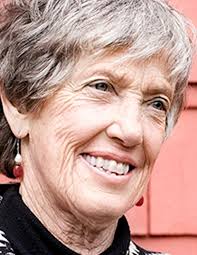
Eve Ensler

Eve Ensler

I have been reading Eve Ensler’s incredibly powerful cancer memoir, In the Body of the World, with my students this week.  We watched Ensler’s 2010 TED Talk, “Suddenly My Body,” given while she was still practically bald from the chemo treatments; and you could have heard a pin drop in the room, everyone was so swept away by Ensler’s passionately delivered paean to the intricate interconnections between the individual body and what she later came to call “the body of the world.”

This is a concept I have most often heard expressed in Buddhist circles.  Thich Nhat Hanh and the Dalai Lama talk about “inter-being,” and how it is egotistical, arrogant, androcentric and just plain wrong for human beings to imagine that we are somehow separate, over and above other livings beings on the planet.

Joanna Macy

Joanna Macy

Joanna Macy, extending Arne Naess’ concept of the “ecological self,” uses the body as a metaphor to describe the futility of imagining ourselves as immune from the destruction we are wreaking on our planet.

The concept of the “ecological self,” Macy says, is important now because “moral exhortation does not work.  Sermons seldom hinder us from following our self-interest as we conceive it.

“The obvious choice, then, is to extend our notions of self-interest.  For example, it would not occur to me to plead with you, ‘Don’t saw off your leg.  That would be an act of violence.’ It wouldn’t occur to me (or to you) because your leg is part of your body.  Well, so are the trees in the Amazon rain basin.  They are our external lungs.  We are beginning to realize that the world is our body” (World as Lover, World as Self, 157).

Eve Ensler has spent much of her life recovering from violence (she was a sexually assaulted and battered by her father as a child), bearing witness to violence against other women and girls, and creating powerful creative works, organizations and movements to end violence against women and girls.

And yet, she says, it was not until the jolt of realizing that her body had been invaded by cancer that she was able to overcome her ingrained alienation from her own body, born of the dissociation that was a survival tactic in her childhood.

Once she allowed herself to become fully connected with her body, it was but a short step to see the cancer in her uterus as symbolic of the much greater cancers of over-consumption and unsustainable growth afflicting the body of the world.

“Cancer is essentially built in our DNA, our self-destruction programmed into our original design—biologically, psychologically.  We spend our days, most of us consciously or unconsciously doing ourselves in.  Think building a nuclear power plant on a fault line, close to the water.  Think poisoning the Earth that feeds us, the air that lets us breathe….We are a suicidal lot, propelled toward self-eradication” (194).

But as Ensler discovers how fiercely she wants to live, to survive the cancer, she realizes that human beings are propelled as much toward life as toward death.  In a further twist of Freud’s insight into the immortal battle between Eros and Thanatos, she realizes that love is the answer—a fierce, unstoppable love for the battered, assaulted but still beautiful Earth, our mother, our home, our self.

Like Eve Ensler, I have spent much of my life focusing on the stories of women, and working to empower women to speak our truths and change the world for the better.

As I ponder the way forward now, in these end times of environmental tragedy, I am wondering whether women have a special role to play in bringing about the kind of radical social change that we need to survive into the future.

City of Joy openingEnsler uses the City of Joy, which she worked so hard to build in Bukavu, DRC (with the help of women all over the world contributing through the V-Day infrastructure), as a model for the kind of new life-giving, life-enhancing community that the world needs now.

It’s a City of Women, founded on the following ten principles:

1. TELL THE TRUTH

2. STOP WAITING TO BE RESCUED; TAKE INITIATIVE

3. KNOW YOUR RIGHTS

4. RAISE YOUR VOICE

5. SHARE WHAT YOU’VE LEARNED

6. GIVE WHAT YOU WANT THE MOST

7.  FEEL AND TELL THE TRUTH ABOUT WHAT YOU’VE BEEN THROUGH

8. USE IT TO FUEL A REVOLUTION

9. PRACTICE KINDNESS

10. TREAT YOUR SISTER’S LIFE AS IF IT WERE YOUR OWN

These seem like sound principles on which to base any human community, and particularly one founded on ashes, corpses and pain, as is the case in the Congo (but isn’t almost every human society founded, as Marx said, on blood?).

Women stay for six months at the City of Joy, during which they recover their physical and mental health with all kinds of therapies, participate in skills training, and get ready to return to their homes as leaders who can become change agents for peace and sanity in one of the most brutal and brutalized regions of the planet.

I know that there can be no lasting change that doesn’t also include men.  There can be no “City of Women” that survives past a single generation.

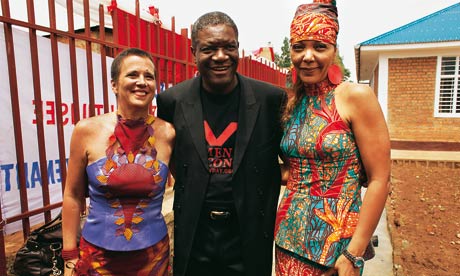
Eve Ensler, Dr. Denis Mukwege and Christine Deschryver, co-founders of the City of Joy.  Dr. Mukwege is a Congolese gynecologist who has operated on hundreds of women and girls left incontinent by tears in their vaginas due to violent rape.

Eve Ensler, Dr. Denis Mukwege and Christine Deschryver, co-founders of the City of Joy. Dr. Mukwege is a Congolese gynecologist who has operated on hundreds of women and girls left incontinent by tears in their vaginas (fistulas) due to violent rape.

I also know that it is important to recognize and acknowledge righteous anger at those responsible for all the destruction and violence.

We have to speak the truth that in the Congo, as on Earth overall, it has been men, acting with the blessing of our patriarchal religious, political, legal and social structures, who have been responsible for the machines, technologies and brutalities that have been so destructive to individual women and men, as well as to the environment without which we cannot live.

Women have often been complicit and have enjoyed the fruits of industrialization.  Women, especially privileged women, have gone along for the ride.

But it was never the vision of women that created the weapons and bulldozers, the chain saws and cars, the nuclear power plants and oil rigs.  All of those implements were envisioned, created and deployed by the men in charge of human society—especially the Europeans and their colonized offshoots—these last few centuries.

We can’t know now whether it would have been different if women had been allowed education and access to the board rooms and laboratories and congressional chambers where society-changing decisions got made, particularly during the crucial two centuries of industrialization.

We can’t change the past.  We can only look forward and, as mandated in the City of Joy’s Guiding Principles, “stop waiting to be rescued, tell the truth, and use it to fuel a revolution.”

eve-ensler-approved-photo_193x290[1]At death’s door, Eve Ensler realized that human beings and the world we have so profoundly altered are now at the threshold of a new era.

“What is coming is not like anything we have known before,” she says. “Your dying, my dying, is necessary and irrelevant and inevitable.  Do not be afraid, no, death will not be our end.  Indifference will be, disassociation will be, collateral damage, polar caps melting, endless hunger, mass rapes, grotesque wealth.

“The change will come from those who know they do not exist separately but as part of the river….You worry about germs and stockpile your herbs, but they will not save you, nor will your fancy house or gated villages.  The only salvation is kindness.  The only way out is care” (214).

I would like to quote the entire last chapter of Ensler’s remarkable memoir, but I won’t—just go buy the book and read it for yourself.  And then, as she says, “let us turn our pain to power, our victimhood to fire, our self-hatred to action, our self-obsession to service” (216).

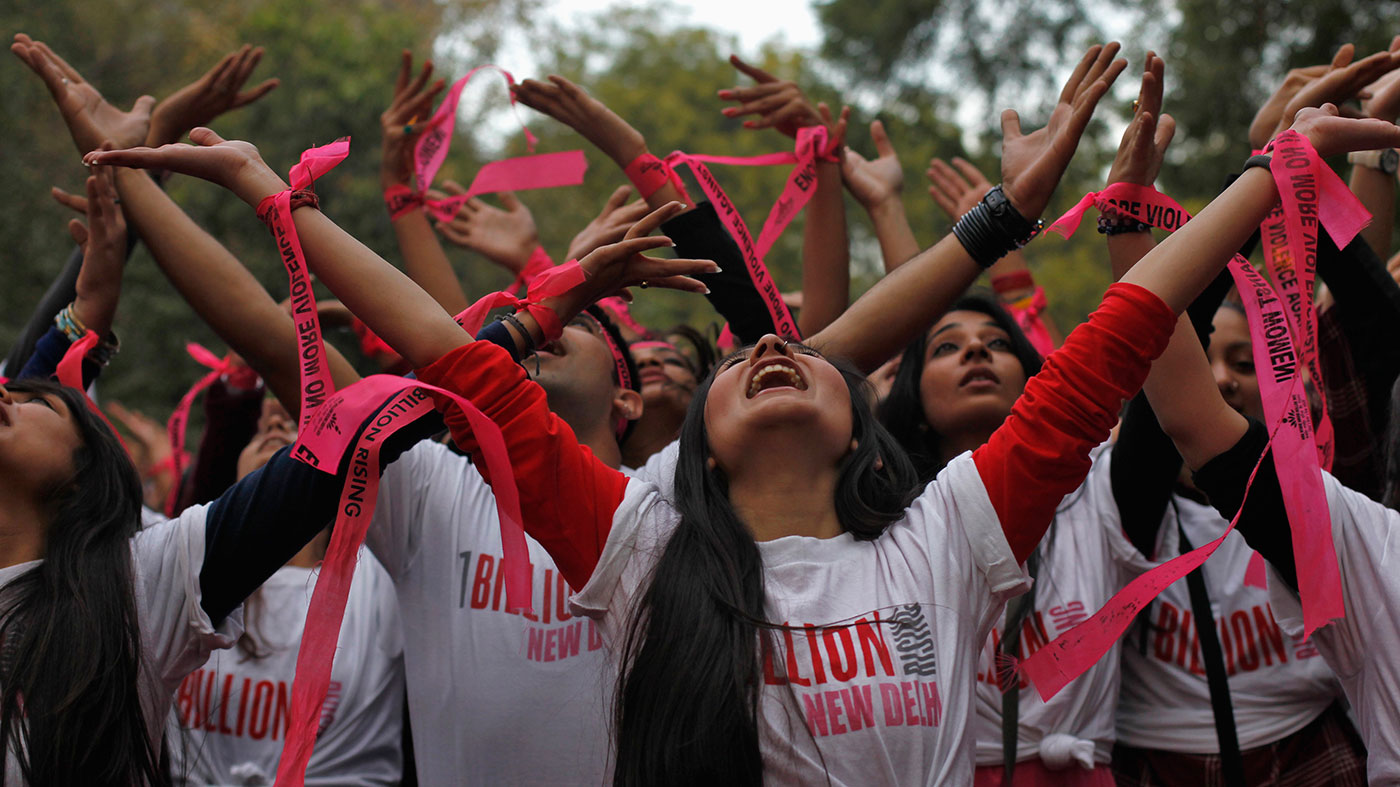
Unknown-1Women, it’s time for us to rise and give birth to a new human relationship with the planet and with each other.  It’s past time.

Men are most welcome to join us in this life-saving mission, as long as they are men in touch with their feminine side, their life-giving, nurturing, relational side.

All of us humans possess both masculine and feminine energies and traits.  What we need now is balance.  Balance within each one of us that can become a catalyst for the balance our planet so desperately needs.

1billion-home-india

PS: Check out this TED Talk by Eve from just before she came down with cancer, talking, miraculously, about the importance of the “girl cell” in both men and women.

A message from the wounded heart of our magnificent Earth

This week, as in the foreground Washington politics continued as usual, a remarkable animal came like a messenger sent to remind me of the state of things in the background, where what’s really important is going on.

I’m using Mary Daly’s terminology here: she calls everything that mainstream society generally focuses on part of the “foreground,” which distracts us from the deeper and more significant issues and events going on in the “background.”

Instead of worrying about how the “snools” are jerking the country around from their headquarters inside the Beltway, Daly urges us to pay attention to the bigger, deeper picture of what’s happening on a global level to the ecological systems that keep us all alive.

Sometimes it’s hard to wrench my attention away from all the grotesqueries going on in the foreground.  This week, I had help.

***

On Tuesday, as I was walking along a trail by a small river near my house, in the gathering gloom of dusk, I looked back to see my dog Loki standing stock-still near a large object that I couldn’t immediately identify.

Afraid it might be a big and potentially dangerous animal, like a raccoon, I hurried back, and was astonished to perceive that Loki was standing nose to beak with an enormous eagle-like bird.

osprey

Both animals were calm, and Loki came to me at once when I called.

The eagle, which I later identified as an osprey, turned and looked at me keenly, with a gaze I can only call commanding.  Its huge, hooked beak was intimidating; this was not the kind of wild animal I would consider going anywhere near.

And yet here it was, down on the ground, strong and well-fed, clearly in its prime, but immobilized by a badly broken right wing, which was hanging twisted and useless at its side.

A human being in that condition would have been writhing and crying desperately for help.

The osprey merely stood its ground, calmly and regally, waiting.

It was still there the next morning when I went back to check on it.  I had called the state Fish & Wildlife Service, and as I stood there by the eagle, a wildlife biologist called me to ask directions to the bird.  He was going to bring it to a veterinarian to have its wing set, and then bring it to a shelter.

Wild raptors with broken wings almost never fly again, but there are raptor rescue centers that maintain them as ambassadors for their kind, educating the public about the beauty and importance of these magnificent birds.

 ***

I don’t know how that bird came to break its wing. There was a house not far away from where I found it; perhaps it flew into a window at full tilt?

I do know that if it had come down elsewhere, away from the trail, it would have certainly died of starvation or been eaten by a coyote, which I have seen in those woods.

In this case, human beings could be of use to this osprey, and indeed I felt very strongly, when it trained its sharp, steely gaze upon me, that it was demanding my help.

More broadly, I take my encounter with the eagle this week as a reminder to keep my focus on the bigger, deeper picture of the continual wounding of the natural world.

For every damaged osprey there are literally millions of creatures I can’t see personally, who are wounded and dying all over the Earth.

I can’t afford to lose myself in the busy-ness and distraction of foreground concerns—the headlines of mainstream media outlets, the daily housework, the struggle to make enough money to pay bills and keep my family going.

Those concerns will continue and as a functioning member of human society, I have to keep my eye on them.

But my inner eye–my third eye, my most deeply aware sense of vision–must be ceaselessly trained on the slowly unfolding planetary tragedy that is occurring relentlessly in the background.  I must stay alert for opportunities to be of help to those who cannot help themselves.

I thank the beautiful osprey for this reminder, and wish it, most fervently, Godspeed.

IMG_4053 copy

Being the change–beyond hope, beyond fear

Every time I write an exhortatory post like the last one, I imagine my readers getting to the end and clucking their tongues in frustration.

“OK, we get it, now the is time to act—but what does she want us to DO?  Doesn’t she have any practical suggestions on what to do in this terrible transition time?  Isn’t she going to lead by example?”

Well, yeah.  In relentlessly focusing my attention, and by extension my readers’ attention, on the frightening facts of environmental degradation–from climate change to toxic pollution to the precipitous decline of millions of species—I am doing something.  It may not be much, but at least it’s better than sticking my head in the sand and ignoring the gathering storm, or selfishly trying to live it up as long as possible—let the band play on!

There are many things I dream of doing, but right now simply cannot.

I cannot build myself an environmentally sustainable, off-the-grid house, nor can I pick myself up and move to an eco-village at this time.

I cannot spend all my time sitting in trees to protest logging or marching on Washington D.C. to protest inaction on climate change.

I cannot devote myself 100% to environmental communications work.

And I can’t wave my wand and stop the poles from melting, or make all the toxic chemicals just go away.

What I can do is take the strengths I’ve been given, in writing and communicating, and use them to try to spread awareness among others, in the hope that the little ripple I may be able to start will grow to a mighty wave of positive change.

***

I need to think more about this question of hope, though.

Margaret Wheatley

Margaret Wheatley

Lately I’ve been reading and re-reading Margaret Wheatley’s latest book, So Far From Home, in which she talks, rather surprisingly, about the need for activists to move beyond hope.

The problem with hoping for change, she says, is that “fear is the constant, unavoidable companion of hope. What this simply means is that I hope for a certain outcome and I’m afraid I won’t get it. I hope for a certain result and I’m fearful it won’t happen. This is the way that hope and fear are wedded together….So, it might be that the road to fearlessness is only found by giving up hope. By giving up outcomes, by giving up goals.”

This is a challenging idea.  If we give up on goals, doesn’t it mean that we give up, period?  That we just bow our heads in resignation and accept the anthropogenic destruction of our planet as inevitable?

Not according to Wheatley.

Quoting from Thomas Merton, who says that we need to “concentrate not on the results but on the value, the rightness, the truth of the work itself,” Wheatley gently asks:

“What if we could offer our work as a gift so lightly, and with so much love, that that’s really the source of fearlessness? We don’t need it to be accepted in any one way. We don’t need it to create any certain outcome. We don’t need it to be any one thing. It is in the way we offer it, that the work transforms us. It is in the way we offer our work as a gift to those we love, to those we care about, to the issues we care about. It is in the way we offer the work that we find fearlessness. Beyond hope and fear, I think, is the possibility of love.”

Could this be a kind of answer to those skeptics who would take me to task for writing about environmental issues without doing enough to be the change I want to see?

By giving myself to this work of raising the alarm, motivated by my deep love for the planet and my awareness of the inter-being of all her denizens, am I doing the work I came here to do in this lifetime?

The truth is that I don’t have much hope, anymore, that we will be able to “save the world.”  Nevertheless, I keep on writing, because writing is my way of working through and releasing myself from fear.

Having spent a lot of my life in fear, and having come to know it intimately, I can say with some authority that fear is a useless, paralyzing emotion.  Fear holds us back, it pinions our wings, it pushes us to do things we will later regret.

What we need, Wheatley says, is the clarity that resides beyond fear and its twin sister, hope.  The clarity that comes with knowing that since our time is going to come sooner or later, what’s important is how we spend each one of our days.

We need to do the work we came here to do, as well as we can, without expecting reward or recognition, without depending on external acclaim or tangible, material successes.

Beyond hope, beyond fear, I will keep going on, day to day, raising my children, doing my teaching and writing, enjoying beauty, pleasure and loving-kindness as they cross my path, and conjuring them myself in the way I live my life.  In that sense, yes, I will be the change.

100_2487 copy

Talking Union with my Dad: A Father’s Day Tribute

I got my love of narrative and my awareness of social justice very early in life, from my father’s vast repertory of American folk songs.

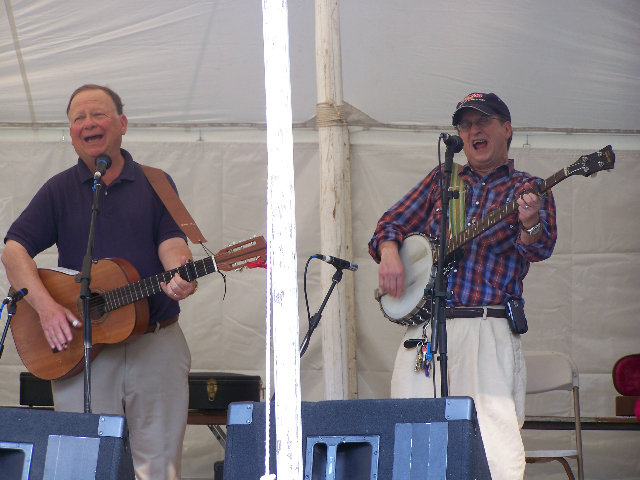
My dad, Joe Browdy, learned guitar as a teenager in the 1950s, taking his inspiration from the great folk singers of the time, like Woody Guthrie, Pete Seeger, Odetta, Cisco Houston, The Weavers and the New Lost City Ramblers.  He developed his repertoire while working as the music counselor at the camp where he and my mother met, and he continued to sing and play guitar for audiences while he earned his B.A. in history at Oberlin, and his law degree at NYU.

Joe Browdy and Alan Chartock

Joe Browdy and Alan Chartock

Some of my earliest memories are sitting with a group of relaxed, happy people by a crackling bonfire listening to my dad belting out his signature songs, with everyone joining in on the chorus.  Although there were some special children’s songs in his repertoire, he didn’t censor his songbook for me and my brother: we learned about the tragedies and the murders, the drunkenness and the fighting, wars, poverty and injustice, making sense of it as best we could over years of repetition.

Although he got busy with his law practice around the time that I was born, my dad  never stopped singing.  On Friday nights we’d get into the car around 8 p.m. for the two and a half hour ride to our country house in Hillsdale, N.Y., and to keep himself awake my dad would start singing, my mom adding her sweet tones in harmony on the chorus, my brother and I joining in sleepily when we knew the words.  On Saturday nights all through my childhood, our entertainment was to build a fire after dinner—outside in the summer, in the living room in the winter—and sit around it for a few hours, my dad leading us in the familiar songs that took us traveling far and wide in time, space, and experience.

The folk song tradition is a living oral history, passed from one generation to the next.  As soon as we could, my brother and I learned how to play guitar, and the words and tunes of those old songs now live on in us, and in our children who are learning them too.  With folk music, it’s not about the perfection of the sound, or the accuracy of the lyrics: it’s about the interest of the stories being told through music, and the emotion with which they’re conveyed.

My father has the ability to make the songs he loves come alive through the heartfelt nature of his singing and playing—getting slow and quiet for the tragic love songs, letting it rip and roar on the fighting union songs, modulating into a plaintive tone for his signature delivery of “One Meatball,” about a poor man who is sneered at by the waiter because all he can afford to buy is a single meatball for his dinner.  When my dad plays guitar, he’s not just singing some songs, he’s taking us on a journey through the American spirit.

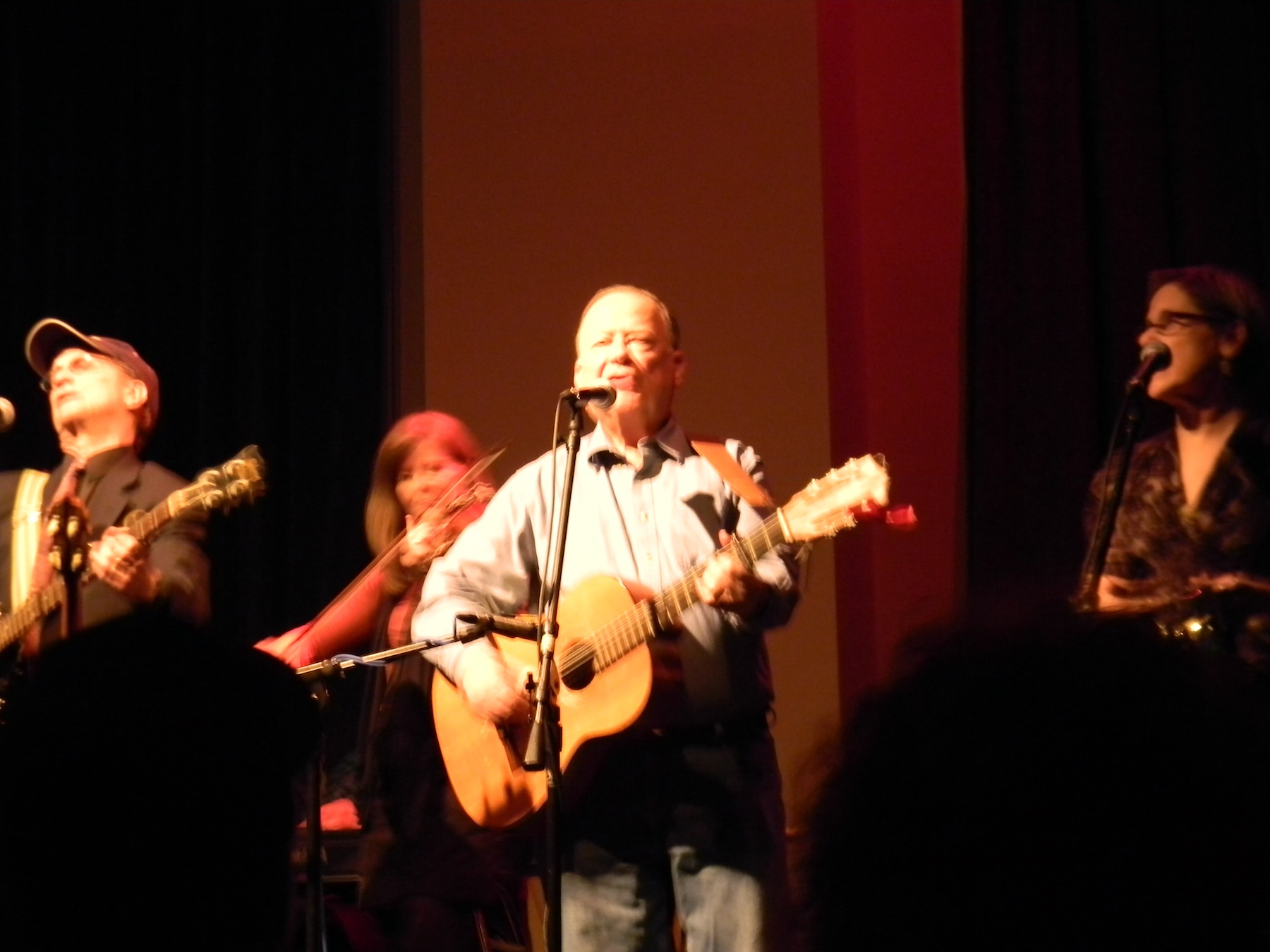
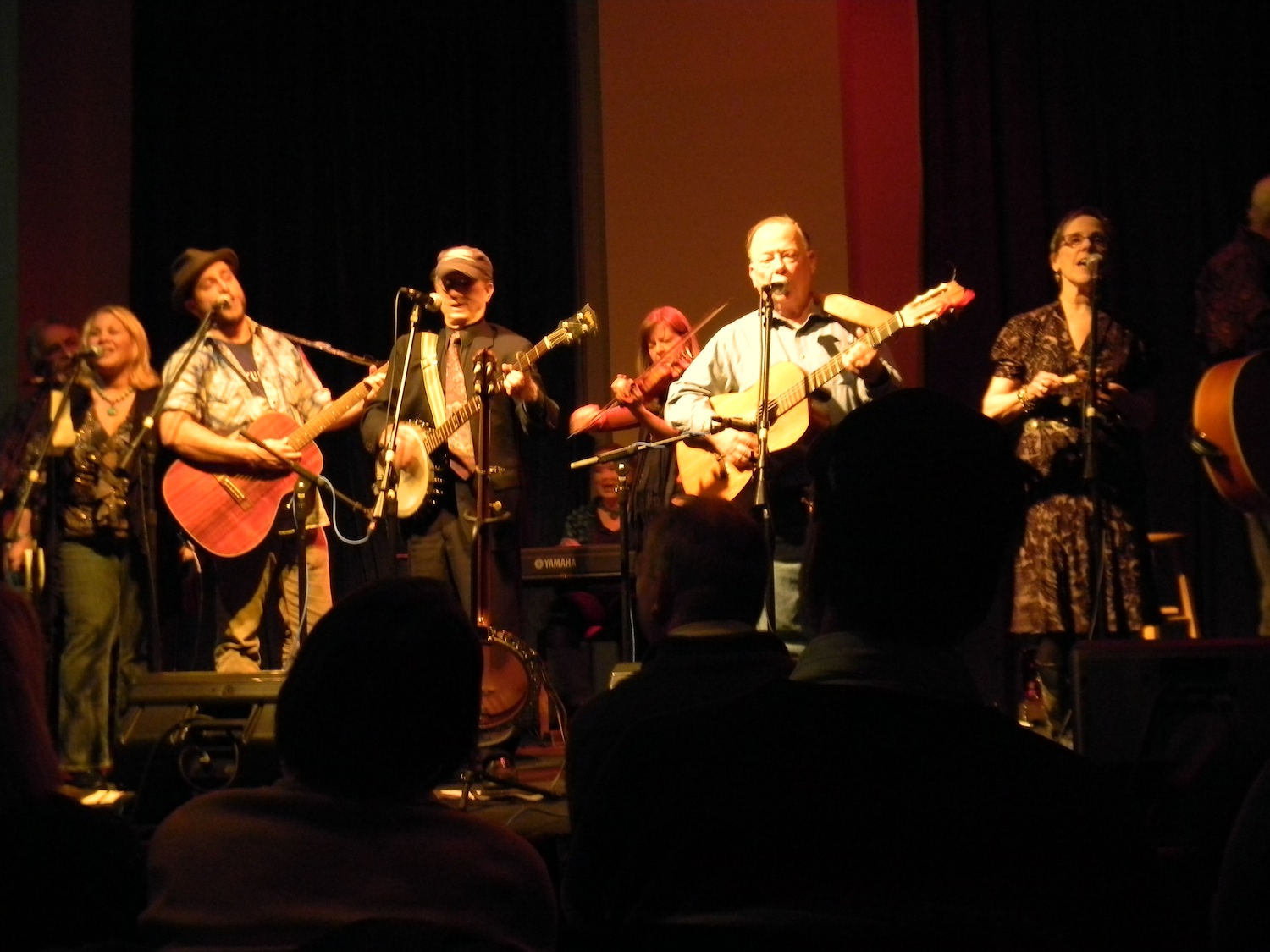
Live at the Linda Norris Auditorium, Albany NY

Live at the Linda Norris Auditorium, Albany NY

Dad’s repertoire includes cowboy songs, songs about the laying of the train tracks across the West, and songs about the building of dams across mighty American rivers. There are feisty union songs from the 1920s and 30s; songs inveighing against the greed of bankers and bosses, and lamenting the hardships faced by miners, factory workers and farm hands. There are stirring political songs, about the founding of the United Nations, or the dream of world peace.

There are work songs from the African American South, about picking cotton or working on a train line, and older songs from the slave times, about dreaming of freedom, and making a break for it.  There are songs—some sad, some funny—about traveling around the country during the Dust Bowl refugee time.

There are many love songs, most of them mournful, bluesy songs about loves lost to drowning, train accidents, or just never heard from again.  But there are also some sweet romantic ballads about lifelong happiness spent by the side of one’s beloved.  The songs never fail to come alive when my dad adds his voice and driving guitar to the mix.

These days, my dad sings for the public most often with the Berkshire Ramblers, led by his old friends Alan and Roselle Chartock, and joined by a varying cast of other folk musicians.  But I still like it best when we sing together around a fire, not for an audience but just for our own amusement and delight.  This Father’s Day, I want to thank my dad for sharing this powerful, inspiring musical legacy with me, and so many others.  May the circle be unbroken!

DSCN2248 copy


When the union’s inspiration through the workers’ blood shall run

There can be no power greater anywhere beneath the sun

Yet what force on earth is weaker than the feeble strength of one

For the union makes us strong.


Solidarity forever, solidarity forever, solidarity forever

For the union makes us strong.

Which Side Are You On?

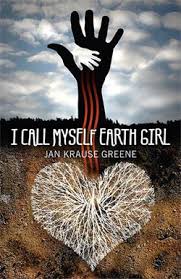
imagesFor the past few nights I have been putting myself to sleep by reading an advance copy of my friend Jan Krause Greene’s new novel, I Call Myself Earth Girl.

It’s not exactly a feel-good bedtime story, dealing as it does with rape, environmental disaster, death and bereavement.

But it’s also about empathy and love, between family members and also on a worldwide scale.

In Greene’s vision, the Earth and its denizens can be saved from catastrophe by mindful attention to what really matters: affirming life, both our own and that of the unborn generations to come.

Not since Starhawk’s 1994 masterpiece The Fifth Sacred Thing have I come across a book that so clearly matches my own waking nightmare of the terrible times that await us in the future, if we do not succeed in changing our ways now.

Let’s face it: it is possible that the kind of violence afflicting resource-starved places like Afghanistan, Syria and Somalia will become the norm in much more of the world, as climate instability creates food shortages and accelerates the pace of natural disasters beyond our capacity to recover.

America is a tinderbox just waiting to go off.  Imagine what would happen if suddenly it was not possible to go down to the supermarket and get your week’s worth of groceries?

Such a scenario is more or less unthinkable to people like me, who have grown up cradled by the richest breadbasket in the world.

We are only beginning to realize the costs that have come with our cornucopia: the destruction of the virgin prairies in the Midwest, the poisoning of the earth, water and air with chemical fertilizers, pesticides and herbicides; the grotesque factory farms of livestock and fish; the genetic alteration of seeds; the destruction of local farming by the huge predatory monster of American-style factory farms.

We have grown fat on these practices.  And now it’s time for us to accept responsibility for the outcomes of our heedlessness.

Those of us alive today have the privilege, and the responsibility, of presiding over what could very well be the end times for human civilization.

It’s somewhat analogous to the end times of specific human cultures, like the Greeks, the Romans, the Egyptians, the Ottomans, the great Chinese dynasties….except that this time, we’re not just talking about the end of a single culture, we’re talking about the demise of humanity as a species.

It is possible to imagine, as Jan Krause Greene did, that our lush green planet could turn brown from environmental disaster, provoking a culture of armed militias surviving by means of ruthless violence—with women, as always, at the bottom of the heap.

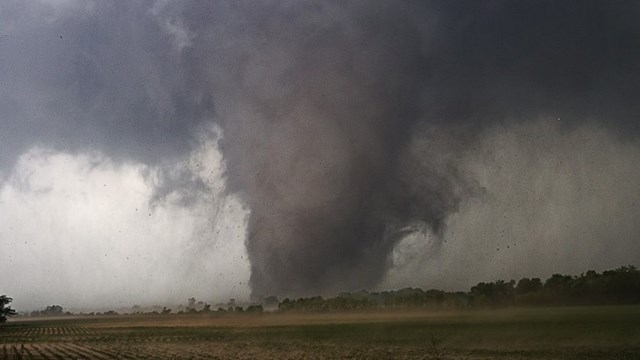
Tornado bearing down on Moore, OK; May 21, 2013

Tornado bearing down on Moore, OK; May 21, 2013

It is already happening—just not yet here, in the gated community we call America.

Can we wake up in time to forestall total, worldwide environmental melt-down?

In the past week we had a deadly two-mile-wide tornado in Oklahoma, and the Russian science station in the Arctic Circle had to be evacuated because the ice was melting at an unprecedented rate.

Here in New England we are expecting temperatures in the 30s Farenheit this weekend—way below normal for what should be the start of the growing season.

What’s next?

We don’t know.  But I take heart from local initiatives like the rehabilitation of the long-dormant Great Barrington Fairgrounds into a vibrant community-supported agriculture site.

We are going to have to re-localize agriculture if we want to survive the shocks of the 21st century.  We need to re-imagine not just agriculture, but community along with it.

As I Call Myself Earth Girl shows well, the antidote to violence and fear is love and empathy.

We still have a choice. Which way will you turn?  Which side are you on?  How far will you go to protect the planet and the generations to come?

fifth-sacred-thing

Mother’s Day Salute to my Mom

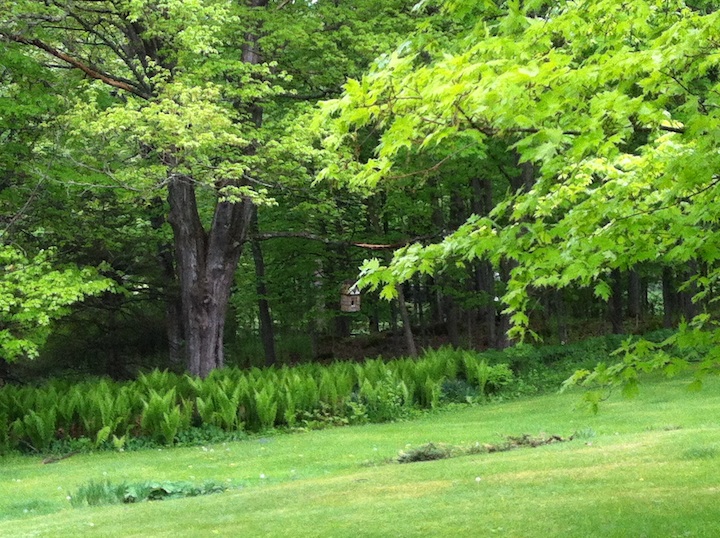
Throughout my childhood, my mother always spent a lot of time and energy tending and shaping the land around the house, following her own instincts of landscaping and working almost entirely with hand tools.

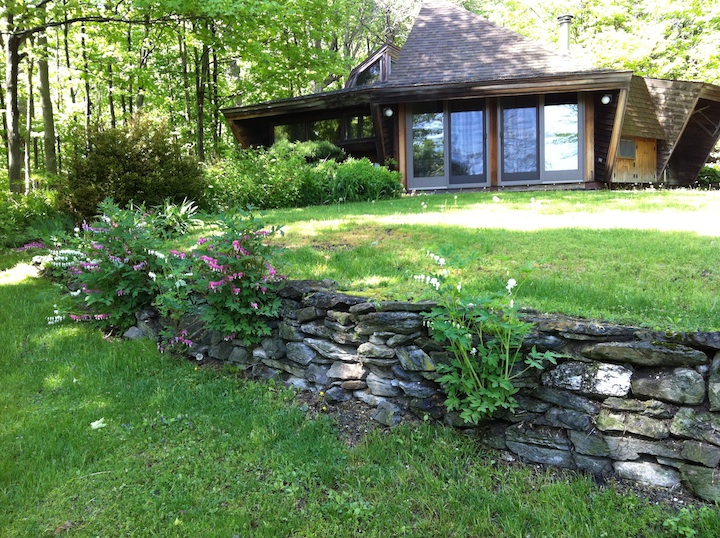
The little house; I am standing where the big thicket was

The little house; I am standing where the big thicket was

She started just outside the sliding glass doors in the living room, where she planted a small lawn, beyond which was an expansive swamp dogwood thicket, laced with black raspberries and bordered by a young maple forest on one side, and a few barely visible pine trees on the other.  Armed only with loppers, my mother began cutting down the thicket stalk by stalk, a project that took a couple of years of slow, patient labor.

Once the thicket was gone, and grass had been seeded in its place, my mom turned her attention to the huge limestone ledge that ran down alongside the house, part of it visible as mossy, grassy outcroppings, but most of it underground.  She set to work with her shovel, hand rake and trowel, her intention to create a rock garden out of that long, sloping rock ledge.  That project provided a focus for the long summers she spent with me and my brother in the country while my father went back to the city to work during the weeks.

The rock garden runs up the whole length of the lawn beside the house.  It's hard to see the rocks here, as they've been covered with plants, which my mom regularly scrapes off to reveal the contours of the rock again.   This big rock garden took years to accomplish.

The rock garden runs up the whole length of the lawn beside the house. It’s hard to see the rocks here, as they’ve been covered with plants, which my mom regularly scrapes off to reveal the contours of the rock again. This big rock garden took years to accomplish.

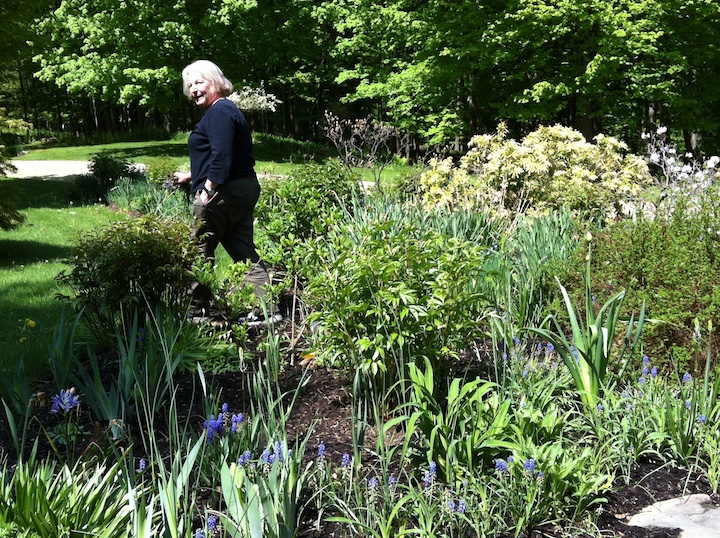
I can see her standing, sweaty and red-faced at the end of a hot morning’s work, with a fine layer of black earth coating her bare shoulders, drinking iced tea out of a tall green glass and surveying the ledge with a squinted sculptor’s eye.  She would be quietly exultant as her shovel and trowel gradually revealed new curves or deep, smooth walls of rock, a small, determined woman with a strong back and great patience, tracing out the rock with hand tools and as much love as if she were carving out the sweet, benevolent face and voluptuous body of the Earth Mother herself.

IMG_2168 copy

She also dug out a vegetable garden, in which she planted her morning coffee grounds and eggshells, which yielded crunchy sugar snap peas and big shiny zucchinis and a tangle of tomato plants loaded down with plum, cherry and huge oxheart tomatoes.  In time, every contour of the ten acres or so around the houses on the property had felt the gentle touch of her hands, and yielded to the influence of her spades and trowels.  Every young maple or oak grew there because she had judiciously allowed it to advance past sapling-hood.

This was my favorite climbing tree in childhood; a sugar maple named Cricket

This was my favorite climbing tree in childhood; a sugar maple named Cricket

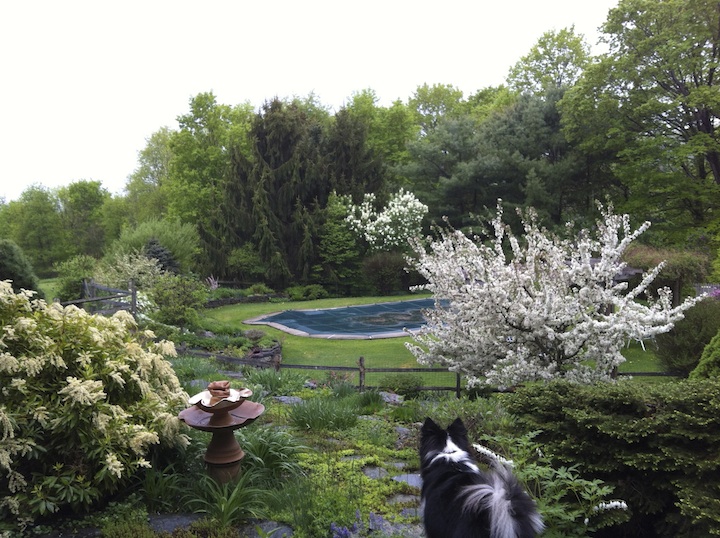
What had once been a rocky, harum-scarum cow pasture became, over the course of many years, an orderly oasis of verdant green lawns, perennial flower beds and raised vegetable gardens, with the long ridge of the rock garden sloping down through the middle of it all to the elegantly landscaped pool.  Now, more than forty years later, she’s still out there with her shovel, trowel and hand tools, tending and stroking her gardens into ever more radiant beauty.

The view from the "new" house (c. 1989), down towards the pool

The view from the “new” house (c. 1989), down towards the pool

This Mother’s Day, I salute my mother, whose outstanding gardening talents I have admired and learned from all my life.  I can only hope that in some small way her greenest of thumbs has rubbed off on me.

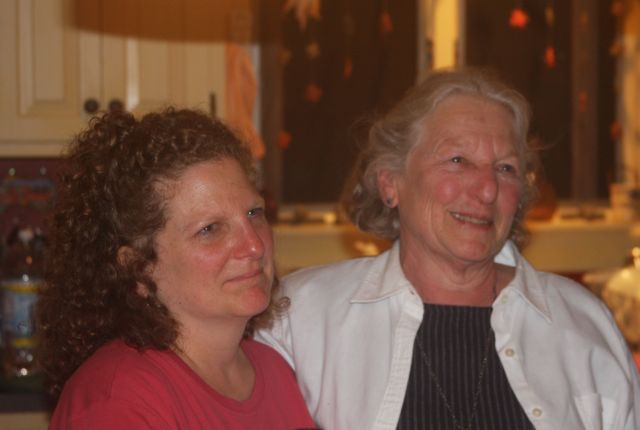
Jenny and Sue 1

Did I mention that my mom is an outstanding potter?

Did I mention that my mom is an outstanding potter?

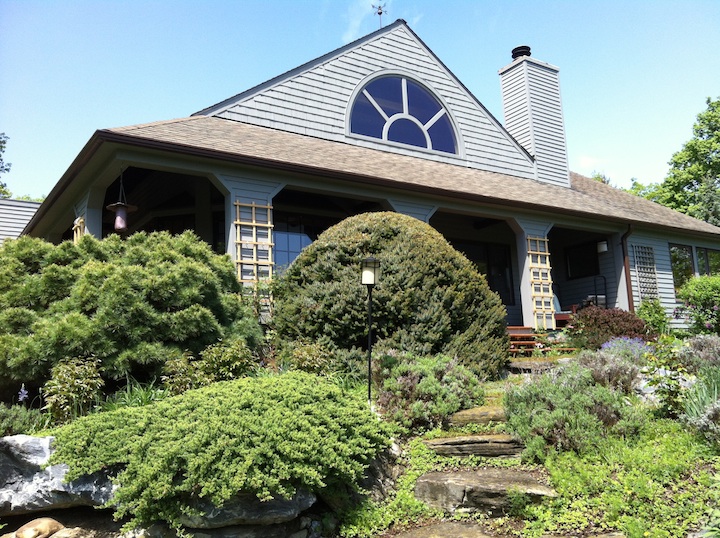
She is as talented at architectural design as she is at landscape design

She is as talented at architectural design as she is at landscape design


IMG_2148 copy


IMG_2144 copy

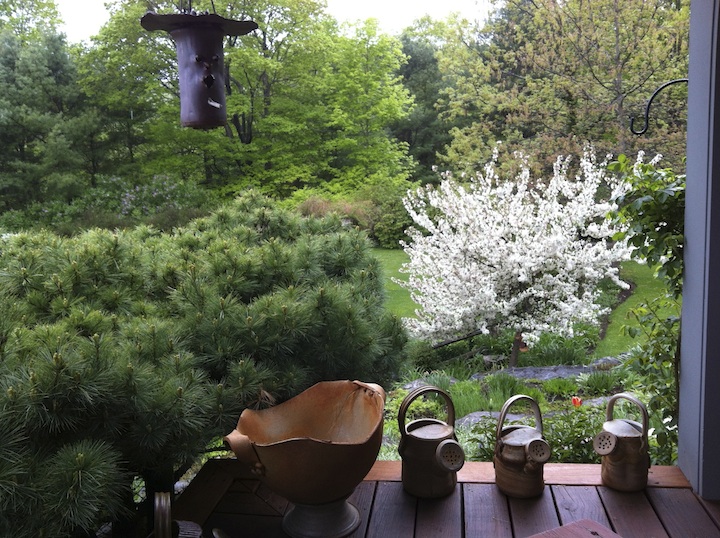
Innumerable shrubs, trees and fruit trees have been planted over the years, most often by my mom and her trusty spade.


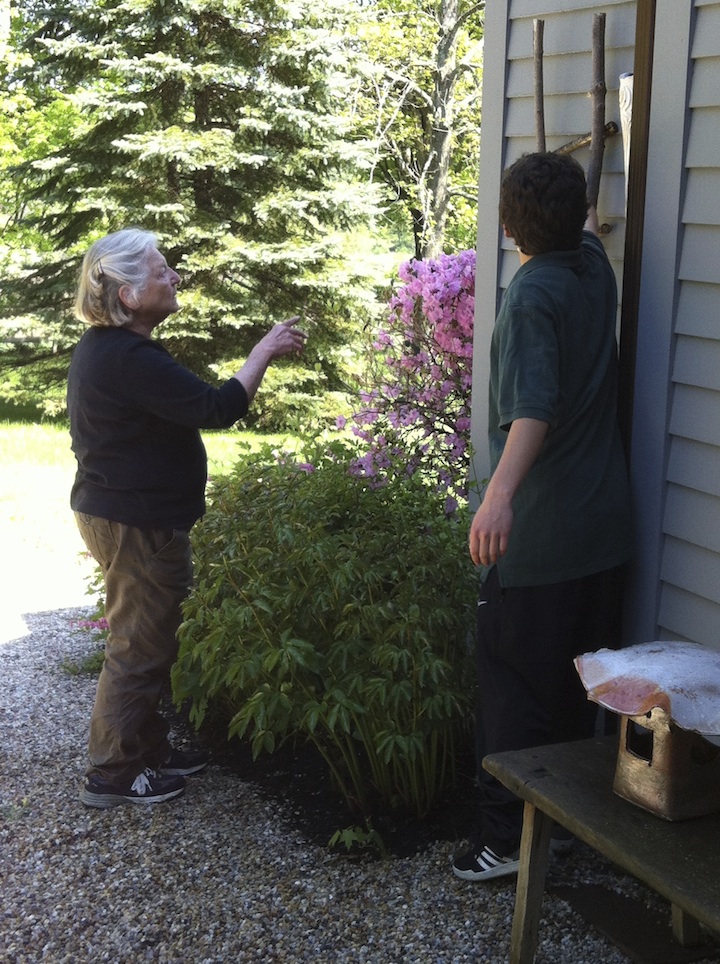
Making plans for the next project with grandson Eric.  The work of a gardener is never done....

Making plans for the next project with grandson Eric. The work of a gardener is never done….


This is one of the most recent gardens, just outside the pottery studio, next to the oldest tree on the property, a venerable sugar maple

This is one of the most recent gardens, just outside the pottery studio, next to the oldest tree on the property, a venerable sugar maple


This May Day, A Special Salute to the Humble, Hard-working Honeybee

This May Day, I want to give a special shout-out to a segment of the working population that may be small in stature, but is huge in productiveness and dedication.

Let’s hear it for the much-beleaguered honey bees!

images-2

It is no secret that honeybees, particularly in the developed world, have been in trouble these past few years.

If you’ve been paying attention, you have probably heard by now of so-called “colony collapse disorder,” which first surfaced around 2005—not at all coincidentally, just around the time that a powerful new class of pesticides, neonicotinoids, was introduced to Western commercial agriculture.

Neonicotinoids are pesticides that are incorporated into the plants themselves.  According to their patent-holders, they only harm the kinds of insects that actually chew on the plants.

But growing scientific evidence suggests that these highly toxic chemicals also harm bees, who have to stick their heads into pollen-laden flowers and tassels in the course of their day-to-day work routines, and who bring back to their hives  insecticide-laden pollen to feed the next generation of workers.

images-1

European bees just got a huge concession from the European Union, which, as of this week, will be restricting the use of three of the most prevalent neonicotinoids (clothianidin, imidacloprid and thiametoxam) for the next two years, while more stringent studies are conducted.

The United States, where commercial beekeepers are reporting the loss of 40 to 50 percent of their colonies, must do the same.

Not only could the loss of the hardworking honeybee be a total disaster for agriculture, but we also have no idea what the effects on humans may be of eating chemically engineered plants.

Where health is concerned, the burden of proof should rest on the chemical companies to prove their products are safe.

Instead, what we are living—and dying—with now is a deeply flawed version of “innocent until proven guilty.”

imagesHow many billions of bees have to die before the federal agencies responsible for the health of humans, our agriculture and our environment get the message that something is seriously wrong with the toxic brew being inculcated into our crops?

It has been suggested that exposure to such chemicals may be playing a role in the explosion of autism that is plaguing American society, with neo-natal exposure and toxic breast milk a major concern.

Do you want really want to give the chemical companies the benefit of the doubt?  Or would you rather play it safe with the next generation?

This May Day, I serenade the humble honeybee.  If you care about this mighty little worker, and all of us who depend on her production, you can take individual action on her behalf.

Buy organic.

Looking for Valentinaville….

So far, my number one, all-time most popular blog post on Transition Times has been my 2012 Valentine’s Day post, “There’s More to Love than Cupid and His Arrows,” which was read by nearly 30,000 people worldwide in the past year.

In that post, I reflected on how the Valentine’s Day celebration of love could and should extend to more than just romantic love—we should celebrate family love, I said, the kind of love that runs “like molten gold at the core of a happy family like mine.”

A year later, and still without a romantic attachment this Valentine’s Day, I feel no different—but my thoughts on this issue are more defined.

marilyn-monroe-diamonds-gentlemen-prefer-blondes-blonde-movieIn American culture, and I am sure in many other cultures around the world, it is viewed as a shortcoming to be without a romantic partner.

To be alone, without a significant other on Valentine’s Day, is a source of shame.

Well to hell with that, especially for mature women!

I see so many women my age, midlife or older, without partners.

Is this just an American phenomenon?  I wish my non-American friends would chime in and let me know.

Here in the States, the divorce rate is astronomical, and we seem to have a surfeit of single women—either the 30- to 40-something put-career-first-and-never-married cohort, or the 40- to 50-something just-couldn’t-take-it-anymore divorced group.

And then at the upper edge of the age scale, there are the 70-something widows, too.

For men in all of these age groups, there are plenty of women to choose from.

After all, it’s not unusual for a man of 60 to take up with a woman 20 years his junior.

But when was the last time you heard of a woman of 60 partnering with a 40-year-old man?

For heterosexual women, the field narrows considerably as we age.

And the risks grow.  Why would I, as a 50-year-old, really want to take up with a man twenty years my senior?

If I were to enter the dating market now, I’d be lucky to find a guy my age to partner with.  Most guys my age are looking for younger women, and they don’t seem to have any trouble finding a match.

On Valentine’s Day, 2013, I’d like to affirm the fact that women don’t need romantic love to be happy.

I’d like to suggest that women be more appreciative of the love and support we get from each other, and from all kinds of non-romantic attachments.

In the old days, women who sought to avoid marriage ensconced themselves in nunneries, and had a pretty good life there (check out the life of Sor Juana for an example).

I am wondering if today we need a modern form of the nunnery, a place where women of a certain age could go to live full, empowered, mutually supportive lives free from the pressure of romantic attachments.

Maybe we should found such an institution, and call it Valentinaville.  Just for us.

Why waste away in Margaritaville when we can be happy in Valentinaville?